
Understanding the Backswing
The backswing is one of the most critical elements of a successful golf swing, yet it is often misunderstood and overly complicated by many golfers. In this article, we'll simplify the backswing into three fundamental components you need to remember: rotation, elevation, and flexion. These concepts, abbreviated as REE, will help you master your backswing today.
1. Rotation
First, let's dive into rotation. The key here is understanding how both your body and arms need to rotate during the backswing. Your body must rotate back, and simultaneously, your arms need to rotate slightly to place the club on the correct plane. Imagine standing face-on; by rotating your forearms just a bit, the club transitions from a vertical position to an inclined one. This rotation is essential for ensuring that the club stays on the correct path throughout your swing.
It's crucial to focus on a big body swing with a tiny little arm swing. If your body controls the movement of the club, and your arms only move because of that body rotation, you’re on the right track. Remember, the primary movement during your backswing should be from your body, not your arms.
2. Elevation
The second component is elevation, which is often misunderstood. Many golfers incorrectly attempt to take the club back by swinging their arms too much, which can lead to the club being pulled inside and creating an over-the-top move. The solution lies in elevating your arms correctly. Think of this as arm elevation from the shoulder socket.
Your arms should move straight up and down in front of your body while your body is turning. This elevation helps keep the club working back on plane, preventing it from going too far inside. By combining your body's rotation with the correct elevation of your arms, you create the necessary swing plane. Picture this: if you elevate your arms while rotating your body, you’ll see how this movement naturally sets the club on the right path.
3. Flexion
The final component is flexion, which is simply the bending of your right arm at the elbow. This flexion creates a lever in your swing, allowing you to generate force and thrust at the bottom of your swing. Without this angle, you won't have the necessary power to execute your swing effectively.
So, what's the sequence? As you rotate your body and elevate your arms, add a bit of flexion at the end. This combination—rotation, elevation, and flexion—will produce a solid backswing.
Putting It All Together
Now, let’s visualize the entire process. Start by rotating your body while simultaneously elevating your arms. As you reach the top of your swing, introduce some flexion in your right arm. This sequence will result in a natural and effective backswing.
The beauty of these movements is that you can practice them indoors without hitting a ball. Stand in front of a mirror to check your positions and ensure your arms are in the right relationship to your body. With practice, you'll be able to create the correct backswing posture and movement.
Bonus Resources
For further assistance, I recommend checking out my video titled 'Five Minutes of the Perfect Backswing.' In it, I explain how to check your arm positions and transport them correctly to the top of your swing, making the backswing even simpler.
Key Takeaways
- The three key components of a successful backswing are rotation, elevation, and flexion.
- Focus on a big body swing with minimal arm movement to maintain control.
- Elevate your arms correctly to keep the club on the right plane.
- Flexion in your right arm creates the necessary leverage and power in your swing.
- Practice these movements indoors to perfect your backswing without hitting a ball.
See What GOATY Finds in Your Swing
Upload a swing video and get your GOATScore, root cause diagnosis, and personalized drill prescription in 60 seconds.
Analyze My Swing FreeFree, no credit card
Get Your Free Swing AnalysisRelated Articles

Mastering Your Backswing: Fix Right Arm Bending Issues
Learn how to stop your right arm from bending too soon in the backswing for better impact positions and power in your go

Boost Your Swing Speed: Essential Tips for Golfers
Learn how to regain swing speed with expert techniques from Chuck Quinton. Improve your golf game and hit longer shots t
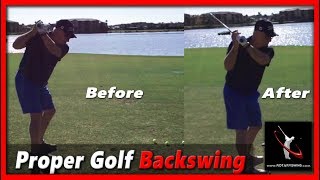
Mastering the Proper Golf Backswing: Key Techniques
Learn the essential techniques for a proper golf backswing with insights from Chuck Quinton, focusing on body movement,