
Understanding Early Extension in Your Golf Swing
Welcome back, rotary swing golfers! In this fifth installment of our six-week series aimed at helping you play the best golf of your life, we’ll be focusing on a common issue many golfers face: early extension. This week, we’re diving into the importance of spine position at impact and how it affects your club path. Understanding this relationship is crucial for controlling your starting line and achieving more consistent shots.
What is Early Extension?
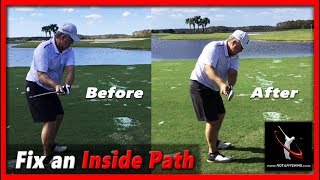
Early extension occurs when your hips push forward during the downswing, causing your spine to become more vertical. This shift can lead to a flatter shaft plane, resulting in an exaggerated in-to-out swing path. This is problematic because it makes it difficult to control the clubface, leading to poor shot direction and inconsistency.
The Cause and Effect Relationship
Let’s break down the mechanics of early extension. As you begin your downswing, if you drive hard off your trail leg, your hips will move forward. This movement can flatten your shaft plane, pulling your club path more inside than desired. Ideally, you want your path to be as close to zeroed out as possible, allowing for better control over the clubface and the ability to shape your shots.
Tour-level players typically have a swing path close to zero degrees, which is essential for consistent ball flight. If your club path is excessively in-to-out, like seven degrees, you’ll need to close the clubface significantly to compensate, making it challenging to control your shots on the course.
Using Technology to Analyze Your Swing
To illustrate this point, I utilized Flight Scope technology to track the effects of early extension on my swing path. Upon driving hard off my right leg, I recorded a seven-degree in-to-out path and had to close my clubface by five degrees to compensate. This example emphasizes how critical it is to maintain proper mechanics throughout your swing to achieve better results.
A Practical Drill to Overcome Early Extension
Now that we understand the cause, let’s move on to a practical solution. To help alleviate early extension, I recommend a simple drill using a necktie. Here’s how to perform this drill:
- Take a necktie and tie a standard knot, ensuring it’s visible and contrasting against your clothing.
- Position yourself in your golf stance, allowing only the knot to touch your chest. Ensure nothing below the knot is in contact with your body.
- As you begin your swing, focus on shifting your weight to your lead side without letting anything below the knot touch your belly.
- Your goal is to keep the knot as the only point of contact with your chest throughout the swing.
This drill requires practice, and I recommend performing around 500 repetitions without hitting golf balls. If you can’t get to the range, you can complete the repetitions at home. The key is to maintain the proper sensation of keeping your hips back and your chest over the ball.
Measuring Your Progress
After completing the drill, revisit the Flight Scope to analyze your swing path again. With practice, you should see an improvement where your path is closer to zero, indicating that you’re better controlling your swing mechanics.
Conclusion
In summary, addressing early extension in your golf swing is vital for improving your overall performance. By understanding the cause-and-effect relationship between your spine position and club path, and by using the necktie drill, you can start to see significant improvements in your swing. I encourage you to commit to this drill over the next week, and I’m confident you’ll notice a difference in your game.
Key Takeaways
- Early extension can negatively affect your swing path and shot consistency.
- Understanding the mechanics of your spine position at impact is crucial for maintaining control.
- The necktie drill is an effective way to practice proper weight shift and prevent early extension.
- Using technology like Flight Scope can help measure your swing path and track improvements.
- Commit to practicing the drill to see lasting improvements in your golf swing.
See What GOATY Finds in Your Swing
Upload a swing video and get your GOATScore, root cause diagnosis, and personalized drill prescription in 60 seconds.
Analyze My Swing FreeFree, no credit card
Get Your Free Swing AnalysisRelated Articles

Mastering Lag: Reshape Your Golf Swing for Better Shots
Learn how to reshape your golf swing to achieve lag for longer and more accurate shots. Perfect for golfers of all level

Transform Your Golf Swing Indoors: Make Lemonade Out of Lemons
Discover how to enhance your golf swing indoors during tough times with effective drills and techniques from Chuck Quint
How to Fix a Pull Hook and Improve Your Swing Path
Learn how to fix a pull hook and enhance your golf swing path with expert tips from Chuck Quinton.