
Understanding Club Face Squaring in Golf
In the world of golf, the difference between the elite model and amateur golfers often comes down to specific techniques and knowledge of how to properly square the club face through impact. If you're looking to improve your game and achieve more consistent shots, it's crucial to understand the mechanics behind club face rotation and release.
The Importance of Proper Release
To achieve a dead straight shot, the key lies in the proper release of the club face. Tour pros exhibit significantly less rotation through impact compared to the average amateur golfer. Data from launch monitors has shown that while elite players average between 200 to 300 degrees of rotation per second, amateurs can rotate the club face anywhere from 1,000 to 1,400 degrees per second. This difference is critical for achieving accuracy in shots.
The Misconception of Old-School Techniques
Many golfers have been misled by outdated teachings regarding ball flight laws. These old-school notions have been proven incorrect by modern equipment, such as Trackman, which provides precise measurements of swing dynamics. The truth is, the methods employed by tour pros are distinctly different from those of amateurs.
How Amateurs Approach Impact
Typically, amateurs come into impact with a steep and over-the-top swing. This often causes the club face to remain open at impact. Picture swinging an axe vertically; it doesn't naturally rotate. However, if you were to swing it horizontally, it would want to rotate around the hosel. This illustrates how the club face behaves during a golf swing.
The Last-Minute Flip
As amateurs approach impact, they may sense that the club face is too open and attempt to flip it at the last moment to correct their shot direction. This is a common error, as timing the release in such a last-minute manner is not sustainable. Pros, on the other hand, allow the club face to rotate naturally, which is key to achieving optimal results.
Why Less Rotation Equals More Consistency
With less rotation, tour pros can maintain better accuracy and consistency in their shots. By allowing the club face to release naturally, they benefit from a free club head speed of about seven miles per hour. In contrast, amateurs who attempt to hold off on the release end up sacrificing valuable speed, which is critical in today’s power-driven game.
The Power Game in Golf
Golf courses have become longer and more challenging, making it essential for players to maximize their distance. Understanding how to square the club face early in the downswing is integral to achieving this while maintaining control. The club face is always rotating throughout the swing, and learning to embrace this natural motion can help you achieve greater consistency.
Next Steps for Improvement
To further develop your understanding of squaring the club face and improving your release, consider watching the bonus video linked in the description. This resource will provide additional insights into how to implement these techniques into your swing for better accuracy, much like the pros.
Key Takeaways
- Proper release is crucial for achieving straight shots.
- Tour pros have significantly less club face rotation than amateurs.
- Understanding the mechanics of club face squaring can improve your consistency.
- Embrace the natural rotation of the club for optimal club head speed.
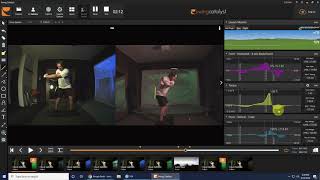
- Utilize video analysis and coaching resources to refine your technique.
See What GOATY Finds in Your Swing
Upload a swing video and get your GOATScore, root cause diagnosis, and personalized drill prescription in 60 seconds.
Analyze My Swing FreeFree, no credit card
Get Your Free Swing AnalysisRelated Articles

Mastering the Release in Golf: The Chainsaw Analogy
Learn how to improve your golf swing release using the chainsaw analogy for maximum efficiency and speed.

Swing Caddie SC4 Review: Affordable Launch Monitor Insights
Explore the accuracy and benefits of the Swing Caddie SC4, the budget-friendly launch monitor every golfer needs.
Understanding SwingCatalyst and 3D Motion Plate for Golf
Learn how SwingCatalyst and 3D motion analysis can enhance your golf swing and consistency.