
Understanding Weight Shift in the Golf Swing
In the realm of golf instruction, few concepts are as critical as the weight shift in your swing. This aspect often determines the success of your shot, particularly during the downswing, where the real magic happens. While many golfers focus on perfecting their backswing, it is during the downswing that the correct sequencing and weight transfer can make or break your shot. If you want to hit powerful, accurate shots, understanding how to shift your weight correctly is essential.
The Importance of the Right Hip Line
In the previous part of this series, we discussed how to load your weight properly during the backswing. This initial step is crucial as it sets the stage for a successful weight shift during the downswing. An often-overlooked element in this process is the right hip line. By focusing on this checkpoint, you can enhance your weight transfer and overall swing efficiency.
When golfers hear the term 'sway,' many immediately become anxious. They fear that any lateral movement could disrupt their swing. However, it's essential to understand that shifting your weight to the right is a necessary part of generating power. This principle applies across all sports that involve hitting or throwing; you must load your weight onto your back foot before transferring it forward.
Finding the Balance in Your Swing
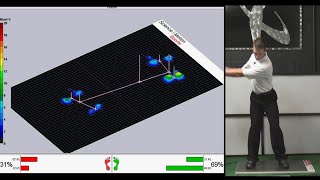
So, how do you achieve the right balance in your weight shift? The key lies in understanding the right hip line. To visualize this, draw an imaginary line from your right hip towards the target. During your backswing, this line should remain stable, not moving backward or forward. If your hips slide too much, you risk losing power and stability, which leads to a weak position and an ineffective swing.
To maintain this right hip line, focus on how your weight interacts with your feet. You should feel your weight pushing down into the ground through your ankle while keeping it centered over your foot. Avoid rolling to the outside of your foot, as this can lead to an unstable and awkward position.
Turning vs. Sliding
Another common issue is the tendency to avoid lateral movement altogether. While it’s natural to want to remain centered, your hips must turn during the backswing. This movement creates the necessary angle for a proper weight shift. Imagine that as you turn your hips, they naturally move away from the target, which actually keeps the right hip line intact.
Picture this: as you rotate, you are increasing pressure on your right foot, which helps to store energy for the downswing. If, however, you allow your right leg to rotate outward, you lose this pressure and consequently the power needed for an effective swing. Keeping your right knee pointed toward the ball during the backswing will help maintain the integrity of your right hip line.
Visual Aids and Practice
To truly grasp the concept of the right hip line and effective weight shift, I encourage you to utilize swing analysis tools. By recording your swing and visually assessing your hip movement, you can gain valuable insights into your performance. Drawing lines on your video can help you see whether your hip line is stable or if you're swaying too much.
Key Takeaways
- Weight shift is crucial; focus on it during both the backswing and downswing.
- The right hip line serves as a vital checkpoint for maintaining stability in your swing.
- Allow lateral movement while ensuring your hips rotate properly to avoid losing power.
- Use visual aids to assess and improve your hip movement and weight transfer.
- Practice consistently to build comfort and proficiency in shifting your weight correctly.
See What GOATY Finds in Your Swing
Upload a swing video and get your GOATScore, root cause diagnosis, and personalized drill prescription in 60 seconds.
Analyze My Swing FreeFree, no credit card
Get Your Free Swing AnalysisRelated Articles

Unlock Power and Consistency in Your Golf Swing
Discover how to achieve power and consistency in your golf swing using trail side body mechanics. Join our exclusive cli

Understanding FORCE vs. WEIGHT SHIFT in Golf Swing
Learn the crucial difference between force and weight shift in golf swings to enhance your performance with expert insig
Mastering Weight Shift in Your Golf Swing
Learn how to improve your weight shift for a powerful golf swing, essential for better lag and impact positions.