
The Importance of Transition in the Golf Swing
One of the most common aspects of the golf swing that golfers struggle with is the transition from the backswing to the downswing. Many players mistakenly believe that swinging as fast and hard as possible from the top will lead to greater speed at impact. However, the exact opposite is often true. Understanding the sequence of the transition and the downswing technique is crucial to achieving proper impact alignments.
In fact, mastering this sequence is really 99% of the golf swing. When you can align everything correctly and sequence your movements properly, you can enjoy the game of golf, hit the ball long distances, and do so with minimal effort. Conversely, failing to prioritize learning this sequence will lead to struggles on the course, resulting in inconsistencies such as flipping the ball, hitting it too high and weak, or failing to compress the ball effectively.
Why Proper Sequencing Is Essential
The enjoyment of golf often comes from the feeling of compressing a golf ball effectively. When you learn to handle the sequence correctly, you can experience this sensation, perhaps for the first time. To achieve this, it’s critical to focus on the mundane tasks that come with mastering the swing. This includes practicing quarter, half, and three-quarter shots before attempting a full swing.
Starting slowly allows you to work through the mechanics in a more manageable way. By taking your time and executing each step carefully, you'll create a solid foundation that you can build upon as you progress to full-speed swings.
Steps to Mastering the Transition
Here’s how to properly execute the transition:
- Begin at the top of your swing and pause, as previously discussed in our training.
- Incorporate the down drill: shift your weight to the left, bend your right wrist back, and bring the club in close to your right shoulder.
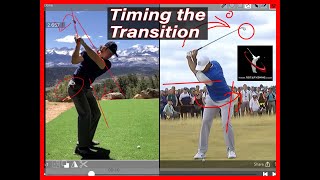
- Next, focus on bringing your hands to your right thigh. If you can achieve this while keeping the club shaft parallel to the ground, you’ll have the necessary lag to hit a good shot.
If your hands reach your right thigh but the club has lost its angle—meaning the shaft is no longer parallel to the ground—you’re likely to experience issues like scooping and flipping the ball at impact.
Avoiding Common Pitfalls
Many golfers inadvertently cast the club from the top due to what’s known as centripetal force. When you rotate your body too quickly, centrifugal force counteracts this motion, causing the club to be thrown out too early. This results in the dreaded scoop and flip at impact.
To counteract this, practice maintaining a stable upper body and hips. Keep them feeling 'shut' during the transition. If you look at your left shoulder, it should remain low rather than rising up and out. This position helps maintain the necessary lag in your swing.
Drills to Enhance Your Transition
Here are some drills to help reinforce proper transition sequencing:
- Practice quarter and half swings, focusing on the weight shift and wrist position.
- Use a mirror or video analysis to ensure your hands are reaching your right thigh while maintaining lag.
- Perform slow-motion swings, concentrating on the feel of your left shoulder staying low throughout the transition.
By incorporating these drills into your practice routine, you’ll develop a better understanding of the transition and its impact on your overall swing performance.
Key Takeaways
- The transition from backswing to downswing is crucial for power and sequencing.
- Proper sequencing and impact alignment can significantly improve your golf game.
- Focus on drills that reinforce lag and the correct positioning of your hands and body.
- Slow practice and repetition are essential for mastering the transition.
- Video analysis can be a helpful tool to measure and improve your swing patterns.
See What GOATY Finds in Your Swing
Upload a swing video and get your GOATScore, root cause diagnosis, and personalized drill prescription in 60 seconds.
Analyze My Swing FreeFree, no credit card
Get Your Free Swing AnalysisRelated Articles

Mastering Golf Swing Transition: From Backswing to Downswing
Learn the crucial transition from backswing to downswing to achieve powerful, accurate golf shots with this effective dr
Mastering the Transition in Your Golf Swing
Learn the critical timing and sequence for a perfect golf swing transition. Discover how to improve your swing today!

Transform Your Golf Game: Add 20 Yards in 15 Minutes
Unlock your potential and learn to drive your golf ball 20 yards further with this game-changing drill. Discover the sec