There are two kinds of putters in this world. Some seem to float effortlessly downstream, while others work themselves to exhaustion trying to swim against the current.
We all know that one golfer who picks everything up naturally. They move their body in ways that feel comfortable and effortless, and results just seem to happen for them.
Is this the fault costing you strokes?
Film one swing on your phone. In about a minute GOATY measures it and names the single biggest thing costing you strokes — free, no card.
Analyze My Swing Free
Related: Golf swing lag — why AI coaching fixes it faster →
Android users: Download GOATY on Google Play — free AI golf coaching on your Android phone. →
They drain their putts. They play relaxed rounds without appearing to put any conscious effort into their putting stroke whatsoever.
Stop reading about it — feel it in your swing today
GOATY watches your swing live and coaches you between every rep. Free. No signup.
Start Your FREE Live Lesson →
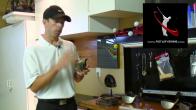
Three moves: The shoulders rotate around the spine, the arms flow freely from the shoulders, the putter flows freely from the arms
If you're not that person, there are probably times when you feel like you're working incredibly hard on your putting — with maddeningly poor results.
You're trying to keep the putter face perfectly square, force the putter to swing straight back and straight through, lock in your body, and get everything working like a precision machine.
You're putting in maximum effort but getting nowhere. You feel like you're swimming upstream. It's incredibly frustrating — and every golfer has experienced this at some point.

Make Your Putting Stroke Effortless
What you actually want is to make the entire putting motion effortless.
When you position your body correctly, use the correct putting grip, and then simply move your body the way it's designed to move, everything becomes remarkably easy.
That's exactly what we're going to accomplish today. You'll learn three incredibly simple movements so next time you can be the one floating downstream instead of exhausting yourself fighting the current.
There are just three basic movements in the putting stroke, and all three are deceptively simple:
- The shoulders rotate around the spine
- The arms flow freely from the shoulders
- The putter flows freely from the arms
That's the entire putting stroke. Nothing more.
These movements work with your body's natural mechanics, so you're no longer trying to manipulate the club face into artificial positions like "straight back and straight through."
Move 1: The Shoulders Rotate Around the Spine
First, understand that the putting stroke operates on a natural arc.
You're not creating an arc. You're simply allowing one to happen because that's how your body naturally functions. Here's why.

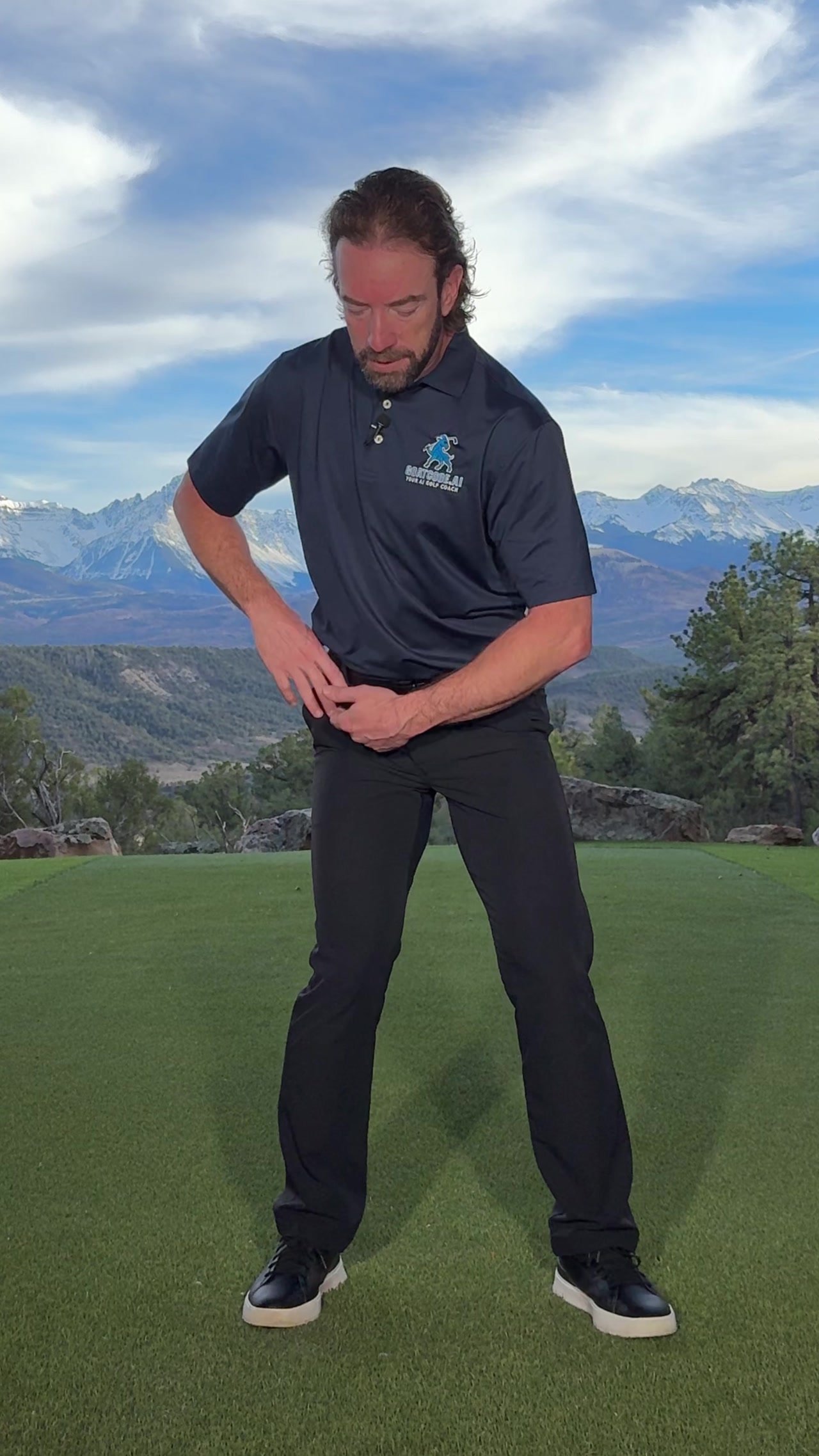
The shoulders rotate around the spine
The first movement is that the shoulders rotate around the spine.
Your spine serves as the axis of the stroke. It doesn't move at all during the putting motion. To keep the spine perfectly stationary, the lower body must remain completely still.
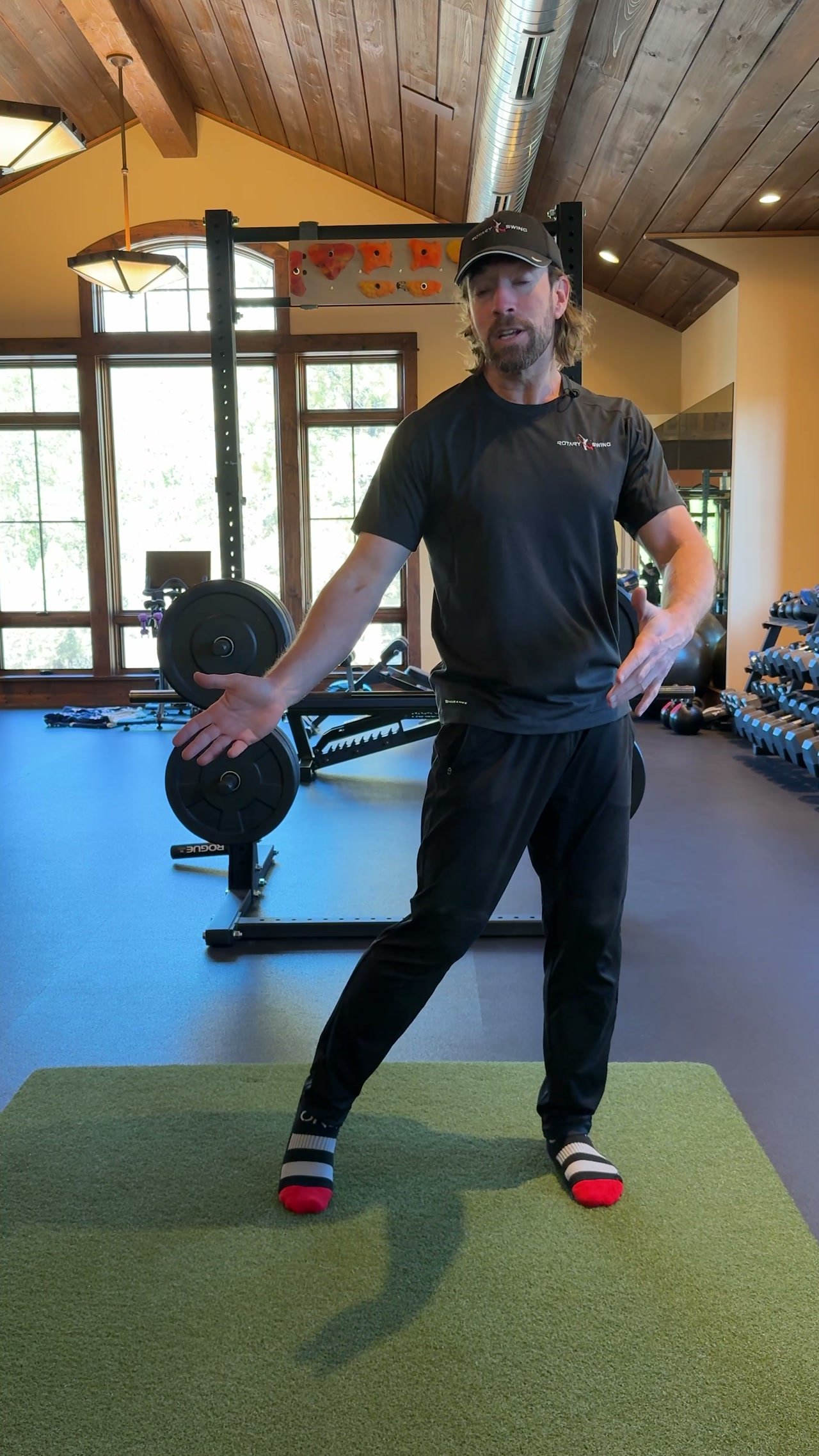
This point is critical. Your lower body must not move an inch. Forget about it entirely and keep it perfectly stable. Your belt buckle should show zero movement throughout the entire putting stroke.
Stand up and try it right now. Rotate your shoulders around your spine without moving your lower body. Make sure your belt buckle stays completely motionless.
This is exactly how your arms and shoulders function in the putting stroke.

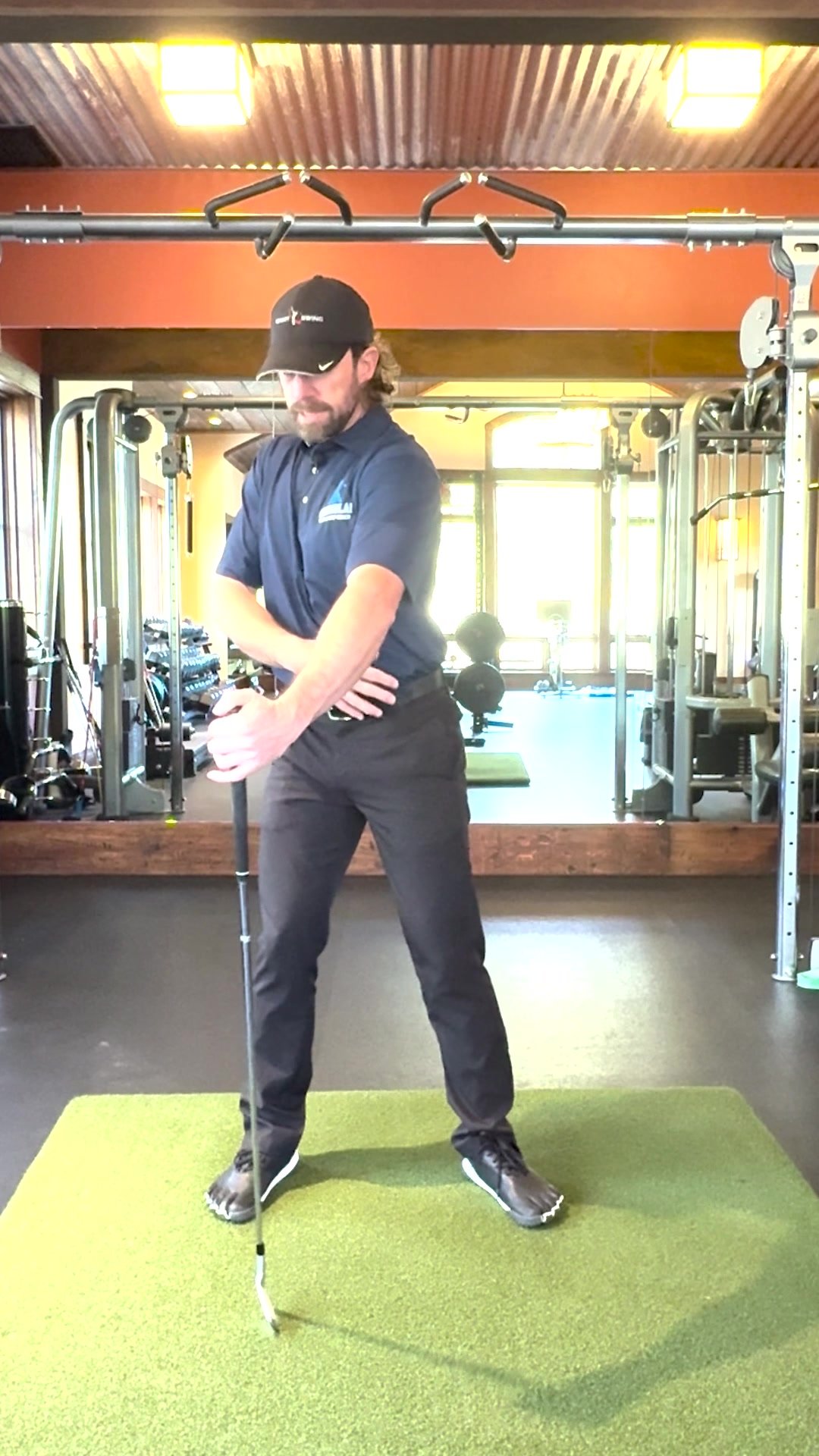
Hinging forward - rotation creates an arc
The spine itself simply rotates. The shoulders turn around it, and the spine never bends or sways.
That's how your body is designed to move. That's how your spine is built to rotate. The motion should feel effortless and completely comfortable.
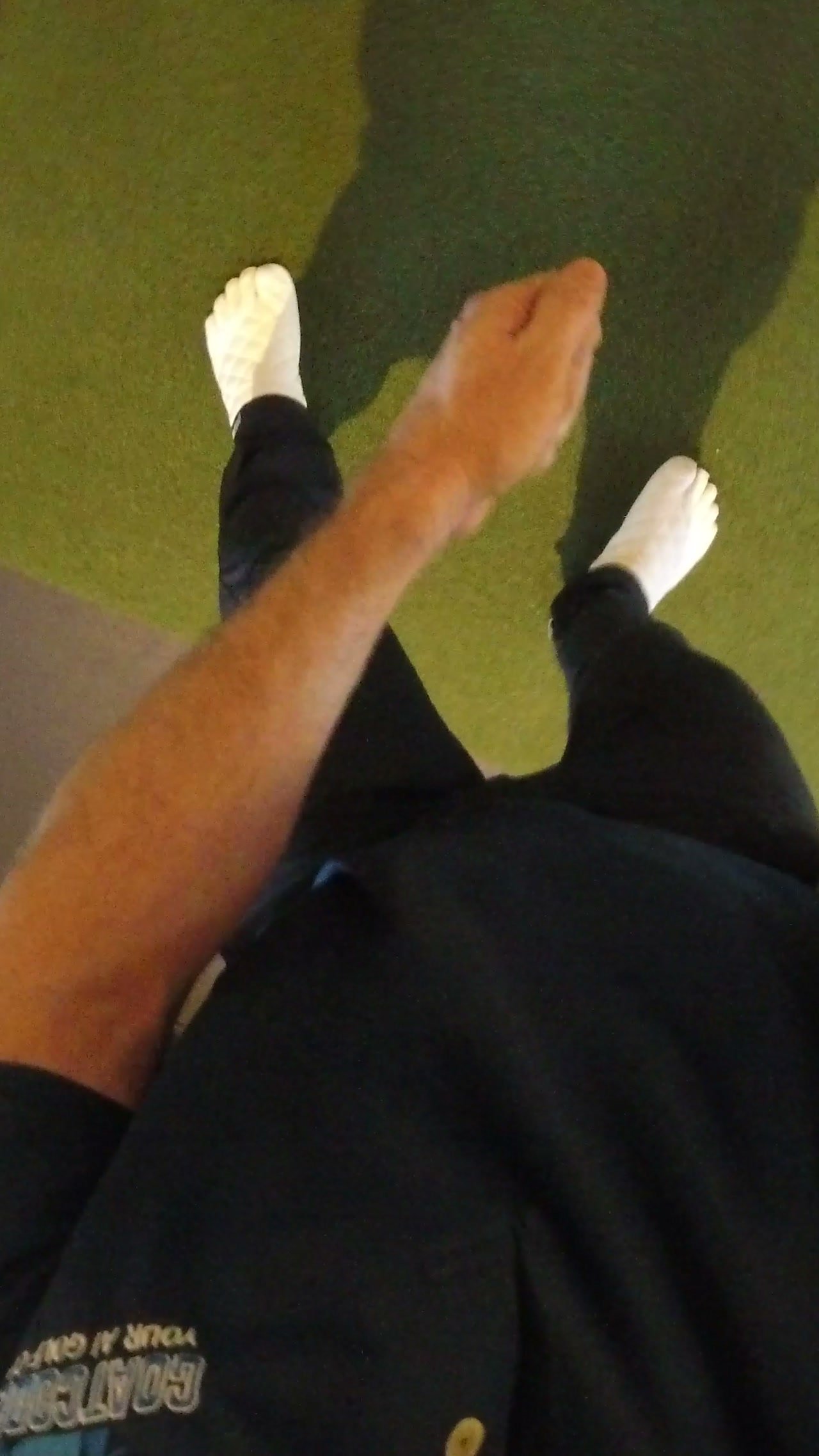
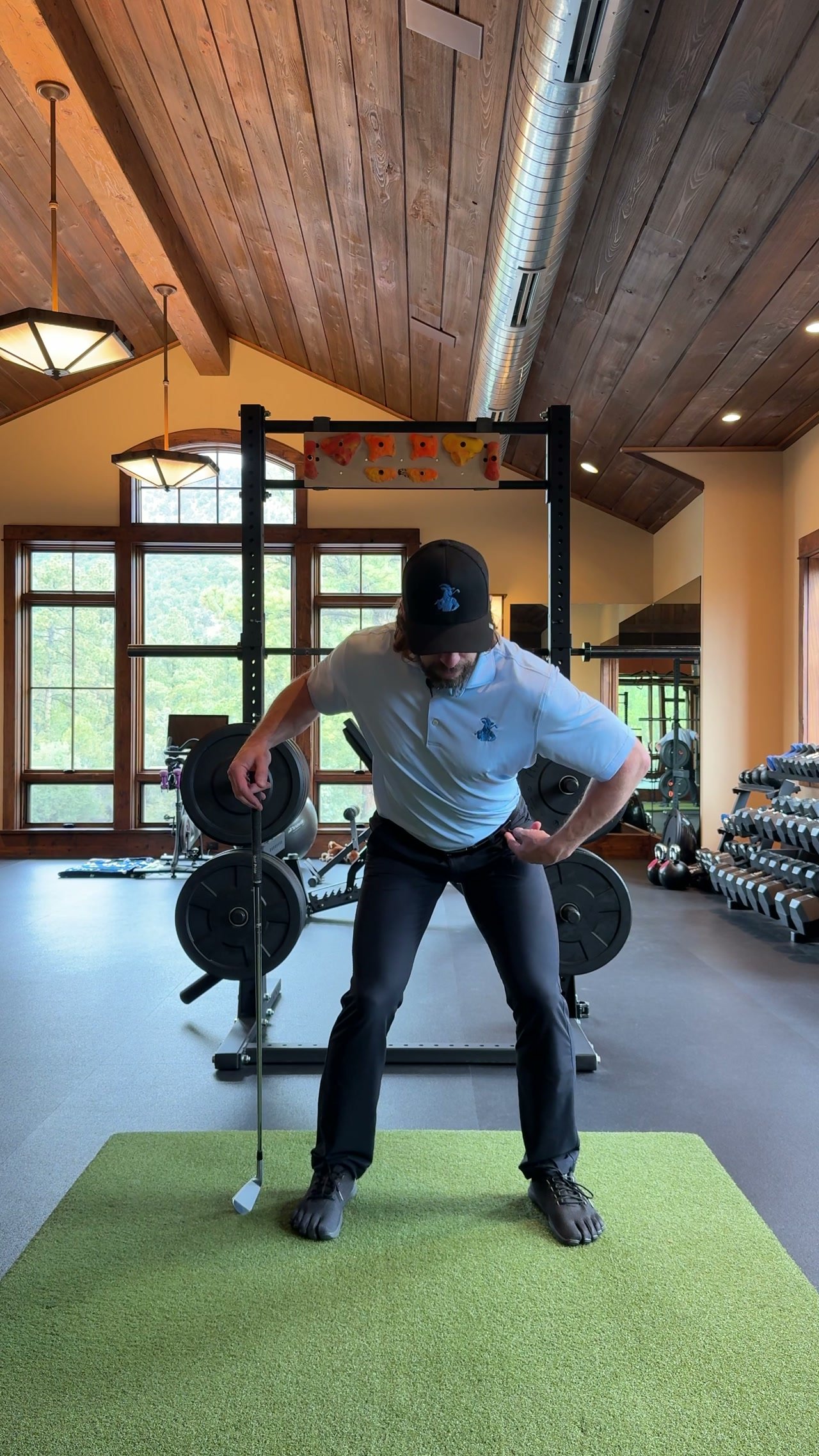
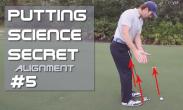
Now hinge forward from the hips and rotate again. As demonstrated at left, rotating around your inclined spine naturally creates an arc — a plane of motion.
Your spine tilts forward, but it still rotates without bending. As your shoulders turn around this inclined axis, an arc forms naturally.
That's where the arc originates in the putting stroke. It's simply a consequence of your spine being tilted forward.
Why "Straight Back & Straight Through" Is Flawed
At some point, you've almost certainly been told to take the putter "straight back and straight through."
If you tried to create this movement while letting your shoulders rotate naturally around the spine, you'd have to bend all the way over until your spine was perpendicular to the ground.

If "straight back & straight through" were anatomically correct: Don't try this at home!
That extreme position would allow you to move the putter straight back and straight through while still making an anatomically correct movement.
Of course, you'd need an absurdly short putter and your back would be screaming after 10 minutes.
Try a free live lesson with GOATY
GOATY, my AI golf coach, watches your swing through your phone camera and coaches every rep. Free, about 20 minutes, no credit card.
It's far simpler to let your body set up and move the way it naturally wants to — in a comfortable posture with a standard-length putter.
Again, the shoulders rotate around the spine. When you hinge forward and make that rotating motion, you create a slight arc.
The club head moves slightly inside on the backswing, returns to neutral through the impact zone, and then tracks slightly inside again on the follow-through. This happens simply because your spine is tilted forward.
You're only turning a very small amount. Even on a lengthy putt, your shoulder rotation is minimal.
That's the entirety of the shoulder movement. It's remarkably simple.
Move 2: The Arms Flow Freely From the Shoulders
The second component is allowing your arms to flow freely from your shoulder sockets — and it's equally simple.
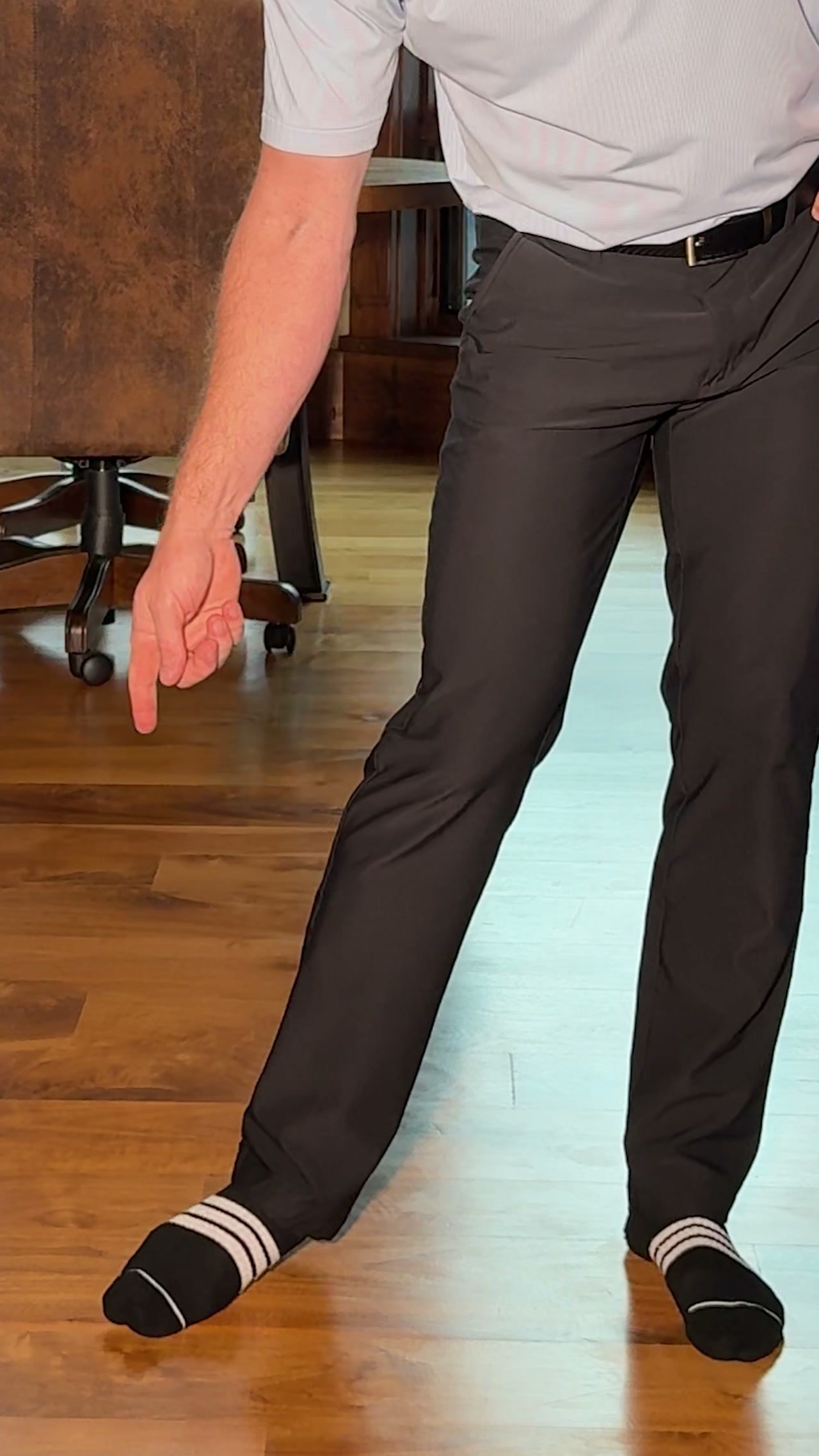
Release all tension from your arms. Switch off every shoulder and arm muscle and let your arms simply dangle naturally.

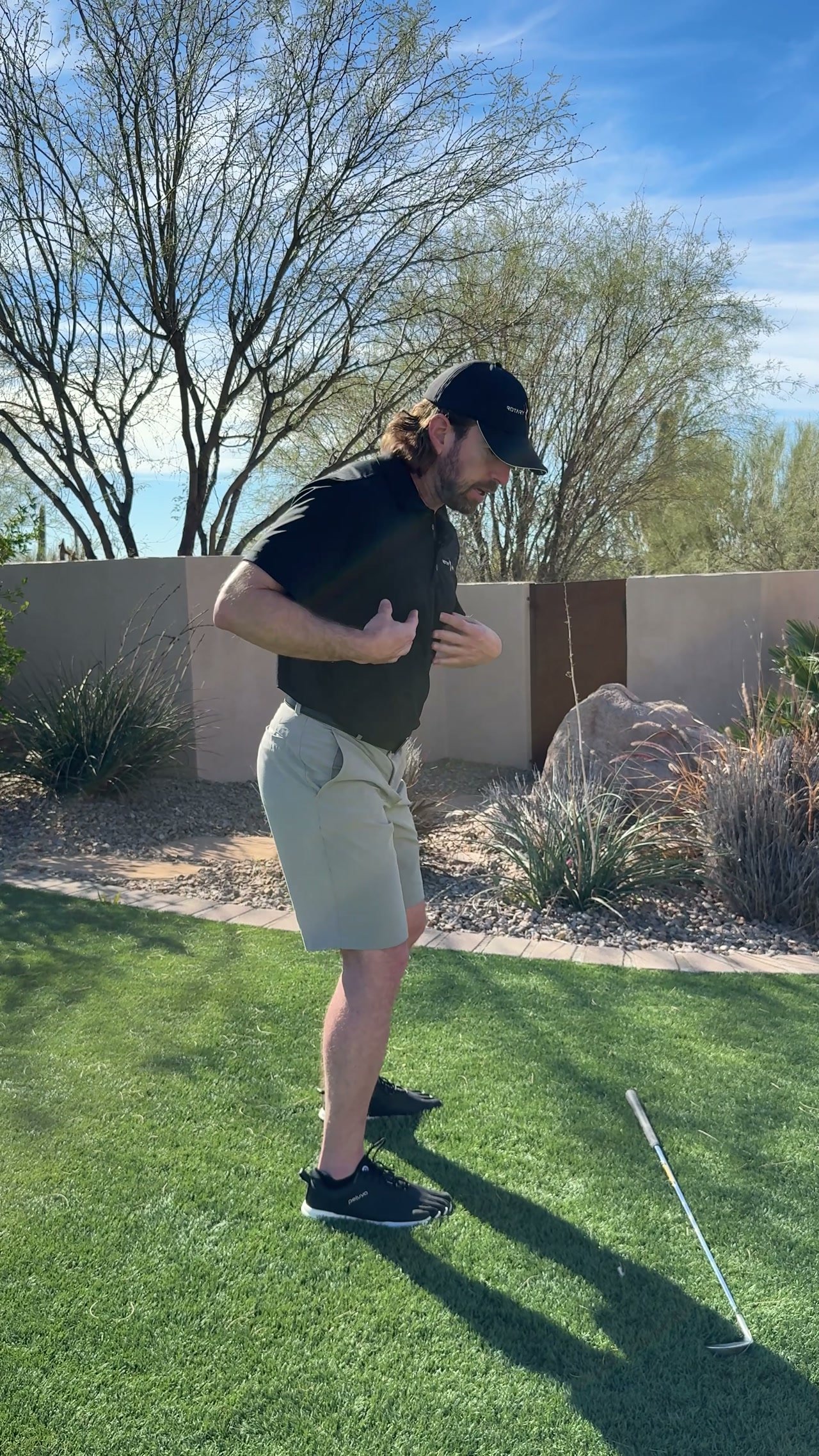
Let the arms swing freely
You'll notice that your arms also want to swing on a gentle arc.
Your trail arm comes from the inside, bottoms out somewhere near your trail foot, and swings back to the inside. That's its natural pendulum path.
The same applies to the lead arm. It naturally swings from inside, through, and back inside on a slight arc. That's really all the arms do.
With both hands on the club, it's perfectly acceptable to allow a tiny bit of bend in the trail arm during the backswing and the lead arm during the follow-through.
We're talking about a very subtle amount — but a slight bend is not a problem at all.
Why "Rocking the Triangle" Kills Your Feel
Permitting that tiny bit of bend allows the arms to flow freely from the shoulder sockets.

Rocking the triangle
You see many golfers trying to lock everything together into a rigid triangle when they putt, keeping both arms perfectly straight so they can rock the entire unit back and through.
From a physics standpoint, this approach looks reasonable. Mathematically, it may create a decent arc. But it completely eliminates your natural feel and distance control.
Pick up a ball and toss it to someone. You don't lock everything up and tense your body when you throw — you stay loose and just let it go.
You don't consciously think about the mechanics of tossing a ball. You aren't trying to lock in every angle and achieve exact precision through rigidity.
You simply toss it, and it goes where you want. It doesn't sail wildly right or fly across the room to the left.
It's just not that complicated.

Tossing a ball is a loose, effortless motion
Most people can toss a ball accurately without thinking about keeping everything perfectly straight.
Then they step onto the putting green and want to lock the arms, lock the body, and strip away all that natural athleticism in pursuit of a theoretically perfect stroke.
They're making it dramatically harder than it needs to be.
When you let your body move properly — the way it's designed to function — you can make a natural, athletic movement and — here's the key — the club face squares itself automatically.
The Face Squares Itself Automatically
You don't need to work hard manipulating the club to square the putter face. Simply let it happen naturally.
Stop trying to keep the face perfectly square going back and through. Let your muscles work the way they want to. The face will release at the exact same spot every single time.

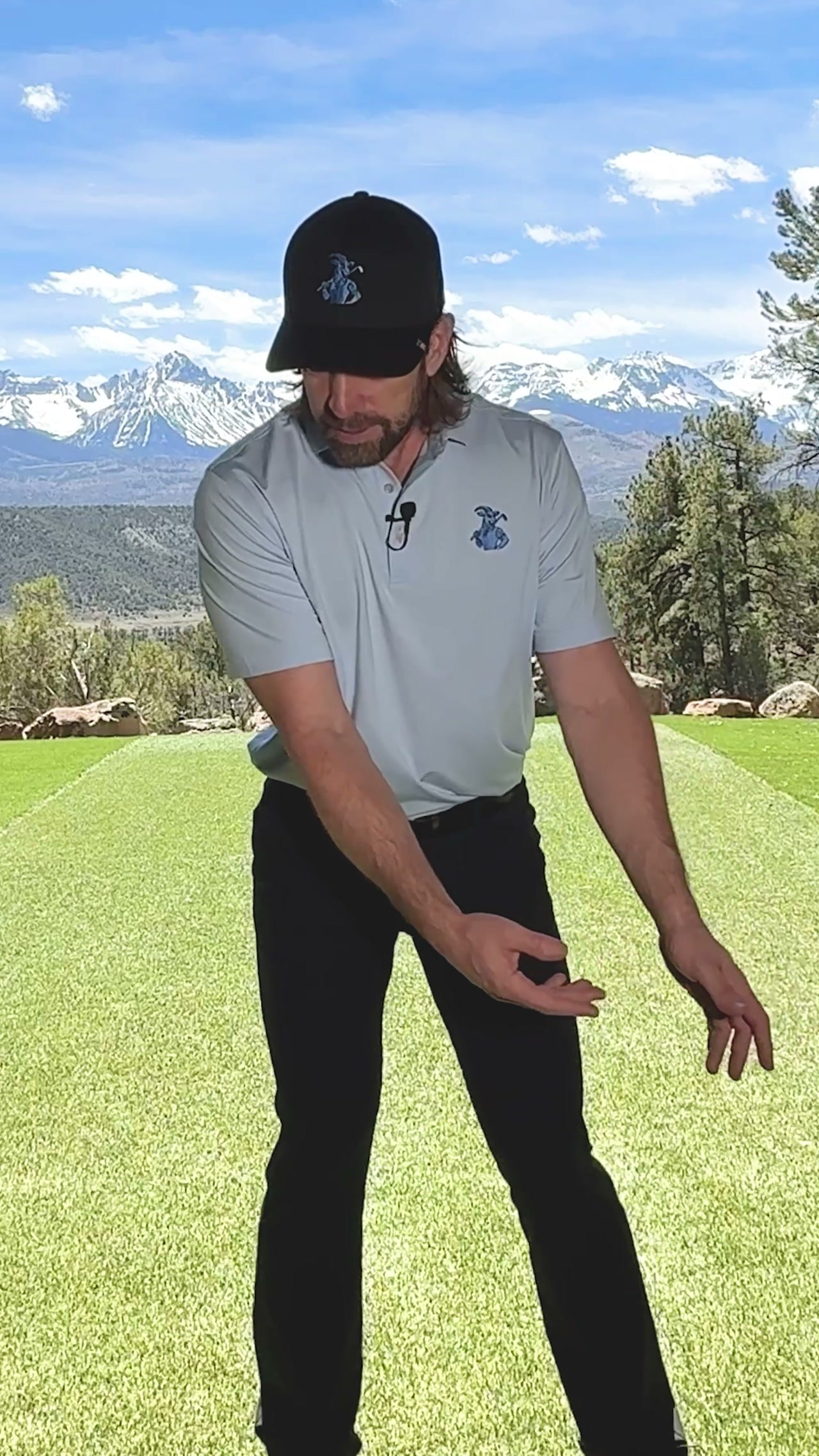
The putter face opens as the arm swings
Pick up the putter and let your arms swing freely again. Because the stroke travels on a subtle arc, the putter face opens slightly on the way back.
Clay has exaggerated this slightly in the photo so you can see the movement clearly.
As your arm swings back, the face opens gently. Then it closes naturally as you swing through.
You're not creating this movement. You're simply allowing it to happen as your arms swing through their natural path.
Move 3: The Putter Flows Freely From the Arms
The final component — and probably the most counterintuitive for most golfers — is the movement of the putter itself.
The club does make a pendulum-like stroke, but it's slightly different from what you may have heard when others describe the pendulum concept.
Imagine swinging back and through without providing any resistance on the club.
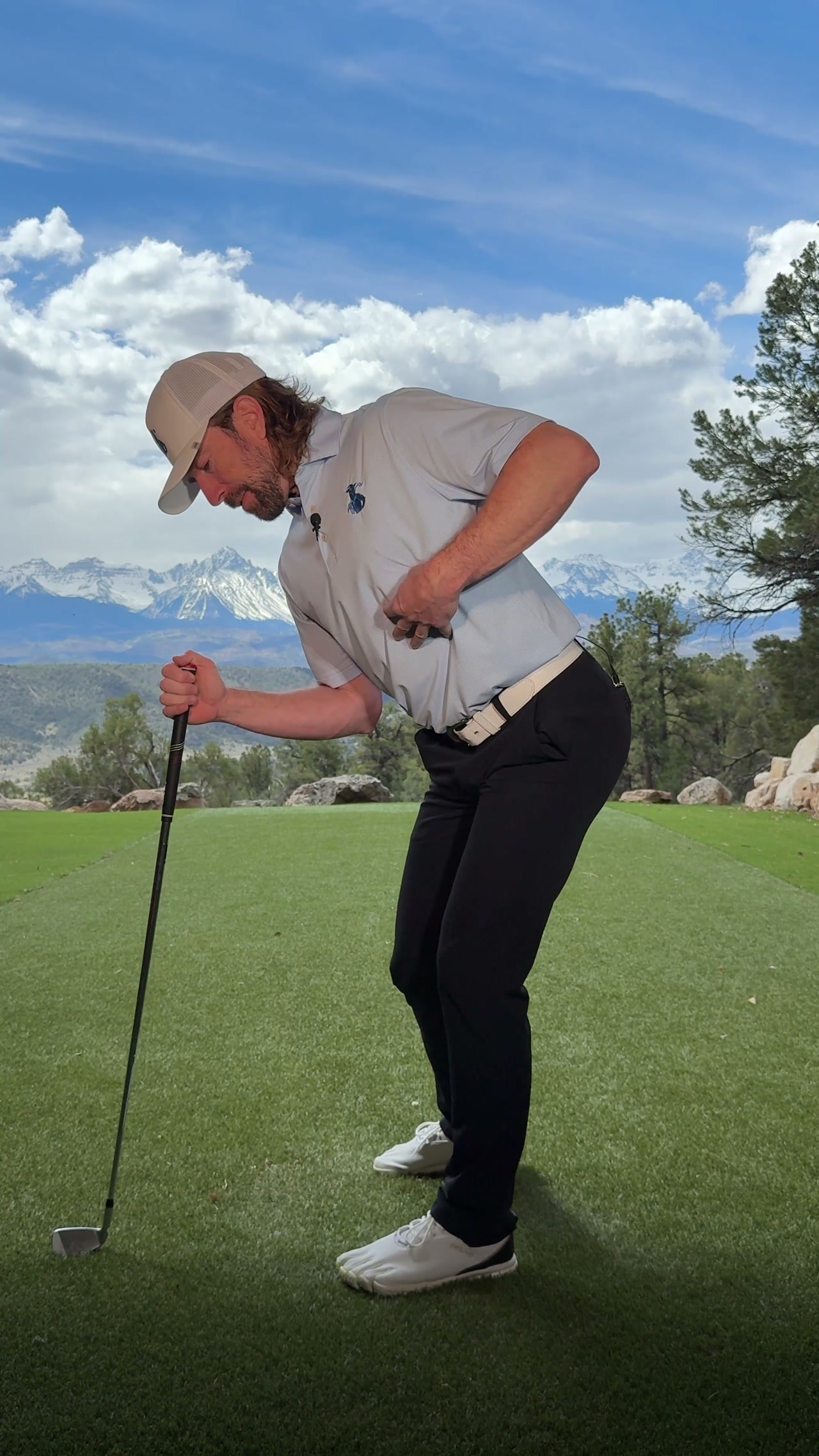
If you let your arm swing back freely, the club trails along with it. The weight of the club head may even cause your trail wrist to bow slightly forward. When you change direction, the club lags behind, bending the wrist the other way.

With no resistance, the club trails along, lagging behind when the hand changes directions
The photos above are intentionally exaggerated. These are much larger movements than what actually occurs in the putting stroke — but the mechanics are identical.
What actually happens is that your arms slow down through impact to let the putter head release.

Dragging the lag through prevents release
If you're trying to accelerate through impact, you never allow the putter to release. With the club head lagging behind while you drag your hands forward, you prevent the putter face from squaring naturally.
Your hands stay ahead, creating forward shaft lean that delofts the putter.
Most golfers unconsciously try to counteract that forward lean by either getting extremely rigid with their arms or adding a little flip at the bottom.
The club face is lagging behind, so you try to catch up by flipping the wrist — creating inconsistency.
What we want instead — and this will feel exaggerated at first — is to practice letting the club flow very freely from the wrists.
Eliminate the Flip
As you swing back, your wrist stays neutral and straight. As you swing forward, your wrist is so soft that it allows the club to lag naturally behind. As your arms decelerate, the putter head releases through impact on its own.
It sounds complex. It sounds like there's a lot happening. But it's actually an extremely simple, natural motion.
Try it yourself with the trail hand only, keeping the movement exaggerated at first. This is precisely what happens in the putt. Your hands and arms actually slow down through impact to let the putter head release naturally.
It feels completely natural — like that's exactly how the club should swing. The only way to change it would be to deliberately apply force and manipulate the club.

Allow the club to flow freely from your wrist
Once you're comfortable with the drill, put both hands on the putter. Now the movement becomes extremely subtle compared to the exaggerated one-handed version.
As you take the club back, the putter stays very centered — almost like "rocking the triangle" at this stage.
As you begin the forward stroke, you'll develop a tiny amount of forward shaft lean, and then the putter releases through naturally.
The Movement Is Nearly Invisible
In an actual putt, this is a very, very small movement. To the naked eye, it won't look like you're letting the club lag and then release — but you are.
You should feel that you're simply letting the club release under its own momentum, without any manipulation whatsoever.

The actual amount of lag is very small
This is what golfers mean when they talk about "releasing the putter head." It involves slowing the hands down a tiny amount and letting the club's natural momentum carry it through impact.
Keep your hands and arms tension-free so the putter head can release rather than being dragged through impact.
If you pull the club through impact, you'll never achieve a natural release. Your putting will remain extremely inconsistent — you'll be swimming upstream indefinitely.
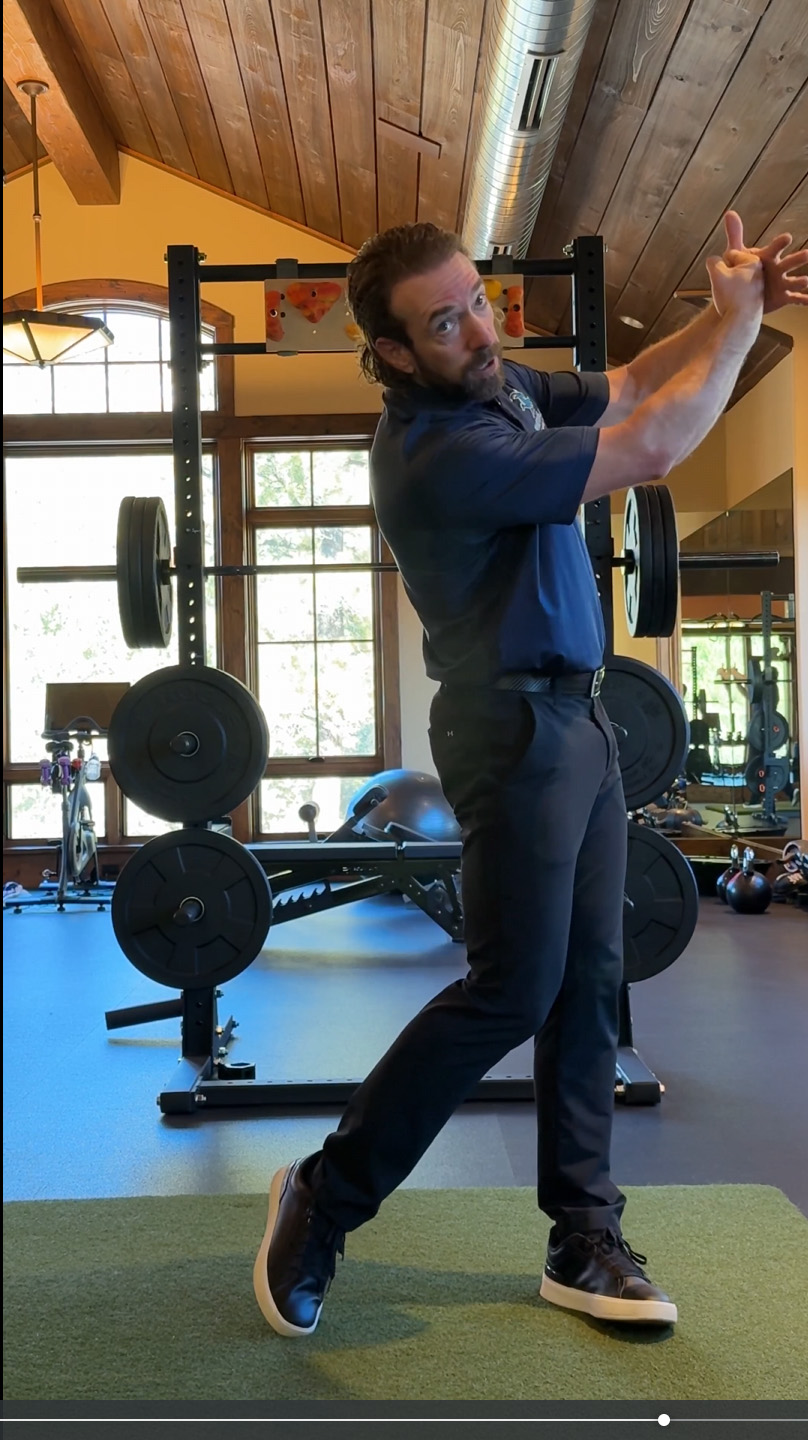
From down the line, notice in the final photo that Clay's shoulders are hinged forward, creating a slight plane.
The shoulders rotate around the spine. The arms flow freely from the shoulder sockets. And the club flows freely from the wrists.
If you pause during the backswing, you'll see the putter face is slightly inside the line and slightly open. As you swing through, the putter head automatically closes and releases.

The putter face opens slightly on the backswing
You achieve all of this by keeping your arms and hands completely relaxed, allowing the club to flow naturally without any body manipulation. The result is a consistent, gently arcing stroke.
That's why the putting stroke has a natural arc. It's a consequence of human anatomy — everything works around an axis.
We let the club flow freely, so we're not manufacturing an arc — we're simply allowing one to occur naturally.
If you've putted "straight back and straight through" for years and it feels like exhausting work, that's because you've trained your body to perform a movement it was never designed to make.
You can become a good putter that way, but it demands an enormous amount of practice.
Learn to set up correctly, grip the club correctly, and let the club flow freely — and you can become the most consistent, athletic putter you know, making it look completely effortless. For personalized insight into how your swing mechanics compare to the elite model, try a free AI golf lesson that tracks your body positions in real time.
Watch part 2 now to see how you're moving your body in the opposite direction of the pros!