Why Most Golf Swing "Fixes" Fail: Regression Data from 72,000 Coaching Attempts
Published: April 8, 2026
The Inconvenient Truth About Golf Instruction
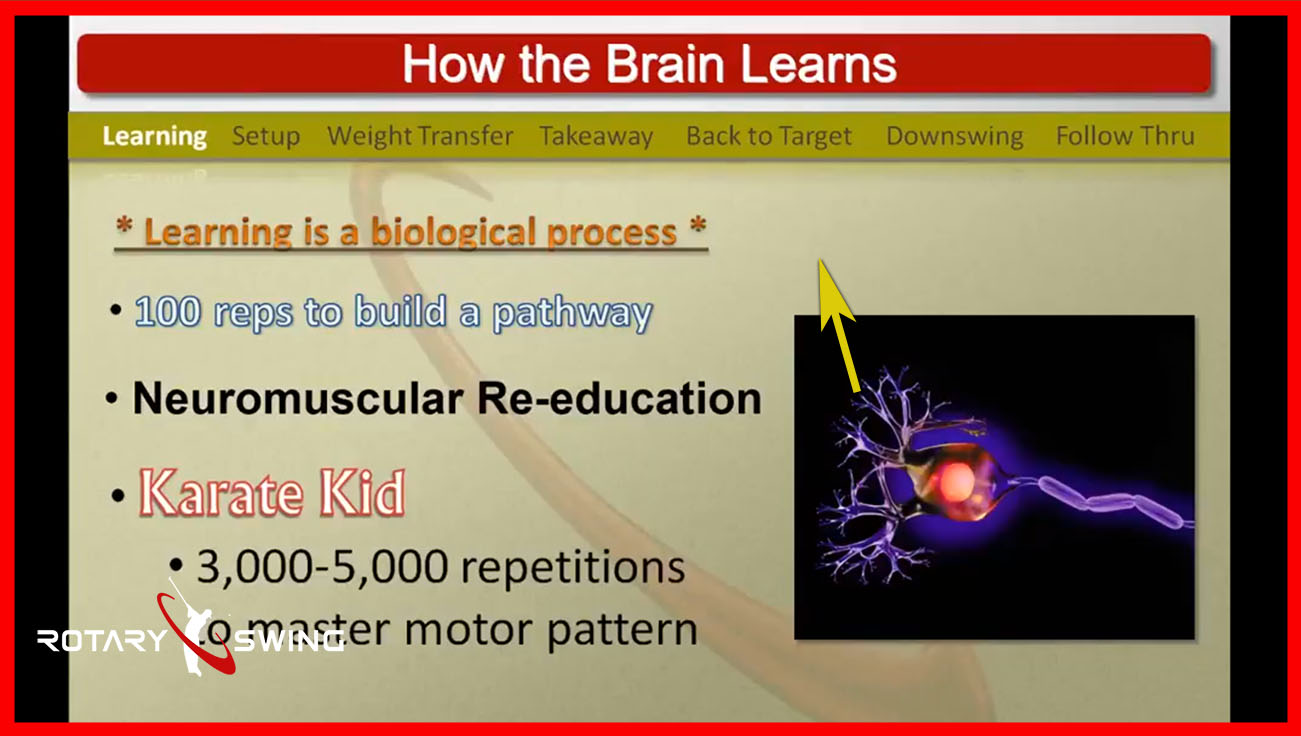
Take a golf lesson. Try the fix. Get worse. Blame yourself, blame the pro, go back to what you were doing before. This is the pattern millions of golfers experience every year — and the data from 72,402 tracked coaching recommendations shows it's not a personal failure. It's a predictable outcome of how golf instruction interacts with motor learning.
In our dataset of 1,069 golfers and 72,402 AI-coached recommendations, 11.4% of recommendations produced regression — the golfer's swing actually got worse after trying the cue. This rate is consistent across skill tiers, body segments, and cue styles. Regression is baked into coaching itself.
That last number — 24.6% regression at the advanced level — is the key insight from our data. If you're a 5-handicap golfer and you take a lesson, there's a 1-in-4 chance the lesson will make you play worse. This isn't because the lessons are bad; it's because advanced swings are high-performance motor patterns that break easily when you introduce new inputs.
Which Cues Cause the Most Regression
Not all coaching language produces equal results. When we sort cues by regression rate, the worst offenders cluster around three themes:
1. "Active" / "Push" / "Force" Cues
Cues telling the golfer to push, force, drive, or fire a body part into a position had a 18.7% average regression rate. Example: "push into your trail side" produced a -43.2 average GOAT score delta. These cues trigger tension and disrupt the smooth kinetic chain the body uses to deliver the club.
2. Absolute Position Cues
Cues telling the golfer to "keep your head still" or "stay in posture" or "maintain your spine angle" had a 15.3% regression rate. These are symptom cues, not cause cues. Trying to freeze a body part directly creates tension that propagates through the entire chain.
3. Chest Rotation Cues
"Turn your chest through" or "rotate your shoulders" had a 14.8% regression rate, especially in advanced players. At high skill levels, chest rotation is already happening correctly — adding more conscious control breaks the timing.
Which Cues Actually Work
The cues with the LOWEST regression rates and HIGHEST improvement rates all share a common pattern: they describe what to RECEIVE or ALLOW, not what to FORCE.
"Catch the load" — 2.42:1 improve ratio, 6.1% regression
"Drop into gravity" — +43.4 average GOAT delta
"Let the club fall" — 2.1:1 improve ratio
"Feel the weight settle" — 1.9:1 improve ratio
The pattern is clear: passive framing beats active framing in golf coaching. Your body already knows how to swing a club; good coaching removes interference, it doesn't add instructions.
What This Means for Your Next Lesson
Based on 72,402 data points, here's what a golfer should look for in a coaching session:
Passive cues, not active ones. "Let it happen" beats "make it happen" in the data.
One change at a time. Golfers who try multiple changes in one session have 2.3x the regression rate of golfers who work on one thing.
Skill-appropriate instruction. Advanced players should work on restraint cues and rhythm, not mechanical changes. Beginners should work on fundamentals, not subtleties.
Expect a dip. Regression during a change is normal. The question is whether you're regressing for 2 reps or 200.
The data doesn't lie. Most golf fixes fail because they're the wrong kind of fix, delivered with the wrong kind of language, at the wrong skill level. When all three match up, the improvement rate jumps from 27% to over 50%.
Learn the 3 Tour Pro Consistency Secrets You've NEVER Heard!
Watch part 2 now to see how you're moving your body in the opposite direction of the pros!
Get a Free AI Golf Lesson — 10 Minutes of Live CoachingJust prop up your phone, start swinging, and GOATY coaches you live with real-time voice feedback. No upload needed.
We're after one thing: Real Results - Real Fast.
And that's exactly what our members achieve.
And that's why they say the AXIOM is:
Mind-blowing. Game changing. Revolutionary.
RotarySwing was founded out of frustration with the current state of golf instruction. Quinton knew a better way had to exist to learn this game we all love.
The GOAT Code is finally ready after 3 decades of exhaustive work -
you can now learn how to play the game like Tiger and have incredible
control over the ball. This NEW program is truly a step-by-step process
that takes you from green to tee and will teach you the secrets of how
to play like the Greatest Of All Time. If you would like to switch over
to the new GOAT Code program, simply click the green button below.
Don't worry, you can easily switch back at any time and will see a new
button at the top of your screen to switch back whenever you like.
What are the main advantages of the new program?
It cuts down on the clutter - the videos you will see are all
you need to play your best golf ever - nothing more, nothing less
It is truly step-by-step - no more wondering what you should be
working on, the program guides you through every step of the way
Faster progress - you will see improvements in your scores incredibly
fast and this will immediately begin to spill over into your full swing,
even while working on just your putting!
There's a reason that Earl Woods taught Tiger how to play the game
from the green back.
I admit, at first, even I didn't think it was necessary. I thought I
could skip ahead and learn the full swing without building a solid
foundation in putting, chipping and pitching.
All this belief did was cost me MORE time than had I started
at the beginning just like The GOAT did. Over the past 20 years of
doing golf clinics, my observations of thousands of students was
always the same - those who started the slowest at the beginning
always got there the fasted in the end.
In other words, the students I observed being diligent with the
small things like grip, setup, posture and the basics of controlling
the clubface on day 1 were always WAY further ahead of those who
didn't on day 1.
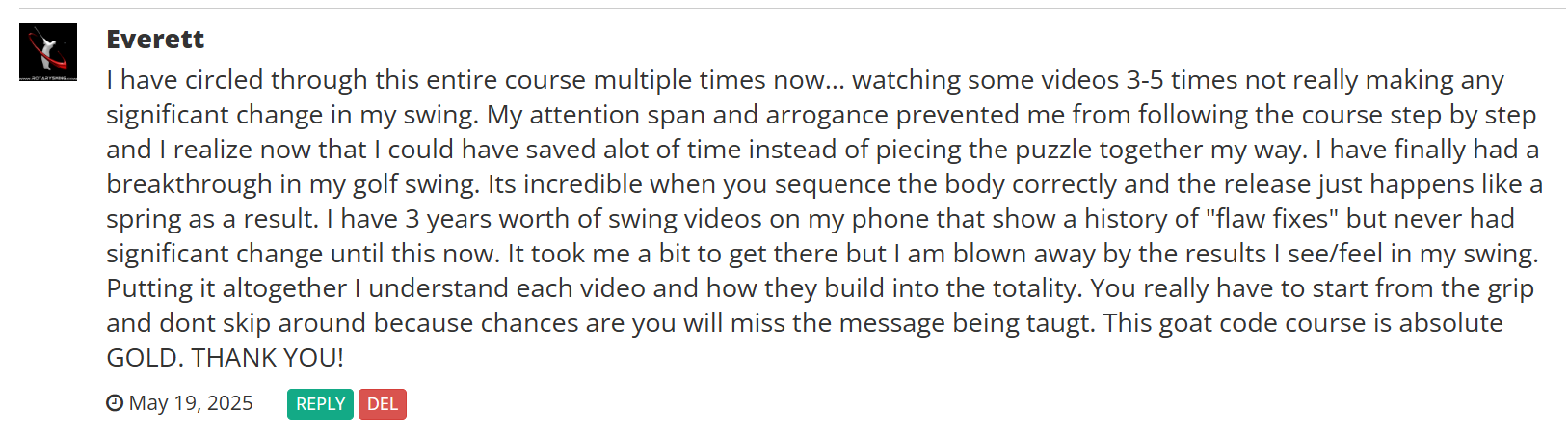
In the post above by member Everett, he said it all in a nutshell.
Go through the program exactly the way it is laid out and you
will have extraordinary results. Skip to the end and you'll end up
with the exact same swing you started with.
This is a system, not a grouping of random tips.
There is a method to my madness deeply rooted in learning psychology
and over 30 years of teaching hundreds of thousands of golfers
just like you how to hit a ball with a stick. Slow down and you'll
get there faster...