























































Q-n-A Webinar 18: Apr 1
Sorry, you need to be a member to access this video. You Are Just Seconds Away!


Q-n-A with Craig Morrow, eighteenth webinar, April 1st 2026
Hey, Mark.
As usual, I'd be disappointed if I didn't see you.
Can you hear me?
All right.
Well, two for two.
Hey, Tom.
How are you doing today?
Sorry to kind of help you out so much on that community question today.
If I can see the move, I'll help you out a little bit more.
It says a side note.
Hey, Jonathan, Howard, Stan, Charles, Mitchell, Josh.
All right, oh, Mark I, I did they do something I don't know about Mark because I know both of them.
I know George very well, I've got my own opinions on George.
All right, well, before we get started on that.
And I have a heart attack.
Um, so I know this has nothing to do with anything, but I just came down the street and a whole thing of water was coming from my mother's house.
So I just, I literally just turned off the water and then now I'm here doing this.
I'll figure it out after the webinar.
So how's everybody today?
If this is your first time, welcome to the webinar session.
I will be your humble RST host, Craig Morrow.
And if this is your returning time, you know the drill.
What I do is I'm going to let people get in the room, pile in for the first couple minutes, and then I'll get started on tonight's Q&A session.
And as usual, I'll give a little bit of time to the end to some questions to the crowd.
And if you have any questions or anything, make sure you put them up in the community now.
With that being said, all right, with that being said.
A lot of people wait until today to get their questions in.
Now, I know some people are procrastinators, you know, late studiers, so to speak, you know, wait until right at the end to give the teacher the.
But, so I may not get to you.
So I'm going to see if I can do another session, you know, a little bit tighter window if I don't get all the questions answered today.
But I'm just telling you procrastinators, I have them.
I just don't know if I'm going to get to them because.
We do have a healthy list tonight.
I am toast.
Hey, Scott.
Hey, Ray.
Hey, Michael.
Is George like his on video?
Oh, well.
I'm going to say that he's grown up.
How's that?
He's grown up.
I wouldn't say he's exactly like he is on video, but he's a lot closer to the way he is on video than he was in his younger years.
I think him and Wesley have made a great career out of YouTube and doing what they do.
I think that playing mini tour golf like George was doing, that's tough on anybody.
It's just brutal.
And George kind of wears his emotions on his sleeve, as do I.
But he wears his emotions on his sleeves, especially back in the day.
I think after he got married and ETC, I think that he grew a lot, and so I don't hold anything against him.
I wouldn't say he's exactly like video, but he's closer today than he was in his earlier years.
Noah's father teaches in Columbia, South Carolina.
The thing is, what's funny is George has always been better than Wesley.
Just as a side note, back in the day, they're both great players.
But George, you could tell that George was the one, the better player.
And I think that was a little bit hard on him because he was kind of.
Than the chosen one, so to speak.
So I don't hold anything against them, but I'm definitely happy for their success and what they've done in the golf and YouTube world.
Because they definitely, they bring people in, and that's my whole thing at the end of the day.
It's why I quote, unquote, don't like the PGA because their motto is grow the game and they do everything the exact opposite.
So, um?
And that's what they do.
They help bring people in.
That's what we need.
All right.
Yeah, yeah.
Man, he's a hell of a ball striker, Mark.
Really is.
And like I said, nothing against him.
I think he really came into his own once he started focusing more on that side of golf.
Back from North Myrtle Beach.
It was a successful trip.
Hit the ball well.
All right, Tom.
And for those of you that don't know, Tom.
If I'm thinking of the right top, he's in my unlimited group, so he just got back from a golf trip in North Myrtle, so we were trying to get things buttoned up before he went down there.
Played a couple of my old stomping grounds when I lived in North Myrtle.
Bill.
Bill.
Hi, Bill.
All right, I'm going to give about a minute or two, then I'm going to get started.
And I apologize if you see me sweating profusely, because I am.
Oh, hey, Bill.
All right, so I'm going to give two minutes.
So any other topics anybody wants to talk about before we get started?
Because my counter is still going up right there.
Howdy.
Hey, Bill.
That's my line.
I'm always the one, and I'm like, howdy.
Hopefully, everybody's got some good plans for Masters Week coming up here in the great state of Georgia.
Haven't seen you in a while.
You look so young.
Me?
All I've been doing is putting on weight, Tim.
Cortisol stress, and Goaty chasing me down over here, just stressing me up, putting on.
Giving me more of a spare tire around here.
The reason I look young is because you don't see me with a hat in my face.
Like, that's I've got, I've got a auto, I've got an autoimmune thing going on right now.
Um, and so I had to cut my hair, had to shave my face, and I'm kind of going through some stuff with that.
So that's why I look different for everybody.
It's like, Wait a minute, you look kind of funky, believe me, I don't like looking like a baby.
I think I had a mustache or a five All right, I will do these two and then get started.
GerAld Just watch the Uh, Artemis Moon launch and wondering why that is easier than fixing my swing.
You want to know why?
Gerald?
I can explain that because there's a formula for that, There's a math for that.
Golf, there might be a formula, might be sequence of events and all that, but you got to throw in that old field and you got to throw in the brain.
You plug 0-1-1 -0-1 into a computer, it does that.
You plug 0-1-1-0-1 into this computer, it's like, I don't compute.
What are you talking about?
Is there, I'll do this one and get going.
Is there lag?
between pushing the trail leg into the ground and starting to rotate the core?
Is there lag between?
I mean, I still think about it as ground up.
So what I've been seeing in answer to that question too much is players starting from here and then trying to rotate and throw their hip back, and their arms are right here.
And they have no way at getting to the top now other than trail, arm lift and picking up their arms.
So it still kind of starts from the ground up because you start moving that pressure into this hip and this hip starts going.
But you, for most players, you want to feel how this coil with the core is really aiding and abetting this motion.
But I don't.
I don't like to split it up too much.
If you think about moving dynamically, like, all right, I'm starting on my lead side right here and I move into my trail side.
You can see my core's going and my pressure's changing in my feet and I'm coiling into that hip.
So some players need one or the other a little bit more.
I see players just going like this, like trying.
I'm like, you can't.
It's got to be a blend into this.
The core and the hip are winding deep to get that stretch.
You can't, you can't separate two.
And I see other players that are just rotating their core, they're not letting their hip move.
So I like to think about it as kind of from the ground up.
I start pushing into the ground and I let my core and hip start working deep right there.
Goaty is working me through getting deeper in the right hip and the backswing.
Analogy was a woman holding a baby and videos a tiger on the range going deep into his hip.
Craig mentioned it should be the same deep hip and the backswing.
And also deep hip and the follow through on the left side.
Can you expand on how the hip would go deep on the follow through?
They're just reverse order, Josh.
I mean, that's why if you think about the golf swing, for those that saw Chuck's podcast, you know, that he was like, well, my feeling is this and this.
Because what ends up happening, if I'm going from here.
And I'm extending this hip, going back and I'm loading into this side.
That's all the same thing I'm doing over here, getting back to this side and now I'm posting and extending that hip.
What you can see is pulling my chest down right here, so hip deep, shift, hip deep, and that's all that is is that's.
That's why the golf swing, the feeling is, the backswing is like this, coiling into that, and then the downswing is Like that.
It's not a perfect mirror image, but if you go that way, it's that way.
That kind of looked like an Elaine dance move.
Okay, so to the tape.
Or to the questions.
Hopefully that helped, Josh.
There might be something in here that talks about that.
All right.
First question.
Thanks again for the explanations in the last webinar.
No problem.
My pleasure.
Here's another tricky question.
At impact, the lead hip should be open, correct?
Showing towards the target.
Now, what do you mean by showing towards the target?
Rory's hips are very open.
I guess more than 45 degrees.
They're open, but they're not as open as you think they are.
Even when I think I do okay, my hip is merely open 30 degrees or less.
And this is only possible when I actively get my lead shoulder out of the way and back.
So what you're doing is you're effectively rotating your chest and hip at the same time right here, which is not exactly what you're looking for.
I literally push my lead shoulder back, resulting in my lead arm retracting to help me in opening my hips.
What do my shoulders have to do with opening up my hips?
Some tour pros I watch seem to do it deliberately and do that to the extreme.
Yeah, there's some players that actually do do that.
Is there a way you'd recommend to get my hip more open?
Is there a better way?
Anything I'd recommend to get your hip more open.
It depends on why your hip's not opening.
What's the number one reason why people's hips don't open?
Number one reason why people's hips don't open is because they fire their arms from the top.
And when they fire their arms from the top, it tells their brain, tell their legs to slam on the brakes.
So the first thing that I would check to see is to make sure that you're not firing your arms.
Because that will impede that.
The second thing is, is don't think about it as being so rotational.
It's kind of a misnomer.
Getting your hip open right here isn't because I'm trying to get my belt buckle facing this way.
This is a vertical motion.
This is me pushing up the hip back and away.
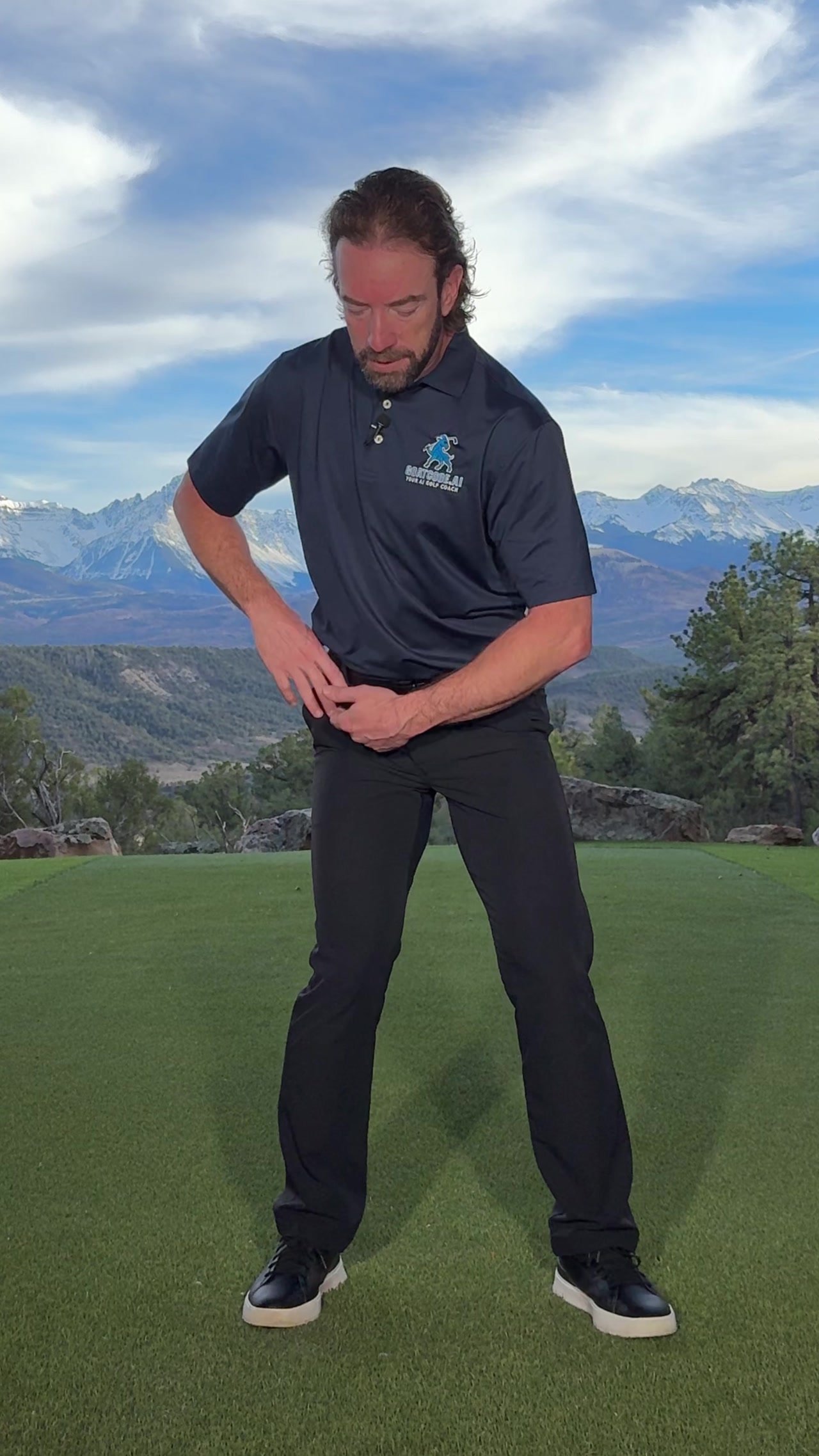
Look at how much butt cheek I have right here.
I didn't try to rotate at all.
This was me just pushing my hip back and straightening my leg.
So without seeing the motion, what I would say is two things.
One, make sure you're not firing your arms.
Two, I had a student do this the other day, which really clicked for him because he was throwing his hands so much that he couldn't get his hip open.
Not that this is correct or anything.
I'm trying to give you the feel of things.
Put yourself in GDP and get the impact without moving your arms.
All right.
So if you're in GDP right here.
Can't do that, get to GDP without moving your arms or get to impact.
Well, obviously, that's not going to work.
So the only way I can do this is if I take this hip and my core, rotate it out of the way.
Now, you can see how open my hip is now.
It looks like my shoulders are wide open right now because I didn't do anything other than that.
But you can actually see from down the line, they're really not.
But you need to get the feeling of how the hips bring you into this position.
Because I would be willing to bet you're firing your arms.
And then also, I still love the torque bridge type feel.
Like I still like the feel of getting here, getting this deep.
I can feel my glute right now.
I can feel it.
It's flexed.
If I stay here, it's going to hurt.
And I can feel how when I get to here, I can get from this glute.
Now I can activate that glute.
Now I can pull that.
I can engage that.
Like I'm like my glutes on fire right now.
This is one of those things where if you haven't done it right before, start to learn the feel of what muscles you're trying to use.
I know it sounds kind of crazy for golf, but really like, especially with the glutes, like we used to have an old video called squeeze the cheeks, you know, it was about impact getting both glutes to fire so you can snap the club.
But get a feel for how these work.
Like right now, like I'm literally only feeling my glutes right now.
I'm not focusing on my obliques.
I'm literally extending this glute, extending that glute.
Like you would think I would have buns of steel by now.
I don't.
But that's all I'm firing is I'm feeling that muscle group.
So I have no reason to not work my hips because I'm firing the muscles that are actually working these guys.
So that's what I'd say.
When starting the downswing, would it be efficient or counterproductive when I try to hold the club back with my trail hand?
I read it how it's written.
On the top of the backswing, while the hip is moving towards the target.
It feels like this additional stretch is excellent for whip, but it's also quite exhausting.
Nevertheless, it seems like the video of some tour pros actually do that.
What is your opinion?
Okay, so I'm going to take this as you're going to the top.
and you're holding this, and then while the hip is moving towards the target, you're trying to get additional stretch.
You can't fake the short stretch cycle, and that's essentially what you're doing, okay?
You know, you see some tour pros that may look like that, but then if you look at the vast majority of them, the vast majority of them are sitting here like Justin Rose all day.
They're sitting here like, okay, let me get my arms down.
They're not trying to get here.
And you'll see, can the camera see me over here?
Yeah.
You'll see players, they'll do this.
Like they'll set up against the wall and they'll be like, okay, how can I restrict my shoulders and get, like that's good for muscle activation and feeling separation and feeling the hips lead and all that.
But you can't fake it.
If you think about up here, okay, I'm going to try to force more stretch now.
You're going to activate tension somewhere else that's not going to allow this recoil to happen as much as it should.
Are there little baby things with like some protraction and stuff?
Yes.
But the main thing at the end of the day is this coil and rebound and this stretch has to be dynamic.
And it's because I'm going this way and this way, not because I'm getting up here and now I'm trying to create the stretch.
That's going to be a timing recipe for disaster.
So ideally, I wouldn't do that.
In your last webinar, you were explaining the corridor in which the arms should stay during the backswing and downswing.
Looking at tour pros, however, especially Tiger from down the line, the shaft of the club is much steeper.
Just behind the head, he lifts the club up very high.
He's pretty much in the exact same corridor I do.
So the hands are higher than his head, yeah?
Trying this actually gives me more speed.
We have more elevation, potential for more leverage from that.
But in order to get that steep and high, I think you're conflating steep with elevation.
During the back swing, I cannot tug my lead upper arm against my breast.
It has to be loose and pressing against my chin.
For me, this leads to lack of control.
Nevertheless, I would like to swing steeper for more speed and get my hands higher.
When Jon Rahm doesn't get his hands higher and he hits the crap out of the ball.
What do you recommend?
And is it okay for the lead upper arm to go across the chin or should it stay below the chin?
Well, I'm going to kind of work this backwards.
Is it okay for the lead upper arm to go across the chin or stay below the chin?
Well, if I'm right here and I'm setting up to this position.
As soon as my arm starts doing this, like you're going to see people kind of scraping it right here.
I really don't want it covering my mouth.
A little bit right there is okay, but ideally, if you start covering your chin right here, what's going to probably start happening?
This arm is going to start to get too internally rotated, and your shoulder plane is going to start to plan out, and you're going to end up pushing with this arm.
That's why when we think about how the arms work, the arms are always still kind of staying in front as I'm getting this depth.
If you want to get higher, so to speak, I don't really want it kind of going across your mouth, and I really want it to do that.
You can add some extra protraction, but I'd be a little bit careful with adding more of this.
Like that gives me a little caution for concern.
But, and I hate to break it to you, some of this is genetics.
You know, my width and my height and my swing, that's due to my mom.
All right?
If I got my dad's genetics, I'd be a little bit bigger.
But I got a little bit of blood in my mom's genetics, and she's about this big.
So I can only go as much as my body is going to kind of allow me to because I'm going to have to nip and tuck.
And I don't want to have to nip and tuck.
For me, if I go from here.
I start getting into the back, swinging, I get up here towards the top.
That's about the max I can go.
Now, could I get these higher?
Yes, but what would that do?
All right, so if I, I don't even know, I'm stretching right now.
If I get my hands higher like this, what do I got to do?
At some point in time, I got to wait for my arms to get back down.
That's adding an element of timing for me, and now I'm trying to get more distance with the sacrifice of consistency.
That's why we always kind of shot for a neutral.
You know, when we talk about shoulder elevation and stuff like that, we always kind of shot base of pectoral because for everybody about right here is where you're in a good spot.
And that's actually where Tiger is.
Tiger might be a tiny bit higher and a tiny bit more over here, but it ain't much.
He's not like this.
His elbow is not in line with his chin like this when he's up here at the top.
He's down like this and about right.
He's about right there.
So if you want more height, make sure that you're not going beyond what you should, genetic-wise.
You're born with all the width you're ever going to have.
It's in your right arm.
And I would check to make sure that you're just staying in front.
So if I have this line right here, I've got this window right here, my club's going down, and I'm shifting and posting, I can get a little bit higher right there.
But see, to me, that's a little bit out of control for me.
That's why this club's starting to lay off a little bit.
Because it's starting to get a little bit unsupported for me.
But my question would be, where are you trying to get out of it?
I don't want you getting too disconnected.
Here, here, that's not going to give you that much more speed.
At the end of the day, it's really not going to do a whole bunch of anything.
So what I would shoot for is base here, but I'd have to kind of see what you're doing first to know if you're kind of maxing out.
But it's a give and take situation.
If you want higher hands, all right, then you're going to have to make up for that factor.
Think of daily and couples.
They take the longest out of any player on tour other than Bubba.
To get back to the golf ball, because as soon as they get here and they disconnect, they've got a.
That's why, Freddie, you know, when you look at his swing, you know that's why some of his smoothness that he has, he has to.
He can't swing at the rate that Tiger swings.
Because when he gets to here and he gets to here and just, he's got to wait on that to get back down.
Okay, now I'm back connected, now I can start firing.
But if he got up here and he's dynamic with his legs, his arm and hand would be so far.
Back here, there wouldn't be any whip.
And he'd end up just pushing with his right hand all day, or trail hands.
So every time you add a component, you're going to have to have a makeup move somewhere.
I just don't like that.
I'd rather just leave the elevation right here, kind of base effectorals, and then everybody can just work together.
Especially when I'm getting tired, my lead arm is bending during the backswing.
What do you suggest in order to keep the lead arm straight?
Keep your trail arm straight.
When you get tired, your lead arm is bending during the backswing.
So if your lead arm is bending during the backswing when you get tired, then you're quitting rotation.
All right.
So you're starting to get here.
And when you get tired, you're like, I don't feel like rotating anymore.
So your trail arm is starting to take over, which is causing your lead arm to bend.
Okay.
Because if you're still rotating, I mean, I can do this all day long.
My arms are chill.
It's because I have a lot of rotation.
So when you start to get tired, don't try to keep the lead arm straight.
Like don't sit here and I'm going to grab this straight.
That's not going to serve anybody any good purpose.
What I would do is I would start allowing myself to turn.
Now, what do I mean by turn?
If I'm going from here and I'm getting tired and my arms are bending, just start allowing for a little bit more hip turn.
If you allow for a little bit more hip turn, you can still get this glute to fire and all that, but it's going to help you rotate.
So as your arms go this way, They don't have to do anything.
I mean, you can see how loosey-goosey I am right now.
All they have to do is kind of support the weight of the club, but it's because I'm rotating.
As soon as I have a lot of rotation right here, keeping my arms straight is easy-peasy.
If I'm getting tired because I'm working the whole round trying to keep that straight, because I'm not rotating, yeah, you're going to get exhausted.
But I would actually just.
Just open yourself up a little bit.
Just say, okay, well, I'm getting this torque and getting that, but I'm getting tired, you know, walking or my abs are hurting or my glute.
Okay, well, let me, I'm just going to kind of just let myself just have a little bit more hip turn.
Just let that kind of just get a little deeper, a little bit more turn.
Maybe let my left foot pick up a little bit just so it's easier for me to whine.
Therefore, it's easier for you to keep your arms straight.
At impact, I always try to look straight at the ball.
Sometimes I forget, and it results in a lack of speed.
This I do not understand.
Why is that, and how do you recommend a train looking at the golf ball?
Train looking at the golf ball?
And why is that?
Well, when you're not looking at the golf ball, the problem is where the eyes go, the head goes, the head goes, the chest goes.
So as soon as your head starts going like that, your body starts prematurely opening.
So you end up kind of dragging the club right here so you don't get an effective whip.
And so that's why when you look at Tiger or Jack or even me, like when you watch my head, as I start to come down, You'll almost even see my head, like, going back this way instead of this way.
Because I'm trying to create the opposite effect, because I'm trying to get whip in there, trying to get speed.
And when my eyes and head start going this way, it starts to prematurely open and I get the drag of the club.
So the training of that, to be honest with you, I've never really thought about that for my own swing.
But what I've done with players before is take a marker or a sharpie and mark the ball.
So that when you're sitting here doing this and you're looking at that spot on the ball, you have to see yourself hit that spot.
And that'll be long enough for the club to release.
For you to get through, or just pick a logo.
Like, if you're hitting a tailor-made ball, put the tailor-made right there on the range.
And be like, All right.
I've got to see myself swing through that tailor-made before.
I can let this head go so I can stay in the shot and let the arms extend, you know, relative to the body right here.
Um, another thing, uh, one of our other other instructors he used to have when working on release, the two ball method.
Which I only have one.
But what he used to do is put a ball right here and then.
Trying to find something Makeup.
So I don't know if we can see that on camera, let me go back this way Okay, so imagine this eyelash curl is a golf ball But what you're doing is you're staring at this outside golf ball the whole time.
You're hitting this one.
You're set up to hitting this one.
But you're staring at that one the whole time to make sure that you release through the ball right there.
But sometimes when you're not just death staring the ball and you're focusing on that, it helps out with that as well.
I'll get to that at the end, Stephen.
Roy is extremely looking straight at the ball at impact, actually looking from front on.
You can see the lead side of his face showing towards the camera.
How does he do this?
Can you help copy this?
Well, it's more of a reaction.
So Roy's eyes and head as he's doing that is the same.
I didn't train to look this way.
What happened is I had an impact bag, and I'm working on trying to develop speed.
And I'm looking at my numbers, trying to see what's going on.
And so when I start to sequence through here, I realize that.
Okay, if I keep my head back, I can get this to snap more down here.
But when I get my eyes going, this delays the release for me.
So this goes back to the question of the keeping this like forcing the stretch in the downswing.
This is reactionary, You can't really train a reactionary force.
You can.
You can sit here and practice like getting to here and then look back this way.
And that's one way to do it.
I wouldn't advise it, but you can.
Even Chuck talked about like, you know, if you think about like when you're skiing or snowboarding high of the head, you're always kind of going in the opposite direction of which way you're going, how your eyes kind of play with that.
But the big thing that I would do.
Is just work on speed, keeping your head here, and the better that this goes, and the better you keep your head here.
As you're doing that, the more you'll start to naturally develop.
Oh, I'm going to keep it that way.
So that's that's a little more reactionary, and it's.
I'm not a big fan of just copying somebody to copy them or training something just because they do it.
Why are Roy's eyes doing this?
His eyes are doing that because he's trying to get, he's cleared his hips, he's done everything he's done, and he's trying to get the club to work independently of him.
So the harder he starts swinging, the more his brain's telling him, stay away from that darn golf ball.
The same thing like long drives.
When they get here, and then they're like, they don't.
They don't train to do that.
It's because that's the force of the motion that's getting them to do that.
It's the way that they're sequencing their core and their legs.
So just be a little careful with that.
At the end of the day, that's not going to change anything for you.
I mean, keep your head down and let the club release.
Making your head stay back more this way, I wouldn't worry about it too much, personally.
Um, after impact, the trail hand should immediately flip over the lead hand.
Right now, like flip, but it covers it.
I mean, we don't, we don't use flipping golf, don't ever say the flip word.
That's like the S word I'm not talking about, you know, the S word, and we're not even talking about the S word.
It's the first rule of S word, we don't talk about S word.
When focusing on supination of the trail, hand at impact, more or less trying to force supination as long as possible, there is a point to release supination.
How do you do that?
When's the ideal time?
You can't force that.
It goes back to when you've seen me up here spinning the club.
So in the downswing, there's obviously, we've got supination, deviation, and then we get.
Pronation right here, you can't make that happen.
That is a hundred percent of byproduct.
If you start making this happen where you actually do, start flipping and doing this now, we're going to be into trouble.
So that's why all I would do is I'd get here and I'd just spin this puppy.
And you'll get a feel for where the bottoming out is.
You want the club and all this to square itself.
I promise you that the club is much smarter at squaring up that club than you are, than I am, than Chuck is, than Tiger You've got, it's the club that's squaring itself.
I'm sequencing, I am sequencing me where I've got here, I'm feeling the supination, deviation, rotation.
It's getting to the bottom of the arc where this is maxed out.
It has no other place it can go.
Other than this one, because I can't, that's not going to work.
At some point, it gets, it has to snap over, so I get this feeling combined with a little body.
I don't know if you can hear that, but there's some speed in that.
And it's not really me forcing anything.
It's me taking advantage of the fact that the club is designed to do this.
That's why you get here and it's like, all right, I got this now, let me sequence some body.
That's what I would do is.
I would actually take the timing mechanism out of it and I would get comfortable with feeling how that bottoms out.
Let the release happen on its own.
And to that point, I want to say one thing about that.
That's one thing why a lot of players ask me all the time why I hit it so straight.
It's because I'm not trying to hit it straight.
I'm not trying to time a release.
I'm not that much talented than anybody in this room.
It has nothing to do with that.
It's because I'm trying to get here, and I'm like, all right, club, do whatever the hell you want to do.
And when I do do that, go straight because it wants to do what it wants to do, and it will square up automatically.
Breathing, big topic.
From an athletic point of view, I should out-breath during the downswing and at impact.
Please correct me if you see it differently.
In reality, I often find myself holding my breath at impact.
What is I do, and how would you suggest that?
I've even asked Chuck this comment, and even Chuck and I have always been on this.
We've always been on the same page on this.
We don't think about that that much.
But think about how the breath is reactionary, right?
So this is how I would think about training it.
If I'm going from here and I'm coiling, what does that do to your lungs?
It starts to, you really start to get tight in your lungs right here, right?
So you start to get that compression.
And then what do you see Tiger do and all these players do in the downswing?
Or their cheeks get really big because now they're going from tight to, and they're starting to really compress and fire these guys.
I've never really thought about my breathing.
But what I would say is as we're going here and we're winding up our core and we're going this way, all right, you're going to start to feel some tightness and some compression.
And so you're going to really kind of suck everything out right there.
So as that's happening, and then as you start to get back, like that's as you start to compress, like that's why you get that big.
Tiger cheek or whatever you want to call it in the downswing.
It's funny.
The first time I asked Chuck about that, and this was years ago, the only time I ever heard about breathing is playing in money matches where you're on 18 and you've got a four -footer, and then somebody's like, do you breathe in or out when you putt?
You said you'd been working on getting your weight to the front foot for like a year.
Yeah, that's because from a past teacher, I got stuck on this side and spinning off of this foot like this.
So a lot of my triggers, players tend to have their problems, but there's usually like one or two like, man, I've got to, like this is my Achilles.
Like I've got to work on this.
So yes, I had to work on getting here.
And getting my pressure, or getting my weight back into this side because I trained for literally two years to not shift my weight.
Um, that was a my brain had no idea what was going on.
Uh, what was your issue and how'd you work on it?
I stayed on that trail side.
And so, I mean, I even have some of these old videos where I'd literally I'd go to the range.
Shift my weight now go up here, shift my weight now, go.
And that's literally how I did that.
And then as soon as I got comfortable with getting my weight over here and getting my glute to fire, then I'd start blending it.
And that's why I still like that foot drill to this day.
I'd be like, okay, well, I'm just going to lift my lead foot just a little bit right here, just enough to get it off the ground.
So it forces over here.
And then I'm going to push it into the ground.
I'm going to make this lead leg work a little bit.
So I first trained it kind of independently.
Here, get the feeling, go.
Then to start blending it, I let my lead foot lift a little bit and then go into whatever, you know, what Goaty's telling everybody right now is getting, all right, Now I'm going to stretch and work back into that so I can make it a little bit more fluid without picking up my feet.
So I can get a little bit more SSC.
Let's see.
I have an issue.
Pushing too hard with the right side from the top and sliding into the golf ball.
So you're going from here and then pushing too hard and then sliding into With my weight falling back.
Great when the timing is on, not so much when it's off.
But is that really a weight transfer issue?
I see the chat popping up.
I just want to make sure.
Okay.
I have an issue pushing too hard from the right side from the top and sliding into the golf ball with my weight falling back.
So you go from here, you push, and then go that way?
That's kind of how I'm picturing it.
If you're pushing hard with your right side from the top and you're sliding into it, your weight's going to be on this side.
So if your weight's falling back, oh, okay, so now, yeah, so you're posting and you're falling back this way because you're so far out ahead right there.
Yeah, I don't think my drill would be the best for that.
I think that the foot drill would be good for you on that, but I'm going to counter you with this.
Instead of pushing with your right side, why don't you use your right side?
Now, there's a big debate.
On what people are working on with Goatee and things of this nature because of how things get said sometimes.
So you still have to go into the right, you still shift your weight, you don't just stay on your lead leg like this.
And then, I mean, that's stack and tilt, we're not doing that.
Um, but the trail hip loading from the ground up video where Chuck's talking about, Okay, and this is kind of how I give it to people.
As you get into your trail side and this hip starts to get deep, instead of loading this hip and pushing off of it, push it even deeper.
And so what I mean is get here, get into this hip, and then push it deeper as you start to transition.
Notice how if I'm obviously in my trail side, right?
I'm not going to do anything except I'm literally going to take both of my hands and start pushing my hip deeper, all right?
What's going on right now?
I'm starting to move back to this side because if I'm deep into this hip coiled correctly and now I start to push it deeper, that's automatically getting me to go that way.
So I want to think about it as trying to stop a push or something like that.
It's still one of my big things that I tell people all the time when I teach.
I just can't tell you not to do something.
I can't give you something to do or give something to work.
So what I would do is I would get into this hip and then feel like you sit even deeper into it when you transition.
That way, by the time you get to here, that automatically gets it over here.
Oh, well, now just doink.
So that's how I would think about getting around that.
Also, uh-oh, Goaty told me part of my issue is getting the sling all the way to my left shoulder might be limited thoracic mobility.
Is there a way to test for that?
Probably.
If there's any orthopedics or physical therapists in the chat, if you would like to post a link right now on any limited thoracic mobility exercises or tests, I have no problem with that.
So getting the sling all the way to my left shoulder might be limited thoracic mobility.
I only have like one or two students that have limited right there, you know, getting into that position.
I mean, I'd rather see it before I give you anything crazy with that.
But going to, since this is the follow-up to the pushing question.
So your issue is pushing hard and sliding into it.
All right.
Now you're probably pushing hard because you don't feel any stretch.
So this uncoil right here isn't very natural.
So you kind of, if you were to put this question first, it would actually have been better for the prior question that you put.
Because you're pushing because you don't feel any other way to create any juice.
Okay.
So that's why you're probably doing that.
I don't think if you have limited thoracic mobility, you still should be able to get.
I'm trying to.
I'm going to.
Don't copy my setup right here.
Yeah, you still should be able to get even though about right here, even with the limited.
And right now I feel.
Like I want to start going this way without pushing.
Put your swing in the community.
I have no problem taking a look at it.
But what I would do for the first issue is I would get into this side and do that.
If this is really limiting your ability to turn and do that, I still think we've got to check this.
I still think we've got to make sure this is deep and deeper.
Because that's going to give you enough stretch to get that sling loaded going back this way.
So that would be my thoughts.
Charles, I like that concept.
I don't know what I said, but I appreciate it.
Is it okay to start the swing as if in GDP?
Or is it better to do the supination from the top?
What's the easiest way to do it?
If I were to choose.
Does this even matter if the rebound effect from the top isn't there in the downswing?
Is it okay to start the swing from GDP?
Like if you're going to like make a golf swing?
I mean, technically you can.
That's a lot better.
He said it.
I mean, technically you can do that.
Or is it better to do the supination from the top?
What is the easiest?
I like them both.
And so if you're talking about like drilling, and working on the swing.
I like both.
I've got one player right now where I have him literally, like I was showing you earlier, I have him literally setting up in GDP right here, getting just a little bit of momentum.
He's not allowed to do anything.
He's just here, a little bit of momentum, hit.
Because he's got to start to get the feeling of how this fires and brings him into impact right there.
That's a good thing to do right there.
If you want to add a little bit more wind, you can.
Going through the whole supination where you get up here and you're getting the feeling of, okay, well, I'm going to feel this as I get, I mean, I don't think there's a pro and con to working on either one.
But the third part of the question, does this even matter if the rebound effect from the top isn't there in the downswing?
That's kind of the real thing.
You need to train what it feels like.
to move into impact correctly, to feel supination.
The goal is to get everybody to work as a unit and rebound.
But it goes back to the question when somebody was talking about the left side weight shift.
If I don't know what it feels like to have this glute activated, how am I going to use it?
Now, I understand if I coil, this will all, you know, rebound automatically for me.
But devil's advocate on this.
When I'm working down into this position and I want to start to get faster, I need to get that glute to engage more.
What the heck's my glute?
Well, for me, that's what gave me the feeling of getting that feeling and understanding that pressure like that.
So training GDP or training feeling supination, all that, there's definitely a place for it.
We want things to happen automatic because if you coil in sequence and do that, but you still need to feel these things.
It's kind of like a lifelong over -the-topper.
Your brain, your movement patterns have overridden the system.
There's nothing wrong with overriding.
You've been overriding the system.
So there's nothing wrong with training like, okay, I need to feel some extra supination here because I've overridden this so much.
The goal is, is if you load the muscles correctly, they will rebound correctly.
But you, I mean, I don't know if you watch any of Chuck's videos on Instagram or social media or anything, but you'll see him.
He'll be up here at the top and he'll be, I think that this one was titled like Whip It.
He's sitting here and you'll see where he's, Mike's sitting here, and he's got lines because he's trying to feel where this is.
And there's nothing wrong with kind of separating and feeling like, oh, how much is supination?
What is GDP?
The goal is to try to make it all rebound by itself.
Okay.
As you begin your backswing, Focus on winding your lead hip.
The lead hip coil into the socket like a spring, which creates a rotational loading effect.
During this process, your lead leg will extend slightly while your trail knee softens.
This action drops the trail side, allowing pressure to flow naturally into your trail foot.
Can you show and explain for us to understand how this is possible?
I might leave that one to go to you.
So during this process, your lead leg will extend slightly while your trail knee softens.
This action drops the trail side.
So I think about this a little bit differently.
I think.
I think we're not supposed to do it.
The lead hip should coil under the socket like a spring.
This is where it kind of goes back to the last webinar.
If I think about.
kind of starting from the lead side right here.
So if I kind of put myself a little bit, you know, a little baby post up right here, got a little weight on the side, a little open right here.
Now, as I start to coil into this side and I'm using this kind of, I'm rotating my core and this starts to soften, I can start to feel how this starts to coil and this starts to coil.
And this is just really tough.
Now, if I'm here and I get that feeling of that coil, you can see as I'm doing that, Like I'm not really, I'm still getting into this side, but I'm not moving that much.
And that's a really hard thing to feel with.
That's why when I was showing you this earlier, like if you kind of feel both kind of internal like this.
So if I'm right here and I kind of almost feel like an internal internal.
So when I get internal internal like that, that's what gives me that stretch.
But like I said, some of that stuff, that one I'm going to have to leave.
To the boss.
Because, yeah, I'm the way I think about things and fuel things, so as I'm going this way, if this is my pivot point.
I like that kind of little pre -start right here.
So where it starts to get me into this side.
And now I'm trying to feel getting that trail hit there and that starts to.
You can see how it's kind of dropping me right there.
And it's just because I'm not allowing this side to kind of go like this.
I'm allowing it to feel everything deeper, so that's giving me that feeling right here.
Can you tell us something about grip pressure left versus right hand, and chipping, pitching, wedges and full swings?
Does a trail side dominant player have more grip pressure in his right hand versus his left hand?
Can you give a percentage?
Can I give a percentage?
Taking trail side and lead side out of it, the typical mark of the pro was a 2 to an 8.
Taking whatever side grip pressure increases from a 2 to an 8 in the typical tour pro, regardless of whether trail side dominant, lead side dominant, on a scale of 1 to 10.
Now for you, I don't know what a 2 or a 10 is for you or a 2 or an 8 is for you.
Because my 2 may be your 4.
In chipping, you must feel the club head.
If you feel the club head with your trail hand, should your anchor swing still be the left leg?
Yeah, so when you're chipping right here, your trail hand's right at your core.
You're still pivoting around this lead hip right here.
You're not pivoting around the trail hip socket right here.
Okay?
So yeah, you're still, the lead leg is still of the utmost importance.
It's just a very core driven move.
This is still the kind of pivot point right here is it's a core driven move.
Ask Chuck to make a video about this issue.
I will.
Now, can you tell us something about grip pressure right hand versus left hand and chipping pitches, wedges, and full swing?
And chipping pitches and wedges, it's going to feel very right hand controlled.
Now, as we talk about, the lead hand is still a very good guide because it's still going to – I mean, it's got the glove on it.
It's doing something.
So that, you know, as even Tiger talks about it, the left hand is guide, but this is the guy that's kind of doing everything.
This is providing a little bit of structure to it.
So in chipping, pitching, and wedges for a trail side player, you're going to feel pretty firm in this trail hand.
You don't want it too weak because if it's too weak, the club's going to be too loose.
You need to give your brain a little feedback of what you're trying to do with your core and stuff.
So this is going to be pretty firm, all right?
Like it can still move.
But what I've been seeing a lot on my end is that players doing this, they're taking like a two, and they're getting really floppy with it and going like that because they're too loose in their grip.
So the trail hand in the short game is going to be pretty firm, and even the same thing in the full swing where this trail hand, when you think about your pivot point with that middle finger right there, it's not death grip, but it's firm.
because you want to be able to apply that force.
You know, Togan talked about three right hands.
You want to be able to apply that force as you're doing that when you're posting up right here.
So I'm not going to give you an exact percentage because I don't think that's fair based on feel, but I will say firm with the right hand and all of that.
And in the left hand, the left hand is just kind of a guide and a passenger in the short game version of trail side.
where it's kind of reacting to it.
So my lead wrist right here is moving into extension right here, or excuse me, flexion, because of what my trail wrist is doing right here.
And so I can still feel it, and I'm keeping it just a little bit as a guide right here, just making sure that it stays kind of ahead for delofting.
But as you get into the full swing, you know, Chuck talks about the three S's, you know, this lead has to maintain its structure right there.
It's not going to maintain structure.
If it's like this, so I'm not saying death.
Grip it, but you have to have enough presence of mind with the grip pressure right here to maintain your wrist angles.
And that's kind of how I'm going to answer that question is have enough pressure to where this isn't loose and floppy, but you're impeding it from ever doing anything.
It's got to be enough pressure where you can maintain restructure, but as you maintain restructure, You can still have some whip in there.
Because kind of like if I was going to snap, if I was going to snap the towel or whatever, I wouldn't be here and just be loosey-goosey.
I'd have it enough firm.
When I do snap back, I can't snap it back.
Middle of the road, balanced young Padawan.
I don't even watch Star Wars.
Let's see what time is it.
Oh, a little bit later than I thought.
Yeah, so this is what I'm going to do because, like I was talking about earlier, yeah, I've got another page and a half.
I'm going to try to sneak one in on a little bit of the Sooner side so I can get to these other questions.
So if you have some, get them posted in the community because I'll try to turn one over a little faster.
Maybe I'll do it after Master's Week.
So instead of not next week but the following week to get to these.
I'll see what I can do about that.
Remember, I'm not upper management, so I don't have control over things.
So with that being said, I will get to those for those that didn't answer.
Hopefully the ones that did answered your question.
I'm going to answer.
I'm going to stay here about five or ten minutes, answer some extra questions if you've got to go.
I truly appreciate you joining me tonight.
As I always say, without you guys, I'm not here.
So I truly appreciate you giving me the opportunity to help teach you all and keep guiding you through this swing journey and swing process.
I'm going to try to get the next one on the Sooner side just so I can get to the rest of those questions.
If not, I'm still going to get to them.
And I hope everybody has some great master's plans.
And if you want to stick around and ask me some live questions right now, this is the time.
I'm going to go to the tail of the tape.
In the meantime, I hope you did enjoy the session if you have to go.
I truly thank you for that.
Tim, I'm Craig, but I appreciate it.
Mark, thank you, thank you.
Let's see.
I'm going to wind back right here, here.
All right, Stephen said, How much weight is on the lead foot as one completes the backswing?
Don't think of, remember, weight and pressure are two different things.
So you're still, as you're going from here, you're still getting, you know, 70 to 80 right here.
I already start shifting by the time I get to the top, so my pressure is already starting to increase on this side.
So, like, even if you looked at me, you'll see with like, my nine iron.
Like, by the time I get to here, I've already got about 50 of my pressure back on this side.
By the time I finish the top, it does vary between club to club.
But this is, this is, this is my warning, don't get up here and have all your weight on this side.
You will never get posted up.
Make sure that you get into this side before that pressure starts going that way.
All right, so don't really shoot for a number.
Make sure that you get to this before you get over there because I've seen too much of, and this is never going to work.
I'm going 70, 80 from here.
And as I'm getting here, that natural already starts to get me to about 50, 50.
By the time that my lead arm's right here, I'm already 70% back in that position.
Looking forward to Mountain Dew coming back in original formula.
Having issue hitting all my approach shots left.
I've been taught to have my stance a bit closed and face closed at a dress with a strong grip.
Coming in to out, swing to the right, trying to learn the fade to correct.
Any suggestions?
I mean, you can learn a fade to correct that problem, but I'd just correct the setup first.
I mean, if you're already setting up with a closed stance and a closed face, now if you set up square, I have to kind of see that one.
That one's kind of tricky.
If I've always set up closed and I've got closed, like I said, I'm having to do this without seeing it.
If I always set up closed and I'm closed, then I was taught to swing even more out this way.
I wouldn't go to the extreme of open, open, and then just start trying to – you're going to get double-crossed so fast it's not going to be funny.
What I would do is I would get neutral first.
I'd weaken the grip.
I'd get the grip a little bit more neutral.
I'd get square.
I wouldn't even worry about the inside-out path.
And then I'd start to pick the target dead straight where you're lined up square and start to see if you're naturally.
Adjust just a little bit of that first.
Without seeing it, that one's a little – that's what I would do.
How do you train daily to feel all the pieces of sequence?
How do you start slow and then move up into speed where it matches the speed of our regular speed?
I think it depends on what you're working on, Tim.
Because with my students or players, the ones that know me, what we tend to do is we tend to kind of break things up a little bit sometimes to kind of get it manual.
But then I push them to start, okay, blending things in order to where they start feeling, how they're moving their hips, or how they're shift.
I start trying to get them to feel the dynamics of moving through these pieces.
So I kind of like to give them the feel of what they're trying to do, the positions they're trying to get to.
So they they know, they know the agenda, they know the destination with it, And then have them start trying to say, okay, well, Now, let's start slowing down the mechanical thought and let's start focusing on the sequence.
And see if we can kind of feel moving through the same positions by adding a little speed, but doing it with their feet, doing it with their hips.
How do we begin to own all these pieces?
You make it look so easy.
I don't know if I make it look easy.
I mean, obviously, you know, Goaty's going to have his thoughts on this and, you know, Goat Code will have his thoughts on this and all this.
I'm going to give you my thoughts on it.
The way I did it is I just did it how I learned anything.
All right.
You know, if I'm trying to get good at throwing, I didn't just start throwing Hail Marys.
Like I wasn't just trying to throw it as far as hard as I could because my mechanics would be crap.
I might learn how to throw a Hail Mary, but everything else was crap.
I always just did things in smaller components and things that I could tackle.
Like, you know, if my focus today is weight shift, we're getting my hip deep.
That's all I'm going to do today.
Just focus on getting my hip deep.
Whatever happens, whatever happens.
But let me just focus on these pieces at a time and then stack them together.
it's like three or four webinars back then, maybe the Christmas webinar, is I try to get, I get a component and then I try to stack as many as I can without them breaking down.
And then I grind those out.
If I combine getting the hip deep, getting deeper, getting the pressure back and combining soup, like I try to stack and stack and stack to push myself.
So I don't just get working on one thing.
I try to start.
pushing myself to be like, how many can I kind of do at once?
Okay, if I'm a little Icarus and I'm like, okay, I've added too much, I know to back back down and get that down before I add the next component.
That's how I kind of get there faster.
And I make it look so easy because that's why.
And because Chuck beat me and just feed me every now and then, put me in a cage.
Throw some meat at me every now and then.
But that would be, as he famously said, go home to me one time.
You're done practicing for the day.
With chipping move, you're feeling a lot of tension.
And pressure in the arms and the lats to keep that body structure.
I want to say I'm feeling excess tension.
I still like to have a little bit of feel with it.
So I'm not getting here and like, super depressing the lats or anything like that.
Pretty relaxed.
Right here, I've got my setup, I'm right here.
I want my core to be in control, but I'm not overly like trying to.
I don't, I don't, that doesn't, I don't see players swing that way.
The most common thing I always hear is what Tim just said a second ago.
Why do pros make it look so easy?
It looks like they're doing nothing.
That's because, to me, I don't see them sitting here with their lats.
They're ready to work.
They're ready to move.
Just like if I'm throwing a pitch, like I'm getting ready to do something.
That's going to be when things fire, not overly controlling them throughout the entire motion.
When do you break your wrist?
At club parallel?
In the backswing?
Downswing?
So I really don't have a whole lot of wrists.
I mean, there's a tiny bit right here.
But when I'm roughly lead arm parallel to the ground right here, here's my club.
I'm not full 90.
I'm not dead.
I'm enough with my grip right here to support the weight of the club.
So there's, I'd say.
By the time lead arms parallel to the ground, I have about that much for a set.
Yeah, that's about right.
No, I haven't hit a golf ball in years, but roughly.
Thank you, Scott.
Thank you, Vijay.
The new look is cool.
I don't know how I feel about it, Vijay.
Mark, I'll say hello to George next time I see him.
I don't know about that one, Mark.
Let's see.
Much appreciated.
Thanks, Kevin.
Michael, thanks.
Good luck with your mom's house.
Well, thank you, Michael.
I appreciate that.
I don't know what the heck's going on.
All I know is when I drove past, it was one of those things where, like I see.
Like a river going down the street.
And I'm like, man, I got a bad feeling I know where that's coming from because it's completely dry up there.
And I'm like, please don't.
And it just was.
At least it's not in the house.
So let's see.
Gerald also had someone teach pitch shots with a closed face, but it was because.
In his experience, most students tended to leave the face open to impact.
It worked great, but he told me if they started going consistently left to square it more at setup.
Yeah, and that still goes back to part of my issue with the PGA and stuff, is people teach.
They're like, okay, players are slicing, so we've got to get them to swing inside to out.
So let's have them set up with their everything closed right here and have them do this.
They're not fixing the problem.
They're fixing a symptom.
And so it kind of, I'm like, in my opinion, I'm like, wait a minute.
This is kind of like, you know, Doc, this is what's wrong with me.
What do I need to do?
And it's like, well, let's just kind of, this will get you through the hump.
Because it's insanely tough.
It's insanely tough.
Let's say you're a new golfer.
And I'm going through the swing and I'm moving through the positions.
Somebody's like, okay, you're over the top and you're hitting slices.
So let's shut down your stance.
Let's give you a really strong grip.
And then let's get your club face closed so you can start getting the feeling for hitting more of a toe draw or something.
And you start doing that.
And you start swinging from there and you're like, oh, and it's like, because your movement pattern was so dominant this way that you're actually coming down on plane, even though you feel like you're super under plane.
And you get excited.
And so you start practicing more and you're like, hey, this is the greatest thing since sliced bread.
Then two months go by and now you're swinging super inside with a super shot club face and a super strong grip.
And you're hooking everything.
And you don't know how to get out of it.
Then you go back to the teacher and he's like, hey, well, you're doing that too much.
Well, let's now open you up a little bit and let's work on working it this way right now.
That doesn't work for me.
I mean.
It just doesn't because you're just bouncing back and forth training an incorrect movement.
Doc, just give it to me straight.
I'm coming over the top.
What do I need to do to fix this?
Well, you've got to start shifting your weight and shallowing out the club and stop diving your head towards the golf ball.
Okay.
Well, let me just, I'd rather fix it the right way the first time.
And I know so many golfers, obviously, for what I do for a living.
that have these cockamamie setups where they're like this and they've got these super, you know, they're like, okay, well, one guy, you know, I was doing this, so he's got my wrist or he doesn't want any bend right here.
My grip's strong like this.
And then when I go back, like he wants me to feel it going this way.
And, you know, they're up here at the top.
You can see my frustration with that.
You're not fixing the problem.
You're giving them another problem.
And I get so frustrated because you guys work your tails off.
I say it in my reviews all the time.
I can tell you everything I know about the golf swing, but if you don't work on it, you don't get better.
And you guys work your tails off.
That's why you're here.
So when other teachers have gotten players into that, I'm like, you just wasted all their time and all their effort.
And that's.
Reminds me of another story, not to get on a soapbox right here.
Had a lesson a while back where I'm like, I wish I would have been this guy because he paid this instructor an insane amount of money.
And when I mean insane amount of money, think about coming to take a lesson with me twice a week for two years.
No, it wasn't me, Aaron.
I wish it was.
But that wouldn't be the case.
And after two lessons, he'd be like, okay, I need to go work on it per month.
And he goes, Greg, all we did was work on grip.
For almost a straight year, all he did was work on grip.
Every time I'd go Tuesday, Thursday, and be like, oh, your grip's going, you got to get this.
And once you get that right grip, everything's just going to start to sink And I'm like, you paid this guy how much to just continually tell you that you're in a poor setup or poor grip?
I don't tell a lot of people I'm a golf instructor out in public.
What's your take on shaft flex and weight?
Are we better off feeling more shaft flex?
Stiffer board shaft I know we can get fitted and the numbers will show, but there are so many different shaft variations these days.
Kick points tipping Don't ever worry about getting your shaft pure.
That's a waste of money, in my opinion.
Um, I think there are some things to that, but I think a lot of people have really started charging insane amounts.
Oh, let me pure your shaft.
Um, so, uh.
See, this is going to be where there's going to be a little bit of difference in feel, Josh.
So for me, I like a heavy, stiffer 3-wood because I like having a little bit of options.
I like a heavier, stiffer 3-wood because I like to hit it hard, but I also like to know that I can get through things and I kind of play it like a driver sometimes.
But I like having a little bit more feel in that 3-wood head because a little bit more weight helps.
keep my tempo better.
In my driver, I'm kind of the exact opposite.
I like a very light shaft with a little bit more kick to it because I can feel it load a little bit more, and it's just because of what I've done for so long.
I know how to time that to get a little bit more snap out of it.
My thoughts on this, since I'm not a club guy, I've got a great club guy, but I'm not a club guy, is players often You go to either end of the spectrum.
Oh, I swing fast.
I need to get heavy super stuff.
Well, okay.
But you're not making it easier on yourself.
And then vice versa.
Like I need game improvement.
Well, now you've gotten so weak and it's so light that you have no feel for the head.
So you're not getting any feedback.
I would just say when it comes to this stuff, it is a very big feel component and keep your ego out of it.
To me, that is the two biggest things when it comes to it.
And so I've got, I mean, I know club fitters, you know, all around.
And when I talk to them or ones that have done mine in the past, like one of my guys, you know, one of my old roommates is still like way up here in the PGA Superstore, you know, branch.
I mean, like he's, so he's been doing this for 20 something years.
And the biggest thing that players, Players get too locked in.
I want to have, like this right here.
Like this is an X100 shaft, and this, I don't know what this is, three iron right here.
My iron shafts are X100s, but they're also soft-stepped instead of hard-stepped, all right, because the way I like my irons, they kick and feel.
Now, I know, and I've seen this, I know some players have been like, oh, well, Craig plays X100s.
I'm going to go put them in my club because they must be the best.
That doesn't mean that's for you.
I would say the biggest thing with it is you've got to check your ego at the door.
Who cares?
I care about score at the end of the day.
That's it.
I don't care how I do it.
I don't care if I'm using a shovel.
They don't ask how you do it.
They just ask what you shot.
That's all that matters at the end of the day.
is whatever you choose, make sure you can feel this.
I think that's one of the biggest problems that's happened in club manufacturing, golf, you name it, is that the balances and the weights and all that have taken so much feel away from the head that there's nothing to respond to.
I mean, it's like right here, like I'm just swinging this.
I don't know if it's open, closed, where it is or anything like that.
There's no feedback.
It's not giving your brain something.
When I pick up a weight and I start swinging a weight, like my brain says, start going the other way, Craig, because we don't want seven years of bad luck.
And it's because my brain feels this weight.
And it's like, Craig, this weight's pulling you that way.
Start going this way.
That's all this thing is, is a weight.
So when things start to get too light and too non-feedback-ish, you're not telling your brain, oh, okay, it's starting to get way back there.
Let's start thinking about kind of going the other way.
Your brain's a lot smarter than you give it credit for.
Mine's not.
So that's kind of my thoughts on it.
Thanks, Bob.
Josh, no problem.
I'll answer these two, and then I got to.
figure out what's going on and make sure that Noah's Ark's not in front of my mother's house.
What's the order of footwork for moving into backswing?
What?
Chuck in one video goes from left foot toe to right foot heel in reverse ending on the left heel.
Yeah.
It's not, I want to say it's exactly the same as the dead, but it's pretty much Steven.
I mean, Your your pressure is still going.
But as I'm going this way, my pressure is still going towards my right heel and towards kind of my left toe.
Right here, ball of my foot right here, and then as I get here, this order switches to where as I'm going back this way.
It goes ball of foot and this jumps to ball of foot on this side as that jumps to heel, so it's still.
It works like a rudder system, it's not the best answer, but it still works like this, all right, Wing, wong, wing, wong.
Now it obviously rolls, but it still goes trail heel, lead toe, lead heel, trail toe.
So it still works like a rudder system.
Manny, my irons are super heavy.
And that's okay.
I mean, I'm a little guy.
Well, not here, but.
For me, I don't like super heavy irons because I feel like I'm having to overwork to swing them, and I lose a little bit of feel of the head.
I like to have a balance to where, okay, this isn't a chore.
I can move it fast, but I haven't lost feel of what that club head is.
Kind of like it's in my office.
Anybody seen my little pendulum spinny thing?
I'm going to do a nunchuck.
It's like a nunchuck.
Like, I'm sitting here spinning.
Like, I want to still have this thing doing what it's doing, but I still kind of want to know where it's at.
I still want some feedback with it.
That helps.
All right.
Good.
All right, everybody.
I appreciate you stopping by.
I'm going to leave it as that.
I'm going to try to do a session on the sooner side, if you'll want.
And maybe right after the Masters, we'll talk some Masters.
We'll do some more questions.
And we'll keep this thing rocking and rolling.
So I appreciate you stopping by.
And if you have any questions, please, please, please put them in the community.
I'll add them to this list, but I'll make sure that this list gets done on that one.
Peter, much appreciated.
Still Craig, but much appreciated.
Don't do it, Eugene.
Don't do it.
I see what's going on.
I catch on pretty fast.
I know it's April 1st.
You know, so, all right.
You got Christina, Craig, and Chuck.
All start with C.
So, I mean, at least you're in the ballpark.
Your name doesn't start with C.
You're kind of in trouble.
All right, everybody.
Y'all have a good one.
I appreciate it.
Keep me alive.
Keep me in business.
Keep me working.
As usual, I'd be disappointed if I didn't see you.
Can you hear me?
All right.
Well, two for two.
Hey, Tom.
How are you doing today?
Sorry to kind of help you out so much on that community question today.
If I can see the move, I'll help you out a little bit more.
It says a side note.
Hey, Jonathan, Howard, Stan, Charles, Mitchell, Josh.
All right, oh, Mark I, I did they do something I don't know about Mark because I know both of them.
I know George very well, I've got my own opinions on George.
All right, well, before we get started on that.
And I have a heart attack.
Um, so I know this has nothing to do with anything, but I just came down the street and a whole thing of water was coming from my mother's house.
So I just, I literally just turned off the water and then now I'm here doing this.
I'll figure it out after the webinar.
So how's everybody today?
If this is your first time, welcome to the webinar session.
I will be your humble RST host, Craig Morrow.
And if this is your returning time, you know the drill.
What I do is I'm going to let people get in the room, pile in for the first couple minutes, and then I'll get started on tonight's Q&A session.
And as usual, I'll give a little bit of time to the end to some questions to the crowd.
And if you have any questions or anything, make sure you put them up in the community now.
With that being said, all right, with that being said.
A lot of people wait until today to get their questions in.
Now, I know some people are procrastinators, you know, late studiers, so to speak, you know, wait until right at the end to give the teacher the.
But, so I may not get to you.
So I'm going to see if I can do another session, you know, a little bit tighter window if I don't get all the questions answered today.
But I'm just telling you procrastinators, I have them.
I just don't know if I'm going to get to them because.
We do have a healthy list tonight.
I am toast.
Hey, Scott.
Hey, Ray.
Hey, Michael.
Is George like his on video?
Oh, well.
I'm going to say that he's grown up.
How's that?
He's grown up.
I wouldn't say he's exactly like he is on video, but he's a lot closer to the way he is on video than he was in his younger years.
I think him and Wesley have made a great career out of YouTube and doing what they do.
I think that playing mini tour golf like George was doing, that's tough on anybody.
It's just brutal.
And George kind of wears his emotions on his sleeve, as do I.
But he wears his emotions on his sleeves, especially back in the day.
I think after he got married and ETC, I think that he grew a lot, and so I don't hold anything against him.
I wouldn't say he's exactly like video, but he's closer today than he was in his earlier years.
Noah's father teaches in Columbia, South Carolina.
The thing is, what's funny is George has always been better than Wesley.
Just as a side note, back in the day, they're both great players.
But George, you could tell that George was the one, the better player.
And I think that was a little bit hard on him because he was kind of.
Than the chosen one, so to speak.
So I don't hold anything against them, but I'm definitely happy for their success and what they've done in the golf and YouTube world.
Because they definitely, they bring people in, and that's my whole thing at the end of the day.
It's why I quote, unquote, don't like the PGA because their motto is grow the game and they do everything the exact opposite.
So, um?
And that's what they do.
They help bring people in.
That's what we need.
All right.
Yeah, yeah.
Man, he's a hell of a ball striker, Mark.
Really is.
And like I said, nothing against him.
I think he really came into his own once he started focusing more on that side of golf.
Back from North Myrtle Beach.
It was a successful trip.
Hit the ball well.
All right, Tom.
And for those of you that don't know, Tom.
If I'm thinking of the right top, he's in my unlimited group, so he just got back from a golf trip in North Myrtle, so we were trying to get things buttoned up before he went down there.
Played a couple of my old stomping grounds when I lived in North Myrtle.
Bill.
Bill.
Hi, Bill.
All right, I'm going to give about a minute or two, then I'm going to get started.
And I apologize if you see me sweating profusely, because I am.
Oh, hey, Bill.
All right, so I'm going to give two minutes.
So any other topics anybody wants to talk about before we get started?
Because my counter is still going up right there.
Howdy.
Hey, Bill.
That's my line.
I'm always the one, and I'm like, howdy.
Hopefully, everybody's got some good plans for Masters Week coming up here in the great state of Georgia.
Haven't seen you in a while.
You look so young.
Me?
All I've been doing is putting on weight, Tim.
Cortisol stress, and Goaty chasing me down over here, just stressing me up, putting on.
Giving me more of a spare tire around here.
The reason I look young is because you don't see me with a hat in my face.
Like, that's I've got, I've got a auto, I've got an autoimmune thing going on right now.
Um, and so I had to cut my hair, had to shave my face, and I'm kind of going through some stuff with that.
So that's why I look different for everybody.
It's like, Wait a minute, you look kind of funky, believe me, I don't like looking like a baby.
I think I had a mustache or a five All right, I will do these two and then get started.
GerAld Just watch the Uh, Artemis Moon launch and wondering why that is easier than fixing my swing.
You want to know why?
Gerald?
I can explain that because there's a formula for that, There's a math for that.
Golf, there might be a formula, might be sequence of events and all that, but you got to throw in that old field and you got to throw in the brain.
You plug 0-1-1 -0-1 into a computer, it does that.
You plug 0-1-1-0-1 into this computer, it's like, I don't compute.
What are you talking about?
Is there, I'll do this one and get going.
Is there lag?
between pushing the trail leg into the ground and starting to rotate the core?
Is there lag between?
I mean, I still think about it as ground up.
So what I've been seeing in answer to that question too much is players starting from here and then trying to rotate and throw their hip back, and their arms are right here.
And they have no way at getting to the top now other than trail, arm lift and picking up their arms.
So it still kind of starts from the ground up because you start moving that pressure into this hip and this hip starts going.
But you, for most players, you want to feel how this coil with the core is really aiding and abetting this motion.
But I don't.
I don't like to split it up too much.
If you think about moving dynamically, like, all right, I'm starting on my lead side right here and I move into my trail side.
You can see my core's going and my pressure's changing in my feet and I'm coiling into that hip.
So some players need one or the other a little bit more.
I see players just going like this, like trying.
I'm like, you can't.
It's got to be a blend into this.
The core and the hip are winding deep to get that stretch.
You can't, you can't separate two.
And I see other players that are just rotating their core, they're not letting their hip move.
So I like to think about it as kind of from the ground up.
I start pushing into the ground and I let my core and hip start working deep right there.
Goaty is working me through getting deeper in the right hip and the backswing.
Analogy was a woman holding a baby and videos a tiger on the range going deep into his hip.
Craig mentioned it should be the same deep hip and the backswing.
And also deep hip and the follow through on the left side.
Can you expand on how the hip would go deep on the follow through?
They're just reverse order, Josh.
I mean, that's why if you think about the golf swing, for those that saw Chuck's podcast, you know, that he was like, well, my feeling is this and this.
Because what ends up happening, if I'm going from here.
And I'm extending this hip, going back and I'm loading into this side.
That's all the same thing I'm doing over here, getting back to this side and now I'm posting and extending that hip.
What you can see is pulling my chest down right here, so hip deep, shift, hip deep, and that's all that is is that's.
That's why the golf swing, the feeling is, the backswing is like this, coiling into that, and then the downswing is Like that.
It's not a perfect mirror image, but if you go that way, it's that way.
That kind of looked like an Elaine dance move.
Okay, so to the tape.
Or to the questions.
Hopefully that helped, Josh.
There might be something in here that talks about that.
All right.
First question.
Thanks again for the explanations in the last webinar.
No problem.
My pleasure.
Here's another tricky question.
At impact, the lead hip should be open, correct?
Showing towards the target.
Now, what do you mean by showing towards the target?
Rory's hips are very open.
I guess more than 45 degrees.
They're open, but they're not as open as you think they are.
Even when I think I do okay, my hip is merely open 30 degrees or less.
And this is only possible when I actively get my lead shoulder out of the way and back.
So what you're doing is you're effectively rotating your chest and hip at the same time right here, which is not exactly what you're looking for.
I literally push my lead shoulder back, resulting in my lead arm retracting to help me in opening my hips.
What do my shoulders have to do with opening up my hips?
Some tour pros I watch seem to do it deliberately and do that to the extreme.
Yeah, there's some players that actually do do that.
Is there a way you'd recommend to get my hip more open?
Is there a better way?
Anything I'd recommend to get your hip more open.
It depends on why your hip's not opening.
What's the number one reason why people's hips don't open?
Number one reason why people's hips don't open is because they fire their arms from the top.
And when they fire their arms from the top, it tells their brain, tell their legs to slam on the brakes.
So the first thing that I would check to see is to make sure that you're not firing your arms.
Because that will impede that.
The second thing is, is don't think about it as being so rotational.
It's kind of a misnomer.
Getting your hip open right here isn't because I'm trying to get my belt buckle facing this way.
This is a vertical motion.
This is me pushing up the hip back and away.
Look at how much butt cheek I have right here.
I didn't try to rotate at all.
This was me just pushing my hip back and straightening my leg.
So without seeing the motion, what I would say is two things.
One, make sure you're not firing your arms.
Two, I had a student do this the other day, which really clicked for him because he was throwing his hands so much that he couldn't get his hip open.
Not that this is correct or anything.
I'm trying to give you the feel of things.
Put yourself in GDP and get the impact without moving your arms.
All right.
So if you're in GDP right here.
Can't do that, get to GDP without moving your arms or get to impact.
Well, obviously, that's not going to work.
So the only way I can do this is if I take this hip and my core, rotate it out of the way.
Now, you can see how open my hip is now.
It looks like my shoulders are wide open right now because I didn't do anything other than that.
But you can actually see from down the line, they're really not.
But you need to get the feeling of how the hips bring you into this position.
Because I would be willing to bet you're firing your arms.
And then also, I still love the torque bridge type feel.
Like I still like the feel of getting here, getting this deep.
I can feel my glute right now.
I can feel it.
It's flexed.
If I stay here, it's going to hurt.
And I can feel how when I get to here, I can get from this glute.
Now I can activate that glute.
Now I can pull that.
I can engage that.
Like I'm like my glutes on fire right now.
This is one of those things where if you haven't done it right before, start to learn the feel of what muscles you're trying to use.
I know it sounds kind of crazy for golf, but really like, especially with the glutes, like we used to have an old video called squeeze the cheeks, you know, it was about impact getting both glutes to fire so you can snap the club.
But get a feel for how these work.
Like right now, like I'm literally only feeling my glutes right now.
I'm not focusing on my obliques.
I'm literally extending this glute, extending that glute.
Like you would think I would have buns of steel by now.
I don't.
But that's all I'm firing is I'm feeling that muscle group.
So I have no reason to not work my hips because I'm firing the muscles that are actually working these guys.
So that's what I'd say.
When starting the downswing, would it be efficient or counterproductive when I try to hold the club back with my trail hand?
I read it how it's written.
On the top of the backswing, while the hip is moving towards the target.
It feels like this additional stretch is excellent for whip, but it's also quite exhausting.
Nevertheless, it seems like the video of some tour pros actually do that.
What is your opinion?
Okay, so I'm going to take this as you're going to the top.
and you're holding this, and then while the hip is moving towards the target, you're trying to get additional stretch.
You can't fake the short stretch cycle, and that's essentially what you're doing, okay?
You know, you see some tour pros that may look like that, but then if you look at the vast majority of them, the vast majority of them are sitting here like Justin Rose all day.
They're sitting here like, okay, let me get my arms down.
They're not trying to get here.
And you'll see, can the camera see me over here?
Yeah.
You'll see players, they'll do this.
Like they'll set up against the wall and they'll be like, okay, how can I restrict my shoulders and get, like that's good for muscle activation and feeling separation and feeling the hips lead and all that.
But you can't fake it.
If you think about up here, okay, I'm going to try to force more stretch now.
You're going to activate tension somewhere else that's not going to allow this recoil to happen as much as it should.
Are there little baby things with like some protraction and stuff?
Yes.
But the main thing at the end of the day is this coil and rebound and this stretch has to be dynamic.
And it's because I'm going this way and this way, not because I'm getting up here and now I'm trying to create the stretch.
That's going to be a timing recipe for disaster.
So ideally, I wouldn't do that.
In your last webinar, you were explaining the corridor in which the arms should stay during the backswing and downswing.
Looking at tour pros, however, especially Tiger from down the line, the shaft of the club is much steeper.
Just behind the head, he lifts the club up very high.
He's pretty much in the exact same corridor I do.
So the hands are higher than his head, yeah?
Trying this actually gives me more speed.
We have more elevation, potential for more leverage from that.
But in order to get that steep and high, I think you're conflating steep with elevation.
During the back swing, I cannot tug my lead upper arm against my breast.
It has to be loose and pressing against my chin.
For me, this leads to lack of control.
Nevertheless, I would like to swing steeper for more speed and get my hands higher.
When Jon Rahm doesn't get his hands higher and he hits the crap out of the ball.
What do you recommend?
And is it okay for the lead upper arm to go across the chin or should it stay below the chin?
Well, I'm going to kind of work this backwards.
Is it okay for the lead upper arm to go across the chin or stay below the chin?
Well, if I'm right here and I'm setting up to this position.
As soon as my arm starts doing this, like you're going to see people kind of scraping it right here.
I really don't want it covering my mouth.
A little bit right there is okay, but ideally, if you start covering your chin right here, what's going to probably start happening?
This arm is going to start to get too internally rotated, and your shoulder plane is going to start to plan out, and you're going to end up pushing with this arm.
That's why when we think about how the arms work, the arms are always still kind of staying in front as I'm getting this depth.
If you want to get higher, so to speak, I don't really want it kind of going across your mouth, and I really want it to do that.
You can add some extra protraction, but I'd be a little bit careful with adding more of this.
Like that gives me a little caution for concern.
But, and I hate to break it to you, some of this is genetics.
You know, my width and my height and my swing, that's due to my mom.
All right?
If I got my dad's genetics, I'd be a little bit bigger.
But I got a little bit of blood in my mom's genetics, and she's about this big.
So I can only go as much as my body is going to kind of allow me to because I'm going to have to nip and tuck.
And I don't want to have to nip and tuck.
For me, if I go from here.
I start getting into the back, swinging, I get up here towards the top.
That's about the max I can go.
Now, could I get these higher?
Yes, but what would that do?
All right, so if I, I don't even know, I'm stretching right now.
If I get my hands higher like this, what do I got to do?
At some point in time, I got to wait for my arms to get back down.
That's adding an element of timing for me, and now I'm trying to get more distance with the sacrifice of consistency.
That's why we always kind of shot for a neutral.
You know, when we talk about shoulder elevation and stuff like that, we always kind of shot base of pectoral because for everybody about right here is where you're in a good spot.
And that's actually where Tiger is.
Tiger might be a tiny bit higher and a tiny bit more over here, but it ain't much.
He's not like this.
His elbow is not in line with his chin like this when he's up here at the top.
He's down like this and about right.
He's about right there.
So if you want more height, make sure that you're not going beyond what you should, genetic-wise.
You're born with all the width you're ever going to have.
It's in your right arm.
And I would check to make sure that you're just staying in front.
So if I have this line right here, I've got this window right here, my club's going down, and I'm shifting and posting, I can get a little bit higher right there.
But see, to me, that's a little bit out of control for me.
That's why this club's starting to lay off a little bit.
Because it's starting to get a little bit unsupported for me.
But my question would be, where are you trying to get out of it?
I don't want you getting too disconnected.
Here, here, that's not going to give you that much more speed.
At the end of the day, it's really not going to do a whole bunch of anything.
So what I would shoot for is base here, but I'd have to kind of see what you're doing first to know if you're kind of maxing out.
But it's a give and take situation.
If you want higher hands, all right, then you're going to have to make up for that factor.
Think of daily and couples.
They take the longest out of any player on tour other than Bubba.
To get back to the golf ball, because as soon as they get here and they disconnect, they've got a.
That's why, Freddie, you know, when you look at his swing, you know that's why some of his smoothness that he has, he has to.
He can't swing at the rate that Tiger swings.
Because when he gets to here and he gets to here and just, he's got to wait on that to get back down.
Okay, now I'm back connected, now I can start firing.
But if he got up here and he's dynamic with his legs, his arm and hand would be so far.
Back here, there wouldn't be any whip.
And he'd end up just pushing with his right hand all day, or trail hands.
So every time you add a component, you're going to have to have a makeup move somewhere.
I just don't like that.
I'd rather just leave the elevation right here, kind of base effectorals, and then everybody can just work together.
Especially when I'm getting tired, my lead arm is bending during the backswing.
What do you suggest in order to keep the lead arm straight?
Keep your trail arm straight.
When you get tired, your lead arm is bending during the backswing.
So if your lead arm is bending during the backswing when you get tired, then you're quitting rotation.
All right.
So you're starting to get here.
And when you get tired, you're like, I don't feel like rotating anymore.
So your trail arm is starting to take over, which is causing your lead arm to bend.
Okay.
Because if you're still rotating, I mean, I can do this all day long.
My arms are chill.
It's because I have a lot of rotation.
So when you start to get tired, don't try to keep the lead arm straight.
Like don't sit here and I'm going to grab this straight.
That's not going to serve anybody any good purpose.
What I would do is I would start allowing myself to turn.
Now, what do I mean by turn?
If I'm going from here and I'm getting tired and my arms are bending, just start allowing for a little bit more hip turn.
If you allow for a little bit more hip turn, you can still get this glute to fire and all that, but it's going to help you rotate.
So as your arms go this way, They don't have to do anything.
I mean, you can see how loosey-goosey I am right now.
All they have to do is kind of support the weight of the club, but it's because I'm rotating.
As soon as I have a lot of rotation right here, keeping my arms straight is easy-peasy.
If I'm getting tired because I'm working the whole round trying to keep that straight, because I'm not rotating, yeah, you're going to get exhausted.
But I would actually just.
Just open yourself up a little bit.
Just say, okay, well, I'm getting this torque and getting that, but I'm getting tired, you know, walking or my abs are hurting or my glute.
Okay, well, let me, I'm just going to kind of just let myself just have a little bit more hip turn.
Just let that kind of just get a little deeper, a little bit more turn.
Maybe let my left foot pick up a little bit just so it's easier for me to whine.
Therefore, it's easier for you to keep your arms straight.
At impact, I always try to look straight at the ball.
Sometimes I forget, and it results in a lack of speed.
This I do not understand.
Why is that, and how do you recommend a train looking at the golf ball?
Train looking at the golf ball?
And why is that?
Well, when you're not looking at the golf ball, the problem is where the eyes go, the head goes, the head goes, the chest goes.
So as soon as your head starts going like that, your body starts prematurely opening.
So you end up kind of dragging the club right here so you don't get an effective whip.
And so that's why when you look at Tiger or Jack or even me, like when you watch my head, as I start to come down, You'll almost even see my head, like, going back this way instead of this way.
Because I'm trying to create the opposite effect, because I'm trying to get whip in there, trying to get speed.
And when my eyes and head start going this way, it starts to prematurely open and I get the drag of the club.
So the training of that, to be honest with you, I've never really thought about that for my own swing.
But what I've done with players before is take a marker or a sharpie and mark the ball.
So that when you're sitting here doing this and you're looking at that spot on the ball, you have to see yourself hit that spot.
And that'll be long enough for the club to release.
For you to get through, or just pick a logo.
Like, if you're hitting a tailor-made ball, put the tailor-made right there on the range.
And be like, All right.
I've got to see myself swing through that tailor-made before.
I can let this head go so I can stay in the shot and let the arms extend, you know, relative to the body right here.
Um, another thing, uh, one of our other other instructors he used to have when working on release, the two ball method.
Which I only have one.
But what he used to do is put a ball right here and then.
Trying to find something Makeup.
So I don't know if we can see that on camera, let me go back this way Okay, so imagine this eyelash curl is a golf ball But what you're doing is you're staring at this outside golf ball the whole time.
You're hitting this one.
You're set up to hitting this one.
But you're staring at that one the whole time to make sure that you release through the ball right there.
But sometimes when you're not just death staring the ball and you're focusing on that, it helps out with that as well.
I'll get to that at the end, Stephen.
Roy is extremely looking straight at the ball at impact, actually looking from front on.
You can see the lead side of his face showing towards the camera.
How does he do this?
Can you help copy this?
Well, it's more of a reaction.
So Roy's eyes and head as he's doing that is the same.
I didn't train to look this way.
What happened is I had an impact bag, and I'm working on trying to develop speed.
And I'm looking at my numbers, trying to see what's going on.
And so when I start to sequence through here, I realize that.
Okay, if I keep my head back, I can get this to snap more down here.
But when I get my eyes going, this delays the release for me.
So this goes back to the question of the keeping this like forcing the stretch in the downswing.
This is reactionary, You can't really train a reactionary force.
You can.
You can sit here and practice like getting to here and then look back this way.
And that's one way to do it.
I wouldn't advise it, but you can.
Even Chuck talked about like, you know, if you think about like when you're skiing or snowboarding high of the head, you're always kind of going in the opposite direction of which way you're going, how your eyes kind of play with that.
But the big thing that I would do.
Is just work on speed, keeping your head here, and the better that this goes, and the better you keep your head here.
As you're doing that, the more you'll start to naturally develop.
Oh, I'm going to keep it that way.
So that's that's a little more reactionary, and it's.
I'm not a big fan of just copying somebody to copy them or training something just because they do it.
Why are Roy's eyes doing this?
His eyes are doing that because he's trying to get, he's cleared his hips, he's done everything he's done, and he's trying to get the club to work independently of him.
So the harder he starts swinging, the more his brain's telling him, stay away from that darn golf ball.
The same thing like long drives.
When they get here, and then they're like, they don't.
They don't train to do that.
It's because that's the force of the motion that's getting them to do that.
It's the way that they're sequencing their core and their legs.
So just be a little careful with that.
At the end of the day, that's not going to change anything for you.
I mean, keep your head down and let the club release.
Making your head stay back more this way, I wouldn't worry about it too much, personally.
Um, after impact, the trail hand should immediately flip over the lead hand.
Right now, like flip, but it covers it.
I mean, we don't, we don't use flipping golf, don't ever say the flip word.
That's like the S word I'm not talking about, you know, the S word, and we're not even talking about the S word.
It's the first rule of S word, we don't talk about S word.
When focusing on supination of the trail, hand at impact, more or less trying to force supination as long as possible, there is a point to release supination.
How do you do that?
When's the ideal time?
You can't force that.
It goes back to when you've seen me up here spinning the club.
So in the downswing, there's obviously, we've got supination, deviation, and then we get.
Pronation right here, you can't make that happen.
That is a hundred percent of byproduct.
If you start making this happen where you actually do, start flipping and doing this now, we're going to be into trouble.
So that's why all I would do is I'd get here and I'd just spin this puppy.
And you'll get a feel for where the bottoming out is.
You want the club and all this to square itself.
I promise you that the club is much smarter at squaring up that club than you are, than I am, than Chuck is, than Tiger You've got, it's the club that's squaring itself.
I'm sequencing, I am sequencing me where I've got here, I'm feeling the supination, deviation, rotation.
It's getting to the bottom of the arc where this is maxed out.
It has no other place it can go.
Other than this one, because I can't, that's not going to work.
At some point, it gets, it has to snap over, so I get this feeling combined with a little body.
I don't know if you can hear that, but there's some speed in that.
And it's not really me forcing anything.
It's me taking advantage of the fact that the club is designed to do this.
That's why you get here and it's like, all right, I got this now, let me sequence some body.
That's what I would do is.
I would actually take the timing mechanism out of it and I would get comfortable with feeling how that bottoms out.
Let the release happen on its own.
And to that point, I want to say one thing about that.
That's one thing why a lot of players ask me all the time why I hit it so straight.
It's because I'm not trying to hit it straight.
I'm not trying to time a release.
I'm not that much talented than anybody in this room.
It has nothing to do with that.
It's because I'm trying to get here, and I'm like, all right, club, do whatever the hell you want to do.
And when I do do that, go straight because it wants to do what it wants to do, and it will square up automatically.
Breathing, big topic.
From an athletic point of view, I should out-breath during the downswing and at impact.
Please correct me if you see it differently.
In reality, I often find myself holding my breath at impact.
What is I do, and how would you suggest that?
I've even asked Chuck this comment, and even Chuck and I have always been on this.
We've always been on the same page on this.
We don't think about that that much.
But think about how the breath is reactionary, right?
So this is how I would think about training it.
If I'm going from here and I'm coiling, what does that do to your lungs?
It starts to, you really start to get tight in your lungs right here, right?
So you start to get that compression.
And then what do you see Tiger do and all these players do in the downswing?
Or their cheeks get really big because now they're going from tight to, and they're starting to really compress and fire these guys.
I've never really thought about my breathing.
But what I would say is as we're going here and we're winding up our core and we're going this way, all right, you're going to start to feel some tightness and some compression.
And so you're going to really kind of suck everything out right there.
So as that's happening, and then as you start to get back, like that's as you start to compress, like that's why you get that big.
Tiger cheek or whatever you want to call it in the downswing.
It's funny.
The first time I asked Chuck about that, and this was years ago, the only time I ever heard about breathing is playing in money matches where you're on 18 and you've got a four -footer, and then somebody's like, do you breathe in or out when you putt?
You said you'd been working on getting your weight to the front foot for like a year.
Yeah, that's because from a past teacher, I got stuck on this side and spinning off of this foot like this.
So a lot of my triggers, players tend to have their problems, but there's usually like one or two like, man, I've got to, like this is my Achilles.
Like I've got to work on this.
So yes, I had to work on getting here.
And getting my pressure, or getting my weight back into this side because I trained for literally two years to not shift my weight.
Um, that was a my brain had no idea what was going on.
Uh, what was your issue and how'd you work on it?
I stayed on that trail side.
And so, I mean, I even have some of these old videos where I'd literally I'd go to the range.
Shift my weight now go up here, shift my weight now, go.
And that's literally how I did that.
And then as soon as I got comfortable with getting my weight over here and getting my glute to fire, then I'd start blending it.
And that's why I still like that foot drill to this day.
I'd be like, okay, well, I'm just going to lift my lead foot just a little bit right here, just enough to get it off the ground.
So it forces over here.
And then I'm going to push it into the ground.
I'm going to make this lead leg work a little bit.
So I first trained it kind of independently.
Here, get the feeling, go.
Then to start blending it, I let my lead foot lift a little bit and then go into whatever, you know, what Goaty's telling everybody right now is getting, all right, Now I'm going to stretch and work back into that so I can make it a little bit more fluid without picking up my feet.
So I can get a little bit more SSC.
Let's see.
I have an issue.
Pushing too hard with the right side from the top and sliding into the golf ball.
So you're going from here and then pushing too hard and then sliding into With my weight falling back.
Great when the timing is on, not so much when it's off.
But is that really a weight transfer issue?
I see the chat popping up.
I just want to make sure.
Okay.
I have an issue pushing too hard from the right side from the top and sliding into the golf ball with my weight falling back.
So you go from here, you push, and then go that way?
That's kind of how I'm picturing it.
If you're pushing hard with your right side from the top and you're sliding into it, your weight's going to be on this side.
So if your weight's falling back, oh, okay, so now, yeah, so you're posting and you're falling back this way because you're so far out ahead right there.
Yeah, I don't think my drill would be the best for that.
I think that the foot drill would be good for you on that, but I'm going to counter you with this.
Instead of pushing with your right side, why don't you use your right side?
Now, there's a big debate.
On what people are working on with Goatee and things of this nature because of how things get said sometimes.
So you still have to go into the right, you still shift your weight, you don't just stay on your lead leg like this.
And then, I mean, that's stack and tilt, we're not doing that.
Um, but the trail hip loading from the ground up video where Chuck's talking about, Okay, and this is kind of how I give it to people.
As you get into your trail side and this hip starts to get deep, instead of loading this hip and pushing off of it, push it even deeper.
And so what I mean is get here, get into this hip, and then push it deeper as you start to transition.
Notice how if I'm obviously in my trail side, right?
I'm not going to do anything except I'm literally going to take both of my hands and start pushing my hip deeper, all right?
What's going on right now?
I'm starting to move back to this side because if I'm deep into this hip coiled correctly and now I start to push it deeper, that's automatically getting me to go that way.
So I want to think about it as trying to stop a push or something like that.
It's still one of my big things that I tell people all the time when I teach.
I just can't tell you not to do something.
I can't give you something to do or give something to work.
So what I would do is I would get into this hip and then feel like you sit even deeper into it when you transition.
That way, by the time you get to here, that automatically gets it over here.
Oh, well, now just doink.
So that's how I would think about getting around that.
Also, uh-oh, Goaty told me part of my issue is getting the sling all the way to my left shoulder might be limited thoracic mobility.
Is there a way to test for that?
Probably.
If there's any orthopedics or physical therapists in the chat, if you would like to post a link right now on any limited thoracic mobility exercises or tests, I have no problem with that.
So getting the sling all the way to my left shoulder might be limited thoracic mobility.
I only have like one or two students that have limited right there, you know, getting into that position.
I mean, I'd rather see it before I give you anything crazy with that.
But going to, since this is the follow-up to the pushing question.
So your issue is pushing hard and sliding into it.
All right.
Now you're probably pushing hard because you don't feel any stretch.
So this uncoil right here isn't very natural.
So you kind of, if you were to put this question first, it would actually have been better for the prior question that you put.
Because you're pushing because you don't feel any other way to create any juice.
Okay.
So that's why you're probably doing that.
I don't think if you have limited thoracic mobility, you still should be able to get.
I'm trying to.
I'm going to.
Don't copy my setup right here.
Yeah, you still should be able to get even though about right here, even with the limited.
And right now I feel.
Like I want to start going this way without pushing.
Put your swing in the community.
I have no problem taking a look at it.
But what I would do for the first issue is I would get into this side and do that.
If this is really limiting your ability to turn and do that, I still think we've got to check this.
I still think we've got to make sure this is deep and deeper.
Because that's going to give you enough stretch to get that sling loaded going back this way.
So that would be my thoughts.
Charles, I like that concept.
I don't know what I said, but I appreciate it.
Is it okay to start the swing as if in GDP?
Or is it better to do the supination from the top?
What's the easiest way to do it?
If I were to choose.
Does this even matter if the rebound effect from the top isn't there in the downswing?
Is it okay to start the swing from GDP?
Like if you're going to like make a golf swing?
I mean, technically you can.
That's a lot better.
He said it.
I mean, technically you can do that.
Or is it better to do the supination from the top?
What is the easiest?
I like them both.
And so if you're talking about like drilling, and working on the swing.
I like both.
I've got one player right now where I have him literally, like I was showing you earlier, I have him literally setting up in GDP right here, getting just a little bit of momentum.
He's not allowed to do anything.
He's just here, a little bit of momentum, hit.
Because he's got to start to get the feeling of how this fires and brings him into impact right there.
That's a good thing to do right there.
If you want to add a little bit more wind, you can.
Going through the whole supination where you get up here and you're getting the feeling of, okay, well, I'm going to feel this as I get, I mean, I don't think there's a pro and con to working on either one.
But the third part of the question, does this even matter if the rebound effect from the top isn't there in the downswing?
That's kind of the real thing.
You need to train what it feels like.
to move into impact correctly, to feel supination.
The goal is to get everybody to work as a unit and rebound.
But it goes back to the question when somebody was talking about the left side weight shift.
If I don't know what it feels like to have this glute activated, how am I going to use it?
Now, I understand if I coil, this will all, you know, rebound automatically for me.
But devil's advocate on this.
When I'm working down into this position and I want to start to get faster, I need to get that glute to engage more.
What the heck's my glute?
Well, for me, that's what gave me the feeling of getting that feeling and understanding that pressure like that.
So training GDP or training feeling supination, all that, there's definitely a place for it.
We want things to happen automatic because if you coil in sequence and do that, but you still need to feel these things.
It's kind of like a lifelong over -the-topper.
Your brain, your movement patterns have overridden the system.
There's nothing wrong with overriding.
You've been overriding the system.
So there's nothing wrong with training like, okay, I need to feel some extra supination here because I've overridden this so much.
The goal is, is if you load the muscles correctly, they will rebound correctly.
But you, I mean, I don't know if you watch any of Chuck's videos on Instagram or social media or anything, but you'll see him.
He'll be up here at the top and he'll be, I think that this one was titled like Whip It.
He's sitting here and you'll see where he's, Mike's sitting here, and he's got lines because he's trying to feel where this is.
And there's nothing wrong with kind of separating and feeling like, oh, how much is supination?
What is GDP?
The goal is to try to make it all rebound by itself.
Okay.
As you begin your backswing, Focus on winding your lead hip.
The lead hip coil into the socket like a spring, which creates a rotational loading effect.
During this process, your lead leg will extend slightly while your trail knee softens.
This action drops the trail side, allowing pressure to flow naturally into your trail foot.
Can you show and explain for us to understand how this is possible?
I might leave that one to go to you.
So during this process, your lead leg will extend slightly while your trail knee softens.
This action drops the trail side.
So I think about this a little bit differently.
I think.
I think we're not supposed to do it.
The lead hip should coil under the socket like a spring.
This is where it kind of goes back to the last webinar.
If I think about.
kind of starting from the lead side right here.
So if I kind of put myself a little bit, you know, a little baby post up right here, got a little weight on the side, a little open right here.
Now, as I start to coil into this side and I'm using this kind of, I'm rotating my core and this starts to soften, I can start to feel how this starts to coil and this starts to coil.
And this is just really tough.
Now, if I'm here and I get that feeling of that coil, you can see as I'm doing that, Like I'm not really, I'm still getting into this side, but I'm not moving that much.
And that's a really hard thing to feel with.
That's why when I was showing you this earlier, like if you kind of feel both kind of internal like this.
So if I'm right here and I kind of almost feel like an internal internal.
So when I get internal internal like that, that's what gives me that stretch.
But like I said, some of that stuff, that one I'm going to have to leave.
To the boss.
Because, yeah, I'm the way I think about things and fuel things, so as I'm going this way, if this is my pivot point.
I like that kind of little pre -start right here.
So where it starts to get me into this side.
And now I'm trying to feel getting that trail hit there and that starts to.
You can see how it's kind of dropping me right there.
And it's just because I'm not allowing this side to kind of go like this.
I'm allowing it to feel everything deeper, so that's giving me that feeling right here.
Can you tell us something about grip pressure left versus right hand, and chipping, pitching, wedges and full swings?
Does a trail side dominant player have more grip pressure in his right hand versus his left hand?
Can you give a percentage?
Can I give a percentage?
Taking trail side and lead side out of it, the typical mark of the pro was a 2 to an 8.
Taking whatever side grip pressure increases from a 2 to an 8 in the typical tour pro, regardless of whether trail side dominant, lead side dominant, on a scale of 1 to 10.
Now for you, I don't know what a 2 or a 10 is for you or a 2 or an 8 is for you.
Because my 2 may be your 4.
In chipping, you must feel the club head.
If you feel the club head with your trail hand, should your anchor swing still be the left leg?
Yeah, so when you're chipping right here, your trail hand's right at your core.
You're still pivoting around this lead hip right here.
You're not pivoting around the trail hip socket right here.
Okay?
So yeah, you're still, the lead leg is still of the utmost importance.
It's just a very core driven move.
This is still the kind of pivot point right here is it's a core driven move.
Ask Chuck to make a video about this issue.
I will.
Now, can you tell us something about grip pressure right hand versus left hand and chipping pitches, wedges, and full swing?
And chipping pitches and wedges, it's going to feel very right hand controlled.
Now, as we talk about, the lead hand is still a very good guide because it's still going to – I mean, it's got the glove on it.
It's doing something.
So that, you know, as even Tiger talks about it, the left hand is guide, but this is the guy that's kind of doing everything.
This is providing a little bit of structure to it.
So in chipping, pitching, and wedges for a trail side player, you're going to feel pretty firm in this trail hand.
You don't want it too weak because if it's too weak, the club's going to be too loose.
You need to give your brain a little feedback of what you're trying to do with your core and stuff.
So this is going to be pretty firm, all right?
Like it can still move.
But what I've been seeing a lot on my end is that players doing this, they're taking like a two, and they're getting really floppy with it and going like that because they're too loose in their grip.
So the trail hand in the short game is going to be pretty firm, and even the same thing in the full swing where this trail hand, when you think about your pivot point with that middle finger right there, it's not death grip, but it's firm.
because you want to be able to apply that force.
You know, Togan talked about three right hands.
You want to be able to apply that force as you're doing that when you're posting up right here.
So I'm not going to give you an exact percentage because I don't think that's fair based on feel, but I will say firm with the right hand and all of that.
And in the left hand, the left hand is just kind of a guide and a passenger in the short game version of trail side.
where it's kind of reacting to it.
So my lead wrist right here is moving into extension right here, or excuse me, flexion, because of what my trail wrist is doing right here.
And so I can still feel it, and I'm keeping it just a little bit as a guide right here, just making sure that it stays kind of ahead for delofting.
But as you get into the full swing, you know, Chuck talks about the three S's, you know, this lead has to maintain its structure right there.
It's not going to maintain structure.
If it's like this, so I'm not saying death.
Grip it, but you have to have enough presence of mind with the grip pressure right here to maintain your wrist angles.
And that's kind of how I'm going to answer that question is have enough pressure to where this isn't loose and floppy, but you're impeding it from ever doing anything.
It's got to be enough pressure where you can maintain restructure, but as you maintain restructure, You can still have some whip in there.
Because kind of like if I was going to snap, if I was going to snap the towel or whatever, I wouldn't be here and just be loosey-goosey.
I'd have it enough firm.
When I do snap back, I can't snap it back.
Middle of the road, balanced young Padawan.
I don't even watch Star Wars.
Let's see what time is it.
Oh, a little bit later than I thought.
Yeah, so this is what I'm going to do because, like I was talking about earlier, yeah, I've got another page and a half.
I'm going to try to sneak one in on a little bit of the Sooner side so I can get to these other questions.
So if you have some, get them posted in the community because I'll try to turn one over a little faster.
Maybe I'll do it after Master's Week.
So instead of not next week but the following week to get to these.
I'll see what I can do about that.
Remember, I'm not upper management, so I don't have control over things.
So with that being said, I will get to those for those that didn't answer.
Hopefully the ones that did answered your question.
I'm going to answer.
I'm going to stay here about five or ten minutes, answer some extra questions if you've got to go.
I truly appreciate you joining me tonight.
As I always say, without you guys, I'm not here.
So I truly appreciate you giving me the opportunity to help teach you all and keep guiding you through this swing journey and swing process.
I'm going to try to get the next one on the Sooner side just so I can get to the rest of those questions.
If not, I'm still going to get to them.
And I hope everybody has some great master's plans.
And if you want to stick around and ask me some live questions right now, this is the time.
I'm going to go to the tail of the tape.
In the meantime, I hope you did enjoy the session if you have to go.
I truly thank you for that.
Tim, I'm Craig, but I appreciate it.
Mark, thank you, thank you.
Let's see.
I'm going to wind back right here, here.
All right, Stephen said, How much weight is on the lead foot as one completes the backswing?
Don't think of, remember, weight and pressure are two different things.
So you're still, as you're going from here, you're still getting, you know, 70 to 80 right here.
I already start shifting by the time I get to the top, so my pressure is already starting to increase on this side.
So, like, even if you looked at me, you'll see with like, my nine iron.
Like, by the time I get to here, I've already got about 50 of my pressure back on this side.
By the time I finish the top, it does vary between club to club.
But this is, this is, this is my warning, don't get up here and have all your weight on this side.
You will never get posted up.
Make sure that you get into this side before that pressure starts going that way.
All right, so don't really shoot for a number.
Make sure that you get to this before you get over there because I've seen too much of, and this is never going to work.
I'm going 70, 80 from here.
And as I'm getting here, that natural already starts to get me to about 50, 50.
By the time that my lead arm's right here, I'm already 70% back in that position.
Looking forward to Mountain Dew coming back in original formula.
Having issue hitting all my approach shots left.
I've been taught to have my stance a bit closed and face closed at a dress with a strong grip.
Coming in to out, swing to the right, trying to learn the fade to correct.
Any suggestions?
I mean, you can learn a fade to correct that problem, but I'd just correct the setup first.
I mean, if you're already setting up with a closed stance and a closed face, now if you set up square, I have to kind of see that one.
That one's kind of tricky.
If I've always set up closed and I've got closed, like I said, I'm having to do this without seeing it.
If I always set up closed and I'm closed, then I was taught to swing even more out this way.
I wouldn't go to the extreme of open, open, and then just start trying to – you're going to get double-crossed so fast it's not going to be funny.
What I would do is I would get neutral first.
I'd weaken the grip.
I'd get the grip a little bit more neutral.
I'd get square.
I wouldn't even worry about the inside-out path.
And then I'd start to pick the target dead straight where you're lined up square and start to see if you're naturally.
Adjust just a little bit of that first.
Without seeing it, that one's a little – that's what I would do.
How do you train daily to feel all the pieces of sequence?
How do you start slow and then move up into speed where it matches the speed of our regular speed?
I think it depends on what you're working on, Tim.
Because with my students or players, the ones that know me, what we tend to do is we tend to kind of break things up a little bit sometimes to kind of get it manual.
But then I push them to start, okay, blending things in order to where they start feeling, how they're moving their hips, or how they're shift.
I start trying to get them to feel the dynamics of moving through these pieces.
So I kind of like to give them the feel of what they're trying to do, the positions they're trying to get to.
So they they know, they know the agenda, they know the destination with it, And then have them start trying to say, okay, well, Now, let's start slowing down the mechanical thought and let's start focusing on the sequence.
And see if we can kind of feel moving through the same positions by adding a little speed, but doing it with their feet, doing it with their hips.
How do we begin to own all these pieces?
You make it look so easy.
I don't know if I make it look easy.
I mean, obviously, you know, Goaty's going to have his thoughts on this and, you know, Goat Code will have his thoughts on this and all this.
I'm going to give you my thoughts on it.
The way I did it is I just did it how I learned anything.
All right.
You know, if I'm trying to get good at throwing, I didn't just start throwing Hail Marys.
Like I wasn't just trying to throw it as far as hard as I could because my mechanics would be crap.
I might learn how to throw a Hail Mary, but everything else was crap.
I always just did things in smaller components and things that I could tackle.
Like, you know, if my focus today is weight shift, we're getting my hip deep.
That's all I'm going to do today.
Just focus on getting my hip deep.
Whatever happens, whatever happens.
But let me just focus on these pieces at a time and then stack them together.
it's like three or four webinars back then, maybe the Christmas webinar, is I try to get, I get a component and then I try to stack as many as I can without them breaking down.
And then I grind those out.
If I combine getting the hip deep, getting deeper, getting the pressure back and combining soup, like I try to stack and stack and stack to push myself.
So I don't just get working on one thing.
I try to start.
pushing myself to be like, how many can I kind of do at once?
Okay, if I'm a little Icarus and I'm like, okay, I've added too much, I know to back back down and get that down before I add the next component.
That's how I kind of get there faster.
And I make it look so easy because that's why.
And because Chuck beat me and just feed me every now and then, put me in a cage.
Throw some meat at me every now and then.
But that would be, as he famously said, go home to me one time.
You're done practicing for the day.
With chipping move, you're feeling a lot of tension.
And pressure in the arms and the lats to keep that body structure.
I want to say I'm feeling excess tension.
I still like to have a little bit of feel with it.
So I'm not getting here and like, super depressing the lats or anything like that.
Pretty relaxed.
Right here, I've got my setup, I'm right here.
I want my core to be in control, but I'm not overly like trying to.
I don't, I don't, that doesn't, I don't see players swing that way.
The most common thing I always hear is what Tim just said a second ago.
Why do pros make it look so easy?
It looks like they're doing nothing.
That's because, to me, I don't see them sitting here with their lats.
They're ready to work.
They're ready to move.
Just like if I'm throwing a pitch, like I'm getting ready to do something.
That's going to be when things fire, not overly controlling them throughout the entire motion.
When do you break your wrist?
At club parallel?
In the backswing?
Downswing?
So I really don't have a whole lot of wrists.
I mean, there's a tiny bit right here.
But when I'm roughly lead arm parallel to the ground right here, here's my club.
I'm not full 90.
I'm not dead.
I'm enough with my grip right here to support the weight of the club.
So there's, I'd say.
By the time lead arms parallel to the ground, I have about that much for a set.
Yeah, that's about right.
No, I haven't hit a golf ball in years, but roughly.
Thank you, Scott.
Thank you, Vijay.
The new look is cool.
I don't know how I feel about it, Vijay.
Mark, I'll say hello to George next time I see him.
I don't know about that one, Mark.
Let's see.
Much appreciated.
Thanks, Kevin.
Michael, thanks.
Good luck with your mom's house.
Well, thank you, Michael.
I appreciate that.
I don't know what the heck's going on.
All I know is when I drove past, it was one of those things where, like I see.
Like a river going down the street.
And I'm like, man, I got a bad feeling I know where that's coming from because it's completely dry up there.
And I'm like, please don't.
And it just was.
At least it's not in the house.
So let's see.
Gerald also had someone teach pitch shots with a closed face, but it was because.
In his experience, most students tended to leave the face open to impact.
It worked great, but he told me if they started going consistently left to square it more at setup.
Yeah, and that still goes back to part of my issue with the PGA and stuff, is people teach.
They're like, okay, players are slicing, so we've got to get them to swing inside to out.
So let's have them set up with their everything closed right here and have them do this.
They're not fixing the problem.
They're fixing a symptom.
And so it kind of, I'm like, in my opinion, I'm like, wait a minute.
This is kind of like, you know, Doc, this is what's wrong with me.
What do I need to do?
And it's like, well, let's just kind of, this will get you through the hump.
Because it's insanely tough.
It's insanely tough.
Let's say you're a new golfer.
And I'm going through the swing and I'm moving through the positions.
Somebody's like, okay, you're over the top and you're hitting slices.
So let's shut down your stance.
Let's give you a really strong grip.
And then let's get your club face closed so you can start getting the feeling for hitting more of a toe draw or something.
And you start doing that.
And you start swinging from there and you're like, oh, and it's like, because your movement pattern was so dominant this way that you're actually coming down on plane, even though you feel like you're super under plane.
And you get excited.
And so you start practicing more and you're like, hey, this is the greatest thing since sliced bread.
Then two months go by and now you're swinging super inside with a super shot club face and a super strong grip.
And you're hooking everything.
And you don't know how to get out of it.
Then you go back to the teacher and he's like, hey, well, you're doing that too much.
Well, let's now open you up a little bit and let's work on working it this way right now.
That doesn't work for me.
I mean.
It just doesn't because you're just bouncing back and forth training an incorrect movement.
Doc, just give it to me straight.
I'm coming over the top.
What do I need to do to fix this?
Well, you've got to start shifting your weight and shallowing out the club and stop diving your head towards the golf ball.
Okay.
Well, let me just, I'd rather fix it the right way the first time.
And I know so many golfers, obviously, for what I do for a living.
that have these cockamamie setups where they're like this and they've got these super, you know, they're like, okay, well, one guy, you know, I was doing this, so he's got my wrist or he doesn't want any bend right here.
My grip's strong like this.
And then when I go back, like he wants me to feel it going this way.
And, you know, they're up here at the top.
You can see my frustration with that.
You're not fixing the problem.
You're giving them another problem.
And I get so frustrated because you guys work your tails off.
I say it in my reviews all the time.
I can tell you everything I know about the golf swing, but if you don't work on it, you don't get better.
And you guys work your tails off.
That's why you're here.
So when other teachers have gotten players into that, I'm like, you just wasted all their time and all their effort.
And that's.
Reminds me of another story, not to get on a soapbox right here.
Had a lesson a while back where I'm like, I wish I would have been this guy because he paid this instructor an insane amount of money.
And when I mean insane amount of money, think about coming to take a lesson with me twice a week for two years.
No, it wasn't me, Aaron.
I wish it was.
But that wouldn't be the case.
And after two lessons, he'd be like, okay, I need to go work on it per month.
And he goes, Greg, all we did was work on grip.
For almost a straight year, all he did was work on grip.
Every time I'd go Tuesday, Thursday, and be like, oh, your grip's going, you got to get this.
And once you get that right grip, everything's just going to start to sink And I'm like, you paid this guy how much to just continually tell you that you're in a poor setup or poor grip?
I don't tell a lot of people I'm a golf instructor out in public.
What's your take on shaft flex and weight?
Are we better off feeling more shaft flex?
Stiffer board shaft I know we can get fitted and the numbers will show, but there are so many different shaft variations these days.
Kick points tipping Don't ever worry about getting your shaft pure.
That's a waste of money, in my opinion.
Um, I think there are some things to that, but I think a lot of people have really started charging insane amounts.
Oh, let me pure your shaft.
Um, so, uh.
See, this is going to be where there's going to be a little bit of difference in feel, Josh.
So for me, I like a heavy, stiffer 3-wood because I like having a little bit of options.
I like a heavier, stiffer 3-wood because I like to hit it hard, but I also like to know that I can get through things and I kind of play it like a driver sometimes.
But I like having a little bit more feel in that 3-wood head because a little bit more weight helps.
keep my tempo better.
In my driver, I'm kind of the exact opposite.
I like a very light shaft with a little bit more kick to it because I can feel it load a little bit more, and it's just because of what I've done for so long.
I know how to time that to get a little bit more snap out of it.
My thoughts on this, since I'm not a club guy, I've got a great club guy, but I'm not a club guy, is players often You go to either end of the spectrum.
Oh, I swing fast.
I need to get heavy super stuff.
Well, okay.
But you're not making it easier on yourself.
And then vice versa.
Like I need game improvement.
Well, now you've gotten so weak and it's so light that you have no feel for the head.
So you're not getting any feedback.
I would just say when it comes to this stuff, it is a very big feel component and keep your ego out of it.
To me, that is the two biggest things when it comes to it.
And so I've got, I mean, I know club fitters, you know, all around.
And when I talk to them or ones that have done mine in the past, like one of my guys, you know, one of my old roommates is still like way up here in the PGA Superstore, you know, branch.
I mean, like he's, so he's been doing this for 20 something years.
And the biggest thing that players, Players get too locked in.
I want to have, like this right here.
Like this is an X100 shaft, and this, I don't know what this is, three iron right here.
My iron shafts are X100s, but they're also soft-stepped instead of hard-stepped, all right, because the way I like my irons, they kick and feel.
Now, I know, and I've seen this, I know some players have been like, oh, well, Craig plays X100s.
I'm going to go put them in my club because they must be the best.
That doesn't mean that's for you.
I would say the biggest thing with it is you've got to check your ego at the door.
Who cares?
I care about score at the end of the day.
That's it.
I don't care how I do it.
I don't care if I'm using a shovel.
They don't ask how you do it.
They just ask what you shot.
That's all that matters at the end of the day.
is whatever you choose, make sure you can feel this.
I think that's one of the biggest problems that's happened in club manufacturing, golf, you name it, is that the balances and the weights and all that have taken so much feel away from the head that there's nothing to respond to.
I mean, it's like right here, like I'm just swinging this.
I don't know if it's open, closed, where it is or anything like that.
There's no feedback.
It's not giving your brain something.
When I pick up a weight and I start swinging a weight, like my brain says, start going the other way, Craig, because we don't want seven years of bad luck.
And it's because my brain feels this weight.
And it's like, Craig, this weight's pulling you that way.
Start going this way.
That's all this thing is, is a weight.
So when things start to get too light and too non-feedback-ish, you're not telling your brain, oh, okay, it's starting to get way back there.
Let's start thinking about kind of going the other way.
Your brain's a lot smarter than you give it credit for.
Mine's not.
So that's kind of my thoughts on it.
Thanks, Bob.
Josh, no problem.
I'll answer these two, and then I got to.
figure out what's going on and make sure that Noah's Ark's not in front of my mother's house.
What's the order of footwork for moving into backswing?
What?
Chuck in one video goes from left foot toe to right foot heel in reverse ending on the left heel.
Yeah.
It's not, I want to say it's exactly the same as the dead, but it's pretty much Steven.
I mean, Your your pressure is still going.
But as I'm going this way, my pressure is still going towards my right heel and towards kind of my left toe.
Right here, ball of my foot right here, and then as I get here, this order switches to where as I'm going back this way.
It goes ball of foot and this jumps to ball of foot on this side as that jumps to heel, so it's still.
It works like a rudder system, it's not the best answer, but it still works like this, all right, Wing, wong, wing, wong.
Now it obviously rolls, but it still goes trail heel, lead toe, lead heel, trail toe.
So it still works like a rudder system.
Manny, my irons are super heavy.
And that's okay.
I mean, I'm a little guy.
Well, not here, but.
For me, I don't like super heavy irons because I feel like I'm having to overwork to swing them, and I lose a little bit of feel of the head.
I like to have a balance to where, okay, this isn't a chore.
I can move it fast, but I haven't lost feel of what that club head is.
Kind of like it's in my office.
Anybody seen my little pendulum spinny thing?
I'm going to do a nunchuck.
It's like a nunchuck.
Like, I'm sitting here spinning.
Like, I want to still have this thing doing what it's doing, but I still kind of want to know where it's at.
I still want some feedback with it.
That helps.
All right.
Good.
All right, everybody.
I appreciate you stopping by.
I'm going to leave it as that.
I'm going to try to do a session on the sooner side, if you'll want.
And maybe right after the Masters, we'll talk some Masters.
We'll do some more questions.
And we'll keep this thing rocking and rolling.
So I appreciate you stopping by.
And if you have any questions, please, please, please put them in the community.
I'll add them to this list, but I'll make sure that this list gets done on that one.
Peter, much appreciated.
Still Craig, but much appreciated.
Don't do it, Eugene.
Don't do it.
I see what's going on.
I catch on pretty fast.
I know it's April 1st.
You know, so, all right.
You got Christina, Craig, and Chuck.
All start with C.
So, I mean, at least you're in the ballpark.
Your name doesn't start with C.
You're kind of in trouble.
All right, everybody.
Y'all have a good one.
I appreciate it.
Keep me alive.
Keep me in business.
Keep me working.
Salut Mark.
Comme d'habitude, je serais déçu(e) si je ne te voyais pas.
Pouvez-vous m'entendre?
D'accord.
Eh bien, deux sur deux.
Salut, Tom.
Comment vas-tu aujourd'hui?
Désolé de vous avoir autant aidé aujourd'hui sur cette question de la communauté.
Si je peux voir le mouvement, je vous aiderai un peu plus.
Il est indiqué « note en marge ».
Salut Jonathan, Howard, Stan, Charles, Mitchell, Josh.
Très bien, oh, Mark I, je ne sais pas ce qu'ils ont fait à propos de Mark, car je les connais tous les deux.
Je connais très bien George, j'ai mon propre avis sur George.
Très bien, avant de commencer.
Et je fais une crise cardiaque.
Euh, je sais que ça n'a rien à voir, mais je suis descendue dans la rue et il y avait une énorme quantité d'eau qui sortait de la maison de ma mère.
Alors, j'ai littéralement coupé l'eau et me voilà à faire ça.
Je trouverai la solution après le webinaire.
Alors, comment allez-vous aujourd'hui ?
Si c'est votre première fois, bienvenue à cette session de webinaire.
Je serai votre humble hôte RST, Craig Morrow.
Et si c'est votre retour, vous connaissez la procédure.
Ce que je vais faire, c'est laisser les gens entrer dans la salle, s'y installer pendant les deux premières minutes, et ensuite je commencerai la séance de questions-réponses de ce soir.
Et comme d'habitude, je consacrerai un peu de temps à la fin pour répondre à quelques questions du public.
Et si vous avez des questions ou quoi que ce soit d'autre, n'hésitez pas à les poser dès maintenant à la communauté.
Ceci étant dit, très bien, ceci étant dit.
Beaucoup de gens attendent jusqu'à aujourd'hui pour poser leurs questions.
Maintenant, je sais que certaines personnes sont des procrastinateurs, vous savez, des étudiants qui étudient tard, pour ainsi dire, vous savez, qui attendent la toute fin pour donner au professeur le.
Mais il se peut que je ne puisse pas vous joindre.
Je vais donc voir si je peux faire une autre session, vous savez, dans un créneau horaire un peu plus court, si je n'obtiens pas de réponses à toutes les questions aujourd'hui.
Mais je vous le dis à vous, les procrastinateurs, j'en ai aussi.
Je ne sais tout simplement pas si je vais y arriver parce que…
Nous avons une liste de joueurs en bonne santé ce soir.
Je suis cuit.
Salut Scott.
Salut, Ray.
Salut Michael.
George est-il comme dans la vidéo ?
Tant pis.
Je dirais qu'il a grandi.
Comment ça ?
Il a grandi.
Je ne dirais pas qu'il est exactement comme dans ses vidéos, mais il s'en rapproche beaucoup plus qu'il ne l'était dans sa jeunesse.
Je pense que lui et Wesley ont bâti une belle carrière grâce à YouTube et à ce qu'ils font.
Je pense que jouer au golf sur des circuits de mini-tournoi comme le faisait George, c'est difficile pour n'importe qui.
C'est tout simplement brutal.
Et George, comme moi, est assez expressif.
Mais il ne cache pas ses émotions, surtout à l'époque.
Je pense qu'après son mariage et tout ça, il a beaucoup mûri, et donc je ne lui en veux pas.
Je ne dirais pas qu'il est exactement comme dans la vidéo, mais il s'en rapproche davantage aujourd'hui qu'il ne l'était dans sa jeunesse.
Le père de Noah enseigne à Columbia, en Caroline du Sud.
Ce qui est drôle, c'est que George a toujours été meilleur que Wesley.
Pour la petite histoire, à l'époque, c'étaient tous les deux d'excellents joueurs.
Mais George, ça se voyait bien que c'était lui, le meilleur joueur.
Et je pense que ça a été un peu dur pour lui parce qu'il était en quelque sorte.
Que l'élu, pour ainsi dire.
Je ne leur en veux donc pas, mais je suis vraiment content de leur succès et de ce qu'ils ont accompli dans le monde du golf et de YouTube.
Parce qu'ils attirent clairement des gens, et c'est bien là l'essentiel pour moi au final.
C'est pourquoi je « n'aime pas » la PGA, car leur devise est de développer le golf et ils font exactement le contraire.
Alors, euh ?
Et c'est ce qu'ils font.
Ils contribuent à attirer des gens.
C'est ce dont nous avons besoin.
D'accord.
Ouais, ouais.
Mark, quel frappeur de balle exceptionnel !
C'est vraiment le cas.
Et comme je l'ai dit, rien contre lui.
Je pense qu'il a vraiment trouvé sa voie une fois qu'il a commencé à se concentrer davantage sur cet aspect du golf.
De retour de North Myrtle Beach.
Le voyage a été une réussite.
Frappez bien la balle.
Très bien, Tom.
Et pour ceux d'entre vous qui ne le savent pas, Tom.
Si je pense bien à la personne en question, il fait partie de mon groupe illimité, il vient de rentrer d'un séjour de golf à North Myrtle, donc on essayait de finaliser les détails avant son départ.
J'ai joué sur quelques-uns de mes anciens terrains de jeu lorsque j'habitais à North Myrtle.
Facture.
Facture.
Salut Bill.
Très bien, je vais vous laisser une minute ou deux, puis je commencerai.
Et je m'excuse si vous me voyez transpirer abondamment, car c'est le cas.
Oh, salut Bill.
Très bien, je vais vous accorder deux minutes.
Y a-t-il d'autres sujets que quelqu'un souhaite aborder avant de commencer ?
Parce que mon compteur continue de monter juste là.
Salut.
Salut Bill.
C'est ma réplique.
C'est toujours moi qui suis là, et je dis genre, salut.
J'espère que tout le monde a de bons projets pour la semaine du Masters qui arrive bientôt dans le magnifique État de Géorgie.
Ça fait longtemps que je ne t'ai pas vu.
Tu as l'air si jeune.
Moi?
Je n'ai fait que prendre du poids, Tim.
Le stress dû au cortisol, et Goaty qui me poursuit, ça ne fait que m'énerver, c'est insupportable.
Ça me donne plutôt une roue de secours par ici.
Si j'ai l'air jeune, c'est parce que vous ne me voyez pas avec un chapeau sur le visage.
Voilà, j'ai une maladie auto-immune en ce moment.
Euh, du coup j'ai dû me couper les cheveux, me raser le visage, et je traverse une période difficile à cause de ça.
Voilà pourquoi j'ai une apparence différente pour chacun.
C'est comme si on me disait : « Attends une minute, tu as l'air bizarre, crois-moi, je n'aime pas avoir l'air d'un bébé. »
Je crois que j'avais une moustache ou un cinq. Bon, je vais faire ces deux-là et ensuite je commencerai.
GerAld Je viens de regarder le lancement d'Artemis sur la Lune et je me demande pourquoi c'est plus facile que de corriger mon swing.
Vous voulez savoir pourquoi ?
Gérald ?
Je peux l'expliquer car il existe une formule pour cela, il y a des calculs mathématiques pour cela.
Au golf, il y a peut-être une formule, une suite d'événements et tout ça, mais il faut aussi y ajouter son expérience et son intelligence.
Vous branchez 0-1-1 -0-1 sur un ordinateur, et ça fait ça.
Si vous branchez 0-1-1-0-1 sur cet ordinateur, c'est comme si je ne comprenais rien.
De quoi parles-tu?
Voilà, je vais faire celui-ci et me mettre au travail.
Y a-t-il un décalage ?
entre pousser la jambe arrière dans le sol et commencer à faire pivoter le tronc ?
Y a-t-il un décalage entre ?
Je veux dire, je le vois toujours comme une construction à partir de zéro.
Ce que j'observe trop souvent en réponse à cette question, c'est que les joueurs partent de cette position, puis essaient de pivoter et de rejeter leur hanche en arrière, alors que leurs bras sont juste ici.
Et ils n'ont plus aucun moyen d'atteindre le sommet autrement qu'en suivant le sentier, en levant les bras et en les ramassant.
Donc, en quelque sorte, ça part toujours du bas, parce qu'on commence à déplacer cette pression sur cette hanche et cette hanche se met à bouger.
Mais vous, la plupart des joueurs, vous voulez sentir comment cette bobine avec son noyau contribue réellement à ce mouvement.
Mais moi, non.
Je n'aime pas trop le diviser.
Si vous pensez à un déplacement dynamique, par exemple, je commence du côté où je suis en tête et je me déplace du côté où je suis en queue de peloton.
Vous pouvez voir mes muscles abdominaux se contracter, la pression dans mes pieds se modifier et je m'enroule au niveau de la hanche.
Certains joueurs ont donc un peu plus besoin de l'un ou de l'autre.
Je vois des joueurs qui font ça comme ça, comme s'ils essayaient.
Je me dis : tu ne peux pas.
Il faut que ça se mélange à ça.
Les muscles abdominaux et les hanches s'étirent profondément pour obtenir cet étirement.
Vous ne pouvez pas, vous ne pouvez pas séparer deux.
Et je vois d'autres joueurs qui se contentent de faire pivoter leur tronc, sans laisser leurs hanches bouger.
J'aime donc l'envisager comme une approche partant de la base.
Je commence à pousser dans le sol et je laisse mes muscles abdominaux et mes hanches travailler en profondeur.
Goaty m'aide à approfondir le mouvement de la hanche droite et l'élan arrière.
L'analogie était celle d'une femme tenant un bébé et filmant un tigre dans son habitat naturel, lui enfonçant une profonde balle dans la hanche.
Craig a indiqué que le mouvement de hanche profond et le mouvement de recul devaient être identiques.
Et aussi un mouvement profond de la hanche et un suivi du mouvement du côté gauche.
Pouvez-vous expliquer plus en détail comment la hanche descendrait profondément lors de la phase finale du mouvement ?
C'est juste l'ordre inverse, Josh.
C'est pour ça que, si on pense au swing de golf, pour ceux qui ont vu le podcast de Chuck, vous savez, il disait : « Eh bien, mon ressenti est ceci et cela. »
Parce que voilà ce qui va se passer, si je pars d'ici.
Et j'étends cette hanche, je recule et je me charge sur ce côté.
C'est exactement la même chose que je fais ici, je reviens de ce côté et maintenant je poste et j'étends cette hanche.
Ce que vous voyez, c'est que ça tire ma poitrine vers le bas juste ici, jusqu'aux hanches, ça bouge, jusqu'aux hanches, et c'est tout.
C'est pourquoi, au golf, la sensation est la suivante : le backswing est comme ceci, s'enroulant en cela, et le downswing est comme cela.
Ce n'est pas une image miroir parfaite, mais si vous allez dans cette direction, c'est par là.
Ça ressemblait un peu à un pas de danse d'Elaine.
Bon, passons à la bande.
Ou aux questions.
J'espère que ça t'a aidé, Josh.
Il y a peut-être quelque chose ici qui en parle.
D'accord.
Première question.
Merci encore pour les explications lors du dernier webinaire.
Aucun problème.
Avec plaisir.
Voici une autre question délicate.
Au moment de l'impact, la hanche avant doit être ouverte, n'est-ce pas ?
Pointant vers la cible.
Que voulez-vous dire par « montrer en direction de la cible » ?
Les hanches de Rory sont très ouvertes.
Je dirais plus de 45 degrés.
Ils sont ouverts, mais pas autant que vous le pensez.
Même quand je pense que ça va, ma hanche n'est ouverte qu'à 30 degrés ou moins.
Et cela n'est possible que lorsque je dégage activement mon épaule avant et la ramène en arrière.
Donc, ce que vous faites, c'est que vous faites pivoter simultanément votre poitrine et votre hanche, ce qui n'est pas exactement ce que vous recherchez.
Je repousse littéralement mon épaule avant vers l'arrière, ce qui a pour effet de rétracter mon bras avant et de m'aider à ouvrir mes hanches.
Quel rapport entre mes épaules et l'ouverture de mes hanches ?
Certains pros du circuit que je regarde semblent le faire délibérément et le pousser à l'extrême.
Oui, certains joueurs le font effectivement.
Auriez-vous un moyen de me conseiller pour ouvrir davantage ma hanche ?
Existe-t-il une meilleure solution ?
Voici ce que je pourrais vous recommander pour ouvrir davantage votre hanche.
Cela dépend de la raison pour laquelle votre hanche ne s'ouvre pas.
Quelle est la principale raison pour laquelle les hanches de certaines personnes ne s'ouvrent pas ?
La principale raison pour laquelle les hanches des gens ne s'ouvrent pas est qu'ils tirent leurs bras depuis le haut.
Et lorsqu'ils donnent un coup de bras depuis le haut, cela ordonne à leur cerveau de freiner brusquement par les jambes.
La première chose que je vérifierais, c'est de m'assurer que vous ne faites pas feu avec vos armes.
Parce que cela va l'empêcher.
Deuxièmement, ne le percevez pas comme un phénomène de rotation.
C'est en quelque sorte un abus de langage.
Le fait d'ouvrir la hanche ici n'est pas dû au fait que j'essaie d'orienter ma boucle de ceinture de cette façon.
Il s'agit d'un mouvement vertical.
Voici comment je pousse la hanche vers l'arrière et vers l'extérieur.
Regardez comme j'ai de belles fesses ici.
Je n'ai pas du tout essayé de pivoter.
Je repoussais simplement ma hanche vers l'arrière et tendais ma jambe.
Donc, sans voir la vidéo, je dirais deux choses.
Premièrement, assurez-vous de ne pas utiliser vos armes à feu.
Deuxièmement, j'ai eu un élève qui a fait cet exercice l'autre jour, et ça a vraiment été une révélation pour lui parce qu'il agitait tellement les mains qu'il n'arrivait pas à ouvrir sa hanche.
Non pas que ce soit correct, bien sûr.
J'essaie de vous donner une idée des choses.
Intégrez-vous au PIB et obtenez un impact sans lever le petit doigt.
D'accord.
Donc si vous êtes dans le PIB ici même.
Impossible de faire ça, d'atteindre le PIB sans lever le petit doigt ou d'avoir un impact.
Bon, évidemment, ça ne marchera pas.
La seule façon d'y parvenir est donc de faire pivoter ma hanche et mon tronc pour les dégager.
Vous pouvez maintenant voir à quel point ma hanche est ouverte.
On dirait que mes épaules sont grandes ouvertes en ce moment parce que je n'ai rien fait d'autre que ça.
Mais en réalité, vu de loin, ils ne le sont pas vraiment.
Mais vous devez ressentir comment les hanches vous amènent dans cette position.
Parce que je parierais que vous faites feu avec vos armes.
Et puis, j'aime toujours autant la sensation de pont de torsion.
J'aime toujours cette sensation d'arriver ici, d'aller aussi loin.
Je sens mes fessiers en ce moment.
Je le sens.
Il est fléchi.
Si je reste ici, ça va faire mal.
Et je sens que lorsque j'arrive ici, je peux tirer profit de cette fesse.
Maintenant, je peux activer ce fessier.
Maintenant, je peux faire ça.
Je peux m'en charger.
J'ai l'impression que mes fessiers sont en feu en ce moment.
C'est le genre de chose où, si vous ne l'avez jamais fait correctement auparavant, il faut commencer par apprendre à ressentir les muscles que vous essayez d'utiliser.
Je sais que ça peut paraître un peu fou pour le golf, mais vraiment, surtout au niveau des fessiers, comme on avait une vieille vidéo qui s'appelait « serrer les fesses », vous savez, il s'agissait de faire en sorte que les deux fessiers se contractent à l'impact pour pouvoir frapper le club avec force.
Mais familiarisez-vous avec leur fonctionnement.
Là, tout de suite, je ne sens littéralement que mes fessiers.
Je ne me concentre pas sur mes obliques.
Je suis en train d'étirer littéralement cette fesse, d'étirer cette fesse.
Comme si j'avais des fesses en béton à force de travail !
Je ne sais pas.
Mais je ne fais que ça, je travaille juste ce groupe musculaire.
Je n'ai donc aucune raison de ne pas faire travailler mes hanches puisque je sollicite les muscles qui font réellement travailler ces muscles-là.
Voilà ce que je dirais.
Au début de la descente, est-ce que retenir le club avec ma main arrière serait efficace ou contre-productif ?
Je l'ai lu tel qu'il est écrit.
Au sommet de la montée, lorsque la hanche se déplace vers la cible.
Cet étirement supplémentaire semble excellent pour le fouet, mais il est aussi assez épuisant.
Pourtant, il semblerait que les vidéos de certains pros du circuit le montrent effectivement.
Quel est votre avis ?
D'accord, donc je vais considérer que vous allez au sommet.
et vous maintenez cette position, puis, pendant que la hanche se déplace vers la cible, vous essayez d'obtenir un étirement supplémentaire.
On ne peut pas simuler un cycle d'étirement court, et c'est essentiellement ce que vous faites, d'accord ?
Vous savez, on voit certains pros du circuit qui ont peut-être ce look, mais si on regarde la grande majorité d'entre eux, la grande majorité est assise ici comme Justin Rose toute la journée.
Ils sont assis là, genre : « OK, laissez-moi baisser les bras. »
Ils n'essaient pas d'arriver ici.
Et vous verrez, la caméra peut-elle me voir d'ici ?
Ouais.
Vous verrez des joueurs, ils feront ça.
Ils vont s'adosser au mur et se dire : « OK, comment puis-je limiter les mouvements de mes épaules pour obtenir… » C'est bon pour l'activation musculaire, la sensation de séparation, le mouvement des hanches en tête, etc.
Mais on ne peut pas le simuler.
Si vous réfléchissez à ce qui se passe ici, d'accord, je vais essayer de forcer un étirement plus important maintenant.
Vous allez créer des tensions ailleurs qui ne permettront pas à ce recul de se produire autant qu'il le devrait.
Existe-t-il des petits jouets pour bébés avec des systèmes de protraction et tout ça ?
Oui.
Mais au final, l'essentiel c'est que cette compression et ce rebond, ainsi que l'étirement, soient dynamiques.
Et c'est parce que je vais dans cette direction et dans celle-ci, et non parce que je monte ici et que j'essaie maintenant de créer un étirement.
C'est la recette parfaite pour un désastre.
Idéalement, je ne le ferais pas.
Lors de votre dernier webinaire, vous expliquiez le couloir dans lequel les bras doivent rester pendant la montée et la descente.
Cependant, si l'on regarde les pros du circuit, et notamment Tiger Woods vu de loin, le manche du club est beaucoup plus incliné.
Juste derrière sa tête, il lève le club très haut.
Il se trouve à peu près dans le même couloir que moi.
Donc ses mains sont plus hautes que sa tête, c'est bien ça ?
En essayant cette méthode, j'obtiens en fait plus de vitesse.
Nous avons plus d'altitude, ce qui nous offre un potentiel de levier plus important.
Mais pour arriver à une pente aussi raide et une telle hauteur, je pense que vous confondez raideur et altitude.
Lors de la phase d'élan arrière, je ne peux pas tirer mon bras avant vers le bas contre ma poitrine.
Il doit être lâche et appuyer contre mon menton.
Pour moi, cela engendre une perte de contrôle.
Néanmoins, j'aimerais accentuer mon mouvement de balancier pour gagner en vitesse et placer mes mains plus haut.
Quand Jon Rahm ne lève pas les mains plus haut et qu'il frappe la balle avec une force incroyable.
Que recommandez-vous?
Est-il acceptable que le bras du leader dépasse le menton ou doit-il rester en dessous ?
Eh bien, je vais procéder un peu à l'envers.
Est-ce acceptable que le bras qui mène passe au-dessus du menton ou reste-t-il en dessous ?
Eh bien, si je suis bien là et que je me prépare à cette position.
Dès que mon bras commencera à faire ça, vous allez voir des gens se gratter juste ici.
Je ne veux vraiment pas que ça me couvre la bouche.
Un petit peu là, ça va, mais idéalement, si vous commencez à vous couvrir le menton ici, que va-t-il probablement se passer ?
Ce bras va commencer à se tourner excessivement vers l'intérieur, le plan de votre épaule va commencer à se déformer, et vous allez finir par pousser avec ce bras.
C'est pourquoi, lorsqu'on réfléchit au fonctionnement des bras, ils restent en quelque sorte toujours devant moi, même lorsque j'atteins cette profondeur.
Si tu veux aller plus haut, pour ainsi dire, je ne veux pas vraiment que ça traverse ta bouche, et je veux vraiment que ça fasse ça.
Vous pouvez ajouter un peu de prolongation supplémentaire, mais je serais un peu prudent si j'en ajoutais davantage.
Cela me rend un peu prudent et inquiet.
Mais, et je suis désolée de vous l'annoncer, une partie de cela est d'ordre génétique.
Vous savez, ma carrure, ma taille et mon amplitude de mouvement, c'est grâce à ma mère.
D'accord?
Si j'avais hérité des gènes de mon père, je serais un peu plus grand.
Mais j'ai hérité d'un peu de sang de cette taille de la part de ma mère, et elle est à peu près de cette taille.
Je ne peux donc aller que dans la mesure où mon corps me le permettra, car je vais devoir faire quelques retouches.
Et je ne veux pas avoir à faire de retouches.
Pour moi, si je pars d'ici.
Je commence à me placer à l'arrière, à me balancer, je monte jusqu'ici, vers le haut.
C'est à peu près le maximum que je puisse faire.
Maintenant, pourrais-je les faire monter encore plus haut ?
Oui, mais à quoi cela servirait-il ?
Bon, alors si je, je ne sais même pas, je suis en train de m'étirer.
Si je lève les mains comme ça, que dois-je faire ?
À un moment donné, j'ai dû attendre que mes bras redescendent.
Cela ajoute une dimension de timing pour moi, et maintenant j'essaie de gagner en distance au détriment de la régularité.
C'est pourquoi nous avons toujours cherché à obtenir un résultat neutre.
Vous savez, quand on parle d'élévation des épaules et de choses comme ça, on filme toujours la base du pectoral parce que pour tout le monde, c'est à peu près ici qu'on se trouve dans une bonne position.
Et c'est précisément là que se trouve Tiger.
Tiger est peut-être un tout petit peu plus haut et un tout petit peu plus loin par ici, mais ce n'est pas grand-chose.
Il n'est pas comme ça.
Son coude n'est pas aligné avec son menton comme ceci lorsqu'il est en haut.
Il est comme ça, et c'est normal.
Il est juste là.
Donc, si vous souhaitez gagner en taille, assurez-vous de ne pas dépasser vos limites génétiques.
Vous naissez avec toute la largeur que vous aurez jamais.
C'est dans votre bras droit.
Et je vérifierais que vous restez bien en tête.
Donc si j'ai cette ligne ici, cette fenêtre ici, mon club descend, et je change de vitesse et je poste, je peux monter un peu plus haut ici.
Mais voyez-vous, pour moi, c'est un peu hors de contrôle.
C'est pourquoi ce club commence à lever un peu le pied.
Parce que ça commence à devenir un peu insatisfaisant pour moi.
Mais ma question serait : où essayez-vous de vous sortir de tout ça ?
Je ne veux pas que tu te déconnectes trop.
Voilà, voilà, ça ne va pas vous donner beaucoup plus de vitesse.
Au final, ça ne changera pas grand-chose.
Donc, ce que je viserais, c'est le niveau de base ici, mais il faudrait d'abord que je voie ce que vous faites pour savoir si vous atteignez le maximum.
Mais c'est une situation où il faut donner et recevoir.
Si vous voulez des mains plus hautes, très bien, alors il va falloir compenser ce facteur.
Pensez au quotidien et aux couples.
Ils sont ceux qui prennent le plus de temps à l'épuisement parmi tous les joueurs du circuit, à l'exception de Bubba.
Pour en revenir à la balle de golf, car dès qu'ils arrivent ici et qu'ils se déconnectent, ils ont un.
C'est pour ça, Freddie, tu sais, quand tu regardes son swing, tu comprends que c'est pour ça qu'il a une telle fluidité, il le doit.
Il ne peut pas frapper aussi vite que Tiger.
Parce que lorsqu'il arrive ici, et qu'il arrive ici, il doit attendre pour redescendre.
OK, maintenant je suis de nouveau connecté, je peux recommencer à tirer.
Mais s'il arrivait à ce niveau et qu'il était dynamique avec ses jambes, son bras et sa main seraient tellement loin.
Ici, il n'y aurait pas de fouet.
Et il finissait par pousser toute la journée avec sa main droite, ou avec les mains en retrait.
Donc, à chaque fois que vous ajoutez un composant, vous devrez effectuer un déplacement de maquillage quelque part.
Je n'aime pas ça.
Je préférerais laisser l'élévation ici, au niveau des effecteurs de base, et ensuite tout le monde pourra travailler ensemble.
Surtout lorsque je suis fatigué, mon bras avant se plie pendant la phase de montée.
Que suggérez-vous pour maintenir le bras directeur droit ?
Gardez votre bras arrière droit.
Lorsque vous êtes fatigué, votre bras avant se plie pendant la phase de montée.
Donc, si votre bras avant se plie pendant la montée du club lorsque vous êtes fatigué, vous interrompez la rotation.
D'accord.
Vous commencez donc à y arriver.
Et quand on est fatigué, on se dit : « Je n'ai plus envie de faire des rotations. »
Votre bras de suspension arrière commence donc à prendre le dessus, ce qui provoque la flexion de votre bras de suspension avant.
D'accord.
Parce que si vous continuez à tourner, je veux dire, je peux faire ça toute la journée.
J'ai les bras froids.
C'est parce que j'ai beaucoup de rotation.
Alors, lorsque vous commencez à vous fatiguer, n'essayez pas de garder le bras directeur tendu.
Ne restez pas assis là, je vais dire les choses clairement.
Cela ne sera d'aucune utilité à personne.
Ce que je ferais, c'est que je commencerais à me permettre de changer.
Maintenant, qu'est-ce que j'entends par « tour » ?
Si je pars de là et que je commence à me fatiguer et que mes bras se plient, il suffit d'accentuer légèrement la rotation des hanches.
Si vous autorisez une rotation des hanches un peu plus importante, vous pourrez toujours faire travailler le fessier et tout ça, mais cela vous aidera surtout à pivoter.
Ainsi, lorsque vos bras vont dans cette direction, ils n'ont rien à faire.
Vous voyez bien à quel point je suis détendue en ce moment.
Leur rôle se limite en quelque sorte à supporter le poids du club, mais c'est parce que je suis en rotation.
Dès que j'ai une bonne rotation ici, garder les bras tendus devient un jeu d'enfant.
Si je suis fatiguée parce que je fais tout le tour pour essayer de garder ça droit, parce que je ne fais pas de rotation, oui, tu vas être épuisée.
Mais en fait, je le ferais.
Ouvrez-vous un peu.
Dis-toi simplement : « OK, eh bien, je ressens ce couple et cela, mais je commence à me fatiguer, tu sais, en marchant, ou j'ai mal aux abdos ou aux fessiers. »
Bon, eh bien, laissez-moi, je vais juste me permettre un petit mouvement de hanches plus ample.
Laissez simplement cela s'approfondir un peu plus, se transformer un peu plus.
Peut-être devrais-je lever un peu plus le pied gauche pour pouvoir me plaindre plus facilement.
Il vous est donc plus facile de garder les bras droits.
Au moment de l'impact, j'essaie toujours de regarder droit dans la balle.
Il m'arrive d'oublier, et cela entraîne un manque de vitesse.
Cela, je ne le comprends pas.
Pourquoi cela, et comment recommandez-vous de suivre la balle de golf en train de rouler ?
Train regardant la balle de golf ?
Et pourquoi cela ?
Eh bien, quand on ne regarde pas la balle de golf, le problème, c'est où vont les yeux, la tête, la poitrine.
Dès que votre tête commence à tourner comme ça, votre corps commence à s'ouvrir prématurément.
Du coup, vous finissez par traîner le club ici, ce qui vous empêche d'obtenir un coup de fouet efficace.
C'est pourquoi, quand vous regardez Tiger, Jack ou même moi, quand vous regardez ma tête se balancer au moment où je commence à redescendre, vous verrez presque ma tête revenir dans cette direction au lieu de dans l'autre.
Parce que j'essaie de créer l'effet inverse, parce que j'essaie d'y mettre du fouet, d'obtenir de la vitesse.
Et quand mes yeux et ma tête commencent à bouger dans cette direction, ça commence à s'ouvrir prématurément et je ressens la force du club.
Honnêtement, je n'ai jamais vraiment réfléchi à l'entraînement pour mon propre swing.
Mais ce que j'ai déjà fait avec des joueurs, c'est prendre un marqueur ou un Sharpie et marquer la balle.
Ainsi, lorsque vous êtes assis ici à faire cela et que vous regardez cet endroit sur la balle, vous devez vous visualiser en train de toucher cet endroit.
Et cela laissera suffisamment de temps au club pour publier le communiqué.
Pour que vous puissiez passer, ou choisissez simplement un logo.
Par exemple, si vous frappez une balle sur mesure, posez-la directement sur le practice.
Et dites : « D'accord. »
Il faut que je me voie déjà passer par là.
Je peux laisser tomber la tête pour rester dans le cadre et laisser les bras s'étendre, vous savez, par rapport au corps, juste ici.
Euh, autre chose, euh, un de nos autres instructeurs utilisait, lorsqu'il travaillait sur le lâcher de balle, la méthode à deux balles.
J'en ai un seul.
Mais ce qu'il faisait avant, c'était placer une balle juste ici, à ce moment-là.
Je cherche du maquillage.
Je ne sais pas si on peut voir ça à la caméra, laissez-moi revenir en arrière. Imaginez que cette courbure de cil soit une balle de golf. Mais ce que vous faites, c'est que vous fixez cette balle de golf extérieure pendant tout ce temps.
Vous allez toucher celui-ci.
Vous êtes bien positionné pour réussir celui-ci.
Mais vous fixez ce point précis du regard tout le temps pour être sûr de bien relâcher la balle à cet endroit.
Mais parfois, quand on ne se contente pas de fixer la balle du regard et qu'on se concentre dessus, ça aide aussi.
J'y reviendrai à la fin, Stephen.
Roy regarde la balle droit devant lui au moment de l'impact, il la regarde même de face.
On peut voir le côté avant de son visage tourné vers la caméra.
Comment fait-il cela ?
Pouvez-vous m'aider à copier ceci ?
En fait, c'est plutôt une réaction.
Les yeux et la tête de Roy restent donc inchangés pendant qu'il fait cela.
Je ne me suis pas entraîné à avoir cette apparence.
Ce qui s'est passé, c'est que j'avais un sac de frappe et que je travaille à développer ma vitesse.
Et j'analyse mes chiffres, j'essaie de comprendre ce qui se passe.
Et donc, lorsque je commence à séquencer ici, je me rends compte que…
D'accord, si je garde la tête en arrière, je peux faire en sorte que ça se casse plus bas.
Mais lorsque mes yeux commencent à s'ouvrir, cela retarde la libération pour moi.
Cela nous ramène donc à la question de maintenir cette position, comme si l'on forçait l'étirement lors de la descente.
C'est une attitude réactionnaire. On ne peut pas vraiment former une force réactionnaire.
Tu peux.
Vous pouvez vous asseoir ici et vous entraîner à arriver jusqu'ici, puis regarder en arrière de cette façon.
Et c'est une façon de procéder.
Je ne le conseillerais pas, mais vous pouvez.
Même Chuck en parlait, vous savez, si vous pensez à la façon dont vous skiez ou faites du snowboard, la tête haute, vous allez toujours un peu dans la direction opposée à celle où vous allez, comment vos yeux interagissent avec cela.
Mais la chose la plus importante que je ferais.
Il s'agit simplement de travailler sa vitesse, de rester concentré, et plus ça se passera bien, mieux vous resterez concentré.
Plus vous ferez cela, plus vous vous développerez naturellement.
Oh, je vais le laisser comme ça.
C'est donc un peu plus réactionnaire, et c'est.
Je ne suis pas très partisan de simplement copier quelqu'un pour le copier, ni de former quelqu'un juste parce qu'il le fait.
Pourquoi les yeux de Roy réagissent-ils ainsi ?
Ses yeux bougent comme ça parce qu'il essaie de… il a dégagé ses hanches, il a fait tout ce qu'il a dû faire, et il essaie de faire en sorte que le club fonctionne indépendamment de lui.
Plus il frappe fort, plus son cerveau lui dit : « Reste loin de cette satanée balle de golf ! »
C'est la même chose que les longs trajets en voiture.
Quand ils arrivent ici, ils se disent : « Non, en fait non. »
Ils ne sont pas formés pour cela.
C'est parce que c'est la force du mouvement qui les pousse à faire cela.
C'est la façon dont ils enchaînent les mouvements de leur tronc et de leurs jambes.
Alors faites juste un peu attention à ça.
Au final, ça ne changera rien pour vous.
Je veux dire, baissez la tête et laissez le club se déchaîner.
En gardant la tête davantage en arrière de cette façon, je ne m'en inquiéterais pas trop, personnellement.
Euh, après l'impact, la main arrière doit immédiatement se retourner par-dessus la main avant.
En ce moment, c'est comme un retournement de situation, mais ça couvre le problème.
Je veux dire, on ne dit pas ça, on ne dit pas « flipping golf », ne prononcez jamais ce mot.
C'est comme le mot en S dont je ne parle pas, vous savez, le mot en S, et on ne parle même pas du mot en S.
C'est la première règle du mot en S : on ne parle pas du mot en S.
Lorsqu'on se concentre sur la supination de la main au moment de l'impact, en essayant plus ou moins de forcer la supination le plus longtemps possible, il existe un moment pour relâcher la supination.
Comment fait-on cela ?
Quel est le moment idéal ?
Vous ne pouvez pas forcer cela.
Cela remonte à l'époque où vous m'avez vu ici en train de faire tourner le club.
Donc, dans la phase descendante, il y a évidemment supination, déviation, et ensuite nous obtenons.
La pronation ici, vous ne pouvez pas provoquer ça.
C'est un sous-produit à 100 %.
Si vous commencez à faire en sorte que cela se produise là où vous le faites réellement, si vous commencez à changer d'avis et à faire cela maintenant, nous allons avoir des problèmes.
C'est pourquoi tout ce que je faisais, c'était arriver ici et faire tourner ce petit bijou.
Et vous aurez une idée de l'endroit où le problème se pose.
Vous voulez que le club et tout ça s'équilibrent.
Je vous promets que le club est bien plus intelligent pour se mettre au carré que vous, que moi, que Chuck, que Tiger. Vous l'avez compris, c'est le club qui se met au carré tout seul.
Je séquence, je séquence mon parcours jusqu'ici, je ressens la supination, la déviation, la rotation.
On arrive au bas de l'arc, là où cela atteint son maximum.
Il n'a pas d'autre endroit où aller.
À part celle-ci, parce que je ne peux pas, ça ne marchera pas.
À un moment donné, ça arrive, ça doit se déclencher, alors j'ai cette sensation combinée à une légère sensation corporelle.
Je ne sais pas si vous pouvez l'entendre, mais il y a une certaine vitesse là-dedans.
Et je ne force rien.
Je profite du fait que le club est conçu pour cela.
C'est pour ça que tu arrives ici et que tu te dis : « OK, j'ai compris, maintenant je vais séquencer un peu de corps. »
Voilà ce que je ferais.
En fait, je retirerais le mécanisme de synchronisation et je m'habituerais à sentir comment il arrive en butée.
Laissez la libération se produire d'elle-même.
Et à ce propos, je voudrais dire une chose.
C'est une des raisons pour lesquelles beaucoup de joueurs me demandent sans cesse pourquoi je frappe si droit.
C'est parce que je n'essaie pas de frapper droit.
Je ne cherche pas à programmer une sortie.
Je ne suis pas plus talentueux que n'importe qui d'autre dans cette pièce.
Cela n'a rien à voir avec ça.
C'est parce que j'essaie d'arriver ici, et je me dis : très bien, club, faites ce que vous voulez.
Et quand je fais ça, j'y vais tout droit parce que ça fait ce que ça veut, et ça se mettra automatiquement en place.
La respiration, sujet important.
D'un point de vue athlétique, je devrais expirer pendant la descente et à l'impact.
N'hésitez pas à me corriger si vous avez un avis différent.
En réalité, je me surprends souvent à retenir ma respiration au moment de l'impact.
Que dois-je faire, et comment me le suggérez-vous ?
J'ai même posé la question à Chuck, et Chuck et moi avons toujours été d'accord là-dessus.
Nous avons toujours été d'accord sur ce point.
On n'y pense pas tellement.
Mais réfléchissez à la façon dont la respiration est réactionnelle, n'est-ce pas ?
Voici donc comment j'envisagerais son entraînement.
Si je pars d'ici et que je me replie sur moi-même, quel effet cela aura-t-il sur vos poumons ?
Ça commence à se produire, vous commencez vraiment à ressentir une oppression dans les poumons ici, n'est-ce pas ?
On commence donc à obtenir cette compression.
Et ensuite, que faites-vous, Tiger et tous ces joueurs, lors de la phase descendante ?
Ou alors leurs joues gonflent vraiment parce qu'elles passent d'un état serré à un état plus ample, et elles commencent vraiment à se comprimer et à activer ces muscles.
Je n'ai jamais vraiment réfléchi à ma respiration.
Mais ce que je dirais, c'est que pendant que nous allons ici, que nous contractons nos muscles abdominaux et que nous allons dans cette direction, d'accord, vous allez commencer à ressentir une certaine tension et une certaine compression.
Vous allez donc vraiment tout aspirer là.
Donc, pendant que cela se produit, et ensuite quand vous commencez à revenir, c'est comme si vous commenciez à vous comprimer, c'est pourquoi vous devenez si gros.
Joue de tigre, ou appelez ça comme vous voulez, pendant la phase descendante.
C'est drôle.
La première fois que j'ai posé la question à Chuck, et c'était il y a des années, la seule fois où j'ai entendu parler de respiration, c'était lors de matchs d'argent où vous êtes sur le 18 et vous avez un putt de quatre pieds, et là quelqu'un demande : est-ce que tu inspires ou tu expires quand tu puttes ?
Tu as dit que tu travaillais depuis environ un an à transférer ton poids sur ton pied avant.
Oui, c'est parce qu'avec un ancien professeur, je restais bloqué de ce côté et je tournais sur ce pied comme ça.
Donc, beaucoup de mes déclencheurs, les joueurs ont tendance à avoir leurs problèmes, mais il y en a généralement un ou deux qui se disent : « Bon sang, il faut que je… », comme si c’était mon talon d’Achille.
Il faut que je travaille là-dessus.
Oui, j'ai dû travailler pour en arriver là.
Et retrouver ma pression, ou plutôt mon poids, de ce côté-ci, car je me suis entraînée pendant deux ans pour ne pas déplacer mon poids.
Euh, mon cerveau n'avait aucune idée de ce qui se passait.
Euh, quel était votre problème et comment l'avez-vous résolu ?
Je suis resté de ce côté du sentier.
Et donc, je veux dire, j'ai même quelques-unes de ces vieilles vidéos où j'allais littéralement au stand de tir.
Déplacez mon poids maintenant, montez ici, déplacez mon poids maintenant, allez.
Et c'est littéralement comme ça que j'ai fait.
Et puis, dès que je me sentais à l'aise avec le transfert de mon poids et la contraction de mes fessiers, je commençais à mélanger les mouvements.
Et c'est pourquoi j'aime toujours autant cet exercice pour les pieds, même aujourd'hui.
Je me dirais : « OK, eh bien, je vais juste lever un tout petit peu mon pied avant ici, juste assez pour le décoller du sol. »
Donc ça force le passage ici.
Et ensuite, je vais l'enfoncer dans le sol.
Je vais faire travailler un peu cette jambe avant.
Je l'ai donc d'abord entraîné de manière assez indépendante.
Tiens, prends le pouls, vas-y.
Ensuite, pour commencer à mélanger les mouvements, je soulève légèrement mon pied avant, puis je fais ce que Goaty explique à tout le monde en ce moment : « OK, maintenant je vais m’étirer et revenir en arrière pour rendre le mouvement un peu plus fluide sans lever les pieds. »
Je peux donc obtenir un peu plus de SSC.
Voyons.
J'ai un problème.
Pousser trop fort du côté droit depuis le haut et glisser sur la balle de golf.
Donc tu pars de là et tu pousses trop fort et puis tu glisses, mon poids retombant en arrière.
C'est parfait quand la minuterie est réglée, beaucoup moins bien quand elle est déréglée.
Mais s'agit-il réellement d'un problème de transfert de poids ?
Je vois la fenêtre de discussion apparaître.
Je veux juste m'en assurer.
D'accord.
J'ai du mal à pousser trop fort du côté droit en partant du haut et à glisser sur la balle de golf, mon poids basculant vers l'arrière.
Donc vous partez d'ici, vous poussez, et ensuite vous allez par là ?
C'est un peu comme ça que je l'imagine.
Si vous poussez fort avec votre côté droit depuis le haut et que vous glissez vers l'intérieur, votre poids se trouvera de ce côté.
Donc si votre poids diminue, oh, d'accord, alors maintenant, oui, vous publiez et vous reculez de cette façon parce que vous êtes tellement en avance là.
Ouais, je ne pense pas que ma perceuse soit la mieux adaptée pour ça.
Je pense que l'exercice pour les pieds vous serait bénéfique, mais je vais vous contredire avec ceci.
Au lieu de pousser avec votre côté droit, pourquoi ne pas utiliser votre côté droit ?
Aujourd'hui, un grand débat fait rage.
À propos de ce sur quoi les gens travaillent avec le bouc et autres choses de ce genre, à cause de la façon dont les choses sont parfois dites.
Il faut donc toujours aller sur la jambe droite, il faut toujours déplacer son poids, on ne reste pas simplement sur sa jambe d'appui comme ça.
Et puis, enfin, ça c'est du stack and tilt, on ne va pas faire ça.
Euh, mais la vidéo sur le chargement des hanches en trail, depuis le sol, où Chuck explique : « OK, et c'est un peu comme ça que je le présente aux gens. »
Lorsque vous vous engagez sur le côté du sentier et que cette hanche commence à s'enfoncer, au lieu de charger cette hanche et de prendre appui dessus, enfoncez-la encore plus profondément.
Donc, ce que je veux dire, c'est d'arriver ici, de bien ancrer le mouvement dans cette hanche, puis de pousser plus profondément au fur et à mesure de la transition.
Vous remarquerez que je suis clairement du côté de la piste, n'est-ce pas ?
Je ne vais rien faire d'autre que de prendre mes deux mains et de commencer à pousser ma hanche plus profondément, d'accord ?
Que se passe-t-il en ce moment ?
Je commence à revenir de ce côté car si je suis bien engagé dans cette hanche et que je commence à la pousser plus profondément, cela me fait automatiquement aller de ce côté.
J'ai donc tendance à le voir comme une tentative d'arrêter une poussée, ou quelque chose de ce genre.
C'est encore un des points essentiels que je souligne constamment chez les gens que j'enseigne.
Je ne peux tout simplement pas vous interdire de faire quelque chose.
Je ne peux pas vous donner quelque chose à faire ni quelque chose à travailler.
Donc, ce que je ferais, ce serait de bien m'appuyer sur cette hanche, puis de ressentir une sensation de détente encore plus profonde lors de la transition.
De cette façon, lorsque vous arriverez ici, cela le fera automatiquement parvenir jusqu'ici.
Bon, eh bien, maintenant, fais juste ça.
Voilà comment j'envisagerais de contourner ce problème.
De plus, oups, Goaty m'a dit qu'une partie de mon problème venait peut-être du fait que je n'arrivais pas à placer l'écharpe complètement sur mon épaule gauche, à cause d'une mobilité thoracique limitée.
Existe-t-il un moyen de le vérifier ?
Probablement.
S'il y a des orthopédistes ou des physiothérapeutes parmi nous, si vous souhaitez poster un lien dès maintenant concernant des exercices ou des tests de mobilité thoracique limitée, cela ne me pose aucun problème.
Donc, amener l'écharpe jusqu'à mon épaule gauche pourrait être dû à une mobilité thoracique limitée.
Je n'ai qu'un ou deux étudiants qui ont des difficultés à accéder à ce poste.
Je veux dire, je préférerais le voir avant de te proposer une idée saugrenue avec ça.
Mais j'y vais, puisque c'est la suite logique de la question qui m'a poussé à agir.
Votre problème, c'est donc de pousser fort et de glisser dedans.
D'accord.
Maintenant, vous forcez probablement beaucoup parce que vous ne sentez aucun étirement.
Ce déroulement n'est donc pas très naturel.
Donc, en quelque sorte, si vous aviez posé cette question en premier, cela aurait en fait été mieux pour la question précédente que vous avez posée.
Parce que tu forces, parce que tu ne vois pas d'autre moyen de produire du jus.
D'accord.
Voilà probablement pourquoi vous faites ça.
Je ne pense pas que si vous avez une mobilité thoracique limitée, vous devriez quand même pouvoir l'obtenir.
J'essaie.
Je vais le faire.
Ne copiez pas ma configuration ici.
Oui, vous devriez quand même pouvoir l'obtenir par ici, même avec les restrictions.
Et en ce moment je ressens.
J'ai envie de commencer à aller dans ce sens sans forcer les choses.
Mettez votre balançoire au service de la communauté.
Je n'ai aucun problème à y jeter un coup d'œil.
Mais pour le premier problème, je me concentrerais sur cet aspect et je ferais cela.
Si cela limite réellement votre capacité à vous retourner et à faire cela, je pense qu'il faut quand même vérifier cela.
Je pense toujours que nous devons nous assurer que cela soit de plus en plus profond.
Parce que cela vous donnera suffisamment d'élasticité pour charger la sangle en revenant dans cette direction.
Voilà donc ce que j'en pense.
Charles, j'aime bien ce concept.
Je ne sais pas ce que j'ai dit, mais je l'apprécie.
Est-il acceptable d'amorcer la rotation comme s'il s'agissait du PIB ?
Ou vaut-il mieux effectuer la supination par le haut ?
Quelle est la méthode la plus simple ?
Si j'avais le choix.
Est-ce vraiment important si l'effet de rebond du sommet n'est pas présent lors de la descente ?
Est-il acceptable de commencer le mouvement à partir du PIB ?
Comme si tu allais faire un swing de golf ?
Techniquement, oui.
C'est beaucoup mieux.
Il l'a dit.
Techniquement, c'est possible.
Ou vaut-il mieux effectuer la supination par le haut ?
Quel est le plus facile ?
Je les aime bien tous les deux.
Donc, si vous parlez de s'entraîner, de travailler son swing.
J'aime les deux.
J'ai un joueur en ce moment où, comme je vous le montrais tout à l'heure, je l'ai littéralement en train de se positionner dans GDP ici même, en train de prendre un peu d'élan.
Il n'a le droit de rien faire.
Il est là, il a pris un peu d'élan.
Parce qu'il doit commencer à ressentir comment cela déclenche l'action et le met en contact direct avec le spectateur.
C'est une bonne chose à faire.
Si vous voulez ajouter un peu plus de vent, vous pouvez.
En passant par toute la phase de supination où vous vous redressez et où vous ressentez, ok, eh bien, je vais ressentir ceci en me redressant, je veux dire, je ne pense pas qu'il y ait d'avantage ou d'inconvénient à travailler sur l'un ou l'autre.
Mais la troisième partie de la question, est-ce que cela a vraiment une importance si l'effet de rebond du sommet n'est pas présent lors de la baisse ?
C'est ça, la vraie chose.
Vous devez vous entraîner à ressentir cette sensation.
pour bien aborder l'impact, pour ressentir la supination.
L'objectif est d'amener tout le monde à travailler en équipe et à se ressaisir.
Mais cela nous ramène à la question dont parlait quelqu'un à propos du transfert de poids vers la gauche.
Si je ne sais pas ce que ça fait d'avoir ce fessier activé, comment vais-je pouvoir l'utiliser ?
Maintenant, je comprends que si je tends le fil, tout cela va se détendre automatiquement.
Mais je joue l'avocat du diable sur ce point.
Lorsque je descends dans cette position et que je veux gagner en vitesse, je dois davantage solliciter les fessiers.
C'est quoi, mon fessier ?
Eh bien, pour moi, c'est ce qui m'a permis de ressentir et de comprendre cette pression.
Donc, l'entraînement du GDP ou l'entraînement de la sensation de supination, tout ça, il y a définitivement une place pour ça.
Nous voulons que les choses se fassent automatiquement, car même si vous enchaînez les actions en séquence, vous avez quand même besoin de ressentir ces choses.
C'est un peu comme une exagération permanente.
Votre cerveau, vos schémas moteurs ont pris le dessus sur le système.
Il n'y a rien de mal à passer outre.
Vous avez outrepassé les capacités du système.
Il n'y a donc rien de mal à s'entraîner en se disant : « OK, j'ai besoin de ressentir une supination supplémentaire ici parce que j'ai tellement forcé ce mouvement. »
L'objectif est que, si vous sollicitez correctement les muscles, ils rebondissent correctement.
Mais vous, enfin, je ne sais pas si vous regardez les vidéos de Chuck sur Instagram ou les réseaux sociaux, mais vous le verrez.
Il sera là-haut, tout en haut, et il sera… je crois que celui-ci s'intitulait « Whip It ».
Il est assis ici, et vous verrez où il est. Mike est assis ici, et il a des rides parce qu'il essaie de ressentir où il se trouve.
Et il n'y a rien de mal à se détacher en quelque sorte et à se demander, oh, à quel point la supination est-elle importante ?
Qu'est-ce que le PIB ?
L'objectif est de tenter de faire en sorte que tout se redresse de soi-même.
D'accord.
Au début de votre élan arrière, concentrez-vous sur la rotation de votre hanche avant.
La prothèse de hanche s'enroule dans la cavité comme un ressort, ce qui crée un effet de charge rotationnelle.
Durant ce processus, votre jambe avant s'étendra légèrement tandis que votre genou arrière s'assouplira.
Ce mouvement abaisse le côté opposé au sentier, permettant à la pression de se répartir naturellement sur le pied d'appui.
Pouvez-vous nous montrer et nous expliquer comment cela est possible ?
Je te laisserai peut-être le soin de choisir.
Ainsi, durant ce processus, votre jambe avant s'étendra légèrement tandis que votre genou arrière s'assouplira.
Cette action fait descendre le côté sentier.
Je vois donc les choses un peu différemment.
Je pense.
Je crois qu'on n'est pas censés le faire.
La hanche avant doit s'enrouler sous la cavité articulaire comme un ressort.
C'est là que l'on rejoint en quelque sorte le dernier webinaire.
Si j'y pense.
On commence en quelque sorte par le côté conducteur, juste ici.
Alors si je me mets un peu en position fœtale, vous savez, un peu comme un bébé, juste ici, avec un peu de poids sur le côté, un peu ouvert ici.
Maintenant, alors que je commence à enrouler de ce côté et que j'utilise cette technique, je fais tourner mon noyau et cela commence à s'assouplir, je peux commencer à sentir comment ceci commence à s'enrouler et comment cela commence à s'enrouler.
Et c'est vraiment très difficile.
Maintenant, si je suis ici et que je ressens cette sensation de spirale, vous pouvez voir pendant que je fais ça, comme si je n'y arrivais pas vraiment, je suis encore en train d'entrer de ce côté, mais je ne bouge pas beaucoup.
Et c'est un sentiment vraiment difficile à vivre.
C'est pourquoi, lorsque je vous montrais cela tout à l'heure, vous ressentiez en quelque sorte une sorte de sensation intérieure comme ceci.
Donc si je suis juste ici et que j'ai presque l'impression d'être un intérieur intérieur.
Alors quand je ressens cette tension intérieure, c'est ce qui me permet de m'étirer.
Mais comme je l'ai dit, certaines de ces choses, celle-là, je vais devoir la laisser de côté.
Au patron.
Parce que, oui, je suis ma façon de penser et d'alimenter les choses, donc si je vais dans cette direction, si c'est mon point de pivot.
J'aime bien ce petit pré-démarrage.
Voilà où ça commence à me faire adhérer à ce camp.
Et maintenant, j'essaie de ressentir ce sentier qui me frappe et ça commence à se produire.
Vous voyez bien que ça me laisse en plan.
Et c'est simplement parce que je ne permets pas à ce côté-là de se comporter ainsi.
Je lui permets de tout ressentir plus profondément, et c'est ce qui me procure cette sensation ici et maintenant.
Pouvez-vous nous parler de la pression exercée sur la prise en main par rapport à la main droite, et des coups d'approche, de pitching, de wedge et des swings complets ?
Un joueur dominant du côté opposé à la trajectoire exerce-t-il une pression de grip plus importante avec sa main droite qu'avec sa main gauche ?
Pouvez-vous donner un pourcentage ?
Puis-je donner un pourcentage ?
Si l'on exclut le côté piste et le côté tête, la note typique du pro était de 2 à 8.
En prenant la pression de prise latérale qui augmente de 2 à 8 chez le pro typique du tour, que ce soit du côté de la piste ou du côté de la tête, sur une échelle de 1 à 10.
Quant à vous, je ne sais pas ce que représente pour vous un 2 ou un 10, ni ce que représente pour vous un 2 ou un 8.
Parce que mon 2 pourrait être votre 4.
Au chipping, il faut bien sentir la tête du club.
Si vous sentez la tête du club avec votre main arrière, votre ancrage doit-il toujours se faire avec la jambe gauche ?
Oui, donc lorsque vous effectuez un chipping ici, votre main arrière se trouve juste au niveau de votre centre.
Vous continuez à pivoter autour de cette hanche avant, juste ici.
Vous ne pivotez pas autour de l'articulation de la hanche à cet endroit précis.
D'accord?
Donc oui, le rôle de la jambe d'appui reste primordial.
C'est tout simplement une décision très axée sur les fondamentaux.
C'est toujours ce genre de point pivot, car il s'agit d'un mouvement axé sur le noyau dur.
Demandez à Chuck de faire une vidéo sur ce sujet.
Je vais.
Maintenant, pouvez-vous nous parler de la pression exercée par la main droite par rapport à la main gauche sur les coups d'approche, les wedges et le swing complet ?
Et pour les approches et les wedges, le contrôle se fera principalement de la main droite.
Or, comme nous l'avons évoqué, la main directrice reste un très bon guide car elle va toujours – je veux dire, elle porte le gant.
Ça fait quelque chose.
Donc, comme Tiger le dit lui-même, la main gauche sert de guide, mais c'est lui qui fait un peu tout.
Cela lui donne un peu de structure.
Donc, pour les approches, les pitchs et les coups de wedge, en tant que joueur de trail, vous allez ressentir une bonne fermeté dans cette main arrière.
Il ne faut pas qu'elle soit trop faible, car si elle est trop faible, le club sera trop lâche.
Il faut donner à votre cerveau un petit retour d'information sur ce que vous essayez de faire avec vos muscles profonds, etc.
Ça va être assez ferme, d'accord ?
Comme si elle pouvait encore bouger.
Mais ce que j'ai beaucoup observé de mon côté, c'est que les joueurs qui font ça, ils prennent un deux, et ils deviennent vraiment mous avec la balle et font ça parce qu'ils ont une prise trop relâchée.
Donc, la main arrière dans le petit jeu sera assez ferme, et c'est la même chose dans le swing complet où cette main arrière, quand on pense au point de pivot avec ce majeur juste là, ce n'est pas une prise à mort, mais elle est ferme.
parce que vous voulez pouvoir appliquer cette force.
Vous savez, Togan a parlé de trois mains droites.
Vous voulez pouvoir appliquer cette force pendant que vous vous positionnez ici.
Je ne vais donc pas vous donner un pourcentage exact car je ne pense pas que ce soit juste de se fier à la sensation, mais je dirai ferme avec la main droite et tout ça.
Et dans la main gauche, la main gauche sert en quelque sorte de guide et de passager dans la version courte du jeu en bord de sentier.
où il réagit en quelque sorte à cela.
Donc, mon poignet avant, ici, se met en extension, ou excusez-moi, en flexion, à cause de ce que fait mon poignet arrière, ici.
Je peux donc encore le sentir, et je le garde un peu comme guide ici, juste pour m'assurer qu'il reste en quelque sorte en avance pour le dégonflage.
Mais une fois que vous êtes vraiment lancé, vous savez, Chuck parle des trois S, vous savez, cette piste doit conserver sa structure.
Cela ne permettra pas de maintenir une structure.
Si c'est comme ça, alors je ne dis pas la mort.
Saisissez-le, mais vous devez faire preuve d'une présence d'esprit suffisante au niveau de la pression exercée ici pour maintenir les angles de vos poignets.
Et c'est en quelque sorte comme ça que je vais répondre à cette question : il faut exercer une pression suffisante pour que ce ne soit pas lâche et mou, mais pour l'empêcher de faire quoi que ce soit.
Il faut une pression suffisante pour permettre la restructuration, mais tout en maintenant la restructuration, on peut conserver une certaine marge de manœuvre.
Parce que si j'allais craquer, si j'allais casser la serviette ou quoi que ce soit, je ne serais pas là à être aussi décontractée.
Je le rendrais suffisamment ferme.
Quand je reprends mes esprits, je ne peux pas reprendre mes esprits.
Jeune Padawan équilibré et sans prétention.
Je ne regarde même pas Star Wars.
Voyons voir quelle heure il est.
Oh, un peu plus tard que prévu.
Oui, alors voilà ce que je vais faire parce que, comme je le disais tout à l'heure, oui, il me reste une page et demie.
Je vais essayer de glisser une petite question du côté des Sooners pour pouvoir ensuite aborder les autres.
Alors si vous en avez, publiez-les dans la communauté car j'essaierai d'en traiter une un peu plus rapidement.
Je le ferai peut-être après la semaine du Master.
Donc, au lieu de pas attendre la semaine prochaine, mais la semaine suivante pour y arriver.
Je vais voir ce que je peux faire.
N'oubliez pas que je ne fais pas partie de la haute direction, donc je n'ai aucun contrôle sur les choses.
Ceci étant dit, je vais répondre aux questions de ceux qui n'ont pas encore répondu.
J'espère que ceux qui l'ont fait ont répondu à votre question.
Je vais répondre.
Je vais rester ici encore cinq ou dix minutes, pour répondre à quelques questions supplémentaires si vous devez partir.
Je vous remercie sincèrement de vous joindre à moi ce soir.
Comme je le dis toujours, sans vous, je ne serais pas là.
Je vous remercie donc sincèrement de me donner l'opportunité de vous aider à vous enseigner et de continuer à vous guider tout au long de ce parcours et de ce processus de swing.
Je vais essayer de trouver la prochaine question du côté des Sooners pour pouvoir ensuite répondre aux autres.
Sinon, je finirai par m'en occuper.
Et j'espère que chacun a de grands projets de maître.
Et si vous voulez rester et me poser des questions en direct maintenant, c'est le moment.
Je vais aller jusqu'à la fin de la bande.
En attendant, j'espère que vous avez apprécié la séance si vous devez partir.
Je vous en remercie sincèrement.
Tim, je suis Craig, mais j'apprécie.
Mark, merci, merci.
Voyons.
Je vais revenir en arrière ici, juste ici.
Très bien, dit Stephen, quel est le poids du corps sur le pied avant lorsqu'on termine le mouvement de montée ?
N'y pensez pas, souvenez-vous, le poids et la pression sont deux choses différentes.
Donc, en continuant à partir d'ici, vous obtenez toujours, vous savez, entre 70 et 80 ici.
Je commence déjà à changer de position lorsque j'arrive en haut, donc la pression commence déjà à augmenter de ce côté.
Donc, même si vous me regardiez, vous verriez avec, genre, mon fer neuf.
Genre, quand j'arrive ici, j'ai déjà récupéré environ 50 % de ma pression de ce côté-ci.
Au moment où j'aurai terminé le classement, le résultat variera d'un club à l'autre.
Mais ceci est, ceci est, ceci est mon avertissement : ne montez pas ici et ne mettez pas tout votre poids de ce côté.
Tu ne seras jamais affiché.
Assurez-vous de vous placer de ce côté avant que la pression ne commence à s'exercer de ce côté.
Très bien, alors ne visez pas vraiment un chiffre.
Assurez-vous de régler ça avant d'y aller, parce que j'en ai trop vu, et ça ne marchera jamais.
Je vais à 70 ou 80 km/h d'ici.
Et comme j'arrive ici, ce naturel commence déjà à me faire atteindre environ 50, 50.
Au moment où mon bras avant arrive ici, je suis déjà revenu à 70% de ma position initiale.
J'ai hâte que Mountain Dew revienne dans sa formule originale.
J'ai du mal à placer tous mes coups d'approche à gauche.
On m'a appris à adopter une posture légèrement fermée et à coller mon visage à une robe en la tenant fermement.
En entrant et en sortant, en effectuant un mouvement vers la droite, en essayant d'apprendre le fade pour corriger.
Des suggestions ?
Je veux dire, on peut apprendre un fondu pour corriger ce problème, mais je corrigerais d'abord la configuration.
Je veux dire, si vous êtes déjà en position fermée et le visage fermé, maintenant si vous vous mettez en position carrée, il faut que je voie ça.
Celui-là est un peu délicat.
Si j'ai toujours configuré le système en mode fermé et qu'il est maintenant fermé, comme je l'ai dit, je dois faire cela sans le voir.
Si je me positionne toujours fermé et que je reste fermé, alors on m'a appris à accentuer encore plus ce mouvement.
Je n'irais pas jusqu'à l'extrême d'ouvrir, d'ouvrir, puis de commencer à essayer de… – vous allez vous faire doubler tellement vite que ce ne sera pas drôle.
Ce que je ferais, c'est de me mettre au point mort d'abord.
Je relâcherais la pression.
Je rendrais la prise en main un peu plus neutre.
Je serais carré.
Je ne me soucierais même pas du chemin de l'intérieur vers l'extérieur.
Ensuite, je commencerais à choisir la cible bien droite, là où vous êtes parfaitement aligné, et je commencerais à voir si vous êtes naturellement à l'aise.
Commencez par ajuster un tout petit peu cela.
Sans le voir, c'est un peu… c'est ce que je ferais.
Comment s'entraîner quotidiennement pour ressentir toutes les pièces de la séquence ?
Comment démarrer lentement et augmenter progressivement la vitesse jusqu'à atteindre notre vitesse habituelle ?
Je pense que ça dépend de ce sur quoi tu travailles, Tim.
Parce qu'avec mes élèves ou mes joueurs, ceux qui me connaissent, ce que nous avons tendance à faire, c'est de parfois décomposer un peu les choses pour obtenir une sorte de méthode manuelle.
Mais ensuite, je les encourage à commencer, d'accord, à mélanger les choses pour qu'ils ressentent comment ils bougent leurs hanches, ou comment ils se déplacent.
Je commence par essayer de leur faire ressentir la dynamique de leur passage à travers ces morceaux.
J'aime donc leur donner une idée de ce qu'ils essaient de faire, des positions qu'ils cherchent à atteindre.
Ainsi, ils connaissent l'ordre du jour, ils connaissent l'objectif, et ensuite, on les amène à se dire : « D'accord, maintenant, ralentissons le rythme de la pensée mécanique et concentrons-nous sur la séquence. »
Et voir si on peut ressentir le même mouvement à travers les mêmes positions en ajoutant un peu de vitesse, mais en le faisant avec leurs pieds, en le faisant avec leurs hanches.
Comment pouvons-nous commencer à posséder toutes ces pièces ?
Tu fais paraître ça si facile.
Je ne sais pas si je le fais paraître facile.
Enfin, évidemment, Goaty aura son avis là-dessus, et Goat Code aura le sien aussi, et tout ça.
Je vais vous faire part de mon avis à ce sujet.
J'ai procédé comme j'ai toujours appris.
D'accord.
Vous savez, si je veux devenir bon au lancer, je ne me suis pas mis à lancer des Ave Maria.
Comme si je n'essayais pas simplement de lancer le plus loin et le plus fort possible parce que ma technique serait nulle.
J'ai peut-être appris à faire un jet de croix, mais tout le reste était nul.
J'ai toujours procédé par petites étapes, en me concentrant sur les choses que je pouvais gérer.
Par exemple, si mon objectif aujourd'hui est le transfert de poids, on va travailler en profondeur au niveau des hanches.
C'est tout ce que je ferai aujourd'hui.
Concentrez-vous simplement sur le fait d'enfoncer profondément mes hanches.
Quoi qu'il arrive, quoi qu'il arrive.
Mais concentrons-nous sur ces éléments un par un, puis assemblons-les.
C'est comme trois ou quatre webinaires à l'époque, peut-être le webinaire de Noël, j'essaie d'obtenir un composant et ensuite j'essaie d'en empiler autant que possible sans qu'ils ne tombent en panne.
Et ensuite, je les usine.
Si je combine le fait de descendre profondément dans les hanches, de descendre encore plus profondément, de reprendre la pression et de combiner le tout, comme j'essaie d'empiler et d'empiler et d'empiler pour me pousser.
Je ne me contente donc pas de travailler sur une seule chose.
J'essaie de commencer.
Je me pousse à me demander : combien puis-je en faire à la fois ?
Bon, si je suis un peu comme Icare et que je me dis : « Bon, j'en ai trop ajouté », je sais qu'il faut que je revienne en arrière et que je corrige ça avant d'ajouter le composant suivant.
C'est comme ça que j'y arrive plus vite.
Et je donne l'impression que c'est si facile parce que c'est pour ça.
Et parce que Chuck me battait et ne me nourrissait que de temps en temps, il m'a mis dans une cage.
Jetez-moi un peu de viande de temps en temps.
Mais cela reviendrait, comme il l'a dit si bien, à rentrer chez moi une seule fois.
Votre entraînement est terminé pour aujourd'hui.
Lors d'un chipping, vous ressentez beaucoup de tension.
Et une pression dans les bras et les dorsaux pour maintenir cette structure corporelle.
Je ressens une tension excessive.
J'aime encore garder un certain contact avec ça.
Donc je ne vais pas arriver ici et me mettre dans un état de dépression extrême, comme si je forçais sur les dorsaux ou quoi que ce soit de ce genre.
Plutôt détendu.
Voilà, j'ai mon installation, je suis juste là.
Je veux que mon noyau central garde le contrôle, mais je n'essaie pas excessivement de le faire.
Je ne vois pas, je ne vois pas, ça ne correspond pas à ce que je vois les joueurs swinguer dans ce sens.
Ce que j'entends le plus souvent, c'est ce que Tim vient de dire il y a une seconde.
Pourquoi les pros font-ils paraître ça si facile ?
On dirait qu'ils ne font rien.
C'est parce que, pour moi, je ne les vois pas assis ici avec leurs dorsaux.
Ils sont prêts à travailler.
Ils sont prêts à déménager.
Comme si je lançais une balle, comme si je me préparais à faire quelque chose.
C'est à ce moment-là que les choses vont se déclencher, et non pas en les contrôlant excessivement tout au long du mouvement.
Quand se casse-t-on le poignet ?
Au club parallèle ?
Dans la phase de préparation ?
Vent descendant ?
Je n'ai donc pas beaucoup de poignets.
Je veux dire, il y en a un tout petit peu juste ici.
Mais lorsque mon bras avant est à peu près parallèle au sol ici, voici mon club.
Je ne suis pas à 90 %.
Je ne suis pas mort.
Ma prise en main est suffisante pour supporter le poids du club.
Donc voilà, je dirais.
Au moment où les bras de plomb sont parallèles au sol, j'en ai à peu près autant pour un ensemble.
Oui, c'est à peu près ça.
Non, je n'ai pas tapé de balle de golf depuis des années, mais à peu près.
Merci, Scott.
Merci, Vijay.
Le nouveau look est cool.
Je ne sais pas quoi en penser, Vijay.
Mark, je saluerai George de ma part la prochaine fois que je le verrai.
Je ne sais pas trop, Mark.
Voyons.
Merci beaucoup.
Merci, Kevin.
Michael, merci.
Bonne chance pour la maison de ta mère.
Eh bien, merci, Michael.
J'apprécie cela.
Je ne sais pas ce qui se passe.
Tout ce que je sais, c'est que lorsque je suis passé en voiture, c'était un de ces endroits où, genre, je vois.
Comme une rivière qui coule dans la rue.
Et je me dis, mince, j'ai un mauvais pressentiment, je sais d'où ça vient parce que c'est complètement sec là-haut.
Et je me dis : s'il vous plaît, ne le faites pas.
Et c'était tout simplement le cas.
Au moins, ce n'est pas dans la maison.
Voyons voir.
Gerald avait aussi quelqu'un qui lui apprenait les coups d'approche avec une face fermée, mais c'était parce que.
D'après son expérience, la plupart des élèves avaient tendance à laisser leur visage exposé aux impacts.
Ça a très bien fonctionné, mais il m'a dit que si elles commençaient à aller systématiquement à gauche, il fallait mieux les aligner lors de la mise en place.
Oui, et cela rejoint une partie de mon problème avec la PGA et tout ça : les gens enseignent.
Ils se disent : « OK, les joueurs font des slices, il faut donc les amener à frapper de l'intérieur vers l'extérieur. »
Alors, installons-les ici, tout est fermé, et faisons ceci.
Ils ne règlent pas le problème.
Ils s'attaquent à un symptôme.
Du coup, en quelque sorte, je me dis, à mon avis, attendez une minute.
C'est un peu comme si, vous savez, Docteur, voilà ce qui ne va pas chez moi.
Que dois-je faire ?
Et c'est comme si on se disait : « Bon, on va faire en sorte que ça vous permette de passer le cap difficile. »
Parce que c'est incroyablement difficile.
C'est incroyablement difficile.
Imaginons que vous soyez un golfeur débutant.
Et je répète le mouvement et je passe d'une position à l'autre.
Quelqu'un dit : « OK, tu exagères et tu fais des slices. »
Alors, mettons fin à votre position.
Nous allons vous donner une prise vraiment solide.
Ensuite, fermons la face de votre club pour que vous puissiez commencer à ressentir ce que c'est que de frapper un coup plus proche d'un draw ou quelque chose du genre.
Et vous commencez à faire cela.
Et à partir de là, tu commences à te balancer et tu te dis : « Oh ! » Et c'est comme si, parce que ton schéma de mouvement était tellement dominant de cette façon, tu atterrissais en fait sur le plan, même si tu as l'impression d'être complètement en dessous.
Et vous vous emballez.
Et donc on commence à s'entraîner davantage et on se dit : « Hé, c'est la meilleure invention depuis le pain tranché ! »
Deux mois passent et vous voilà à réaliser un swing ultra-intérieur, avec une face de club parfaitement alignée et une prise en main ultra-forte.
Et tu accroches tout.
Et vous ne savez pas comment vous en sortir.
Ensuite, vous retournez voir le professeur et il vous dit : « Hé, eh bien, vous en faites trop. »
Bon, maintenant, ouvrons-nous un peu et essayons de travailler de cette façon dès maintenant.
Ça ne me convient pas.
Je veux dire.
Ça ne marche tout simplement pas, car vous ne faites que répéter inlassablement un mouvement incorrect.
Docteur, dites-moi les choses franchement.
Je passe au-dessus.
Que dois-je faire pour régler ce problème ?
Eh bien, il faut commencer à déplacer votre poids, à aplatir le club et à arrêter de plonger la tête vers la balle de golf.
D'accord.
Eh bien, laissez-moi vous dire que je préfère régler le problème correctement du premier coup.
Et je connais évidemment beaucoup de golfeurs, de par mon métier.
qui ont ces installations farfelues où ils sont comme ça et ils ont ces super, vous savez, ils sont du genre, ok, eh bien, un gars, vous savez, je faisais ça, donc il tient mon poignet ou il ne veut pas de flexion ici.
Ma poigne est forte comme ça.
Et puis quand je reviens, c'est comme s'il voulait que je le ressente en allant dans ce sens.
Et, vous savez, ils sont tout en haut.
Vous pouvez constater ma frustration.
Vous ne résolvez pas le problème.
Vous leur créez un autre problème.
Et ça me frustre tellement parce que vous vous tuez à la tâche.
Je le dis tout le temps dans mes critiques.
Je peux vous dire tout ce que je sais sur le swing de golf, mais si vous ne le travaillez pas, vous ne progresserez pas.
Et vous, vous travaillez comme des fous.
Voilà pourquoi vous êtes ici.
Alors quand d'autres professeurs ont entraîné des joueurs dans ce genre de situation, je me dis : vous venez de gâcher leur temps et tous leurs efforts.
Et c'est tout.
Cela me rappelle une autre histoire, mais je ne veux pas m'étendre sur le sujet ici.
J'ai pris un cours il y a quelque temps où je me suis dit : « J'aurais aimé être à la place de ce type, parce qu'il a payé une somme folle à son moniteur. »
Et quand je parle d'une somme d'argent astronomique, imaginez prendre un cours avec moi deux fois par semaine pendant deux ans.
Non, ce n'était pas moi, Aaron.
J'aimerais que ce soit le cas.
Mais ce ne serait pas le cas.
Et après deux leçons, il disait : « OK, il faut que je travaille dessus chaque mois. »
Et il répond : « Greg, on a juste travaillé sur l'adhérence. »
Pendant près d'un an, il n'a fait que travailler sa prise en main.
À chaque fois, j'y allais le mardi ou le jeudi, et je me disais : « Oh, ta prise en main faiblit, il faut que tu t'en occupes. »
Et une fois que vous aurez trouvé la bonne prise, tout va commencer à se faire naturellement. Et je me dirai : vous avez payé ce type combien pour qu'il vous répète sans cesse que votre position ou votre prise est mauvaise ?
Je ne dis pas à beaucoup de gens en public que je suis moniteur de golf.
Que pensez-vous de la flexibilité et du poids du manche ?
Est-il préférable de ressentir une plus grande flexibilité du manche ?
Je sais qu'on peut faire un essai avec un shaft plus rigide et que les chiffres le confirmeront, mais il existe tellement de variantes de shafts différentes de nos jours.
Points de flexion pour les pointes. Ne vous souciez jamais de la pureté de votre tige.
À mon avis, c'est du gaspillage d'argent.
Euh, je pense qu'il y a du vrai là-dedans, mais je pense que beaucoup de gens ont vraiment commencé à facturer des sommes exorbitantes.
Oh, laisse-moi purifier ton manche.
Euh, alors, euh.
Tu vois, c'est là que tu vas sentir une petite différence, Josh.
Personnellement, je préfère un bois 3 lourd et rigide car j'aime avoir un peu plus d'options.
J'aime un bois 3 plus lourd et plus rigide parce que j'aime frapper fort, mais j'aime aussi savoir que je peux traverser les obstacles et je l'utilise parfois un peu comme un driver.
Mais j'aime bien avoir un peu plus de sensations dans la tête de ce bois 3, car un peu plus de poids est utile.
maintenir un meilleur rythme.
Dans mon rôle de conducteur, je suis en quelque sorte l'exact opposé.
J'aime une flèche très légère avec un peu plus de puissance car je sens qu'elle se charge un peu plus, et c'est tout simplement dû à ce que je fais depuis si longtemps.
Je sais comment doser ça pour en tirer un peu plus de punch.
Mon avis là-dessus, puisque je ne suis pas un fan de clubs (j'ai un excellent fan de clubs, mais je ne suis pas un fan de clubs), c'est que les joueurs se situent souvent aux deux extrémités du spectre.
Oh, je frappe vite.
J'ai besoin de me procurer du matériel super lourd.
Bon, d'accord.
Mais vous ne vous facilitez pas la tâche.
Et inversement.
Comme si j'avais besoin d'améliorations dans le jeu.
Eh bien, maintenant vous êtes tellement faible et c'est tellement léger que vous ne sentez plus votre tête.
Vous ne recevez donc aucun retour d'information.
Je dirais simplement que, pour ce genre de choses, le ressenti est primordial et qu'il faut mettre son ego de côté.
Pour moi, ce sont les deux points les plus importants.
Du coup, j'ai, enfin, je connais des spécialistes de l'ajustement des clubs, vous savez, un peu partout.
Et quand je parle à ceux qui ont travaillé pour moi par le passé, comme un de mes gars, vous savez, un de mes anciens colocataires, qui travaille encore ici, dans la succursale du PGA Superstore.
Je veux dire, il fait ça depuis une vingtaine d'années.
Et le plus gros problème, c'est que les joueurs s'enferment trop dans leurs schémas de pensée.
Je veux avoir quelque chose comme ça, juste ici.
Ça, c'est un manche X100, et ça, je ne sais pas ce que c'est, un fer 3 juste ici.
Mes manches de fers sont des X100, mais ils sont aussi à profil doux au lieu d'être à profil dur, d'accord ? Parce que j'aime que mes fers aient du rebond et de bonnes sensations.
Maintenant, je sais, et je l'ai vu, que certains joueurs se sont dit : « Oh, eh bien, Craig joue sur X100. »
Je vais les intégrer à mon club car ils doivent être les meilleurs.
Cela ne veut pas dire que c'est pour vous.
Le plus important, je dirais, c'est de laisser son ego à la porte.
Qui s'en soucie?
Au final, seul le score m'importe.
C'est ça.
Peu m'importe comment je m'y prends.
Peu m'importe d'utiliser une pelle.
Ils ne demandent pas comment vous faites.
Ils demandent simplement ce que vous avez photographié.
C'est tout ce qui compte au final.
Quel que soit votre choix, assurez-vous de pouvoir le ressentir.
Je pense que c'est l'un des plus gros problèmes qui soient apparus dans la fabrication des clubs, de golf, etc. : l'équilibrage, le poids et tout le reste ont tellement altéré les sensations au niveau de la tête de club qu'il n'y a plus rien à quoi réagir.
Je veux dire, c'est juste là, comme si je balançais ça.
Je ne sais pas s'il est ouvert, fermé, où il se trouve, ni rien de ce genre.
Aucun retour d'information.
Ça ne donne rien à votre cerveau.
Quand je soulève un poids et que je commence à le balancer, comme me le dit mon cerveau, il faut que j'aille dans l'autre sens, Craig, parce qu'on ne veut pas sept ans de malchance.
Et c'est parce que mon cerveau ressent ce poids.
Et c'est comme si, Craig, ce poids te tirait dans cette direction.
Commencez par là.
C'est tout simplement un poids.
Ainsi, lorsque les choses commencent à devenir trop légères et à manquer de retour d'information, vous ne dites pas à votre cerveau : « Oh, d'accord, on commence à s'éloigner beaucoup trop de la réalité. »
Commençons à envisager une approche inverse.
Votre cerveau est bien plus intelligent que vous ne le pensez.
Le mien ne l'est pas.
Voilà donc en gros ce que j'en pense.
Merci, Bob.
Josh, pas de problème.
Je répondrai à ces deux questions, et ensuite j'aurai quelque chose à faire.
Déterminez ce qui se passe et assurez-vous que l'arche de Noé ne se trouve pas devant la maison de ma mère.
Quel est l'ordre des mouvements de jambes pour amorcer la montée du club ?
Quoi?
Dans une vidéo, Chuck effectue le mouvement inverse, du bout du pied gauche au talon du pied droit, pour terminer sur le talon gauche.
Ouais.
Ce n'est pas exactement la même chose que les morts, mais c'est quasiment Steven.
Je veux dire, votre pression continue d'augmenter.
Mais en allant dans cette direction, la pression s'exerce toujours vers mon talon droit et vers mon orteil gauche.
Ici même, la plante de mon pied juste ici, et puis, lorsque j'arrive ici, cet ordre change lorsque je reviens en arrière par ici.
Le mouvement se fait sur la plante du pied, puis sur la plante du pied de l'autre côté, tandis que l'autre côté se déplace vers le talon ; le mouvement reste donc inchangé.
Ça fonctionne comme un système de gouvernail, ce n'est pas la meilleure solution, mais ça fonctionne quand même comme ça, d'accord, aile, aile, aile, aile.
Maintenant, le pied roule évidemment, mais le mouvement reste le même : talon arrière, pointe avant, talon avant, pointe arrière.
Il fonctionne donc toujours comme un système de gouvernail.
Manny, mes fers sont super lourds.
Et c'est normal.
Je veux dire, je suis un petit gabarit.
Eh bien, pas ici, mais.
Personnellement, je n'aime pas les fers très lourds car j'ai l'impression de devoir trop forcer pour les manier, et je perds un peu de sensation au niveau de la tête du club.
J'aime trouver un équilibre pour que cela ne soit pas une corvée.
Je peux la déplacer rapidement, mais je n'ai pas perdu la sensation de ce que représente la tête du club.
Un peu comme dans mon bureau.
Quelqu'un a vu mon petit pendule qui tourne ?
Je vais faire du nunchaku.
C'est comme un nunchaku.
Genre, je suis assise là à tourner en rond.
J'aimerais que ça continue à fonctionner comme ça, mais j'aimerais quand même savoir où ça se passe.
J'aimerais encore avoir des retours à ce sujet.
Ça aide.
D'accord.
Bien.
Très bien, tout le monde.
Merci de votre visite.
Je vais en rester là.
Je vais essayer d'organiser une séance assez rapidement, si vous le souhaitez.
Et peut-être qu'après le Masters, on parlera du Masters.
Nous allons poser d'autres questions.
Et on va continuer sur notre lancée.
Je vous remercie donc de votre visite.
Et si vous avez des questions, n'hésitez surtout pas à les poser à la communauté.
Je les ajouterai à cette liste, mais je veillerai à ce que cette liste soit complétée pour celui-ci.
Peter, merci beaucoup.
Toujours Craig, mais merci beaucoup.
Ne le fais pas, Eugène.
Ne le faites pas.
Je vois ce qui se passe.
J'apprends assez vite.
Je sais que c'est le 1er avril.
Vous savez, alors, d'accord.
Vous avez Christina, Craig et Chuck.
Tous commencent par C.
Donc, au moins, vous êtes dans la bonne fourchette.
Votre nom ne commence pas par C.
Vous êtes un peu dans le pétrin.
Très bien, tout le monde.
Passez une bonne journée.
Je l'apprécie.
Gardez-moi en vie.
Aidez-moi à rester en activité.
Continuez à me faire travailler.
Comme d'habitude, je serais déçu(e) si je ne te voyais pas.
Pouvez-vous m'entendre?
D'accord.
Eh bien, deux sur deux.
Salut, Tom.
Comment vas-tu aujourd'hui?
Désolé de vous avoir autant aidé aujourd'hui sur cette question de la communauté.
Si je peux voir le mouvement, je vous aiderai un peu plus.
Il est indiqué « note en marge ».
Salut Jonathan, Howard, Stan, Charles, Mitchell, Josh.
Très bien, oh, Mark I, je ne sais pas ce qu'ils ont fait à propos de Mark, car je les connais tous les deux.
Je connais très bien George, j'ai mon propre avis sur George.
Très bien, avant de commencer.
Et je fais une crise cardiaque.
Euh, je sais que ça n'a rien à voir, mais je suis descendue dans la rue et il y avait une énorme quantité d'eau qui sortait de la maison de ma mère.
Alors, j'ai littéralement coupé l'eau et me voilà à faire ça.
Je trouverai la solution après le webinaire.
Alors, comment allez-vous aujourd'hui ?
Si c'est votre première fois, bienvenue à cette session de webinaire.
Je serai votre humble hôte RST, Craig Morrow.
Et si c'est votre retour, vous connaissez la procédure.
Ce que je vais faire, c'est laisser les gens entrer dans la salle, s'y installer pendant les deux premières minutes, et ensuite je commencerai la séance de questions-réponses de ce soir.
Et comme d'habitude, je consacrerai un peu de temps à la fin pour répondre à quelques questions du public.
Et si vous avez des questions ou quoi que ce soit d'autre, n'hésitez pas à les poser dès maintenant à la communauté.
Ceci étant dit, très bien, ceci étant dit.
Beaucoup de gens attendent jusqu'à aujourd'hui pour poser leurs questions.
Maintenant, je sais que certaines personnes sont des procrastinateurs, vous savez, des étudiants qui étudient tard, pour ainsi dire, vous savez, qui attendent la toute fin pour donner au professeur le.
Mais il se peut que je ne puisse pas vous joindre.
Je vais donc voir si je peux faire une autre session, vous savez, dans un créneau horaire un peu plus court, si je n'obtiens pas de réponses à toutes les questions aujourd'hui.
Mais je vous le dis à vous, les procrastinateurs, j'en ai aussi.
Je ne sais tout simplement pas si je vais y arriver parce que…
Nous avons une liste de joueurs en bonne santé ce soir.
Je suis cuit.
Salut Scott.
Salut, Ray.
Salut Michael.
George est-il comme dans la vidéo ?
Tant pis.
Je dirais qu'il a grandi.
Comment ça ?
Il a grandi.
Je ne dirais pas qu'il est exactement comme dans ses vidéos, mais il s'en rapproche beaucoup plus qu'il ne l'était dans sa jeunesse.
Je pense que lui et Wesley ont bâti une belle carrière grâce à YouTube et à ce qu'ils font.
Je pense que jouer au golf sur des circuits de mini-tournoi comme le faisait George, c'est difficile pour n'importe qui.
C'est tout simplement brutal.
Et George, comme moi, est assez expressif.
Mais il ne cache pas ses émotions, surtout à l'époque.
Je pense qu'après son mariage et tout ça, il a beaucoup mûri, et donc je ne lui en veux pas.
Je ne dirais pas qu'il est exactement comme dans la vidéo, mais il s'en rapproche davantage aujourd'hui qu'il ne l'était dans sa jeunesse.
Le père de Noah enseigne à Columbia, en Caroline du Sud.
Ce qui est drôle, c'est que George a toujours été meilleur que Wesley.
Pour la petite histoire, à l'époque, c'étaient tous les deux d'excellents joueurs.
Mais George, ça se voyait bien que c'était lui, le meilleur joueur.
Et je pense que ça a été un peu dur pour lui parce qu'il était en quelque sorte.
Que l'élu, pour ainsi dire.
Je ne leur en veux donc pas, mais je suis vraiment content de leur succès et de ce qu'ils ont accompli dans le monde du golf et de YouTube.
Parce qu'ils attirent clairement des gens, et c'est bien là l'essentiel pour moi au final.
C'est pourquoi je « n'aime pas » la PGA, car leur devise est de développer le golf et ils font exactement le contraire.
Alors, euh ?
Et c'est ce qu'ils font.
Ils contribuent à attirer des gens.
C'est ce dont nous avons besoin.
D'accord.
Ouais, ouais.
Mark, quel frappeur de balle exceptionnel !
C'est vraiment le cas.
Et comme je l'ai dit, rien contre lui.
Je pense qu'il a vraiment trouvé sa voie une fois qu'il a commencé à se concentrer davantage sur cet aspect du golf.
De retour de North Myrtle Beach.
Le voyage a été une réussite.
Frappez bien la balle.
Très bien, Tom.
Et pour ceux d'entre vous qui ne le savent pas, Tom.
Si je pense bien à la personne en question, il fait partie de mon groupe illimité, il vient de rentrer d'un séjour de golf à North Myrtle, donc on essayait de finaliser les détails avant son départ.
J'ai joué sur quelques-uns de mes anciens terrains de jeu lorsque j'habitais à North Myrtle.
Facture.
Facture.
Salut Bill.
Très bien, je vais vous laisser une minute ou deux, puis je commencerai.
Et je m'excuse si vous me voyez transpirer abondamment, car c'est le cas.
Oh, salut Bill.
Très bien, je vais vous accorder deux minutes.
Y a-t-il d'autres sujets que quelqu'un souhaite aborder avant de commencer ?
Parce que mon compteur continue de monter juste là.
Salut.
Salut Bill.
C'est ma réplique.
C'est toujours moi qui suis là, et je dis genre, salut.
J'espère que tout le monde a de bons projets pour la semaine du Masters qui arrive bientôt dans le magnifique État de Géorgie.
Ça fait longtemps que je ne t'ai pas vu.
Tu as l'air si jeune.
Moi?
Je n'ai fait que prendre du poids, Tim.
Le stress dû au cortisol, et Goaty qui me poursuit, ça ne fait que m'énerver, c'est insupportable.
Ça me donne plutôt une roue de secours par ici.
Si j'ai l'air jeune, c'est parce que vous ne me voyez pas avec un chapeau sur le visage.
Voilà, j'ai une maladie auto-immune en ce moment.
Euh, du coup j'ai dû me couper les cheveux, me raser le visage, et je traverse une période difficile à cause de ça.
Voilà pourquoi j'ai une apparence différente pour chacun.
C'est comme si on me disait : « Attends une minute, tu as l'air bizarre, crois-moi, je n'aime pas avoir l'air d'un bébé. »
Je crois que j'avais une moustache ou un cinq. Bon, je vais faire ces deux-là et ensuite je commencerai.
GerAld Je viens de regarder le lancement d'Artemis sur la Lune et je me demande pourquoi c'est plus facile que de corriger mon swing.
Vous voulez savoir pourquoi ?
Gérald ?
Je peux l'expliquer car il existe une formule pour cela, il y a des calculs mathématiques pour cela.
Au golf, il y a peut-être une formule, une suite d'événements et tout ça, mais il faut aussi y ajouter son expérience et son intelligence.
Vous branchez 0-1-1 -0-1 sur un ordinateur, et ça fait ça.
Si vous branchez 0-1-1-0-1 sur cet ordinateur, c'est comme si je ne comprenais rien.
De quoi parles-tu?
Voilà, je vais faire celui-ci et me mettre au travail.
Y a-t-il un décalage ?
entre pousser la jambe arrière dans le sol et commencer à faire pivoter le tronc ?
Y a-t-il un décalage entre ?
Je veux dire, je le vois toujours comme une construction à partir de zéro.
Ce que j'observe trop souvent en réponse à cette question, c'est que les joueurs partent de cette position, puis essaient de pivoter et de rejeter leur hanche en arrière, alors que leurs bras sont juste ici.
Et ils n'ont plus aucun moyen d'atteindre le sommet autrement qu'en suivant le sentier, en levant les bras et en les ramassant.
Donc, en quelque sorte, ça part toujours du bas, parce qu'on commence à déplacer cette pression sur cette hanche et cette hanche se met à bouger.
Mais vous, la plupart des joueurs, vous voulez sentir comment cette bobine avec son noyau contribue réellement à ce mouvement.
Mais moi, non.
Je n'aime pas trop le diviser.
Si vous pensez à un déplacement dynamique, par exemple, je commence du côté où je suis en tête et je me déplace du côté où je suis en queue de peloton.
Vous pouvez voir mes muscles abdominaux se contracter, la pression dans mes pieds se modifier et je m'enroule au niveau de la hanche.
Certains joueurs ont donc un peu plus besoin de l'un ou de l'autre.
Je vois des joueurs qui font ça comme ça, comme s'ils essayaient.
Je me dis : tu ne peux pas.
Il faut que ça se mélange à ça.
Les muscles abdominaux et les hanches s'étirent profondément pour obtenir cet étirement.
Vous ne pouvez pas, vous ne pouvez pas séparer deux.
Et je vois d'autres joueurs qui se contentent de faire pivoter leur tronc, sans laisser leurs hanches bouger.
J'aime donc l'envisager comme une approche partant de la base.
Je commence à pousser dans le sol et je laisse mes muscles abdominaux et mes hanches travailler en profondeur.
Goaty m'aide à approfondir le mouvement de la hanche droite et l'élan arrière.
L'analogie était celle d'une femme tenant un bébé et filmant un tigre dans son habitat naturel, lui enfonçant une profonde balle dans la hanche.
Craig a indiqué que le mouvement de hanche profond et le mouvement de recul devaient être identiques.
Et aussi un mouvement profond de la hanche et un suivi du mouvement du côté gauche.
Pouvez-vous expliquer plus en détail comment la hanche descendrait profondément lors de la phase finale du mouvement ?
C'est juste l'ordre inverse, Josh.
C'est pour ça que, si on pense au swing de golf, pour ceux qui ont vu le podcast de Chuck, vous savez, il disait : « Eh bien, mon ressenti est ceci et cela. »
Parce que voilà ce qui va se passer, si je pars d'ici.
Et j'étends cette hanche, je recule et je me charge sur ce côté.
C'est exactement la même chose que je fais ici, je reviens de ce côté et maintenant je poste et j'étends cette hanche.
Ce que vous voyez, c'est que ça tire ma poitrine vers le bas juste ici, jusqu'aux hanches, ça bouge, jusqu'aux hanches, et c'est tout.
C'est pourquoi, au golf, la sensation est la suivante : le backswing est comme ceci, s'enroulant en cela, et le downswing est comme cela.
Ce n'est pas une image miroir parfaite, mais si vous allez dans cette direction, c'est par là.
Ça ressemblait un peu à un pas de danse d'Elaine.
Bon, passons à la bande.
Ou aux questions.
J'espère que ça t'a aidé, Josh.
Il y a peut-être quelque chose ici qui en parle.
D'accord.
Première question.
Merci encore pour les explications lors du dernier webinaire.
Aucun problème.
Avec plaisir.
Voici une autre question délicate.
Au moment de l'impact, la hanche avant doit être ouverte, n'est-ce pas ?
Pointant vers la cible.
Que voulez-vous dire par « montrer en direction de la cible » ?
Les hanches de Rory sont très ouvertes.
Je dirais plus de 45 degrés.
Ils sont ouverts, mais pas autant que vous le pensez.
Même quand je pense que ça va, ma hanche n'est ouverte qu'à 30 degrés ou moins.
Et cela n'est possible que lorsque je dégage activement mon épaule avant et la ramène en arrière.
Donc, ce que vous faites, c'est que vous faites pivoter simultanément votre poitrine et votre hanche, ce qui n'est pas exactement ce que vous recherchez.
Je repousse littéralement mon épaule avant vers l'arrière, ce qui a pour effet de rétracter mon bras avant et de m'aider à ouvrir mes hanches.
Quel rapport entre mes épaules et l'ouverture de mes hanches ?
Certains pros du circuit que je regarde semblent le faire délibérément et le pousser à l'extrême.
Oui, certains joueurs le font effectivement.
Auriez-vous un moyen de me conseiller pour ouvrir davantage ma hanche ?
Existe-t-il une meilleure solution ?
Voici ce que je pourrais vous recommander pour ouvrir davantage votre hanche.
Cela dépend de la raison pour laquelle votre hanche ne s'ouvre pas.
Quelle est la principale raison pour laquelle les hanches de certaines personnes ne s'ouvrent pas ?
La principale raison pour laquelle les hanches des gens ne s'ouvrent pas est qu'ils tirent leurs bras depuis le haut.
Et lorsqu'ils donnent un coup de bras depuis le haut, cela ordonne à leur cerveau de freiner brusquement par les jambes.
La première chose que je vérifierais, c'est de m'assurer que vous ne faites pas feu avec vos armes.
Parce que cela va l'empêcher.
Deuxièmement, ne le percevez pas comme un phénomène de rotation.
C'est en quelque sorte un abus de langage.
Le fait d'ouvrir la hanche ici n'est pas dû au fait que j'essaie d'orienter ma boucle de ceinture de cette façon.
Il s'agit d'un mouvement vertical.
Voici comment je pousse la hanche vers l'arrière et vers l'extérieur.
Regardez comme j'ai de belles fesses ici.
Je n'ai pas du tout essayé de pivoter.
Je repoussais simplement ma hanche vers l'arrière et tendais ma jambe.
Donc, sans voir la vidéo, je dirais deux choses.
Premièrement, assurez-vous de ne pas utiliser vos armes à feu.
Deuxièmement, j'ai eu un élève qui a fait cet exercice l'autre jour, et ça a vraiment été une révélation pour lui parce qu'il agitait tellement les mains qu'il n'arrivait pas à ouvrir sa hanche.
Non pas que ce soit correct, bien sûr.
J'essaie de vous donner une idée des choses.
Intégrez-vous au PIB et obtenez un impact sans lever le petit doigt.
D'accord.
Donc si vous êtes dans le PIB ici même.
Impossible de faire ça, d'atteindre le PIB sans lever le petit doigt ou d'avoir un impact.
Bon, évidemment, ça ne marchera pas.
La seule façon d'y parvenir est donc de faire pivoter ma hanche et mon tronc pour les dégager.
Vous pouvez maintenant voir à quel point ma hanche est ouverte.
On dirait que mes épaules sont grandes ouvertes en ce moment parce que je n'ai rien fait d'autre que ça.
Mais en réalité, vu de loin, ils ne le sont pas vraiment.
Mais vous devez ressentir comment les hanches vous amènent dans cette position.
Parce que je parierais que vous faites feu avec vos armes.
Et puis, j'aime toujours autant la sensation de pont de torsion.
J'aime toujours cette sensation d'arriver ici, d'aller aussi loin.
Je sens mes fessiers en ce moment.
Je le sens.
Il est fléchi.
Si je reste ici, ça va faire mal.
Et je sens que lorsque j'arrive ici, je peux tirer profit de cette fesse.
Maintenant, je peux activer ce fessier.
Maintenant, je peux faire ça.
Je peux m'en charger.
J'ai l'impression que mes fessiers sont en feu en ce moment.
C'est le genre de chose où, si vous ne l'avez jamais fait correctement auparavant, il faut commencer par apprendre à ressentir les muscles que vous essayez d'utiliser.
Je sais que ça peut paraître un peu fou pour le golf, mais vraiment, surtout au niveau des fessiers, comme on avait une vieille vidéo qui s'appelait « serrer les fesses », vous savez, il s'agissait de faire en sorte que les deux fessiers se contractent à l'impact pour pouvoir frapper le club avec force.
Mais familiarisez-vous avec leur fonctionnement.
Là, tout de suite, je ne sens littéralement que mes fessiers.
Je ne me concentre pas sur mes obliques.
Je suis en train d'étirer littéralement cette fesse, d'étirer cette fesse.
Comme si j'avais des fesses en béton à force de travail !
Je ne sais pas.
Mais je ne fais que ça, je travaille juste ce groupe musculaire.
Je n'ai donc aucune raison de ne pas faire travailler mes hanches puisque je sollicite les muscles qui font réellement travailler ces muscles-là.
Voilà ce que je dirais.
Au début de la descente, est-ce que retenir le club avec ma main arrière serait efficace ou contre-productif ?
Je l'ai lu tel qu'il est écrit.
Au sommet de la montée, lorsque la hanche se déplace vers la cible.
Cet étirement supplémentaire semble excellent pour le fouet, mais il est aussi assez épuisant.
Pourtant, il semblerait que les vidéos de certains pros du circuit le montrent effectivement.
Quel est votre avis ?
D'accord, donc je vais considérer que vous allez au sommet.
et vous maintenez cette position, puis, pendant que la hanche se déplace vers la cible, vous essayez d'obtenir un étirement supplémentaire.
On ne peut pas simuler un cycle d'étirement court, et c'est essentiellement ce que vous faites, d'accord ?
Vous savez, on voit certains pros du circuit qui ont peut-être ce look, mais si on regarde la grande majorité d'entre eux, la grande majorité est assise ici comme Justin Rose toute la journée.
Ils sont assis là, genre : « OK, laissez-moi baisser les bras. »
Ils n'essaient pas d'arriver ici.
Et vous verrez, la caméra peut-elle me voir d'ici ?
Ouais.
Vous verrez des joueurs, ils feront ça.
Ils vont s'adosser au mur et se dire : « OK, comment puis-je limiter les mouvements de mes épaules pour obtenir… » C'est bon pour l'activation musculaire, la sensation de séparation, le mouvement des hanches en tête, etc.
Mais on ne peut pas le simuler.
Si vous réfléchissez à ce qui se passe ici, d'accord, je vais essayer de forcer un étirement plus important maintenant.
Vous allez créer des tensions ailleurs qui ne permettront pas à ce recul de se produire autant qu'il le devrait.
Existe-t-il des petits jouets pour bébés avec des systèmes de protraction et tout ça ?
Oui.
Mais au final, l'essentiel c'est que cette compression et ce rebond, ainsi que l'étirement, soient dynamiques.
Et c'est parce que je vais dans cette direction et dans celle-ci, et non parce que je monte ici et que j'essaie maintenant de créer un étirement.
C'est la recette parfaite pour un désastre.
Idéalement, je ne le ferais pas.
Lors de votre dernier webinaire, vous expliquiez le couloir dans lequel les bras doivent rester pendant la montée et la descente.
Cependant, si l'on regarde les pros du circuit, et notamment Tiger Woods vu de loin, le manche du club est beaucoup plus incliné.
Juste derrière sa tête, il lève le club très haut.
Il se trouve à peu près dans le même couloir que moi.
Donc ses mains sont plus hautes que sa tête, c'est bien ça ?
En essayant cette méthode, j'obtiens en fait plus de vitesse.
Nous avons plus d'altitude, ce qui nous offre un potentiel de levier plus important.
Mais pour arriver à une pente aussi raide et une telle hauteur, je pense que vous confondez raideur et altitude.
Lors de la phase d'élan arrière, je ne peux pas tirer mon bras avant vers le bas contre ma poitrine.
Il doit être lâche et appuyer contre mon menton.
Pour moi, cela engendre une perte de contrôle.
Néanmoins, j'aimerais accentuer mon mouvement de balancier pour gagner en vitesse et placer mes mains plus haut.
Quand Jon Rahm ne lève pas les mains plus haut et qu'il frappe la balle avec une force incroyable.
Que recommandez-vous?
Est-il acceptable que le bras du leader dépasse le menton ou doit-il rester en dessous ?
Eh bien, je vais procéder un peu à l'envers.
Est-ce acceptable que le bras qui mène passe au-dessus du menton ou reste-t-il en dessous ?
Eh bien, si je suis bien là et que je me prépare à cette position.
Dès que mon bras commencera à faire ça, vous allez voir des gens se gratter juste ici.
Je ne veux vraiment pas que ça me couvre la bouche.
Un petit peu là, ça va, mais idéalement, si vous commencez à vous couvrir le menton ici, que va-t-il probablement se passer ?
Ce bras va commencer à se tourner excessivement vers l'intérieur, le plan de votre épaule va commencer à se déformer, et vous allez finir par pousser avec ce bras.
C'est pourquoi, lorsqu'on réfléchit au fonctionnement des bras, ils restent en quelque sorte toujours devant moi, même lorsque j'atteins cette profondeur.
Si tu veux aller plus haut, pour ainsi dire, je ne veux pas vraiment que ça traverse ta bouche, et je veux vraiment que ça fasse ça.
Vous pouvez ajouter un peu de prolongation supplémentaire, mais je serais un peu prudent si j'en ajoutais davantage.
Cela me rend un peu prudent et inquiet.
Mais, et je suis désolée de vous l'annoncer, une partie de cela est d'ordre génétique.
Vous savez, ma carrure, ma taille et mon amplitude de mouvement, c'est grâce à ma mère.
D'accord?
Si j'avais hérité des gènes de mon père, je serais un peu plus grand.
Mais j'ai hérité d'un peu de sang de cette taille de la part de ma mère, et elle est à peu près de cette taille.
Je ne peux donc aller que dans la mesure où mon corps me le permettra, car je vais devoir faire quelques retouches.
Et je ne veux pas avoir à faire de retouches.
Pour moi, si je pars d'ici.
Je commence à me placer à l'arrière, à me balancer, je monte jusqu'ici, vers le haut.
C'est à peu près le maximum que je puisse faire.
Maintenant, pourrais-je les faire monter encore plus haut ?
Oui, mais à quoi cela servirait-il ?
Bon, alors si je, je ne sais même pas, je suis en train de m'étirer.
Si je lève les mains comme ça, que dois-je faire ?
À un moment donné, j'ai dû attendre que mes bras redescendent.
Cela ajoute une dimension de timing pour moi, et maintenant j'essaie de gagner en distance au détriment de la régularité.
C'est pourquoi nous avons toujours cherché à obtenir un résultat neutre.
Vous savez, quand on parle d'élévation des épaules et de choses comme ça, on filme toujours la base du pectoral parce que pour tout le monde, c'est à peu près ici qu'on se trouve dans une bonne position.
Et c'est précisément là que se trouve Tiger.
Tiger est peut-être un tout petit peu plus haut et un tout petit peu plus loin par ici, mais ce n'est pas grand-chose.
Il n'est pas comme ça.
Son coude n'est pas aligné avec son menton comme ceci lorsqu'il est en haut.
Il est comme ça, et c'est normal.
Il est juste là.
Donc, si vous souhaitez gagner en taille, assurez-vous de ne pas dépasser vos limites génétiques.
Vous naissez avec toute la largeur que vous aurez jamais.
C'est dans votre bras droit.
Et je vérifierais que vous restez bien en tête.
Donc si j'ai cette ligne ici, cette fenêtre ici, mon club descend, et je change de vitesse et je poste, je peux monter un peu plus haut ici.
Mais voyez-vous, pour moi, c'est un peu hors de contrôle.
C'est pourquoi ce club commence à lever un peu le pied.
Parce que ça commence à devenir un peu insatisfaisant pour moi.
Mais ma question serait : où essayez-vous de vous sortir de tout ça ?
Je ne veux pas que tu te déconnectes trop.
Voilà, voilà, ça ne va pas vous donner beaucoup plus de vitesse.
Au final, ça ne changera pas grand-chose.
Donc, ce que je viserais, c'est le niveau de base ici, mais il faudrait d'abord que je voie ce que vous faites pour savoir si vous atteignez le maximum.
Mais c'est une situation où il faut donner et recevoir.
Si vous voulez des mains plus hautes, très bien, alors il va falloir compenser ce facteur.
Pensez au quotidien et aux couples.
Ils sont ceux qui prennent le plus de temps à l'épuisement parmi tous les joueurs du circuit, à l'exception de Bubba.
Pour en revenir à la balle de golf, car dès qu'ils arrivent ici et qu'ils se déconnectent, ils ont un.
C'est pour ça, Freddie, tu sais, quand tu regardes son swing, tu comprends que c'est pour ça qu'il a une telle fluidité, il le doit.
Il ne peut pas frapper aussi vite que Tiger.
Parce que lorsqu'il arrive ici, et qu'il arrive ici, il doit attendre pour redescendre.
OK, maintenant je suis de nouveau connecté, je peux recommencer à tirer.
Mais s'il arrivait à ce niveau et qu'il était dynamique avec ses jambes, son bras et sa main seraient tellement loin.
Ici, il n'y aurait pas de fouet.
Et il finissait par pousser toute la journée avec sa main droite, ou avec les mains en retrait.
Donc, à chaque fois que vous ajoutez un composant, vous devrez effectuer un déplacement de maquillage quelque part.
Je n'aime pas ça.
Je préférerais laisser l'élévation ici, au niveau des effecteurs de base, et ensuite tout le monde pourra travailler ensemble.
Surtout lorsque je suis fatigué, mon bras avant se plie pendant la phase de montée.
Que suggérez-vous pour maintenir le bras directeur droit ?
Gardez votre bras arrière droit.
Lorsque vous êtes fatigué, votre bras avant se plie pendant la phase de montée.
Donc, si votre bras avant se plie pendant la montée du club lorsque vous êtes fatigué, vous interrompez la rotation.
D'accord.
Vous commencez donc à y arriver.
Et quand on est fatigué, on se dit : « Je n'ai plus envie de faire des rotations. »
Votre bras de suspension arrière commence donc à prendre le dessus, ce qui provoque la flexion de votre bras de suspension avant.
D'accord.
Parce que si vous continuez à tourner, je veux dire, je peux faire ça toute la journée.
J'ai les bras froids.
C'est parce que j'ai beaucoup de rotation.
Alors, lorsque vous commencez à vous fatiguer, n'essayez pas de garder le bras directeur tendu.
Ne restez pas assis là, je vais dire les choses clairement.
Cela ne sera d'aucune utilité à personne.
Ce que je ferais, c'est que je commencerais à me permettre de changer.
Maintenant, qu'est-ce que j'entends par « tour » ?
Si je pars de là et que je commence à me fatiguer et que mes bras se plient, il suffit d'accentuer légèrement la rotation des hanches.
Si vous autorisez une rotation des hanches un peu plus importante, vous pourrez toujours faire travailler le fessier et tout ça, mais cela vous aidera surtout à pivoter.
Ainsi, lorsque vos bras vont dans cette direction, ils n'ont rien à faire.
Vous voyez bien à quel point je suis détendue en ce moment.
Leur rôle se limite en quelque sorte à supporter le poids du club, mais c'est parce que je suis en rotation.
Dès que j'ai une bonne rotation ici, garder les bras tendus devient un jeu d'enfant.
Si je suis fatiguée parce que je fais tout le tour pour essayer de garder ça droit, parce que je ne fais pas de rotation, oui, tu vas être épuisée.
Mais en fait, je le ferais.
Ouvrez-vous un peu.
Dis-toi simplement : « OK, eh bien, je ressens ce couple et cela, mais je commence à me fatiguer, tu sais, en marchant, ou j'ai mal aux abdos ou aux fessiers. »
Bon, eh bien, laissez-moi, je vais juste me permettre un petit mouvement de hanches plus ample.
Laissez simplement cela s'approfondir un peu plus, se transformer un peu plus.
Peut-être devrais-je lever un peu plus le pied gauche pour pouvoir me plaindre plus facilement.
Il vous est donc plus facile de garder les bras droits.
Au moment de l'impact, j'essaie toujours de regarder droit dans la balle.
Il m'arrive d'oublier, et cela entraîne un manque de vitesse.
Cela, je ne le comprends pas.
Pourquoi cela, et comment recommandez-vous de suivre la balle de golf en train de rouler ?
Train regardant la balle de golf ?
Et pourquoi cela ?
Eh bien, quand on ne regarde pas la balle de golf, le problème, c'est où vont les yeux, la tête, la poitrine.
Dès que votre tête commence à tourner comme ça, votre corps commence à s'ouvrir prématurément.
Du coup, vous finissez par traîner le club ici, ce qui vous empêche d'obtenir un coup de fouet efficace.
C'est pourquoi, quand vous regardez Tiger, Jack ou même moi, quand vous regardez ma tête se balancer au moment où je commence à redescendre, vous verrez presque ma tête revenir dans cette direction au lieu de dans l'autre.
Parce que j'essaie de créer l'effet inverse, parce que j'essaie d'y mettre du fouet, d'obtenir de la vitesse.
Et quand mes yeux et ma tête commencent à bouger dans cette direction, ça commence à s'ouvrir prématurément et je ressens la force du club.
Honnêtement, je n'ai jamais vraiment réfléchi à l'entraînement pour mon propre swing.
Mais ce que j'ai déjà fait avec des joueurs, c'est prendre un marqueur ou un Sharpie et marquer la balle.
Ainsi, lorsque vous êtes assis ici à faire cela et que vous regardez cet endroit sur la balle, vous devez vous visualiser en train de toucher cet endroit.
Et cela laissera suffisamment de temps au club pour publier le communiqué.
Pour que vous puissiez passer, ou choisissez simplement un logo.
Par exemple, si vous frappez une balle sur mesure, posez-la directement sur le practice.
Et dites : « D'accord. »
Il faut que je me voie déjà passer par là.
Je peux laisser tomber la tête pour rester dans le cadre et laisser les bras s'étendre, vous savez, par rapport au corps, juste ici.
Euh, autre chose, euh, un de nos autres instructeurs utilisait, lorsqu'il travaillait sur le lâcher de balle, la méthode à deux balles.
J'en ai un seul.
Mais ce qu'il faisait avant, c'était placer une balle juste ici, à ce moment-là.
Je cherche du maquillage.
Je ne sais pas si on peut voir ça à la caméra, laissez-moi revenir en arrière. Imaginez que cette courbure de cil soit une balle de golf. Mais ce que vous faites, c'est que vous fixez cette balle de golf extérieure pendant tout ce temps.
Vous allez toucher celui-ci.
Vous êtes bien positionné pour réussir celui-ci.
Mais vous fixez ce point précis du regard tout le temps pour être sûr de bien relâcher la balle à cet endroit.
Mais parfois, quand on ne se contente pas de fixer la balle du regard et qu'on se concentre dessus, ça aide aussi.
J'y reviendrai à la fin, Stephen.
Roy regarde la balle droit devant lui au moment de l'impact, il la regarde même de face.
On peut voir le côté avant de son visage tourné vers la caméra.
Comment fait-il cela ?
Pouvez-vous m'aider à copier ceci ?
En fait, c'est plutôt une réaction.
Les yeux et la tête de Roy restent donc inchangés pendant qu'il fait cela.
Je ne me suis pas entraîné à avoir cette apparence.
Ce qui s'est passé, c'est que j'avais un sac de frappe et que je travaille à développer ma vitesse.
Et j'analyse mes chiffres, j'essaie de comprendre ce qui se passe.
Et donc, lorsque je commence à séquencer ici, je me rends compte que…
D'accord, si je garde la tête en arrière, je peux faire en sorte que ça se casse plus bas.
Mais lorsque mes yeux commencent à s'ouvrir, cela retarde la libération pour moi.
Cela nous ramène donc à la question de maintenir cette position, comme si l'on forçait l'étirement lors de la descente.
C'est une attitude réactionnaire. On ne peut pas vraiment former une force réactionnaire.
Tu peux.
Vous pouvez vous asseoir ici et vous entraîner à arriver jusqu'ici, puis regarder en arrière de cette façon.
Et c'est une façon de procéder.
Je ne le conseillerais pas, mais vous pouvez.
Même Chuck en parlait, vous savez, si vous pensez à la façon dont vous skiez ou faites du snowboard, la tête haute, vous allez toujours un peu dans la direction opposée à celle où vous allez, comment vos yeux interagissent avec cela.
Mais la chose la plus importante que je ferais.
Il s'agit simplement de travailler sa vitesse, de rester concentré, et plus ça se passera bien, mieux vous resterez concentré.
Plus vous ferez cela, plus vous vous développerez naturellement.
Oh, je vais le laisser comme ça.
C'est donc un peu plus réactionnaire, et c'est.
Je ne suis pas très partisan de simplement copier quelqu'un pour le copier, ni de former quelqu'un juste parce qu'il le fait.
Pourquoi les yeux de Roy réagissent-ils ainsi ?
Ses yeux bougent comme ça parce qu'il essaie de… il a dégagé ses hanches, il a fait tout ce qu'il a dû faire, et il essaie de faire en sorte que le club fonctionne indépendamment de lui.
Plus il frappe fort, plus son cerveau lui dit : « Reste loin de cette satanée balle de golf ! »
C'est la même chose que les longs trajets en voiture.
Quand ils arrivent ici, ils se disent : « Non, en fait non. »
Ils ne sont pas formés pour cela.
C'est parce que c'est la force du mouvement qui les pousse à faire cela.
C'est la façon dont ils enchaînent les mouvements de leur tronc et de leurs jambes.
Alors faites juste un peu attention à ça.
Au final, ça ne changera rien pour vous.
Je veux dire, baissez la tête et laissez le club se déchaîner.
En gardant la tête davantage en arrière de cette façon, je ne m'en inquiéterais pas trop, personnellement.
Euh, après l'impact, la main arrière doit immédiatement se retourner par-dessus la main avant.
En ce moment, c'est comme un retournement de situation, mais ça couvre le problème.
Je veux dire, on ne dit pas ça, on ne dit pas « flipping golf », ne prononcez jamais ce mot.
C'est comme le mot en S dont je ne parle pas, vous savez, le mot en S, et on ne parle même pas du mot en S.
C'est la première règle du mot en S : on ne parle pas du mot en S.
Lorsqu'on se concentre sur la supination de la main au moment de l'impact, en essayant plus ou moins de forcer la supination le plus longtemps possible, il existe un moment pour relâcher la supination.
Comment fait-on cela ?
Quel est le moment idéal ?
Vous ne pouvez pas forcer cela.
Cela remonte à l'époque où vous m'avez vu ici en train de faire tourner le club.
Donc, dans la phase descendante, il y a évidemment supination, déviation, et ensuite nous obtenons.
La pronation ici, vous ne pouvez pas provoquer ça.
C'est un sous-produit à 100 %.
Si vous commencez à faire en sorte que cela se produise là où vous le faites réellement, si vous commencez à changer d'avis et à faire cela maintenant, nous allons avoir des problèmes.
C'est pourquoi tout ce que je faisais, c'était arriver ici et faire tourner ce petit bijou.
Et vous aurez une idée de l'endroit où le problème se pose.
Vous voulez que le club et tout ça s'équilibrent.
Je vous promets que le club est bien plus intelligent pour se mettre au carré que vous, que moi, que Chuck, que Tiger. Vous l'avez compris, c'est le club qui se met au carré tout seul.
Je séquence, je séquence mon parcours jusqu'ici, je ressens la supination, la déviation, la rotation.
On arrive au bas de l'arc, là où cela atteint son maximum.
Il n'a pas d'autre endroit où aller.
À part celle-ci, parce que je ne peux pas, ça ne marchera pas.
À un moment donné, ça arrive, ça doit se déclencher, alors j'ai cette sensation combinée à une légère sensation corporelle.
Je ne sais pas si vous pouvez l'entendre, mais il y a une certaine vitesse là-dedans.
Et je ne force rien.
Je profite du fait que le club est conçu pour cela.
C'est pour ça que tu arrives ici et que tu te dis : « OK, j'ai compris, maintenant je vais séquencer un peu de corps. »
Voilà ce que je ferais.
En fait, je retirerais le mécanisme de synchronisation et je m'habituerais à sentir comment il arrive en butée.
Laissez la libération se produire d'elle-même.
Et à ce propos, je voudrais dire une chose.
C'est une des raisons pour lesquelles beaucoup de joueurs me demandent sans cesse pourquoi je frappe si droit.
C'est parce que je n'essaie pas de frapper droit.
Je ne cherche pas à programmer une sortie.
Je ne suis pas plus talentueux que n'importe qui d'autre dans cette pièce.
Cela n'a rien à voir avec ça.
C'est parce que j'essaie d'arriver ici, et je me dis : très bien, club, faites ce que vous voulez.
Et quand je fais ça, j'y vais tout droit parce que ça fait ce que ça veut, et ça se mettra automatiquement en place.
La respiration, sujet important.
D'un point de vue athlétique, je devrais expirer pendant la descente et à l'impact.
N'hésitez pas à me corriger si vous avez un avis différent.
En réalité, je me surprends souvent à retenir ma respiration au moment de l'impact.
Que dois-je faire, et comment me le suggérez-vous ?
J'ai même posé la question à Chuck, et Chuck et moi avons toujours été d'accord là-dessus.
Nous avons toujours été d'accord sur ce point.
On n'y pense pas tellement.
Mais réfléchissez à la façon dont la respiration est réactionnelle, n'est-ce pas ?
Voici donc comment j'envisagerais son entraînement.
Si je pars d'ici et que je me replie sur moi-même, quel effet cela aura-t-il sur vos poumons ?
Ça commence à se produire, vous commencez vraiment à ressentir une oppression dans les poumons ici, n'est-ce pas ?
On commence donc à obtenir cette compression.
Et ensuite, que faites-vous, Tiger et tous ces joueurs, lors de la phase descendante ?
Ou alors leurs joues gonflent vraiment parce qu'elles passent d'un état serré à un état plus ample, et elles commencent vraiment à se comprimer et à activer ces muscles.
Je n'ai jamais vraiment réfléchi à ma respiration.
Mais ce que je dirais, c'est que pendant que nous allons ici, que nous contractons nos muscles abdominaux et que nous allons dans cette direction, d'accord, vous allez commencer à ressentir une certaine tension et une certaine compression.
Vous allez donc vraiment tout aspirer là.
Donc, pendant que cela se produit, et ensuite quand vous commencez à revenir, c'est comme si vous commenciez à vous comprimer, c'est pourquoi vous devenez si gros.
Joue de tigre, ou appelez ça comme vous voulez, pendant la phase descendante.
C'est drôle.
La première fois que j'ai posé la question à Chuck, et c'était il y a des années, la seule fois où j'ai entendu parler de respiration, c'était lors de matchs d'argent où vous êtes sur le 18 et vous avez un putt de quatre pieds, et là quelqu'un demande : est-ce que tu inspires ou tu expires quand tu puttes ?
Tu as dit que tu travaillais depuis environ un an à transférer ton poids sur ton pied avant.
Oui, c'est parce qu'avec un ancien professeur, je restais bloqué de ce côté et je tournais sur ce pied comme ça.
Donc, beaucoup de mes déclencheurs, les joueurs ont tendance à avoir leurs problèmes, mais il y en a généralement un ou deux qui se disent : « Bon sang, il faut que je… », comme si c’était mon talon d’Achille.
Il faut que je travaille là-dessus.
Oui, j'ai dû travailler pour en arriver là.
Et retrouver ma pression, ou plutôt mon poids, de ce côté-ci, car je me suis entraînée pendant deux ans pour ne pas déplacer mon poids.
Euh, mon cerveau n'avait aucune idée de ce qui se passait.
Euh, quel était votre problème et comment l'avez-vous résolu ?
Je suis resté de ce côté du sentier.
Et donc, je veux dire, j'ai même quelques-unes de ces vieilles vidéos où j'allais littéralement au stand de tir.
Déplacez mon poids maintenant, montez ici, déplacez mon poids maintenant, allez.
Et c'est littéralement comme ça que j'ai fait.
Et puis, dès que je me sentais à l'aise avec le transfert de mon poids et la contraction de mes fessiers, je commençais à mélanger les mouvements.
Et c'est pourquoi j'aime toujours autant cet exercice pour les pieds, même aujourd'hui.
Je me dirais : « OK, eh bien, je vais juste lever un tout petit peu mon pied avant ici, juste assez pour le décoller du sol. »
Donc ça force le passage ici.
Et ensuite, je vais l'enfoncer dans le sol.
Je vais faire travailler un peu cette jambe avant.
Je l'ai donc d'abord entraîné de manière assez indépendante.
Tiens, prends le pouls, vas-y.
Ensuite, pour commencer à mélanger les mouvements, je soulève légèrement mon pied avant, puis je fais ce que Goaty explique à tout le monde en ce moment : « OK, maintenant je vais m’étirer et revenir en arrière pour rendre le mouvement un peu plus fluide sans lever les pieds. »
Je peux donc obtenir un peu plus de SSC.
Voyons.
J'ai un problème.
Pousser trop fort du côté droit depuis le haut et glisser sur la balle de golf.
Donc tu pars de là et tu pousses trop fort et puis tu glisses, mon poids retombant en arrière.
C'est parfait quand la minuterie est réglée, beaucoup moins bien quand elle est déréglée.
Mais s'agit-il réellement d'un problème de transfert de poids ?
Je vois la fenêtre de discussion apparaître.
Je veux juste m'en assurer.
D'accord.
J'ai du mal à pousser trop fort du côté droit en partant du haut et à glisser sur la balle de golf, mon poids basculant vers l'arrière.
Donc vous partez d'ici, vous poussez, et ensuite vous allez par là ?
C'est un peu comme ça que je l'imagine.
Si vous poussez fort avec votre côté droit depuis le haut et que vous glissez vers l'intérieur, votre poids se trouvera de ce côté.
Donc si votre poids diminue, oh, d'accord, alors maintenant, oui, vous publiez et vous reculez de cette façon parce que vous êtes tellement en avance là.
Ouais, je ne pense pas que ma perceuse soit la mieux adaptée pour ça.
Je pense que l'exercice pour les pieds vous serait bénéfique, mais je vais vous contredire avec ceci.
Au lieu de pousser avec votre côté droit, pourquoi ne pas utiliser votre côté droit ?
Aujourd'hui, un grand débat fait rage.
À propos de ce sur quoi les gens travaillent avec le bouc et autres choses de ce genre, à cause de la façon dont les choses sont parfois dites.
Il faut donc toujours aller sur la jambe droite, il faut toujours déplacer son poids, on ne reste pas simplement sur sa jambe d'appui comme ça.
Et puis, enfin, ça c'est du stack and tilt, on ne va pas faire ça.
Euh, mais la vidéo sur le chargement des hanches en trail, depuis le sol, où Chuck explique : « OK, et c'est un peu comme ça que je le présente aux gens. »
Lorsque vous vous engagez sur le côté du sentier et que cette hanche commence à s'enfoncer, au lieu de charger cette hanche et de prendre appui dessus, enfoncez-la encore plus profondément.
Donc, ce que je veux dire, c'est d'arriver ici, de bien ancrer le mouvement dans cette hanche, puis de pousser plus profondément au fur et à mesure de la transition.
Vous remarquerez que je suis clairement du côté de la piste, n'est-ce pas ?
Je ne vais rien faire d'autre que de prendre mes deux mains et de commencer à pousser ma hanche plus profondément, d'accord ?
Que se passe-t-il en ce moment ?
Je commence à revenir de ce côté car si je suis bien engagé dans cette hanche et que je commence à la pousser plus profondément, cela me fait automatiquement aller de ce côté.
J'ai donc tendance à le voir comme une tentative d'arrêter une poussée, ou quelque chose de ce genre.
C'est encore un des points essentiels que je souligne constamment chez les gens que j'enseigne.
Je ne peux tout simplement pas vous interdire de faire quelque chose.
Je ne peux pas vous donner quelque chose à faire ni quelque chose à travailler.
Donc, ce que je ferais, ce serait de bien m'appuyer sur cette hanche, puis de ressentir une sensation de détente encore plus profonde lors de la transition.
De cette façon, lorsque vous arriverez ici, cela le fera automatiquement parvenir jusqu'ici.
Bon, eh bien, maintenant, fais juste ça.
Voilà comment j'envisagerais de contourner ce problème.
De plus, oups, Goaty m'a dit qu'une partie de mon problème venait peut-être du fait que je n'arrivais pas à placer l'écharpe complètement sur mon épaule gauche, à cause d'une mobilité thoracique limitée.
Existe-t-il un moyen de le vérifier ?
Probablement.
S'il y a des orthopédistes ou des physiothérapeutes parmi nous, si vous souhaitez poster un lien dès maintenant concernant des exercices ou des tests de mobilité thoracique limitée, cela ne me pose aucun problème.
Donc, amener l'écharpe jusqu'à mon épaule gauche pourrait être dû à une mobilité thoracique limitée.
Je n'ai qu'un ou deux étudiants qui ont des difficultés à accéder à ce poste.
Je veux dire, je préférerais le voir avant de te proposer une idée saugrenue avec ça.
Mais j'y vais, puisque c'est la suite logique de la question qui m'a poussé à agir.
Votre problème, c'est donc de pousser fort et de glisser dedans.
D'accord.
Maintenant, vous forcez probablement beaucoup parce que vous ne sentez aucun étirement.
Ce déroulement n'est donc pas très naturel.
Donc, en quelque sorte, si vous aviez posé cette question en premier, cela aurait en fait été mieux pour la question précédente que vous avez posée.
Parce que tu forces, parce que tu ne vois pas d'autre moyen de produire du jus.
D'accord.
Voilà probablement pourquoi vous faites ça.
Je ne pense pas que si vous avez une mobilité thoracique limitée, vous devriez quand même pouvoir l'obtenir.
J'essaie.
Je vais le faire.
Ne copiez pas ma configuration ici.
Oui, vous devriez quand même pouvoir l'obtenir par ici, même avec les restrictions.
Et en ce moment je ressens.
J'ai envie de commencer à aller dans ce sens sans forcer les choses.
Mettez votre balançoire au service de la communauté.
Je n'ai aucun problème à y jeter un coup d'œil.
Mais pour le premier problème, je me concentrerais sur cet aspect et je ferais cela.
Si cela limite réellement votre capacité à vous retourner et à faire cela, je pense qu'il faut quand même vérifier cela.
Je pense toujours que nous devons nous assurer que cela soit de plus en plus profond.
Parce que cela vous donnera suffisamment d'élasticité pour charger la sangle en revenant dans cette direction.
Voilà donc ce que j'en pense.
Charles, j'aime bien ce concept.
Je ne sais pas ce que j'ai dit, mais je l'apprécie.
Est-il acceptable d'amorcer la rotation comme s'il s'agissait du PIB ?
Ou vaut-il mieux effectuer la supination par le haut ?
Quelle est la méthode la plus simple ?
Si j'avais le choix.
Est-ce vraiment important si l'effet de rebond du sommet n'est pas présent lors de la descente ?
Est-il acceptable de commencer le mouvement à partir du PIB ?
Comme si tu allais faire un swing de golf ?
Techniquement, oui.
C'est beaucoup mieux.
Il l'a dit.
Techniquement, c'est possible.
Ou vaut-il mieux effectuer la supination par le haut ?
Quel est le plus facile ?
Je les aime bien tous les deux.
Donc, si vous parlez de s'entraîner, de travailler son swing.
J'aime les deux.
J'ai un joueur en ce moment où, comme je vous le montrais tout à l'heure, je l'ai littéralement en train de se positionner dans GDP ici même, en train de prendre un peu d'élan.
Il n'a le droit de rien faire.
Il est là, il a pris un peu d'élan.
Parce qu'il doit commencer à ressentir comment cela déclenche l'action et le met en contact direct avec le spectateur.
C'est une bonne chose à faire.
Si vous voulez ajouter un peu plus de vent, vous pouvez.
En passant par toute la phase de supination où vous vous redressez et où vous ressentez, ok, eh bien, je vais ressentir ceci en me redressant, je veux dire, je ne pense pas qu'il y ait d'avantage ou d'inconvénient à travailler sur l'un ou l'autre.
Mais la troisième partie de la question, est-ce que cela a vraiment une importance si l'effet de rebond du sommet n'est pas présent lors de la baisse ?
C'est ça, la vraie chose.
Vous devez vous entraîner à ressentir cette sensation.
pour bien aborder l'impact, pour ressentir la supination.
L'objectif est d'amener tout le monde à travailler en équipe et à se ressaisir.
Mais cela nous ramène à la question dont parlait quelqu'un à propos du transfert de poids vers la gauche.
Si je ne sais pas ce que ça fait d'avoir ce fessier activé, comment vais-je pouvoir l'utiliser ?
Maintenant, je comprends que si je tends le fil, tout cela va se détendre automatiquement.
Mais je joue l'avocat du diable sur ce point.
Lorsque je descends dans cette position et que je veux gagner en vitesse, je dois davantage solliciter les fessiers.
C'est quoi, mon fessier ?
Eh bien, pour moi, c'est ce qui m'a permis de ressentir et de comprendre cette pression.
Donc, l'entraînement du GDP ou l'entraînement de la sensation de supination, tout ça, il y a définitivement une place pour ça.
Nous voulons que les choses se fassent automatiquement, car même si vous enchaînez les actions en séquence, vous avez quand même besoin de ressentir ces choses.
C'est un peu comme une exagération permanente.
Votre cerveau, vos schémas moteurs ont pris le dessus sur le système.
Il n'y a rien de mal à passer outre.
Vous avez outrepassé les capacités du système.
Il n'y a donc rien de mal à s'entraîner en se disant : « OK, j'ai besoin de ressentir une supination supplémentaire ici parce que j'ai tellement forcé ce mouvement. »
L'objectif est que, si vous sollicitez correctement les muscles, ils rebondissent correctement.
Mais vous, enfin, je ne sais pas si vous regardez les vidéos de Chuck sur Instagram ou les réseaux sociaux, mais vous le verrez.
Il sera là-haut, tout en haut, et il sera… je crois que celui-ci s'intitulait « Whip It ».
Il est assis ici, et vous verrez où il est. Mike est assis ici, et il a des rides parce qu'il essaie de ressentir où il se trouve.
Et il n'y a rien de mal à se détacher en quelque sorte et à se demander, oh, à quel point la supination est-elle importante ?
Qu'est-ce que le PIB ?
L'objectif est de tenter de faire en sorte que tout se redresse de soi-même.
D'accord.
Au début de votre élan arrière, concentrez-vous sur la rotation de votre hanche avant.
La prothèse de hanche s'enroule dans la cavité comme un ressort, ce qui crée un effet de charge rotationnelle.
Durant ce processus, votre jambe avant s'étendra légèrement tandis que votre genou arrière s'assouplira.
Ce mouvement abaisse le côté opposé au sentier, permettant à la pression de se répartir naturellement sur le pied d'appui.
Pouvez-vous nous montrer et nous expliquer comment cela est possible ?
Je te laisserai peut-être le soin de choisir.
Ainsi, durant ce processus, votre jambe avant s'étendra légèrement tandis que votre genou arrière s'assouplira.
Cette action fait descendre le côté sentier.
Je vois donc les choses un peu différemment.
Je pense.
Je crois qu'on n'est pas censés le faire.
La hanche avant doit s'enrouler sous la cavité articulaire comme un ressort.
C'est là que l'on rejoint en quelque sorte le dernier webinaire.
Si j'y pense.
On commence en quelque sorte par le côté conducteur, juste ici.
Alors si je me mets un peu en position fœtale, vous savez, un peu comme un bébé, juste ici, avec un peu de poids sur le côté, un peu ouvert ici.
Maintenant, alors que je commence à enrouler de ce côté et que j'utilise cette technique, je fais tourner mon noyau et cela commence à s'assouplir, je peux commencer à sentir comment ceci commence à s'enrouler et comment cela commence à s'enrouler.
Et c'est vraiment très difficile.
Maintenant, si je suis ici et que je ressens cette sensation de spirale, vous pouvez voir pendant que je fais ça, comme si je n'y arrivais pas vraiment, je suis encore en train d'entrer de ce côté, mais je ne bouge pas beaucoup.
Et c'est un sentiment vraiment difficile à vivre.
C'est pourquoi, lorsque je vous montrais cela tout à l'heure, vous ressentiez en quelque sorte une sorte de sensation intérieure comme ceci.
Donc si je suis juste ici et que j'ai presque l'impression d'être un intérieur intérieur.
Alors quand je ressens cette tension intérieure, c'est ce qui me permet de m'étirer.
Mais comme je l'ai dit, certaines de ces choses, celle-là, je vais devoir la laisser de côté.
Au patron.
Parce que, oui, je suis ma façon de penser et d'alimenter les choses, donc si je vais dans cette direction, si c'est mon point de pivot.
J'aime bien ce petit pré-démarrage.
Voilà où ça commence à me faire adhérer à ce camp.
Et maintenant, j'essaie de ressentir ce sentier qui me frappe et ça commence à se produire.
Vous voyez bien que ça me laisse en plan.
Et c'est simplement parce que je ne permets pas à ce côté-là de se comporter ainsi.
Je lui permets de tout ressentir plus profondément, et c'est ce qui me procure cette sensation ici et maintenant.
Pouvez-vous nous parler de la pression exercée sur la prise en main par rapport à la main droite, et des coups d'approche, de pitching, de wedge et des swings complets ?
Un joueur dominant du côté opposé à la trajectoire exerce-t-il une pression de grip plus importante avec sa main droite qu'avec sa main gauche ?
Pouvez-vous donner un pourcentage ?
Puis-je donner un pourcentage ?
Si l'on exclut le côté piste et le côté tête, la note typique du pro était de 2 à 8.
En prenant la pression de prise latérale qui augmente de 2 à 8 chez le pro typique du tour, que ce soit du côté de la piste ou du côté de la tête, sur une échelle de 1 à 10.
Quant à vous, je ne sais pas ce que représente pour vous un 2 ou un 10, ni ce que représente pour vous un 2 ou un 8.
Parce que mon 2 pourrait être votre 4.
Au chipping, il faut bien sentir la tête du club.
Si vous sentez la tête du club avec votre main arrière, votre ancrage doit-il toujours se faire avec la jambe gauche ?
Oui, donc lorsque vous effectuez un chipping ici, votre main arrière se trouve juste au niveau de votre centre.
Vous continuez à pivoter autour de cette hanche avant, juste ici.
Vous ne pivotez pas autour de l'articulation de la hanche à cet endroit précis.
D'accord?
Donc oui, le rôle de la jambe d'appui reste primordial.
C'est tout simplement une décision très axée sur les fondamentaux.
C'est toujours ce genre de point pivot, car il s'agit d'un mouvement axé sur le noyau dur.
Demandez à Chuck de faire une vidéo sur ce sujet.
Je vais.
Maintenant, pouvez-vous nous parler de la pression exercée par la main droite par rapport à la main gauche sur les coups d'approche, les wedges et le swing complet ?
Et pour les approches et les wedges, le contrôle se fera principalement de la main droite.
Or, comme nous l'avons évoqué, la main directrice reste un très bon guide car elle va toujours – je veux dire, elle porte le gant.
Ça fait quelque chose.
Donc, comme Tiger le dit lui-même, la main gauche sert de guide, mais c'est lui qui fait un peu tout.
Cela lui donne un peu de structure.
Donc, pour les approches, les pitchs et les coups de wedge, en tant que joueur de trail, vous allez ressentir une bonne fermeté dans cette main arrière.
Il ne faut pas qu'elle soit trop faible, car si elle est trop faible, le club sera trop lâche.
Il faut donner à votre cerveau un petit retour d'information sur ce que vous essayez de faire avec vos muscles profonds, etc.
Ça va être assez ferme, d'accord ?
Comme si elle pouvait encore bouger.
Mais ce que j'ai beaucoup observé de mon côté, c'est que les joueurs qui font ça, ils prennent un deux, et ils deviennent vraiment mous avec la balle et font ça parce qu'ils ont une prise trop relâchée.
Donc, la main arrière dans le petit jeu sera assez ferme, et c'est la même chose dans le swing complet où cette main arrière, quand on pense au point de pivot avec ce majeur juste là, ce n'est pas une prise à mort, mais elle est ferme.
parce que vous voulez pouvoir appliquer cette force.
Vous savez, Togan a parlé de trois mains droites.
Vous voulez pouvoir appliquer cette force pendant que vous vous positionnez ici.
Je ne vais donc pas vous donner un pourcentage exact car je ne pense pas que ce soit juste de se fier à la sensation, mais je dirai ferme avec la main droite et tout ça.
Et dans la main gauche, la main gauche sert en quelque sorte de guide et de passager dans la version courte du jeu en bord de sentier.
où il réagit en quelque sorte à cela.
Donc, mon poignet avant, ici, se met en extension, ou excusez-moi, en flexion, à cause de ce que fait mon poignet arrière, ici.
Je peux donc encore le sentir, et je le garde un peu comme guide ici, juste pour m'assurer qu'il reste en quelque sorte en avance pour le dégonflage.
Mais une fois que vous êtes vraiment lancé, vous savez, Chuck parle des trois S, vous savez, cette piste doit conserver sa structure.
Cela ne permettra pas de maintenir une structure.
Si c'est comme ça, alors je ne dis pas la mort.
Saisissez-le, mais vous devez faire preuve d'une présence d'esprit suffisante au niveau de la pression exercée ici pour maintenir les angles de vos poignets.
Et c'est en quelque sorte comme ça que je vais répondre à cette question : il faut exercer une pression suffisante pour que ce ne soit pas lâche et mou, mais pour l'empêcher de faire quoi que ce soit.
Il faut une pression suffisante pour permettre la restructuration, mais tout en maintenant la restructuration, on peut conserver une certaine marge de manœuvre.
Parce que si j'allais craquer, si j'allais casser la serviette ou quoi que ce soit, je ne serais pas là à être aussi décontractée.
Je le rendrais suffisamment ferme.
Quand je reprends mes esprits, je ne peux pas reprendre mes esprits.
Jeune Padawan équilibré et sans prétention.
Je ne regarde même pas Star Wars.
Voyons voir quelle heure il est.
Oh, un peu plus tard que prévu.
Oui, alors voilà ce que je vais faire parce que, comme je le disais tout à l'heure, oui, il me reste une page et demie.
Je vais essayer de glisser une petite question du côté des Sooners pour pouvoir ensuite aborder les autres.
Alors si vous en avez, publiez-les dans la communauté car j'essaierai d'en traiter une un peu plus rapidement.
Je le ferai peut-être après la semaine du Master.
Donc, au lieu de pas attendre la semaine prochaine, mais la semaine suivante pour y arriver.
Je vais voir ce que je peux faire.
N'oubliez pas que je ne fais pas partie de la haute direction, donc je n'ai aucun contrôle sur les choses.
Ceci étant dit, je vais répondre aux questions de ceux qui n'ont pas encore répondu.
J'espère que ceux qui l'ont fait ont répondu à votre question.
Je vais répondre.
Je vais rester ici encore cinq ou dix minutes, pour répondre à quelques questions supplémentaires si vous devez partir.
Je vous remercie sincèrement de vous joindre à moi ce soir.
Comme je le dis toujours, sans vous, je ne serais pas là.
Je vous remercie donc sincèrement de me donner l'opportunité de vous aider à vous enseigner et de continuer à vous guider tout au long de ce parcours et de ce processus de swing.
Je vais essayer de trouver la prochaine question du côté des Sooners pour pouvoir ensuite répondre aux autres.
Sinon, je finirai par m'en occuper.
Et j'espère que chacun a de grands projets de maître.
Et si vous voulez rester et me poser des questions en direct maintenant, c'est le moment.
Je vais aller jusqu'à la fin de la bande.
En attendant, j'espère que vous avez apprécié la séance si vous devez partir.
Je vous en remercie sincèrement.
Tim, je suis Craig, mais j'apprécie.
Mark, merci, merci.
Voyons.
Je vais revenir en arrière ici, juste ici.
Très bien, dit Stephen, quel est le poids du corps sur le pied avant lorsqu'on termine le mouvement de montée ?
N'y pensez pas, souvenez-vous, le poids et la pression sont deux choses différentes.
Donc, en continuant à partir d'ici, vous obtenez toujours, vous savez, entre 70 et 80 ici.
Je commence déjà à changer de position lorsque j'arrive en haut, donc la pression commence déjà à augmenter de ce côté.
Donc, même si vous me regardiez, vous verriez avec, genre, mon fer neuf.
Genre, quand j'arrive ici, j'ai déjà récupéré environ 50 % de ma pression de ce côté-ci.
Au moment où j'aurai terminé le classement, le résultat variera d'un club à l'autre.
Mais ceci est, ceci est, ceci est mon avertissement : ne montez pas ici et ne mettez pas tout votre poids de ce côté.
Tu ne seras jamais affiché.
Assurez-vous de vous placer de ce côté avant que la pression ne commence à s'exercer de ce côté.
Très bien, alors ne visez pas vraiment un chiffre.
Assurez-vous de régler ça avant d'y aller, parce que j'en ai trop vu, et ça ne marchera jamais.
Je vais à 70 ou 80 km/h d'ici.
Et comme j'arrive ici, ce naturel commence déjà à me faire atteindre environ 50, 50.
Au moment où mon bras avant arrive ici, je suis déjà revenu à 70% de ma position initiale.
J'ai hâte que Mountain Dew revienne dans sa formule originale.
J'ai du mal à placer tous mes coups d'approche à gauche.
On m'a appris à adopter une posture légèrement fermée et à coller mon visage à une robe en la tenant fermement.
En entrant et en sortant, en effectuant un mouvement vers la droite, en essayant d'apprendre le fade pour corriger.
Des suggestions ?
Je veux dire, on peut apprendre un fondu pour corriger ce problème, mais je corrigerais d'abord la configuration.
Je veux dire, si vous êtes déjà en position fermée et le visage fermé, maintenant si vous vous mettez en position carrée, il faut que je voie ça.
Celui-là est un peu délicat.
Si j'ai toujours configuré le système en mode fermé et qu'il est maintenant fermé, comme je l'ai dit, je dois faire cela sans le voir.
Si je me positionne toujours fermé et que je reste fermé, alors on m'a appris à accentuer encore plus ce mouvement.
Je n'irais pas jusqu'à l'extrême d'ouvrir, d'ouvrir, puis de commencer à essayer de… – vous allez vous faire doubler tellement vite que ce ne sera pas drôle.
Ce que je ferais, c'est de me mettre au point mort d'abord.
Je relâcherais la pression.
Je rendrais la prise en main un peu plus neutre.
Je serais carré.
Je ne me soucierais même pas du chemin de l'intérieur vers l'extérieur.
Ensuite, je commencerais à choisir la cible bien droite, là où vous êtes parfaitement aligné, et je commencerais à voir si vous êtes naturellement à l'aise.
Commencez par ajuster un tout petit peu cela.
Sans le voir, c'est un peu… c'est ce que je ferais.
Comment s'entraîner quotidiennement pour ressentir toutes les pièces de la séquence ?
Comment démarrer lentement et augmenter progressivement la vitesse jusqu'à atteindre notre vitesse habituelle ?
Je pense que ça dépend de ce sur quoi tu travailles, Tim.
Parce qu'avec mes élèves ou mes joueurs, ceux qui me connaissent, ce que nous avons tendance à faire, c'est de parfois décomposer un peu les choses pour obtenir une sorte de méthode manuelle.
Mais ensuite, je les encourage à commencer, d'accord, à mélanger les choses pour qu'ils ressentent comment ils bougent leurs hanches, ou comment ils se déplacent.
Je commence par essayer de leur faire ressentir la dynamique de leur passage à travers ces morceaux.
J'aime donc leur donner une idée de ce qu'ils essaient de faire, des positions qu'ils cherchent à atteindre.
Ainsi, ils connaissent l'ordre du jour, ils connaissent l'objectif, et ensuite, on les amène à se dire : « D'accord, maintenant, ralentissons le rythme de la pensée mécanique et concentrons-nous sur la séquence. »
Et voir si on peut ressentir le même mouvement à travers les mêmes positions en ajoutant un peu de vitesse, mais en le faisant avec leurs pieds, en le faisant avec leurs hanches.
Comment pouvons-nous commencer à posséder toutes ces pièces ?
Tu fais paraître ça si facile.
Je ne sais pas si je le fais paraître facile.
Enfin, évidemment, Goaty aura son avis là-dessus, et Goat Code aura le sien aussi, et tout ça.
Je vais vous faire part de mon avis à ce sujet.
J'ai procédé comme j'ai toujours appris.
D'accord.
Vous savez, si je veux devenir bon au lancer, je ne me suis pas mis à lancer des Ave Maria.
Comme si je n'essayais pas simplement de lancer le plus loin et le plus fort possible parce que ma technique serait nulle.
J'ai peut-être appris à faire un jet de croix, mais tout le reste était nul.
J'ai toujours procédé par petites étapes, en me concentrant sur les choses que je pouvais gérer.
Par exemple, si mon objectif aujourd'hui est le transfert de poids, on va travailler en profondeur au niveau des hanches.
C'est tout ce que je ferai aujourd'hui.
Concentrez-vous simplement sur le fait d'enfoncer profondément mes hanches.
Quoi qu'il arrive, quoi qu'il arrive.
Mais concentrons-nous sur ces éléments un par un, puis assemblons-les.
C'est comme trois ou quatre webinaires à l'époque, peut-être le webinaire de Noël, j'essaie d'obtenir un composant et ensuite j'essaie d'en empiler autant que possible sans qu'ils ne tombent en panne.
Et ensuite, je les usine.
Si je combine le fait de descendre profondément dans les hanches, de descendre encore plus profondément, de reprendre la pression et de combiner le tout, comme j'essaie d'empiler et d'empiler et d'empiler pour me pousser.
Je ne me contente donc pas de travailler sur une seule chose.
J'essaie de commencer.
Je me pousse à me demander : combien puis-je en faire à la fois ?
Bon, si je suis un peu comme Icare et que je me dis : « Bon, j'en ai trop ajouté », je sais qu'il faut que je revienne en arrière et que je corrige ça avant d'ajouter le composant suivant.
C'est comme ça que j'y arrive plus vite.
Et je donne l'impression que c'est si facile parce que c'est pour ça.
Et parce que Chuck me battait et ne me nourrissait que de temps en temps, il m'a mis dans une cage.
Jetez-moi un peu de viande de temps en temps.
Mais cela reviendrait, comme il l'a dit si bien, à rentrer chez moi une seule fois.
Votre entraînement est terminé pour aujourd'hui.
Lors d'un chipping, vous ressentez beaucoup de tension.
Et une pression dans les bras et les dorsaux pour maintenir cette structure corporelle.
Je ressens une tension excessive.
J'aime encore garder un certain contact avec ça.
Donc je ne vais pas arriver ici et me mettre dans un état de dépression extrême, comme si je forçais sur les dorsaux ou quoi que ce soit de ce genre.
Plutôt détendu.
Voilà, j'ai mon installation, je suis juste là.
Je veux que mon noyau central garde le contrôle, mais je n'essaie pas excessivement de le faire.
Je ne vois pas, je ne vois pas, ça ne correspond pas à ce que je vois les joueurs swinguer dans ce sens.
Ce que j'entends le plus souvent, c'est ce que Tim vient de dire il y a une seconde.
Pourquoi les pros font-ils paraître ça si facile ?
On dirait qu'ils ne font rien.
C'est parce que, pour moi, je ne les vois pas assis ici avec leurs dorsaux.
Ils sont prêts à travailler.
Ils sont prêts à déménager.
Comme si je lançais une balle, comme si je me préparais à faire quelque chose.
C'est à ce moment-là que les choses vont se déclencher, et non pas en les contrôlant excessivement tout au long du mouvement.
Quand se casse-t-on le poignet ?
Au club parallèle ?
Dans la phase de préparation ?
Vent descendant ?
Je n'ai donc pas beaucoup de poignets.
Je veux dire, il y en a un tout petit peu juste ici.
Mais lorsque mon bras avant est à peu près parallèle au sol ici, voici mon club.
Je ne suis pas à 90 %.
Je ne suis pas mort.
Ma prise en main est suffisante pour supporter le poids du club.
Donc voilà, je dirais.
Au moment où les bras de plomb sont parallèles au sol, j'en ai à peu près autant pour un ensemble.
Oui, c'est à peu près ça.
Non, je n'ai pas tapé de balle de golf depuis des années, mais à peu près.
Merci, Scott.
Merci, Vijay.
Le nouveau look est cool.
Je ne sais pas quoi en penser, Vijay.
Mark, je saluerai George de ma part la prochaine fois que je le verrai.
Je ne sais pas trop, Mark.
Voyons.
Merci beaucoup.
Merci, Kevin.
Michael, merci.
Bonne chance pour la maison de ta mère.
Eh bien, merci, Michael.
J'apprécie cela.
Je ne sais pas ce qui se passe.
Tout ce que je sais, c'est que lorsque je suis passé en voiture, c'était un de ces endroits où, genre, je vois.
Comme une rivière qui coule dans la rue.
Et je me dis, mince, j'ai un mauvais pressentiment, je sais d'où ça vient parce que c'est complètement sec là-haut.
Et je me dis : s'il vous plaît, ne le faites pas.
Et c'était tout simplement le cas.
Au moins, ce n'est pas dans la maison.
Voyons voir.
Gerald avait aussi quelqu'un qui lui apprenait les coups d'approche avec une face fermée, mais c'était parce que.
D'après son expérience, la plupart des élèves avaient tendance à laisser leur visage exposé aux impacts.
Ça a très bien fonctionné, mais il m'a dit que si elles commençaient à aller systématiquement à gauche, il fallait mieux les aligner lors de la mise en place.
Oui, et cela rejoint une partie de mon problème avec la PGA et tout ça : les gens enseignent.
Ils se disent : « OK, les joueurs font des slices, il faut donc les amener à frapper de l'intérieur vers l'extérieur. »
Alors, installons-les ici, tout est fermé, et faisons ceci.
Ils ne règlent pas le problème.
Ils s'attaquent à un symptôme.
Du coup, en quelque sorte, je me dis, à mon avis, attendez une minute.
C'est un peu comme si, vous savez, Docteur, voilà ce qui ne va pas chez moi.
Que dois-je faire ?
Et c'est comme si on se disait : « Bon, on va faire en sorte que ça vous permette de passer le cap difficile. »
Parce que c'est incroyablement difficile.
C'est incroyablement difficile.
Imaginons que vous soyez un golfeur débutant.
Et je répète le mouvement et je passe d'une position à l'autre.
Quelqu'un dit : « OK, tu exagères et tu fais des slices. »
Alors, mettons fin à votre position.
Nous allons vous donner une prise vraiment solide.
Ensuite, fermons la face de votre club pour que vous puissiez commencer à ressentir ce que c'est que de frapper un coup plus proche d'un draw ou quelque chose du genre.
Et vous commencez à faire cela.
Et à partir de là, tu commences à te balancer et tu te dis : « Oh ! » Et c'est comme si, parce que ton schéma de mouvement était tellement dominant de cette façon, tu atterrissais en fait sur le plan, même si tu as l'impression d'être complètement en dessous.
Et vous vous emballez.
Et donc on commence à s'entraîner davantage et on se dit : « Hé, c'est la meilleure invention depuis le pain tranché ! »
Deux mois passent et vous voilà à réaliser un swing ultra-intérieur, avec une face de club parfaitement alignée et une prise en main ultra-forte.
Et tu accroches tout.
Et vous ne savez pas comment vous en sortir.
Ensuite, vous retournez voir le professeur et il vous dit : « Hé, eh bien, vous en faites trop. »
Bon, maintenant, ouvrons-nous un peu et essayons de travailler de cette façon dès maintenant.
Ça ne me convient pas.
Je veux dire.
Ça ne marche tout simplement pas, car vous ne faites que répéter inlassablement un mouvement incorrect.
Docteur, dites-moi les choses franchement.
Je passe au-dessus.
Que dois-je faire pour régler ce problème ?
Eh bien, il faut commencer à déplacer votre poids, à aplatir le club et à arrêter de plonger la tête vers la balle de golf.
D'accord.
Eh bien, laissez-moi vous dire que je préfère régler le problème correctement du premier coup.
Et je connais évidemment beaucoup de golfeurs, de par mon métier.
qui ont ces installations farfelues où ils sont comme ça et ils ont ces super, vous savez, ils sont du genre, ok, eh bien, un gars, vous savez, je faisais ça, donc il tient mon poignet ou il ne veut pas de flexion ici.
Ma poigne est forte comme ça.
Et puis quand je reviens, c'est comme s'il voulait que je le ressente en allant dans ce sens.
Et, vous savez, ils sont tout en haut.
Vous pouvez constater ma frustration.
Vous ne résolvez pas le problème.
Vous leur créez un autre problème.
Et ça me frustre tellement parce que vous vous tuez à la tâche.
Je le dis tout le temps dans mes critiques.
Je peux vous dire tout ce que je sais sur le swing de golf, mais si vous ne le travaillez pas, vous ne progresserez pas.
Et vous, vous travaillez comme des fous.
Voilà pourquoi vous êtes ici.
Alors quand d'autres professeurs ont entraîné des joueurs dans ce genre de situation, je me dis : vous venez de gâcher leur temps et tous leurs efforts.
Et c'est tout.
Cela me rappelle une autre histoire, mais je ne veux pas m'étendre sur le sujet ici.
J'ai pris un cours il y a quelque temps où je me suis dit : « J'aurais aimé être à la place de ce type, parce qu'il a payé une somme folle à son moniteur. »
Et quand je parle d'une somme d'argent astronomique, imaginez prendre un cours avec moi deux fois par semaine pendant deux ans.
Non, ce n'était pas moi, Aaron.
J'aimerais que ce soit le cas.
Mais ce ne serait pas le cas.
Et après deux leçons, il disait : « OK, il faut que je travaille dessus chaque mois. »
Et il répond : « Greg, on a juste travaillé sur l'adhérence. »
Pendant près d'un an, il n'a fait que travailler sa prise en main.
À chaque fois, j'y allais le mardi ou le jeudi, et je me disais : « Oh, ta prise en main faiblit, il faut que tu t'en occupes. »
Et une fois que vous aurez trouvé la bonne prise, tout va commencer à se faire naturellement. Et je me dirai : vous avez payé ce type combien pour qu'il vous répète sans cesse que votre position ou votre prise est mauvaise ?
Je ne dis pas à beaucoup de gens en public que je suis moniteur de golf.
Que pensez-vous de la flexibilité et du poids du manche ?
Est-il préférable de ressentir une plus grande flexibilité du manche ?
Je sais qu'on peut faire un essai avec un shaft plus rigide et que les chiffres le confirmeront, mais il existe tellement de variantes de shafts différentes de nos jours.
Points de flexion pour les pointes. Ne vous souciez jamais de la pureté de votre tige.
À mon avis, c'est du gaspillage d'argent.
Euh, je pense qu'il y a du vrai là-dedans, mais je pense que beaucoup de gens ont vraiment commencé à facturer des sommes exorbitantes.
Oh, laisse-moi purifier ton manche.
Euh, alors, euh.
Tu vois, c'est là que tu vas sentir une petite différence, Josh.
Personnellement, je préfère un bois 3 lourd et rigide car j'aime avoir un peu plus d'options.
J'aime un bois 3 plus lourd et plus rigide parce que j'aime frapper fort, mais j'aime aussi savoir que je peux traverser les obstacles et je l'utilise parfois un peu comme un driver.
Mais j'aime bien avoir un peu plus de sensations dans la tête de ce bois 3, car un peu plus de poids est utile.
maintenir un meilleur rythme.
Dans mon rôle de conducteur, je suis en quelque sorte l'exact opposé.
J'aime une flèche très légère avec un peu plus de puissance car je sens qu'elle se charge un peu plus, et c'est tout simplement dû à ce que je fais depuis si longtemps.
Je sais comment doser ça pour en tirer un peu plus de punch.
Mon avis là-dessus, puisque je ne suis pas un fan de clubs (j'ai un excellent fan de clubs, mais je ne suis pas un fan de clubs), c'est que les joueurs se situent souvent aux deux extrémités du spectre.
Oh, je frappe vite.
J'ai besoin de me procurer du matériel super lourd.
Bon, d'accord.
Mais vous ne vous facilitez pas la tâche.
Et inversement.
Comme si j'avais besoin d'améliorations dans le jeu.
Eh bien, maintenant vous êtes tellement faible et c'est tellement léger que vous ne sentez plus votre tête.
Vous ne recevez donc aucun retour d'information.
Je dirais simplement que, pour ce genre de choses, le ressenti est primordial et qu'il faut mettre son ego de côté.
Pour moi, ce sont les deux points les plus importants.
Du coup, j'ai, enfin, je connais des spécialistes de l'ajustement des clubs, vous savez, un peu partout.
Et quand je parle à ceux qui ont travaillé pour moi par le passé, comme un de mes gars, vous savez, un de mes anciens colocataires, qui travaille encore ici, dans la succursale du PGA Superstore.
Je veux dire, il fait ça depuis une vingtaine d'années.
Et le plus gros problème, c'est que les joueurs s'enferment trop dans leurs schémas de pensée.
Je veux avoir quelque chose comme ça, juste ici.
Ça, c'est un manche X100, et ça, je ne sais pas ce que c'est, un fer 3 juste ici.
Mes manches de fers sont des X100, mais ils sont aussi à profil doux au lieu d'être à profil dur, d'accord ? Parce que j'aime que mes fers aient du rebond et de bonnes sensations.
Maintenant, je sais, et je l'ai vu, que certains joueurs se sont dit : « Oh, eh bien, Craig joue sur X100. »
Je vais les intégrer à mon club car ils doivent être les meilleurs.
Cela ne veut pas dire que c'est pour vous.
Le plus important, je dirais, c'est de laisser son ego à la porte.
Qui s'en soucie?
Au final, seul le score m'importe.
C'est ça.
Peu m'importe comment je m'y prends.
Peu m'importe d'utiliser une pelle.
Ils ne demandent pas comment vous faites.
Ils demandent simplement ce que vous avez photographié.
C'est tout ce qui compte au final.
Quel que soit votre choix, assurez-vous de pouvoir le ressentir.
Je pense que c'est l'un des plus gros problèmes qui soient apparus dans la fabrication des clubs, de golf, etc. : l'équilibrage, le poids et tout le reste ont tellement altéré les sensations au niveau de la tête de club qu'il n'y a plus rien à quoi réagir.
Je veux dire, c'est juste là, comme si je balançais ça.
Je ne sais pas s'il est ouvert, fermé, où il se trouve, ni rien de ce genre.
Aucun retour d'information.
Ça ne donne rien à votre cerveau.
Quand je soulève un poids et que je commence à le balancer, comme me le dit mon cerveau, il faut que j'aille dans l'autre sens, Craig, parce qu'on ne veut pas sept ans de malchance.
Et c'est parce que mon cerveau ressent ce poids.
Et c'est comme si, Craig, ce poids te tirait dans cette direction.
Commencez par là.
C'est tout simplement un poids.
Ainsi, lorsque les choses commencent à devenir trop légères et à manquer de retour d'information, vous ne dites pas à votre cerveau : « Oh, d'accord, on commence à s'éloigner beaucoup trop de la réalité. »
Commençons à envisager une approche inverse.
Votre cerveau est bien plus intelligent que vous ne le pensez.
Le mien ne l'est pas.
Voilà donc en gros ce que j'en pense.
Merci, Bob.
Josh, pas de problème.
Je répondrai à ces deux questions, et ensuite j'aurai quelque chose à faire.
Déterminez ce qui se passe et assurez-vous que l'arche de Noé ne se trouve pas devant la maison de ma mère.
Quel est l'ordre des mouvements de jambes pour amorcer la montée du club ?
Quoi?
Dans une vidéo, Chuck effectue le mouvement inverse, du bout du pied gauche au talon du pied droit, pour terminer sur le talon gauche.
Ouais.
Ce n'est pas exactement la même chose que les morts, mais c'est quasiment Steven.
Je veux dire, votre pression continue d'augmenter.
Mais en allant dans cette direction, la pression s'exerce toujours vers mon talon droit et vers mon orteil gauche.
Ici même, la plante de mon pied juste ici, et puis, lorsque j'arrive ici, cet ordre change lorsque je reviens en arrière par ici.
Le mouvement se fait sur la plante du pied, puis sur la plante du pied de l'autre côté, tandis que l'autre côté se déplace vers le talon ; le mouvement reste donc inchangé.
Ça fonctionne comme un système de gouvernail, ce n'est pas la meilleure solution, mais ça fonctionne quand même comme ça, d'accord, aile, aile, aile, aile.
Maintenant, le pied roule évidemment, mais le mouvement reste le même : talon arrière, pointe avant, talon avant, pointe arrière.
Il fonctionne donc toujours comme un système de gouvernail.
Manny, mes fers sont super lourds.
Et c'est normal.
Je veux dire, je suis un petit gabarit.
Eh bien, pas ici, mais.
Personnellement, je n'aime pas les fers très lourds car j'ai l'impression de devoir trop forcer pour les manier, et je perds un peu de sensation au niveau de la tête du club.
J'aime trouver un équilibre pour que cela ne soit pas une corvée.
Je peux la déplacer rapidement, mais je n'ai pas perdu la sensation de ce que représente la tête du club.
Un peu comme dans mon bureau.
Quelqu'un a vu mon petit pendule qui tourne ?
Je vais faire du nunchaku.
C'est comme un nunchaku.
Genre, je suis assise là à tourner en rond.
J'aimerais que ça continue à fonctionner comme ça, mais j'aimerais quand même savoir où ça se passe.
J'aimerais encore avoir des retours à ce sujet.
Ça aide.
D'accord.
Bien.
Très bien, tout le monde.
Merci de votre visite.
Je vais en rester là.
Je vais essayer d'organiser une séance assez rapidement, si vous le souhaitez.
Et peut-être qu'après le Masters, on parlera du Masters.
Nous allons poser d'autres questions.
Et on va continuer sur notre lancée.
Je vous remercie donc de votre visite.
Et si vous avez des questions, n'hésitez surtout pas à les poser à la communauté.
Je les ajouterai à cette liste, mais je veillerai à ce que cette liste soit complétée pour celui-ci.
Peter, merci beaucoup.
Toujours Craig, mais merci beaucoup.
Ne le fais pas, Eugène.
Ne le faites pas.
Je vois ce qui se passe.
J'apprends assez vite.
Je sais que c'est le 1er avril.
Vous savez, alors, d'accord.
Vous avez Christina, Craig et Chuck.
Tous commencent par C.
Donc, au moins, vous êtes dans la bonne fourchette.
Votre nom ne commence pas par C.
Vous êtes un peu dans le pétrin.
Très bien, tout le monde.
Passez une bonne journée.
Je l'apprécie.
Gardez-moi en vie.
Aidez-moi à rester en activité.
Continuez à me faire travailler.
Hola, Mark.
Como siempre, me decepcionaría no verte.
¿Puedes oírme?
Está bien.
Bueno, dos de dos.
Hola, Tom.
¿Cómo está hoy?
Disculpen por haberles ayudado tanto con esa pregunta de la comunidad hoy.
Si puedo ver el movimiento, te ayudaré un poco más.
Dice una nota al margen.
Hola, Jonathan, Howard, Stan, Charles, Mitchell, Josh.
Muy bien, oh, Mark I, ¿hicieron algo que no sé sobre Mark porque los conozco a ambos?
Conozco muy bien a George, tengo mi propia opinión sobre él.
Muy bien, bueno, antes de empezar con eso.
Y sufro un ataque al corazón.
Eh, bueno, sé que esto no tiene nada que ver con nada, pero acabo de bajar por la calle y salió un montón de agua de la casa de mi madre.
Así que, literalmente, apagué el agua y ahora estoy aquí haciendo esto.
Lo averiguaré después del seminario web.
¿Cómo están todos hoy?
Si es la primera vez que participa, bienvenido/a a la sesión del seminario web.
Seré su humilde anfitrión de RST, Craig Morrow.
Y si este es el momento de tu regreso, ya sabes cómo funciona.
Lo que voy a hacer es dejar que la gente entre en la sala, que se aglomere durante los primeros minutos, y luego empezaré con la sesión de preguntas y respuestas de esta noche.
Y como siempre, dedicaré un poco de tiempo al final para que el público pueda hacer algunas preguntas.
Y si tenéis alguna pregunta o cualquier otra cosa, aseguraos de publicarla en la comunidad ahora mismo.
Dicho esto, de acuerdo, dicho esto.
Mucha gente espera hasta hoy para enviar sus preguntas.
Ahora bien, sé que algunas personas son procrastinadoras, ya saben, estudiantes tardíos, por así decirlo, ya saben, esperan hasta el último momento para darle al profesor la respuesta.
Pero, puede que no llegue a ti.
Así que voy a ver si puedo hacer otra sesión, ya sabes, en un plazo un poco más ajustado, si no consigo que me respondan todas las preguntas hoy.
Pero solo les digo a los que procrastinan que yo también los tengo.
Simplemente no sé si voy a llegar a ellos porque.
Esta noche tenemos una buena lista de participantes.
Estoy acabado.
Hola, Scott.
Hola, Ray.
Hola, Michael.
¿George es igual que en el vídeo?
Bueno, qué se le va a hacer.
Voy a decir que ha madurado.
¿Qué te parece?
Ha crecido.
No diría que es exactamente igual que en los vídeos, pero se parece mucho más a cómo es en los vídeos que a como era en su juventud.
Creo que él y Wesley han hecho una gran carrera en YouTube y en lo que hacen.
Creo que jugar al golf en circuitos menores, como lo hacía George, es duro para cualquiera.
Es simplemente brutal.
Y George, al igual que yo, no oculta sus emociones.
Pero él no oculta sus emociones, especialmente en el pasado.
Creo que después de casarse y demás, maduró mucho, así que no le guardo rencor.
No diría que es exactamente igual que en los vídeos, pero hoy en día está más cerca de serlo que en sus primeros años.
El padre de Noah da clases en Columbia, Carolina del Sur.
Lo curioso es que George siempre ha sido mejor que Wesley.
Como dato curioso, en su época, ambos eran grandes jugadores.
Pero George, se notaba que George era el indicado, el mejor jugador.
Y creo que eso fue un poco duro para él porque era un poco.
Que el elegido, por así decirlo.
Así que no les guardo rencor, pero sin duda me alegro por su éxito y por lo que han logrado en el mundo del golf y de YouTube.
Porque sin duda atraen gente, y ese es mi objetivo principal al fin y al cabo.
Por eso, entre comillas, no me gusta la PGA, porque su lema es "haz crecer el deporte" y hacen exactamente lo contrario.
Entonces, ¿eh?
Y eso es lo que hacen.
Ayudan a atraer gente.
Eso es lo que necesitamos.
Está bien.
Sí, sí.
¡Vaya, Mark es un auténtico crack pegando al balón!
Realmente lo es.
Y como ya dije, no tengo nada en contra de él.
Creo que realmente alcanzó su máximo potencial una vez que empezó a centrarse más en ese aspecto del golf.
De regreso de North Myrtle Beach.
Fue un viaje exitoso.
Golpea bien la pelota.
Muy bien, Tom.
Y para aquellos de ustedes que no lo saben, Tom.
Si no me equivoco, él está en mi grupo ilimitado, así que acaba de regresar de un viaje de golf en North Myrtle, y estábamos tratando de dejar todo listo antes de que se fuera para allá.
Jugué en algunos de los lugares que frecuentaba cuando vivía en North Myrtle.
Factura.
Factura.
Hola, Bill.
Muy bien, voy a esperar un minuto o dos, y luego voy a empezar.
Y les pido disculpas si me ven sudando profusamente, porque lo estoy haciendo.
Oh, hola, Bill.
Muy bien, voy a dar dos minutos.
¿Hay algún otro tema del que quieran hablar antes de empezar?
Porque mi contador sigue subiendo ahí mismo.
Hola.
Hola, Bill.
Esa es mi frase.
Siempre soy yo quien dice, hola.
Esperemos que todos tengan buenos planes para la Semana del Masters que se avecina aquí en el gran estado de Georgia.
Hace tiempo que no te veo.
Te ves tan joven.
¿A mí?
Lo único que he hecho es engordar, Tim.
El estrés del cortisol y Goaty persiguiéndome hasta aquí, solo me estresan, poniéndose nervioso.
Me está dando más bien una rueda de repuesto por aquí.
La razón por la que parezco joven es porque no me ves con un sombrero que me tape la cara.
Por ejemplo, tengo una enfermedad autoinmune, tengo algo autoinmune en este momento.
Eh, pues tuve que cortarme el pelo, tuve que afeitarme la cara, y estoy pasando por un proceso un poco complicado con eso.
Por eso me veo diferente para cada persona.
Es como, espera un minuto, te ves un poco raro, créeme, no me gusta verme como un bebé.
Creo que tenía bigote o cinco. Muy bien, haré estos dos y luego empezaré.
GerAld Solo mira el lanzamiento de la Luna Artemisa y pregúntate por qué eso es más fácil que arreglar mi swing.
¿Quieres saber por qué?
¿Gerald?
Puedo explicarlo porque hay una fórmula para eso, hay una explicación matemática para eso.
En el golf, puede que haya una fórmula, una secuencia de eventos y todo eso, pero hay que añadir ese viejo elemento del campo y hay que añadir la cabeza.
Conectas 0-1-1-0-1 a una computadora y hace eso.
Conectas 0-1-1-0-1 a esta computadora, es como si no pudiera procesar nada.
¿De qué estás hablando?
Si está ahí, haré este y me iré.
¿Hay retraso?
¿Entre empujar la pierna trasera contra el suelo y comenzar a rotar el tronco?
¿Hay algún retraso entre ellos?
Quiero decir, sigo pensando en ello como algo que empezó desde cero.
Lo que he estado viendo con demasiada frecuencia en respuesta a esa pregunta es que los jugadores comienzan desde aquí y luego intentan rotar y echar la cadera hacia atrás, y sus brazos están justo aquí.
Y ahora no tienen otra forma de llegar a la cima que arrastrando los brazos y levantándolos.
Así que, en cierto modo, empieza desde abajo, porque empiezas a mover esa presión hacia esta cadera y esta cadera empieza a moverse.
Pero tú, como la mayoría de los jugadores, querrás sentir cómo esta bobina con el núcleo realmente ayuda y facilita este movimiento.
Pero yo no.
No me gusta dividirlo demasiado.
Si piensas en moverte dinámicamente, como, bueno, empiezo por mi lado delantero aquí y me muevo hacia mi lado trasero.
Puedes ver cómo se mueve mi abdomen y cómo cambia la presión en mis pies, y cómo se enrolla la cadera.
Por lo tanto, algunos jugadores necesitan uno u otro un poco más.
Veo a los jugadores yendo así, como si lo intentaran.
Yo digo, no puedes.
Tiene que ser una mezcla en esto.
El tronco y la cadera se contraen profundamente para conseguir ese estiramiento.
No puedes, no puedes separar dos.
Y veo a otros jugadores que solo rotan el tronco, sin dejar que la cadera se mueva.
Así que me gusta pensar en ello como algo que empieza desde cero.
Empiezo a empujar contra el suelo y dejo que mi abdomen y mis caderas empiecen a trabajar profundamente justo ahí.
Goaty me está ayudando a profundizar en la cadera derecha y en el backswing.
La analogía consistía en una mujer sosteniendo a un bebé y un vídeo de un tigre en la pradera mordiéndole profundamente la cadera.
Craig mencionó que debería ser la misma cadera profunda y el mismo backswing.
Y también cadera profunda y seguimiento en el lado izquierdo.
¿Podrías explicar con más detalle cómo la cadera se hunde profundamente en el seguimiento del movimiento?
Simplemente están en orden inverso, Josh.
Quiero decir, por eso, si piensas en el swing de golf, para aquellos que vieron el podcast de Chuck, ya sabes, él decía algo así como: bueno, mi sensación es esta y esta.
Porque lo que acaba pasando, si sigo desde aquí.
Y estoy extendiendo esta cadera, yendo hacia atrás y estoy cargando sobre este lado.
Eso es exactamente lo mismo que estoy haciendo aquí, volviendo a este lado y ahora estoy extendiendo la cadera.
Lo que puedes ver es que me está bajando el pecho justo aquí, hasta la cadera, cambia, hasta la cadera, y eso es todo lo que es eso.
Por eso, en el swing de golf, la sensación es que el backswing es así, enroscándose hacia allá, y luego el downswing es así.
No es una imagen especular perfecta, pero si vas por ahí, es así.
Eso se parecía un poco a un paso de baile de Elaine.
Bien, entonces, a la cinta.
O a las preguntas.
Espero que te haya servido de ayuda, Josh.
Puede que haya algo aquí que hable de eso.
Está bien.
Primera pregunta.
Gracias de nuevo por las explicaciones del último seminario web.
Ningún problema.
Mi placer.
Aquí va otra pregunta complicada.
En el momento del impacto, la cadera delantera debería estar abierta, ¿correcto?
Apuntando hacia el objetivo.
Ahora bien, ¿a qué te refieres con apuntar hacia el objetivo?
Las caderas de Rory están muy abiertas.
Supongo que más de 45 grados.
Están abiertos, pero no tanto como crees.
Incluso cuando creo que lo estoy haciendo bien, mi cadera solo está abierta 30 grados o menos.
Y esto solo es posible cuando aparto activamente mi hombro delantero y lo echo hacia atrás.
Lo que estás haciendo es rotar el pecho y la cadera al mismo tiempo, lo cual no es exactamente lo que buscas.
Literalmente, empujo mi hombro delantero hacia atrás, lo que provoca que mi brazo delantero se retraiga para ayudarme a abrir las caderas.
¿Qué tienen que ver mis hombros con abrir mis caderas?
Algunos profesionales del circuito que sigo parecen hacerlo deliberadamente y lo llevan al extremo.
Sí, hay algunos jugadores que realmente hacen eso.
¿Hay alguna forma que me recomiendes para abrir más la cadera?
¿Existe una forma mejor?
¿Algo que te recomendaría para abrir más la cadera?
Depende de por qué no se te abre la cadera.
¿Cuál es la principal razón por la que las caderas de las personas no se abren?
La principal razón por la que las caderas de las personas no se abren es porque mueven los brazos desde arriba.
Y cuando extienden los brazos desde arriba, le indican a su cerebro, le indican a sus piernas, que frenen bruscamente.
Lo primero que comprobaría es que no estés disparando.
Porque eso lo impedirá.
Lo segundo es que no lo pienses como algo tan rotacional.
Es un término un tanto inapropiado.
Abrir la cadera aquí no es porque esté tratando de que la hebilla de mi cinturón quede hacia aquí.
Este es un movimiento vertical.
Así es como empujo la cadera hacia arriba y hacia atrás.
Mira cuánta nalga tengo aquí.
No intenté rotar en absoluto.
Simplemente estaba echando la cadera hacia atrás y estirando la pierna.
Así que, sin ver la moción, diría dos cosas.
Primero, asegúrate de no estar disparando.
Dos, el otro día un alumno me hizo este ejercicio, y le resultó muy útil porque movía tanto las manos que no podía abrir la cadera.
No es que esto sea correcto ni nada por el estilo.
Estoy tratando de darte una idea de cómo son las cosas.
Involúcrate en el PIB y obtén el impacto sin mover un brazo.
Está bien.
Así que si estás en el PIB aquí mismo.
No se puede hacer eso, llegar al PIB sin mover los brazos o llegar al impacto.
Bueno, obviamente, eso no va a funcionar.
Así que la única manera en que puedo hacer esto es si tomo esta cadera y mi tronco, y los giro para apartarlos del camino.
Ahora puedes ver lo abierta que está mi cadera.
Parece que ahora mismo tengo los hombros muy abiertos porque no he hecho nada más que eso.
Pero si lo ves desde más lejos, te das cuenta de que en realidad no es así.
Pero necesitas sentir cómo las caderas te llevan a esta posición.
Porque apostaría a que estás disparando tus armas.
Y además, me sigue encantando la sensación de puente de torsión.
Todavía me gusta la sensación de llegar hasta aquí, de llegar tan profundo.
Puedo sentir mi glúteo ahora mismo.
Puedo sentirlo.
Está flexionado.
Si me quedo aquí, me va a doler.
Y puedo sentir cómo cuando llegue aquí, puedo obtener desde este glúteo.
Ahora puedo activar ese glúteo.
Ahora puedo hacer eso.
Puedo participar en eso.
Es como si mis glúteos estuvieran ardiendo ahora mismo.
Esta es una de esas cosas en las que, si no lo has hecho bien antes, empieza a familiarizarte con la sensación de los músculos que estás intentando usar.
Sé que suena un poco loco para el golf, pero realmente, especialmente con los glúteos, teníamos un video antiguo llamado "aprieta las mejillas", ya sabes, se trataba de lograr que ambos glúteos se activaran para poder golpear el palo con fuerza.
Pero familiarízate con su funcionamiento.
Ahora mismo, literalmente solo siento los glúteos.
No me estoy concentrando en mis oblicuos.
Literalmente estoy estirando este glúteo, estirando aquel glúteo.
Como era de esperar, ya tendría unos glúteos de acero.
No.
Pero lo único que estoy haciendo es sentir ese grupo muscular.
Así que no tengo ninguna razón para no ejercitar mis caderas porque estoy activando los músculos que realmente están trabajando estos otros.
Eso es lo que yo diría.
Al iniciar el descenso del swing, ¿sería eficiente o contraproducente intentar sujetar el palo con la mano que tengo más atrás?
Lo leí tal como está escrito.
En la parte superior del backswing, mientras la cadera se mueve hacia el objetivo.
Este estiramiento adicional parece excelente para el látigo, pero también resulta bastante agotador.
Sin embargo, parece que en los vídeos de algunos profesionales del circuito sí que lo hacen.
¿Cuál es tu opinión?
Bien, entonces voy a interpretar esto como que vas a llegar a la cima.
y mantienes esta posición, y mientras la cadera se mueve hacia el objetivo, intentas conseguir un estiramiento adicional.
No puedes simular el ciclo de estiramiento corto, y eso es esencialmente lo que estás haciendo, ¿de acuerdo?
Ya sabes, ves a algunos profesionales del circuito que pueden parecer así, pero si te fijas en la gran mayoría de ellos, la gran mayoría están sentados aquí como Justin Rose todo el día.
Están sentados aquí como diciendo: "Vale, déjame bajar los brazos".
No están intentando llegar aquí.
Y ya verás, ¿me puede ver la cámara desde aquí?
Sí.
Verás a los jugadores, ellos harán esto.
Como que se colocan contra la pared y dicen, bueno, ¿cómo puedo restringir mis hombros y conseguir, como que eso es bueno para la activación muscular y sentir la separación y sentir que las caderas guían y todo eso?
Pero no puedes fingirlo.
Si piensas en esto de arriba, bueno, voy a intentar forzar un mayor estiramiento ahora.
Vas a activar tensión en algún otro lugar que no permitirá que este retroceso se produzca en la medida en que debería.
¿Hay cosas pequeñas para bebés con algún tipo de protrusión y esas cosas?
Sí.
Pero lo principal al fin y al cabo es que esta torsión, rebote y estiramiento tienen que ser dinámicos.
Y es porque voy en esta dirección y en esta otra, no porque esté subiendo aquí y ahora esté tratando de crear el estiramiento.
Esa combinación de tiempos va a ser desastrosa.
Así que, idealmente, no lo haría.
En tu último seminario web, explicaste el recorrido que deben seguir los brazos durante el backswing y el downswing.
Sin embargo, si observamos a los profesionales del circuito, especialmente a Tiger Woods desde una perspectiva más amplia, la varilla del palo es mucho más inclinada.
Justo detrás de la cabeza, levanta el palo muy alto.
Está prácticamente en el mismo pasillo que yo.
Entonces, las manos están más altas que su cabeza, ¿verdad?
Probar esto realmente me da más velocidad.
Tenemos mayor elevación, potencial para obtener mayor ventaja a partir de eso.
Pero para llegar a esa pendiente y altura, creo que estás confundiendo pendiente con elevación.
Durante el backswing, no puedo tirar de mi brazo delantero contra mi pecho.
Tiene que quedar suelto y presionando contra mi barbilla.
Para mí, esto conlleva una falta de control.
Sin embargo, me gustaría hacer un swing más vertical para conseguir más velocidad y levantar más las manos.
Cuando Jon Rahm no levanta las manos y le pega a la pelota con muchísima fuerza.
¿Qué me recomienda?
¿Está bien que el brazo delantero pase por encima de la barbilla o debe permanecer por debajo de ella?
Bueno, voy a abordar esto un poco al revés.
¿Está bien que el brazo delantero pase por encima de la barbilla o que se quede por debajo?
Bueno, si estoy aquí y me estoy preparando para esta posición.
En cuanto mi brazo empiece a hacer esto, verás que la gente empieza a rasparlo justo aquí.
Realmente no quiero que me cubra la boca.
Un poquito ahí está bien, pero lo ideal sería que, si empiezas a cubrirte la barbilla aquí, ¿qué es lo que probablemente empezará a pasar?
Este brazo va a empezar a rotar demasiado hacia adentro, el plano de tu hombro va a empezar a desviarse y vas a terminar empujando con este brazo.
Por eso, cuando pensamos en cómo funcionan los brazos, estos siempre se mantienen un poco al frente mientras consigo esta profundidad.
Si quieres llegar más alto, por así decirlo, realmente no quiero que pase por tu boca, y realmente quiero que lo haga de esa manera.
Puedes añadir algo más de protrusión, pero yo tendría un poco de cuidado al añadir más de esto.
Eso me genera cierta cautela y preocupación.
Pero, y lamento tener que decírtelo, parte de esto se debe a la genética.
Ya sabes, mi anchura, mi altura y mi swing, todo eso se debe a mi madre.
¿Está bien?
Si tuviera la genética de mi padre, sería un poco más grande.
Pero heredé un poco de la genética de mi madre, y ella es más o menos de este tamaño.
Así que solo puedo ir hasta donde mi cuerpo me lo permita, porque voy a tener que hacerme algunos retoques estéticos.
Y no quiero tener que someterme a retoques estéticos.
Para mí, si sigo desde aquí.
Empiezo a moverme hacia atrás, balanceándome, y llego hasta aquí arriba.
Ese es el máximo que puedo alcanzar.
Ahora, ¿podría subirlos más?
Sí, pero ¿qué efecto tendría eso?
Bueno, si yo, no sé, estoy estirándome ahora mismo.
Si levanto las manos así, ¿qué tengo que hacer?
En algún momento, tuve que esperar a que mis brazos volvieran a bajar.
Eso añade un componente de sincronización para mí, y ahora estoy intentando conseguir más distancia a costa de la consistencia.
Por eso siempre buscábamos un resultado neutral.
Ya sabes, cuando hablamos de elevación del hombro y cosas así, siempre apuntamos a la base del pectoral porque para todos, más o menos aquí es donde estás en una buena posición.
Y ahí es precisamente donde está Tiger.
Puede que Tiger esté un poquito más arriba y sea un poquito más caro por aquí, pero no es mucho.
Él no es así.
Su codo no está alineado con su barbilla de esta manera cuando está aquí arriba.
Está así de decaído, y con razón.
Está justo ahí.
Así que, si quieres crecer más, asegúrate de no ir más allá de lo que te corresponde genéticamente.
Naces con toda la anchura que vas a tener en tu vida.
Está en tu brazo derecho.
Y yo comprobaría que te mantienes justo delante.
Entonces, si tengo esta línea aquí, tengo esta ventana aquí, mi club está bajando, y estoy cambiando y publicando, puedo subir un poco más ahí.
Pero mira, para mí, eso se me está yendo un poco de las manos.
Por eso este club está empezando a relajarse un poco.
Porque está empezando a quedarse un poco sin soporte para mí.
Pero mi pregunta sería, ¿cómo intentas salir de esta situación?
No quiero que te desconectes demasiado.
Aquí, aquí, eso no te va a dar mucha más velocidad.
Al fin y al cabo, no va a servir para gran cosa.
Así que lo que yo intentaría es empezar desde cero, pero primero tendría que ver qué estás haciendo para saber si estás llegando al máximo.
Pero es una situación en la que hay que dar y recibir.
Si quieres tener manos más altas, de acuerdo, entonces tendrás que compensar ese factor.
Piensa en el día a día y en las parejas.
Son los que más tiempo les sacan de juego a todos los jugadores del circuito, con la excepción de Bubba.
Para volver a la pelota de golf, porque en cuanto llegan aquí y se desconectan, tienen un problema.
Por eso, Freddie, ya sabes, cuando ves su swing, sabes que por eso tiene esa fluidez.
No puede batear al ritmo que lo hace Tiger.
Porque cuando llegue aquí y llegue aquí y simplemente, tiene que esperar a que eso lo lleve de vuelta.
Vale, ya estoy conectado de nuevo, ahora puedo empezar a disparar.
Pero si llegara hasta aquí y fuera dinámico con sus piernas, su brazo y su mano estarían muy lejos.
Aquí atrás, no habría ningún látigo.
Y terminaba empujando con la mano derecha todo el día, o con las manos de apoyo.
Así que cada vez que añadas un componente, tendrás que hacer que el maquillaje se mueva a algún sitio.
Eso simplemente no me gusta.
Prefiero dejar la elevación aquí mismo, como efectores básicos, y así todos podrán trabajar juntos.
Sobre todo cuando estoy cansado, mi brazo delantero se dobla durante el backswing.
¿Qué sugieres para mantener el brazo principal recto?
Mantén el brazo trasero recto.
Cuando te cansas, tu brazo delantero se dobla durante el backswing.
Si tu brazo delantero se dobla durante el backswing cuando te cansas, entonces estás dejando de rotar.
Está bien.
Así que estás empezando a llegar aquí.
Y cuando te cansas, piensas: ya no tengo ganas de seguir girando.
Entonces, el brazo de arrastre está empezando a tomar el control, lo que está provocando que el brazo de ataque se doble.
Bueno.
Porque si sigues girando, quiero decir, puedo hacer esto todo el día.
Tengo los brazos fríos.
Es porque tengo mucha rotación.
Así que cuando empieces a cansarte, no intentes mantener el brazo delantero recto.
Como si no te sentaras aquí y yo voy a agarrar esto directamente.
Eso no le va a servir de nada a nadie.
Lo que yo haría sería empezar a permitirme cambiar.
Ahora bien, ¿a qué me refiero con turno?
Si voy desde aquí y me estoy cansando y mis brazos se doblan, simplemente comienza a permitir un poco más de giro de cadera.
Si permites un poco más de giro de cadera, aún puedes lograr que este glúteo se active y todo eso, pero te ayudará a rotar.
Así que, cuando tus brazos se muevan de esta manera, no tendrán que hacer nada.
Quiero decir, puedes ver lo relajado que estoy ahora mismo.
Lo único que tienen que hacer es soportar el peso del palo, pero es porque estoy girando.
En cuanto consigo mucha rotación aquí, mantener los brazos rectos es pan comido.
Si me canso porque estoy trabajando toda la ronda tratando de mantener eso en orden, porque no estoy rotando, sí, te vas a agotar.
Pero en realidad yo simplemente.
Ábrete un poco.
Solo di, bueno, estoy obteniendo este torque y obteniendo aquello, pero me estoy cansando, ya sabes, al caminar o me duelen los abdominales o el glúteo.
Bueno, déjenme, voy a permitirme girar un poco más las caderas.
Deja que se vuelva un poco más profundo, un poco más de giro.
Tal vez debería levantar un poco el pie izquierdo para que me resulte más fácil quejarme.
Por lo tanto, te resultará más fácil mantener los brazos rectos.
En el momento del impacto, siempre intento mirar directamente a la pelota.
A veces se me olvida, y eso resulta en una falta de velocidad.
Esto no lo entiendo.
¿Por qué sucede eso y cómo recomienda usted que un tren observe la pelota de golf?
¿Un tren mirando la pelota de golf?
¿Y por qué?
Bueno, cuando no estás mirando la pelota de golf, el problema es a dónde van los ojos, a dónde va la cabeza, a dónde va la cabeza, a dónde va el pecho.
Así que, en cuanto tu cabeza empieza a ir así, tu cuerpo empieza a abrirse prematuramente.
Así que terminas arrastrando el palo justo aquí, por lo que no consigues un latigazo efectivo.
Y por eso, cuando miras a Tiger, a Jack o incluso a mí, como cuando ves mi cabeza, mientras empiezo a bajar, casi verás mi cabeza yendo hacia aquí en lugar de hacia allá.
Porque estoy tratando de crear el efecto contrario, porque estoy tratando de meter látigo ahí, tratando de conseguir velocidad.
Y cuando mis ojos y mi cabeza empiezan a ir hacia este lado, empiezan a abrirse prematuramente y siento el tirón del palo.
La verdad es que nunca había pensado en entrenar ese aspecto para mi propio swing.
Pero lo que he hecho antes con los jugadores es coger un rotulador o un marcador permanente y marcar la pelota.
Así que cuando estés aquí sentado haciendo esto y estés mirando ese punto de la pelota, tienes que verte a ti mismo golpeando ese punto.
Y eso será tiempo suficiente para que el club lo libere.
Para que puedas acceder o simplemente elegir un logotipo.
Por ejemplo, si vas a usar una pelota hecha a medida, ponla ahí mismo en el campo de prácticas.
Y decir, está bien.
Tengo que verme balanceándome en ese traje hecho a medida antes.
Puedo soltar la cabeza para poder mantenerme dentro del encuadre y dejar que los brazos se extiendan, ya sabes, en relación con el cuerpo aquí mismo.
Eh, otra cosa, eh, uno de nuestros otros instructores solía tener cuando trabajaba en el lanzamiento, el método de las dos pelotas.
De los cuales solo tengo uno.
Pero lo que solía hacer era poner una pelota justo aquí y entonces.
Intentando encontrar algo de maquillaje.
Entonces no sé si podemos ver eso en la cámara, déjame volver por aquí. Bien, imagina que este rizo de pestañas es una pelota de golf. Pero lo que estás haciendo es mirar fijamente esta pelota de golf exterior todo el tiempo.
Le estás dando a esta.
Estás preparado para acertar este.
Pero te quedas mirando ese punto todo el tiempo para asegurarte de soltar la pelota justo ahí.
Pero a veces, cuando no solo miras fijamente la pelota con expresión de muerte y te concentras en eso, también ayuda con eso.
Ya llegaré a eso al final, Stephen.
Roy mira fijamente la pelota en el momento del impacto, de hecho, la mira de frente.
Se puede ver el lado de su rostro que da hacia la cámara.
¿Cómo lo hace?
¿Puedes ayudarme a copiar esto?
Bueno, es más bien una reacción.
Así que los ojos y la cabeza de Roy mientras hace eso son los mismos.
No me entrenaron para tener este aspecto.
Lo que pasó es que tenía un saco de boxeo de impacto y estoy trabajando para intentar desarrollar velocidad.
Y estoy revisando mis números, tratando de ver qué está pasando.
Y entonces, cuando empiezo a secuenciar esto, me doy cuenta de eso.
Vale, si mantengo la cabeza hacia atrás, puedo conseguir que esto se rompa más aquí abajo.
Pero cuando empiezo a fijarme en la hora, esto retrasa la liberación.
Así que esto nos lleva de nuevo a la cuestión de mantener esto como forzar el estiramiento en el descenso.
Esto es reaccionario. En realidad, no se puede entrenar a una fuerza reaccionaria.
Puede.
Puedes sentarte aquí y practicar como si llegaras hasta aquí y luego miraras hacia atrás en esta dirección.
Y esa es una forma de hacerlo.
No lo aconsejaría, pero puedes hacerlo.
Incluso Chuck habló de algo así como, ya sabes, si piensas en cuando estás esquiando o haciendo snowboard con la cabeza muy alta, siempre vas en la dirección opuesta a la que vas, y cómo tus ojos juegan con eso.
Pero lo más importante que haría.
Se trata simplemente de trabajar en la velocidad, mantener la cabeza aquí, y cuanto mejor vaya esto, mejor mantendrás la cabeza aquí.
Mientras haces eso, más comenzarás a desarrollarte de forma natural.
Oh, voy a dejarlo así.
Así que eso es un poco más reaccionario, y lo es.
No soy muy partidario de copiar a alguien simplemente por copiarlo, ni de entrenar algo solo porque otros lo hacen.
¿Por qué los ojos de Roy hacen esto?
Sus ojos hacen eso porque está tratando de conseguirlo, ha liberado sus caderas, ha hecho todo lo que ha hecho, y está tratando de hacer que el club funcione independientemente de él.
Así que cuanto más fuerte empieza a balancear el palo, más le dice su cerebro: aléjate de esa maldita pelota de golf.
Lo mismo que los viajes largos en coche.
Cuando llegan aquí, y luego dicen que no.
No se entrenan para hacer eso.
Es porque esa es la fuerza del movimiento que los hace hacer eso.
Es la forma en que combinan el trabajo del tronco y las piernas.
Así que ten un poco de cuidado con eso.
Al fin y al cabo, eso no va a cambiar nada para ti.
Es decir, mantén la cabeza baja y deja que el club se libere.
Si mantienes la cabeza más hacia atrás de esta manera, personalmente no me preocuparía demasiado.
Eh, después del impacto, la mano que está detrás debe pasar inmediatamente por encima de la mano que va delante.
Ahora mismo, como Flip, pero lo cubre.
Quiero decir, nosotros no, no usamos el golf de voltear, nunca digas la palabra voltear.
Esa es como la palabra con S de la que no estoy hablando, ya sabes, la palabra con S, y ni siquiera estamos hablando de la palabra con S.
Es la primera regla de la palabra que empieza con S: no hablamos de la palabra que empieza con S.
Cuando uno se concentra en la supinación del sendero, con la mano en el momento del impacto, tratando más o menos de forzar la supinación el mayor tiempo posible, llega un punto en el que se debe liberar la supinación.
¿Cómo se hace eso?
¿Cuál es el momento ideal?
No puedes forzar eso.
Se remonta a cuando me viste aquí arriba haciendo girar el palo.
Entonces, en el descenso, obviamente, tenemos supinación, desviación y luego obtenemos.
Pronación justo aquí, no puedes hacer que eso suceda.
Eso es un subproducto al cien por cien.
Si empiezas a hacer que esto suceda donde realmente lo haces, empiezas a hacer cambios y a hacer esto ahora, vamos a tener problemas.
Por eso, lo único que haría sería llegar aquí y hacer girar a este cachorrito.
Y te harás una idea de dónde está el punto más bajo.
Quieres que el club y todo esto se resuelva por sí solo.
Te prometo que el club es mucho más inteligente para cuadrar ese club que tú, que yo, que Chuck, que Tiger. Es el club el que se cuadra solo.
Estoy secuenciando, estoy secuenciando dónde he llegado hasta aquí, estoy sintiendo la supinación, la desviación, la rotación.
Se está llegando al final del arco donde esto alcanza su máximo.
No tiene otro lugar adonde ir.
Aparte de esta, porque no puedo, eso no va a funcionar.
En algún momento, se pone, tiene que romperse, así que tengo esta sensación combinada con un poco de cuerpo.
No sé si lo oyes, pero hay algo de velocidad en eso.
Y en realidad no soy yo quien fuerza nada.
Estoy aprovechando que el club está diseñado para esto.
Por eso llegas aquí y piensas: "Vale, ya lo tengo, voy a secuenciar a alguien".
Eso es lo que yo haría.
De hecho, le quitaría el mecanismo de temporización y me familiarizaría con la sensación de cómo llega al tope.
Deja que el lanzamiento ocurra por sí solo.
Y en ese sentido, quiero decir una cosa al respecto.
Esa es una de las razones por las que muchos jugadores me preguntan constantemente por qué le pego tan recto.
Es porque no intento darle directo.
No estoy intentando programar el lanzamiento.
No tengo tanto talento como cualquiera de los presentes en esta sala.
No tiene nada que ver con eso.
Es porque estoy tratando de llegar aquí, y yo digo, está bien, club, hagan lo que les dé la gana.
Y cuando hago eso, voy en línea recta porque quiere hacer lo que quiere hacer, y se cuadrará automáticamente.
La respiración, un tema importante.
Desde un punto de vista atlético, debería exhalar durante el descenso del swing y en el momento del impacto.
Por favor, corrígeme si lo ves de otra manera.
En realidad, a menudo me encuentro conteniendo la respiración en el momento del impacto.
¿Qué debo hacer y cómo me lo sugerirías?
Incluso le he hecho este comentario a Chuck, y Chuck y yo siempre hemos estado hablando de esto.
Siempre hemos estado de acuerdo en esto.
No pensamos mucho en eso.
Pero piensa en cómo la respiración es una reacción, ¿verdad?
Así es como yo pensaría en entrenarlo.
Si voy desde aquí y me enrollo, ¿qué efecto tiene eso en tus pulmones?
Empieza a sentirse, de verdad empiezas a sentir opresión en los pulmones justo aquí, ¿verdad?
Entonces empiezas a obtener esa compresión.
¿Y qué ves hacer a Tiger y a todos estos jugadores durante la fase descendente del partido?
O sus mejillas se agrandan mucho porque ahora pasan de estar tensas a estar muy apretadas, y empiezan a comprimir y disparar a estos tipos.
Nunca me había parado a pensar en mi respiración.
Pero lo que yo diría es que a medida que vamos hacia aquí y vamos a tensar el tronco y vamos en esta dirección, de acuerdo, van a empezar a sentir cierta tensión y cierta compresión.
Y entonces vas a extraerlo todo ahí mismo.
Entonces, mientras eso sucede, y luego, cuando empiezas a retroceder, es cuando empiezas a comprimirte, por eso te haces tan grande.
Mejilla de tigre o como quieras llamarlo en el descenso.
Es gracioso.
La primera vez que le pregunté a Chuck sobre eso, y esto fue hace años, la única vez que escuché hablar de respirar fue jugando en partidos de apuestas donde estás en el hoyo 18 y tienes un putt de un metro veinte, y entonces alguien te pregunta: ¿inhalas o exhalas cuando haces el putt?
Dijiste que llevabas como un año trabajando en transferir tu peso al pie delantero.
Sí, eso es porque, por culpa de un profesor anterior, me quedé atascado en este lado y girando con este pie así.
Así que muchos de mis desencadenantes, los jugadores tienden a tener sus problemas, pero normalmente hay uno o dos como, hombre, tengo que, como este es mi talón de Aquiles.
Como si tuviera que trabajar en esto.
Sí, tuve que esforzarme para llegar hasta aquí.
Y estoy recuperando mi presión, o recuperando mi peso en este lado porque entrené durante dos años para no cambiar de peso.
Eh, mi cerebro no tenía ni idea de lo que estaba pasando.
Eh, ¿cuál era tu problema y cómo lo solucionaste?
Me quedé en ese lado del sendero.
Y bueno, quiero decir, incluso tengo algunos de estos videos antiguos donde literalmente iba al campo de tiro.
Cambia mi peso ahora, sube aquí, cambia mi peso ahora, ve.
Y así es literalmente como lo hice.
Y luego, tan pronto como me sentí cómodo moviendo mi peso aquí y activando mis glúteos, comencé a mezclarlo.
Y por eso todavía me gusta ese ejercicio de pies.
Yo diría algo como: bueno, voy a levantar un poquito el pie delantero aquí, lo suficiente para que se eleve del suelo.
Así que obliga a venir aquí.
Y luego lo voy a clavar en el suelo.
Voy a hacer que esta pierna de apoyo funcione un poco.
Así que primero lo entrené de forma un tanto independiente.
Aquí, capta la sensación, vete.
Luego, para empezar a mezclarlo, dejo que mi pie delantero se levante un poco y luego voy a lo que sea, ya sabes, lo que Goaty les está diciendo a todos ahora mismo es conseguir, bien, ahora voy a estirar y volver a eso para poder hacerlo un poco más fluido sin levantar los pies.
Así puedo obtener un poco más de SSC.
Vamos a ver.
Tengo un problema.
Presionar demasiado fuerte con el lado derecho desde arriba y deslizarse hacia la pelota de golf.
Entonces vas desde aquí y luego empujas demasiado fuerte y luego te deslizas hacia atrás con mi peso cayendo.
Funciona de maravilla cuando la sincronización es la correcta, no tanto cuando no lo es.
Pero, ¿se trata realmente de un problema de transferencia de peso?
Veo que aparece el chat.
Solo quiero asegurarme.
Bueno.
Tengo un problema: empujo demasiado fuerte desde el lado derecho desde arriba y me deslizo hacia la bola de golf, haciendo que mi peso se incline hacia atrás.
¿Entonces, desde aquí, empujas y luego vas por allá?
Así es más o menos como me lo imagino.
Si empujas con fuerza con el lado derecho desde arriba y te deslizas hacia él, tu peso estará sobre este lado.
Entonces, si tu peso está retrocediendo, oh, está bien, entonces ahora, sí, entonces estás publicando y estás retrocediendo en esta dirección porque estás muy adelantado ahí.
Sí, no creo que mi taladro sea el más adecuado para eso.
Creo que el ejercicio de pies te vendría bien para eso, pero voy a responderte con esto.
En lugar de empujar con el lado derecho, ¿por qué no usas el lado derecho?
Ahora bien, hay un gran debate.
Sobre en qué están trabajando las personas con Goatee y cosas de esta naturaleza debido a cómo se dicen las cosas a veces.
Así que todavía tienes que ir hacia la derecha, todavía tienes que cambiar tu peso, no te quedas simplemente sobre tu pierna adelantada de esta manera.
Y luego, quiero decir, eso es apilar e inclinar, nosotros no vamos a hacer eso.
Eh, pero el video de carga de cadera del sendero desde el suelo donde Chuck está hablando, está bien, y así es como se lo doy a la gente.
A medida que te adentras en el sendero y esta cadera comienza a hundirse, en lugar de cargar esta cadera y empujarla, empújala aún más profundamente.
Y lo que quiero decir es llegar aquí, entrar en esta cadera y luego empujarla más profundamente a medida que empiezas la transición.
Fíjate si estoy obviamente en mi lado del sendero, ¿verdad?
No voy a hacer nada más que, literalmente, voy a coger ambas manos y empezar a empujar mi cadera más profundamente, ¿de acuerdo?
¿Qué está pasando ahora mismo?
Estoy empezando a moverme hacia este lado porque si estoy bien posicionado en esta cadera y ahora empiezo a empujarla más profundamente, eso automáticamente me está llevando hacia allá.
Así que quiero pensar en ello como un intento de detener un empuje o algo parecido.
Sigue siendo una de las cosas que más les cuento a las personas cuando doy clases.
Simplemente no puedo decirte que no hagas algo.
No puedo darte algo que hacer ni algo en lo que trabajar.
Entonces, lo que yo haría sería meterme en esta cadera y luego sentir que te sientas aún más profundamente en ella cuando haces la transición.
De esa forma, para cuando llegues aquí, ya estará aquí automáticamente.
Oh, bueno, ahora solo hazlo.
Así es como yo pensaría en solucionar eso.
Además, oh, oh, Goaty me dijo que parte de mi problema es que al intentar colocar el cabestrillo hasta mi hombro izquierdo podría tener movilidad torácica limitada.
¿Existe alguna forma de comprobarlo?
Probablemente.
Si hay algún ortopedista o fisioterapeuta en el chat, si quisieran publicar un enlace ahora mismo sobre ejercicios o pruebas para la movilidad torácica limitada, no tengo ningún problema con eso.
Por lo tanto, extender el cabestrillo hasta mi hombro izquierdo podría limitar la movilidad torácica.
Solo tengo uno o dos estudiantes que tienen limitaciones ahí mismo, ya sabes, para llegar a esa posición.
Quiero decir, prefiero verlo antes de decirte algo descabellado al respecto.
Pero vamos a hacerlo, ya que esta es la continuación de la pregunta inicial.
Entonces, tu problema es presionar con fuerza y resbalar hacia ello.
Está bien.
Ahora probablemente estás haciendo mucha fuerza porque no sientes ningún estiramiento.
Así que este desenrollamiento de aquí no es muy natural.
Así que, si hubieras puesto esta pregunta primero, en realidad habría sido mejor para la pregunta anterior que pusiste.
Porque estás empujando porque no ves otra forma de generar jugo.
Bueno.
Así que probablemente por eso lo estás haciendo.
No creo que si tienes movilidad torácica limitada, aún así puedas conseguirlo.
Lo estoy intentando.
Voy a hacerlo.
No copies mi configuración aquí.
Sí, aún deberías poder conseguirlo aquí mismo, incluso con las limitaciones.
Y ahora mismo me siento.
Como si quisiera empezar a ir por este camino sin forzar.
Pon tu swing en la comunidad.
No tengo ningún problema en echarle un vistazo.
Pero lo que yo haría para el primer problema es meterme en este lado y hacer eso.
Si esto realmente limita tu capacidad para girar y hacer eso, sigo pensando que tenemos que revisarlo.
Sigo pensando que tenemos que asegurarnos de que esto sea cada vez más profundo.
Porque eso te dará suficiente elasticidad para cargar la eslinga yendo hacia atrás en esta dirección.
Esa sería mi opinión.
Charles, me gusta ese concepto.
No sé qué dije, pero lo agradezco.
¿Está bien comenzar el cambio como si fuera en el PIB?
¿O es mejor hacer la supinación desde arriba?
¿Cuál es la forma más fácil de hacerlo?
Si tuviera que elegir.
¿Acaso importa si el efecto rebote desde la cima no se produce en la fase descendente?
¿Está bien comenzar el cambio desde el PIB?
¿Como si fueras a hacer un swing de golf?
Es decir, técnicamente sí se puede.
Eso está mucho mejor.
Él lo dijo.
Es decir, técnicamente puedes hacerlo.
¿O es mejor hacer la supinación desde arriba?
¿Qué es lo más fácil?
Me gustan los dos.
Y entonces, si estás hablando de tal cosa como perforar y trabajar en el swing.
Me gustan ambos.
Tengo un jugador ahora mismo donde lo tengo literalmente, como te estaba mostrando antes, lo tengo literalmente estableciéndose en GDP aquí mismo, ganando un poco de impulso.
No tiene permitido hacer nada.
Está aquí, con un poco de impulso, y listo.
Porque tiene que empezar a sentir cómo esto lo activa y lo lleva al impacto en ese preciso instante.
Eso es algo bueno que hacer.
Si quieres añadir un poco más de viento, puedes hacerlo.
Pasar por toda la supinación donde te levantas aquí y tienes la sensación de, bueno, voy a sentir esto a medida que me levanto, quiero decir, no creo que haya un pro y un contra en trabajar en cualquiera de los dos.
Pero la tercera parte de la pregunta es: ¿importa siquiera si el efecto rebote desde el máximo no se produce en la fase descendente?
Eso es algo muy real.
Necesitas entrenar lo que se siente.
para realizar el impacto correctamente, para sentir la supinación.
El objetivo es lograr que todos trabajen en equipo y se recuperen.
Pero volvemos a la pregunta que surgió cuando alguien hablaba del desplazamiento del peso hacia el lado izquierdo.
Si no sé qué se siente al tener este glúteo activado, ¿cómo voy a usarlo?
Ahora entiendo que si me enrollo, todo esto, ya sabes, rebotará automáticamente para mí.
Pero, ¿qué hay de abogado del diablo en esto?
Cuando estoy trabajando en esta posición y quiero empezar a ir más rápido, necesito activar más el glúteo.
¿Qué demonios es mi glúteo?
Bueno, para mí, eso fue lo que me dio la sensación de experimentar esa sensación y comprender esa presión de esa manera.
Así que entrenar el GDP o entrenar la sensación de supinación, todo eso, definitivamente tiene su lugar.
Queremos que las cosas sucedan automáticamente porque si te enrollas en secuencia y haces eso, pero aún necesitas sentir estas cosas.
Es como un adorno constante de por vida.
Tu cerebro, tus patrones de movimiento, han anulado el sistema.
No hay nada de malo en anular la configuración.
Has estado anulando el sistema.
Así que no hay nada de malo en entrenar, como por ejemplo, necesito sentir algo más de supinación aquí porque he anulado esto demasiado.
El objetivo es que, si se cargan los músculos correctamente, estos se recuperarán correctamente.
Pero tú, quiero decir, no sé si ves alguno de los vídeos de Chuck en Instagram o en las redes sociales o en cualquier otro sitio, pero lo verás.
Él estará aquí arriba y será, creo que este se titulaba algo así como Whip It.
Está sentado aquí y verás dónde está, Mike está sentado aquí, y tiene líneas porque está tratando de sentir dónde está esto.
Y no hay nada de malo en separarse un poco y pensar, oh, ¿cuánto es supinación?
¿Qué es el PIB?
El objetivo es intentar que todo se recupere por sí solo.
Bueno.
Al comenzar el movimiento de retroceso, concéntrese en girar la cadera delantera.
La pieza de cadera se enrolla en el encaje como un resorte, lo que crea un efecto de carga rotacional.
Durante este proceso, la pierna delantera se extenderá ligeramente mientras que la rodilla trasera se flexionará.
Esta acción hace que el pie que va hacia atrás descienda, permitiendo que la presión fluya de forma natural hacia el pie que va hacia atrás.
¿Podrías mostrarnos y explicarnos cómo es posible?
Quizás te deje esa a ti.
Así pues, durante este proceso, la pierna delantera se extenderá ligeramente mientras que la rodilla trasera se flexionará.
Esta acción deja caer el lado del sendero.
Así que yo lo veo de una manera un poco diferente.
Creo.
Creo que no deberíamos hacerlo.
La prótesis de cadera debe enrollarse bajo la cavidad como un resorte.
Aquí es donde, en cierto modo, volvemos al último seminario web.
Si lo pienso.
Empezando por el lado principal, aquí mismo.
Entonces, si me coloco un poco, ya sabes, un pequeño poste de bebé aquí arriba, con un poco de peso a un lado, un poco abierto aquí.
Ahora, mientras empiezo a enrollarme en este lado y estoy usando este tipo de, estoy girando mi núcleo y esto empieza a ablandarse, puedo empezar a sentir cómo esto empieza a enrollarse y esto empieza a enrollarse.
Y esto es realmente difícil.
Ahora, si estoy aquí y siento esa sensación de esa espiral, puedes ver que mientras lo hago, en realidad no estoy, todavía estoy entrando en este lado, pero no me muevo mucho.
Y eso es algo muy difícil de sobrellevar.
Por eso, cuando te lo estaba mostrando antes, es como si sintieras ambas cosas internas así.
Entonces, si estoy aquí y casi me siento como un interno interno.
Entonces, cuando me siento así de internamente, eso es lo que me da ese estiramiento.
Pero como dije, algunas de esas cosas, esa en particular, tendré que dejarla.
Al jefe.
Porque sí, soy la forma en que pienso sobre las cosas y las impulso, así que mientras voy por este camino, si este es mi punto de inflexión.
Me gusta ese pequeño preámbulo.
Entonces, ¿dónde empieza todo para que me interese este lado?
Y ahora estoy tratando de sentir cómo llega ese sendero y eso empieza a suceder.
Puedes ver cómo me está dejando caer justo ahí.
Y es simplemente porque no voy a permitir que este lado vaya por este camino.
Estoy permitiendo que sienta todo más profundamente, y eso es lo que me está dando esa sensación aquí mismo.
¿Podrías contarnos algo sobre la presión de agarre con la mano izquierda frente a la derecha, y sobre los golpes cortos, los golpes de aproximación, los golpes con wedges y los swings completos?
¿Un jugador que domina el lado de la red ejerce más presión de agarre con la mano derecha que con la izquierda?
¿Puedes dar un porcentaje?
¿Puedo dar un porcentaje?
Si se excluyen tanto el lado de la pista como el lado de la cabeza, la calificación típica del profesional era de 2 a 8.
Tomando como referencia cualquier aumento en la presión de agarre lateral de 2 a 8 en el típico profesional de gira, independientemente de si predomina el lado de la retaguardia o el lado dominante de la delantera, en una escala de 1 a 10.
Ahora bien, para ti, no sé qué significa un 2 o un 10, ni un 2 o un 8.
Porque mi 2 puede ser tu 4.
Al hacer un chipping, debes sentir la cabeza del palo.
Si sientes la cabeza del palo con la mano que tienes detrás, ¿debe seguir siendo la pierna izquierda la que sirve de ancla al swing?
Sí, entonces cuando estás haciendo un chip aquí, tu mano derecha está justo en tu centro.
Sigues girando sobre esta cadera delantera justo aquí.
Aquí no estás pivotando sobre la articulación de la cadera del sendero.
¿Bueno?
Así que sí, la pierna delantera sigue siendo de suma importancia.
Es una decisión muy centrada en los fundamentos.
Este sigue siendo el punto de inflexión, ya que se trata de un movimiento impulsado por los pilares fundamentales.
Pídele a Chuck que haga un video sobre este tema.
Lo haré.
Ahora bien, ¿podría contarnos algo sobre la presión de agarre con la mano derecha frente a la izquierda y sobre los golpes de aproximación, los golpes con wedges y el swing completo?
Y al hacer golpes de aproximación y con wedges, se sentirá un gran control con la mano derecha.
Ahora, como estamos hablando, la mano que guía sigue siendo una muy buena guía porque todavía va a. quiero decir, tiene el guante puesto.
Está haciendo algo.
Así que, como incluso Tiger comenta, la mano izquierda es la guía, pero este es el que lo hace todo.
Esto le aporta un poco de estructura.
Así que, al hacer golpes cortos, de aproximación y con wedges, si juegas desde el lado de la pista, sentirás bastante firmeza en esta mano.
No conviene que esté demasiado flojo, porque si lo está, el palo quedará demasiado suelto.
Necesitas darle a tu cerebro un poco de retroalimentación sobre lo que estás tratando de hacer con tu zona central y demás.
Así que esto va a ser bastante firme, ¿de acuerdo?
Como si aún pudiera moverse.
Pero lo que he estado viendo mucho por mi parte es que los jugadores que hacen esto, toman como un dos, y se vuelven muy flojos con él y van así porque tienen un agarre demasiado flojo.
Así que la mano trasera en el juego corto va a ser bastante firme, e incluso lo mismo en el swing completo donde esta mano trasera, cuando piensas en tu punto de pivote con ese dedo medio ahí, no es un agarre mortal, pero es firme.
Porque quieres poder aplicar esa fuerza.
Ya sabes, Togan habló de tres manos derechas.
Quieres poder aplicar esa fuerza mientras haces eso cuando te colocas aquí arriba.
Así que no voy a darte un porcentaje exacto porque no creo que sea justo basándome en la sensación, pero sí diré que firme con la mano derecha y todo eso.
Y en la mano izquierda, la mano izquierda es solo una especie de guía y pasajera en la versión de juego corto al lado del sendero.
donde está reaccionando de alguna manera.
Así que mi muñeca delantera, aquí mismo, se está moviendo hacia la extensión, o mejor dicho, hacia la flexión, debido a lo que está haciendo mi muñeca trasera.
Y todavía puedo sentirlo, y lo estoy manteniendo un poco como guía aquí, solo para asegurarme de que se mantenga un poco adelantado para el descenso.
Pero a medida que entras en pleno apogeo, ya sabes, Chuck habla de las tres S, ya sabes, este líder tiene que mantener su estructura justo ahí.
No va a mantener la estructura.
Si es así, entonces no estoy diciendo la muerte.
Agárralo bien, pero debes tener la suficiente presencia de ánimo con la presión de agarre en este punto para mantener los ángulos de la muñeca.
Y así es como voy a responder a esa pregunta: hay que aplicar suficiente presión para que no quede suelto y flojo, pero sin impedir que haga nada.
Tiene que haber suficiente presión para poder mantener la reestructuración, pero mientras se mantiene la reestructuración, aún se puede tener cierto margen de maniobra.
Porque es como si fuera a estallar, si fuera a romper la toalla o lo que sea, no estaría aquí tan relajado.
Me gustaría que estuviera lo suficientemente firme.
Cuando intento reaccionar, no puedo volver a reaccionar.
Un joven Padawan equilibrado, de término medio.
Ni siquiera veo Star Wars.
Veamos qué hora es.
Oh, un poco más tarde de lo que pensaba.
Sí, esto es lo que voy a hacer porque, como decía antes, sí, tengo otra página y media.
Voy a intentar colar una pequeña pregunta sobre los Sooners para poder abordar las demás.
Así que si tenéis alguna, publicadla en la comunidad porque intentaré procesarla un poco más rápido.
Quizás lo haga después de la semana de fin de máster.
Así que en lugar de no la semana que viene, sino la siguiente, para llegar a esto.
Veré qué puedo hacer al respecto.
Recuerda, no soy de la alta dirección, así que no tengo control sobre las cosas.
Dicho esto, me ocuparé de las preguntas de quienes no respondieron.
Esperemos que quienes lo hicieron hayan respondido a tu pregunta.
Voy a responder.
Me quedaré aquí unos cinco o diez minutos, para responder a algunas preguntas adicionales si tienen que irse.
Agradezco sinceramente que me acompañes esta noche.
Como siempre digo, sin vosotros, no estaría aquí.
Así que realmente les agradezco la oportunidad que me dan de ayudarles a enseñarles y de seguir guiándolos a lo largo de este viaje y proceso de swing.
Voy a intentar conseguir el siguiente del lado de los Sooners para poder abordar el resto de las preguntas.
Si no, de todas formas me ocuparé de ellos.
Y espero que todos tengan unos planes de máster estupendos.
Y si quieres quedarte y hacerme algunas preguntas en directo ahora mismo, este es el momento.
Voy a llegar hasta el final de la cinta.
Mientras tanto, espero que hayas disfrutado de la sesión si tuviste que ir.
Te lo agradezco sinceramente.
Tim, soy Craig, pero te lo agradezco.
Mark, gracias, gracias.
Vamos a ver.
Voy a retroceder aquí, aquí.
Muy bien, dijo Stephen, ¿cuánto peso recae sobre el pie delantero al completar el backswing?
No lo pienses, recuerda, el peso y la presión son dos cosas diferentes.
Así que, mientras sigues desde aquí, sigues obteniendo, ya sabes, entre 70 y 80 aquí mismo.
Cuando llego a la cima, ya empiezo a cambiar de dirección, así que la presión en este lado ya está empezando a aumentar.
Entonces, incluso si me miraras, verías con mi hierro nueve.
Por ejemplo, para cuando llego aquí, ya he recuperado alrededor del 50% de mi presión en este lado.
Para cuando termino la parte superior, varía de un club a otro.
Pero esta es, esta es, esta es mi advertencia, no se suban aquí y pongan todo su peso de este lado.
Nunca te publicarán nada.
Asegúrate de entrar por este lado antes de que la presión empiece a ir hacia allá.
Muy bien, entonces no intentes fijarte un número.
Asegúrate de llegar a esto antes de ir allí porque he visto demasiado de esto, y esto nunca va a funcionar.
Voy a ir a 70 u 80 desde aquí.
Y a medida que llego aquí, esa naturalidad ya empieza a llevarme a unos 50, 50.
Para cuando mi brazo principal esté justo aquí, ya estaré de vuelta en el 70% de esa posición.
Tengo muchas ganas de que Mountain Dew vuelva con su fórmula original.
Tengo problemas para golpear todos mis tiros de aproximación hacia la izquierda.
Me han enseñado a mantener una postura algo cerrada y la cara cerrada al vestir, con un agarre firme.
Al entrar y salir, balanceo hacia la derecha, tratando de aprender el fade para corregir.
¿Alguna sugerencia?
Quiero decir, puedes aprender un efecto de desvanecimiento para corregir ese problema, pero yo primero corregiría la configuración.
Quiero decir, si ya estás adoptando una postura cerrada y una cara cerrada, ahora si te colocas de frente, tengo que ver eso.
Esa es un poco complicada.
Si siempre lo he configurado como cerrado y lo he cerrado, como dije, tengo que hacer esto sin verlo.
Si siempre me coloco cerrado y estoy cerrado, entonces me enseñaron a balancearme aún más hacia afuera en esta dirección.
No iría al extremo de abrirse, abrirse y luego empezar a intentarlo; te van a traicionar tan rápido que no va a ser gracioso.
Lo que yo haría sería ponerme neutral primero.
Yo debilitaría el agarre.
Yo haría que el agarre fuera un poco más neutro.
Me pondría cuadrado.
Ni siquiera me preocuparía por el camino de adentro hacia afuera.
Y luego comenzaría a elegir el objetivo justo en línea recta donde estás alineado de frente y comenzaría a ver si lo haces de forma natural.
Primero, ajusta un poquito eso.
Sin verlo, ese es un poco. eso es lo que yo haría.
¿Cómo entrenas a diario para sentir todas las partes de la secuencia?
¿Cómo se empieza despacio y luego se va aumentando la velocidad hasta que coincida con nuestra velocidad habitual?
Creo que depende de en qué estés trabajando, Tim.
Porque con mis alumnos o jugadores, los que me conocen, lo que solemos hacer es dividir un poco las cosas a veces para que sea más manual.
Pero luego los animo a que empiecen a mezclar las cosas en orden, a que empiecen a sentir, a mover las caderas o a cambiar de posición.
Empiezo a intentar que sientan la dinámica de moverse a través de estas piezas.
Así que me gusta darles una idea de lo que están intentando hacer, de las posiciones a las que intentan llegar.
Entonces ellos saben, conocen la agenda, conocen el destino con ella, Y luego hacer que empiecen a tratar de decir, bueno, ahora, comencemos a ralentizar el pensamiento mecánico y comencemos a centrarnos en la secuencia.
Y veamos si podemos sentir cómo se mueven a través de las mismas posiciones añadiendo un poco de velocidad, pero haciéndolo con los pies, haciéndolo con las caderas.
¿Cómo podemos empezar a apropiarnos de todas estas piezas?
Haces que parezca tan fácil.
No sé si lo hago parecer fácil.
Quiero decir, obviamente, ya sabes, Goaty va a tener sus opiniones sobre esto y, ya sabes, Goat Code va a tener sus opiniones sobre esto y todo esto.
Voy a darte mi opinión al respecto.
La forma en que lo hice fue simplemente como aprendí cualquier cosa.
Está bien.
Ya sabes, si estoy tratando de mejorar mi técnica de lanzamiento, no empecé a lanzar simplemente Ave Marías.
Como si no estuviera tratando de lanzarlo lo más lejos y con la mayor fuerza posible porque mi técnica sería pésima.
Quizás aprenda a lanzar un Ave María, pero todo lo demás era una porquería.
Siempre he hecho las cosas por partes, en componentes más pequeños y de forma que pudiera abordarlos directamente.
Por ejemplo, si mi objetivo hoy es el cambio de peso, vamos a llegar hasta la cadera.
Eso es todo lo que voy a hacer hoy.
Solo concéntrate en llegar hasta mi cadera.
Pase lo que pase, pase lo que pase.
Pero déjenme concentrarme en estas piezas una por una y luego unirlas.
Es como si en aquel entonces hubiera tres o cuatro seminarios web, tal vez el seminario web de Navidad, intentara conseguir un componente y luego intentar apilar tantos como pudiera sin que se rompieran.
Y luego los elimino.
Si combino llegar hasta la cadera, llegar más profundo, volver a presionar y combinar sopa, como si tratara de apilar y apilar y apilar para superarme.
Así que no me limito a trabajar en una sola cosa.
Intento empezar.
Me obligo a pensar: ¿cuántas cosas puedo hacer a la vez?
Vale, si soy un poco como Ícaro y pienso: "Vale, he añadido demasiado", sé que tengo que retroceder y bajarlo antes de añadir el siguiente componente.
Así es como llego más rápido.
Y hago que parezca tan fácil porque esa es la razón.
Y como Chuck me pegaba y solo me daba de comer de vez en cuando, me metió en una jaula.
Tírame algo de carne de vez en cuando.
Pero eso sería, como él mismo dijo en una ocasión, volver a casa conmigo.
Ya has terminado de practicar por hoy.
Al realizar un movimiento de chipping, se siente mucha tensión.
Y presión en los brazos y los dorsales para mantener esa estructura corporal.
Quiero decir que siento una tensión excesiva.
Todavía me gusta tener algo de sensibilidad al hacerlo.
Así que no llego aquí y, como, deprimo mucho los dorsales o algo así.
Bastante relajado.
Aquí mismo, tengo mi equipo, estoy aquí mismo.
Quiero tener el control de mi zona central, pero no me esfuerzo demasiado por conseguirlo.
Yo no, yo no, eso no, no veo a los jugadores inclinarse hacia ese lado.
Lo que más oigo siempre es lo que Tim acaba de decir hace un segundo.
¿Por qué los profesionales hacen que parezca tan fácil?
Parece que no están haciendo nada.
Eso es porque, en mi opinión, no los veo sentados aquí con los dorsales.
Están listos para trabajar.
Están listos para mudarse.
Como si estuviera lanzando una pelota, como si me estuviera preparando para hacer algo.
Eso es cuando las cosas se disparan, no controlándolas excesivamente durante todo el movimiento.
¿Cuándo te rompes la muñeca?
¿En el club paralelo?
¿En el backswing?
¿Recta descendente?
Así que realmente no tengo muchas muñecas.
Quiero decir, hay un poquito aquí mismo.
Pero cuando mi brazo principal está más o menos paralelo al suelo, aquí es donde está mi palo.
No estoy al 90%.
No estoy muerto.
Con mi agarre aquí mismo puedo soportar el peso del palo.
Así que ahí lo hay, diría yo.
Para cuando los brazos de plomo estén paralelos al suelo, tendré aproximadamente esa cantidad para un juego.
Sí, eso es más o menos correcto.
No, no he golpeado una pelota de golf en años, pero más o menos.
Gracias, Scott.
Gracias, Vijay.
El nuevo diseño es genial.
No sé qué pensar al respecto, Vijay.
Mark, saludaré a George la próxima vez que lo vea.
No sé qué pensar de eso, Mark.
Vamos a ver.
Muchas gracias.
Gracias, Kevin.
Michael, gracias.
Buena suerte con la casa de tu madre.
Bueno, gracias, Michael.
Lo agradezco.
No sé qué demonios está pasando.
Lo único que sé es que cuando pasé en coche, fue una de esas cosas que, como veo.
Como un río que baja por la calle.
Y yo pienso, tío, tengo un mal presentimiento, sé de dónde viene eso porque está completamente seco ahí arriba.
Y yo pienso: por favor, no lo hagas.
Y así fue.
Al menos no está en casa.
Veamos.
Gerald también hizo que alguien le enseñara a hacer tiros de pitch con la cara cerrada, pero fue porque.
Según su experiencia, la mayoría de los estudiantes tendían a dejar el rostro expuesto al impacto.
Funcionó de maravilla, pero me dijo que si empezaban a desviarse constantemente hacia la izquierda, debía ajustarlo mejor durante la configuración.
Sí, y eso sigue volviendo a parte de mi problema con la PGA y esas cosas, es que la gente enseña.
Piensan: "Vale, los jugadores están haciendo slice, así que tenemos que conseguir que hagan swings de dentro hacia fuera".
Así que vamos a hacer que se preparen con todo cerrado aquí mismo y que hagan esto.
No están solucionando el problema.
Están solucionando un síntoma.
Y entonces, en mi opinión, pienso: un momento.
Es como si, ya sabes, doctor, esto es lo que me pasa.
¿Qué debo hacer?
Y es como, bueno, vamos a, esto te ayudará a superar el momento difícil.
Porque es increíblemente difícil.
Es increíblemente difícil.
Digamos que eres un golfista principiante.
Y estoy realizando el swing y moviéndome a través de las posiciones.
Alguien dice: "Vale, te estás pasando y estás haciendo cortes".
Así que desmintamos tu postura.
Vamos a darte un agarre realmente fuerte.
Y luego vamos a cerrar la cara del palo para que puedas empezar a sentir cómo golpear con efecto de punta o algo parecido.
Y empiezas a hacerlo.
Y empiezas a balancearte desde ahí y piensas, oh, y es como si, debido a que tu patrón de movimiento era tan dominante de esta manera, en realidad estás bajando en el plano, aunque sientas que estás muy por debajo del plano.
Y te emocionas.
Entonces empiezas a practicar más y piensas: "Oye, esto es lo mejor que ha existido desde el pan de molde".
Luego pasan dos meses y ahora estás haciendo un swing súper interno con una cara del palo súper golpeada y un agarre súper fuerte.
Y lo estás enganchando todo.
Y no sabes cómo salir de esta situación.
Luego vuelves con el profesor y él te dice: "Oye, bueno, estás haciendo eso demasiado".
Bueno, ahora vamos a abrirnos un poco y a trabajar en ello de esta manera ahora mismo.
Eso no me funciona.
Quiero decir.
Simplemente no funciona porque estás rebotando de un lado a otro entrenando un movimiento incorrecto.
Doctor, dígamelo sin rodeos.
Estoy llegando por encima.
¿Qué debo hacer para solucionar esto?
Bueno, tienes que empezar a desplazar tu peso y a hacer que el palo sea menos profundo, y dejar de lanzar la cabeza hacia la bola de golf.
Bueno.
Bueno, déjenme decirles que prefiero arreglarlo bien a la primera.
Y conozco a muchísimos golfistas, obviamente, por mi profesión.
que tienen estas configuraciones estúpidas donde son así y tienen estas súper, ya sabes, son como, bueno, un tipo, ya sabes, yo estaba haciendo esto, así que él tiene mi muñeca o no quiere ninguna flexión aquí.
Mi agarre es fuerte así.
Y luego, cuando regrese, como él quiere que sienta que va en esta dirección.
Y, ya sabes, están aquí arriba, en la cima.
Puedes ver mi frustración con eso.
No estás solucionando el problema.
Les estás creando otro problema.
Y me frustro mucho porque ustedes trabajan muchísimo.
Lo digo siempre en mis reseñas.
Puedo contarte todo lo que sé sobre el swing de golf, pero si no lo practicas, no mejorarás.
Y ustedes trabajan muchísimo.
Por eso estás aquí.
Así que cuando otros profesores han metido a los jugadores en eso, pienso: simplemente les has hecho perder el tiempo y el esfuerzo.
Y eso es.
Me recuerda a otra historia, pero no quiero ponerme a dar sermones ahora mismo.
Hace un tiempo tuve una clase en la que pensé: "Ojalá hubiera sido este tipo, porque le pagó a este instructor una cantidad de dinero desorbitada".
Y cuando digo una cantidad de dinero desorbitada, imagínate venir a tomar una clase conmigo dos veces por semana durante dos años.
No, no fui yo, Aaron.
Ojalá lo fuera.
Pero ese no sería el caso.
Y después de dos lecciones, decía: "Vale, tengo que practicarlo una vez al mes".
Y él dice: Greg, lo único que hicimos fue trabajar en el agarre.
Durante casi un año entero, lo único que hizo fue trabajar en el agarre.
Cada vez que iba, los martes y jueves, pensaba: "Oh, tu agarre está fallando, tienes que conseguir esto".
Y una vez que consigas el agarre correcto, todo empezará a hundirse. Y yo pienso: ¿Cuánto le pagaste a este tipo para que te dijera continuamente que tienes una mala configuración o un mal agarre?
No suelo decirle a mucha gente que soy instructor de golf en público.
¿Qué opinas sobre la flexibilidad y el peso del eje?
¿Nos conviene sentir una mayor flexibilidad en el eje?
Sé que podemos hacernos una prueba de ajuste y los números lo demostrarán, pero hoy en día existen muchísimas variaciones de ejes diferentes.
Puntos de patada que dan punta Nunca te preocupes por conseguir que tu eje sea puro.
En mi opinión, eso es un desperdicio de dinero.
Mmm, creo que hay algo de cierto en eso, pero creo que mucha gente ha empezado a cobrar cantidades desorbitadas.
Oh, déjame limpiar tu eje.
Eh, entonces, eh.
Mira, aquí es donde va a haber una pequeña diferencia en la sensación, Josh.
En mi caso, prefiero una madera 3 pesada y rígida porque me gusta tener algunas opciones.
Me gusta una madera 3 más pesada y rígida porque me gusta golpearla con fuerza, pero también me gusta saber que puedo superar ciertos obstáculos y, a veces, la uso como si fuera un driver.
Pero me gusta tener un poco más de sensibilidad en la cabeza de la madera 3 porque un poco más de peso ayuda.
Mantengo mejor mi ritmo.
Como conductor, soy justo lo contrario.
Me gusta un eje muy ligero con un poco más de potencia porque puedo sentir cómo se carga un poco más, y es simplemente por lo que he hecho durante tanto tiempo.
Sé cómo calcular el momento preciso para sacarle un poco más de fuerza.
Mis pensamientos sobre esto, ya que no soy un tipo de club, tengo un gran tipo de club, pero no soy un tipo de club, es que los jugadores a menudo van a cualquiera de los extremos del espectro.
Oh, me balanceo rápido.
Necesito conseguir cosas súper pesadas.
Bueno, está bien.
Pero no te lo estás poniendo más fácil a ti mismo.
Y viceversa.
Como si necesitara mejorar mi juego.
Bueno, ahora estás tan débil y es tan ligero que no sientes la cabeza.
Así que no estás recibiendo ninguna retroalimentación.
Yo diría que, cuando se trata de estas cosas, hay un componente emocional muy importante y hay que dejar el ego de lado.
Para mí, esas son las dos cosas más importantes al respecto.
Y bueno, conozco a especialistas en ajuste de palos de golf por todas partes.
Y cuando hablo con ellos o con los que han hecho lo mismo en el pasado, como uno de mis chicos, ya sabes, uno de mis antiguos compañeros de piso todavía está aquí arriba en la sucursal de PGA Superstore, ya sabes.
Quiero decir, él lleva haciendo esto durante más de 20 años.
Y lo más importante es que los jugadores se enfrascan demasiado.
Quiero tener algo así de aquí.
Como este es un eje X100, y esto, no sé qué es esto, un hierro tres de aquí.
Mis varillas de hierro son X100, pero también tienen un diseño escalonado suave en lugar de uno escalonado duro, ¿de acuerdo?, porque así es como me gustan mis hierros: tienen buen impacto y sensación.
Ahora bien, lo sé, y lo he visto, sé que algunos jugadores han dicho: "Oh, bueno, Craig juega con X100".
Voy a incluirlos en mi club porque deben ser los mejores.
Eso no significa que sea para ti.
Yo diría que lo más importante es dejar el ego a un lado.
¿A quién le importa?
Al fin y al cabo, lo que me importa es la puntuación.
Eso es todo.
No me importa cómo lo haga.
Me da igual si tengo que usar una pala.
No te preguntan cómo lo haces.
Solo te preguntan qué has disparado.
Eso es lo único que importa al final del día.
Es lo que sea que elijas, asegúrate de poder sentirlo.
Creo que uno de los mayores problemas que ha surgido en la fabricación de palos de golf, en todo lo relacionado con el golf, es que los equilibrios, los pesos y demás han eliminado tanta sensibilidad de la cabeza del palo que ya no hay nada a lo que responder.
Quiero decir, es como si estuviera balanceando esto justo aquí.
No sé si está abierto, cerrado, dónde está o algo así.
No hay comentarios.
No le estás dando nada a tu cerebro.
Cuando cojo una pesa y empiezo a balancearla, mi cerebro me dice: empieza a ir en la otra dirección, Craig, porque no queremos siete años de mala suerte.
Y es porque mi cerebro siente este peso.
Y es como si, Craig, este peso te estuviera tirando en esa dirección.
Empieza a ir por aquí.
Esto no es más que un peso.
Entonces, cuando las cosas empiezan a ponerse demasiado ligeras y a no dar demasiada retroalimentación, no le estás diciendo a tu cerebro: "Oh, vale, está empezando a retroceder mucho".
Empecemos a pensar en ir en la dirección opuesta.
Tu cerebro es mucho más inteligente de lo que crees.
El mío no.
Esa es, más o menos, mi opinión al respecto.
Gracias, Bob.
Josh, no hay problema.
Voy a responder a estas dos, y luego tengo que hacerlo.
Averiguar qué está pasando y asegurarse de que el Arca de Noé no esté frente a la casa de mi madre.
¿Cuál es el orden de los movimientos de los pies para pasar al backswing?
¿Qué?
En un vídeo, Chuck va desde la punta del pie izquierdo hasta el talón del pie derecho en sentido inverso, terminando en el talón izquierdo.
Sí.
No es, quiero decir que es exactamente lo mismo que los muertos, pero es prácticamente Steven.
Quiero decir, tu presión aún continúa.
Pero mientras avanzo en esta dirección, la presión sigue dirigiéndose hacia mi talón derecho y hacia la punta de mi pie izquierdo.
Justo aquí, la punta de mi pie justo aquí, y luego, cuando llego aquí, este orden cambia a cuando estoy volviendo por aquí.
Va sobre la punta del pie y este salta sobre la punta del pie en este lado mientras que aquel salta sobre el talón, así que se queda quieto.
Funciona como un sistema de timón, no es la mejor respuesta, pero sigue funcionando así, de acuerdo, Wing, wong, wing, wong.
Ahora obviamente rueda, pero sigue siendo talón trasero, punta delantera, talón delantero, punta trasera.
Así que sigue funcionando como un sistema de timón.
Manny, mis planchas son súper pesadas.
Y eso está bien.
Quiero decir, soy un tipo pequeño.
Bueno, no aquí, pero.
En mi caso, no me gustan los hierros muy pesados porque siento que tengo que esforzarme demasiado para balancearlos y pierdo un poco de sensibilidad con la cabeza del palo.
Me gusta tener un equilibrio en el que, bueno, esto no sea una tarea pesada.
Puedo moverlo rápido, pero no he perdido la sensación de cómo es la cabeza del palo.
Es como si estuviera en mi oficina.
¿Alguien ha visto mi pequeño péndulo giratorio?
Voy a hacer un nunchaku.
Es como un nunchaku.
O sea, estoy aquí sentada dando vueltas.
Es decir, quiero que esto siga haciendo lo que está haciendo, pero también quiero saber en qué punto se encuentra.
Todavía quiero recibir comentarios al respecto.
Eso ayuda.
Está bien.
Bien.
Muy bien, todos.
Agradezco tu visita.
Voy a dejarlo así.
Voy a intentar programar una sesión lo antes posible, si quieres.
Y tal vez justo después del Masters, hablemos un poco sobre el Masters.
Haremos algunas preguntas más.
Y seguiremos haciendo que esto siga rodando a toda máquina.
Así que te agradezco que hayas pasado por aquí.
Y si tienen alguna pregunta, por favor, por favor, por favor, háganla en la comunidad.
Los añadiré a esta lista, pero me aseguraré de que esta lista se complete en esa otra.
Peter, muchas gracias.
Sigue siendo Craig, pero se agradece mucho.
No lo hagas, Eugene.
No lo hagas.
Ya veo lo que está pasando.
Aprendo bastante rápido.
Sé que es 1 de abril.
Ya sabes, pues, está bien.
Tienes a Christina, Craig y Chuck.
Todos empiezan con C.
Bueno, al menos estás en lo cierto.
Tu nombre no empieza con C.
Estás en un pequeño aprieto.
Muy bien, todos.
Que tengan un buen día.
Te lo agradezco.
Manténganme con vida.
Ayúdenme a seguir trabajando.
Manténganme trabajando.
Como siempre, me decepcionaría no verte.
¿Puedes oírme?
Está bien.
Bueno, dos de dos.
Hola, Tom.
¿Cómo está hoy?
Disculpen por haberles ayudado tanto con esa pregunta de la comunidad hoy.
Si puedo ver el movimiento, te ayudaré un poco más.
Dice una nota al margen.
Hola, Jonathan, Howard, Stan, Charles, Mitchell, Josh.
Muy bien, oh, Mark I, ¿hicieron algo que no sé sobre Mark porque los conozco a ambos?
Conozco muy bien a George, tengo mi propia opinión sobre él.
Muy bien, bueno, antes de empezar con eso.
Y sufro un ataque al corazón.
Eh, bueno, sé que esto no tiene nada que ver con nada, pero acabo de bajar por la calle y salió un montón de agua de la casa de mi madre.
Así que, literalmente, apagué el agua y ahora estoy aquí haciendo esto.
Lo averiguaré después del seminario web.
¿Cómo están todos hoy?
Si es la primera vez que participa, bienvenido/a a la sesión del seminario web.
Seré su humilde anfitrión de RST, Craig Morrow.
Y si este es el momento de tu regreso, ya sabes cómo funciona.
Lo que voy a hacer es dejar que la gente entre en la sala, que se aglomere durante los primeros minutos, y luego empezaré con la sesión de preguntas y respuestas de esta noche.
Y como siempre, dedicaré un poco de tiempo al final para que el público pueda hacer algunas preguntas.
Y si tenéis alguna pregunta o cualquier otra cosa, aseguraos de publicarla en la comunidad ahora mismo.
Dicho esto, de acuerdo, dicho esto.
Mucha gente espera hasta hoy para enviar sus preguntas.
Ahora bien, sé que algunas personas son procrastinadoras, ya saben, estudiantes tardíos, por así decirlo, ya saben, esperan hasta el último momento para darle al profesor la respuesta.
Pero, puede que no llegue a ti.
Así que voy a ver si puedo hacer otra sesión, ya sabes, en un plazo un poco más ajustado, si no consigo que me respondan todas las preguntas hoy.
Pero solo les digo a los que procrastinan que yo también los tengo.
Simplemente no sé si voy a llegar a ellos porque.
Esta noche tenemos una buena lista de participantes.
Estoy acabado.
Hola, Scott.
Hola, Ray.
Hola, Michael.
¿George es igual que en el vídeo?
Bueno, qué se le va a hacer.
Voy a decir que ha madurado.
¿Qué te parece?
Ha crecido.
No diría que es exactamente igual que en los vídeos, pero se parece mucho más a cómo es en los vídeos que a como era en su juventud.
Creo que él y Wesley han hecho una gran carrera en YouTube y en lo que hacen.
Creo que jugar al golf en circuitos menores, como lo hacía George, es duro para cualquiera.
Es simplemente brutal.
Y George, al igual que yo, no oculta sus emociones.
Pero él no oculta sus emociones, especialmente en el pasado.
Creo que después de casarse y demás, maduró mucho, así que no le guardo rencor.
No diría que es exactamente igual que en los vídeos, pero hoy en día está más cerca de serlo que en sus primeros años.
El padre de Noah da clases en Columbia, Carolina del Sur.
Lo curioso es que George siempre ha sido mejor que Wesley.
Como dato curioso, en su época, ambos eran grandes jugadores.
Pero George, se notaba que George era el indicado, el mejor jugador.
Y creo que eso fue un poco duro para él porque era un poco.
Que el elegido, por así decirlo.
Así que no les guardo rencor, pero sin duda me alegro por su éxito y por lo que han logrado en el mundo del golf y de YouTube.
Porque sin duda atraen gente, y ese es mi objetivo principal al fin y al cabo.
Por eso, entre comillas, no me gusta la PGA, porque su lema es "haz crecer el deporte" y hacen exactamente lo contrario.
Entonces, ¿eh?
Y eso es lo que hacen.
Ayudan a atraer gente.
Eso es lo que necesitamos.
Está bien.
Sí, sí.
¡Vaya, Mark es un auténtico crack pegando al balón!
Realmente lo es.
Y como ya dije, no tengo nada en contra de él.
Creo que realmente alcanzó su máximo potencial una vez que empezó a centrarse más en ese aspecto del golf.
De regreso de North Myrtle Beach.
Fue un viaje exitoso.
Golpea bien la pelota.
Muy bien, Tom.
Y para aquellos de ustedes que no lo saben, Tom.
Si no me equivoco, él está en mi grupo ilimitado, así que acaba de regresar de un viaje de golf en North Myrtle, y estábamos tratando de dejar todo listo antes de que se fuera para allá.
Jugué en algunos de los lugares que frecuentaba cuando vivía en North Myrtle.
Factura.
Factura.
Hola, Bill.
Muy bien, voy a esperar un minuto o dos, y luego voy a empezar.
Y les pido disculpas si me ven sudando profusamente, porque lo estoy haciendo.
Oh, hola, Bill.
Muy bien, voy a dar dos minutos.
¿Hay algún otro tema del que quieran hablar antes de empezar?
Porque mi contador sigue subiendo ahí mismo.
Hola.
Hola, Bill.
Esa es mi frase.
Siempre soy yo quien dice, hola.
Esperemos que todos tengan buenos planes para la Semana del Masters que se avecina aquí en el gran estado de Georgia.
Hace tiempo que no te veo.
Te ves tan joven.
¿A mí?
Lo único que he hecho es engordar, Tim.
El estrés del cortisol y Goaty persiguiéndome hasta aquí, solo me estresan, poniéndose nervioso.
Me está dando más bien una rueda de repuesto por aquí.
La razón por la que parezco joven es porque no me ves con un sombrero que me tape la cara.
Por ejemplo, tengo una enfermedad autoinmune, tengo algo autoinmune en este momento.
Eh, pues tuve que cortarme el pelo, tuve que afeitarme la cara, y estoy pasando por un proceso un poco complicado con eso.
Por eso me veo diferente para cada persona.
Es como, espera un minuto, te ves un poco raro, créeme, no me gusta verme como un bebé.
Creo que tenía bigote o cinco. Muy bien, haré estos dos y luego empezaré.
GerAld Solo mira el lanzamiento de la Luna Artemisa y pregúntate por qué eso es más fácil que arreglar mi swing.
¿Quieres saber por qué?
¿Gerald?
Puedo explicarlo porque hay una fórmula para eso, hay una explicación matemática para eso.
En el golf, puede que haya una fórmula, una secuencia de eventos y todo eso, pero hay que añadir ese viejo elemento del campo y hay que añadir la cabeza.
Conectas 0-1-1-0-1 a una computadora y hace eso.
Conectas 0-1-1-0-1 a esta computadora, es como si no pudiera procesar nada.
¿De qué estás hablando?
Si está ahí, haré este y me iré.
¿Hay retraso?
¿Entre empujar la pierna trasera contra el suelo y comenzar a rotar el tronco?
¿Hay algún retraso entre ellos?
Quiero decir, sigo pensando en ello como algo que empezó desde cero.
Lo que he estado viendo con demasiada frecuencia en respuesta a esa pregunta es que los jugadores comienzan desde aquí y luego intentan rotar y echar la cadera hacia atrás, y sus brazos están justo aquí.
Y ahora no tienen otra forma de llegar a la cima que arrastrando los brazos y levantándolos.
Así que, en cierto modo, empieza desde abajo, porque empiezas a mover esa presión hacia esta cadera y esta cadera empieza a moverse.
Pero tú, como la mayoría de los jugadores, querrás sentir cómo esta bobina con el núcleo realmente ayuda y facilita este movimiento.
Pero yo no.
No me gusta dividirlo demasiado.
Si piensas en moverte dinámicamente, como, bueno, empiezo por mi lado delantero aquí y me muevo hacia mi lado trasero.
Puedes ver cómo se mueve mi abdomen y cómo cambia la presión en mis pies, y cómo se enrolla la cadera.
Por lo tanto, algunos jugadores necesitan uno u otro un poco más.
Veo a los jugadores yendo así, como si lo intentaran.
Yo digo, no puedes.
Tiene que ser una mezcla en esto.
El tronco y la cadera se contraen profundamente para conseguir ese estiramiento.
No puedes, no puedes separar dos.
Y veo a otros jugadores que solo rotan el tronco, sin dejar que la cadera se mueva.
Así que me gusta pensar en ello como algo que empieza desde cero.
Empiezo a empujar contra el suelo y dejo que mi abdomen y mis caderas empiecen a trabajar profundamente justo ahí.
Goaty me está ayudando a profundizar en la cadera derecha y en el backswing.
La analogía consistía en una mujer sosteniendo a un bebé y un vídeo de un tigre en la pradera mordiéndole profundamente la cadera.
Craig mencionó que debería ser la misma cadera profunda y el mismo backswing.
Y también cadera profunda y seguimiento en el lado izquierdo.
¿Podrías explicar con más detalle cómo la cadera se hunde profundamente en el seguimiento del movimiento?
Simplemente están en orden inverso, Josh.
Quiero decir, por eso, si piensas en el swing de golf, para aquellos que vieron el podcast de Chuck, ya sabes, él decía algo así como: bueno, mi sensación es esta y esta.
Porque lo que acaba pasando, si sigo desde aquí.
Y estoy extendiendo esta cadera, yendo hacia atrás y estoy cargando sobre este lado.
Eso es exactamente lo mismo que estoy haciendo aquí, volviendo a este lado y ahora estoy extendiendo la cadera.
Lo que puedes ver es que me está bajando el pecho justo aquí, hasta la cadera, cambia, hasta la cadera, y eso es todo lo que es eso.
Por eso, en el swing de golf, la sensación es que el backswing es así, enroscándose hacia allá, y luego el downswing es así.
No es una imagen especular perfecta, pero si vas por ahí, es así.
Eso se parecía un poco a un paso de baile de Elaine.
Bien, entonces, a la cinta.
O a las preguntas.
Espero que te haya servido de ayuda, Josh.
Puede que haya algo aquí que hable de eso.
Está bien.
Primera pregunta.
Gracias de nuevo por las explicaciones del último seminario web.
Ningún problema.
Mi placer.
Aquí va otra pregunta complicada.
En el momento del impacto, la cadera delantera debería estar abierta, ¿correcto?
Apuntando hacia el objetivo.
Ahora bien, ¿a qué te refieres con apuntar hacia el objetivo?
Las caderas de Rory están muy abiertas.
Supongo que más de 45 grados.
Están abiertos, pero no tanto como crees.
Incluso cuando creo que lo estoy haciendo bien, mi cadera solo está abierta 30 grados o menos.
Y esto solo es posible cuando aparto activamente mi hombro delantero y lo echo hacia atrás.
Lo que estás haciendo es rotar el pecho y la cadera al mismo tiempo, lo cual no es exactamente lo que buscas.
Literalmente, empujo mi hombro delantero hacia atrás, lo que provoca que mi brazo delantero se retraiga para ayudarme a abrir las caderas.
¿Qué tienen que ver mis hombros con abrir mis caderas?
Algunos profesionales del circuito que sigo parecen hacerlo deliberadamente y lo llevan al extremo.
Sí, hay algunos jugadores que realmente hacen eso.
¿Hay alguna forma que me recomiendes para abrir más la cadera?
¿Existe una forma mejor?
¿Algo que te recomendaría para abrir más la cadera?
Depende de por qué no se te abre la cadera.
¿Cuál es la principal razón por la que las caderas de las personas no se abren?
La principal razón por la que las caderas de las personas no se abren es porque mueven los brazos desde arriba.
Y cuando extienden los brazos desde arriba, le indican a su cerebro, le indican a sus piernas, que frenen bruscamente.
Lo primero que comprobaría es que no estés disparando.
Porque eso lo impedirá.
Lo segundo es que no lo pienses como algo tan rotacional.
Es un término un tanto inapropiado.
Abrir la cadera aquí no es porque esté tratando de que la hebilla de mi cinturón quede hacia aquí.
Este es un movimiento vertical.
Así es como empujo la cadera hacia arriba y hacia atrás.
Mira cuánta nalga tengo aquí.
No intenté rotar en absoluto.
Simplemente estaba echando la cadera hacia atrás y estirando la pierna.
Así que, sin ver la moción, diría dos cosas.
Primero, asegúrate de no estar disparando.
Dos, el otro día un alumno me hizo este ejercicio, y le resultó muy útil porque movía tanto las manos que no podía abrir la cadera.
No es que esto sea correcto ni nada por el estilo.
Estoy tratando de darte una idea de cómo son las cosas.
Involúcrate en el PIB y obtén el impacto sin mover un brazo.
Está bien.
Así que si estás en el PIB aquí mismo.
No se puede hacer eso, llegar al PIB sin mover los brazos o llegar al impacto.
Bueno, obviamente, eso no va a funcionar.
Así que la única manera en que puedo hacer esto es si tomo esta cadera y mi tronco, y los giro para apartarlos del camino.
Ahora puedes ver lo abierta que está mi cadera.
Parece que ahora mismo tengo los hombros muy abiertos porque no he hecho nada más que eso.
Pero si lo ves desde más lejos, te das cuenta de que en realidad no es así.
Pero necesitas sentir cómo las caderas te llevan a esta posición.
Porque apostaría a que estás disparando tus armas.
Y además, me sigue encantando la sensación de puente de torsión.
Todavía me gusta la sensación de llegar hasta aquí, de llegar tan profundo.
Puedo sentir mi glúteo ahora mismo.
Puedo sentirlo.
Está flexionado.
Si me quedo aquí, me va a doler.
Y puedo sentir cómo cuando llegue aquí, puedo obtener desde este glúteo.
Ahora puedo activar ese glúteo.
Ahora puedo hacer eso.
Puedo participar en eso.
Es como si mis glúteos estuvieran ardiendo ahora mismo.
Esta es una de esas cosas en las que, si no lo has hecho bien antes, empieza a familiarizarte con la sensación de los músculos que estás intentando usar.
Sé que suena un poco loco para el golf, pero realmente, especialmente con los glúteos, teníamos un video antiguo llamado "aprieta las mejillas", ya sabes, se trataba de lograr que ambos glúteos se activaran para poder golpear el palo con fuerza.
Pero familiarízate con su funcionamiento.
Ahora mismo, literalmente solo siento los glúteos.
No me estoy concentrando en mis oblicuos.
Literalmente estoy estirando este glúteo, estirando aquel glúteo.
Como era de esperar, ya tendría unos glúteos de acero.
No.
Pero lo único que estoy haciendo es sentir ese grupo muscular.
Así que no tengo ninguna razón para no ejercitar mis caderas porque estoy activando los músculos que realmente están trabajando estos otros.
Eso es lo que yo diría.
Al iniciar el descenso del swing, ¿sería eficiente o contraproducente intentar sujetar el palo con la mano que tengo más atrás?
Lo leí tal como está escrito.
En la parte superior del backswing, mientras la cadera se mueve hacia el objetivo.
Este estiramiento adicional parece excelente para el látigo, pero también resulta bastante agotador.
Sin embargo, parece que en los vídeos de algunos profesionales del circuito sí que lo hacen.
¿Cuál es tu opinión?
Bien, entonces voy a interpretar esto como que vas a llegar a la cima.
y mantienes esta posición, y mientras la cadera se mueve hacia el objetivo, intentas conseguir un estiramiento adicional.
No puedes simular el ciclo de estiramiento corto, y eso es esencialmente lo que estás haciendo, ¿de acuerdo?
Ya sabes, ves a algunos profesionales del circuito que pueden parecer así, pero si te fijas en la gran mayoría de ellos, la gran mayoría están sentados aquí como Justin Rose todo el día.
Están sentados aquí como diciendo: "Vale, déjame bajar los brazos".
No están intentando llegar aquí.
Y ya verás, ¿me puede ver la cámara desde aquí?
Sí.
Verás a los jugadores, ellos harán esto.
Como que se colocan contra la pared y dicen, bueno, ¿cómo puedo restringir mis hombros y conseguir, como que eso es bueno para la activación muscular y sentir la separación y sentir que las caderas guían y todo eso?
Pero no puedes fingirlo.
Si piensas en esto de arriba, bueno, voy a intentar forzar un mayor estiramiento ahora.
Vas a activar tensión en algún otro lugar que no permitirá que este retroceso se produzca en la medida en que debería.
¿Hay cosas pequeñas para bebés con algún tipo de protrusión y esas cosas?
Sí.
Pero lo principal al fin y al cabo es que esta torsión, rebote y estiramiento tienen que ser dinámicos.
Y es porque voy en esta dirección y en esta otra, no porque esté subiendo aquí y ahora esté tratando de crear el estiramiento.
Esa combinación de tiempos va a ser desastrosa.
Así que, idealmente, no lo haría.
En tu último seminario web, explicaste el recorrido que deben seguir los brazos durante el backswing y el downswing.
Sin embargo, si observamos a los profesionales del circuito, especialmente a Tiger Woods desde una perspectiva más amplia, la varilla del palo es mucho más inclinada.
Justo detrás de la cabeza, levanta el palo muy alto.
Está prácticamente en el mismo pasillo que yo.
Entonces, las manos están más altas que su cabeza, ¿verdad?
Probar esto realmente me da más velocidad.
Tenemos mayor elevación, potencial para obtener mayor ventaja a partir de eso.
Pero para llegar a esa pendiente y altura, creo que estás confundiendo pendiente con elevación.
Durante el backswing, no puedo tirar de mi brazo delantero contra mi pecho.
Tiene que quedar suelto y presionando contra mi barbilla.
Para mí, esto conlleva una falta de control.
Sin embargo, me gustaría hacer un swing más vertical para conseguir más velocidad y levantar más las manos.
Cuando Jon Rahm no levanta las manos y le pega a la pelota con muchísima fuerza.
¿Qué me recomienda?
¿Está bien que el brazo delantero pase por encima de la barbilla o debe permanecer por debajo de ella?
Bueno, voy a abordar esto un poco al revés.
¿Está bien que el brazo delantero pase por encima de la barbilla o que se quede por debajo?
Bueno, si estoy aquí y me estoy preparando para esta posición.
En cuanto mi brazo empiece a hacer esto, verás que la gente empieza a rasparlo justo aquí.
Realmente no quiero que me cubra la boca.
Un poquito ahí está bien, pero lo ideal sería que, si empiezas a cubrirte la barbilla aquí, ¿qué es lo que probablemente empezará a pasar?
Este brazo va a empezar a rotar demasiado hacia adentro, el plano de tu hombro va a empezar a desviarse y vas a terminar empujando con este brazo.
Por eso, cuando pensamos en cómo funcionan los brazos, estos siempre se mantienen un poco al frente mientras consigo esta profundidad.
Si quieres llegar más alto, por así decirlo, realmente no quiero que pase por tu boca, y realmente quiero que lo haga de esa manera.
Puedes añadir algo más de protrusión, pero yo tendría un poco de cuidado al añadir más de esto.
Eso me genera cierta cautela y preocupación.
Pero, y lamento tener que decírtelo, parte de esto se debe a la genética.
Ya sabes, mi anchura, mi altura y mi swing, todo eso se debe a mi madre.
¿Está bien?
Si tuviera la genética de mi padre, sería un poco más grande.
Pero heredé un poco de la genética de mi madre, y ella es más o menos de este tamaño.
Así que solo puedo ir hasta donde mi cuerpo me lo permita, porque voy a tener que hacerme algunos retoques estéticos.
Y no quiero tener que someterme a retoques estéticos.
Para mí, si sigo desde aquí.
Empiezo a moverme hacia atrás, balanceándome, y llego hasta aquí arriba.
Ese es el máximo que puedo alcanzar.
Ahora, ¿podría subirlos más?
Sí, pero ¿qué efecto tendría eso?
Bueno, si yo, no sé, estoy estirándome ahora mismo.
Si levanto las manos así, ¿qué tengo que hacer?
En algún momento, tuve que esperar a que mis brazos volvieran a bajar.
Eso añade un componente de sincronización para mí, y ahora estoy intentando conseguir más distancia a costa de la consistencia.
Por eso siempre buscábamos un resultado neutral.
Ya sabes, cuando hablamos de elevación del hombro y cosas así, siempre apuntamos a la base del pectoral porque para todos, más o menos aquí es donde estás en una buena posición.
Y ahí es precisamente donde está Tiger.
Puede que Tiger esté un poquito más arriba y sea un poquito más caro por aquí, pero no es mucho.
Él no es así.
Su codo no está alineado con su barbilla de esta manera cuando está aquí arriba.
Está así de decaído, y con razón.
Está justo ahí.
Así que, si quieres crecer más, asegúrate de no ir más allá de lo que te corresponde genéticamente.
Naces con toda la anchura que vas a tener en tu vida.
Está en tu brazo derecho.
Y yo comprobaría que te mantienes justo delante.
Entonces, si tengo esta línea aquí, tengo esta ventana aquí, mi club está bajando, y estoy cambiando y publicando, puedo subir un poco más ahí.
Pero mira, para mí, eso se me está yendo un poco de las manos.
Por eso este club está empezando a relajarse un poco.
Porque está empezando a quedarse un poco sin soporte para mí.
Pero mi pregunta sería, ¿cómo intentas salir de esta situación?
No quiero que te desconectes demasiado.
Aquí, aquí, eso no te va a dar mucha más velocidad.
Al fin y al cabo, no va a servir para gran cosa.
Así que lo que yo intentaría es empezar desde cero, pero primero tendría que ver qué estás haciendo para saber si estás llegando al máximo.
Pero es una situación en la que hay que dar y recibir.
Si quieres tener manos más altas, de acuerdo, entonces tendrás que compensar ese factor.
Piensa en el día a día y en las parejas.
Son los que más tiempo les sacan de juego a todos los jugadores del circuito, con la excepción de Bubba.
Para volver a la pelota de golf, porque en cuanto llegan aquí y se desconectan, tienen un problema.
Por eso, Freddie, ya sabes, cuando ves su swing, sabes que por eso tiene esa fluidez.
No puede batear al ritmo que lo hace Tiger.
Porque cuando llegue aquí y llegue aquí y simplemente, tiene que esperar a que eso lo lleve de vuelta.
Vale, ya estoy conectado de nuevo, ahora puedo empezar a disparar.
Pero si llegara hasta aquí y fuera dinámico con sus piernas, su brazo y su mano estarían muy lejos.
Aquí atrás, no habría ningún látigo.
Y terminaba empujando con la mano derecha todo el día, o con las manos de apoyo.
Así que cada vez que añadas un componente, tendrás que hacer que el maquillaje se mueva a algún sitio.
Eso simplemente no me gusta.
Prefiero dejar la elevación aquí mismo, como efectores básicos, y así todos podrán trabajar juntos.
Sobre todo cuando estoy cansado, mi brazo delantero se dobla durante el backswing.
¿Qué sugieres para mantener el brazo principal recto?
Mantén el brazo trasero recto.
Cuando te cansas, tu brazo delantero se dobla durante el backswing.
Si tu brazo delantero se dobla durante el backswing cuando te cansas, entonces estás dejando de rotar.
Está bien.
Así que estás empezando a llegar aquí.
Y cuando te cansas, piensas: ya no tengo ganas de seguir girando.
Entonces, el brazo de arrastre está empezando a tomar el control, lo que está provocando que el brazo de ataque se doble.
Bueno.
Porque si sigues girando, quiero decir, puedo hacer esto todo el día.
Tengo los brazos fríos.
Es porque tengo mucha rotación.
Así que cuando empieces a cansarte, no intentes mantener el brazo delantero recto.
Como si no te sentaras aquí y yo voy a agarrar esto directamente.
Eso no le va a servir de nada a nadie.
Lo que yo haría sería empezar a permitirme cambiar.
Ahora bien, ¿a qué me refiero con turno?
Si voy desde aquí y me estoy cansando y mis brazos se doblan, simplemente comienza a permitir un poco más de giro de cadera.
Si permites un poco más de giro de cadera, aún puedes lograr que este glúteo se active y todo eso, pero te ayudará a rotar.
Así que, cuando tus brazos se muevan de esta manera, no tendrán que hacer nada.
Quiero decir, puedes ver lo relajado que estoy ahora mismo.
Lo único que tienen que hacer es soportar el peso del palo, pero es porque estoy girando.
En cuanto consigo mucha rotación aquí, mantener los brazos rectos es pan comido.
Si me canso porque estoy trabajando toda la ronda tratando de mantener eso en orden, porque no estoy rotando, sí, te vas a agotar.
Pero en realidad yo simplemente.
Ábrete un poco.
Solo di, bueno, estoy obteniendo este torque y obteniendo aquello, pero me estoy cansando, ya sabes, al caminar o me duelen los abdominales o el glúteo.
Bueno, déjenme, voy a permitirme girar un poco más las caderas.
Deja que se vuelva un poco más profundo, un poco más de giro.
Tal vez debería levantar un poco el pie izquierdo para que me resulte más fácil quejarme.
Por lo tanto, te resultará más fácil mantener los brazos rectos.
En el momento del impacto, siempre intento mirar directamente a la pelota.
A veces se me olvida, y eso resulta en una falta de velocidad.
Esto no lo entiendo.
¿Por qué sucede eso y cómo recomienda usted que un tren observe la pelota de golf?
¿Un tren mirando la pelota de golf?
¿Y por qué?
Bueno, cuando no estás mirando la pelota de golf, el problema es a dónde van los ojos, a dónde va la cabeza, a dónde va la cabeza, a dónde va el pecho.
Así que, en cuanto tu cabeza empieza a ir así, tu cuerpo empieza a abrirse prematuramente.
Así que terminas arrastrando el palo justo aquí, por lo que no consigues un latigazo efectivo.
Y por eso, cuando miras a Tiger, a Jack o incluso a mí, como cuando ves mi cabeza, mientras empiezo a bajar, casi verás mi cabeza yendo hacia aquí en lugar de hacia allá.
Porque estoy tratando de crear el efecto contrario, porque estoy tratando de meter látigo ahí, tratando de conseguir velocidad.
Y cuando mis ojos y mi cabeza empiezan a ir hacia este lado, empiezan a abrirse prematuramente y siento el tirón del palo.
La verdad es que nunca había pensado en entrenar ese aspecto para mi propio swing.
Pero lo que he hecho antes con los jugadores es coger un rotulador o un marcador permanente y marcar la pelota.
Así que cuando estés aquí sentado haciendo esto y estés mirando ese punto de la pelota, tienes que verte a ti mismo golpeando ese punto.
Y eso será tiempo suficiente para que el club lo libere.
Para que puedas acceder o simplemente elegir un logotipo.
Por ejemplo, si vas a usar una pelota hecha a medida, ponla ahí mismo en el campo de prácticas.
Y decir, está bien.
Tengo que verme balanceándome en ese traje hecho a medida antes.
Puedo soltar la cabeza para poder mantenerme dentro del encuadre y dejar que los brazos se extiendan, ya sabes, en relación con el cuerpo aquí mismo.
Eh, otra cosa, eh, uno de nuestros otros instructores solía tener cuando trabajaba en el lanzamiento, el método de las dos pelotas.
De los cuales solo tengo uno.
Pero lo que solía hacer era poner una pelota justo aquí y entonces.
Intentando encontrar algo de maquillaje.
Entonces no sé si podemos ver eso en la cámara, déjame volver por aquí. Bien, imagina que este rizo de pestañas es una pelota de golf. Pero lo que estás haciendo es mirar fijamente esta pelota de golf exterior todo el tiempo.
Le estás dando a esta.
Estás preparado para acertar este.
Pero te quedas mirando ese punto todo el tiempo para asegurarte de soltar la pelota justo ahí.
Pero a veces, cuando no solo miras fijamente la pelota con expresión de muerte y te concentras en eso, también ayuda con eso.
Ya llegaré a eso al final, Stephen.
Roy mira fijamente la pelota en el momento del impacto, de hecho, la mira de frente.
Se puede ver el lado de su rostro que da hacia la cámara.
¿Cómo lo hace?
¿Puedes ayudarme a copiar esto?
Bueno, es más bien una reacción.
Así que los ojos y la cabeza de Roy mientras hace eso son los mismos.
No me entrenaron para tener este aspecto.
Lo que pasó es que tenía un saco de boxeo de impacto y estoy trabajando para intentar desarrollar velocidad.
Y estoy revisando mis números, tratando de ver qué está pasando.
Y entonces, cuando empiezo a secuenciar esto, me doy cuenta de eso.
Vale, si mantengo la cabeza hacia atrás, puedo conseguir que esto se rompa más aquí abajo.
Pero cuando empiezo a fijarme en la hora, esto retrasa la liberación.
Así que esto nos lleva de nuevo a la cuestión de mantener esto como forzar el estiramiento en el descenso.
Esto es reaccionario. En realidad, no se puede entrenar a una fuerza reaccionaria.
Puede.
Puedes sentarte aquí y practicar como si llegaras hasta aquí y luego miraras hacia atrás en esta dirección.
Y esa es una forma de hacerlo.
No lo aconsejaría, pero puedes hacerlo.
Incluso Chuck habló de algo así como, ya sabes, si piensas en cuando estás esquiando o haciendo snowboard con la cabeza muy alta, siempre vas en la dirección opuesta a la que vas, y cómo tus ojos juegan con eso.
Pero lo más importante que haría.
Se trata simplemente de trabajar en la velocidad, mantener la cabeza aquí, y cuanto mejor vaya esto, mejor mantendrás la cabeza aquí.
Mientras haces eso, más comenzarás a desarrollarte de forma natural.
Oh, voy a dejarlo así.
Así que eso es un poco más reaccionario, y lo es.
No soy muy partidario de copiar a alguien simplemente por copiarlo, ni de entrenar algo solo porque otros lo hacen.
¿Por qué los ojos de Roy hacen esto?
Sus ojos hacen eso porque está tratando de conseguirlo, ha liberado sus caderas, ha hecho todo lo que ha hecho, y está tratando de hacer que el club funcione independientemente de él.
Así que cuanto más fuerte empieza a balancear el palo, más le dice su cerebro: aléjate de esa maldita pelota de golf.
Lo mismo que los viajes largos en coche.
Cuando llegan aquí, y luego dicen que no.
No se entrenan para hacer eso.
Es porque esa es la fuerza del movimiento que los hace hacer eso.
Es la forma en que combinan el trabajo del tronco y las piernas.
Así que ten un poco de cuidado con eso.
Al fin y al cabo, eso no va a cambiar nada para ti.
Es decir, mantén la cabeza baja y deja que el club se libere.
Si mantienes la cabeza más hacia atrás de esta manera, personalmente no me preocuparía demasiado.
Eh, después del impacto, la mano que está detrás debe pasar inmediatamente por encima de la mano que va delante.
Ahora mismo, como Flip, pero lo cubre.
Quiero decir, nosotros no, no usamos el golf de voltear, nunca digas la palabra voltear.
Esa es como la palabra con S de la que no estoy hablando, ya sabes, la palabra con S, y ni siquiera estamos hablando de la palabra con S.
Es la primera regla de la palabra que empieza con S: no hablamos de la palabra que empieza con S.
Cuando uno se concentra en la supinación del sendero, con la mano en el momento del impacto, tratando más o menos de forzar la supinación el mayor tiempo posible, llega un punto en el que se debe liberar la supinación.
¿Cómo se hace eso?
¿Cuál es el momento ideal?
No puedes forzar eso.
Se remonta a cuando me viste aquí arriba haciendo girar el palo.
Entonces, en el descenso, obviamente, tenemos supinación, desviación y luego obtenemos.
Pronación justo aquí, no puedes hacer que eso suceda.
Eso es un subproducto al cien por cien.
Si empiezas a hacer que esto suceda donde realmente lo haces, empiezas a hacer cambios y a hacer esto ahora, vamos a tener problemas.
Por eso, lo único que haría sería llegar aquí y hacer girar a este cachorrito.
Y te harás una idea de dónde está el punto más bajo.
Quieres que el club y todo esto se resuelva por sí solo.
Te prometo que el club es mucho más inteligente para cuadrar ese club que tú, que yo, que Chuck, que Tiger. Es el club el que se cuadra solo.
Estoy secuenciando, estoy secuenciando dónde he llegado hasta aquí, estoy sintiendo la supinación, la desviación, la rotación.
Se está llegando al final del arco donde esto alcanza su máximo.
No tiene otro lugar adonde ir.
Aparte de esta, porque no puedo, eso no va a funcionar.
En algún momento, se pone, tiene que romperse, así que tengo esta sensación combinada con un poco de cuerpo.
No sé si lo oyes, pero hay algo de velocidad en eso.
Y en realidad no soy yo quien fuerza nada.
Estoy aprovechando que el club está diseñado para esto.
Por eso llegas aquí y piensas: "Vale, ya lo tengo, voy a secuenciar a alguien".
Eso es lo que yo haría.
De hecho, le quitaría el mecanismo de temporización y me familiarizaría con la sensación de cómo llega al tope.
Deja que el lanzamiento ocurra por sí solo.
Y en ese sentido, quiero decir una cosa al respecto.
Esa es una de las razones por las que muchos jugadores me preguntan constantemente por qué le pego tan recto.
Es porque no intento darle directo.
No estoy intentando programar el lanzamiento.
No tengo tanto talento como cualquiera de los presentes en esta sala.
No tiene nada que ver con eso.
Es porque estoy tratando de llegar aquí, y yo digo, está bien, club, hagan lo que les dé la gana.
Y cuando hago eso, voy en línea recta porque quiere hacer lo que quiere hacer, y se cuadrará automáticamente.
La respiración, un tema importante.
Desde un punto de vista atlético, debería exhalar durante el descenso del swing y en el momento del impacto.
Por favor, corrígeme si lo ves de otra manera.
En realidad, a menudo me encuentro conteniendo la respiración en el momento del impacto.
¿Qué debo hacer y cómo me lo sugerirías?
Incluso le he hecho este comentario a Chuck, y Chuck y yo siempre hemos estado hablando de esto.
Siempre hemos estado de acuerdo en esto.
No pensamos mucho en eso.
Pero piensa en cómo la respiración es una reacción, ¿verdad?
Así es como yo pensaría en entrenarlo.
Si voy desde aquí y me enrollo, ¿qué efecto tiene eso en tus pulmones?
Empieza a sentirse, de verdad empiezas a sentir opresión en los pulmones justo aquí, ¿verdad?
Entonces empiezas a obtener esa compresión.
¿Y qué ves hacer a Tiger y a todos estos jugadores durante la fase descendente del partido?
O sus mejillas se agrandan mucho porque ahora pasan de estar tensas a estar muy apretadas, y empiezan a comprimir y disparar a estos tipos.
Nunca me había parado a pensar en mi respiración.
Pero lo que yo diría es que a medida que vamos hacia aquí y vamos a tensar el tronco y vamos en esta dirección, de acuerdo, van a empezar a sentir cierta tensión y cierta compresión.
Y entonces vas a extraerlo todo ahí mismo.
Entonces, mientras eso sucede, y luego, cuando empiezas a retroceder, es cuando empiezas a comprimirte, por eso te haces tan grande.
Mejilla de tigre o como quieras llamarlo en el descenso.
Es gracioso.
La primera vez que le pregunté a Chuck sobre eso, y esto fue hace años, la única vez que escuché hablar de respirar fue jugando en partidos de apuestas donde estás en el hoyo 18 y tienes un putt de un metro veinte, y entonces alguien te pregunta: ¿inhalas o exhalas cuando haces el putt?
Dijiste que llevabas como un año trabajando en transferir tu peso al pie delantero.
Sí, eso es porque, por culpa de un profesor anterior, me quedé atascado en este lado y girando con este pie así.
Así que muchos de mis desencadenantes, los jugadores tienden a tener sus problemas, pero normalmente hay uno o dos como, hombre, tengo que, como este es mi talón de Aquiles.
Como si tuviera que trabajar en esto.
Sí, tuve que esforzarme para llegar hasta aquí.
Y estoy recuperando mi presión, o recuperando mi peso en este lado porque entrené durante dos años para no cambiar de peso.
Eh, mi cerebro no tenía ni idea de lo que estaba pasando.
Eh, ¿cuál era tu problema y cómo lo solucionaste?
Me quedé en ese lado del sendero.
Y bueno, quiero decir, incluso tengo algunos de estos videos antiguos donde literalmente iba al campo de tiro.
Cambia mi peso ahora, sube aquí, cambia mi peso ahora, ve.
Y así es literalmente como lo hice.
Y luego, tan pronto como me sentí cómodo moviendo mi peso aquí y activando mis glúteos, comencé a mezclarlo.
Y por eso todavía me gusta ese ejercicio de pies.
Yo diría algo como: bueno, voy a levantar un poquito el pie delantero aquí, lo suficiente para que se eleve del suelo.
Así que obliga a venir aquí.
Y luego lo voy a clavar en el suelo.
Voy a hacer que esta pierna de apoyo funcione un poco.
Así que primero lo entrené de forma un tanto independiente.
Aquí, capta la sensación, vete.
Luego, para empezar a mezclarlo, dejo que mi pie delantero se levante un poco y luego voy a lo que sea, ya sabes, lo que Goaty les está diciendo a todos ahora mismo es conseguir, bien, ahora voy a estirar y volver a eso para poder hacerlo un poco más fluido sin levantar los pies.
Así puedo obtener un poco más de SSC.
Vamos a ver.
Tengo un problema.
Presionar demasiado fuerte con el lado derecho desde arriba y deslizarse hacia la pelota de golf.
Entonces vas desde aquí y luego empujas demasiado fuerte y luego te deslizas hacia atrás con mi peso cayendo.
Funciona de maravilla cuando la sincronización es la correcta, no tanto cuando no lo es.
Pero, ¿se trata realmente de un problema de transferencia de peso?
Veo que aparece el chat.
Solo quiero asegurarme.
Bueno.
Tengo un problema: empujo demasiado fuerte desde el lado derecho desde arriba y me deslizo hacia la bola de golf, haciendo que mi peso se incline hacia atrás.
¿Entonces, desde aquí, empujas y luego vas por allá?
Así es más o menos como me lo imagino.
Si empujas con fuerza con el lado derecho desde arriba y te deslizas hacia él, tu peso estará sobre este lado.
Entonces, si tu peso está retrocediendo, oh, está bien, entonces ahora, sí, entonces estás publicando y estás retrocediendo en esta dirección porque estás muy adelantado ahí.
Sí, no creo que mi taladro sea el más adecuado para eso.
Creo que el ejercicio de pies te vendría bien para eso, pero voy a responderte con esto.
En lugar de empujar con el lado derecho, ¿por qué no usas el lado derecho?
Ahora bien, hay un gran debate.
Sobre en qué están trabajando las personas con Goatee y cosas de esta naturaleza debido a cómo se dicen las cosas a veces.
Así que todavía tienes que ir hacia la derecha, todavía tienes que cambiar tu peso, no te quedas simplemente sobre tu pierna adelantada de esta manera.
Y luego, quiero decir, eso es apilar e inclinar, nosotros no vamos a hacer eso.
Eh, pero el video de carga de cadera del sendero desde el suelo donde Chuck está hablando, está bien, y así es como se lo doy a la gente.
A medida que te adentras en el sendero y esta cadera comienza a hundirse, en lugar de cargar esta cadera y empujarla, empújala aún más profundamente.
Y lo que quiero decir es llegar aquí, entrar en esta cadera y luego empujarla más profundamente a medida que empiezas la transición.
Fíjate si estoy obviamente en mi lado del sendero, ¿verdad?
No voy a hacer nada más que, literalmente, voy a coger ambas manos y empezar a empujar mi cadera más profundamente, ¿de acuerdo?
¿Qué está pasando ahora mismo?
Estoy empezando a moverme hacia este lado porque si estoy bien posicionado en esta cadera y ahora empiezo a empujarla más profundamente, eso automáticamente me está llevando hacia allá.
Así que quiero pensar en ello como un intento de detener un empuje o algo parecido.
Sigue siendo una de las cosas que más les cuento a las personas cuando doy clases.
Simplemente no puedo decirte que no hagas algo.
No puedo darte algo que hacer ni algo en lo que trabajar.
Entonces, lo que yo haría sería meterme en esta cadera y luego sentir que te sientas aún más profundamente en ella cuando haces la transición.
De esa forma, para cuando llegues aquí, ya estará aquí automáticamente.
Oh, bueno, ahora solo hazlo.
Así es como yo pensaría en solucionar eso.
Además, oh, oh, Goaty me dijo que parte de mi problema es que al intentar colocar el cabestrillo hasta mi hombro izquierdo podría tener movilidad torácica limitada.
¿Existe alguna forma de comprobarlo?
Probablemente.
Si hay algún ortopedista o fisioterapeuta en el chat, si quisieran publicar un enlace ahora mismo sobre ejercicios o pruebas para la movilidad torácica limitada, no tengo ningún problema con eso.
Por lo tanto, extender el cabestrillo hasta mi hombro izquierdo podría limitar la movilidad torácica.
Solo tengo uno o dos estudiantes que tienen limitaciones ahí mismo, ya sabes, para llegar a esa posición.
Quiero decir, prefiero verlo antes de decirte algo descabellado al respecto.
Pero vamos a hacerlo, ya que esta es la continuación de la pregunta inicial.
Entonces, tu problema es presionar con fuerza y resbalar hacia ello.
Está bien.
Ahora probablemente estás haciendo mucha fuerza porque no sientes ningún estiramiento.
Así que este desenrollamiento de aquí no es muy natural.
Así que, si hubieras puesto esta pregunta primero, en realidad habría sido mejor para la pregunta anterior que pusiste.
Porque estás empujando porque no ves otra forma de generar jugo.
Bueno.
Así que probablemente por eso lo estás haciendo.
No creo que si tienes movilidad torácica limitada, aún así puedas conseguirlo.
Lo estoy intentando.
Voy a hacerlo.
No copies mi configuración aquí.
Sí, aún deberías poder conseguirlo aquí mismo, incluso con las limitaciones.
Y ahora mismo me siento.
Como si quisiera empezar a ir por este camino sin forzar.
Pon tu swing en la comunidad.
No tengo ningún problema en echarle un vistazo.
Pero lo que yo haría para el primer problema es meterme en este lado y hacer eso.
Si esto realmente limita tu capacidad para girar y hacer eso, sigo pensando que tenemos que revisarlo.
Sigo pensando que tenemos que asegurarnos de que esto sea cada vez más profundo.
Porque eso te dará suficiente elasticidad para cargar la eslinga yendo hacia atrás en esta dirección.
Esa sería mi opinión.
Charles, me gusta ese concepto.
No sé qué dije, pero lo agradezco.
¿Está bien comenzar el cambio como si fuera en el PIB?
¿O es mejor hacer la supinación desde arriba?
¿Cuál es la forma más fácil de hacerlo?
Si tuviera que elegir.
¿Acaso importa si el efecto rebote desde la cima no se produce en la fase descendente?
¿Está bien comenzar el cambio desde el PIB?
¿Como si fueras a hacer un swing de golf?
Es decir, técnicamente sí se puede.
Eso está mucho mejor.
Él lo dijo.
Es decir, técnicamente puedes hacerlo.
¿O es mejor hacer la supinación desde arriba?
¿Qué es lo más fácil?
Me gustan los dos.
Y entonces, si estás hablando de tal cosa como perforar y trabajar en el swing.
Me gustan ambos.
Tengo un jugador ahora mismo donde lo tengo literalmente, como te estaba mostrando antes, lo tengo literalmente estableciéndose en GDP aquí mismo, ganando un poco de impulso.
No tiene permitido hacer nada.
Está aquí, con un poco de impulso, y listo.
Porque tiene que empezar a sentir cómo esto lo activa y lo lleva al impacto en ese preciso instante.
Eso es algo bueno que hacer.
Si quieres añadir un poco más de viento, puedes hacerlo.
Pasar por toda la supinación donde te levantas aquí y tienes la sensación de, bueno, voy a sentir esto a medida que me levanto, quiero decir, no creo que haya un pro y un contra en trabajar en cualquiera de los dos.
Pero la tercera parte de la pregunta es: ¿importa siquiera si el efecto rebote desde el máximo no se produce en la fase descendente?
Eso es algo muy real.
Necesitas entrenar lo que se siente.
para realizar el impacto correctamente, para sentir la supinación.
El objetivo es lograr que todos trabajen en equipo y se recuperen.
Pero volvemos a la pregunta que surgió cuando alguien hablaba del desplazamiento del peso hacia el lado izquierdo.
Si no sé qué se siente al tener este glúteo activado, ¿cómo voy a usarlo?
Ahora entiendo que si me enrollo, todo esto, ya sabes, rebotará automáticamente para mí.
Pero, ¿qué hay de abogado del diablo en esto?
Cuando estoy trabajando en esta posición y quiero empezar a ir más rápido, necesito activar más el glúteo.
¿Qué demonios es mi glúteo?
Bueno, para mí, eso fue lo que me dio la sensación de experimentar esa sensación y comprender esa presión de esa manera.
Así que entrenar el GDP o entrenar la sensación de supinación, todo eso, definitivamente tiene su lugar.
Queremos que las cosas sucedan automáticamente porque si te enrollas en secuencia y haces eso, pero aún necesitas sentir estas cosas.
Es como un adorno constante de por vida.
Tu cerebro, tus patrones de movimiento, han anulado el sistema.
No hay nada de malo en anular la configuración.
Has estado anulando el sistema.
Así que no hay nada de malo en entrenar, como por ejemplo, necesito sentir algo más de supinación aquí porque he anulado esto demasiado.
El objetivo es que, si se cargan los músculos correctamente, estos se recuperarán correctamente.
Pero tú, quiero decir, no sé si ves alguno de los vídeos de Chuck en Instagram o en las redes sociales o en cualquier otro sitio, pero lo verás.
Él estará aquí arriba y será, creo que este se titulaba algo así como Whip It.
Está sentado aquí y verás dónde está, Mike está sentado aquí, y tiene líneas porque está tratando de sentir dónde está esto.
Y no hay nada de malo en separarse un poco y pensar, oh, ¿cuánto es supinación?
¿Qué es el PIB?
El objetivo es intentar que todo se recupere por sí solo.
Bueno.
Al comenzar el movimiento de retroceso, concéntrese en girar la cadera delantera.
La pieza de cadera se enrolla en el encaje como un resorte, lo que crea un efecto de carga rotacional.
Durante este proceso, la pierna delantera se extenderá ligeramente mientras que la rodilla trasera se flexionará.
Esta acción hace que el pie que va hacia atrás descienda, permitiendo que la presión fluya de forma natural hacia el pie que va hacia atrás.
¿Podrías mostrarnos y explicarnos cómo es posible?
Quizás te deje esa a ti.
Así pues, durante este proceso, la pierna delantera se extenderá ligeramente mientras que la rodilla trasera se flexionará.
Esta acción deja caer el lado del sendero.
Así que yo lo veo de una manera un poco diferente.
Creo.
Creo que no deberíamos hacerlo.
La prótesis de cadera debe enrollarse bajo la cavidad como un resorte.
Aquí es donde, en cierto modo, volvemos al último seminario web.
Si lo pienso.
Empezando por el lado principal, aquí mismo.
Entonces, si me coloco un poco, ya sabes, un pequeño poste de bebé aquí arriba, con un poco de peso a un lado, un poco abierto aquí.
Ahora, mientras empiezo a enrollarme en este lado y estoy usando este tipo de, estoy girando mi núcleo y esto empieza a ablandarse, puedo empezar a sentir cómo esto empieza a enrollarse y esto empieza a enrollarse.
Y esto es realmente difícil.
Ahora, si estoy aquí y siento esa sensación de esa espiral, puedes ver que mientras lo hago, en realidad no estoy, todavía estoy entrando en este lado, pero no me muevo mucho.
Y eso es algo muy difícil de sobrellevar.
Por eso, cuando te lo estaba mostrando antes, es como si sintieras ambas cosas internas así.
Entonces, si estoy aquí y casi me siento como un interno interno.
Entonces, cuando me siento así de internamente, eso es lo que me da ese estiramiento.
Pero como dije, algunas de esas cosas, esa en particular, tendré que dejarla.
Al jefe.
Porque sí, soy la forma en que pienso sobre las cosas y las impulso, así que mientras voy por este camino, si este es mi punto de inflexión.
Me gusta ese pequeño preámbulo.
Entonces, ¿dónde empieza todo para que me interese este lado?
Y ahora estoy tratando de sentir cómo llega ese sendero y eso empieza a suceder.
Puedes ver cómo me está dejando caer justo ahí.
Y es simplemente porque no voy a permitir que este lado vaya por este camino.
Estoy permitiendo que sienta todo más profundamente, y eso es lo que me está dando esa sensación aquí mismo.
¿Podrías contarnos algo sobre la presión de agarre con la mano izquierda frente a la derecha, y sobre los golpes cortos, los golpes de aproximación, los golpes con wedges y los swings completos?
¿Un jugador que domina el lado de la red ejerce más presión de agarre con la mano derecha que con la izquierda?
¿Puedes dar un porcentaje?
¿Puedo dar un porcentaje?
Si se excluyen tanto el lado de la pista como el lado de la cabeza, la calificación típica del profesional era de 2 a 8.
Tomando como referencia cualquier aumento en la presión de agarre lateral de 2 a 8 en el típico profesional de gira, independientemente de si predomina el lado de la retaguardia o el lado dominante de la delantera, en una escala de 1 a 10.
Ahora bien, para ti, no sé qué significa un 2 o un 10, ni un 2 o un 8.
Porque mi 2 puede ser tu 4.
Al hacer un chipping, debes sentir la cabeza del palo.
Si sientes la cabeza del palo con la mano que tienes detrás, ¿debe seguir siendo la pierna izquierda la que sirve de ancla al swing?
Sí, entonces cuando estás haciendo un chip aquí, tu mano derecha está justo en tu centro.
Sigues girando sobre esta cadera delantera justo aquí.
Aquí no estás pivotando sobre la articulación de la cadera del sendero.
¿Bueno?
Así que sí, la pierna delantera sigue siendo de suma importancia.
Es una decisión muy centrada en los fundamentos.
Este sigue siendo el punto de inflexión, ya que se trata de un movimiento impulsado por los pilares fundamentales.
Pídele a Chuck que haga un video sobre este tema.
Lo haré.
Ahora bien, ¿podría contarnos algo sobre la presión de agarre con la mano derecha frente a la izquierda y sobre los golpes de aproximación, los golpes con wedges y el swing completo?
Y al hacer golpes de aproximación y con wedges, se sentirá un gran control con la mano derecha.
Ahora, como estamos hablando, la mano que guía sigue siendo una muy buena guía porque todavía va a. quiero decir, tiene el guante puesto.
Está haciendo algo.
Así que, como incluso Tiger comenta, la mano izquierda es la guía, pero este es el que lo hace todo.
Esto le aporta un poco de estructura.
Así que, al hacer golpes cortos, de aproximación y con wedges, si juegas desde el lado de la pista, sentirás bastante firmeza en esta mano.
No conviene que esté demasiado flojo, porque si lo está, el palo quedará demasiado suelto.
Necesitas darle a tu cerebro un poco de retroalimentación sobre lo que estás tratando de hacer con tu zona central y demás.
Así que esto va a ser bastante firme, ¿de acuerdo?
Como si aún pudiera moverse.
Pero lo que he estado viendo mucho por mi parte es que los jugadores que hacen esto, toman como un dos, y se vuelven muy flojos con él y van así porque tienen un agarre demasiado flojo.
Así que la mano trasera en el juego corto va a ser bastante firme, e incluso lo mismo en el swing completo donde esta mano trasera, cuando piensas en tu punto de pivote con ese dedo medio ahí, no es un agarre mortal, pero es firme.
Porque quieres poder aplicar esa fuerza.
Ya sabes, Togan habló de tres manos derechas.
Quieres poder aplicar esa fuerza mientras haces eso cuando te colocas aquí arriba.
Así que no voy a darte un porcentaje exacto porque no creo que sea justo basándome en la sensación, pero sí diré que firme con la mano derecha y todo eso.
Y en la mano izquierda, la mano izquierda es solo una especie de guía y pasajera en la versión de juego corto al lado del sendero.
donde está reaccionando de alguna manera.
Así que mi muñeca delantera, aquí mismo, se está moviendo hacia la extensión, o mejor dicho, hacia la flexión, debido a lo que está haciendo mi muñeca trasera.
Y todavía puedo sentirlo, y lo estoy manteniendo un poco como guía aquí, solo para asegurarme de que se mantenga un poco adelantado para el descenso.
Pero a medida que entras en pleno apogeo, ya sabes, Chuck habla de las tres S, ya sabes, este líder tiene que mantener su estructura justo ahí.
No va a mantener la estructura.
Si es así, entonces no estoy diciendo la muerte.
Agárralo bien, pero debes tener la suficiente presencia de ánimo con la presión de agarre en este punto para mantener los ángulos de la muñeca.
Y así es como voy a responder a esa pregunta: hay que aplicar suficiente presión para que no quede suelto y flojo, pero sin impedir que haga nada.
Tiene que haber suficiente presión para poder mantener la reestructuración, pero mientras se mantiene la reestructuración, aún se puede tener cierto margen de maniobra.
Porque es como si fuera a estallar, si fuera a romper la toalla o lo que sea, no estaría aquí tan relajado.
Me gustaría que estuviera lo suficientemente firme.
Cuando intento reaccionar, no puedo volver a reaccionar.
Un joven Padawan equilibrado, de término medio.
Ni siquiera veo Star Wars.
Veamos qué hora es.
Oh, un poco más tarde de lo que pensaba.
Sí, esto es lo que voy a hacer porque, como decía antes, sí, tengo otra página y media.
Voy a intentar colar una pequeña pregunta sobre los Sooners para poder abordar las demás.
Así que si tenéis alguna, publicadla en la comunidad porque intentaré procesarla un poco más rápido.
Quizás lo haga después de la semana de fin de máster.
Así que en lugar de no la semana que viene, sino la siguiente, para llegar a esto.
Veré qué puedo hacer al respecto.
Recuerda, no soy de la alta dirección, así que no tengo control sobre las cosas.
Dicho esto, me ocuparé de las preguntas de quienes no respondieron.
Esperemos que quienes lo hicieron hayan respondido a tu pregunta.
Voy a responder.
Me quedaré aquí unos cinco o diez minutos, para responder a algunas preguntas adicionales si tienen que irse.
Agradezco sinceramente que me acompañes esta noche.
Como siempre digo, sin vosotros, no estaría aquí.
Así que realmente les agradezco la oportunidad que me dan de ayudarles a enseñarles y de seguir guiándolos a lo largo de este viaje y proceso de swing.
Voy a intentar conseguir el siguiente del lado de los Sooners para poder abordar el resto de las preguntas.
Si no, de todas formas me ocuparé de ellos.
Y espero que todos tengan unos planes de máster estupendos.
Y si quieres quedarte y hacerme algunas preguntas en directo ahora mismo, este es el momento.
Voy a llegar hasta el final de la cinta.
Mientras tanto, espero que hayas disfrutado de la sesión si tuviste que ir.
Te lo agradezco sinceramente.
Tim, soy Craig, pero te lo agradezco.
Mark, gracias, gracias.
Vamos a ver.
Voy a retroceder aquí, aquí.
Muy bien, dijo Stephen, ¿cuánto peso recae sobre el pie delantero al completar el backswing?
No lo pienses, recuerda, el peso y la presión son dos cosas diferentes.
Así que, mientras sigues desde aquí, sigues obteniendo, ya sabes, entre 70 y 80 aquí mismo.
Cuando llego a la cima, ya empiezo a cambiar de dirección, así que la presión en este lado ya está empezando a aumentar.
Entonces, incluso si me miraras, verías con mi hierro nueve.
Por ejemplo, para cuando llego aquí, ya he recuperado alrededor del 50% de mi presión en este lado.
Para cuando termino la parte superior, varía de un club a otro.
Pero esta es, esta es, esta es mi advertencia, no se suban aquí y pongan todo su peso de este lado.
Nunca te publicarán nada.
Asegúrate de entrar por este lado antes de que la presión empiece a ir hacia allá.
Muy bien, entonces no intentes fijarte un número.
Asegúrate de llegar a esto antes de ir allí porque he visto demasiado de esto, y esto nunca va a funcionar.
Voy a ir a 70 u 80 desde aquí.
Y a medida que llego aquí, esa naturalidad ya empieza a llevarme a unos 50, 50.
Para cuando mi brazo principal esté justo aquí, ya estaré de vuelta en el 70% de esa posición.
Tengo muchas ganas de que Mountain Dew vuelva con su fórmula original.
Tengo problemas para golpear todos mis tiros de aproximación hacia la izquierda.
Me han enseñado a mantener una postura algo cerrada y la cara cerrada al vestir, con un agarre firme.
Al entrar y salir, balanceo hacia la derecha, tratando de aprender el fade para corregir.
¿Alguna sugerencia?
Quiero decir, puedes aprender un efecto de desvanecimiento para corregir ese problema, pero yo primero corregiría la configuración.
Quiero decir, si ya estás adoptando una postura cerrada y una cara cerrada, ahora si te colocas de frente, tengo que ver eso.
Esa es un poco complicada.
Si siempre lo he configurado como cerrado y lo he cerrado, como dije, tengo que hacer esto sin verlo.
Si siempre me coloco cerrado y estoy cerrado, entonces me enseñaron a balancearme aún más hacia afuera en esta dirección.
No iría al extremo de abrirse, abrirse y luego empezar a intentarlo; te van a traicionar tan rápido que no va a ser gracioso.
Lo que yo haría sería ponerme neutral primero.
Yo debilitaría el agarre.
Yo haría que el agarre fuera un poco más neutro.
Me pondría cuadrado.
Ni siquiera me preocuparía por el camino de adentro hacia afuera.
Y luego comenzaría a elegir el objetivo justo en línea recta donde estás alineado de frente y comenzaría a ver si lo haces de forma natural.
Primero, ajusta un poquito eso.
Sin verlo, ese es un poco. eso es lo que yo haría.
¿Cómo entrenas a diario para sentir todas las partes de la secuencia?
¿Cómo se empieza despacio y luego se va aumentando la velocidad hasta que coincida con nuestra velocidad habitual?
Creo que depende de en qué estés trabajando, Tim.
Porque con mis alumnos o jugadores, los que me conocen, lo que solemos hacer es dividir un poco las cosas a veces para que sea más manual.
Pero luego los animo a que empiecen a mezclar las cosas en orden, a que empiecen a sentir, a mover las caderas o a cambiar de posición.
Empiezo a intentar que sientan la dinámica de moverse a través de estas piezas.
Así que me gusta darles una idea de lo que están intentando hacer, de las posiciones a las que intentan llegar.
Entonces ellos saben, conocen la agenda, conocen el destino con ella, Y luego hacer que empiecen a tratar de decir, bueno, ahora, comencemos a ralentizar el pensamiento mecánico y comencemos a centrarnos en la secuencia.
Y veamos si podemos sentir cómo se mueven a través de las mismas posiciones añadiendo un poco de velocidad, pero haciéndolo con los pies, haciéndolo con las caderas.
¿Cómo podemos empezar a apropiarnos de todas estas piezas?
Haces que parezca tan fácil.
No sé si lo hago parecer fácil.
Quiero decir, obviamente, ya sabes, Goaty va a tener sus opiniones sobre esto y, ya sabes, Goat Code va a tener sus opiniones sobre esto y todo esto.
Voy a darte mi opinión al respecto.
La forma en que lo hice fue simplemente como aprendí cualquier cosa.
Está bien.
Ya sabes, si estoy tratando de mejorar mi técnica de lanzamiento, no empecé a lanzar simplemente Ave Marías.
Como si no estuviera tratando de lanzarlo lo más lejos y con la mayor fuerza posible porque mi técnica sería pésima.
Quizás aprenda a lanzar un Ave María, pero todo lo demás era una porquería.
Siempre he hecho las cosas por partes, en componentes más pequeños y de forma que pudiera abordarlos directamente.
Por ejemplo, si mi objetivo hoy es el cambio de peso, vamos a llegar hasta la cadera.
Eso es todo lo que voy a hacer hoy.
Solo concéntrate en llegar hasta mi cadera.
Pase lo que pase, pase lo que pase.
Pero déjenme concentrarme en estas piezas una por una y luego unirlas.
Es como si en aquel entonces hubiera tres o cuatro seminarios web, tal vez el seminario web de Navidad, intentara conseguir un componente y luego intentar apilar tantos como pudiera sin que se rompieran.
Y luego los elimino.
Si combino llegar hasta la cadera, llegar más profundo, volver a presionar y combinar sopa, como si tratara de apilar y apilar y apilar para superarme.
Así que no me limito a trabajar en una sola cosa.
Intento empezar.
Me obligo a pensar: ¿cuántas cosas puedo hacer a la vez?
Vale, si soy un poco como Ícaro y pienso: "Vale, he añadido demasiado", sé que tengo que retroceder y bajarlo antes de añadir el siguiente componente.
Así es como llego más rápido.
Y hago que parezca tan fácil porque esa es la razón.
Y como Chuck me pegaba y solo me daba de comer de vez en cuando, me metió en una jaula.
Tírame algo de carne de vez en cuando.
Pero eso sería, como él mismo dijo en una ocasión, volver a casa conmigo.
Ya has terminado de practicar por hoy.
Al realizar un movimiento de chipping, se siente mucha tensión.
Y presión en los brazos y los dorsales para mantener esa estructura corporal.
Quiero decir que siento una tensión excesiva.
Todavía me gusta tener algo de sensibilidad al hacerlo.
Así que no llego aquí y, como, deprimo mucho los dorsales o algo así.
Bastante relajado.
Aquí mismo, tengo mi equipo, estoy aquí mismo.
Quiero tener el control de mi zona central, pero no me esfuerzo demasiado por conseguirlo.
Yo no, yo no, eso no, no veo a los jugadores inclinarse hacia ese lado.
Lo que más oigo siempre es lo que Tim acaba de decir hace un segundo.
¿Por qué los profesionales hacen que parezca tan fácil?
Parece que no están haciendo nada.
Eso es porque, en mi opinión, no los veo sentados aquí con los dorsales.
Están listos para trabajar.
Están listos para mudarse.
Como si estuviera lanzando una pelota, como si me estuviera preparando para hacer algo.
Eso es cuando las cosas se disparan, no controlándolas excesivamente durante todo el movimiento.
¿Cuándo te rompes la muñeca?
¿En el club paralelo?
¿En el backswing?
¿Recta descendente?
Así que realmente no tengo muchas muñecas.
Quiero decir, hay un poquito aquí mismo.
Pero cuando mi brazo principal está más o menos paralelo al suelo, aquí es donde está mi palo.
No estoy al 90%.
No estoy muerto.
Con mi agarre aquí mismo puedo soportar el peso del palo.
Así que ahí lo hay, diría yo.
Para cuando los brazos de plomo estén paralelos al suelo, tendré aproximadamente esa cantidad para un juego.
Sí, eso es más o menos correcto.
No, no he golpeado una pelota de golf en años, pero más o menos.
Gracias, Scott.
Gracias, Vijay.
El nuevo diseño es genial.
No sé qué pensar al respecto, Vijay.
Mark, saludaré a George la próxima vez que lo vea.
No sé qué pensar de eso, Mark.
Vamos a ver.
Muchas gracias.
Gracias, Kevin.
Michael, gracias.
Buena suerte con la casa de tu madre.
Bueno, gracias, Michael.
Lo agradezco.
No sé qué demonios está pasando.
Lo único que sé es que cuando pasé en coche, fue una de esas cosas que, como veo.
Como un río que baja por la calle.
Y yo pienso, tío, tengo un mal presentimiento, sé de dónde viene eso porque está completamente seco ahí arriba.
Y yo pienso: por favor, no lo hagas.
Y así fue.
Al menos no está en casa.
Veamos.
Gerald también hizo que alguien le enseñara a hacer tiros de pitch con la cara cerrada, pero fue porque.
Según su experiencia, la mayoría de los estudiantes tendían a dejar el rostro expuesto al impacto.
Funcionó de maravilla, pero me dijo que si empezaban a desviarse constantemente hacia la izquierda, debía ajustarlo mejor durante la configuración.
Sí, y eso sigue volviendo a parte de mi problema con la PGA y esas cosas, es que la gente enseña.
Piensan: "Vale, los jugadores están haciendo slice, así que tenemos que conseguir que hagan swings de dentro hacia fuera".
Así que vamos a hacer que se preparen con todo cerrado aquí mismo y que hagan esto.
No están solucionando el problema.
Están solucionando un síntoma.
Y entonces, en mi opinión, pienso: un momento.
Es como si, ya sabes, doctor, esto es lo que me pasa.
¿Qué debo hacer?
Y es como, bueno, vamos a, esto te ayudará a superar el momento difícil.
Porque es increíblemente difícil.
Es increíblemente difícil.
Digamos que eres un golfista principiante.
Y estoy realizando el swing y moviéndome a través de las posiciones.
Alguien dice: "Vale, te estás pasando y estás haciendo cortes".
Así que desmintamos tu postura.
Vamos a darte un agarre realmente fuerte.
Y luego vamos a cerrar la cara del palo para que puedas empezar a sentir cómo golpear con efecto de punta o algo parecido.
Y empiezas a hacerlo.
Y empiezas a balancearte desde ahí y piensas, oh, y es como si, debido a que tu patrón de movimiento era tan dominante de esta manera, en realidad estás bajando en el plano, aunque sientas que estás muy por debajo del plano.
Y te emocionas.
Entonces empiezas a practicar más y piensas: "Oye, esto es lo mejor que ha existido desde el pan de molde".
Luego pasan dos meses y ahora estás haciendo un swing súper interno con una cara del palo súper golpeada y un agarre súper fuerte.
Y lo estás enganchando todo.
Y no sabes cómo salir de esta situación.
Luego vuelves con el profesor y él te dice: "Oye, bueno, estás haciendo eso demasiado".
Bueno, ahora vamos a abrirnos un poco y a trabajar en ello de esta manera ahora mismo.
Eso no me funciona.
Quiero decir.
Simplemente no funciona porque estás rebotando de un lado a otro entrenando un movimiento incorrecto.
Doctor, dígamelo sin rodeos.
Estoy llegando por encima.
¿Qué debo hacer para solucionar esto?
Bueno, tienes que empezar a desplazar tu peso y a hacer que el palo sea menos profundo, y dejar de lanzar la cabeza hacia la bola de golf.
Bueno.
Bueno, déjenme decirles que prefiero arreglarlo bien a la primera.
Y conozco a muchísimos golfistas, obviamente, por mi profesión.
que tienen estas configuraciones estúpidas donde son así y tienen estas súper, ya sabes, son como, bueno, un tipo, ya sabes, yo estaba haciendo esto, así que él tiene mi muñeca o no quiere ninguna flexión aquí.
Mi agarre es fuerte así.
Y luego, cuando regrese, como él quiere que sienta que va en esta dirección.
Y, ya sabes, están aquí arriba, en la cima.
Puedes ver mi frustración con eso.
No estás solucionando el problema.
Les estás creando otro problema.
Y me frustro mucho porque ustedes trabajan muchísimo.
Lo digo siempre en mis reseñas.
Puedo contarte todo lo que sé sobre el swing de golf, pero si no lo practicas, no mejorarás.
Y ustedes trabajan muchísimo.
Por eso estás aquí.
Así que cuando otros profesores han metido a los jugadores en eso, pienso: simplemente les has hecho perder el tiempo y el esfuerzo.
Y eso es.
Me recuerda a otra historia, pero no quiero ponerme a dar sermones ahora mismo.
Hace un tiempo tuve una clase en la que pensé: "Ojalá hubiera sido este tipo, porque le pagó a este instructor una cantidad de dinero desorbitada".
Y cuando digo una cantidad de dinero desorbitada, imagínate venir a tomar una clase conmigo dos veces por semana durante dos años.
No, no fui yo, Aaron.
Ojalá lo fuera.
Pero ese no sería el caso.
Y después de dos lecciones, decía: "Vale, tengo que practicarlo una vez al mes".
Y él dice: Greg, lo único que hicimos fue trabajar en el agarre.
Durante casi un año entero, lo único que hizo fue trabajar en el agarre.
Cada vez que iba, los martes y jueves, pensaba: "Oh, tu agarre está fallando, tienes que conseguir esto".
Y una vez que consigas el agarre correcto, todo empezará a hundirse. Y yo pienso: ¿Cuánto le pagaste a este tipo para que te dijera continuamente que tienes una mala configuración o un mal agarre?
No suelo decirle a mucha gente que soy instructor de golf en público.
¿Qué opinas sobre la flexibilidad y el peso del eje?
¿Nos conviene sentir una mayor flexibilidad en el eje?
Sé que podemos hacernos una prueba de ajuste y los números lo demostrarán, pero hoy en día existen muchísimas variaciones de ejes diferentes.
Puntos de patada que dan punta Nunca te preocupes por conseguir que tu eje sea puro.
En mi opinión, eso es un desperdicio de dinero.
Mmm, creo que hay algo de cierto en eso, pero creo que mucha gente ha empezado a cobrar cantidades desorbitadas.
Oh, déjame limpiar tu eje.
Eh, entonces, eh.
Mira, aquí es donde va a haber una pequeña diferencia en la sensación, Josh.
En mi caso, prefiero una madera 3 pesada y rígida porque me gusta tener algunas opciones.
Me gusta una madera 3 más pesada y rígida porque me gusta golpearla con fuerza, pero también me gusta saber que puedo superar ciertos obstáculos y, a veces, la uso como si fuera un driver.
Pero me gusta tener un poco más de sensibilidad en la cabeza de la madera 3 porque un poco más de peso ayuda.
Mantengo mejor mi ritmo.
Como conductor, soy justo lo contrario.
Me gusta un eje muy ligero con un poco más de potencia porque puedo sentir cómo se carga un poco más, y es simplemente por lo que he hecho durante tanto tiempo.
Sé cómo calcular el momento preciso para sacarle un poco más de fuerza.
Mis pensamientos sobre esto, ya que no soy un tipo de club, tengo un gran tipo de club, pero no soy un tipo de club, es que los jugadores a menudo van a cualquiera de los extremos del espectro.
Oh, me balanceo rápido.
Necesito conseguir cosas súper pesadas.
Bueno, está bien.
Pero no te lo estás poniendo más fácil a ti mismo.
Y viceversa.
Como si necesitara mejorar mi juego.
Bueno, ahora estás tan débil y es tan ligero que no sientes la cabeza.
Así que no estás recibiendo ninguna retroalimentación.
Yo diría que, cuando se trata de estas cosas, hay un componente emocional muy importante y hay que dejar el ego de lado.
Para mí, esas son las dos cosas más importantes al respecto.
Y bueno, conozco a especialistas en ajuste de palos de golf por todas partes.
Y cuando hablo con ellos o con los que han hecho lo mismo en el pasado, como uno de mis chicos, ya sabes, uno de mis antiguos compañeros de piso todavía está aquí arriba en la sucursal de PGA Superstore, ya sabes.
Quiero decir, él lleva haciendo esto durante más de 20 años.
Y lo más importante es que los jugadores se enfrascan demasiado.
Quiero tener algo así de aquí.
Como este es un eje X100, y esto, no sé qué es esto, un hierro tres de aquí.
Mis varillas de hierro son X100, pero también tienen un diseño escalonado suave en lugar de uno escalonado duro, ¿de acuerdo?, porque así es como me gustan mis hierros: tienen buen impacto y sensación.
Ahora bien, lo sé, y lo he visto, sé que algunos jugadores han dicho: "Oh, bueno, Craig juega con X100".
Voy a incluirlos en mi club porque deben ser los mejores.
Eso no significa que sea para ti.
Yo diría que lo más importante es dejar el ego a un lado.
¿A quién le importa?
Al fin y al cabo, lo que me importa es la puntuación.
Eso es todo.
No me importa cómo lo haga.
Me da igual si tengo que usar una pala.
No te preguntan cómo lo haces.
Solo te preguntan qué has disparado.
Eso es lo único que importa al final del día.
Es lo que sea que elijas, asegúrate de poder sentirlo.
Creo que uno de los mayores problemas que ha surgido en la fabricación de palos de golf, en todo lo relacionado con el golf, es que los equilibrios, los pesos y demás han eliminado tanta sensibilidad de la cabeza del palo que ya no hay nada a lo que responder.
Quiero decir, es como si estuviera balanceando esto justo aquí.
No sé si está abierto, cerrado, dónde está o algo así.
No hay comentarios.
No le estás dando nada a tu cerebro.
Cuando cojo una pesa y empiezo a balancearla, mi cerebro me dice: empieza a ir en la otra dirección, Craig, porque no queremos siete años de mala suerte.
Y es porque mi cerebro siente este peso.
Y es como si, Craig, este peso te estuviera tirando en esa dirección.
Empieza a ir por aquí.
Esto no es más que un peso.
Entonces, cuando las cosas empiezan a ponerse demasiado ligeras y a no dar demasiada retroalimentación, no le estás diciendo a tu cerebro: "Oh, vale, está empezando a retroceder mucho".
Empecemos a pensar en ir en la dirección opuesta.
Tu cerebro es mucho más inteligente de lo que crees.
El mío no.
Esa es, más o menos, mi opinión al respecto.
Gracias, Bob.
Josh, no hay problema.
Voy a responder a estas dos, y luego tengo que hacerlo.
Averiguar qué está pasando y asegurarse de que el Arca de Noé no esté frente a la casa de mi madre.
¿Cuál es el orden de los movimientos de los pies para pasar al backswing?
¿Qué?
En un vídeo, Chuck va desde la punta del pie izquierdo hasta el talón del pie derecho en sentido inverso, terminando en el talón izquierdo.
Sí.
No es, quiero decir que es exactamente lo mismo que los muertos, pero es prácticamente Steven.
Quiero decir, tu presión aún continúa.
Pero mientras avanzo en esta dirección, la presión sigue dirigiéndose hacia mi talón derecho y hacia la punta de mi pie izquierdo.
Justo aquí, la punta de mi pie justo aquí, y luego, cuando llego aquí, este orden cambia a cuando estoy volviendo por aquí.
Va sobre la punta del pie y este salta sobre la punta del pie en este lado mientras que aquel salta sobre el talón, así que se queda quieto.
Funciona como un sistema de timón, no es la mejor respuesta, pero sigue funcionando así, de acuerdo, Wing, wong, wing, wong.
Ahora obviamente rueda, pero sigue siendo talón trasero, punta delantera, talón delantero, punta trasera.
Así que sigue funcionando como un sistema de timón.
Manny, mis planchas son súper pesadas.
Y eso está bien.
Quiero decir, soy un tipo pequeño.
Bueno, no aquí, pero.
En mi caso, no me gustan los hierros muy pesados porque siento que tengo que esforzarme demasiado para balancearlos y pierdo un poco de sensibilidad con la cabeza del palo.
Me gusta tener un equilibrio en el que, bueno, esto no sea una tarea pesada.
Puedo moverlo rápido, pero no he perdido la sensación de cómo es la cabeza del palo.
Es como si estuviera en mi oficina.
¿Alguien ha visto mi pequeño péndulo giratorio?
Voy a hacer un nunchaku.
Es como un nunchaku.
O sea, estoy aquí sentada dando vueltas.
Es decir, quiero que esto siga haciendo lo que está haciendo, pero también quiero saber en qué punto se encuentra.
Todavía quiero recibir comentarios al respecto.
Eso ayuda.
Está bien.
Bien.
Muy bien, todos.
Agradezco tu visita.
Voy a dejarlo así.
Voy a intentar programar una sesión lo antes posible, si quieres.
Y tal vez justo después del Masters, hablemos un poco sobre el Masters.
Haremos algunas preguntas más.
Y seguiremos haciendo que esto siga rodando a toda máquina.
Así que te agradezco que hayas pasado por aquí.
Y si tienen alguna pregunta, por favor, por favor, por favor, háganla en la comunidad.
Los añadiré a esta lista, pero me aseguraré de que esta lista se complete en esa otra.
Peter, muchas gracias.
Sigue siendo Craig, pero se agradece mucho.
No lo hagas, Eugene.
No lo hagas.
Ya veo lo que está pasando.
Aprendo bastante rápido.
Sé que es 1 de abril.
Ya sabes, pues, está bien.
Tienes a Christina, Craig y Chuck.
Todos empiezan con C.
Bueno, al menos estás en lo cierto.
Tu nombre no empieza con C.
Estás en un pequeño aprieto.
Muy bien, todos.
Que tengan un buen día.
Te lo agradezco.
Manténganme con vida.
Ayúdenme a seguir trabajando.
Manténganme trabajando.
Hey, Mark.
Wie immer wäre ich enttäuscht, wenn ich dich nicht sehen würde.
Können Sie mich hören?
In Ordnung.
Nun, zwei Treffer bei zwei Versuchen.
Hey, Tom.
Wie geht es dir heute?
Tut mir leid, dass ich Ihnen heute bei Ihrer Community-Frage so sehr geholfen habe.
Wenn ich den Umzug sehe, helfe ich dir noch ein bisschen mehr.
Es heißt, es sei eine Randbemerkung.
Hey, Jonathan, Howard, Stan, Charles, Mitchell, Josh.
Okay, oh, Mark, ich habe etwas getan, was ich nicht weiß, Mark, weil ich beide kenne.
Ich kenne George sehr gut, ich habe meine eigene Meinung zu George.
Okay, bevor wir damit anfangen, …
Und ich erleide einen Herzinfarkt.
Ähm, ich weiß, das hat mit nichts zu tun, aber ich bin gerade die Straße entlanggekommen und aus dem Haus meiner Mutter kam eine ganze Menge Wasser.
Ich habe also buchstäblich einfach das Wasser abgedreht und jetzt sitze ich hier und mache das.
Ich werde es nach dem Webinar herausfinden.
Na, wie geht es euch allen heute?
Falls Sie zum ersten Mal teilnehmen, herzlich willkommen zur Webinar-Sitzung.
Ich werde Ihr ergebener RST-Moderator, Craig Morrow, sein.
Und falls dies Ihre Rückkehrzeit ist, kennen Sie ja das Prozedere.
Ich lasse die Leute erst einmal in den Raum, damit sie sich die ersten paar Minuten ungestört unterhalten können, und dann beginne ich mit der heutigen Fragerunde.
Und wie üblich werde ich zum Schluss noch etwas Zeit für einige Fragen aus dem Publikum einräumen.
Und falls Sie Fragen oder Anmerkungen haben, stellen Sie diese bitte jetzt in der Community.
Nun gut, nachdem das gesagt ist.
Viele Leute warten bis heute, um ihre Fragen einzureichen.
Ich weiß, manche Leute neigen zum Aufschieben, sie lernen sozusagen erst spät, warten bis zum Schluss, um dem Lehrer die Aufgaben zu geben.
Aber deshalb kann es sein, dass ich dich nicht erreiche.
Ich werde also sehen, ob ich eine weitere Sitzung einplanen kann, in einem etwas engeren Zeitfenster, falls ich heute nicht alle Fragen beantworten kann.
Aber ich sage euch Aufschiebern nur, dass ich sie kenne.
Ich weiß einfach nicht, ob ich sie erreichen werde, weil…
Wir haben heute Abend eine gesunde Mannschaft.
Ich bin erledigt.
Hey, Scott.
Hey, Ray.
Hey, Michael.
Ist George so wie auf dem Video?
Nun ja.
Ich würde sagen, er ist erwachsen geworden.
Wie findest du das?
Er ist erwachsen geworden.
Ich würde nicht sagen, dass er genau so ist wie im Video, aber er ist dem, wie er im Video ist, viel näher als in seinen jüngeren Jahren.
Ich finde, er und Wesley haben mit YouTube und dem, was sie tun, eine großartige Karriere gemacht.
Ich glaube, dass Mini-Tour-Golf so zu spielen wie George, das ist für jeden eine harte Nuss.
Es ist einfach nur brutal.
Und George trägt seine Gefühle gewissermaßen auf der Zunge, genau wie ich.
Aber er trägt seine Gefühle offen zur Schau, besonders früher.
Ich denke, nachdem er geheiratet hat und so weiter, ist er sehr gereift, und deshalb nehme ich ihm nichts übel.
Ich würde nicht sagen, dass er genau so ist wie im Video, aber er ist heute näher dran als in seinen früheren Jahren.
Noahs Vater unterrichtet in Columbia, South Carolina.
Das Lustige daran ist, dass George immer besser war als Wesley.
Nur nebenbei bemerkt: Früher waren beide großartige Spieler.
Aber George, man konnte sehen, dass George derjenige, der bessere Spieler war.
Und ich glaube, das war ein bisschen hart für ihn, weil er irgendwie.
Als der Auserwählte, sozusagen.
Ich hege also keinen Groll gegen sie, sondern freue mich sehr über ihren Erfolg und das, was sie in der Golf- und YouTube-Welt geleistet haben.
Denn sie bringen definitiv Leute an, und darum geht es mir letztendlich.
Deshalb mag ich die PGA nicht, weil ihr Motto „Den Golfsport fördern“ lautet und sie genau das Gegenteil tun.
Also, ähm?
Und genau das tun sie.
Sie helfen dabei, Besucher anzulocken.
Genau das brauchen wir.
In Ordnung.
Ja ja.
Mann, Mark ist ein verdammt guter Ballschütze.
Das stimmt.
Und wie gesagt, ich habe nichts gegen ihn.
Ich glaube, er hat sein volles Potenzial erst richtig entfaltet, als er sich mehr auf diesen Aspekt des Golfsports konzentrierte.
Zurück aus North Myrtle Beach.
Es war eine erfolgreiche Reise.
Den Ball gut getroffen.
Okay, Tom.
Und für diejenigen unter Ihnen, die es nicht wissen: Tom.
Wenn ich an den richtigen Spieler denke, dann ist er in meiner Unlimited-Gruppe. Er ist gerade von einer Golfreise nach North Myrtle zurückgekommen, deshalb haben wir versucht, alles zu regeln, bevor er dorthin gefahren ist.
Ich habe in einigen meiner alten Lieblingsplätze gespielt, als ich in North Myrtle wohnte.
Rechnung.
Rechnung.
Hallo Bill.
Okay, ich gebe euch ein oder zwei Minuten Zeit, dann fange ich an.
Und ich entschuldige mich, falls Sie mich stark schwitzen sehen, denn das tue ich.
Oh, hallo, Bill.
Okay, ich gebe Ihnen zwei Minuten.
Gibt es sonst noch Themen, über die jemand sprechen möchte, bevor wir anfangen?
Weil meine Arbeitsfläche dort gerade noch aufgebaut wird.
Hallo.
Hey, Bill.
Das ist mein Spruch.
Ich bin immer diejenige, und ich sage dann sowas wie: Hallo.
Hoffentlich haben alle schon gute Pläne für die bevorstehende Masters-Woche hier im großartigen Bundesstaat Georgia.
Ich habe dich schon lange nicht mehr gesehen.
Du siehst so jung aus.
Mich?
Ich habe einfach nur zugenommen, Tim.
Cortisolstress und Goaty, der mich hier verfolgt, stressen mich einfach nur, machen mich verrückt.
Das gibt mir hier mehr Sicherheit.
Der Grund, warum ich jung aussehe, ist, dass man mich nicht mit einem Hut im Gesicht sieht.
Ich meine, ich habe eine Autoimmunerkrankung, die mich gerade plagte.
Ähm, also musste ich mir die Haare schneiden, mein Gesicht rasieren, und ich mache deswegen gerade eine ziemliche Krise durch.
Deshalb sehe ich für jeden anders aus.
Es ist so, als ob man sagen würde: „Moment mal, du siehst irgendwie komisch aus, glaub mir, ich mag es nicht, wie ein Baby auszusehen.“
Ich glaube, ich hatte einen Schnurrbart oder eine Fünf. Okay, ich mache diese beiden und fange dann an.
GerAld Ich schaue mir gerade den Start der Artemis-Mondmission an und frage mich, warum das einfacher ist als die Verbesserung meines Golfschwungs.
Sie möchten wissen, warum?
Gerald?
Das kann ich erklären, denn dafür gibt es eine Formel, dafür gibt es eine mathematische Erklärung.
Beim Golf gibt es vielleicht eine Formel, eine Abfolge von Ereignissen und so weiter, aber man muss auch das Spielfeld und den Verstand mit einbeziehen.
Man steckt 0-1-1-0-1 in einen Computer ein, und dann passiert genau das.
Wenn man 0-1-1-0-1 in diesen Computer eingibt, ist das so, als ob ich nichts damit anfangen könnte.
Worüber redest du?
Ist es da? Dann mache ich das und lege los.
Gibt es Verzögerungen?
zwischen dem Drücken des hinteren Beins in den Boden und dem Beginn der Rumpfrotation?
Gibt es eine Verzögerung?
Ich meine, ich denke immer noch davon, dass es von Grund auf neu aufgebaut wird.
Was ich als Antwort auf diese Frage zu oft gesehen habe, ist, dass die Spieler von hier ausgehen und dann versuchen, sich zu drehen und ihre Hüfte nach hinten zu werfen, während ihre Arme genau hier sind.
Und sie haben jetzt keine andere Möglichkeit, den Gipfel zu erreichen, als durch Trailrunning, Armheben und Anheben der Arme.
Es beginnt also gewissermaßen immer noch von unten nach oben, weil man den Druck auf die Hüfte verlagert und diese Hüfte sich dann bewegt.
Aber Sie, die meisten Spieler, möchten spüren, wie diese Spule mit dem Kern diese Bewegung tatsächlich unterstützt und fördert.
Ich aber nicht.
Ich mag es nicht, es zu sehr aufzuteilen.
Wenn man sich die Bewegung dynamisch vorstellt, so nach dem Motto: Okay, ich beginne hier auf meiner Führungsseite und bewege mich dann auf meine Nachläuferseite.
Man kann sehen, wie sich meine Rumpfmuskulatur anspannt, wie sich der Druck in meinen Füßen verändert und wie ich mich in die Hüfte drehe.
Manche Spieler brauchen also das eine, manches etwas mehr.
Ich sehe Spieler, die einfach so drauflosspielen, als würden sie es versuchen.
Ich denke mir dann: Das geht nicht.
Das muss eine Mischung daraus sein.
Die Rumpfmuskulatur und die Hüfte werden tief eingespannt, um diese Dehnung zu erzielen.
Das geht nicht, man kann die beiden nicht trennen.
Und ich sehe andere Spieler, die nur ihren Oberkörper drehen, aber ihre Hüfte nicht bewegen.
Ich betrachte es daher gerne als etwas, das von Grund auf neu entsteht.
Ich beginne, mich vom Boden abzudrücken, und lasse meine Rumpf- und Hüftmuskulatur genau dort tief arbeiten.
Goaty arbeitet mit mir daran, tiefer in die rechte Hüfte und in den Rückschwung zu kommen.
Die Analogie war eine Frau, die ein Baby hält, und ein Video, das einen Tiger in der Wildnis zeigt, der tief in seine Hüfte eindringt.
Craig erwähnte, dass die Hüfte und der Rückschwung gleich tief sein sollten.
Und außerdem die tiefe Hüftbewegung und der Nachschwung auf der linken Seite.
Können Sie genauer erklären, wie die Hüfte beim Durchziehen der Bewegung tief in die Bewegung geht?
Sie sind einfach in umgekehrter Reihenfolge, Josh.
Ich meine, deshalb, wenn man an den Golfschwung denkt, für diejenigen, die Chucks Podcast gesehen haben, wisst ihr, dass er sagte: „Nun, mein Gefühl ist dies und das.“
Denn was wird dann geschehen, wenn ich von hier aus weitergehe?
Und ich strecke diese Hüfte, gehe nach hinten und verlagere mein Gewicht auf diese Seite.
Genau das mache ich hier auch, ich komme zurück auf diese Seite und jetzt strecke ich die Hüfte.
Was Sie sehen können, ist, wie ich meine Brust hier nach unten ziehe, also hüfttief, verlagern, hüfttief, und das ist alles.
Deshalb fühlt sich der Golfschwung so an: Der Rückschwung ist so, er dreht sich in das, und der Abschwung ist so.
Es ist kein perfektes Spiegelbild, aber wenn man diesen Weg geht, dann ist es eben so.
Das sah irgendwie nach einer Tanzbewegung von Elaine aus.
Okay, nun zum Band.
Oder zu den Fragen.
Ich hoffe, das hat geholfen, Josh.
Vielleicht findet sich hier etwas dazu.
In Ordnung.
Erste Frage.
Vielen Dank nochmals für die Erklärungen im letzten Webinar.
Kein Problem.
Freut mich.
Hier ist noch eine knifflige Frage.
Beim Aufprall sollte die vordere Hüfte geöffnet sein, richtig?
Blickrichtung zum Ziel.
Was genau meinen Sie mit „auf das Ziel ausgerichtet“?
Rorys Hüften sind sehr offen.
Ich schätze, mehr als 45 Grad.
Sie sind zwar geöffnet, aber nicht so geöffnet, wie Sie vielleicht denken.
Selbst wenn ich denke, dass es mir gut geht, ist meine Hüfte nur um 30 Grad oder weniger geöffnet.
Und das ist nur möglich, wenn ich meine vordere Schulter aktiv aus dem Weg räume und nach hinten ziehe.
Was Sie hier also tun, ist, dass Sie im Grunde gleichzeitig Ihren Brustkorb und Ihre Hüfte drehen, was nicht genau das ist, was Sie erreichen wollen.
Ich drücke meine vordere Schulter buchstäblich nach hinten, wodurch sich mein vorderer Arm zurückzieht, was mir hilft, meine Hüften zu öffnen.
Was haben meine Schultern mit der Öffnung meiner Hüften zu tun?
Manche Tour-Profis, die ich beobachte, scheinen das absichtlich zu tun und treiben es auf die Spitze.
Ja, einige Spieler tun das tatsächlich.
Gibt es eine Methode, die Sie empfehlen würden, um meine Hüfte besser zu öffnen?
Gibt es einen besseren Weg?
Gibt es irgendwelche Empfehlungen, um Ihre Hüfte besser zu öffnen?
Das hängt davon ab, warum sich Ihre Hüfte nicht öffnet.
Was ist der Hauptgrund dafür, dass sich die Hüfte bei manchen Menschen nicht öffnen lässt?
Der Hauptgrund, warum sich die Hüften der Leute nicht öffnen, ist, dass sie ihre Arme von oben heraus bewegen.
Und wenn sie von oben ihre Arme abfeuern, signalisiert das ihrem Gehirn, ihren Beinen, voll auf die Bremse zu treten.
Als Erstes würde ich überprüfen, ob Sie Ihre Waffen nicht abfeuern.
Denn das würde das behindern.
Die zweite Sache ist, dass man es nicht als etwas so Drehendes betrachten sollte.
Das ist eigentlich eine Fehlbezeichnung.
Dass ich meine Hüfte hier so öffne, liegt nicht daran, dass ich versuche, meine Gürtelschnalle in diese Richtung auszurichten.
Dies ist eine vertikale Bewegung.
Das ist, wie ich die Hüfte nach hinten und weg drücke.
Schaut euch mal an, wie viel Pobacke ich hier habe.
Ich habe gar nicht versucht, mich zu drehen.
Ich habe einfach meine Hüfte nach hinten geschoben und mein Bein gestreckt.
Ohne die Bewegung gesehen zu haben, würde ich zwei Dinge sagen.
Erstens, vergewissern Sie sich, dass Sie Ihre Waffen nicht abfeuern.
Zweitens, ich hatte das neulich bei einem Schüler, was ihm wirklich geholfen hat, weil er so wild mit den Händen fuchtelte, dass er seine Hüfte nicht öffnen konnte.
Das ist natürlich nicht korrekt oder so.
Ich versuche, Ihnen ein Gefühl für die Dinge zu vermitteln.
Versetzen Sie sich in das BIP und spüren Sie die Auswirkungen, ohne selbst Hand anlegen zu müssen.
In Ordnung.
Wenn Sie sich also hier im BIP befinden.
Das geht nicht, man muss das BIP berechnen, ohne die Arme zu bewegen, oder man muss die Auswirkungen spüren.
Nun, das wird offensichtlich nicht funktionieren.
Die einzige Möglichkeit, dies zu tun, besteht also darin, meine Hüfte und meinen Rumpf zur Seite zu drehen.
Jetzt können Sie sehen, wie offen meine Hüfte jetzt ist.
Es sieht so aus, als ob meine Schultern im Moment völlig offen wären, weil ich nichts anderes getan habe.
Aber aus der Ferne kann man sehen, dass dem nicht so ist.
Aber Sie müssen ein Gefühl dafür entwickeln, wie Ihre Hüften Sie in diese Position bringen.
Denn ich wäre bereit, darauf zu wetten, dass Sie Ihre Waffen abfeuern.
Und außerdem liebe ich immer noch das Gefühl, das diese Art von Drehmomentbrücke vermittelt.
Ich mag immer noch das Gefühl, hier anzukommen, so tief einzutauchen.
Ich kann meinen Po jetzt spüren.
Ich kann es spüren.
Es ist flexibel.
Wenn ich hier bleibe, wird es weh tun.
Und ich kann spüren, wie ich, wenn ich hier ankomme, von diesem Gesäßmuskel ausgehen kann.
Jetzt kann ich den Gesäßmuskel aktivieren.
Das kann ich jetzt machen.
Ich kann das in Angriff nehmen.
Als ob meine Gesäßmuskeln gerade in Flammen stünden.
Das ist so eine Sache, bei der man, wenn man es vorher noch nie richtig gemacht hat, erst einmal ein Gefühl dafür entwickeln muss, welche Muskeln man eigentlich einsetzen will.
Ich weiß, das klingt für Golf irgendwie verrückt, aber wirklich, besonders was die Gesäßmuskulatur angeht, wir hatten mal ein altes Video namens "Squeeze the Cheeks", da ging es darum, beim Treffmoment beide Gesäßmuskeln zu aktivieren, damit man den Schläger richtig schwingen kann.
Aber verschaffen Sie sich ein Gefühl dafür, wie diese funktionieren.
So wie jetzt gerade, ich spüre im Moment buchstäblich nur meine Gesäßmuskeln.
Ich konzentriere mich nicht auf meine schrägen Bauchmuskeln.
Ich dehne buchstäblich diesen Gesäßmuskel, dehne jenen Gesäßmuskel.
Man sollte meinen, ich hätte mittlerweile einen Po aus Stahl.
Ich tu nicht.
Aber das ist alles, was ich auslöse; ich spüre nur diese Muskelgruppe.
Ich habe also keinen Grund, meine Hüften nicht zu trainieren, da ich ja die Muskeln aktiviere, die diese Muskeln tatsächlich betätigen.
Das würde ich also sagen.
Wäre es beim Einleiten des Abschwungs effizient oder kontraproduktiv, wenn ich versuche, den Schläger mit meiner hinteren Hand zurückzuhalten?
Ich habe es so gelesen, wie es geschrieben steht.
Am höchsten Punkt des Rückschwungs, während sich die Hüfte in Richtung Ziel bewegt.
Diese zusätzliche Dehnung scheint zwar hervorragend für die Peitsche zu sein, ist aber auch ziemlich anstrengend.
Dennoch scheint es, als ob die Videos einiger Tour-Profis genau das tun.
Was ist Ihre Meinung dazu?
Okay, ich gehe also davon aus, dass du damit ganz nach oben kommst.
Und während du diese Position hältst, versuchst du, während sich die Hüfte in Richtung Ziel bewegt, eine zusätzliche Dehnung zu erreichen.
Den kurzen Dehnungszyklus kann man nicht vortäuschen, und genau das tust du im Grunde genommen, okay?
Man sieht zwar einige Tour-Profis, die so aussehen, aber wenn man sich die große Mehrheit von ihnen ansieht, dann sitzen die allermeisten von ihnen den ganzen Tag hier wie Justin Rose.
Sie sitzen hier und denken sich wohl: Okay, lass mich mal meine Arme runternehmen.
Sie versuchen nicht, hierher zu gelangen.
Und Sie werden sehen, kann die Kamera mich hier drüben erfassen?
Ja.
Sie werden sehen, dass Spieler das tun.
Sie stellen sich zum Beispiel an die Wand und denken sich: Okay, wie kann ich meine Schultern einschränken und dadurch die Muskeln aktivieren, die Trennung spüren und die Führung der Hüfte spüren und so weiter.
Aber das kann man nicht vortäuschen.
Wenn Sie an hier oben denken, okay, ich werde jetzt versuchen, mich noch mehr zu dehnen.
Du wirst an anderer Stelle Spannung erzeugen, wodurch der Rückstoß nicht so stark wirken kann, wie er sollte.
Gibt es da so kleine Babydinger mit irgendwelchen Vorstreckungen und so?
Ja.
Aber das Wichtigste ist letztendlich diese Aufwicklung und Rückfederung, und diese Dehnung muss dynamisch sein.
Und das liegt daran, dass ich diesen und jenen Weg gehe, nicht daran, dass ich hier oben bin und jetzt versuche, die Dehnung zu erzeugen.
Das ist ein Rezept für eine Katastrophe, wenn man das Timing nicht richtig einschätzt.
Idealerweise würde ich das also nicht tun.
In Ihrem letzten Webinar erklärten Sie den Korridor, in dem sich die Arme während des Rückschwungs und des Abschwungs befinden sollten.
Schaut man sich jedoch die Tour-Profis an, insbesondere Tiger Woods von hinten, so ist der Schaft des Schlägers deutlich steiler.
Direkt hinter dem Kopf hebt er den Schläger sehr hoch.
Er ist so ziemlich im selben Flur wie ich.
Seine Hände sind also höher als sein Kopf, ja?
Das bringt mir tatsächlich mehr Geschwindigkeit.
Wir haben eine größere Höhenlage und dadurch ein größeres Hebelpotenzial.
Um aber auf diese steile und hohe Ebene zu kommen, verwechseln Sie meiner Meinung nach steil mit Höhe.
Beim Rückschwung kann ich meinen vorderen Oberarm nicht an meine Brust ziehen.
Es muss locker sitzen und gegen mein Kinn drücken.
Für mich führt das zu Kontrollverlust.
Dennoch möchte ich steiler schwingen, um mehr Geschwindigkeit zu erzielen und meine Hände höher zu bringen.
Wenn Jon Rahm seine Hände nicht höher hebt und den Ball trotzdem brutal trifft.
Was empfehlen Sie?
Ist es in Ordnung, wenn der vordere Oberarm über das Kinn verläuft, oder sollte er unterhalb des Kinns bleiben?
Nun, ich werde das Ganze sozusagen rückwärts angehen.
Ist es in Ordnung, wenn der vordere Oberarm über das Kinn verläuft oder unterhalb des Kinns bleibt?
Nun, wenn ich richtig liege und mich auf diese Position vorbereite…
Sobald mein Arm anfängt, so zu reagieren, werden Sie sehen, wie die Leute ihn hier abkratzen.
Ich möchte wirklich nicht, dass es meinen Mund bedeckt.
Ein bisschen hier ist in Ordnung, aber idealerweise, wenn Sie anfangen, Ihr Kinn hier zu bedecken, was wird dann wahrscheinlich passieren?
Dieser Arm wird sich zu stark nach innen drehen, die Schulterebene beginnt sich nach außen zu verdrehen, und Sie werden am Ende mit diesem Arm drücken.
Deshalb bleiben die Arme, wenn wir darüber nachdenken, wie sie funktionieren, immer noch gewissermaßen vorne, während ich diese Tiefe erreiche.
Wenn du sozusagen höher kommen willst, will ich nicht, dass es dir einfach über den Mund läuft, und ich will unbedingt, dass es genau das tut.
Sie können die Vorverlagerung noch etwas verstärken, aber ich wäre etwas vorsichtig, wenn Sie mehr davon hinzufügen.
Das gibt mir etwas Anlass zur Sorge.
Aber, und ich muss es Ihnen leider sagen, ein Teil davon ist genetisch bedingt.
Weißt du, meine Breite, meine Größe und mein Schwung – das habe ich von meiner Mutter.
In Ordnung?
Wenn ich die Gene meines Vaters geerbt hätte, wäre ich etwas größer.
Aber ich habe ein bisschen Blut in den Genen meiner Mutter geerbt, und sie ist ungefähr so groß.
Ich kann also nur so weit gehen, wie es mein Körper zulässt, denn ich muss noch ein paar kleine Korrekturen vornehmen lassen.
Und ich möchte keine Schönheitsoperationen durchführen lassen müssen.
Für mich, wenn ich von hier aus weitergehe.
Ich fange an, nach hinten zu gehen, schwinge, und komme hier oben an die Spitze.
Das ist so ziemlich das Maximum, was ich leisten kann.
Könnte ich diese Werte noch höher setzen?
Ja, aber was würde das bewirken?
Okay, also wenn ich, ich weiß es selbst nicht, ich dehne mich gerade.
Wenn ich meine Hände so hoch hebe, was muss ich dann tun?
Irgendwann musste ich warten, bis meine Arme wieder herunterkamen.
Das bringt für mich eine zusätzliche Timing-Komponente mit sich, und jetzt versuche ich, mehr Distanz zu erreichen, auch wenn das die Konstanz beeinträchtigt.
Deshalb haben wir immer versucht, eine neutrale Position einzunehmen.
Wenn wir über Schulterhebung und ähnliches sprechen, fotografieren wir immer den Ansatz der Brustmuskulatur, denn für jeden ist genau hier die optimale Position.
Und genau dort befindet sich Tiger.
Tiger mag hier ein kleines bisschen höher und ein kleines bisschen größer sein, aber das macht nicht viel aus.
So ist er nicht.
Sein Ellbogen ist nicht auf Höhe seines Kinns, wenn er hier oben ist.
So ist er drauf, und das ist auch gut so.
Er ist ungefähr richtig.
Wenn Sie also größer werden möchten, achten Sie darauf, dass Sie nicht über Ihre genetischen Möglichkeiten hinausgehen.
Du wirst mit der gesamten Breite geboren, die du jemals haben wirst.
Es befindet sich in deinem rechten Arm.
Und ich würde überprüfen, ob Sie wirklich vorne bleiben.
Wenn ich also diese Linie hier habe, dieses Fenster hier, mein Schläger nach unten geht und ich den Ball verschiebe und abwerfe, kann ich dort noch ein bisschen höher kommen.
Aber sehen Sie, für mich ist das ein bisschen außer Kontrolle geraten.
Deshalb fährt dieser Verein seine Kräfte nun etwas zurück.
Weil ich mich zunehmend nicht mehr ausreichend unterstützt fühle.
Meine Frage wäre aber: Was wollen Sie damit eigentlich erreichen?
Ich möchte nicht, dass du dich zu sehr entfremdest.
Nein, nein, damit gewinnst du nicht viel mehr Geschwindigkeit.
Am Ende des Tages wird es wirklich nicht viel bringen.
Mein Ziel wäre es also, hier die Basis zu schaffen, aber ich müsste erst einmal sehen, was Sie genau machen, um zu wissen, ob Sie schon am Limit sind.
Aber es ist ein Geben und Nehmen.
Wenn Sie höhere Handwerte erzielen möchten, gut, dann müssen Sie diesen Faktor ausgleichen.
Denken Sie an den Alltag und an Paare.
Sie brauchen von allen Spielern auf der Tour außer Bubba am längsten.
Um auf den Golfball zurückzukommen, denn sobald sie hier ankommen und die Verbindung abbrechen, haben sie ein Problem.
Deshalb, Freddie, wenn man sich seinen Schwung ansieht, erkennt man auch, warum er so geschmeidig ist – das muss einfach so sein.
Er kann nicht so schnell schwingen wie Tiger.
Denn wenn er hier ankommt, muss er erst einmal warten, bis er wieder runterkommt.
Okay, jetzt bin ich wieder verbunden, jetzt kann ich loslegen.
Aber wenn er es bis hierher schaffen würde und seine Beine dynamisch einsetzen würde, wären sein Arm und seine Hand so weit entfernt.
Hier gäbe es keine Peitsche.
Und am Ende würde er den ganzen Tag nur mit der rechten Hand schieben, oder mit den Händen, die er nachzieht.
Jedes Mal, wenn Sie eine Komponente hinzufügen, müssen Sie also irgendwo eine Umstrukturierung vornehmen.
Das gefällt mir einfach nicht.
Ich würde die Höhenlage lieber so lassen, sozusagen die Basiseffektoren, und dann können alle einfach zusammenarbeiten.
Vor allem wenn ich müde werde, beugt sich mein Führungsarm beim Rückschwung.
Was schlagen Sie vor, um den Führungsarm gerade zu halten?
Halten Sie Ihren hinteren Arm gerade.
Wenn du müde wirst, beugt sich dein Führungsarm während des Rückschwungs.
Wenn sich also Ihr Führungsarm während des Rückschwungs beugt, weil Sie müde werden, dann hören Sie mit der Rotation auf.
In Ordnung.
Du bist also fast da.
Und wenn man müde wird, denkt man sich: Ich habe keine Lust mehr, mich zu drehen.
Der hintere Lenker beginnt also, die Kontrolle zu übernehmen, was dazu führt, dass sich der vordere Lenker verbiegt.
Okay.
Denn wenn du dich immer noch drehst, meine ich, ich könnte das den ganzen Tag lang machen.
Meine Arme sind kalt.
Das liegt daran, dass ich viel Rotation habe.
Wenn Sie also anfangen, müde zu werden, versuchen Sie nicht, den Führungsarm gestreckt zu halten.
So nach dem Motto: Setz dich nicht hier hin und ich schnapp mir das gleich.
Das wird niemandem etwas nützen.
Ich würde anfangen, mir selbst die Verwandlung zu erlauben.
Was meine ich nun mit „nacheinander“?
Wenn ich von hier aus weitermache und müde werde und meine Arme sich beugen, beginne einfach damit, die Hüfte etwas mehr zu drehen.
Wenn Sie eine etwas stärkere Hüftdrehung zulassen, können Sie den Gesäßmuskel immer noch aktivieren und so weiter, aber es wird Ihnen bei der Rotation helfen.
Wenn Ihre Arme also in diese Richtung gehen, müssen sie nichts tun.
Ich meine, man sieht ja, wie locker ich im Moment bin.
Sie müssen im Grunde nur das Gewicht des Clubs tragen, aber das liegt daran, dass ich rotiere.
Sobald ich hier eine gute Rotation habe, ist es kinderleicht, meine Arme gerade zu halten.
Wenn ich müde werde, weil ich die ganze Runde über versuche, das gerade zu halten, weil ich nicht rotiere, ja, dann wird man irgendwann erschöpft sein.
Aber ich würde eigentlich einfach nur.
Öffne dich einfach ein bisschen.
Sag einfach: Okay, gut, ich erreiche dieses Drehmoment und das, aber ich werde müde, weißt du, beim Gehen oder meine Bauchmuskeln oder mein Gesäß schmerzen.
Okay, also, ich werde jetzt einfach mal meine Hüfte ein bisschen mehr drehen.
Lass es einfach ein bisschen tiefer werden, sich noch ein bisschen mehr drehen.
Vielleicht sollte ich meinen linken Fuß ein bisschen anheben, damit ich leichter jammern kann.
Deshalb fällt es Ihnen leichter, Ihre Arme gerade zu halten.
Beim Ballkontakt versuche ich immer, direkt auf den Ball zu schauen.
Manchmal vergesse ich das, und das führt zu einem Geschwindigkeitsverlust.
Das verstehe ich nicht.
Warum ist das so, und wie empfehlen Sie einem Zug, der auf einen Golfball schaut?
Zug, der den Golfball anschaut?
Und warum ist das so?
Wenn man nicht auf den Golfball schaut, liegt das Problem darin, wohin die Augen, der Kopf, der Brustkorb wandern.
Sobald der Kopf also so anfängt zu denken, beginnt der Körper sich vorzeitig zu öffnen.
Dadurch schleift man den Knüppel quasi hierher, sodass man keine effektive Peitsche mehr schlagen kann.
Und deshalb, wenn man Tiger, Jack oder auch mich beobachtet, zum Beispiel wenn man meinen Kopf beobachtet, wenn ich anfange, mich nach unten zu bewegen, sieht man fast, wie sich mein Kopf eher in diese Richtung bewegt als in diese.
Weil ich den gegenteiligen Effekt erzielen will, weil ich Schwung und Geschwindigkeit erreichen will.
Und wenn meine Augen und mein Kopf anfangen, sich in diese Richtung zu bewegen, öffnen sie sich vorzeitig und ich spüre den Zug des Schlägers.
Also, um ehrlich zu sein, darüber habe ich im Zusammenhang mit meinem eigenen Schwung noch nie wirklich nachgedacht.
Was ich aber schon mal mit Spielern gemacht habe, ist, einen Filzstift oder einen Permanentmarker zu nehmen und den Ball damit zu markieren.
Wenn Sie also hier sitzen und das tun und auf diesen Punkt auf dem Ball schauen, müssen Sie sich vorstellen können, wie Sie diesen Punkt treffen.
Und das wird für den Verein ausreichend Zeit für die Freigabe sein.
Damit Sie durchkommen, oder wählen Sie einfach ein Logo aus.
Wenn man zum Beispiel einen maßgeschneiderten Ball schlägt, sollte man den maßgeschneiderten Ball genau dort auf der Driving Range platzieren.
Und dann so was wie: Na gut.
Ich muss mich vorher noch einmal in diesem maßgeschneiderten Anzug sehen.
Ich kann meinen Kopf loslassen, damit ich im Bild bleibe und die Arme ausstrecken kann, im Verhältnis zum Körper hier.
Ähm, noch etwas anderes, äh, einer unserer anderen Trainer, den er früher beim Training des Wurfs eingesetzt hat, war die Zwei-Ball-Methode.
Wovon ich nur einen habe.
Aber was er sonst immer gemacht hat, war, den Ball genau hierhin und dann zu legen.
Ich suche etwas zum Thema Make-up.
Ich weiß nicht, ob wir das auf der Kamera sehen können, lass mich nochmal kurz zurückgehen. Okay, also stell dir vor, diese Wimpernkrümmung wäre ein Golfball. Aber was du tust, ist, dass du die ganze Zeit auf diesen äußeren Golfball starrst.
Das ist ein Volltreffer.
Du bist bestens gerüstet, um diesen Treffer zu landen.
Aber du schaust die ganze Zeit genau darauf, um sicherzustellen, dass du den Ball genau dort loslässt.
Aber manchmal, wenn man nicht nur den Ball anstarrt, sondern sich darauf konzentriert, hilft das auch dabei.
Darauf komme ich am Ende zurück, Stephen.
Roy schaut beim Aufprall des Balls ganz direkt hin, er schaut tatsächlich von vorn.
Man kann die linke Gesichtshälfte zur Kamera hin sehen.
Wie macht er das?
Können Sie mir beim Kopieren helfen?
Nun ja, es ist eher eine Reaktion.
Roys Augen und sein Kopf bleiben dabei unverändert.
Ich habe nicht dafür trainiert, so auszusehen.
Ich hatte einen Boxsack und arbeite daran, meine Geschwindigkeit zu verbessern.
Und ich schaue mir meine Zahlen an und versuche herauszufinden, was da vor sich geht.
Und als ich dann anfing, die Sequenz hier durchzugehen, wurde mir das klar.
Okay, wenn ich meinen Kopf zurückhalte, kann ich das hier unten noch besser zum Einrasten bringen.
Aber wenn meine Augen erst einmal in Gang gekommen sind, verzögert das bei mir die Freisetzung.
Das führt uns zurück zur Frage, wie man diese Bewegung beibehält, indem man beispielsweise im Abschwung die Streckung erzwingt.
Das ist reaktionär. Eine reaktionäre Kraft kann man nicht wirklich trainieren.
Du kannst.
Sie können hier sitzen und üben, wie Sie hierher gelangen und dann in diese Richtung zurückblicken.
Und das ist eine Möglichkeit, es zu tun.
Ich würde es nicht empfehlen, aber Sie können es tun.
Sogar Chuck sprach darüber, dass man beim Skifahren oder Snowboarden, wenn man hoch oben auf dem Kopf steht, immer irgendwie in die entgegengesetzte Richtung fährt, in die man eigentlich fährt, und wie die Augen das beeinflussen.
Aber das Wichtigste, was ich tun würde.
Es geht einfach darum, schnell zu sein, konzentriert zu bleiben, und je besser das läuft und je besser du konzentriert bleibst.
Während du das tust, wirst du dich ganz natürlich weiterentwickeln.
Oh, ich werde es so beibehalten.
Das ist also etwas reaktionärer, und das ist es.
Ich bin kein großer Fan davon, einfach jemanden zu kopieren, nur um ihn zu kopieren, oder etwas zu lernen, nur weil es andere tun.
Warum machen Roys Augen das?
Seine Augen machen das, weil er versucht, seine Hüften freizubekommen, alles getan hat, was er tun musste, und er versucht, den Club unabhängig von ihm zum Laufen zu bringen.
Je heftiger er also ausholt, desto mehr sagt ihm sein Gehirn: „Lass bloß die Finger von diesem verdammten Golfball!“
Das Gleiche gilt für lange Autofahrten.
Wenn sie dann hier ankommen, heißt es plötzlich: „Nein, doch nicht.“
Dafür werden sie nicht ausgebildet.
Das liegt daran, dass es die Kraft der Bewegung ist, die sie dazu bringt.
Es liegt an der Art und Weise, wie sie ihre Rumpf- und Beinbewegungen koordinieren.
Seien Sie daher bitte etwas vorsichtig.
Am Ende des Tages wird das für dich nichts ändern.
Ich meine, halt dich bedeckt und lass den Club die Musik rauslassen.
Wenn du deinen Kopf so etwas weiter nach hinten hältst, würde ich mir persönlich keine allzu großen Sorgen machen.
Ähm, nach dem Aufprall sollte die hintere Hand sofort über die vordere Hand kippen.
Im Moment ist es wie ein Flip, aber es deckt alles ab.
Ich meine, wir benutzen nicht das Wort „Flip Golf“, wir sagen niemals das Wort „Flip“.
Das ist so ein Schimpfwort, von dem ich nicht rede, wissen Sie, das Schimpfwort, und wir reden ja noch gar nicht über das Schimpfwort.
Das ist die erste Regel beim Thema S: Man spricht nicht über das S-Wort.
Wenn man sich auf die Supination der Laufbahn konzentriert, die Hand beim Aufprall, und mehr oder weniger versucht, die Supination so lange wie möglich aufrechtzuerhalten, gibt es einen Punkt, an dem man die Supination loslassen muss.
Wie macht man das?
Wann ist der ideale Zeitpunkt?
Das kann man nicht erzwingen.
Das geht zurück auf die Zeit, als ihr mich hier oben beim Auflegen gesehen habt.
Im Abschwung gibt es also offensichtlich Supination, Deviation und dann noch Folgendes.
Hier kommt die Pronation ins Spiel, das kann man nicht erzwingen.
Das ist hundertprozentig ein Nebenprodukt.
Wenn du damit anfängst, das dort umzusetzen, wo du es tatsächlich tust, wenn du jetzt damit anfängst, alles umzukrempeln und das zu tun, dann werden wir in Schwierigkeiten geraten.
Deshalb würde ich einfach hierherkommen und dieses Ding durchdrehen lassen.
Und Sie bekommen ein Gefühl dafür, wo der Tiefpunkt liegt.
Du willst, dass sich der Club und das alles wieder regelt.
Ich verspreche Ihnen, dass der Club viel klüger darin ist, sich selbst in Position zu bringen, als Sie, als ich, als Chuck, als Tiger – Sie haben Recht, es ist der Club, der sich selbst in Position bringt.
Ich sequenziere, ich sequenziere mich dahin, wo ich jetzt bin, ich spüre die Supination, die Abweichung, die Rotation.
Das Maximum wird hier erreicht, wenn man den tiefsten Punkt des Bogens erreicht hat.
Es hat keinen anderen Ort, an den es gehen kann.
Außer dieser einen, denn die kann ich nicht, das wird nicht funktionieren.
Irgendwann muss es einfach kippen, und dann bekomme ich dieses Gefühl, verbunden mit einem leichten Körpergefühl.
Ich weiß nicht, ob man das hören kann, aber da steckt eine gewisse Geschwindigkeit drin.
Und es ist eigentlich nicht so, dass ich irgendetwas erzwinge.
Ich nutze einfach die Tatsache aus, dass der Verein genau dafür konzipiert ist.
Deshalb kommt man hierher und denkt sich: Okay, jetzt hab ich's, lass mich mal jemanden sequenzieren.
Genau das würde ich tun.
Ich würde den Zeitmechanismus komplett entfernen und mich daran gewöhnen, ein Gefühl dafür zu entwickeln, wie er seinen Tiefpunkt erreicht.
Die Freigabe erfolgt von selbst.
Und dazu möchte ich eines sagen.
Das ist einer der Gründe, warum mich viele Spieler immer wieder fragen, warum ich den Ball so gerade treffe.
Das liegt daran, dass ich nicht versuche, den Ball gerade zu treffen.
Ich versuche nicht, einen Veröffentlichungszeitpunkt festzulegen.
Ich bin nicht viel talentierter als irgendjemand anderes in diesem Raum.
Das hat damit nichts zu tun.
Das liegt daran, dass ich versuche, hierher zu kommen, und ich denke mir: Okay, Verein, macht, was zum Teufel ihr machen wollt.
Und wenn ich das tue, fahre ich geradeaus, denn es will tun, was es will, und es wird sich automatisch ausrichten.
Atmung, ein großes Thema.
Aus sportlicher Sicht sollte ich während des Abschwungs und beim Treffmoment ausatmen.
Bitte korrigieren Sie mich, falls Sie das anders sehen.
Tatsächlich ertappe ich mich oft dabei, wie ich beim Aufprall den Atem anhalte.
Was soll ich tun, und wie würden Sie mir das vorschlagen?
Ich habe sogar Chuck um diese Stellungnahme gebeten, und auch Chuck und ich waren uns in dieser Frage immer einig.
Wir waren uns in dieser Sache immer einig.
Darüber denken wir nicht so oft nach.
Aber denken Sie mal darüber nach, wie reaktiv der Atem ist, nicht wahr?
So würde ich das Training angehen.
Wenn ich von hier aus in einer Art Spiralflug gehe, was bewirkt das in der Lunge?
Es fängt an, man spürt hier richtig ein Engegefühl in der Lunge, nicht wahr?
So kommt es zu dieser Kompression.
Und was beobachten Sie dann bei Tiger Woods und all diesen anderen Spielern im Abschwung?
Oder ihre Wangen werden richtig dick, weil sie jetzt von straff zu angespannt übergehen und anfangen, diese Dinger richtig zusammenzupressen und abzufeuern.
Ich habe über meine Atmung noch nie wirklich nachgedacht.
Aber ich würde sagen, wenn wir hierhin gehen und unsere Rumpfmuskulatur anspannen und in diese Richtung gehen, werden Sie anfangen, eine gewisse Spannung und Kompression zu spüren.
Und so saugst du im Grunde alles direkt heraus.
Währenddessen, und wenn man dann wieder zurückkommt, beginnt sich alles zu komprimieren, und deshalb wird es so groß.
Tigerwange oder wie auch immer man es im Abschwung nennen mag.
Das ist witzig.
Als ich Chuck das erste Mal danach fragte – und das ist schon Jahre her –, hörte ich das Thema Atmung nur einmal, und zwar bei Geldspielen, wenn man auf der 18 einen Putt aus 1,20 Metern vor sich hat und dann jemand fragt: „Atmet man beim Putten ein oder aus?“
Du sagtest, du arbeitest schon seit etwa einem Jahr daran, dein Gewicht auf den vorderen Fuß zu verlagern.
Ja, das liegt daran, dass ich bei einem früheren Lehrer immer auf dieser Seite hängen geblieben bin und mich mit diesem Fuß so gedreht habe.
Viele meiner Triggerpunkte, Spieler haben ja ihre Probleme, aber es gibt normalerweise ein oder zwei Dinge, bei denen ich denke: Mann, ich muss da jetzt durch, das ist meine Achillesferse.
Als ob ich daran arbeiten müsste.
Ja, ich musste hart arbeiten, um hierher zu kommen.
Und ich muss meinen Druck abbauen, bzw. mein Gewicht wieder auf diese Seite verlagern, denn ich habe buchstäblich zwei Jahre lang trainiert, um mein Gewicht nicht zu verändern.
Ähm, mein Gehirn hatte überhaupt keine Ahnung, was da vor sich ging.
Äh, was war Ihr Problem und wie haben Sie es gelöst?
Ich bin auf dieser Wegseite geblieben.
Ich meine, ich habe sogar noch ein paar alte Videos, in denen ich tatsächlich auf den Schießstand gegangen bin.
Verlagere jetzt mein Gewicht, geh hier hoch, verlagere jetzt mein Gewicht, geh.
Und genau so habe ich es gemacht.
Und sobald ich mich daran gewöhnt hatte, mein Gewicht hierhin zu verlagern und meine Gesäßmuskulatur anzuspannen, dann würde ich anfangen, es zu mixen.
Und deshalb mag ich diese Fußübung bis heute.
Ich würde mir dann denken: Okay, gut, ich hebe meinen vorderen Fuß jetzt einfach ein kleines bisschen an, gerade so weit, dass er den Boden verlässt.
Also zwingt es hierher.
Und dann werde ich es in den Boden drücken.
Ich werde dieses Führungsbein ein bisschen einsetzen.
Ich habe es also zunächst eher selbstständig trainiert.
Hier, spür es, geh.
Um dann mit dem Mischen zu beginnen, hebe ich meinen Führungsfuß ein wenig an und gehe dann in das über, was Goaty gerade allen erklärt: Okay, jetzt dehne ich mich und arbeite mich wieder in diese Richtung zurück, damit ich es etwas flüssiger gestalten kann, ohne meine Füße anzuheben.
So kann ich ein bisschen mehr SSC bekommen.
Mal sehen.
Ich habe ein Problem.
Er drückt von oben mit der rechten Seite zu stark und rutscht dabei gegen den Golfball.
Du gehst also von hier aus und gibst dann zu viel Gas und rutschst dann ab, wobei mein Gewicht nach hinten fällt.
Super, wenn das Timing stimmt, weniger, wenn es nicht stimmt.
Aber handelt es sich dabei wirklich um ein Problem der Gewichtsverlagerung?
Ich sehe, wie der Chat aufpoppt.
Ich möchte nur sichergehen.
Okay.
Ich habe das Problem, dass ich von oben zu stark von rechts drücke und dabei mit dem Gewicht nach hinten in den Golfball rutsche.
Also, man geht von hier aus, schiebt und geht dann in diese Richtung?
So ungefähr stelle ich es mir vor.
Wenn du dich von oben mit der rechten Seite stark abstützt und dabei hineinrutschst, wird dein Gewicht auf dieser Seite liegen.
Wenn dein Gewicht also wieder sinkt, oh, okay, ja, jetzt postest du also und dein Gewicht sinkt in diese Richtung, weil du vorher so weit vorne lagst.
Ja, ich glaube nicht, dass meine Bohrmaschine dafür am besten geeignet wäre.
Ich denke, die Fußübung wäre dafür gut geeignet, aber ich möchte Ihnen Folgendes vorschlagen.
Anstatt mit der rechten Seite zu drücken, warum benutzt du nicht deine rechte Seite?
Nun gibt es eine große Debatte.
Worüber sich die Leute mit Ziegenbart und ähnlichen Dingen beschäftigen, hängt manchmal davon ab, wie die Dinge ausgedrückt werden.
Du musst also immer noch nach rechts gehen, du verlagerst immer noch dein Gewicht, du bleibst nicht einfach so auf deinem vorderen Bein.
Und dann, ich meine, das ist Stack and Tilt, das machen wir nicht.
Ähm, aber in dem Video über die Belastung der Hüfte beim Trailrunning von unten nach oben, in dem Chuck darüber spricht, okay, und so ungefähr erkläre ich es den Leuten.
Wenn du in die Kurve kommst und diese Hüfte tiefer sinkt, anstatt sie zu belasten und dich von ihr abzudrücken, drücke sie noch tiefer.
Was ich damit sagen will: Geh hierher, drück dich in diese Hüfte und drück dich dann noch tiefer hinein, während du mit dem Übergang beginnst.
Beachten Sie, dass ich mich offensichtlich auf meiner Wegseite befinde, richtig?
Ich werde nichts weiter tun, als dass ich buchstäblich beide Hände nehme und anfange, meine Hüfte tiefer hineinzudrücken, okay?
Was passiert gerade?
Ich beginne, mich wieder auf diese Seite zu verlagern, denn wenn ich tief in dieser Hüftposition bin, richtig gedreht bin und jetzt anfange, sie noch tiefer zu drücken, bringt mich das automatisch dazu, in diese Richtung zu gehen.
Ich möchte mir das so vorstellen, als würde man versuchen, einen Schubser zu verhindern oder so etwas in der Art.
Das ist immer noch einer der wichtigsten Punkte, die ich den Leuten beim Unterrichten immer wieder erzähle.
Ich kann dir einfach nicht verbieten, etwas zu tun.
Ich kann dir keine Aufgabe geben und dir auch keine Arbeit aufgeben.
Ich würde also in diese Hüfte hineinrutschen und dann das Gefühl haben, beim Übergang noch tiefer hineinzusitzen.
Auf diese Weise wird es, wenn Sie hier ankommen, automatisch hierher gebracht.
Na ja, jetzt einfach machen.
So würde ich also vorgehen, um das zu umgehen.
Oh je, Goaty meinte auch, dass ein Teil meines Problems darin bestehen könnte, die Schlinge nicht ganz bis zu meiner linken Schulter zu bekommen, da meine Brustwirbelsäule möglicherweise nicht ausreichend beweglich ist.
Gibt es eine Möglichkeit, das zu testen?
Wahrscheinlich.
Falls sich Orthopäden oder Physiotherapeuten im Chat befinden, kann ich gerne einen Link zu Übungen oder Tests zur Verbesserung der eingeschränkten Beweglichkeit der Brustwirbelsäule posten.
Das Anlegen der Schlinge bis zur linken Schulter könnte die Beweglichkeit der Brustwirbelsäule einschränken.
Ich habe nur ein oder zwei Schüler, die derzeit noch eingeschränkte Möglichkeiten haben, diese Position zu erreichen.
Ich meine, ich würde es mir lieber ansehen, bevor ich dir irgendwelche verrückten Sachen damit erzähle.
Aber ich werde es tun, da dies die Anschlussfrage zur Frage des Drängens ist.
Ihr Problem ist also, dass Sie mit Gewalt dagegen drücken und dabei hineinrutschen.
In Ordnung.
Jetzt drückst du wahrscheinlich besonders fest, weil du keine Dehnung spürst.
Dieses Abwickeln hier ist also nicht sehr natürlich.
Wenn Sie diese Frage also an erste Stelle gesetzt hätten, wäre es eigentlich besser gewesen, die vorher gestellte Frage entsprechend zu formulieren.
Weil du presst, weil du keinen anderen Weg siehst, Saft zu produzieren.
Okay.
Das ist also der Grund, warum du das wahrscheinlich tust.
Ich glaube nicht, dass man bei eingeschränkter Beweglichkeit der Brustwirbelsäule trotzdem in der Lage sein sollte, das zu schaffen.
Ich versuche es.
Ich werde es tun.
Kopiere meine Konfiguration nicht einfach hier.
Ja, das sollte auch mit den Einschränkungen noch möglich sein, selbst wenn es hier ungefähr so ist.
Und im Moment fühle ich mich.
Ich möchte diesen Weg einschlagen, ohne mich dazu aufzudrängen.
Bring deinen Swing in die Gemeinschaft ein.
Ich habe kein Problem damit, einen Blick darauf zu werfen.
Aber was ich beim ersten Problem tun würde, wäre, mich auf diese Seite zu begeben und das zu tun.
Wenn dies Ihre Fähigkeit, sich umzudrehen und das zu tun, tatsächlich einschränkt, sollten wir das meiner Meinung nach trotzdem überprüfen.
Ich bin nach wie vor der Meinung, dass wir sicherstellen müssen, dass das Ganze tiefgründig und immer tiefer geht.
Denn das gibt dir genug Dehnung, um die Schlinge auf diesem Weg wieder zu beladen.
Das wären also meine Gedanken.
Charles, das Konzept gefällt mir.
Ich weiß nicht, was ich gesagt habe, aber ich weiß es zu schätzen.
Ist es in Ordnung, die Schwingung so zu beginnen, als ob sie beim BIP läge?
Oder ist es besser, die Supination von oben durchzuführen?
Was ist der einfachste Weg, das zu tun?
Wenn ich die Wahl hätte.
Spielt das überhaupt eine Rolle, wenn der Rebound-Effekt vom höchsten Punkt im Abschwung nicht vorhanden ist?
Ist es in Ordnung, die Schwingung vom BIP aus zu starten?
So wie beim Golfschwung?
Ich meine, rein theoretisch schon.
Das ist viel besser.
Er hat es gesagt.
Ich meine, rein technisch gesehen ist das möglich.
Oder ist es besser, die Supination von oben durchzuführen?
Was ist am einfachsten?
Ich mag beide.
Wenn du also von Übungen und dem Verbessern des Schwungs sprichst.
Ich mag beide.
Ich habe gerade einen Spieler, bei dem ich ihn buchstäblich, wie ich Ihnen vorhin gezeigt habe, hier im GDP-Bereich aufgestellt habe, um ein bisschen Schwung zu bekommen.
Ihm ist es nicht erlaubt, irgendetwas zu tun.
Er ist einfach da, ein bisschen Schwung, Treffer.
Denn er muss anfangen, ein Gefühl dafür zu bekommen, wie das funktioniert und wie es ihn genau dort in den Wirkungsbereich bringt.
Das ist eine gute Idee.
Wer noch etwas mehr Wind hinzufügen möchte, kann das tun.
Wenn man die ganze Supination durchmacht, wo man hier oben ankommt und das Gefühl bekommt, okay, nun, ich werde das spüren, während ich komme, ich meine, ich glaube nicht, dass es Vor- und Nachteile hat, an der einen oder anderen Übung zu arbeiten.
Aber der dritte Teil der Frage lautet: Spielt das überhaupt eine Rolle, wenn der Rebound-Effekt vom Höchststand im Abwärtsschwung nicht vorhanden ist?
Das ist so ziemlich das Wahre.
Du musst trainieren, wie sich das anfühlt.
Um den Aufprall richtig einzuleiten, um die Supination zu spüren.
Ziel ist es, alle dazu zu bringen, als Einheit zusammenzuarbeiten und wieder auf die Beine zu kommen.
Aber das führt zurück zu der Frage, als jemand über die Gewichtsverlagerung nach links sprach.
Wenn ich nicht weiß, wie es sich anfühlt, wenn dieser Gesäßmuskel aktiviert ist, wie soll ich ihn dann einsetzen?
Ich verstehe, wenn ich die Spule aufwickle, federt das alles automatisch zurück.
Aber nehmen wir mal den Advocatus Diaboli.
Wenn ich in diese Position gehe und schneller werden möchte, muss ich den Gesäßmuskel stärker anspannen.
Was zum Teufel ist mein Gesäßmuskel?
Nun, genau das hat mir das Gefühl gegeben, diesen Druck zu spüren und zu verstehen.
Also, das Training des GDP oder das Training des Supinationsgefühls, all das, dafür hat es definitiv seinen Platz.
Wir wollen, dass die Dinge automatisch ablaufen, denn wenn man sie nacheinander aufwickelt und das tut, muss man diese Dinge trotzdem spüren.
Es ist so etwas wie ein lebenslanger Überdrehter.
Ihr Gehirn, Ihre Bewegungsmuster haben das System außer Kraft gesetzt.
Das Überschreiben ist völlig in Ordnung.
Sie haben das System außer Kraft gesetzt.
Es spricht also nichts dagegen, zu trainieren, etwa: „Okay, ich muss hier eine stärkere Supination spüren, weil ich das so sehr übersteuert habe.“
Das Ziel ist, dass die Muskeln, wenn sie richtig belastet werden, auch richtig reagieren.
Aber du, ich meine, ich weiß nicht, ob du dir irgendwelche Videos von Chuck auf Instagram oder in den sozialen Medien ansiehst, aber du wirst ihn sehen.
Er wird ganz oben stehen und ich glaube, dieser Song hieß so ähnlich wie „Whip It“.
Er sitzt hier, und Sie werden sehen, wo er ist, Mike sitzt hier, und er hat eine Schlange, weil er versucht zu erspüren, wo das ist.
Und es ist nichts Verkehrtes daran, das Ganze etwas zu differenzieren und sich zu fragen: „Oh, wie viel Supination ist das?“
Was ist das BIP?
Das Ziel ist es, zu versuchen, dass sich alles von selbst wieder erholt.
Okay.
Konzentriere dich beim Einleiten des Rückschwungs darauf, deine vordere Hüfte zu drehen.
Die Führungshüfte windet sich wie eine Feder in die Gelenkpfanne, wodurch eine Drehbelastung entsteht.
Während dieses Vorgangs streckt sich Ihr vorderes Bein leicht, während sich Ihr hinteres Knie beugt.
Durch diese Bewegung senkt sich die Fußseite des Trails, wodurch der Druck auf natürliche Weise in den Trail-Fuß fließen kann.
Können Sie uns zeigen und erklären, wie das möglich ist?
Ich überlasse dir vielleicht diese Aufgabe.
Während dieses Vorgangs streckt sich Ihr vorderes Bein leicht, während sich Ihr hinteres Knie beugt.
Diese Aktion senkt den Pfadrand.
Ich sehe das Ganze etwas anders.
Ich finde.
Ich glaube, wir sollten das nicht tun.
Das vordere Hüftgelenk sollte sich wie eine Feder unter der Gelenkpfanne aufrollen.
Hier knüpft das Ganze gewissermaßen an das letzte Webinar an.
Wenn ich darüber nachdenke.
Wir fangen sozusagen von der Führungsseite aus an.
Wenn ich mich also ein bisschen, wissen Sie, so ein kleines Baby-Pfosten hier oben hinstelle, ein bisschen Gewicht an der Seite habe, hier ein bisschen offen bin.
Wenn ich nun anfange, mich auf dieser Seite aufzuwickeln und diese Art von Technik anwende, drehe ich meinen Kern und dieser beginnt weicher zu werden, kann ich spüren, wie sich dies und jenes aufwickelt.
Und das ist wirklich schwierig.
Wenn ich jetzt hier bin und dieses Gefühl der Spannung spüre, können Sie sehen, wie ich das mache. Ich bin zwar noch nicht ganz in dieser Position, aber ich bewege mich nicht so viel.
Und das ist ein wirklich schwer zu ertragendes Gefühl.
Deshalb habe ich Ihnen das vorhin gezeigt, so als ob Sie beides irgendwie innerlich spüren würden.
Wenn ich also hier bin, fühle ich mich irgendwie fast wie ein inneres Inneres.
Wenn ich also so eine innere Spannung spüre, dann ist das der Auslöser für diese Dehnung.
Aber wie gesagt, einiges davon, das eine muss ich wohl zurücklassen.
Zum Chef.
Denn ja, ich bin so, wie ich über Dinge denke und sie antreibe. Wenn das also mein Wendepunkt ist, dann ist das eben so.
Mir gefällt diese Art von kleinem Vorlauf hier.
Und genau da beginnt es, mich auf diese Seite zu ziehen.
Und jetzt versuche ich zu spüren, wie der Pfad mich dort trifft, und das fängt an.
Man kann sehen, wie es mich da quasi fallen lässt.
Und das liegt einfach daran, dass ich nicht zulasse, dass sich diese Seite so entwickelt.
Ich lasse alles intensiver zu, und genau das gibt mir dieses Gefühl hier.
Können Sie uns etwas über den Griffdruck der linken im Vergleich zur rechten Hand sowie beim Chippen, Pitchen, Wedges und vollen Schwüngen erzählen?
Übt ein Spieler, der auf der linken Seite dominant ist, in seiner rechten Hand mehr Griffdruck aus als in seiner linken Hand?
Können Sie einen Prozentsatz angeben?
Kann ich einen Prozentsatz angeben?
Lässt man die Trail- und Lead-Seite außer Acht, lag die typische Bewertung des Profis zwischen 2 und 8.
Der Seitengriffdruck erhöht sich bei einem typischen Tour-Profi von 2 auf 8, unabhängig davon, ob die Griffe eher auf der Trail- oder der Führungsseite liegen, auf einer Skala von 1 bis 10.
Nun, ich weiß nicht, was für dich eine 2 oder eine 10 bedeutet, oder eine 2 oder eine 8.
Denn meine 2 könnte deine 4 sein.
Beim Chippen muss man den Schlägerkopf spüren.
Wenn Sie den Schlägerkopf mit Ihrer hinteren Hand spüren, sollte Ihr Ankerschwung dann immer noch mit dem linken Bein erfolgen?
Ja, wenn du also genau hier chippst, befindet sich deine Trail-Hand genau an deiner Körpermitte.
Du drehst dich immer noch um diese vordere Hüfte.
Hier dreht sich die Hüfte nicht um den Trail-Hüftgelenkpunkt.
Okay?
Ja, das Führungsbein ist nach wie vor von größter Wichtigkeit.
Das ist einfach eine sehr kernorientierte Entscheidung.
Dies ist nach wie vor ein Wendepunkt, denn es handelt sich um eine vom Kern der Organisation getragene Entwicklung.
Bitte Chuck, ein Video zu diesem Thema zu machen.
Ich werde.
Können Sie uns nun etwas über den Griffdruck der rechten Hand im Vergleich zur linken Hand und über Chippen, Wedges und den vollen Schwung sagen?
Und bei Chippen, Pitches und Wedges wird sich alles sehr nach rechtshändig anfühlen.
Nun, wie wir bereits besprochen haben, ist die Führungshand immer noch eine sehr gute Orientierungshilfe, denn sie hat ja schließlich den Handschuh dran.
Es bewirkt etwas.
Das heißt, wie auch Tiger Woods selbst sagt, die linke Hand dient als Führung, aber dieser Typ ist derjenige, der im Grunde alles macht.
Das gibt dem Ganzen ein wenig Struktur.
Beim Chippen, Pitchen und Wedgen für einen Spieler auf der hinteren Seite des Schlägers wird man mit dieser hinteren Hand ein ziemlich sicheres Gefühl haben.
Es darf nicht zu schwach sein, denn wenn es zu schwach ist, wird der Club zu locker.
Du musst deinem Gehirn ein wenig Feedback geben, was du mit deiner Rumpfmuskulatur und so weiter versuchst.
Das wird also ziemlich fest, okay?
Als ob es sich noch bewegen könnte.
Was ich aber häufig beobachte, ist, dass Spieler, die das tun, quasi einen Zweier nehmen und dabei sehr locker werden und so weitermachen, weil sie den Ball zu locker halten.
Die hintere Hand im kurzen Spiel wird also ziemlich fest sein, und das Gleiche gilt auch für den vollen Schwung, wo diese hintere Hand, wenn Sie an Ihren Drehpunkt mit dem Mittelfinger dort denken, es kein Todesgriff ist, aber er ist fest.
weil Sie diese Kraft auch anwenden können wollen.
Sie wissen ja, Togan sprach von drei rechten Händen.
Du solltest in der Lage sein, diese Kraft anzuwenden, während du das tust, wenn du dich hier abstützt.
Ich werde Ihnen also keinen genauen Prozentsatz nennen, weil ich das aufgrund meines Gefühls nicht für fair halte, aber ich kann sagen, dass es mit der rechten Hand fest zugeht und so weiter.
Und in der linken Hand ist die linke Hand in der Kurzversion des Spiels „Trail Side“ eher eine Art Führer und Mitfahrer.
wo es gewissermaßen darauf reagiert.
Mein vorderes Handgelenk bewegt sich also hier in die Streckung, oder besser gesagt, in die Beugung, aufgrund dessen, was mein hinteres Handgelenk hier tut.
Und so kann ich es immer noch spüren, und ich behalte es hier nur ein bisschen als Orientierungshilfe, um sicherzustellen, dass es beim Entflachen einigermaßen voraus ist.
Aber wenn man erst einmal richtig in Fahrt kommt, weißt du, Chuck spricht von den drei S's, weißt du, diese Führung muss ihre Struktur genau dort beibehalten.
Die Struktur wird nicht erhalten bleiben.
Wenn es so ist, also ich sage nicht, dass es der Tod ist.
Halten Sie es fest, aber Sie müssen in dieser Hinsicht eine gute Geistesgegenwart haben, um den Griffdruck so zu dosieren, dass Sie die Winkel Ihrer Handgelenke beibehalten können.
Und so würde ich diese Frage beantworten: Man muss genug Druck ausüben, damit es nicht locker und schlaff ist, aber gleichzeitig verhindern, dass es überhaupt etwas tut.
Es muss genügend Druck herrschen, damit die Umstrukturierung aufrechterhalten werden kann, aber während der Umstrukturierung muss dennoch ein gewisser Spielraum vorhanden sein.
Denn so ähnlich wie wenn ich ausrasten würde, wenn ich zum Beispiel das Handtuch zerreißen würde, wäre ich nicht hier und würde nicht so locker drauf sein.
Ich würde es fest genug haben.
Wenn ich dann zurückschnappe, kann ich es nicht mehr rückgängig machen.
Ein ausgeglichener, durchschnittlicher junger Padawan.
Ich schaue nicht einmal Star Wars.
Mal sehen, wie spät es ist.
Oh, etwas später als ich dachte.
Ja, also das werde ich tun, denn, wie ich vorhin schon sagte, ja, ich habe noch anderthalb Seiten.
Ich werde versuchen, kurz auf die Sooners-Seite einzugehen, damit ich zu diesen anderen Fragen kommen kann.
Wenn ihr also welche habt, postet sie in der Community, denn ich werde versuchen, einen davon etwas schneller umzudrehen.
Vielleicht mache ich es nach der Masterwoche.
Also statt nächste Woche, sondern in der darauffolgenden Woche, um diese zu erreichen.
Ich werde sehen, was ich da tun kann.
Denken Sie daran, ich gehöre nicht zur Geschäftsleitung, daher habe ich keinen Einfluss auf die Dinge.
Nachdem das gesagt ist, werde ich nun auf diejenigen eingehen, die nicht geantwortet haben.
Hoffentlich haben diejenigen, die das getan haben, Ihre Frage beantwortet.
Ich werde antworten.
Ich bleibe noch etwa fünf bis zehn Minuten hier und beantworte gerne noch ein paar zusätzliche Fragen, falls Sie gehen müssen.
Ich freue mich sehr, dass Sie heute Abend dabei sind.
Wie ich immer sage: Ohne euch wäre ich nicht hier.
Ich weiß es wirklich zu schätzen, dass Sie mir die Gelegenheit geben, Ihnen allen beim Unterrichten zu helfen und Sie auf Ihrem Weg zum Schwung und während des gesamten Schwungprozesses zu begleiten.
Ich werde versuchen, die nächste Frage auf der Sooner-Seite zu bekommen, damit ich zu den restlichen Fragen kommen kann.
Wenn nicht, werde ich sie trotzdem erreichen.
Und ich hoffe, jeder hat großartige Pläne für seinen Master.
Und wenn Sie noch etwas bleiben und mir jetzt live Fragen stellen möchten, dann ist jetzt der richtige Zeitpunkt.
Ich werde bis zum Ende des Bandes gehen.
Ich hoffe, Ihnen hat die Veranstaltung gefallen, falls Sie doch gehen müssen.
Ich danke Ihnen dafür aufrichtig.
Tim, ich bin Craig, aber ich weiß das zu schätzen.
Mark, vielen Dank, vielen Dank.
Mal sehen.
Ich werde jetzt genau hier und jetzt zurückspulen.
„Okay“, sagte Stephen, „wie viel Gewicht ruht auf dem vorderen Fuß, wenn man den Rückschwung beendet?“
Denken Sie nicht daran, Gewicht und Druck sind zwei verschiedene Dinge.
Wenn Sie also von hier aus weitermachen, erreichen Sie immer noch Werte von etwa 70 bis 80.
Schon wenn ich oben ankomme, beginnt sich meine Position zu verändern, sodass der Druck auf dieser Seite bereits zunimmt.
Also, selbst wenn du mich anschaust, wirst du sehen, dass ich zum Beispiel ein Neuner-Eisen habe.
Wenn ich hier ankomme, habe ich auf dieser Seite bereits etwa 50 Prozent meines Blutdrucks wiederhergestellt.
Bis ich mit dem Top fertig bin, variiert das von Club zu Club.
Aber das hier ist meine Warnung: Geht nicht hierher und verlagert euer ganzes Gewicht auf diese Seite.
Du wirst niemals einen Platz im Team bekommen.
Sorgen Sie dafür, dass Sie auf diese Seite gelangen, bevor der Druck in diese Richtung geht.
Okay, also sollte man sich nicht wirklich auf eine bestimmte Zahl festlegen.
Kümmere dich unbedingt darum, bevor du dorthin fährst, denn ich habe schon zu viel davon gesehen, und das wird niemals funktionieren.
Von hier aus fahre ich 70, 80.
Und während ich hier ankomme, bringt mich diese natürliche Kraft bereits auf etwa 50,50.
Wenn mein Führungsarm genau hier ist, bin ich schon wieder zu 70% in dieser Position.
Ich freue mich darauf, dass Mountain Dew in der Originalrezeptur zurückkehrt.
Ich habe Probleme, meine Annäherungsschläge nach links zu verlegen.
Mir wurde beigebracht, bei einem Kleid mit festem Griff eine leicht geschlossene Haltung und ein geschlossenes Gesicht einzunehmen.
Beim Ein- und Ausschwingen nach rechts versuchen, den Fade zu lernen und zu korrigieren.
Irgendwelche Vorschläge?
Ich meine, man kann einen Fade lernen, um dieses Problem zu beheben, aber ich würde zuerst die Einstellung korrigieren.
Ich meine, wenn man schon mit geschlossener Haltung und geschlossenem Gesicht antritt, und man dann eine gerade Haltung einnimmt, muss ich mir das erst einmal ansehen.
Das ist eine knifflige Frage.
Wenn ich immer auf „geschlossen“ eingestellt habe und es auch tatsächlich geschlossen ist, muss ich das jetzt tun, ohne es zu sehen.
Wenn ich immer mit geschlossener Schlaghaltung anfange und meine Schlaghaltung geschlossen ist, dann wurde mir beigebracht, noch weiter in diese Richtung auszuholen.
Ich würde nicht so weit gehen und einfach alles offenlegen und dann einfach anfangen zu versuchen – man wird so schnell hintergangen, dass es nicht mehr lustig sein wird.
Ich würde zunächst die neutrale Position wählen.
Ich würde den Griff lockern.
Ich würde den Griff etwas neutraler einstellen.
Ich würde quadratisch werden.
Ich würde mir nicht einmal Gedanken über den umgekehrten Weg machen.
Und dann würde ich anfangen, das Ziel genau dort anzuvisieren, wo man im rechten Winkel steht, und zu schauen, ob man von Natur aus gut trifft.
Passe das zunächst nur ein bisschen an.
Ohne es gesehen zu haben, ist das ein bisschen – das würde ich tun.
Wie trainiert man täglich, um alle Teile der Bewegungssequenz zu spüren?
Wie schafft man es, langsam anzufangen und dann die Geschwindigkeit zu steigern, bis sie unserer normalen Geschwindigkeit entspricht?
Ich denke, das hängt davon ab, woran du arbeitest, Tim.
Denn bei meinen Schülern oder Spielern, die mich kennen, ist es so, dass wir die Dinge manchmal etwas aufbrechen, um sie manuell anzugehen.
Aber dann dränge ich sie dazu, anzufangen, die Dinge miteinander zu vermischen, sodass sie spüren, wie sie ihre Hüften bewegen oder wie sie sich verlagern.
Ich versuche, ihnen die Dynamik des Durchlaufens dieser einzelnen Elemente nahezubringen.
Ich versuche ihnen also ein Gefühl dafür zu vermitteln, was sie erreichen wollen, welche Positionen sie anstreben.
Sie kennen also die Agenda, sie kennen das Ziel, und dann sollen sie anfangen zu sagen: Okay, nun lasst uns das mechanische Denken verlangsamen und uns auf die Abfolge konzentrieren.
Und versuchen wir, die gleichen Positionen mit etwas mehr Tempo zu durchlaufen, indem wir die Bewegungen mit den Füßen und der Hüfte ausführen.
Wie gelangen wir in den Besitz all dieser Teile?
Du lässt es so einfach aussehen.
Ich weiß nicht, ob ich es einfach aussehen lasse.
Ich meine, natürlich wird Goaty seine Meinung dazu haben und Goat Code wird seine Meinung dazu haben und so weiter.
Ich werde Ihnen meine Gedanken dazu mitteilen.
Ich habe es einfach so gemacht, wie ich alles gelernt habe.
In Ordnung.
Wissen Sie, wenn ich im Werfen besser werden will, habe ich nicht einfach angefangen, Hail Marys zu werfen.
Als ob ich nicht einfach nur versucht hätte, den Ball so weit und fest wie möglich zu werfen, weil meine Technik miserabel wäre.
Ich konnte vielleicht noch lernen, wie man einen Hail Mary wirft, aber alles andere war Mist.
Ich habe die Dinge immer in kleinere Teilaufgaben zerlegt und Dinge angegangen, die ich bewältigen konnte.
Wenn mein Fokus heute zum Beispiel auf Gewichtsverlagerung liegt, dann gehe ich bis zur Hüfte ins Wasser.
Das ist alles, was ich heute tun werde.
Konzentriere dich einfach darauf, mit der Hüfte tief ins Wasser zu kommen.
Was auch immer passiert, was auch immer passiert.
Aber ich möchte mich erst einmal auf diese einzelnen Teile konzentrieren und sie dann zusammenfügen.
Es sind ungefähr drei oder vier Webinare damals, vielleicht das Weihnachtswebinar. Ich versuche, eine Komponente zu bekommen und dann so viele wie möglich übereinander zu stapeln, ohne dass sie kaputt gehen.
Und dann schleife ich die durch.
Wenn ich versuche, tief ins Wasser zu gehen, tiefer zu gehen, den Druck wieder aufzubauen und die Flüssigkeit zu vermischen, so wie ich versuche, immer weiter zu stapeln, um mich selbst anzutreiben.
Ich beschäftige mich also nicht nur mit einer Sache.
Ich versuche anzufangen.
Ich versuche, mich selbst herauszufordern und herauszufinden, wie viele ich gleichzeitig schaffen kann.
Okay, wenn ich ein bisschen wie Ikarus bin und denke: Okay, ich habe zu viel hinzugefügt, dann weiß ich, dass ich einen Schritt zurückgehen und das reduzieren muss, bevor ich die nächste Komponente hinzufüge.
So komme ich sozusagen schneller dorthin.
Und ich lasse es so einfach aussehen, weil genau das der Grund ist.
Und weil Chuck mich geschlagen und mich nur ab und zu gefüttert hat, hat er mich in einen Käfig gesperrt.
Wirf mir ab und zu etwas Fleisch zu.
Aber das wäre, wie er so treffend sagte, „eines Tages zu mir nach Hause zu kommen“.
Du hast dein Training für heute beendet.
Beim Chippen spürt man eine starke Spannung.
Und Druck in den Armen und im Latissimus, um diese Körperstruktur aufrechtzuerhalten.
Ich möchte sagen, dass ich übermäßige Anspannung verspüre.
Ich mag es immer noch, ein bisschen Gefühl dabei zu haben.
Ich komme also nicht hierher und mache dann sowas wie totale Muskelverspannungen oder so.
Ziemlich entspannt.
Hier habe ich mein Equipment, ich bin genau hier.
Ich möchte, dass meine Körpermitte die Kontrolle behält, aber ich versuche es nicht übermäßig.
Ich sehe nicht, dass Spieler in diese Richtung schlagen.
Am häufigsten höre ich immer wieder dasselbe, was Tim eben vorhin gesagt hat.
Warum lassen Profis es so einfach aussehen?
Es sieht so aus, als würden sie nichts tun.
Das liegt daran, dass ich sie hier nicht mit ihren ausgeprägten Latissimusmuskeln sitzen sehe.
Sie sind bereit zu arbeiten.
Sie sind bereit umzuziehen.
So wie wenn ich einen Ball werfe, als würde ich mich darauf vorbereiten, etwas zu tun.
Das wird dann der Fall sein, wenn die Dinge passieren, und nicht die übermäßige Kontrolle während der gesamten Bewegung.
Wann bricht man sich das Handgelenk?
Auf Clubebene?
Im Rückschwung?
Abwärtsschwung?
Ich habe also tatsächlich nicht besonders viele Handgelenke.
Ich meine, hier ist ein winziges bisschen.
Aber wenn mein Führungsarm ungefähr parallel zum Boden ist, hier ist mein Schläger.
Ich bin noch nicht bei vollen 90.
Ich bin nicht tot.
Mein Griff hier reicht aus, um das Gewicht des Schlägers zu tragen.
Das würde ich sagen.
Wenn ich die Bleiarme parallel zum Boden ausrichte, habe ich ungefähr so viel für einen Satz.
Ja, das kommt ungefähr hin.
Nein, ich habe seit Jahren keinen Golfball mehr geschlagen, aber ungefähr.
Danke, Scott.
Danke, Vijay.
Der neue Look ist cool.
Ich weiß nicht, was ich davon halten soll, Vijay.
Mark, ich werde George beim nächsten Mal grüßen.
Das weiß ich nicht, Mark.
Mal sehen.
Vielen Dank.
Danke, Kevin.
Michael, danke.
Viel Glück mit dem Haus deiner Mutter.
Vielen Dank, Michael.
Das weiß ich zu schätzen.
Ich habe keine Ahnung, was hier los ist.
Ich weiß nur, dass es, als ich vorbeifuhr, so ein Moment war, wo ich.
Wie ein Fluss, der die Straße entlangfließt.
Und ich dachte nur: Mann, ich hab so ein ungutes Gefühl, ich weiß, woher das kommt, denn da oben ist es komplett ausgetrocknet.
Und ich denke nur: Bitte nicht.
Und so war es einfach.
Wenigstens ist es nicht im Haus.
Mal sehen.
Gerald ließ sich auch von jemandem beibringen, wie man mit geschlossenem Schlägerblatt Pitches schlägt, aber das hatte seinen Grund.
Seiner Erfahrung nach neigten die meisten Schüler dazu, ihr Gesicht ungeschützt dem Aufprall auszusetzen.
Es hat super funktioniert, aber er meinte, wenn sie anfangen, ständig nach links zu gehen, solle ich beim Aufbau mehr auf die richtige Position achten.
Ja, und das führt mich immer noch zu einem Teil meines Problems mit der PGA und so weiter zurück: Leute unterrichten.
Sie denken sich wohl: Okay, die Spieler schlagen den Ball nach innen, also müssen wir sie dazu bringen, von innen nach außen zu schlagen.
Also, lasst uns dafür sorgen, dass sie hier alles geschlossen haben und Folgendes tun.
Sie lösen das Problem nicht.
Sie beheben ein Symptom.
Und deshalb denke ich mir irgendwie: Moment mal.
Das ist so ähnlich wie: „Wissen Sie, Doktor, das ist es, was mit mir nicht stimmt.“
Was muss ich tun?
Und dann denkt man sich: Na ja, damit kommt man erst mal über die erste Hürde.
Weil es wahnsinnig schwierig ist.
Es ist wahnsinnig schwierig.
Nehmen wir an, Sie sind ein Golfanfänger.
Und ich führe den Schwung aus und wechsle dabei die Positionen.
Jemand meinte dann sowas wie: Okay, du übertreibst es und triffst die Slices.
Dann beenden wir mal Ihre Argumentation.
Wir geben Ihnen einen richtig festen Halt.
Und dann schließen wir mal die Schlagfläche des Schlägers, damit du ein Gefühl dafür bekommst, wie man einen Toe Draw oder so etwas schlägt.
Und dann fängst du damit an.
Und dann schwingst du von dort aus und denkst: „Oh, und weil dein Bewegungsmuster so dominant war, kommst du tatsächlich in der Ebene herunter, obwohl du das Gefühl hast, weit unterhalb der Ebene zu sein.“
Und du bist begeistert.
Und so fängt man an, mehr zu üben, und denkt sich: Hey, das ist ja die beste Erfindung seit dem geschnittenen Brot.
Dann vergehen zwei Monate und jetzt schwingst du super innen mit einer super Schlagfläche und einem super starken Griff.
Und du hängst alles mit dir ab.
Und du weißt nicht, wie du da wieder rauskommst.
Dann gehst du zurück zum Lehrer und der sagt sowas wie: Hey, na ja, das machst du zu oft.
Nun, öffnen wir uns ein wenig und versuchen wir es gleich mal auf diese Weise.
Das funktioniert bei mir nicht.
Ich meine.
Das funktioniert einfach nicht, weil man immer wieder dieselbe falsche Bewegung trainiert.
Doktor, sagen Sie es mir einfach direkt.
Ich komme über die Spitze.
Was muss ich tun, um das Problem zu beheben?
Nun, Sie müssen anfangen, Ihr Gewicht zu verlagern und den Schläger flacher zu führen und aufhören, Ihren Kopf in Richtung Golfball zu senken.
Okay.
Nun ja, ich würde es lieber gleich beim ersten Mal richtig reparieren.
Und ich kenne natürlich sehr viele Golfer, schließlich mache ich das beruflich.
die haben so verrückte Setups, wo sie so sind und diese super, wissen Sie, die sagen so was wie: Okay, also einer von denen, wissen Sie, ich hab das gemacht, also hat er mein Handgelenk oder er will hier keine Biegung.
So fest kann ich greifen.
Und wenn ich dann zurückkomme, so als ob er möchte, dass ich spüre, wie es in diese Richtung geht.
Und wissen Sie, sie sind hier ganz oben.
Sie können meine Frustration darüber verstehen.
Du löst das Problem nicht.
Du bereitest ihnen damit ein weiteres Problem.
Und ich bin so frustriert, weil ihr euch alle so abrackert.
Ich sage es in meinen Rezensionen ständig.
Ich kann Ihnen alles erzählen, was ich über den Golfschwung weiß, aber wenn Sie nicht daran arbeiten, werden Sie nicht besser.
Und ihr arbeitet euch den Hintern ab.
Deshalb sind Sie hier.
Wenn andere Lehrer also Spieler dazu gebracht haben, so etwas zu tun, denke ich mir: Ihr habt ihre ganze Zeit und Mühe verschwendet.
Und das ist es.
Das erinnert mich an eine andere Geschichte, aber ich will jetzt nicht in eine Predigt verfallen.
Ich hatte vor einiger Zeit eine Fahrstunde, bei der ich mir dachte: Ich wünschte, ich wäre an seiner Stelle gewesen, denn er hat diesem Fahrlehrer eine wahnsinnig hohe Summe Geld gezahlt.
Und wenn ich von wahnsinnig viel Geld spreche, dann denken Sie daran, dass Sie zwei Jahre lang zweimal pro Woche bei mir Unterricht nehmen müssten.
Nein, ich war's nicht, Aaron.
Ich wünschte, es wäre so.
Das wäre aber nicht der Fall.
Und nach zwei Unterrichtsstunden meinte er dann: Okay, ich muss monatlich daran arbeiten.
Und er meinte: Greg, wir haben doch nur an der Griffigkeit gearbeitet.
Fast ein ganzes Jahr lang hat er nichts anderes getan, als an seinem Grip zu arbeiten.
Jedes Mal, wenn ich Dienstag, Donnerstag hinging, dachte ich: Oh je, dein Griff lässt nach, du musst das unbedingt reparieren.
Und wenn man den richtigen Griff erst mal hat, geht alles wie von selbst. Und ich denke mir dann: Wie viel hast du diesem Typen bezahlt, damit er dir ständig sagt, dass du eine schlechte Einstellung oder einen schlechten Griff hast?
Ich erzähle nicht vielen Leuten in der Öffentlichkeit, dass ich Golflehrer bin.
Was ist Ihre Meinung zu Schaftflexibilität und Gewicht?
Ist es von Vorteil, wenn sich der Schaft flexibler anfühlt?
Steifere Schaftkonstruktionen können wir anpassen lassen, und die Zahlen werden es zeigen, aber es gibt heutzutage so viele verschiedene Schaftvarianten.
Kickpoints-Tiping: Mach dir keine Sorgen, wenn dein Schaft nicht ganz sauber ist.
Das ist meiner Meinung nach Geldverschwendung.
Ähm, ich denke, da ist etwas Wahres dran, aber ich glaube, viele Leute verlangen mittlerweile wirklich wahnsinnig hohe Preise.
Oh, lass mich deinen Schaft reinigen.
Ähm, also, äh.
Siehst du, Josh, genau hier wird es einen kleinen Unterschied im Spielgefühl geben.
Ich persönlich bevorzuge ein schweres, steiferes 3-Holz, weil ich gerne ein paar Optionen habe.
Ich mag ein schwereres, steiferes 3-Holz, weil ich es gerne hart schlage, aber ich möchte auch wissen, dass ich damit durchkomme, und manchmal spiele ich es ein bisschen wie einen Driver.
Mir gefällt es aber, wenn ich beim 3er-Holzkopf etwas mehr Gefühl habe, weil ein etwas höheres Gewicht dabei hilft.
Mein Tempo besser halten.
Bei meinem Fahrer bin ich quasi das genaue Gegenteil.
Ich mag einen sehr leichten Schaft mit etwas mehr Rückstoß, weil ich die Belastung dadurch etwas stärker spüre, und das liegt einfach daran, was ich schon so lange mache.
Ich weiß, wie ich den richtigen Zeitpunkt abpassen muss, um etwas mehr Schwung herauszuholen.
Meine Gedanken dazu, da ich kein typischer Vereinsmensch bin – ich kenne zwar einen tollen Vereinsmenschen, aber ich bin eben kein typischer Vereinsmensch –, sind, dass Spieler oft an einem der beiden Extreme anzutreffen sind.
Oh, ich schwinge schnell.
Ich brauche richtig schweres Superzeug.
Na gut.
Aber du machst es dir dadurch nicht leichter.
Und umgekehrt.
Als ob ich Spielverbesserungen bräuchte.
Nun bist du so schwach geworden und es ist so leicht, dass du den Kopf gar nicht mehr spürst.
Sie erhalten also keinerlei Feedback.
Ich würde nur sagen: Bei solchen Dingen spielt das Gefühl eine sehr große Rolle, und man sollte sein Ego außen vor lassen.
Für mich sind das die beiden wichtigsten Aspekte.
Und deshalb kenne ich, ich meine, Club-Fitter, wissen Sie, überall.
Und wenn ich mit ihnen spreche oder mit denen, die das in der Vergangenheit für mich gemacht haben, wie zum Beispiel einer meiner Jungs, wissen Sie, einer meiner alten Mitbewohner, ist immer noch hier oben in der PGA Superstore-Filiale.
Ich meine, er macht das schon seit über 20 Jahren.
Und das Schlimmste ist, dass sich die Spieler zu sehr darauf versteifen.
Ich möchte so etwas haben, genau wie hier.
Das hier ist ein X100-Schaft, und das hier, ich weiß nicht, was das ist, ist ein Dreier-Eisen.
Meine Eisenschäfte sind X100s, aber sie sind auch weich statt hart getrimmt, denn so wie ich meine Eisen mag, sollen sie einen guten Rückstoß und ein gutes Spielgefühl haben.
Ich weiß, und ich habe das auch schon mitbekommen, einige Spieler haben gesagt: „Ach, Craig spielt X100s.“
Ich werde sie in meinen Club aufnehmen, denn sie müssen die besten sein.
Das heißt nicht, dass das für Sie geeignet ist.
Ich würde sagen, das Wichtigste dabei ist, dass man sein Ego draußen lassen muss.
Wen interessiert das?
Mir geht es am Ende des Tages nur um das Ergebnis.
Das war’s.
Mir ist egal, wie ich es mache.
Mir ist es egal, ob ich eine Schaufel benutze.
Sie fragen nicht, wie du es machst.
Sie fragen nur, was du geschossen hast.
Das ist am Ende alles, was zählt.
Was auch immer du wählst, sorge dafür, dass du es auch fühlen kannst.
Ich glaube, das ist eines der größten Probleme, das bei der Herstellung von Golfschlägern, egal ob im Sport oder im Golfsport, aufgetreten ist: Die Balance, die Gewichte und all das haben so viel Gefühl vom Schlägerkopf genommen, dass es nichts mehr gibt, worauf man reagieren kann.
Ich meine, es ist so, als würde ich hier einfach damit herumschwingen.
Ich weiß nicht, ob es offen oder geschlossen ist, wo es sich befindet oder Ähnliches.
Es gibt kein Feedback.
Es gibt deinem Gehirn nichts.
Wenn ich ein Gewicht hochhebe und anfange, es zu schwingen, dann sage ich mir, dass ich es in die andere Richtung schwingen soll, Craig, denn wir wollen ja nicht sieben Jahre Pech haben.
Und das liegt daran, dass mein Gehirn dieses Gewicht spürt.
Und es ist so, Craig, dieses Gewicht zieht dich in diese Richtung.
Folgen Sie diesem Weg.
Das Ding ist nichts anderes als ein Gewicht.
Wenn die Dinge also zu leicht und zu wenig rückkopplungsorientiert werden, signalisieren Sie Ihrem Gehirn nicht: „Okay, es geht jetzt wieder weit zurück.“
Lasst uns darüber nachdenken, den umgekehrten Weg zu gehen.
Dein Gehirn ist viel intelligenter, als du denkst.
Meins nicht.
Das sind also meine Gedanken dazu.
Danke, Bob.
Josh, kein Problem.
Ich werde diese beiden Fragen beantworten, und dann komme ich zu …
Ich muss herausfinden, was da vor sich geht, und sicherstellen, dass die Arche Noah nicht vor dem Haus meiner Mutter steht.
Welche Fußarbeit ist beim Einleiten des Rückschwungs erforderlich?
Was?
In einem Video macht Chuck eine umgekehrte Bewegung vom linken Fußzeh zur rechten Fußferse und landet schließlich wieder auf der linken Ferse.
Ja.
Es ist nicht so, ich möchte sagen, es ist genau dasselbe wie bei den Toten, aber es ist so ziemlich Steven.
Ich meine, dein Druck besteht weiterhin.
Aber während ich diesen Weg gehe, verlagert sich der Druck immer noch in Richtung meiner rechten Ferse und irgendwie auch in Richtung meines linken Zehs.
Genau hier, mit dem Fußballen genau hier, und dann, wenn ich hier ankomme, ändert sich die Reihenfolge, und ich gehe diesen Weg zurück.
Es geht auf den Fußballen und das springt auf dieser Seite auf den Fußballen, während das andere auf die Ferse springt, also ist es still.
Es funktioniert wie ein Rudersystem, es ist nicht die beste Lösung, aber es funktioniert immerhin so, okay, Wing, wong, wing, wong.
Jetzt rollt es offensichtlich, aber es geht immer noch abwechselnd Fersenlauf und Vorderzehe.
Es funktioniert also immer noch wie ein Rudersystem.
Manny, meine Eisen sind super schwer.
Und das ist in Ordnung.
Ich meine, ich bin ja nur ein kleiner Kerl.
Nun ja, nicht hier, aber
Ich persönlich mag super schwere Eisen nicht, weil ich das Gefühl habe, mich beim Schwingen übermäßig anstrengen zu müssen, und ich dadurch etwas das Gefühl für den Schlägerkopf verliere.
Ich mag es, ein Gleichgewicht zu finden, sodass es sich nicht wie eine lästige Pflicht anfühlt.
Ich kann ihn schnell bewegen, aber ich habe das Gefühl für den Schlägerkopf nicht verloren.
So ähnlich wie in meinem Büro.
Hat jemand mein kleines Pendel-Drehding gesehen?
Ich werde einen Nunchaku machen.
Es ist wie ein Nunchaku.
Mir ist schwindelig vor Augen.
Ich möchte, dass das Ding weiterhin so funktioniert, wie es funktioniert, aber ich möchte trotzdem irgendwie wissen, wo es sich gerade befindet.
Ich hätte gerne noch Feedback dazu.
Das hilft.
In Ordnung.
Gut.
Okay, Leute.
Ich freue mich über Ihren Besuch.
Ich belasse es dabei.
Ich werde versuchen, demnächst eine Sitzung anzubieten, falls Sie das wünschen.
Und vielleicht sprechen wir direkt nach dem Masters über das Masters.
Wir werden noch einige Fragen stellen.
Und wir werden dafür sorgen, dass die Sache weitergeht.
Vielen Dank für Ihren Besuch.
Und falls Sie Fragen haben, stellen Sie diese bitte, bitte, bitte in der Community.
Ich werde sie dieser Liste hinzufügen, aber ich werde sicherstellen, dass diese Liste auch wirklich abgearbeitet wird.
Peter, vielen Dank.
Trotzdem Craig, aber vielen Dank.
Tu es nicht, Eugene.
Tu es nicht.
Ich sehe, was los ist.
Ich lerne ziemlich schnell.
Ich weiß, es ist der 1. April.
Weißt du, also, alles klar.
Du hast Christina, Craig und Chuck.
Alle beginnen mit C.
Na ja, immerhin liegst du ungefähr richtig.
Dein Name beginnt nicht mit C.
Du steckst in Schwierigkeiten.
Okay, Leute.
Euch allen einen schönen Tag.
Ich schätze es.
Lasst mich am Leben.
Sichert mir mein Geschäft.
Haltet mich in Arbeit.
Wie immer wäre ich enttäuscht, wenn ich dich nicht sehen würde.
Können Sie mich hören?
In Ordnung.
Nun, zwei Treffer bei zwei Versuchen.
Hey, Tom.
Wie geht es dir heute?
Tut mir leid, dass ich Ihnen heute bei Ihrer Community-Frage so sehr geholfen habe.
Wenn ich den Umzug sehe, helfe ich dir noch ein bisschen mehr.
Es heißt, es sei eine Randbemerkung.
Hey, Jonathan, Howard, Stan, Charles, Mitchell, Josh.
Okay, oh, Mark, ich habe etwas getan, was ich nicht weiß, Mark, weil ich beide kenne.
Ich kenne George sehr gut, ich habe meine eigene Meinung zu George.
Okay, bevor wir damit anfangen, …
Und ich erleide einen Herzinfarkt.
Ähm, ich weiß, das hat mit nichts zu tun, aber ich bin gerade die Straße entlanggekommen und aus dem Haus meiner Mutter kam eine ganze Menge Wasser.
Ich habe also buchstäblich einfach das Wasser abgedreht und jetzt sitze ich hier und mache das.
Ich werde es nach dem Webinar herausfinden.
Na, wie geht es euch allen heute?
Falls Sie zum ersten Mal teilnehmen, herzlich willkommen zur Webinar-Sitzung.
Ich werde Ihr ergebener RST-Moderator, Craig Morrow, sein.
Und falls dies Ihre Rückkehrzeit ist, kennen Sie ja das Prozedere.
Ich lasse die Leute erst einmal in den Raum, damit sie sich die ersten paar Minuten ungestört unterhalten können, und dann beginne ich mit der heutigen Fragerunde.
Und wie üblich werde ich zum Schluss noch etwas Zeit für einige Fragen aus dem Publikum einräumen.
Und falls Sie Fragen oder Anmerkungen haben, stellen Sie diese bitte jetzt in der Community.
Nun gut, nachdem das gesagt ist.
Viele Leute warten bis heute, um ihre Fragen einzureichen.
Ich weiß, manche Leute neigen zum Aufschieben, sie lernen sozusagen erst spät, warten bis zum Schluss, um dem Lehrer die Aufgaben zu geben.
Aber deshalb kann es sein, dass ich dich nicht erreiche.
Ich werde also sehen, ob ich eine weitere Sitzung einplanen kann, in einem etwas engeren Zeitfenster, falls ich heute nicht alle Fragen beantworten kann.
Aber ich sage euch Aufschiebern nur, dass ich sie kenne.
Ich weiß einfach nicht, ob ich sie erreichen werde, weil…
Wir haben heute Abend eine gesunde Mannschaft.
Ich bin erledigt.
Hey, Scott.
Hey, Ray.
Hey, Michael.
Ist George so wie auf dem Video?
Nun ja.
Ich würde sagen, er ist erwachsen geworden.
Wie findest du das?
Er ist erwachsen geworden.
Ich würde nicht sagen, dass er genau so ist wie im Video, aber er ist dem, wie er im Video ist, viel näher als in seinen jüngeren Jahren.
Ich finde, er und Wesley haben mit YouTube und dem, was sie tun, eine großartige Karriere gemacht.
Ich glaube, dass Mini-Tour-Golf so zu spielen wie George, das ist für jeden eine harte Nuss.
Es ist einfach nur brutal.
Und George trägt seine Gefühle gewissermaßen auf der Zunge, genau wie ich.
Aber er trägt seine Gefühle offen zur Schau, besonders früher.
Ich denke, nachdem er geheiratet hat und so weiter, ist er sehr gereift, und deshalb nehme ich ihm nichts übel.
Ich würde nicht sagen, dass er genau so ist wie im Video, aber er ist heute näher dran als in seinen früheren Jahren.
Noahs Vater unterrichtet in Columbia, South Carolina.
Das Lustige daran ist, dass George immer besser war als Wesley.
Nur nebenbei bemerkt: Früher waren beide großartige Spieler.
Aber George, man konnte sehen, dass George derjenige, der bessere Spieler war.
Und ich glaube, das war ein bisschen hart für ihn, weil er irgendwie.
Als der Auserwählte, sozusagen.
Ich hege also keinen Groll gegen sie, sondern freue mich sehr über ihren Erfolg und das, was sie in der Golf- und YouTube-Welt geleistet haben.
Denn sie bringen definitiv Leute an, und darum geht es mir letztendlich.
Deshalb mag ich die PGA nicht, weil ihr Motto „Den Golfsport fördern“ lautet und sie genau das Gegenteil tun.
Also, ähm?
Und genau das tun sie.
Sie helfen dabei, Besucher anzulocken.
Genau das brauchen wir.
In Ordnung.
Ja ja.
Mann, Mark ist ein verdammt guter Ballschütze.
Das stimmt.
Und wie gesagt, ich habe nichts gegen ihn.
Ich glaube, er hat sein volles Potenzial erst richtig entfaltet, als er sich mehr auf diesen Aspekt des Golfsports konzentrierte.
Zurück aus North Myrtle Beach.
Es war eine erfolgreiche Reise.
Den Ball gut getroffen.
Okay, Tom.
Und für diejenigen unter Ihnen, die es nicht wissen: Tom.
Wenn ich an den richtigen Spieler denke, dann ist er in meiner Unlimited-Gruppe. Er ist gerade von einer Golfreise nach North Myrtle zurückgekommen, deshalb haben wir versucht, alles zu regeln, bevor er dorthin gefahren ist.
Ich habe in einigen meiner alten Lieblingsplätze gespielt, als ich in North Myrtle wohnte.
Rechnung.
Rechnung.
Hallo Bill.
Okay, ich gebe euch ein oder zwei Minuten Zeit, dann fange ich an.
Und ich entschuldige mich, falls Sie mich stark schwitzen sehen, denn das tue ich.
Oh, hallo, Bill.
Okay, ich gebe Ihnen zwei Minuten.
Gibt es sonst noch Themen, über die jemand sprechen möchte, bevor wir anfangen?
Weil meine Arbeitsfläche dort gerade noch aufgebaut wird.
Hallo.
Hey, Bill.
Das ist mein Spruch.
Ich bin immer diejenige, und ich sage dann sowas wie: Hallo.
Hoffentlich haben alle schon gute Pläne für die bevorstehende Masters-Woche hier im großartigen Bundesstaat Georgia.
Ich habe dich schon lange nicht mehr gesehen.
Du siehst so jung aus.
Mich?
Ich habe einfach nur zugenommen, Tim.
Cortisolstress und Goaty, der mich hier verfolgt, stressen mich einfach nur, machen mich verrückt.
Das gibt mir hier mehr Sicherheit.
Der Grund, warum ich jung aussehe, ist, dass man mich nicht mit einem Hut im Gesicht sieht.
Ich meine, ich habe eine Autoimmunerkrankung, die mich gerade plagte.
Ähm, also musste ich mir die Haare schneiden, mein Gesicht rasieren, und ich mache deswegen gerade eine ziemliche Krise durch.
Deshalb sehe ich für jeden anders aus.
Es ist so, als ob man sagen würde: „Moment mal, du siehst irgendwie komisch aus, glaub mir, ich mag es nicht, wie ein Baby auszusehen.“
Ich glaube, ich hatte einen Schnurrbart oder eine Fünf. Okay, ich mache diese beiden und fange dann an.
GerAld Ich schaue mir gerade den Start der Artemis-Mondmission an und frage mich, warum das einfacher ist als die Verbesserung meines Golfschwungs.
Sie möchten wissen, warum?
Gerald?
Das kann ich erklären, denn dafür gibt es eine Formel, dafür gibt es eine mathematische Erklärung.
Beim Golf gibt es vielleicht eine Formel, eine Abfolge von Ereignissen und so weiter, aber man muss auch das Spielfeld und den Verstand mit einbeziehen.
Man steckt 0-1-1-0-1 in einen Computer ein, und dann passiert genau das.
Wenn man 0-1-1-0-1 in diesen Computer eingibt, ist das so, als ob ich nichts damit anfangen könnte.
Worüber redest du?
Ist es da? Dann mache ich das und lege los.
Gibt es Verzögerungen?
zwischen dem Drücken des hinteren Beins in den Boden und dem Beginn der Rumpfrotation?
Gibt es eine Verzögerung?
Ich meine, ich denke immer noch davon, dass es von Grund auf neu aufgebaut wird.
Was ich als Antwort auf diese Frage zu oft gesehen habe, ist, dass die Spieler von hier ausgehen und dann versuchen, sich zu drehen und ihre Hüfte nach hinten zu werfen, während ihre Arme genau hier sind.
Und sie haben jetzt keine andere Möglichkeit, den Gipfel zu erreichen, als durch Trailrunning, Armheben und Anheben der Arme.
Es beginnt also gewissermaßen immer noch von unten nach oben, weil man den Druck auf die Hüfte verlagert und diese Hüfte sich dann bewegt.
Aber Sie, die meisten Spieler, möchten spüren, wie diese Spule mit dem Kern diese Bewegung tatsächlich unterstützt und fördert.
Ich aber nicht.
Ich mag es nicht, es zu sehr aufzuteilen.
Wenn man sich die Bewegung dynamisch vorstellt, so nach dem Motto: Okay, ich beginne hier auf meiner Führungsseite und bewege mich dann auf meine Nachläuferseite.
Man kann sehen, wie sich meine Rumpfmuskulatur anspannt, wie sich der Druck in meinen Füßen verändert und wie ich mich in die Hüfte drehe.
Manche Spieler brauchen also das eine, manches etwas mehr.
Ich sehe Spieler, die einfach so drauflosspielen, als würden sie es versuchen.
Ich denke mir dann: Das geht nicht.
Das muss eine Mischung daraus sein.
Die Rumpfmuskulatur und die Hüfte werden tief eingespannt, um diese Dehnung zu erzielen.
Das geht nicht, man kann die beiden nicht trennen.
Und ich sehe andere Spieler, die nur ihren Oberkörper drehen, aber ihre Hüfte nicht bewegen.
Ich betrachte es daher gerne als etwas, das von Grund auf neu entsteht.
Ich beginne, mich vom Boden abzudrücken, und lasse meine Rumpf- und Hüftmuskulatur genau dort tief arbeiten.
Goaty arbeitet mit mir daran, tiefer in die rechte Hüfte und in den Rückschwung zu kommen.
Die Analogie war eine Frau, die ein Baby hält, und ein Video, das einen Tiger in der Wildnis zeigt, der tief in seine Hüfte eindringt.
Craig erwähnte, dass die Hüfte und der Rückschwung gleich tief sein sollten.
Und außerdem die tiefe Hüftbewegung und der Nachschwung auf der linken Seite.
Können Sie genauer erklären, wie die Hüfte beim Durchziehen der Bewegung tief in die Bewegung geht?
Sie sind einfach in umgekehrter Reihenfolge, Josh.
Ich meine, deshalb, wenn man an den Golfschwung denkt, für diejenigen, die Chucks Podcast gesehen haben, wisst ihr, dass er sagte: „Nun, mein Gefühl ist dies und das.“
Denn was wird dann geschehen, wenn ich von hier aus weitergehe?
Und ich strecke diese Hüfte, gehe nach hinten und verlagere mein Gewicht auf diese Seite.
Genau das mache ich hier auch, ich komme zurück auf diese Seite und jetzt strecke ich die Hüfte.
Was Sie sehen können, ist, wie ich meine Brust hier nach unten ziehe, also hüfttief, verlagern, hüfttief, und das ist alles.
Deshalb fühlt sich der Golfschwung so an: Der Rückschwung ist so, er dreht sich in das, und der Abschwung ist so.
Es ist kein perfektes Spiegelbild, aber wenn man diesen Weg geht, dann ist es eben so.
Das sah irgendwie nach einer Tanzbewegung von Elaine aus.
Okay, nun zum Band.
Oder zu den Fragen.
Ich hoffe, das hat geholfen, Josh.
Vielleicht findet sich hier etwas dazu.
In Ordnung.
Erste Frage.
Vielen Dank nochmals für die Erklärungen im letzten Webinar.
Kein Problem.
Freut mich.
Hier ist noch eine knifflige Frage.
Beim Aufprall sollte die vordere Hüfte geöffnet sein, richtig?
Blickrichtung zum Ziel.
Was genau meinen Sie mit „auf das Ziel ausgerichtet“?
Rorys Hüften sind sehr offen.
Ich schätze, mehr als 45 Grad.
Sie sind zwar geöffnet, aber nicht so geöffnet, wie Sie vielleicht denken.
Selbst wenn ich denke, dass es mir gut geht, ist meine Hüfte nur um 30 Grad oder weniger geöffnet.
Und das ist nur möglich, wenn ich meine vordere Schulter aktiv aus dem Weg räume und nach hinten ziehe.
Was Sie hier also tun, ist, dass Sie im Grunde gleichzeitig Ihren Brustkorb und Ihre Hüfte drehen, was nicht genau das ist, was Sie erreichen wollen.
Ich drücke meine vordere Schulter buchstäblich nach hinten, wodurch sich mein vorderer Arm zurückzieht, was mir hilft, meine Hüften zu öffnen.
Was haben meine Schultern mit der Öffnung meiner Hüften zu tun?
Manche Tour-Profis, die ich beobachte, scheinen das absichtlich zu tun und treiben es auf die Spitze.
Ja, einige Spieler tun das tatsächlich.
Gibt es eine Methode, die Sie empfehlen würden, um meine Hüfte besser zu öffnen?
Gibt es einen besseren Weg?
Gibt es irgendwelche Empfehlungen, um Ihre Hüfte besser zu öffnen?
Das hängt davon ab, warum sich Ihre Hüfte nicht öffnet.
Was ist der Hauptgrund dafür, dass sich die Hüfte bei manchen Menschen nicht öffnen lässt?
Der Hauptgrund, warum sich die Hüften der Leute nicht öffnen, ist, dass sie ihre Arme von oben heraus bewegen.
Und wenn sie von oben ihre Arme abfeuern, signalisiert das ihrem Gehirn, ihren Beinen, voll auf die Bremse zu treten.
Als Erstes würde ich überprüfen, ob Sie Ihre Waffen nicht abfeuern.
Denn das würde das behindern.
Die zweite Sache ist, dass man es nicht als etwas so Drehendes betrachten sollte.
Das ist eigentlich eine Fehlbezeichnung.
Dass ich meine Hüfte hier so öffne, liegt nicht daran, dass ich versuche, meine Gürtelschnalle in diese Richtung auszurichten.
Dies ist eine vertikale Bewegung.
Das ist, wie ich die Hüfte nach hinten und weg drücke.
Schaut euch mal an, wie viel Pobacke ich hier habe.
Ich habe gar nicht versucht, mich zu drehen.
Ich habe einfach meine Hüfte nach hinten geschoben und mein Bein gestreckt.
Ohne die Bewegung gesehen zu haben, würde ich zwei Dinge sagen.
Erstens, vergewissern Sie sich, dass Sie Ihre Waffen nicht abfeuern.
Zweitens, ich hatte das neulich bei einem Schüler, was ihm wirklich geholfen hat, weil er so wild mit den Händen fuchtelte, dass er seine Hüfte nicht öffnen konnte.
Das ist natürlich nicht korrekt oder so.
Ich versuche, Ihnen ein Gefühl für die Dinge zu vermitteln.
Versetzen Sie sich in das BIP und spüren Sie die Auswirkungen, ohne selbst Hand anlegen zu müssen.
In Ordnung.
Wenn Sie sich also hier im BIP befinden.
Das geht nicht, man muss das BIP berechnen, ohne die Arme zu bewegen, oder man muss die Auswirkungen spüren.
Nun, das wird offensichtlich nicht funktionieren.
Die einzige Möglichkeit, dies zu tun, besteht also darin, meine Hüfte und meinen Rumpf zur Seite zu drehen.
Jetzt können Sie sehen, wie offen meine Hüfte jetzt ist.
Es sieht so aus, als ob meine Schultern im Moment völlig offen wären, weil ich nichts anderes getan habe.
Aber aus der Ferne kann man sehen, dass dem nicht so ist.
Aber Sie müssen ein Gefühl dafür entwickeln, wie Ihre Hüften Sie in diese Position bringen.
Denn ich wäre bereit, darauf zu wetten, dass Sie Ihre Waffen abfeuern.
Und außerdem liebe ich immer noch das Gefühl, das diese Art von Drehmomentbrücke vermittelt.
Ich mag immer noch das Gefühl, hier anzukommen, so tief einzutauchen.
Ich kann meinen Po jetzt spüren.
Ich kann es spüren.
Es ist flexibel.
Wenn ich hier bleibe, wird es weh tun.
Und ich kann spüren, wie ich, wenn ich hier ankomme, von diesem Gesäßmuskel ausgehen kann.
Jetzt kann ich den Gesäßmuskel aktivieren.
Das kann ich jetzt machen.
Ich kann das in Angriff nehmen.
Als ob meine Gesäßmuskeln gerade in Flammen stünden.
Das ist so eine Sache, bei der man, wenn man es vorher noch nie richtig gemacht hat, erst einmal ein Gefühl dafür entwickeln muss, welche Muskeln man eigentlich einsetzen will.
Ich weiß, das klingt für Golf irgendwie verrückt, aber wirklich, besonders was die Gesäßmuskulatur angeht, wir hatten mal ein altes Video namens "Squeeze the Cheeks", da ging es darum, beim Treffmoment beide Gesäßmuskeln zu aktivieren, damit man den Schläger richtig schwingen kann.
Aber verschaffen Sie sich ein Gefühl dafür, wie diese funktionieren.
So wie jetzt gerade, ich spüre im Moment buchstäblich nur meine Gesäßmuskeln.
Ich konzentriere mich nicht auf meine schrägen Bauchmuskeln.
Ich dehne buchstäblich diesen Gesäßmuskel, dehne jenen Gesäßmuskel.
Man sollte meinen, ich hätte mittlerweile einen Po aus Stahl.
Ich tu nicht.
Aber das ist alles, was ich auslöse; ich spüre nur diese Muskelgruppe.
Ich habe also keinen Grund, meine Hüften nicht zu trainieren, da ich ja die Muskeln aktiviere, die diese Muskeln tatsächlich betätigen.
Das würde ich also sagen.
Wäre es beim Einleiten des Abschwungs effizient oder kontraproduktiv, wenn ich versuche, den Schläger mit meiner hinteren Hand zurückzuhalten?
Ich habe es so gelesen, wie es geschrieben steht.
Am höchsten Punkt des Rückschwungs, während sich die Hüfte in Richtung Ziel bewegt.
Diese zusätzliche Dehnung scheint zwar hervorragend für die Peitsche zu sein, ist aber auch ziemlich anstrengend.
Dennoch scheint es, als ob die Videos einiger Tour-Profis genau das tun.
Was ist Ihre Meinung dazu?
Okay, ich gehe also davon aus, dass du damit ganz nach oben kommst.
Und während du diese Position hältst, versuchst du, während sich die Hüfte in Richtung Ziel bewegt, eine zusätzliche Dehnung zu erreichen.
Den kurzen Dehnungszyklus kann man nicht vortäuschen, und genau das tust du im Grunde genommen, okay?
Man sieht zwar einige Tour-Profis, die so aussehen, aber wenn man sich die große Mehrheit von ihnen ansieht, dann sitzen die allermeisten von ihnen den ganzen Tag hier wie Justin Rose.
Sie sitzen hier und denken sich wohl: Okay, lass mich mal meine Arme runternehmen.
Sie versuchen nicht, hierher zu gelangen.
Und Sie werden sehen, kann die Kamera mich hier drüben erfassen?
Ja.
Sie werden sehen, dass Spieler das tun.
Sie stellen sich zum Beispiel an die Wand und denken sich: Okay, wie kann ich meine Schultern einschränken und dadurch die Muskeln aktivieren, die Trennung spüren und die Führung der Hüfte spüren und so weiter.
Aber das kann man nicht vortäuschen.
Wenn Sie an hier oben denken, okay, ich werde jetzt versuchen, mich noch mehr zu dehnen.
Du wirst an anderer Stelle Spannung erzeugen, wodurch der Rückstoß nicht so stark wirken kann, wie er sollte.
Gibt es da so kleine Babydinger mit irgendwelchen Vorstreckungen und so?
Ja.
Aber das Wichtigste ist letztendlich diese Aufwicklung und Rückfederung, und diese Dehnung muss dynamisch sein.
Und das liegt daran, dass ich diesen und jenen Weg gehe, nicht daran, dass ich hier oben bin und jetzt versuche, die Dehnung zu erzeugen.
Das ist ein Rezept für eine Katastrophe, wenn man das Timing nicht richtig einschätzt.
Idealerweise würde ich das also nicht tun.
In Ihrem letzten Webinar erklärten Sie den Korridor, in dem sich die Arme während des Rückschwungs und des Abschwungs befinden sollten.
Schaut man sich jedoch die Tour-Profis an, insbesondere Tiger Woods von hinten, so ist der Schaft des Schlägers deutlich steiler.
Direkt hinter dem Kopf hebt er den Schläger sehr hoch.
Er ist so ziemlich im selben Flur wie ich.
Seine Hände sind also höher als sein Kopf, ja?
Das bringt mir tatsächlich mehr Geschwindigkeit.
Wir haben eine größere Höhenlage und dadurch ein größeres Hebelpotenzial.
Um aber auf diese steile und hohe Ebene zu kommen, verwechseln Sie meiner Meinung nach steil mit Höhe.
Beim Rückschwung kann ich meinen vorderen Oberarm nicht an meine Brust ziehen.
Es muss locker sitzen und gegen mein Kinn drücken.
Für mich führt das zu Kontrollverlust.
Dennoch möchte ich steiler schwingen, um mehr Geschwindigkeit zu erzielen und meine Hände höher zu bringen.
Wenn Jon Rahm seine Hände nicht höher hebt und den Ball trotzdem brutal trifft.
Was empfehlen Sie?
Ist es in Ordnung, wenn der vordere Oberarm über das Kinn verläuft, oder sollte er unterhalb des Kinns bleiben?
Nun, ich werde das Ganze sozusagen rückwärts angehen.
Ist es in Ordnung, wenn der vordere Oberarm über das Kinn verläuft oder unterhalb des Kinns bleibt?
Nun, wenn ich richtig liege und mich auf diese Position vorbereite…
Sobald mein Arm anfängt, so zu reagieren, werden Sie sehen, wie die Leute ihn hier abkratzen.
Ich möchte wirklich nicht, dass es meinen Mund bedeckt.
Ein bisschen hier ist in Ordnung, aber idealerweise, wenn Sie anfangen, Ihr Kinn hier zu bedecken, was wird dann wahrscheinlich passieren?
Dieser Arm wird sich zu stark nach innen drehen, die Schulterebene beginnt sich nach außen zu verdrehen, und Sie werden am Ende mit diesem Arm drücken.
Deshalb bleiben die Arme, wenn wir darüber nachdenken, wie sie funktionieren, immer noch gewissermaßen vorne, während ich diese Tiefe erreiche.
Wenn du sozusagen höher kommen willst, will ich nicht, dass es dir einfach über den Mund läuft, und ich will unbedingt, dass es genau das tut.
Sie können die Vorverlagerung noch etwas verstärken, aber ich wäre etwas vorsichtig, wenn Sie mehr davon hinzufügen.
Das gibt mir etwas Anlass zur Sorge.
Aber, und ich muss es Ihnen leider sagen, ein Teil davon ist genetisch bedingt.
Weißt du, meine Breite, meine Größe und mein Schwung – das habe ich von meiner Mutter.
In Ordnung?
Wenn ich die Gene meines Vaters geerbt hätte, wäre ich etwas größer.
Aber ich habe ein bisschen Blut in den Genen meiner Mutter geerbt, und sie ist ungefähr so groß.
Ich kann also nur so weit gehen, wie es mein Körper zulässt, denn ich muss noch ein paar kleine Korrekturen vornehmen lassen.
Und ich möchte keine Schönheitsoperationen durchführen lassen müssen.
Für mich, wenn ich von hier aus weitergehe.
Ich fange an, nach hinten zu gehen, schwinge, und komme hier oben an die Spitze.
Das ist so ziemlich das Maximum, was ich leisten kann.
Könnte ich diese Werte noch höher setzen?
Ja, aber was würde das bewirken?
Okay, also wenn ich, ich weiß es selbst nicht, ich dehne mich gerade.
Wenn ich meine Hände so hoch hebe, was muss ich dann tun?
Irgendwann musste ich warten, bis meine Arme wieder herunterkamen.
Das bringt für mich eine zusätzliche Timing-Komponente mit sich, und jetzt versuche ich, mehr Distanz zu erreichen, auch wenn das die Konstanz beeinträchtigt.
Deshalb haben wir immer versucht, eine neutrale Position einzunehmen.
Wenn wir über Schulterhebung und ähnliches sprechen, fotografieren wir immer den Ansatz der Brustmuskulatur, denn für jeden ist genau hier die optimale Position.
Und genau dort befindet sich Tiger.
Tiger mag hier ein kleines bisschen höher und ein kleines bisschen größer sein, aber das macht nicht viel aus.
So ist er nicht.
Sein Ellbogen ist nicht auf Höhe seines Kinns, wenn er hier oben ist.
So ist er drauf, und das ist auch gut so.
Er ist ungefähr richtig.
Wenn Sie also größer werden möchten, achten Sie darauf, dass Sie nicht über Ihre genetischen Möglichkeiten hinausgehen.
Du wirst mit der gesamten Breite geboren, die du jemals haben wirst.
Es befindet sich in deinem rechten Arm.
Und ich würde überprüfen, ob Sie wirklich vorne bleiben.
Wenn ich also diese Linie hier habe, dieses Fenster hier, mein Schläger nach unten geht und ich den Ball verschiebe und abwerfe, kann ich dort noch ein bisschen höher kommen.
Aber sehen Sie, für mich ist das ein bisschen außer Kontrolle geraten.
Deshalb fährt dieser Verein seine Kräfte nun etwas zurück.
Weil ich mich zunehmend nicht mehr ausreichend unterstützt fühle.
Meine Frage wäre aber: Was wollen Sie damit eigentlich erreichen?
Ich möchte nicht, dass du dich zu sehr entfremdest.
Nein, nein, damit gewinnst du nicht viel mehr Geschwindigkeit.
Am Ende des Tages wird es wirklich nicht viel bringen.
Mein Ziel wäre es also, hier die Basis zu schaffen, aber ich müsste erst einmal sehen, was Sie genau machen, um zu wissen, ob Sie schon am Limit sind.
Aber es ist ein Geben und Nehmen.
Wenn Sie höhere Handwerte erzielen möchten, gut, dann müssen Sie diesen Faktor ausgleichen.
Denken Sie an den Alltag und an Paare.
Sie brauchen von allen Spielern auf der Tour außer Bubba am längsten.
Um auf den Golfball zurückzukommen, denn sobald sie hier ankommen und die Verbindung abbrechen, haben sie ein Problem.
Deshalb, Freddie, wenn man sich seinen Schwung ansieht, erkennt man auch, warum er so geschmeidig ist – das muss einfach so sein.
Er kann nicht so schnell schwingen wie Tiger.
Denn wenn er hier ankommt, muss er erst einmal warten, bis er wieder runterkommt.
Okay, jetzt bin ich wieder verbunden, jetzt kann ich loslegen.
Aber wenn er es bis hierher schaffen würde und seine Beine dynamisch einsetzen würde, wären sein Arm und seine Hand so weit entfernt.
Hier gäbe es keine Peitsche.
Und am Ende würde er den ganzen Tag nur mit der rechten Hand schieben, oder mit den Händen, die er nachzieht.
Jedes Mal, wenn Sie eine Komponente hinzufügen, müssen Sie also irgendwo eine Umstrukturierung vornehmen.
Das gefällt mir einfach nicht.
Ich würde die Höhenlage lieber so lassen, sozusagen die Basiseffektoren, und dann können alle einfach zusammenarbeiten.
Vor allem wenn ich müde werde, beugt sich mein Führungsarm beim Rückschwung.
Was schlagen Sie vor, um den Führungsarm gerade zu halten?
Halten Sie Ihren hinteren Arm gerade.
Wenn du müde wirst, beugt sich dein Führungsarm während des Rückschwungs.
Wenn sich also Ihr Führungsarm während des Rückschwungs beugt, weil Sie müde werden, dann hören Sie mit der Rotation auf.
In Ordnung.
Du bist also fast da.
Und wenn man müde wird, denkt man sich: Ich habe keine Lust mehr, mich zu drehen.
Der hintere Lenker beginnt also, die Kontrolle zu übernehmen, was dazu führt, dass sich der vordere Lenker verbiegt.
Okay.
Denn wenn du dich immer noch drehst, meine ich, ich könnte das den ganzen Tag lang machen.
Meine Arme sind kalt.
Das liegt daran, dass ich viel Rotation habe.
Wenn Sie also anfangen, müde zu werden, versuchen Sie nicht, den Führungsarm gestreckt zu halten.
So nach dem Motto: Setz dich nicht hier hin und ich schnapp mir das gleich.
Das wird niemandem etwas nützen.
Ich würde anfangen, mir selbst die Verwandlung zu erlauben.
Was meine ich nun mit „nacheinander“?
Wenn ich von hier aus weitermache und müde werde und meine Arme sich beugen, beginne einfach damit, die Hüfte etwas mehr zu drehen.
Wenn Sie eine etwas stärkere Hüftdrehung zulassen, können Sie den Gesäßmuskel immer noch aktivieren und so weiter, aber es wird Ihnen bei der Rotation helfen.
Wenn Ihre Arme also in diese Richtung gehen, müssen sie nichts tun.
Ich meine, man sieht ja, wie locker ich im Moment bin.
Sie müssen im Grunde nur das Gewicht des Clubs tragen, aber das liegt daran, dass ich rotiere.
Sobald ich hier eine gute Rotation habe, ist es kinderleicht, meine Arme gerade zu halten.
Wenn ich müde werde, weil ich die ganze Runde über versuche, das gerade zu halten, weil ich nicht rotiere, ja, dann wird man irgendwann erschöpft sein.
Aber ich würde eigentlich einfach nur.
Öffne dich einfach ein bisschen.
Sag einfach: Okay, gut, ich erreiche dieses Drehmoment und das, aber ich werde müde, weißt du, beim Gehen oder meine Bauchmuskeln oder mein Gesäß schmerzen.
Okay, also, ich werde jetzt einfach mal meine Hüfte ein bisschen mehr drehen.
Lass es einfach ein bisschen tiefer werden, sich noch ein bisschen mehr drehen.
Vielleicht sollte ich meinen linken Fuß ein bisschen anheben, damit ich leichter jammern kann.
Deshalb fällt es Ihnen leichter, Ihre Arme gerade zu halten.
Beim Ballkontakt versuche ich immer, direkt auf den Ball zu schauen.
Manchmal vergesse ich das, und das führt zu einem Geschwindigkeitsverlust.
Das verstehe ich nicht.
Warum ist das so, und wie empfehlen Sie einem Zug, der auf einen Golfball schaut?
Zug, der den Golfball anschaut?
Und warum ist das so?
Wenn man nicht auf den Golfball schaut, liegt das Problem darin, wohin die Augen, der Kopf, der Brustkorb wandern.
Sobald der Kopf also so anfängt zu denken, beginnt der Körper sich vorzeitig zu öffnen.
Dadurch schleift man den Knüppel quasi hierher, sodass man keine effektive Peitsche mehr schlagen kann.
Und deshalb, wenn man Tiger, Jack oder auch mich beobachtet, zum Beispiel wenn man meinen Kopf beobachtet, wenn ich anfange, mich nach unten zu bewegen, sieht man fast, wie sich mein Kopf eher in diese Richtung bewegt als in diese.
Weil ich den gegenteiligen Effekt erzielen will, weil ich Schwung und Geschwindigkeit erreichen will.
Und wenn meine Augen und mein Kopf anfangen, sich in diese Richtung zu bewegen, öffnen sie sich vorzeitig und ich spüre den Zug des Schlägers.
Also, um ehrlich zu sein, darüber habe ich im Zusammenhang mit meinem eigenen Schwung noch nie wirklich nachgedacht.
Was ich aber schon mal mit Spielern gemacht habe, ist, einen Filzstift oder einen Permanentmarker zu nehmen und den Ball damit zu markieren.
Wenn Sie also hier sitzen und das tun und auf diesen Punkt auf dem Ball schauen, müssen Sie sich vorstellen können, wie Sie diesen Punkt treffen.
Und das wird für den Verein ausreichend Zeit für die Freigabe sein.
Damit Sie durchkommen, oder wählen Sie einfach ein Logo aus.
Wenn man zum Beispiel einen maßgeschneiderten Ball schlägt, sollte man den maßgeschneiderten Ball genau dort auf der Driving Range platzieren.
Und dann so was wie: Na gut.
Ich muss mich vorher noch einmal in diesem maßgeschneiderten Anzug sehen.
Ich kann meinen Kopf loslassen, damit ich im Bild bleibe und die Arme ausstrecken kann, im Verhältnis zum Körper hier.
Ähm, noch etwas anderes, äh, einer unserer anderen Trainer, den er früher beim Training des Wurfs eingesetzt hat, war die Zwei-Ball-Methode.
Wovon ich nur einen habe.
Aber was er sonst immer gemacht hat, war, den Ball genau hierhin und dann zu legen.
Ich suche etwas zum Thema Make-up.
Ich weiß nicht, ob wir das auf der Kamera sehen können, lass mich nochmal kurz zurückgehen. Okay, also stell dir vor, diese Wimpernkrümmung wäre ein Golfball. Aber was du tust, ist, dass du die ganze Zeit auf diesen äußeren Golfball starrst.
Das ist ein Volltreffer.
Du bist bestens gerüstet, um diesen Treffer zu landen.
Aber du schaust die ganze Zeit genau darauf, um sicherzustellen, dass du den Ball genau dort loslässt.
Aber manchmal, wenn man nicht nur den Ball anstarrt, sondern sich darauf konzentriert, hilft das auch dabei.
Darauf komme ich am Ende zurück, Stephen.
Roy schaut beim Aufprall des Balls ganz direkt hin, er schaut tatsächlich von vorn.
Man kann die linke Gesichtshälfte zur Kamera hin sehen.
Wie macht er das?
Können Sie mir beim Kopieren helfen?
Nun ja, es ist eher eine Reaktion.
Roys Augen und sein Kopf bleiben dabei unverändert.
Ich habe nicht dafür trainiert, so auszusehen.
Ich hatte einen Boxsack und arbeite daran, meine Geschwindigkeit zu verbessern.
Und ich schaue mir meine Zahlen an und versuche herauszufinden, was da vor sich geht.
Und als ich dann anfing, die Sequenz hier durchzugehen, wurde mir das klar.
Okay, wenn ich meinen Kopf zurückhalte, kann ich das hier unten noch besser zum Einrasten bringen.
Aber wenn meine Augen erst einmal in Gang gekommen sind, verzögert das bei mir die Freisetzung.
Das führt uns zurück zur Frage, wie man diese Bewegung beibehält, indem man beispielsweise im Abschwung die Streckung erzwingt.
Das ist reaktionär. Eine reaktionäre Kraft kann man nicht wirklich trainieren.
Du kannst.
Sie können hier sitzen und üben, wie Sie hierher gelangen und dann in diese Richtung zurückblicken.
Und das ist eine Möglichkeit, es zu tun.
Ich würde es nicht empfehlen, aber Sie können es tun.
Sogar Chuck sprach darüber, dass man beim Skifahren oder Snowboarden, wenn man hoch oben auf dem Kopf steht, immer irgendwie in die entgegengesetzte Richtung fährt, in die man eigentlich fährt, und wie die Augen das beeinflussen.
Aber das Wichtigste, was ich tun würde.
Es geht einfach darum, schnell zu sein, konzentriert zu bleiben, und je besser das läuft und je besser du konzentriert bleibst.
Während du das tust, wirst du dich ganz natürlich weiterentwickeln.
Oh, ich werde es so beibehalten.
Das ist also etwas reaktionärer, und das ist es.
Ich bin kein großer Fan davon, einfach jemanden zu kopieren, nur um ihn zu kopieren, oder etwas zu lernen, nur weil es andere tun.
Warum machen Roys Augen das?
Seine Augen machen das, weil er versucht, seine Hüften freizubekommen, alles getan hat, was er tun musste, und er versucht, den Club unabhängig von ihm zum Laufen zu bringen.
Je heftiger er also ausholt, desto mehr sagt ihm sein Gehirn: „Lass bloß die Finger von diesem verdammten Golfball!“
Das Gleiche gilt für lange Autofahrten.
Wenn sie dann hier ankommen, heißt es plötzlich: „Nein, doch nicht.“
Dafür werden sie nicht ausgebildet.
Das liegt daran, dass es die Kraft der Bewegung ist, die sie dazu bringt.
Es liegt an der Art und Weise, wie sie ihre Rumpf- und Beinbewegungen koordinieren.
Seien Sie daher bitte etwas vorsichtig.
Am Ende des Tages wird das für dich nichts ändern.
Ich meine, halt dich bedeckt und lass den Club die Musik rauslassen.
Wenn du deinen Kopf so etwas weiter nach hinten hältst, würde ich mir persönlich keine allzu großen Sorgen machen.
Ähm, nach dem Aufprall sollte die hintere Hand sofort über die vordere Hand kippen.
Im Moment ist es wie ein Flip, aber es deckt alles ab.
Ich meine, wir benutzen nicht das Wort „Flip Golf“, wir sagen niemals das Wort „Flip“.
Das ist so ein Schimpfwort, von dem ich nicht rede, wissen Sie, das Schimpfwort, und wir reden ja noch gar nicht über das Schimpfwort.
Das ist die erste Regel beim Thema S: Man spricht nicht über das S-Wort.
Wenn man sich auf die Supination der Laufbahn konzentriert, die Hand beim Aufprall, und mehr oder weniger versucht, die Supination so lange wie möglich aufrechtzuerhalten, gibt es einen Punkt, an dem man die Supination loslassen muss.
Wie macht man das?
Wann ist der ideale Zeitpunkt?
Das kann man nicht erzwingen.
Das geht zurück auf die Zeit, als ihr mich hier oben beim Auflegen gesehen habt.
Im Abschwung gibt es also offensichtlich Supination, Deviation und dann noch Folgendes.
Hier kommt die Pronation ins Spiel, das kann man nicht erzwingen.
Das ist hundertprozentig ein Nebenprodukt.
Wenn du damit anfängst, das dort umzusetzen, wo du es tatsächlich tust, wenn du jetzt damit anfängst, alles umzukrempeln und das zu tun, dann werden wir in Schwierigkeiten geraten.
Deshalb würde ich einfach hierherkommen und dieses Ding durchdrehen lassen.
Und Sie bekommen ein Gefühl dafür, wo der Tiefpunkt liegt.
Du willst, dass sich der Club und das alles wieder regelt.
Ich verspreche Ihnen, dass der Club viel klüger darin ist, sich selbst in Position zu bringen, als Sie, als ich, als Chuck, als Tiger – Sie haben Recht, es ist der Club, der sich selbst in Position bringt.
Ich sequenziere, ich sequenziere mich dahin, wo ich jetzt bin, ich spüre die Supination, die Abweichung, die Rotation.
Das Maximum wird hier erreicht, wenn man den tiefsten Punkt des Bogens erreicht hat.
Es hat keinen anderen Ort, an den es gehen kann.
Außer dieser einen, denn die kann ich nicht, das wird nicht funktionieren.
Irgendwann muss es einfach kippen, und dann bekomme ich dieses Gefühl, verbunden mit einem leichten Körpergefühl.
Ich weiß nicht, ob man das hören kann, aber da steckt eine gewisse Geschwindigkeit drin.
Und es ist eigentlich nicht so, dass ich irgendetwas erzwinge.
Ich nutze einfach die Tatsache aus, dass der Verein genau dafür konzipiert ist.
Deshalb kommt man hierher und denkt sich: Okay, jetzt hab ich's, lass mich mal jemanden sequenzieren.
Genau das würde ich tun.
Ich würde den Zeitmechanismus komplett entfernen und mich daran gewöhnen, ein Gefühl dafür zu entwickeln, wie er seinen Tiefpunkt erreicht.
Die Freigabe erfolgt von selbst.
Und dazu möchte ich eines sagen.
Das ist einer der Gründe, warum mich viele Spieler immer wieder fragen, warum ich den Ball so gerade treffe.
Das liegt daran, dass ich nicht versuche, den Ball gerade zu treffen.
Ich versuche nicht, einen Veröffentlichungszeitpunkt festzulegen.
Ich bin nicht viel talentierter als irgendjemand anderes in diesem Raum.
Das hat damit nichts zu tun.
Das liegt daran, dass ich versuche, hierher zu kommen, und ich denke mir: Okay, Verein, macht, was zum Teufel ihr machen wollt.
Und wenn ich das tue, fahre ich geradeaus, denn es will tun, was es will, und es wird sich automatisch ausrichten.
Atmung, ein großes Thema.
Aus sportlicher Sicht sollte ich während des Abschwungs und beim Treffmoment ausatmen.
Bitte korrigieren Sie mich, falls Sie das anders sehen.
Tatsächlich ertappe ich mich oft dabei, wie ich beim Aufprall den Atem anhalte.
Was soll ich tun, und wie würden Sie mir das vorschlagen?
Ich habe sogar Chuck um diese Stellungnahme gebeten, und auch Chuck und ich waren uns in dieser Frage immer einig.
Wir waren uns in dieser Sache immer einig.
Darüber denken wir nicht so oft nach.
Aber denken Sie mal darüber nach, wie reaktiv der Atem ist, nicht wahr?
So würde ich das Training angehen.
Wenn ich von hier aus in einer Art Spiralflug gehe, was bewirkt das in der Lunge?
Es fängt an, man spürt hier richtig ein Engegefühl in der Lunge, nicht wahr?
So kommt es zu dieser Kompression.
Und was beobachten Sie dann bei Tiger Woods und all diesen anderen Spielern im Abschwung?
Oder ihre Wangen werden richtig dick, weil sie jetzt von straff zu angespannt übergehen und anfangen, diese Dinger richtig zusammenzupressen und abzufeuern.
Ich habe über meine Atmung noch nie wirklich nachgedacht.
Aber ich würde sagen, wenn wir hierhin gehen und unsere Rumpfmuskulatur anspannen und in diese Richtung gehen, werden Sie anfangen, eine gewisse Spannung und Kompression zu spüren.
Und so saugst du im Grunde alles direkt heraus.
Währenddessen, und wenn man dann wieder zurückkommt, beginnt sich alles zu komprimieren, und deshalb wird es so groß.
Tigerwange oder wie auch immer man es im Abschwung nennen mag.
Das ist witzig.
Als ich Chuck das erste Mal danach fragte – und das ist schon Jahre her –, hörte ich das Thema Atmung nur einmal, und zwar bei Geldspielen, wenn man auf der 18 einen Putt aus 1,20 Metern vor sich hat und dann jemand fragt: „Atmet man beim Putten ein oder aus?“
Du sagtest, du arbeitest schon seit etwa einem Jahr daran, dein Gewicht auf den vorderen Fuß zu verlagern.
Ja, das liegt daran, dass ich bei einem früheren Lehrer immer auf dieser Seite hängen geblieben bin und mich mit diesem Fuß so gedreht habe.
Viele meiner Triggerpunkte, Spieler haben ja ihre Probleme, aber es gibt normalerweise ein oder zwei Dinge, bei denen ich denke: Mann, ich muss da jetzt durch, das ist meine Achillesferse.
Als ob ich daran arbeiten müsste.
Ja, ich musste hart arbeiten, um hierher zu kommen.
Und ich muss meinen Druck abbauen, bzw. mein Gewicht wieder auf diese Seite verlagern, denn ich habe buchstäblich zwei Jahre lang trainiert, um mein Gewicht nicht zu verändern.
Ähm, mein Gehirn hatte überhaupt keine Ahnung, was da vor sich ging.
Äh, was war Ihr Problem und wie haben Sie es gelöst?
Ich bin auf dieser Wegseite geblieben.
Ich meine, ich habe sogar noch ein paar alte Videos, in denen ich tatsächlich auf den Schießstand gegangen bin.
Verlagere jetzt mein Gewicht, geh hier hoch, verlagere jetzt mein Gewicht, geh.
Und genau so habe ich es gemacht.
Und sobald ich mich daran gewöhnt hatte, mein Gewicht hierhin zu verlagern und meine Gesäßmuskulatur anzuspannen, dann würde ich anfangen, es zu mixen.
Und deshalb mag ich diese Fußübung bis heute.
Ich würde mir dann denken: Okay, gut, ich hebe meinen vorderen Fuß jetzt einfach ein kleines bisschen an, gerade so weit, dass er den Boden verlässt.
Also zwingt es hierher.
Und dann werde ich es in den Boden drücken.
Ich werde dieses Führungsbein ein bisschen einsetzen.
Ich habe es also zunächst eher selbstständig trainiert.
Hier, spür es, geh.
Um dann mit dem Mischen zu beginnen, hebe ich meinen Führungsfuß ein wenig an und gehe dann in das über, was Goaty gerade allen erklärt: Okay, jetzt dehne ich mich und arbeite mich wieder in diese Richtung zurück, damit ich es etwas flüssiger gestalten kann, ohne meine Füße anzuheben.
So kann ich ein bisschen mehr SSC bekommen.
Mal sehen.
Ich habe ein Problem.
Er drückt von oben mit der rechten Seite zu stark und rutscht dabei gegen den Golfball.
Du gehst also von hier aus und gibst dann zu viel Gas und rutschst dann ab, wobei mein Gewicht nach hinten fällt.
Super, wenn das Timing stimmt, weniger, wenn es nicht stimmt.
Aber handelt es sich dabei wirklich um ein Problem der Gewichtsverlagerung?
Ich sehe, wie der Chat aufpoppt.
Ich möchte nur sichergehen.
Okay.
Ich habe das Problem, dass ich von oben zu stark von rechts drücke und dabei mit dem Gewicht nach hinten in den Golfball rutsche.
Also, man geht von hier aus, schiebt und geht dann in diese Richtung?
So ungefähr stelle ich es mir vor.
Wenn du dich von oben mit der rechten Seite stark abstützt und dabei hineinrutschst, wird dein Gewicht auf dieser Seite liegen.
Wenn dein Gewicht also wieder sinkt, oh, okay, ja, jetzt postest du also und dein Gewicht sinkt in diese Richtung, weil du vorher so weit vorne lagst.
Ja, ich glaube nicht, dass meine Bohrmaschine dafür am besten geeignet wäre.
Ich denke, die Fußübung wäre dafür gut geeignet, aber ich möchte Ihnen Folgendes vorschlagen.
Anstatt mit der rechten Seite zu drücken, warum benutzt du nicht deine rechte Seite?
Nun gibt es eine große Debatte.
Worüber sich die Leute mit Ziegenbart und ähnlichen Dingen beschäftigen, hängt manchmal davon ab, wie die Dinge ausgedrückt werden.
Du musst also immer noch nach rechts gehen, du verlagerst immer noch dein Gewicht, du bleibst nicht einfach so auf deinem vorderen Bein.
Und dann, ich meine, das ist Stack and Tilt, das machen wir nicht.
Ähm, aber in dem Video über die Belastung der Hüfte beim Trailrunning von unten nach oben, in dem Chuck darüber spricht, okay, und so ungefähr erkläre ich es den Leuten.
Wenn du in die Kurve kommst und diese Hüfte tiefer sinkt, anstatt sie zu belasten und dich von ihr abzudrücken, drücke sie noch tiefer.
Was ich damit sagen will: Geh hierher, drück dich in diese Hüfte und drück dich dann noch tiefer hinein, während du mit dem Übergang beginnst.
Beachten Sie, dass ich mich offensichtlich auf meiner Wegseite befinde, richtig?
Ich werde nichts weiter tun, als dass ich buchstäblich beide Hände nehme und anfange, meine Hüfte tiefer hineinzudrücken, okay?
Was passiert gerade?
Ich beginne, mich wieder auf diese Seite zu verlagern, denn wenn ich tief in dieser Hüftposition bin, richtig gedreht bin und jetzt anfange, sie noch tiefer zu drücken, bringt mich das automatisch dazu, in diese Richtung zu gehen.
Ich möchte mir das so vorstellen, als würde man versuchen, einen Schubser zu verhindern oder so etwas in der Art.
Das ist immer noch einer der wichtigsten Punkte, die ich den Leuten beim Unterrichten immer wieder erzähle.
Ich kann dir einfach nicht verbieten, etwas zu tun.
Ich kann dir keine Aufgabe geben und dir auch keine Arbeit aufgeben.
Ich würde also in diese Hüfte hineinrutschen und dann das Gefühl haben, beim Übergang noch tiefer hineinzusitzen.
Auf diese Weise wird es, wenn Sie hier ankommen, automatisch hierher gebracht.
Na ja, jetzt einfach machen.
So würde ich also vorgehen, um das zu umgehen.
Oh je, Goaty meinte auch, dass ein Teil meines Problems darin bestehen könnte, die Schlinge nicht ganz bis zu meiner linken Schulter zu bekommen, da meine Brustwirbelsäule möglicherweise nicht ausreichend beweglich ist.
Gibt es eine Möglichkeit, das zu testen?
Wahrscheinlich.
Falls sich Orthopäden oder Physiotherapeuten im Chat befinden, kann ich gerne einen Link zu Übungen oder Tests zur Verbesserung der eingeschränkten Beweglichkeit der Brustwirbelsäule posten.
Das Anlegen der Schlinge bis zur linken Schulter könnte die Beweglichkeit der Brustwirbelsäule einschränken.
Ich habe nur ein oder zwei Schüler, die derzeit noch eingeschränkte Möglichkeiten haben, diese Position zu erreichen.
Ich meine, ich würde es mir lieber ansehen, bevor ich dir irgendwelche verrückten Sachen damit erzähle.
Aber ich werde es tun, da dies die Anschlussfrage zur Frage des Drängens ist.
Ihr Problem ist also, dass Sie mit Gewalt dagegen drücken und dabei hineinrutschen.
In Ordnung.
Jetzt drückst du wahrscheinlich besonders fest, weil du keine Dehnung spürst.
Dieses Abwickeln hier ist also nicht sehr natürlich.
Wenn Sie diese Frage also an erste Stelle gesetzt hätten, wäre es eigentlich besser gewesen, die vorher gestellte Frage entsprechend zu formulieren.
Weil du presst, weil du keinen anderen Weg siehst, Saft zu produzieren.
Okay.
Das ist also der Grund, warum du das wahrscheinlich tust.
Ich glaube nicht, dass man bei eingeschränkter Beweglichkeit der Brustwirbelsäule trotzdem in der Lage sein sollte, das zu schaffen.
Ich versuche es.
Ich werde es tun.
Kopiere meine Konfiguration nicht einfach hier.
Ja, das sollte auch mit den Einschränkungen noch möglich sein, selbst wenn es hier ungefähr so ist.
Und im Moment fühle ich mich.
Ich möchte diesen Weg einschlagen, ohne mich dazu aufzudrängen.
Bring deinen Swing in die Gemeinschaft ein.
Ich habe kein Problem damit, einen Blick darauf zu werfen.
Aber was ich beim ersten Problem tun würde, wäre, mich auf diese Seite zu begeben und das zu tun.
Wenn dies Ihre Fähigkeit, sich umzudrehen und das zu tun, tatsächlich einschränkt, sollten wir das meiner Meinung nach trotzdem überprüfen.
Ich bin nach wie vor der Meinung, dass wir sicherstellen müssen, dass das Ganze tiefgründig und immer tiefer geht.
Denn das gibt dir genug Dehnung, um die Schlinge auf diesem Weg wieder zu beladen.
Das wären also meine Gedanken.
Charles, das Konzept gefällt mir.
Ich weiß nicht, was ich gesagt habe, aber ich weiß es zu schätzen.
Ist es in Ordnung, die Schwingung so zu beginnen, als ob sie beim BIP läge?
Oder ist es besser, die Supination von oben durchzuführen?
Was ist der einfachste Weg, das zu tun?
Wenn ich die Wahl hätte.
Spielt das überhaupt eine Rolle, wenn der Rebound-Effekt vom höchsten Punkt im Abschwung nicht vorhanden ist?
Ist es in Ordnung, die Schwingung vom BIP aus zu starten?
So wie beim Golfschwung?
Ich meine, rein theoretisch schon.
Das ist viel besser.
Er hat es gesagt.
Ich meine, rein technisch gesehen ist das möglich.
Oder ist es besser, die Supination von oben durchzuführen?
Was ist am einfachsten?
Ich mag beide.
Wenn du also von Übungen und dem Verbessern des Schwungs sprichst.
Ich mag beide.
Ich habe gerade einen Spieler, bei dem ich ihn buchstäblich, wie ich Ihnen vorhin gezeigt habe, hier im GDP-Bereich aufgestellt habe, um ein bisschen Schwung zu bekommen.
Ihm ist es nicht erlaubt, irgendetwas zu tun.
Er ist einfach da, ein bisschen Schwung, Treffer.
Denn er muss anfangen, ein Gefühl dafür zu bekommen, wie das funktioniert und wie es ihn genau dort in den Wirkungsbereich bringt.
Das ist eine gute Idee.
Wer noch etwas mehr Wind hinzufügen möchte, kann das tun.
Wenn man die ganze Supination durchmacht, wo man hier oben ankommt und das Gefühl bekommt, okay, nun, ich werde das spüren, während ich komme, ich meine, ich glaube nicht, dass es Vor- und Nachteile hat, an der einen oder anderen Übung zu arbeiten.
Aber der dritte Teil der Frage lautet: Spielt das überhaupt eine Rolle, wenn der Rebound-Effekt vom Höchststand im Abwärtsschwung nicht vorhanden ist?
Das ist so ziemlich das Wahre.
Du musst trainieren, wie sich das anfühlt.
Um den Aufprall richtig einzuleiten, um die Supination zu spüren.
Ziel ist es, alle dazu zu bringen, als Einheit zusammenzuarbeiten und wieder auf die Beine zu kommen.
Aber das führt zurück zu der Frage, als jemand über die Gewichtsverlagerung nach links sprach.
Wenn ich nicht weiß, wie es sich anfühlt, wenn dieser Gesäßmuskel aktiviert ist, wie soll ich ihn dann einsetzen?
Ich verstehe, wenn ich die Spule aufwickle, federt das alles automatisch zurück.
Aber nehmen wir mal den Advocatus Diaboli.
Wenn ich in diese Position gehe und schneller werden möchte, muss ich den Gesäßmuskel stärker anspannen.
Was zum Teufel ist mein Gesäßmuskel?
Nun, genau das hat mir das Gefühl gegeben, diesen Druck zu spüren und zu verstehen.
Also, das Training des GDP oder das Training des Supinationsgefühls, all das, dafür hat es definitiv seinen Platz.
Wir wollen, dass die Dinge automatisch ablaufen, denn wenn man sie nacheinander aufwickelt und das tut, muss man diese Dinge trotzdem spüren.
Es ist so etwas wie ein lebenslanger Überdrehter.
Ihr Gehirn, Ihre Bewegungsmuster haben das System außer Kraft gesetzt.
Das Überschreiben ist völlig in Ordnung.
Sie haben das System außer Kraft gesetzt.
Es spricht also nichts dagegen, zu trainieren, etwa: „Okay, ich muss hier eine stärkere Supination spüren, weil ich das so sehr übersteuert habe.“
Das Ziel ist, dass die Muskeln, wenn sie richtig belastet werden, auch richtig reagieren.
Aber du, ich meine, ich weiß nicht, ob du dir irgendwelche Videos von Chuck auf Instagram oder in den sozialen Medien ansiehst, aber du wirst ihn sehen.
Er wird ganz oben stehen und ich glaube, dieser Song hieß so ähnlich wie „Whip It“.
Er sitzt hier, und Sie werden sehen, wo er ist, Mike sitzt hier, und er hat eine Schlange, weil er versucht zu erspüren, wo das ist.
Und es ist nichts Verkehrtes daran, das Ganze etwas zu differenzieren und sich zu fragen: „Oh, wie viel Supination ist das?“
Was ist das BIP?
Das Ziel ist es, zu versuchen, dass sich alles von selbst wieder erholt.
Okay.
Konzentriere dich beim Einleiten des Rückschwungs darauf, deine vordere Hüfte zu drehen.
Die Führungshüfte windet sich wie eine Feder in die Gelenkpfanne, wodurch eine Drehbelastung entsteht.
Während dieses Vorgangs streckt sich Ihr vorderes Bein leicht, während sich Ihr hinteres Knie beugt.
Durch diese Bewegung senkt sich die Fußseite des Trails, wodurch der Druck auf natürliche Weise in den Trail-Fuß fließen kann.
Können Sie uns zeigen und erklären, wie das möglich ist?
Ich überlasse dir vielleicht diese Aufgabe.
Während dieses Vorgangs streckt sich Ihr vorderes Bein leicht, während sich Ihr hinteres Knie beugt.
Diese Aktion senkt den Pfadrand.
Ich sehe das Ganze etwas anders.
Ich finde.
Ich glaube, wir sollten das nicht tun.
Das vordere Hüftgelenk sollte sich wie eine Feder unter der Gelenkpfanne aufrollen.
Hier knüpft das Ganze gewissermaßen an das letzte Webinar an.
Wenn ich darüber nachdenke.
Wir fangen sozusagen von der Führungsseite aus an.
Wenn ich mich also ein bisschen, wissen Sie, so ein kleines Baby-Pfosten hier oben hinstelle, ein bisschen Gewicht an der Seite habe, hier ein bisschen offen bin.
Wenn ich nun anfange, mich auf dieser Seite aufzuwickeln und diese Art von Technik anwende, drehe ich meinen Kern und dieser beginnt weicher zu werden, kann ich spüren, wie sich dies und jenes aufwickelt.
Und das ist wirklich schwierig.
Wenn ich jetzt hier bin und dieses Gefühl der Spannung spüre, können Sie sehen, wie ich das mache. Ich bin zwar noch nicht ganz in dieser Position, aber ich bewege mich nicht so viel.
Und das ist ein wirklich schwer zu ertragendes Gefühl.
Deshalb habe ich Ihnen das vorhin gezeigt, so als ob Sie beides irgendwie innerlich spüren würden.
Wenn ich also hier bin, fühle ich mich irgendwie fast wie ein inneres Inneres.
Wenn ich also so eine innere Spannung spüre, dann ist das der Auslöser für diese Dehnung.
Aber wie gesagt, einiges davon, das eine muss ich wohl zurücklassen.
Zum Chef.
Denn ja, ich bin so, wie ich über Dinge denke und sie antreibe. Wenn das also mein Wendepunkt ist, dann ist das eben so.
Mir gefällt diese Art von kleinem Vorlauf hier.
Und genau da beginnt es, mich auf diese Seite zu ziehen.
Und jetzt versuche ich zu spüren, wie der Pfad mich dort trifft, und das fängt an.
Man kann sehen, wie es mich da quasi fallen lässt.
Und das liegt einfach daran, dass ich nicht zulasse, dass sich diese Seite so entwickelt.
Ich lasse alles intensiver zu, und genau das gibt mir dieses Gefühl hier.
Können Sie uns etwas über den Griffdruck der linken im Vergleich zur rechten Hand sowie beim Chippen, Pitchen, Wedges und vollen Schwüngen erzählen?
Übt ein Spieler, der auf der linken Seite dominant ist, in seiner rechten Hand mehr Griffdruck aus als in seiner linken Hand?
Können Sie einen Prozentsatz angeben?
Kann ich einen Prozentsatz angeben?
Lässt man die Trail- und Lead-Seite außer Acht, lag die typische Bewertung des Profis zwischen 2 und 8.
Der Seitengriffdruck erhöht sich bei einem typischen Tour-Profi von 2 auf 8, unabhängig davon, ob die Griffe eher auf der Trail- oder der Führungsseite liegen, auf einer Skala von 1 bis 10.
Nun, ich weiß nicht, was für dich eine 2 oder eine 10 bedeutet, oder eine 2 oder eine 8.
Denn meine 2 könnte deine 4 sein.
Beim Chippen muss man den Schlägerkopf spüren.
Wenn Sie den Schlägerkopf mit Ihrer hinteren Hand spüren, sollte Ihr Ankerschwung dann immer noch mit dem linken Bein erfolgen?
Ja, wenn du also genau hier chippst, befindet sich deine Trail-Hand genau an deiner Körpermitte.
Du drehst dich immer noch um diese vordere Hüfte.
Hier dreht sich die Hüfte nicht um den Trail-Hüftgelenkpunkt.
Okay?
Ja, das Führungsbein ist nach wie vor von größter Wichtigkeit.
Das ist einfach eine sehr kernorientierte Entscheidung.
Dies ist nach wie vor ein Wendepunkt, denn es handelt sich um eine vom Kern der Organisation getragene Entwicklung.
Bitte Chuck, ein Video zu diesem Thema zu machen.
Ich werde.
Können Sie uns nun etwas über den Griffdruck der rechten Hand im Vergleich zur linken Hand und über Chippen, Wedges und den vollen Schwung sagen?
Und bei Chippen, Pitches und Wedges wird sich alles sehr nach rechtshändig anfühlen.
Nun, wie wir bereits besprochen haben, ist die Führungshand immer noch eine sehr gute Orientierungshilfe, denn sie hat ja schließlich den Handschuh dran.
Es bewirkt etwas.
Das heißt, wie auch Tiger Woods selbst sagt, die linke Hand dient als Führung, aber dieser Typ ist derjenige, der im Grunde alles macht.
Das gibt dem Ganzen ein wenig Struktur.
Beim Chippen, Pitchen und Wedgen für einen Spieler auf der hinteren Seite des Schlägers wird man mit dieser hinteren Hand ein ziemlich sicheres Gefühl haben.
Es darf nicht zu schwach sein, denn wenn es zu schwach ist, wird der Club zu locker.
Du musst deinem Gehirn ein wenig Feedback geben, was du mit deiner Rumpfmuskulatur und so weiter versuchst.
Das wird also ziemlich fest, okay?
Als ob es sich noch bewegen könnte.
Was ich aber häufig beobachte, ist, dass Spieler, die das tun, quasi einen Zweier nehmen und dabei sehr locker werden und so weitermachen, weil sie den Ball zu locker halten.
Die hintere Hand im kurzen Spiel wird also ziemlich fest sein, und das Gleiche gilt auch für den vollen Schwung, wo diese hintere Hand, wenn Sie an Ihren Drehpunkt mit dem Mittelfinger dort denken, es kein Todesgriff ist, aber er ist fest.
weil Sie diese Kraft auch anwenden können wollen.
Sie wissen ja, Togan sprach von drei rechten Händen.
Du solltest in der Lage sein, diese Kraft anzuwenden, während du das tust, wenn du dich hier abstützt.
Ich werde Ihnen also keinen genauen Prozentsatz nennen, weil ich das aufgrund meines Gefühls nicht für fair halte, aber ich kann sagen, dass es mit der rechten Hand fest zugeht und so weiter.
Und in der linken Hand ist die linke Hand in der Kurzversion des Spiels „Trail Side“ eher eine Art Führer und Mitfahrer.
wo es gewissermaßen darauf reagiert.
Mein vorderes Handgelenk bewegt sich also hier in die Streckung, oder besser gesagt, in die Beugung, aufgrund dessen, was mein hinteres Handgelenk hier tut.
Und so kann ich es immer noch spüren, und ich behalte es hier nur ein bisschen als Orientierungshilfe, um sicherzustellen, dass es beim Entflachen einigermaßen voraus ist.
Aber wenn man erst einmal richtig in Fahrt kommt, weißt du, Chuck spricht von den drei S's, weißt du, diese Führung muss ihre Struktur genau dort beibehalten.
Die Struktur wird nicht erhalten bleiben.
Wenn es so ist, also ich sage nicht, dass es der Tod ist.
Halten Sie es fest, aber Sie müssen in dieser Hinsicht eine gute Geistesgegenwart haben, um den Griffdruck so zu dosieren, dass Sie die Winkel Ihrer Handgelenke beibehalten können.
Und so würde ich diese Frage beantworten: Man muss genug Druck ausüben, damit es nicht locker und schlaff ist, aber gleichzeitig verhindern, dass es überhaupt etwas tut.
Es muss genügend Druck herrschen, damit die Umstrukturierung aufrechterhalten werden kann, aber während der Umstrukturierung muss dennoch ein gewisser Spielraum vorhanden sein.
Denn so ähnlich wie wenn ich ausrasten würde, wenn ich zum Beispiel das Handtuch zerreißen würde, wäre ich nicht hier und würde nicht so locker drauf sein.
Ich würde es fest genug haben.
Wenn ich dann zurückschnappe, kann ich es nicht mehr rückgängig machen.
Ein ausgeglichener, durchschnittlicher junger Padawan.
Ich schaue nicht einmal Star Wars.
Mal sehen, wie spät es ist.
Oh, etwas später als ich dachte.
Ja, also das werde ich tun, denn, wie ich vorhin schon sagte, ja, ich habe noch anderthalb Seiten.
Ich werde versuchen, kurz auf die Sooners-Seite einzugehen, damit ich zu diesen anderen Fragen kommen kann.
Wenn ihr also welche habt, postet sie in der Community, denn ich werde versuchen, einen davon etwas schneller umzudrehen.
Vielleicht mache ich es nach der Masterwoche.
Also statt nächste Woche, sondern in der darauffolgenden Woche, um diese zu erreichen.
Ich werde sehen, was ich da tun kann.
Denken Sie daran, ich gehöre nicht zur Geschäftsleitung, daher habe ich keinen Einfluss auf die Dinge.
Nachdem das gesagt ist, werde ich nun auf diejenigen eingehen, die nicht geantwortet haben.
Hoffentlich haben diejenigen, die das getan haben, Ihre Frage beantwortet.
Ich werde antworten.
Ich bleibe noch etwa fünf bis zehn Minuten hier und beantworte gerne noch ein paar zusätzliche Fragen, falls Sie gehen müssen.
Ich freue mich sehr, dass Sie heute Abend dabei sind.
Wie ich immer sage: Ohne euch wäre ich nicht hier.
Ich weiß es wirklich zu schätzen, dass Sie mir die Gelegenheit geben, Ihnen allen beim Unterrichten zu helfen und Sie auf Ihrem Weg zum Schwung und während des gesamten Schwungprozesses zu begleiten.
Ich werde versuchen, die nächste Frage auf der Sooner-Seite zu bekommen, damit ich zu den restlichen Fragen kommen kann.
Wenn nicht, werde ich sie trotzdem erreichen.
Und ich hoffe, jeder hat großartige Pläne für seinen Master.
Und wenn Sie noch etwas bleiben und mir jetzt live Fragen stellen möchten, dann ist jetzt der richtige Zeitpunkt.
Ich werde bis zum Ende des Bandes gehen.
Ich hoffe, Ihnen hat die Veranstaltung gefallen, falls Sie doch gehen müssen.
Ich danke Ihnen dafür aufrichtig.
Tim, ich bin Craig, aber ich weiß das zu schätzen.
Mark, vielen Dank, vielen Dank.
Mal sehen.
Ich werde jetzt genau hier und jetzt zurückspulen.
„Okay“, sagte Stephen, „wie viel Gewicht ruht auf dem vorderen Fuß, wenn man den Rückschwung beendet?“
Denken Sie nicht daran, Gewicht und Druck sind zwei verschiedene Dinge.
Wenn Sie also von hier aus weitermachen, erreichen Sie immer noch Werte von etwa 70 bis 80.
Schon wenn ich oben ankomme, beginnt sich meine Position zu verändern, sodass der Druck auf dieser Seite bereits zunimmt.
Also, selbst wenn du mich anschaust, wirst du sehen, dass ich zum Beispiel ein Neuner-Eisen habe.
Wenn ich hier ankomme, habe ich auf dieser Seite bereits etwa 50 Prozent meines Blutdrucks wiederhergestellt.
Bis ich mit dem Top fertig bin, variiert das von Club zu Club.
Aber das hier ist meine Warnung: Geht nicht hierher und verlagert euer ganzes Gewicht auf diese Seite.
Du wirst niemals einen Platz im Team bekommen.
Sorgen Sie dafür, dass Sie auf diese Seite gelangen, bevor der Druck in diese Richtung geht.
Okay, also sollte man sich nicht wirklich auf eine bestimmte Zahl festlegen.
Kümmere dich unbedingt darum, bevor du dorthin fährst, denn ich habe schon zu viel davon gesehen, und das wird niemals funktionieren.
Von hier aus fahre ich 70, 80.
Und während ich hier ankomme, bringt mich diese natürliche Kraft bereits auf etwa 50,50.
Wenn mein Führungsarm genau hier ist, bin ich schon wieder zu 70% in dieser Position.
Ich freue mich darauf, dass Mountain Dew in der Originalrezeptur zurückkehrt.
Ich habe Probleme, meine Annäherungsschläge nach links zu verlegen.
Mir wurde beigebracht, bei einem Kleid mit festem Griff eine leicht geschlossene Haltung und ein geschlossenes Gesicht einzunehmen.
Beim Ein- und Ausschwingen nach rechts versuchen, den Fade zu lernen und zu korrigieren.
Irgendwelche Vorschläge?
Ich meine, man kann einen Fade lernen, um dieses Problem zu beheben, aber ich würde zuerst die Einstellung korrigieren.
Ich meine, wenn man schon mit geschlossener Haltung und geschlossenem Gesicht antritt, und man dann eine gerade Haltung einnimmt, muss ich mir das erst einmal ansehen.
Das ist eine knifflige Frage.
Wenn ich immer auf „geschlossen“ eingestellt habe und es auch tatsächlich geschlossen ist, muss ich das jetzt tun, ohne es zu sehen.
Wenn ich immer mit geschlossener Schlaghaltung anfange und meine Schlaghaltung geschlossen ist, dann wurde mir beigebracht, noch weiter in diese Richtung auszuholen.
Ich würde nicht so weit gehen und einfach alles offenlegen und dann einfach anfangen zu versuchen – man wird so schnell hintergangen, dass es nicht mehr lustig sein wird.
Ich würde zunächst die neutrale Position wählen.
Ich würde den Griff lockern.
Ich würde den Griff etwas neutraler einstellen.
Ich würde quadratisch werden.
Ich würde mir nicht einmal Gedanken über den umgekehrten Weg machen.
Und dann würde ich anfangen, das Ziel genau dort anzuvisieren, wo man im rechten Winkel steht, und zu schauen, ob man von Natur aus gut trifft.
Passe das zunächst nur ein bisschen an.
Ohne es gesehen zu haben, ist das ein bisschen – das würde ich tun.
Wie trainiert man täglich, um alle Teile der Bewegungssequenz zu spüren?
Wie schafft man es, langsam anzufangen und dann die Geschwindigkeit zu steigern, bis sie unserer normalen Geschwindigkeit entspricht?
Ich denke, das hängt davon ab, woran du arbeitest, Tim.
Denn bei meinen Schülern oder Spielern, die mich kennen, ist es so, dass wir die Dinge manchmal etwas aufbrechen, um sie manuell anzugehen.
Aber dann dränge ich sie dazu, anzufangen, die Dinge miteinander zu vermischen, sodass sie spüren, wie sie ihre Hüften bewegen oder wie sie sich verlagern.
Ich versuche, ihnen die Dynamik des Durchlaufens dieser einzelnen Elemente nahezubringen.
Ich versuche ihnen also ein Gefühl dafür zu vermitteln, was sie erreichen wollen, welche Positionen sie anstreben.
Sie kennen also die Agenda, sie kennen das Ziel, und dann sollen sie anfangen zu sagen: Okay, nun lasst uns das mechanische Denken verlangsamen und uns auf die Abfolge konzentrieren.
Und versuchen wir, die gleichen Positionen mit etwas mehr Tempo zu durchlaufen, indem wir die Bewegungen mit den Füßen und der Hüfte ausführen.
Wie gelangen wir in den Besitz all dieser Teile?
Du lässt es so einfach aussehen.
Ich weiß nicht, ob ich es einfach aussehen lasse.
Ich meine, natürlich wird Goaty seine Meinung dazu haben und Goat Code wird seine Meinung dazu haben und so weiter.
Ich werde Ihnen meine Gedanken dazu mitteilen.
Ich habe es einfach so gemacht, wie ich alles gelernt habe.
In Ordnung.
Wissen Sie, wenn ich im Werfen besser werden will, habe ich nicht einfach angefangen, Hail Marys zu werfen.
Als ob ich nicht einfach nur versucht hätte, den Ball so weit und fest wie möglich zu werfen, weil meine Technik miserabel wäre.
Ich konnte vielleicht noch lernen, wie man einen Hail Mary wirft, aber alles andere war Mist.
Ich habe die Dinge immer in kleinere Teilaufgaben zerlegt und Dinge angegangen, die ich bewältigen konnte.
Wenn mein Fokus heute zum Beispiel auf Gewichtsverlagerung liegt, dann gehe ich bis zur Hüfte ins Wasser.
Das ist alles, was ich heute tun werde.
Konzentriere dich einfach darauf, mit der Hüfte tief ins Wasser zu kommen.
Was auch immer passiert, was auch immer passiert.
Aber ich möchte mich erst einmal auf diese einzelnen Teile konzentrieren und sie dann zusammenfügen.
Es sind ungefähr drei oder vier Webinare damals, vielleicht das Weihnachtswebinar. Ich versuche, eine Komponente zu bekommen und dann so viele wie möglich übereinander zu stapeln, ohne dass sie kaputt gehen.
Und dann schleife ich die durch.
Wenn ich versuche, tief ins Wasser zu gehen, tiefer zu gehen, den Druck wieder aufzubauen und die Flüssigkeit zu vermischen, so wie ich versuche, immer weiter zu stapeln, um mich selbst anzutreiben.
Ich beschäftige mich also nicht nur mit einer Sache.
Ich versuche anzufangen.
Ich versuche, mich selbst herauszufordern und herauszufinden, wie viele ich gleichzeitig schaffen kann.
Okay, wenn ich ein bisschen wie Ikarus bin und denke: Okay, ich habe zu viel hinzugefügt, dann weiß ich, dass ich einen Schritt zurückgehen und das reduzieren muss, bevor ich die nächste Komponente hinzufüge.
So komme ich sozusagen schneller dorthin.
Und ich lasse es so einfach aussehen, weil genau das der Grund ist.
Und weil Chuck mich geschlagen und mich nur ab und zu gefüttert hat, hat er mich in einen Käfig gesperrt.
Wirf mir ab und zu etwas Fleisch zu.
Aber das wäre, wie er so treffend sagte, „eines Tages zu mir nach Hause zu kommen“.
Du hast dein Training für heute beendet.
Beim Chippen spürt man eine starke Spannung.
Und Druck in den Armen und im Latissimus, um diese Körperstruktur aufrechtzuerhalten.
Ich möchte sagen, dass ich übermäßige Anspannung verspüre.
Ich mag es immer noch, ein bisschen Gefühl dabei zu haben.
Ich komme also nicht hierher und mache dann sowas wie totale Muskelverspannungen oder so.
Ziemlich entspannt.
Hier habe ich mein Equipment, ich bin genau hier.
Ich möchte, dass meine Körpermitte die Kontrolle behält, aber ich versuche es nicht übermäßig.
Ich sehe nicht, dass Spieler in diese Richtung schlagen.
Am häufigsten höre ich immer wieder dasselbe, was Tim eben vorhin gesagt hat.
Warum lassen Profis es so einfach aussehen?
Es sieht so aus, als würden sie nichts tun.
Das liegt daran, dass ich sie hier nicht mit ihren ausgeprägten Latissimusmuskeln sitzen sehe.
Sie sind bereit zu arbeiten.
Sie sind bereit umzuziehen.
So wie wenn ich einen Ball werfe, als würde ich mich darauf vorbereiten, etwas zu tun.
Das wird dann der Fall sein, wenn die Dinge passieren, und nicht die übermäßige Kontrolle während der gesamten Bewegung.
Wann bricht man sich das Handgelenk?
Auf Clubebene?
Im Rückschwung?
Abwärtsschwung?
Ich habe also tatsächlich nicht besonders viele Handgelenke.
Ich meine, hier ist ein winziges bisschen.
Aber wenn mein Führungsarm ungefähr parallel zum Boden ist, hier ist mein Schläger.
Ich bin noch nicht bei vollen 90.
Ich bin nicht tot.
Mein Griff hier reicht aus, um das Gewicht des Schlägers zu tragen.
Das würde ich sagen.
Wenn ich die Bleiarme parallel zum Boden ausrichte, habe ich ungefähr so viel für einen Satz.
Ja, das kommt ungefähr hin.
Nein, ich habe seit Jahren keinen Golfball mehr geschlagen, aber ungefähr.
Danke, Scott.
Danke, Vijay.
Der neue Look ist cool.
Ich weiß nicht, was ich davon halten soll, Vijay.
Mark, ich werde George beim nächsten Mal grüßen.
Das weiß ich nicht, Mark.
Mal sehen.
Vielen Dank.
Danke, Kevin.
Michael, danke.
Viel Glück mit dem Haus deiner Mutter.
Vielen Dank, Michael.
Das weiß ich zu schätzen.
Ich habe keine Ahnung, was hier los ist.
Ich weiß nur, dass es, als ich vorbeifuhr, so ein Moment war, wo ich.
Wie ein Fluss, der die Straße entlangfließt.
Und ich dachte nur: Mann, ich hab so ein ungutes Gefühl, ich weiß, woher das kommt, denn da oben ist es komplett ausgetrocknet.
Und ich denke nur: Bitte nicht.
Und so war es einfach.
Wenigstens ist es nicht im Haus.
Mal sehen.
Gerald ließ sich auch von jemandem beibringen, wie man mit geschlossenem Schlägerblatt Pitches schlägt, aber das hatte seinen Grund.
Seiner Erfahrung nach neigten die meisten Schüler dazu, ihr Gesicht ungeschützt dem Aufprall auszusetzen.
Es hat super funktioniert, aber er meinte, wenn sie anfangen, ständig nach links zu gehen, solle ich beim Aufbau mehr auf die richtige Position achten.
Ja, und das führt mich immer noch zu einem Teil meines Problems mit der PGA und so weiter zurück: Leute unterrichten.
Sie denken sich wohl: Okay, die Spieler schlagen den Ball nach innen, also müssen wir sie dazu bringen, von innen nach außen zu schlagen.
Also, lasst uns dafür sorgen, dass sie hier alles geschlossen haben und Folgendes tun.
Sie lösen das Problem nicht.
Sie beheben ein Symptom.
Und deshalb denke ich mir irgendwie: Moment mal.
Das ist so ähnlich wie: „Wissen Sie, Doktor, das ist es, was mit mir nicht stimmt.“
Was muss ich tun?
Und dann denkt man sich: Na ja, damit kommt man erst mal über die erste Hürde.
Weil es wahnsinnig schwierig ist.
Es ist wahnsinnig schwierig.
Nehmen wir an, Sie sind ein Golfanfänger.
Und ich führe den Schwung aus und wechsle dabei die Positionen.
Jemand meinte dann sowas wie: Okay, du übertreibst es und triffst die Slices.
Dann beenden wir mal Ihre Argumentation.
Wir geben Ihnen einen richtig festen Halt.
Und dann schließen wir mal die Schlagfläche des Schlägers, damit du ein Gefühl dafür bekommst, wie man einen Toe Draw oder so etwas schlägt.
Und dann fängst du damit an.
Und dann schwingst du von dort aus und denkst: „Oh, und weil dein Bewegungsmuster so dominant war, kommst du tatsächlich in der Ebene herunter, obwohl du das Gefühl hast, weit unterhalb der Ebene zu sein.“
Und du bist begeistert.
Und so fängt man an, mehr zu üben, und denkt sich: Hey, das ist ja die beste Erfindung seit dem geschnittenen Brot.
Dann vergehen zwei Monate und jetzt schwingst du super innen mit einer super Schlagfläche und einem super starken Griff.
Und du hängst alles mit dir ab.
Und du weißt nicht, wie du da wieder rauskommst.
Dann gehst du zurück zum Lehrer und der sagt sowas wie: Hey, na ja, das machst du zu oft.
Nun, öffnen wir uns ein wenig und versuchen wir es gleich mal auf diese Weise.
Das funktioniert bei mir nicht.
Ich meine.
Das funktioniert einfach nicht, weil man immer wieder dieselbe falsche Bewegung trainiert.
Doktor, sagen Sie es mir einfach direkt.
Ich komme über die Spitze.
Was muss ich tun, um das Problem zu beheben?
Nun, Sie müssen anfangen, Ihr Gewicht zu verlagern und den Schläger flacher zu führen und aufhören, Ihren Kopf in Richtung Golfball zu senken.
Okay.
Nun ja, ich würde es lieber gleich beim ersten Mal richtig reparieren.
Und ich kenne natürlich sehr viele Golfer, schließlich mache ich das beruflich.
die haben so verrückte Setups, wo sie so sind und diese super, wissen Sie, die sagen so was wie: Okay, also einer von denen, wissen Sie, ich hab das gemacht, also hat er mein Handgelenk oder er will hier keine Biegung.
So fest kann ich greifen.
Und wenn ich dann zurückkomme, so als ob er möchte, dass ich spüre, wie es in diese Richtung geht.
Und wissen Sie, sie sind hier ganz oben.
Sie können meine Frustration darüber verstehen.
Du löst das Problem nicht.
Du bereitest ihnen damit ein weiteres Problem.
Und ich bin so frustriert, weil ihr euch alle so abrackert.
Ich sage es in meinen Rezensionen ständig.
Ich kann Ihnen alles erzählen, was ich über den Golfschwung weiß, aber wenn Sie nicht daran arbeiten, werden Sie nicht besser.
Und ihr arbeitet euch den Hintern ab.
Deshalb sind Sie hier.
Wenn andere Lehrer also Spieler dazu gebracht haben, so etwas zu tun, denke ich mir: Ihr habt ihre ganze Zeit und Mühe verschwendet.
Und das ist es.
Das erinnert mich an eine andere Geschichte, aber ich will jetzt nicht in eine Predigt verfallen.
Ich hatte vor einiger Zeit eine Fahrstunde, bei der ich mir dachte: Ich wünschte, ich wäre an seiner Stelle gewesen, denn er hat diesem Fahrlehrer eine wahnsinnig hohe Summe Geld gezahlt.
Und wenn ich von wahnsinnig viel Geld spreche, dann denken Sie daran, dass Sie zwei Jahre lang zweimal pro Woche bei mir Unterricht nehmen müssten.
Nein, ich war's nicht, Aaron.
Ich wünschte, es wäre so.
Das wäre aber nicht der Fall.
Und nach zwei Unterrichtsstunden meinte er dann: Okay, ich muss monatlich daran arbeiten.
Und er meinte: Greg, wir haben doch nur an der Griffigkeit gearbeitet.
Fast ein ganzes Jahr lang hat er nichts anderes getan, als an seinem Grip zu arbeiten.
Jedes Mal, wenn ich Dienstag, Donnerstag hinging, dachte ich: Oh je, dein Griff lässt nach, du musst das unbedingt reparieren.
Und wenn man den richtigen Griff erst mal hat, geht alles wie von selbst. Und ich denke mir dann: Wie viel hast du diesem Typen bezahlt, damit er dir ständig sagt, dass du eine schlechte Einstellung oder einen schlechten Griff hast?
Ich erzähle nicht vielen Leuten in der Öffentlichkeit, dass ich Golflehrer bin.
Was ist Ihre Meinung zu Schaftflexibilität und Gewicht?
Ist es von Vorteil, wenn sich der Schaft flexibler anfühlt?
Steifere Schaftkonstruktionen können wir anpassen lassen, und die Zahlen werden es zeigen, aber es gibt heutzutage so viele verschiedene Schaftvarianten.
Kickpoints-Tiping: Mach dir keine Sorgen, wenn dein Schaft nicht ganz sauber ist.
Das ist meiner Meinung nach Geldverschwendung.
Ähm, ich denke, da ist etwas Wahres dran, aber ich glaube, viele Leute verlangen mittlerweile wirklich wahnsinnig hohe Preise.
Oh, lass mich deinen Schaft reinigen.
Ähm, also, äh.
Siehst du, Josh, genau hier wird es einen kleinen Unterschied im Spielgefühl geben.
Ich persönlich bevorzuge ein schweres, steiferes 3-Holz, weil ich gerne ein paar Optionen habe.
Ich mag ein schwereres, steiferes 3-Holz, weil ich es gerne hart schlage, aber ich möchte auch wissen, dass ich damit durchkomme, und manchmal spiele ich es ein bisschen wie einen Driver.
Mir gefällt es aber, wenn ich beim 3er-Holzkopf etwas mehr Gefühl habe, weil ein etwas höheres Gewicht dabei hilft.
Mein Tempo besser halten.
Bei meinem Fahrer bin ich quasi das genaue Gegenteil.
Ich mag einen sehr leichten Schaft mit etwas mehr Rückstoß, weil ich die Belastung dadurch etwas stärker spüre, und das liegt einfach daran, was ich schon so lange mache.
Ich weiß, wie ich den richtigen Zeitpunkt abpassen muss, um etwas mehr Schwung herauszuholen.
Meine Gedanken dazu, da ich kein typischer Vereinsmensch bin – ich kenne zwar einen tollen Vereinsmenschen, aber ich bin eben kein typischer Vereinsmensch –, sind, dass Spieler oft an einem der beiden Extreme anzutreffen sind.
Oh, ich schwinge schnell.
Ich brauche richtig schweres Superzeug.
Na gut.
Aber du machst es dir dadurch nicht leichter.
Und umgekehrt.
Als ob ich Spielverbesserungen bräuchte.
Nun bist du so schwach geworden und es ist so leicht, dass du den Kopf gar nicht mehr spürst.
Sie erhalten also keinerlei Feedback.
Ich würde nur sagen: Bei solchen Dingen spielt das Gefühl eine sehr große Rolle, und man sollte sein Ego außen vor lassen.
Für mich sind das die beiden wichtigsten Aspekte.
Und deshalb kenne ich, ich meine, Club-Fitter, wissen Sie, überall.
Und wenn ich mit ihnen spreche oder mit denen, die das in der Vergangenheit für mich gemacht haben, wie zum Beispiel einer meiner Jungs, wissen Sie, einer meiner alten Mitbewohner, ist immer noch hier oben in der PGA Superstore-Filiale.
Ich meine, er macht das schon seit über 20 Jahren.
Und das Schlimmste ist, dass sich die Spieler zu sehr darauf versteifen.
Ich möchte so etwas haben, genau wie hier.
Das hier ist ein X100-Schaft, und das hier, ich weiß nicht, was das ist, ist ein Dreier-Eisen.
Meine Eisenschäfte sind X100s, aber sie sind auch weich statt hart getrimmt, denn so wie ich meine Eisen mag, sollen sie einen guten Rückstoß und ein gutes Spielgefühl haben.
Ich weiß, und ich habe das auch schon mitbekommen, einige Spieler haben gesagt: „Ach, Craig spielt X100s.“
Ich werde sie in meinen Club aufnehmen, denn sie müssen die besten sein.
Das heißt nicht, dass das für Sie geeignet ist.
Ich würde sagen, das Wichtigste dabei ist, dass man sein Ego draußen lassen muss.
Wen interessiert das?
Mir geht es am Ende des Tages nur um das Ergebnis.
Das war’s.
Mir ist egal, wie ich es mache.
Mir ist es egal, ob ich eine Schaufel benutze.
Sie fragen nicht, wie du es machst.
Sie fragen nur, was du geschossen hast.
Das ist am Ende alles, was zählt.
Was auch immer du wählst, sorge dafür, dass du es auch fühlen kannst.
Ich glaube, das ist eines der größten Probleme, das bei der Herstellung von Golfschlägern, egal ob im Sport oder im Golfsport, aufgetreten ist: Die Balance, die Gewichte und all das haben so viel Gefühl vom Schlägerkopf genommen, dass es nichts mehr gibt, worauf man reagieren kann.
Ich meine, es ist so, als würde ich hier einfach damit herumschwingen.
Ich weiß nicht, ob es offen oder geschlossen ist, wo es sich befindet oder Ähnliches.
Es gibt kein Feedback.
Es gibt deinem Gehirn nichts.
Wenn ich ein Gewicht hochhebe und anfange, es zu schwingen, dann sage ich mir, dass ich es in die andere Richtung schwingen soll, Craig, denn wir wollen ja nicht sieben Jahre Pech haben.
Und das liegt daran, dass mein Gehirn dieses Gewicht spürt.
Und es ist so, Craig, dieses Gewicht zieht dich in diese Richtung.
Folgen Sie diesem Weg.
Das Ding ist nichts anderes als ein Gewicht.
Wenn die Dinge also zu leicht und zu wenig rückkopplungsorientiert werden, signalisieren Sie Ihrem Gehirn nicht: „Okay, es geht jetzt wieder weit zurück.“
Lasst uns darüber nachdenken, den umgekehrten Weg zu gehen.
Dein Gehirn ist viel intelligenter, als du denkst.
Meins nicht.
Das sind also meine Gedanken dazu.
Danke, Bob.
Josh, kein Problem.
Ich werde diese beiden Fragen beantworten, und dann komme ich zu …
Ich muss herausfinden, was da vor sich geht, und sicherstellen, dass die Arche Noah nicht vor dem Haus meiner Mutter steht.
Welche Fußarbeit ist beim Einleiten des Rückschwungs erforderlich?
Was?
In einem Video macht Chuck eine umgekehrte Bewegung vom linken Fußzeh zur rechten Fußferse und landet schließlich wieder auf der linken Ferse.
Ja.
Es ist nicht so, ich möchte sagen, es ist genau dasselbe wie bei den Toten, aber es ist so ziemlich Steven.
Ich meine, dein Druck besteht weiterhin.
Aber während ich diesen Weg gehe, verlagert sich der Druck immer noch in Richtung meiner rechten Ferse und irgendwie auch in Richtung meines linken Zehs.
Genau hier, mit dem Fußballen genau hier, und dann, wenn ich hier ankomme, ändert sich die Reihenfolge, und ich gehe diesen Weg zurück.
Es geht auf den Fußballen und das springt auf dieser Seite auf den Fußballen, während das andere auf die Ferse springt, also ist es still.
Es funktioniert wie ein Rudersystem, es ist nicht die beste Lösung, aber es funktioniert immerhin so, okay, Wing, wong, wing, wong.
Jetzt rollt es offensichtlich, aber es geht immer noch abwechselnd Fersenlauf und Vorderzehe.
Es funktioniert also immer noch wie ein Rudersystem.
Manny, meine Eisen sind super schwer.
Und das ist in Ordnung.
Ich meine, ich bin ja nur ein kleiner Kerl.
Nun ja, nicht hier, aber
Ich persönlich mag super schwere Eisen nicht, weil ich das Gefühl habe, mich beim Schwingen übermäßig anstrengen zu müssen, und ich dadurch etwas das Gefühl für den Schlägerkopf verliere.
Ich mag es, ein Gleichgewicht zu finden, sodass es sich nicht wie eine lästige Pflicht anfühlt.
Ich kann ihn schnell bewegen, aber ich habe das Gefühl für den Schlägerkopf nicht verloren.
So ähnlich wie in meinem Büro.
Hat jemand mein kleines Pendel-Drehding gesehen?
Ich werde einen Nunchaku machen.
Es ist wie ein Nunchaku.
Mir ist schwindelig vor Augen.
Ich möchte, dass das Ding weiterhin so funktioniert, wie es funktioniert, aber ich möchte trotzdem irgendwie wissen, wo es sich gerade befindet.
Ich hätte gerne noch Feedback dazu.
Das hilft.
In Ordnung.
Gut.
Okay, Leute.
Ich freue mich über Ihren Besuch.
Ich belasse es dabei.
Ich werde versuchen, demnächst eine Sitzung anzubieten, falls Sie das wünschen.
Und vielleicht sprechen wir direkt nach dem Masters über das Masters.
Wir werden noch einige Fragen stellen.
Und wir werden dafür sorgen, dass die Sache weitergeht.
Vielen Dank für Ihren Besuch.
Und falls Sie Fragen haben, stellen Sie diese bitte, bitte, bitte in der Community.
Ich werde sie dieser Liste hinzufügen, aber ich werde sicherstellen, dass diese Liste auch wirklich abgearbeitet wird.
Peter, vielen Dank.
Trotzdem Craig, aber vielen Dank.
Tu es nicht, Eugene.
Tu es nicht.
Ich sehe, was los ist.
Ich lerne ziemlich schnell.
Ich weiß, es ist der 1. April.
Weißt du, also, alles klar.
Du hast Christina, Craig und Chuck.
Alle beginnen mit C.
Na ja, immerhin liegst du ungefähr richtig.
Dein Name beginnt nicht mit C.
Du steckst in Schwierigkeiten.
Okay, Leute.
Euch allen einen schönen Tag.
Ich schätze es.
Lasst mich am Leben.
Sichert mir mein Geschäft.
Haltet mich in Arbeit.



THOMAS J
Craig (Certified RST Instructor)