





























GOATY's Unifying Drill - Everything in One Drill
Sorry, you need to be a member to access this video. You Are Just Seconds Away!

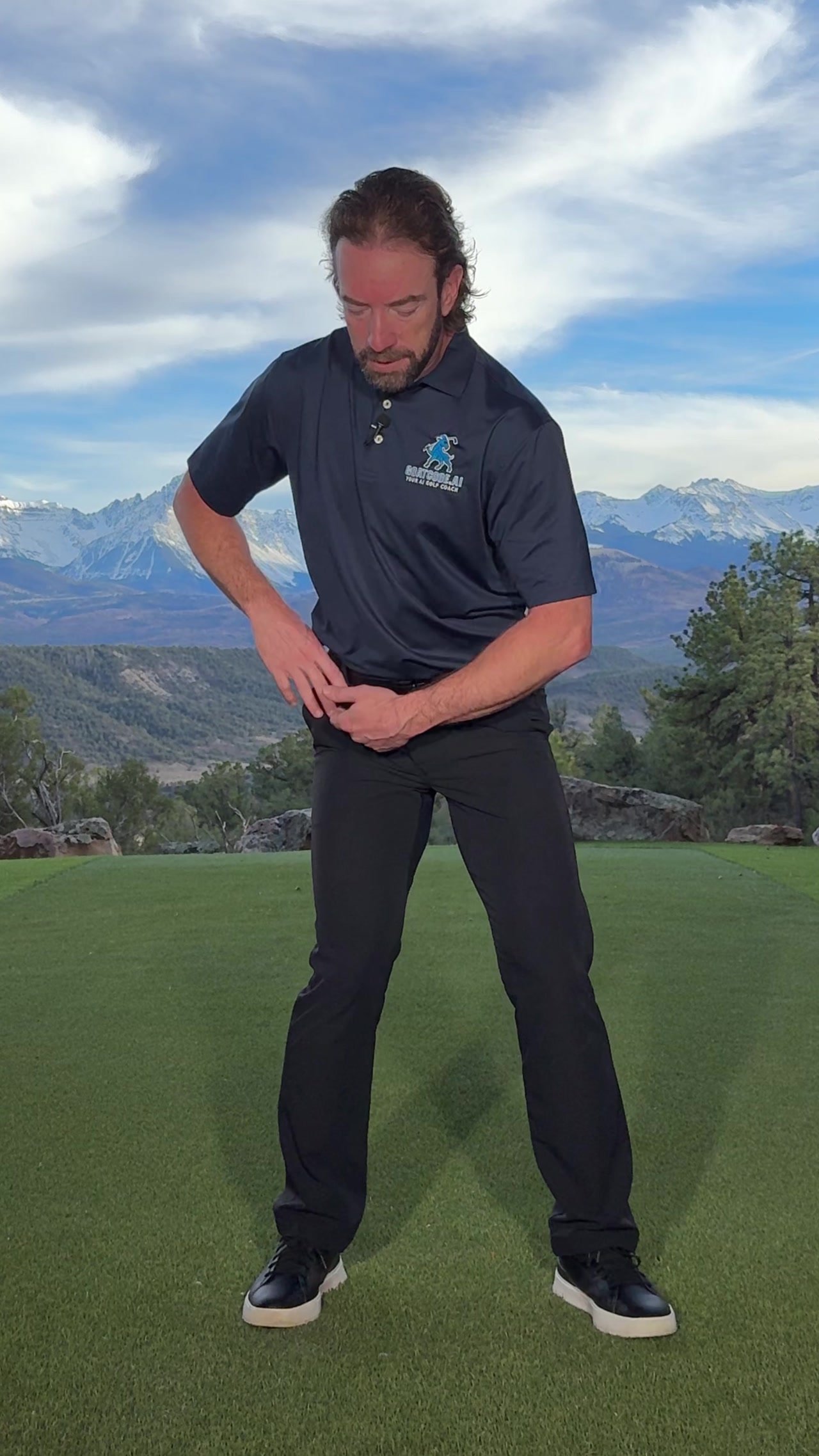
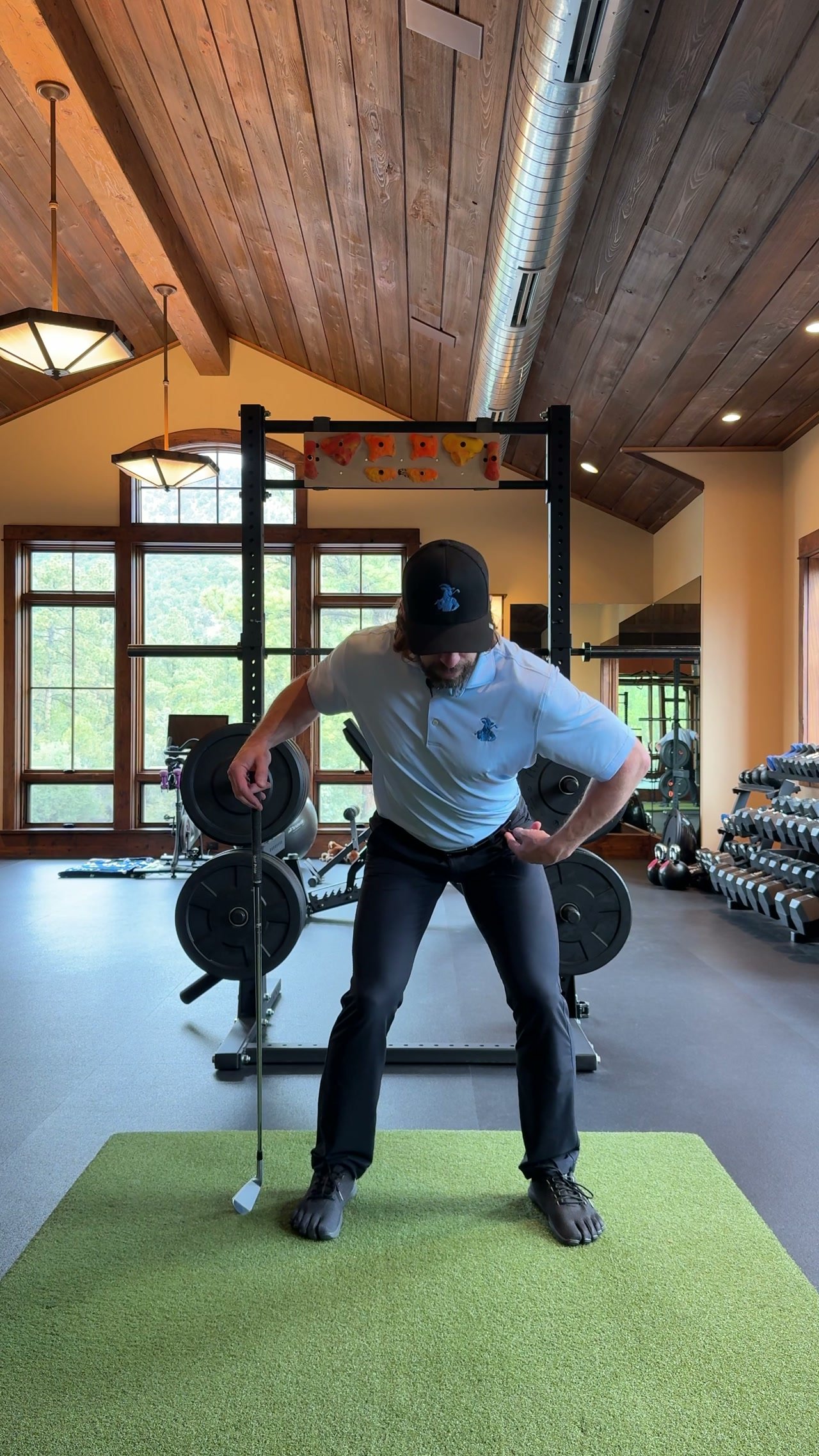
Try the Down the Line live lesson with GOATY free as a RotarySwing member at https://goatcode.ai/easy The goal of GOATY is to make learning the golf swing simple for everyone of all abilities. This new drill that is designed to be used with the new Down the Line Live Lesson in GOATY is a step in the direction of explaining the golf swing as a fascially driven system that loads and unloads. With one simple visual and feel, the swing unifies into one overall motion rather than trying to group together dozens of moving parts.
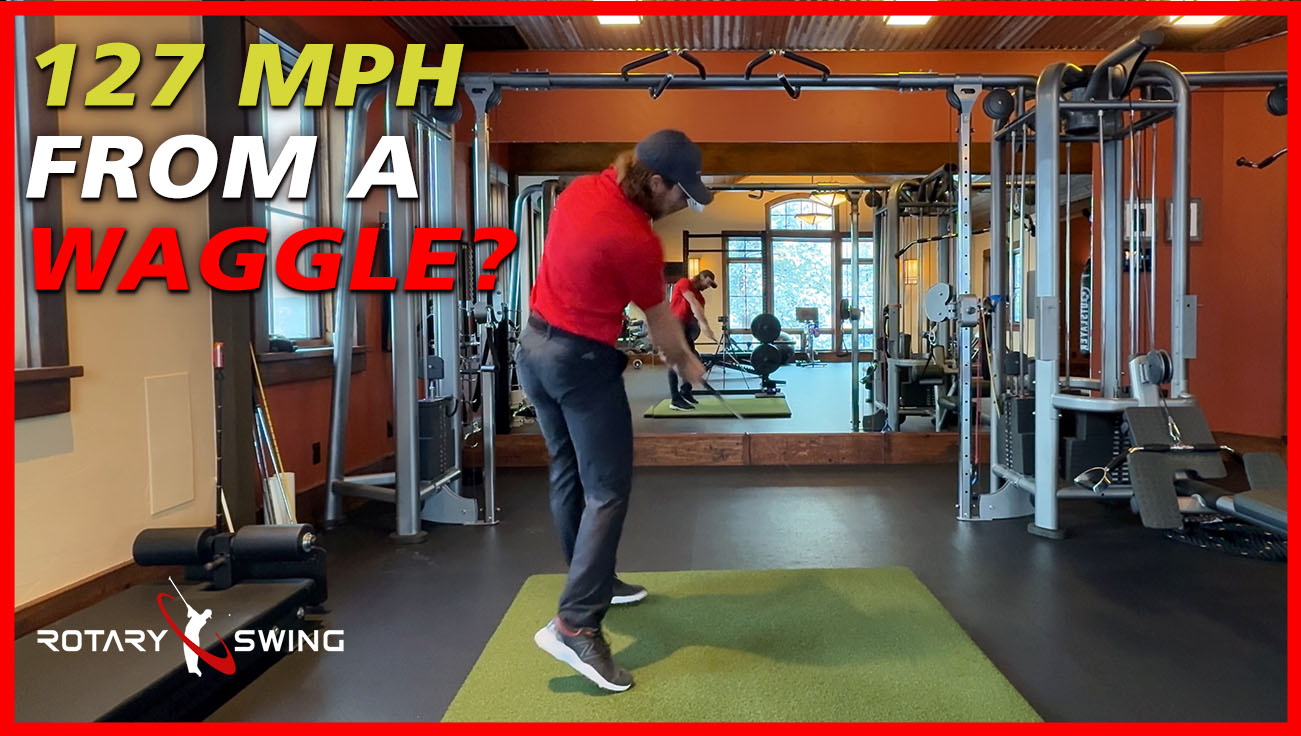
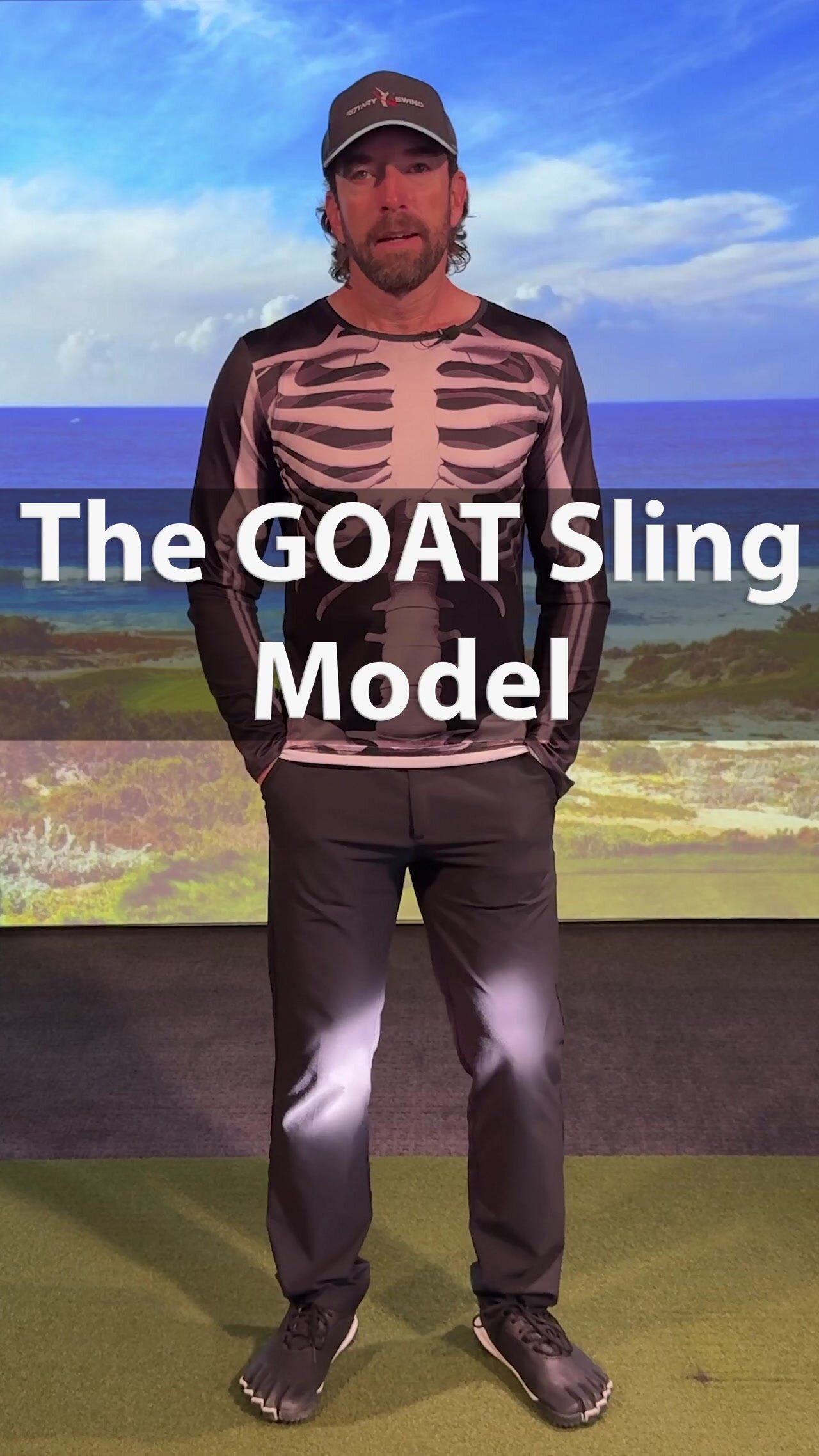
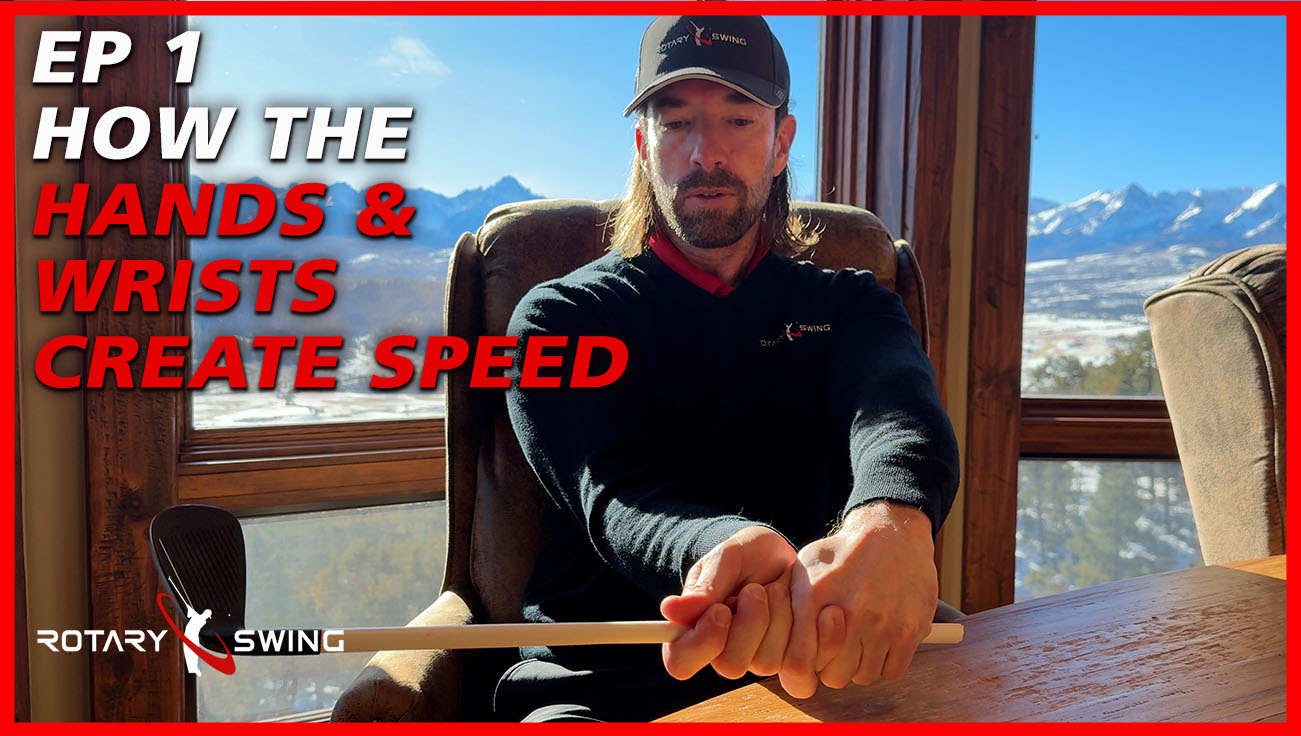
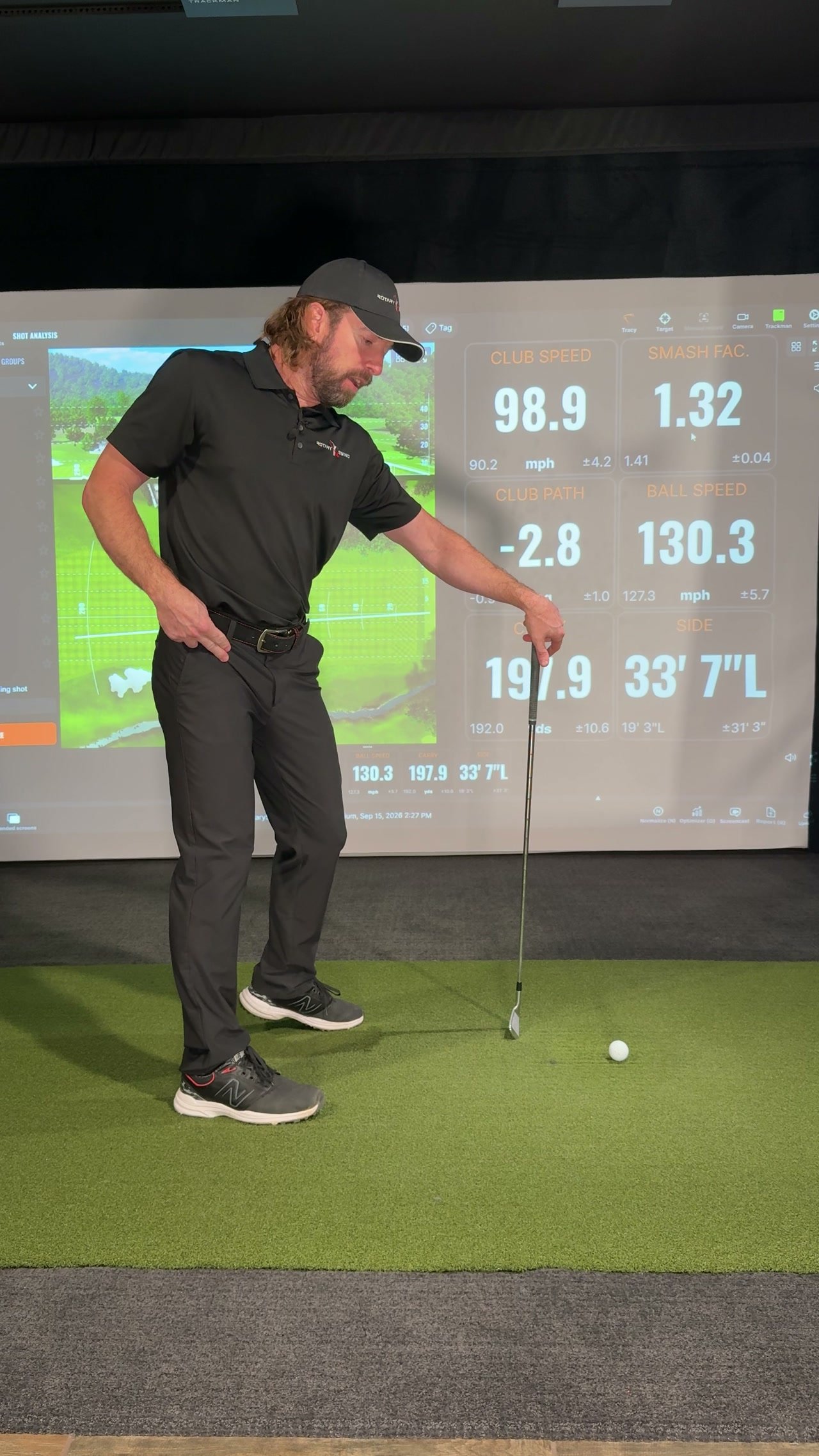
All you need to understand how I'm hitting a 5-iron just cruising, swinging almost 100 miles an hour, is you need a $1 TheraBand that you can get on Amazon.
I literally bought a package of three of these for $5.
And this will teach you more about the golf swing and understand how Goaty is understanding the swing, how I teach the swing, how I envision it, how I use it in my own game, and how to create this really simple visual in your mind of what the golf swing really is.
Because it's really simple.
I'm going to talk to you about three things today.
One, the coil.
This is the most important part.
How do you coil up the body and the backspin?
If you don't do this right, everything else is hosed.
You're not going to be able to play good golf.
And it's really simple, and that's where the TheraBand comes in.
The second thing is containing the club.
And I'm going to show you what that means in more of the second part of this video.
And then the third part is letting it release.
The club releases when you contain it.
In fact, the more you contain it, in other words, trying not to release it, trying not to let it release, the more violently it will release through the ball, as you'll see here in just a moment.
So TheraBand, just grab something like this.
You can do this with surgical tubing, anything stretchy.
The point is that I want you to feel and visualize what's going on in the swing and how I think about what I am teaching you.
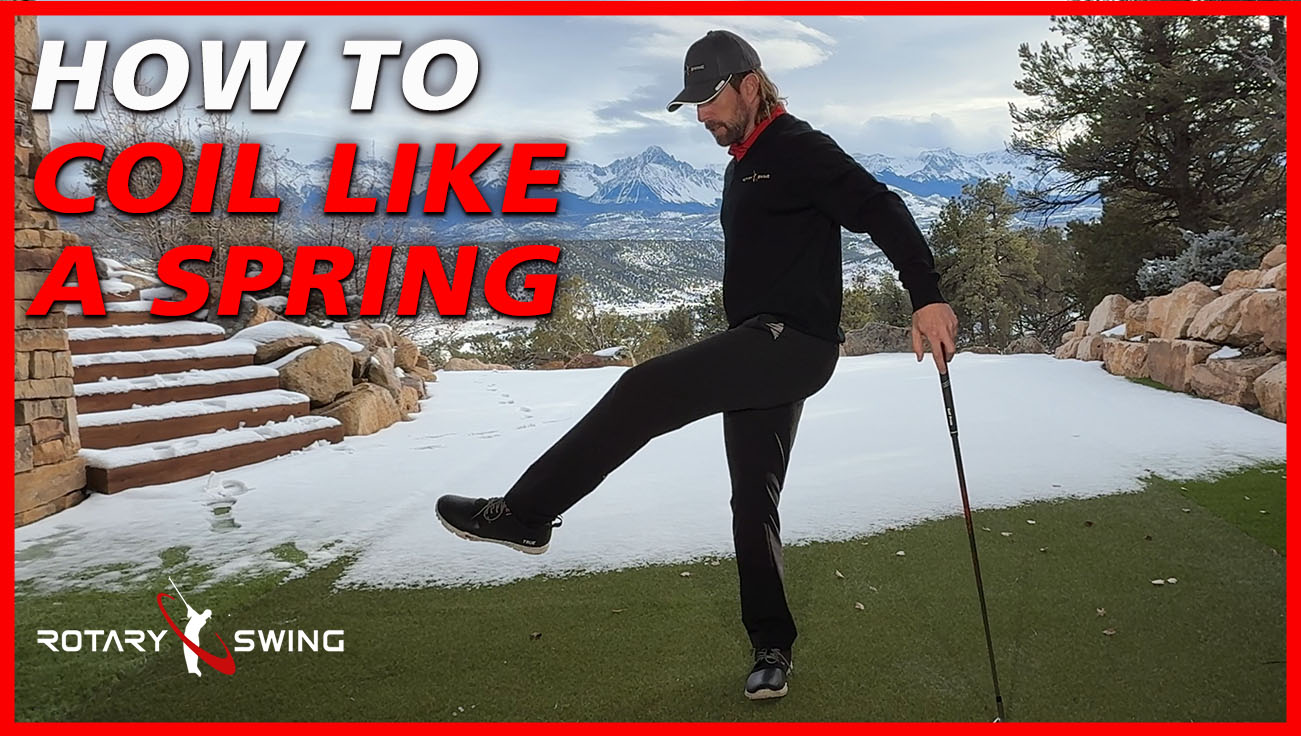
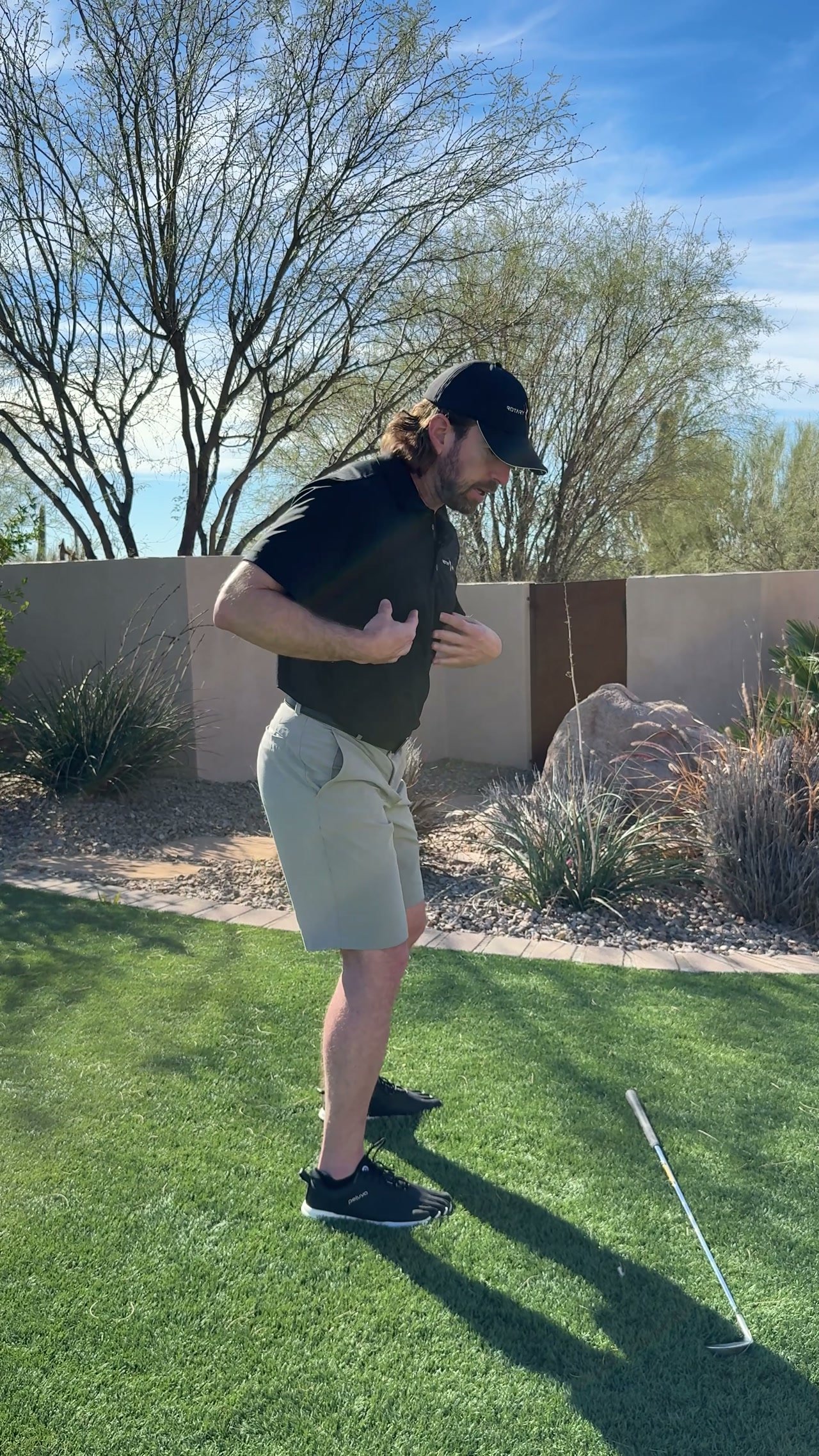
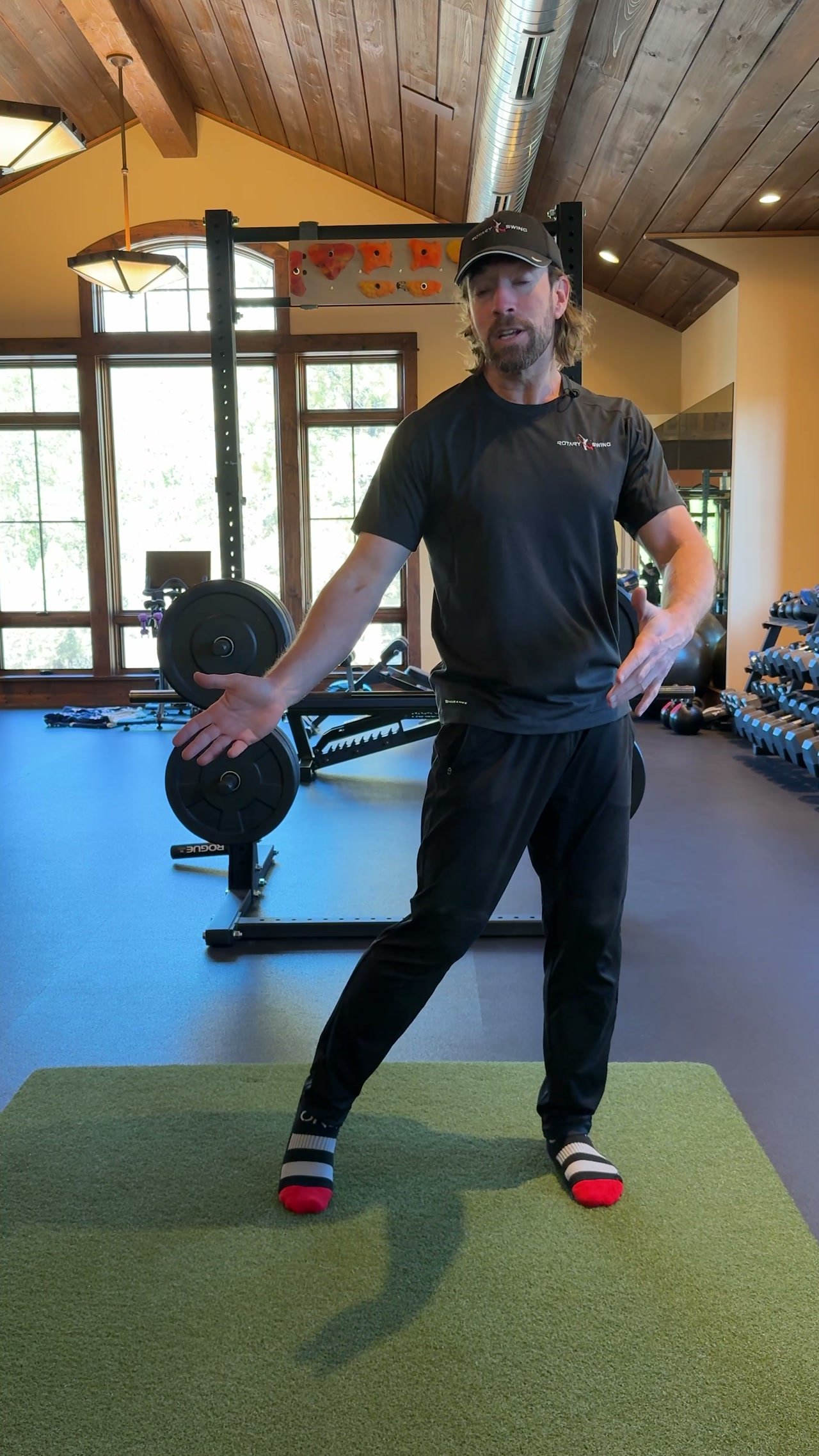
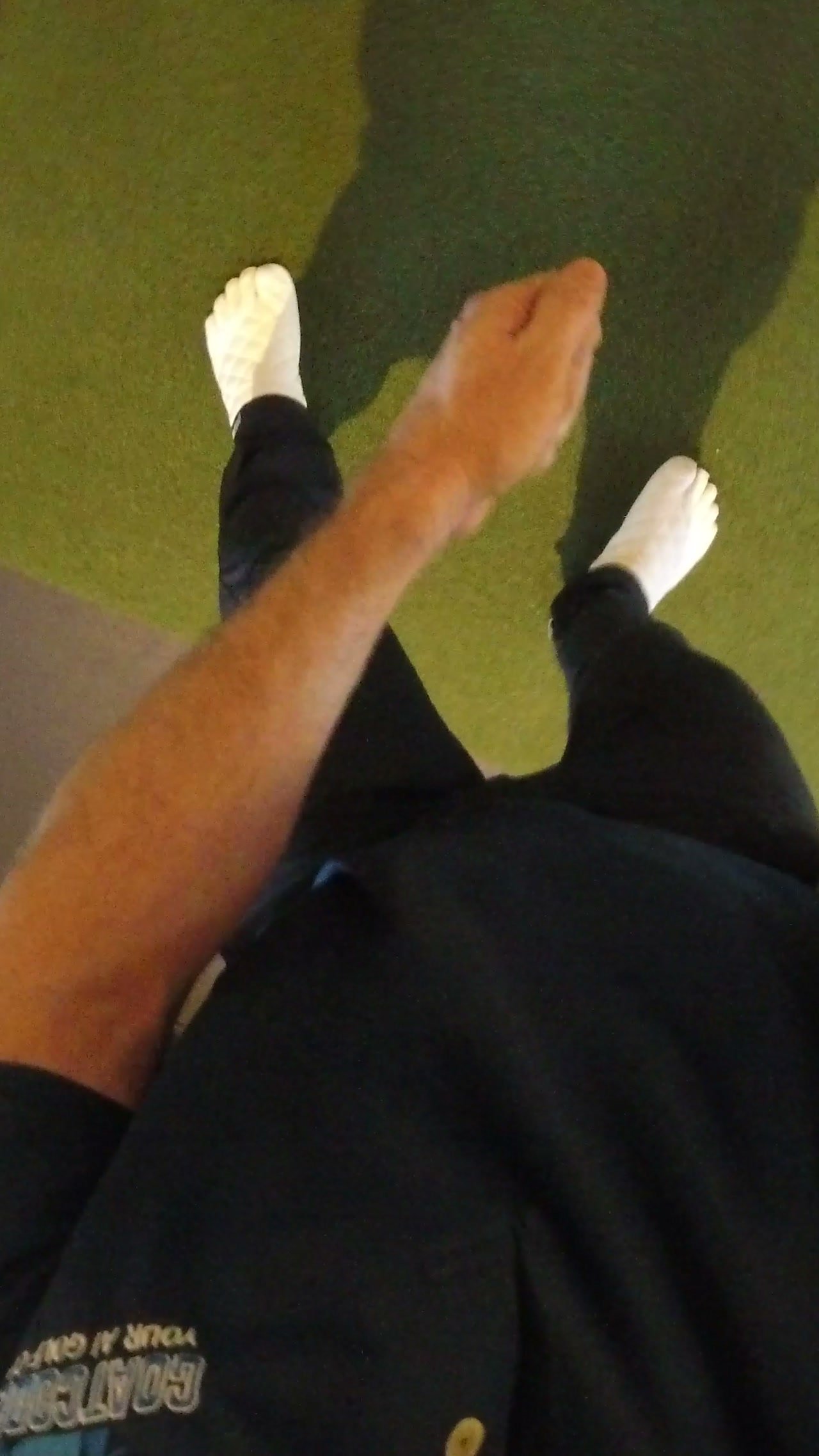
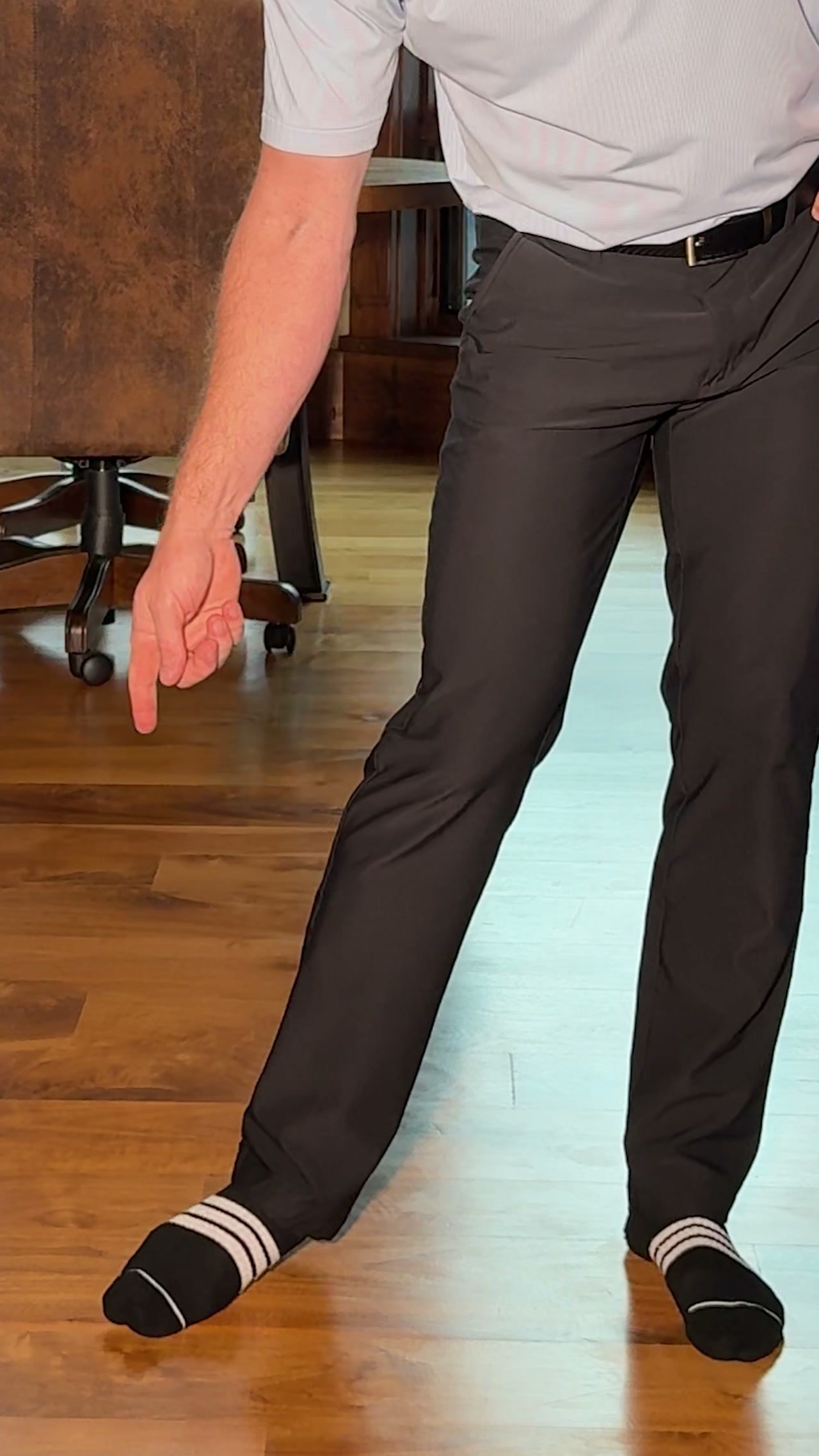
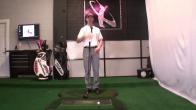
So I just put it under my right big toe.
And then all I want you to do is start to stretch it a little bit, wrap it around your body or wrap it around your leg.
It's going to come up through the inside of your thigh.
Imagine it going through your glute, through your low back up, over your shoulder, your lead shoulder, and down to your lead hand.
This is what you're coiling in the golf swing.
This is all you need to really understand to hit it, as far as I'm hitting it.
as easy as I'm hitting it, because I'm coiling, letting that uncoil, containing the club with my lead side, which you'll see in just a moment, and basically preventing the release until it emerges on its own.
That's it.
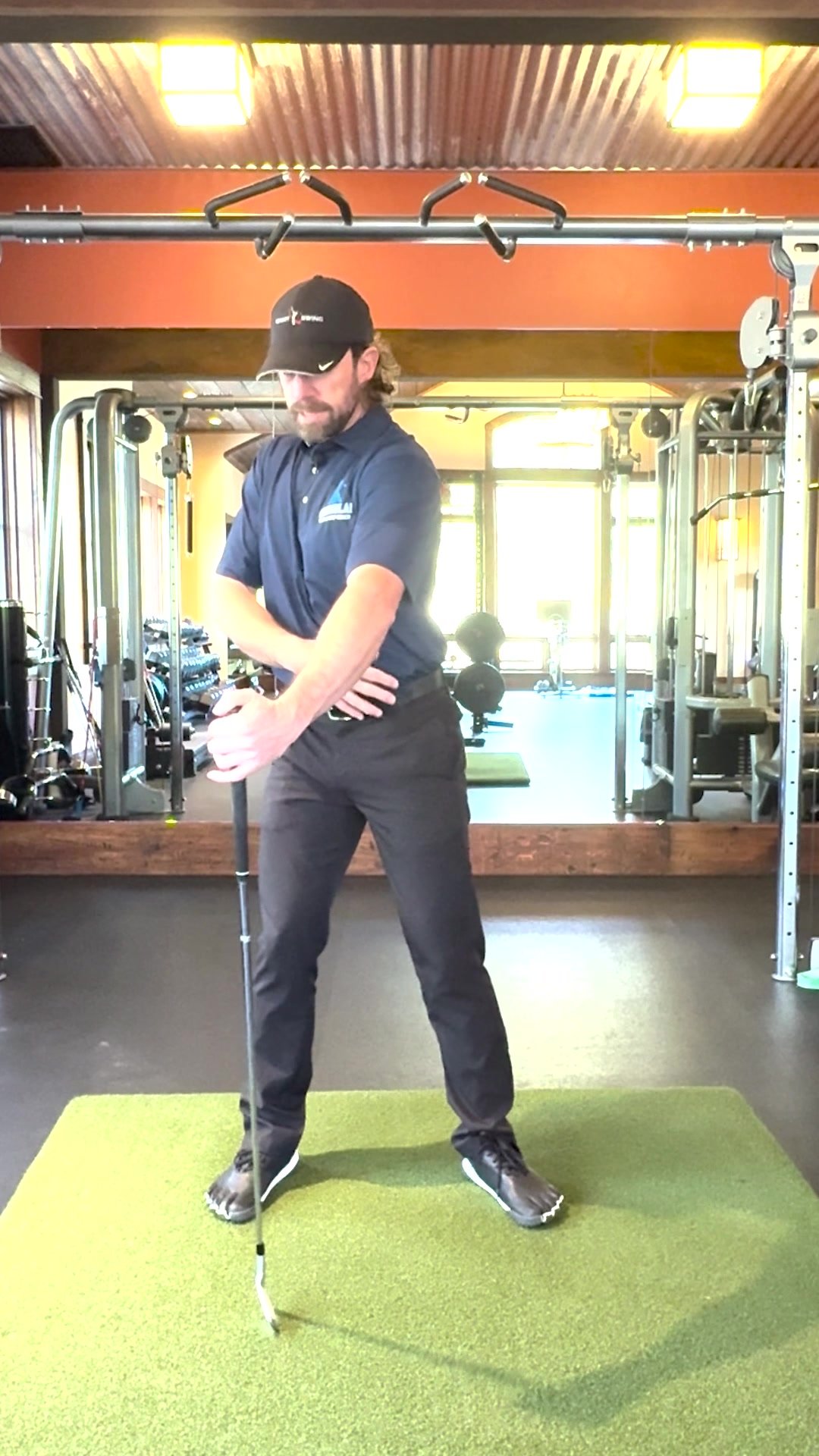
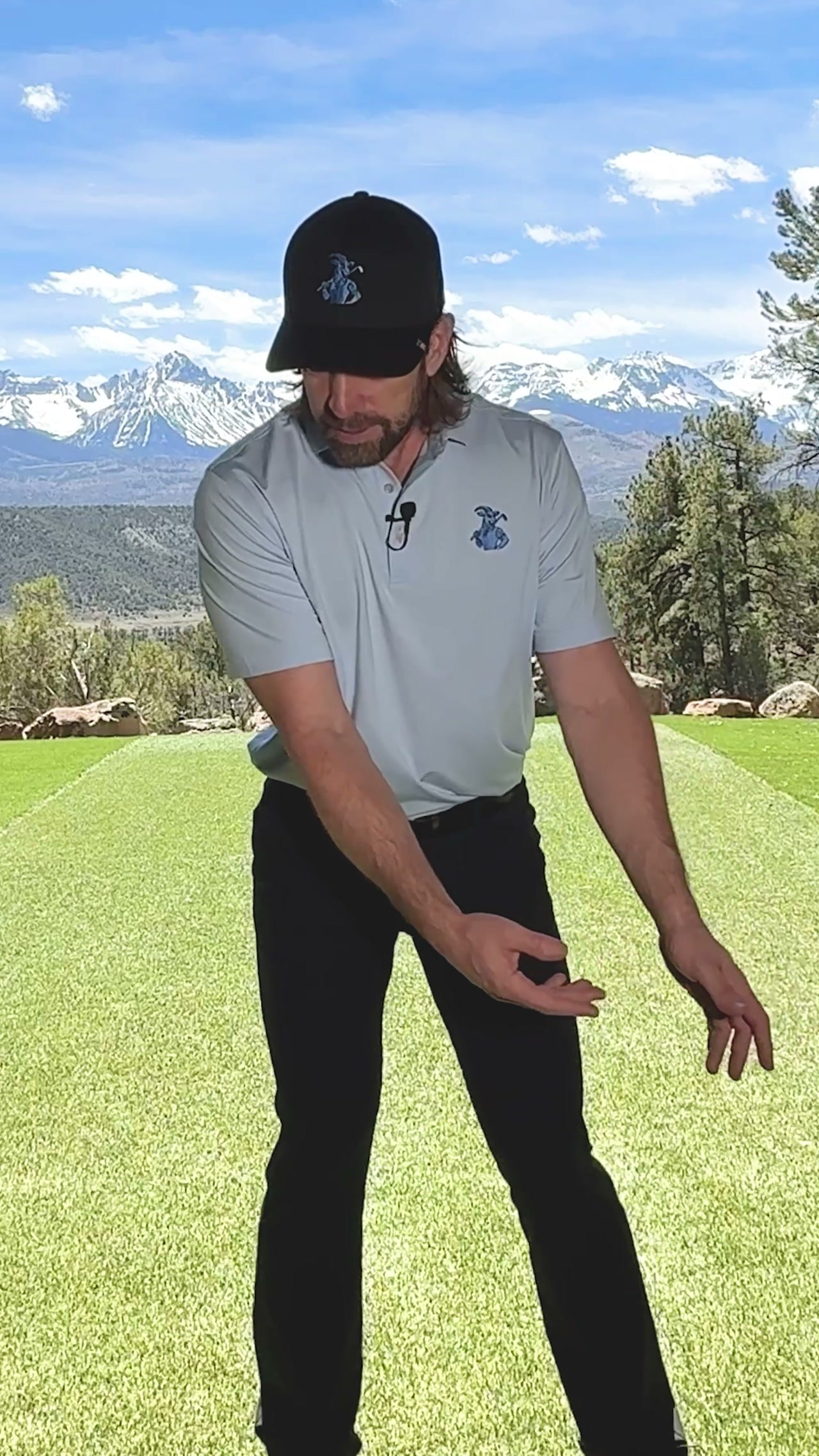
So take this and put your lead thumb through it because this will help you start to understand what all is going on, what you're trying to feel in your body in the swing.
So all I'm trying to feel is that the first thing I do is start to pre-tension this thing.
As I straighten my leg, as I go back and drive my hip back, if you get one of these, you'll feel immediately that it starts to put more tension on it because you're taking out slack.
And that's what you're trying to do with your fascia.
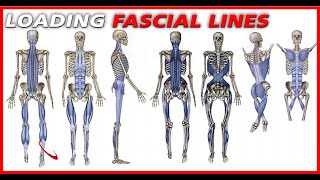
Your whole body, every cell is covered and surrounded in fascia.
Your whole body is just like one giant big elastic rubber band.
And there are different fascial lines and slings throughout the whole body that help us create rotation and walk and all of these things.
And this is what you're really trying to do is take tension out of that, or, excuse me, take slack out of these fascial lines.
That's why your lead arm's got to stay straight.
If I let my lead arm bend, all the tension I feel here is gone.
And it goes throughout the whole system because your whole body is connected with fascia.
So as I go back, the first thing I'm doing is straightening this leg and giving myself a nice.
stolid anchor.
So I got to get into this hip.
I'm not sliding like this.
This puts more slack into the system.
I'm going up and back.
And now I feel, oh, don't go away.
Step on that hard.
So you can see I put more tension on it, pulled it out from under my feet because I'm loading this way.
And this movement, as I've just basically driven my trail hip up and back, my pelvis is turned and my rib cage is turned.
Look how much I've turned already.
And I feel very little tension here.
So what I'm doing is I'm using my leg in the ground to kind of initiate and drive everything and keeping this wide.
I'm just trying to prevent the club from going anywhere.
I'm not trying to swing the club and set my wrist.
I'm doing the opposite.
I'm trying to contain the club, which I'll show you again in a moment.
But the big key here is as I go back, I'm keeping this wide and long.
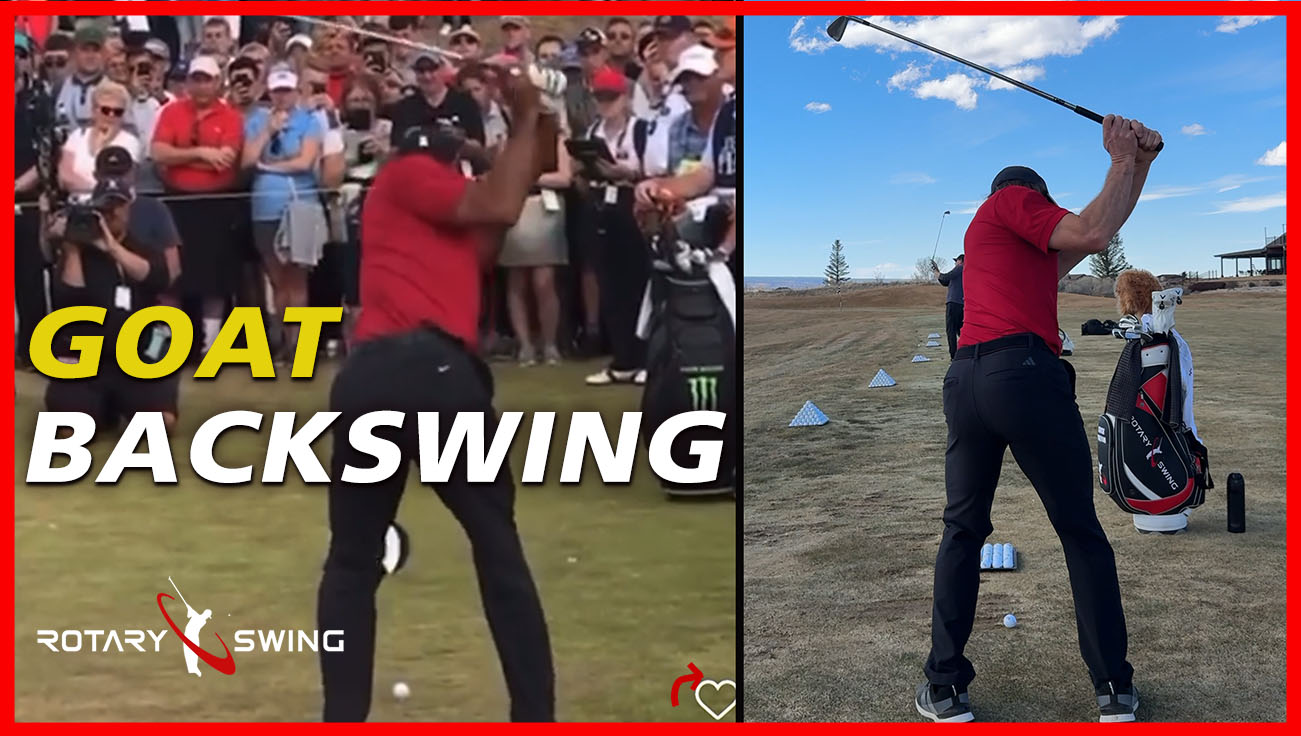
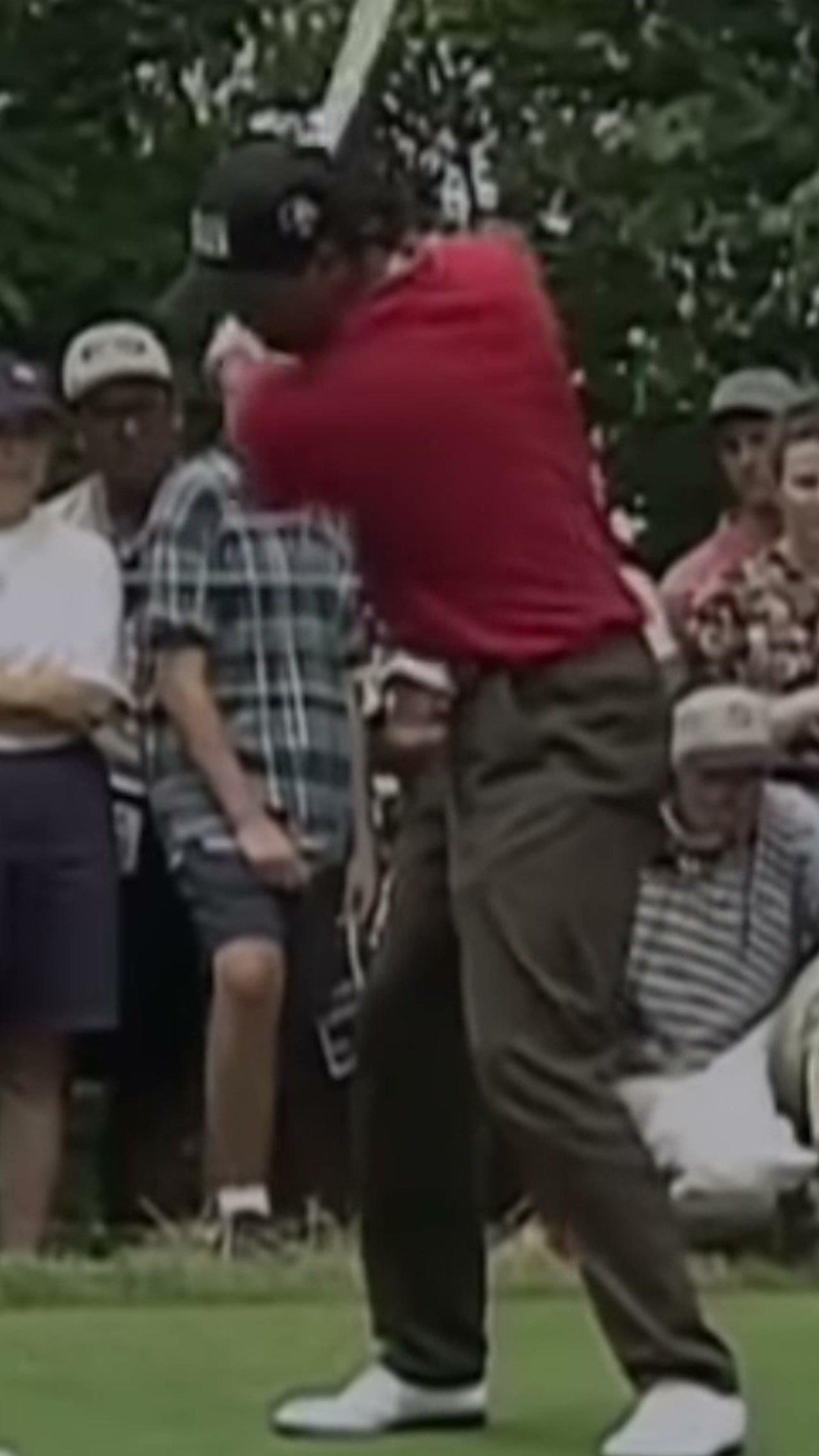
Tiger used to talk about that all the time in his swing.
And he's had the widest swing, perhaps, of anybody other than maybe Davis Love.
The third Tiger's always had very little late, very little early wrist set, a super wide path.
And he's always said.
I try to get my hands as far away from the top of my, up, from my head as I can, at the top of my swing.
Because he's stretching his whole body to be able to fire violently through the ball, but it's effortless violence.
When you understand that you're just basically stretching this whole diagonal line, the spiral line and letting that release, then you start to understand that you're not trying to muscle it.
I'm trying to load this whole line and then as I load it even more in the downswing, dynamically.
And then as I keep driving, there's so much tension here.
It pulls everything through for me, it rebounds.
That's what fascia does, you stretch it and you let it go.
It's exactly like this.
If I let this thing go, it's gonna smack me in the face.
That's what you feel in the swing, that's what effortless power is, it's stretching the fascial system and letting it do all the work for you.
So load up, go back, keep this puppy wide.
You let your arm bend, what happens?
tension's gone, and you reduced it all the way down to the ground.
Keep this wide.
You don't want to bend your right arm, what happens makes your left arm bend, and then you lose all the tension.
You want to pick the club up because now you're not letting the club go or your hands go around enough.
This all of this spiral line needs to go this way if you just pick the club up like this.
Again, no tension.
So keep your trail arm out of it.
It's not going to do anything.
You're just going to use this to keep it structured.
You're going to keep your lead arm straight.
It's connected to your rib cage.
Go back.
You can see I've almost made a full shoulder turn, but I literally have not turned my shoulders.
I'm not trying to do this, nor am I trying to create separation between my upper and lower halves.
That's all going to happen as a result.
All I'm trying to do is load this so I've got an anchor into the ground, Straighten this leg, drive this hip up and back.
And that has moved my rib cage, where I've almost made a 90 degree shoulder turn.
And I feel zero tension here.
I'm just keeping this spiral fascial line loaded and now as I start down again, I would already be moving over here.
Because of the dynamics of the swing, you don't have to try to shift, you don't want to push, you're just going to stay when you're doing this slow.
What I want you to do is stay back on your trail foot for right now.
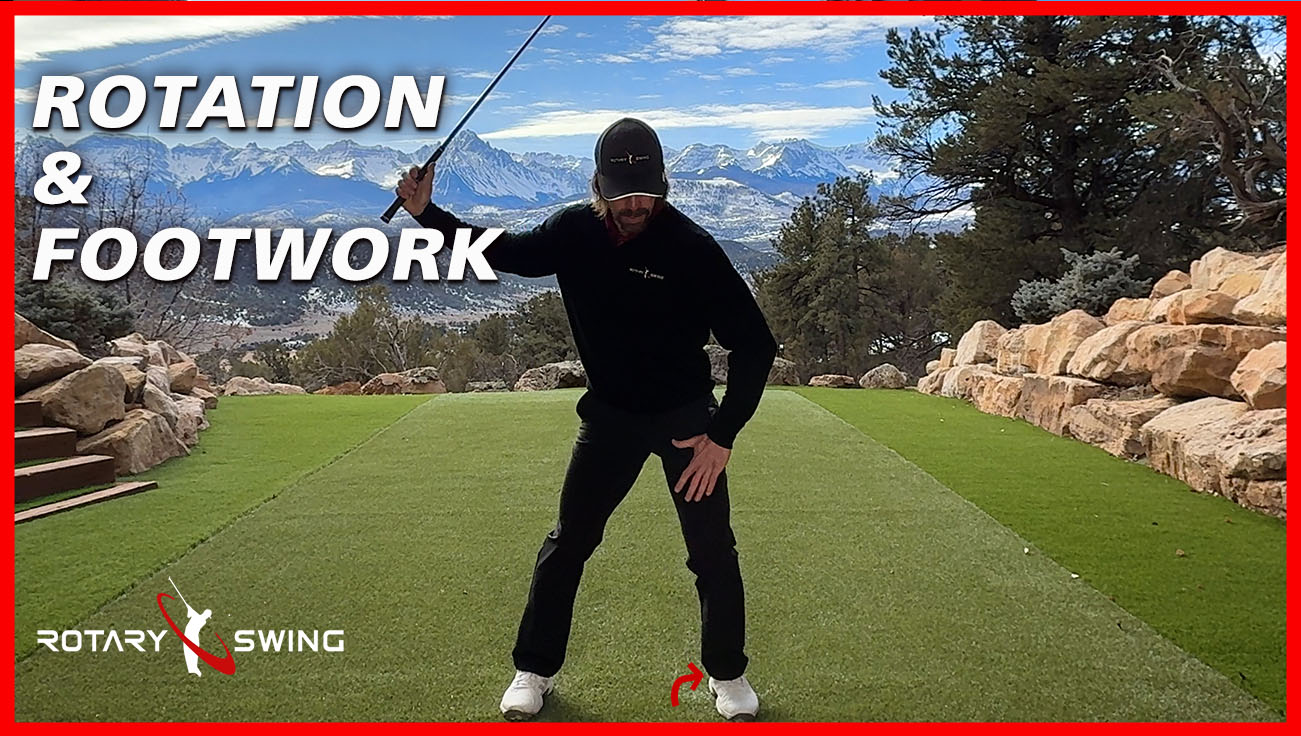
What you're going to feel now, come up onto the ball of your foot, straight to your right big toe.
Now I can feel that, as that's happened, I've taken even more slack out of the system, it's now pulling against my thumb.
I feel it by doing this because now I've started to turn.
I've taken fashion or tension out with my shin as my knee comes forward.
And now my.
I'm onto my toes and ball over my foot.
So I can explode off the ground and drive explosively and pivot rather than slowly push myself over.
It's not what I'm trying to do.
You don't need to try and shift, you stay here, come up onto your ball, your foot and your toe.
Keep this back, and a great feeling is taking your trail hand, putting it behind your trail elbow.
And now, if I do this and my hand doesn't come with me, what do you think's happening to the tension in these bands?
I feel it even more loaded now.
So now, from here, the whole chain reaction has been set off.
And as I just keep pivoting on this toe, that's why I say, I don't want you to try and shift over right now.
Pivot onto your toe and you'll feel how that is going to allow you to keep rotating and look where my hand is.
I didn't move my left arm, my left arm got moved by the whole fascial system, by the loading by my right leg, my pivot onto my toe.
That's where all of this happened.
From now.
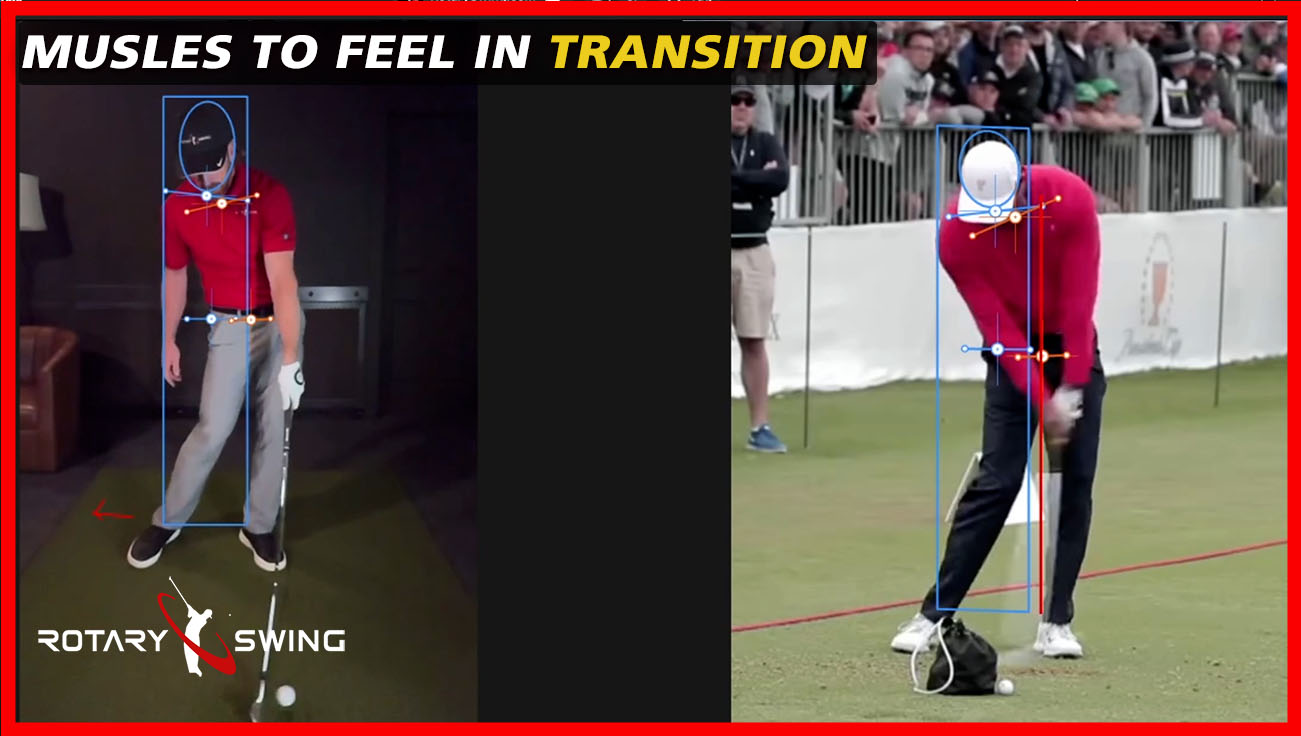
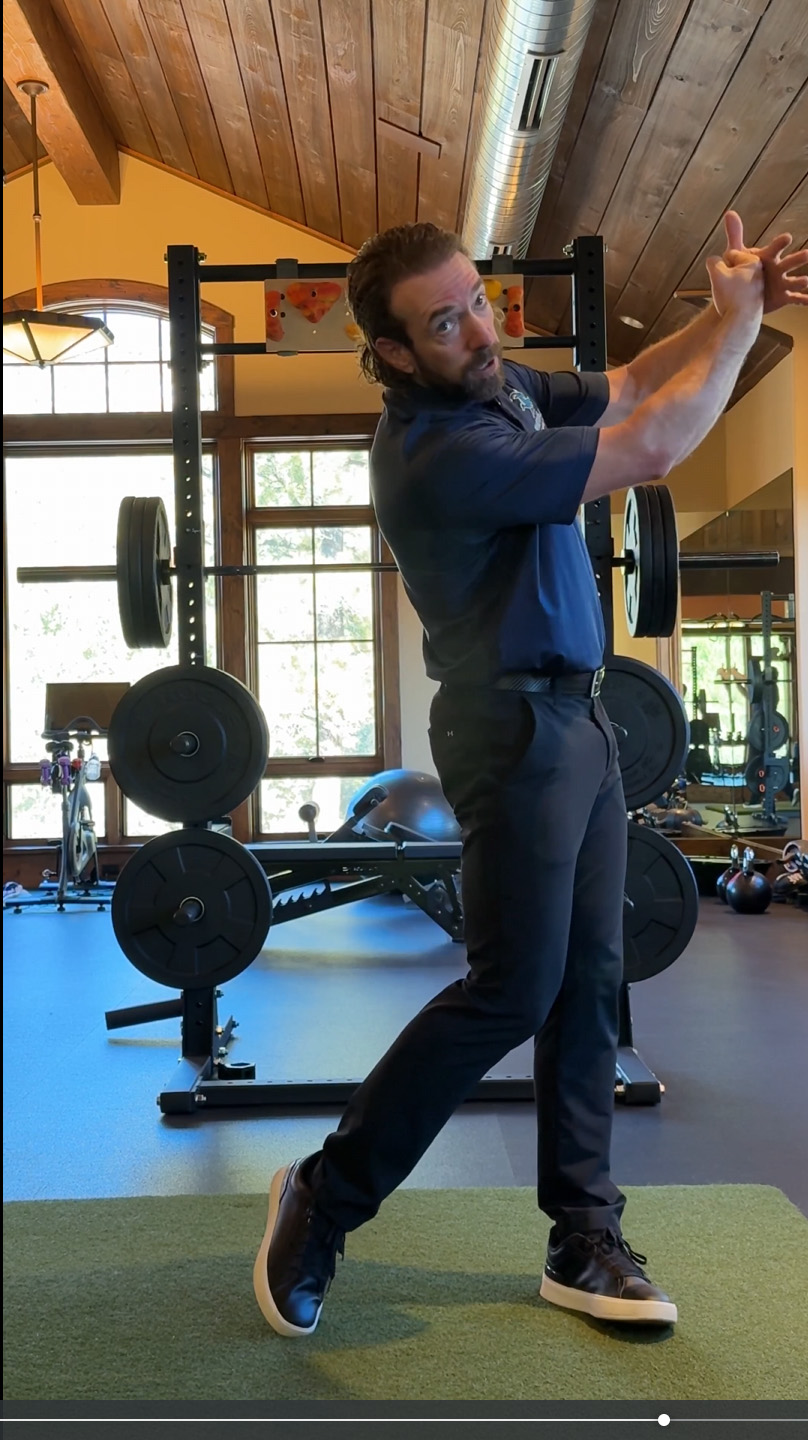
Look where I'm at, I'm right back in GDP, the Goat delivery position, right?
I got moved here by my whole right foot, right leg, right hip.
That did everything.
And then from there, all I need to do is contain it.
Let me talk to you about what I mean with that.
Okay, so you start to get the spiral fascial line that I have envisioned in my head.
That's what I feel in my swing.
That's what all I'm doing is.
I'm coiling up and you'll see in a moment.
I'm going to cruise at almost 100 miles an hour with a five iron and look like I'm barely moving.
And it feels like I'm barely moving, but I'm moving a lot and fast from this guy.
Now, if this is moving fast and a lot, what do your arms need to do?
Nothing.
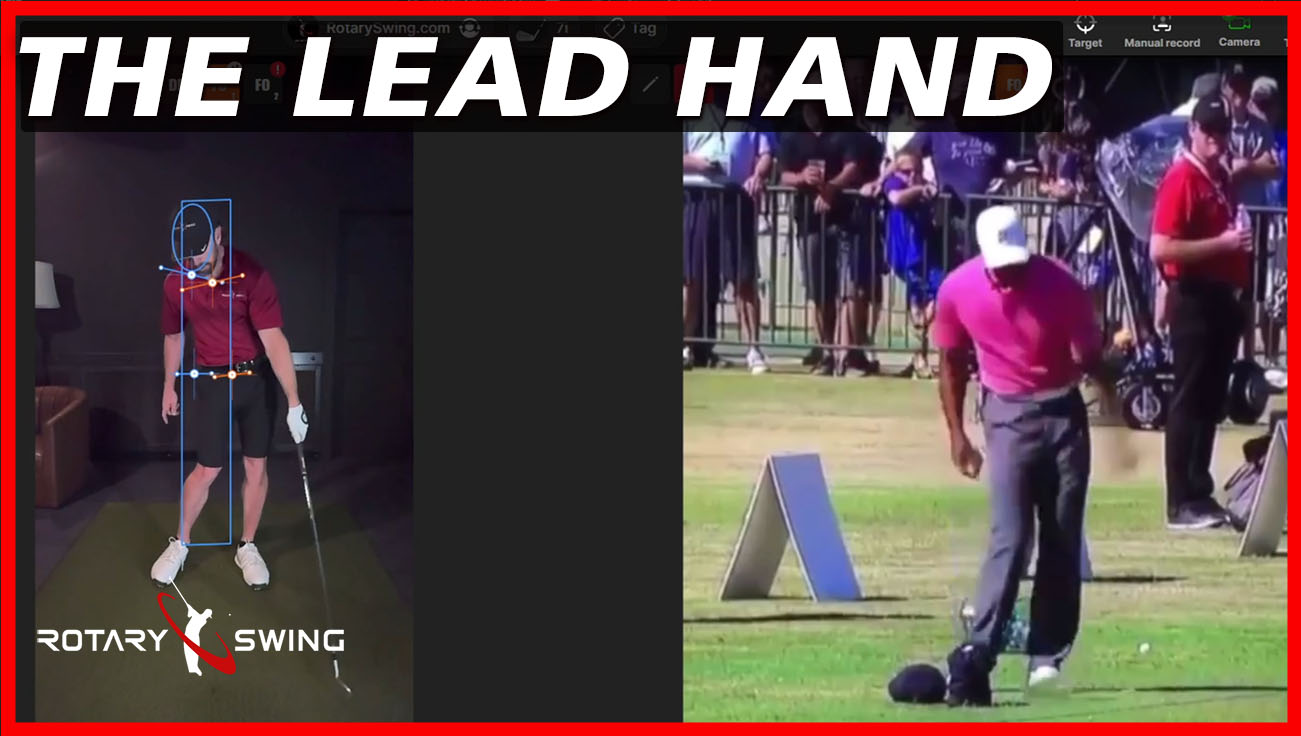
They contain the club.
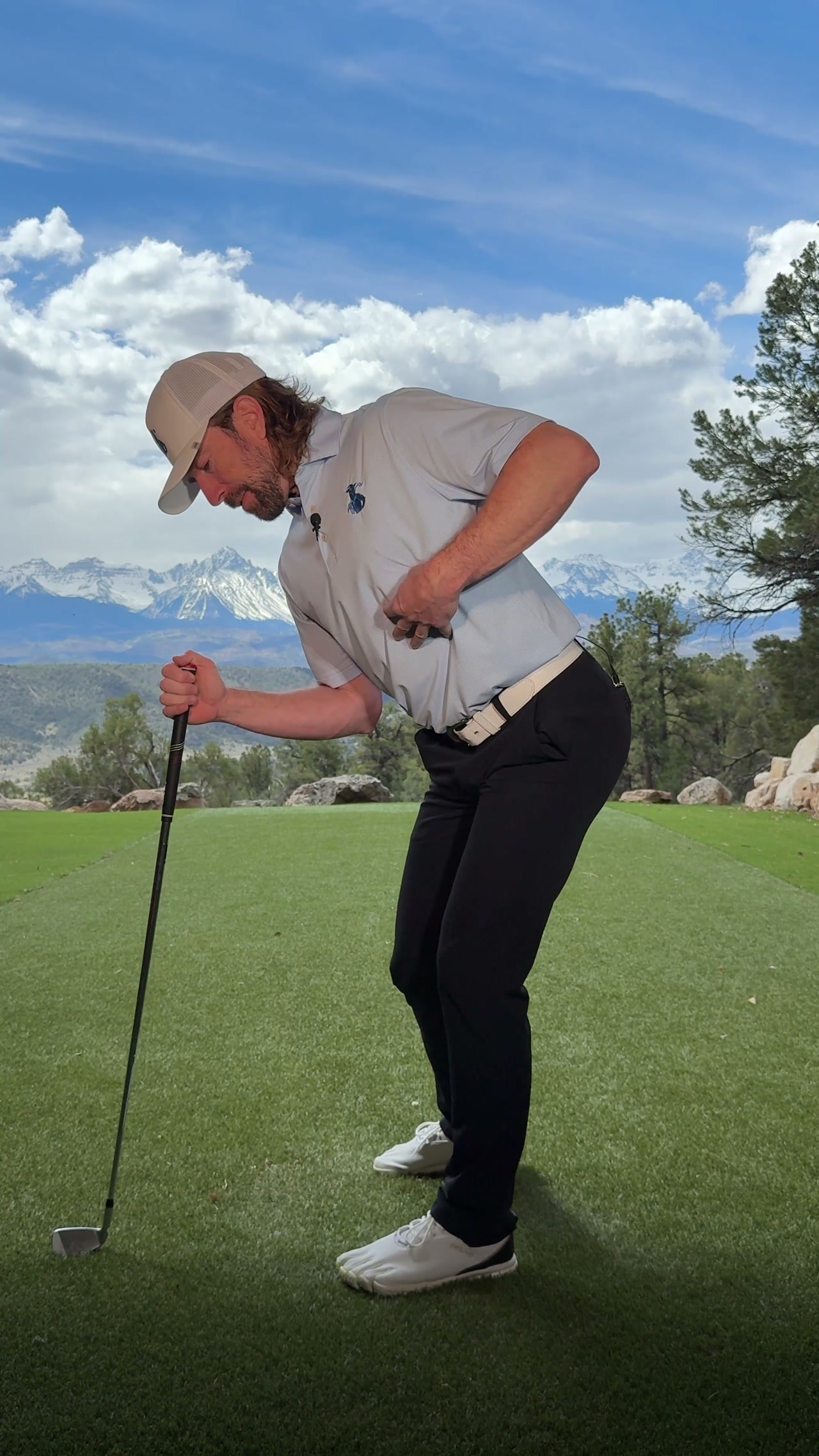
Your job is constraint, not to swing, not to set, constraint, contain.
What I mean by that is, once you set up here, your job is to try and keep this relationship the exact same throughout the entire golf swing.
That's your job not to set it, not to roll your arms, not to do any of that.
What I want you to do is start loading the spiral fascial line and contain the club.
So now you'll see that as I go back.
club's right in line with my hands.
I got a perfect takeaway.
I did not try to do a takeaway.
I'm loading and letting this all start to move back together.
Now, of course, my ribcage is going to start to turn.
You're going to use that to help start swinging the arms and so on, but it starts from your trail foot and leg.
Once you're over here, now, if I don't contain the club, guess where it wants to go?
Way back inside.
If I try to manipulate it, I take it outside.
I'm doing nothing, I am loading my right leg and containing the club.
My last three fingers are holding on to the club.
My thumb is, you know, holding on to it to help give it control as well.
I'm not trying to push against it, but I'm holding it firm enough.
That the club doesn't want to do all this stuff.
Because I don't want it to do anything, I want to contain it, so as I go back, club still contained, right, my arms didn't do anything.
And with momentum, they're going to go all the way back and that's going to stretch the rest of this fascial line.
And then as I come down, my arms aren't doing anything.
They're not pushing, they're not pulling, they're staying.
Because I want to slow this fascial line and keep this under load, under tension.
And if my right leg fires very quickly, look what happens in my hands, I'm literally holding it back.
But the club is starting to go and it's going to go fast.
Because this motion, just like you would make in baseball, is super fast.
And so as I'm doing this now, the club's here.
It's right back in GDP, but I felt like it's right where it was at address now.
Of course, the momentum and the speed.
You are going to go back very fast, you're going to load this back as fast as you can, and your arms are going to get swung very fast.
But what you're trying to feel is that they stayed exactly where they were at address.
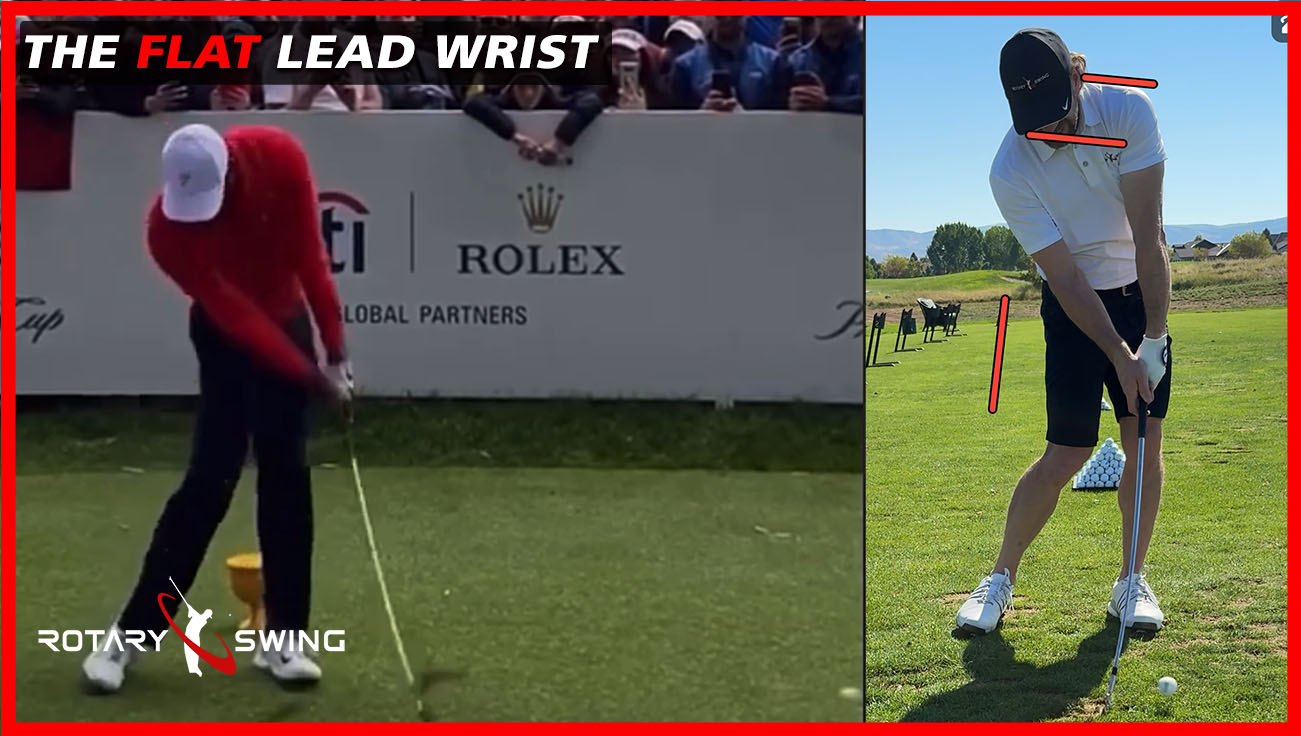
But the catch is it's going to start to bend.
It's just too heavy, you know?
It starts to want to set here, that starts to flatten my wrist.
I didn't do any of those things.
I'm trying to contain it the whole freaking time, and if I could, really, if I go slow, I can actually contain it right.
So it really is exactly where it was at setup.
And then if I pivoted really quickly, I would just feel, as I come through the ball, that it's exactly where it was at address.
I'm trying to just maintain setup throughout the entire swing with my arms, that's my feel, and you'll see that as I'm trying to do that.
It can't happen.
And that's when the release emerges, you are trying to contain it, it will release itself.
So as I come through, all I'm trying to do is keep pivoting.
To make sure that this trail hip keeps getting my hips all the way open to drive up my this lead side structure back to the ball.
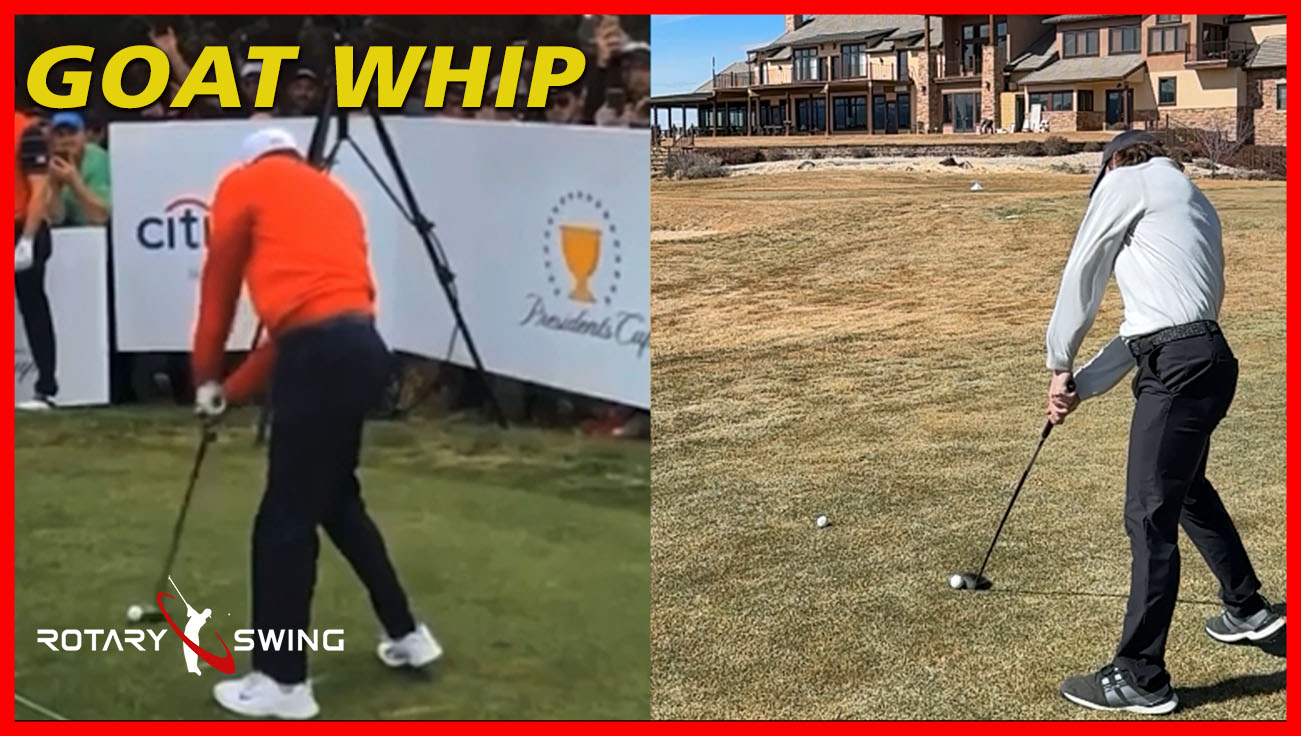
And you'll see as I start to do that now, as this trail hips open and made room, that's when you can feel your trail hand start to throw.
A lot of people when they take the throw from the top idea, they think a throw from the top is using their arms.
A throw from the top is still my leg.
I don't throw a baseball like this.
That's dumb.
I'm coiling and throwing and driving and then my arm is rotating.
It's not pushing.
This is a push.
My arm is rotating.
And then as I build up all this tension in my fascia, it snaps effortlessly.
The golf swing is no different.
If I'm going to feel that throw, I'm just making room with my trail leg.
But all I want you to feel to start out with is just containment.
Don't let that puppy go anywhere.
Set your constraints at address.
My left wrist, my left hand, they're all relatively soft, but I'm not letting the.
I'm holding onto it firm enough.
That's not going anywhere, and as I keep going again, momentum flattens out my wrist.
For me, it sets the club for me.
I'm trying to contain it and you can hold on to it tight at first to get used to this feel.
If you're used to making a, you know, really sloppy, long backswing contain, contain.
I'm just making it exactly like it was at address.
And then I'm firing as fast as I can.
And then, as I feel like I come through the ball, my goal is just again not letting anything release.
But because there's so much tension on the fascial system, my hands snap like crazy.
And that's how I'm able to swing so easy and yet still hit it so far without trying.
And that's what you're going to feel.
I'm doing exactly this motion.
Let me show you.
So once you start getting used to this trail leg firing correctly, you're going to be able to just cruise.
And I'm going to show you and I'm going to walk you through exactly what I'm feeling, exactly what is going on in my swing, and how simple and effortless it is because there's really only two things going on.
Trail legs loading.
I'm containing the club with my lead side.
That's it.
And you can make it more complicated if you want to, but I'm all for being very simple here.
So the first thing that I'm really focusing on is just loading.
I get into this trail leg, so I'm here, I'm, I'm really getting into it.
And as that starts, standing up and going back, I'm getting power out of the ground, into this trail leg.
And getting ready for it to be able to fire, that's all I'm really focusing on.
I'm keeping my arms very relaxed, even though my lead arm is providing structure and containment for the club.
it's not actively swinging.
Watch what happens.
My job is to contain this club.
I don't want it to do anything is basically what I'm trying to feel.
But if I load this back, you can see that my rib cage is turning.
And as long as this comes along with it, the club starts going, but it's all being driven off loading up off this trail leg.
So I'll hit a couple here and I'm going to walk you through it.
So all I'm doing at setup, I'm really starting to feel that this leg and this glute and this hip are ready to push into the ground, to straighten, to get this hip to drive back.
So that I can coil around it because I need a strong leg in order to load those fascial slings, that that spiral fascial line, I showed you, so now I'm focusing on last three fingers, middle two.
On this hand.
The club's just going to fall into the to my right hand as the club comes down, but I'm really just keeping my lead arm connected.
but soft, relatively, and just loading into my trail leg, and that's it.
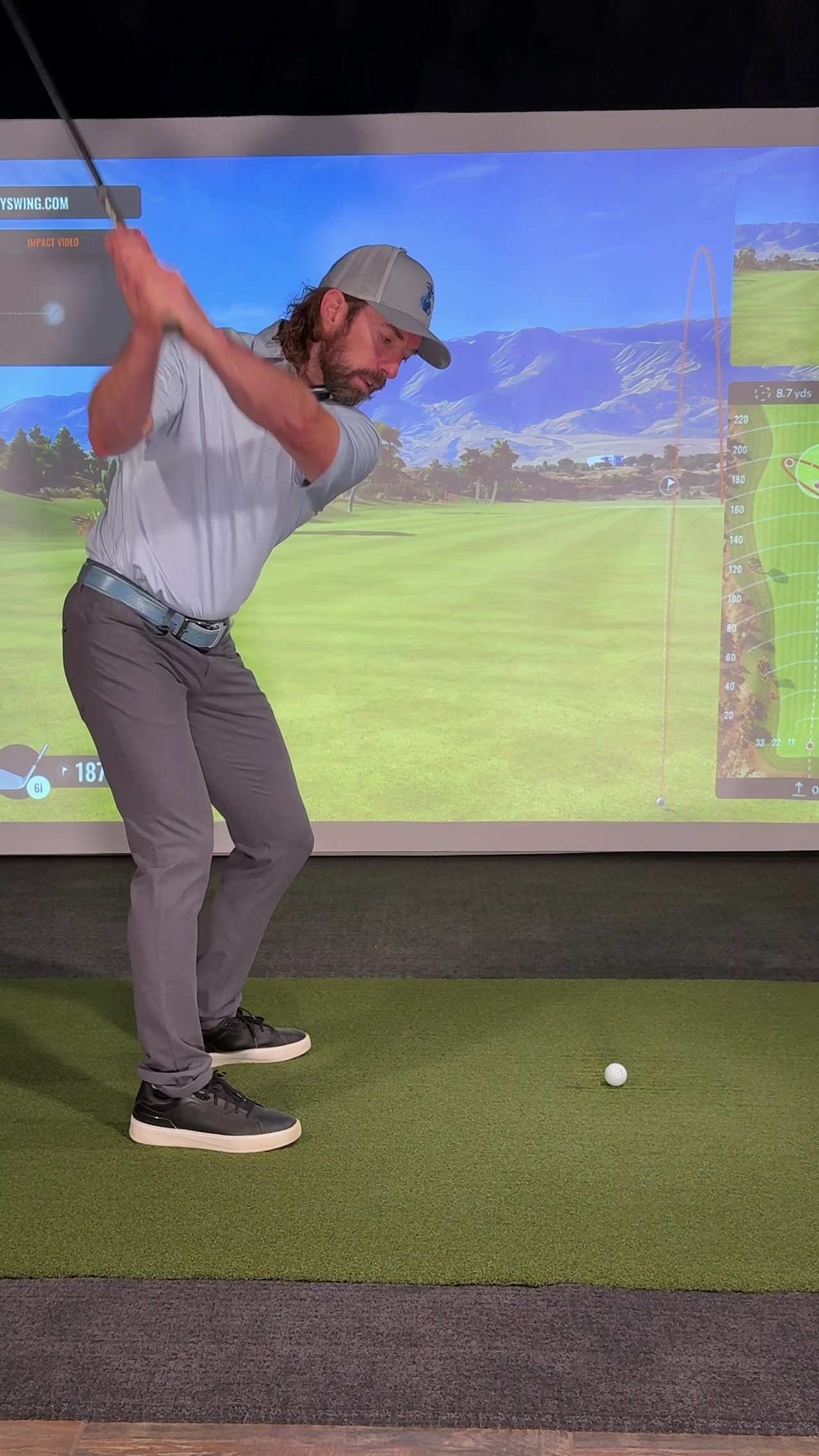
So just cruising 96.
5 with my trusty 12 -year-old 5-iron, 11 inches right of the target.
All I felt, load, drive, load, uncoil, coil, uncoil.
And I'm really feeling my knee because as I go back and I lengthen this hamstring, as it gets long, it then wants to release.
And so this is fast, as fast as I can make it.
And what happens when that, when this starts to fire back and I get up onto my right big toe, my arms, because they're not doing anything, They just kind of collapse and fold into my body.
And then, as my trail leg keeps driving, you know, off my big toe, as I keep pivoting, then my arms get slung through.
But I'm not trying to release the club, I'm trying to contain the club.
But as I keep driving and all of this force gets transmitted up through my arms, the club releases, I load, I contain, the club releases notice.
I didn't say I release the club.
I didn't feel that my hands were flipping over there.
I'm trying to keep them from doing that.
I'm trying to just drive through, get this great hip to fire all the way through and letting the club feel like this the whole way through.
But because it starts moving so fast, that was 96 and a half miles an hour, again, just cruising.
The club is going to overtake my hands.
My job is to contain it and force it.
So that, you know, build the system around it, around my trail leg, loading and unloading such that it's forced to release.
Let's do a couple more and I'll talk through, I'll make a couple mistakes here, and I'll show you what tends to happen when I do this, but I'll just make another normal swing here.
So again, I'm really getting ready to get onto this right leg.
I really feel that I move on to it pretty substantially now.
Obviously, you look at my video.
It's not that big of a drop or lateral movement, but it feels significant because I'm trying to get this whole leg to fire.
Hit that one off the toe a little bit.
Again, thinking, talking, all that stuff, but 99 miles an hour, just cruising, and my hands are doing nothing through the ball.
I'm actually literally trying not to release the club, but not forcing it.
I'm just not doing anything that would cause it to release, except for driving this coil coiling back and letting it uncoil for me.
Now, let me do one.
That's really common mistake that you kind of stop, so maybe you get this first part of the trail leg, but then because you're used to using your arms, you kind of stop.
And then you push into the the ground with the the trail arm and your hips will still be square.
So when you're on this down the line lesson, you want to see that both butt cheeks are open.
And that's only going to happen if you don't try to hit the ball with your right arm.
So I'll hit one here and I'll show, you're going to see.
I'm going to put more effort into this, but I'm going to swing way slower.
So I hit really hard and lost nine, nine, ten miles an hour and so, and you will see that at impact.
I was more like this instead of like this, because I tried to help it by pushing with my trail arm.
And to be clear, I've talked a lot about why you don't push off of this trail leg, it's not that there's not pushing force going to the ground, of course, there is.
What I'm saying is, I don't want you to load over here and then push to try and move yourself laterally.
I don't want you to do that at all.
And I don't want you to try and push this way.
Because you're going to push your hip into the ball and lose your posture.
What is happening is I'm loading and then uncoiling.
And because of the dynamics of everything and the club pulling back this way, that's how I end up over here.
As I recenter, I don't try and push myself to shift my weight.
My feeling is this and that.
I don't feel like I'm ever trying to get onto my lead side.
I feel like I'm just loading and pivoting and everything's happening off of this trail leg and everything else is reacting to it.
So let's do, try to do another good one.
Now that I put my arm into the swing, it'll be hard to get it out.
And that's normal.
You know, you're going to have to practice this because I feel like both arms are just really quiet and I'm just containing the club.
I don't want the club going this way.
I don't want to go this way.
I'm containing it from where it was at address.
I'm trying to keep everything the same, everything structured as it was.
Ah, tried to help it, so my right arm went into it again and that's normal.
So just understand that when you start trying to, if you're used to using your trail arm.
And most everybody wants to, because you're right-handed and you're right hand dominant.
You want to start doing this and that's when you start pushing and getting into the ball with your pelvis.
Which causes your spine to rise, which causes you to lose control of the club at the bottom and so on.
So to reset myself, I'm just going to start, I'm going to do a couple of reps where I'm just really loading.
Feeling this glute, engage and then start to fire it really quickly.
Feel my calf, my hamstring, my glute.
Everything's starting to wake up now.
I got to kill this guy.
Because your right arm is not involved your right hand.
You can hit as hard as you want with your right hand at the bottom once, this right leg makes room for it.
But if you start pushing from the top, your hips will actually go backwards.
You actually, you've got to lead with this, which is why it's got to be coiled up immediately off the ball.
So reset focus on my last three fingers and my lead hand, middle two of my right.
And then I'm going to focus on loading that leg and letting my arms just come along for the ride.
So back up to 95 to 15 and carry, and it's way less effort.
I literally feel like I'm coiling, loading that Thera band up, putting even more tension on the bottom.
My arms just fold and flap behind my body, with maintaining this lead arm being straight.
But they're not going out, they're staying here.
Being driven by my pivot, I'm maintaining my hands or containing the club and then just letting it go.
Do one more and this.
I'll try to step on one a little bit here so that I can embarrass myself and I probably do it wrong.
But I'll show you as I really start to want to put some juice into it.
Not that I would do this with a five iron.
But what's going to change is I'm going to be more aggressive in my load in the backswing to get this thing really coiled up.
And then I'm going to fire that knee, this whole thing even faster and keep my arms even softer because I want to keep that stretch coming down.
I don't want my arms coming out with me.
Oh, I hooked that one.
It wasn't even faster than my easy swings.
There's a proof positive right there.
You don't have to swing hard.
You actually kind of hurt my calf there.
That's another thing.
As you start learning how to fire off this, I actually pulled my calf for a few times I did it.
And I actually strained it.
I had to take a couple days off.
So if you feel that firing that hard, it's actually showing you that you're heading in the right direction.
But you don't need to swing hard.
As you can see, I swung pretty hard, tried to maximize stuff, and I actually swung slower.
If I actually just let the club, let my right leg do the work, we'll be all right.
95, 212 carry, 11 feet from the target.
That's going to work.
So now my calf is sore.
Got to be careful with that one.
And just one other side tip for this.
This is a quick, light, powerful movement.
It's not a, I'm going to squat 400 pounds.
It's, I'm going to jump.
I'm going to move quick.
That is the key to bringing back effortless power in your golf swing, because what's happening is you get older.
Happened for me, I'm 50 now, and I started, you know, doing really heavy weights and moving really heavy things really slow.
The golf swing is about moving something really light, really fast.
And when you start moving slow in life, you start feeling old.
You start moving light again.
You start feeling good again on your feet.
You're going to start feeling young again.
So let yourself start to work, get this start to happen quick, and you'll pick up effortless power.
I literally bought a package of three of these for $5.
And this will teach you more about the golf swing and understand how Goaty is understanding the swing, how I teach the swing, how I envision it, how I use it in my own game, and how to create this really simple visual in your mind of what the golf swing really is.
Because it's really simple.
I'm going to talk to you about three things today.
One, the coil.
This is the most important part.
How do you coil up the body and the backspin?
If you don't do this right, everything else is hosed.
You're not going to be able to play good golf.
And it's really simple, and that's where the TheraBand comes in.
The second thing is containing the club.
And I'm going to show you what that means in more of the second part of this video.
And then the third part is letting it release.
The club releases when you contain it.
In fact, the more you contain it, in other words, trying not to release it, trying not to let it release, the more violently it will release through the ball, as you'll see here in just a moment.
So TheraBand, just grab something like this.
You can do this with surgical tubing, anything stretchy.
The point is that I want you to feel and visualize what's going on in the swing and how I think about what I am teaching you.
So I just put it under my right big toe.
And then all I want you to do is start to stretch it a little bit, wrap it around your body or wrap it around your leg.
It's going to come up through the inside of your thigh.
Imagine it going through your glute, through your low back up, over your shoulder, your lead shoulder, and down to your lead hand.
This is what you're coiling in the golf swing.
This is all you need to really understand to hit it, as far as I'm hitting it.
as easy as I'm hitting it, because I'm coiling, letting that uncoil, containing the club with my lead side, which you'll see in just a moment, and basically preventing the release until it emerges on its own.
That's it.
So take this and put your lead thumb through it because this will help you start to understand what all is going on, what you're trying to feel in your body in the swing.
So all I'm trying to feel is that the first thing I do is start to pre-tension this thing.
As I straighten my leg, as I go back and drive my hip back, if you get one of these, you'll feel immediately that it starts to put more tension on it because you're taking out slack.
And that's what you're trying to do with your fascia.
Your whole body, every cell is covered and surrounded in fascia.
Your whole body is just like one giant big elastic rubber band.
And there are different fascial lines and slings throughout the whole body that help us create rotation and walk and all of these things.
And this is what you're really trying to do is take tension out of that, or, excuse me, take slack out of these fascial lines.
That's why your lead arm's got to stay straight.
If I let my lead arm bend, all the tension I feel here is gone.
And it goes throughout the whole system because your whole body is connected with fascia.
So as I go back, the first thing I'm doing is straightening this leg and giving myself a nice.
stolid anchor.
So I got to get into this hip.
I'm not sliding like this.
This puts more slack into the system.
I'm going up and back.
And now I feel, oh, don't go away.
Step on that hard.
So you can see I put more tension on it, pulled it out from under my feet because I'm loading this way.
And this movement, as I've just basically driven my trail hip up and back, my pelvis is turned and my rib cage is turned.
Look how much I've turned already.
And I feel very little tension here.
So what I'm doing is I'm using my leg in the ground to kind of initiate and drive everything and keeping this wide.
I'm just trying to prevent the club from going anywhere.
I'm not trying to swing the club and set my wrist.
I'm doing the opposite.
I'm trying to contain the club, which I'll show you again in a moment.
But the big key here is as I go back, I'm keeping this wide and long.
Tiger used to talk about that all the time in his swing.
And he's had the widest swing, perhaps, of anybody other than maybe Davis Love.
The third Tiger's always had very little late, very little early wrist set, a super wide path.
And he's always said.
I try to get my hands as far away from the top of my, up, from my head as I can, at the top of my swing.
Because he's stretching his whole body to be able to fire violently through the ball, but it's effortless violence.
When you understand that you're just basically stretching this whole diagonal line, the spiral line and letting that release, then you start to understand that you're not trying to muscle it.
I'm trying to load this whole line and then as I load it even more in the downswing, dynamically.
And then as I keep driving, there's so much tension here.
It pulls everything through for me, it rebounds.
That's what fascia does, you stretch it and you let it go.
It's exactly like this.
If I let this thing go, it's gonna smack me in the face.
That's what you feel in the swing, that's what effortless power is, it's stretching the fascial system and letting it do all the work for you.
So load up, go back, keep this puppy wide.
You let your arm bend, what happens?
tension's gone, and you reduced it all the way down to the ground.
Keep this wide.
You don't want to bend your right arm, what happens makes your left arm bend, and then you lose all the tension.
You want to pick the club up because now you're not letting the club go or your hands go around enough.
This all of this spiral line needs to go this way if you just pick the club up like this.
Again, no tension.
So keep your trail arm out of it.
It's not going to do anything.
You're just going to use this to keep it structured.
You're going to keep your lead arm straight.
It's connected to your rib cage.
Go back.
You can see I've almost made a full shoulder turn, but I literally have not turned my shoulders.
I'm not trying to do this, nor am I trying to create separation between my upper and lower halves.
That's all going to happen as a result.
All I'm trying to do is load this so I've got an anchor into the ground, Straighten this leg, drive this hip up and back.
And that has moved my rib cage, where I've almost made a 90 degree shoulder turn.
And I feel zero tension here.
I'm just keeping this spiral fascial line loaded and now as I start down again, I would already be moving over here.
Because of the dynamics of the swing, you don't have to try to shift, you don't want to push, you're just going to stay when you're doing this slow.
What I want you to do is stay back on your trail foot for right now.
What you're going to feel now, come up onto the ball of your foot, straight to your right big toe.
Now I can feel that, as that's happened, I've taken even more slack out of the system, it's now pulling against my thumb.
I feel it by doing this because now I've started to turn.
I've taken fashion or tension out with my shin as my knee comes forward.
And now my.
I'm onto my toes and ball over my foot.
So I can explode off the ground and drive explosively and pivot rather than slowly push myself over.
It's not what I'm trying to do.
You don't need to try and shift, you stay here, come up onto your ball, your foot and your toe.
Keep this back, and a great feeling is taking your trail hand, putting it behind your trail elbow.
And now, if I do this and my hand doesn't come with me, what do you think's happening to the tension in these bands?
I feel it even more loaded now.
So now, from here, the whole chain reaction has been set off.
And as I just keep pivoting on this toe, that's why I say, I don't want you to try and shift over right now.
Pivot onto your toe and you'll feel how that is going to allow you to keep rotating and look where my hand is.
I didn't move my left arm, my left arm got moved by the whole fascial system, by the loading by my right leg, my pivot onto my toe.
That's where all of this happened.
From now.
Look where I'm at, I'm right back in GDP, the Goat delivery position, right?
I got moved here by my whole right foot, right leg, right hip.
That did everything.
And then from there, all I need to do is contain it.
Let me talk to you about what I mean with that.
Okay, so you start to get the spiral fascial line that I have envisioned in my head.
That's what I feel in my swing.
That's what all I'm doing is.
I'm coiling up and you'll see in a moment.
I'm going to cruise at almost 100 miles an hour with a five iron and look like I'm barely moving.
And it feels like I'm barely moving, but I'm moving a lot and fast from this guy.
Now, if this is moving fast and a lot, what do your arms need to do?
Nothing.
They contain the club.
Your job is constraint, not to swing, not to set, constraint, contain.
What I mean by that is, once you set up here, your job is to try and keep this relationship the exact same throughout the entire golf swing.
That's your job not to set it, not to roll your arms, not to do any of that.
What I want you to do is start loading the spiral fascial line and contain the club.
So now you'll see that as I go back.
club's right in line with my hands.
I got a perfect takeaway.
I did not try to do a takeaway.
I'm loading and letting this all start to move back together.
Now, of course, my ribcage is going to start to turn.
You're going to use that to help start swinging the arms and so on, but it starts from your trail foot and leg.
Once you're over here, now, if I don't contain the club, guess where it wants to go?
Way back inside.
If I try to manipulate it, I take it outside.
I'm doing nothing, I am loading my right leg and containing the club.
My last three fingers are holding on to the club.
My thumb is, you know, holding on to it to help give it control as well.
I'm not trying to push against it, but I'm holding it firm enough.
That the club doesn't want to do all this stuff.
Because I don't want it to do anything, I want to contain it, so as I go back, club still contained, right, my arms didn't do anything.
And with momentum, they're going to go all the way back and that's going to stretch the rest of this fascial line.
And then as I come down, my arms aren't doing anything.
They're not pushing, they're not pulling, they're staying.
Because I want to slow this fascial line and keep this under load, under tension.
And if my right leg fires very quickly, look what happens in my hands, I'm literally holding it back.
But the club is starting to go and it's going to go fast.
Because this motion, just like you would make in baseball, is super fast.
And so as I'm doing this now, the club's here.
It's right back in GDP, but I felt like it's right where it was at address now.
Of course, the momentum and the speed.
You are going to go back very fast, you're going to load this back as fast as you can, and your arms are going to get swung very fast.
But what you're trying to feel is that they stayed exactly where they were at address.
But the catch is it's going to start to bend.
It's just too heavy, you know?
It starts to want to set here, that starts to flatten my wrist.
I didn't do any of those things.
I'm trying to contain it the whole freaking time, and if I could, really, if I go slow, I can actually contain it right.
So it really is exactly where it was at setup.
And then if I pivoted really quickly, I would just feel, as I come through the ball, that it's exactly where it was at address.
I'm trying to just maintain setup throughout the entire swing with my arms, that's my feel, and you'll see that as I'm trying to do that.
It can't happen.
And that's when the release emerges, you are trying to contain it, it will release itself.
So as I come through, all I'm trying to do is keep pivoting.
To make sure that this trail hip keeps getting my hips all the way open to drive up my this lead side structure back to the ball.
And you'll see as I start to do that now, as this trail hips open and made room, that's when you can feel your trail hand start to throw.
A lot of people when they take the throw from the top idea, they think a throw from the top is using their arms.
A throw from the top is still my leg.
I don't throw a baseball like this.
That's dumb.
I'm coiling and throwing and driving and then my arm is rotating.
It's not pushing.
This is a push.
My arm is rotating.
And then as I build up all this tension in my fascia, it snaps effortlessly.
The golf swing is no different.
If I'm going to feel that throw, I'm just making room with my trail leg.
But all I want you to feel to start out with is just containment.
Don't let that puppy go anywhere.
Set your constraints at address.
My left wrist, my left hand, they're all relatively soft, but I'm not letting the.
I'm holding onto it firm enough.
That's not going anywhere, and as I keep going again, momentum flattens out my wrist.
For me, it sets the club for me.
I'm trying to contain it and you can hold on to it tight at first to get used to this feel.
If you're used to making a, you know, really sloppy, long backswing contain, contain.
I'm just making it exactly like it was at address.
And then I'm firing as fast as I can.
And then, as I feel like I come through the ball, my goal is just again not letting anything release.
But because there's so much tension on the fascial system, my hands snap like crazy.
And that's how I'm able to swing so easy and yet still hit it so far without trying.
And that's what you're going to feel.
I'm doing exactly this motion.
Let me show you.
So once you start getting used to this trail leg firing correctly, you're going to be able to just cruise.
And I'm going to show you and I'm going to walk you through exactly what I'm feeling, exactly what is going on in my swing, and how simple and effortless it is because there's really only two things going on.
Trail legs loading.
I'm containing the club with my lead side.
That's it.
And you can make it more complicated if you want to, but I'm all for being very simple here.
So the first thing that I'm really focusing on is just loading.
I get into this trail leg, so I'm here, I'm, I'm really getting into it.
And as that starts, standing up and going back, I'm getting power out of the ground, into this trail leg.
And getting ready for it to be able to fire, that's all I'm really focusing on.
I'm keeping my arms very relaxed, even though my lead arm is providing structure and containment for the club.
it's not actively swinging.
Watch what happens.
My job is to contain this club.
I don't want it to do anything is basically what I'm trying to feel.
But if I load this back, you can see that my rib cage is turning.
And as long as this comes along with it, the club starts going, but it's all being driven off loading up off this trail leg.
So I'll hit a couple here and I'm going to walk you through it.
So all I'm doing at setup, I'm really starting to feel that this leg and this glute and this hip are ready to push into the ground, to straighten, to get this hip to drive back.
So that I can coil around it because I need a strong leg in order to load those fascial slings, that that spiral fascial line, I showed you, so now I'm focusing on last three fingers, middle two.
On this hand.
The club's just going to fall into the to my right hand as the club comes down, but I'm really just keeping my lead arm connected.
but soft, relatively, and just loading into my trail leg, and that's it.
So just cruising 96.
5 with my trusty 12 -year-old 5-iron, 11 inches right of the target.
All I felt, load, drive, load, uncoil, coil, uncoil.
And I'm really feeling my knee because as I go back and I lengthen this hamstring, as it gets long, it then wants to release.
And so this is fast, as fast as I can make it.
And what happens when that, when this starts to fire back and I get up onto my right big toe, my arms, because they're not doing anything, They just kind of collapse and fold into my body.
And then, as my trail leg keeps driving, you know, off my big toe, as I keep pivoting, then my arms get slung through.
But I'm not trying to release the club, I'm trying to contain the club.
But as I keep driving and all of this force gets transmitted up through my arms, the club releases, I load, I contain, the club releases notice.
I didn't say I release the club.
I didn't feel that my hands were flipping over there.
I'm trying to keep them from doing that.
I'm trying to just drive through, get this great hip to fire all the way through and letting the club feel like this the whole way through.
But because it starts moving so fast, that was 96 and a half miles an hour, again, just cruising.
The club is going to overtake my hands.
My job is to contain it and force it.
So that, you know, build the system around it, around my trail leg, loading and unloading such that it's forced to release.
Let's do a couple more and I'll talk through, I'll make a couple mistakes here, and I'll show you what tends to happen when I do this, but I'll just make another normal swing here.
So again, I'm really getting ready to get onto this right leg.
I really feel that I move on to it pretty substantially now.
Obviously, you look at my video.
It's not that big of a drop or lateral movement, but it feels significant because I'm trying to get this whole leg to fire.
Hit that one off the toe a little bit.
Again, thinking, talking, all that stuff, but 99 miles an hour, just cruising, and my hands are doing nothing through the ball.
I'm actually literally trying not to release the club, but not forcing it.
I'm just not doing anything that would cause it to release, except for driving this coil coiling back and letting it uncoil for me.
Now, let me do one.
That's really common mistake that you kind of stop, so maybe you get this first part of the trail leg, but then because you're used to using your arms, you kind of stop.
And then you push into the the ground with the the trail arm and your hips will still be square.
So when you're on this down the line lesson, you want to see that both butt cheeks are open.
And that's only going to happen if you don't try to hit the ball with your right arm.
So I'll hit one here and I'll show, you're going to see.
I'm going to put more effort into this, but I'm going to swing way slower.
So I hit really hard and lost nine, nine, ten miles an hour and so, and you will see that at impact.
I was more like this instead of like this, because I tried to help it by pushing with my trail arm.
And to be clear, I've talked a lot about why you don't push off of this trail leg, it's not that there's not pushing force going to the ground, of course, there is.
What I'm saying is, I don't want you to load over here and then push to try and move yourself laterally.
I don't want you to do that at all.
And I don't want you to try and push this way.
Because you're going to push your hip into the ball and lose your posture.
What is happening is I'm loading and then uncoiling.
And because of the dynamics of everything and the club pulling back this way, that's how I end up over here.
As I recenter, I don't try and push myself to shift my weight.
My feeling is this and that.
I don't feel like I'm ever trying to get onto my lead side.
I feel like I'm just loading and pivoting and everything's happening off of this trail leg and everything else is reacting to it.
So let's do, try to do another good one.
Now that I put my arm into the swing, it'll be hard to get it out.
And that's normal.
You know, you're going to have to practice this because I feel like both arms are just really quiet and I'm just containing the club.
I don't want the club going this way.
I don't want to go this way.
I'm containing it from where it was at address.
I'm trying to keep everything the same, everything structured as it was.
Ah, tried to help it, so my right arm went into it again and that's normal.
So just understand that when you start trying to, if you're used to using your trail arm.
And most everybody wants to, because you're right-handed and you're right hand dominant.
You want to start doing this and that's when you start pushing and getting into the ball with your pelvis.
Which causes your spine to rise, which causes you to lose control of the club at the bottom and so on.
So to reset myself, I'm just going to start, I'm going to do a couple of reps where I'm just really loading.
Feeling this glute, engage and then start to fire it really quickly.
Feel my calf, my hamstring, my glute.
Everything's starting to wake up now.
I got to kill this guy.
Because your right arm is not involved your right hand.
You can hit as hard as you want with your right hand at the bottom once, this right leg makes room for it.
But if you start pushing from the top, your hips will actually go backwards.
You actually, you've got to lead with this, which is why it's got to be coiled up immediately off the ball.
So reset focus on my last three fingers and my lead hand, middle two of my right.
And then I'm going to focus on loading that leg and letting my arms just come along for the ride.
So back up to 95 to 15 and carry, and it's way less effort.
I literally feel like I'm coiling, loading that Thera band up, putting even more tension on the bottom.
My arms just fold and flap behind my body, with maintaining this lead arm being straight.
But they're not going out, they're staying here.
Being driven by my pivot, I'm maintaining my hands or containing the club and then just letting it go.
Do one more and this.
I'll try to step on one a little bit here so that I can embarrass myself and I probably do it wrong.
But I'll show you as I really start to want to put some juice into it.
Not that I would do this with a five iron.
But what's going to change is I'm going to be more aggressive in my load in the backswing to get this thing really coiled up.
And then I'm going to fire that knee, this whole thing even faster and keep my arms even softer because I want to keep that stretch coming down.
I don't want my arms coming out with me.
Oh, I hooked that one.
It wasn't even faster than my easy swings.
There's a proof positive right there.
You don't have to swing hard.
You actually kind of hurt my calf there.
That's another thing.
As you start learning how to fire off this, I actually pulled my calf for a few times I did it.
And I actually strained it.
I had to take a couple days off.
So if you feel that firing that hard, it's actually showing you that you're heading in the right direction.
But you don't need to swing hard.
As you can see, I swung pretty hard, tried to maximize stuff, and I actually swung slower.
If I actually just let the club, let my right leg do the work, we'll be all right.
95, 212 carry, 11 feet from the target.
That's going to work.
So now my calf is sore.
Got to be careful with that one.
And just one other side tip for this.
This is a quick, light, powerful movement.
It's not a, I'm going to squat 400 pounds.
It's, I'm going to jump.
I'm going to move quick.
That is the key to bringing back effortless power in your golf swing, because what's happening is you get older.
Happened for me, I'm 50 now, and I started, you know, doing really heavy weights and moving really heavy things really slow.
The golf swing is about moving something really light, really fast.
And when you start moving slow in life, you start feeling old.
You start moving light again.
You start feeling good again on your feet.
You're going to start feeling young again.
So let yourself start to work, get this start to happen quick, and you'll pick up effortless power.
Pour comprendre comment je frappe un fer 5 en toute décontraction, avec un swing à près de 160 km/h, il vous suffit d'un TheraBand à 1 $ que vous pouvez trouver sur Amazon.
J'ai littéralement acheté un paquet de trois de ces trucs pour 5 dollars.
Et cela vous permettra d'en apprendre davantage sur le swing de golf et de comprendre comment Goaty le conçoit, comment je l'enseigne, comment je le visualise, comment je l'utilise dans mon propre jeu, et comment créer dans votre esprit une représentation visuelle très simple de ce qu'est réellement le swing de golf.
Parce que c'est vraiment simple.
Je vais vous parler de trois choses aujourd'hui.
Premièrement, la bobine.
C'est la partie la plus importante.
Comment enrouler le corps et le backspin ?
Si vous ne faites pas ça correctement, tout le reste est fichu.
Vous n'allez pas pouvoir bien jouer au golf.
Et c'est vraiment simple, et c'est là qu'intervient le TheraBand.
La deuxième chose, c'est de contenir le club.
Et je vais vous montrer ce que cela signifie dans la suite de la deuxième partie de cette vidéo.
Et la troisième partie consiste à le laisser se libérer.
Le club se libère lorsque vous le maîtrisez.
En fait, plus vous la contaminez, autrement dit, plus vous essayez de ne pas la libérer, d'empêcher qu'elle se libère, plus elle se libérera violemment à travers la balle, comme vous le verrez ici dans un instant.
Alors TheraBand, prenez simplement quelque chose comme ça.
Vous pouvez utiliser des tubes chirurgicaux, n'importe quel matériau extensible.
L'important, c'est que vous ressentiez et visualisiez ce qui se passe dans la balançoire et comment je conçois ce que je vous enseigne.
Je l'ai donc simplement placé sous mon gros orteil droit.
Ensuite, tout ce que je vous demande, c'est de commencer à l'étirer un peu, de l'enrouler autour de votre corps ou autour de votre jambe.
Ça va remonter par l'intérieur de votre cuisse.
Imaginez-le traverser votre fesse, remonter le long de votre bas du dos, passer par-dessus votre épaule, votre épaule avant, et descendre jusqu'à votre main avant.
Voici ce que vous enroulez lors du swing de golf.
Voilà tout ce que vous devez vraiment comprendre pour y arriver, du moins en ce qui concerne ma façon de l'atteindre.
Aussi facilement que je frappe, car je m'enroule, je laisse le club se dérouler, je le retiens avec mon côté gauche, ce que vous verrez dans un instant, et j'empêche essentiellement le relâchement jusqu'à ce qu'il se produise de lui-même.
C'est ça.
Prenez donc ceci et passez votre pouce directeur dedans, car cela vous aidera à commencer à comprendre ce qui se passe, ce que vous essayez de ressentir dans votre corps pendant le swing.
Donc, tout ce que j'essaie de ressentir, c'est que la première chose que je fais, c'est de commencer à pré-tendre cette chose.
Lorsque je tends la jambe, lorsque je recule et que je pousse ma hanche vers l'arrière, si vous en faites l'expérience, vous sentirez immédiatement que cela commence à exercer une plus grande tension car vous éliminez le jeu.
Et c'est ce que vous essayez de faire avec votre fascia.
Votre corps tout entier, chaque cellule, est recouvert et entouré de fascia.
Votre corps tout entier est comme un immense élastique.
Et il existe différentes lignes et sangles fasciales dans tout le corps qui nous aident à créer la rotation, à marcher et toutes ces choses.
Et c'est précisément ce que vous essayez de faire : éliminer la tension, ou, excusez-moi, détendre ces lignes fasciales.
C'est pourquoi votre bras directeur doit rester droit.
Si je laisse mon bras directeur se plier, toute la tension que je ressens ici disparaît.
Et cela se répercute sur l'ensemble du système, car tout le corps est connecté par le fascia.
Alors en revenant, la première chose que je fais est de redresser cette jambe et de me faire un joli mouvement.
ancre solide.
Il faut donc que je m'occupe de cette hanche.
Je ne vais pas glisser comme ça.
Cela introduit plus de marge de manœuvre dans le système.
Je monte et je redescends.
Et maintenant je ressens, oh, ne t'en va pas.
Appuyez fort dessus.
Vous voyez donc que j'ai accentué la tension, que je l'ai tirée de sous mes pieds parce que je charge de cette façon.
Et ce mouvement, puisque j'ai simplement poussé ma hanche arrière vers le haut, mon bassin et ma cage thoracique sont tournés.
Regarde comme j'ai déjà changé.
Et je ressens très peu de tension ici.
Donc, ce que je fais, c'est que j'utilise ma jambe au sol pour initier et piloter le tout, tout en gardant cette trajectoire large.
J'essaie simplement d'empêcher le club de disparaître.
Je n'essaie pas de faire un swing et de positionner mon poignet.
Je fais le contraire.
J'essaie de contenir le club, que je vous montrerai à nouveau dans un instant.
Mais le point essentiel, c'est que lorsque je recule, je garde cette trajectoire large et longue.
Tiger en parlait tout le temps pendant son swing.
Et il a peut-être eu le swing le plus ample, à l'exception peut-être de Davis Love.
Le troisième Tiger avait toujours très peu de jeu de poignet tardif et précoce, une trajectoire extrêmement large.
Et il l'a toujours dit.
J'essaie d'éloigner le plus possible mes mains du haut de mon corps, de ma tête, au sommet de mon élan.
Parce qu'il étire tout son corps pour pouvoir frapper la balle avec une violence inouïe, mais cette violence est sans effort.
Quand on comprend qu'on étire simplement toute cette ligne diagonale, la ligne en spirale, et qu'on laisse cette tension se relâcher, alors on commence à comprendre qu'on n'essaie pas de forcer.
J'essaie de charger toute cette ligne, puis de la charger encore davantage lors de la descente, de manière dynamique.
Et puis, plus je conduis, plus la tension monte.
Ça me permet de surmonter toutes les difficultés, ça me donne un bon rebond.
C'est le rôle du fascia : on l'étire puis on le relâche.
C'est exactement comme ça.
Si je laisse passer ça, ça va me retomber dessus.
C’est ce que vous ressentez dans le swing, c’est ce qu’est la puissance sans effort : c’est étirer le système fascial et le laisser faire tout le travail à votre place.
Alors chargez, retournez en arrière, gardez cette route bien large.
Vous laissez votre bras se plier, que se passe-t-il ?
La tension a disparu, et vous l'avez réduite à néant.
Gardez cette largeur.
Vous ne voulez pas plier votre bras droit, car ce qui se passe fait plier votre bras gauche, et vous perdez alors toute la tension.
Vous voulez ramasser le club parce que vous ne le lâchez pas assez ou que vos mains ne font pas un mouvement suffisant autour.
Toute cette spirale doit être orientée dans ce sens si vous soulevez le club comme ceci.
Encore une fois, aucune tension.
Alors, ne laissez pas votre bras de suspension arrière s'en mêler.
Ça ne changera rien.
Vous allez simplement utiliser ceci pour structurer le tout.
Vous allez garder votre bras avant tendu.
Il est relié à votre cage thoracique.
Retournez en arrière.
Vous pouvez voir que j'ai presque effectué une rotation complète des épaules, mais en réalité, je n'ai pas tourné les épaules.
Je n'essaie pas de faire cela, ni de créer une séparation entre le haut et le bas de mon corps.
Tout cela va se produire en conséquence.
Tout ce que j'essaie de faire, c'est de charger le corps pour avoir un ancrage au sol, de tendre cette jambe, de pousser cette hanche vers le haut et vers l'arrière.
Et cela a déplacé ma cage thoracique, au point que j'ai presque effectué une rotation des épaules à 90 degrés.
Et je ne ressens aucune tension ici.
Je maintiens simplement cette ligne fasciale en spirale sous tension et maintenant, alors que je recommence à descendre, je me déplacerais déjà par ici.
Grâce à la dynamique du swing, vous n'avez pas besoin de chercher à changer de position, vous n'avez pas envie de pousser, vous allez simplement rester en place lorsque vous effectuez ce mouvement lentement.
Ce que je veux que tu fasses, c'est de rester sur le sentier pour le moment.
Vous allez maintenant ressentir une contraction musculaire sur la pointe du pied, directement au niveau de votre gros orteil droit.
Maintenant, je le sens, car cela s'est produit, j'ai encore plus relâché le système, qui tire maintenant contre mon pouce.
Je le ressens en faisant cela parce que maintenant j'ai commencé à changer.
J'ai évacué la tension ou la gêne avec mon tibia lorsque mon genou avance.
Et maintenant, mon.
Je suis sur la pointe des pieds, l'avant du pied au-dessus.
Je peux donc décoller du sol, foncer de manière explosive et pivoter au lieu de me pousser lentement.
Ce n'est pas ce que j'essaie de faire.
Vous n'avez pas besoin de bouger, vous restez ici, vous vous appuyez sur la pointe du pied, puis sur l'orteil.
Gardez cela en arrière, et une sensation agréable consiste à prendre votre main arrière et à la placer derrière votre coude arrière.
Et maintenant, si je fais ça et que ma main ne me suit pas, à votre avis, que va-t-il se passer au niveau de la tension dans ces bandes ?
Je le sens encore plus lourd maintenant.
À partir de là, toute la réaction en chaîne s'est déclenchée.
Et comme je continue à pivoter sur cet orteil, c'est pour ça que je dis : je ne veux pas que vous essayiez de vous déplacer maintenant.
Pivotez sur votre orteil et vous sentirez comment cela va vous permettre de continuer à pivoter et de regarder où se trouve ma main.
Je n'ai pas bougé mon bras gauche, c'est tout le système fascial qui l'a déplacé, par la charge exercée par ma jambe droite, par mon appui sur mon orteil.
C'est là que tout cela s'est passé.
À partir de maintenant.
Regarde où je suis, je suis de retour au PIB, au poste de livraison de Goat, pas vrai ?
J'ai été déplacé ici par tout mon pied droit, ma jambe droite, ma hanche droite.
Ça a tout résolu.
Et ensuite, tout ce que j'ai à faire, c'est de le contenir.
Permettez-moi de vous expliquer ce que j'entends par là.
D'accord, vous commencez donc à percevoir la ligne fasciale en spirale que j'avais imaginée.
C'est ce que je ressens dans mon swing.
C'est tout ce que je fais.
Je me replie sur moi-même et vous verrez dans un instant.
Je vais rouler à près de 160 km/h avec un fer 5 et avoir l'air de ne presque pas bouger.
Et j'ai l'impression de ne presque pas bouger, mais je m'éloigne beaucoup et vite de ce type.
Maintenant, si cela se produit rapidement et en grande quantité, que doivent faire vos bras ?
Rien.
Ils contiennent le club.
Votre rôle est de contraindre, pas de balancer, pas de fixer, contraindre, contenir.
Ce que je veux dire, c'est qu'une fois que vous êtes en position, votre travail consiste à essayer de maintenir cette relation exactement la même tout au long du swing de golf.
Votre travail consiste à ne pas le paramétrer, à ne pas lever les bras, à ne rien faire de tout cela.
Ce que je veux que vous fassiez, c'est commencer à solliciter la ligne fasciale spirale et à contenir le club.
Vous verrez donc cela au fur et à mesure que je reviens.
Le club est parfaitement aligné avec mes mains.
J'ai eu un plat à emporter parfait.
Je n'ai pas essayé de faire de plats à emporter.
Je suis en train de charger et de laisser tout cela se remettre en place.
Maintenant, forcément, ma cage thoracique va commencer à se déformer.
Vous allez utiliser cela pour vous aider à amorcer le mouvement des bras, etc., mais tout commence par votre pied et votre jambe arrière.
Maintenant que tu es ici, si je ne parviens pas à contenir le club, devine où il veut aller ?
Tout au fond.
Si j'essaie de le manipuler, je le sors.
Je ne fais rien, je charge ma jambe droite et je contrôle le club.
Mes trois derniers doigts tiennent le club.
Mon pouce, vous savez, le tient pour mieux le contrôler.
Je ne cherche pas à forcer, mais je le tiens suffisamment fermement.
Que le club ne veut pas faire tout ça.
Parce que je ne veux pas que ça fasse quoi que ce soit, je veux le contenir, donc quand je recule, le club est toujours contenu, n'est-ce pas, mes bras n'ont rien fait.
Et avec cet élan, ils vont remonter complètement, ce qui va étirer le reste de cette ligne fasciale.
Et puis, quand je redescends, mes bras ne font plus rien.
Ils ne poussent pas, ils ne tirent pas, ils restent.
Parce que je veux ralentir cette ligne fasciale et la maintenir sous charge, sous tension.
Et si ma jambe droite se contracte très rapidement, regardez ce qui se passe dans mes mains, je la retiens littéralement.
Mais le club commence à décoller et ça va aller vite.
Parce que ce mouvement, tout comme celui que vous feriez au baseball, est extrêmement rapide.
Et donc, au moment où je fais cela, le club est ici.
Il est de nouveau intégré au PIB, mais j'avais l'impression qu'il était revenu à son niveau initial.
Bien sûr, l'élan et la vitesse.
Vous allez reculer très vite, vous allez recharger aussi vite que possible, et vos bras vont se balancer très rapidement.
Mais ce que vous essayez de ressentir, c'est qu'ils sont restés exactement à l'adresse indiquée.
Mais le problème, c'est qu'il va commencer à se plier.
C'est tout simplement trop lourd, vous savez ?
Ça commence à vouloir se fixer ici, ça commence à aplatir mon poignet.
Je n'ai rien fait de tout cela.
J'essaie de me contenir tout le temps, et si je pouvais vraiment, si j'y allais doucement, je pourrais y arriver.
Il est donc exactement au même point qu'au moment de l'installation.
Et puis, si je pivotais très rapidement, je sentirais, au moment de l'impact, que la balle se trouvait exactement au même endroit qu'à l'adresse.
J'essaie simplement de maintenir la même position de départ avec mes bras tout au long du swing, c'est ma sensation, et vous le verrez pendant que j'essaie de faire cela.
C'est impossible.
Et c'est à ce moment-là que le phénomène se produit ; vous essayez de le contenir, mais il se déchaînera d' lui-même.
Alors, au fur et à mesure que j'avance, tout ce que j'essaie de faire, c'est de m'adapter constamment.
Pour m'assurer que cette hanche arrière continue d'ouvrir complètement mes hanches afin de propulser ma structure du côté avant vers la balle.
Et vous verrez, au fur et à mesure que je commence à faire cela, lorsque ces hanches de trail s'ouvrent et créent de l'espace, c'est à ce moment-là que vous pouvez sentir votre main de trail commencer à lancer.
Beaucoup de gens, lorsqu'ils pensent à un lancer depuis le haut, imaginent qu'il s'agit d'utiliser leurs bras.
Un lancer du haut, c'est toujours ma jambe.
Je ne lance pas une balle de baseball comme ça.
C'est stupide.
Je fais des mouvements de bobine, de lancer et de propulsion, puis mon bras se met à tourner.
Il ne s'agit pas de pousser.
C'est une poussée.
Mon bras est en rotation.
Et puis, à mesure que toute cette tension s'accumule dans mon fascia, il se rompt sans effort.
Le swing de golf n'est pas différent.
Si je veux ressentir ce lancer, je vais simplement créer de l'espace avec ma jambe arrière.
Mais tout ce que je veux que vous ressentiez au début, c'est un sentiment de confinement.
Ne laissez pas ce chiot aller n'importe où.
Définissez vos contraintes à l'adresse.
Mon poignet gauche, ma main gauche, ils sont tous relativement souples, mais je ne laisse pas faire.
Je le tiens suffisamment fermement.
Ça ne va nulle part, et plus je continue, plus l'élan aplatit mon poignet.
Pour moi, ça définit le club.
J'essaie de la contenir, et vous pouvez la tenir fermement au début pour vous habituer à cette sensation.
Si vous avez l'habitude de faire un, vous savez, un backswing vraiment bâclé et long, tenez bon.
Je le reproduis exactement comme il était à cette adresse.
Et ensuite, je tire aussi vite que je peux.
Et puis, au moment où je sens que je traverse le ballon, mon objectif est simplement de ne rien laisser se libérer.
Mais à cause de la forte tension exercée sur le système fascial, mes mains craquent de façon incontrôlable.
Et c'est comme ça que je parviens à frapper si loin avec autant d'aisance, sans même y penser.
Et c'est ce que vous allez ressentir.
Je fais exactement ce mouvement.
Laissez-moi vous montrer.
Une fois que vous aurez pris l'habitude de bien actionner la jambe arrière, vous pourrez simplement rouler en croisière.
Et je vais vous montrer et vous expliquer exactement ce que je ressens, ce qui se passe exactement dans mon swing, et à quel point c'est simple et sans effort, car il n'y a vraiment que deux choses qui se passent.
Chargement des jambes de trail.
Je contrôle le club avec mon côté gauche.
C'est ça.
Et vous pouvez le compliquer si vous le souhaitez, mais je suis tout à fait pour la simplicité.
Donc, la première chose sur laquelle je me concentre vraiment, c'est le chargement.
Je me lance dans cette étape de trail, donc je suis là, je suis, je me lance vraiment dedans.
Et dès que ça commence, en me levant et en reculant, je puise ma force dans le sol, dans cette jambe arrière.
Et me préparer à ce qu'il puisse tirer, c'est tout ce sur quoi je me concentre vraiment.
Je garde les bras très détendus, même si mon bras directeur assure la structure et le maintien du club.
Il ne se balance pas activement.
Regardez ce qui se passe.
Mon travail consiste à contenir ce club.
En gros, j'essaie de ressentir que je ne veux pas que ça fasse quoi que ce soit.
Mais si je recharge ces images, vous pouvez voir que ma cage thoracique est en train de tourner.
Et tant que cela s'accompagne, le club se met en route, mais tout est ralenti par le chargement de cette étape de randonnée.
Je vais donc en aborder quelques-uns ici et vous les expliquer.
Donc, au moment de la préparation, je commence vraiment à sentir que cette jambe, ce fessier et cette hanche sont prêts à pousser dans le sol, à se redresser, à faire reculer cette hanche.
Pour que je puisse m'enrouler autour, car j'ai besoin d'une jambe forte pour charger ces sangles fasciales, cette ligne fasciale en spirale que je vous ai montrée, je me concentre maintenant sur les trois derniers doigts et les deux du milieu.
D'une part.
Le club va simplement tomber dans ma main droite au fur et à mesure de sa descente, mais je garde simplement mon bras avant connecté.
mais souple, relativement, et je me suis juste mise en marche dans ma jambe arrière, et c'est tout.
Donc je roule tranquillement à 96.
5 avec mon fidèle fer 5 de 12 ans, 11 pouces à droite de la cible.
Tout ce que j'ai ressenti, charge, conduite, charge, déroulement, enroulement, déroulement.
Et je sens vraiment mon genou parce que lorsque je reviens en arrière et que j'étire cet ischio-jambier, à mesure qu'il s'allonge, il a tendance à se relâcher.
Et donc c'est rapide, aussi rapide que je peux le faire.
Et que se passe-t-il quand ça, quand ça commence à réagir et que je me mets en appui sur mon gros orteil droit, mes bras, parce qu'ils ne font rien, ils s'affaissent et se replient contre mon corps.
Et puis, tandis que ma jambe arrière continue de pousser, vous savez, en prenant appui sur mon gros orteil, tandis que je continue de pivoter, mes bras se balancent à travers.
Mais je n'essaie pas de libérer le club, j'essaie de le contenir.
Mais tandis que je continue à conduire et que toute cette force se transmet à travers mes bras, le club se relâche, je charge, je retiens, le club se relâche (remarque).
Je n'ai pas dit que je libérais le club.
Je n'avais pas l'impression que mes mains se retournaient à cet endroit.
J'essaie de les empêcher de faire ça.
J'essaie juste de pousser fort, de bien faire bouger mes hanches jusqu'au bout et de laisser le club procurer cette sensation tout au long du mouvement.
Mais comme la vitesse a commencé à monter très vite, soit 96 miles et demi à l'heure, encore une fois, en vitesse de croisière.
Le club va me submerger les mains.
Mon travail consiste à le contenir et à le forcer.
Pour que, vous savez, on construise le système autour de ça, autour de ma jambe arrière, en chargeant et déchargeant de manière à ce qu'elle soit forcée de se libérer.
Faisons-en encore quelques-uns et je vous expliquerai. Je vais faire quelques erreurs et vous montrer ce qui se passe généralement quand je fais ça, mais je vais juste faire un autre swing normal ici.
Donc, encore une fois, je me prépare vraiment à m'attaquer à cette jambe droite.
J'ai vraiment l'impression d'avoir bien progressé sur ce point maintenant.
Évidemment, vous regardez ma vidéo.
Ce n'est pas une chute ou un mouvement latéral très important, mais c'est perceptible car j'essaie de faire travailler toute cette jambe.
Celui-là, je l'ai touché un peu du bout du pied.
Encore une fois, je réfléchis, je parle, tout ça, mais à 159 km/h, je roule tranquillement, et mes mains ne font rien à travers la balle.
En fait, j'essaie littéralement de ne pas libérer le club, mais je ne le force pas.
Je ne fais absolument rien qui puisse provoquer son déclenchement, si ce n'est de repousser l'enroulement de la bobine et de la laisser se dérouler.
Maintenant, laissez-moi en faire un.
C'est une erreur très courante : on s'arrête en quelque sorte. On arrive peut-être à faire la première partie du parcours, mais ensuite, comme on a l'habitude d'utiliser ses bras, on s'arrête.
Ensuite, vous poussez dans le sol avec le bras de suspension et vos hanches resteront alignées.
Donc, lorsque vous passerez à la leçon suivante, vous voudrez vérifier que les deux fesses sont bien ouvertes.
Et cela n'arrivera que si vous n'essayez pas de frapper la balle avec votre bras droit.
Alors je vais en frapper un ici et je vais vous montrer, vous allez voir.
Je vais y mettre plus d'efforts, mais je vais swinguer beaucoup plus lentement.
J'ai donc percuté très fort et j'ai perdu neuf, neuf, dix miles par heure, etc., et vous le verrez à l'impact.
J'étais plutôt comme ça que comme ça, car j'essayais de l'aider en poussant avec mon bras arrière.
Et pour être clair, j'ai beaucoup parlé des raisons pour lesquelles vous ne prenez pas appui sur cette jambe arrière ; ce n'est pas qu'il n'y ait pas de force de poussée vers le sol, bien sûr qu'il y en a une.
Ce que je veux dire, c'est que je ne veux pas que vous vous chargiez ici et que vous essayiez ensuite de vous déplacer latéralement.
Je ne veux absolument pas que tu fasses ça.
Et je ne veux pas que vous essayiez de forcer les choses dans ce sens.
Parce que vous allez pousser votre hanche contre le ballon et perdre votre posture.
Ce qui se passe, c'est que je charge puis je déroule.
Et c'est à cause de la dynamique de la situation et du retrait du club dans cette direction que je me retrouve ici.
En me recentrant, je ne cherche pas à forcer le déplacement de mon poids.
Mon sentiment est ceci et cela.
Je n'ai pas l'impression d'essayer de me mettre en tête.
J'ai l'impression que je me contente de charger et de pivoter, et que tout se passe à partir de cette jambe d'appui, le reste réagissant à celle-ci.
Alors allons-y, essayons d'en faire un autre de bon.
Maintenant que j'ai mis mon bras dans la balançoire, ça va être difficile de le retirer.
Et c'est normal.
Tu sais, tu vas devoir t'entraîner parce que j'ai l'impression que mes deux bras sont vraiment immobiles et que je me contente de contenir le club.
Je ne veux pas que le club évolue dans cette direction.
Je ne veux pas aller par là.
Je le récupère à l'endroit où il se trouvait à cette adresse.
J'essaie de tout garder identique, de conserver la même structure qu'avant.
Ah, j'ai essayé de l'aider, alors mon bras droit s'est remis à bouger, et c'est normal.
Il faut donc bien comprendre que lorsque vous commencerez à essayer, si vous avez l'habitude d'utiliser votre bras de suspension arrière.
Et la plupart des gens le veulent, parce que vous êtes droitier et que vous êtes droitier.
Vous voulez commencer par faire cela, et c'est à ce moment-là que vous commencez à pousser et à engager le bassin dans le mouvement.
Ce qui provoque un soulèvement de votre colonne vertébrale, ce qui vous fait perdre le contrôle du club en bas, et ainsi de suite.
Pour me remettre en selle, je vais commencer par faire quelques répétitions en chargeant vraiment intensément.
Sentez ce fessier, contractez-le puis commencez à le relâcher très rapidement.
Sens mon mollet, mon ischio-jambier, mon fessier.
Tout commence à se réveiller maintenant.
Je dois tuer ce type.
Parce que votre bras droit n'est pas impliqué, votre main droite.
Vous pouvez frapper aussi fort que vous le souhaitez avec votre main droite en bas, une seule fois ; votre jambe droite lui en laisse la place.
Mais si vous commencez à pousser par le haut, vos hanches vont en fait reculer.
En fait, il faut commencer par ça, c'est pourquoi il faut l'enrouler immédiatement après le départ.
Je recentre donc mon attention sur mes trois derniers doigts et sur ma main dominante, les deux doigts du milieu de ma main droite.
Ensuite, je vais me concentrer sur le chargement de cette jambe et laisser mes bras suivre le mouvement.
Donc, revenez à un rapport de 95 à 15 et portez, et cela demande beaucoup moins d'efforts.
J'ai vraiment l'impression de me tordre, de charger cette bande Thera, d'exercer encore plus de tension sur la partie inférieure.
Mes bras se replient et battent derrière mon corps, tout en gardant le bras avant droit.
Mais ils ne sortent pas, ils restent ici.
Guidé par mon pivot, je maintiens mes mains ou je contrôle le club, puis je le laisse simplement partir.
Faites-en encore un et ceci.
Je vais essayer de marcher un peu dessus par hasard, histoire de me ridiculiser, et je vais probablement mal m'y prendre.
Mais je vous montrerai quand je commencerai vraiment à avoir envie d'y mettre du cœur.
Non pas que je ferais ça avec un fer 5.
Mais ce qui va changer, c'est que je vais être plus agressif dans ma préparation lors de la montée pour bien enrouler la balle.
Et ensuite, je vais accélérer le mouvement de ce genou, tout ça encore plus vite, en gardant les bras encore plus souples parce que je veux prolonger l'étirement.
Je ne veux pas que mes bras sortent avec moi.
Oh, je l'ai attrapé.
Ce n'était même pas plus rapide que mes swings faciles.
Voilà une preuve irréfutable.
Vous n'avez pas besoin de frapper fort.
Tu m'as en fait fait un peu mal au mollet.
C'est autre chose.
En apprenant à maîtriser ce mouvement, je me suis en fait fait fait un claquage au mollet à plusieurs reprises.
Et j'ai même forcé.
J'ai dû prendre quelques jours de congé.
Donc si vous ressentez cette intensité de tir, cela vous indique en réalité que vous êtes sur la bonne voie.
Mais vous n'avez pas besoin de frapper fort.
Comme vous pouvez le constater, j'ai frappé fort, j'ai essayé d'optimiser chaque détail, et en fait, j'ai frappé plus lentement.
Si je laisse simplement le club, si je laisse ma jambe droite faire le travail, tout ira bien.
95, 212 portés, à 11 pieds de la cible.
Ça va marcher.
Du coup, j'ai mal au mollet.
Il faut faire attention avec celui-là.
Et juste une autre astuce en plus.
Il s'agit d'un mouvement rapide, léger et puissant.
Ce n'est pas du genre « Je vais soulever 180 kilos en squat ».
C'est. je vais sauter.
Je vais agir vite.
Voilà la clé pour retrouver une puissance sans effort dans votre swing de golf, car ce qui se passe, c'est que vous vieillissez.
C'est ce qui m'est arrivé, j'ai 50 ans maintenant, et j'ai commencé, vous savez, à soulever des poids très lourds et à déplacer des objets très lourds très lentement.
Le swing de golf consiste à déplacer quelque chose de très léger, très rapidement.
Et quand on commence à ralentir dans la vie, on commence à se sentir vieux.
Tu recommences à déplacer la lumière.
Vous commencez à vous sentir de nouveau bien sur vos pieds.
Vous allez recommencer à vous sentir jeune.
Alors mettez-vous au travail, faites en sorte que cela se produise rapidement, et vous gagnerez en puissance sans effort.
J'ai littéralement acheté un paquet de trois de ces trucs pour 5 dollars.
Et cela vous permettra d'en apprendre davantage sur le swing de golf et de comprendre comment Goaty le conçoit, comment je l'enseigne, comment je le visualise, comment je l'utilise dans mon propre jeu, et comment créer dans votre esprit une représentation visuelle très simple de ce qu'est réellement le swing de golf.
Parce que c'est vraiment simple.
Je vais vous parler de trois choses aujourd'hui.
Premièrement, la bobine.
C'est la partie la plus importante.
Comment enrouler le corps et le backspin ?
Si vous ne faites pas ça correctement, tout le reste est fichu.
Vous n'allez pas pouvoir bien jouer au golf.
Et c'est vraiment simple, et c'est là qu'intervient le TheraBand.
La deuxième chose, c'est de contenir le club.
Et je vais vous montrer ce que cela signifie dans la suite de la deuxième partie de cette vidéo.
Et la troisième partie consiste à le laisser se libérer.
Le club se libère lorsque vous le maîtrisez.
En fait, plus vous la contaminez, autrement dit, plus vous essayez de ne pas la libérer, d'empêcher qu'elle se libère, plus elle se libérera violemment à travers la balle, comme vous le verrez ici dans un instant.
Alors TheraBand, prenez simplement quelque chose comme ça.
Vous pouvez utiliser des tubes chirurgicaux, n'importe quel matériau extensible.
L'important, c'est que vous ressentiez et visualisiez ce qui se passe dans la balançoire et comment je conçois ce que je vous enseigne.
Je l'ai donc simplement placé sous mon gros orteil droit.
Ensuite, tout ce que je vous demande, c'est de commencer à l'étirer un peu, de l'enrouler autour de votre corps ou autour de votre jambe.
Ça va remonter par l'intérieur de votre cuisse.
Imaginez-le traverser votre fesse, remonter le long de votre bas du dos, passer par-dessus votre épaule, votre épaule avant, et descendre jusqu'à votre main avant.
Voici ce que vous enroulez lors du swing de golf.
Voilà tout ce que vous devez vraiment comprendre pour y arriver, du moins en ce qui concerne ma façon de l'atteindre.
Aussi facilement que je frappe, car je m'enroule, je laisse le club se dérouler, je le retiens avec mon côté gauche, ce que vous verrez dans un instant, et j'empêche essentiellement le relâchement jusqu'à ce qu'il se produise de lui-même.
C'est ça.
Prenez donc ceci et passez votre pouce directeur dedans, car cela vous aidera à commencer à comprendre ce qui se passe, ce que vous essayez de ressentir dans votre corps pendant le swing.
Donc, tout ce que j'essaie de ressentir, c'est que la première chose que je fais, c'est de commencer à pré-tendre cette chose.
Lorsque je tends la jambe, lorsque je recule et que je pousse ma hanche vers l'arrière, si vous en faites l'expérience, vous sentirez immédiatement que cela commence à exercer une plus grande tension car vous éliminez le jeu.
Et c'est ce que vous essayez de faire avec votre fascia.
Votre corps tout entier, chaque cellule, est recouvert et entouré de fascia.
Votre corps tout entier est comme un immense élastique.
Et il existe différentes lignes et sangles fasciales dans tout le corps qui nous aident à créer la rotation, à marcher et toutes ces choses.
Et c'est précisément ce que vous essayez de faire : éliminer la tension, ou, excusez-moi, détendre ces lignes fasciales.
C'est pourquoi votre bras directeur doit rester droit.
Si je laisse mon bras directeur se plier, toute la tension que je ressens ici disparaît.
Et cela se répercute sur l'ensemble du système, car tout le corps est connecté par le fascia.
Alors en revenant, la première chose que je fais est de redresser cette jambe et de me faire un joli mouvement.
ancre solide.
Il faut donc que je m'occupe de cette hanche.
Je ne vais pas glisser comme ça.
Cela introduit plus de marge de manœuvre dans le système.
Je monte et je redescends.
Et maintenant je ressens, oh, ne t'en va pas.
Appuyez fort dessus.
Vous voyez donc que j'ai accentué la tension, que je l'ai tirée de sous mes pieds parce que je charge de cette façon.
Et ce mouvement, puisque j'ai simplement poussé ma hanche arrière vers le haut, mon bassin et ma cage thoracique sont tournés.
Regarde comme j'ai déjà changé.
Et je ressens très peu de tension ici.
Donc, ce que je fais, c'est que j'utilise ma jambe au sol pour initier et piloter le tout, tout en gardant cette trajectoire large.
J'essaie simplement d'empêcher le club de disparaître.
Je n'essaie pas de faire un swing et de positionner mon poignet.
Je fais le contraire.
J'essaie de contenir le club, que je vous montrerai à nouveau dans un instant.
Mais le point essentiel, c'est que lorsque je recule, je garde cette trajectoire large et longue.
Tiger en parlait tout le temps pendant son swing.
Et il a peut-être eu le swing le plus ample, à l'exception peut-être de Davis Love.
Le troisième Tiger avait toujours très peu de jeu de poignet tardif et précoce, une trajectoire extrêmement large.
Et il l'a toujours dit.
J'essaie d'éloigner le plus possible mes mains du haut de mon corps, de ma tête, au sommet de mon élan.
Parce qu'il étire tout son corps pour pouvoir frapper la balle avec une violence inouïe, mais cette violence est sans effort.
Quand on comprend qu'on étire simplement toute cette ligne diagonale, la ligne en spirale, et qu'on laisse cette tension se relâcher, alors on commence à comprendre qu'on n'essaie pas de forcer.
J'essaie de charger toute cette ligne, puis de la charger encore davantage lors de la descente, de manière dynamique.
Et puis, plus je conduis, plus la tension monte.
Ça me permet de surmonter toutes les difficultés, ça me donne un bon rebond.
C'est le rôle du fascia : on l'étire puis on le relâche.
C'est exactement comme ça.
Si je laisse passer ça, ça va me retomber dessus.
C’est ce que vous ressentez dans le swing, c’est ce qu’est la puissance sans effort : c’est étirer le système fascial et le laisser faire tout le travail à votre place.
Alors chargez, retournez en arrière, gardez cette route bien large.
Vous laissez votre bras se plier, que se passe-t-il ?
La tension a disparu, et vous l'avez réduite à néant.
Gardez cette largeur.
Vous ne voulez pas plier votre bras droit, car ce qui se passe fait plier votre bras gauche, et vous perdez alors toute la tension.
Vous voulez ramasser le club parce que vous ne le lâchez pas assez ou que vos mains ne font pas un mouvement suffisant autour.
Toute cette spirale doit être orientée dans ce sens si vous soulevez le club comme ceci.
Encore une fois, aucune tension.
Alors, ne laissez pas votre bras de suspension arrière s'en mêler.
Ça ne changera rien.
Vous allez simplement utiliser ceci pour structurer le tout.
Vous allez garder votre bras avant tendu.
Il est relié à votre cage thoracique.
Retournez en arrière.
Vous pouvez voir que j'ai presque effectué une rotation complète des épaules, mais en réalité, je n'ai pas tourné les épaules.
Je n'essaie pas de faire cela, ni de créer une séparation entre le haut et le bas de mon corps.
Tout cela va se produire en conséquence.
Tout ce que j'essaie de faire, c'est de charger le corps pour avoir un ancrage au sol, de tendre cette jambe, de pousser cette hanche vers le haut et vers l'arrière.
Et cela a déplacé ma cage thoracique, au point que j'ai presque effectué une rotation des épaules à 90 degrés.
Et je ne ressens aucune tension ici.
Je maintiens simplement cette ligne fasciale en spirale sous tension et maintenant, alors que je recommence à descendre, je me déplacerais déjà par ici.
Grâce à la dynamique du swing, vous n'avez pas besoin de chercher à changer de position, vous n'avez pas envie de pousser, vous allez simplement rester en place lorsque vous effectuez ce mouvement lentement.
Ce que je veux que tu fasses, c'est de rester sur le sentier pour le moment.
Vous allez maintenant ressentir une contraction musculaire sur la pointe du pied, directement au niveau de votre gros orteil droit.
Maintenant, je le sens, car cela s'est produit, j'ai encore plus relâché le système, qui tire maintenant contre mon pouce.
Je le ressens en faisant cela parce que maintenant j'ai commencé à changer.
J'ai évacué la tension ou la gêne avec mon tibia lorsque mon genou avance.
Et maintenant, mon.
Je suis sur la pointe des pieds, l'avant du pied au-dessus.
Je peux donc décoller du sol, foncer de manière explosive et pivoter au lieu de me pousser lentement.
Ce n'est pas ce que j'essaie de faire.
Vous n'avez pas besoin de bouger, vous restez ici, vous vous appuyez sur la pointe du pied, puis sur l'orteil.
Gardez cela en arrière, et une sensation agréable consiste à prendre votre main arrière et à la placer derrière votre coude arrière.
Et maintenant, si je fais ça et que ma main ne me suit pas, à votre avis, que va-t-il se passer au niveau de la tension dans ces bandes ?
Je le sens encore plus lourd maintenant.
À partir de là, toute la réaction en chaîne s'est déclenchée.
Et comme je continue à pivoter sur cet orteil, c'est pour ça que je dis : je ne veux pas que vous essayiez de vous déplacer maintenant.
Pivotez sur votre orteil et vous sentirez comment cela va vous permettre de continuer à pivoter et de regarder où se trouve ma main.
Je n'ai pas bougé mon bras gauche, c'est tout le système fascial qui l'a déplacé, par la charge exercée par ma jambe droite, par mon appui sur mon orteil.
C'est là que tout cela s'est passé.
À partir de maintenant.
Regarde où je suis, je suis de retour au PIB, au poste de livraison de Goat, pas vrai ?
J'ai été déplacé ici par tout mon pied droit, ma jambe droite, ma hanche droite.
Ça a tout résolu.
Et ensuite, tout ce que j'ai à faire, c'est de le contenir.
Permettez-moi de vous expliquer ce que j'entends par là.
D'accord, vous commencez donc à percevoir la ligne fasciale en spirale que j'avais imaginée.
C'est ce que je ressens dans mon swing.
C'est tout ce que je fais.
Je me replie sur moi-même et vous verrez dans un instant.
Je vais rouler à près de 160 km/h avec un fer 5 et avoir l'air de ne presque pas bouger.
Et j'ai l'impression de ne presque pas bouger, mais je m'éloigne beaucoup et vite de ce type.
Maintenant, si cela se produit rapidement et en grande quantité, que doivent faire vos bras ?
Rien.
Ils contiennent le club.
Votre rôle est de contraindre, pas de balancer, pas de fixer, contraindre, contenir.
Ce que je veux dire, c'est qu'une fois que vous êtes en position, votre travail consiste à essayer de maintenir cette relation exactement la même tout au long du swing de golf.
Votre travail consiste à ne pas le paramétrer, à ne pas lever les bras, à ne rien faire de tout cela.
Ce que je veux que vous fassiez, c'est commencer à solliciter la ligne fasciale spirale et à contenir le club.
Vous verrez donc cela au fur et à mesure que je reviens.
Le club est parfaitement aligné avec mes mains.
J'ai eu un plat à emporter parfait.
Je n'ai pas essayé de faire de plats à emporter.
Je suis en train de charger et de laisser tout cela se remettre en place.
Maintenant, forcément, ma cage thoracique va commencer à se déformer.
Vous allez utiliser cela pour vous aider à amorcer le mouvement des bras, etc., mais tout commence par votre pied et votre jambe arrière.
Maintenant que tu es ici, si je ne parviens pas à contenir le club, devine où il veut aller ?
Tout au fond.
Si j'essaie de le manipuler, je le sors.
Je ne fais rien, je charge ma jambe droite et je contrôle le club.
Mes trois derniers doigts tiennent le club.
Mon pouce, vous savez, le tient pour mieux le contrôler.
Je ne cherche pas à forcer, mais je le tiens suffisamment fermement.
Que le club ne veut pas faire tout ça.
Parce que je ne veux pas que ça fasse quoi que ce soit, je veux le contenir, donc quand je recule, le club est toujours contenu, n'est-ce pas, mes bras n'ont rien fait.
Et avec cet élan, ils vont remonter complètement, ce qui va étirer le reste de cette ligne fasciale.
Et puis, quand je redescends, mes bras ne font plus rien.
Ils ne poussent pas, ils ne tirent pas, ils restent.
Parce que je veux ralentir cette ligne fasciale et la maintenir sous charge, sous tension.
Et si ma jambe droite se contracte très rapidement, regardez ce qui se passe dans mes mains, je la retiens littéralement.
Mais le club commence à décoller et ça va aller vite.
Parce que ce mouvement, tout comme celui que vous feriez au baseball, est extrêmement rapide.
Et donc, au moment où je fais cela, le club est ici.
Il est de nouveau intégré au PIB, mais j'avais l'impression qu'il était revenu à son niveau initial.
Bien sûr, l'élan et la vitesse.
Vous allez reculer très vite, vous allez recharger aussi vite que possible, et vos bras vont se balancer très rapidement.
Mais ce que vous essayez de ressentir, c'est qu'ils sont restés exactement à l'adresse indiquée.
Mais le problème, c'est qu'il va commencer à se plier.
C'est tout simplement trop lourd, vous savez ?
Ça commence à vouloir se fixer ici, ça commence à aplatir mon poignet.
Je n'ai rien fait de tout cela.
J'essaie de me contenir tout le temps, et si je pouvais vraiment, si j'y allais doucement, je pourrais y arriver.
Il est donc exactement au même point qu'au moment de l'installation.
Et puis, si je pivotais très rapidement, je sentirais, au moment de l'impact, que la balle se trouvait exactement au même endroit qu'à l'adresse.
J'essaie simplement de maintenir la même position de départ avec mes bras tout au long du swing, c'est ma sensation, et vous le verrez pendant que j'essaie de faire cela.
C'est impossible.
Et c'est à ce moment-là que le phénomène se produit ; vous essayez de le contenir, mais il se déchaînera d' lui-même.
Alors, au fur et à mesure que j'avance, tout ce que j'essaie de faire, c'est de m'adapter constamment.
Pour m'assurer que cette hanche arrière continue d'ouvrir complètement mes hanches afin de propulser ma structure du côté avant vers la balle.
Et vous verrez, au fur et à mesure que je commence à faire cela, lorsque ces hanches de trail s'ouvrent et créent de l'espace, c'est à ce moment-là que vous pouvez sentir votre main de trail commencer à lancer.
Beaucoup de gens, lorsqu'ils pensent à un lancer depuis le haut, imaginent qu'il s'agit d'utiliser leurs bras.
Un lancer du haut, c'est toujours ma jambe.
Je ne lance pas une balle de baseball comme ça.
C'est stupide.
Je fais des mouvements de bobine, de lancer et de propulsion, puis mon bras se met à tourner.
Il ne s'agit pas de pousser.
C'est une poussée.
Mon bras est en rotation.
Et puis, à mesure que toute cette tension s'accumule dans mon fascia, il se rompt sans effort.
Le swing de golf n'est pas différent.
Si je veux ressentir ce lancer, je vais simplement créer de l'espace avec ma jambe arrière.
Mais tout ce que je veux que vous ressentiez au début, c'est un sentiment de confinement.
Ne laissez pas ce chiot aller n'importe où.
Définissez vos contraintes à l'adresse.
Mon poignet gauche, ma main gauche, ils sont tous relativement souples, mais je ne laisse pas faire.
Je le tiens suffisamment fermement.
Ça ne va nulle part, et plus je continue, plus l'élan aplatit mon poignet.
Pour moi, ça définit le club.
J'essaie de la contenir, et vous pouvez la tenir fermement au début pour vous habituer à cette sensation.
Si vous avez l'habitude de faire un, vous savez, un backswing vraiment bâclé et long, tenez bon.
Je le reproduis exactement comme il était à cette adresse.
Et ensuite, je tire aussi vite que je peux.
Et puis, au moment où je sens que je traverse le ballon, mon objectif est simplement de ne rien laisser se libérer.
Mais à cause de la forte tension exercée sur le système fascial, mes mains craquent de façon incontrôlable.
Et c'est comme ça que je parviens à frapper si loin avec autant d'aisance, sans même y penser.
Et c'est ce que vous allez ressentir.
Je fais exactement ce mouvement.
Laissez-moi vous montrer.
Une fois que vous aurez pris l'habitude de bien actionner la jambe arrière, vous pourrez simplement rouler en croisière.
Et je vais vous montrer et vous expliquer exactement ce que je ressens, ce qui se passe exactement dans mon swing, et à quel point c'est simple et sans effort, car il n'y a vraiment que deux choses qui se passent.
Chargement des jambes de trail.
Je contrôle le club avec mon côté gauche.
C'est ça.
Et vous pouvez le compliquer si vous le souhaitez, mais je suis tout à fait pour la simplicité.
Donc, la première chose sur laquelle je me concentre vraiment, c'est le chargement.
Je me lance dans cette étape de trail, donc je suis là, je suis, je me lance vraiment dedans.
Et dès que ça commence, en me levant et en reculant, je puise ma force dans le sol, dans cette jambe arrière.
Et me préparer à ce qu'il puisse tirer, c'est tout ce sur quoi je me concentre vraiment.
Je garde les bras très détendus, même si mon bras directeur assure la structure et le maintien du club.
Il ne se balance pas activement.
Regardez ce qui se passe.
Mon travail consiste à contenir ce club.
En gros, j'essaie de ressentir que je ne veux pas que ça fasse quoi que ce soit.
Mais si je recharge ces images, vous pouvez voir que ma cage thoracique est en train de tourner.
Et tant que cela s'accompagne, le club se met en route, mais tout est ralenti par le chargement de cette étape de randonnée.
Je vais donc en aborder quelques-uns ici et vous les expliquer.
Donc, au moment de la préparation, je commence vraiment à sentir que cette jambe, ce fessier et cette hanche sont prêts à pousser dans le sol, à se redresser, à faire reculer cette hanche.
Pour que je puisse m'enrouler autour, car j'ai besoin d'une jambe forte pour charger ces sangles fasciales, cette ligne fasciale en spirale que je vous ai montrée, je me concentre maintenant sur les trois derniers doigts et les deux du milieu.
D'une part.
Le club va simplement tomber dans ma main droite au fur et à mesure de sa descente, mais je garde simplement mon bras avant connecté.
mais souple, relativement, et je me suis juste mise en marche dans ma jambe arrière, et c'est tout.
Donc je roule tranquillement à 96.
5 avec mon fidèle fer 5 de 12 ans, 11 pouces à droite de la cible.
Tout ce que j'ai ressenti, charge, conduite, charge, déroulement, enroulement, déroulement.
Et je sens vraiment mon genou parce que lorsque je reviens en arrière et que j'étire cet ischio-jambier, à mesure qu'il s'allonge, il a tendance à se relâcher.
Et donc c'est rapide, aussi rapide que je peux le faire.
Et que se passe-t-il quand ça, quand ça commence à réagir et que je me mets en appui sur mon gros orteil droit, mes bras, parce qu'ils ne font rien, ils s'affaissent et se replient contre mon corps.
Et puis, tandis que ma jambe arrière continue de pousser, vous savez, en prenant appui sur mon gros orteil, tandis que je continue de pivoter, mes bras se balancent à travers.
Mais je n'essaie pas de libérer le club, j'essaie de le contenir.
Mais tandis que je continue à conduire et que toute cette force se transmet à travers mes bras, le club se relâche, je charge, je retiens, le club se relâche (remarque).
Je n'ai pas dit que je libérais le club.
Je n'avais pas l'impression que mes mains se retournaient à cet endroit.
J'essaie de les empêcher de faire ça.
J'essaie juste de pousser fort, de bien faire bouger mes hanches jusqu'au bout et de laisser le club procurer cette sensation tout au long du mouvement.
Mais comme la vitesse a commencé à monter très vite, soit 96 miles et demi à l'heure, encore une fois, en vitesse de croisière.
Le club va me submerger les mains.
Mon travail consiste à le contenir et à le forcer.
Pour que, vous savez, on construise le système autour de ça, autour de ma jambe arrière, en chargeant et déchargeant de manière à ce qu'elle soit forcée de se libérer.
Faisons-en encore quelques-uns et je vous expliquerai. Je vais faire quelques erreurs et vous montrer ce qui se passe généralement quand je fais ça, mais je vais juste faire un autre swing normal ici.
Donc, encore une fois, je me prépare vraiment à m'attaquer à cette jambe droite.
J'ai vraiment l'impression d'avoir bien progressé sur ce point maintenant.
Évidemment, vous regardez ma vidéo.
Ce n'est pas une chute ou un mouvement latéral très important, mais c'est perceptible car j'essaie de faire travailler toute cette jambe.
Celui-là, je l'ai touché un peu du bout du pied.
Encore une fois, je réfléchis, je parle, tout ça, mais à 159 km/h, je roule tranquillement, et mes mains ne font rien à travers la balle.
En fait, j'essaie littéralement de ne pas libérer le club, mais je ne le force pas.
Je ne fais absolument rien qui puisse provoquer son déclenchement, si ce n'est de repousser l'enroulement de la bobine et de la laisser se dérouler.
Maintenant, laissez-moi en faire un.
C'est une erreur très courante : on s'arrête en quelque sorte. On arrive peut-être à faire la première partie du parcours, mais ensuite, comme on a l'habitude d'utiliser ses bras, on s'arrête.
Ensuite, vous poussez dans le sol avec le bras de suspension et vos hanches resteront alignées.
Donc, lorsque vous passerez à la leçon suivante, vous voudrez vérifier que les deux fesses sont bien ouvertes.
Et cela n'arrivera que si vous n'essayez pas de frapper la balle avec votre bras droit.
Alors je vais en frapper un ici et je vais vous montrer, vous allez voir.
Je vais y mettre plus d'efforts, mais je vais swinguer beaucoup plus lentement.
J'ai donc percuté très fort et j'ai perdu neuf, neuf, dix miles par heure, etc., et vous le verrez à l'impact.
J'étais plutôt comme ça que comme ça, car j'essayais de l'aider en poussant avec mon bras arrière.
Et pour être clair, j'ai beaucoup parlé des raisons pour lesquelles vous ne prenez pas appui sur cette jambe arrière ; ce n'est pas qu'il n'y ait pas de force de poussée vers le sol, bien sûr qu'il y en a une.
Ce que je veux dire, c'est que je ne veux pas que vous vous chargiez ici et que vous essayiez ensuite de vous déplacer latéralement.
Je ne veux absolument pas que tu fasses ça.
Et je ne veux pas que vous essayiez de forcer les choses dans ce sens.
Parce que vous allez pousser votre hanche contre le ballon et perdre votre posture.
Ce qui se passe, c'est que je charge puis je déroule.
Et c'est à cause de la dynamique de la situation et du retrait du club dans cette direction que je me retrouve ici.
En me recentrant, je ne cherche pas à forcer le déplacement de mon poids.
Mon sentiment est ceci et cela.
Je n'ai pas l'impression d'essayer de me mettre en tête.
J'ai l'impression que je me contente de charger et de pivoter, et que tout se passe à partir de cette jambe d'appui, le reste réagissant à celle-ci.
Alors allons-y, essayons d'en faire un autre de bon.
Maintenant que j'ai mis mon bras dans la balançoire, ça va être difficile de le retirer.
Et c'est normal.
Tu sais, tu vas devoir t'entraîner parce que j'ai l'impression que mes deux bras sont vraiment immobiles et que je me contente de contenir le club.
Je ne veux pas que le club évolue dans cette direction.
Je ne veux pas aller par là.
Je le récupère à l'endroit où il se trouvait à cette adresse.
J'essaie de tout garder identique, de conserver la même structure qu'avant.
Ah, j'ai essayé de l'aider, alors mon bras droit s'est remis à bouger, et c'est normal.
Il faut donc bien comprendre que lorsque vous commencerez à essayer, si vous avez l'habitude d'utiliser votre bras de suspension arrière.
Et la plupart des gens le veulent, parce que vous êtes droitier et que vous êtes droitier.
Vous voulez commencer par faire cela, et c'est à ce moment-là que vous commencez à pousser et à engager le bassin dans le mouvement.
Ce qui provoque un soulèvement de votre colonne vertébrale, ce qui vous fait perdre le contrôle du club en bas, et ainsi de suite.
Pour me remettre en selle, je vais commencer par faire quelques répétitions en chargeant vraiment intensément.
Sentez ce fessier, contractez-le puis commencez à le relâcher très rapidement.
Sens mon mollet, mon ischio-jambier, mon fessier.
Tout commence à se réveiller maintenant.
Je dois tuer ce type.
Parce que votre bras droit n'est pas impliqué, votre main droite.
Vous pouvez frapper aussi fort que vous le souhaitez avec votre main droite en bas, une seule fois ; votre jambe droite lui en laisse la place.
Mais si vous commencez à pousser par le haut, vos hanches vont en fait reculer.
En fait, il faut commencer par ça, c'est pourquoi il faut l'enrouler immédiatement après le départ.
Je recentre donc mon attention sur mes trois derniers doigts et sur ma main dominante, les deux doigts du milieu de ma main droite.
Ensuite, je vais me concentrer sur le chargement de cette jambe et laisser mes bras suivre le mouvement.
Donc, revenez à un rapport de 95 à 15 et portez, et cela demande beaucoup moins d'efforts.
J'ai vraiment l'impression de me tordre, de charger cette bande Thera, d'exercer encore plus de tension sur la partie inférieure.
Mes bras se replient et battent derrière mon corps, tout en gardant le bras avant droit.
Mais ils ne sortent pas, ils restent ici.
Guidé par mon pivot, je maintiens mes mains ou je contrôle le club, puis je le laisse simplement partir.
Faites-en encore un et ceci.
Je vais essayer de marcher un peu dessus par hasard, histoire de me ridiculiser, et je vais probablement mal m'y prendre.
Mais je vous montrerai quand je commencerai vraiment à avoir envie d'y mettre du cœur.
Non pas que je ferais ça avec un fer 5.
Mais ce qui va changer, c'est que je vais être plus agressif dans ma préparation lors de la montée pour bien enrouler la balle.
Et ensuite, je vais accélérer le mouvement de ce genou, tout ça encore plus vite, en gardant les bras encore plus souples parce que je veux prolonger l'étirement.
Je ne veux pas que mes bras sortent avec moi.
Oh, je l'ai attrapé.
Ce n'était même pas plus rapide que mes swings faciles.
Voilà une preuve irréfutable.
Vous n'avez pas besoin de frapper fort.
Tu m'as en fait fait un peu mal au mollet.
C'est autre chose.
En apprenant à maîtriser ce mouvement, je me suis en fait fait fait un claquage au mollet à plusieurs reprises.
Et j'ai même forcé.
J'ai dû prendre quelques jours de congé.
Donc si vous ressentez cette intensité de tir, cela vous indique en réalité que vous êtes sur la bonne voie.
Mais vous n'avez pas besoin de frapper fort.
Comme vous pouvez le constater, j'ai frappé fort, j'ai essayé d'optimiser chaque détail, et en fait, j'ai frappé plus lentement.
Si je laisse simplement le club, si je laisse ma jambe droite faire le travail, tout ira bien.
95, 212 portés, à 11 pieds de la cible.
Ça va marcher.
Du coup, j'ai mal au mollet.
Il faut faire attention avec celui-là.
Et juste une autre astuce en plus.
Il s'agit d'un mouvement rapide, léger et puissant.
Ce n'est pas du genre « Je vais soulever 180 kilos en squat ».
C'est. je vais sauter.
Je vais agir vite.
Voilà la clé pour retrouver une puissance sans effort dans votre swing de golf, car ce qui se passe, c'est que vous vieillissez.
C'est ce qui m'est arrivé, j'ai 50 ans maintenant, et j'ai commencé, vous savez, à soulever des poids très lourds et à déplacer des objets très lourds très lentement.
Le swing de golf consiste à déplacer quelque chose de très léger, très rapidement.
Et quand on commence à ralentir dans la vie, on commence à se sentir vieux.
Tu recommences à déplacer la lumière.
Vous commencez à vous sentir de nouveau bien sur vos pieds.
Vous allez recommencer à vous sentir jeune.
Alors mettez-vous au travail, faites en sorte que cela se produise rapidement, et vous gagnerez en puissance sans effort.
Para entender cómo le pego a un hierro 5 con tanta facilidad, a casi 160 kilómetros por hora, solo necesitas una TheraBand de 1 dólar que puedes comprar en Amazon.
Literalmente compré un paquete de tres de estos por 5 dólares.
Esto te enseñará más sobre el swing de golf y te permitirá comprender cómo Goaty entiende el swing, cómo lo enseño yo, cómo lo visualizo, cómo lo uso en mi propio juego y cómo crear en tu mente una imagen mental muy sencilla de lo que realmente es el swing de golf.
Porque es realmente sencillo.
Hoy les voy a hablar de tres cosas.
Uno, la bobina.
Esta es la parte más importante.
¿Cómo se enrolla el cuerpo y se genera el efecto de retroceso?
Si no haces esto bien, todo lo demás se irá al traste.
No vas a poder jugar bien al golf.
Y es realmente sencillo, y ahí es donde entra en juego la TheraBand.
Lo segundo es contener el club.
Y les voy a mostrar qué significa eso más adelante en la segunda parte de este video.
Y la tercera parte consiste en dejar que se libere.
El club se libera cuando lo contienes.
De hecho, cuanto más lo contengas, es decir, cuanto más intentes no liberarlo, cuanto más intentes impedir que se libere, con mayor violencia se liberará a través de la pelota, como verás aquí en un momento.
Entonces, TheraBand, simplemente toma algo como esto.
Esto se puede hacer con tubos quirúrgicos, con cualquier material elástico.
La cuestión es que quiero que sientas y visualices lo que sucede en el swing y cómo pienso sobre lo que te estoy enseñando.
Así que simplemente lo coloqué debajo del dedo gordo del pie derecho.
Y luego, lo único que quiero que hagas es empezar a estirarlo un poco, envolverlo alrededor de tu cuerpo o alrededor de tu pierna.
Va a salir por la parte interior del muslo.
Imagínalo recorriendo tu glúteo, pasando por la parte baja de tu espalda, subiendo por tu hombro, tu hombro delantero y bajando hasta tu mano delantera.
Esto es lo que se enrolla en el swing de golf.
Esto es todo lo que necesitas entender para lograrlo, al menos en lo que a mí respecta.
Es tan fácil como golpearlo, porque estoy enrollando, dejando que se desenrolle, conteniendo el palo con mi lado de plomo, que verás en un momento, y básicamente evitando la liberación hasta que emerge por sí solo.
Eso es todo.
Así que toma esto y pasa tu pulgar principal a través de él porque esto te ayudará a empezar a entender qué está pasando, qué estás tratando de sentir en tu cuerpo durante el swing.
Así que lo único que intento sentir es que lo primero que hago es empezar a pretensar esto.
Al estirar la pierna, al llevar la cadera hacia atrás, si haces uno de estos movimientos, sentirás inmediatamente que empieza a ejercer más tensión porque estás eliminando la holgura.
Y eso es lo que estás intentando hacer con tu fascia.
Todo tu cuerpo, cada célula, está cubierta y rodeada de fascia.
Todo tu cuerpo es como una enorme goma elástica.
Y existen diferentes líneas fasciales y cadenas musculares a lo largo de todo el cuerpo que nos ayudan a crear rotación, a caminar y a realizar todas estas funciones.
Y lo que realmente intentas hacer es quitar la tensión de ahí, o, perdón, quitar la holgura de estas líneas fasciales.
Por eso tu brazo principal debe permanecer recto.
Si dejo que mi brazo principal se doble, toda la tensión que siento aquí desaparece.
Y se extiende por todo el sistema porque todo el cuerpo está conectado por la fascia.
Entonces, al regresar, lo primero que hago es estirar esta pierna y darme un buen masaje.
ancla sólida.
Así que tengo que meterme en esta cadera.
No voy a deslizarme así.
Esto introduce más margen de maniobra en el sistema.
Voy a ir y volver.
Y ahora siento, oh, no te vayas.
Pisa eso con fuerza.
Como pueden ver, le puse más tensión, lo saqué de debajo de mis pies porque estoy cargando de esta manera.
Y con este movimiento, al básicamente llevar mi cadera trasera hacia arriba y hacia atrás, mi pelvis gira y mi caja torácica gira.
Mira cuánto he girado ya.
Y aquí siento muy poca tensión.
Lo que estoy haciendo es usar mi pierna en el suelo para iniciar e impulsar todo y mantener esto abierto.
Solo intento evitar que el club vaya a ninguna parte.
No intento balancear el palo y fijar la muñeca.
Yo estoy haciendo lo contrario.
Estoy intentando controlar al club, que os mostraré de nuevo en un momento.
Pero la clave aquí es que, al retroceder, mantengo esto amplio y largo.
Tiger solía hablar de eso todo el tiempo mientras hacía su swing.
Y ha tenido el swing más amplio, quizás, de todos los jugadores, con la posible excepción de Davis Love.
El tercer Tiger siempre tuvo muy poca flexión de muñeca tardía y muy poca temprana, un camino súper amplio.
Y siempre lo ha dicho.
Intento alejar mis manos lo más posible de la parte superior de mi cabeza, en la parte más alta de mi swing.
Porque estira todo su cuerpo para poder disparar con violencia a través del balón, pero es una violencia sin esfuerzo.
Cuando entiendes que básicamente estás estirando toda esta línea diagonal, la línea espiral, y dejando que se libere, entonces empiezas a comprender que no estás tratando de forzarla.
Estoy intentando cargar toda esta línea y luego, a medida que la cargo aún más en el descenso, de forma dinámica.
Y mientras sigo conduciendo, hay muchísima tensión aquí.
Me ayuda a superar cualquier obstáculo, me recupera.
Eso es lo que hace la fascia: la estiras y la dejas ir.
Es exactamente así.
Si dejo que esto se salga de control, me va a dar un buen golpe en la cara.
Eso es lo que sientes al balancearte, eso es la potencia sin esfuerzo: estirar el sistema fascial y dejar que haga todo el trabajo por ti.
Así que carga, regresa, mantén este cachorro bien abierto.
Dejas que tu brazo se doble, ¿qué sucede?
La tensión ha desaparecido, y la has reducido hasta el fondo.
Mantén esto abierto.
No debes doblar el brazo derecho, lo que sucede hace que se doble el brazo izquierdo y entonces pierdes toda la tensión.
Debes levantar el palo porque ahora no lo estás soltando o tus manos no lo están girando lo suficiente.
Toda esta línea en espiral tiene que ir en esta dirección si simplemente tomas el palo de esta manera.
De nuevo, sin tensión.
Así que mantén tu brazo de apoyo fuera de esto.
No va a hacer nada.
Simplemente lo usarás para mantenerlo estructurado.
Debes mantener tu brazo delantero recto.
Está conectado a la caja torácica.
Volver.
Como pueden ver, casi he girado los hombros por completo, pero en realidad no los he girado.
No intento hacer esto, ni tampoco intento crear una separación entre la parte superior e inferior de mi cuerpo.
Todo eso va a suceder como resultado.
Lo único que intento hacer es cargar esto para tener un anclaje en el suelo, estirar esta pierna, impulsar esta cadera hacia arriba y hacia atrás.
Y eso ha movido mi caja torácica, hasta el punto de que casi he girado 90 grados sobre mis hombros.
Y aquí no siento ninguna tensión.
Simplemente mantengo esta línea fascial en espiral cargada y ahora, al comenzar a descender de nuevo, ya estaría moviéndome hacia aquí.
Debido a la dinámica del swing, no tienes que intentar cambiar de dirección, no quieres empujar, simplemente te quedarás donde estás cuando lo hagas lentamente.
Lo que quiero que hagas es que, por ahora, mantengas el pie que está detrás.
Lo que vas a sentir ahora es ponerte en la punta del pie, directamente hacia el dedo gordo del pie derecho.
Ahora puedo sentir que, al suceder eso, he eliminado aún más holgura del sistema, y ahora está tirando contra mi pulgar.
Lo siento al hacer esto porque ahora he empezado a cambiar.
He eliminado la tensión o el efecto de la moda con mi espinilla al mover mi rodilla hacia adelante.
Y ahora mi.
Estoy de puntillas y con la pelota sobre el pie.
Así puedo impulsarme con fuerza desde el suelo, conducir de forma explosiva y pivotar en lugar de empujarme lentamente hacia adelante.
No es lo que intento hacer.
No necesitas intentar cambiar de posición, quédate aquí, ponte de puntillas, apoya el pie y la punta del pie.
Mantén esto atrás, y una gran sensación es tomar tu mano derecha, poniéndola detrás de tu codo derecho.
Y ahora, si hago esto y mi mano no me acompaña, ¿qué crees que le está pasando a la tensión de estas bandas?
Ahora lo siento aún más cargado.
Así pues, a partir de aquí, se ha desencadenado toda una reacción en cadena.
Y como sigo girando sobre este dedo del pie, por eso digo que no quiero que intentes cambiar de dirección ahora mismo.
Gira sobre la punta del pie y sentirás cómo eso te permitirá seguir girando y mirar dónde está mi mano.
Yo no moví mi brazo izquierdo, mi brazo izquierdo fue movido por todo el sistema fascial, por la carga de mi pierna derecha, mi pivote sobre mi dedo del pie.
Ahí es donde ocurrió todo esto.
Desde ahora.
Mira dónde estoy, estoy de vuelta en el PIB, en la posición de reparto de Goat, ¿verdad?
Me moví hasta aquí por mi pie derecho, mi pierna derecha y mi cadera derecha.
Eso lo solucionó todo.
Y a partir de ahí, todo lo que tengo que hacer es contenerlo.
Déjame explicarte a qué me refiero con eso.
Bien, entonces empiezas a ver la línea fascial en espiral que me había imaginado.
Eso es lo que siento al hacer swing.
Eso es todo lo que estoy haciendo.
Me estoy preparando y lo verás en un momento.
Voy a ir a casi 160 kilómetros por hora con un palo de golf de hierro cinco y parecerá que apenas me muevo.
Y siento que apenas me muevo, pero me muevo mucho y rápido para alejarme de este tipo.
Ahora bien, si esto se mueve rápido y mucho, ¿qué tienen que hacer tus brazos?
Nada.
Contienen el club.
Tu trabajo es restringir, no oscilar, no establecer, restringir, contener.
Lo que quiero decir con esto es que, una vez que te instalas aquí, tu trabajo consiste en intentar mantener esta relación exactamente igual durante todo el swing de golf.
Tu trabajo es no ajustarlo, no mover los brazos, no hacer nada de eso.
Lo que quiero que hagas es empezar a cargar la línea fascial espiral y contener el palo.
Así que ahora lo verán a medida que retroceda.
El palo está justo en línea con mis manos.
Me dieron una comida para llevar perfecta.
No intenté pedir comida para llevar.
Estoy cargando y dejando que todo empiece a moverse de nuevo.
Ahora, por supuesto, mi caja torácica va a empezar a girar.
Vas a usar eso para ayudarte a empezar a balancear los brazos y demás, pero empieza desde tu pie y pierna de apoyo.
Una vez que estés aquí, si no controlo el club, ¿adivina adónde querrá ir?
Bien adentro.
Si intento manipularlo, lo saco afuera.
No estoy haciendo nada, estoy cargando mi pierna derecha y conteniendo el palo.
Mis últimos tres dedos sujetan el palo.
Mi pulgar, ya sabes, lo sujeta para ayudar a controlarlo también.
No intento oponerme, pero me mantengo firme.
Que el club no quiere hacer todo esto.
Porque no quiero que haga nada, quiero contenerlo, así que cuando vuelvo, el club sigue contenido, ¿verdad?, mis brazos no hicieron nada.
Y con ese impulso, van a retroceder por completo y eso va a estirar el resto de esta línea fascial.
Y luego, al bajar, mis brazos no hacen nada.
No están empujando, no están tirando, se están quedando.
Porque quiero ralentizar esta línea fascial y mantenerla bajo carga, bajo tensión.
Y si mi pierna derecha se dispara muy rápido, mira lo que pasa en mis manos, literalmente la estoy conteniendo.
Pero el club está empezando a despegar y va a ir muy rápido.
Porque este movimiento, igual que el que se hace en el béisbol, es súper rápido.
Y mientras hago esto, el club está aquí.
Está de vuelta en el PIB, pero sentí que está justo donde estaba en la dirección ahora.
Por supuesto, el impulso y la velocidad.
Vas a retroceder muy rápido, vas a cargar esto hacia atrás lo más rápido que puedas, y tus brazos se van a balancear muy rápido.
Pero lo que intentas transmitir es que se quedaron exactamente donde estaban, en esa dirección.
Pero el problema es que va a empezar a doblarse.
Es demasiado pesado, ¿sabes?
Empieza a querer asentarse aquí, eso empieza a aplanar mi muñeca.
Yo no hice ninguna de esas cosas.
Estoy tratando de contenerlo todo el tiempo, y si pudiera, de verdad, si voy despacio, podría contenerlo bien.
Así que realmente está exactamente donde estaba en el momento de la instalación.
Y si luego giraba muy rápido, al golpear la pelota sentía que estaba exactamente donde estaba al prepararme para el golpe.
Intento mantener la postura correcta con los brazos durante todo el swing, esa es mi sensación, y lo verás mientras intento hacerlo.
No puede suceder.
Y es entonces cuando surge la liberación; si intentas contenerla, se liberará por sí sola.
Así que, a medida que avanzo, lo único que intento hacer es seguir adaptándome.
Para asegurarme de que esta cadera de arrastre siga abriendo mis caderas por completo para impulsar mi estructura del lado líder de vuelta a la bola.
Y verás que cuando empiece a hacerlo ahora, cuando esta cadera del sendero se abra y deje espacio, es cuando podrás sentir que tu mano del sendero empieza a lanzar.
Mucha gente, cuando piensa en lanzar desde arriba, cree que un lanzamiento desde arriba implica usar los brazos.
Un lanzamiento desde arriba sigue siendo mi pierna.
Yo no lanzo una pelota de béisbol así.
Eso es tonto.
Estoy enrollando, lanzando y conduciendo, y luego mi brazo está girando.
No está empujando.
Esto es un empujón.
Mi brazo está girando.
Y entonces, a medida que acumulo toda esta tensión en mi fascia, se rompe sin esfuerzo.
El swing de golf no es diferente.
Si voy a sentir ese lanzamiento, simplemente estoy haciendo espacio con mi pierna de apoyo.
Pero lo único que quiero que sientas al principio es contención.
No dejes que ese cachorro se vaya a ninguna parte.
Establezca sus restricciones en la dirección.
Mi muñeca izquierda, mi mano izquierda, todas son relativamente suaves, pero no estoy dejando que.
Lo estoy sujetando con suficiente firmeza.
Eso no va a ninguna parte, y mientras sigo adelante, el impulso hace que mi muñeca se aplane.
Para mí, eso define el club.
Estoy tratando de controlarlo y puedes sujetarlo con fuerza al principio para acostumbrarte a esta sensación.
Si estás acostumbrado a hacer un backswing largo y descuidado, contén, contén.
Lo estoy haciendo exactamente igual que estaba en la dirección.
Y entonces disparo tan rápido como puedo.
Y entonces, cuando siento que atravieso el balón, mi objetivo es simplemente no dejar que se escape nada.
Pero debido a la gran tensión que hay en el sistema fascial, mis manos se contraen de forma incontrolable.
Y así es como consigo hacer un swing tan fácil y, sin embargo, golpear la pelota tan lejos sin esfuerzo.
Y eso es lo que vas a sentir.
Estoy haciendo exactamente ese movimiento.
Déjame mostrarte.
Una vez que empieces a acostumbrarte a que esta pierna de apoyo funcione correctamente, podrás simplemente rodar con tranquilidad.
Y voy a mostrarte y te voy a explicar paso a paso exactamente lo que siento, exactamente lo que está pasando en mi swing, y lo simple y sin esfuerzo que es porque realmente solo hay dos cosas sucediendo.
Carga de las patas de apoyo.
Estoy sujetando el palo con mi lado de plomo.
Eso es todo.
Y puedes complicarlo más si quieres, pero yo prefiero que sea muy sencillo.
Así que lo primero en lo que me estoy centrando es en la carga.
Me meto de lleno en esta etapa del sendero, así que estoy aquí, y realmente me estoy metiendo de lleno en ella.
Y a medida que eso comienza, al ponerme de pie y retroceder, estoy obteniendo fuerza del suelo, en esta pierna de apoyo.
Y prepararlo para que pueda disparar, en eso es en lo único que me estoy concentrando.
Mantengo los brazos muy relajados, aunque mi brazo delantero proporciona estructura y sujeción al palo.
No se está balanceando activamente.
Mira lo que pasa.
Mi trabajo es contener a este club.
Básicamente, lo que intento sentir es que no quiero que haga nada.
Pero si lo cargo hacia atrás, puedes ver que mi caja torácica está girando.
Y mientras esto siga así, el club seguirá adelante, pero todo se está impulsando cargando en esta etapa del sendero.
Así que voy a mencionar un par de ejemplos y luego les explicaré cómo hacerlo.
Así que, durante la preparación, empiezo a sentir que esta pierna, este glúteo y esta cadera están listos para empujar contra el suelo, para enderezarse, para impulsar la cadera hacia atrás.
Para poder enrollarme alrededor de ella porque necesito una pierna fuerte para cargar esas cadenas fasciales, esa línea fascial en espiral que te mostré, así que ahora me estoy concentrando en los últimos tres dedos, los dos del medio.
Por esta mano.
El palo simplemente caerá en mi mano derecha al bajar, pero en realidad solo estoy manteniendo mi brazo delantero conectado.
pero suave, relativamente, y simplemente cargando en mi pierna de apoyo, y eso es todo.
Así que simplemente conduciendo a 96.
5 con mi confiable hierro 5 de 12 años, 11 pulgadas a la derecha del objetivo.
Todo lo que sentí fue cargar, conducir, cargar, desenrollar, enrollar, desenrollar.
Y realmente siento la rodilla porque a medida que retrocedo y alargo el isquiotibial, a medida que se alarga, tiende a soltarse.
Y esto es rápido, tan rápido como puedo hacerlo.
¿Y qué pasa cuando eso, cuando esto empieza a dispararse de vuelta y me levanto sobre el dedo gordo del pie derecho, mis brazos, porque no están haciendo nada, simplemente se colapsan y se pliegan contra mi cuerpo?
Y luego, mientras mi pierna trasera sigue impulsando, ya sabes, desde mi dedo gordo del pie, mientras sigo pivotando, entonces mis brazos se balancean hacia afuera.
Pero no estoy tratando de liberar al club, estoy tratando de contenerlo.
Pero mientras sigo conduciendo y toda esta fuerza se transmite a través de mis brazos, el palo se suelta, cargo, contengo, el palo se suelta, nota.
No dije que liberara al club.
No sentí que mis manos se movieran hacia allá.
Estoy tratando de evitar que hagan eso.
Estoy tratando de simplemente conducir, hacer que esta gran cadera se active de principio a fin y dejar que el club se sienta así durante todo el recorrido.
Pero como empezó a moverse tan rápido, eso fue 96 millas y media por hora, de nuevo, simplemente a velocidad de crucero.
El palo va a apoderarse de mis manos.
Mi trabajo es contenerlo y forzarlo.
Para que, ya sabes, construyas el sistema a su alrededor, alrededor de mi pierna de apoyo, cargando y descargando de tal manera que se vea obligada a liberarse.
Vamos a hacer un par más y les explicaré, cometeré un par de errores aquí y les mostraré lo que suele suceder cuando hago esto, pero ahora haré otro swing normal.
Así que, de nuevo, me estoy preparando para ponerme con la pierna derecha.
Siento que ahora he avanzado bastante en ese aspecto.
Obviamente, miras mi video.
No es una caída o un movimiento lateral tan grande, pero se siente significativo porque estoy tratando de activar toda esta pierna.
Le di un golpe en la punta del pie.
De nuevo, pensando, hablando, todo eso, pero a 99 millas por hora, simplemente navegando, y mis manos no hacen nada a través de la pelota.
En realidad, estoy intentando no lanzar el club, pero sin forzarlo.
Simplemente no estoy haciendo nada que pueda provocar que se suelte, excepto hacer que esta bobina se enrolle hacia atrás y dejar que se desenrolle por mí.
Ahora, déjenme hacer uno.
Es un error muy común que uno se detenga, así que tal vez logre completar la primera parte del tramo final, pero luego, como está acostumbrado a usar los brazos, se detiene.
Y luego empujas contra el suelo con el brazo trasero y tus caderas seguirán alineadas.
Entonces, cuando estés en esta lección más adelante, querrás ver que ambas nalgas estén abiertas.
Y eso solo va a ocurrir si no intentas golpear la pelota con el brazo derecho.
Así que voy a golpear uno aquí y les mostraré, ya lo verán.
Voy a esforzarme más en esto, pero voy a balancearme mucho más despacio.
Así que golpeé muy fuerte y perdí nueve, nueve, diez millas por hora y así, y lo verán en el impacto.
Yo era más así que así, porque intenté ayudarlo empujando con mi brazo trasero.
Y para que quede claro, he hablado mucho sobre por qué no te impulsas desde esta pierna de apoyo; no es que no haya fuerza de empuje hacia el suelo, por supuesto que la hay.
Lo que quiero decir es que no quiero que cargues aquí y luego empujes para intentar moverte lateralmente.
No quiero que hagas eso en absoluto.
Y no quiero que intentes forzar esto.
Porque vas a empujar la cadera contra la pelota y perderás la postura.
Lo que está sucediendo es que estoy cargando y luego desenrollando.
Y debido a la dinámica de todo esto y a que el club se está replegando en esta dirección, así es como terminé aquí.
Al recentrarme, no intento forzarme a cambiar mi peso.
Mi sensación es esto y aquello.
No siento que esté tratando de ponerme en mi lado líder.
Siento que solo estoy cargando y pivotando y todo está sucediendo a partir de esta pierna de apoyo y todo lo demás está reaccionando a ella.
Así que hagámoslo, intentemos hacer otro bueno.
Ahora que he metido el brazo en el columpio, va a ser difícil sacarlo.
Y eso es normal.
Sabes, vas a tener que practicar esto porque siento que ambos brazos están muy quietos y solo estoy conteniendo el palo.
No quiero que el club vaya por este camino.
No quiero ir por este camino.
Lo estoy conteniendo desde donde estaba en la dirección.
Estoy tratando de mantener todo igual, todo estructurado como estaba antes.
Ah, intenté ayudar, así que mi brazo derecho volvió a meterse ahí y eso es normal.
Así que simplemente entienda que cuando empiece a intentarlo, si está acostumbrado a usar su brazo de apoyo.
Y casi todo el mundo quiere hacerlo, porque eres diestro y tienes la mano dominante derecha.
Debes empezar a hacer esto y es entonces cuando empiezas a empujar y a meter la pelvis en la pelota.
Lo cual provoca que tu columna vertebral se eleve, lo cual provoca que pierdas el control del palo en la parte inferior, y así sucesivamente.
Para reiniciarme, voy a empezar, voy a hacer un par de repeticiones donde realmente estoy cargando.
Siente este glúteo, actívalo y luego comienza a contraerlo muy rápidamente.
Siente mi pantorrilla, mi isquiotibial, mi glúteo.
Todo está empezando a despertar ahora.
Tengo que matar a este tipo.
Porque tu brazo derecho no está involucrado, tu mano derecha.
Puedes golpear tan fuerte como quieras con tu mano derecha en la parte inferior una sola vez, esta pierna derecha deja espacio para ello.
Pero si empiezas a empujar desde arriba, tus caderas en realidad irán hacia atrás.
En realidad, tienes que empezar con esto, por eso tiene que estar listo inmediatamente después de soltar el balón.
Así que vuelve a centrarte en mis últimos tres dedos y en mi mano dominante, los dos del medio de mi derecha.
Y luego me voy a concentrar en cargar esa pierna y dejar que mis brazos simplemente me acompañen en el movimiento.
Así que vuelve a subir a 95 a 15 y carga, y requiere mucho menos esfuerzo.
Literalmente siento como si me estuviera enrollando, cargando esa banda elástica, ejerciendo aún más tensión en la parte inferior.
Mis brazos simplemente se pliegan y se agitan detrás de mi cuerpo, manteniendo el brazo delantero recto.
Pero no van a salir, se quedan aquí.
Guiado por mi pivote, mantengo las manos o contengo el palo y luego simplemente lo suelto.
Haz uno más y esto.
Voy a intentar pisar uno un poquito aquí para poder hacer el ridículo y probablemente lo haga mal.
Pero te lo mostraré cuando realmente empiece a querer ponerle algo de jugo.
No es que yo hiciera esto con un hierro cinco.
Pero lo que va a cambiar es que voy a ser más agresivo en mi carga durante el backswing para conseguir que esto se enrolle de verdad.
Y luego voy a lanzar esa rodilla, todo esto aún más rápido y mantener mis brazos aún más suaves porque quiero mantener ese estiramiento hacia abajo.
No quiero que mis brazos se me salgan conmigo.
Oh, ese sí que lo he enganchado.
Ni siquiera fue más rápido que mis swings fáciles.
Ahí está la prueba irrefutable.
No tienes que golpear con fuerza.
La verdad es que me has hecho daño en la pantorrilla.
Esa es otra cosa.
Mientras aprendía a ejecutar este movimiento, de hecho, me lesioné la pantorrilla varias veces que lo hice.
Y de hecho lo estiré.
Tuve que tomarme un par de días libres.
Así que si sientes esa sensación de ardor tan fuerte, en realidad te está indicando que vas en la dirección correcta.
Pero no necesitas golpear con fuerza.
Como pueden ver, le pegué con bastante fuerza, intenté sacar el máximo provecho, pero en realidad le pegué más despacio de lo normal.
Si simplemente dejo que el palo, si dejo que mi pierna derecha haga el trabajo, todo irá bien.
95, 212 de distancia, 11 pies del objetivo.
Eso va a funcionar.
Ahora me duele la pantorrilla.
Hay que tener cuidado con ese.
Y un último consejo adicional.
Se trata de un movimiento rápido, ligero y potente.
No es que vaya a levantar 400 libras en sentadilla.
Es que voy a saltar.
Voy a actuar con rapidez.
Esa es la clave para recuperar la potencia y la facilidad en tu swing de golf, porque lo que sucede es que te haces mayor.
Me pasó a mí, ahora tengo 50 años, y empecé, ya sabes, a levantar pesas muy pesadas y a mover cosas muy pesadas muy despacio.
El swing de golf consiste en mover algo muy ligero, muy rápido.
Y cuando empiezas a moverte despacio en la vida, empiezas a sentirte viejo.
Empiezas a moverte ligero de nuevo.
Empiezas a sentirte bien de nuevo al caminar.
Vas a empezar a sentirte joven de nuevo.
Así que empieza a trabajar, consigue que esto suceda rápidamente y obtendrás un poder sin esfuerzo.
Literalmente compré un paquete de tres de estos por 5 dólares.
Esto te enseñará más sobre el swing de golf y te permitirá comprender cómo Goaty entiende el swing, cómo lo enseño yo, cómo lo visualizo, cómo lo uso en mi propio juego y cómo crear en tu mente una imagen mental muy sencilla de lo que realmente es el swing de golf.
Porque es realmente sencillo.
Hoy les voy a hablar de tres cosas.
Uno, la bobina.
Esta es la parte más importante.
¿Cómo se enrolla el cuerpo y se genera el efecto de retroceso?
Si no haces esto bien, todo lo demás se irá al traste.
No vas a poder jugar bien al golf.
Y es realmente sencillo, y ahí es donde entra en juego la TheraBand.
Lo segundo es contener el club.
Y les voy a mostrar qué significa eso más adelante en la segunda parte de este video.
Y la tercera parte consiste en dejar que se libere.
El club se libera cuando lo contienes.
De hecho, cuanto más lo contengas, es decir, cuanto más intentes no liberarlo, cuanto más intentes impedir que se libere, con mayor violencia se liberará a través de la pelota, como verás aquí en un momento.
Entonces, TheraBand, simplemente toma algo como esto.
Esto se puede hacer con tubos quirúrgicos, con cualquier material elástico.
La cuestión es que quiero que sientas y visualices lo que sucede en el swing y cómo pienso sobre lo que te estoy enseñando.
Así que simplemente lo coloqué debajo del dedo gordo del pie derecho.
Y luego, lo único que quiero que hagas es empezar a estirarlo un poco, envolverlo alrededor de tu cuerpo o alrededor de tu pierna.
Va a salir por la parte interior del muslo.
Imagínalo recorriendo tu glúteo, pasando por la parte baja de tu espalda, subiendo por tu hombro, tu hombro delantero y bajando hasta tu mano delantera.
Esto es lo que se enrolla en el swing de golf.
Esto es todo lo que necesitas entender para lograrlo, al menos en lo que a mí respecta.
Es tan fácil como golpearlo, porque estoy enrollando, dejando que se desenrolle, conteniendo el palo con mi lado de plomo, que verás en un momento, y básicamente evitando la liberación hasta que emerge por sí solo.
Eso es todo.
Así que toma esto y pasa tu pulgar principal a través de él porque esto te ayudará a empezar a entender qué está pasando, qué estás tratando de sentir en tu cuerpo durante el swing.
Así que lo único que intento sentir es que lo primero que hago es empezar a pretensar esto.
Al estirar la pierna, al llevar la cadera hacia atrás, si haces uno de estos movimientos, sentirás inmediatamente que empieza a ejercer más tensión porque estás eliminando la holgura.
Y eso es lo que estás intentando hacer con tu fascia.
Todo tu cuerpo, cada célula, está cubierta y rodeada de fascia.
Todo tu cuerpo es como una enorme goma elástica.
Y existen diferentes líneas fasciales y cadenas musculares a lo largo de todo el cuerpo que nos ayudan a crear rotación, a caminar y a realizar todas estas funciones.
Y lo que realmente intentas hacer es quitar la tensión de ahí, o, perdón, quitar la holgura de estas líneas fasciales.
Por eso tu brazo principal debe permanecer recto.
Si dejo que mi brazo principal se doble, toda la tensión que siento aquí desaparece.
Y se extiende por todo el sistema porque todo el cuerpo está conectado por la fascia.
Entonces, al regresar, lo primero que hago es estirar esta pierna y darme un buen masaje.
ancla sólida.
Así que tengo que meterme en esta cadera.
No voy a deslizarme así.
Esto introduce más margen de maniobra en el sistema.
Voy a ir y volver.
Y ahora siento, oh, no te vayas.
Pisa eso con fuerza.
Como pueden ver, le puse más tensión, lo saqué de debajo de mis pies porque estoy cargando de esta manera.
Y con este movimiento, al básicamente llevar mi cadera trasera hacia arriba y hacia atrás, mi pelvis gira y mi caja torácica gira.
Mira cuánto he girado ya.
Y aquí siento muy poca tensión.
Lo que estoy haciendo es usar mi pierna en el suelo para iniciar e impulsar todo y mantener esto abierto.
Solo intento evitar que el club vaya a ninguna parte.
No intento balancear el palo y fijar la muñeca.
Yo estoy haciendo lo contrario.
Estoy intentando controlar al club, que os mostraré de nuevo en un momento.
Pero la clave aquí es que, al retroceder, mantengo esto amplio y largo.
Tiger solía hablar de eso todo el tiempo mientras hacía su swing.
Y ha tenido el swing más amplio, quizás, de todos los jugadores, con la posible excepción de Davis Love.
El tercer Tiger siempre tuvo muy poca flexión de muñeca tardía y muy poca temprana, un camino súper amplio.
Y siempre lo ha dicho.
Intento alejar mis manos lo más posible de la parte superior de mi cabeza, en la parte más alta de mi swing.
Porque estira todo su cuerpo para poder disparar con violencia a través del balón, pero es una violencia sin esfuerzo.
Cuando entiendes que básicamente estás estirando toda esta línea diagonal, la línea espiral, y dejando que se libere, entonces empiezas a comprender que no estás tratando de forzarla.
Estoy intentando cargar toda esta línea y luego, a medida que la cargo aún más en el descenso, de forma dinámica.
Y mientras sigo conduciendo, hay muchísima tensión aquí.
Me ayuda a superar cualquier obstáculo, me recupera.
Eso es lo que hace la fascia: la estiras y la dejas ir.
Es exactamente así.
Si dejo que esto se salga de control, me va a dar un buen golpe en la cara.
Eso es lo que sientes al balancearte, eso es la potencia sin esfuerzo: estirar el sistema fascial y dejar que haga todo el trabajo por ti.
Así que carga, regresa, mantén este cachorro bien abierto.
Dejas que tu brazo se doble, ¿qué sucede?
La tensión ha desaparecido, y la has reducido hasta el fondo.
Mantén esto abierto.
No debes doblar el brazo derecho, lo que sucede hace que se doble el brazo izquierdo y entonces pierdes toda la tensión.
Debes levantar el palo porque ahora no lo estás soltando o tus manos no lo están girando lo suficiente.
Toda esta línea en espiral tiene que ir en esta dirección si simplemente tomas el palo de esta manera.
De nuevo, sin tensión.
Así que mantén tu brazo de apoyo fuera de esto.
No va a hacer nada.
Simplemente lo usarás para mantenerlo estructurado.
Debes mantener tu brazo delantero recto.
Está conectado a la caja torácica.
Volver.
Como pueden ver, casi he girado los hombros por completo, pero en realidad no los he girado.
No intento hacer esto, ni tampoco intento crear una separación entre la parte superior e inferior de mi cuerpo.
Todo eso va a suceder como resultado.
Lo único que intento hacer es cargar esto para tener un anclaje en el suelo, estirar esta pierna, impulsar esta cadera hacia arriba y hacia atrás.
Y eso ha movido mi caja torácica, hasta el punto de que casi he girado 90 grados sobre mis hombros.
Y aquí no siento ninguna tensión.
Simplemente mantengo esta línea fascial en espiral cargada y ahora, al comenzar a descender de nuevo, ya estaría moviéndome hacia aquí.
Debido a la dinámica del swing, no tienes que intentar cambiar de dirección, no quieres empujar, simplemente te quedarás donde estás cuando lo hagas lentamente.
Lo que quiero que hagas es que, por ahora, mantengas el pie que está detrás.
Lo que vas a sentir ahora es ponerte en la punta del pie, directamente hacia el dedo gordo del pie derecho.
Ahora puedo sentir que, al suceder eso, he eliminado aún más holgura del sistema, y ahora está tirando contra mi pulgar.
Lo siento al hacer esto porque ahora he empezado a cambiar.
He eliminado la tensión o el efecto de la moda con mi espinilla al mover mi rodilla hacia adelante.
Y ahora mi.
Estoy de puntillas y con la pelota sobre el pie.
Así puedo impulsarme con fuerza desde el suelo, conducir de forma explosiva y pivotar en lugar de empujarme lentamente hacia adelante.
No es lo que intento hacer.
No necesitas intentar cambiar de posición, quédate aquí, ponte de puntillas, apoya el pie y la punta del pie.
Mantén esto atrás, y una gran sensación es tomar tu mano derecha, poniéndola detrás de tu codo derecho.
Y ahora, si hago esto y mi mano no me acompaña, ¿qué crees que le está pasando a la tensión de estas bandas?
Ahora lo siento aún más cargado.
Así pues, a partir de aquí, se ha desencadenado toda una reacción en cadena.
Y como sigo girando sobre este dedo del pie, por eso digo que no quiero que intentes cambiar de dirección ahora mismo.
Gira sobre la punta del pie y sentirás cómo eso te permitirá seguir girando y mirar dónde está mi mano.
Yo no moví mi brazo izquierdo, mi brazo izquierdo fue movido por todo el sistema fascial, por la carga de mi pierna derecha, mi pivote sobre mi dedo del pie.
Ahí es donde ocurrió todo esto.
Desde ahora.
Mira dónde estoy, estoy de vuelta en el PIB, en la posición de reparto de Goat, ¿verdad?
Me moví hasta aquí por mi pie derecho, mi pierna derecha y mi cadera derecha.
Eso lo solucionó todo.
Y a partir de ahí, todo lo que tengo que hacer es contenerlo.
Déjame explicarte a qué me refiero con eso.
Bien, entonces empiezas a ver la línea fascial en espiral que me había imaginado.
Eso es lo que siento al hacer swing.
Eso es todo lo que estoy haciendo.
Me estoy preparando y lo verás en un momento.
Voy a ir a casi 160 kilómetros por hora con un palo de golf de hierro cinco y parecerá que apenas me muevo.
Y siento que apenas me muevo, pero me muevo mucho y rápido para alejarme de este tipo.
Ahora bien, si esto se mueve rápido y mucho, ¿qué tienen que hacer tus brazos?
Nada.
Contienen el club.
Tu trabajo es restringir, no oscilar, no establecer, restringir, contener.
Lo que quiero decir con esto es que, una vez que te instalas aquí, tu trabajo consiste en intentar mantener esta relación exactamente igual durante todo el swing de golf.
Tu trabajo es no ajustarlo, no mover los brazos, no hacer nada de eso.
Lo que quiero que hagas es empezar a cargar la línea fascial espiral y contener el palo.
Así que ahora lo verán a medida que retroceda.
El palo está justo en línea con mis manos.
Me dieron una comida para llevar perfecta.
No intenté pedir comida para llevar.
Estoy cargando y dejando que todo empiece a moverse de nuevo.
Ahora, por supuesto, mi caja torácica va a empezar a girar.
Vas a usar eso para ayudarte a empezar a balancear los brazos y demás, pero empieza desde tu pie y pierna de apoyo.
Una vez que estés aquí, si no controlo el club, ¿adivina adónde querrá ir?
Bien adentro.
Si intento manipularlo, lo saco afuera.
No estoy haciendo nada, estoy cargando mi pierna derecha y conteniendo el palo.
Mis últimos tres dedos sujetan el palo.
Mi pulgar, ya sabes, lo sujeta para ayudar a controlarlo también.
No intento oponerme, pero me mantengo firme.
Que el club no quiere hacer todo esto.
Porque no quiero que haga nada, quiero contenerlo, así que cuando vuelvo, el club sigue contenido, ¿verdad?, mis brazos no hicieron nada.
Y con ese impulso, van a retroceder por completo y eso va a estirar el resto de esta línea fascial.
Y luego, al bajar, mis brazos no hacen nada.
No están empujando, no están tirando, se están quedando.
Porque quiero ralentizar esta línea fascial y mantenerla bajo carga, bajo tensión.
Y si mi pierna derecha se dispara muy rápido, mira lo que pasa en mis manos, literalmente la estoy conteniendo.
Pero el club está empezando a despegar y va a ir muy rápido.
Porque este movimiento, igual que el que se hace en el béisbol, es súper rápido.
Y mientras hago esto, el club está aquí.
Está de vuelta en el PIB, pero sentí que está justo donde estaba en la dirección ahora.
Por supuesto, el impulso y la velocidad.
Vas a retroceder muy rápido, vas a cargar esto hacia atrás lo más rápido que puedas, y tus brazos se van a balancear muy rápido.
Pero lo que intentas transmitir es que se quedaron exactamente donde estaban, en esa dirección.
Pero el problema es que va a empezar a doblarse.
Es demasiado pesado, ¿sabes?
Empieza a querer asentarse aquí, eso empieza a aplanar mi muñeca.
Yo no hice ninguna de esas cosas.
Estoy tratando de contenerlo todo el tiempo, y si pudiera, de verdad, si voy despacio, podría contenerlo bien.
Así que realmente está exactamente donde estaba en el momento de la instalación.
Y si luego giraba muy rápido, al golpear la pelota sentía que estaba exactamente donde estaba al prepararme para el golpe.
Intento mantener la postura correcta con los brazos durante todo el swing, esa es mi sensación, y lo verás mientras intento hacerlo.
No puede suceder.
Y es entonces cuando surge la liberación; si intentas contenerla, se liberará por sí sola.
Así que, a medida que avanzo, lo único que intento hacer es seguir adaptándome.
Para asegurarme de que esta cadera de arrastre siga abriendo mis caderas por completo para impulsar mi estructura del lado líder de vuelta a la bola.
Y verás que cuando empiece a hacerlo ahora, cuando esta cadera del sendero se abra y deje espacio, es cuando podrás sentir que tu mano del sendero empieza a lanzar.
Mucha gente, cuando piensa en lanzar desde arriba, cree que un lanzamiento desde arriba implica usar los brazos.
Un lanzamiento desde arriba sigue siendo mi pierna.
Yo no lanzo una pelota de béisbol así.
Eso es tonto.
Estoy enrollando, lanzando y conduciendo, y luego mi brazo está girando.
No está empujando.
Esto es un empujón.
Mi brazo está girando.
Y entonces, a medida que acumulo toda esta tensión en mi fascia, se rompe sin esfuerzo.
El swing de golf no es diferente.
Si voy a sentir ese lanzamiento, simplemente estoy haciendo espacio con mi pierna de apoyo.
Pero lo único que quiero que sientas al principio es contención.
No dejes que ese cachorro se vaya a ninguna parte.
Establezca sus restricciones en la dirección.
Mi muñeca izquierda, mi mano izquierda, todas son relativamente suaves, pero no estoy dejando que.
Lo estoy sujetando con suficiente firmeza.
Eso no va a ninguna parte, y mientras sigo adelante, el impulso hace que mi muñeca se aplane.
Para mí, eso define el club.
Estoy tratando de controlarlo y puedes sujetarlo con fuerza al principio para acostumbrarte a esta sensación.
Si estás acostumbrado a hacer un backswing largo y descuidado, contén, contén.
Lo estoy haciendo exactamente igual que estaba en la dirección.
Y entonces disparo tan rápido como puedo.
Y entonces, cuando siento que atravieso el balón, mi objetivo es simplemente no dejar que se escape nada.
Pero debido a la gran tensión que hay en el sistema fascial, mis manos se contraen de forma incontrolable.
Y así es como consigo hacer un swing tan fácil y, sin embargo, golpear la pelota tan lejos sin esfuerzo.
Y eso es lo que vas a sentir.
Estoy haciendo exactamente ese movimiento.
Déjame mostrarte.
Una vez que empieces a acostumbrarte a que esta pierna de apoyo funcione correctamente, podrás simplemente rodar con tranquilidad.
Y voy a mostrarte y te voy a explicar paso a paso exactamente lo que siento, exactamente lo que está pasando en mi swing, y lo simple y sin esfuerzo que es porque realmente solo hay dos cosas sucediendo.
Carga de las patas de apoyo.
Estoy sujetando el palo con mi lado de plomo.
Eso es todo.
Y puedes complicarlo más si quieres, pero yo prefiero que sea muy sencillo.
Así que lo primero en lo que me estoy centrando es en la carga.
Me meto de lleno en esta etapa del sendero, así que estoy aquí, y realmente me estoy metiendo de lleno en ella.
Y a medida que eso comienza, al ponerme de pie y retroceder, estoy obteniendo fuerza del suelo, en esta pierna de apoyo.
Y prepararlo para que pueda disparar, en eso es en lo único que me estoy concentrando.
Mantengo los brazos muy relajados, aunque mi brazo delantero proporciona estructura y sujeción al palo.
No se está balanceando activamente.
Mira lo que pasa.
Mi trabajo es contener a este club.
Básicamente, lo que intento sentir es que no quiero que haga nada.
Pero si lo cargo hacia atrás, puedes ver que mi caja torácica está girando.
Y mientras esto siga así, el club seguirá adelante, pero todo se está impulsando cargando en esta etapa del sendero.
Así que voy a mencionar un par de ejemplos y luego les explicaré cómo hacerlo.
Así que, durante la preparación, empiezo a sentir que esta pierna, este glúteo y esta cadera están listos para empujar contra el suelo, para enderezarse, para impulsar la cadera hacia atrás.
Para poder enrollarme alrededor de ella porque necesito una pierna fuerte para cargar esas cadenas fasciales, esa línea fascial en espiral que te mostré, así que ahora me estoy concentrando en los últimos tres dedos, los dos del medio.
Por esta mano.
El palo simplemente caerá en mi mano derecha al bajar, pero en realidad solo estoy manteniendo mi brazo delantero conectado.
pero suave, relativamente, y simplemente cargando en mi pierna de apoyo, y eso es todo.
Así que simplemente conduciendo a 96.
5 con mi confiable hierro 5 de 12 años, 11 pulgadas a la derecha del objetivo.
Todo lo que sentí fue cargar, conducir, cargar, desenrollar, enrollar, desenrollar.
Y realmente siento la rodilla porque a medida que retrocedo y alargo el isquiotibial, a medida que se alarga, tiende a soltarse.
Y esto es rápido, tan rápido como puedo hacerlo.
¿Y qué pasa cuando eso, cuando esto empieza a dispararse de vuelta y me levanto sobre el dedo gordo del pie derecho, mis brazos, porque no están haciendo nada, simplemente se colapsan y se pliegan contra mi cuerpo?
Y luego, mientras mi pierna trasera sigue impulsando, ya sabes, desde mi dedo gordo del pie, mientras sigo pivotando, entonces mis brazos se balancean hacia afuera.
Pero no estoy tratando de liberar al club, estoy tratando de contenerlo.
Pero mientras sigo conduciendo y toda esta fuerza se transmite a través de mis brazos, el palo se suelta, cargo, contengo, el palo se suelta, nota.
No dije que liberara al club.
No sentí que mis manos se movieran hacia allá.
Estoy tratando de evitar que hagan eso.
Estoy tratando de simplemente conducir, hacer que esta gran cadera se active de principio a fin y dejar que el club se sienta así durante todo el recorrido.
Pero como empezó a moverse tan rápido, eso fue 96 millas y media por hora, de nuevo, simplemente a velocidad de crucero.
El palo va a apoderarse de mis manos.
Mi trabajo es contenerlo y forzarlo.
Para que, ya sabes, construyas el sistema a su alrededor, alrededor de mi pierna de apoyo, cargando y descargando de tal manera que se vea obligada a liberarse.
Vamos a hacer un par más y les explicaré, cometeré un par de errores aquí y les mostraré lo que suele suceder cuando hago esto, pero ahora haré otro swing normal.
Así que, de nuevo, me estoy preparando para ponerme con la pierna derecha.
Siento que ahora he avanzado bastante en ese aspecto.
Obviamente, miras mi video.
No es una caída o un movimiento lateral tan grande, pero se siente significativo porque estoy tratando de activar toda esta pierna.
Le di un golpe en la punta del pie.
De nuevo, pensando, hablando, todo eso, pero a 99 millas por hora, simplemente navegando, y mis manos no hacen nada a través de la pelota.
En realidad, estoy intentando no lanzar el club, pero sin forzarlo.
Simplemente no estoy haciendo nada que pueda provocar que se suelte, excepto hacer que esta bobina se enrolle hacia atrás y dejar que se desenrolle por mí.
Ahora, déjenme hacer uno.
Es un error muy común que uno se detenga, así que tal vez logre completar la primera parte del tramo final, pero luego, como está acostumbrado a usar los brazos, se detiene.
Y luego empujas contra el suelo con el brazo trasero y tus caderas seguirán alineadas.
Entonces, cuando estés en esta lección más adelante, querrás ver que ambas nalgas estén abiertas.
Y eso solo va a ocurrir si no intentas golpear la pelota con el brazo derecho.
Así que voy a golpear uno aquí y les mostraré, ya lo verán.
Voy a esforzarme más en esto, pero voy a balancearme mucho más despacio.
Así que golpeé muy fuerte y perdí nueve, nueve, diez millas por hora y así, y lo verán en el impacto.
Yo era más así que así, porque intenté ayudarlo empujando con mi brazo trasero.
Y para que quede claro, he hablado mucho sobre por qué no te impulsas desde esta pierna de apoyo; no es que no haya fuerza de empuje hacia el suelo, por supuesto que la hay.
Lo que quiero decir es que no quiero que cargues aquí y luego empujes para intentar moverte lateralmente.
No quiero que hagas eso en absoluto.
Y no quiero que intentes forzar esto.
Porque vas a empujar la cadera contra la pelota y perderás la postura.
Lo que está sucediendo es que estoy cargando y luego desenrollando.
Y debido a la dinámica de todo esto y a que el club se está replegando en esta dirección, así es como terminé aquí.
Al recentrarme, no intento forzarme a cambiar mi peso.
Mi sensación es esto y aquello.
No siento que esté tratando de ponerme en mi lado líder.
Siento que solo estoy cargando y pivotando y todo está sucediendo a partir de esta pierna de apoyo y todo lo demás está reaccionando a ella.
Así que hagámoslo, intentemos hacer otro bueno.
Ahora que he metido el brazo en el columpio, va a ser difícil sacarlo.
Y eso es normal.
Sabes, vas a tener que practicar esto porque siento que ambos brazos están muy quietos y solo estoy conteniendo el palo.
No quiero que el club vaya por este camino.
No quiero ir por este camino.
Lo estoy conteniendo desde donde estaba en la dirección.
Estoy tratando de mantener todo igual, todo estructurado como estaba antes.
Ah, intenté ayudar, así que mi brazo derecho volvió a meterse ahí y eso es normal.
Así que simplemente entienda que cuando empiece a intentarlo, si está acostumbrado a usar su brazo de apoyo.
Y casi todo el mundo quiere hacerlo, porque eres diestro y tienes la mano dominante derecha.
Debes empezar a hacer esto y es entonces cuando empiezas a empujar y a meter la pelvis en la pelota.
Lo cual provoca que tu columna vertebral se eleve, lo cual provoca que pierdas el control del palo en la parte inferior, y así sucesivamente.
Para reiniciarme, voy a empezar, voy a hacer un par de repeticiones donde realmente estoy cargando.
Siente este glúteo, actívalo y luego comienza a contraerlo muy rápidamente.
Siente mi pantorrilla, mi isquiotibial, mi glúteo.
Todo está empezando a despertar ahora.
Tengo que matar a este tipo.
Porque tu brazo derecho no está involucrado, tu mano derecha.
Puedes golpear tan fuerte como quieras con tu mano derecha en la parte inferior una sola vez, esta pierna derecha deja espacio para ello.
Pero si empiezas a empujar desde arriba, tus caderas en realidad irán hacia atrás.
En realidad, tienes que empezar con esto, por eso tiene que estar listo inmediatamente después de soltar el balón.
Así que vuelve a centrarte en mis últimos tres dedos y en mi mano dominante, los dos del medio de mi derecha.
Y luego me voy a concentrar en cargar esa pierna y dejar que mis brazos simplemente me acompañen en el movimiento.
Así que vuelve a subir a 95 a 15 y carga, y requiere mucho menos esfuerzo.
Literalmente siento como si me estuviera enrollando, cargando esa banda elástica, ejerciendo aún más tensión en la parte inferior.
Mis brazos simplemente se pliegan y se agitan detrás de mi cuerpo, manteniendo el brazo delantero recto.
Pero no van a salir, se quedan aquí.
Guiado por mi pivote, mantengo las manos o contengo el palo y luego simplemente lo suelto.
Haz uno más y esto.
Voy a intentar pisar uno un poquito aquí para poder hacer el ridículo y probablemente lo haga mal.
Pero te lo mostraré cuando realmente empiece a querer ponerle algo de jugo.
No es que yo hiciera esto con un hierro cinco.
Pero lo que va a cambiar es que voy a ser más agresivo en mi carga durante el backswing para conseguir que esto se enrolle de verdad.
Y luego voy a lanzar esa rodilla, todo esto aún más rápido y mantener mis brazos aún más suaves porque quiero mantener ese estiramiento hacia abajo.
No quiero que mis brazos se me salgan conmigo.
Oh, ese sí que lo he enganchado.
Ni siquiera fue más rápido que mis swings fáciles.
Ahí está la prueba irrefutable.
No tienes que golpear con fuerza.
La verdad es que me has hecho daño en la pantorrilla.
Esa es otra cosa.
Mientras aprendía a ejecutar este movimiento, de hecho, me lesioné la pantorrilla varias veces que lo hice.
Y de hecho lo estiré.
Tuve que tomarme un par de días libres.
Así que si sientes esa sensación de ardor tan fuerte, en realidad te está indicando que vas en la dirección correcta.
Pero no necesitas golpear con fuerza.
Como pueden ver, le pegué con bastante fuerza, intenté sacar el máximo provecho, pero en realidad le pegué más despacio de lo normal.
Si simplemente dejo que el palo, si dejo que mi pierna derecha haga el trabajo, todo irá bien.
95, 212 de distancia, 11 pies del objetivo.
Eso va a funcionar.
Ahora me duele la pantorrilla.
Hay que tener cuidado con ese.
Y un último consejo adicional.
Se trata de un movimiento rápido, ligero y potente.
No es que vaya a levantar 400 libras en sentadilla.
Es que voy a saltar.
Voy a actuar con rapidez.
Esa es la clave para recuperar la potencia y la facilidad en tu swing de golf, porque lo que sucede es que te haces mayor.
Me pasó a mí, ahora tengo 50 años, y empecé, ya sabes, a levantar pesas muy pesadas y a mover cosas muy pesadas muy despacio.
El swing de golf consiste en mover algo muy ligero, muy rápido.
Y cuando empiezas a moverte despacio en la vida, empiezas a sentirte viejo.
Empiezas a moverte ligero de nuevo.
Empiezas a sentirte bien de nuevo al caminar.
Vas a empezar a sentirte joven de nuevo.
Así que empieza a trabajar, consigue que esto suceda rápidamente y obtendrás un poder sin esfuerzo.
Um zu verstehen, wie ich mit einem 5er-Eisen so mühelos schlage und dabei fast 160 km/h schwinge, brauchen Sie lediglich ein TheraBand für 1 Dollar, das Sie bei Amazon kaufen können.
Ich habe tatsächlich eine Dreierpackung davon für 5 Dollar gekauft.
Und das wird Ihnen mehr über den Golfschwung beibringen und Ihnen zeigen, wie Goaty den Schwung versteht, wie ich den Schwung lehre, wie ich ihn mir vorstelle, wie ich ihn in meinem eigenen Spiel anwende und wie Sie sich eine wirklich einfache visuelle Vorstellung davon machen können, was der Golfschwung eigentlich ist.
Weil es wirklich ganz einfach ist.
Ich werde heute mit Ihnen über drei Dinge sprechen.
Erstens, die Spule.
Dies ist der wichtigste Teil.
Wie erzeugt man den Rückwärtsdrall?
Wenn das nicht klappt, ist alles andere im Eimer.
Du wirst nicht gut Golf spielen können.
Und es ist wirklich ganz einfach, und genau da kommt das TheraBand ins Spiel.
Das zweite ist die Eindämmung des Clubs.
Und ich werde Ihnen im zweiten Teil dieses Videos genauer zeigen, was das bedeutet.
Und der dritte Teil besteht darin, es loszulassen.
Der Club löst sich auf, wenn man ihn einschließt.
Tatsächlich ist es so, dass je mehr man es zurückhält, also versucht, es nicht freizusetzen, desto heftiger es sich durch den Ball entlädt, wie Sie gleich sehen werden.
Also, TheraBand, nimm einfach so etwas.
Das geht mit chirurgischen Schläuchen, mit allem, was dehnbar ist.
Es geht mir darum, dass Sie fühlen und sich vorstellen können, was beim Schwung passiert und wie ich über das denke, was ich Ihnen beibringe.
Also habe ich es einfach unter meinen rechten großen Zeh gelegt.
Und dann sollst du es einfach nur ein bisschen dehnen, es um deinen Körper oder um dein Bein wickeln.
Es wird durch die Innenseite Ihres Oberschenkels nach oben kommen.
Stell dir vor, es fließt durch dein Gesäß, durch deinen unteren Rücken, über deine Schulter, deine vordere Schulter und hinunter zu deiner vorderen Hand.
Das ist die Bewegung, die man beim Golfschwung ausführt.
Das ist im Grunde alles, was man verstehen muss, um es so zu treffen, wie ich es tue.
So einfach, wie ich den Ball treffe, weil ich ihn aufwickle, ihn dann wieder entwickle, den Schläger mit meiner Führungsseite halte, was Sie gleich sehen werden, und im Grunde die Freigabe verhindere, bis sie von selbst erfolgt.
Das war’s.
Nehmen Sie also dieses Teil und stecken Sie Ihren Führungsdaumen hindurch, denn das wird Ihnen helfen zu verstehen, was da alles vor sich geht, was Sie beim Schwung in Ihrem Körper zu spüren versuchen.
Ich versuche also nur das Gefühl zu bekommen, dass ich als Erstes damit beginne, diese Sache vorzuspannen.
Wenn ich mein Bein strecke, wenn ich zurückgehe und meine Hüfte nach hinten schiebe, werden Sie, wenn Sie so etwas machen, sofort spüren, dass dadurch mehr Spannung entsteht, weil Sie das Spiel beseitigen.
Und genau das versuchen Sie mit Ihren Faszien zu erreichen.
Ihr ganzer Körper, jede einzelne Zelle, ist von Faszien bedeckt und umgeben.
Dein ganzer Körper ist wie ein einziges riesiges Gummiband.
Und es gibt verschiedene Faszienlinien und -schlingen im ganzen Körper, die uns bei der Rotation, beim Gehen und all diesen Dingen helfen.
Und genau das versuchen Sie eigentlich zu erreichen: die Spannung daraus zu lösen, oder, entschuldigen Sie, die Faszien zu lockern.
Deshalb muss Ihr Führungsarm gerade bleiben.
Wenn ich meinen Führungsarm beuge, verschwindet die ganze Spannung, die ich hier spüre.
Und das zieht sich durch das gesamte System, weil Ihr ganzer Körper mit Faszien verbunden ist.
Als ich also zurückging, streckte ich als Erstes mein Bein und gönnte mir eine schöne Pause.
unerschütterlicher Anker.
Also muss ich in diese Hüfte hineinkommen.
So rutsche ich nicht.
Dadurch entsteht mehr Spielraum im System.
Ich gehe hoch und wieder zurück.
Und jetzt denke ich: Oh, geh nicht weg.
Tritt fest darauf.
Sie können also sehen, dass ich mehr Spannung darauf ausgeübt habe und es unter meinen Füßen weggezogen habe, weil ich es so belaste.
Und durch diese Bewegung, bei der ich im Grunde meine hintere Hüfte nach oben und hinten bewegt habe, wird mein Becken und mein Brustkorb gedreht.
Seht nur, wie weit ich mich schon gedreht habe.
Und ich verspüre hier kaum Anspannung.
Ich nutze also mein Bein im Boden, um die Bewegung einzuleiten und voranzutreiben und dabei die Spur breit zu halten.
Ich versuche lediglich zu verhindern, dass der Verein irgendwohin geht.
Ich versuche nicht, den Schläger zu schwingen und gleichzeitig mein Handgelenk zu fixieren.
Ich mache genau das Gegenteil.
Ich versuche, den Club unter Kontrolle zu halten, den ich Ihnen gleich noch einmal zeigen werde.
Der entscheidende Punkt ist jedoch, dass ich beim Zurückgehen den Schwung weit und lang beibehalte.
Tiger sprach während seines Schwungs ständig darüber.
Und er hatte vielleicht den größten Schwungumfang von allen, außer vielleicht von Davis Love.
Der dritte Tiger hatte immer sehr wenig späten, sehr wenig frühen Handgelenkeinsatz, eine super weite Bahn.
Und das hat er immer gesagt.
Ich versuche, meine Hände am höchsten Punkt meines Schwungs so weit wie möglich von meinem Kopf weg zu bekommen.
Weil er seinen ganzen Körper dehnt, um den Ball mit voller Wucht abzufeuern, aber es ist mühelose Gewalt.
Wenn man versteht, dass man im Grunde nur diese gesamte diagonale Linie, die Spirallinie, dehnt und sie dann loslässt, dann beginnt man zu begreifen, dass man nicht versucht, sie mit Kraft zu bewegen.
Ich versuche, diese gesamte Zeile zu laden und sie dann beim Abwärtslauf dynamisch weiter zu laden.
Und während ich weiterfahre, entsteht hier eine unglaubliche Spannung.
Es hilft mir, alles wieder in Ordnung zu bringen, es erholt sich immer wieder.
Genau das bewirkt die Faszie: Man dehnt sie und lässt sie dann los.
Es ist genau so.
Wenn ich das jetzt durchgehen lasse, wird es mir ins Gesicht schlagen.
Das ist es, was man beim Schwung spürt, das ist mühelose Kraft, es dehnt das Fasziensystem und lässt es die ganze Arbeit für einen erledigen.
Also, ladet alles ein, geht zurück und haltet diesen Welpen weit offen.
Du lässt deinen Arm beugen, was passiert dann?
Die Spannung ist weg, und du hast sie komplett auf den Boden der Tatsachen reduziert.
Halten Sie diesen Abstand breit.
Wenn du deinen rechten Arm nicht beugst, beugt sich automatisch dein linker Arm, und dann geht die ganze Spannung verloren.
Du willst den Schläger hochheben, weil du ihn jetzt nicht mehr loslässt oder deine Hände ihn nicht mehr richtig umkreisen.
Diese gesamte Spirallinie muss in diese Richtung verlaufen, wenn man den Schläger einfach so aufhebt.
Wiederum keine Spannungen.
Also halte deinen hinteren Arm da raus.
Das wird nichts bringen.
Du wirst das nur verwenden, um die Struktur beizubehalten.
Du hältst deinen Führungsarm gerade.
Es ist mit Ihrem Brustkorb verbunden.
Geh zurück.
Man kann sehen, dass ich fast eine vollständige Schulterdrehung gemacht habe, aber ich habe meine Schultern tatsächlich nicht gedreht.
Ich versuche weder das, noch versuche ich, eine Trennung zwischen meinem Ober- und Unterkörper herzustellen.
Das alles wird als Folge davon geschehen.
Ich versuche lediglich, das Gewicht so zu verlagern, dass ich einen Anker im Boden habe, dieses Bein zu strecken und diese Hüfte nach oben und hinten zu drücken.
Und das hat meinen Brustkorb verschoben, sodass ich fast eine 90-Grad-Drehung der Schulter vollzogen habe.
Und ich verspüre hier keinerlei Anspannung.
Ich halte diese spiralförmige Faszienlinie einfach unter Spannung, und jetzt, wo ich wieder nach unten gehe, bewege ich mich bereits hierher.
Aufgrund der Dynamik des Schwungs müssen Sie nicht versuchen, sich zu verlagern, Sie müssen nicht schieben, Sie bleiben einfach in der Position, wenn Sie diese Bewegung langsam ausführen.
Ich möchte, dass du jetzt erst einmal auf deinem Weg bleibst.
Das Gefühl, das Sie jetzt spüren werden, wandert mit dem Fußballen nach oben, direkt zu Ihrem rechten großen Zeh.
Jetzt merke ich, dass ich dadurch noch mehr Spielraum aus dem System genommen habe; es zieht jetzt gegen meinen Daumen.
Ich spüre es dadurch, dass ich mich jetzt zu drehen begonnen habe.
Ich habe die Mode oder Spannung mit meinem Schienbein beseitigt, während mein Knie nach vorne kommt.
Und nun mein.
Ich stehe auf den Zehenspitzen und schlage den Ballen über den Fuß.
So kann ich explosiv vom Boden abheben und kraftvoll beschleunigen und mich drehen, anstatt mich langsam umzuwerfen.
Das ist nicht das, was ich versuche.
Du brauchst nicht zu versuchen, dich zu verlagern, bleib einfach hier, komm auf deinen Ballen, deinen Fuß und deine Zehen.
Halten Sie das im Hinterkopf, und es fühlt sich großartig an, die Hand, mit der Sie den Trail entlangwandern, hinter den Ellbogen zu legen.
Und wenn ich das jetzt mache und meine Hand nicht mitmacht, was glaubst du, passiert dann mit der Spannung in diesen Bändern?
Ich spüre die Belastung jetzt noch stärker.
Von hier an wurde also die gesamte Kettenreaktion in Gang gesetzt.
Und weil ich mich ständig auf diesem Zeh drehe, sage ich ja auch: Ich möchte nicht, dass du jetzt versuchst, das Gleichgewicht zu wechseln.
Drehe dich auf deine Zehenspitzen und du wirst spüren, wie du dich dadurch weiterdrehen kannst und darauf achtest, wo meine Hand ist.
Ich habe meinen linken Arm nicht bewegt, mein linker Arm wurde durch das gesamte Fasziensystem bewegt, durch die Belastung meines rechten Beins, durch meinen Drehpunkt auf meinem Zeh.
Dort hat sich das alles ereignet.
Ab sofort.
Schaut mal, wo ich bin, ich bin wieder direkt im BIP, in der Position, wo der Ziegenbock geliefert wird, richtig?
Ich wurde von meinem gesamten rechten Fuß, rechten Bein und meiner rechten Hüfte hierher bewegt.
Das hat alles erledigt.
Und dann muss ich es nur noch eindämmen.
Lassen Sie mich Ihnen erklären, was ich damit meine.
Okay, also fängt es an, die spiralförmige Faszienlinie zu erkennen, die ich mir im Kopf vorgestellt habe.
Das ist es, was ich bei meinem Schwung spüre.
Genau das tue ich gerade.
Ich spanne mich an und du wirst es gleich sehen.
Ich werde mit fast 160 km/h mit einem Fünfer-Eisen dahingleiten und dabei so aussehen, als würde ich mich kaum bewegen.
Und es fühlt sich an, als würde ich mich kaum bewegen, aber ich bewege mich viel und schnell von diesem Kerl weg.
Wenn sich das Ganze schnell und intensiv bewegt, was müssen Ihre Arme dann leisten?
Nichts.
Sie beinhalten den Club.
Ihre Aufgabe ist es, einzuschränken, nicht zu schwingen, nicht festzulegen, einzuschränken, zu enthalten.
Was ich damit meine, ist Folgendes: Sobald Sie sich hier eingerichtet haben, besteht Ihre Aufgabe darin, diese Beziehung während des gesamten Golfschwungs aufrechtzuerhalten.
Deine Aufgabe ist es nicht, die Position zu verändern, die Arme zu kreisen oder irgendetwas in der Art zu tun.
Ich möchte, dass Sie anfangen, die spiralförmige Faszienlinie zu belasten und den Knüppel einzuschließen.
Das werdet ihr also sehen, wenn ich zurückkomme.
Der Schläger liegt genau in einer Linie mit meinen Händen.
Ich habe ein perfektes Essen zum Mitnehmen bekommen.
Ich habe nicht versucht, etwas zum Mitnehmen zu bestellen.
Ich lade alles auf und lasse es wieder in Bewegung kommen.
Nun wird sich natürlich mein Brustkorb zu drehen beginnen.
Das hilft dir dabei, die Arme in Schwung zu bringen und so weiter, aber es beginnt mit dem hinteren Fuß und Bein.
Wenn du erst einmal hier bist und ich den Club nicht aufhalte, rate mal, wohin er dann will?
Ganz hinten im Inneren.
Wenn ich versuche, es zu manipulieren, nehme ich es mit nach draußen.
Ich mache nichts, ich belaste mein rechtes Bein und halte den Schläger fest.
Meine letzten drei Finger halten den Schläger fest.
Mein Daumen hält es fest, um auch die Kontrolle darüber zu erleichtern.
Ich versuche nicht, mich dagegen zu wehren, aber ich halte es fest genug.
Dass der Verein all das nicht tun will.
Weil ich nicht will, dass es irgendetwas tut, ich will es eindämmen, also, als ich zurückging, war der Schläger immer noch eingedämmt, richtig, meine Arme haben nichts getan.
Und durch die entstehende Dynamik werden sie sich ganz nach hinten bewegen, wodurch der Rest dieser Faszienlinie gedehnt wird.
Und dann, als ich wieder runterkomme, tun meine Arme gar nichts mehr.
Sie drängen nicht, sie ziehen nicht, sie bleiben.
Weil ich diese Faszienlinie verlangsamen und sie unter Spannung halten möchte.
Und wenn mein rechtes Bein sehr schnell reagiert, seht, was in meinen Händen passiert, ich halte es buchstäblich zurück.
Aber der Club kommt ins Wanken und das wird schnell gehen.
Denn diese Bewegung ist, genau wie beim Baseball, extrem schnell.
Und während ich das hier jetzt mache, ist der Club hier.
Es ist wieder direkt im BIP enthalten, aber ich hatte das Gefühl, dass es jetzt an der Adresse genau da steht, wo es vorher war.
Natürlich spielen auch Schwung und Geschwindigkeit eine Rolle.
Du wirst sehr schnell zurückgehen, du wirst das so schnell wie möglich wieder aufladen, und deine Arme werden sehr schnell geschwungen.
Aber was Sie eigentlich fühlen wollen, ist, dass sie genau dort geblieben sind, wo sie sich an der Adresse befanden.
Der Haken an der Sache ist jedoch, dass es sich verbiegen wird.
Es ist einfach zu schwer, wissen Sie?
Es fängt an, sich hier zu verfestigen, das fängt an, mein Handgelenk abzuflachen.
Ich habe keines dieser Dinge getan.
Ich versuche, es die ganze verdammte Zeit unter Kontrolle zu halten, und wenn ich es könnte, wirklich, wenn ich es langsam angehe, könnte ich es tatsächlich richtig unter Kontrolle halten.
Es befindet sich also tatsächlich genau dort, wo es sich bei der Einrichtung befand.
Und wenn ich dann ganz schnell die Richtung wechselte, hatte ich beim Durchschwung des Balls genau das Gefühl, dass er sich noch an der gleichen Stelle befand wie beim Ansprechen.
Ich versuche, während des gesamten Schwungs die Ausgangsposition mit meinen Armen beizubehalten, so fühlt es sich für mich an, und das werden Sie sehen, wenn ich das versuche.
Das kann nicht passieren.
Und genau dann kommt es zur Entladung; man versucht, sie einzudämmen, aber sie entlädt sich von selbst.
Während ich also durchkomme, versuche ich einfach nur, mich immer wieder neu auszurichten.
Um sicherzustellen, dass diese hintere Hüfte meine Hüften immer vollständig öffnet, um meine vordere Seitenstruktur wieder zum Ballen hochzuziehen.
Und Sie werden sehen, wenn ich jetzt damit anfange, wenn sich meine hintere Hüfte öffnet und Platz schafft, dann können Sie spüren, wie Ihre hintere Hand zu werfen beginnt.
Viele Leute denken bei einem Wurf von oben, dass man dabei die Arme benutzt.
Ein Wurf von oben ist immer noch mein Bein.
So werfe ich keinen Baseball.
Das ist dumm.
Ich wickle, werfe und schlage den Ball, und dabei dreht sich mein Arm.
Es ist kein Drängen.
Das ist ein Schubser.
Mein Arm dreht sich.
Und wenn sich dann all diese Spannung in meinen Faszien aufbaut, reißt es mühelos.
Beim Golfschwung ist es nicht anders.
Wenn ich diesen Wurf spüren will, schaffe ich einfach Platz mit meinem hinteren Bein.
Aber alles, was ich dir zu Beginn vermitteln möchte, ist das Gefühl der Geborgenheit.
Lass den Welpen bloß nicht weglaufen.
Setzen Sie Ihre Einschränkungen an der Adresse.
Mein linkes Handgelenk, meine linke Hand, die sind alle relativ weich, aber ich lasse das nicht zu.
Ich halte es fest genug.
Das bewegt sich nicht von selbst, und während ich weitermache, drückt die Schwungmasse mein Handgelenk flach.
Für mich ist das richtungsweisend für den Verein.
Ich versuche, es zu kontrollieren, und du kannst es anfangs ruhig festhalten, um dich an dieses Gefühl zu gewöhnen.
Wenn du es gewohnt bist, einen, du weißt schon, wirklich unsauberen, langen Rückschwung zu machen, dann halte durch, halte durch.
Ich mache es genau so, wie es an der Adresse war.
Und dann feuere ich so schnell ich kann.
Und wenn ich dann das Gefühl habe, den Ball getroffen zu haben, ist mein Ziel wieder nur, nichts durchzulassen.
Aber weil so viel Spannung auf dem Fasziensystem lastet, schnappen meine Hände wie verrückt.
Und genau deshalb gelingt es mir, so mühelos zu schwingen und den Ball trotzdem so weit zu schlagen, ohne mich anzustrengen.
Und genau das wirst du fühlen.
Ich führe genau diese Bewegung aus.
Ich zeige es Ihnen.
Sobald Sie sich daran gewöhnt haben, dass dieses hintere Bein richtig funktioniert, können Sie einfach entspannt weiterfahren.
Und ich werde es Ihnen zeigen und Ihnen genau erklären, was ich fühle, was genau bei meinem Schwung passiert und wie einfach und mühelos das Ganze ist, weil eigentlich nur zwei Dinge gleichzeitig ablaufen.
Die Stützbeine werden geladen.
Ich halte den Gegner mit meiner Führungsseite in Schach.
Das war’s.
Man kann es natürlich auch komplizierter gestalten, wenn man will, aber ich bin hier ganz dafür, es ganz einfach zu halten.
Das Erste, worauf ich mich konzentriere, ist also das Laden.
Ich bin jetzt richtig in diesem Trail-Abschnitt angekommen, also bin ich hier, ich bin, ich bin richtig dabei.
Und während das beginnt, wenn ich aufstehe und zurückgehe, hole ich Kraft aus dem Boden, in diesen Trail-Abschnitt.
Und die Vorbereitungen dafür, dass es einsatzbereit ist, darauf konzentriere ich mich im Moment am meisten.
Meine Arme sind dabei sehr entspannt, obwohl mein Führungsarm dem Schläger Struktur und Halt gibt.
Es schwingt nicht aktiv.
Beobachten Sie, was passiert.
Meine Aufgabe ist es, diesen Club im Zaum zu halten.
Ich möchte im Grunde nur, dass es nichts bewirkt – das ist es, was ich eigentlich fühlen möchte.
Aber wenn ich das wieder zurücklade, kann man sehen, dass sich mein Brustkorb dreht.
Und solange das alles dazugehört, kommt der Club in Schwung, aber alles wird vom Beladen dieser Etappe des Trails abgetrieben.
Ich werde jetzt ein paar Beispiele anklicken und euch das Ganze erklären.
Beim Setup geht es mir also vor allem darum, zu spüren, dass dieses Bein, dieser Gesäßmuskel und diese Hüfte bereit sind, sich vom Boden abzudrücken, sich zu strecken und die Hüfte nach hinten zu schieben.
Damit ich mich darum winden kann, weil ich ein starkes Bein brauche, um diese Faszienschlingen, diese spiralförmige Faszienlinie, die ich Ihnen gezeigt habe, zu belasten, konzentriere ich mich jetzt auf die letzten drei Finger, die mittleren zwei.
Andererseits…
Der Schläger landet beim Herunterkommen einfach in meiner rechten Hand, aber ich halte meinen Führungsarm einfach nur verbunden.
aber weich, relativ gesehen, und belastet gerade so mein hinteres Bein, und das war's.
Ich fahre einfach gemütlich auf der 96.
5 mit meinem treuen 12 Jahre alten 5er-Eisen, 11 Zoll rechts vom Ziel.
Ich fühlte nur: laden, fahren, laden, abwickeln, aufwickeln, abwickeln.
Und ich spüre mein Knie richtig, denn wenn ich zurückgehe und diese Oberschenkelmuskulatur verlängere, dann will sie sich entspannen, sobald sie lang wird.
Und das geht so schnell wie möglich.
Und was passiert, wenn das, wenn das zurückschlägt und ich mich auf meinen rechten großen Zeh stütze, meine Arme, weil sie ja nichts tun, die sacken einfach zusammen und fallen in meinen Körper.
Und dann, während mein hinteres Bein immer weiter Druck ausübt, wissen Sie, von meinem großen Zeh abhebt, während ich mich immer weiter drehe, dann werden meine Arme durchgeschleudert.
Aber ich versuche nicht, den Club freizugeben, ich versuche, den Club unter Kontrolle zu halten.
Doch während ich weiterfahre und sich diese ganze Kraft durch meine Arme nach oben überträgt, löst sich der Schlagring, ich lade, ich halte durch, der Schlagring löst sich.
Ich habe nicht gesagt, dass ich den Club entlasse.
Ich hatte nicht das Gefühl, dass meine Hände dort hinüberschwappten.
Ich versuche, sie davon abzuhalten.
Ich versuche einfach, den Schwung durchzuziehen, die Hüfte voll zum Schwingen zu bringen und dem Schlägerkopf dieses Gefühl die ganze Zeit über zu geben.
Aber weil es so schnell beschleunigt, waren das wieder 96,5 Meilen pro Stunde, und das war nur die Reisegeschwindigkeit.
Der Schläger wird meine Hände übernehmen.
Meine Aufgabe ist es, es einzudämmen und zu erzwingen.
Sodas, wissen Sie, baue das System darum herum, um mein hinteres Bein herum, Be- und Entlastung so, dass es zur Entlastung gezwungen wird.
Lass uns noch ein paar Wiederholungen machen, ich erkläre es dir, ich werde dabei ein paar Fehler machen und dir zeigen, was dabei meistens passiert, aber jetzt mache ich einfach noch einen normalen Schwung.
Also, ich bereite mich jetzt wirklich darauf vor, auf das rechte Bein zu kommen.
Ich habe wirklich das Gefühl, dass ich in dieser Hinsicht jetzt schon ziemlich weit bin.
Natürlich schaust du dir mein Video an.
Es ist kein besonders großer Abfall oder eine seitliche Bewegung, aber es fühlt sich bedeutsam an, weil ich versuche, das ganze Bein zu aktivieren.
Den Ball hast du ein bisschen mit der Spitze getroffen.
Wieder denke ich nach, rede, all das, aber ich fahre 99 Meilen pro Stunde, gleite einfach dahin, und meine Hände tun nichts am Ball.
Ich versuche tatsächlich, den Club nicht freizugeben, aber ich erzwinge es auch nicht.
Ich tue einfach nichts, was dazu führen würde, dass es sich löst, außer dass ich diese Spule zurückrolle und sie sich dann für mich abwickeln lasse.
Nun, ich mache es mal.
Das ist ein sehr häufiger Fehler, dass man quasi aufhört. Man schafft vielleicht den ersten Teil des Trail-Beins, aber dann, weil man es gewohnt ist, die Arme zu benutzen, hört man quasi auf.
Und dann drückst du mit dem hinteren Arm vom Boden ab, und deine Hüfte bleibt dabei gerade.
Wenn Sie also diese Übung durchführen, sollten Sie darauf achten, dass beide Gesäßbacken geöffnet sind.
Und das wird nur passieren, wenn du nicht versuchst, den Ball mit deinem rechten Arm zu schlagen.
Ich schlage also hier einen Ball und dann zeige ich es euch, ihr werdet schon sehen.
Ich werde mir mehr Mühe geben, aber deutlich langsamer schwingen.
Ich bin also richtig hart aufgeschlagen und habe neun, neun, zehn Meilen pro Stunde und so weiter verloren, und das werden Sie beim Aufprall sehen.
Ich war eher so als so, weil ich versucht habe, mit meinem hinteren Arm nachzuhelfen.
Und um es klarzustellen: Ich habe schon viel darüber gesprochen, warum man sich auf diesem hinteren Bein nicht abstößt; es liegt nicht daran, dass keine Abdruckkraft auf den Boden wirkt, die gibt es natürlich.
Was ich sagen will, ist, dass ich nicht möchte, dass Sie hier Ihr Gewicht verlagern und dann versuchen, sich seitlich zu bewegen, indem Sie schieben.
Ich möchte auf keinen Fall, dass du das tust.
Und ich möchte nicht, dass du versuchst, in diese Richtung zu drängen.
Weil du mit der Hüfte gegen den Ball drückst und deine Haltung verlierst.
Was passiert, ist Folgendes: Ich lade die Schnur und wickle sie dann wieder ab.
Und aufgrund der Dynamik der gesamten Situation und der Tatsache, dass sich der Verein in diese Richtung zurückgezogen hat, bin ich schließlich hier gelandet.
Während ich mich wieder neu zentriere, versuche ich nicht, mich dazu zu zwingen, mein Gewicht zu verlagern.
Ich empfinde dies und das.
Ich habe nicht das Gefühl, dass ich jemals versuche, auf meine Führungsseite zu wechseln.
Ich habe das Gefühl, ich lade nur und drehe mich, alles andere ergibt sich aus diesem Trail-Bein und alles andere reagiert darauf.
Also, lasst es uns versuchen, noch einen guten Beitrag zu leisten.
Jetzt, wo ich meinen Arm in die Schwinge genommen habe, wird es schwer, ihn wieder herauszubekommen.
Und das ist normal.
Weißt du, du musst das üben, denn ich habe das Gefühl, dass beide Arme ganz ruhig sind und ich den Schläger nur kontrolliere.
Ich möchte nicht, dass der Verein diesen Weg einschlägt.
Ich möchte diesen Weg nicht gehen.
Ich halte es von der Adresse fern, an der es sich befand.
Ich versuche, alles so zu lassen, wie es war, alles so zu gestalten, wie es war.
Ach, ich habe versucht, dem entgegenzuwirken, also ist mein rechter Arm wieder hineingerutscht, und das ist normal.
Machen Sie sich also klar, dass Sie, wenn Sie anfangen, es zu versuchen, daran gewöhnt sind, Ihren Trail-Arm zu benutzen.
Und das wollen die meisten auch, weil du Rechtshänder bist und deine Hand rechtsdominant ist.
Du solltest damit anfangen, und zwar dann, wenn du anfängst, Druck auszuüben und mit dem Becken gegen den Ball zu drücken.
Dadurch hebt sich Ihre Wirbelsäule, wodurch Sie unten die Kontrolle über den Schläger verlieren und so weiter.
Um mich also neu zu fokussieren, fange ich einfach an und mache ein paar Wiederholungen, bei denen ich wirklich alles gebe.
Spüre diesen Gesäßmuskel, spanne ihn an und beginne dann, ihn ganz schnell zu aktivieren.
Spüre meine Wade, meine Oberschenkelrückseite, meinen Gesäßmuskel.
Jetzt erwacht langsam alles zum Leben.
Ich muss diesen Kerl töten.
Weil Ihr rechter Arm nicht beteiligt ist, Ihre rechte Hand.
Sie können unten einmal mit der rechten Hand so fest zuschlagen, wie Sie wollen; dieses rechte Bein schafft dafür Platz.
Wenn du aber von oben anfängst zu drücken, bewegen sich deine Hüften tatsächlich nach hinten.
Man muss tatsächlich damit beginnen, deshalb muss der Ball sofort nach dem Abprallen aufgerollt werden.
Konzentriere dich also wieder auf meine letzten drei Finger und meine Führungshand, die mittleren beiden meiner rechten Hand.
Und dann werde ich mich darauf konzentrieren, das Bein zu belasten und meine Arme einfach mitmachen zu lassen.
Also zurück zu 95 zu 15 und Übertrag, das ist viel weniger Aufwand.
Ich habe buchstäblich das Gefühl, mich aufzurollen, das Thera-Band zu belasten und so noch mehr Spannung auf die Unterseite zu bringen.
Meine Arme falten sich einfach hinter meinem Körper und schlagen umher, wobei der vordere Arm gestreckt bleibt.
Aber sie gehen nicht aus, sie bleiben hier.
Ausgehend von meinem Drehpunkt halte ich den Schläger in meinen Händen bzw. kontrolliere ihn und lasse ihn dann einfach los.
Mach noch einen und dann diesen.
Ich werde hier mal versuchen, ein bisschen ins Fettnäpfchen zu treten, damit ich mich blamiere und es wahrscheinlich falsch mache.
Aber ich zeige es euch, sobald ich richtig loslegen will.
Nicht, dass ich das mit einem Fünfer-Eisen machen würde.
Was sich aber ändern wird, ist, dass ich beim Rückschwung aggressiver vorgehen werde, um den Schläger richtig aufzudrehen.
Und dann werde ich das Knie noch schneller bewegen, die ganze Bewegung noch schneller ausführen und meine Arme noch lockerer halten, weil ich die Dehnung beibehalten möchte.
Ich möchte nicht, dass meine Arme mit mir herauskommen.
Oh, den habe ich gefangen.
Es war nicht einmal schneller als meine leichten Schwünge.
Das ist doch ein eindeutiger Beweis.
Man muss nicht fest schwingen.
Du hast mir da echt wehgetan.
Das ist noch so eine Sache.
Als ich anfing, das Abfeuern dieser Waffe zu üben, habe ich mir tatsächlich ein paar Mal die Wade gezerrt.
Und ich habe es tatsächlich gestresst.
Ich musste mir ein paar Tage frei nehmen.
Wenn Sie also das Gefühl haben, dass Sie so stark schießen, zeigt Ihnen das eigentlich, dass Sie auf dem richtigen Weg sind.
Aber du musst nicht mit voller Kraft schwingen.
Wie Sie sehen können, habe ich ziemlich kräftig geschwungen, versucht, das Maximum herauszuholen, und bin dabei tatsächlich langsamer geschwungen.
Wenn ich einfach den Schläger laufen lasse, mein rechtes Bein die Arbeit machen lasse, dann wird alles gut.
95, 212 Carry, 11 Fuß vom Ziel entfernt.
Das wird funktionieren.
Jetzt schmerzt meine Wade.
Da muss man vorsichtig sein.
Und noch ein kleiner Tipp dazu.
Das ist eine schnelle, leichte und kraftvolle Bewegung.
Es ist nicht so, dass ich sage: „Ich werde 400 Pfund Kniebeugen machen.“
Ich werde springen.
Ich werde mich beeilen.
Das ist der Schlüssel, um die mühelose Kraft in Ihren Golfschwung zurückzugewinnen, denn was passiert, ist, dass man älter wird.
Das ist mir auch passiert, ich bin jetzt 50, und ich habe angefangen, richtig schwere Gewichte zu heben und richtig schwere Dinge ganz langsam zu bewegen.
Beim Golfschwung geht es darum, etwas sehr Leichtes sehr schnell zu bewegen.
Und wenn man im Leben langsamer wird, fängt man an, sich alt zu fühlen.
Du beginnst wieder, Licht zu bewegen.
Sie fühlen sich wieder wohl auf den Beinen.
Sie werden sich wieder jung fühlen.
Also, fangen Sie an zu arbeiten, bringen Sie diesen Start schnell in Gang, und Sie werden mühelos Kraft gewinnen.
Ich habe tatsächlich eine Dreierpackung davon für 5 Dollar gekauft.
Und das wird Ihnen mehr über den Golfschwung beibringen und Ihnen zeigen, wie Goaty den Schwung versteht, wie ich den Schwung lehre, wie ich ihn mir vorstelle, wie ich ihn in meinem eigenen Spiel anwende und wie Sie sich eine wirklich einfache visuelle Vorstellung davon machen können, was der Golfschwung eigentlich ist.
Weil es wirklich ganz einfach ist.
Ich werde heute mit Ihnen über drei Dinge sprechen.
Erstens, die Spule.
Dies ist der wichtigste Teil.
Wie erzeugt man den Rückwärtsdrall?
Wenn das nicht klappt, ist alles andere im Eimer.
Du wirst nicht gut Golf spielen können.
Und es ist wirklich ganz einfach, und genau da kommt das TheraBand ins Spiel.
Das zweite ist die Eindämmung des Clubs.
Und ich werde Ihnen im zweiten Teil dieses Videos genauer zeigen, was das bedeutet.
Und der dritte Teil besteht darin, es loszulassen.
Der Club löst sich auf, wenn man ihn einschließt.
Tatsächlich ist es so, dass je mehr man es zurückhält, also versucht, es nicht freizusetzen, desto heftiger es sich durch den Ball entlädt, wie Sie gleich sehen werden.
Also, TheraBand, nimm einfach so etwas.
Das geht mit chirurgischen Schläuchen, mit allem, was dehnbar ist.
Es geht mir darum, dass Sie fühlen und sich vorstellen können, was beim Schwung passiert und wie ich über das denke, was ich Ihnen beibringe.
Also habe ich es einfach unter meinen rechten großen Zeh gelegt.
Und dann sollst du es einfach nur ein bisschen dehnen, es um deinen Körper oder um dein Bein wickeln.
Es wird durch die Innenseite Ihres Oberschenkels nach oben kommen.
Stell dir vor, es fließt durch dein Gesäß, durch deinen unteren Rücken, über deine Schulter, deine vordere Schulter und hinunter zu deiner vorderen Hand.
Das ist die Bewegung, die man beim Golfschwung ausführt.
Das ist im Grunde alles, was man verstehen muss, um es so zu treffen, wie ich es tue.
So einfach, wie ich den Ball treffe, weil ich ihn aufwickle, ihn dann wieder entwickle, den Schläger mit meiner Führungsseite halte, was Sie gleich sehen werden, und im Grunde die Freigabe verhindere, bis sie von selbst erfolgt.
Das war’s.
Nehmen Sie also dieses Teil und stecken Sie Ihren Führungsdaumen hindurch, denn das wird Ihnen helfen zu verstehen, was da alles vor sich geht, was Sie beim Schwung in Ihrem Körper zu spüren versuchen.
Ich versuche also nur das Gefühl zu bekommen, dass ich als Erstes damit beginne, diese Sache vorzuspannen.
Wenn ich mein Bein strecke, wenn ich zurückgehe und meine Hüfte nach hinten schiebe, werden Sie, wenn Sie so etwas machen, sofort spüren, dass dadurch mehr Spannung entsteht, weil Sie das Spiel beseitigen.
Und genau das versuchen Sie mit Ihren Faszien zu erreichen.
Ihr ganzer Körper, jede einzelne Zelle, ist von Faszien bedeckt und umgeben.
Dein ganzer Körper ist wie ein einziges riesiges Gummiband.
Und es gibt verschiedene Faszienlinien und -schlingen im ganzen Körper, die uns bei der Rotation, beim Gehen und all diesen Dingen helfen.
Und genau das versuchen Sie eigentlich zu erreichen: die Spannung daraus zu lösen, oder, entschuldigen Sie, die Faszien zu lockern.
Deshalb muss Ihr Führungsarm gerade bleiben.
Wenn ich meinen Führungsarm beuge, verschwindet die ganze Spannung, die ich hier spüre.
Und das zieht sich durch das gesamte System, weil Ihr ganzer Körper mit Faszien verbunden ist.
Als ich also zurückging, streckte ich als Erstes mein Bein und gönnte mir eine schöne Pause.
unerschütterlicher Anker.
Also muss ich in diese Hüfte hineinkommen.
So rutsche ich nicht.
Dadurch entsteht mehr Spielraum im System.
Ich gehe hoch und wieder zurück.
Und jetzt denke ich: Oh, geh nicht weg.
Tritt fest darauf.
Sie können also sehen, dass ich mehr Spannung darauf ausgeübt habe und es unter meinen Füßen weggezogen habe, weil ich es so belaste.
Und durch diese Bewegung, bei der ich im Grunde meine hintere Hüfte nach oben und hinten bewegt habe, wird mein Becken und mein Brustkorb gedreht.
Seht nur, wie weit ich mich schon gedreht habe.
Und ich verspüre hier kaum Anspannung.
Ich nutze also mein Bein im Boden, um die Bewegung einzuleiten und voranzutreiben und dabei die Spur breit zu halten.
Ich versuche lediglich zu verhindern, dass der Verein irgendwohin geht.
Ich versuche nicht, den Schläger zu schwingen und gleichzeitig mein Handgelenk zu fixieren.
Ich mache genau das Gegenteil.
Ich versuche, den Club unter Kontrolle zu halten, den ich Ihnen gleich noch einmal zeigen werde.
Der entscheidende Punkt ist jedoch, dass ich beim Zurückgehen den Schwung weit und lang beibehalte.
Tiger sprach während seines Schwungs ständig darüber.
Und er hatte vielleicht den größten Schwungumfang von allen, außer vielleicht von Davis Love.
Der dritte Tiger hatte immer sehr wenig späten, sehr wenig frühen Handgelenkeinsatz, eine super weite Bahn.
Und das hat er immer gesagt.
Ich versuche, meine Hände am höchsten Punkt meines Schwungs so weit wie möglich von meinem Kopf weg zu bekommen.
Weil er seinen ganzen Körper dehnt, um den Ball mit voller Wucht abzufeuern, aber es ist mühelose Gewalt.
Wenn man versteht, dass man im Grunde nur diese gesamte diagonale Linie, die Spirallinie, dehnt und sie dann loslässt, dann beginnt man zu begreifen, dass man nicht versucht, sie mit Kraft zu bewegen.
Ich versuche, diese gesamte Zeile zu laden und sie dann beim Abwärtslauf dynamisch weiter zu laden.
Und während ich weiterfahre, entsteht hier eine unglaubliche Spannung.
Es hilft mir, alles wieder in Ordnung zu bringen, es erholt sich immer wieder.
Genau das bewirkt die Faszie: Man dehnt sie und lässt sie dann los.
Es ist genau so.
Wenn ich das jetzt durchgehen lasse, wird es mir ins Gesicht schlagen.
Das ist es, was man beim Schwung spürt, das ist mühelose Kraft, es dehnt das Fasziensystem und lässt es die ganze Arbeit für einen erledigen.
Also, ladet alles ein, geht zurück und haltet diesen Welpen weit offen.
Du lässt deinen Arm beugen, was passiert dann?
Die Spannung ist weg, und du hast sie komplett auf den Boden der Tatsachen reduziert.
Halten Sie diesen Abstand breit.
Wenn du deinen rechten Arm nicht beugst, beugt sich automatisch dein linker Arm, und dann geht die ganze Spannung verloren.
Du willst den Schläger hochheben, weil du ihn jetzt nicht mehr loslässt oder deine Hände ihn nicht mehr richtig umkreisen.
Diese gesamte Spirallinie muss in diese Richtung verlaufen, wenn man den Schläger einfach so aufhebt.
Wiederum keine Spannungen.
Also halte deinen hinteren Arm da raus.
Das wird nichts bringen.
Du wirst das nur verwenden, um die Struktur beizubehalten.
Du hältst deinen Führungsarm gerade.
Es ist mit Ihrem Brustkorb verbunden.
Geh zurück.
Man kann sehen, dass ich fast eine vollständige Schulterdrehung gemacht habe, aber ich habe meine Schultern tatsächlich nicht gedreht.
Ich versuche weder das, noch versuche ich, eine Trennung zwischen meinem Ober- und Unterkörper herzustellen.
Das alles wird als Folge davon geschehen.
Ich versuche lediglich, das Gewicht so zu verlagern, dass ich einen Anker im Boden habe, dieses Bein zu strecken und diese Hüfte nach oben und hinten zu drücken.
Und das hat meinen Brustkorb verschoben, sodass ich fast eine 90-Grad-Drehung der Schulter vollzogen habe.
Und ich verspüre hier keinerlei Anspannung.
Ich halte diese spiralförmige Faszienlinie einfach unter Spannung, und jetzt, wo ich wieder nach unten gehe, bewege ich mich bereits hierher.
Aufgrund der Dynamik des Schwungs müssen Sie nicht versuchen, sich zu verlagern, Sie müssen nicht schieben, Sie bleiben einfach in der Position, wenn Sie diese Bewegung langsam ausführen.
Ich möchte, dass du jetzt erst einmal auf deinem Weg bleibst.
Das Gefühl, das Sie jetzt spüren werden, wandert mit dem Fußballen nach oben, direkt zu Ihrem rechten großen Zeh.
Jetzt merke ich, dass ich dadurch noch mehr Spielraum aus dem System genommen habe; es zieht jetzt gegen meinen Daumen.
Ich spüre es dadurch, dass ich mich jetzt zu drehen begonnen habe.
Ich habe die Mode oder Spannung mit meinem Schienbein beseitigt, während mein Knie nach vorne kommt.
Und nun mein.
Ich stehe auf den Zehenspitzen und schlage den Ballen über den Fuß.
So kann ich explosiv vom Boden abheben und kraftvoll beschleunigen und mich drehen, anstatt mich langsam umzuwerfen.
Das ist nicht das, was ich versuche.
Du brauchst nicht zu versuchen, dich zu verlagern, bleib einfach hier, komm auf deinen Ballen, deinen Fuß und deine Zehen.
Halten Sie das im Hinterkopf, und es fühlt sich großartig an, die Hand, mit der Sie den Trail entlangwandern, hinter den Ellbogen zu legen.
Und wenn ich das jetzt mache und meine Hand nicht mitmacht, was glaubst du, passiert dann mit der Spannung in diesen Bändern?
Ich spüre die Belastung jetzt noch stärker.
Von hier an wurde also die gesamte Kettenreaktion in Gang gesetzt.
Und weil ich mich ständig auf diesem Zeh drehe, sage ich ja auch: Ich möchte nicht, dass du jetzt versuchst, das Gleichgewicht zu wechseln.
Drehe dich auf deine Zehenspitzen und du wirst spüren, wie du dich dadurch weiterdrehen kannst und darauf achtest, wo meine Hand ist.
Ich habe meinen linken Arm nicht bewegt, mein linker Arm wurde durch das gesamte Fasziensystem bewegt, durch die Belastung meines rechten Beins, durch meinen Drehpunkt auf meinem Zeh.
Dort hat sich das alles ereignet.
Ab sofort.
Schaut mal, wo ich bin, ich bin wieder direkt im BIP, in der Position, wo der Ziegenbock geliefert wird, richtig?
Ich wurde von meinem gesamten rechten Fuß, rechten Bein und meiner rechten Hüfte hierher bewegt.
Das hat alles erledigt.
Und dann muss ich es nur noch eindämmen.
Lassen Sie mich Ihnen erklären, was ich damit meine.
Okay, also fängt es an, die spiralförmige Faszienlinie zu erkennen, die ich mir im Kopf vorgestellt habe.
Das ist es, was ich bei meinem Schwung spüre.
Genau das tue ich gerade.
Ich spanne mich an und du wirst es gleich sehen.
Ich werde mit fast 160 km/h mit einem Fünfer-Eisen dahingleiten und dabei so aussehen, als würde ich mich kaum bewegen.
Und es fühlt sich an, als würde ich mich kaum bewegen, aber ich bewege mich viel und schnell von diesem Kerl weg.
Wenn sich das Ganze schnell und intensiv bewegt, was müssen Ihre Arme dann leisten?
Nichts.
Sie beinhalten den Club.
Ihre Aufgabe ist es, einzuschränken, nicht zu schwingen, nicht festzulegen, einzuschränken, zu enthalten.
Was ich damit meine, ist Folgendes: Sobald Sie sich hier eingerichtet haben, besteht Ihre Aufgabe darin, diese Beziehung während des gesamten Golfschwungs aufrechtzuerhalten.
Deine Aufgabe ist es nicht, die Position zu verändern, die Arme zu kreisen oder irgendetwas in der Art zu tun.
Ich möchte, dass Sie anfangen, die spiralförmige Faszienlinie zu belasten und den Knüppel einzuschließen.
Das werdet ihr also sehen, wenn ich zurückkomme.
Der Schläger liegt genau in einer Linie mit meinen Händen.
Ich habe ein perfektes Essen zum Mitnehmen bekommen.
Ich habe nicht versucht, etwas zum Mitnehmen zu bestellen.
Ich lade alles auf und lasse es wieder in Bewegung kommen.
Nun wird sich natürlich mein Brustkorb zu drehen beginnen.
Das hilft dir dabei, die Arme in Schwung zu bringen und so weiter, aber es beginnt mit dem hinteren Fuß und Bein.
Wenn du erst einmal hier bist und ich den Club nicht aufhalte, rate mal, wohin er dann will?
Ganz hinten im Inneren.
Wenn ich versuche, es zu manipulieren, nehme ich es mit nach draußen.
Ich mache nichts, ich belaste mein rechtes Bein und halte den Schläger fest.
Meine letzten drei Finger halten den Schläger fest.
Mein Daumen hält es fest, um auch die Kontrolle darüber zu erleichtern.
Ich versuche nicht, mich dagegen zu wehren, aber ich halte es fest genug.
Dass der Verein all das nicht tun will.
Weil ich nicht will, dass es irgendetwas tut, ich will es eindämmen, also, als ich zurückging, war der Schläger immer noch eingedämmt, richtig, meine Arme haben nichts getan.
Und durch die entstehende Dynamik werden sie sich ganz nach hinten bewegen, wodurch der Rest dieser Faszienlinie gedehnt wird.
Und dann, als ich wieder runterkomme, tun meine Arme gar nichts mehr.
Sie drängen nicht, sie ziehen nicht, sie bleiben.
Weil ich diese Faszienlinie verlangsamen und sie unter Spannung halten möchte.
Und wenn mein rechtes Bein sehr schnell reagiert, seht, was in meinen Händen passiert, ich halte es buchstäblich zurück.
Aber der Club kommt ins Wanken und das wird schnell gehen.
Denn diese Bewegung ist, genau wie beim Baseball, extrem schnell.
Und während ich das hier jetzt mache, ist der Club hier.
Es ist wieder direkt im BIP enthalten, aber ich hatte das Gefühl, dass es jetzt an der Adresse genau da steht, wo es vorher war.
Natürlich spielen auch Schwung und Geschwindigkeit eine Rolle.
Du wirst sehr schnell zurückgehen, du wirst das so schnell wie möglich wieder aufladen, und deine Arme werden sehr schnell geschwungen.
Aber was Sie eigentlich fühlen wollen, ist, dass sie genau dort geblieben sind, wo sie sich an der Adresse befanden.
Der Haken an der Sache ist jedoch, dass es sich verbiegen wird.
Es ist einfach zu schwer, wissen Sie?
Es fängt an, sich hier zu verfestigen, das fängt an, mein Handgelenk abzuflachen.
Ich habe keines dieser Dinge getan.
Ich versuche, es die ganze verdammte Zeit unter Kontrolle zu halten, und wenn ich es könnte, wirklich, wenn ich es langsam angehe, könnte ich es tatsächlich richtig unter Kontrolle halten.
Es befindet sich also tatsächlich genau dort, wo es sich bei der Einrichtung befand.
Und wenn ich dann ganz schnell die Richtung wechselte, hatte ich beim Durchschwung des Balls genau das Gefühl, dass er sich noch an der gleichen Stelle befand wie beim Ansprechen.
Ich versuche, während des gesamten Schwungs die Ausgangsposition mit meinen Armen beizubehalten, so fühlt es sich für mich an, und das werden Sie sehen, wenn ich das versuche.
Das kann nicht passieren.
Und genau dann kommt es zur Entladung; man versucht, sie einzudämmen, aber sie entlädt sich von selbst.
Während ich also durchkomme, versuche ich einfach nur, mich immer wieder neu auszurichten.
Um sicherzustellen, dass diese hintere Hüfte meine Hüften immer vollständig öffnet, um meine vordere Seitenstruktur wieder zum Ballen hochzuziehen.
Und Sie werden sehen, wenn ich jetzt damit anfange, wenn sich meine hintere Hüfte öffnet und Platz schafft, dann können Sie spüren, wie Ihre hintere Hand zu werfen beginnt.
Viele Leute denken bei einem Wurf von oben, dass man dabei die Arme benutzt.
Ein Wurf von oben ist immer noch mein Bein.
So werfe ich keinen Baseball.
Das ist dumm.
Ich wickle, werfe und schlage den Ball, und dabei dreht sich mein Arm.
Es ist kein Drängen.
Das ist ein Schubser.
Mein Arm dreht sich.
Und wenn sich dann all diese Spannung in meinen Faszien aufbaut, reißt es mühelos.
Beim Golfschwung ist es nicht anders.
Wenn ich diesen Wurf spüren will, schaffe ich einfach Platz mit meinem hinteren Bein.
Aber alles, was ich dir zu Beginn vermitteln möchte, ist das Gefühl der Geborgenheit.
Lass den Welpen bloß nicht weglaufen.
Setzen Sie Ihre Einschränkungen an der Adresse.
Mein linkes Handgelenk, meine linke Hand, die sind alle relativ weich, aber ich lasse das nicht zu.
Ich halte es fest genug.
Das bewegt sich nicht von selbst, und während ich weitermache, drückt die Schwungmasse mein Handgelenk flach.
Für mich ist das richtungsweisend für den Verein.
Ich versuche, es zu kontrollieren, und du kannst es anfangs ruhig festhalten, um dich an dieses Gefühl zu gewöhnen.
Wenn du es gewohnt bist, einen, du weißt schon, wirklich unsauberen, langen Rückschwung zu machen, dann halte durch, halte durch.
Ich mache es genau so, wie es an der Adresse war.
Und dann feuere ich so schnell ich kann.
Und wenn ich dann das Gefühl habe, den Ball getroffen zu haben, ist mein Ziel wieder nur, nichts durchzulassen.
Aber weil so viel Spannung auf dem Fasziensystem lastet, schnappen meine Hände wie verrückt.
Und genau deshalb gelingt es mir, so mühelos zu schwingen und den Ball trotzdem so weit zu schlagen, ohne mich anzustrengen.
Und genau das wirst du fühlen.
Ich führe genau diese Bewegung aus.
Ich zeige es Ihnen.
Sobald Sie sich daran gewöhnt haben, dass dieses hintere Bein richtig funktioniert, können Sie einfach entspannt weiterfahren.
Und ich werde es Ihnen zeigen und Ihnen genau erklären, was ich fühle, was genau bei meinem Schwung passiert und wie einfach und mühelos das Ganze ist, weil eigentlich nur zwei Dinge gleichzeitig ablaufen.
Die Stützbeine werden geladen.
Ich halte den Gegner mit meiner Führungsseite in Schach.
Das war’s.
Man kann es natürlich auch komplizierter gestalten, wenn man will, aber ich bin hier ganz dafür, es ganz einfach zu halten.
Das Erste, worauf ich mich konzentriere, ist also das Laden.
Ich bin jetzt richtig in diesem Trail-Abschnitt angekommen, also bin ich hier, ich bin, ich bin richtig dabei.
Und während das beginnt, wenn ich aufstehe und zurückgehe, hole ich Kraft aus dem Boden, in diesen Trail-Abschnitt.
Und die Vorbereitungen dafür, dass es einsatzbereit ist, darauf konzentriere ich mich im Moment am meisten.
Meine Arme sind dabei sehr entspannt, obwohl mein Führungsarm dem Schläger Struktur und Halt gibt.
Es schwingt nicht aktiv.
Beobachten Sie, was passiert.
Meine Aufgabe ist es, diesen Club im Zaum zu halten.
Ich möchte im Grunde nur, dass es nichts bewirkt – das ist es, was ich eigentlich fühlen möchte.
Aber wenn ich das wieder zurücklade, kann man sehen, dass sich mein Brustkorb dreht.
Und solange das alles dazugehört, kommt der Club in Schwung, aber alles wird vom Beladen dieser Etappe des Trails abgetrieben.
Ich werde jetzt ein paar Beispiele anklicken und euch das Ganze erklären.
Beim Setup geht es mir also vor allem darum, zu spüren, dass dieses Bein, dieser Gesäßmuskel und diese Hüfte bereit sind, sich vom Boden abzudrücken, sich zu strecken und die Hüfte nach hinten zu schieben.
Damit ich mich darum winden kann, weil ich ein starkes Bein brauche, um diese Faszienschlingen, diese spiralförmige Faszienlinie, die ich Ihnen gezeigt habe, zu belasten, konzentriere ich mich jetzt auf die letzten drei Finger, die mittleren zwei.
Andererseits…
Der Schläger landet beim Herunterkommen einfach in meiner rechten Hand, aber ich halte meinen Führungsarm einfach nur verbunden.
aber weich, relativ gesehen, und belastet gerade so mein hinteres Bein, und das war's.
Ich fahre einfach gemütlich auf der 96.
5 mit meinem treuen 12 Jahre alten 5er-Eisen, 11 Zoll rechts vom Ziel.
Ich fühlte nur: laden, fahren, laden, abwickeln, aufwickeln, abwickeln.
Und ich spüre mein Knie richtig, denn wenn ich zurückgehe und diese Oberschenkelmuskulatur verlängere, dann will sie sich entspannen, sobald sie lang wird.
Und das geht so schnell wie möglich.
Und was passiert, wenn das, wenn das zurückschlägt und ich mich auf meinen rechten großen Zeh stütze, meine Arme, weil sie ja nichts tun, die sacken einfach zusammen und fallen in meinen Körper.
Und dann, während mein hinteres Bein immer weiter Druck ausübt, wissen Sie, von meinem großen Zeh abhebt, während ich mich immer weiter drehe, dann werden meine Arme durchgeschleudert.
Aber ich versuche nicht, den Club freizugeben, ich versuche, den Club unter Kontrolle zu halten.
Doch während ich weiterfahre und sich diese ganze Kraft durch meine Arme nach oben überträgt, löst sich der Schlagring, ich lade, ich halte durch, der Schlagring löst sich.
Ich habe nicht gesagt, dass ich den Club entlasse.
Ich hatte nicht das Gefühl, dass meine Hände dort hinüberschwappten.
Ich versuche, sie davon abzuhalten.
Ich versuche einfach, den Schwung durchzuziehen, die Hüfte voll zum Schwingen zu bringen und dem Schlägerkopf dieses Gefühl die ganze Zeit über zu geben.
Aber weil es so schnell beschleunigt, waren das wieder 96,5 Meilen pro Stunde, und das war nur die Reisegeschwindigkeit.
Der Schläger wird meine Hände übernehmen.
Meine Aufgabe ist es, es einzudämmen und zu erzwingen.
Sodas, wissen Sie, baue das System darum herum, um mein hinteres Bein herum, Be- und Entlastung so, dass es zur Entlastung gezwungen wird.
Lass uns noch ein paar Wiederholungen machen, ich erkläre es dir, ich werde dabei ein paar Fehler machen und dir zeigen, was dabei meistens passiert, aber jetzt mache ich einfach noch einen normalen Schwung.
Also, ich bereite mich jetzt wirklich darauf vor, auf das rechte Bein zu kommen.
Ich habe wirklich das Gefühl, dass ich in dieser Hinsicht jetzt schon ziemlich weit bin.
Natürlich schaust du dir mein Video an.
Es ist kein besonders großer Abfall oder eine seitliche Bewegung, aber es fühlt sich bedeutsam an, weil ich versuche, das ganze Bein zu aktivieren.
Den Ball hast du ein bisschen mit der Spitze getroffen.
Wieder denke ich nach, rede, all das, aber ich fahre 99 Meilen pro Stunde, gleite einfach dahin, und meine Hände tun nichts am Ball.
Ich versuche tatsächlich, den Club nicht freizugeben, aber ich erzwinge es auch nicht.
Ich tue einfach nichts, was dazu führen würde, dass es sich löst, außer dass ich diese Spule zurückrolle und sie sich dann für mich abwickeln lasse.
Nun, ich mache es mal.
Das ist ein sehr häufiger Fehler, dass man quasi aufhört. Man schafft vielleicht den ersten Teil des Trail-Beins, aber dann, weil man es gewohnt ist, die Arme zu benutzen, hört man quasi auf.
Und dann drückst du mit dem hinteren Arm vom Boden ab, und deine Hüfte bleibt dabei gerade.
Wenn Sie also diese Übung durchführen, sollten Sie darauf achten, dass beide Gesäßbacken geöffnet sind.
Und das wird nur passieren, wenn du nicht versuchst, den Ball mit deinem rechten Arm zu schlagen.
Ich schlage also hier einen Ball und dann zeige ich es euch, ihr werdet schon sehen.
Ich werde mir mehr Mühe geben, aber deutlich langsamer schwingen.
Ich bin also richtig hart aufgeschlagen und habe neun, neun, zehn Meilen pro Stunde und so weiter verloren, und das werden Sie beim Aufprall sehen.
Ich war eher so als so, weil ich versucht habe, mit meinem hinteren Arm nachzuhelfen.
Und um es klarzustellen: Ich habe schon viel darüber gesprochen, warum man sich auf diesem hinteren Bein nicht abstößt; es liegt nicht daran, dass keine Abdruckkraft auf den Boden wirkt, die gibt es natürlich.
Was ich sagen will, ist, dass ich nicht möchte, dass Sie hier Ihr Gewicht verlagern und dann versuchen, sich seitlich zu bewegen, indem Sie schieben.
Ich möchte auf keinen Fall, dass du das tust.
Und ich möchte nicht, dass du versuchst, in diese Richtung zu drängen.
Weil du mit der Hüfte gegen den Ball drückst und deine Haltung verlierst.
Was passiert, ist Folgendes: Ich lade die Schnur und wickle sie dann wieder ab.
Und aufgrund der Dynamik der gesamten Situation und der Tatsache, dass sich der Verein in diese Richtung zurückgezogen hat, bin ich schließlich hier gelandet.
Während ich mich wieder neu zentriere, versuche ich nicht, mich dazu zu zwingen, mein Gewicht zu verlagern.
Ich empfinde dies und das.
Ich habe nicht das Gefühl, dass ich jemals versuche, auf meine Führungsseite zu wechseln.
Ich habe das Gefühl, ich lade nur und drehe mich, alles andere ergibt sich aus diesem Trail-Bein und alles andere reagiert darauf.
Also, lasst es uns versuchen, noch einen guten Beitrag zu leisten.
Jetzt, wo ich meinen Arm in die Schwinge genommen habe, wird es schwer, ihn wieder herauszubekommen.
Und das ist normal.
Weißt du, du musst das üben, denn ich habe das Gefühl, dass beide Arme ganz ruhig sind und ich den Schläger nur kontrolliere.
Ich möchte nicht, dass der Verein diesen Weg einschlägt.
Ich möchte diesen Weg nicht gehen.
Ich halte es von der Adresse fern, an der es sich befand.
Ich versuche, alles so zu lassen, wie es war, alles so zu gestalten, wie es war.
Ach, ich habe versucht, dem entgegenzuwirken, also ist mein rechter Arm wieder hineingerutscht, und das ist normal.
Machen Sie sich also klar, dass Sie, wenn Sie anfangen, es zu versuchen, daran gewöhnt sind, Ihren Trail-Arm zu benutzen.
Und das wollen die meisten auch, weil du Rechtshänder bist und deine Hand rechtsdominant ist.
Du solltest damit anfangen, und zwar dann, wenn du anfängst, Druck auszuüben und mit dem Becken gegen den Ball zu drücken.
Dadurch hebt sich Ihre Wirbelsäule, wodurch Sie unten die Kontrolle über den Schläger verlieren und so weiter.
Um mich also neu zu fokussieren, fange ich einfach an und mache ein paar Wiederholungen, bei denen ich wirklich alles gebe.
Spüre diesen Gesäßmuskel, spanne ihn an und beginne dann, ihn ganz schnell zu aktivieren.
Spüre meine Wade, meine Oberschenkelrückseite, meinen Gesäßmuskel.
Jetzt erwacht langsam alles zum Leben.
Ich muss diesen Kerl töten.
Weil Ihr rechter Arm nicht beteiligt ist, Ihre rechte Hand.
Sie können unten einmal mit der rechten Hand so fest zuschlagen, wie Sie wollen; dieses rechte Bein schafft dafür Platz.
Wenn du aber von oben anfängst zu drücken, bewegen sich deine Hüften tatsächlich nach hinten.
Man muss tatsächlich damit beginnen, deshalb muss der Ball sofort nach dem Abprallen aufgerollt werden.
Konzentriere dich also wieder auf meine letzten drei Finger und meine Führungshand, die mittleren beiden meiner rechten Hand.
Und dann werde ich mich darauf konzentrieren, das Bein zu belasten und meine Arme einfach mitmachen zu lassen.
Also zurück zu 95 zu 15 und Übertrag, das ist viel weniger Aufwand.
Ich habe buchstäblich das Gefühl, mich aufzurollen, das Thera-Band zu belasten und so noch mehr Spannung auf die Unterseite zu bringen.
Meine Arme falten sich einfach hinter meinem Körper und schlagen umher, wobei der vordere Arm gestreckt bleibt.
Aber sie gehen nicht aus, sie bleiben hier.
Ausgehend von meinem Drehpunkt halte ich den Schläger in meinen Händen bzw. kontrolliere ihn und lasse ihn dann einfach los.
Mach noch einen und dann diesen.
Ich werde hier mal versuchen, ein bisschen ins Fettnäpfchen zu treten, damit ich mich blamiere und es wahrscheinlich falsch mache.
Aber ich zeige es euch, sobald ich richtig loslegen will.
Nicht, dass ich das mit einem Fünfer-Eisen machen würde.
Was sich aber ändern wird, ist, dass ich beim Rückschwung aggressiver vorgehen werde, um den Schläger richtig aufzudrehen.
Und dann werde ich das Knie noch schneller bewegen, die ganze Bewegung noch schneller ausführen und meine Arme noch lockerer halten, weil ich die Dehnung beibehalten möchte.
Ich möchte nicht, dass meine Arme mit mir herauskommen.
Oh, den habe ich gefangen.
Es war nicht einmal schneller als meine leichten Schwünge.
Das ist doch ein eindeutiger Beweis.
Man muss nicht fest schwingen.
Du hast mir da echt wehgetan.
Das ist noch so eine Sache.
Als ich anfing, das Abfeuern dieser Waffe zu üben, habe ich mir tatsächlich ein paar Mal die Wade gezerrt.
Und ich habe es tatsächlich gestresst.
Ich musste mir ein paar Tage frei nehmen.
Wenn Sie also das Gefühl haben, dass Sie so stark schießen, zeigt Ihnen das eigentlich, dass Sie auf dem richtigen Weg sind.
Aber du musst nicht mit voller Kraft schwingen.
Wie Sie sehen können, habe ich ziemlich kräftig geschwungen, versucht, das Maximum herauszuholen, und bin dabei tatsächlich langsamer geschwungen.
Wenn ich einfach den Schläger laufen lasse, mein rechtes Bein die Arbeit machen lasse, dann wird alles gut.
95, 212 Carry, 11 Fuß vom Ziel entfernt.
Das wird funktionieren.
Jetzt schmerzt meine Wade.
Da muss man vorsichtig sein.
Und noch ein kleiner Tipp dazu.
Das ist eine schnelle, leichte und kraftvolle Bewegung.
Es ist nicht so, dass ich sage: „Ich werde 400 Pfund Kniebeugen machen.“
Ich werde springen.
Ich werde mich beeilen.
Das ist der Schlüssel, um die mühelose Kraft in Ihren Golfschwung zurückzugewinnen, denn was passiert, ist, dass man älter wird.
Das ist mir auch passiert, ich bin jetzt 50, und ich habe angefangen, richtig schwere Gewichte zu heben und richtig schwere Dinge ganz langsam zu bewegen.
Beim Golfschwung geht es darum, etwas sehr Leichtes sehr schnell zu bewegen.
Und wenn man im Leben langsamer wird, fängt man an, sich alt zu fühlen.
Du beginnst wieder, Licht zu bewegen.
Sie fühlen sich wieder wohl auf den Beinen.
Sie werden sich wieder jung fühlen.
Also, fangen Sie an zu arbeiten, bringen Sie diesen Start schnell in Gang, und Sie werden mühelos Kraft gewinnen.


Jack
Jack
Craig (Certified RST Instructor)
Jack
GOATY
Kade
Craig (Certified RST Instructor)
Anthony
Craig (Certified RST Instructor)
Gregory
Craig (Certified RST Instructor)
Gregory
Craig (Certified RST Instructor)
Griffen
GOATY
Peter
Chuck
Mary
GOATY
Peter
stephen
Craig (Certified RST Instructor)