













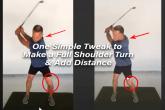
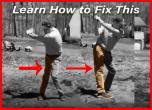
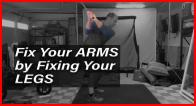
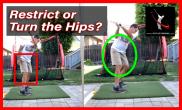










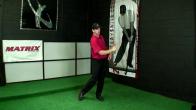
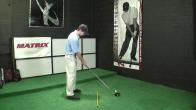





Trail Hip Loading from the Ground Up
Sorry, you need to be a member to access this video. You Are Just Seconds Away!

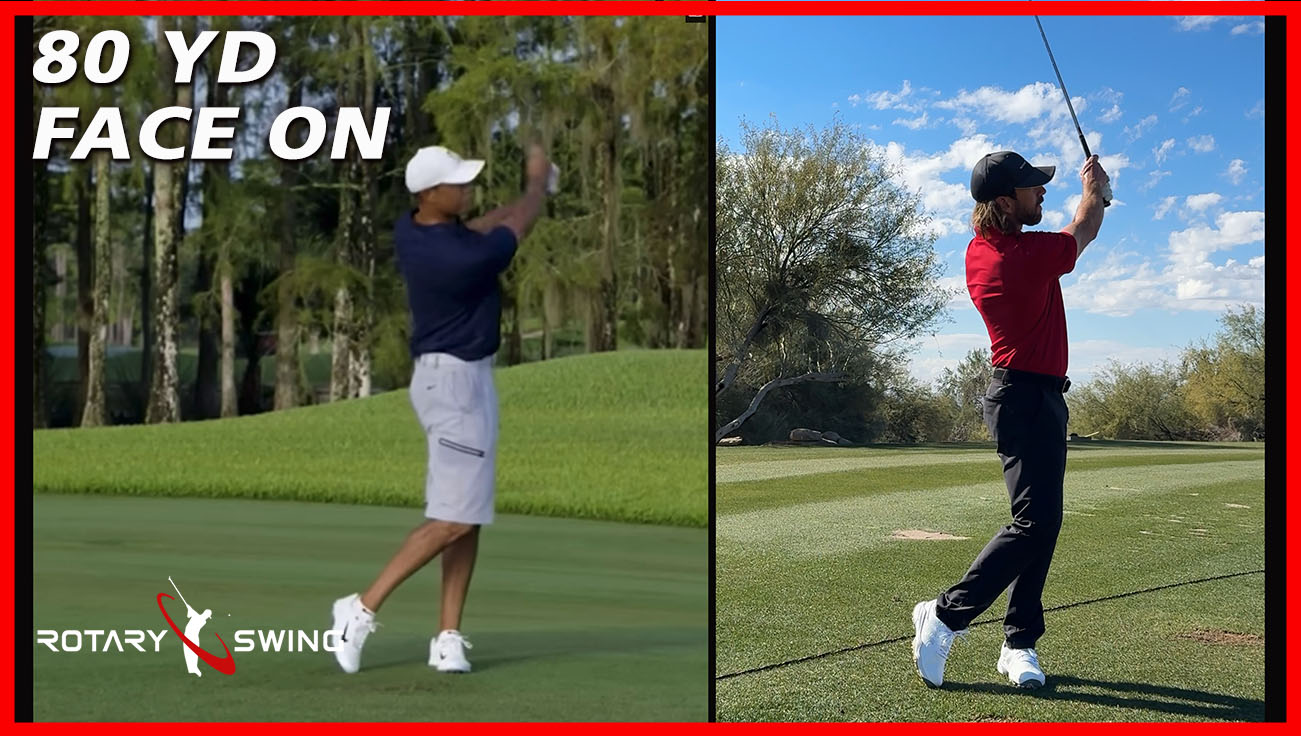
Everything you need to know about how to load the body in the golf swing and stop picking up the arms in 16 minutes.
Learning how to get your arms to stop lifting the club and how to load correctly in the swing is the most important thing that you're ever going to learn as a golfer.
If you want to, effortless power.
All the greats do this, and I'm going to show you a very unique perspective of this in just a moment.
So you can see it from your own perspective when you're looking down at the ground and seeing your shadow.
But first, I want to give you just a really brief overview of exactly what's supposed to happen.
And then I'm going to show you from your own perspective, what it's going to look like.
The most important key is understanding how to load your trail side.
This is where all of the coil happens in your swing.
So everything starts spiraling from the ground up.
And if you don't start from literally the ground up with a solid base, then your arms are going to have to lift and you're going to keep getting that gate one trail arm failure over and over and over again.
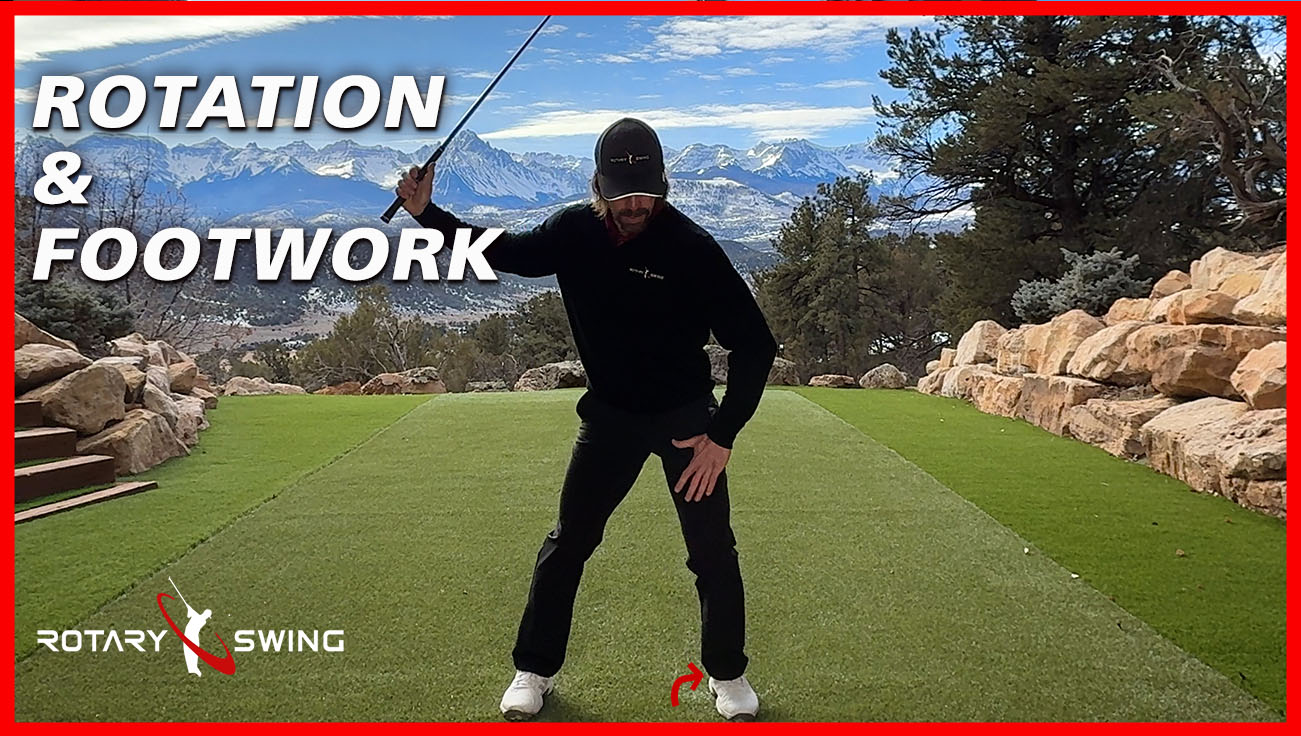
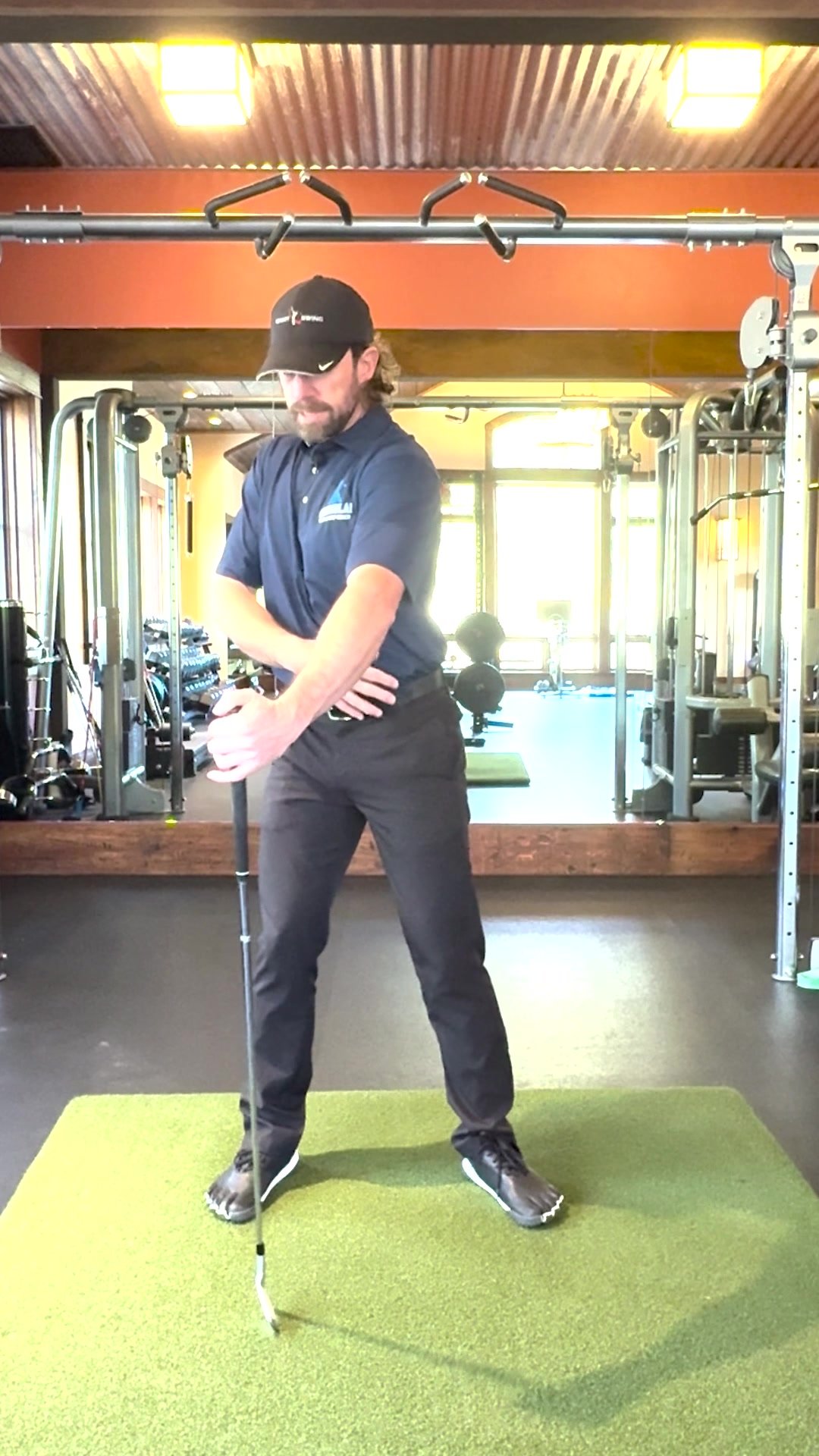
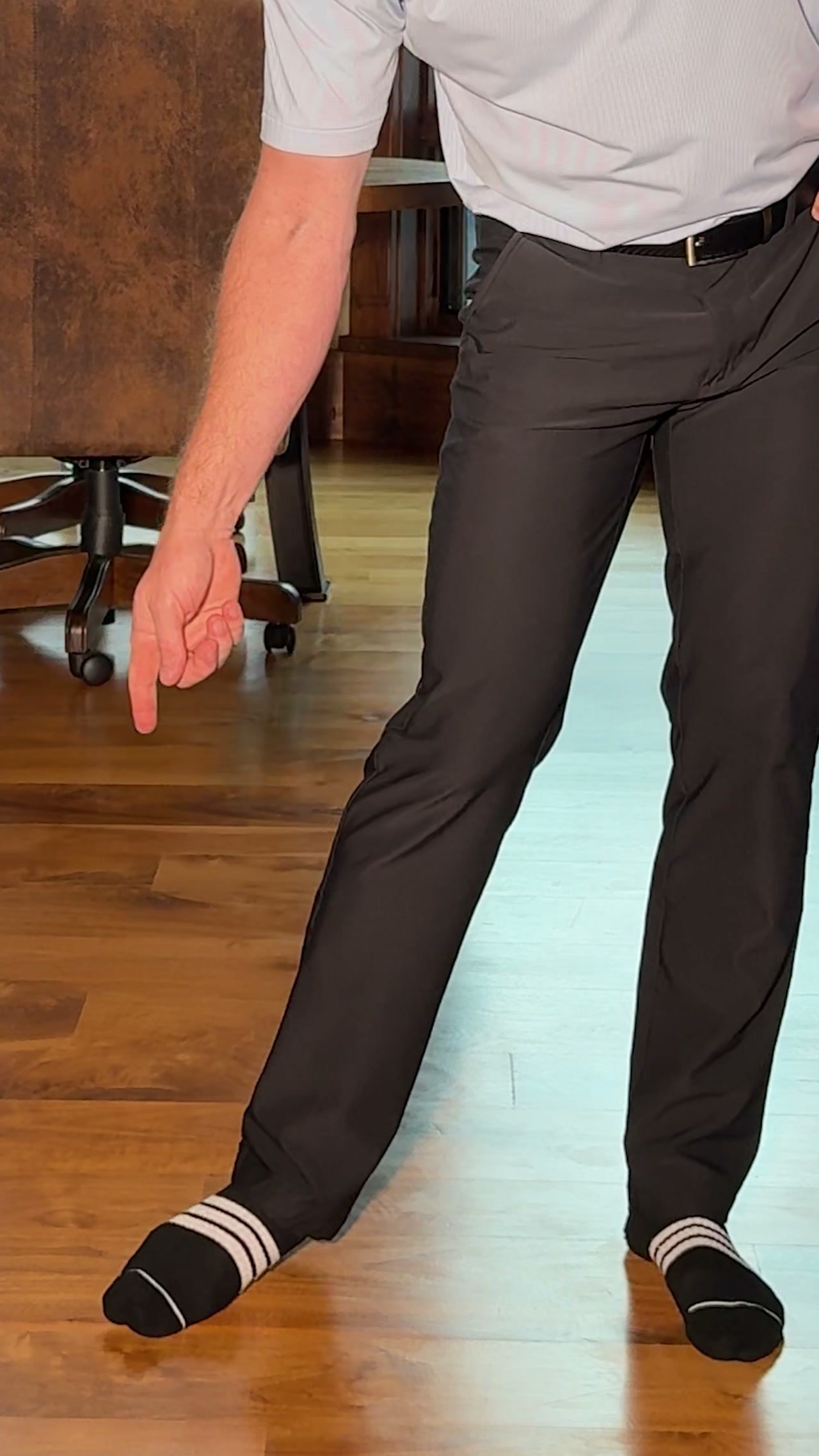
So as you start, you're going to feel that your trail foot provides resistance into the ground.
And if you're a right -handed golfer, this is going to be going toward the target, if you will, or in a counterclockwise direction.
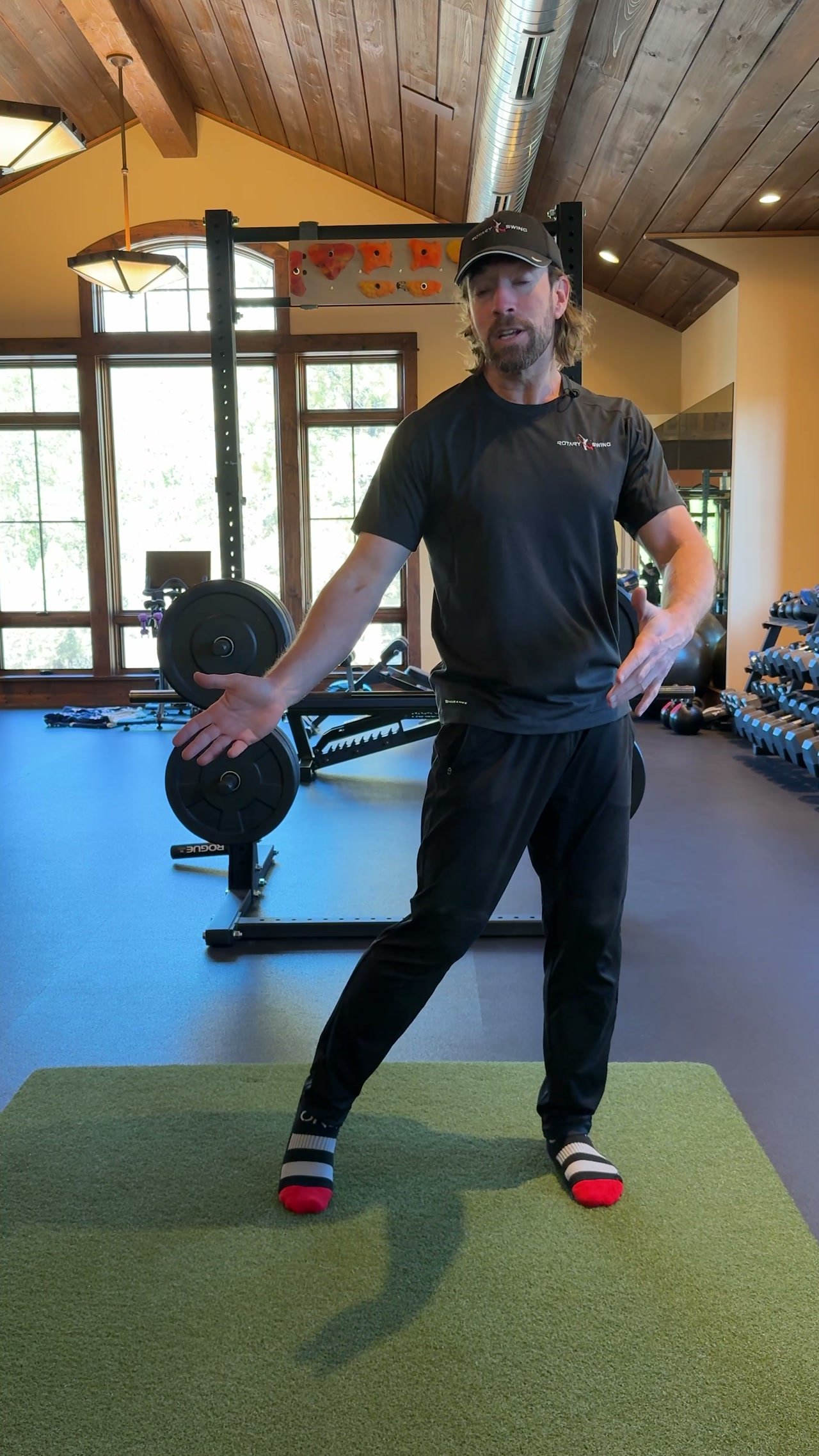
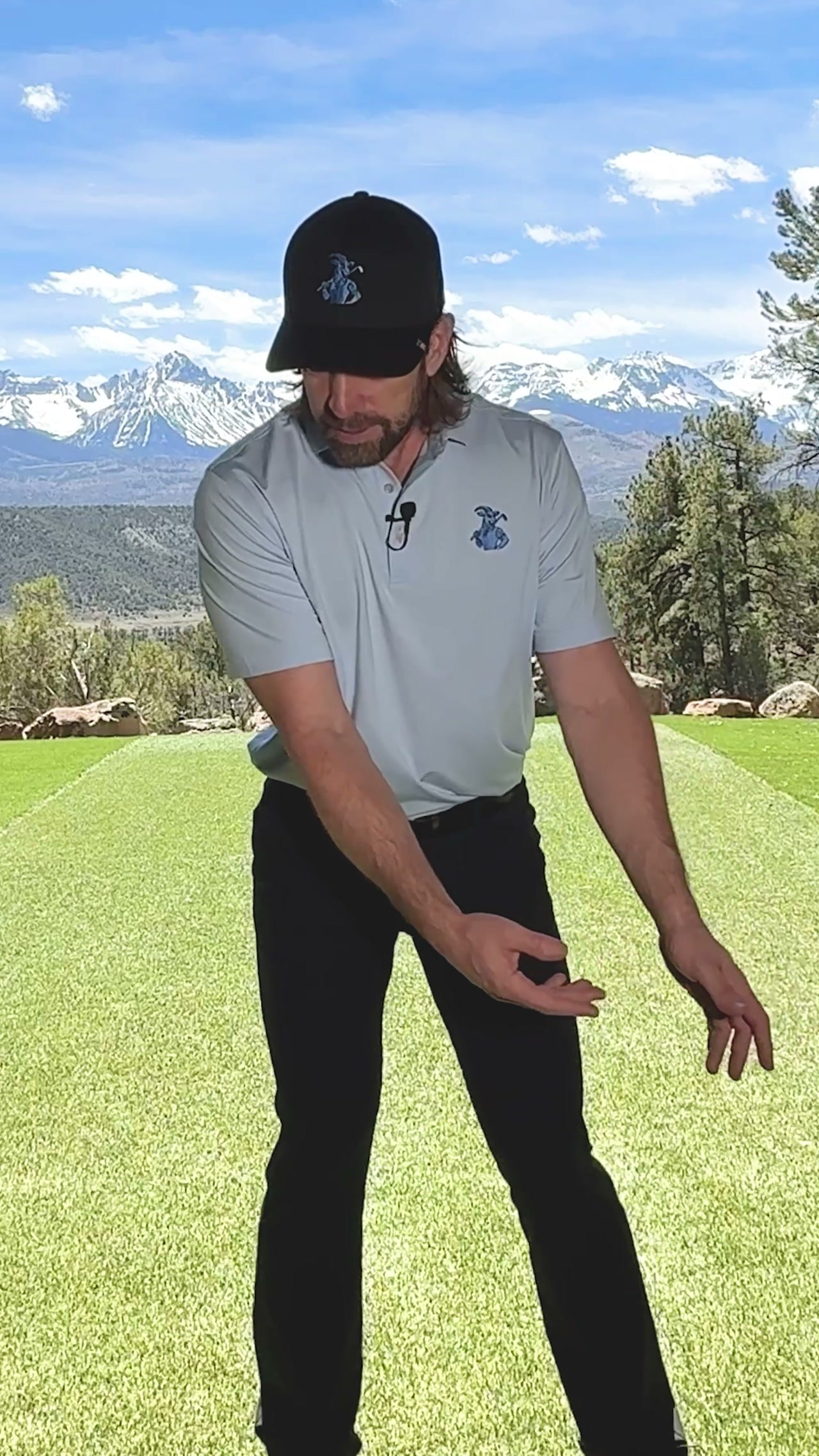
Now, I've seen a lot of golfers try and turn their leg and they say their hip is going this way.
And when you do this correctly, if I'm providing resistance, you'll see that my hip actually goes back that way.
What you're, you're not trying to turn your foot into the ground with your hip.
That's the exact opposite of what you're trying to do.
What you're trying to do is provide resistance as if you were twisting a towel.
And if you're going to twist it with your top hand, the bottom hand has to provide some resistance.
If this hand's just allowed to twist, then there's no torque created.
And that's what you're trying to do in the golf swing.
You're trying to create torque.
And so what happens is, is I resist with my foot.
And this will make more sense when I show you from your perspective in just a moment.
As my foot is twisting, resisting toward the target, that actually drives my hip back.
But if you're trying to use your hip and your body to turn your foot into the ground, you're missing the point because your body is trying to create torsional resistance or a spiral from the ground up.
So as my leap, my trail foot resists and twists into the ground that way, that actually drives my hip back.
And that's what starts the entire swing as you shift and get pressure over here.
Now you're in a position where you can load up.
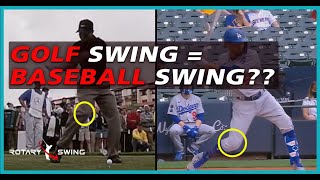
And this is really no different than a baseball player.
If you were to throw a ball when you're loading up, you don't let your foot roll out this way because then you're not creating any torsion.
You're not creating any resistance.
See, if my foot and hip go together, there's no resistance.
So now I have to use my whole upper body to sling the club.
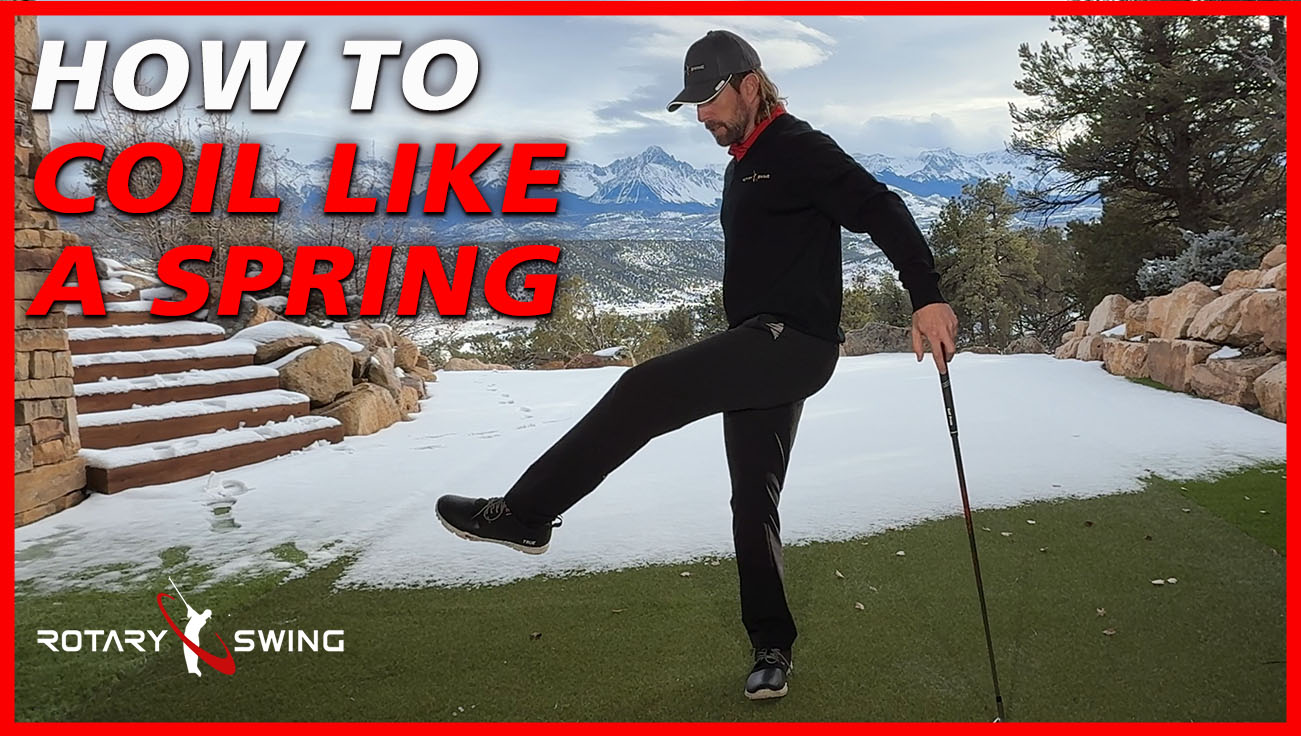
But when I create resistance, this is loading up like a spring and then my core is going to fire.
And that's really the key that most golfers are missing is that.
As I'm providing resistance with my foot twisting into the ground so that my knee is like a torque coupler.
Don't try to use your knee, let your knee relax and your hip relax.
And respond to this pressure that you're creating with your trail foot to drive this back.
And then once that happens, you're going to be loaded up.
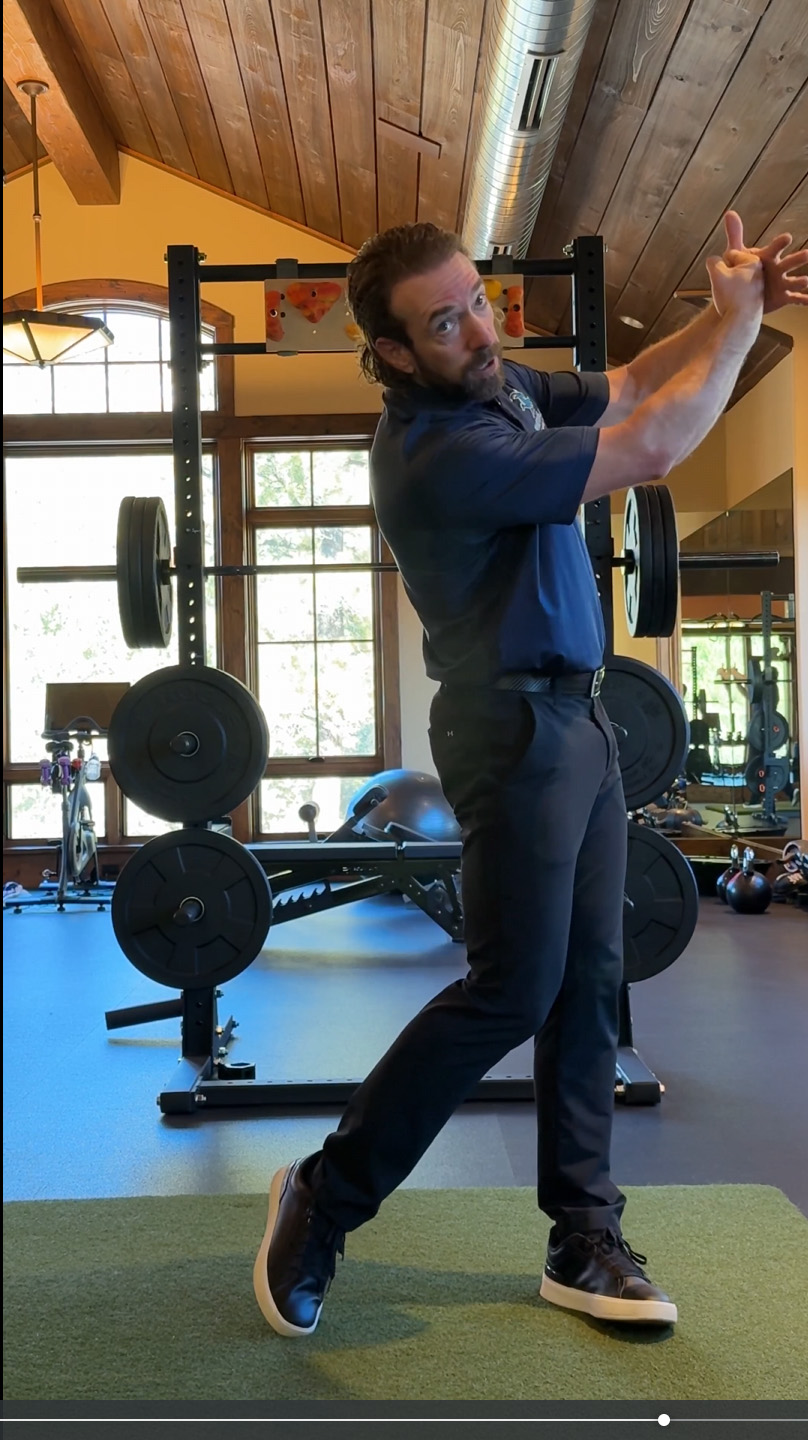
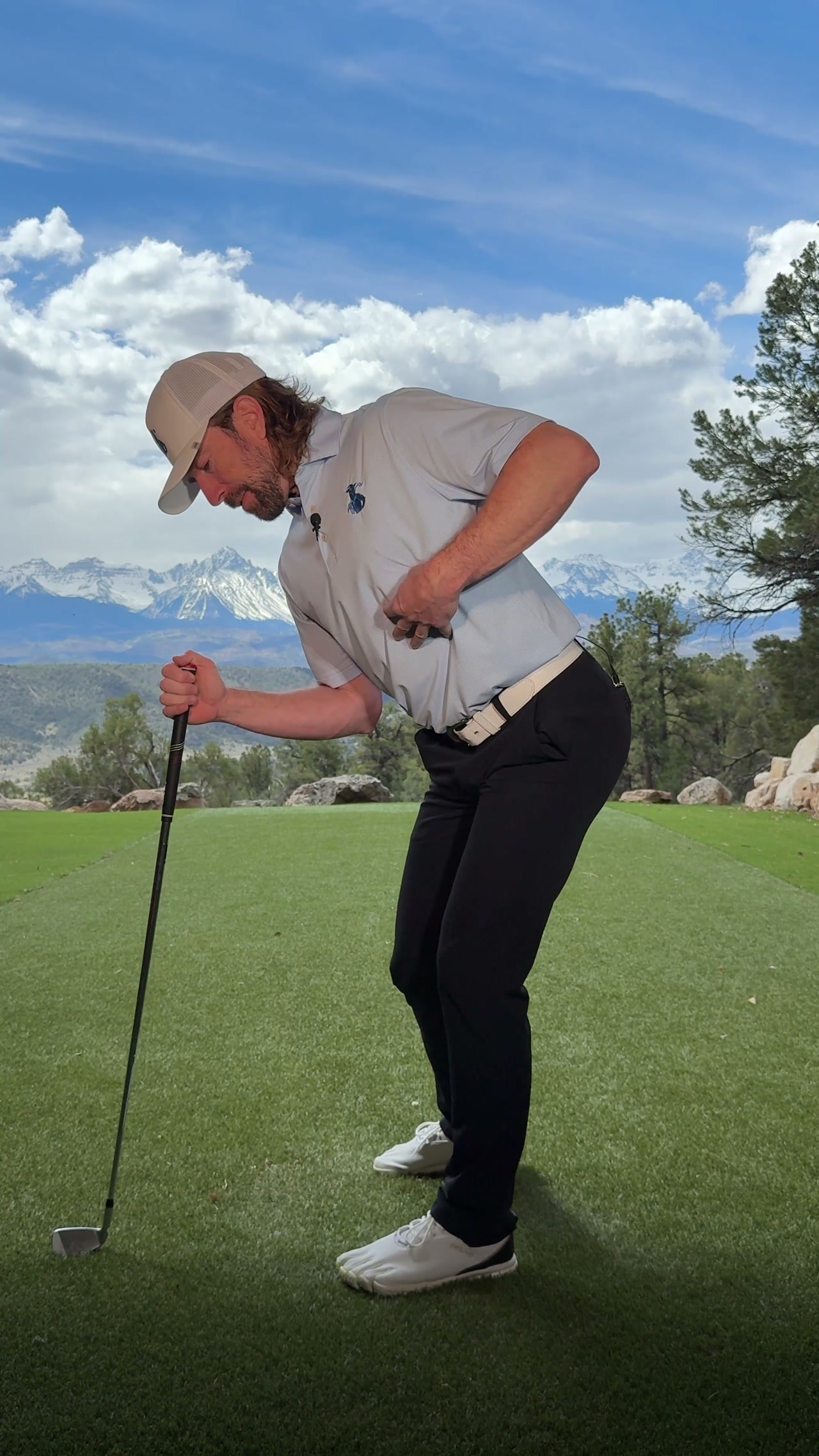
You should feel your glute really activated at this point from down the line, it's driving my hip back just a little bit, it's keeping it deep.
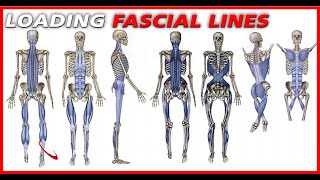
And this is critical because I need my pelvis to act as an anchor for my core, my belly, and my fascial oblique slings to load against.
Now again, if everything kind of just goes back together in the backswing, so I let my foot twist out, I don't have any resistance on my foot, and I'll explain why I'm wearing these goofy looking shoes in just a moment, and then I let my upper body go back and my hips turn, there's no torque.
So literally I could stay here all day.
You want to feel coiled up, like a spring to where it's uncomfortable to stay here.
Because then your belly is starting to unwind you, and that's what slings your arms back through impact.
If you don't have that torque, you're gonna your proprioception.
Your brain's gonna pick up on this and say, like, No, I need to add arms, and you'll keep adding arms no matter what.
And that will cause you to continue to fail by lifting up the club with your trail arm.
So the key resistance with the lower, with the foot.
That's giving me something to load against.
And now I'm very coiled up and that's going to help me fire everything on the way down.
There's a couple little things I'm going to show you from your perspective in just a moment that are a little bit strange and unique at first, but once you see them in other elite players, it's going to start to make sense.
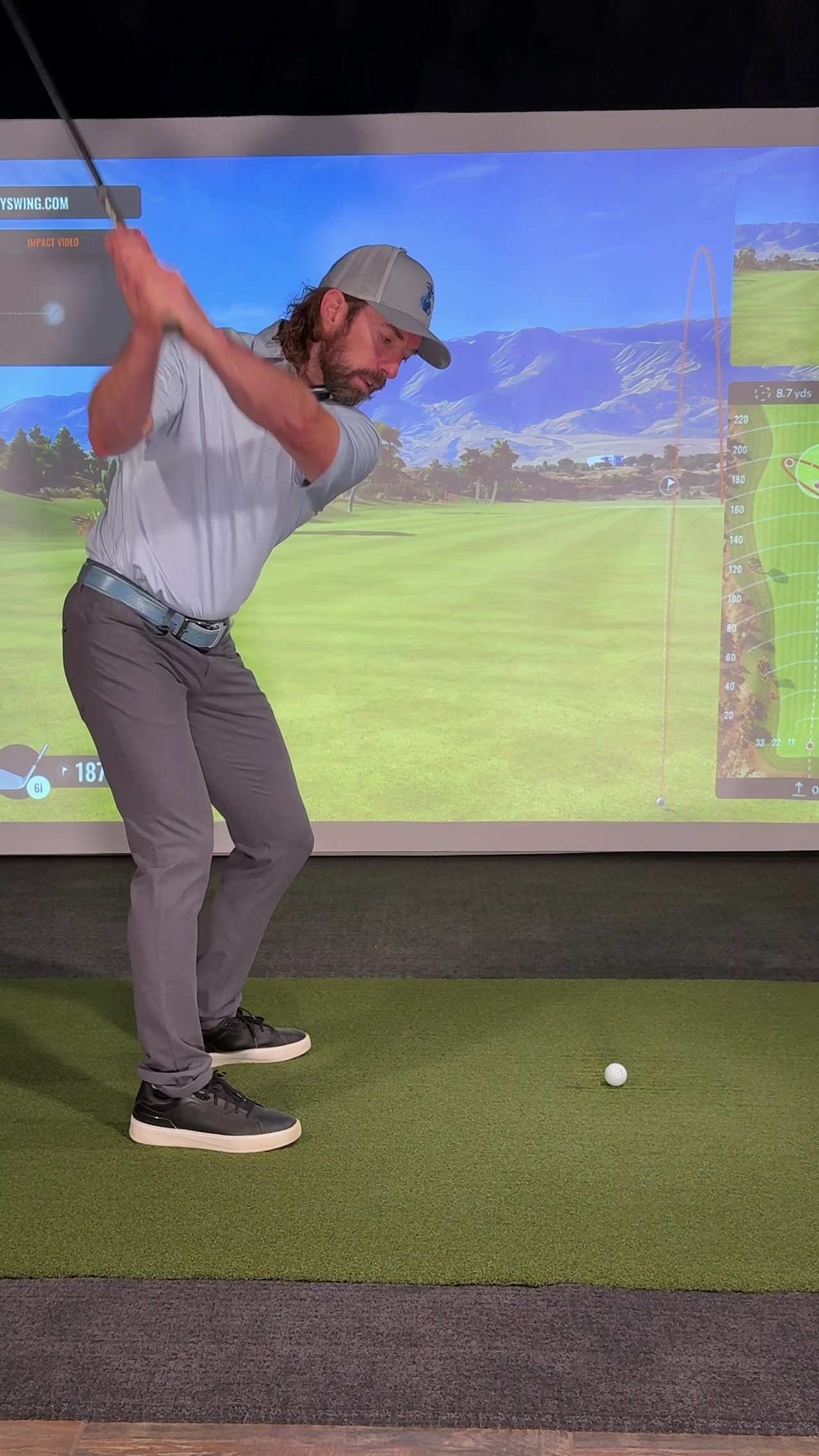
So the first little thing, as I go back and get into my trail side, there's a little kind of rock and I got to get some momentum.
So this is obviously way bigger movement than I would really have in the swing, but this movement is what's happening because that's going to get some rocking motion to start getting everything to give momentum to my arms.
You never want to pick your arms up.
And that's what I've seen thousands and thousands of times.
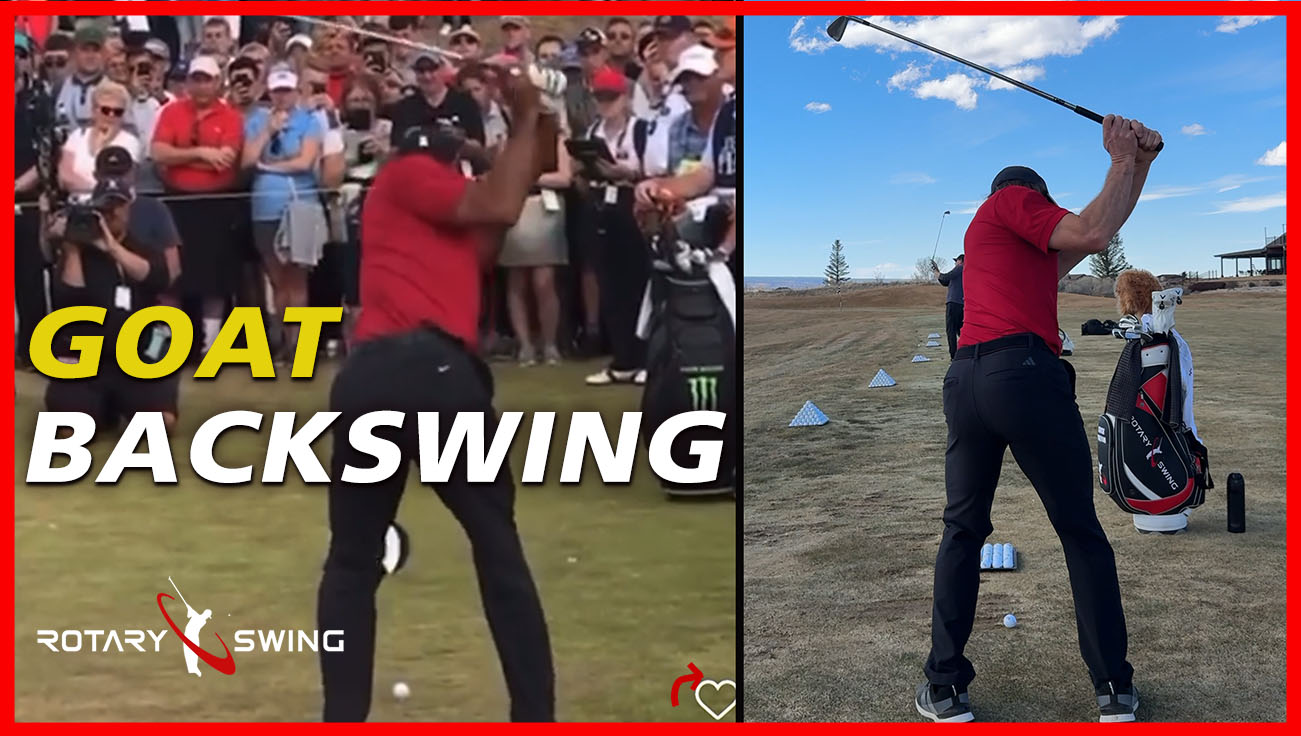
With all the goatee data that we have, is that almost everyone fails this first gate at the beginning, picking the club up with their trail arm.
Once you start having this feeling, the next key is keeping this hip deep.
What I mean by that is that if you are loading and you feel a stretch across your belly, then what's going to happen is that this hip?
In order to stay back, your trail leg is going to kind of actually go like this, and again, I'll show you from your perspective in just a moment.
But if you see that your trail leg is going like this, you are now pushing off the trail side.
And that's going to cause you again to swing with your upper body and arms.
Instead of letting your body naturally unwind, so as you go back, you don't want to start unwinding this way.
Sit into it a little bit more.
Stay closed just that split second longer as your arms start to fall back down in front of your body.
And that's what's going to get everything to sling through together.
But if you're trying to muscle it and try to help it, you're missing this.
So as you go back, sit down just a little bit, and I'm going to show you from this perspective, sit down just a little bit.
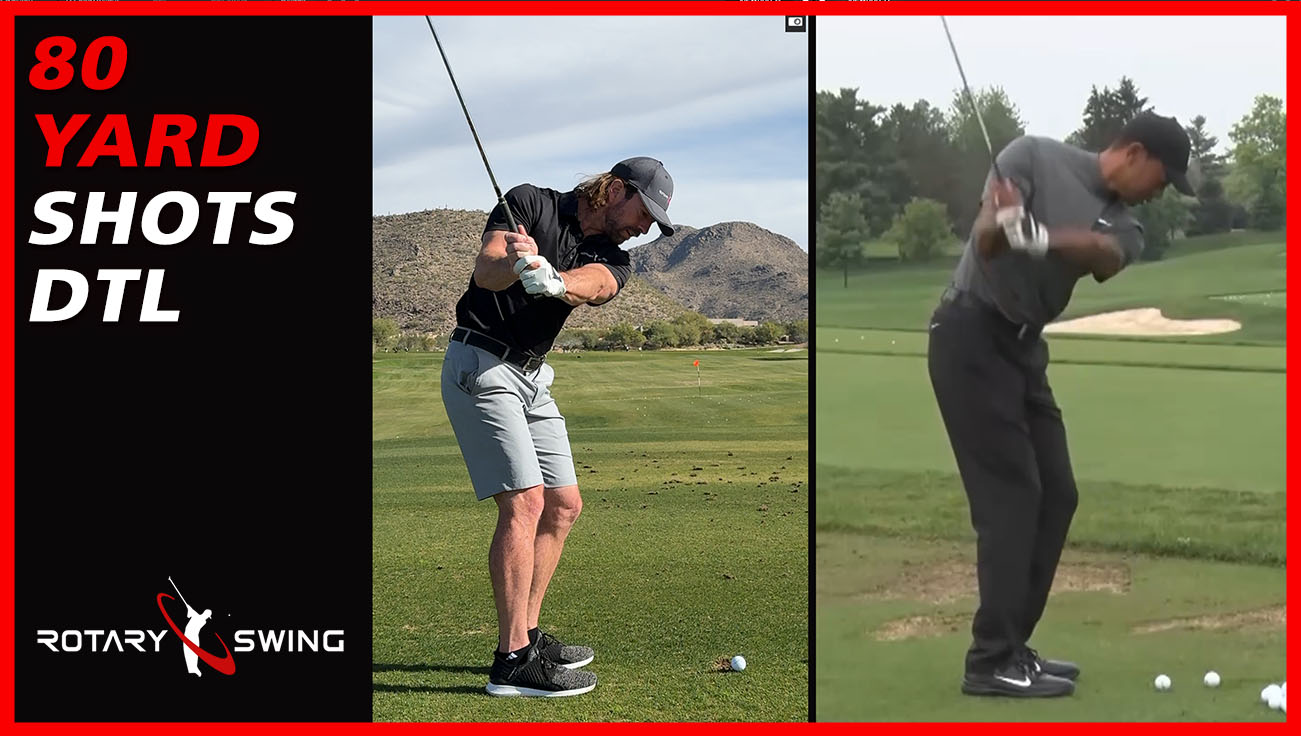
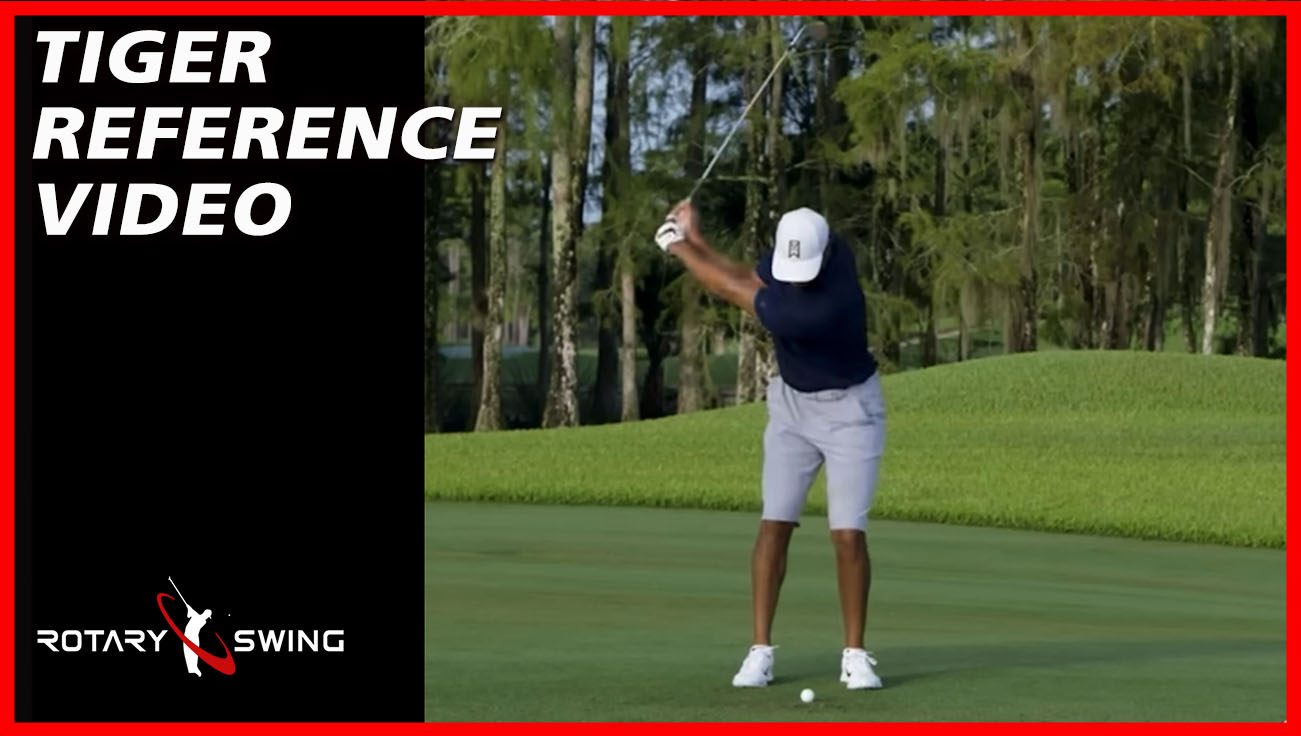
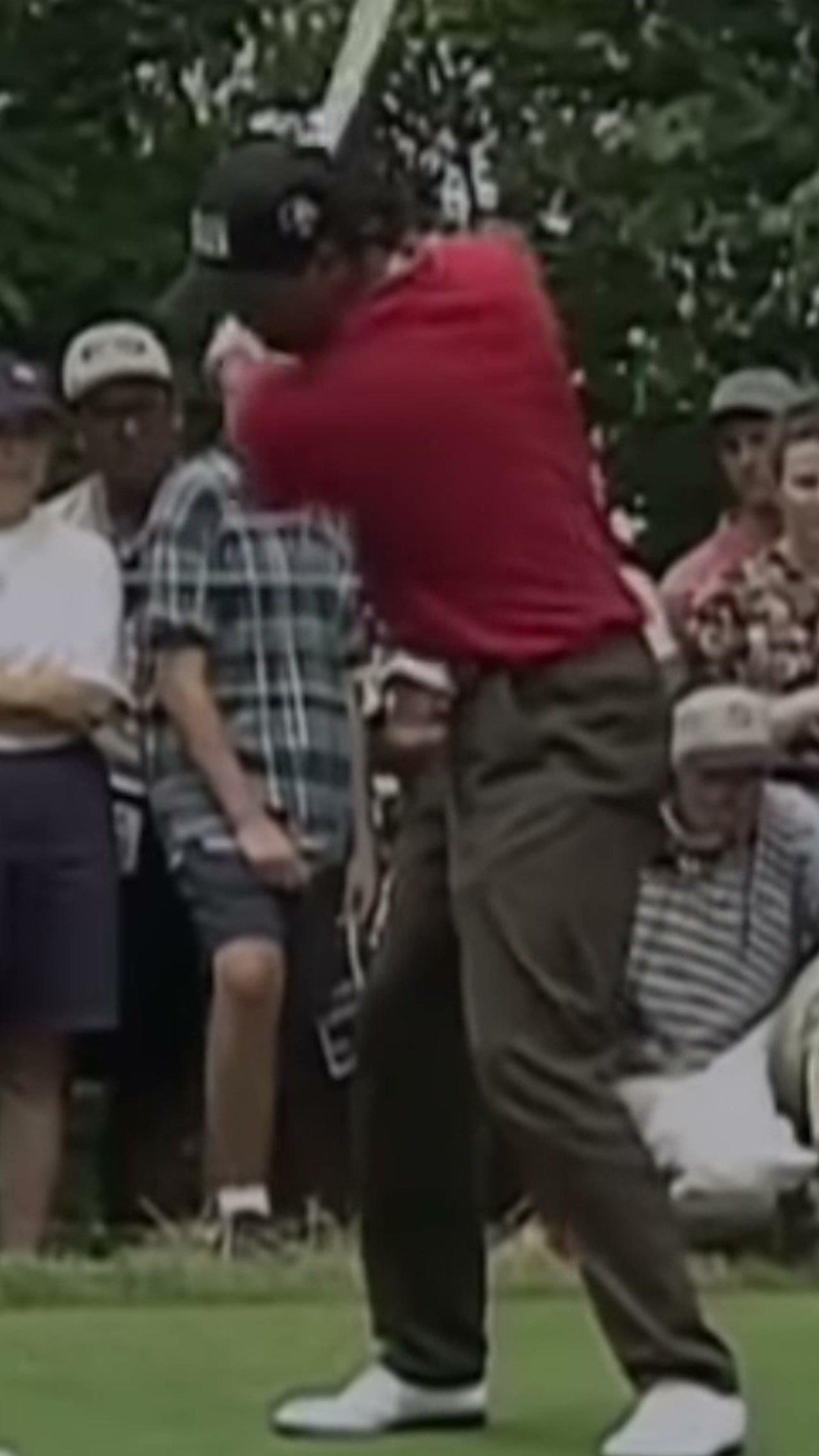
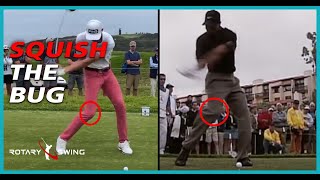
This is where you see really, really powerful players like Tiger have that squat.
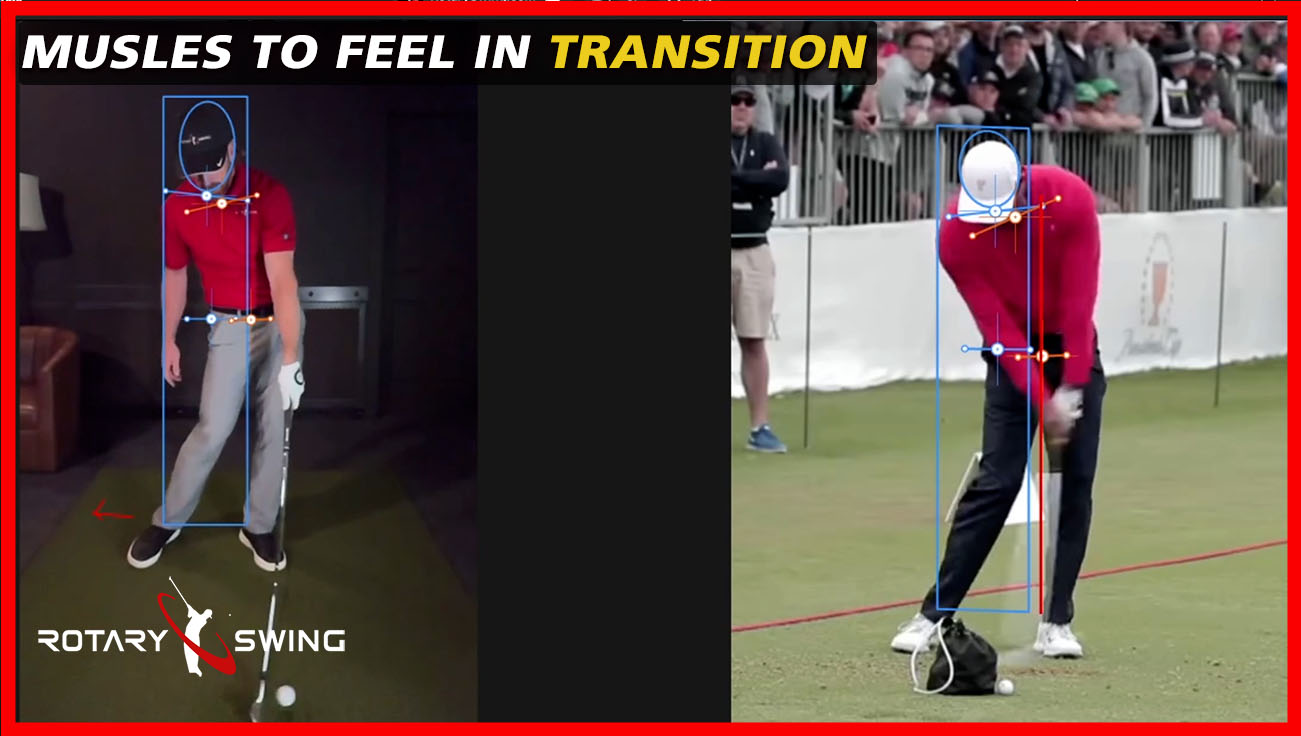
This feeling is keeping this hip loaded during the transition so that my fascial slings in my belly can begin to unwind against the stable lower body.
So again, you don't want to ever feel like you're driving your hip or pushing off your foot.
You'll see that's going to cause early extension and for you to come down steep.
So as you go back, sit into it, wait, keep your hips closed, keep your shoulders closed.
Your arms would be falling at this point, and then your belly is going to sling them through.
Now let me show you from a different perspective what this is going to look like when you're practicing inside.
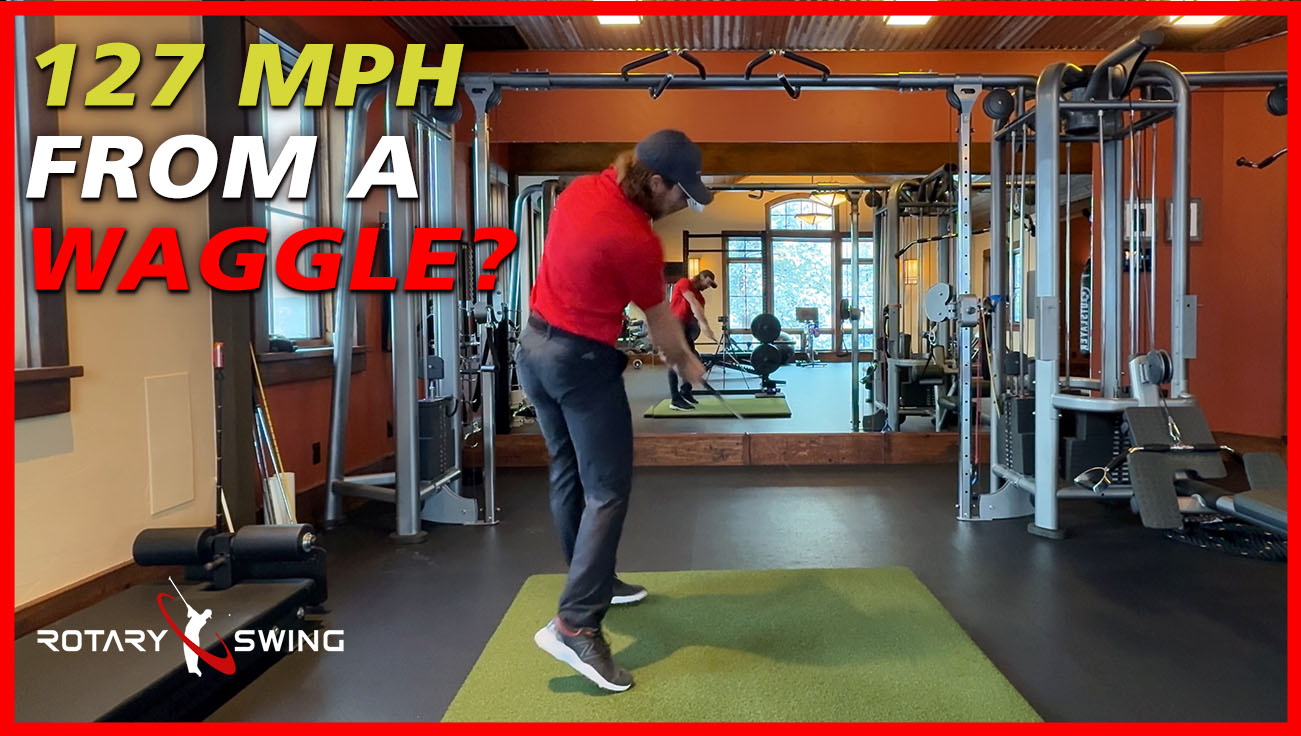
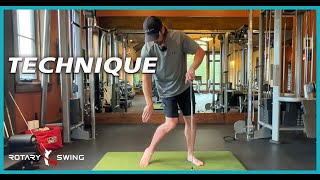
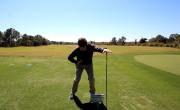
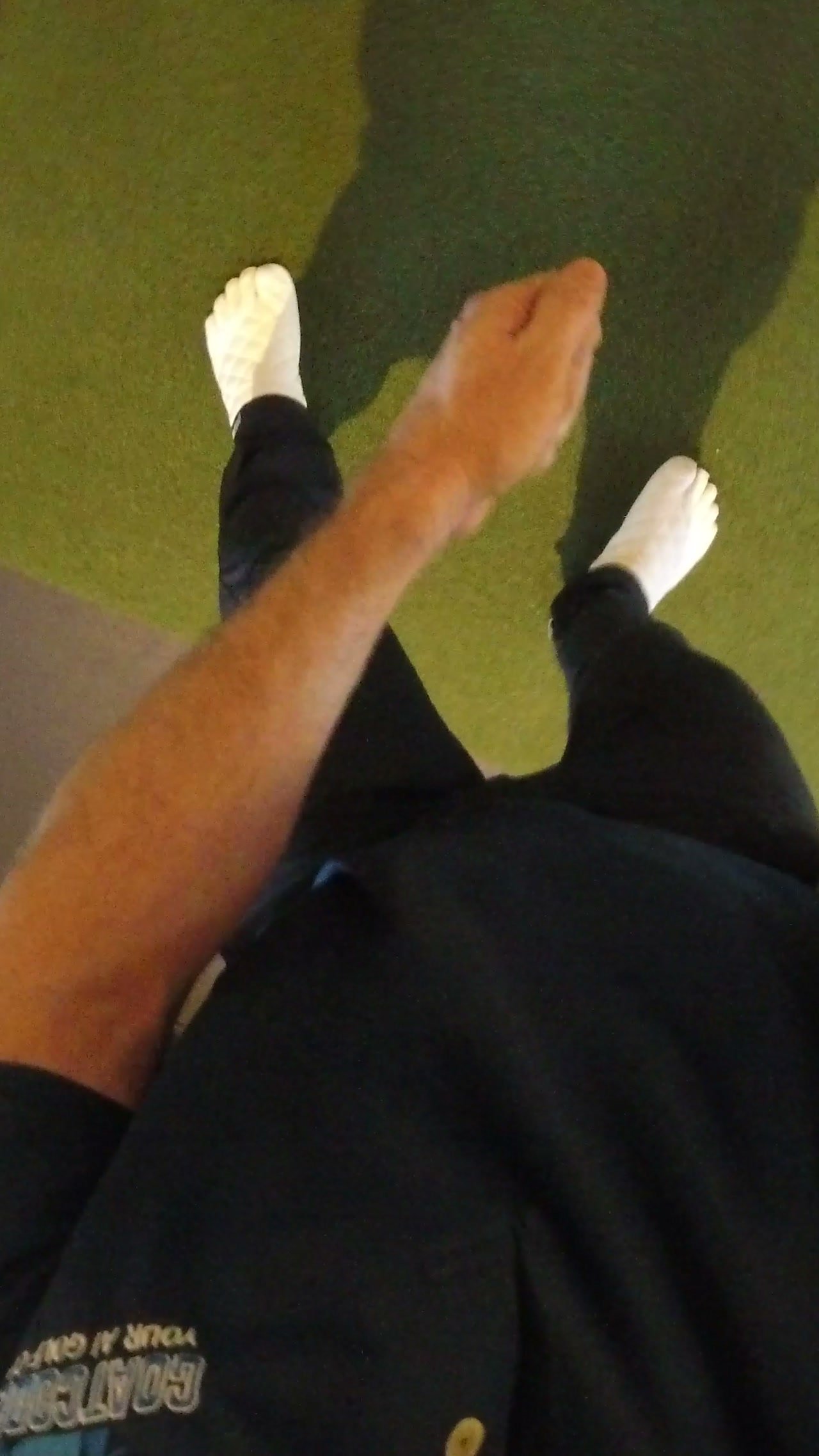
Now I have a camera on my head so that I can see my shadow.
Shadow golfing, like shadow boxing, is so valuable to start to understand what's really happening and starting to feel a more 3D perspective on your golf swing.
So get a light behind your head or even out in the sun.
You just need a shadow and you can start to feel this motion very simply.
And now you're going to see the reason I wear these shoes.
One, they give you tremendous feel for what your feet are doing in the ground.
Because your feet are so vitally important to the golf swing, and these shoes are perfect for this.
But you'll be able to start to see little different movements that I'm going to show you in my feet.
So first, as I start to go back, you'll see I'm just going to exaggerate this motion when again, I saw many people trying to turn their foot into the ground like this.
Because you're trying to use your whole body, relax your legs, relax your hips, you're not trying to use your hip to screw your foot into the ground.
Your foot is providing resistance.
And as it's providing resistance, as my knee and leg and hip are relaxed, you'll see that you can see my foot just twisting slightly into the ground.
And as I relax my hip, it naturally goes back.
And this is getting that hip depth that you need to start to stretch your belly here.
If you don't have that hip depth, you're going to start to be in a position where you don't get any stretch across your core.
And if you don't feel stretch across your belly, you're not loading your fascial slings correctly and you're going to have to muscle the swing.
So again, I'm going to relax my knee and leg and quad and glute.
And I'm going to just start to provide resistance, just a slight resistance against the ground.
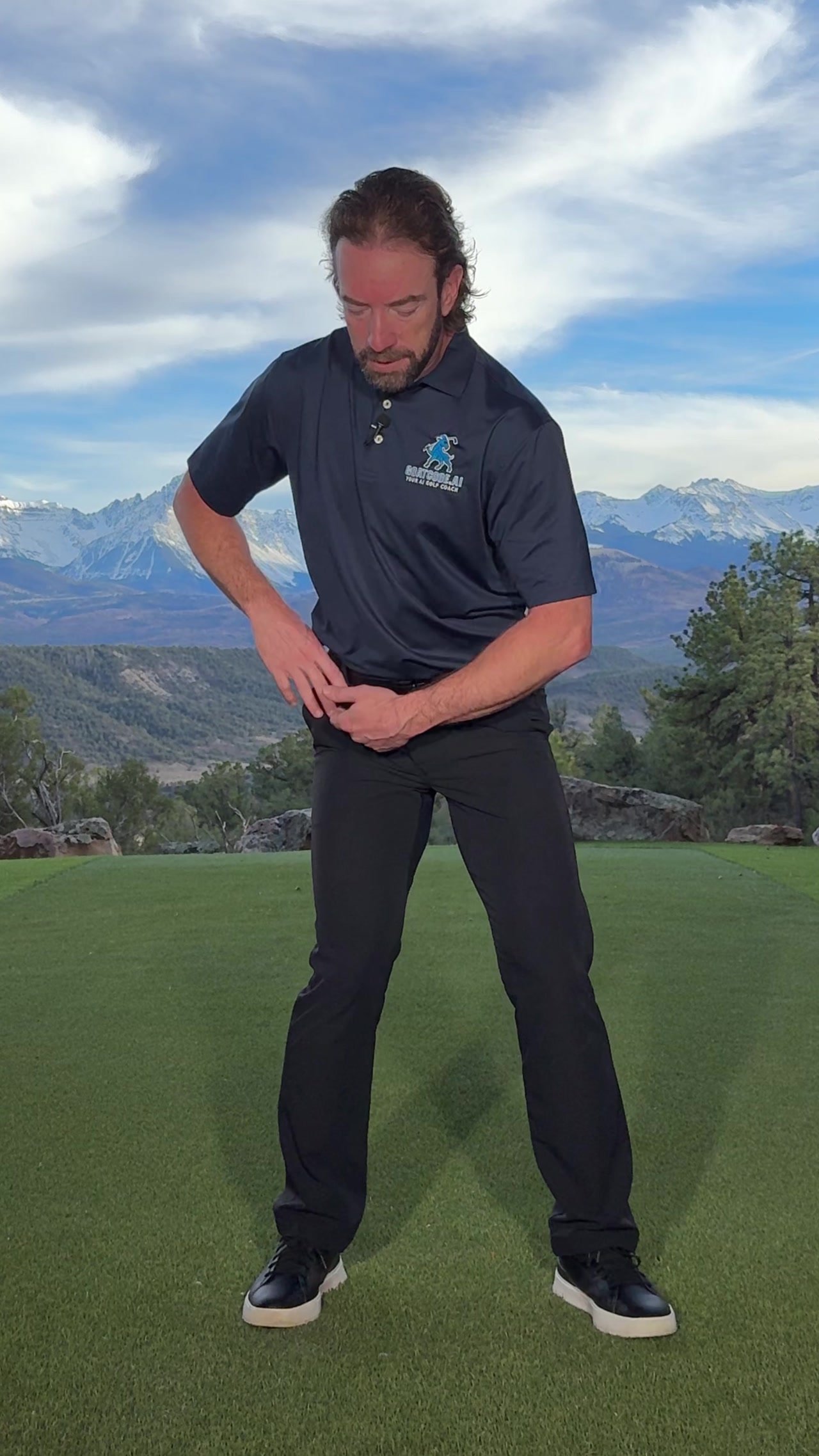
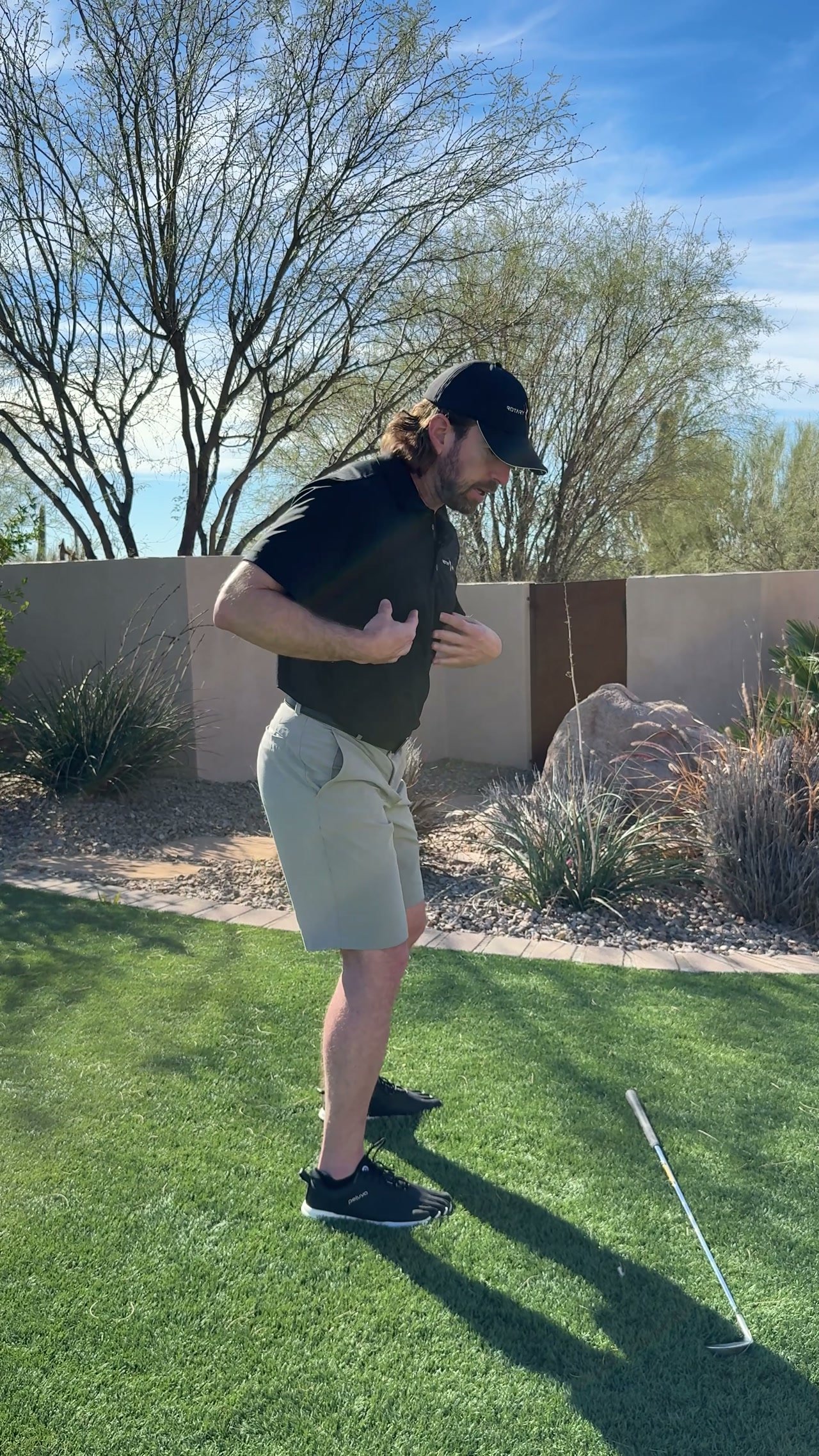
And now you can see my right butt cheek back here, my trail butt cheek.
I'm going to put my hand on there.
Kind of like a shark fin.
Watch what happens as I do this, where is it moving?
You can see very clearly in my shadow that's moving toward the target.
I'm starting to coil.
I'm not sliding laterally, not reverse shifting, I'm just providing torque and resistance with my foot into the ground.
That's driving my hip back.
Now, this is most of the backswing is done already.
All I did was just provide that resistance, let my hip and knee go back.
My leg extends slightly and now you can see my ribcage is rotated a ton, but all I've really done is focused on moving from the ground up.
And you'll see that's moving my hip back toward the target.
Now, what needs to happen here is as my hip needs to stay deep during that transition, you don't want to see that you immediately go like this.
That's a death move in the swing.
What you're going to feel is that you stay there and now slightly sit back.
So now what I'm feeling is almost trying to, I'm trying to sit my right butt cheek down into a high stool.
This is again, in the real swing, this happens incredibly fast.
I'm just exaggerating this to help you feel it.
So now you should feel even more coil on your hip and your outside of your hip and your glute.
And now what's happening is I've got a really stable and twisted coiled torqued up base and a whole body that as I'm doing this at speed, my belly is now able to stretch against this anchored hip.
If my hip is moving with my body, there's no stretch.
But once I get anchored and I sit into it just slightly, you'll see that it's kind of going to drop my head just a little bit.
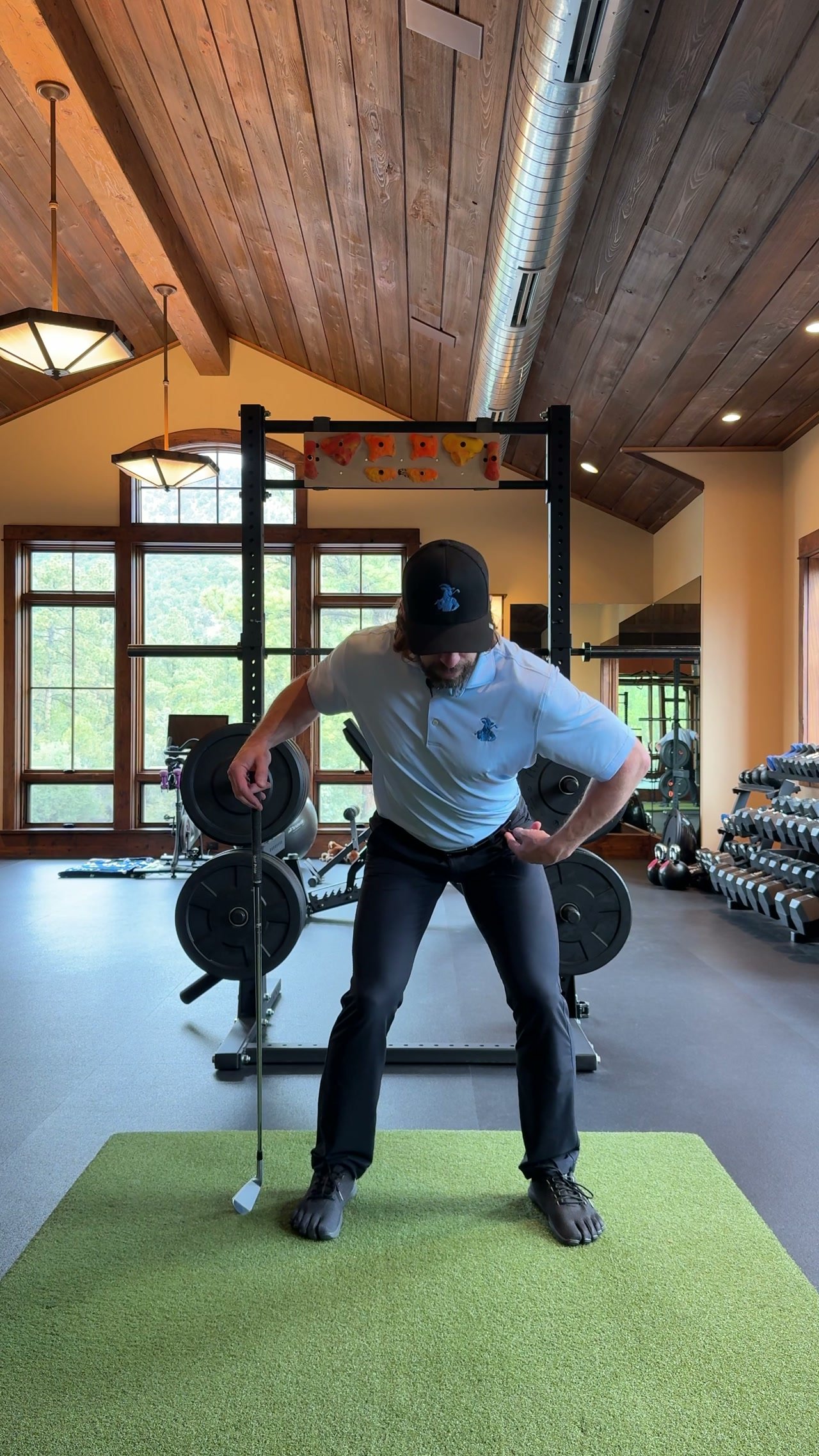
I'll show you from down the line here in this camera view as I go back.
As this hip goes deep and my hip keeps going toward the target, I'm now really deep with my hip.
It feels like my hips moved a foot compared to where it was at address.
And again, these are slight exaggerations, but this is what you should feel as you're doing this motion.
And now my chest and spine are actually tilting slightly further down toward the target.
And my hip has to go back in order to make room for that.
And it's not just going back straight away from the ball.
It's also moving toward the target because we're creating rotation.
So now, as I do this and my hips anchored and I sit back.
Now.
I want you to focus on my trail femur here as I start to sit back into it, note that my femur is kind of pointing outside of my foot again.
If I start rotating when trying to muscle this, trying to use my upper body or push off my trail leg, my femur is going to start immediately going like this.
And I lose all of that tension that I built up in the swing, and I have no torque it in my swing, so I have to muscle it instead.
I don't want to do that, so I'm staying back on this trail hip.
And now, as my as a momentum would build, my belly would start to get really stretched.
And that's what I want you to try and feel.
First, relax your arms, start with this ground resistance.
So I kind of bump to the left just a little bit and then I get back to the trail side.
My trail foot's creating resistance, my trail hips going back, and I use that to create momentum, to swing my arms and rotate my rib cage, I'm not just trying to turn my shoulders.
That's when you're going to see the gate fail.
That said, you started with your upper body first.
You can clearly see that's going to move my head, and my upper body is going to start first.
That's going to move me completely out of sequence.
If I start from the ground up, just this little torque, you can see my foot just twisting to the ground, my trail hip going back.
Now I'm in a great position to be loaded.
And if I do this with speed, my arms start to really stretch across this midsection of my body.
And that is what's going to unwind.
So as I get there and my hip stays back, watch my trail hip now I'm sitting into it, then it's going to start to unwind back this way.
But that's really happening as a result.
So if you think about it in this way, it all starts from right here.
The ground up, that spiraling motion builds all the way through my body.
It stretches my core, my obliques, my fascial slings.
They start to unwind first.
So as that's happening, my pelvis is now just responding to this.
And so everything unwinds in the reverse direction.
So the first move starting down is my obliques are starting to unwind.
My pelvis is providing the stability for my upper body to rotate on.
And now my foot, watch my right foot now.
Now it's twisting in the opposite direction, not because I'm trying to twist it, but because I'm producing torque in the golf swing.
So as my upper body is loading against my pelvis and it begins to unwind, My foot is going to do this and now it's.
But again, it's just responding because everything in my core is unwinding and now I'm in a great impact position.
So when we look at this from down the line, I'm going back as I do.
Momentum, I feel my as my shoulders kind of get slung around with from momentum that's generated from my whole body loading up and creating torque.
And then it's my hip stays back as I come down, I feel like I keep my hip even deeper to start down.
Because that's giving me that stable base for my belly and fascial slings to unwind on and bring everything down and impact.
So that is the most important thing.
If you practice with your shadow and you start seeing your body and your feet and your hips and everything move the way.
I just showed you, you'll be in a perfect position.
You'll be able to naturally start feeling your arms just being literally moved, starting from the ground up.
I almost feel like my right foot, my trail foot is kind of everything that I focus on.
In the swing.
That creates everything spiraling, winding up from there, and then everything unwinds on its own.
If you want to, effortless power.
All the greats do this, and I'm going to show you a very unique perspective of this in just a moment.
So you can see it from your own perspective when you're looking down at the ground and seeing your shadow.
But first, I want to give you just a really brief overview of exactly what's supposed to happen.
And then I'm going to show you from your own perspective, what it's going to look like.
The most important key is understanding how to load your trail side.
This is where all of the coil happens in your swing.
So everything starts spiraling from the ground up.
And if you don't start from literally the ground up with a solid base, then your arms are going to have to lift and you're going to keep getting that gate one trail arm failure over and over and over again.
So as you start, you're going to feel that your trail foot provides resistance into the ground.
And if you're a right -handed golfer, this is going to be going toward the target, if you will, or in a counterclockwise direction.
Now, I've seen a lot of golfers try and turn their leg and they say their hip is going this way.
And when you do this correctly, if I'm providing resistance, you'll see that my hip actually goes back that way.
What you're, you're not trying to turn your foot into the ground with your hip.
That's the exact opposite of what you're trying to do.
What you're trying to do is provide resistance as if you were twisting a towel.
And if you're going to twist it with your top hand, the bottom hand has to provide some resistance.
If this hand's just allowed to twist, then there's no torque created.
And that's what you're trying to do in the golf swing.
You're trying to create torque.
And so what happens is, is I resist with my foot.
And this will make more sense when I show you from your perspective in just a moment.
As my foot is twisting, resisting toward the target, that actually drives my hip back.
But if you're trying to use your hip and your body to turn your foot into the ground, you're missing the point because your body is trying to create torsional resistance or a spiral from the ground up.
So as my leap, my trail foot resists and twists into the ground that way, that actually drives my hip back.
And that's what starts the entire swing as you shift and get pressure over here.
Now you're in a position where you can load up.
And this is really no different than a baseball player.
If you were to throw a ball when you're loading up, you don't let your foot roll out this way because then you're not creating any torsion.
You're not creating any resistance.
See, if my foot and hip go together, there's no resistance.
So now I have to use my whole upper body to sling the club.
But when I create resistance, this is loading up like a spring and then my core is going to fire.
And that's really the key that most golfers are missing is that.
As I'm providing resistance with my foot twisting into the ground so that my knee is like a torque coupler.
Don't try to use your knee, let your knee relax and your hip relax.
And respond to this pressure that you're creating with your trail foot to drive this back.
And then once that happens, you're going to be loaded up.
You should feel your glute really activated at this point from down the line, it's driving my hip back just a little bit, it's keeping it deep.
And this is critical because I need my pelvis to act as an anchor for my core, my belly, and my fascial oblique slings to load against.
Now again, if everything kind of just goes back together in the backswing, so I let my foot twist out, I don't have any resistance on my foot, and I'll explain why I'm wearing these goofy looking shoes in just a moment, and then I let my upper body go back and my hips turn, there's no torque.
So literally I could stay here all day.
You want to feel coiled up, like a spring to where it's uncomfortable to stay here.
Because then your belly is starting to unwind you, and that's what slings your arms back through impact.
If you don't have that torque, you're gonna your proprioception.
Your brain's gonna pick up on this and say, like, No, I need to add arms, and you'll keep adding arms no matter what.
And that will cause you to continue to fail by lifting up the club with your trail arm.
So the key resistance with the lower, with the foot.
That's giving me something to load against.
And now I'm very coiled up and that's going to help me fire everything on the way down.
There's a couple little things I'm going to show you from your perspective in just a moment that are a little bit strange and unique at first, but once you see them in other elite players, it's going to start to make sense.
So the first little thing, as I go back and get into my trail side, there's a little kind of rock and I got to get some momentum.
So this is obviously way bigger movement than I would really have in the swing, but this movement is what's happening because that's going to get some rocking motion to start getting everything to give momentum to my arms.
You never want to pick your arms up.
And that's what I've seen thousands and thousands of times.
With all the goatee data that we have, is that almost everyone fails this first gate at the beginning, picking the club up with their trail arm.
Once you start having this feeling, the next key is keeping this hip deep.
What I mean by that is that if you are loading and you feel a stretch across your belly, then what's going to happen is that this hip?
In order to stay back, your trail leg is going to kind of actually go like this, and again, I'll show you from your perspective in just a moment.
But if you see that your trail leg is going like this, you are now pushing off the trail side.
And that's going to cause you again to swing with your upper body and arms.
Instead of letting your body naturally unwind, so as you go back, you don't want to start unwinding this way.
Sit into it a little bit more.
Stay closed just that split second longer as your arms start to fall back down in front of your body.
And that's what's going to get everything to sling through together.
But if you're trying to muscle it and try to help it, you're missing this.
So as you go back, sit down just a little bit, and I'm going to show you from this perspective, sit down just a little bit.
This is where you see really, really powerful players like Tiger have that squat.
This feeling is keeping this hip loaded during the transition so that my fascial slings in my belly can begin to unwind against the stable lower body.
So again, you don't want to ever feel like you're driving your hip or pushing off your foot.
You'll see that's going to cause early extension and for you to come down steep.
So as you go back, sit into it, wait, keep your hips closed, keep your shoulders closed.
Your arms would be falling at this point, and then your belly is going to sling them through.
Now let me show you from a different perspective what this is going to look like when you're practicing inside.
Now I have a camera on my head so that I can see my shadow.
Shadow golfing, like shadow boxing, is so valuable to start to understand what's really happening and starting to feel a more 3D perspective on your golf swing.
So get a light behind your head or even out in the sun.
You just need a shadow and you can start to feel this motion very simply.
And now you're going to see the reason I wear these shoes.
One, they give you tremendous feel for what your feet are doing in the ground.
Because your feet are so vitally important to the golf swing, and these shoes are perfect for this.
But you'll be able to start to see little different movements that I'm going to show you in my feet.
So first, as I start to go back, you'll see I'm just going to exaggerate this motion when again, I saw many people trying to turn their foot into the ground like this.
Because you're trying to use your whole body, relax your legs, relax your hips, you're not trying to use your hip to screw your foot into the ground.
Your foot is providing resistance.
And as it's providing resistance, as my knee and leg and hip are relaxed, you'll see that you can see my foot just twisting slightly into the ground.
And as I relax my hip, it naturally goes back.
And this is getting that hip depth that you need to start to stretch your belly here.
If you don't have that hip depth, you're going to start to be in a position where you don't get any stretch across your core.
And if you don't feel stretch across your belly, you're not loading your fascial slings correctly and you're going to have to muscle the swing.
So again, I'm going to relax my knee and leg and quad and glute.
And I'm going to just start to provide resistance, just a slight resistance against the ground.
And now you can see my right butt cheek back here, my trail butt cheek.
I'm going to put my hand on there.
Kind of like a shark fin.
Watch what happens as I do this, where is it moving?
You can see very clearly in my shadow that's moving toward the target.
I'm starting to coil.
I'm not sliding laterally, not reverse shifting, I'm just providing torque and resistance with my foot into the ground.
That's driving my hip back.
Now, this is most of the backswing is done already.
All I did was just provide that resistance, let my hip and knee go back.
My leg extends slightly and now you can see my ribcage is rotated a ton, but all I've really done is focused on moving from the ground up.
And you'll see that's moving my hip back toward the target.
Now, what needs to happen here is as my hip needs to stay deep during that transition, you don't want to see that you immediately go like this.
That's a death move in the swing.
What you're going to feel is that you stay there and now slightly sit back.
So now what I'm feeling is almost trying to, I'm trying to sit my right butt cheek down into a high stool.
This is again, in the real swing, this happens incredibly fast.
I'm just exaggerating this to help you feel it.
So now you should feel even more coil on your hip and your outside of your hip and your glute.
And now what's happening is I've got a really stable and twisted coiled torqued up base and a whole body that as I'm doing this at speed, my belly is now able to stretch against this anchored hip.
If my hip is moving with my body, there's no stretch.
But once I get anchored and I sit into it just slightly, you'll see that it's kind of going to drop my head just a little bit.
I'll show you from down the line here in this camera view as I go back.
As this hip goes deep and my hip keeps going toward the target, I'm now really deep with my hip.
It feels like my hips moved a foot compared to where it was at address.
And again, these are slight exaggerations, but this is what you should feel as you're doing this motion.
And now my chest and spine are actually tilting slightly further down toward the target.
And my hip has to go back in order to make room for that.
And it's not just going back straight away from the ball.
It's also moving toward the target because we're creating rotation.
So now, as I do this and my hips anchored and I sit back.
Now.
I want you to focus on my trail femur here as I start to sit back into it, note that my femur is kind of pointing outside of my foot again.
If I start rotating when trying to muscle this, trying to use my upper body or push off my trail leg, my femur is going to start immediately going like this.
And I lose all of that tension that I built up in the swing, and I have no torque it in my swing, so I have to muscle it instead.
I don't want to do that, so I'm staying back on this trail hip.
And now, as my as a momentum would build, my belly would start to get really stretched.
And that's what I want you to try and feel.
First, relax your arms, start with this ground resistance.
So I kind of bump to the left just a little bit and then I get back to the trail side.
My trail foot's creating resistance, my trail hips going back, and I use that to create momentum, to swing my arms and rotate my rib cage, I'm not just trying to turn my shoulders.
That's when you're going to see the gate fail.
That said, you started with your upper body first.
You can clearly see that's going to move my head, and my upper body is going to start first.
That's going to move me completely out of sequence.
If I start from the ground up, just this little torque, you can see my foot just twisting to the ground, my trail hip going back.
Now I'm in a great position to be loaded.
And if I do this with speed, my arms start to really stretch across this midsection of my body.
And that is what's going to unwind.
So as I get there and my hip stays back, watch my trail hip now I'm sitting into it, then it's going to start to unwind back this way.
But that's really happening as a result.
So if you think about it in this way, it all starts from right here.
The ground up, that spiraling motion builds all the way through my body.
It stretches my core, my obliques, my fascial slings.
They start to unwind first.
So as that's happening, my pelvis is now just responding to this.
And so everything unwinds in the reverse direction.
So the first move starting down is my obliques are starting to unwind.
My pelvis is providing the stability for my upper body to rotate on.
And now my foot, watch my right foot now.
Now it's twisting in the opposite direction, not because I'm trying to twist it, but because I'm producing torque in the golf swing.
So as my upper body is loading against my pelvis and it begins to unwind, My foot is going to do this and now it's.
But again, it's just responding because everything in my core is unwinding and now I'm in a great impact position.
So when we look at this from down the line, I'm going back as I do.
Momentum, I feel my as my shoulders kind of get slung around with from momentum that's generated from my whole body loading up and creating torque.
And then it's my hip stays back as I come down, I feel like I keep my hip even deeper to start down.
Because that's giving me that stable base for my belly and fascial slings to unwind on and bring everything down and impact.
So that is the most important thing.
If you practice with your shadow and you start seeing your body and your feet and your hips and everything move the way.
I just showed you, you'll be in a perfect position.
You'll be able to naturally start feeling your arms just being literally moved, starting from the ground up.
I almost feel like my right foot, my trail foot is kind of everything that I focus on.
In the swing.
That creates everything spiraling, winding up from there, and then everything unwinds on its own.
Apprendre à empêcher vos bras de lever le club et à bien vous positionner lors du swing est la chose la plus importante que vous apprendrez jamais en tant que golfeur.
Si vous le souhaitez, une puissance sans effort.
Tous les grands champions font ça, et je vais vous montrer une perspective très unique à ce sujet dans un instant.
Vous pouvez donc le constater de votre propre point de vue lorsque vous regardez le sol et que vous voyez votre ombre.
Mais d'abord, je voudrais vous donner un très bref aperçu de ce qui est censé se passer.
Et ensuite, je vais vous montrer, de votre propre point de vue, à quoi cela va ressembler.
L'élément clé le plus important est de comprendre comment charger son matériel en bordure de sentier.
C'est à ce moment précis que se produit toute la torsion de votre swing.
Alors tout se met à dégénérer en spirale à partir de la base.
Et si vous ne partez pas littéralement de zéro avec une base solide, alors vos bras vont devoir se soulever et vous allez sans cesse subir cette défaillance du bras de guidage de la première porte.
Dès le départ, vous sentirez que votre pied d'appui oppose une résistance au sol.
Et si vous êtes un golfeur droitier, cela signifie que votre balle va se diriger vers la cible, ou dans le sens antihoraire.
J'ai vu beaucoup de golfeurs essayer de tourner la jambe et ils disent que leur hanche va dans ce sens-là.
Et lorsque vous ferez cela correctement, si j'oppose une résistance, vous verrez que ma hanche revient effectivement dans cette direction.
Ce que vous faites, vous n'essayez pas de tourner votre pied dans le sol avec votre hanche.
C'est exactement le contraire de ce que vous essayez de faire.
Ce que vous essayez de faire, c'est d'opposer une résistance comme si vous tordiez une serviette.
Et si vous voulez le tordre avec votre main du haut, la main du bas doit opposer une certaine résistance.
Si on laisse simplement cette main se tordre, aucun couple n'est créé.
Et c'est ce que vous essayez de faire lors du swing de golf.
Vous essayez de créer un couple.
Et donc ce qui se passe, c'est que je résiste avec mon pied.
Et cela deviendra plus clair lorsque je vous l'expliquerai de votre point de vue dans un instant.
Lorsque mon pied se tord, résistant vers la cible, cela repousse en réalité ma hanche vers l'arrière.
Mais si vous essayez d'utiliser votre hanche et votre corps pour enfoncer votre pied dans le sol, vous passez à côté de l'essentiel, car votre corps essaie de créer une résistance à la torsion ou une spirale à partir du sol.
Ainsi, au moment de mon saut, mon pied d'appui résiste et se tord dans le sol, ce qui propulse ma hanche vers l'arrière.
Et c'est ce qui déclenche tout le mouvement, lorsque vous changez de direction et que la pression se fait sentir ici.
Vous êtes maintenant en mesure de faire le plein.
Et c'est en réalité exactement la même chose pour un joueur de baseball.
Si vous deviez lancer une balle en prenant votre élan, vous ne laisseriez pas votre pied se dérouler de cette façon, car vous ne créeriez alors aucune torsion.
Vous ne créez aucune résistance.
Voyez, si mon pied et ma hanche vont ensemble, il n'y a aucune résistance.
Je dois donc maintenant utiliser tout le haut de mon corps pour lancer le club.
Mais lorsque je crée une résistance, cela se charge comme un ressort et alors mon noyau va se déclencher.
Et c'est vraiment là le point essentiel qui échappe à la plupart des golfeurs.
Je résiste en enfonçant mon pied dans le sol, de sorte que mon genou agisse comme un coupleur de couple.
N'essayez pas de forcer sur votre genou, laissez-le se détendre, ainsi que votre hanche.
Et répondez à cette pression que vous créez avec votre pied arrière pour ramener le pied en arrière.
Et une fois que ce sera fait, vous serez blindé.
Vous devriez sentir votre fessier vraiment activé à ce stade, vu de l'avant du corps ; il repousse légèrement ma hanche vers l'arrière, il la maintient en profondeur.
Et c'est essentiel car j'ai besoin que mon bassin serve de point d'ancrage pour que mes muscles abdominaux, mon ventre et mes muscles obliques puissent s'appuyer dessus.
Maintenant, encore une fois, si tout se remet en place lors de la phase d'armement arrière, donc je laisse mon pied pivoter vers l'extérieur, je n'ai aucune résistance sur mon pied, et je vous expliquerai dans un instant pourquoi je porte ces chaussures à l'allure bizarre, puis je laisse le haut de mon corps reculer et mes hanches tourner, il n'y a pas de couple.
Je pourrais donc littéralement rester ici toute la journée.
Vous voulez vous sentir tendu comme un ressort, au point qu'il devienne inconfortable de rester ici.
Parce que c'est alors que votre ventre commence à vous détendre, et c'est ce qui propulse vos bras en arrière lors de l'impact.
Si vous n'avez pas ce couple, votre proprioception sera affectée.
Votre cerveau va s'en rendre compte et se dire : « Non, je dois ajouter des bras », et vous continuerez à en ajouter quoi qu'il arrive.
Et cela vous conduira à continuer d'échouer en soulevant le club avec votre bras arrière.
La résistance principale se situe donc au niveau inférieur, au niveau du pied.
Ça me donne quelque chose sur quoi m'appuyer.
Et maintenant, je suis très tendu, et ça va m'aider à tout déclencher pendant la descente.
Je vais vous montrer dans un instant deux ou trois petites choses, de votre point de vue, qui peuvent paraître un peu étranges et uniques au premier abord, mais une fois que vous les verrez chez d'autres joueurs d'élite, cela commencera à avoir du sens.
Alors, première petite chose : en revenant sur le côté du sentier, il y a une sorte de rocher et je dois prendre de l'élan.
Il s'agit donc évidemment d'un mouvement beaucoup plus ample que celui que j'aurais réellement lors d'un swing, mais c'est ce mouvement qui se produit car il va engendrer un mouvement de balancier qui permettra de donner de l'élan à mes bras.
Vous ne voulez jamais lever les bras.
Et c'est ce que j'ai vu des milliers et des milliers de fois.
D'après toutes les données dont nous disposons sur les boucs, presque tout le monde échoue à cette première étape dès le début, en ramassant le club avec son bras arrière.
Une fois que vous commencez à ressentir cette sensation, l'étape suivante consiste à maintenir le bassin enfoncé.
Ce que je veux dire, c'est que si vous faites une charge et que vous sentez un étirement au niveau du ventre, alors ce qui va se passer, c'est au niveau de la hanche ?
Pour rester en arrière, votre jambe arrière va se déplacer à peu près comme ceci, et je vais vous le montrer de votre point de vue dans un instant.
Mais si vous constatez que votre jambe arrière se déplace ainsi, vous poussez maintenant du côté opposé à la piste.
Et cela va vous obliger à nouveau à balancer le haut de votre corps et vos bras.
Au lieu de laisser votre corps se détendre naturellement, vous ne voulez pas commencer à vous détendre de cette façon en reprenant le travail.
Imprégnez-vous-en encore un peu.
Gardez les bras fermés une fraction de seconde de plus, tandis que vos bras commencent à retomber devant votre corps.
Et c'est ce qui va permettre à tout de se dérouler harmonieusement.
Mais si vous essayez de le forcer et de l'aider, vous passez à côté de ceci.
Alors, en reculant, asseyez-vous un petit peu, et je vais vous montrer de ce point de vue, asseyez-vous un petit peu.
C'est là qu'on voit des joueurs vraiment très puissants comme Tiger adopter cette position accroupie.
Cette sensation maintient cette hanche sous tension pendant la transition, permettant ainsi aux fascias de mon ventre de commencer à se détendre contre le bas du corps stable.
Encore une fois, vous ne devez jamais avoir l'impression de forcer avec votre hanche ou de prendre appui sur votre pied.
Vous verrez que cela va provoquer une extension précoce et une chute brutale.
Alors, en reculant, asseyez-vous bien, attendez, gardez les hanches et les épaules fermées.
À ce stade, vos bras retomberaient, puis votre ventre les propulserait à travers.
Permettez-moi maintenant de vous montrer, d'un point de vue différent, à quoi cela ressemblera lorsque vous vous entraînerez à l'intérieur.
Maintenant, j'ai une caméra sur la tête pour pouvoir voir mon ombre.
S'entraîner au golf dans le vide, tout comme s'entraîner à la boxe dans le vide, est très précieux pour commencer à comprendre ce qui se passe réellement et pour commencer à ressentir une perspective plus tridimensionnelle de son swing de golf.
Placez donc une lumière derrière votre tête ou même au soleil.
Il vous suffit d'une ombre et vous pouvez commencer à ressentir ce mouvement très simplement.
Et maintenant, vous allez voir pourquoi je porte ces chaussures.
Premièrement, elles vous donnent une sensation extraordinaire de ce que font vos pieds dans le sol.
Parce que vos pieds sont essentiels au swing de golf, et ces chaussures sont parfaites pour cela.
Mais vous commencerez à percevoir de petits mouvements différents que je vais vous montrer au niveau de mes pieds.
Alors, tout d'abord, en revenant en arrière, vous verrez que je vais exagérer ce mouvement, car j'ai vu beaucoup de gens essayer de tourner leur pied dans le sol de cette façon.
Parce que vous essayez d'utiliser tout votre corps, détendez vos jambes, détendez vos hanches, vous n'essayez pas d'utiliser votre hanche pour ancrer votre pied au sol.
Votre pied offre une résistance.
Et comme cela offre une résistance, comme mon genou, ma jambe et ma hanche sont détendus, vous verrez que mon pied se tord légèrement dans le sol.
Et lorsque je détends ma hanche, elle revient naturellement en place.
Et c'est ce qui permet d'obtenir la profondeur de hanche nécessaire pour commencer à étirer le ventre ici.
Si vous n'avez pas une profondeur de hanche suffisante, vous allez vous retrouver dans une position où vous ne parviendrez pas à étirer vos muscles abdominaux.
Et si vous ne sentez pas d'étirement au niveau du ventre, c'est que vos fascias ne sont pas correctement sollicités et vous allez devoir forcer le mouvement.
Donc, encore une fois, je vais détendre mon genou, ma jambe, ma cuisse et mon fessier.
Et je vais commencer à opposer une légère résistance, juste une légère résistance contre le sol.
Et maintenant, vous pouvez voir ma fesse droite ici, ma fesse de randonnée.
Je vais poser ma main là.
Un peu comme un aileron de requin.
Observez ce qui se passe pendant que je fais cela, où cela se déplace-t-il ?
On peut très clairement voir dans mon ombre qu'elle se déplace vers la cible.
Je commence à m'enrouler.
Je ne fais pas de dérapage latéral, je ne change pas de vitesse en marche arrière, je me contente d'exercer un couple et une résistance en appuyant mon pied au sol.
Cela me fait reculer la hanche.
Maintenant, la majeure partie du mouvement de préparation est déjà terminée.
Je n'ai fait que fournir cette résistance, laisser ma hanche et mon genou reculer.
Ma jambe s'étend légèrement et maintenant vous pouvez voir que ma cage thoracique est énormément tournée, mais en réalité, je me suis seulement concentré sur le mouvement depuis le sol jusqu'en haut.
Et vous verrez que cela ramène ma hanche vers la cible.
Maintenant, ce qui doit se passer ici, c'est que, pendant cette transition, ma hanche doit rester bien enfoncée ; vous ne voulez surtout pas que vous partiez immédiatement comme ça.
C'est un coup fatal en swing.
Vous allez ressentir que vous restez là, puis que vous vous adossez légèrement.
Alors maintenant, ce que je ressens, c'est presque comme si j'essayais de faire asseoir ma fesse droite sur un tabouret haut.
Et là encore, dans la phase de swing réelle, cela se produit incroyablement vite.
J'exagère simplement pour que vous le ressentiez.
Vous devriez maintenant ressentir une tension encore plus importante au niveau de la hanche, de l'extérieur de la hanche et des fessiers.
Et maintenant, ce qui se passe, c'est que j'ai une base très stable, torsadée et enroulée, et tout mon corps, pendant que je fais ça à grande vitesse, mon ventre est maintenant capable de s'étirer contre cette hanche ancrée.
Si ma hanche bouge avec mon corps, il n'y a pas d'étirement.
Mais une fois que je serai bien ancrée et que je m'y installerai légèrement, vous verrez que ma tête va légèrement s'incliner.
Je vais vous montrer la vue depuis l'arrière, ici, dans ce champ de vision de la caméra, au fur et à mesure que je recule.
Alors que ma hanche s'enfonce profondément et continue d'aller vers la cible, je suis maintenant vraiment en position profonde avec ma hanche.
J'ai l'impression que mes hanches ont bougé d'une trentaine de centimètres par rapport à leur position initiale.
Encore une fois, ce sont de légères exagérations, mais c'est ce que vous devriez ressentir en effectuant ce mouvement.
Et maintenant, ma poitrine et ma colonne vertébrale s'inclinent légèrement plus vers le bas, en direction de la cible.
Et ma hanche doit reculer pour faire de la place.
Et il ne s'agit pas simplement de reculer immédiatement après avoir touché le ballon.
Il se déplace également vers la cible car nous créons une rotation.
Alors maintenant, pendant que je fais cela, les hanches bien ancrées, je me détends.
Maintenant.
Je veux que vous vous concentriez sur mon fémur d'appui ici, alors que je commence à me rasseoir ; notez que mon fémur pointe à nouveau vers l'extérieur de mon pied.
Si je commence à pivoter en essayant de forcer, en utilisant le haut de mon corps ou en prenant appui sur ma jambe arrière, mon fémur va immédiatement se déplacer comme ceci.
Et je perds toute la tension que j'avais accumulée pendant le swing, et je n'ai plus de couple dans mon swing, donc je dois le faire avec la force musculaire.
Je ne veux pas faire ça, alors je reste sur le sentier, à l'écart.
Et maintenant, à mesure que mon élan se construisait, mon ventre commençait à vraiment s'étirer.
Et c'est ce que je veux que vous essayiez de ressentir.
Tout d'abord, détendez vos bras, commencez par cette résistance au sol.
Alors je me déporte légèrement sur la gauche, puis je rejoins le bord du sentier.
Mon pied d'appui crée une résistance, mes hanches reculent, et j'utilise cela pour créer de l'élan, pour balancer mes bras et faire pivoter ma cage thoracique ; je n'essaie pas seulement de tourner mes épaules.
C'est à ce moment-là que vous verrez la porte céder.
Cela dit, vous avez commencé par le haut du corps.
Vous pouvez clairement voir que cela va faire bouger ma tête, et le haut de mon corps va commencer par bouger.
Cela va complètement me désorganiser.
Si je pars du sol, juste ce petit mouvement de torsion, vous pouvez voir mon pied se tordre vers le sol, ma hanche arrière reculer.
Maintenant, je suis en excellente position pour devenir riche.
Et si je fais cela rapidement, mes bras commencent vraiment à s'étirer sur toute la partie médiane de mon corps.
Et c'est ce qui va se dérouler.
Donc, au fur et à mesure que j'y arrive et que ma hanche reste en arrière, observez ma hanche arrière maintenant que je m'assieds dedans, puis elle va commencer à se dérouler de cette façon.
Mais c'est pourtant bien ce qui se produit.
Donc, si on y réfléchit de cette façon, tout commence ici.
De la base jusqu'en haut, ce mouvement en spirale se propage dans tout mon corps.
Cela étire mes muscles abdominaux, mes obliques, mes fascias.
Ils commencent par se détendre.
Alors que cela se produit, mon bassin réagit à présent.
Et tout se déroule donc dans le sens inverse.
Le premier mouvement, en partant de la descente, consiste à détendre mes obliques.
Mon bassin assure la stabilité nécessaire à la rotation du haut de mon corps.
Et maintenant mon pied, regardez mon pied droit maintenant.
Maintenant, elle se tord dans la direction opposée, non pas parce que j'essaie de la tordre, mais parce que je produis un couple lors du swing de golf.
Alors que le haut de mon corps se charge contre mon bassin et que celui-ci commence à se dérouler, mon pied va faire ceci et maintenant c'est.
Mais encore une fois, il s'agit simplement d'une réaction, car tout mon corps se détend et je suis maintenant dans une excellente position d'impact.
Donc, quand on regarde cela avec le recul, je reviens en arrière, comme je le fais.
Je ressens cette impulsion, mes épaules sont comme ballottées par l'élan généré par la charge de tout mon corps et la création d'un couple.
Et puis, ma hanche reste en arrière pendant la descente, j'ai l'impression de garder ma hanche encore plus en arrière pour commencer à descendre.
Parce que cela me donne une base stable sur laquelle mon ventre et mes fascias peuvent se détendre et tout ramener vers le bas, en amortissant l'impact.
Voilà donc le plus important.
Si vous vous entraînez avec votre ombre et que vous commencez à voir votre corps, vos pieds, vos hanches et tout le reste bouger de la même manière.
Je viens de vous le montrer, vous serez dans une position idéale.
Vous commencerez naturellement à sentir vos bras se mettre en mouvement, littéralement, en partant du sol.
J'ai presque l'impression que mon pied droit, mon pied d'appui, est au centre de toutes mes attentions.
Dans la balançoire.
Cela crée un effet de spirale, un enchevêtrement qui s'amplifie à partir de là, puis tout se déroule de lui-même.
Si vous le souhaitez, une puissance sans effort.
Tous les grands champions font ça, et je vais vous montrer une perspective très unique à ce sujet dans un instant.
Vous pouvez donc le constater de votre propre point de vue lorsque vous regardez le sol et que vous voyez votre ombre.
Mais d'abord, je voudrais vous donner un très bref aperçu de ce qui est censé se passer.
Et ensuite, je vais vous montrer, de votre propre point de vue, à quoi cela va ressembler.
L'élément clé le plus important est de comprendre comment charger son matériel en bordure de sentier.
C'est à ce moment précis que se produit toute la torsion de votre swing.
Alors tout se met à dégénérer en spirale à partir de la base.
Et si vous ne partez pas littéralement de zéro avec une base solide, alors vos bras vont devoir se soulever et vous allez sans cesse subir cette défaillance du bras de guidage de la première porte.
Dès le départ, vous sentirez que votre pied d'appui oppose une résistance au sol.
Et si vous êtes un golfeur droitier, cela signifie que votre balle va se diriger vers la cible, ou dans le sens antihoraire.
J'ai vu beaucoup de golfeurs essayer de tourner la jambe et ils disent que leur hanche va dans ce sens-là.
Et lorsque vous ferez cela correctement, si j'oppose une résistance, vous verrez que ma hanche revient effectivement dans cette direction.
Ce que vous faites, vous n'essayez pas de tourner votre pied dans le sol avec votre hanche.
C'est exactement le contraire de ce que vous essayez de faire.
Ce que vous essayez de faire, c'est d'opposer une résistance comme si vous tordiez une serviette.
Et si vous voulez le tordre avec votre main du haut, la main du bas doit opposer une certaine résistance.
Si on laisse simplement cette main se tordre, aucun couple n'est créé.
Et c'est ce que vous essayez de faire lors du swing de golf.
Vous essayez de créer un couple.
Et donc ce qui se passe, c'est que je résiste avec mon pied.
Et cela deviendra plus clair lorsque je vous l'expliquerai de votre point de vue dans un instant.
Lorsque mon pied se tord, résistant vers la cible, cela repousse en réalité ma hanche vers l'arrière.
Mais si vous essayez d'utiliser votre hanche et votre corps pour enfoncer votre pied dans le sol, vous passez à côté de l'essentiel, car votre corps essaie de créer une résistance à la torsion ou une spirale à partir du sol.
Ainsi, au moment de mon saut, mon pied d'appui résiste et se tord dans le sol, ce qui propulse ma hanche vers l'arrière.
Et c'est ce qui déclenche tout le mouvement, lorsque vous changez de direction et que la pression se fait sentir ici.
Vous êtes maintenant en mesure de faire le plein.
Et c'est en réalité exactement la même chose pour un joueur de baseball.
Si vous deviez lancer une balle en prenant votre élan, vous ne laisseriez pas votre pied se dérouler de cette façon, car vous ne créeriez alors aucune torsion.
Vous ne créez aucune résistance.
Voyez, si mon pied et ma hanche vont ensemble, il n'y a aucune résistance.
Je dois donc maintenant utiliser tout le haut de mon corps pour lancer le club.
Mais lorsque je crée une résistance, cela se charge comme un ressort et alors mon noyau va se déclencher.
Et c'est vraiment là le point essentiel qui échappe à la plupart des golfeurs.
Je résiste en enfonçant mon pied dans le sol, de sorte que mon genou agisse comme un coupleur de couple.
N'essayez pas de forcer sur votre genou, laissez-le se détendre, ainsi que votre hanche.
Et répondez à cette pression que vous créez avec votre pied arrière pour ramener le pied en arrière.
Et une fois que ce sera fait, vous serez blindé.
Vous devriez sentir votre fessier vraiment activé à ce stade, vu de l'avant du corps ; il repousse légèrement ma hanche vers l'arrière, il la maintient en profondeur.
Et c'est essentiel car j'ai besoin que mon bassin serve de point d'ancrage pour que mes muscles abdominaux, mon ventre et mes muscles obliques puissent s'appuyer dessus.
Maintenant, encore une fois, si tout se remet en place lors de la phase d'armement arrière, donc je laisse mon pied pivoter vers l'extérieur, je n'ai aucune résistance sur mon pied, et je vous expliquerai dans un instant pourquoi je porte ces chaussures à l'allure bizarre, puis je laisse le haut de mon corps reculer et mes hanches tourner, il n'y a pas de couple.
Je pourrais donc littéralement rester ici toute la journée.
Vous voulez vous sentir tendu comme un ressort, au point qu'il devienne inconfortable de rester ici.
Parce que c'est alors que votre ventre commence à vous détendre, et c'est ce qui propulse vos bras en arrière lors de l'impact.
Si vous n'avez pas ce couple, votre proprioception sera affectée.
Votre cerveau va s'en rendre compte et se dire : « Non, je dois ajouter des bras », et vous continuerez à en ajouter quoi qu'il arrive.
Et cela vous conduira à continuer d'échouer en soulevant le club avec votre bras arrière.
La résistance principale se situe donc au niveau inférieur, au niveau du pied.
Ça me donne quelque chose sur quoi m'appuyer.
Et maintenant, je suis très tendu, et ça va m'aider à tout déclencher pendant la descente.
Je vais vous montrer dans un instant deux ou trois petites choses, de votre point de vue, qui peuvent paraître un peu étranges et uniques au premier abord, mais une fois que vous les verrez chez d'autres joueurs d'élite, cela commencera à avoir du sens.
Alors, première petite chose : en revenant sur le côté du sentier, il y a une sorte de rocher et je dois prendre de l'élan.
Il s'agit donc évidemment d'un mouvement beaucoup plus ample que celui que j'aurais réellement lors d'un swing, mais c'est ce mouvement qui se produit car il va engendrer un mouvement de balancier qui permettra de donner de l'élan à mes bras.
Vous ne voulez jamais lever les bras.
Et c'est ce que j'ai vu des milliers et des milliers de fois.
D'après toutes les données dont nous disposons sur les boucs, presque tout le monde échoue à cette première étape dès le début, en ramassant le club avec son bras arrière.
Une fois que vous commencez à ressentir cette sensation, l'étape suivante consiste à maintenir le bassin enfoncé.
Ce que je veux dire, c'est que si vous faites une charge et que vous sentez un étirement au niveau du ventre, alors ce qui va se passer, c'est au niveau de la hanche ?
Pour rester en arrière, votre jambe arrière va se déplacer à peu près comme ceci, et je vais vous le montrer de votre point de vue dans un instant.
Mais si vous constatez que votre jambe arrière se déplace ainsi, vous poussez maintenant du côté opposé à la piste.
Et cela va vous obliger à nouveau à balancer le haut de votre corps et vos bras.
Au lieu de laisser votre corps se détendre naturellement, vous ne voulez pas commencer à vous détendre de cette façon en reprenant le travail.
Imprégnez-vous-en encore un peu.
Gardez les bras fermés une fraction de seconde de plus, tandis que vos bras commencent à retomber devant votre corps.
Et c'est ce qui va permettre à tout de se dérouler harmonieusement.
Mais si vous essayez de le forcer et de l'aider, vous passez à côté de ceci.
Alors, en reculant, asseyez-vous un petit peu, et je vais vous montrer de ce point de vue, asseyez-vous un petit peu.
C'est là qu'on voit des joueurs vraiment très puissants comme Tiger adopter cette position accroupie.
Cette sensation maintient cette hanche sous tension pendant la transition, permettant ainsi aux fascias de mon ventre de commencer à se détendre contre le bas du corps stable.
Encore une fois, vous ne devez jamais avoir l'impression de forcer avec votre hanche ou de prendre appui sur votre pied.
Vous verrez que cela va provoquer une extension précoce et une chute brutale.
Alors, en reculant, asseyez-vous bien, attendez, gardez les hanches et les épaules fermées.
À ce stade, vos bras retomberaient, puis votre ventre les propulserait à travers.
Permettez-moi maintenant de vous montrer, d'un point de vue différent, à quoi cela ressemblera lorsque vous vous entraînerez à l'intérieur.
Maintenant, j'ai une caméra sur la tête pour pouvoir voir mon ombre.
S'entraîner au golf dans le vide, tout comme s'entraîner à la boxe dans le vide, est très précieux pour commencer à comprendre ce qui se passe réellement et pour commencer à ressentir une perspective plus tridimensionnelle de son swing de golf.
Placez donc une lumière derrière votre tête ou même au soleil.
Il vous suffit d'une ombre et vous pouvez commencer à ressentir ce mouvement très simplement.
Et maintenant, vous allez voir pourquoi je porte ces chaussures.
Premièrement, elles vous donnent une sensation extraordinaire de ce que font vos pieds dans le sol.
Parce que vos pieds sont essentiels au swing de golf, et ces chaussures sont parfaites pour cela.
Mais vous commencerez à percevoir de petits mouvements différents que je vais vous montrer au niveau de mes pieds.
Alors, tout d'abord, en revenant en arrière, vous verrez que je vais exagérer ce mouvement, car j'ai vu beaucoup de gens essayer de tourner leur pied dans le sol de cette façon.
Parce que vous essayez d'utiliser tout votre corps, détendez vos jambes, détendez vos hanches, vous n'essayez pas d'utiliser votre hanche pour ancrer votre pied au sol.
Votre pied offre une résistance.
Et comme cela offre une résistance, comme mon genou, ma jambe et ma hanche sont détendus, vous verrez que mon pied se tord légèrement dans le sol.
Et lorsque je détends ma hanche, elle revient naturellement en place.
Et c'est ce qui permet d'obtenir la profondeur de hanche nécessaire pour commencer à étirer le ventre ici.
Si vous n'avez pas une profondeur de hanche suffisante, vous allez vous retrouver dans une position où vous ne parviendrez pas à étirer vos muscles abdominaux.
Et si vous ne sentez pas d'étirement au niveau du ventre, c'est que vos fascias ne sont pas correctement sollicités et vous allez devoir forcer le mouvement.
Donc, encore une fois, je vais détendre mon genou, ma jambe, ma cuisse et mon fessier.
Et je vais commencer à opposer une légère résistance, juste une légère résistance contre le sol.
Et maintenant, vous pouvez voir ma fesse droite ici, ma fesse de randonnée.
Je vais poser ma main là.
Un peu comme un aileron de requin.
Observez ce qui se passe pendant que je fais cela, où cela se déplace-t-il ?
On peut très clairement voir dans mon ombre qu'elle se déplace vers la cible.
Je commence à m'enrouler.
Je ne fais pas de dérapage latéral, je ne change pas de vitesse en marche arrière, je me contente d'exercer un couple et une résistance en appuyant mon pied au sol.
Cela me fait reculer la hanche.
Maintenant, la majeure partie du mouvement de préparation est déjà terminée.
Je n'ai fait que fournir cette résistance, laisser ma hanche et mon genou reculer.
Ma jambe s'étend légèrement et maintenant vous pouvez voir que ma cage thoracique est énormément tournée, mais en réalité, je me suis seulement concentré sur le mouvement depuis le sol jusqu'en haut.
Et vous verrez que cela ramène ma hanche vers la cible.
Maintenant, ce qui doit se passer ici, c'est que, pendant cette transition, ma hanche doit rester bien enfoncée ; vous ne voulez surtout pas que vous partiez immédiatement comme ça.
C'est un coup fatal en swing.
Vous allez ressentir que vous restez là, puis que vous vous adossez légèrement.
Alors maintenant, ce que je ressens, c'est presque comme si j'essayais de faire asseoir ma fesse droite sur un tabouret haut.
Et là encore, dans la phase de swing réelle, cela se produit incroyablement vite.
J'exagère simplement pour que vous le ressentiez.
Vous devriez maintenant ressentir une tension encore plus importante au niveau de la hanche, de l'extérieur de la hanche et des fessiers.
Et maintenant, ce qui se passe, c'est que j'ai une base très stable, torsadée et enroulée, et tout mon corps, pendant que je fais ça à grande vitesse, mon ventre est maintenant capable de s'étirer contre cette hanche ancrée.
Si ma hanche bouge avec mon corps, il n'y a pas d'étirement.
Mais une fois que je serai bien ancrée et que je m'y installerai légèrement, vous verrez que ma tête va légèrement s'incliner.
Je vais vous montrer la vue depuis l'arrière, ici, dans ce champ de vision de la caméra, au fur et à mesure que je recule.
Alors que ma hanche s'enfonce profondément et continue d'aller vers la cible, je suis maintenant vraiment en position profonde avec ma hanche.
J'ai l'impression que mes hanches ont bougé d'une trentaine de centimètres par rapport à leur position initiale.
Encore une fois, ce sont de légères exagérations, mais c'est ce que vous devriez ressentir en effectuant ce mouvement.
Et maintenant, ma poitrine et ma colonne vertébrale s'inclinent légèrement plus vers le bas, en direction de la cible.
Et ma hanche doit reculer pour faire de la place.
Et il ne s'agit pas simplement de reculer immédiatement après avoir touché le ballon.
Il se déplace également vers la cible car nous créons une rotation.
Alors maintenant, pendant que je fais cela, les hanches bien ancrées, je me détends.
Maintenant.
Je veux que vous vous concentriez sur mon fémur d'appui ici, alors que je commence à me rasseoir ; notez que mon fémur pointe à nouveau vers l'extérieur de mon pied.
Si je commence à pivoter en essayant de forcer, en utilisant le haut de mon corps ou en prenant appui sur ma jambe arrière, mon fémur va immédiatement se déplacer comme ceci.
Et je perds toute la tension que j'avais accumulée pendant le swing, et je n'ai plus de couple dans mon swing, donc je dois le faire avec la force musculaire.
Je ne veux pas faire ça, alors je reste sur le sentier, à l'écart.
Et maintenant, à mesure que mon élan se construisait, mon ventre commençait à vraiment s'étirer.
Et c'est ce que je veux que vous essayiez de ressentir.
Tout d'abord, détendez vos bras, commencez par cette résistance au sol.
Alors je me déporte légèrement sur la gauche, puis je rejoins le bord du sentier.
Mon pied d'appui crée une résistance, mes hanches reculent, et j'utilise cela pour créer de l'élan, pour balancer mes bras et faire pivoter ma cage thoracique ; je n'essaie pas seulement de tourner mes épaules.
C'est à ce moment-là que vous verrez la porte céder.
Cela dit, vous avez commencé par le haut du corps.
Vous pouvez clairement voir que cela va faire bouger ma tête, et le haut de mon corps va commencer par bouger.
Cela va complètement me désorganiser.
Si je pars du sol, juste ce petit mouvement de torsion, vous pouvez voir mon pied se tordre vers le sol, ma hanche arrière reculer.
Maintenant, je suis en excellente position pour devenir riche.
Et si je fais cela rapidement, mes bras commencent vraiment à s'étirer sur toute la partie médiane de mon corps.
Et c'est ce qui va se dérouler.
Donc, au fur et à mesure que j'y arrive et que ma hanche reste en arrière, observez ma hanche arrière maintenant que je m'assieds dedans, puis elle va commencer à se dérouler de cette façon.
Mais c'est pourtant bien ce qui se produit.
Donc, si on y réfléchit de cette façon, tout commence ici.
De la base jusqu'en haut, ce mouvement en spirale se propage dans tout mon corps.
Cela étire mes muscles abdominaux, mes obliques, mes fascias.
Ils commencent par se détendre.
Alors que cela se produit, mon bassin réagit à présent.
Et tout se déroule donc dans le sens inverse.
Le premier mouvement, en partant de la descente, consiste à détendre mes obliques.
Mon bassin assure la stabilité nécessaire à la rotation du haut de mon corps.
Et maintenant mon pied, regardez mon pied droit maintenant.
Maintenant, elle se tord dans la direction opposée, non pas parce que j'essaie de la tordre, mais parce que je produis un couple lors du swing de golf.
Alors que le haut de mon corps se charge contre mon bassin et que celui-ci commence à se dérouler, mon pied va faire ceci et maintenant c'est.
Mais encore une fois, il s'agit simplement d'une réaction, car tout mon corps se détend et je suis maintenant dans une excellente position d'impact.
Donc, quand on regarde cela avec le recul, je reviens en arrière, comme je le fais.
Je ressens cette impulsion, mes épaules sont comme ballottées par l'élan généré par la charge de tout mon corps et la création d'un couple.
Et puis, ma hanche reste en arrière pendant la descente, j'ai l'impression de garder ma hanche encore plus en arrière pour commencer à descendre.
Parce que cela me donne une base stable sur laquelle mon ventre et mes fascias peuvent se détendre et tout ramener vers le bas, en amortissant l'impact.
Voilà donc le plus important.
Si vous vous entraînez avec votre ombre et que vous commencez à voir votre corps, vos pieds, vos hanches et tout le reste bouger de la même manière.
Je viens de vous le montrer, vous serez dans une position idéale.
Vous commencerez naturellement à sentir vos bras se mettre en mouvement, littéralement, en partant du sol.
J'ai presque l'impression que mon pied droit, mon pied d'appui, est au centre de toutes mes attentions.
Dans la balançoire.
Cela crée un effet de spirale, un enchevêtrement qui s'amplifie à partir de là, puis tout se déroule de lui-même.
Aprender cómo hacer que los brazos dejen de levantar el palo y cómo cargarlo correctamente en el swing es lo más importante que aprenderás como golfista.
Si lo deseas, potencia sin esfuerzo.
Todos los grandes hacen esto, y en un momento les mostraré una perspectiva muy singular de esto.
Así que puedes verlo desde tu propia perspectiva cuando miras al suelo y ves tu sombra.
Pero primero quiero darles una breve descripción general de exactamente lo que se supone que debe suceder.
Y luego te mostraré, desde tu propia perspectiva, cómo se verá.
La clave más importante es entender cómo cargar el equipo de trail.
Aquí es donde se produce todo el movimiento en tu swing.
Entonces todo empieza a tomar forma desde abajo.
Y si no empiezas literalmente desde el suelo con una base sólida, entonces tendrás que levantar los brazos y seguirás teniendo esa falla del brazo de arrastre de la puerta uno una y otra vez.
Entonces, cuando comiences, sentirás que el pie que va más atrás proporciona resistencia contra el suelo.
Y si eres un golfista diestro, esto irá hacia el objetivo, por así decirlo, o en dirección contraria a las agujas del reloj.
Ahora, he visto a muchos golfistas intentar girar la pierna y dicen que su cadera va en esta dirección.
Y cuando lo hagas correctamente, si estoy proporcionando resistencia, verás que mi cadera en realidad vuelve en esa dirección.
Lo que estás haciendo es no intentar apoyar el pie en el suelo con la cadera.
Eso es exactamente lo opuesto de lo que estás intentando hacer.
Lo que estás intentando hacer es proporcionar resistencia como si estuvieras retorciendo una toalla.
Y si vas a girarlo con la mano superior, la mano inferior tiene que ofrecer cierta resistencia.
Si simplemente se permite que esta mano gire, entonces no se crea ningún torque.
Y eso es lo que estás intentando hacer en el swing de golf.
Estás intentando crear torque.
Y entonces lo que pasa es que me resisto con mi pie.
Y esto tendrá más sentido cuando te lo muestre desde tu perspectiva en un momento.
Mientras mi pie gira, resistiéndose hacia el objetivo, eso en realidad empuja mi cadera hacia atrás.
Pero si estás tratando de usar tu cadera y tu cuerpo para girar tu pie hacia el suelo, estás perdiendo el punto porque tu cuerpo está tratando de crear resistencia torsional o una espiral desde el suelo hacia arriba.
Entonces, durante mi salto, mi pie trasero se resiste y gira hacia el suelo de esa manera, lo que en realidad empuja mi cadera hacia atrás.
Y eso es lo que inicia todo el swing, mientras te desplazas y obtienes presión aquí.
Ahora estás en posición de poder cargar.
Y esto realmente no es diferente a lo que le ocurre a un jugador de béisbol.
Si lanzas una pelota mientras estás cargando, no dejas que tu pie ruede de esta manera porque entonces no estás creando ninguna torsión.
No estás creando ninguna resistencia.
Mira, si mi pie y mi cadera van juntos, no hay resistencia.
Así que ahora tengo que usar todo la parte superior de mi cuerpo para lanzar el palo.
Pero cuando creo resistencia, ésta se carga como un resorte y entonces mi núcleo se activa.
Y esa es realmente la clave que la mayoría de los golfistas pasan por alto.
Mientras brindo resistencia con mi pie girando hacia el suelo, mi rodilla actúa como un acoplador de torsión.
No intentes usar la rodilla, deja que la rodilla se relaje y la cadera se relaje.
Y responde a esta presión que estás creando con el pie trasero para impulsarlo hacia atrás.
Y luego, cuando eso suceda, te cargarán.
En este punto deberías sentir que tu glúteo está realmente activado, desde abajo empuja mi cadera un poquito hacia atrás y la mantiene profunda.
Y esto es fundamental porque necesito que mi pelvis actúe como ancla para mi centro, mi abdomen y mis eslingas oblicuas fasciales para cargar contra ellas.
Ahora, nuevamente, si todo vuelve a unirse en el backswing, entonces dejo que mi pie gire hacia afuera, no tengo ninguna resistencia en mi pie, y explicaré por qué estoy usando estos zapatos de aspecto ridículo en un momento, y luego dejo que la parte superior de mi cuerpo vaya hacia atrás y mis caderas giren, no hay torsión.
Así que literalmente podría quedarme aquí todo el día.
Quieres sentirte enroscado, como un resorte, hasta el punto de que te resulta incómodo permanecer ahí.
Porque entonces tu vientre comienza a desenrollarte, y eso es lo que envía tus brazos hacia atrás durante el impacto.
Si no tienes ese torque, vas a afectar tu propiocepción.
Tu cerebro captará esto y dirá: "No, necesito agregar brazos", y seguirás agregando brazos pase lo que pase.
Y eso provocará que continúes fallando al levantar el palo con el brazo trasero.
Entonces la resistencia clave está en la parte inferior, en el pie.
Eso me da algo contra lo cual cargar.
Y ahora estoy muy concentrado y eso me va a ayudar a disparar todo en el camino hacia abajo.
Hay un par de pequeñas cosas que voy a mostrarte desde tu perspectiva en un momento que son un poco extrañas y únicas al principio, pero una vez que las veas en otros jugadores de élite, comenzarán a tener sentido.
Entonces, lo primero que debo hacer es regresar y entrar al sendero, hay una pequeña roca y tengo que tomar algo de impulso.
Entonces, obviamente este es un movimiento mucho más grande del que realmente tendría en el swing, pero este movimiento es lo que sucede porque va a generar algo de movimiento de balanceo para comenzar a lograr que todo le dé impulso a mis brazos.
Nunca querrás levantar los brazos.
Y eso es lo que he visto miles y miles de veces.
Con todos los datos que tenemos sobre la perilla, es que casi todo el mundo falla en esta primera puerta al principio, cogiendo el palo con el brazo trasero.
Una vez que comiences a tener esta sensación, la siguiente clave es mantenerla hundida en la cadera.
Lo que quiero decir con esto es que si estás cargando y sientes un estiramiento en tu vientre, entonces ¿qué va a pasar es esta cadera?
Para permanecer atrás, tu pierna de seguimiento va a ir más o menos así, y nuevamente, te lo mostraré desde tu perspectiva en un momento.
Pero si ves que tu pierna de seguimiento va así, ahora estás empujándote hacia el costado del camino.
Y eso hará que vuelvas a balancearte con la parte superior del cuerpo y los brazos.
En lugar de dejar que tu cuerpo se relaje de forma natural, a medida que retrocedes, no quieres comenzar a relajarte de esta manera.
Siéntate un poquito más.
Manténgase cerrado sólo esa fracción de segundo más mientras sus brazos comienzan a caer hacia atrás frente a su cuerpo.
Y eso es lo que va a hacer que todo funcione junto.
Pero si estás tratando de forzarlo y tratar de ayudarlo, te estás perdiendo esto.
Entonces, a medida que retrocedas, siéntate un poquito, y te lo voy a mostrar desde esta perspectiva, siéntate un poquito.
Aquí es donde vemos a jugadores realmente muy poderosos como Tiger hacer esa sentadilla.
Esta sensación mantiene esta cadera cargada durante la transición para que mis eslingas fasciales en mi vientre puedan comenzar a desenrollarse contra la parte inferior estable del cuerpo.
Por lo tanto, nuevamente, no quieres sentir nunca que estás impulsando tu cadera o impulsando tu pie.
Verás que eso provocará una extensión temprana y una caída abrupta.
Entonces, mientras retrocedes, siéntate, espera, mantén las caderas cerradas, mantén los hombros cerrados.
En este punto, tus brazos caerían y luego tu vientre los lanzaría hacia afuera.
Ahora déjame mostrarte desde una perspectiva diferente cómo se verá esto cuando estés practicando en el interior.
Ahora tengo una cámara en mi cabeza para poder ver mi sombra.
El golf de sombra, al igual que el boxeo de sombra, es muy valioso para comenzar a comprender lo que realmente está sucediendo y comenzar a sentir una perspectiva más tridimensional en su swing de golf.
Así que coloca una luz detrás de tu cabeza o incluso afuera, bajo el sol.
Sólo necesitas una sombra y podrás empezar a sentir este movimiento de forma muy sencilla.
Y ahora veréis la razón por la que uso estos zapatos.
En primer lugar, te brindan una sensación tremenda de lo que hacen tus pies en el suelo.
Porque tus pies son de vital importancia para el swing de golf, y estos zapatos son perfectos para ello.
Pero podréis empezar a ver pequeños movimientos diferentes que os voy a mostrar en mis pies.
Entonces, primero, cuando comienzo a retroceder, verán que simplemente voy a exagerar este movimiento cuando, nuevamente, vi a muchas personas tratando de girar su pie en el suelo de esta manera.
Porque estás intentando usar todo tu cuerpo, relajar tus piernas, relajar tus caderas, no estás intentando usar tu cadera para atornillar tu pie al suelo.
Tu pie está proporcionando resistencia.
Y como está proporcionando resistencia, mientras mi rodilla, mi pierna y mi cadera están relajadas, verás que puedes ver mi pie girando ligeramente hacia el suelo.
Y a medida que relajo mi cadera, ésta vuelve a su posición normal.
Y esto es conseguir la profundidad de cadera que necesitas para empezar a estirar el vientre aquí.
Si no tienes esa profundidad en la cadera, comenzarás a estar en una posición en la que no obtendrás ningún estiramiento en el centro del cuerpo.
Y si no sientes estiramiento en tu abdomen, no estás cargando tus eslingas fasciales correctamente y tendrás que forzar el balanceo.
Entonces, nuevamente, voy a relajar mi rodilla, mi pierna, mi cuádriceps y mi glúteo.
Y voy a empezar a proporcionar resistencia, sólo una ligera resistencia contra el suelo.
Y ahora puedes ver mi nalga derecha aquí atrás, mi nalga trasera.
Voy a poner mi mano allí.
Algo así como una aleta de tiburón.
Mira lo que pasa mientras hago esto, ¿hacia dónde se mueve?
Puedes ver muy claramente en mi sombra que se mueve hacia el objetivo.
Estoy empezando a enroscarme.
No me estoy deslizando lateralmente, no estoy cambiando de marcha en reversa, simplemente estoy proporcionando torsión y resistencia con mi pie en el suelo.
Eso está haciendo que mi cadera retroceda.
Ahora, la mayor parte del backswing ya está hecho.
Lo único que hice fue proporcionar resistencia y dejar que mi cadera y mi rodilla retrocedieran.
Mi pierna se extiende ligeramente y ahora puedes ver que mi caja torácica está girada muchísimo, pero lo único que realmente he hecho es concentrarme en moverme desde el suelo hacia arriba.
Y verás que eso mueve mi cadera hacia el objetivo.
Ahora, lo que tiene que pasar aquí es que mi cadera debe permanecer profunda durante esa transición, no quieres ver que inmediatamente te pongas así.
Ese es un movimiento mortal en el swing.
Lo que vas a sentir es que te quedas ahí y ahora te sientas ligeramente hacia atrás.
Así que ahora lo que siento es casi intentar, intentar sentar mi nalga derecha en un taburete alto.
Esto es nuevamente, en el swing real, esto sucede increíblemente rápido.
Sólo estoy exagerando esto para ayudarte a sentirlo.
Ahora deberías sentir aún más tensión en la cadera y en la parte exterior de la cadera y el glúteo.
Y ahora lo que está sucediendo es que tengo una base realmente estable y retorcida, enrollada y torcida, y un cuerpo entero que, mientras hago esto a velocidad, mi vientre ahora puede estirarse contra esta cadera anclada.
Si mi cadera se mueve con mi cuerpo, no hay estiramiento.
Pero una vez que me ancla y me siento ligeramente, verás que mi cabeza se inclinará un poco.
Te lo mostraré desde aquí abajo en esta vista de cámara a medida que retrocedo.
A medida que esta cadera se profundiza y mi cadera continúa yendo hacia el objetivo, ahora estoy realmente profundo con mi cadera.
Siento como si mis caderas se hubieran movido un pie en comparación con donde estaban al momento de la posición inicial.
Y de nuevo, estas son ligeras exageraciones, pero esto es lo que debes sentir mientras haces este movimiento.
Y ahora mi pecho y mi columna se inclinan ligeramente más hacia abajo, hacia el objetivo.
Y mi cadera tiene que ir hacia atrás para hacer espacio para eso.
Y no se trata simplemente de alejarse inmediatamente de la pelota.
También se está moviendo hacia el objetivo porque estamos creando rotación.
Así que ahora, mientras hago esto, con mis caderas ancladas, me siento hacia atrás.
Ahora.
Quiero que te concentres en mi fémur trasero mientras empiezo a sentarme hacia atrás; nota que mi fémur está apuntando hacia afuera de mi pie nuevamente.
Si empiezo a girar cuando intento hacer esto, intentando usar la parte superior de mi cuerpo o empujar con la pierna de atrás, mi fémur inmediatamente comenzará a moverse así.
Y pierdo toda esa tensión que he acumulado en el swing, y no tengo torque en mi swing, así que tengo que usar los músculos.
No quiero hacer eso, por eso me quedaré en este sendero.
Y ahora, a medida que iba ganando impulso, mi vientre comenzaba a estirarse realmente.
Y eso es lo que quiero que intentes y sientas.
Primero relaja los brazos y comienza con esta resistencia del suelo.
Entonces me desvío un poco hacia la izquierda y luego vuelvo al costado del sendero.
Mi pie de apoyo crea resistencia, mis caderas de apoyo van hacia atrás y uso eso para crear impulso, para balancear mis brazos y rotar mi caja torácica, no solo estoy tratando de girar mis hombros.
Ahí es cuando verás que la puerta falla.
Dicho esto, comenzaste con la parte superior del cuerpo primero.
Puedes ver claramente que esto va a mover mi cabeza, y la parte superior de mi cuerpo va a empezar primero.
Eso me va a sacar completamente de secuencia.
Si empiezo desde el suelo, con solo este pequeño torque, puedes ver mi pie girando hacia el suelo y mi cadera yendo hacia atrás.
Ahora estoy en una excelente posición para estar cargado.
Y si hago esto con velocidad, mis brazos comienzan a estirarse realmente a través de la sección media de mi cuerpo.
Y eso es lo que se va a desarrollar.
Entonces, cuando llego allí y mi cadera se queda atrás, mira mi cadera trasera ahora que estoy sentado sobre ella, luego comenzará a desenrollarse hacia atrás en esta dirección.
Pero esto es lo que realmente está sucediendo.
Así que si lo piensas de esta manera, todo comienza aquí.
Desde abajo, ese movimiento en espiral se va construyendo a lo largo de todo mi cuerpo.
Estira mi núcleo, mis oblicuos, mis bandas fasciales.
Primero empiezan a relajarse.
Mientras eso sucede, mi pelvis simplemente está respondiendo a esto.
Y así todo se desarrolla en la dirección inversa.
Entonces, el primer movimiento al comenzar a descender es que mis oblicuos comienzan a relajarse.
Mi pelvis proporciona estabilidad para que la parte superior de mi cuerpo pueda girar.
Y ahora mi pie, mira mi pie derecho ahora.
Ahora está girando en la dirección opuesta, no porque esté intentando girarlo, sino porque estoy produciendo torsión en el swing de golf.
Entonces, mientras la parte superior de mi cuerpo se carga contra mi pelvis y comienza a relajarse, mi pie va a hacer esto y ahora es.
Pero de nuevo, simplemente estoy respondiendo porque todo en mi núcleo se está desenrollando y ahora estoy en una gran posición de impacto.
Así que cuando miramos esto desde una perspectiva más amplia, voy hacia atrás como lo hago.
Impulso, siento que mis hombros se balancean debido al impulso que se genera cuando todo mi cuerpo se carga y crea torque.
Y luego mi cadera se queda atrás mientras bajo, siento que mantengo mi cadera aún más profunda para comenzar a bajar.
Porque eso me da esa base estable para que mi vientre y mis eslingas fasciales se desenrollen y bajen todo y produzcan impacto.
Así que eso es lo más importante.
Si practicas con tu sombra y comienzas a ver tu cuerpo y tus pies y tus caderas y todo moverse en la dirección correcta.
Te lo acabo de mostrar, estarás en una posición perfecta.
Podrás comenzar a sentir de manera natural que tus brazos se mueven literalmente, comenzando desde el suelo hacia arriba.
Casi siento que mi pie derecho, mi pie de apoyo, es todo en lo que me concentro.
En el columpio.
Eso hace que todo comience a girar en espiral, a partir de ahí, y luego todo se desenrolla por sí solo.
Si lo deseas, potencia sin esfuerzo.
Todos los grandes hacen esto, y en un momento les mostraré una perspectiva muy singular de esto.
Así que puedes verlo desde tu propia perspectiva cuando miras al suelo y ves tu sombra.
Pero primero quiero darles una breve descripción general de exactamente lo que se supone que debe suceder.
Y luego te mostraré, desde tu propia perspectiva, cómo se verá.
La clave más importante es entender cómo cargar el equipo de trail.
Aquí es donde se produce todo el movimiento en tu swing.
Entonces todo empieza a tomar forma desde abajo.
Y si no empiezas literalmente desde el suelo con una base sólida, entonces tendrás que levantar los brazos y seguirás teniendo esa falla del brazo de arrastre de la puerta uno una y otra vez.
Entonces, cuando comiences, sentirás que el pie que va más atrás proporciona resistencia contra el suelo.
Y si eres un golfista diestro, esto irá hacia el objetivo, por así decirlo, o en dirección contraria a las agujas del reloj.
Ahora, he visto a muchos golfistas intentar girar la pierna y dicen que su cadera va en esta dirección.
Y cuando lo hagas correctamente, si estoy proporcionando resistencia, verás que mi cadera en realidad vuelve en esa dirección.
Lo que estás haciendo es no intentar apoyar el pie en el suelo con la cadera.
Eso es exactamente lo opuesto de lo que estás intentando hacer.
Lo que estás intentando hacer es proporcionar resistencia como si estuvieras retorciendo una toalla.
Y si vas a girarlo con la mano superior, la mano inferior tiene que ofrecer cierta resistencia.
Si simplemente se permite que esta mano gire, entonces no se crea ningún torque.
Y eso es lo que estás intentando hacer en el swing de golf.
Estás intentando crear torque.
Y entonces lo que pasa es que me resisto con mi pie.
Y esto tendrá más sentido cuando te lo muestre desde tu perspectiva en un momento.
Mientras mi pie gira, resistiéndose hacia el objetivo, eso en realidad empuja mi cadera hacia atrás.
Pero si estás tratando de usar tu cadera y tu cuerpo para girar tu pie hacia el suelo, estás perdiendo el punto porque tu cuerpo está tratando de crear resistencia torsional o una espiral desde el suelo hacia arriba.
Entonces, durante mi salto, mi pie trasero se resiste y gira hacia el suelo de esa manera, lo que en realidad empuja mi cadera hacia atrás.
Y eso es lo que inicia todo el swing, mientras te desplazas y obtienes presión aquí.
Ahora estás en posición de poder cargar.
Y esto realmente no es diferente a lo que le ocurre a un jugador de béisbol.
Si lanzas una pelota mientras estás cargando, no dejas que tu pie ruede de esta manera porque entonces no estás creando ninguna torsión.
No estás creando ninguna resistencia.
Mira, si mi pie y mi cadera van juntos, no hay resistencia.
Así que ahora tengo que usar todo la parte superior de mi cuerpo para lanzar el palo.
Pero cuando creo resistencia, ésta se carga como un resorte y entonces mi núcleo se activa.
Y esa es realmente la clave que la mayoría de los golfistas pasan por alto.
Mientras brindo resistencia con mi pie girando hacia el suelo, mi rodilla actúa como un acoplador de torsión.
No intentes usar la rodilla, deja que la rodilla se relaje y la cadera se relaje.
Y responde a esta presión que estás creando con el pie trasero para impulsarlo hacia atrás.
Y luego, cuando eso suceda, te cargarán.
En este punto deberías sentir que tu glúteo está realmente activado, desde abajo empuja mi cadera un poquito hacia atrás y la mantiene profunda.
Y esto es fundamental porque necesito que mi pelvis actúe como ancla para mi centro, mi abdomen y mis eslingas oblicuas fasciales para cargar contra ellas.
Ahora, nuevamente, si todo vuelve a unirse en el backswing, entonces dejo que mi pie gire hacia afuera, no tengo ninguna resistencia en mi pie, y explicaré por qué estoy usando estos zapatos de aspecto ridículo en un momento, y luego dejo que la parte superior de mi cuerpo vaya hacia atrás y mis caderas giren, no hay torsión.
Así que literalmente podría quedarme aquí todo el día.
Quieres sentirte enroscado, como un resorte, hasta el punto de que te resulta incómodo permanecer ahí.
Porque entonces tu vientre comienza a desenrollarte, y eso es lo que envía tus brazos hacia atrás durante el impacto.
Si no tienes ese torque, vas a afectar tu propiocepción.
Tu cerebro captará esto y dirá: "No, necesito agregar brazos", y seguirás agregando brazos pase lo que pase.
Y eso provocará que continúes fallando al levantar el palo con el brazo trasero.
Entonces la resistencia clave está en la parte inferior, en el pie.
Eso me da algo contra lo cual cargar.
Y ahora estoy muy concentrado y eso me va a ayudar a disparar todo en el camino hacia abajo.
Hay un par de pequeñas cosas que voy a mostrarte desde tu perspectiva en un momento que son un poco extrañas y únicas al principio, pero una vez que las veas en otros jugadores de élite, comenzarán a tener sentido.
Entonces, lo primero que debo hacer es regresar y entrar al sendero, hay una pequeña roca y tengo que tomar algo de impulso.
Entonces, obviamente este es un movimiento mucho más grande del que realmente tendría en el swing, pero este movimiento es lo que sucede porque va a generar algo de movimiento de balanceo para comenzar a lograr que todo le dé impulso a mis brazos.
Nunca querrás levantar los brazos.
Y eso es lo que he visto miles y miles de veces.
Con todos los datos que tenemos sobre la perilla, es que casi todo el mundo falla en esta primera puerta al principio, cogiendo el palo con el brazo trasero.
Una vez que comiences a tener esta sensación, la siguiente clave es mantenerla hundida en la cadera.
Lo que quiero decir con esto es que si estás cargando y sientes un estiramiento en tu vientre, entonces ¿qué va a pasar es esta cadera?
Para permanecer atrás, tu pierna de seguimiento va a ir más o menos así, y nuevamente, te lo mostraré desde tu perspectiva en un momento.
Pero si ves que tu pierna de seguimiento va así, ahora estás empujándote hacia el costado del camino.
Y eso hará que vuelvas a balancearte con la parte superior del cuerpo y los brazos.
En lugar de dejar que tu cuerpo se relaje de forma natural, a medida que retrocedes, no quieres comenzar a relajarte de esta manera.
Siéntate un poquito más.
Manténgase cerrado sólo esa fracción de segundo más mientras sus brazos comienzan a caer hacia atrás frente a su cuerpo.
Y eso es lo que va a hacer que todo funcione junto.
Pero si estás tratando de forzarlo y tratar de ayudarlo, te estás perdiendo esto.
Entonces, a medida que retrocedas, siéntate un poquito, y te lo voy a mostrar desde esta perspectiva, siéntate un poquito.
Aquí es donde vemos a jugadores realmente muy poderosos como Tiger hacer esa sentadilla.
Esta sensación mantiene esta cadera cargada durante la transición para que mis eslingas fasciales en mi vientre puedan comenzar a desenrollarse contra la parte inferior estable del cuerpo.
Por lo tanto, nuevamente, no quieres sentir nunca que estás impulsando tu cadera o impulsando tu pie.
Verás que eso provocará una extensión temprana y una caída abrupta.
Entonces, mientras retrocedes, siéntate, espera, mantén las caderas cerradas, mantén los hombros cerrados.
En este punto, tus brazos caerían y luego tu vientre los lanzaría hacia afuera.
Ahora déjame mostrarte desde una perspectiva diferente cómo se verá esto cuando estés practicando en el interior.
Ahora tengo una cámara en mi cabeza para poder ver mi sombra.
El golf de sombra, al igual que el boxeo de sombra, es muy valioso para comenzar a comprender lo que realmente está sucediendo y comenzar a sentir una perspectiva más tridimensional en su swing de golf.
Así que coloca una luz detrás de tu cabeza o incluso afuera, bajo el sol.
Sólo necesitas una sombra y podrás empezar a sentir este movimiento de forma muy sencilla.
Y ahora veréis la razón por la que uso estos zapatos.
En primer lugar, te brindan una sensación tremenda de lo que hacen tus pies en el suelo.
Porque tus pies son de vital importancia para el swing de golf, y estos zapatos son perfectos para ello.
Pero podréis empezar a ver pequeños movimientos diferentes que os voy a mostrar en mis pies.
Entonces, primero, cuando comienzo a retroceder, verán que simplemente voy a exagerar este movimiento cuando, nuevamente, vi a muchas personas tratando de girar su pie en el suelo de esta manera.
Porque estás intentando usar todo tu cuerpo, relajar tus piernas, relajar tus caderas, no estás intentando usar tu cadera para atornillar tu pie al suelo.
Tu pie está proporcionando resistencia.
Y como está proporcionando resistencia, mientras mi rodilla, mi pierna y mi cadera están relajadas, verás que puedes ver mi pie girando ligeramente hacia el suelo.
Y a medida que relajo mi cadera, ésta vuelve a su posición normal.
Y esto es conseguir la profundidad de cadera que necesitas para empezar a estirar el vientre aquí.
Si no tienes esa profundidad en la cadera, comenzarás a estar en una posición en la que no obtendrás ningún estiramiento en el centro del cuerpo.
Y si no sientes estiramiento en tu abdomen, no estás cargando tus eslingas fasciales correctamente y tendrás que forzar el balanceo.
Entonces, nuevamente, voy a relajar mi rodilla, mi pierna, mi cuádriceps y mi glúteo.
Y voy a empezar a proporcionar resistencia, sólo una ligera resistencia contra el suelo.
Y ahora puedes ver mi nalga derecha aquí atrás, mi nalga trasera.
Voy a poner mi mano allí.
Algo así como una aleta de tiburón.
Mira lo que pasa mientras hago esto, ¿hacia dónde se mueve?
Puedes ver muy claramente en mi sombra que se mueve hacia el objetivo.
Estoy empezando a enroscarme.
No me estoy deslizando lateralmente, no estoy cambiando de marcha en reversa, simplemente estoy proporcionando torsión y resistencia con mi pie en el suelo.
Eso está haciendo que mi cadera retroceda.
Ahora, la mayor parte del backswing ya está hecho.
Lo único que hice fue proporcionar resistencia y dejar que mi cadera y mi rodilla retrocedieran.
Mi pierna se extiende ligeramente y ahora puedes ver que mi caja torácica está girada muchísimo, pero lo único que realmente he hecho es concentrarme en moverme desde el suelo hacia arriba.
Y verás que eso mueve mi cadera hacia el objetivo.
Ahora, lo que tiene que pasar aquí es que mi cadera debe permanecer profunda durante esa transición, no quieres ver que inmediatamente te pongas así.
Ese es un movimiento mortal en el swing.
Lo que vas a sentir es que te quedas ahí y ahora te sientas ligeramente hacia atrás.
Así que ahora lo que siento es casi intentar, intentar sentar mi nalga derecha en un taburete alto.
Esto es nuevamente, en el swing real, esto sucede increíblemente rápido.
Sólo estoy exagerando esto para ayudarte a sentirlo.
Ahora deberías sentir aún más tensión en la cadera y en la parte exterior de la cadera y el glúteo.
Y ahora lo que está sucediendo es que tengo una base realmente estable y retorcida, enrollada y torcida, y un cuerpo entero que, mientras hago esto a velocidad, mi vientre ahora puede estirarse contra esta cadera anclada.
Si mi cadera se mueve con mi cuerpo, no hay estiramiento.
Pero una vez que me ancla y me siento ligeramente, verás que mi cabeza se inclinará un poco.
Te lo mostraré desde aquí abajo en esta vista de cámara a medida que retrocedo.
A medida que esta cadera se profundiza y mi cadera continúa yendo hacia el objetivo, ahora estoy realmente profundo con mi cadera.
Siento como si mis caderas se hubieran movido un pie en comparación con donde estaban al momento de la posición inicial.
Y de nuevo, estas son ligeras exageraciones, pero esto es lo que debes sentir mientras haces este movimiento.
Y ahora mi pecho y mi columna se inclinan ligeramente más hacia abajo, hacia el objetivo.
Y mi cadera tiene que ir hacia atrás para hacer espacio para eso.
Y no se trata simplemente de alejarse inmediatamente de la pelota.
También se está moviendo hacia el objetivo porque estamos creando rotación.
Así que ahora, mientras hago esto, con mis caderas ancladas, me siento hacia atrás.
Ahora.
Quiero que te concentres en mi fémur trasero mientras empiezo a sentarme hacia atrás; nota que mi fémur está apuntando hacia afuera de mi pie nuevamente.
Si empiezo a girar cuando intento hacer esto, intentando usar la parte superior de mi cuerpo o empujar con la pierna de atrás, mi fémur inmediatamente comenzará a moverse así.
Y pierdo toda esa tensión que he acumulado en el swing, y no tengo torque en mi swing, así que tengo que usar los músculos.
No quiero hacer eso, por eso me quedaré en este sendero.
Y ahora, a medida que iba ganando impulso, mi vientre comenzaba a estirarse realmente.
Y eso es lo que quiero que intentes y sientas.
Primero relaja los brazos y comienza con esta resistencia del suelo.
Entonces me desvío un poco hacia la izquierda y luego vuelvo al costado del sendero.
Mi pie de apoyo crea resistencia, mis caderas de apoyo van hacia atrás y uso eso para crear impulso, para balancear mis brazos y rotar mi caja torácica, no solo estoy tratando de girar mis hombros.
Ahí es cuando verás que la puerta falla.
Dicho esto, comenzaste con la parte superior del cuerpo primero.
Puedes ver claramente que esto va a mover mi cabeza, y la parte superior de mi cuerpo va a empezar primero.
Eso me va a sacar completamente de secuencia.
Si empiezo desde el suelo, con solo este pequeño torque, puedes ver mi pie girando hacia el suelo y mi cadera yendo hacia atrás.
Ahora estoy en una excelente posición para estar cargado.
Y si hago esto con velocidad, mis brazos comienzan a estirarse realmente a través de la sección media de mi cuerpo.
Y eso es lo que se va a desarrollar.
Entonces, cuando llego allí y mi cadera se queda atrás, mira mi cadera trasera ahora que estoy sentado sobre ella, luego comenzará a desenrollarse hacia atrás en esta dirección.
Pero esto es lo que realmente está sucediendo.
Así que si lo piensas de esta manera, todo comienza aquí.
Desde abajo, ese movimiento en espiral se va construyendo a lo largo de todo mi cuerpo.
Estira mi núcleo, mis oblicuos, mis bandas fasciales.
Primero empiezan a relajarse.
Mientras eso sucede, mi pelvis simplemente está respondiendo a esto.
Y así todo se desarrolla en la dirección inversa.
Entonces, el primer movimiento al comenzar a descender es que mis oblicuos comienzan a relajarse.
Mi pelvis proporciona estabilidad para que la parte superior de mi cuerpo pueda girar.
Y ahora mi pie, mira mi pie derecho ahora.
Ahora está girando en la dirección opuesta, no porque esté intentando girarlo, sino porque estoy produciendo torsión en el swing de golf.
Entonces, mientras la parte superior de mi cuerpo se carga contra mi pelvis y comienza a relajarse, mi pie va a hacer esto y ahora es.
Pero de nuevo, simplemente estoy respondiendo porque todo en mi núcleo se está desenrollando y ahora estoy en una gran posición de impacto.
Así que cuando miramos esto desde una perspectiva más amplia, voy hacia atrás como lo hago.
Impulso, siento que mis hombros se balancean debido al impulso que se genera cuando todo mi cuerpo se carga y crea torque.
Y luego mi cadera se queda atrás mientras bajo, siento que mantengo mi cadera aún más profunda para comenzar a bajar.
Porque eso me da esa base estable para que mi vientre y mis eslingas fasciales se desenrollen y bajen todo y produzcan impacto.
Así que eso es lo más importante.
Si practicas con tu sombra y comienzas a ver tu cuerpo y tus pies y tus caderas y todo moverse en la dirección correcta.
Te lo acabo de mostrar, estarás en una posición perfecta.
Podrás comenzar a sentir de manera natural que tus brazos se mueven literalmente, comenzando desde el suelo hacia arriba.
Casi siento que mi pie derecho, mi pie de apoyo, es todo en lo que me concentro.
En el columpio.
Eso hace que todo comience a girar en espiral, a partir de ahí, y luego todo se desenrolla por sí solo.
Zu lernen, wie man die Arme davon abhält, den Schläger anzuheben, und wie man den Schwung richtig vorbereitet, ist das Wichtigste, was man als Golfer jemals lernen wird.
Wenn Sie wollen, mühelose Kraftentfaltung.
Das machen alle Großen, und ich werde Ihnen gleich eine ganz besondere Sichtweise darauf zeigen.
Man kann es also aus der eigenen Perspektive sehen, wenn man auf den Boden hinunterschaut und seinen Schatten sieht.
Aber zuerst möchte ich Ihnen einen ganz kurzen Überblick darüber geben, was genau passieren soll.
Und dann zeige ich Ihnen aus Ihrer eigenen Perspektive, wie es aussehen wird.
Der wichtigste Schlüssel liegt darin, zu verstehen, wie man seinen Trail richtig belädt.
Hier findet die gesamte Drehung Ihres Schwungs statt.
So beginnt alles, sich von unten nach oben zu drehen.
Und wenn man nicht buchstäblich von Grund auf mit einer soliden Basis beginnt, dann müssen die Arme angehoben werden und man wird immer und immer wieder mit dem Problem des Ausfalls des hinteren Torarms konfrontiert werden.
Beim Start werden Sie also spüren, dass Ihr hinterer Fuß Widerstand gegen den Boden bietet.
Und wenn Sie Rechtshänder sind, geht der Ball sozusagen in Richtung Ziel, also entgegen dem Uhrzeigersinn.
Ich habe schon viele Golfer gesehen, die versucht haben, ihr Bein zu drehen, und dann sagten sie, ihre Hüfte gehe in diese Richtung.
Und wenn Sie das richtig machen, wenn ich Widerstand leiste, werden Sie sehen, dass meine Hüfte tatsächlich in diese Richtung zurückgeht.
Du versuchst nicht, deinen Fuß mit der Hüfte in den Boden zu drücken.
Das ist genau das Gegenteil von dem, was Sie versuchen zu erreichen.
Sie versuchen, Widerstand zu erzeugen, so als würden Sie ein Handtuch auswringen.
Und wenn Sie es mit der oberen Hand drehen wollen, muss die untere Hand einen gewissen Widerstand leisten.
Wenn sich diese Hand einfach nur drehen kann, entsteht kein Drehmoment.
Und genau das versucht man beim Golfschwung.
Du versuchst, ein Drehmoment zu erzeugen.
Und so geschieht es, dass ich mit dem Fuß Widerstand leiste.
Und das wird Ihnen gleich klarer werden, wenn ich es Ihnen aus Ihrer Perspektive zeige.
Während sich mein Fuß dreht und sich dem Ziel entgegenbewegt, wird dadurch meine Hüfte tatsächlich nach hinten gedrückt.
Wenn Sie aber versuchen, mit Hüfte und Körperkraft den Fuß in den Boden zu drehen, verfehlen Sie den Sinn, denn Ihr Körper versucht, einen Torsionswiderstand oder eine Spirale vom Boden nach oben zu erzeugen.
Beim Absprung leistet mein hinterer Fuß Widerstand und verdreht sich dabei in den Boden, wodurch meine Hüfte nach hinten gedrückt wird.
Und genau das ist der Ausgangspunkt für den gesamten Schwung, wenn man das Gewicht verlagert und hier Druck aufbaut.
Jetzt sind Sie in der Lage, alles aufzuladen.
Und das ist im Grunde nichts anderes als bei einem Baseballspieler.
Wenn man beim Ausholen einen Ball wirft, lässt man den Fuß nicht so nach außen rollen, weil man sonst keine Torsion erzeugt.
Du erzeugst keinen Widerstand.
Siehst du, wenn mein Fuß und meine Hüfte zusammenpassen, gibt es keinen Widerstand.
Jetzt muss ich also meinen ganzen Oberkörper einsetzen, um den Schläger zu schwingen.
Wenn ich aber Widerstand erzeuge, spannt sich das wie eine Feder an und dann wird mein Rumpf aktiviert.
Und genau das ist der entscheidende Punkt, den die meisten Golfer übersehen.
Indem ich mit meinem Fuß Widerstand leiste, indem ich ihn in den Boden drehe, fungiert mein Knie als Drehmomentkupplung.
Versuchen Sie nicht, Ihr Knie zu belasten, lassen Sie Ihr Knie und Ihre Hüfte entspannt.
Und reagiere auf diesen Druck, den du mit deinem hinteren Fuß erzeugst, um ihn zurückzudrängen.
Und wenn das dann passiert, bist du bestens ausgestattet.
Du solltest jetzt spüren, wie dein Gesäßmuskel von unten nach oben richtig aktiviert wird; er drückt meine Hüfte ein kleines bisschen nach hinten und hält sie tief im Becken.
Und das ist von entscheidender Bedeutung, denn ich brauche mein Becken als Ankerpunkt für meine Rumpfmuskulatur, meinen Bauch und meine faszialen schrägen Bauchmuskelschlingen, gegen die sie sich abstützen können.
Wenn nun im Rückschwung alles wieder zusammenkommt, ich also meinen Fuß nach außen drehen lasse, habe ich keinen Widerstand an meinem Fuß – ich erkläre gleich, warum ich diese komisch aussehenden Schuhe trage – und dann lasse ich meinen Oberkörper nach hinten gehen und meine Hüften drehen, entsteht kein Drehmoment.
Ich könnte also buchstäblich den ganzen Tag hier bleiben.
Man möchte sich zusammengezogen fühlen, wie eine Feder, sodass es unangenehm ist, hier zu verharren.
Denn dann beginnt dein Bauch, sich zu entspannen, und das ist es, was deine Arme beim Aufprall nach hinten schleudert.
Wenn du dieses Drehmoment nicht hast, wird deine Propriozeption beeinträchtigt sein.
Dein Gehirn wird das aufgreifen und sagen: „Nein, ich muss Arme hinzufügen“, und du wirst immer weiter Arme hinzufügen, egal was passiert.
Und das wird dazu führen, dass Sie weiterhin scheitern, indem Sie den Schläger mit Ihrem hinteren Arm anheben.
Der entscheidende Widerstand liegt also im unteren Bereich, im Fußbereich.
Das gibt mir einen Anhaltspunkt.
Und jetzt bin ich total angespannt, und das wird mir helfen, auf dem Weg nach unten alles abzufeuern.
Ich werde Ihnen gleich ein paar Kleinigkeiten aus Ihrer Perspektive zeigen, die zunächst etwas seltsam und ungewöhnlich erscheinen mögen, aber wenn Sie sie bei anderen Spitzenspielern sehen, werden sie Ihnen einleuchten.
Als ich also zurück auf meinen Pfad kam, war da als erstes ein kleiner Stein, und ich musste etwas Schwung holen.
Das ist also offensichtlich eine viel größere Bewegung, als ich sie normalerweise beim Schwung hätte, aber genau diese Bewegung findet statt, denn dadurch wird eine Schaukelbewegung in Gang gesetzt, die meinen Armen Schwung verleiht.
Man sollte die Arme niemals heben.
Und genau das habe ich schon tausende Male gesehen.
Aus allen uns vorliegenden Daten zu Spitzbärten geht hervor, dass fast jeder an dieser ersten Hürde scheitert und den Schläger mit dem hinteren Arm aufhebt.
Sobald Sie dieses Gefühl verspüren, ist der nächste wichtige Punkt, diese Hüfte tief zu halten.
Was ich damit meine, ist Folgendes: Wenn Sie beim Belasten eine Dehnung im Bauchraum spüren, dann wird Folgendes in Ihrer Hüfte passieren?
Um Abstand zu halten, wird Ihr hinteres Bein ungefähr so aussehen, und ich werde Ihnen das gleich aus Ihrer Perspektive zeigen.
Wenn du aber feststellst, dass dein hinteres Bein so in die Kurve geht, drückst du dich jetzt von der Seite des Trails ab.
Und das wird dazu führen, dass du wieder mit Oberkörper und Armen schwingst.
Statt Ihrem Körper die Möglichkeit zu geben, sich auf natürliche Weise zu entspannen, sollten Sie beim Zurückkehren nicht auf diese Weise mit dem Entspannen beginnen.
Lass dich noch ein bisschen darauf ein.
Halten Sie die Arme noch einen kurzen Moment länger geschlossen, während sie vor Ihrem Körper wieder nach unten fallen.
Und genau das wird dafür sorgen, dass alles reibungslos zusammenläuft.
Aber wenn man versucht, es mit Gewalt zu erzwingen und ihm zu helfen, übersieht man das.
Wenn Sie also zurückgehen, setzen Sie sich bitte ein wenig hin, und ich werde es Ihnen aus dieser Perspektive zeigen, setzen Sie sich bitte ein wenig hin.
Hier sieht man, dass wirklich, wirklich starke Spieler wie Tiger diese Hocke haben.
Dieses Gefühl sorgt dafür, dass die Hüfte während des Übergangs belastet bleibt, sodass sich meine Faszienschlingen im Bauchraum gegen den stabilen Unterkörper entspannen können.
Also nochmal: Sie sollten niemals das Gefühl haben, die Bewegung mit der Hüfte auszuführen oder sich mit dem Fuß abzustoßen.
Sie werden sehen, dass dies zu einer vorzeitigen Streckung führt und Sie steil hinunterrollen lässt.
Wenn du also zurückgehst, setz dich hinein, warte, halte deine Hüften geschlossen, halte deine Schultern geschlossen.
Deine Arme würden in diesem Moment herunterfallen, und dann würde dein Bauch sie durchschleudern.
Nun möchte ich Ihnen aus einer anderen Perspektive zeigen, wie das aussehen wird, wenn Sie drinnen üben.
Jetzt habe ich eine Kamera auf dem Kopf, damit ich meinen Schatten sehen kann.
Schattengolf ist, ähnlich wie Schattenboxen, äußerst wertvoll, um zu verstehen, was wirklich passiert und um eine dreidimensionalere Perspektive auf den eigenen Golfschwung zu entwickeln.
Stellen Sie sich also eine Lampe hinter den Kopf oder stellen Sie sich einfach in die Sonne.
Man braucht nur einen Schatten, und schon kann man diese Bewegung ganz einfach spüren.
Und jetzt werdet ihr den Grund dafür sehen, warum ich diese Schuhe trage.
Erstens vermitteln sie einem ein hervorragendes Gefühl dafür, was die eigenen Füße im Boden tun.
Weil Ihre Füße für den Golfschwung so entscheidend sind, und diese Schuhe dafür perfekt geeignet sind.
Aber Sie werden anfangen können, kleine Unterschiede in den Bewegungen meiner Füße zu erkennen, die ich Ihnen gleich zeigen werde.
Also, wenn ich jetzt zurückgehe, werden Sie sehen, dass ich diese Bewegung einfach übertreibe, denn ich habe viele Leute gesehen, die versucht haben, ihren Fuß so in den Boden zu drehen.
Weil du versuchst, deinen ganzen Körper einzusetzen, deine Beine und Hüften zu entspannen, versuchst du nicht, mit der Hüfte den Fuß in den Boden zu drücken.
Ihr Fuß leistet Widerstand.
Und da es Widerstand leistet, während mein Knie, mein Bein und meine Hüfte entspannt sind, können Sie sehen, dass sich mein Fuß leicht in den Boden dreht.
Und wenn ich meine Hüfte entspanne, geht sie ganz natürlich wieder zurück.
Und dadurch erreichst du die nötige Hüfttiefe, um hier mit der Dehnung des Bauches zu beginnen.
Wenn du diese Hüfttiefe nicht erreichst, wirst du in eine Position geraten, in der du keine Dehnung im Rumpfbereich erfährst.
Und wenn Sie keine Dehnung im Bauchbereich spüren, belasten Sie Ihre Faszienschlingen nicht richtig und müssen die Schwungbewegung mit Muskelkraft ausführen.
Also, ich werde jetzt wieder mein Knie, mein Bein, meinen Oberschenkel und mein Gesäß entspannen.
Und ich werde einfach anfangen, Widerstand zu leisten, nur einen leichten Widerstand gegen den Boden.
Und jetzt können Sie hier hinten meine rechte Gesäßbacke sehen, meine hintere Gesäßbacke.
Ich werde meine Hand darauflegen.
So ähnlich wie eine Haifischflosse.
Beobachte, was dabei passiert, wohin bewegt es sich?
Man kann ganz deutlich an meinem Schatten erkennen, dass er sich auf das Ziel zubewegt.
Ich fange an, mich aufzuwickeln.
Ich rutsche nicht seitlich, ich schalte nicht rückwärts, ich übe lediglich Drehmoment und Widerstand mit meinem Fuß auf dem Boden aus.
Das drückt meine Hüfte nach hinten.
Nun ist der größte Teil des Rückschwungs bereits absolviert.
Ich habe lediglich diesen Widerstand geleistet und meine Hüfte und mein Knie nach hinten gleiten lassen.
Mein Bein ist leicht gestreckt und jetzt kann man sehen, dass mein Brustkorb stark verdreht ist, aber eigentlich habe ich mich nur darauf konzentriert, mich vom Boden nach oben zu bewegen.
Und Sie werden sehen, dass sich dadurch meine Hüfte wieder in Richtung Ziel bewegt.
Was hier unbedingt passieren muss, ist, dass meine Hüfte während dieses Übergangs tief bleibt; man möchte nicht, dass man sich sofort so bewegt.
Das ist ein fataler Fehler beim Schwung.
Sie werden spüren, dass Sie in dieser Position verharren und sich nun etwas zurücklehnen.
Ich habe jetzt fast das Gefühl, ich versuche, meine rechte Gesäßbacke auf einen hohen Hocker zu setzen.
Auch hier gilt: Im realen Schwung passiert so etwas unglaublich schnell.
Ich übertreibe hier nur, damit du es besser nachvollziehen kannst.
Jetzt sollten Sie eine noch stärkere Spannung in Ihrer Hüfte, an der Außenseite Ihrer Hüfte und in Ihrem Gesäß spüren.
Und was jetzt passiert, ist, dass ich eine wirklich stabile und verdrehte, aufgerollte, verdrehte Basis habe und mein ganzer Körper, während ich das mit hoher Geschwindigkeit mache, mein Bauch sich jetzt gegen diese verankerte Hüfte dehnen kann.
Wenn sich meine Hüfte mit meinem Körper bewegt, findet keine Dehnung statt.
Aber sobald ich mich verankert habe und mich ein wenig darauf einlasse, werden Sie sehen, dass sich mein Kopf ein wenig senkt.
Ich zeige Ihnen das hier aus der Perspektive der Kamera, während ich zurückgehe.
Während meine Hüfte tief eintaucht und sich immer weiter in Richtung Ziel bewegt, bin ich jetzt wirklich tief mit der Hüfte drin.
Es fühlt sich an, als ob sich meine Hüfte um etwa 30 Zentimeter verschoben hätte im Vergleich zur Ausgangsposition.
Und nochmal, das sind leichte Übertreibungen, aber so sollten Sie sich fühlen, während Sie diese Bewegung ausführen.
Und jetzt neigen sich mein Brustkorb und meine Wirbelsäule tatsächlich noch etwas weiter nach unten in Richtung Ziel.
Und meine Hüfte muss dafür nach hinten verschoben werden.
Und es geht nicht nur darum, sich direkt vom Ball zu entfernen.
Es bewegt sich auch deshalb auf das Ziel zu, weil wir eine Rotation erzeugen.
Während ich das nun mache, meine Hüften stabilisiert sind und ich mich zurücklehne, …
Jetzt.
Konzentrieren Sie sich bitte auf meinen Oberschenkelknochen, während ich mich wieder zurücklehne. Beachten Sie, dass mein Oberschenkelknochen wieder etwas nach außen zeigt.
Wenn ich beim Versuch, dies mit Kraft zu erreichen, anfange zu rotieren, indem ich versuche, meinen Oberkörper einzusetzen oder mich mit dem hinteren Bein abzustoßen, wird mein Oberschenkelknochen sofort so reagieren.
Und ich verliere die ganze Spannung, die ich beim Schwung aufgebaut habe, und ich habe kein Drehmoment mehr im Schwung, also muss ich stattdessen Kraft aufwenden.
Das möchte ich nicht, deshalb bleibe ich auf diesem Pfad.
Und nun, da sich meine Bewegung zuspitzte, begann sich mein Bauch immer stärker zu dehnen.
Und genau das möchte ich, dass du versuchst zu fühlen.
Entspannen Sie zunächst Ihre Arme, beginnen Sie mit diesem Bodenwiderstand.
Ich fahre also ein kleines bisschen nach links und komme dann wieder auf den Weg zurück.
Mein hinterer Fuß erzeugt Widerstand, meine hintere Hüfte geht nach hinten, und das nutze ich, um Schwung zu holen, meine Arme zu schwingen und meinen Brustkorb zu drehen; ich versuche nicht nur, meine Schultern zu drehen.
Dann wird das Tor versagen.
Das heißt, du hast zuerst mit dem Oberkörper begonnen.
Man kann deutlich sehen, dass sich dadurch mein Kopf bewegt und mein Oberkörper zuerst.
Das wird mich komplett aus dem Rhythmus bringen.
Wenn ich ganz von unten beginne, nur mit diesem kleinen Drehmoment, kann man sehen, wie sich mein Fuß zum Boden dreht und meine hintere Hüfte nach hinten geht.
Jetzt bin ich in einer hervorragenden Position, um reich zu werden.
Und wenn ich das schnell mache, dehnen sich meine Arme richtig über diesen mittleren Bereich meines Körpers aus.
Und genau das wird sich auflösen.
Wenn ich also dort ankomme und meine Hüfte hinten bleibt, achte ich jetzt auf meine hintere Hüfte, während ich mich hineinsetze, dann wird sie sich in diese Richtung zurückdrehen.
Aber genau das passiert als Folge davon.
Wenn man es also so betrachtet, beginnt alles genau hier.
Von unten nach oben baut sich diese spiralförmige Bewegung in meinem ganzen Körper auf.
Es dehnt meine Rumpfmuskulatur, meine schrägen Bauchmuskeln und meine Faszienschlingen.
Sie fangen zuerst an, sich zu entspannen.
Währenddessen reagiert mein Becken nun einfach darauf.
Und so löst sich alles in umgekehrter Richtung auf.
Der erste Schritt beim Abwärtsgehen ist also, dass sich meine schrägen Bauchmuskeln zu entspannen beginnen.
Mein Becken bietet die Stabilität, auf der sich mein Oberkörper drehen kann.
Und nun mein Fuß, schauen Sie sich jetzt meinen rechten Fuß an.
Jetzt dreht es sich in die entgegengesetzte Richtung, nicht weil ich versuche, es zu drehen, sondern weil ich beim Golfschwung ein Drehmoment erzeuge.
Während sich mein Oberkörper gegen mein Becken stemmt und sich zu entspannen beginnt, macht mein Fuß Folgendes:
Aber nochmal, es ist einfach eine Reaktion darauf, dass sich in meinem Innersten alles entspannt und ich mich jetzt in einer Position befinde, in der ich eine großartige Wirkung erzielen kann.
Wenn wir das also aus der Ferne betrachten, gehe ich genauso vor wie bisher.
Ich spüre den Schwung, als würden meine Schultern durch die Wucht, die dadurch entsteht, dass sich mein ganzer Körper auflädt und ein Drehmoment erzeugt, hin und her geschleudert.
Und dann bleibt meine Hüfte beim Absenken hinten, ich habe das Gefühl, ich halte meine Hüfte noch tiefer, um mit dem Absenken zu beginnen.
Denn das gibt mir die stabile Basis, auf der sich mein Bauch und meine Faszien entspannen und alles nach unten und auf die Wucht des Aufpralls bringen können.
Das ist also das Wichtigste.
Wenn du mit deinem Schatten übst und anfängst, deinen Körper, deine Füße, deine Hüften und alles andere sich so bewegen zu sehen, wie es dir gefällt.
Ich habe es Ihnen doch gerade gezeigt, Sie werden in einer perfekten Position sein.
Sie werden ganz natürlich spüren, wie Ihre Arme buchstäblich bewegt werden, angefangen beim Boden aufwärts.
Ich habe fast das Gefühl, dass mein rechter Fuß, mein Fuß, auf dem ich nach vorne laufe, der Mittelpunkt meiner Aufmerksamkeit ist.
In der Schaukel.
Dadurch entsteht eine Spirale, die sich von dort aus immer weiter aufwickelt, und dann löst sich alles von selbst wieder auf.
Wenn Sie wollen, mühelose Kraftentfaltung.
Das machen alle Großen, und ich werde Ihnen gleich eine ganz besondere Sichtweise darauf zeigen.
Man kann es also aus der eigenen Perspektive sehen, wenn man auf den Boden hinunterschaut und seinen Schatten sieht.
Aber zuerst möchte ich Ihnen einen ganz kurzen Überblick darüber geben, was genau passieren soll.
Und dann zeige ich Ihnen aus Ihrer eigenen Perspektive, wie es aussehen wird.
Der wichtigste Schlüssel liegt darin, zu verstehen, wie man seinen Trail richtig belädt.
Hier findet die gesamte Drehung Ihres Schwungs statt.
So beginnt alles, sich von unten nach oben zu drehen.
Und wenn man nicht buchstäblich von Grund auf mit einer soliden Basis beginnt, dann müssen die Arme angehoben werden und man wird immer und immer wieder mit dem Problem des Ausfalls des hinteren Torarms konfrontiert werden.
Beim Start werden Sie also spüren, dass Ihr hinterer Fuß Widerstand gegen den Boden bietet.
Und wenn Sie Rechtshänder sind, geht der Ball sozusagen in Richtung Ziel, also entgegen dem Uhrzeigersinn.
Ich habe schon viele Golfer gesehen, die versucht haben, ihr Bein zu drehen, und dann sagten sie, ihre Hüfte gehe in diese Richtung.
Und wenn Sie das richtig machen, wenn ich Widerstand leiste, werden Sie sehen, dass meine Hüfte tatsächlich in diese Richtung zurückgeht.
Du versuchst nicht, deinen Fuß mit der Hüfte in den Boden zu drücken.
Das ist genau das Gegenteil von dem, was Sie versuchen zu erreichen.
Sie versuchen, Widerstand zu erzeugen, so als würden Sie ein Handtuch auswringen.
Und wenn Sie es mit der oberen Hand drehen wollen, muss die untere Hand einen gewissen Widerstand leisten.
Wenn sich diese Hand einfach nur drehen kann, entsteht kein Drehmoment.
Und genau das versucht man beim Golfschwung.
Du versuchst, ein Drehmoment zu erzeugen.
Und so geschieht es, dass ich mit dem Fuß Widerstand leiste.
Und das wird Ihnen gleich klarer werden, wenn ich es Ihnen aus Ihrer Perspektive zeige.
Während sich mein Fuß dreht und sich dem Ziel entgegenbewegt, wird dadurch meine Hüfte tatsächlich nach hinten gedrückt.
Wenn Sie aber versuchen, mit Hüfte und Körperkraft den Fuß in den Boden zu drehen, verfehlen Sie den Sinn, denn Ihr Körper versucht, einen Torsionswiderstand oder eine Spirale vom Boden nach oben zu erzeugen.
Beim Absprung leistet mein hinterer Fuß Widerstand und verdreht sich dabei in den Boden, wodurch meine Hüfte nach hinten gedrückt wird.
Und genau das ist der Ausgangspunkt für den gesamten Schwung, wenn man das Gewicht verlagert und hier Druck aufbaut.
Jetzt sind Sie in der Lage, alles aufzuladen.
Und das ist im Grunde nichts anderes als bei einem Baseballspieler.
Wenn man beim Ausholen einen Ball wirft, lässt man den Fuß nicht so nach außen rollen, weil man sonst keine Torsion erzeugt.
Du erzeugst keinen Widerstand.
Siehst du, wenn mein Fuß und meine Hüfte zusammenpassen, gibt es keinen Widerstand.
Jetzt muss ich also meinen ganzen Oberkörper einsetzen, um den Schläger zu schwingen.
Wenn ich aber Widerstand erzeuge, spannt sich das wie eine Feder an und dann wird mein Rumpf aktiviert.
Und genau das ist der entscheidende Punkt, den die meisten Golfer übersehen.
Indem ich mit meinem Fuß Widerstand leiste, indem ich ihn in den Boden drehe, fungiert mein Knie als Drehmomentkupplung.
Versuchen Sie nicht, Ihr Knie zu belasten, lassen Sie Ihr Knie und Ihre Hüfte entspannt.
Und reagiere auf diesen Druck, den du mit deinem hinteren Fuß erzeugst, um ihn zurückzudrängen.
Und wenn das dann passiert, bist du bestens ausgestattet.
Du solltest jetzt spüren, wie dein Gesäßmuskel von unten nach oben richtig aktiviert wird; er drückt meine Hüfte ein kleines bisschen nach hinten und hält sie tief im Becken.
Und das ist von entscheidender Bedeutung, denn ich brauche mein Becken als Ankerpunkt für meine Rumpfmuskulatur, meinen Bauch und meine faszialen schrägen Bauchmuskelschlingen, gegen die sie sich abstützen können.
Wenn nun im Rückschwung alles wieder zusammenkommt, ich also meinen Fuß nach außen drehen lasse, habe ich keinen Widerstand an meinem Fuß – ich erkläre gleich, warum ich diese komisch aussehenden Schuhe trage – und dann lasse ich meinen Oberkörper nach hinten gehen und meine Hüften drehen, entsteht kein Drehmoment.
Ich könnte also buchstäblich den ganzen Tag hier bleiben.
Man möchte sich zusammengezogen fühlen, wie eine Feder, sodass es unangenehm ist, hier zu verharren.
Denn dann beginnt dein Bauch, sich zu entspannen, und das ist es, was deine Arme beim Aufprall nach hinten schleudert.
Wenn du dieses Drehmoment nicht hast, wird deine Propriozeption beeinträchtigt sein.
Dein Gehirn wird das aufgreifen und sagen: „Nein, ich muss Arme hinzufügen“, und du wirst immer weiter Arme hinzufügen, egal was passiert.
Und das wird dazu führen, dass Sie weiterhin scheitern, indem Sie den Schläger mit Ihrem hinteren Arm anheben.
Der entscheidende Widerstand liegt also im unteren Bereich, im Fußbereich.
Das gibt mir einen Anhaltspunkt.
Und jetzt bin ich total angespannt, und das wird mir helfen, auf dem Weg nach unten alles abzufeuern.
Ich werde Ihnen gleich ein paar Kleinigkeiten aus Ihrer Perspektive zeigen, die zunächst etwas seltsam und ungewöhnlich erscheinen mögen, aber wenn Sie sie bei anderen Spitzenspielern sehen, werden sie Ihnen einleuchten.
Als ich also zurück auf meinen Pfad kam, war da als erstes ein kleiner Stein, und ich musste etwas Schwung holen.
Das ist also offensichtlich eine viel größere Bewegung, als ich sie normalerweise beim Schwung hätte, aber genau diese Bewegung findet statt, denn dadurch wird eine Schaukelbewegung in Gang gesetzt, die meinen Armen Schwung verleiht.
Man sollte die Arme niemals heben.
Und genau das habe ich schon tausende Male gesehen.
Aus allen uns vorliegenden Daten zu Spitzbärten geht hervor, dass fast jeder an dieser ersten Hürde scheitert und den Schläger mit dem hinteren Arm aufhebt.
Sobald Sie dieses Gefühl verspüren, ist der nächste wichtige Punkt, diese Hüfte tief zu halten.
Was ich damit meine, ist Folgendes: Wenn Sie beim Belasten eine Dehnung im Bauchraum spüren, dann wird Folgendes in Ihrer Hüfte passieren?
Um Abstand zu halten, wird Ihr hinteres Bein ungefähr so aussehen, und ich werde Ihnen das gleich aus Ihrer Perspektive zeigen.
Wenn du aber feststellst, dass dein hinteres Bein so in die Kurve geht, drückst du dich jetzt von der Seite des Trails ab.
Und das wird dazu führen, dass du wieder mit Oberkörper und Armen schwingst.
Statt Ihrem Körper die Möglichkeit zu geben, sich auf natürliche Weise zu entspannen, sollten Sie beim Zurückkehren nicht auf diese Weise mit dem Entspannen beginnen.
Lass dich noch ein bisschen darauf ein.
Halten Sie die Arme noch einen kurzen Moment länger geschlossen, während sie vor Ihrem Körper wieder nach unten fallen.
Und genau das wird dafür sorgen, dass alles reibungslos zusammenläuft.
Aber wenn man versucht, es mit Gewalt zu erzwingen und ihm zu helfen, übersieht man das.
Wenn Sie also zurückgehen, setzen Sie sich bitte ein wenig hin, und ich werde es Ihnen aus dieser Perspektive zeigen, setzen Sie sich bitte ein wenig hin.
Hier sieht man, dass wirklich, wirklich starke Spieler wie Tiger diese Hocke haben.
Dieses Gefühl sorgt dafür, dass die Hüfte während des Übergangs belastet bleibt, sodass sich meine Faszienschlingen im Bauchraum gegen den stabilen Unterkörper entspannen können.
Also nochmal: Sie sollten niemals das Gefühl haben, die Bewegung mit der Hüfte auszuführen oder sich mit dem Fuß abzustoßen.
Sie werden sehen, dass dies zu einer vorzeitigen Streckung führt und Sie steil hinunterrollen lässt.
Wenn du also zurückgehst, setz dich hinein, warte, halte deine Hüften geschlossen, halte deine Schultern geschlossen.
Deine Arme würden in diesem Moment herunterfallen, und dann würde dein Bauch sie durchschleudern.
Nun möchte ich Ihnen aus einer anderen Perspektive zeigen, wie das aussehen wird, wenn Sie drinnen üben.
Jetzt habe ich eine Kamera auf dem Kopf, damit ich meinen Schatten sehen kann.
Schattengolf ist, ähnlich wie Schattenboxen, äußerst wertvoll, um zu verstehen, was wirklich passiert und um eine dreidimensionalere Perspektive auf den eigenen Golfschwung zu entwickeln.
Stellen Sie sich also eine Lampe hinter den Kopf oder stellen Sie sich einfach in die Sonne.
Man braucht nur einen Schatten, und schon kann man diese Bewegung ganz einfach spüren.
Und jetzt werdet ihr den Grund dafür sehen, warum ich diese Schuhe trage.
Erstens vermitteln sie einem ein hervorragendes Gefühl dafür, was die eigenen Füße im Boden tun.
Weil Ihre Füße für den Golfschwung so entscheidend sind, und diese Schuhe dafür perfekt geeignet sind.
Aber Sie werden anfangen können, kleine Unterschiede in den Bewegungen meiner Füße zu erkennen, die ich Ihnen gleich zeigen werde.
Also, wenn ich jetzt zurückgehe, werden Sie sehen, dass ich diese Bewegung einfach übertreibe, denn ich habe viele Leute gesehen, die versucht haben, ihren Fuß so in den Boden zu drehen.
Weil du versuchst, deinen ganzen Körper einzusetzen, deine Beine und Hüften zu entspannen, versuchst du nicht, mit der Hüfte den Fuß in den Boden zu drücken.
Ihr Fuß leistet Widerstand.
Und da es Widerstand leistet, während mein Knie, mein Bein und meine Hüfte entspannt sind, können Sie sehen, dass sich mein Fuß leicht in den Boden dreht.
Und wenn ich meine Hüfte entspanne, geht sie ganz natürlich wieder zurück.
Und dadurch erreichst du die nötige Hüfttiefe, um hier mit der Dehnung des Bauches zu beginnen.
Wenn du diese Hüfttiefe nicht erreichst, wirst du in eine Position geraten, in der du keine Dehnung im Rumpfbereich erfährst.
Und wenn Sie keine Dehnung im Bauchbereich spüren, belasten Sie Ihre Faszienschlingen nicht richtig und müssen die Schwungbewegung mit Muskelkraft ausführen.
Also, ich werde jetzt wieder mein Knie, mein Bein, meinen Oberschenkel und mein Gesäß entspannen.
Und ich werde einfach anfangen, Widerstand zu leisten, nur einen leichten Widerstand gegen den Boden.
Und jetzt können Sie hier hinten meine rechte Gesäßbacke sehen, meine hintere Gesäßbacke.
Ich werde meine Hand darauflegen.
So ähnlich wie eine Haifischflosse.
Beobachte, was dabei passiert, wohin bewegt es sich?
Man kann ganz deutlich an meinem Schatten erkennen, dass er sich auf das Ziel zubewegt.
Ich fange an, mich aufzuwickeln.
Ich rutsche nicht seitlich, ich schalte nicht rückwärts, ich übe lediglich Drehmoment und Widerstand mit meinem Fuß auf dem Boden aus.
Das drückt meine Hüfte nach hinten.
Nun ist der größte Teil des Rückschwungs bereits absolviert.
Ich habe lediglich diesen Widerstand geleistet und meine Hüfte und mein Knie nach hinten gleiten lassen.
Mein Bein ist leicht gestreckt und jetzt kann man sehen, dass mein Brustkorb stark verdreht ist, aber eigentlich habe ich mich nur darauf konzentriert, mich vom Boden nach oben zu bewegen.
Und Sie werden sehen, dass sich dadurch meine Hüfte wieder in Richtung Ziel bewegt.
Was hier unbedingt passieren muss, ist, dass meine Hüfte während dieses Übergangs tief bleibt; man möchte nicht, dass man sich sofort so bewegt.
Das ist ein fataler Fehler beim Schwung.
Sie werden spüren, dass Sie in dieser Position verharren und sich nun etwas zurücklehnen.
Ich habe jetzt fast das Gefühl, ich versuche, meine rechte Gesäßbacke auf einen hohen Hocker zu setzen.
Auch hier gilt: Im realen Schwung passiert so etwas unglaublich schnell.
Ich übertreibe hier nur, damit du es besser nachvollziehen kannst.
Jetzt sollten Sie eine noch stärkere Spannung in Ihrer Hüfte, an der Außenseite Ihrer Hüfte und in Ihrem Gesäß spüren.
Und was jetzt passiert, ist, dass ich eine wirklich stabile und verdrehte, aufgerollte, verdrehte Basis habe und mein ganzer Körper, während ich das mit hoher Geschwindigkeit mache, mein Bauch sich jetzt gegen diese verankerte Hüfte dehnen kann.
Wenn sich meine Hüfte mit meinem Körper bewegt, findet keine Dehnung statt.
Aber sobald ich mich verankert habe und mich ein wenig darauf einlasse, werden Sie sehen, dass sich mein Kopf ein wenig senkt.
Ich zeige Ihnen das hier aus der Perspektive der Kamera, während ich zurückgehe.
Während meine Hüfte tief eintaucht und sich immer weiter in Richtung Ziel bewegt, bin ich jetzt wirklich tief mit der Hüfte drin.
Es fühlt sich an, als ob sich meine Hüfte um etwa 30 Zentimeter verschoben hätte im Vergleich zur Ausgangsposition.
Und nochmal, das sind leichte Übertreibungen, aber so sollten Sie sich fühlen, während Sie diese Bewegung ausführen.
Und jetzt neigen sich mein Brustkorb und meine Wirbelsäule tatsächlich noch etwas weiter nach unten in Richtung Ziel.
Und meine Hüfte muss dafür nach hinten verschoben werden.
Und es geht nicht nur darum, sich direkt vom Ball zu entfernen.
Es bewegt sich auch deshalb auf das Ziel zu, weil wir eine Rotation erzeugen.
Während ich das nun mache, meine Hüften stabilisiert sind und ich mich zurücklehne, …
Jetzt.
Konzentrieren Sie sich bitte auf meinen Oberschenkelknochen, während ich mich wieder zurücklehne. Beachten Sie, dass mein Oberschenkelknochen wieder etwas nach außen zeigt.
Wenn ich beim Versuch, dies mit Kraft zu erreichen, anfange zu rotieren, indem ich versuche, meinen Oberkörper einzusetzen oder mich mit dem hinteren Bein abzustoßen, wird mein Oberschenkelknochen sofort so reagieren.
Und ich verliere die ganze Spannung, die ich beim Schwung aufgebaut habe, und ich habe kein Drehmoment mehr im Schwung, also muss ich stattdessen Kraft aufwenden.
Das möchte ich nicht, deshalb bleibe ich auf diesem Pfad.
Und nun, da sich meine Bewegung zuspitzte, begann sich mein Bauch immer stärker zu dehnen.
Und genau das möchte ich, dass du versuchst zu fühlen.
Entspannen Sie zunächst Ihre Arme, beginnen Sie mit diesem Bodenwiderstand.
Ich fahre also ein kleines bisschen nach links und komme dann wieder auf den Weg zurück.
Mein hinterer Fuß erzeugt Widerstand, meine hintere Hüfte geht nach hinten, und das nutze ich, um Schwung zu holen, meine Arme zu schwingen und meinen Brustkorb zu drehen; ich versuche nicht nur, meine Schultern zu drehen.
Dann wird das Tor versagen.
Das heißt, du hast zuerst mit dem Oberkörper begonnen.
Man kann deutlich sehen, dass sich dadurch mein Kopf bewegt und mein Oberkörper zuerst.
Das wird mich komplett aus dem Rhythmus bringen.
Wenn ich ganz von unten beginne, nur mit diesem kleinen Drehmoment, kann man sehen, wie sich mein Fuß zum Boden dreht und meine hintere Hüfte nach hinten geht.
Jetzt bin ich in einer hervorragenden Position, um reich zu werden.
Und wenn ich das schnell mache, dehnen sich meine Arme richtig über diesen mittleren Bereich meines Körpers aus.
Und genau das wird sich auflösen.
Wenn ich also dort ankomme und meine Hüfte hinten bleibt, achte ich jetzt auf meine hintere Hüfte, während ich mich hineinsetze, dann wird sie sich in diese Richtung zurückdrehen.
Aber genau das passiert als Folge davon.
Wenn man es also so betrachtet, beginnt alles genau hier.
Von unten nach oben baut sich diese spiralförmige Bewegung in meinem ganzen Körper auf.
Es dehnt meine Rumpfmuskulatur, meine schrägen Bauchmuskeln und meine Faszienschlingen.
Sie fangen zuerst an, sich zu entspannen.
Währenddessen reagiert mein Becken nun einfach darauf.
Und so löst sich alles in umgekehrter Richtung auf.
Der erste Schritt beim Abwärtsgehen ist also, dass sich meine schrägen Bauchmuskeln zu entspannen beginnen.
Mein Becken bietet die Stabilität, auf der sich mein Oberkörper drehen kann.
Und nun mein Fuß, schauen Sie sich jetzt meinen rechten Fuß an.
Jetzt dreht es sich in die entgegengesetzte Richtung, nicht weil ich versuche, es zu drehen, sondern weil ich beim Golfschwung ein Drehmoment erzeuge.
Während sich mein Oberkörper gegen mein Becken stemmt und sich zu entspannen beginnt, macht mein Fuß Folgendes:
Aber nochmal, es ist einfach eine Reaktion darauf, dass sich in meinem Innersten alles entspannt und ich mich jetzt in einer Position befinde, in der ich eine großartige Wirkung erzielen kann.
Wenn wir das also aus der Ferne betrachten, gehe ich genauso vor wie bisher.
Ich spüre den Schwung, als würden meine Schultern durch die Wucht, die dadurch entsteht, dass sich mein ganzer Körper auflädt und ein Drehmoment erzeugt, hin und her geschleudert.
Und dann bleibt meine Hüfte beim Absenken hinten, ich habe das Gefühl, ich halte meine Hüfte noch tiefer, um mit dem Absenken zu beginnen.
Denn das gibt mir die stabile Basis, auf der sich mein Bauch und meine Faszien entspannen und alles nach unten und auf die Wucht des Aufpralls bringen können.
Das ist also das Wichtigste.
Wenn du mit deinem Schatten übst und anfängst, deinen Körper, deine Füße, deine Hüften und alles andere sich so bewegen zu sehen, wie es dir gefällt.
Ich habe es Ihnen doch gerade gezeigt, Sie werden in einer perfekten Position sein.
Sie werden ganz natürlich spüren, wie Ihre Arme buchstäblich bewegt werden, angefangen beim Boden aufwärts.
Ich habe fast das Gefühl, dass mein rechter Fuß, mein Fuß, auf dem ich nach vorne laufe, der Mittelpunkt meiner Aufmerksamkeit ist.
In der Schaukel.
Dadurch entsteht eine Spirale, die sich von dort aus immer weiter aufwickelt, und dann löst sich alles von selbst wieder auf.



philip
Craig (Certified RST Instructor)
Ewan
Craig (Certified RST Instructor)
Ewan
Craig (Certified RST Instructor)
Atle
Chuck
Eric
Chuck
Scott
Chuck