























































































Q-n-A Webinar 20: June 10
Sorry, you need to be a member to access this video. You Are Just Seconds Away!


Q-n-A with Craig Morrow, twentieth webinar, June 10th 2026
Hey, Mark.
Can you hear me?
Maybe?
Somewhat?
Don't know?
I can hear you all.
Perfect.
I appreciate your promptness, Mark, in keeping me on task.
Chris, go Braves.
I agree.
I agree.
Should have had a couple more titles in the 90s, but what's your.
All-time favorite TV sitcom.
All-time favorite?
Wow, that's tough.
Sitcom, though.
Would it have to be Seinfeld or Cheers?
Obviously, most people know me.
I'm kind of a wise butt, if you know what I mean.
Any kind of quick-witted.
Nah, things like that.
So, welcome everybody to webinar 20.
For those of you that are new here, I'm RST instructor Craig Morrow.
I will be your humble swing guide today.
And welcome, I appreciate you all giving me the opportunity to do this.
And, you know, to start out, I always let kind of people fill into the room as I watch my counter climb up and then I'll get started.
Or tonight's?
I don't even know what it is right now.
This is my third outfit today and I'll explain that.
Um, I didn't have hardly.
I didn't have any questions submitted, I only had four questions submitted, so tonight's format is going to be a little bit different.
I guess Gody's answering everything, so there's, there's no need for the human anymore.
Um, so, uh, well, I will get through those and then I will open it up to the floor and hopefully help the ones out that are here currently.
And we'll try to make this a good webinar.
Since I don't have a ton of ammo, we'll do what we can.
But with that being said, we will let the room fill up and I'll chitchat with you a little bit.
Let's see, Seinfeld is the right answer.
It's a good one.
Hey, Mitchell.
Stan, such a diva, three outfits, or Scott, such a diva, three outfits.
Yeah, so I don't know if anybody's residing in Georgia right now, but today it was one billion degrees, especially with the humidity.
Apparently we got some kind of Godzilla El Nino coming through.
And so with lessons and all of our fans are butts.
I went through everything that I put on today.
So I was like, oh, I can't show up in front of you guys looking like the swamp thing.
So I was like, I got to change clothes.
I got to do something.
Let's see.
Hey, Mary.
Hi, Tom.
Tommy.
Right.
Dennis.
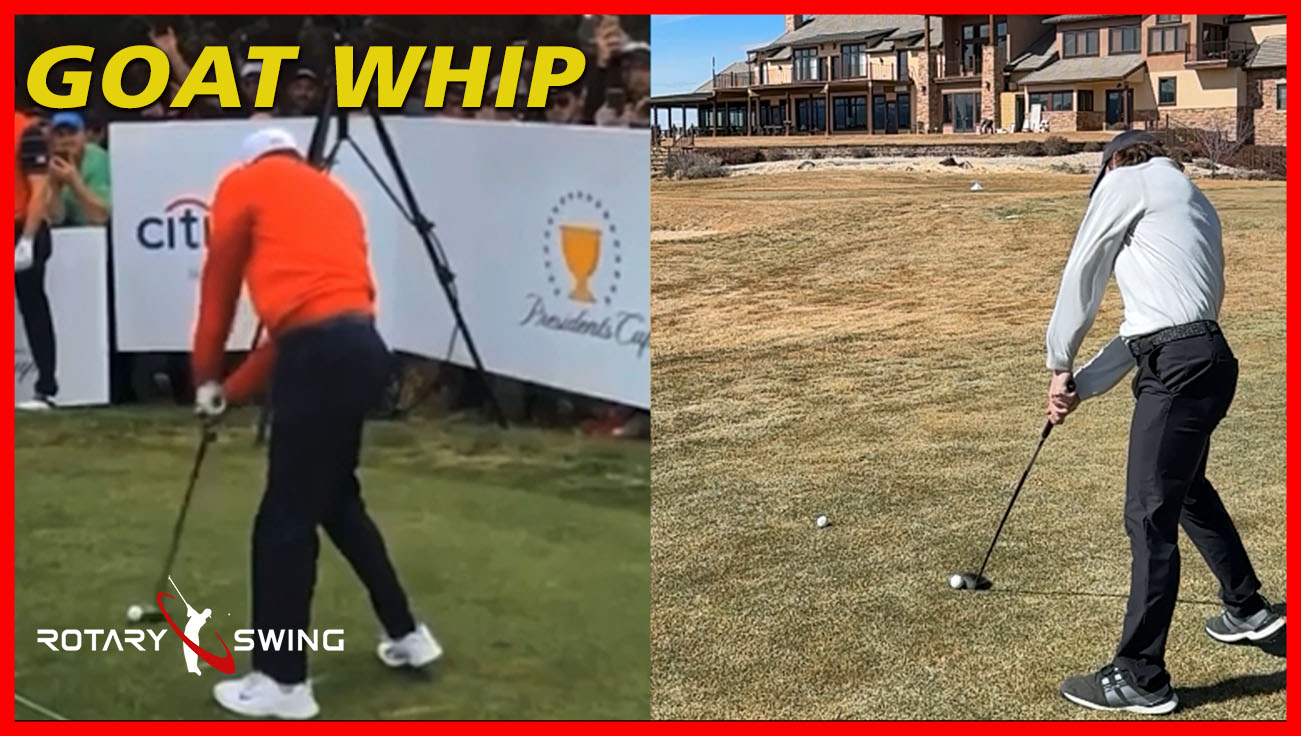
Jim, review the whip if time.
We'll have time, but I mean, what's the review about the whip?
We'll talk about it.
You just whip it.
Yes.
Yeah, it was a heat stroke weather in Augusta.
Yeah, I mean, today, because we've been so spoiled with the weather.
I keep telling everybody we've been spoiled so far this year that all of a sudden today, I mean, it just.
Usually you walk outside in the summer.
It's like, all right, I'm starting to sweat a little bit.
Like I walked outside and I was like, I'm about to die.
I got your question, Jeff.
I got that on my list.
You're the fourth question.
I just got it in the email.
So I'll get to you on that.
So you made it in on the very tiny list I have today.
So what else?
My ticker's going up a little bit, so I'll give it a little more time.
Anything else going on in the world?
Anything I'm missing?
I mean, you know, for you 1099ers, we got some dues coming up in five days.
So that's fun.
I should just play like this.
I really just don't need my right hand.
All right.
Hey, Tony.
Hey, John.
Scott, if you're looking for questions, I have issues.
I wish you would have just put a period right there.
I have issues.
That would have been better.
With not being able to stop my chest rotation early enough, Goaty says my hand's slow, fine, but my chest rotates through to contact.
Doesn't seem or feel like it to me, but Goaty is relentless of the mistake that I make, that the chest rotates all the way through contact.
What do you, well, we'll come, hey, Scott, so I'm going to come back to that.
Let me do this list first for the people that got it, and I'll come back through these.
Because that's a good question.
How do you recommend blend the use of classic rotary swing with goatee?
That's a, define classic.
I don't look at goatee as being a trail side or lead side dominant swing.
So there's components that I can find in dead drill, you know, Axiom, C4, all across the spectrum when it comes to goatee.
The same parameters are still there, just how you're loading and how you're using them.
I mean, if we were to take dead drill one.
I mean, even dead drill one, what are we trying to do in dead drill one?
We're trying to rotate, load, maintain shoulder plane, have hip depth.
Now, how you're trying to achieve it and how you're trying to feel it and what muscle groups you're trying to do maybe come across a little bit different.
But the same basic parameters are there.
And I think that's what I think some players are looking at it and are like, this is.
totally radically different.
What is, and understanding how the fascia works, understanding what muscles you're engaging and stuff like that.
But the same kind of basic principles are there.
I mean, that's why, like you'll see, well, you know, in my swing review, sometimes I'll use like an old C4 video or use an old Axiom video or something, because it's a way of getting my point across.
Take like this whip thing, like just like, you know, when Chuck was talking about the supination, or I even thought it was explained even best in Axiom, Understanding how this club whips through on its own, like I get, I can get the feel for the whip so easily.
Doing this because I can feel how this club gets to the point where it doesn't have any choice but to go here, go back on itself and then release, so like, that's, that's an old rotary thing to.
I wouldn't try to separate them too much because there's information you can get, period, from them.
I'm still confused on the bow, Sean, but I'm going to do my best to explain it to you.
I think your imagery of the side bending getting back over there is correct.
Go human.
I appreciate it.
Human needs all the help he can get.
I'm running four jobs right now, all this.
Give some up for the human.
Let's see.
All right, well, my ticker stops, so we will get going.
I have a lot more.
Now, this is nothing against you all, but I have a lot more people in this one than the last one, and you all only gave me four questions?
Don't look at me.
And one of them is just a comment.
All right.
So without further ado, let's do this.
Let's get through these, which shouldn't be too bad.
And then I'll open up the forum and we'll just do more of a golf talk live.
Sound good?
So first one, I found it easier to get the right hip loaded, the pelvis tilted, and the chest lowered in the backswing, if I think 3D, which golf swing always is.
Absolutely.
I think some people struggle.
when they're trying to change their swing or build their swing because they think of it so much in a 2D format.
In 3D, there just isn't right angles 90 degrees.
It's more diagonal angles 45 degrees.
Exactly.
This made the loading of the pelvis and chest drop easier to do all at the same time instead of the 2D approach, which was a mess.
I think it's worth mentioning in the next webinar.
And that's a great comment.
And that's the truth.
Because when.
Obviously, when working on a golf swing, you only have, and depending on how many cameras you have, but typically somebody only uses their phone or their camera.
So they have their camera set up right here.
They make it pretty, and then they go over here, and they're like, everything's broken on this side.
I had a Zoom lesson this morning, where from face on, everything looked fantastic.
Everything up to here, getting down here, everything looked great.
And I said, hey, I need you to move the camera down the line because it looks great, but something just in my mind, something, I got this bug in here.
It's like something's a little bit off.
And as soon as the player went down the line, I saw that, well, everything was looking great, but he was pushing his arms and hands out this way.
He wasn't losing tush line, but it wasn't getting deeper either.
So I understand how it's really tough for everyone.
because you're looking at things very two -dimensionally that way.
And that's why, like the last whip video, when Chuck had the little GoPro on, that was probably the greatest revelation for more players on the whip and the release, because now not only are you looking at it from the player's perspective, but you're looking at it from an angle of how it actually works and how it actually works in these concentric circles.
So going to this student or this member's thought process, Think of everything that you do in the swing.
Think of its effect.
So when I give an in-person lesson or Zoom lesson or anything like that, I always try to make the player think.
It drives them absolutely nuts.
It drives them nuts.
I always question them because if I can pull it out of them and get them to figure it out versus me just telling them the answer, they're not only going to remember it better.
But it's going to hit home more.
And so when you think of even like the hip, you know, if I was just standing right here and I push my right hip in, well, my spine obviously comes up right here.
I don't have a choice with that.
But what also does that do?
When this pushes in, my pressure goes towards my toes.
And now even me just swinging, how many times do I see in a lesson that somebody falls this way?
And I'll just ask them.
I'll be like, why did you fall forward?
And they kind of look at me with like this glossy eyed look and they're like, I don't know, I always fall forward.
And I'm like, Let's think about this for a second and break it all the way back down into its components.
Of you're falling forward because as you're going from the top, you're firing your right shoulder, right hip, which is moving your weight out towards your toes, which is why you can't maintain balance over here.
Well, I didn't know I was doing that.
Why didn't you know you're doing that?
Because all they were filming from was right here.
So you need to think about the cause and effect relationship, and you just can't see that in a 2D model.
Think of how each component affects the next.
If I pull this hip back, where does this hip go?
If I take this shoulder, I mean, this is one I see all the time, the flattening of the shoulder plane.
I see that literally on a daily basis.
What actually, just think for a second.
What actually causes that?
Just stand right here.
Any problem that you're struggling with.
All right, if I tilt my head like this, that's not getting me off the golf ball.
Okay, well, if I drop my shoulder like this, okay, I can kind of see a little bit of this, so I may be pulling too hard with this.
Well, my head's also moving off the golf ball too.
Well, if I push with this shoulder, it starts to move my head.
Think about how each little component affects the next.
The swing is actually ridiculously simple.
Like when you start to understand, like how the core actually moves, your body, to move your arms, to move your hands, to move the club.
As long as you get set up right and you're driving it with your engine right here, a lot of the things become very, very simple.
It's just that we add so much to it.
So when you can get caught up.
Just seeing what you're seeing here, or seeing what you're seeing here.
Because you don't have, you know, 360 cameras around you.
That's one thing about an in-person lesson is I kind of have that view, which is, you know, good for me.
But when you start struggling with the problem and you're looking at it from these views, just think of what the effect is.
Don't just look at the problem.
Like, okay, well, I'm doing.
Look at all the little channels and how it affects it down the line, not down the line camera, but down the line.
Because that's, I think players get too caught up on.
Okay, this is my problem, I'm going to fix this problem well, where did the dam actually start leaking?
Did it start here?
Did it start here?
Did it start here?
Work your way back to the actual cause and only tackle that and let the effects start to change themselves.
But that's what I see a lot with the 2D, 3D thing is that when they're thinking about it in 2D, oh, I got to get my hips over here.
Well, that's not a hip turn.
My hips are turned, but that's not a hip turn because if you were to look at this down the line, I'm going to do that.
Oh, that's not what this is pushing out right here.
So just be careful when you're looking at things.
I'm going to make sure.
Got my Mountain Dew tonight.
I need it.
And I've already had two Celsiuses.
I'm not Canadian.
How would you say that?
Celsiuses.
Celsiuses?
Is that like deer?
Not deers.
For the Q&A, I'll try to explain this as best I can, so I hope it makes sense.
I'm wondering what the correct club path and feel through the hitting area should be.
Okay, that's a good question.
I'm finding there are two different ways to feel I'm hitting the ball.
Of course, I'd like to groove only one.
Since you're the rotary swing guru, I know you can tell me which is the correct go pattern and guide me to the light.
The first pattern is similar.
to softball, pitch, or bowling, which I do neither, so that's kind of tough, where the trail hand and club feel like they're almost coming underhand to collect the ball.
Not necessarily a scoop, but coming in underneath and finishing high.
So I take that as literally what I was just doing a second ago with the spit, is that you're feeling that it's supinating from here, coming from underneath, and kind of catching the ball like this, and almost kind of scooping it up, but not scooping.
The second feeling is that the club kicks out in front of my hands and then the club finishes around my body with the hands low instead of up.
So I'm assuming kicks out and goes this way.
My hands drop close to my body in GDP, which they actually do in both versions.
And then the club kicks around like a windshield wiper.
The follow through goes around with my body rotation.
Makes sense.
Thanks as always.
Well, I appreciate that.
So, this doesn't really get gray.
It gets gray because of feelings.
And I'll explain to you kind of what's more correct, but why it's gray with feeling.
So, when I get up here, all right, so if we take my golf swing, and I get up here to the top, when I start to come down, I literally feel, as Chuck talks about it, the stab, the thot.
I literally feel this, all right?
This is literally what my downswing feels like.
Because I go to here and I feel like I'm literally chopping down on it.
Now, if you look at my golf swing, it doesn't look like that at all, all right?
That's my feel because my problem is, is I get under plane.
So if anything, I need to feel some early steepening of getting down on plane.
That's what I need to feel.
Now, if you talk to Justin Rose about this, He would say that's the absolute worst thing to feel because he does that too much.
And you'll see that he gets up here and he practices that drill where he stays on his trail side.
He drops the club behind him like this.
And then once he drops the club behind him like this, he whips it around.
And he talks about it as in like it's the boat and skier effect.
The boat's pulling the skier, which that part I agree with.
It's the same thing like goat sling or anything like that.
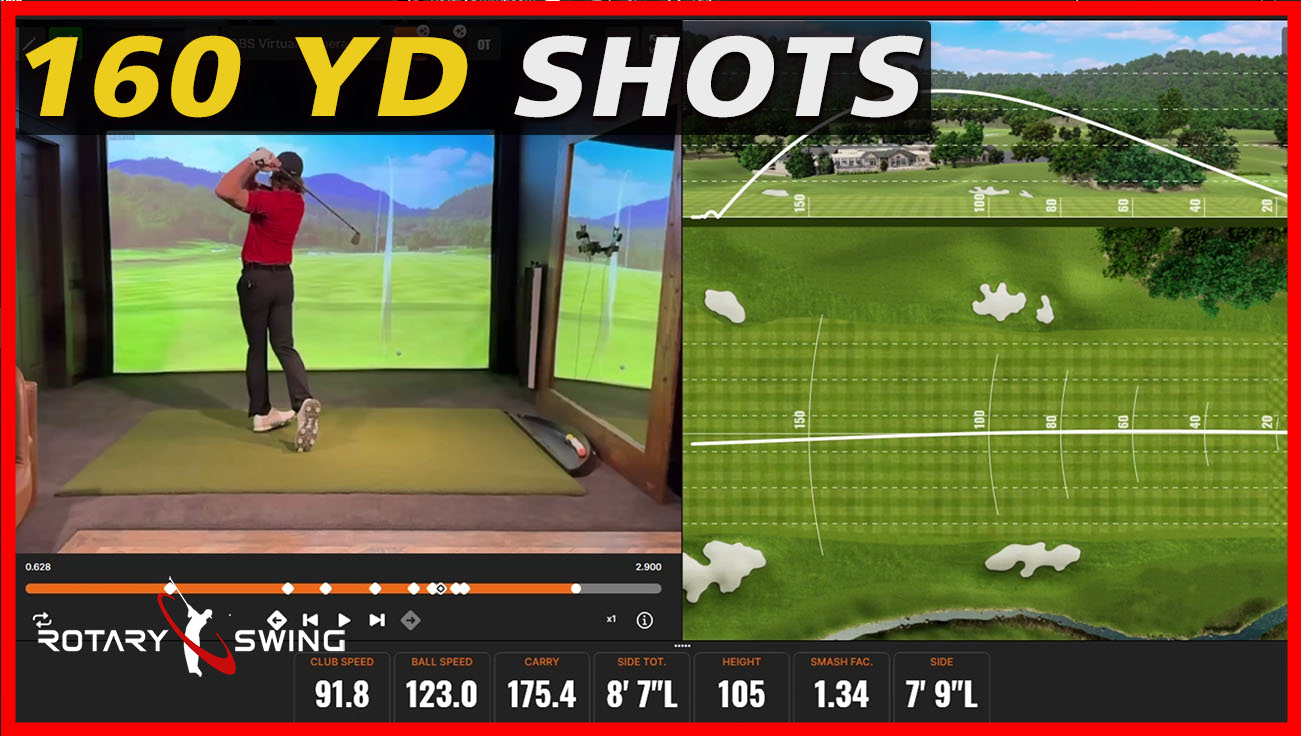
So in answer to your question, feel-wise, I can't tell you the right answer because my path is literally, I don't know, I think on the simulator, it was 0.
7.
My club face is like one.
Like my path is always like within like one degree of zero.
All right.
But my feel is your second feel.
Where I get to here and I feel like I kick it around now, that's not what actually happens in my swing.
So this is why you have to be a little bit careful with the feeling real thing.
Now.
In actuality, it's more the former that as you're coming down, this is supinating.
I'm pivoting around the skier.
I don't want to outrace the boat.
If you see my stomach, the stomach's my boat, So I don't want the skier to outrace the boat.
I want the skier to be pulled by the boat until it's time to fling the skier, which is going to be more your feeling in the first part of that question, where it's going to feel almost like it's coming underneath and slinging out this way.
So it's going to feel like it's going this way and then coming underneath and slinging that way.
If I did that, That would be literally the worst thing I could do, feel-wise, for my ball striking.
But that's more of what really happens is that I'm using my core to bring everything down.
The club's staying in this supinated position until it's time for it to whip and snap.
So that's going to match much more of your number one in the mechanical realm.
But feel-wise, I just can't answer that because feeling real are two different things.
Mechanical realm, number one.
Fuel realm, it's just two different animals.
I mean, that's one of the biggest revelations to change my ball striking was to actually feel over the top, even though I don't come over the top even remotely close.
But that's a feel.
I can't teach based on feel.
So that's my answer to that.
Hopefully it makes sense.
Nothing makes sense on my field.
Bow imagery.
I'm still trying to figure this one out, Sean.
So if I'm thinking of the bow imagery, here's the bow, so to speak.
As I start to get that load diagonally, it's almost a feeling of creating, like if you look at me like right now, I kind of look like a bow.
You see how my string's getting pulled this way as I've got right here to now let go of it right here.
It kind of is a reverse bow, but it's from both views.
This goes great with that last question because it's a feeling.
As I go this way, the two things that I see the most when it comes to getting this load thing.
correctly or incorrectly, is A, people are trying to load like this.
They get all this lateral motion either from sliding this way or pushing this way.
That's not how it happens, all right?
It is this 3D feel of going 45 degrees.
Now, if I get my hip driving deep behind me and extending my glute, I literally feel like I moved like this.
Like, it feels like this, but with the combination and the rotation and what I'm doing with my core, I'm not.
So it feels like I'm taking a bow back so that this can snap through this way.
So it's almost like, you remember the hip kick video?
Or Chuck's like, you know, hold the baby or anything like that?
Well, that's the thing.
If I feel like I'm like bowing to get this stretch and load right here, I feel ridiculously loaded right now.
If this is the bow, I'm here to now unload this way.
So I don't like the bow imagery because it can be taken 4,000 different ways.
All right.
For me, that does not work because I can look at that in a 2D.
I can look at that in a 3D.
But this is what I would say about it.
Think more like a coil in a rubber band.
All right.
If I'm pulling back a bow like this, All right, so I got a bow and arrow.
It's going like this.
I'm trying to stretch that bow this way to now make this uncoil, very natural.
And if you don't get that stretch of, like, pulling back a bow, like, think about this, you've.
I'm sure everybody here has watched YouTube or seen it.
I mean, everybody is always looking for swing stuff.
And you'll see people practice this all the time where they're like this, and it's kind of the same thing right there.
Think about if I was pulling back a bow, but with my body, not with my arm and hand.
And I'm stretching out this way.
And I kind of have this bowed look to me here to get this unwind.
So I know that doesn't help that much on that.
I don't really like it per se.
It's kind of like, I always tell people.
I've always the, you know, the the thing with Chuck and my relationship.
I've always been the yin to his yang.
He does something, I'm like, hey, that's great, but that kind of, I don't know about that.
What do you mean you don't know about that?
Well, I'll tell you when I don't like something.
To me, that imagery, I picture it like this as I'm stretching back that bow like I'm here pulling against it to get it to rebound.
But the people that I've seen do it go like this or go like this trying to get the stretch to feel like they're.
Boeing, which I don't want that either.
So that's just my thoughts.
Now, Jeff, I know you asked a question about the whip, but I got to go up here because I didn't have time to print it.
So when practicing at the range and at home, can you explain how I should be practicing the whip?
When practicing at home, I'm looking at the swing both face on and down the line in the monitors to make sure I'm doing it correctly.
When at the range, I would video a course.
So Jeff, I know you're in here.
What exactly are you meaning by practicing it?
Because remember, there's two different distinctions with this.
One is that the whip is a byproduct.
You don't make the club whip.
You can't make the club whip.
The whip is a byproduct of me doing all the stuff and then letting the weight whip through.
Now, the motion of it, where if you're right here and you're working on, okay, I'm going to feel kind of close to my thigh and then feeling this pulling away from my lead hand, which if anybody knows me, this one's pretty easy for me.
Feeling this coming down and then pulling away from my fingers.
That's literally how I would do it separately, like if it were me.
I had a some flood damage, so I don't know where my golf balls went.
Aha, the whip is a byproduct, all right, but I would actually practice working on getting here, getting my arm and hand down, having a little bit of flow, and then just to get the feel of what it's like with the ball and letting this kick back.
And you can generate an enormous amount of speed by just doing that.
I had a student a little bit a while back that was literally just doing that, hitting it 85 yards with a seven iron.
Getting it here, letting it come down, and then just.
feeling the whip.
That's a good way to do it.
The problem is, is that's very isolated.
It trains this motion, but does it train how it actually happens?
Because it happens because I'm going through here to here to here, and then it's whipping on its own because there's literally nothing left to happen other than getting this to snap down here.
So if you're trying to train the motion, getting up here, letting your arms fall, having a little pump to get the correct feel of, okay, Frowny face, smiley face.
Browny face, smiley face.
Doing that, I don't have a problem with.
I think that can be really helpful.
But I need you to understand that that motion right there is a byproduct of me going all through here and letting that happen.
That's not me powering it through.
That's me working through my sequence.
And now the club is whipping.
That's why I can still talk as I'm doing this.
Because I'm letting the club move fast, not me.
I say this all the time.
I don't care how fast you move at all.
I care how fast this thing moves.
That's the only thing that needs to move fast.
All right.
And I think players, because of release patterns and old push moves and steering the club and all that, don't really realize how little kind of control you have over these things.
You know, when you think of Vijay or you think of Phil and you've seen them with their trail hands like this coming through impact, this whole snap working from here and getting down into this position, we really don't care.
Like I literally, as I start to get to here and this, I don't care because I know that this, that's why my path and my face angle are always so zeroed out because I'm not trying to do things with them.
I'm literally like, okay, get here.
Do whatever the hell you want.
It's literally my thought process behind Everybody's like, I don't understand why you hit it so straight because I'm not trying to hit it straight.
I'm literally saying just do what you're designed to do, which is you're swung on an incline plane and designed to rotate.
So when you start to get down through here, I don't care what you do.
Just release.
But I'm like this right now.
I'm as relaxed as a daisy.
So my two thought processes on that when you're practicing it, I have zero problem with you getting here, getting a little weight, getting this down, and hitting some small shots, just trusting this just to get the feel of, oh, just let this go.
And I guarantee you'll actually hit some quality shots.
But still, at the end of the day, remember, all of this is a byproduct of how I'm loading, sequencing, getting down here, and letting that whip on its own.
So hopefully that answers a little bit of the question.
I wouldn't say, because I know I'm going to get this comment at some point in time, I wouldn't say it's like a lead side release.
Like, just go practice left-hand only shots.
On my end, I would always recommend that.
It's about learning.
The biggest problem we, and I'm putting myself in this, we have as golfers is giving up control.
All right?
That's the biggest problem that we have is controlling something that really is out of control.
All right?
So even if you hit a couple hooks or you hit a couple blocks or you do.
I don't care, I need you to start getting down into this position and saying, Hey, let the golf gods take the wheel.
Because what you will find is when you stop trying, when you stop trying to make the club do something, when you stop trying to make it bend to your will.
And you just start, like, I show this in in -person lessons all the time.
I'm like, I can't wait for super seniors.
I don't play golf.
I don't practice or anything.
But I'm going to be like this because I'm half made of metal and my body's broken.
I'm going to be like this.
But I understand when I get down here, that.
I understand, let the club snap.
And I hit the crap out of the ball that way and straight.
But it's because I don't, I'm letting this.
Do what it wants.
Do what it wants.
It's like I had a student, it was like a week ago, that was a massive hooker, all right?
You know, Bob Hope, massive hooker.
And I told him he was under-releasing it.
And he kind of looked at me like, what?
No, no, no, Craig.
Like, I hit the ball to the left by like 30 yards.
I'm like, I know.
It's because you don't release the club.
And in his mind, letting the club go or letting it release is what's creating his hook.
And so I have to work him with him a little bit and getting him to understand letting this happen.
And then he started to get some speed and then he started hitting it straight.
And he's like, this doesn't make any sense to me that I'm not hitting it left.
And I'm like, because your left shot as you come down for him was taking his trail hand.
and making that club bend to his will, making that toe rotate over that heel, trying to get that out there, hitting that draw, versus when I was taught him how to release the club, Teaching him how to let this club go on its own volition.
And that he could speed up his body as hard as he wanted, and that release could be as hard as he wanted.
Then he started to hit it straight.
And it wasn't that we stopped releasing.
It's actually that we had more release, but we added the release by letting the club do what it's designed to do, by him letting this just whip on its own, which to him was foreign, thinking that was going to be hooked.
So that's why that's just really tough for people to accept, is if you give up the control.
I hated this as a kid.
I hated this as a kid.
Craig, give up control to gain control.
I'd use a lot of colorful words that I'm not going to say on this.
It doesn't make any blank, blank, blank, blank sense to me.
If I'm not giving it control, then how do I get it to do what I want it to Well, as soon as you give up control, you start to get the feel for it.
It's really strange.
It's kind of like a boat and a skier.
You get in the water and you're drowning.
Boat's trying to pull you up.
You're just drinking the entire lake.
And as soon as you finally get one, you might be a little wobbly, but you pop out of the water and you're like, all right, I'll do that.
But you get the feel for it and all of a sudden it's like, oh, this is easy.
Like I can do this every single time now.
It's the same thing with this.
You know, you see these emails on Goaty about breakthroughs and all that.
It's the same thing.
You're like, wait a minute.
I didn't really do anything to create that and it just happened.
It's kind of what you have to do when it comes to this whip and this release, is you've got to give up control if you're going to make it happen, which you're working on your swing, so how do you.
I understand the conundrum.
But with that being said, I don't have any more questions.
So I'm going to scroll back up here, and Scott.
The contact I would go to that, uh, deceleration video personally.
Because if I'm going from here and I'm loading my core and getting up to this position once I get to here.
This is why I was asking, Where do you think that you're moving from?
Because it's people are.
I think people are tying too much of the chest in with the core.
I'm not saying this is your problem, but I think people are tying that too much in, which is why they struggle with getting the rotation with it.
Because if I'm here, where's my chest pointing right now, but where's my stomach pointing?
So to me, it's all about getting the feel of how, as I get to here, it's about my core and how my core does it.
If the chest is accelerating, typically you're probably adding some shoulder rotation to it because it's kind of hard to separate shoulders and chest.
But what I would do is I would practice a lot of up here like that.
So you can see, like watch my legs right here.
I'm not even trying to do that.
I just have a lot of force right here.
You can see how I'm done with my legs.
I'm here, but look at where my chest is.
My chest is already, bam, done.
So I would practice a lot loading, rotating, and then being done by parallel to the ground.
Where if I were here and then being done, but really feeling how my core and this is driving, but not my shoulders and my chest.
Because you might be slowing them down and getting this rotation in them, but it has to be some chest shoulder push right there.
And it's got to be more, I slam on the brakes.
And you can see how that whips.
But look at my look at my body right now, look at what happens when I do that, I go to here.
Well, I still got two butt cheeks right now.
I'm going to get a more open and real golf, but for an exaggeration, that's getting me to get this cleared with feeling like this.
Because I think people put the they kind of tie the chest rotation and the core rotation a little bit too much together, David, let's see.
Who do you have for the U.
S.
Open?
I don't know.
I don't even watch golf.
Is Gene Saracen still playing?
I don't know.
Josh, can you touch on the idea of the club coming down a rotary belt and whipping at the bottom?
Elaborate a little bit, Josh.
I'll come back to you.
What do you mean, and whipping at the bottom?
I kind of was showing that a little bit earlier, if that didn't.
How do you pass hip depth on goatee?
I have 0% rate and it's driving me crazy.
All right, let's talk about that.
All right, Trenton.
So this is really tough without seeing what you're doing because I see a million different reasons why people don't get hip depth.
I had a guy, I think it was yesterday.
I had a guy on a swing review, same thing.
He's like, I'm sending my hips so deep that I don't, like, I'm almost hurting myself, but Goaty says I've got zero hip depth.
All right?
And he's like, is that how it should feel?
I'm like, no, it should feel relatively easy.
Like, it shouldn't feel like you're doing anything like that.
And I'm not picking on this student, you know, but I'm using this guy as an example.
If he's in the room, it's.
I fixed you, so you're fine now.
But what was happening is even though he was getting his hip going this way, he was taking his arm, more specifically lead arm, and pushing it across his chest.
Now if you look, I'm going to try to get in the position that he was in.
If I look at this, where are my arms relative to my hip depth?
All right.
Now Goody's looking at a million different parameters.
My hip might be deep right here, but it's not deep relative to what I'm doing here.
All right, there's no depth to it.
Now, if you look at my swing or just look at what I do right here, you can see I've got hip depth relative to my spine and relative to my arms and hands because I didn't pick anything up, nor did I push them across my chest.
So what I see more often than not, it's because players are swinging their arms deep.
with their hip deep, and Goaty's going to say, hey, that doesn't work.
You're doing, you know, you probably get that combined with trail arm lift.
And so Goaty's looking at that and saying, well, your hip might have gotten over here, but you don't have any hip depth because it's not really deep compared to anything because your arms and hands are over here.
That's just me, but that's typically what I see on that one without seeing your motion.
Josh, I often feel like I'm moving towards the target.
versus the spiral staircase feel.
So like from the top, I mean, that's, you know, when I'm right here and I'm getting that same feeling where I'm extending this glute and I'm rotating into this leg and moving this way, just a good way to kind of get this, you need a mirror.
Obviously, I got a mirror in front of me right here.
If I start to rotate right here, so I'm starting to get my hip depth right here, my hip's going this way, and I'm starting to rotate my rib cage.
All right, right now I'm kind of running out of room.
Now, if I felt like I was going to keep rotating, all right, and that's kind of the big key.
If I felt, instead of going to the right and changing directions and going back to the left, if I felt like I was still rotating right here, At some point in time, I'm running out now, where's my weight starting to go?
You see, I'm running out of real estate to keep rotating right there, so my weight automatically starts to happen this way.
And now, oh, okay, well, now I can start to reverse direction right here.
So what I usually see when it comes to, uh, you often feel like you're moving towards a target versus a spiral tele staircase.
Feel is because players are trying to go to the right and then to the left, and I'm basically keeping it in one motion, all right, that I'm turning so much that I can't turn anymore, so something's got to give, and it's my hips starting to go this way, which now my core is so stupidly loaded, it wants to fire this way, and that's why that happens a little bit more automatic.
I don't know if that helps you out, but that's.
IRA Uh, I've always been a hip spinner.
I'm now loading per rotary cool when I start with my left hip unloading.
How far forward over my left foot do I want to get and not feel like I'm spinning?
How far forward over your left foot do you want to get?
What do you mean by how far forward over your left foot?
As I'm going from here and I coil and load up towards the top, I'm still going to plant my weight.
And if I'm hitting a typical iron shot, I'm still going to be in that safe NGA point.
So ideally, you want this hip kind of stacked over your ankle joint.
You don't want this out ahead.
That's going to tear a labrum.
You don't want this behind the ankle joint because it means you didn't shift any weight.
Uh-oh, I've got like eight new messages, and I'm way up on this list.
So Johari, I know I probably butchered that.
My problem.
Just came back from a game driving it further than I ever have, four times in a round.
Every time I have this feeling at the end of my weight on my back foot at contact with the ball, it goes straight, but I feel it's wrong because of that.
Is it right to feel that?
I have this feeling at the end that my weight is on my back foot at contact with the ball.
I mean, specifically with the driver, your weight and pressure are over here.
But typically with the driver, you're going to have a little bit more secondary tilt.
And as you're creating whip, what you're going to see in most players is this motion right here.
You start to get into vertical hip extension and the head starts to move away as you're trying to create width right here, which can almost feel like you're on your back foot.
So you're probably feeling pressure there, but your weight's still over here.
As long as you're not like this and your weight is on this side, you might be just feeling some breaking.
on that big toe right there because you're trying to get a lot of whip and width on the way through.
So as long as the weight is on the lead leg, I don't think that's necessarily that bad.
Jonathan, can you give us a deeper breakdown of the Tiger Woods hip bump vid and load shape?
I feel like when I do the hip bump first and then my arms come under, I'm turning on a tilted access.
I feel like when I do, are you talking about the beginning of the swing?
Because we have, there's like three hip bump videos on Tiger.
My arms come under and I'm, yeah.
If you're talking about the beginning of the swing where you're, if you're taking this and you're kind of the hold the baby thing.
So it kind of feels like you're more turning or you're on a tilted like this.
Yeah, that's a hundred percent what it's going to feel like.
Because what most people do is they try to turn on this perfect plane and axis right here versus it's almost, it's not stack and tilt.
It's almost a tilting feel.
It's almost like as I get here and I do that, it's like a tilting feel.
Because players get so caught up in pulling the scapula or right shoulder behind their head.
left shoulder under chin, left shoulder under chin.
Yeah, that works.
I thought I said left chin under shoulder.
So, but watch how little I literally have to move.
I'm 90 degrees.
I didn't do crap.
I don't even feel anything in my scapula right now.
So yeah, it feels more like a tilt and it almost feels like the arms are coming under.
All right.
Instead of out and around.
Tom, can you expand on what it means to keep the arm structure in the backswing?
Don't do anything with them.
So, perfect.
Perfect question, Tom.
We had a question earlier.
How does this tie into rotary of old?
What do the arms do in the backswing?
All right, think about the old five minutes.
We got a little elevation.
We got a little flexion.
I even have a video on it.
Right?
Little here, little here.
All right?
So the big thing is, is that as I'm rotating right here, I've got this structure that I have it set up right here.
You can see both my wrists.
I'm in flexion over here, extension on this side.
And as I'm going back, that this structure isn't changing because as I go this way, the arms do very little.
So if you look at my swing right here, this is about my normal golf swing.
If I were to stand up and rotate here, where are my arms?
They did very little.
So it's about the arms not swinging across the chest, the hands picking it up, the arm picking it up, the lead arm breaking down.
It's this unit, this structure that I have right here.
If I had my kettle, think like when I do the kettle and my arm structure doesn't change.
See how I'm moving this with my body and my arm structure staying the same.
Now with a little momentum, My trail arm's going to bend a little bit and the club's going to set if I have proper grip, but that's about it.
So it's all about my arms and hands are just the conduits.
They're the spokes on a wheel.
The spokes don't change on the wheel.
It doesn't work.
You have to have the spokes staying on the wheel.
They're just the conduit.
So you can see the structure of my arms are maintaining.
They haven't really done anything.
That's what they're meaning by arm structure.
But that's what kind of some old rotary can help you out with.
Josh, Chuck has a video where he talks about the club coming down like on a rotary belt and at the bottom it whips around back up the other side like a J.
That's what I was sitting there doing earlier.
All right, so.
Don't get me in trouble for this.
All right?
Some of these things before goatee, it's not that it's outdated.
It's just phrased differently.
So the J pattern of getting up here and letting this wind and then whip down, that's 100% of way you can swing.
I have students that do the, I teach them that.
They don't want to do the other stuff.
So this J pattern is the same thing that I was doing right here.
All right.
That is, I supinate, deviate, and rotate.
that this club, as I do this, rehinges on the way through.
That if I wind this way, it creates a J.
And then as I unwind, I start to supinate, deviate, rotate, and go this way, just like it would if I was just spinning the club right here.
That's what kind of makes the J right here, is this motion right here.
And if you struggle with whip, and if you struggle with release, this is a great thing to feel.
because this will teach you, oh, here, watch the button in the club right here.
This is J release.
This is rotary release.
This is goatee release.
This is whip release, what you just saw in this weekend.
Watch the button in the club right here.
See how it goes from here, kind of kicks the other way, and this goes through.
So the J pattern is just saying, wind this up so that as you come down, you can mimic that same pattern of throwing it.
just as if I was like this.
So I'm winding up my J.
That's why it's easier to just kind of go like this.
You can kind of get the same feel of it right there.
And if you just sit here and spin it like this, you'll get the feel of exactly what it does.
Jacob, I can do the release with the lead arm, but the trail keeps screwing it up and pushing with the shoulder.
We can cut it off.
I got a hacksaw.
Upper body moving forward, right elbow coming out.
A swing stopping shortly after impact.
How do you stop it?
Well, needle arm.
Trail arm keeps screwing it up, pushing with the shoulder.
Typically, players push with the shoulder for a lot of different reasons.
Players push with the shoulder because they lift their arm in the back swing.
Players push with the shoulder because it feels powerful.
I still take it.
as I can't tell you not to do something without telling you to do something.
That may not make a whole lot of sense.
If I tell you to stop over swinging, you're not going to stop over swinging.
I got to give you something to do instead of over swinging.
So when it comes to this trail shoulder push and trail arm push right here, the way that I think about it, it goes back to the question earlier about arm structure.
All right.
Now we did this in a bunch of other webinars, but I really want you to get the feel for this.
Just think about this for a second.
There's more to it than just this.
But if you think of like my backswing drill, all right, where I get here and maintain the two inches, maintain the fingertip length.
All right.
And I get all the way up here and I maintain this.
All right.
So I've got the same two inch gap, got the same fingertip length.
What do you really feel right there?
Now, we could get all in a whole ball of yarn on this, but think about this.
If I go to here, my arms are pretty darn chilled.
Why would I go from a loaded body core position with chilled arms and all of a sudden go, oh, I'm nice and chilled, push! That's not how it works.
So when Chuck keeps talking to you about.
get the backswing load and coil and all that correctly, then the rest of the stuff will kind of happen on its own.
It's kind of the same principle right here.
If I'm loading me, me, correctly, my shoulder is chill.
My arms are chill.
I don't want to fire from here right now.
Now, yes, back in the day of rotary, I used to get here and feel my back stay to the target literally as long as I could.
To keep myself from pushing, but my fix was a band-aid, essentially because my pushing problem was because my arms were doing too much.
And that's all they wanted to do at this point in time.
But once I took my arms out of it and I maintained structure with it.
I didn't want to push with this anymore because my legs wanted to fire because I was loaded there.
Hopefully, that helps.
Tommy, no video.
I'm glad this wasn't everybody.
Sorry, Tommy.
I think it's still good on my end.
Jeff, when do the adductors come into play during the downswing?
Can you reference the video where Chuck mentions using the adductors?
I don't know the exact video because that's been a little bit, but this one's pretty simple.
All right.
As I load up into this position right here, as soon as I start to plant the weight right here.
So as soon as my coil starts to put pressure back on this side, I'm going to start to feel my adductors because my adductors are going to be responsible for pulling the rest of my weight, right?
So as soon as my pressure starts to get back this way, I'm going to feel my adductors start to pull my weight over there.
So not to make it simpleton or overly simple, If I'm up here at the top like this, my foot plants, my knee starts to square, my adductors start to pull.
All right, so it's early.
It ain't late.
And then they really start to pull as I start to fire this glute and get this.
But the adductors are responsible for pulling weight in the swing.
Not only just stability, but pulling weight.
So I'm going to, as soon as I get my, my adductors are already starting.
You know, Chuck had that podcast where he said, like, you know, his, his downswing feels like this.
Because as soon as I get to here and I start going like, that's, I'm already starting.
As soon as this starts, that's what's pulling my weight over.
All right, Tommy, back in the game, Jonathan, hopefully that.
I'll come back to you, Jonathan, here in a second.
Jim, Does the concept of passively letting the arms drop at the beginning of the downswing mean that we all max out on that beginning vertical drop at the speed of gravity?
It sounds like muscular pulldown is against goatee concept.
Muscular pulldown is 1,000% against goatee concept.
So gravity dictates vertical down speed.
Not exactly.
So if you break down what actually has to happen, and this is why the vertical drop, horizontal tug, see if anybody gets that one.
If we think about that, where's max hand speed in the golf swing?
Max hand speed is right here, all right?
Now, that's not because I'm pulling the bell, ringing the bell.
Making the club go.
It's because as soon as I load, get up to here and fire, I have to start my deceleration journey because I don't have time.
If I get here and I pull my arms, then I will already be at the golf ball.
Before.
I've had time to drive my core, clear my hips.
Hell, square up the club.
Look at it right now, it's wide open.
I'd hit it right into my computer screen right here, so remember as I load and rotate, Max hand speeds right here, not because I'm ringing the bell and all that, because I've done all this coil.
And now as I start to drive, all of this has to unwind.
All of this has to start throwing essentially from the top.
But it starts from here.
And that max hand speed isn't because you have to make that happen.
You actually can get that to go faster when the sequence, think about the whip.
When I use my sequence, it's not me pushing my hand out there to get that faster.
It's because of my coil and rebound, that's what's making that happen, with the speed, so the gravity effect of it, the falling effect of it.
If you want to swing faster, it's about doing less up there than doing more.
Like a lot of my long drive guys, they literally will say like, they just feel like, as they're going this, this is just a long for the ride.
Because if they get here and they start tugging it, they'll never get that club face square.
So it's a little bit more of a byproduct of everything that you do.
Thanks, Tommy.
I appreciate that.
Much, much thanks.
Mary, I'm having trouble with the full swing.
I go back to the putting lesson where you said, uh-oh.
I said?
I remember you, Mary, but I don't know what I said.
To use right hand only, stop pushing, stay connected to my core and to feel the putter move more like a paintbrush, no early release.
Can you demonstrate or explain the swing similarities, starting with the putt and moving through fuller swings, or highlight how the stroke should be different?
Or if they should?
Well, the putting stroke is unfortunately different than the golf swing.
It's not that different, but it is a little bit different because in my putting stroke right here, as I get into my goat arm and goat grip right here and I have my core engaged and I start to get my core, To get this feel and release of the club.
This really isn't that different from the golf swing.
All right, but what players tend to do is that they start pushing with this, okay as soon as they start making fuller swings.
But if I were going to go from putting right here, I got goat grip, I got putting right here.
I've got my core engaged and I've got my little back and forth.
Where I start to feel how this putter swings well now, if I start to make a little bit hinge, a little bit more rotation right here.
This is still the same thing that I'm feeling in my swing right now.
Now I'm just letting the weight of the club set.
I'm not really changing a whole bunch.
The problem is they're not exactly the same because when you start adding elevation into the factor or the arm's going up, that's where people screw it up.
But it's still the same thing, just like even a putter.
My core goes through and this releases.
Now this is obviously exaggerated.
I don't want to hit a putt.
You know, this far, but that's still the same thing that happens with this.
I should be able to go all the way up through and build from a putter all the way up into that.
It just happens the fact that the arm starts to go up, we've got more rotation, we got more hip depth, all that.
And then players start using their arm because they stop turning and they start swinging their arm.
And now they're like, I got to get this back somehow.
Um, so they're kind of the same, They really are, but they're kind of not the same because as soon as you add the other hand and you start rotating on more of this, you know, hinge forward plane and all this, it starts to feel different.
But if you get the feel for this in putting where your core is engaged and really kind of driving the whole thing, that's the whole enchilada.
Get the core driving the swing and let that do its job.
Please demonstrate containment and hip snap.
Two goatee gates I have zero passes at so far.
I don't do a whole lot of goatee.
Please demonstrate containment and hip snap.
It depends on.
I don't know which one you're referring to.
Sorry, Sean.
I'm not a whole lot of help with goatee.
It's the human in me.
But.
If you want, I will look at what's going on in that and I'll help you out in the next webinar.
Because the next webinar is going to come up pretty fast because this one was delayed.
Do you have a drill for getting hip depth?
The biggest thing, Trenton, for just getting the hip depth, it's not having like a big drill.
It's really stop using your arms.
I'm not saying you're using your arms like crazy or anything like that, but stop using your arms.
So if I'm right here, we obviously know that this hip needs to go deeper.
So I've got to get this hip deeper.
It doesn't mean that you can see my tomahawk over there.
I'm not trying to get my hip like this.
It may feel like that to some people.
But I'm just trying to get my hip deeper.
The big thing is to stop using your arms.
If your arms and hands were in quicksand right here, Or cement.
Let me do it this way.
I just thought of this.
This is how things are born.
So if my club is in front of this bag right here and I start to make my back swing, and I start to go, and my arms can't move, you see my body right now?
You see how I'm starting to torque?
My body's starting to go on my arms and hands aren't really doing anything right now.
I'm starting to create hip depth because my arms are working on their plane right here, but my hip is starting to get deeper because I'm starting to load it.
But as soon as I start moving everybody in the same direction or start picking it up this way, which is pulling it forward, what I see most on not getting the hip depth is too much motion from everything else versus These, everybody's doing nothing in my hip and my rib cage are doing all the work.
So you can see like right here.
Now, how am I not going to have hip depth right now?
So to me, the reason of all the hip depth on my end, what I see is because everybody's doing something to get back, whether it's the shoulder or the pickup of the arm and all that.
Try and see what happens when you don't move anything and see what your hip depth does.
I will stay on for a couple more minutes if there's any more questions.
Josh, when I'm swinging longer clubs, I'm losing a face a few degrees open.
I'm okay on shorter irons, but long ones no good.
Well, more than likely, you're adding more spin, which is delaying it.
So this kind of goes back to that acceleration -deceleration thing.
And there's still schools of thoughts on what to feel and all that.
Most players.
feel with irons, especially shorter irons, that they get on top of it, get way out ahead of it, and they release it right here.
And then as you work your way up to the driver, you'll see a lot of YouTubers or anything like that will say, hey, get up here and be done with it.
You're going to feel your driver release over here versus waiting late to it versus an iron.
Now, that gets a little convoluted for me.
But what I could imagine.
is when you get to the longer iron, knowing that you need speed to get distance, to get height, is that instead of doing the same thing that you do with the shorter iron, which is nice and tight, getting it done and letting it whip, more than likely you're trying to muscle it more because as soon as you, I see this with players, especially with longer clubs.
If I'm right here like this, it's very easy to stay nice and contained and all the fun stuff.
But as soon as I start getting to a driver and I get very vertical and all this stuff right here, It's so much easier to start moving all over the place and rotate flat and all that.
So I would imagine with the longer clubs that instead of I don't know what this is.
This is a three iron, for example, I thought it was a seven iron As I'm going through here with this three iron.
Because of the loft and because of the extra length as you're going through here, you're probably trying to get more out of it Now look at my clubface right now.
It's wide open.
It didn't have a chance to square up and whip.
It's still got to be nice and tight just like it is with your shorter irons.
But a shorter iron, it's so much easier because once you start deleting that radius, once you start deleting that width, it's very easy to keep it nice and contained.
As soon as it starts to get wider like this, you feel like I've got to do so much more when in fact it's actually you do less.
That's what I would.
That's what I would say.
I need to get these lies checked.
Mary makes sense.
Awesome.
I don't know if I ever make any sense.
When you start the backswing, do you feel your weight on your trail toe or back of the heel?
When I start the backswing, I feel it move from the front to the back.
All right.
So when I'm starting right here, I know it's cliche.
But I feel athletic.
I feel like I'm ready to do anything.
I can go forwards.
I can go backwards.
I can go anywhere like that.
If I favor one side more than the other, it doesn't really work for me.
So as I start the backswing, I feel more.
Like you can even see.
I'll exaggerate.
I'll make it a little bit bigger.
See how Chuck talks about those fascial forward presses and stuff?
So if I make it big.
I kind of forward press this way, you can see like my heels lifted right here, a little bit on my right foot.
And so when I go back, I almost feel like I'm going from that big toe back to the heel.
Now you can see when I make my normal swing, it doesn't really look like that, but I'm that, that's how I'm kind of moving right there, if I'm already this is.
This is something where players really screw up on the depth.
It's a good question here.
Is that player start in this position on their heels, with their hips deep, and they can't go anywhere.
So the only thing they can do is come forward.
You have to be able to move into this.
Move into this.
If I'm already here, that's about as much as I can do.
So hopefully that helps.
All right.
Well, I've lost seven people so far, so maybe I'm crazy or maybe it's late.
No other questions?
I field one more.
And then I've got like 20 swing reviews and who knows what else?
Charles, very clear presentation.
Thank you.
Well, thank you, Charles.
I appreciate that.
I need help from my team.
My computer was recently hacked, and in reprogramming, all my rotary was lost.
I've not been able to access the support team.
I need to connect with them.
So cs at rotary swing dot com.
Just email that directly.
Okay.
If you don't hear from anything, then put a message on the community, and I'll get to you, and then I'll streamline the communication.
Sean, oh, thank you.
I appreciate it.
I had no idea what to do because I didn't have any questions, so I'm like, I guess I'll still go on the show.
Thank you, Christopher.
Thank you, Jim.
Thank you, Kevin.
I mean, it might be my last webinar, I think.
With Goaty, it might be my last one, so we never know.
Tom, well worth it.
Scott, thank you.
Greg, much appreciated.
Glenn, I appreciate your time and efforts.
Thank you.
Today was kind of tough.
Like I said, two Celsiuses, who knows how many of these things.
Rich, awesome job as always.
Thank you, Rich.
I appreciate it.
Hope you're doing well, my friend.
Jeff, thank you, thank you.
Trenton, appreciate Charles, thank you so much.
I missed the program.
Well, I'm glad to have you back.
Mary, I prefer humans.
I appreciate it.
David, thank you, thank you.
Mitchell, that's the most compliments I've had in a while.
So many thanks on that.
Now, y'all know where to find me, right?
You know where to find me if you need help.
If you're in Georgia or if you're on the website, you know where to find me, right?
All right.
Well, I guess there's no order, so I appreciate the compliments, and we will be back on track.
I apologize for the week delay this time, typically the first of the month.
Uh, but that room, that room and that room were flooded.
So now I'll go ahead and tell you when somebody does waterproofing, they do great when they do outside waterproofing.
But if they use flat drains in a spot that can get leaves or debris that doesn't always hold, so I would recommend getting a dome drain just so if there's debris, water can still go down.
Let's see.
Stan, thanks, Craig.
You can show what I'm doing wrong and what it should look like instead of just talking at me like Cody.
I appreciate that, Stan.
Well, if anybody needs any help, you know where to find me.
You know where to find Anthony, too.
And we'll keep rocking and rolling because I just want everybody to enjoy this.
Not to end on a whatever kind of note, but there's so many people.
I really thought that the sport was for fun.
And I see so many miserable people at the driving range or the simulator and all this.
And I'm like, guys, it's a lot simpler than you're making it out to be.
I don't want you struggling.
I don't.
I mean, I even had a student where I said, look, if it's me or you go to another instructor, I don't care.
I just want you happy with your golf game and enjoy it and having fun.
I don't care where you get it from.
This is an outlet for a lot of people, and they don't get that outlet when they're playing miserable.
And I just hope that I'm bringing some simplicity and some answers to it so that you can enjoy it more.
With that being said, everybody, I appreciate it.
I will see you in the trenches, and we should be back on regular schedule next time.
Just had a little water issue.
Can you hear me?
Maybe?
Somewhat?
Don't know?
I can hear you all.
Perfect.
I appreciate your promptness, Mark, in keeping me on task.
Chris, go Braves.
I agree.
I agree.
Should have had a couple more titles in the 90s, but what's your.
All-time favorite TV sitcom.
All-time favorite?
Wow, that's tough.
Sitcom, though.
Would it have to be Seinfeld or Cheers?
Obviously, most people know me.
I'm kind of a wise butt, if you know what I mean.
Any kind of quick-witted.
Nah, things like that.
So, welcome everybody to webinar 20.
For those of you that are new here, I'm RST instructor Craig Morrow.
I will be your humble swing guide today.
And welcome, I appreciate you all giving me the opportunity to do this.
And, you know, to start out, I always let kind of people fill into the room as I watch my counter climb up and then I'll get started.
Or tonight's?
I don't even know what it is right now.
This is my third outfit today and I'll explain that.
Um, I didn't have hardly.
I didn't have any questions submitted, I only had four questions submitted, so tonight's format is going to be a little bit different.
I guess Gody's answering everything, so there's, there's no need for the human anymore.
Um, so, uh, well, I will get through those and then I will open it up to the floor and hopefully help the ones out that are here currently.
And we'll try to make this a good webinar.
Since I don't have a ton of ammo, we'll do what we can.
But with that being said, we will let the room fill up and I'll chitchat with you a little bit.
Let's see, Seinfeld is the right answer.
It's a good one.
Hey, Mitchell.
Stan, such a diva, three outfits, or Scott, such a diva, three outfits.
Yeah, so I don't know if anybody's residing in Georgia right now, but today it was one billion degrees, especially with the humidity.
Apparently we got some kind of Godzilla El Nino coming through.
And so with lessons and all of our fans are butts.
I went through everything that I put on today.
So I was like, oh, I can't show up in front of you guys looking like the swamp thing.
So I was like, I got to change clothes.
I got to do something.
Let's see.
Hey, Mary.
Hi, Tom.
Tommy.
Right.
Dennis.
Jim, review the whip if time.
We'll have time, but I mean, what's the review about the whip?
We'll talk about it.
You just whip it.
Yes.
Yeah, it was a heat stroke weather in Augusta.
Yeah, I mean, today, because we've been so spoiled with the weather.
I keep telling everybody we've been spoiled so far this year that all of a sudden today, I mean, it just.
Usually you walk outside in the summer.
It's like, all right, I'm starting to sweat a little bit.
Like I walked outside and I was like, I'm about to die.
I got your question, Jeff.
I got that on my list.
You're the fourth question.
I just got it in the email.
So I'll get to you on that.
So you made it in on the very tiny list I have today.
So what else?
My ticker's going up a little bit, so I'll give it a little more time.
Anything else going on in the world?
Anything I'm missing?
I mean, you know, for you 1099ers, we got some dues coming up in five days.
So that's fun.
I should just play like this.
I really just don't need my right hand.
All right.
Hey, Tony.
Hey, John.
Scott, if you're looking for questions, I have issues.
I wish you would have just put a period right there.
I have issues.
That would have been better.
With not being able to stop my chest rotation early enough, Goaty says my hand's slow, fine, but my chest rotates through to contact.
Doesn't seem or feel like it to me, but Goaty is relentless of the mistake that I make, that the chest rotates all the way through contact.
What do you, well, we'll come, hey, Scott, so I'm going to come back to that.
Let me do this list first for the people that got it, and I'll come back through these.
Because that's a good question.
How do you recommend blend the use of classic rotary swing with goatee?
That's a, define classic.
I don't look at goatee as being a trail side or lead side dominant swing.
So there's components that I can find in dead drill, you know, Axiom, C4, all across the spectrum when it comes to goatee.
The same parameters are still there, just how you're loading and how you're using them.
I mean, if we were to take dead drill one.
I mean, even dead drill one, what are we trying to do in dead drill one?
We're trying to rotate, load, maintain shoulder plane, have hip depth.
Now, how you're trying to achieve it and how you're trying to feel it and what muscle groups you're trying to do maybe come across a little bit different.
But the same basic parameters are there.
And I think that's what I think some players are looking at it and are like, this is.
totally radically different.
What is, and understanding how the fascia works, understanding what muscles you're engaging and stuff like that.
But the same kind of basic principles are there.
I mean, that's why, like you'll see, well, you know, in my swing review, sometimes I'll use like an old C4 video or use an old Axiom video or something, because it's a way of getting my point across.
Take like this whip thing, like just like, you know, when Chuck was talking about the supination, or I even thought it was explained even best in Axiom, Understanding how this club whips through on its own, like I get, I can get the feel for the whip so easily.
Doing this because I can feel how this club gets to the point where it doesn't have any choice but to go here, go back on itself and then release, so like, that's, that's an old rotary thing to.
I wouldn't try to separate them too much because there's information you can get, period, from them.
I'm still confused on the bow, Sean, but I'm going to do my best to explain it to you.
I think your imagery of the side bending getting back over there is correct.
Go human.
I appreciate it.
Human needs all the help he can get.
I'm running four jobs right now, all this.
Give some up for the human.
Let's see.
All right, well, my ticker stops, so we will get going.
I have a lot more.
Now, this is nothing against you all, but I have a lot more people in this one than the last one, and you all only gave me four questions?
Don't look at me.
And one of them is just a comment.
All right.
So without further ado, let's do this.
Let's get through these, which shouldn't be too bad.
And then I'll open up the forum and we'll just do more of a golf talk live.
Sound good?
So first one, I found it easier to get the right hip loaded, the pelvis tilted, and the chest lowered in the backswing, if I think 3D, which golf swing always is.
Absolutely.
I think some people struggle.
when they're trying to change their swing or build their swing because they think of it so much in a 2D format.
In 3D, there just isn't right angles 90 degrees.
It's more diagonal angles 45 degrees.
Exactly.
This made the loading of the pelvis and chest drop easier to do all at the same time instead of the 2D approach, which was a mess.
I think it's worth mentioning in the next webinar.
And that's a great comment.
And that's the truth.
Because when.
Obviously, when working on a golf swing, you only have, and depending on how many cameras you have, but typically somebody only uses their phone or their camera.
So they have their camera set up right here.
They make it pretty, and then they go over here, and they're like, everything's broken on this side.
I had a Zoom lesson this morning, where from face on, everything looked fantastic.
Everything up to here, getting down here, everything looked great.
And I said, hey, I need you to move the camera down the line because it looks great, but something just in my mind, something, I got this bug in here.
It's like something's a little bit off.
And as soon as the player went down the line, I saw that, well, everything was looking great, but he was pushing his arms and hands out this way.
He wasn't losing tush line, but it wasn't getting deeper either.
So I understand how it's really tough for everyone.
because you're looking at things very two -dimensionally that way.
And that's why, like the last whip video, when Chuck had the little GoPro on, that was probably the greatest revelation for more players on the whip and the release, because now not only are you looking at it from the player's perspective, but you're looking at it from an angle of how it actually works and how it actually works in these concentric circles.
So going to this student or this member's thought process, Think of everything that you do in the swing.
Think of its effect.
So when I give an in-person lesson or Zoom lesson or anything like that, I always try to make the player think.
It drives them absolutely nuts.
It drives them nuts.
I always question them because if I can pull it out of them and get them to figure it out versus me just telling them the answer, they're not only going to remember it better.
But it's going to hit home more.
And so when you think of even like the hip, you know, if I was just standing right here and I push my right hip in, well, my spine obviously comes up right here.
I don't have a choice with that.
But what also does that do?
When this pushes in, my pressure goes towards my toes.
And now even me just swinging, how many times do I see in a lesson that somebody falls this way?
And I'll just ask them.
I'll be like, why did you fall forward?
And they kind of look at me with like this glossy eyed look and they're like, I don't know, I always fall forward.
And I'm like, Let's think about this for a second and break it all the way back down into its components.
Of you're falling forward because as you're going from the top, you're firing your right shoulder, right hip, which is moving your weight out towards your toes, which is why you can't maintain balance over here.
Well, I didn't know I was doing that.
Why didn't you know you're doing that?
Because all they were filming from was right here.
So you need to think about the cause and effect relationship, and you just can't see that in a 2D model.
Think of how each component affects the next.
If I pull this hip back, where does this hip go?
If I take this shoulder, I mean, this is one I see all the time, the flattening of the shoulder plane.
I see that literally on a daily basis.
What actually, just think for a second.
What actually causes that?
Just stand right here.
Any problem that you're struggling with.
All right, if I tilt my head like this, that's not getting me off the golf ball.
Okay, well, if I drop my shoulder like this, okay, I can kind of see a little bit of this, so I may be pulling too hard with this.
Well, my head's also moving off the golf ball too.
Well, if I push with this shoulder, it starts to move my head.
Think about how each little component affects the next.
The swing is actually ridiculously simple.
Like when you start to understand, like how the core actually moves, your body, to move your arms, to move your hands, to move the club.
As long as you get set up right and you're driving it with your engine right here, a lot of the things become very, very simple.
It's just that we add so much to it.
So when you can get caught up.
Just seeing what you're seeing here, or seeing what you're seeing here.
Because you don't have, you know, 360 cameras around you.
That's one thing about an in-person lesson is I kind of have that view, which is, you know, good for me.
But when you start struggling with the problem and you're looking at it from these views, just think of what the effect is.
Don't just look at the problem.
Like, okay, well, I'm doing.
Look at all the little channels and how it affects it down the line, not down the line camera, but down the line.
Because that's, I think players get too caught up on.
Okay, this is my problem, I'm going to fix this problem well, where did the dam actually start leaking?
Did it start here?
Did it start here?
Did it start here?
Work your way back to the actual cause and only tackle that and let the effects start to change themselves.
But that's what I see a lot with the 2D, 3D thing is that when they're thinking about it in 2D, oh, I got to get my hips over here.
Well, that's not a hip turn.
My hips are turned, but that's not a hip turn because if you were to look at this down the line, I'm going to do that.
Oh, that's not what this is pushing out right here.
So just be careful when you're looking at things.
I'm going to make sure.
Got my Mountain Dew tonight.
I need it.
And I've already had two Celsiuses.
I'm not Canadian.
How would you say that?
Celsiuses.
Celsiuses?
Is that like deer?
Not deers.
For the Q&A, I'll try to explain this as best I can, so I hope it makes sense.
I'm wondering what the correct club path and feel through the hitting area should be.
Okay, that's a good question.
I'm finding there are two different ways to feel I'm hitting the ball.
Of course, I'd like to groove only one.
Since you're the rotary swing guru, I know you can tell me which is the correct go pattern and guide me to the light.
The first pattern is similar.
to softball, pitch, or bowling, which I do neither, so that's kind of tough, where the trail hand and club feel like they're almost coming underhand to collect the ball.
Not necessarily a scoop, but coming in underneath and finishing high.
So I take that as literally what I was just doing a second ago with the spit, is that you're feeling that it's supinating from here, coming from underneath, and kind of catching the ball like this, and almost kind of scooping it up, but not scooping.
The second feeling is that the club kicks out in front of my hands and then the club finishes around my body with the hands low instead of up.
So I'm assuming kicks out and goes this way.
My hands drop close to my body in GDP, which they actually do in both versions.
And then the club kicks around like a windshield wiper.
The follow through goes around with my body rotation.
Makes sense.
Thanks as always.
Well, I appreciate that.
So, this doesn't really get gray.
It gets gray because of feelings.
And I'll explain to you kind of what's more correct, but why it's gray with feeling.
So, when I get up here, all right, so if we take my golf swing, and I get up here to the top, when I start to come down, I literally feel, as Chuck talks about it, the stab, the thot.
I literally feel this, all right?
This is literally what my downswing feels like.
Because I go to here and I feel like I'm literally chopping down on it.
Now, if you look at my golf swing, it doesn't look like that at all, all right?
That's my feel because my problem is, is I get under plane.
So if anything, I need to feel some early steepening of getting down on plane.
That's what I need to feel.
Now, if you talk to Justin Rose about this, He would say that's the absolute worst thing to feel because he does that too much.
And you'll see that he gets up here and he practices that drill where he stays on his trail side.
He drops the club behind him like this.
And then once he drops the club behind him like this, he whips it around.
And he talks about it as in like it's the boat and skier effect.
The boat's pulling the skier, which that part I agree with.
It's the same thing like goat sling or anything like that.
So in answer to your question, feel-wise, I can't tell you the right answer because my path is literally, I don't know, I think on the simulator, it was 0.
7.
My club face is like one.
Like my path is always like within like one degree of zero.
All right.
But my feel is your second feel.
Where I get to here and I feel like I kick it around now, that's not what actually happens in my swing.
So this is why you have to be a little bit careful with the feeling real thing.
Now.
In actuality, it's more the former that as you're coming down, this is supinating.
I'm pivoting around the skier.
I don't want to outrace the boat.
If you see my stomach, the stomach's my boat, So I don't want the skier to outrace the boat.
I want the skier to be pulled by the boat until it's time to fling the skier, which is going to be more your feeling in the first part of that question, where it's going to feel almost like it's coming underneath and slinging out this way.
So it's going to feel like it's going this way and then coming underneath and slinging that way.
If I did that, That would be literally the worst thing I could do, feel-wise, for my ball striking.
But that's more of what really happens is that I'm using my core to bring everything down.
The club's staying in this supinated position until it's time for it to whip and snap.
So that's going to match much more of your number one in the mechanical realm.
But feel-wise, I just can't answer that because feeling real are two different things.
Mechanical realm, number one.
Fuel realm, it's just two different animals.
I mean, that's one of the biggest revelations to change my ball striking was to actually feel over the top, even though I don't come over the top even remotely close.
But that's a feel.
I can't teach based on feel.
So that's my answer to that.
Hopefully it makes sense.
Nothing makes sense on my field.
Bow imagery.
I'm still trying to figure this one out, Sean.
So if I'm thinking of the bow imagery, here's the bow, so to speak.
As I start to get that load diagonally, it's almost a feeling of creating, like if you look at me like right now, I kind of look like a bow.
You see how my string's getting pulled this way as I've got right here to now let go of it right here.
It kind of is a reverse bow, but it's from both views.
This goes great with that last question because it's a feeling.
As I go this way, the two things that I see the most when it comes to getting this load thing.
correctly or incorrectly, is A, people are trying to load like this.
They get all this lateral motion either from sliding this way or pushing this way.
That's not how it happens, all right?
It is this 3D feel of going 45 degrees.
Now, if I get my hip driving deep behind me and extending my glute, I literally feel like I moved like this.
Like, it feels like this, but with the combination and the rotation and what I'm doing with my core, I'm not.
So it feels like I'm taking a bow back so that this can snap through this way.
So it's almost like, you remember the hip kick video?
Or Chuck's like, you know, hold the baby or anything like that?
Well, that's the thing.
If I feel like I'm like bowing to get this stretch and load right here, I feel ridiculously loaded right now.
If this is the bow, I'm here to now unload this way.
So I don't like the bow imagery because it can be taken 4,000 different ways.
All right.
For me, that does not work because I can look at that in a 2D.
I can look at that in a 3D.
But this is what I would say about it.
Think more like a coil in a rubber band.
All right.
If I'm pulling back a bow like this, All right, so I got a bow and arrow.
It's going like this.
I'm trying to stretch that bow this way to now make this uncoil, very natural.
And if you don't get that stretch of, like, pulling back a bow, like, think about this, you've.
I'm sure everybody here has watched YouTube or seen it.
I mean, everybody is always looking for swing stuff.
And you'll see people practice this all the time where they're like this, and it's kind of the same thing right there.
Think about if I was pulling back a bow, but with my body, not with my arm and hand.
And I'm stretching out this way.
And I kind of have this bowed look to me here to get this unwind.
So I know that doesn't help that much on that.
I don't really like it per se.
It's kind of like, I always tell people.
I've always the, you know, the the thing with Chuck and my relationship.
I've always been the yin to his yang.
He does something, I'm like, hey, that's great, but that kind of, I don't know about that.
What do you mean you don't know about that?
Well, I'll tell you when I don't like something.
To me, that imagery, I picture it like this as I'm stretching back that bow like I'm here pulling against it to get it to rebound.
But the people that I've seen do it go like this or go like this trying to get the stretch to feel like they're.
Boeing, which I don't want that either.
So that's just my thoughts.
Now, Jeff, I know you asked a question about the whip, but I got to go up here because I didn't have time to print it.
So when practicing at the range and at home, can you explain how I should be practicing the whip?
When practicing at home, I'm looking at the swing both face on and down the line in the monitors to make sure I'm doing it correctly.
When at the range, I would video a course.
So Jeff, I know you're in here.
What exactly are you meaning by practicing it?
Because remember, there's two different distinctions with this.
One is that the whip is a byproduct.
You don't make the club whip.
You can't make the club whip.
The whip is a byproduct of me doing all the stuff and then letting the weight whip through.
Now, the motion of it, where if you're right here and you're working on, okay, I'm going to feel kind of close to my thigh and then feeling this pulling away from my lead hand, which if anybody knows me, this one's pretty easy for me.
Feeling this coming down and then pulling away from my fingers.
That's literally how I would do it separately, like if it were me.
I had a some flood damage, so I don't know where my golf balls went.
Aha, the whip is a byproduct, all right, but I would actually practice working on getting here, getting my arm and hand down, having a little bit of flow, and then just to get the feel of what it's like with the ball and letting this kick back.
And you can generate an enormous amount of speed by just doing that.
I had a student a little bit a while back that was literally just doing that, hitting it 85 yards with a seven iron.
Getting it here, letting it come down, and then just.
feeling the whip.
That's a good way to do it.
The problem is, is that's very isolated.
It trains this motion, but does it train how it actually happens?
Because it happens because I'm going through here to here to here, and then it's whipping on its own because there's literally nothing left to happen other than getting this to snap down here.
So if you're trying to train the motion, getting up here, letting your arms fall, having a little pump to get the correct feel of, okay, Frowny face, smiley face.
Browny face, smiley face.
Doing that, I don't have a problem with.
I think that can be really helpful.
But I need you to understand that that motion right there is a byproduct of me going all through here and letting that happen.
That's not me powering it through.
That's me working through my sequence.
And now the club is whipping.
That's why I can still talk as I'm doing this.
Because I'm letting the club move fast, not me.
I say this all the time.
I don't care how fast you move at all.
I care how fast this thing moves.
That's the only thing that needs to move fast.
All right.
And I think players, because of release patterns and old push moves and steering the club and all that, don't really realize how little kind of control you have over these things.
You know, when you think of Vijay or you think of Phil and you've seen them with their trail hands like this coming through impact, this whole snap working from here and getting down into this position, we really don't care.
Like I literally, as I start to get to here and this, I don't care because I know that this, that's why my path and my face angle are always so zeroed out because I'm not trying to do things with them.
I'm literally like, okay, get here.
Do whatever the hell you want.
It's literally my thought process behind Everybody's like, I don't understand why you hit it so straight because I'm not trying to hit it straight.
I'm literally saying just do what you're designed to do, which is you're swung on an incline plane and designed to rotate.
So when you start to get down through here, I don't care what you do.
Just release.
But I'm like this right now.
I'm as relaxed as a daisy.
So my two thought processes on that when you're practicing it, I have zero problem with you getting here, getting a little weight, getting this down, and hitting some small shots, just trusting this just to get the feel of, oh, just let this go.
And I guarantee you'll actually hit some quality shots.
But still, at the end of the day, remember, all of this is a byproduct of how I'm loading, sequencing, getting down here, and letting that whip on its own.
So hopefully that answers a little bit of the question.
I wouldn't say, because I know I'm going to get this comment at some point in time, I wouldn't say it's like a lead side release.
Like, just go practice left-hand only shots.
On my end, I would always recommend that.
It's about learning.
The biggest problem we, and I'm putting myself in this, we have as golfers is giving up control.
All right?
That's the biggest problem that we have is controlling something that really is out of control.
All right?
So even if you hit a couple hooks or you hit a couple blocks or you do.
I don't care, I need you to start getting down into this position and saying, Hey, let the golf gods take the wheel.
Because what you will find is when you stop trying, when you stop trying to make the club do something, when you stop trying to make it bend to your will.
And you just start, like, I show this in in -person lessons all the time.
I'm like, I can't wait for super seniors.
I don't play golf.
I don't practice or anything.
But I'm going to be like this because I'm half made of metal and my body's broken.
I'm going to be like this.
But I understand when I get down here, that.
I understand, let the club snap.
And I hit the crap out of the ball that way and straight.
But it's because I don't, I'm letting this.
Do what it wants.
Do what it wants.
It's like I had a student, it was like a week ago, that was a massive hooker, all right?
You know, Bob Hope, massive hooker.
And I told him he was under-releasing it.
And he kind of looked at me like, what?
No, no, no, Craig.
Like, I hit the ball to the left by like 30 yards.
I'm like, I know.
It's because you don't release the club.
And in his mind, letting the club go or letting it release is what's creating his hook.
And so I have to work him with him a little bit and getting him to understand letting this happen.
And then he started to get some speed and then he started hitting it straight.
And he's like, this doesn't make any sense to me that I'm not hitting it left.
And I'm like, because your left shot as you come down for him was taking his trail hand.
and making that club bend to his will, making that toe rotate over that heel, trying to get that out there, hitting that draw, versus when I was taught him how to release the club, Teaching him how to let this club go on its own volition.
And that he could speed up his body as hard as he wanted, and that release could be as hard as he wanted.
Then he started to hit it straight.
And it wasn't that we stopped releasing.
It's actually that we had more release, but we added the release by letting the club do what it's designed to do, by him letting this just whip on its own, which to him was foreign, thinking that was going to be hooked.
So that's why that's just really tough for people to accept, is if you give up the control.
I hated this as a kid.
I hated this as a kid.
Craig, give up control to gain control.
I'd use a lot of colorful words that I'm not going to say on this.
It doesn't make any blank, blank, blank, blank sense to me.
If I'm not giving it control, then how do I get it to do what I want it to Well, as soon as you give up control, you start to get the feel for it.
It's really strange.
It's kind of like a boat and a skier.
You get in the water and you're drowning.
Boat's trying to pull you up.
You're just drinking the entire lake.
And as soon as you finally get one, you might be a little wobbly, but you pop out of the water and you're like, all right, I'll do that.
But you get the feel for it and all of a sudden it's like, oh, this is easy.
Like I can do this every single time now.
It's the same thing with this.
You know, you see these emails on Goaty about breakthroughs and all that.
It's the same thing.
You're like, wait a minute.
I didn't really do anything to create that and it just happened.
It's kind of what you have to do when it comes to this whip and this release, is you've got to give up control if you're going to make it happen, which you're working on your swing, so how do you.
I understand the conundrum.
But with that being said, I don't have any more questions.
So I'm going to scroll back up here, and Scott.
The contact I would go to that, uh, deceleration video personally.
Because if I'm going from here and I'm loading my core and getting up to this position once I get to here.
This is why I was asking, Where do you think that you're moving from?
Because it's people are.
I think people are tying too much of the chest in with the core.
I'm not saying this is your problem, but I think people are tying that too much in, which is why they struggle with getting the rotation with it.
Because if I'm here, where's my chest pointing right now, but where's my stomach pointing?
So to me, it's all about getting the feel of how, as I get to here, it's about my core and how my core does it.
If the chest is accelerating, typically you're probably adding some shoulder rotation to it because it's kind of hard to separate shoulders and chest.
But what I would do is I would practice a lot of up here like that.
So you can see, like watch my legs right here.
I'm not even trying to do that.
I just have a lot of force right here.
You can see how I'm done with my legs.
I'm here, but look at where my chest is.
My chest is already, bam, done.
So I would practice a lot loading, rotating, and then being done by parallel to the ground.
Where if I were here and then being done, but really feeling how my core and this is driving, but not my shoulders and my chest.
Because you might be slowing them down and getting this rotation in them, but it has to be some chest shoulder push right there.
And it's got to be more, I slam on the brakes.
And you can see how that whips.
But look at my look at my body right now, look at what happens when I do that, I go to here.
Well, I still got two butt cheeks right now.
I'm going to get a more open and real golf, but for an exaggeration, that's getting me to get this cleared with feeling like this.
Because I think people put the they kind of tie the chest rotation and the core rotation a little bit too much together, David, let's see.
Who do you have for the U.
S.
Open?
I don't know.
I don't even watch golf.
Is Gene Saracen still playing?
I don't know.
Josh, can you touch on the idea of the club coming down a rotary belt and whipping at the bottom?
Elaborate a little bit, Josh.
I'll come back to you.
What do you mean, and whipping at the bottom?
I kind of was showing that a little bit earlier, if that didn't.
How do you pass hip depth on goatee?
I have 0% rate and it's driving me crazy.
All right, let's talk about that.
All right, Trenton.
So this is really tough without seeing what you're doing because I see a million different reasons why people don't get hip depth.
I had a guy, I think it was yesterday.
I had a guy on a swing review, same thing.
He's like, I'm sending my hips so deep that I don't, like, I'm almost hurting myself, but Goaty says I've got zero hip depth.
All right?
And he's like, is that how it should feel?
I'm like, no, it should feel relatively easy.
Like, it shouldn't feel like you're doing anything like that.
And I'm not picking on this student, you know, but I'm using this guy as an example.
If he's in the room, it's.
I fixed you, so you're fine now.
But what was happening is even though he was getting his hip going this way, he was taking his arm, more specifically lead arm, and pushing it across his chest.
Now if you look, I'm going to try to get in the position that he was in.
If I look at this, where are my arms relative to my hip depth?
All right.
Now Goody's looking at a million different parameters.
My hip might be deep right here, but it's not deep relative to what I'm doing here.
All right, there's no depth to it.
Now, if you look at my swing or just look at what I do right here, you can see I've got hip depth relative to my spine and relative to my arms and hands because I didn't pick anything up, nor did I push them across my chest.
So what I see more often than not, it's because players are swinging their arms deep.
with their hip deep, and Goaty's going to say, hey, that doesn't work.
You're doing, you know, you probably get that combined with trail arm lift.
And so Goaty's looking at that and saying, well, your hip might have gotten over here, but you don't have any hip depth because it's not really deep compared to anything because your arms and hands are over here.
That's just me, but that's typically what I see on that one without seeing your motion.
Josh, I often feel like I'm moving towards the target.
versus the spiral staircase feel.
So like from the top, I mean, that's, you know, when I'm right here and I'm getting that same feeling where I'm extending this glute and I'm rotating into this leg and moving this way, just a good way to kind of get this, you need a mirror.
Obviously, I got a mirror in front of me right here.
If I start to rotate right here, so I'm starting to get my hip depth right here, my hip's going this way, and I'm starting to rotate my rib cage.
All right, right now I'm kind of running out of room.
Now, if I felt like I was going to keep rotating, all right, and that's kind of the big key.
If I felt, instead of going to the right and changing directions and going back to the left, if I felt like I was still rotating right here, At some point in time, I'm running out now, where's my weight starting to go?
You see, I'm running out of real estate to keep rotating right there, so my weight automatically starts to happen this way.
And now, oh, okay, well, now I can start to reverse direction right here.
So what I usually see when it comes to, uh, you often feel like you're moving towards a target versus a spiral tele staircase.
Feel is because players are trying to go to the right and then to the left, and I'm basically keeping it in one motion, all right, that I'm turning so much that I can't turn anymore, so something's got to give, and it's my hips starting to go this way, which now my core is so stupidly loaded, it wants to fire this way, and that's why that happens a little bit more automatic.
I don't know if that helps you out, but that's.
IRA Uh, I've always been a hip spinner.
I'm now loading per rotary cool when I start with my left hip unloading.
How far forward over my left foot do I want to get and not feel like I'm spinning?
How far forward over your left foot do you want to get?
What do you mean by how far forward over your left foot?
As I'm going from here and I coil and load up towards the top, I'm still going to plant my weight.
And if I'm hitting a typical iron shot, I'm still going to be in that safe NGA point.
So ideally, you want this hip kind of stacked over your ankle joint.
You don't want this out ahead.
That's going to tear a labrum.
You don't want this behind the ankle joint because it means you didn't shift any weight.
Uh-oh, I've got like eight new messages, and I'm way up on this list.
So Johari, I know I probably butchered that.
My problem.
Just came back from a game driving it further than I ever have, four times in a round.
Every time I have this feeling at the end of my weight on my back foot at contact with the ball, it goes straight, but I feel it's wrong because of that.
Is it right to feel that?
I have this feeling at the end that my weight is on my back foot at contact with the ball.
I mean, specifically with the driver, your weight and pressure are over here.
But typically with the driver, you're going to have a little bit more secondary tilt.
And as you're creating whip, what you're going to see in most players is this motion right here.
You start to get into vertical hip extension and the head starts to move away as you're trying to create width right here, which can almost feel like you're on your back foot.
So you're probably feeling pressure there, but your weight's still over here.
As long as you're not like this and your weight is on this side, you might be just feeling some breaking.
on that big toe right there because you're trying to get a lot of whip and width on the way through.
So as long as the weight is on the lead leg, I don't think that's necessarily that bad.
Jonathan, can you give us a deeper breakdown of the Tiger Woods hip bump vid and load shape?
I feel like when I do the hip bump first and then my arms come under, I'm turning on a tilted access.
I feel like when I do, are you talking about the beginning of the swing?
Because we have, there's like three hip bump videos on Tiger.
My arms come under and I'm, yeah.
If you're talking about the beginning of the swing where you're, if you're taking this and you're kind of the hold the baby thing.
So it kind of feels like you're more turning or you're on a tilted like this.
Yeah, that's a hundred percent what it's going to feel like.
Because what most people do is they try to turn on this perfect plane and axis right here versus it's almost, it's not stack and tilt.
It's almost a tilting feel.
It's almost like as I get here and I do that, it's like a tilting feel.
Because players get so caught up in pulling the scapula or right shoulder behind their head.
left shoulder under chin, left shoulder under chin.
Yeah, that works.
I thought I said left chin under shoulder.
So, but watch how little I literally have to move.
I'm 90 degrees.
I didn't do crap.
I don't even feel anything in my scapula right now.
So yeah, it feels more like a tilt and it almost feels like the arms are coming under.
All right.
Instead of out and around.
Tom, can you expand on what it means to keep the arm structure in the backswing?
Don't do anything with them.
So, perfect.
Perfect question, Tom.
We had a question earlier.
How does this tie into rotary of old?
What do the arms do in the backswing?
All right, think about the old five minutes.
We got a little elevation.
We got a little flexion.
I even have a video on it.
Right?
Little here, little here.
All right?
So the big thing is, is that as I'm rotating right here, I've got this structure that I have it set up right here.
You can see both my wrists.
I'm in flexion over here, extension on this side.
And as I'm going back, that this structure isn't changing because as I go this way, the arms do very little.
So if you look at my swing right here, this is about my normal golf swing.
If I were to stand up and rotate here, where are my arms?
They did very little.
So it's about the arms not swinging across the chest, the hands picking it up, the arm picking it up, the lead arm breaking down.
It's this unit, this structure that I have right here.
If I had my kettle, think like when I do the kettle and my arm structure doesn't change.
See how I'm moving this with my body and my arm structure staying the same.
Now with a little momentum, My trail arm's going to bend a little bit and the club's going to set if I have proper grip, but that's about it.
So it's all about my arms and hands are just the conduits.
They're the spokes on a wheel.
The spokes don't change on the wheel.
It doesn't work.
You have to have the spokes staying on the wheel.
They're just the conduit.
So you can see the structure of my arms are maintaining.
They haven't really done anything.
That's what they're meaning by arm structure.
But that's what kind of some old rotary can help you out with.
Josh, Chuck has a video where he talks about the club coming down like on a rotary belt and at the bottom it whips around back up the other side like a J.
That's what I was sitting there doing earlier.
All right, so.
Don't get me in trouble for this.
All right?
Some of these things before goatee, it's not that it's outdated.
It's just phrased differently.
So the J pattern of getting up here and letting this wind and then whip down, that's 100% of way you can swing.
I have students that do the, I teach them that.
They don't want to do the other stuff.
So this J pattern is the same thing that I was doing right here.
All right.
That is, I supinate, deviate, and rotate.
that this club, as I do this, rehinges on the way through.
That if I wind this way, it creates a J.
And then as I unwind, I start to supinate, deviate, rotate, and go this way, just like it would if I was just spinning the club right here.
That's what kind of makes the J right here, is this motion right here.
And if you struggle with whip, and if you struggle with release, this is a great thing to feel.
because this will teach you, oh, here, watch the button in the club right here.
This is J release.
This is rotary release.
This is goatee release.
This is whip release, what you just saw in this weekend.
Watch the button in the club right here.
See how it goes from here, kind of kicks the other way, and this goes through.
So the J pattern is just saying, wind this up so that as you come down, you can mimic that same pattern of throwing it.
just as if I was like this.
So I'm winding up my J.
That's why it's easier to just kind of go like this.
You can kind of get the same feel of it right there.
And if you just sit here and spin it like this, you'll get the feel of exactly what it does.
Jacob, I can do the release with the lead arm, but the trail keeps screwing it up and pushing with the shoulder.
We can cut it off.
I got a hacksaw.
Upper body moving forward, right elbow coming out.
A swing stopping shortly after impact.
How do you stop it?
Well, needle arm.
Trail arm keeps screwing it up, pushing with the shoulder.
Typically, players push with the shoulder for a lot of different reasons.
Players push with the shoulder because they lift their arm in the back swing.
Players push with the shoulder because it feels powerful.
I still take it.
as I can't tell you not to do something without telling you to do something.
That may not make a whole lot of sense.
If I tell you to stop over swinging, you're not going to stop over swinging.
I got to give you something to do instead of over swinging.
So when it comes to this trail shoulder push and trail arm push right here, the way that I think about it, it goes back to the question earlier about arm structure.
All right.
Now we did this in a bunch of other webinars, but I really want you to get the feel for this.
Just think about this for a second.
There's more to it than just this.
But if you think of like my backswing drill, all right, where I get here and maintain the two inches, maintain the fingertip length.
All right.
And I get all the way up here and I maintain this.
All right.
So I've got the same two inch gap, got the same fingertip length.
What do you really feel right there?
Now, we could get all in a whole ball of yarn on this, but think about this.
If I go to here, my arms are pretty darn chilled.
Why would I go from a loaded body core position with chilled arms and all of a sudden go, oh, I'm nice and chilled, push! That's not how it works.
So when Chuck keeps talking to you about.
get the backswing load and coil and all that correctly, then the rest of the stuff will kind of happen on its own.
It's kind of the same principle right here.
If I'm loading me, me, correctly, my shoulder is chill.
My arms are chill.
I don't want to fire from here right now.
Now, yes, back in the day of rotary, I used to get here and feel my back stay to the target literally as long as I could.
To keep myself from pushing, but my fix was a band-aid, essentially because my pushing problem was because my arms were doing too much.
And that's all they wanted to do at this point in time.
But once I took my arms out of it and I maintained structure with it.
I didn't want to push with this anymore because my legs wanted to fire because I was loaded there.
Hopefully, that helps.
Tommy, no video.
I'm glad this wasn't everybody.
Sorry, Tommy.
I think it's still good on my end.
Jeff, when do the adductors come into play during the downswing?
Can you reference the video where Chuck mentions using the adductors?
I don't know the exact video because that's been a little bit, but this one's pretty simple.
All right.
As I load up into this position right here, as soon as I start to plant the weight right here.
So as soon as my coil starts to put pressure back on this side, I'm going to start to feel my adductors because my adductors are going to be responsible for pulling the rest of my weight, right?
So as soon as my pressure starts to get back this way, I'm going to feel my adductors start to pull my weight over there.
So not to make it simpleton or overly simple, If I'm up here at the top like this, my foot plants, my knee starts to square, my adductors start to pull.
All right, so it's early.
It ain't late.
And then they really start to pull as I start to fire this glute and get this.
But the adductors are responsible for pulling weight in the swing.
Not only just stability, but pulling weight.
So I'm going to, as soon as I get my, my adductors are already starting.
You know, Chuck had that podcast where he said, like, you know, his, his downswing feels like this.
Because as soon as I get to here and I start going like, that's, I'm already starting.
As soon as this starts, that's what's pulling my weight over.
All right, Tommy, back in the game, Jonathan, hopefully that.
I'll come back to you, Jonathan, here in a second.
Jim, Does the concept of passively letting the arms drop at the beginning of the downswing mean that we all max out on that beginning vertical drop at the speed of gravity?
It sounds like muscular pulldown is against goatee concept.
Muscular pulldown is 1,000% against goatee concept.
So gravity dictates vertical down speed.
Not exactly.
So if you break down what actually has to happen, and this is why the vertical drop, horizontal tug, see if anybody gets that one.
If we think about that, where's max hand speed in the golf swing?
Max hand speed is right here, all right?
Now, that's not because I'm pulling the bell, ringing the bell.
Making the club go.
It's because as soon as I load, get up to here and fire, I have to start my deceleration journey because I don't have time.
If I get here and I pull my arms, then I will already be at the golf ball.
Before.
I've had time to drive my core, clear my hips.
Hell, square up the club.
Look at it right now, it's wide open.
I'd hit it right into my computer screen right here, so remember as I load and rotate, Max hand speeds right here, not because I'm ringing the bell and all that, because I've done all this coil.
And now as I start to drive, all of this has to unwind.
All of this has to start throwing essentially from the top.
But it starts from here.
And that max hand speed isn't because you have to make that happen.
You actually can get that to go faster when the sequence, think about the whip.
When I use my sequence, it's not me pushing my hand out there to get that faster.
It's because of my coil and rebound, that's what's making that happen, with the speed, so the gravity effect of it, the falling effect of it.
If you want to swing faster, it's about doing less up there than doing more.
Like a lot of my long drive guys, they literally will say like, they just feel like, as they're going this, this is just a long for the ride.
Because if they get here and they start tugging it, they'll never get that club face square.
So it's a little bit more of a byproduct of everything that you do.
Thanks, Tommy.
I appreciate that.
Much, much thanks.
Mary, I'm having trouble with the full swing.
I go back to the putting lesson where you said, uh-oh.
I said?
I remember you, Mary, but I don't know what I said.
To use right hand only, stop pushing, stay connected to my core and to feel the putter move more like a paintbrush, no early release.
Can you demonstrate or explain the swing similarities, starting with the putt and moving through fuller swings, or highlight how the stroke should be different?
Or if they should?
Well, the putting stroke is unfortunately different than the golf swing.
It's not that different, but it is a little bit different because in my putting stroke right here, as I get into my goat arm and goat grip right here and I have my core engaged and I start to get my core, To get this feel and release of the club.
This really isn't that different from the golf swing.
All right, but what players tend to do is that they start pushing with this, okay as soon as they start making fuller swings.
But if I were going to go from putting right here, I got goat grip, I got putting right here.
I've got my core engaged and I've got my little back and forth.
Where I start to feel how this putter swings well now, if I start to make a little bit hinge, a little bit more rotation right here.
This is still the same thing that I'm feeling in my swing right now.
Now I'm just letting the weight of the club set.
I'm not really changing a whole bunch.
The problem is they're not exactly the same because when you start adding elevation into the factor or the arm's going up, that's where people screw it up.
But it's still the same thing, just like even a putter.
My core goes through and this releases.
Now this is obviously exaggerated.
I don't want to hit a putt.
You know, this far, but that's still the same thing that happens with this.
I should be able to go all the way up through and build from a putter all the way up into that.
It just happens the fact that the arm starts to go up, we've got more rotation, we got more hip depth, all that.
And then players start using their arm because they stop turning and they start swinging their arm.
And now they're like, I got to get this back somehow.
Um, so they're kind of the same, They really are, but they're kind of not the same because as soon as you add the other hand and you start rotating on more of this, you know, hinge forward plane and all this, it starts to feel different.
But if you get the feel for this in putting where your core is engaged and really kind of driving the whole thing, that's the whole enchilada.
Get the core driving the swing and let that do its job.
Please demonstrate containment and hip snap.
Two goatee gates I have zero passes at so far.
I don't do a whole lot of goatee.
Please demonstrate containment and hip snap.
It depends on.
I don't know which one you're referring to.
Sorry, Sean.
I'm not a whole lot of help with goatee.
It's the human in me.
But.
If you want, I will look at what's going on in that and I'll help you out in the next webinar.
Because the next webinar is going to come up pretty fast because this one was delayed.
Do you have a drill for getting hip depth?
The biggest thing, Trenton, for just getting the hip depth, it's not having like a big drill.
It's really stop using your arms.
I'm not saying you're using your arms like crazy or anything like that, but stop using your arms.
So if I'm right here, we obviously know that this hip needs to go deeper.
So I've got to get this hip deeper.
It doesn't mean that you can see my tomahawk over there.
I'm not trying to get my hip like this.
It may feel like that to some people.
But I'm just trying to get my hip deeper.
The big thing is to stop using your arms.
If your arms and hands were in quicksand right here, Or cement.
Let me do it this way.
I just thought of this.
This is how things are born.
So if my club is in front of this bag right here and I start to make my back swing, and I start to go, and my arms can't move, you see my body right now?
You see how I'm starting to torque?
My body's starting to go on my arms and hands aren't really doing anything right now.
I'm starting to create hip depth because my arms are working on their plane right here, but my hip is starting to get deeper because I'm starting to load it.
But as soon as I start moving everybody in the same direction or start picking it up this way, which is pulling it forward, what I see most on not getting the hip depth is too much motion from everything else versus These, everybody's doing nothing in my hip and my rib cage are doing all the work.
So you can see like right here.
Now, how am I not going to have hip depth right now?
So to me, the reason of all the hip depth on my end, what I see is because everybody's doing something to get back, whether it's the shoulder or the pickup of the arm and all that.
Try and see what happens when you don't move anything and see what your hip depth does.
I will stay on for a couple more minutes if there's any more questions.
Josh, when I'm swinging longer clubs, I'm losing a face a few degrees open.
I'm okay on shorter irons, but long ones no good.
Well, more than likely, you're adding more spin, which is delaying it.
So this kind of goes back to that acceleration -deceleration thing.
And there's still schools of thoughts on what to feel and all that.
Most players.
feel with irons, especially shorter irons, that they get on top of it, get way out ahead of it, and they release it right here.
And then as you work your way up to the driver, you'll see a lot of YouTubers or anything like that will say, hey, get up here and be done with it.
You're going to feel your driver release over here versus waiting late to it versus an iron.
Now, that gets a little convoluted for me.
But what I could imagine.
is when you get to the longer iron, knowing that you need speed to get distance, to get height, is that instead of doing the same thing that you do with the shorter iron, which is nice and tight, getting it done and letting it whip, more than likely you're trying to muscle it more because as soon as you, I see this with players, especially with longer clubs.
If I'm right here like this, it's very easy to stay nice and contained and all the fun stuff.
But as soon as I start getting to a driver and I get very vertical and all this stuff right here, It's so much easier to start moving all over the place and rotate flat and all that.
So I would imagine with the longer clubs that instead of I don't know what this is.
This is a three iron, for example, I thought it was a seven iron As I'm going through here with this three iron.
Because of the loft and because of the extra length as you're going through here, you're probably trying to get more out of it Now look at my clubface right now.
It's wide open.
It didn't have a chance to square up and whip.
It's still got to be nice and tight just like it is with your shorter irons.
But a shorter iron, it's so much easier because once you start deleting that radius, once you start deleting that width, it's very easy to keep it nice and contained.
As soon as it starts to get wider like this, you feel like I've got to do so much more when in fact it's actually you do less.
That's what I would.
That's what I would say.
I need to get these lies checked.
Mary makes sense.
Awesome.
I don't know if I ever make any sense.
When you start the backswing, do you feel your weight on your trail toe or back of the heel?
When I start the backswing, I feel it move from the front to the back.
All right.
So when I'm starting right here, I know it's cliche.
But I feel athletic.
I feel like I'm ready to do anything.
I can go forwards.
I can go backwards.
I can go anywhere like that.
If I favor one side more than the other, it doesn't really work for me.
So as I start the backswing, I feel more.
Like you can even see.
I'll exaggerate.
I'll make it a little bit bigger.
See how Chuck talks about those fascial forward presses and stuff?
So if I make it big.
I kind of forward press this way, you can see like my heels lifted right here, a little bit on my right foot.
And so when I go back, I almost feel like I'm going from that big toe back to the heel.
Now you can see when I make my normal swing, it doesn't really look like that, but I'm that, that's how I'm kind of moving right there, if I'm already this is.
This is something where players really screw up on the depth.
It's a good question here.
Is that player start in this position on their heels, with their hips deep, and they can't go anywhere.
So the only thing they can do is come forward.
You have to be able to move into this.
Move into this.
If I'm already here, that's about as much as I can do.
So hopefully that helps.
All right.
Well, I've lost seven people so far, so maybe I'm crazy or maybe it's late.
No other questions?
I field one more.
And then I've got like 20 swing reviews and who knows what else?
Charles, very clear presentation.
Thank you.
Well, thank you, Charles.
I appreciate that.
I need help from my team.
My computer was recently hacked, and in reprogramming, all my rotary was lost.
I've not been able to access the support team.
I need to connect with them.
So cs at rotary swing dot com.
Just email that directly.
Okay.
If you don't hear from anything, then put a message on the community, and I'll get to you, and then I'll streamline the communication.
Sean, oh, thank you.
I appreciate it.
I had no idea what to do because I didn't have any questions, so I'm like, I guess I'll still go on the show.
Thank you, Christopher.
Thank you, Jim.
Thank you, Kevin.
I mean, it might be my last webinar, I think.
With Goaty, it might be my last one, so we never know.
Tom, well worth it.
Scott, thank you.
Greg, much appreciated.
Glenn, I appreciate your time and efforts.
Thank you.
Today was kind of tough.
Like I said, two Celsiuses, who knows how many of these things.
Rich, awesome job as always.
Thank you, Rich.
I appreciate it.
Hope you're doing well, my friend.
Jeff, thank you, thank you.
Trenton, appreciate Charles, thank you so much.
I missed the program.
Well, I'm glad to have you back.
Mary, I prefer humans.
I appreciate it.
David, thank you, thank you.
Mitchell, that's the most compliments I've had in a while.
So many thanks on that.
Now, y'all know where to find me, right?
You know where to find me if you need help.
If you're in Georgia or if you're on the website, you know where to find me, right?
All right.
Well, I guess there's no order, so I appreciate the compliments, and we will be back on track.
I apologize for the week delay this time, typically the first of the month.
Uh, but that room, that room and that room were flooded.
So now I'll go ahead and tell you when somebody does waterproofing, they do great when they do outside waterproofing.
But if they use flat drains in a spot that can get leaves or debris that doesn't always hold, so I would recommend getting a dome drain just so if there's debris, water can still go down.
Let's see.
Stan, thanks, Craig.
You can show what I'm doing wrong and what it should look like instead of just talking at me like Cody.
I appreciate that, Stan.
Well, if anybody needs any help, you know where to find me.
You know where to find Anthony, too.
And we'll keep rocking and rolling because I just want everybody to enjoy this.
Not to end on a whatever kind of note, but there's so many people.
I really thought that the sport was for fun.
And I see so many miserable people at the driving range or the simulator and all this.
And I'm like, guys, it's a lot simpler than you're making it out to be.
I don't want you struggling.
I don't.
I mean, I even had a student where I said, look, if it's me or you go to another instructor, I don't care.
I just want you happy with your golf game and enjoy it and having fun.
I don't care where you get it from.
This is an outlet for a lot of people, and they don't get that outlet when they're playing miserable.
And I just hope that I'm bringing some simplicity and some answers to it so that you can enjoy it more.
With that being said, everybody, I appreciate it.
I will see you in the trenches, and we should be back on regular schedule next time.
Just had a little water issue.