



















































Q-n-A Webinar 22: August 6
Sorry, you need to be a member to access this video. You Are Just Seconds Away!


Q-n-A with Craig Morrow, twenty-second webinar, August 6th 2026
Good evening, ladies and gentlemen.
Can you hear me?
Can you see me?
And if Mark doesn't pop up first, I'm going to be disappointed.
Oh, Jeff, you beat Mark.
Evening to you.
Can you hear me, Jeff?
How's the volume?
I can hear you but can't see you.
Yeah.
If you can't see me, that's fine.
As long as you're seeing something.
That's the most important thing.
Charles, hello.
Chris, how are we doing?
Stan?
There's your arm.
Yeah, that's my arm.
All right.
I've got to empty my pockets.
Glenn, hello.
Michael, good evening.
All right.
Welcome to webinar 20 -something.
For those of you new, I will be your humble RSC swing instructor, Craig Morrow, up here today, guiding you through the webinar.
I hope everybody's having a lovely evening.
And as usual, I'm going to make sure that everybody gets in the room that wants to be here live.
So I'm going to stand up here, do some tricks, and chit-chat with the group as I watch my ticker on the screen right there pick up as people are getting in the room.
And I appreciate and thank you for stopping by this evening.
Hopefully we got some good things to talk about.
I did get a few community posts, some questions.
So hopefully that will clear the air.
Jeff, I just got yours.
So when I get to yours, because I just literally checked my email, I'll have, I got yours, but you're on, you made the list.
You made the list.
Anyway, I hope everybody's having a good August so far.
Depending on what county you live in with Georgia, if you have kids, they started back school on Monday, which is blasphemy in my opinion, but I grew up in a different era.
I would never have been able to play tournament golf if I started back school August 3rd.
I mean, I got a couple plaques over there on the wall from tournaments.
From his kid that I won and I'm looking at the dates and I'm like, late August, um, but anyway, I hope everybody's doing well this evening.
MITCHELL Hello Dennis.
Good evening Jim.
you can hear me well, so that's perfect.
So how are we doing tonight?
While this ticker gets in here?
Hot and humid and North Carolina was only able to play nine?
I'll tell you what we've had off and on storms today.
But like, right now, it's like 70 right now, here is.
And last night was actually very pleasant.
It's going to go away, but it was a welcome change from what it has been.
So what's going on in the world?
Anything I need to know before I get started on this whole golf thing?
I know I have to play golf next week.
It'll be my first round in, man.
Over a year.
I know that.
It'd be the first time I've hit balls in over a year.
So it's funny because I always kid around my students and I'm like, man, I have to play golf next week.
So we shall see.
I might have to call you guys for some swing reviews or something to get some help on my swings.
I don't know what the heck I'm doing.
I have to hit a golf ball.
What is that?
Stan, that must mean you'll play very well.
If I go in with very low expectations, but it's the same thing.
I'm trying to say this humbly or however well I can say this.
It's like going to a doctor.
If you go to a doctor, you expect the doctor to know what he's doing.
It's like me.
If I have to play golf or I have to do something.
I can't go out there and shoot 110 or nobody's ever going to take a lesson from me.
I've got to look like I've got to know what I'm doing.
I kind of know what I'm doing, so I'll be okay.
But I can tell you I'm going to be hurting after it.
I'm going to be sitting in a tub of ice or something.
So what's going on?
Nobody has anything going on in life?
Ticker's increasing a little bit.
I'll give it just about two more minutes.
Anything anybody wants to chit-chat about before we get going?
Nothing too in-depth question-wise because today I do have some community questions that I want to get through, make sure they get answered.
We'll still have some time for some live Q&A, so I'll get you some golf talk live while I'm down here.
Nothing?
Nobody's got anything going on?
Talk about the bears.
I don't know anything.
Cyclosporas?
Anybody get that?
Sit in a tub of Mountain Dew after you're around.
I'll tell you what, Tom.
Uh, if that worked, I probably would have already done it.
I'm I'm gonna be sitting in something, I can tell you what I'm either gonna be.
Yeah, sitting in a vat of whiskey or ice, one of the two, because everything will hurt.
I mean, a lot of you have been around the site for a while, some of you are newbies, which is awesome, uh, but a lot of you've been around the site.
But even like, Yeah, there's my C4 journey, I mean, my Hip, lead hip, was killing me.
So 18 holes is going to be a lot for this kid.
Iroh, what do you think about this new lift thing where players will be owners?
I think about it.
One of my roommates sent me the text, the article of, you know, what's going on with that.
I think about it like.
when they built Hard Rock Park in Myrtle Beach.
So I was living in Myrtle Beach at the time, and I said, I give it a year before it shuts down.
I think I wouldn't invest in it.
Golfers want to golf.
And obviously, depending on how they structure the ownership and all that, and now they're, I'm not putting my chips back on it.
I think it's going to end up in the same boat.
David, Chiefs versus Bears Super Bowl.
Not a chance.
Not a chance.
I hope you get your wish.
I'd rather it be the Falcons, but we're on our eighth string quarterback right now.
Hey, Michael.
Nobody has anything to say.
I think we'll just go ahead and get rock and roll.
I mean, y'all are here for golf anyway.
I definitely know y'all aren't here for my good looks.
Or you are.
I mean, if you are, then you must have some really thick glasses that are fogged over.
All right.
Well, I'd say without further ado.
Talk about some golf.
Talk about the only thing I kind of know what I'm talking about in.
All right.
So question number one of the night.
Since trying to switch my arms off and work more with the body movement to drive the swing, my goat scores improved a bit.
The contact with the ball when I play is dead.
It's sometimes unplayable.
I think in my old swing, my arms and hands were at least delivering some whip.
And I can understand that.
That's basically going to be how I play golf next week.
I'm just going to use my arms and hands to whip the club.
I never got the J release going when it was first issued.
There was all the shorter swing stuff to crack on with.
But my current issue, I revisited the goat grip and had to go with the J release.
And I could feel.
much more the club head release.
I saw in one video a mention to pronate the lead arm as well as the trail arm to generate hand speed.
Can you clarify, please?
I take it that it's the goat grip and trail arm supination always, but is it also the case that in the full swing, we also need to supinate the lead arm in that order to execute the J release?
Yes, the lead arm needs to supinate, but it's not manual.
All right.
So let me kind of talk about that.
I think that some people, when they're trying to create hand and arm speed, they do get hand and arm speed.
They start getting very handsy and armsy.
But this kind of goes back to the how many drivers of your car can you have?
You really can only have kind of one driver to your car.
The whole thing is just going to turn into a mess.
You're not going to keep the car.
between the straight and arrows.
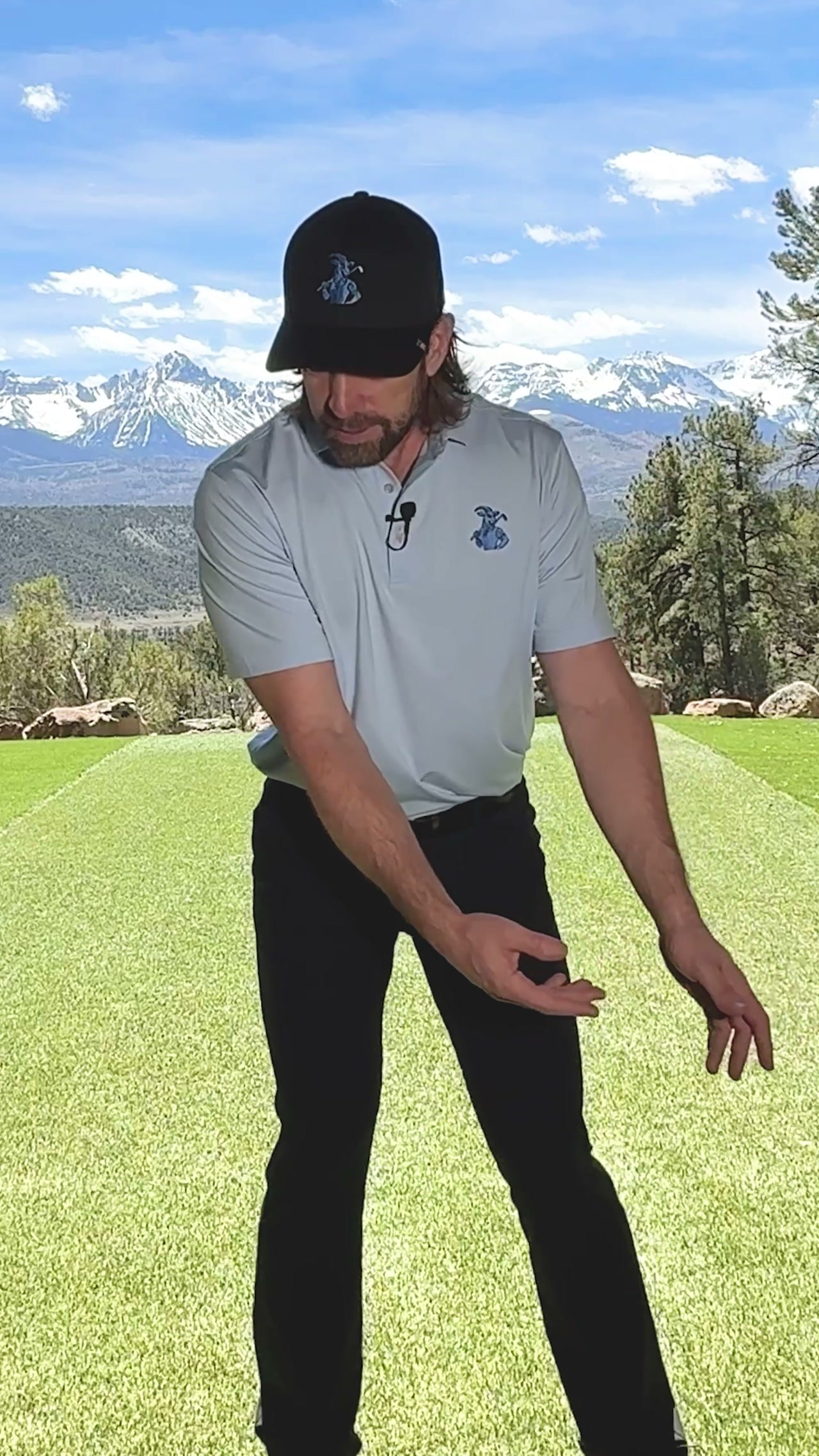
So yes, when you're up here at the top of the backswing and you start to supinate and moving down this way, this lead arm does internally rotate, all right?
But you can't be sitting here trying to supinate the trail arm as you're trying to manually internally rotate the lead arm.
If you take both, make sure.
If you take both and try to do it, where's this club going to end up?
If I'm pushing this or rotating this this way, and I'm also rotating this this way, and the club's ending up over here, I can probably time it to get it back if I shut down my body.
But you need to let this lead arm kind of react.
If you can supinate, your trail arm can supinate, throwing motion, start to deviate.
J release, however you want to think about it.
What happens as I'm going from backswing to downswing?
So I'm starting to load and coil here and get up here towards the top.
What's the one thing I don't want to do from here?
What would be the absolute killer?
Would be to do all this great stuff from here and then try to use my shoulders.
Now, if you just watch my lead arm.
If I go from here and I get up to this position and I spin my shoulders, what does my lead arm do?
You see how my arm and hand go out and it actually starts externally rotating this way, okay?
And that's because the force, when I start pushing with my shoulders, this is why players get steep.
This is why players don't shell out the club, maintain lag, all this fun stuff.
Well, if I'm organizing my swing correctly and I'm rotating up here towards the top and coiling, we all know that pressure.
the lower half, the core, all start going this way before I finish here.
I don't just go to the top of the backswing, stop and say, okay, now it's time to change directions.
I go from here.
And then as I'm coiling up towards the top, I start to cycle back into my lead side.
And if I'm starting it from the ground, watch what happens with my arm.
This arm actually wants to start to get this way because now I start to get that fascial sling and get the stretch from my back, cross my arm and stuff.
But now my lead hip and lead side is starting to pull this down into position.
Okay.
That's really what's going on.
So as I get here, that's what's allowing this to happen.
So does lead arm internally rotate and transition?
Absolutely, but it happens more as a byproduct of me cycling through my order of operations, not because I'm making this happen.
If you already have the feeling of the supination or the J, or the throwing pattern, or going behind you or axiom.
You don't need to try to be doing it with both, because if you end up manually doing it by this, by the time you get down to the golf ball, if you've done it with both, now you've got this where you've got this pitched highly elbow, your shoulder is going to actually protract even more.
And unless you turn off all your body, you're never going to be able to get this club back to square.
So it needs to happen, but it's as a byproduct.
So for that player, I hope it helps.
Because you can't add speed from your arms.
As in, like, making your arms create speed.
That's not really how it works.
All right.
Question number dos.
Based on the past videos of lead hip coil and throwing from the top, is the idea eventually to blend.
An active throw of the hands, not arms, with pulling of the lead glute around and Also, when loading the lead glute and inner thigh, is it a subtle increase in load or should I feel the majority of the weight on my lead side in the backswing that it increases more in transition?
Let's take that backwards because I think that the last question is the easier one to think about.
Okay.
So I'll go back to the throw and stuff like that.
So the question on the table, Is it a subtle increase in load, or should I feel the majority of the weight on the lead side in the backswing, and then it increases even more in transition?
It's not the majority of the weight staying on the lead side in the backswing.
Okay.
You still have to move.
And if anybody watched the video, It came out, I think, like two days ago.
Chuck talks about it as feeling springy, all right?
And I actually think that's probably even the best way.
Instead of getting locked into numbers, you're going to get about 70% until your trail's up, all right?
So you can't have the vast majority staying on your lead set.
But without getting locked down in the numbers, I think the springy way is the way to think about it, all right?
In position right here and I'm starting to get my lateral and I'm starting to get my coil right here.
Chuck talks about feeling springy with this lead leg.
All right to where if I?
I can pick it up, but you can see how as I'm picking it up, I immediately have to fall back on it.
Now, if I was over here, I I can do this all day long.
If I've got too much on this side now, I can't pick up my leg.
It's something I absolutely love doing in in-person lessons, because not this particular drill, but just in general, if somebody hits a golf shot and they're like, oh, I shifted my weight and I'm like, pick up your right foot.
And then you see them kind of jump over like this because they can't get their right foot off the ground.
I'm like, where was your weight?
Same thing with this.
So no, it's a subtle increase.
It's not staying there.
I still have to have the lateral.
and the coil up into this position as I'm getting up here towards the top.
But what you don't want to lose is the sense that you've got a lead side, that you've got a lead leg, that you're stretching from this leg.
If I just go like this, now I've got no reason to kind of rebound.
We talk about the coil getting this way.
If I don't stretch dynamically going back, I've got no reason to go back in this direction.
But it's the same thing with.
having the sense that you still have a lead side and you're still trying to use that lead side in the downswing.
So as you start to move laterally and you start to coil, think about it like this.
I've got enough pressure that I can pick up my leg, but I can't keep it there because that's going to be how you get this coiled and get back into that catch exactly where you need to so you can use it.
All right?
Don't leave it there.
That's a killer.
Do not leave it there.
All right?
Now, is the idea eventually to blend active throw of the hands and pulling the lead group around it up?
Yeah.
That's the whole.
So that when you're here and you've got your throwing pattern like this and you're going this way, it's to blend because it's.
It goes back to my jump shot analogy, except golf, you're doing a lot from this side.
So the goal is to blend this with your release so that you're transferring that.
The goal is to blend.
I've got the feeling of throwing the club behind me, right?
So I'm throwing the club.
This is starting to catch.
And now when I get that caught and I get back into this side, this vertical hip extension, that's what's allowing me to snap the club.
With a lot of speed, but without me having to do it, it's not me going like this.
It's because I'm getting here and that's what's allowing me to snap, and this is a very fast motion.
All right, the golf swings a lot faster than probably most players feel.
I mean, the biggest problem that I have, it's not the biggest problem.
But when it comes to speed with higher handicap averages, It's not that they don't understand the swing needs to be fast.
It's when it needs to be fast.
Because A, you only get one speed burst.
B, the vast majority of people don't hit it far enough because they don't swing fast back enough.
Dyslexia kicking in.
They don't swing back enough fast enough.
They don't get fast enough here and loaded to rebound that they take so long.
Tempo-wise, to get everything loaded and going, that's why they don't have any speed in the downswing.
It's got to be reactionary.
It's got to be motion.
Are you going to find tour players and all that that have – absolutely.
But if you look at the longest hitters, you're going to see that everything that they're doing is to make this fast and dynamically load so this snaps faster coming down.
So, yes, the goal is to get it to where you're getting this motion, and that pop is how you're – That's why there's a drill that I do a lot with players where I have them, if you think of, I don't know why I'm blanking out, the torque bridge drill.
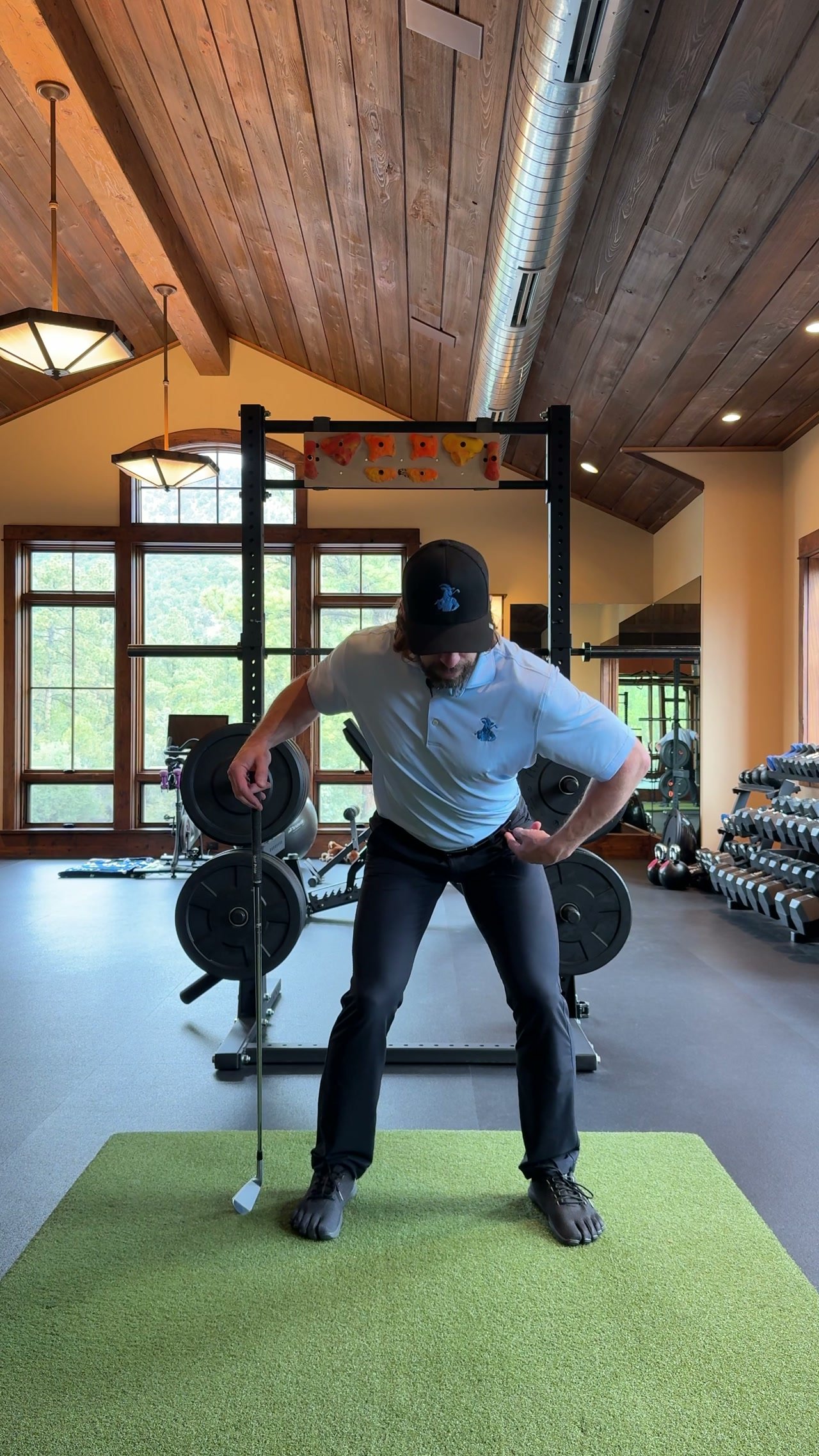
I have a lot of players where I'll have them actually start taking their lead leg this way so that when they start planting, they can start feeling how this actually posts and drives because the vast majority of my players just sit here and spin.
I'm like, Rotation was done a long, long time ago.
Got three forces, lateral, rotational, and vertical.
You're still trying to rotate when you should be almost finished with the vertical at this point.
That's why you don't have any speed.
But that's kind of the same premise.
If I can get the throw and I can get the lead glute to catch and post properly, then when I start to get in, and this is super exaggerated.
Don't go try this at home.
Break your leg.
That if I'm posting right here and I've got something to brace against, now I can snap.
But if I'm, there's no snap in that.
If I'm like this, that creates a post for me to throw against.
But as soon as I start trying to rotate, I can't see the difference right there.
That's because this motion, the vertical hip extension, is internal femur rotation, not external femur rotation.
That's where a lot of players get that wrong.
It screws up their posting because they still think they're trying to rotate open.
I'm like, I didn't even try to rotate.
I can't even remember the last time I tried to rotate.
I think that's it.
Yeah, that should be it.
Okay.
I thought about this one for a second.
How does loading work in the backswing and downswing?
That's a pretty darn, that's like a 20-minute video.
And when and how does the throw come in there?
That's like another 20-minute, like that's like explaining like the theory of relativity.
So I took some notes right here on this one because I did read this question before.
I'm trying to sum it up into like the, Quietest thing that I can.
How does the loading work in the backswing and the downswing?
Well, the loading works because you're increasing pressure and stretch with the whole unit.
So the loading and the backswing works because as I'm right here.
I've got some lateral motion.
And then as I start to turn my rib cage and my core right here, and my hip starts to work this way, this starts, and I start to get extension right here.
This starts to create a stretch right here.
And I'm starting to create a stretch from my lead side this way.
So initially the loading and the backswing is all, I don't want to say like it's a just one body unit movement, but that's kind of what it feels like is that everybody's kind of going together right here.
Because if everybody's kind of going together right here, now my arms aren't really doing anything.
They're just being transported by how I'm moving right here.
I haven't done anything with my arms.
And it kind of feels almost unibody because this hip's going up, this hip's going down.
I've got pressure increasing in this side because I had the lateral motion initially.
And as I start to create my angles right here, this is what's creating load and stretch to not carry my arms.
And then as I get up here to the top, I'm going to kind of reach the wall.
Of diminishing, not diminishing returns.
I'm kind of reach.
Forget the one that I'm looking for right now, where I just can't go any further.
Or a restriction where I can't keep turning anymore.
Because I've taken this rubber band so hard and I've stretched this so much and I'm so loaded that as I start to catch back in this side.
When I get to this position.
This has to start to pop and load in back into my lead leg harder, which is keeping my lead hip down.
Until it's time to snap and then throw the club.
Now, when and how does the throw come in here?
Well, the throw pattern begins right at the top, but the throw snap is going to be a result of after getting the load because that's going to be where I'm getting the snap.
If I'm just getting here and I never get this up here, Catch and load, then when?
By the time I get down here.
If I never did any of that, I'd have to create the throw and snap like this.
But the throwing pattern, the feeling of it, starts at the top.
But it's because I have to get loaded in the downswing to snap it.
So don't kind of, um, overthink it.
I'm throwing a ball right here.
Got Mr.
Ball.
So I'm stepping back.
I'm going over here.
And as I go this way, you can see that's what's really kind of setting my wrist with the weight of the ball and the club as I'm stepping this way.
And once I get this planted and get this to snap back, now I get this.
But that whole throw pattern starts as soon as I'm right here.
And then I let it snap and release.
It's about as simple as I can try to make Because there's a lot that goes on into that.
How does loading work?
It's because it's an increase in pressure and stretching.
If I just stayed on this leg and went back this way, I wouldn't be able to load anything.
It's the fact that I'm kind of, don't do this with your arms, but I'm going this way and this way.
That's how I'm kind of loaded.
I'm going this way and this way.
The problem is I've got lateral motion and I don't want to do that with my arms.
But that's essentially what happens.
And the throw happens because as I get this load in the backswing, but I get loaded in the downswing, I've got this throwing pattern where this is supinating going behind me.
This right here, this pop is what's creating the snap because I don't want to be, I don't want my club head speed tied to muscle strength.
I want it tied.
to my body saying, accelerate, decelerate.
Snap.
Physics are going to do it for me.
Let's see.
Can you please go over the sequencing for the lead knee?
That was in the video yesterday, too.
In the new Goatee Ghost, my lead knee looks to be late turning back towards the target compared to the Ghost.
And that goes back to the same thing with how you're loading in the backswing and coming down.
Most people are late getting that because they're not loading correctly this way.
So what technically happens is as I get up here, my pressure, as soon as I kind of run out of turn back here, starts to increase on this side.
And I used to tell people all the time, they're like, what happens in the downswing?
I'm like, lead knee externally rotates, lead adductors start to pull the weight immediately right here.
As soon as that starts increasing in pressure right here, This gets back.
Now, it doesn't go this way because I don't want you blowing out your knee.
It's also why you've got to be careful for you players that have a giant splay in your foot because you have limited mobility in your hip.
You have to be careful with that.
There's pros and cons to it.
But as my pressure starts to get to here, you're going to see that I'm loaded.
And as I get up here towards the top, the first thing that happens is my lead knee has this external rotation to get stacked.
But because I'm not pushing from this side, okay, because I'm not pushing from that side, and because I'm not trying to spin my hip, if my lead knee externally rotates and my glutes starts to get loaded and my abductors, these muscles right here on the inner thigh, are the ones that are doing it, that's why it feels almost like you're squeezing like pirouetting.
If my knee's going this way, but I'm pirouetting it with my thigh, that keeps this from going this way.
Now all this right here is weak.
When I go like this and I get like that, I can feel all up in here and in my glute now.
But as soon as I let go of that tension, my knee goes this way.
Now I don't have any speed.
So it goes back to the coil first.
You've got to coil correctly first so that as you're winding right here, you want to get back to this side.
And so as like what Chuck said about the springy effect, if this has kind of like a spring, like you're ready to get back on that side as soon as that's done.
All right?
You don't want to manually kind of be stuck trying to rotate it, but it's typically because either A, you shifted too much this way and you can't get back to it, or B, you never left this leg.
But reading your note, my lead knee looks to be late turning back towards the target compared to the ghost.
Well, if it looks to be late, Turning back, you're probably moving a little bit too much this way, and then you're, you're, you're having to do too much.
To try to play catch up, so you probably need to feel a little bit more pivot around the lead leg.
So you can see how mine right here doesn't really, but that springy feeling like that's, you can see, bam, it's back immediately.
Like that, I didn't have to worry about it.
What I see more often than not is too much load this way and then players trying to get their weight over, but because the downswing's so fast, they don't have a chance to get their weight over, and they immediately start spinning open like that.
Where did I fall?
I fell forward.
Let me do that again because it's very important to understand.
If I'm right here and I get too much on my trail side and I don't have all the weight to get the lateral, I'm going to start going into spinning because I'm trying to put speed on the ball.
So I'm not going to finish my lateral and spin.
Where am I going?
For those of you early extenders out there, I stand back here.
Where am I going?
The spin is going to throw me out the golf ball.
So if you struggle with early extension, it's probably a little bit of what's happening.
All right.
That's it on this list.
I'm not going to the tape yet.
Jeff sent in a.
No, right before I got on.
So give me two seconds.
I got to go find it.
All right.
So let's see.
All right.
So can you elaborate about the chest rib cage moving underneath the lead arm during the initial takeaway?
I tried to find this movement in the videos, but unable to, so find it right now.
Well, don't overthink this one.
All right.
Let me get back to my screen so I know what I'm looking at.
Don't overthink this one, Jeff.
So the rib cage rotating underneath the lead arm.
All that's saying is you're trying to get this working as a unit.
A couple webinars back, I talked about the trail arm and kind of thinking about it like a sprinkler.
It's essentially the same thing.
I'm not trying to get here and push my chest down.
That's not rotating my chest.
If I stand right here, I'm rotating my rib cage right here.
So I'm not moving my hips or anything.
And I can feel my rib cage kind of rotating around my spine right here and around my center.
All right.
This is my rib.
I can feel my ribs kind of gliding back and forth right here.
All right.
So the rotating underneath is this working as this unit like this.
All right.
This goes into your second question.
So let me go back to the.
the question because it ties into it.
Also, can you discuss the need or importance of the lead arm to be protracted at a dress without shrugging?
So it ties into your second question.
All right, so let's kind of recap.
First question is what is rotating the ribcage underneath the lead arm?
Also, what's the importance of the lead arm needing to be protracted at setup?
Okay, and shoulders shrugging.
I'm going to go with that one and kind of work my way backwards because the underneath will make a lot more sense.
At setup, this lead shoulder and lead arm are slightly protracted at setup.
Because if it wasn't protracted at setup, where would it sit?
I'd grab my club, And this is something that kind of barrel-chested people struggle with.
Because their arms sit too much on the side of their body and they can't get their arms out in front.
So the need for the protraction is to get the arm forward so we can start to create a link with our rib cage.
All right.
So you can see the difference of being on the side of my body right now.
Now I'm going to have to do something to get my arm back because it can never get up there.
It can only move this far.
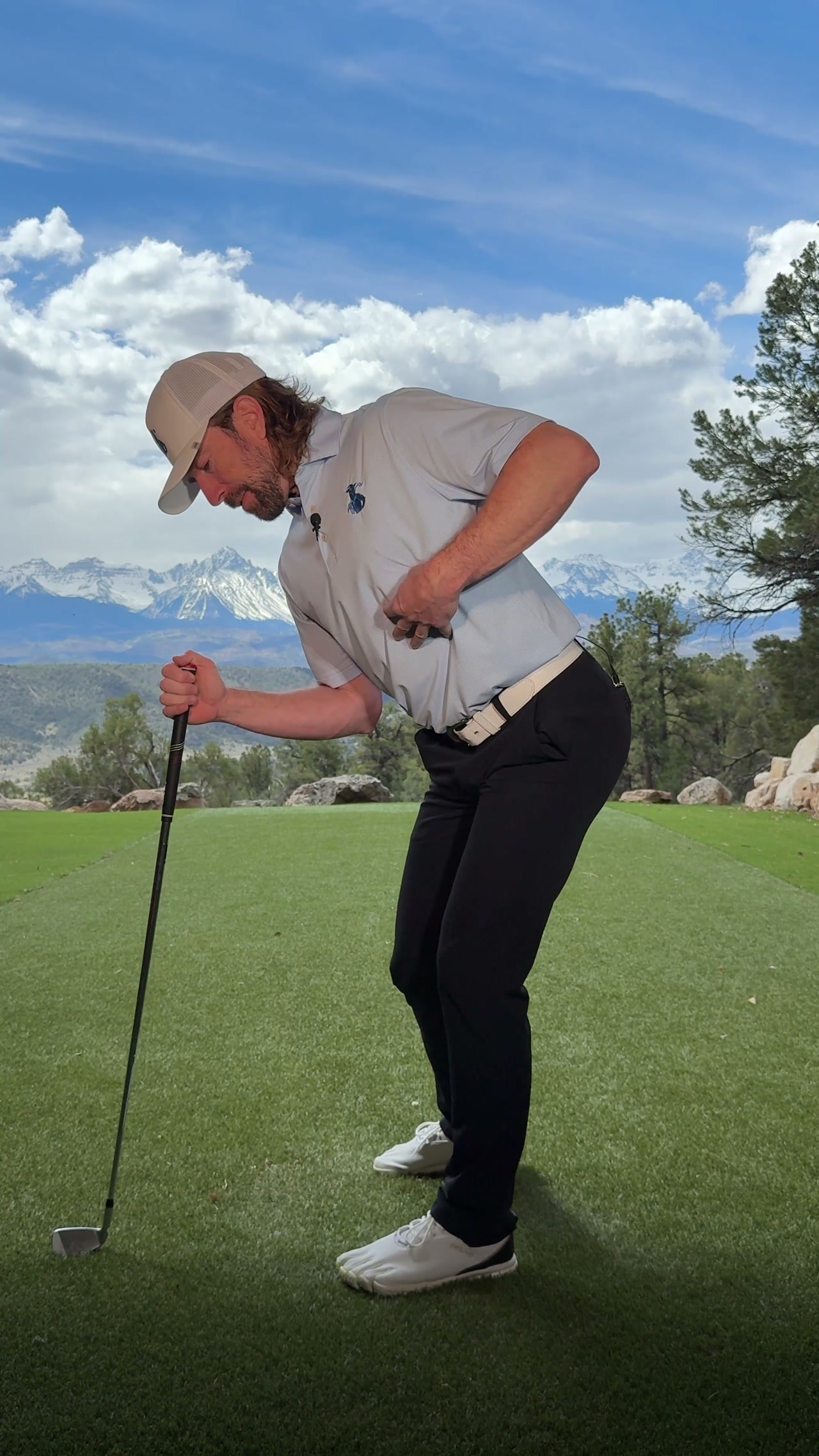
As soon as I protracted a little bit right here, I kind of rested on my rib cage right here.
This is the rotating underneath because the rotation here is carrying.
My lead arm, I don't have to do anything with my arm now now, it's linked to how I'm rotating right here now, with the shoulder shrugging.
This is something that players are always kind of messing up because they either try to get in military posture.
Or they watch shoulder blade glide and they think that you got to be locked in.
The shoulders naturally sit like this, right?
I think mine, this one sits a little bit higher, a little bit lower, depending on the weather.
For But my shoulders don't sit like this.
Now I've got my blades fully retracted.
Now I'm relaxed.
This is shrugged.
Relaxed.
Retracted.
Okay.
That's all that we're meaning.
Is that the blades sit nice and natural right here.
So that they can move.
So they can glide.
So they can move down in whatever.
I don't want you shrugging.
That's disconnecting.
That's adding manual.
You never swing.
Old, for those of you old school rotariers, you swing from the box, you don't swing from the rectangle.
all right, this is the rectangle, this is the box, all right.
So your shoulders are relaxed, not overly depressed, they're relaxed.
The lead arm is shoulders protracted.
Because now, once this is up and protracted a little bit, It's in a position where now the ribcage turn makes it a unit.
So now rounding back out to the sprinkler, that's making it like a sprinkler.
I don't have to move my arm and hand because this is what's doing this.
And now my shoulders are still going to kind of be floating, relaxed.
But they're pulling right now.
They're starting to move down and in.
But until I start to get back.
And start to really do this, that's going to be where I really see.
That kind of big drop in my scapula is as I start to transition.
That's going to be what puts that into position against my spine.
It's not because I'm manually trying to lock it into position, it's what I still call it to this day.
Shoulder blade wrenching players try to get it there as fast, you know, Chuck said.
Two inch shoulder blade glide.
And people are like, I can't get to the top of my back swing.
Yes, that's because that's the entire motion, not in a nanosecond.
So hopefully, if you think about it, and this is an exaggeration, all right?
I can get away with this because I'm overweight, so it's kind of easy to see.
I take my arm right here, and I get it up here, and I rest it on my chest, all right?
This is too high to everything, all right?
But you can see, my rib cage is underneath my tricep right now.
But if I.
super exaggerate it like this.
I'm super exaggerating.
My arm's chilled right now.
My rib cage is underneath right here.
If I just move my rib cage, you can see how I don't have to do anything with my arm.
I just don't need it that exaggerated.
That's really what that's meaning.
You had a third one.
I thought I saw a third one.
Explain what the trail shoulder blade movement is doing during the takeaway and the downswing.
Well, it's sliding back and around.
So the trail shoulder blade is going back down and around.
Now I can't see myself.
The trail shoulder blade is going back down and around.
So as I'm right here and I'm rotating my rib cage, my shoulder blade is starting to move.
In towards my spine.
So this what's happening is my blades going back and in towards my spine and then when I transition and I'm getting here, that's where it's really kind of Slamming into position for that connection.
I don't want to be up here at the top and Already wrenched into it because then I can't make a backswing.
That was one of my big things when people They took the shoulder blade glide too literally.
Still happens.
But if you depress this immediately, my arm can't go up.
All right.
So it would work if I only wanted to swim to here.
But if I want to have some elevation, now my shoulder blade is going to really drop into position as I'm coming down.
You know, the daily couples reference is the easiest.
I mean, they're way over here like this, but they're waiting for that connection in their transition for that to get down.
Hopefully that makes sense.
I think that's your only question, right?
Okay.
So, Jeff, I hope that helped.
And that's all that I had on that tape.
So what we will do is we will go to the crowd.
We'll bring you on up.
Come on down and the price is right.
So if you have any questions, hopefully you've learned something so far.
If you want to stick around for a live Q &A, I'm right here.
Put your question in and I will answer it.
I'm Ron Burgundy.
If you type it, I will say it and talk about it.
Michael, how high should the hands be at the top of the backswing?
How high do you want them?
I mean, are you trying to like match goatee perfect or?
Remember, elevation is still a little bit variable, but you don't want added lift in the swing.
There's no need for it.
So when you're thinking about relative hand height, there's going to be some genetic things in because if I'm right here, you're going to see how my hands are above my head.
And somebody with T -Rex arms, they can't get their hands up there.
So the relative height is kind of based on your genetics of not lifting.
It kind of makes sense.
Trying to think of like, does that relay the message?
If you think about it, as I'm coiling and getting to here, that's where my hands should be.
All right.
I haven't had to add any extra lift.
I haven't depressed by anything.
And that's why I still think like, you know, if you think of like our old, you know, right arm position right here, where you elevate and add your flexion right here.
I mean, it's still roughly around chest height right here with your elbow.
And if your elbow.
It's at the base of your chest or pectorals right here.
That's where you want your hands.
You can get them higher, though.
You can.
It's just, remember, there's a balance to everything.
The higher you get, the more you got to wait.
Charles, since being hack, I've lost all my rotary swing programs.
I've sent several emails and made a call to a number.
Sorry, at the end of the session, please provide me a contact email address, telephone number to contact.
I'm sure Christina or Kristen have probably responded if you sent something in.
Because I looked at customer service today and there was only like three emails left.
And that was from today.
C.
S.
Craig.
C as in Craig.
S as in Slappy or Samsonite.
At RotarySwing.
com.
The telephone number, I'm telling you, email is going to be the fastest.
So I'm not sure what's going on, Charles.
I want to definitely get you back on track.
CS at RotarySwing.
com.
That's going to be your best bet.
All right.
And in fact, give me a second.
I don't see anything, Charles.
Just as a side note, I'm looking at our ticket counter.
So CS at RotarySwing.
com.
All right, back to the golf.
Charles, Craig, what happens at impact and after with supination, i.
e.
goat how to whip the club?
What happens after impact?
Now, I've seen your golf swing.
You know what happens after impact.
What do you think happens after impact?
I supinate, I deviate, and as I get here and rotate, what happens?
This snaps.
So as I move through here, this is going supination, deviation, rotation, and now my lead arm and hand, that's why if you think about the smiley.
Face or the nails, or anything like that, with the lead arm and hand, this is the motion it releases.
So if you think about it, you're literally kind of losing everything you did to that point.
So if I'm right here, I'm losing everything I did to that point.
So once I get to impact supination, deviation, rotation, now, once I get to here, it's like a car wreck.
This snaps The lead, knuckles and all that rotate to here.
The club releases.
This snaps.
I don't know if there's something specific you're looking for, but if you think about it, it's getting to here, rotating.
It doesn't just get to here and then just stay like this.
You let the club snap.
So you're literally undoing everything you did to that point.
Because that's where you get the speed.
That's where you get the snappy.
Let's see.
John, why does Goatee always tell me Chuck's various videos are not relative to your swing?
In his last one, he mentioned a move by the lead knee towards the target.
I'd have to know what your swing looks like, John.
Why does Goatee always tell me Chuck's various videos are not relevant to your swing?
Maybe you're doing it all right.
You don't need it.
In his last one, he mentioned a move by the lead knee towards the target.
Yeah, I mean, that's.
The two most recent videos with Godey Ghost, what Godey's seeing is the vast majority of players aren't getting this enough over here.
That's what Godey's seeing, is that this knee's.
Now they're staying back, going like this.
And this hip's not getting, this lead glute's not getting enough of the pressure.
This hip's not staying down enough.
And I will tell you, for anybody, that is one of my biggest pet peeves.
That's been my biggest pet peeve, I think, since like 2008 with Rotary.
Is that from here, if I see somebody go to the top of the back swing and their first move is this hip starts going up like this, I'm going to kick you.
The vast majority of players don't stay down enough until it's time to snap.
So probably that's what it is, the fact that when you get up here towards the top, you're not getting enough this.
You're not getting enough over here and down and getting this knee stacked.
Most everybody underdoes that.
I even have an old, old, old video of mine where the swing's terrible, but I'm working on the same motion.
And to me, I remember the video where I literally felt like I was like this.
And then on video, it was just.
But because it was so drastically different than anything I'd ever done.
Can you address how to hit off different whys?
David, there's.
I did a whole webinar on that a couple back.
This can get really dicey.
We have a whole section on side hill lies, uphill lies, downhill lies.
There's not really that much variation except what you've got to worry about with your spine and fighting gravity, depending on if it's uphill or downhill.
You're really just fighting gravity on that.
Is that what you're meaning, like side hill, uphill, downhill, all that?
Are you meaning like wet or dry turf?
Because that really doesn't really change.
I mean, if your low point and bottoming out is consistent, that really shouldn't matter.
Anthony, when is Rotary Swing getting sponsored by Mountain Dew live Pilova shoes?
Anthony, I'm just waiting on a sponsor, period.
Are you back?
Anybody?
Bueller?
I have no idea what happened right there.
Somebody said there was a slash through a thing down there, and I saw the same thing.
Hold on a sec.
What happened was that?
All right, so we're all good now?
Last you heard was about the shoes.
Shoes.
Okay, so did anybody hear?
Ronald's question was that you pushed from the trail side.
Did anybody hear that?
We missed the last two or three segments.
Mike with the slash is gone.
Okay.
All right, so.
I just want to make sure because I want to get back to.
Man, I actually gave a really good answer on that.
So, Goaty showed me graph today in regards to timing of the backswing.
We hear that one?
Man, that was the best answer I've given in a webinar.
Trail shoulder going back is their effort to make it move down.
That was where we got lost.
Okay, so I'll get those three in before I – I've got to get out of here tonight.
I'll get those threes.
And, David, I'll get you – I'll make sure you know what you're doing after that one.
Okay, so – sorry.
If it happens again – I have no idea what happened right there.
I've got to blame Demio on that one.
Ira, per answer about trail shoulder going back, is there an effort on the downswing to make it happen?
No, it is a byproduct.
It's a great question.
I gave a great answer.
The trail shoulder moving down and in of that, you don't need to manually force that to happen.
If you're manually forcing that to happen, we got problems.
Because you're not trying to make that happen.
It needs to be a function of how you're sequencing.
So the example that I gave, like I said, I've been doing this for a decade with players and in-person lessons.
If I'm loading over here and I'm getting into position, and I start sequencing this way, but don't let your upper half go anywhere.
So if I extend out my arms right here and I start going, but I'm not letting my upper half go anywhere, You're immediately going to feel how it wants to start to go down and in and start to get in a position.
Like it would be if you're just supinating your arm like this and externally rotating.
It's a byproduct of sequencing.
I don't want you up here at the top saying, okay, drop my blade down and in.
That's not how it works.
It's a function of the fact that as I load and get to here, this is what's happening.
It's because I'm going this direction, so I'm going that way.
But because I'm not spinning and pushing, that's what's sequencing my blade into position.
So it was a great question.
I gave a way better answer prior.
So my apologies.
Okay.
Just making sure y'all can still hear me.
And thank you, Chris.
Horton, I would not have known that because I don't know how anything got muted.
I'd just been up here looking like a mime.
Vincent, Goaty showed me a graph today.
Regards to my timing.
My back swing was very long compared to the goat model.
Could you talk about speed in the back swing?
Okay.
Give a really good answer to this one.
Typical tour pros, three to one tempo ratio, right?
Rory's like two, four, seven, two, seven to one.
Like he's.
If you're getting long in the backswing and you're not matching the GOAT model, you're swinging your arms.
You're lifting your arms.
You're doing something with your arms independently.
Period.
Flat out.
No debate.
Twice on Sunday.
Okay?
So let's think about this.
If I'm right here and I go through proper coiling in the backswing, all right, that's all I got.
All right?
I've got my lateral.
I've got my coil.
I can't move any more than this.
I'm I'm ready to start going back the other direction because I'm stretched and loaded now.
If I take my arms now, I just make my body motion, I'm going.
You can see kind of how fast and dynamic I can make that.
Now.
If I'm not swinging my arms, I'm already, I'm already ready to go the other direction.
Okay, so I'm, you see, I'm already ready because my body is stretching.
It doesn't.
It can't go this way anymore, I physically can't go that way anymore.
Okay?
And if you see me kind of come back up, it's because I'm making sure that we're still fly.
I can't go that way anymore.
So if Goaty's telling you that the timing of your backswing's off and it's taking too long to get back to the lead side or get back to your downswing, it's because you're swinging your arms.
That's literally it.
It's because at some point in time, your arms are starting to lift, maneuver the club.
I don't have to use my arms at all.
You see my arms moving?
You see them moving in space, but do you see me doing anything with them?
I'm literally dynamic load.
Yeah.
I can't go anywhere from here except going back the other way.
And that's why the timing of what you're doing is off.
So if your back swing was very long, you're using your arms.
So what you need to do is you need to focus on how to move your body.
And you can literally just do what I'm doing right here and you'll start to feel, well, if I do this, like my arms don't end up up here.
I mean, that feels really weird.
You'll start to feel independent arm lift if you do that.
This part I actually just came up with.
If I don't do anything with my arms, they don't go anywhere.
Now I feel loaded and it's time for me to go the other direction.
Wait a minute.
Okay.
Still got me?
Uh, Charles, Uh, we'll send another email, try again, miss the programs and sorry for your you know issues, you know, and and we will get you back.
I just haven't seen anything from you, my friend.
Apologies on that.
Uh, Ron Goat drill seems like you pushed from the trail side.
is that right?
I think it's kind of, I think it's a misinterpretation.
now I gave you a nice, long-winded answer, but it's a misinterpretation.
You never want to use push to get yourself to move lateral.
And that's part of the reason, you know, with Godey and what he does.
That's what we saw people messing up with the drill.
That wasn't the intention of the drill.
Because as I start to coil and get up here and I shift my weight, you can see kind of how dead my right side is right now.
I'm not using my right side to push myself laterally this way.
Even with my foot popping up or anything like that, as I'm getting here, I'm not using push to move myself laterally in that transition.
So in the goat drawer, when I'm getting here and I'm feeling that, I don't want to wait all the way to here and then say, okay, well, now I've got to go laterally.
Now I've got to go rotationally.
Now I've got to go vertically.
And I'm going to do all that by pushing with my trail foot by the time I get there.
The lead glutes are already caught.
I've already had that lateral motion.
It's just the way that you interpret it.
And that's why we keep coming out with drills and things of that nature, because how people take information is so, so, so important.
But no, you don't want to get up here to the top and then be required to push yourself laterally with your trail side.
If you're doing that, you're going to be in a world of hurt with a golf course.
But also, that means that you're doing something wrong going back, going back to the springy leg.
By the time I get to here, I literally can't push off my trail leg to move myself laterally because by the time I get here, I'm already going back this way.
My pressure is already increasing.
I've got nothing to push with.
Okay.
Still good?
Somewhat?
You're welcome.
Okay, so Ron said thank you, so it must be still okay with it.
Now, David, I might be able to find the webinar, but I did a whole webinar on, you know, the shot thing, and I don't want to get you a little bit discombobulated on downhill, downhill, side hill wise.
I mean, downhill, it's still the same thing.
Like, I don't want you like this, but.
Typically in a downhill, you're still going to be fighting gravity pulling you down this way.
So you don't want to be like this where like I have no pressure back on this foot, but still in downhill lies, moving the ball back just a little bit, trying to get the slope matching your shoulders.
You don't want to be excessive and really start changing your tilt where you kind of get in like a reverse K like this.
So if you're on a downhill lie like this, weight staying a little bit more forward, but not crazily forward, all right, because the gravity is going to get you on that one.
Slope matching a little bit, ball a little bit back, and just knowing that as you start to move laterally, you're trying not to lose your balance and let it pull you down the mountain, that you're staying here so you've got enough time to pivot around so you don't squirt it off to the right too much.
But we have a whole section on all that, and unfortunately, I do have to be on time tonight.
Stupid Mike kind of got me, so I apologize, guys.
Let me do this real fast.
That's a swimmer.
Let's see.
I'm coming back, guys.
I'm still here.
Might be able to just give you the category Yeah, If you, Hey David, if you just go to this video that I'm posting right here, You will see there's a whole category of all the ball flight stuff.
That way, You can get all those things answered for you because I don't want to leave you here in the dark with it.
Because there's a lot to that.
It's more than just what I just said.
But if you just go to the search box, too, and you just type in side, you'll get there.
Don't worry, man.
Thank you, Charles.
I appreciate that.
Jonathan, I'm going to get to you.
And then, unfortunately, I do have to be out of here tonight on time.
Sorry, I'm late.
I'm sure you talked about it already, But the lead hip loading in the backswing feel as if my groin is stretching away from my lead leg until it hits max and let the lead knee start to move back.
Essentially, yeah, but don't think about it as like I'm trying to stay here, okay?
As I'm going this way and I'm getting this stretch, What I've seen with people that say your words right there is.
They do this because they're kind of conflating the pressure and the weight feel with stretch feel.
Okay.
And that's not really what happens.
So yes, I'm coiling around this lead hip.
I still have the lateral motion right here and I can, I'm really starting to create a stretch right here, which is keeping this lead leg engaged so that once I'm here, my pressure starts to go this way.
My lead knee can externally rotate and the adductors can snap back this way.
And I did talk a little bit about this earlier.
So hopefully that does help you out with that.
Because you want those adductors and all that to be involved.
You don't want to get here.
Just rereading your question.
You don't want to get here and just let this collapse in.
There's no tension there.
There's no nothing.
I'm going to get up here to the top.
I'm going to blow out my knee.
So as I'm doing this, it is because I'm getting lateral.
And as I'm making this coil, this springy feeling, it keeps a little bit of pressure and weight in this side.
But I am feeling a stretch right here so that I can really pull.
and squeeze these adductors as I'm coming down.
So you've got to have some engagement right there.
All right.
Anthony, thank you.
See, Anthony, you broke it.
I just saw your text come through about no audio.
I blame Anthony for the audio.
He asked the question about Mountain Dew and the pullovers and being sponsored, and it went away.
All right.
So, unfortunately, ladies and gentlemen, I do have to be on time tonight.
So thank you again for stopping by.
As always, I don't think you understand how much I appreciate you all giving me an opportunity to help you out with this whole golf thing.
And, you know, the whole shebang.
So if you have any questions, please get them into the community.
I'll be happy to answer them in the next session.
And you've got me, you've got Anthony, you've got Goaty, you've got the community, you've got millions and millions and millions of resources.
We want you guys to be the ultimate golfer because you can be.
You've got the same set of bones and muscles and stuff that I do.
You're probably in better shape than I am.
So we want you to succeed.
Don't be bashful in asking for help.
All right.
We all needed it at some point.
So please reach out to us if you need anything.
I thank you again for coming out tonight.
I will get the replay posted as soon as I can.
But I do have some things, unfortunately, I have to do tonight.
And I wish you all the best this month working on your swing.
And for those of you working with Goaty, you know, you and Ghost having a good time trying to get nailed down.
And I will see you all in the trenches.
And hopefully I'll see you in another webinar.
And we'll keep moving forward from there.
So great to see everybody as usual.
David, thank you.
I appreciate that.
Bob, very much appreciate it.
Chris, thank you, thank you.
Thank you, Greg.
Can you hear me?
Can you see me?
And if Mark doesn't pop up first, I'm going to be disappointed.
Oh, Jeff, you beat Mark.
Evening to you.
Can you hear me, Jeff?
How's the volume?
I can hear you but can't see you.
Yeah.
If you can't see me, that's fine.
As long as you're seeing something.
That's the most important thing.
Charles, hello.
Chris, how are we doing?
Stan?
There's your arm.
Yeah, that's my arm.
All right.
I've got to empty my pockets.
Glenn, hello.
Michael, good evening.
All right.
Welcome to webinar 20 -something.
For those of you new, I will be your humble RSC swing instructor, Craig Morrow, up here today, guiding you through the webinar.
I hope everybody's having a lovely evening.
And as usual, I'm going to make sure that everybody gets in the room that wants to be here live.
So I'm going to stand up here, do some tricks, and chit-chat with the group as I watch my ticker on the screen right there pick up as people are getting in the room.
And I appreciate and thank you for stopping by this evening.
Hopefully we got some good things to talk about.
I did get a few community posts, some questions.
So hopefully that will clear the air.
Jeff, I just got yours.
So when I get to yours, because I just literally checked my email, I'll have, I got yours, but you're on, you made the list.
You made the list.
Anyway, I hope everybody's having a good August so far.
Depending on what county you live in with Georgia, if you have kids, they started back school on Monday, which is blasphemy in my opinion, but I grew up in a different era.
I would never have been able to play tournament golf if I started back school August 3rd.
I mean, I got a couple plaques over there on the wall from tournaments.
From his kid that I won and I'm looking at the dates and I'm like, late August, um, but anyway, I hope everybody's doing well this evening.
MITCHELL Hello Dennis.
Good evening Jim.
you can hear me well, so that's perfect.
So how are we doing tonight?
While this ticker gets in here?
Hot and humid and North Carolina was only able to play nine?
I'll tell you what we've had off and on storms today.
But like, right now, it's like 70 right now, here is.
And last night was actually very pleasant.
It's going to go away, but it was a welcome change from what it has been.
So what's going on in the world?
Anything I need to know before I get started on this whole golf thing?
I know I have to play golf next week.
It'll be my first round in, man.
Over a year.
I know that.
It'd be the first time I've hit balls in over a year.
So it's funny because I always kid around my students and I'm like, man, I have to play golf next week.
So we shall see.
I might have to call you guys for some swing reviews or something to get some help on my swings.
I don't know what the heck I'm doing.
I have to hit a golf ball.
What is that?
Stan, that must mean you'll play very well.
If I go in with very low expectations, but it's the same thing.
I'm trying to say this humbly or however well I can say this.
It's like going to a doctor.
If you go to a doctor, you expect the doctor to know what he's doing.
It's like me.
If I have to play golf or I have to do something.
I can't go out there and shoot 110 or nobody's ever going to take a lesson from me.
I've got to look like I've got to know what I'm doing.
I kind of know what I'm doing, so I'll be okay.
But I can tell you I'm going to be hurting after it.
I'm going to be sitting in a tub of ice or something.
So what's going on?
Nobody has anything going on in life?
Ticker's increasing a little bit.
I'll give it just about two more minutes.
Anything anybody wants to chit-chat about before we get going?
Nothing too in-depth question-wise because today I do have some community questions that I want to get through, make sure they get answered.
We'll still have some time for some live Q&A, so I'll get you some golf talk live while I'm down here.
Nothing?
Nobody's got anything going on?
Talk about the bears.
I don't know anything.
Cyclosporas?
Anybody get that?
Sit in a tub of Mountain Dew after you're around.
I'll tell you what, Tom.
Uh, if that worked, I probably would have already done it.
I'm I'm gonna be sitting in something, I can tell you what I'm either gonna be.
Yeah, sitting in a vat of whiskey or ice, one of the two, because everything will hurt.
I mean, a lot of you have been around the site for a while, some of you are newbies, which is awesome, uh, but a lot of you've been around the site.
But even like, Yeah, there's my C4 journey, I mean, my Hip, lead hip, was killing me.
So 18 holes is going to be a lot for this kid.
Iroh, what do you think about this new lift thing where players will be owners?
I think about it.
One of my roommates sent me the text, the article of, you know, what's going on with that.
I think about it like.
when they built Hard Rock Park in Myrtle Beach.
So I was living in Myrtle Beach at the time, and I said, I give it a year before it shuts down.
I think I wouldn't invest in it.
Golfers want to golf.
And obviously, depending on how they structure the ownership and all that, and now they're, I'm not putting my chips back on it.
I think it's going to end up in the same boat.
David, Chiefs versus Bears Super Bowl.
Not a chance.
Not a chance.
I hope you get your wish.
I'd rather it be the Falcons, but we're on our eighth string quarterback right now.
Hey, Michael.
Nobody has anything to say.
I think we'll just go ahead and get rock and roll.
I mean, y'all are here for golf anyway.
I definitely know y'all aren't here for my good looks.
Or you are.
I mean, if you are, then you must have some really thick glasses that are fogged over.
All right.
Well, I'd say without further ado.
Talk about some golf.
Talk about the only thing I kind of know what I'm talking about in.
All right.
So question number one of the night.
Since trying to switch my arms off and work more with the body movement to drive the swing, my goat scores improved a bit.
The contact with the ball when I play is dead.
It's sometimes unplayable.
I think in my old swing, my arms and hands were at least delivering some whip.
And I can understand that.
That's basically going to be how I play golf next week.
I'm just going to use my arms and hands to whip the club.
I never got the J release going when it was first issued.
There was all the shorter swing stuff to crack on with.
But my current issue, I revisited the goat grip and had to go with the J release.
And I could feel.
much more the club head release.
I saw in one video a mention to pronate the lead arm as well as the trail arm to generate hand speed.
Can you clarify, please?
I take it that it's the goat grip and trail arm supination always, but is it also the case that in the full swing, we also need to supinate the lead arm in that order to execute the J release?
Yes, the lead arm needs to supinate, but it's not manual.
All right.
So let me kind of talk about that.
I think that some people, when they're trying to create hand and arm speed, they do get hand and arm speed.
They start getting very handsy and armsy.
But this kind of goes back to the how many drivers of your car can you have?
You really can only have kind of one driver to your car.
The whole thing is just going to turn into a mess.
You're not going to keep the car.
between the straight and arrows.
So yes, when you're up here at the top of the backswing and you start to supinate and moving down this way, this lead arm does internally rotate, all right?
But you can't be sitting here trying to supinate the trail arm as you're trying to manually internally rotate the lead arm.
If you take both, make sure.
If you take both and try to do it, where's this club going to end up?
If I'm pushing this or rotating this this way, and I'm also rotating this this way, and the club's ending up over here, I can probably time it to get it back if I shut down my body.
But you need to let this lead arm kind of react.
If you can supinate, your trail arm can supinate, throwing motion, start to deviate.
J release, however you want to think about it.
What happens as I'm going from backswing to downswing?
So I'm starting to load and coil here and get up here towards the top.
What's the one thing I don't want to do from here?
What would be the absolute killer?
Would be to do all this great stuff from here and then try to use my shoulders.
Now, if you just watch my lead arm.
If I go from here and I get up to this position and I spin my shoulders, what does my lead arm do?
You see how my arm and hand go out and it actually starts externally rotating this way, okay?
And that's because the force, when I start pushing with my shoulders, this is why players get steep.
This is why players don't shell out the club, maintain lag, all this fun stuff.
Well, if I'm organizing my swing correctly and I'm rotating up here towards the top and coiling, we all know that pressure.
the lower half, the core, all start going this way before I finish here.
I don't just go to the top of the backswing, stop and say, okay, now it's time to change directions.
I go from here.
And then as I'm coiling up towards the top, I start to cycle back into my lead side.
And if I'm starting it from the ground, watch what happens with my arm.
This arm actually wants to start to get this way because now I start to get that fascial sling and get the stretch from my back, cross my arm and stuff.
But now my lead hip and lead side is starting to pull this down into position.
Okay.
That's really what's going on.
So as I get here, that's what's allowing this to happen.
So does lead arm internally rotate and transition?
Absolutely, but it happens more as a byproduct of me cycling through my order of operations, not because I'm making this happen.
If you already have the feeling of the supination or the J, or the throwing pattern, or going behind you or axiom.
You don't need to try to be doing it with both, because if you end up manually doing it by this, by the time you get down to the golf ball, if you've done it with both, now you've got this where you've got this pitched highly elbow, your shoulder is going to actually protract even more.
And unless you turn off all your body, you're never going to be able to get this club back to square.
So it needs to happen, but it's as a byproduct.
So for that player, I hope it helps.
Because you can't add speed from your arms.
As in, like, making your arms create speed.
That's not really how it works.
All right.
Question number dos.
Based on the past videos of lead hip coil and throwing from the top, is the idea eventually to blend.
An active throw of the hands, not arms, with pulling of the lead glute around and Also, when loading the lead glute and inner thigh, is it a subtle increase in load or should I feel the majority of the weight on my lead side in the backswing that it increases more in transition?
Let's take that backwards because I think that the last question is the easier one to think about.
Okay.
So I'll go back to the throw and stuff like that.
So the question on the table, Is it a subtle increase in load, or should I feel the majority of the weight on the lead side in the backswing, and then it increases even more in transition?
It's not the majority of the weight staying on the lead side in the backswing.
Okay.
You still have to move.
And if anybody watched the video, It came out, I think, like two days ago.
Chuck talks about it as feeling springy, all right?
And I actually think that's probably even the best way.
Instead of getting locked into numbers, you're going to get about 70% until your trail's up, all right?
So you can't have the vast majority staying on your lead set.
But without getting locked down in the numbers, I think the springy way is the way to think about it, all right?
In position right here and I'm starting to get my lateral and I'm starting to get my coil right here.
Chuck talks about feeling springy with this lead leg.
All right to where if I?
I can pick it up, but you can see how as I'm picking it up, I immediately have to fall back on it.
Now, if I was over here, I I can do this all day long.
If I've got too much on this side now, I can't pick up my leg.
It's something I absolutely love doing in in-person lessons, because not this particular drill, but just in general, if somebody hits a golf shot and they're like, oh, I shifted my weight and I'm like, pick up your right foot.
And then you see them kind of jump over like this because they can't get their right foot off the ground.
I'm like, where was your weight?
Same thing with this.
So no, it's a subtle increase.
It's not staying there.
I still have to have the lateral.
and the coil up into this position as I'm getting up here towards the top.
But what you don't want to lose is the sense that you've got a lead side, that you've got a lead leg, that you're stretching from this leg.
If I just go like this, now I've got no reason to kind of rebound.
We talk about the coil getting this way.
If I don't stretch dynamically going back, I've got no reason to go back in this direction.
But it's the same thing with.
having the sense that you still have a lead side and you're still trying to use that lead side in the downswing.
So as you start to move laterally and you start to coil, think about it like this.
I've got enough pressure that I can pick up my leg, but I can't keep it there because that's going to be how you get this coiled and get back into that catch exactly where you need to so you can use it.
All right?
Don't leave it there.
That's a killer.
Do not leave it there.
All right?
Now, is the idea eventually to blend active throw of the hands and pulling the lead group around it up?
Yeah.
That's the whole.
So that when you're here and you've got your throwing pattern like this and you're going this way, it's to blend because it's.
It goes back to my jump shot analogy, except golf, you're doing a lot from this side.
So the goal is to blend this with your release so that you're transferring that.
The goal is to blend.
I've got the feeling of throwing the club behind me, right?
So I'm throwing the club.
This is starting to catch.
And now when I get that caught and I get back into this side, this vertical hip extension, that's what's allowing me to snap the club.
With a lot of speed, but without me having to do it, it's not me going like this.
It's because I'm getting here and that's what's allowing me to snap, and this is a very fast motion.
All right, the golf swings a lot faster than probably most players feel.
I mean, the biggest problem that I have, it's not the biggest problem.
But when it comes to speed with higher handicap averages, It's not that they don't understand the swing needs to be fast.
It's when it needs to be fast.
Because A, you only get one speed burst.
B, the vast majority of people don't hit it far enough because they don't swing fast back enough.
Dyslexia kicking in.
They don't swing back enough fast enough.
They don't get fast enough here and loaded to rebound that they take so long.
Tempo-wise, to get everything loaded and going, that's why they don't have any speed in the downswing.
It's got to be reactionary.
It's got to be motion.
Are you going to find tour players and all that that have – absolutely.
But if you look at the longest hitters, you're going to see that everything that they're doing is to make this fast and dynamically load so this snaps faster coming down.
So, yes, the goal is to get it to where you're getting this motion, and that pop is how you're – That's why there's a drill that I do a lot with players where I have them, if you think of, I don't know why I'm blanking out, the torque bridge drill.
I have a lot of players where I'll have them actually start taking their lead leg this way so that when they start planting, they can start feeling how this actually posts and drives because the vast majority of my players just sit here and spin.
I'm like, Rotation was done a long, long time ago.
Got three forces, lateral, rotational, and vertical.
You're still trying to rotate when you should be almost finished with the vertical at this point.
That's why you don't have any speed.
But that's kind of the same premise.
If I can get the throw and I can get the lead glute to catch and post properly, then when I start to get in, and this is super exaggerated.
Don't go try this at home.
Break your leg.
That if I'm posting right here and I've got something to brace against, now I can snap.
But if I'm, there's no snap in that.
If I'm like this, that creates a post for me to throw against.
But as soon as I start trying to rotate, I can't see the difference right there.
That's because this motion, the vertical hip extension, is internal femur rotation, not external femur rotation.
That's where a lot of players get that wrong.
It screws up their posting because they still think they're trying to rotate open.
I'm like, I didn't even try to rotate.
I can't even remember the last time I tried to rotate.
I think that's it.
Yeah, that should be it.
Okay.
I thought about this one for a second.
How does loading work in the backswing and downswing?
That's a pretty darn, that's like a 20-minute video.
And when and how does the throw come in there?
That's like another 20-minute, like that's like explaining like the theory of relativity.
So I took some notes right here on this one because I did read this question before.
I'm trying to sum it up into like the, Quietest thing that I can.
How does the loading work in the backswing and the downswing?
Well, the loading works because you're increasing pressure and stretch with the whole unit.
So the loading and the backswing works because as I'm right here.
I've got some lateral motion.
And then as I start to turn my rib cage and my core right here, and my hip starts to work this way, this starts, and I start to get extension right here.
This starts to create a stretch right here.
And I'm starting to create a stretch from my lead side this way.
So initially the loading and the backswing is all, I don't want to say like it's a just one body unit movement, but that's kind of what it feels like is that everybody's kind of going together right here.
Because if everybody's kind of going together right here, now my arms aren't really doing anything.
They're just being transported by how I'm moving right here.
I haven't done anything with my arms.
And it kind of feels almost unibody because this hip's going up, this hip's going down.
I've got pressure increasing in this side because I had the lateral motion initially.
And as I start to create my angles right here, this is what's creating load and stretch to not carry my arms.
And then as I get up here to the top, I'm going to kind of reach the wall.
Of diminishing, not diminishing returns.
I'm kind of reach.
Forget the one that I'm looking for right now, where I just can't go any further.
Or a restriction where I can't keep turning anymore.
Because I've taken this rubber band so hard and I've stretched this so much and I'm so loaded that as I start to catch back in this side.
When I get to this position.
This has to start to pop and load in back into my lead leg harder, which is keeping my lead hip down.
Until it's time to snap and then throw the club.
Now, when and how does the throw come in here?
Well, the throw pattern begins right at the top, but the throw snap is going to be a result of after getting the load because that's going to be where I'm getting the snap.
If I'm just getting here and I never get this up here, Catch and load, then when?
By the time I get down here.
If I never did any of that, I'd have to create the throw and snap like this.
But the throwing pattern, the feeling of it, starts at the top.
But it's because I have to get loaded in the downswing to snap it.
So don't kind of, um, overthink it.
I'm throwing a ball right here.
Got Mr.
Ball.
So I'm stepping back.
I'm going over here.
And as I go this way, you can see that's what's really kind of setting my wrist with the weight of the ball and the club as I'm stepping this way.
And once I get this planted and get this to snap back, now I get this.
But that whole throw pattern starts as soon as I'm right here.
And then I let it snap and release.
It's about as simple as I can try to make Because there's a lot that goes on into that.
How does loading work?
It's because it's an increase in pressure and stretching.
If I just stayed on this leg and went back this way, I wouldn't be able to load anything.
It's the fact that I'm kind of, don't do this with your arms, but I'm going this way and this way.
That's how I'm kind of loaded.
I'm going this way and this way.
The problem is I've got lateral motion and I don't want to do that with my arms.
But that's essentially what happens.
And the throw happens because as I get this load in the backswing, but I get loaded in the downswing, I've got this throwing pattern where this is supinating going behind me.
This right here, this pop is what's creating the snap because I don't want to be, I don't want my club head speed tied to muscle strength.
I want it tied.
to my body saying, accelerate, decelerate.
Snap.
Physics are going to do it for me.
Let's see.
Can you please go over the sequencing for the lead knee?
That was in the video yesterday, too.
In the new Goatee Ghost, my lead knee looks to be late turning back towards the target compared to the Ghost.
And that goes back to the same thing with how you're loading in the backswing and coming down.
Most people are late getting that because they're not loading correctly this way.
So what technically happens is as I get up here, my pressure, as soon as I kind of run out of turn back here, starts to increase on this side.
And I used to tell people all the time, they're like, what happens in the downswing?
I'm like, lead knee externally rotates, lead adductors start to pull the weight immediately right here.
As soon as that starts increasing in pressure right here, This gets back.
Now, it doesn't go this way because I don't want you blowing out your knee.
It's also why you've got to be careful for you players that have a giant splay in your foot because you have limited mobility in your hip.
You have to be careful with that.
There's pros and cons to it.
But as my pressure starts to get to here, you're going to see that I'm loaded.
And as I get up here towards the top, the first thing that happens is my lead knee has this external rotation to get stacked.
But because I'm not pushing from this side, okay, because I'm not pushing from that side, and because I'm not trying to spin my hip, if my lead knee externally rotates and my glutes starts to get loaded and my abductors, these muscles right here on the inner thigh, are the ones that are doing it, that's why it feels almost like you're squeezing like pirouetting.
If my knee's going this way, but I'm pirouetting it with my thigh, that keeps this from going this way.
Now all this right here is weak.
When I go like this and I get like that, I can feel all up in here and in my glute now.
But as soon as I let go of that tension, my knee goes this way.
Now I don't have any speed.
So it goes back to the coil first.
You've got to coil correctly first so that as you're winding right here, you want to get back to this side.
And so as like what Chuck said about the springy effect, if this has kind of like a spring, like you're ready to get back on that side as soon as that's done.
All right?
You don't want to manually kind of be stuck trying to rotate it, but it's typically because either A, you shifted too much this way and you can't get back to it, or B, you never left this leg.
But reading your note, my lead knee looks to be late turning back towards the target compared to the ghost.
Well, if it looks to be late, Turning back, you're probably moving a little bit too much this way, and then you're, you're, you're having to do too much.
To try to play catch up, so you probably need to feel a little bit more pivot around the lead leg.
So you can see how mine right here doesn't really, but that springy feeling like that's, you can see, bam, it's back immediately.
Like that, I didn't have to worry about it.
What I see more often than not is too much load this way and then players trying to get their weight over, but because the downswing's so fast, they don't have a chance to get their weight over, and they immediately start spinning open like that.
Where did I fall?
I fell forward.
Let me do that again because it's very important to understand.
If I'm right here and I get too much on my trail side and I don't have all the weight to get the lateral, I'm going to start going into spinning because I'm trying to put speed on the ball.
So I'm not going to finish my lateral and spin.
Where am I going?
For those of you early extenders out there, I stand back here.
Where am I going?
The spin is going to throw me out the golf ball.
So if you struggle with early extension, it's probably a little bit of what's happening.
All right.
That's it on this list.
I'm not going to the tape yet.
Jeff sent in a.
No, right before I got on.
So give me two seconds.
I got to go find it.
All right.
So let's see.
All right.
So can you elaborate about the chest rib cage moving underneath the lead arm during the initial takeaway?
I tried to find this movement in the videos, but unable to, so find it right now.
Well, don't overthink this one.
All right.
Let me get back to my screen so I know what I'm looking at.
Don't overthink this one, Jeff.
So the rib cage rotating underneath the lead arm.
All that's saying is you're trying to get this working as a unit.
A couple webinars back, I talked about the trail arm and kind of thinking about it like a sprinkler.
It's essentially the same thing.
I'm not trying to get here and push my chest down.
That's not rotating my chest.
If I stand right here, I'm rotating my rib cage right here.
So I'm not moving my hips or anything.
And I can feel my rib cage kind of rotating around my spine right here and around my center.
All right.
This is my rib.
I can feel my ribs kind of gliding back and forth right here.
All right.
So the rotating underneath is this working as this unit like this.
All right.
This goes into your second question.
So let me go back to the.
the question because it ties into it.
Also, can you discuss the need or importance of the lead arm to be protracted at a dress without shrugging?
So it ties into your second question.
All right, so let's kind of recap.
First question is what is rotating the ribcage underneath the lead arm?
Also, what's the importance of the lead arm needing to be protracted at setup?
Okay, and shoulders shrugging.
I'm going to go with that one and kind of work my way backwards because the underneath will make a lot more sense.
At setup, this lead shoulder and lead arm are slightly protracted at setup.
Because if it wasn't protracted at setup, where would it sit?
I'd grab my club, And this is something that kind of barrel-chested people struggle with.
Because their arms sit too much on the side of their body and they can't get their arms out in front.
So the need for the protraction is to get the arm forward so we can start to create a link with our rib cage.
All right.
So you can see the difference of being on the side of my body right now.
Now I'm going to have to do something to get my arm back because it can never get up there.
It can only move this far.
As soon as I protracted a little bit right here, I kind of rested on my rib cage right here.
This is the rotating underneath because the rotation here is carrying.
My lead arm, I don't have to do anything with my arm now now, it's linked to how I'm rotating right here now, with the shoulder shrugging.
This is something that players are always kind of messing up because they either try to get in military posture.
Or they watch shoulder blade glide and they think that you got to be locked in.
The shoulders naturally sit like this, right?
I think mine, this one sits a little bit higher, a little bit lower, depending on the weather.
For But my shoulders don't sit like this.
Now I've got my blades fully retracted.
Now I'm relaxed.
This is shrugged.
Relaxed.
Retracted.
Okay.
That's all that we're meaning.
Is that the blades sit nice and natural right here.
So that they can move.
So they can glide.
So they can move down in whatever.
I don't want you shrugging.
That's disconnecting.
That's adding manual.
You never swing.
Old, for those of you old school rotariers, you swing from the box, you don't swing from the rectangle.
all right, this is the rectangle, this is the box, all right.
So your shoulders are relaxed, not overly depressed, they're relaxed.
The lead arm is shoulders protracted.
Because now, once this is up and protracted a little bit, It's in a position where now the ribcage turn makes it a unit.
So now rounding back out to the sprinkler, that's making it like a sprinkler.
I don't have to move my arm and hand because this is what's doing this.
And now my shoulders are still going to kind of be floating, relaxed.
But they're pulling right now.
They're starting to move down and in.
But until I start to get back.
And start to really do this, that's going to be where I really see.
That kind of big drop in my scapula is as I start to transition.
That's going to be what puts that into position against my spine.
It's not because I'm manually trying to lock it into position, it's what I still call it to this day.
Shoulder blade wrenching players try to get it there as fast, you know, Chuck said.
Two inch shoulder blade glide.
And people are like, I can't get to the top of my back swing.
Yes, that's because that's the entire motion, not in a nanosecond.
So hopefully, if you think about it, and this is an exaggeration, all right?
I can get away with this because I'm overweight, so it's kind of easy to see.
I take my arm right here, and I get it up here, and I rest it on my chest, all right?
This is too high to everything, all right?
But you can see, my rib cage is underneath my tricep right now.
But if I.
super exaggerate it like this.
I'm super exaggerating.
My arm's chilled right now.
My rib cage is underneath right here.
If I just move my rib cage, you can see how I don't have to do anything with my arm.
I just don't need it that exaggerated.
That's really what that's meaning.
You had a third one.
I thought I saw a third one.
Explain what the trail shoulder blade movement is doing during the takeaway and the downswing.
Well, it's sliding back and around.
So the trail shoulder blade is going back down and around.
Now I can't see myself.
The trail shoulder blade is going back down and around.
So as I'm right here and I'm rotating my rib cage, my shoulder blade is starting to move.
In towards my spine.
So this what's happening is my blades going back and in towards my spine and then when I transition and I'm getting here, that's where it's really kind of Slamming into position for that connection.
I don't want to be up here at the top and Already wrenched into it because then I can't make a backswing.
That was one of my big things when people They took the shoulder blade glide too literally.
Still happens.
But if you depress this immediately, my arm can't go up.
All right.
So it would work if I only wanted to swim to here.
But if I want to have some elevation, now my shoulder blade is going to really drop into position as I'm coming down.
You know, the daily couples reference is the easiest.
I mean, they're way over here like this, but they're waiting for that connection in their transition for that to get down.
Hopefully that makes sense.
I think that's your only question, right?
Okay.
So, Jeff, I hope that helped.
And that's all that I had on that tape.
So what we will do is we will go to the crowd.
We'll bring you on up.
Come on down and the price is right.
So if you have any questions, hopefully you've learned something so far.
If you want to stick around for a live Q &A, I'm right here.
Put your question in and I will answer it.
I'm Ron Burgundy.
If you type it, I will say it and talk about it.
Michael, how high should the hands be at the top of the backswing?
How high do you want them?
I mean, are you trying to like match goatee perfect or?
Remember, elevation is still a little bit variable, but you don't want added lift in the swing.
There's no need for it.
So when you're thinking about relative hand height, there's going to be some genetic things in because if I'm right here, you're going to see how my hands are above my head.
And somebody with T -Rex arms, they can't get their hands up there.
So the relative height is kind of based on your genetics of not lifting.
It kind of makes sense.
Trying to think of like, does that relay the message?
If you think about it, as I'm coiling and getting to here, that's where my hands should be.
All right.
I haven't had to add any extra lift.
I haven't depressed by anything.
And that's why I still think like, you know, if you think of like our old, you know, right arm position right here, where you elevate and add your flexion right here.
I mean, it's still roughly around chest height right here with your elbow.
And if your elbow.
It's at the base of your chest or pectorals right here.
That's where you want your hands.
You can get them higher, though.
You can.
It's just, remember, there's a balance to everything.
The higher you get, the more you got to wait.
Charles, since being hack, I've lost all my rotary swing programs.
I've sent several emails and made a call to a number.
Sorry, at the end of the session, please provide me a contact email address, telephone number to contact.
I'm sure Christina or Kristen have probably responded if you sent something in.
Because I looked at customer service today and there was only like three emails left.
And that was from today.
C.
S.
Craig.
C as in Craig.
S as in Slappy or Samsonite.
At RotarySwing.
com.
The telephone number, I'm telling you, email is going to be the fastest.
So I'm not sure what's going on, Charles.
I want to definitely get you back on track.
CS at RotarySwing.
com.
That's going to be your best bet.
All right.
And in fact, give me a second.
I don't see anything, Charles.
Just as a side note, I'm looking at our ticket counter.
So CS at RotarySwing.
com.
All right, back to the golf.
Charles, Craig, what happens at impact and after with supination, i.
e.
goat how to whip the club?
What happens after impact?
Now, I've seen your golf swing.
You know what happens after impact.
What do you think happens after impact?
I supinate, I deviate, and as I get here and rotate, what happens?
This snaps.
So as I move through here, this is going supination, deviation, rotation, and now my lead arm and hand, that's why if you think about the smiley.
Face or the nails, or anything like that, with the lead arm and hand, this is the motion it releases.
So if you think about it, you're literally kind of losing everything you did to that point.
So if I'm right here, I'm losing everything I did to that point.
So once I get to impact supination, deviation, rotation, now, once I get to here, it's like a car wreck.
This snaps The lead, knuckles and all that rotate to here.
The club releases.
This snaps.
I don't know if there's something specific you're looking for, but if you think about it, it's getting to here, rotating.
It doesn't just get to here and then just stay like this.
You let the club snap.
So you're literally undoing everything you did to that point.
Because that's where you get the speed.
That's where you get the snappy.
Let's see.
John, why does Goatee always tell me Chuck's various videos are not relative to your swing?
In his last one, he mentioned a move by the lead knee towards the target.
I'd have to know what your swing looks like, John.
Why does Goatee always tell me Chuck's various videos are not relevant to your swing?
Maybe you're doing it all right.
You don't need it.
In his last one, he mentioned a move by the lead knee towards the target.
Yeah, I mean, that's.
The two most recent videos with Godey Ghost, what Godey's seeing is the vast majority of players aren't getting this enough over here.
That's what Godey's seeing, is that this knee's.
Now they're staying back, going like this.
And this hip's not getting, this lead glute's not getting enough of the pressure.
This hip's not staying down enough.
And I will tell you, for anybody, that is one of my biggest pet peeves.
That's been my biggest pet peeve, I think, since like 2008 with Rotary.
Is that from here, if I see somebody go to the top of the back swing and their first move is this hip starts going up like this, I'm going to kick you.
The vast majority of players don't stay down enough until it's time to snap.
So probably that's what it is, the fact that when you get up here towards the top, you're not getting enough this.
You're not getting enough over here and down and getting this knee stacked.
Most everybody underdoes that.
I even have an old, old, old video of mine where the swing's terrible, but I'm working on the same motion.
And to me, I remember the video where I literally felt like I was like this.
And then on video, it was just.
But because it was so drastically different than anything I'd ever done.
Can you address how to hit off different whys?
David, there's.
I did a whole webinar on that a couple back.
This can get really dicey.
We have a whole section on side hill lies, uphill lies, downhill lies.
There's not really that much variation except what you've got to worry about with your spine and fighting gravity, depending on if it's uphill or downhill.
You're really just fighting gravity on that.
Is that what you're meaning, like side hill, uphill, downhill, all that?
Are you meaning like wet or dry turf?
Because that really doesn't really change.
I mean, if your low point and bottoming out is consistent, that really shouldn't matter.
Anthony, when is Rotary Swing getting sponsored by Mountain Dew live Pilova shoes?
Anthony, I'm just waiting on a sponsor, period.
Are you back?
Anybody?
Bueller?
I have no idea what happened right there.
Somebody said there was a slash through a thing down there, and I saw the same thing.
Hold on a sec.
What happened was that?
All right, so we're all good now?
Last you heard was about the shoes.
Shoes.
Okay, so did anybody hear?
Ronald's question was that you pushed from the trail side.
Did anybody hear that?
We missed the last two or three segments.
Mike with the slash is gone.
Okay.
All right, so.
I just want to make sure because I want to get back to.
Man, I actually gave a really good answer on that.
So, Goaty showed me graph today in regards to timing of the backswing.
We hear that one?
Man, that was the best answer I've given in a webinar.
Trail shoulder going back is their effort to make it move down.
That was where we got lost.
Okay, so I'll get those three in before I – I've got to get out of here tonight.
I'll get those threes.
And, David, I'll get you – I'll make sure you know what you're doing after that one.
Okay, so – sorry.
If it happens again – I have no idea what happened right there.
I've got to blame Demio on that one.
Ira, per answer about trail shoulder going back, is there an effort on the downswing to make it happen?
No, it is a byproduct.
It's a great question.
I gave a great answer.
The trail shoulder moving down and in of that, you don't need to manually force that to happen.
If you're manually forcing that to happen, we got problems.
Because you're not trying to make that happen.
It needs to be a function of how you're sequencing.
So the example that I gave, like I said, I've been doing this for a decade with players and in-person lessons.
If I'm loading over here and I'm getting into position, and I start sequencing this way, but don't let your upper half go anywhere.
So if I extend out my arms right here and I start going, but I'm not letting my upper half go anywhere, You're immediately going to feel how it wants to start to go down and in and start to get in a position.
Like it would be if you're just supinating your arm like this and externally rotating.
It's a byproduct of sequencing.
I don't want you up here at the top saying, okay, drop my blade down and in.
That's not how it works.
It's a function of the fact that as I load and get to here, this is what's happening.
It's because I'm going this direction, so I'm going that way.
But because I'm not spinning and pushing, that's what's sequencing my blade into position.
So it was a great question.
I gave a way better answer prior.
So my apologies.
Okay.
Just making sure y'all can still hear me.
And thank you, Chris.
Horton, I would not have known that because I don't know how anything got muted.
I'd just been up here looking like a mime.
Vincent, Goaty showed me a graph today.
Regards to my timing.
My back swing was very long compared to the goat model.
Could you talk about speed in the back swing?
Okay.
Give a really good answer to this one.
Typical tour pros, three to one tempo ratio, right?
Rory's like two, four, seven, two, seven to one.
Like he's.
If you're getting long in the backswing and you're not matching the GOAT model, you're swinging your arms.
You're lifting your arms.
You're doing something with your arms independently.
Period.
Flat out.
No debate.
Twice on Sunday.
Okay?
So let's think about this.
If I'm right here and I go through proper coiling in the backswing, all right, that's all I got.
All right?
I've got my lateral.
I've got my coil.
I can't move any more than this.
I'm I'm ready to start going back the other direction because I'm stretched and loaded now.
If I take my arms now, I just make my body motion, I'm going.
You can see kind of how fast and dynamic I can make that.
Now.
If I'm not swinging my arms, I'm already, I'm already ready to go the other direction.
Okay, so I'm, you see, I'm already ready because my body is stretching.
It doesn't.
It can't go this way anymore, I physically can't go that way anymore.
Okay?
And if you see me kind of come back up, it's because I'm making sure that we're still fly.
I can't go that way anymore.
So if Goaty's telling you that the timing of your backswing's off and it's taking too long to get back to the lead side or get back to your downswing, it's because you're swinging your arms.
That's literally it.
It's because at some point in time, your arms are starting to lift, maneuver the club.
I don't have to use my arms at all.
You see my arms moving?
You see them moving in space, but do you see me doing anything with them?
I'm literally dynamic load.
Yeah.
I can't go anywhere from here except going back the other way.
And that's why the timing of what you're doing is off.
So if your back swing was very long, you're using your arms.
So what you need to do is you need to focus on how to move your body.
And you can literally just do what I'm doing right here and you'll start to feel, well, if I do this, like my arms don't end up up here.
I mean, that feels really weird.
You'll start to feel independent arm lift if you do that.
This part I actually just came up with.
If I don't do anything with my arms, they don't go anywhere.
Now I feel loaded and it's time for me to go the other direction.
Wait a minute.
Okay.
Still got me?
Uh, Charles, Uh, we'll send another email, try again, miss the programs and sorry for your you know issues, you know, and and we will get you back.
I just haven't seen anything from you, my friend.
Apologies on that.
Uh, Ron Goat drill seems like you pushed from the trail side.
is that right?
I think it's kind of, I think it's a misinterpretation.
now I gave you a nice, long-winded answer, but it's a misinterpretation.
You never want to use push to get yourself to move lateral.
And that's part of the reason, you know, with Godey and what he does.
That's what we saw people messing up with the drill.
That wasn't the intention of the drill.
Because as I start to coil and get up here and I shift my weight, you can see kind of how dead my right side is right now.
I'm not using my right side to push myself laterally this way.
Even with my foot popping up or anything like that, as I'm getting here, I'm not using push to move myself laterally in that transition.
So in the goat drawer, when I'm getting here and I'm feeling that, I don't want to wait all the way to here and then say, okay, well, now I've got to go laterally.
Now I've got to go rotationally.
Now I've got to go vertically.
And I'm going to do all that by pushing with my trail foot by the time I get there.
The lead glutes are already caught.
I've already had that lateral motion.
It's just the way that you interpret it.
And that's why we keep coming out with drills and things of that nature, because how people take information is so, so, so important.
But no, you don't want to get up here to the top and then be required to push yourself laterally with your trail side.
If you're doing that, you're going to be in a world of hurt with a golf course.
But also, that means that you're doing something wrong going back, going back to the springy leg.
By the time I get to here, I literally can't push off my trail leg to move myself laterally because by the time I get here, I'm already going back this way.
My pressure is already increasing.
I've got nothing to push with.
Okay.
Still good?
Somewhat?
You're welcome.
Okay, so Ron said thank you, so it must be still okay with it.
Now, David, I might be able to find the webinar, but I did a whole webinar on, you know, the shot thing, and I don't want to get you a little bit discombobulated on downhill, downhill, side hill wise.
I mean, downhill, it's still the same thing.
Like, I don't want you like this, but.
Typically in a downhill, you're still going to be fighting gravity pulling you down this way.
So you don't want to be like this where like I have no pressure back on this foot, but still in downhill lies, moving the ball back just a little bit, trying to get the slope matching your shoulders.
You don't want to be excessive and really start changing your tilt where you kind of get in like a reverse K like this.
So if you're on a downhill lie like this, weight staying a little bit more forward, but not crazily forward, all right, because the gravity is going to get you on that one.
Slope matching a little bit, ball a little bit back, and just knowing that as you start to move laterally, you're trying not to lose your balance and let it pull you down the mountain, that you're staying here so you've got enough time to pivot around so you don't squirt it off to the right too much.
But we have a whole section on all that, and unfortunately, I do have to be on time tonight.
Stupid Mike kind of got me, so I apologize, guys.
Let me do this real fast.
That's a swimmer.
Let's see.
I'm coming back, guys.
I'm still here.
Might be able to just give you the category Yeah, If you, Hey David, if you just go to this video that I'm posting right here, You will see there's a whole category of all the ball flight stuff.
That way, You can get all those things answered for you because I don't want to leave you here in the dark with it.
Because there's a lot to that.
It's more than just what I just said.
But if you just go to the search box, too, and you just type in side, you'll get there.
Don't worry, man.
Thank you, Charles.
I appreciate that.
Jonathan, I'm going to get to you.
And then, unfortunately, I do have to be out of here tonight on time.
Sorry, I'm late.
I'm sure you talked about it already, But the lead hip loading in the backswing feel as if my groin is stretching away from my lead leg until it hits max and let the lead knee start to move back.
Essentially, yeah, but don't think about it as like I'm trying to stay here, okay?
As I'm going this way and I'm getting this stretch, What I've seen with people that say your words right there is.
They do this because they're kind of conflating the pressure and the weight feel with stretch feel.
Okay.
And that's not really what happens.
So yes, I'm coiling around this lead hip.
I still have the lateral motion right here and I can, I'm really starting to create a stretch right here, which is keeping this lead leg engaged so that once I'm here, my pressure starts to go this way.
My lead knee can externally rotate and the adductors can snap back this way.
And I did talk a little bit about this earlier.
So hopefully that does help you out with that.
Because you want those adductors and all that to be involved.
You don't want to get here.
Just rereading your question.
You don't want to get here and just let this collapse in.
There's no tension there.
There's no nothing.
I'm going to get up here to the top.
I'm going to blow out my knee.
So as I'm doing this, it is because I'm getting lateral.
And as I'm making this coil, this springy feeling, it keeps a little bit of pressure and weight in this side.
But I am feeling a stretch right here so that I can really pull.
and squeeze these adductors as I'm coming down.
So you've got to have some engagement right there.
All right.
Anthony, thank you.
See, Anthony, you broke it.
I just saw your text come through about no audio.
I blame Anthony for the audio.
He asked the question about Mountain Dew and the pullovers and being sponsored, and it went away.
All right.
So, unfortunately, ladies and gentlemen, I do have to be on time tonight.
So thank you again for stopping by.
As always, I don't think you understand how much I appreciate you all giving me an opportunity to help you out with this whole golf thing.
And, you know, the whole shebang.
So if you have any questions, please get them into the community.
I'll be happy to answer them in the next session.
And you've got me, you've got Anthony, you've got Goaty, you've got the community, you've got millions and millions and millions of resources.
We want you guys to be the ultimate golfer because you can be.
You've got the same set of bones and muscles and stuff that I do.
You're probably in better shape than I am.
So we want you to succeed.
Don't be bashful in asking for help.
All right.
We all needed it at some point.
So please reach out to us if you need anything.
I thank you again for coming out tonight.
I will get the replay posted as soon as I can.
But I do have some things, unfortunately, I have to do tonight.
And I wish you all the best this month working on your swing.
And for those of you working with Goaty, you know, you and Ghost having a good time trying to get nailed down.
And I will see you all in the trenches.
And hopefully I'll see you in another webinar.
And we'll keep moving forward from there.
So great to see everybody as usual.
David, thank you.
I appreciate that.
Bob, very much appreciate it.
Chris, thank you, thank you.
Thank you, Greg.
Bonsoir, mesdames et messieurs.
Pouvez-vous m'entendre?
Pouvez-vous me voir?
Et si Mark n'apparaît pas en premier, je serai déçu.
Oh, Jeff, tu as battu Mark.
Bonsoir à vous.
Tu m'entends, Jeff ?
Quel est le volume ?
Je peux vous entendre mais je ne peux pas vous voir.
Ouais.
Si vous ne pouvez pas me voir, ce n'est pas grave.
Tant que vous voyez quelque chose.
C'est le plus important.
Charles, bonjour.
Chris, comment ça va ?
Stan ?
Voilà ton bras.
Oui, c'est mon bras.
D'accord.
Je dois vider mes poches.
Glenn, bonjour.
Michael, bonsoir.
D'accord.
Bienvenue au webinaire numéro 20 et quelques.
Pour ceux d'entre vous qui sont nouveaux, je serai votre humble instructeur de swing RSC, Craig Morrow, ici présent aujourd'hui pour vous guider tout au long du webinaire.
J'espère que vous passez tous une excellente soirée.
Et comme d'habitude, je vais m'assurer que tous ceux qui souhaitent être présents en direct puissent accéder à la salle.
Je vais donc me lever ici, faire quelques tours de magie et bavarder avec le groupe tout en observant le nombre de personnes qui entrent dans la salle sur l'écran.
Et je vous remercie d'être passé ce soir.
J'espère que nous aurons des choses intéressantes à nous dire.
J'ai reçu quelques messages de la communauté, quelques questions.
J'espère que cela permettra de clarifier la situation.
Jeff, je viens de recevoir le tien.
Donc quand je traiterai le vôtre, car je viens de vérifier mes e-mails, je l'aurai reçu, mais vous êtes sur la liste.
Vous figurez sur la liste.
En tout cas, j'espère que vous passez tous un bon mois d'août jusqu'à présent.
Selon le comté de Géorgie où vous habitez, si vous avez des enfants, la rentrée scolaire a eu lieu lundi, ce qui est un blasphème à mon avis, mais j'ai grandi à une autre époque.
Je n'aurais jamais pu participer à des tournois de golf si j'avais repris les cours le 3 août.
J'ai quelques plaques accrochées au mur, gagnées lors de tournois.
De la part de son enfant que j'ai gagné, et je regarde les dates et je me dis, fin août, euh, mais bref, j'espère que tout le monde va bien ce soir.
MITCHELL Bonjour Dennis.
Bonsoir Jim.
Vous m'entendez bien, c'est parfait.
Alors, comment ça se passe ce soir ?
Pendant combien de temps ce téléscripteur entre-t-il ici ?
Il faisait chaud et humide, et la Caroline du Nord n'a pu jouer que neuf matchs ?
Je vais vous dire que nous avons eu des orages intermittents aujourd'hui.
Mais genre, là, en ce moment, il fait genre 70, voilà.
Et la nuit dernière a été très agréable.
Ça va disparaître, mais c'était un changement bienvenu par rapport à ce que c'était.
Alors, que se passe-t-il dans le monde ?
Y a-t-il quelque chose que je dois savoir avant de me lancer dans le golf ?
Je sais que je dois jouer au golf la semaine prochaine.
Ce sera ma première partie, mec.
Plus d'un an.
Je sais que.
Ce serait la première fois que je taperais des balles depuis plus d'un an.
C'est drôle parce que je plaisante toujours avec mes élèves et je leur dis : « Bon sang, il faut que je joue au golf la semaine prochaine ! »
Nous verrons bien.
Je devrai peut-être vous appeler pour que vous analysiez mon swing ou quelque chose du genre, afin d'obtenir de l'aide pour l'améliorer.
Je ne sais pas ce que je fais.
Je dois frapper une balle de golf.
Qu'est-ce que c'est?
Stan, cela signifie donc que tu vas très bien jouer.
Si j'y vais avec des attentes très faibles, c'est la même chose.
J'essaie de le dire humblement, ou du moins du mieux que je peux.
C'est comme aller chez le médecin.
Si vous allez chez un médecin, vous vous attendez à ce qu'il sache ce qu'il fait.
C'est comme moi.
Si je dois jouer au golf ou si je dois faire quelque chose.
Je ne peux pas aller sur le terrain et tirer à 110, sinon personne ne prendra jamais de leçon de moi.
Je dois avoir l'air de savoir ce que je fais.
Je sais plus ou moins ce que je fais, donc ça ira.
Mais je peux vous dire que je vais souffrir après ça.
Je vais être assis dans une baignoire remplie de glace ou quelque chose comme ça.
Alors, que se passe-t-il ?
Personne n'a rien à faire dans sa vie ?
Le cours de l'action augmente légèrement.
Je vais lui laisser encore deux minutes.
Quelqu'un veut-il discuter de quelque chose avant de commencer ?
Pas de questions trop pointues, car j'ai aujourd'hui des questions de la communauté auxquelles je souhaite répondre.
Nous aurons encore un peu de temps pour une séance de questions-réponses en direct, alors je vous parlerai un peu de golf en direct pendant que je suis ici.
Rien?
Personne n'a rien de prévu ?
Parlons des ours.
Je ne sais rien.
Cyclospores ?
Quelqu'un a compris ça ?
Prenez un bain de Mountain Dew après avoir fait le tour.
Je vais te dire, Tom.
Euh, si ça avait marché, je l'aurais probablement déjà fait.
Je vais être assis quelque part, je peux vous dire ce que ce sera.
Ouais, assis dans une cuve de whisky ou de glace, l'un des deux, parce que tout va faire mal.
Je veux dire, beaucoup d'entre vous fréquentent le site depuis un certain temps, certains sont des nouveaux venus, ce qui est génial, euh, mais beaucoup d'entre vous fréquentent le site depuis longtemps.
Mais même si, ouais, il y a mon parcours avec le C4, je veux dire, ma hanche, ma hanche principale, me tuait.
Dix-huit trous, ça va être beaucoup pour ce gamin.
Iroh, que penses-tu de ce nouveau système d'ascenseur où les joueurs deviendront propriétaires ?
J'y pense.
Un de mes colocataires m'a envoyé le texte, l'article, vous savez, sur ce qui se passe.
Je vois ça comme.
lorsqu'ils ont construit le Hard Rock Park à Myrtle Beach.
À l'époque, je vivais à Myrtle Beach et je me suis dit : « Je lui donne un an avant qu'il ne ferme. »
Je pense que je n'y investirais pas.
Les golfeurs veulent jouer au golf.
Et évidemment, tout dépend de la façon dont ils structurent la propriété et tout ça, et maintenant qu'ils en sont là, je ne mise pas à nouveau là-dessus.
Je pense qu'on va finir dans la même situation.
David, le Super Bowl des Chiefs contre les Bears.
Aucune chance.
Aucune chance.
J'espère que votre souhait se réalisera.
Je préférerais que ce soit les Falcons, mais nous en sommes à notre huitième quart-arrière en ce moment.
Salut Michael.
Personne n'a rien à dire.
Je pense qu'on va tout simplement se lancer et faire du rock and roll.
Enfin, vous êtes tous là pour le golf de toute façon.
Je sais pertinemment que vous n'êtes pas là pour ma beauté.
Ou alors vous l'êtes.
Si c'est le cas, vous devez porter des lunettes vraiment épaisses et embuées.
D'accord.
Eh bien, je dirais sans plus tarder.
Parlons golf.
Parlez de la seule chose dont je sais à peu près de quoi je parle.
D'accord.
Voici donc la première question de la soirée.
Depuis que j'essaie de moins solliciter mes bras et de me concentrer davantage sur le mouvement du corps pour amorcer le swing, mes scores en chasse au chèvre se sont un peu améliorés.
Le contact avec la balle lorsque je joue est inexistant.
Il est parfois injouable.
Je pense que dans mon ancien swing, mes bras et mes mains généraient au moins un certain effet de fouet.
Et je peux comprendre cela.
Voilà en gros comment je vais jouer au golf la semaine prochaine.
Je vais simplement utiliser mes bras et mes mains pour fouetter le club.
Je n'ai jamais réussi à faire fonctionner la version J lors de sa première sortie.
Il restait tout le travail de swing plus court à accomplir.
Mais concernant mon problème actuel, j'ai réexaminé la poignée Goat Grip et j'ai dû opter pour le déclencheur J.
Et je pouvais le sentir.
beaucoup plus le relâchement de la tête du club.
J'ai vu dans une vidéo une mention de la pronation du bras avant ainsi que du bras arrière pour générer de la vitesse de main.
Pourriez-vous préciser, s'il vous plaît ?
Si je comprends bien, il s'agit toujours de la prise en chèvre et de la supination du bras arrière, mais est-il également vrai qu'en plein mouvement, nous devons aussi supiner le bras avant dans cet ordre pour exécuter le lâcher en J ?
Oui, le bras directeur doit se mettre en supination, mais ce n'est pas manuel.
D'accord.
Permettez-moi d'en parler un peu.
Je pense que certaines personnes, lorsqu'elles essaient d'améliorer la vitesse de leurs mains et de leurs bras, y parviennent effectivement.
Ils deviennent très tactiles et belliqueux.
Mais cela nous ramène à la question suivante : combien de conducteurs peut-on avoir dans sa voiture ?
Vous ne pouvez avoir qu'un seul conducteur pour votre voiture.
Tout ça va tourner au fiasco.
Vous n'allez pas garder la voiture.
entre la droite et les flèches.
Donc oui, lorsque vous êtes en haut du backswing et que vous commencez à supiner et à descendre de cette façon, ce bras avant effectue une rotation interne, d'accord ?
Mais vous ne pouvez pas rester assis ici à essayer de supiner le bras arrière tout en essayant de faire pivoter manuellement le bras avant vers l'intérieur.
Si vous prenez les deux, assurez-vous de…
Si vous prenez les deux et que vous essayez de les faire ensemble, où ce club va-t-il finir ?
Si je pousse ceci ou que je fais pivoter ceci de cette façon, et que je fais aussi pivoter ceci de cette façon, et que le club finit par ici, je peux probablement synchroniser le mouvement pour le récupérer si je bloque mon corps.
Mais vous devez laisser ce bras directeur réagir en quelque sorte.
Si vous pouvez effectuer une supination, votre bras arrière peut également effectuer une supination, et lors du mouvement de lancer, commencer à dévier.
Sortie J, peu importe comment vous l'envisagez.
Que se passe-t-il lorsque je passe de la phase de montée à la phase de descente ?
Je commence donc à charger et à enrouler ici, et à monter vers le haut.
Qu'est-ce que je ne veux absolument pas faire à partir de maintenant ?
Quel serait le coup fatal ?
Ce serait de faire toutes ces belles choses à partir d'ici, puis d'essayer de me servir de mes épaules.
Maintenant, si vous regardez simplement mon bras avant.
Si je pars de cette position et que je me place dans celle-ci en faisant pivoter mes épaules, que fait mon bras avant ?
Vous voyez comment mon bras et ma main s'écartent et commencent à pivoter vers l'extérieur de cette façon, d'accord ?
Et c'est parce que la force, lorsque je commence à pousser avec mes épaules, c'est ce qui explique pourquoi les joueurs se redressent.
Voilà pourquoi les joueurs ne dépensent pas des fortunes en clubs, ne subissent pas de latence, et tout ce genre de choses amusantes.
Eh bien, si j'organise correctement mon swing et que je pivote vers le haut en m'enroulant, nous connaissons tous cette pression.
La partie inférieure, le tronc, tout commence à aller dans ce sens avant que je ne termine ici.
Je ne me contente pas d'arriver au sommet de mon élan arrière, de m'arrêter et de dire : « OK, maintenant il est temps de changer de direction. »
Je pars d'ici.
Puis, tandis que je remonte en spirale vers le sommet, je recommence à pédaler vers mon côté dominant.
Et si je commence par le sol, regardez ce qui arrive à mon bras.
Ce bras a envie de se mettre dans cette position parce que maintenant je commence à ressentir cette tension fasciale et à étirer mon dos, à croiser mon bras, etc.
Mais maintenant, ma hanche et mon côté d'appui commencent à tirer cela vers le bas pour le mettre en position.
D'accord.
Voilà ce qui se passe réellement.
Donc, en arrivant ici, c'est ce qui permet à cela de se produire.
Le bras directeur effectue-t-il donc une rotation interne et une transition ?
Absolument, mais cela se produit davantage comme un effet secondaire du déroulement de mes opérations, et non parce que je le provoque intentionnellement.
Si vous avez déjà la sensation de la supination ou du J, ou du schéma de lancer, ou du fait d'aller derrière vous ou de l'axiome.
Vous n'avez pas besoin d'essayer de le faire en même temps, car si vous finissez par le faire manuellement de cette manière, au moment où vous arrivez à la balle de golf, si vous l'avez fait des deux côtés, vous vous retrouvez avec le coude très incliné, et votre épaule va se projeter encore plus en avant.
Et à moins de vous déconnecter complètement, vous ne parviendrez jamais à remettre ce club sur les rails.
Cela doit donc arriver, mais ce sera un effet secondaire.
J'espère donc que cela aidera ce joueur.
Parce qu'on ne peut pas gagner en vitesse avec les bras.
Comme, par exemple, faire en sorte que vos bras génèrent de la vitesse.
Ce n'est pas vraiment comme ça que ça marche.
D'accord.
Question numéro dos.
L'idée est-elle de fusionner à terme les mouvements des hanches lors des précédentes vidéos de rotation du buste et de lancer depuis le haut ?
Un mouvement actif des mains, et non des bras, avec une rotation du fessier avant. De plus, lors du chargement du fessier avant et de l'intérieur de la cuisse, s'agit-il d'une augmentation subtile de la charge ou dois-je ressentir la majeure partie du poids sur mon côté avant lors de la montée, et cette augmentation doit-elle être plus marquée lors de la transition ?
Commençons par l'inverse, car je pense que la dernière question est la plus facile à aborder.
D'accord.
Je vais donc revenir aux lancers et à ce genre de choses.
La question qui se pose est donc la suivante : s'agit-il d'une augmentation subtile de la charge, ou dois-je ressentir la majeure partie du poids du côté avant lors de la montée, et cette augmentation s'accentue-t-elle encore davantage lors de la transition ?
Ce n'est pas la majorité du poids qui reste du côté avant lors de la montée.
D'accord.
Vous devez encore déménager.
Et si quelqu'un a vu la vidéo, elle est sortie, je crois, il y a deux jours.
Chuck décrit cette sensation comme étant élastique, d'accord ?
Et je pense même que c'est probablement la meilleure solution.
Au lieu de vous focaliser sur des chiffres précis, vous obtiendrez environ 70 % jusqu'à la fin de votre parcours, d'accord ?
Vous ne pouvez donc pas avoir la grande majorité des soldats sur votre groupe principal.
Mais sans s'en tenir aux chiffres, je pense qu'il vaut mieux envisager la question sous un angle plus souple, d'accord ?
Je suis en position ici, je commence à placer mon projectile latéral et je commence à placer ma bobine ici.
Chuck parle d'une sensation de ressort avec cette jambe d'appui.
D'accord, où si je ?
Je peux le ramasser, mais vous voyez bien que dès que je le ramasse, je dois immédiatement me laisser retomber dessus.
Si j'étais ici, je pourrais faire ça toute la journée.
Si j'ai trop de poids de ce côté-ci, je ne peux plus lever la jambe.
C'est quelque chose que j'adore faire lors des cours en présentiel, car pas seulement cet exercice en particulier, mais de manière générale, si quelqu'un frappe une balle de golf et qu'il dit : « Oh, j'ai déplacé mon poids », je lui dis : « Lève ton pied droit. »
Et puis on les voit en quelque sorte sauter par-dessus comme ça parce qu'ils n'arrivent pas à lever le pied droit du sol.
Je me disais : « Mais où était ton poids ? »
Même chose pour ceci.
Non, il s'agit d'une augmentation subtile.
Ça ne restera pas là.
Je dois encore subir l'intervention latérale.
et la bobine se met dans cette position à mesure que je monte vers le haut.
Mais ce que vous ne voulez pas perdre, c'est la sensation d'avoir un côté dominant, une jambe d'appui, de vous étirer à partir de cette jambe.
Si je continue comme ça, je n'aurai plus aucune raison de me reprendre.
Nous parlons de la bobine qui se comporte ainsi.
Si je ne m'étire pas dynamiquement en reculant, je n'ai aucune raison de revenir dans cette direction.
Mais c'est la même chose avec.
avoir le sentiment d'avoir encore un côté dominant et d'essayer encore d'utiliser ce côté dominant lors de la descente.
Alors, lorsque vous commencez à vous déplacer latéralement et à vous enrouler, pensez-y comme ceci.
J'ai suffisamment de pression pour pouvoir lever la jambe, mais je ne peux pas la maintenir en place car c'est comme ça que tu vas enrouler le câble et revenir dans la position exacte où tu en as besoin pour pouvoir l'utiliser.
D'accord?
Ne vous arrêtez pas là.
C'est terrible.
Ne le laissez pas là.
D'accord?
L'idée est-elle donc, à terme, de combiner des mouvements actifs des mains et le fait de tirer le groupe de tête vers le haut ?
Ouais.
Voilà tout.
Ainsi, lorsque vous êtes ici et que vous avez votre schéma de lancer comme ceci et que vous allez dans cette direction, c'est pour se fondre dans le décor, car c'est ainsi.
Cela rejoint mon analogie avec le tir en suspension, sauf qu'au golf, on fait beaucoup de choses de ce côté-ci.
L'objectif est donc d'intégrer cela à votre version afin de le transférer.
L'objectif est de mélanger.
J'ai l'impression de jeter le club derrière moi, pas vrai ?
Alors je lance le club.
Ça commence à se répandre.
Et maintenant, quand je parviens à attraper ce mouvement et à revenir de ce côté, cette extension verticale de la hanche, c'est ce qui me permet de frapper le club.
Avec beaucoup de vitesse, mais sans que j'aie à le faire, ce n'est pas moi qui vais comme ça.
C'est parce que j'arrive ici et c'est ce qui me permet de prendre la photo, et c'est un mouvement très rapide.
Bon, le swing au golf est beaucoup plus rapide que ce que la plupart des joueurs ressentent probablement.
En fait, mon plus gros problème n'est pas vraiment le plus gros problème.
Mais lorsqu'il s'agit de vitesse avec des moyennes de handicap plus élevées, ce n'est pas qu'ils ne comprennent pas que le swing doit être rapide.
C'est quand il faut faire vite.
Parce que A, vous ne bénéficiez que d'une seule accélération.
B, la grande majorité des gens ne frappent pas assez loin parce qu'ils ne font pas un mouvement de balancier assez rapide vers l'arrière.
La dyslexie se manifeste.
Ils ne reviennent pas assez vite.
Ils ne sont pas assez rapides et suffisamment chargés pour rebondir, c'est pourquoi ils mettent autant de temps.
En termes de tempo, pour que tout se mette en place et que le mouvement soit optimal, c'est pourquoi ils n'ont aucune vitesse dans la descente.
C'est forcément une réactionnaire.
Il faut du mouvement.
Vous allez trouver des joueurs professionnels et tout ça ? Absolument.
Mais si vous regardez les frappeurs les plus puissants, vous verrez que tout ce qu'ils font vise à rendre ce mouvement rapide et dynamique afin que la balle s'abatte plus rapidement.
Donc oui, l'objectif est d'arriver à obtenir ce mouvement, et ce pop, c'est comme ça que vous… C'est pourquoi il y a un exercice que je fais beaucoup avec les joueurs où je leur fais faire, si vous y réfléchissez, je ne sais plus pourquoi j'ai un trou de mémoire, l'exercice du pont de torsion.
J'ai beaucoup de joueurs à qui je fais commencer par prendre leur jambe d'appui de cette façon, afin que lorsqu'ils commencent à s'ancrer, ils puissent sentir comment cela se produit réellement et comment cela propulse le ballon, car la grande majorité de mes joueurs restent simplement assis ici et tournent.
Je me dis que la rotation a été effectuée il y a bien longtemps.
On distingue trois forces : latérale, rotationnelle et verticale.
Vous essayez encore de faire une rotation alors que vous devriez avoir presque terminé la rotation verticale à ce stade.
C'est pourquoi tu n'as aucune vitesse.
Mais c'est un peu le même principe.
Si je réussis le lancer et que je peux faire en sorte que le fessier avant réceptionne et se positionne correctement, alors quand je commence à m'engager, et c'est très exagéré.
N'essayez pas cela chez vous.
Casse-toi la jambe.
Si je poste ici même et que j'ai un appui, alors là, je peux craquer.
Mais si je le suis, il n'y a pas de claquement là-dedans.
Si je suis comme ça, ça me donne une occasion de m'en prendre à quelqu'un.
Mais dès que je commence à essayer de pivoter, je ne vois pas la différence immédiatement.
En effet, ce mouvement, l'extension verticale de la hanche, correspond à une rotation interne du fémur, et non à une rotation externe.
C'est là que beaucoup de joueurs se trompent.
Cela perturbe leur publication car ils pensent toujours qu'ils essaient de faire pivoter l'ouverture.
Je me disais, j'ai même pas essayé de pivoter.
Je ne me souviens même plus de la dernière fois que j'ai essayé de pivoter.
Je crois que c'est tout.
Oui, ça devrait être ça.
D'accord.
J'y ai réfléchi un instant.
Comment fonctionne le chargement lors de la montée et de la descente ?
C'est sacrément bien, c'est une vidéo d'environ 20 minutes.
Et quand et comment le lancer intervient-il ?
C'est comme si on devait encore expliquer 20 minutes de théorie de la relativité.
J'ai donc pris quelques notes ici même, car j'avais déjà lu cette question.
J'essaie de résumer ça de la manière la plus simple possible.
Comment fonctionne le chargement lors de la montée et de la descente ?
Eh bien, le chargement fonctionne parce que vous augmentez la pression et l'étirement avec l'ensemble de l'unité.
Donc, le chargement et le backswing fonctionnent parce que je suis juste ici.
J'ai une certaine mobilité latérale.
Et puis, lorsque je commence à faire pivoter ma cage thoracique et mon tronc ici, et que ma hanche commence à travailler de cette façon, cela se produit, et je commence à obtenir une extension ici.
Cela commence à créer un étirement ici.
Et je commence à créer un étirement de mon côté dominant de cette façon.
Donc au départ, la préparation et le mouvement de recul, je ne dirais pas que c'est un mouvement d'un seul corps, mais c'est un peu l'impression que ça donne : tout le monde bouge ensemble.
Parce que si tout le monde bouge ensemble ici, mes bras ne servent plus à rien.
Ils sont simplement transportés par la façon dont je me déplace ici même.
Je n'ai rien fait avec mes bras.
Et on a presque l'impression d'un seul corps, parce que cette hanche monte, cette hanche descend.
La pression augmente de ce côté car j'ai eu un mouvement latéral au début.
Et lorsque je commence à créer mes angles ici même, c'est ce qui crée la charge et l'étirement nécessaires pour ne pas porter mes bras.
Et puis, une fois arrivé en haut, je vais en quelque sorte atteindre le mur.
De rendements décroissants, et non décroissants.
Je suis un peu à bout de bras.
Oubliez celui que je cherche en ce moment, où je ne peux plus aller.
Ou une restriction qui m'empêche de tourner davantage.
Parce que j'ai tellement tiré sur cet élastique, que je l'ai tellement étiré et que je suis tellement chargé, que je commence à me bloquer de ce côté.
Quand j'atteindrai ce poste.
Il faut que ça commence à faire effet et à se rétracter plus fortement dans ma jambe d'appui, ce qui maintient ma hanche d'appui basse.
Jusqu'au moment de craquer et de lancer le club.
Maintenant, à quel moment et comment le lancer intervient-il ici ?
Eh bien, le schéma de lancer commence tout en haut, mais le claquement du bras se produira après la prise de charge, car c'est à ce moment-là que j'obtiendrai le claquement.
Si je viens d'arriver et que je ne parviens jamais à charger ça ici, alors quand ?
Au moment où j'arriverai ici.
Si je n'avais jamais fait tout ça, j'aurais dû créer le lancer et le snap comme ceci.
Mais le schéma de lancer, la sensation qu'il procure, commence par le haut.
Mais c'est parce que je dois prendre de l'élan lors de la descente pour réussir le coup.
Alors, n'y réfléchissez pas trop.
Je lance une balle juste ici.
J'ai eu M.
Balle.
Je prends donc du recul.
Je vais par ici.
Et pendant que je me déplace, vous pouvez voir que c'est ce qui stabilise mon poignet avec le poids de la balle et du club lorsque je fais ce pas.
Et une fois que j'aurai planté ça et que j'aurai réussi à le remettre en place, j'obtiendrai ça.
Mais tout ce schéma de lancer commence dès que je suis ici.
Puis je l'ai laissé claquer et se relâcher.
J'essaie de faire aussi simple que possible, car il y a beaucoup de choses à prendre en compte.
Comment fonctionne le chargement ?
C'est parce qu'il s'agit d'une augmentation de la pression et de l'étirement.
Si je restais sur cette étape et que je revenais par là, je ne pourrais rien charger.
C'est le fait que je sois en quelque sorte, ne fais pas ça avec tes bras, mais je vais dans cette direction et dans celle-ci.
C'est comme ça que je suis devenu riche.
Je vais par ici et par là.
Le problème, c'est que j'ai une mobilité latérale et je ne veux pas faire ça avec mes bras.
Mais c'est essentiellement ce qui se passe.
Et le lancer se produit parce que, lorsque je prends de la charge lors de la montée, mais que je me charge également lors de la descente, j'ai ce schéma de lancer où le bras effectue une supination derrière moi.
C’est ce petit claquement, ce « pop », qui crée le claquement, parce que je ne veux pas que la vitesse de la tête de club soit liée à ma force musculaire.
Je veux que ce soit attaché.
à mon corps qui dit : accélère, décélère.
Instantané.
La physique va s'en charger pour moi.
Voyons.
Pourriez-vous s'il vous plaît détailler la séquence pour le genou avant ?
C'était également présent dans la vidéo d'hier.
Avec le nouveau Goatee Ghost, mon genou avant semble tarder à revenir vers la cible par rapport au Ghost.
Et cela nous ramène à la même chose concernant la façon dont vous chargez votre swing lors de la montée et de la descente.
La plupart des gens tardent à obtenir cela car leur système de chargement ne fonctionne pas correctement de cette manière.
Techniquement, ce qui se passe, c'est que lorsque j'arrive ici, la pression, dès que je n'ai plus de marge de manœuvre pour revenir en arrière, commence à augmenter de ce côté.
Et je le disais tout le temps aux gens, ils me demandaient : que se passe-t-il pendant la phase de baisse ?
Je me dis : le genou avant effectue une rotation externe, les adducteurs avant commencent immédiatement à tirer le poids ici.
Dès que la pression commence à augmenter ici, ça revient.
Ça ne se passe pas comme ça parce que je ne veux pas que tu te blesses gravement au genou.
C'est aussi pourquoi il faut faire attention aux joueurs qui ont un grand écartement au niveau du pied, car leur mobilité au niveau de la hanche est limitée.
Il faut faire attention à ça.
Il y a des avantages et des inconvénients.
Mais quand la pression commencera à monter jusqu'ici, vous verrez que je suis armé jusqu'aux dents.
Et lorsque j'arrive en haut, la première chose qui se produit, c'est que mon genou avant subit une rotation externe pour se stabiliser.
Mais comme je ne pousse pas de ce côté, d'accord, comme je ne pousse pas de l'autre, et comme je n'essaie pas de faire pivoter ma hanche, si mon genou avant effectue une rotation externe et que mes fessiers commencent à se contracter et que ce sont mes abducteurs, ces muscles situés ici à l'intérieur de la cuisse, qui travaillent, c'est pourquoi on a presque l'impression de serrer comme en faisant une pirouette.
Si mon genou va dans cette direction, mais que je le fais pivoter avec ma cuisse, cela l'empêche d'aller dans cette autre direction.
Tout ceci est faible.
Quand je fais ça et que je deviens comme ça, je peux tout sentir ici et dans mes fesses maintenant.
Mais dès que je relâche cette tension, mon genou part dans cette direction.
Maintenant, je n'ai plus de vitesse.
Donc, on revient d'abord à la bobine.
Il faut d'abord enrouler correctement le fil afin que, lorsque vous enroulez ici, vous reveniez de ce côté.
Et donc, comme l'a dit Chuck à propos de l'effet élastique, si cela a une sorte de ressort, c'est comme si vous étiez prêt à retourner de l'autre côté dès que ce sera terminé.
D'accord?
Vous ne voulez pas vous retrouver bloqué à essayer de le faire pivoter manuellement, mais c'est généralement parce que soit A, vous avez trop bougé dans ce sens et vous ne pouvez plus revenir en arrière, soit B, vous n'avez jamais quitté cette jambe.
Mais à la lecture de votre note, il semble que mon genou avant soit en retard pour revenir vers la cible par rapport au fantôme.
Bon, s'il semble qu'il soit tard, en faisant demi-tour, vous vous déplacez probablement un peu trop dans ce sens, et vous vous retrouvez à devoir en faire trop.
Pour essayer de rattraper votre retard, vous aurez probablement besoin de ressentir un peu plus de pivotement autour de la jambe d'appui.
Vous voyez bien que le mien, ici, ne le fait pas vraiment, mais cette sensation de ressort, vous voyez, bam, elle revient immédiatement.
Comme ça, je n'avais plus à m'en soucier.
Ce que je vois le plus souvent, c'est une charge excessive de ce côté-ci, et les joueurs essaient ensuite de transférer leur poids, mais comme la descente est si rapide, ils n'ont pas la chance de transférer leur poids et ils commencent immédiatement à tourner dans le sens inverse des aiguilles d'une montre.
Où suis-je tombé ?
Je suis tombé en avant.
Je vais le répéter car il est très important de le comprendre.
Si je suis bien positionné et que je me penche trop du côté arrière, et que je n'ai pas assez de poids pour effectuer un mouvement latéral, je vais commencer à faire de l'effet parce que j'essaie de donner de la vitesse à la balle.
Je ne vais donc pas terminer mon déplacement latéral ni ma rotation.
Où vais-je ?
Pour ceux d'entre vous qui ont opté pour les extensions précoces, je me retire.
Où vais-je ?
L'effet va me faire sortir la balle de golf.
Donc si vous avez des difficultés avec les prolongations précoces, c'est probablement en partie ce qui se passe.
D'accord.
C'est tout pour cette liste.
Je ne vais pas encore regarder la bande.
Jeff a envoyé un.
Non, juste avant de monter à bord.
Donnez-moi deux secondes.
Je dois aller le trouver.
D'accord.
Voyons voir.
D'accord.
Pourriez-vous donc détailler le mouvement de la cage thoracique sous le bras d'attaque lors de la phase initiale de la prise d'appui ?
J'ai essayé de trouver ce mouvement dans les vidéos, mais je n'y suis pas parvenu, alors je le cherche maintenant.
Bon, n'y réfléchissez pas trop.
D'accord.
Laissez-moi retourner à mon écran pour savoir ce que je regarde.
Ne te prends pas trop la tête avec ça, Jeff.
La cage thoracique pivote donc sous le bras directeur.
Tout cela signifie que vous essayez de faire fonctionner le tout comme un ensemble.
Il y a quelques webinaires, j'ai parlé du bras de guidage et j'ai évoqué l'idée de le comparer à un arroseur automatique.
C'est essentiellement la même chose.
Je n'essaie pas d'arriver ici en rentrant le buste.
Ça ne me fait pas tourner la poitrine.
Si je me tiens juste ici, je fais pivoter ma cage thoracique exactement ici.
Donc je ne bouge pas les hanches, ni rien d'autre.
Et je sens ma cage thoracique tourner autour de ma colonne vertébrale, juste ici et autour de mon centre.
D'accord.
Voici ma côte.
Je sens mes côtes glisser d'avant en arrière juste ici.
D'accord.
Donc, la partie inférieure rotative fonctionne comme ceci.
D'accord.
Cela répond à votre deuxième question.
Permettez-moi donc de revenir au.
La question, car elle y est liée.
Pourriez-vous également aborder la nécessité ou l'importance pour le porteur de porter une robe de s'allonger sans hausser les épaules ?
Cela rejoint donc votre deuxième question.
Très bien, alors récapitulons un peu.
La première question est : qu'est-ce qui fait tourner la cage thoracique sous le bras directeur ?
Par ailleurs, quelle est l'importance du fait que le bras de guidage doive être tendu lors de la mise en place ?
D'accord, et haussement d'épaules.
Je vais choisir cette option et procéder à rebours, car la suite sera beaucoup plus logique.
Au point de départ, l'épaule et le bras avant sont légèrement en extension.
Car si sa mise en place n'était pas longue, où se situerait-elle ?
Je prendrais ma massue, et c'est quelque chose qui pose problème aux personnes à la carrure imposante.
Parce que leurs bras sont trop près du corps et qu'ils ne peuvent pas les tendre vers l'avant.
La nécessité de cette protraction est donc d'amener le bras vers l'avant afin de pouvoir commencer à créer un lien avec la cage thoracique.
D'accord.
Vous pouvez donc constater la différence en vous plaçant du côté de mon corps en ce moment.
Maintenant, je vais devoir faire quelque chose pour récupérer mon bras, car il ne pourra jamais atteindre cette position.
Il ne peut se déplacer que jusqu'à cette distance.
Dès que je me suis un peu allongé ici, je me suis en quelque sorte appuyé sur ma cage thoracique.
Il s'agit de la rotation inférieure, car la rotation ici est porteuse.
Mon bras directeur, je n'ai rien à faire avec mon bras maintenant, il est lié à la façon dont je pivote ici, avec le haussement d'épaules.
C'est quelque chose que les joueurs ratent toujours un peu, car ils essaient soit d'adopter une posture militaire.
Ou alors, ils regardent le glissement des omoplates et ils pensent que vous devez être parfaitement immobile.
Les épaules se positionnent naturellement ainsi, n'est-ce pas ?
Je crois que le mien, celui-ci, est un peu plus haut, un peu plus bas, selon la météo.
Car mes épaules ne sont pas comme ça.
Mes lames sont maintenant complètement rétractées.
Maintenant, je suis détendu.
On hausse les épaules.
Détendu.
Rétracté.
D'accord.
C'est tout ce que nous voulons dire.
C'est que les lames sont bien positionnées, de façon naturelle, ici.
Pour qu'ils puissent se déplacer.
Pour qu'ils puissent glisser.
Ils peuvent donc descendre dans n'importe quelle situation.
Je ne veux pas que tu hausses les épaules.
C'est la déconnexion.
Cela ajoute du manuel.
Tu ne te balances jamais.
Pour les vieux adeptes du rotarien, on se balance à partir de la boîte, pas du rectangle.
Très bien, ceci est le rectangle, ceci est la boîte, très bien.
Vos épaules sont donc détendues, pas excessivement affaissées, elles sont simplement relâchées.
Le bras avant a les épaules en extension.
Car maintenant, une fois que c'est en place et un peu étiré, cela se trouve dans une position où la rotation de la cage thoracique en fait une unité.
Pour en revenir à l'arroseur, cela le transforme en arroseur automatique.
Je n'ai pas besoin de bouger mon bras et ma main car c'est ceci qui fait ça.
Et maintenant, mes épaules vont encore être comme flottantes, détendues.
Mais ils sont en train de tirer.
Ils commencent à descendre et à se déplacer vers l'intérieur.
Mais jusqu'à ce que je commence à revenir.
Et c'est en commençant vraiment à le faire que je verrai vraiment des changements.
Ce genre d'affaissement important de mon omoplate survient lorsque je commence une transition.
C'est ce qui va permettre de le positionner contre ma colonne vertébrale.
Ce n'est pas parce que j'essaie de le verrouiller manuellement en position, c'est comme ça que je l'appelle encore aujourd'hui.
« Les joueurs qui se font des entorses aux omoplates essaient d'y arriver le plus vite possible, vous savez », a déclaré Chuck.
Glissement des omoplates de deux pouces.
Et les gens disent : « Je n'arrive pas à atteindre le sommet de mon élan arrière. »
Oui, c'est parce que cela représente le mouvement entier, et non pas une nanoseconde.
Alors, si vous y réfléchissez bien, et c'est une exagération, d'accord ?
Je peux me le permettre parce que je suis en surpoids, donc c'est assez facile à voir.
Je prends mon bras ici, je le lève jusqu'ici et je le pose sur ma poitrine, d'accord ?
C'est beaucoup trop élevé pour tout, n'est-ce pas ?
Mais vous pouvez voir, ma cage thoracique se trouve actuellement sous mon triceps.
Mais si je.
Exagérez-le à l'extrême comme ceci.
J'exagère énormément.
J'ai le bras gelé en ce moment.
Ma cage thoracique se trouve juste en dessous.
Si je bouge simplement ma cage thoracique, vous pouvez voir que je n'ai rien à faire avec mon bras.
Je n'ai pas besoin que ce soit aussi exagéré.
C'est vraiment ce que cela signifie.
Vous en aviez un troisième.
J'ai cru en voir un troisième.
Expliquez le rôle du mouvement de l'omoplate arrière pendant la phase de montée et de descente.
Eh bien, ça glisse en arrière et sur le côté.
L'omoplate du sentier redescend et fait le tour.
Maintenant, je ne me vois plus.
L'omoplate du sentier redescend et contourne le corps.
Alors que je suis ici et que je fais pivoter ma cage thoracique, mon omoplate commence à bouger.
Vers ma colonne vertébrale.
Donc voilà ce qui se passe : mes omoplates reculent et se rapprochent de ma colonne vertébrale, puis, lorsque je fais la transition et que j’arrive ici, c’est là que ça se met vraiment en place pour cette connexion.
Je ne veux pas me retrouver tout en haut, déjà pris au piège, car je ne pourrai plus faire mon élan arrière.
C'était l'un de mes principaux reproches : les gens prenaient le glissement des omoplates trop au pied de la lettre.
Cela arrive encore.
Mais si vous appuyez immédiatement ici, mon bras ne pourra pas se lever.
D'accord.
Donc ça fonctionnerait si je voulais seulement nager jusqu'ici.
Mais si je veux prendre de la hauteur, mon omoplate va vraiment se positionner correctement pendant la descente.
Vous savez, la référence quotidienne aux couples est la plus simple.
Je veux dire, ils sont très loin, comme ça, mais ils attendent ce moment de transition pour que tout se mette en place.
J'espère que c'est clair.
Je crois que c'est votre seule question, n'est-ce pas ?
D'accord.
Alors, Jeff, j'espère que ça t'a aidé.
Et c'est tout ce que j'avais sur cette cassette.
Nous allons donc aller à la rencontre de la foule.
Nous allons vous faire monter.
Venez nous rendre visite, le prix est imbattable.
Si vous avez des questions, j'espère que vous avez appris quelque chose jusqu'à présent.
Si vous souhaitez rester pour une séance de questions-réponses en direct, je suis juste là.
Posez votre question et j'y répondrai.
Je suis Ron Burgundy.
Si vous l'écrivez, je le dirai et j'en parlerai.
Michael, à quelle hauteur doivent se trouver les mains au sommet du backswing ?
À quelle hauteur les voulez-vous ?
Je veux dire, tu essaies d'assortir parfaitement ta barbe ou quoi ?
N'oubliez pas que l'altitude reste légèrement variable, mais vous ne voulez pas de surélévation supplémentaire pendant le balancement.
Ce n'est pas nécessaire.
Donc, lorsqu'on considère la hauteur relative des mains, il y a forcément des facteurs génétiques à prendre en compte, car si je suis juste ici, vous allez voir comment mes mains sont au-dessus de ma tête.
Et quelqu'un avec des bras de T-Rex, il ne pourra pas atteindre cette hauteur avec ses mains.
La taille relative dépend donc en quelque sorte de votre génétique, notamment du fait que vous ne faites pas de musculation.
C'est plutôt logique.
J'essaie de me demander si cela transmet bien le message.
Si vous y réfléchissez, au moment où je m'enroule et que j'arrive jusqu'ici, c'est là que mes mains devraient être.
D'accord.
Je n'ai pas eu besoin d'ajouter de surélévation supplémentaire.
Rien ne m'a déprimé.
Et c'est pourquoi je pense toujours que, si vous pensez à notre ancienne position du bras droit ici, où vous le levez et ajoutez votre flexion ici.
Je veux dire, ça arrive encore à peu près à hauteur de poitrine, juste ici, au niveau du coude.
Et si votre coude.
C'est à la base de votre poitrine, ou de vos pectoraux, juste ici.
C'est là que vous devez placer vos mains.
Vous pouvez toutefois les faire monter plus haut.
Tu peux.
N'oubliez pas qu'il faut trouver un équilibre en toute chose.
Plus vous montez en grade, plus vous devez attendre.
Charles, depuis que mon ordinateur a été piraté, j'ai perdu tous mes programmes de rotation rotative.
J'ai envoyé plusieurs courriels et j'ai passé un appel à un numéro.
Désolé(e), à la fin de la séance, veuillez me fournir une adresse e-mail et un numéro de téléphone pour que je puisse vous contacter.
Je suis sûre que Christina ou Kristen ont probablement déjà répondu si vous leur avez envoyé quelque chose.
Parce que j'ai consulté le service client aujourd'hui et il ne restait que trois adresses e-mail.
Et c'est tout pour aujourd'hui.
C.
S.
Craig.
C comme dans Craig.
S comme dans Slappy ou Samsonite.
Chez RotarySwing.
com.
Le numéro de téléphone, je vous le dis, le courriel sera le moyen le plus rapide.
Je ne sais donc pas ce qui se passe, Charles.
Je veux absolument vous remettre sur les rails.
CS chez RotarySwing.
com.
Ce sera votre meilleure option.
D'accord.
Et en fait, donnez-moi une seconde.
Je ne vois rien, Charles.
Au passage, je regarde notre guichet.
Donc CS chez RotarySwing.
com.
Très bien, retournons au golf.
Charles, Craig, que se passe-t-il lors de l'impact et après avec supination, i.
e.
chèvre, comment fouetter le club ?
Que se passe-t-il après l'impact ?
Maintenant, j'ai vu votre swing de golf.
Vous savez ce qui se passe après l'impact.
Que pensez-vous qu'il se passe après l'impact ?
Je supine, je dévie, et lorsque j'arrive ici et que je pivote, que se passe-t-il ?
Ça casse.
Donc, au fur et à mesure que je progresse ici, on passe par la supination, la déviation, la rotation, et maintenant mon bras et ma main d'appui, c'est pourquoi, si vous pensez au smiley…
Le visage, les ongles, ou quoi que ce soit de ce genre, avec le bras et la main qui mènent, c'est le mouvement que cela libère.
Donc, si vous y réfléchissez, vous êtes littéralement en train de perdre tout ce que vous avez accompli jusque-là.
Donc si je suis ici, je suis en train de perdre tout ce que j'ai accompli jusque-là.
Donc une fois que j'arrive à l'impact supination, déviation, rotation, maintenant, une fois que j'en arrive là, c'est comme un accident de voiture.
Cela fait basculer le plomb, les articulations et tout le reste jusqu'ici.
Le club publie.
Ça casse.
Je ne sais pas si vous cherchez quelque chose de précis, mais si vous y réfléchissez, ça arrive jusqu'ici, en rotation.
Ça ne se produit pas simplement jusqu'ici pour ensuite rester comme ça.
Tu as laissé le club se briser.
Vous êtes donc littéralement en train d'annuler tout ce que vous avez fait jusqu'à présent.
Parce que c'est là que vous obtenez la vitesse.
C'est là que ça devient vif.
Voyons.
John, pourquoi Goatee me dit-il toujours que les différentes vidéos de Chuck ne sont pas pertinentes pour ton swing ?
Dans son dernier message, il a mentionné un mouvement du genou avant vers la cible.
Il faudrait que je sache à quoi ressemble ton swing, John.
Pourquoi Goatee me dit-il toujours que les différentes vidéos de Chuck ne sont pas pertinentes pour mon swing ?
Peut-être que vous faites tout correctement.
Vous n'en avez pas besoin.
Dans son dernier message, il a mentionné un mouvement du genou avant vers la cible.
Oui, enfin, c'est ça.
Dans les deux vidéos les plus récentes avec Godey Ghost, ce que Godey constate, c'est que la grande majorité des joueurs ne comprennent pas suffisamment cela ici.
C'est ce que Godey voit, c'est que ce genou.
Maintenant, ils restent en retrait et font comme ça.
Et cette hanche ne reçoit pas, ce fessier principal ne reçoit pas suffisamment de pression.
Cette hanche ne reste pas suffisamment en place.
Et je peux vous dire que, pour tout le monde, c'est l'une de mes plus grandes sources d'agacement.
C'est ce qui m'agace le plus, je crois, depuis 2008 environ avec le Rotary.
Si je vois quelqu'un arriver en haut de son élan arrière et que son premier mouvement est cette hanche qui se lève comme ça, je vais te donner un coup de pied.
La grande majorité des joueurs ne restent pas suffisamment longtemps au sol jusqu'au moment du snap.
C'est probablement ça le problème : quand on arrive en haut, vers le sommet, on n'en reçoit pas assez.
Tu n'en obtiens pas assez ici et en bas, et tu ne fais pas assez travailler ce genou.
La plupart des gens ne le font pas.
J'ai même une très vieille vidéo où mon balancement est horrible, mais je travaille sur le même mouvement.
Et pour ma part, je me souviens de la vidéo où j'ai vraiment eu l'impression d'être comme ça.
Et puis, en vidéo, c'était juste…
Mais parce que c'était tellement différent de tout ce que j'avais fait auparavant.
Pouvez-vous expliquer comment aborder les différentes questions « pourquoi » ?
David, voilà.
J'ai animé un webinaire entier sur ce sujet il y a quelques années.
Cela peut devenir très risqué.
Nous avons toute une section consacrée aux positions en dévers, en montée et en descente.
Il n'y a pas vraiment beaucoup de variations, si ce n'est ce dont vous devez vous préoccuper au niveau de votre colonne vertébrale et lutter contre la gravité, selon qu'il s'agisse d'une montée ou d'une descente.
Vous luttez simplement contre la gravité.
C'est bien de ça que vous parlez, comme une pente douce, une montée, une descente, tout ça ?
Vous voulez dire un gazon humide ou sec ?
Parce que ça, au fond, ça ne change pas vraiment.
Autrement dit, si votre point le plus bas et votre chute sont constants, cela ne devrait pas vraiment avoir d'importance.
Anthony, quand est-ce que Rotary Swing sera sponsorisé par Mountain Dew et les chaussures Pilova en direct ?
Anthony, j'attends juste un sponsor, point final.
Êtes-vous de retour ?
Personne?
Bueller ?
Je n'ai aucune idée de ce qui s'est passé à ce moment-là.
Quelqu'un a dit qu'il y avait une entaille quelque part en bas, et j'ai vu la même chose.
Attendez une seconde.
Que s'est-il passé ?
Très bien, tout va bien maintenant ?
La dernière fois que vous avez eu des nouvelles, c'était à propos des chaussures.
Chaussures.
Alors, quelqu'un a entendu ?
La question de Ronald était de savoir si vous aviez poussé depuis le côté du sentier.
Quelqu'un a entendu ça ?
Nous avons raté les deux ou trois derniers segments.
Mike, celui avec la barre oblique, est parti.
D'accord.
Très bien, alors.
Je veux juste m'en assurer parce que je veux y retourner.
Franchement, j'ai donné une très bonne réponse à cette question.
Goaty m'a donc montré aujourd'hui un graphique concernant le timing du backswing.
On entend ça ?
Franchement, c'était la meilleure réponse que j'aie donnée dans un webinaire.
Leur effort pour faire descendre le sentier en bordure est de le faire reculer.
C'est là que nous nous sommes perdus.
Bon, je vais faire ces trois-là avant de… je dois partir d'ici ce soir.
Je vais récupérer ces trois points.
Et David, je te le ferai savoir – je m'assurerai que tu saches ce que tu fais après ça.
Bon, alors – désolé.
Si cela se reproduit, je n'ai aucune idée de ce qui s'est passé exactement.
C'est la faute de Demio.
Ira, concernant la réponse sur le recul de l'épaule arrière, y a-t-il un effort à fournir lors de la descente pour y parvenir ?
Non, c'est un sous-produit.
C'est une excellente question.
J'ai donné une excellente réponse.
Le bas du sentier se déplace vers le bas et vers l'intérieur, vous n'avez pas besoin de forcer cela manuellement.
Si vous forcez cela manuellement, nous avons des problèmes.
Parce que vous n'essayez pas de faire en sorte que cela se produise.
Cela doit dépendre de la façon dont vous séquencez les opérations.
L'exemple que j'ai donné, comme je l'ai dit, je fais ça depuis dix ans avec des joueurs et des cours en présentiel.
Si je me charge par ici et que je me mets en position, et que je commence à séquencer de cette façon, mais ne laissez pas le haut de votre corps bouger.
Donc si j'étends les bras ici et que je commence à bouger, mais que je ne laisse pas le haut de mon corps bouger, vous allez immédiatement sentir comment il a envie de descendre et de se mettre en position.
Comme si vous supiniez simplement votre bras de cette façon et que vous le faisiez pivoter vers l'extérieur.
C'est un sous-produit du séquençage.
Je ne veux pas que vous soyez là-haut, en train de dire : « OK, abaissez ma lame et plantez-la. »
Ça ne marche pas comme ça.
C'est dû au fait que, pendant que je charge et que j'arrive ici, voilà ce qui se passe.
C'est parce que je vais dans cette direction, donc je vais par là.
Mais comme je ne fais pas de rotation ni de poussée, c'est ce qui permet à ma lame de se mettre en position.
C'était donc une excellente question.
J'ai donné une bien meilleure réponse auparavant.
Je vous prie de m'excuser.
D'accord.
Je voulais juste m'assurer que vous m'entendiez encore.
Et merci, Chris.
Horton, je n'aurais pas pu le savoir car je ne sais pas comment le son a pu être coupé.
Je venais de monter ici, l'air d'un mime.
Vincent, Goaty m'a montré un graphique aujourd'hui.
En ce qui concerne mon timing.
Mon élan arrière était très long comparé au modèle de la chèvre.
Pourriez-vous nous parler de la vitesse lors de la montée du bras ?
D'accord.
Donnez une très bonne réponse à cette question.
Typique des pros du circuit, un ratio de tempo de trois pour un, n'est-ce pas ?
Rory est à deux, quatre, sept, deux, sept contre un.
Comme lui.
Si votre élan arrière est trop long et que vous ne suivez pas le modèle du GOAT, c'est que vous balancez vos bras inutilement.
Vous levez les bras.
Vous faites quelque chose avec vos bras indépendamment.
Période.
Tout simplement.
Pas de débat.
Deux fois le dimanche.
D'accord?
Alors réfléchissons-y.
Si je suis bien positionné et que je réalise un bon enroulement lors de la montée, alors voilà, c'est tout ce que j'ai.
D'accord?
J'ai mon latéral.
J'ai ma bobine.
Je ne peux plus bouger.
Je suis prêt à repartir dans l'autre sens car je suis maintenant étiré et chargé.
Si je bouge mes bras maintenant, si je fais juste un mouvement de mon corps, j'y vais.
Vous pouvez constater à quel point je peux rendre cela rapide et dynamique.
Maintenant.
Si je ne balance pas les bras, je suis déjà, je suis déjà prêt à aller dans l'autre sens.
Bon, alors je suis, voyez-vous, déjà prête parce que mon corps s'étire.
Non.
Ça ne peut plus continuer comme ça, je ne peux plus physiquement aller dans cette direction.
D'accord?
Et si vous me voyez revenir en force, c'est parce que je m'assure que nous restons au top.
Je ne peux plus continuer comme ça.
Donc si Goaty vous dit que le timing de votre élan arrière est incorrect et que vous mettez trop de temps à revenir du côté avant ou à reprendre votre élan descendant, c'est parce que vous balancez vos bras.
C'est tout.
C'est parce qu'à un certain moment, vos bras commencent à se lever et à manœuvrer le club.
Je n'ai pas besoin d'utiliser mes bras du tout.
Tu vois mes bras bouger ?
Vous les voyez se déplacer dans l'espace, mais me voyez-vous faire quoi que ce soit avec eux ?
Je suis littéralement une charge dynamique.
Ouais.
Je ne peux aller nulle part d'ici, sauf en rebroussant chemin.
Et c'est pourquoi le timing de ce que vous faites est incorrect.
Donc si votre élan arrière était très long, vous utilisez vos bras.
Ce que vous devez faire, c'est vous concentrer sur la façon de bouger votre corps.
Et vous pouvez littéralement faire ce que je fais ici, et vous commencerez à sentir que, si je fais ça, mes bras ne se retrouvent pas là.
Je veux dire, c'est vraiment bizarre.
Vous commencerez à ressentir une force de bras indépendante si vous faites cela.
Cette partie, je viens de l'inventer.
Si je ne fais rien avec mes bras, ils ne vont nulle part.
Maintenant, je me sens chargé et il est temps pour moi d'aller dans l'autre sens.
Attends une minute.
D'accord.
Tu m'as encore eu ?
Euh, Charles, euh, nous allons vous envoyer un autre e-mail, réessayez, vous avez manqué les programmes et nous sommes désolés pour vos problèmes, vous savez, et nous vous recontacterons.
Je n'ai rien reçu de ta part, mon ami.
Toutes mes excuses.
Euh, Ron Goat, on dirait que tu as poussé la foreuse depuis le côté du sentier.
C'est exact ?
Je pense que c'est une sorte de, je pense que c'est une mauvaise interprétation.
Je vous ai donné une réponse détaillée et élégante, mais c'est une mauvaise interprétation.
Il ne faut jamais utiliser la poussée pour se déplacer latéralement.
Et c'est en partie pour ça, vous savez, avec Godey et ce qu'il fait.
C'est ce que nous avons constaté : les gens se trompaient avec la perceuse.
Ce n'était pas le but de l'exercice.
Parce que, lorsque je commence à me redresser et à déplacer mon poids, vous pouvez voir à quel point mon côté droit est complètement paralysé en ce moment.
Je n'utilise pas mon côté droit pour me déplacer latéralement de cette façon.
Même si mon pied se soulève ou quoi que ce soit de ce genre, au moment où j'arrive ici, je n'utilise pas la poussée pour me déplacer latéralement lors de cette transition.
Donc, dans le tiroir à chèvres, quand j'arrive ici et que je ressens ça, je ne veux pas attendre d'être complètement arrivé là et me dire ensuite : « Bon, maintenant, il faut que j'aille latéralement. »
Maintenant, je dois y aller par roulement.
Maintenant, je dois aller verticalement.
Et je vais faire tout ça en poussant avec mon pied arrière d'ici à ce que j'y arrive.
Les fessiers de tête sont déjà pris.
J'ai déjà eu ce mouvement latéral.
Tout dépend de votre interprétation.
Et c'est pourquoi nous continuons à organiser des exercices et autres activités de ce genre, car la façon dont les gens assimilent l'information est extrêmement importante.
Mais non, vous ne voulez pas arriver jusqu'ici, au sommet, et devoir ensuite vous pousser latéralement en suivant le sentier.
Si vous faites ça, vous allez avoir de sérieux problèmes avec un terrain de golf.
Mais cela signifie aussi que vous faites quelque chose de mal en revenant à la jambe élastique.
Quand j'arrive ici, je suis littéralement incapable de prendre appui sur ma jambe arrière pour me déplacer latéralement, car quand j'arrive ici, je suis déjà en train de rebrousser chemin.
Ma pression augmente déjà.
Je n'ai rien pour pousser.
D'accord.
Toujours bon ?
Quelque peu?
Vous êtes les bienvenus.
Bon, Ron a dit merci, donc ça doit toujours aller.
Écoute David, je pourrais peut-être retrouver le webinaire, mais j'en ai déjà fait un entier sur le sujet du tir, et je ne veux pas te perturber un peu avec les descentes, les pentes et les dévers.
Je veux dire, en descente, c'est toujours la même chose.
Je ne veux pas que tu sois comme ça, mais.
En descente, vous allez généralement continuer à lutter contre la gravité qui vous attire vers le bas.
Il ne faut donc pas se retrouver dans une situation où l'on n'exerce aucune pression sur ce pied, tout en restant en descente, en reculant légèrement la balle pour essayer d'aligner la pente avec ses épaules.
Il ne faut pas exagérer et commencer à modifier votre inclinaison au point de vous retrouver dans une sorte de K inversé comme ceci.
Donc, si vous êtes en descente comme celle-ci, le poids doit rester un peu plus en avant, mais pas excessivement, d'accord, parce que la gravité va vous rattraper.
Il faut adapter légèrement la pente, reculer un peu la balle, et savoir qu'en commençant à se déplacer latéralement, il faut éviter de perdre l'équilibre et de se laisser entraîner vers le bas de la montagne, en restant bien positionné pour avoir le temps de pivoter et ne pas trop dévier la balle vers la droite.
Mais nous avons toute une section consacrée à cela, et malheureusement, je dois être à l'heure ce soir.
J'avoue que Stupid Mike m'a eu, alors je m'excuse les gars.
Je vais faire ça très rapidement.
C'est un nageur.
Voyons.
Je reviens, les gars.
Je suis toujours là.
Je pourrais peut-être te donner la catégorie. Ouais, si tu. Hé David, si tu vas juste regarder cette vidéo que je poste ici, tu verras qu'il y a toute une catégorie sur tout ce qui concerne la trajectoire de la balle.
Ainsi, vous pourrez obtenir des réponses à toutes vos questions, car je ne veux pas vous laisser dans l'ignorance.
Parce que c'est un sujet complexe.
C'est bien plus que ce que je viens de dire.
Mais si vous allez simplement dans la barre de recherche et que vous tapez « side », vous y arriverez.
Ne t'inquiète pas, mec.
Merci, Charles.
J'apprécie cela.
Jonathan, je vais te rejoindre.
Et puis, malheureusement, je dois partir d'ici ce soir à l'heure.
Désolé, je suis en retard.
Je suis sûr que vous en avez déjà parlé, mais la charge de la hanche avant lors de la montée donne l'impression que mon aine s'étire loin de ma jambe avant jusqu'à atteindre son maximum et laisser le genou avant commencer à reculer.
En gros, oui, mais ne voyez pas ça comme si j'essayais de rester ici, d'accord ?
En avançant dans cette direction et en m'étirant, ce que j'ai constaté chez les gens qui prononcent exactement les mêmes mots, c'est…
Ils font cela parce qu'ils confondent en quelque sorte la sensation de pression et de poids avec la sensation d'étirement.
D'accord.
Et ce n'est pas vraiment ce qui se passe.
Alors oui, je m'enroule autour de cette hanche de tête.
Je conserve le mouvement latéral ici et je peux, je commence vraiment à créer un étirement ici, ce qui maintient cette jambe d'appui engagée afin qu'une fois ici, ma pression commence à aller dans cette direction.
Mon genou avant peut effectuer une rotation externe et les adducteurs peuvent ainsi revenir en position initiale.
Et j'en ai déjà parlé un peu plus tôt.
J'espère que cela vous aidera.
Parce que vous voulez que ces adducteurs et tout le reste soient impliqués.
Vous ne voulez pas arriver ici.
Je relis juste votre question.
Vous ne voulez pas arriver ici et laisser tout s'effondrer.
Il n'y a aucune tension.
Il n'y a rien.
Je vais arriver jusqu'en haut.
Je vais me blesser gravement au genou.
Donc, si je fais cela, c'est parce que je me déplace latéralement.
Et pendant que je réalise cette spirale, cette sensation de ressort, cela maintient un peu de pression et de poids de ce côté.
Mais je sens une tension ici même, ce qui me permet de vraiment tirer.
et contractez ces adducteurs pendant la descente.
Il faut donc absolument qu'il y ait un certain engagement à ce niveau-là.
D'accord.
Anthony, merci.
Tu vois, Anthony, c'est toi qui l'as cassé.
Je viens de voir votre message concernant l'absence de son.
Je tiens Anthony responsable du problème audio.
Il a posé la question sur Mountain Dew, les pulls et le sponsoring, et l'affaire a été close.
D'accord.
Mesdames et Messieurs, malheureusement, je dois être à l'heure ce soir.
Merci encore de votre visite.
Comme toujours, je ne pense pas que vous compreniez à quel point j'apprécie que vous me donniez l'occasion de vous aider dans toute cette histoire de golf.
Et, vous savez, tout le tralala.
Si vous avez des questions, n'hésitez pas à les poser à la communauté.
Je me ferai un plaisir d'y répondre lors de la prochaine séance.
Et vous m'avez, vous avez Anthony, vous avez Goaty, vous avez la communauté, vous avez des millions et des millions et des millions de ressources.
Nous voulons que vous deveniez les meilleurs golfeurs, car vous en êtes capables.
Tu as la même structure osseuse, musculaire et tout le reste que moi.
Vous êtes probablement en meilleure forme que moi.
Nous souhaitons donc que vous réussissiez.
N'hésitez pas à demander de l'aide.
D'accord.
Nous en avons tous eu besoin à un moment donné.
N'hésitez donc pas à nous contacter si vous avez besoin de quoi que ce soit.
Je vous remercie encore d'être venus ce soir.
Je publierai le replay dès que possible.
Mais j'ai malheureusement quelques choses à faire ce soir.
Et je vous souhaite bonne chance ce mois-ci pour travailler votre swing.
Et pour ceux d'entre vous qui travaillent avec Goaty, vous savez, vous et Ghost qui vous amusez bien à essayer de le coincer.
Et je vous verrai tous dans les tranchées.
Et j'espère vous revoir dans un autre webinaire.
Et nous continuerons d'avancer à partir de là.
Quel plaisir de revoir tout le monde comme d'habitude !
David, merci.
J'apprécie cela.
Bob, merci beaucoup.
Chris, merci, merci.
Merci, Greg.
Pouvez-vous m'entendre?
Pouvez-vous me voir?
Et si Mark n'apparaît pas en premier, je serai déçu.
Oh, Jeff, tu as battu Mark.
Bonsoir à vous.
Tu m'entends, Jeff ?
Quel est le volume ?
Je peux vous entendre mais je ne peux pas vous voir.
Ouais.
Si vous ne pouvez pas me voir, ce n'est pas grave.
Tant que vous voyez quelque chose.
C'est le plus important.
Charles, bonjour.
Chris, comment ça va ?
Stan ?
Voilà ton bras.
Oui, c'est mon bras.
D'accord.
Je dois vider mes poches.
Glenn, bonjour.
Michael, bonsoir.
D'accord.
Bienvenue au webinaire numéro 20 et quelques.
Pour ceux d'entre vous qui sont nouveaux, je serai votre humble instructeur de swing RSC, Craig Morrow, ici présent aujourd'hui pour vous guider tout au long du webinaire.
J'espère que vous passez tous une excellente soirée.
Et comme d'habitude, je vais m'assurer que tous ceux qui souhaitent être présents en direct puissent accéder à la salle.
Je vais donc me lever ici, faire quelques tours de magie et bavarder avec le groupe tout en observant le nombre de personnes qui entrent dans la salle sur l'écran.
Et je vous remercie d'être passé ce soir.
J'espère que nous aurons des choses intéressantes à nous dire.
J'ai reçu quelques messages de la communauté, quelques questions.
J'espère que cela permettra de clarifier la situation.
Jeff, je viens de recevoir le tien.
Donc quand je traiterai le vôtre, car je viens de vérifier mes e-mails, je l'aurai reçu, mais vous êtes sur la liste.
Vous figurez sur la liste.
En tout cas, j'espère que vous passez tous un bon mois d'août jusqu'à présent.
Selon le comté de Géorgie où vous habitez, si vous avez des enfants, la rentrée scolaire a eu lieu lundi, ce qui est un blasphème à mon avis, mais j'ai grandi à une autre époque.
Je n'aurais jamais pu participer à des tournois de golf si j'avais repris les cours le 3 août.
J'ai quelques plaques accrochées au mur, gagnées lors de tournois.
De la part de son enfant que j'ai gagné, et je regarde les dates et je me dis, fin août, euh, mais bref, j'espère que tout le monde va bien ce soir.
MITCHELL Bonjour Dennis.
Bonsoir Jim.
Vous m'entendez bien, c'est parfait.
Alors, comment ça se passe ce soir ?
Pendant combien de temps ce téléscripteur entre-t-il ici ?
Il faisait chaud et humide, et la Caroline du Nord n'a pu jouer que neuf matchs ?
Je vais vous dire que nous avons eu des orages intermittents aujourd'hui.
Mais genre, là, en ce moment, il fait genre 70, voilà.
Et la nuit dernière a été très agréable.
Ça va disparaître, mais c'était un changement bienvenu par rapport à ce que c'était.
Alors, que se passe-t-il dans le monde ?
Y a-t-il quelque chose que je dois savoir avant de me lancer dans le golf ?
Je sais que je dois jouer au golf la semaine prochaine.
Ce sera ma première partie, mec.
Plus d'un an.
Je sais que.
Ce serait la première fois que je taperais des balles depuis plus d'un an.
C'est drôle parce que je plaisante toujours avec mes élèves et je leur dis : « Bon sang, il faut que je joue au golf la semaine prochaine ! »
Nous verrons bien.
Je devrai peut-être vous appeler pour que vous analysiez mon swing ou quelque chose du genre, afin d'obtenir de l'aide pour l'améliorer.
Je ne sais pas ce que je fais.
Je dois frapper une balle de golf.
Qu'est-ce que c'est?
Stan, cela signifie donc que tu vas très bien jouer.
Si j'y vais avec des attentes très faibles, c'est la même chose.
J'essaie de le dire humblement, ou du moins du mieux que je peux.
C'est comme aller chez le médecin.
Si vous allez chez un médecin, vous vous attendez à ce qu'il sache ce qu'il fait.
C'est comme moi.
Si je dois jouer au golf ou si je dois faire quelque chose.
Je ne peux pas aller sur le terrain et tirer à 110, sinon personne ne prendra jamais de leçon de moi.
Je dois avoir l'air de savoir ce que je fais.
Je sais plus ou moins ce que je fais, donc ça ira.
Mais je peux vous dire que je vais souffrir après ça.
Je vais être assis dans une baignoire remplie de glace ou quelque chose comme ça.
Alors, que se passe-t-il ?
Personne n'a rien à faire dans sa vie ?
Le cours de l'action augmente légèrement.
Je vais lui laisser encore deux minutes.
Quelqu'un veut-il discuter de quelque chose avant de commencer ?
Pas de questions trop pointues, car j'ai aujourd'hui des questions de la communauté auxquelles je souhaite répondre.
Nous aurons encore un peu de temps pour une séance de questions-réponses en direct, alors je vous parlerai un peu de golf en direct pendant que je suis ici.
Rien?
Personne n'a rien de prévu ?
Parlons des ours.
Je ne sais rien.
Cyclospores ?
Quelqu'un a compris ça ?
Prenez un bain de Mountain Dew après avoir fait le tour.
Je vais te dire, Tom.
Euh, si ça avait marché, je l'aurais probablement déjà fait.
Je vais être assis quelque part, je peux vous dire ce que ce sera.
Ouais, assis dans une cuve de whisky ou de glace, l'un des deux, parce que tout va faire mal.
Je veux dire, beaucoup d'entre vous fréquentent le site depuis un certain temps, certains sont des nouveaux venus, ce qui est génial, euh, mais beaucoup d'entre vous fréquentent le site depuis longtemps.
Mais même si, ouais, il y a mon parcours avec le C4, je veux dire, ma hanche, ma hanche principale, me tuait.
Dix-huit trous, ça va être beaucoup pour ce gamin.
Iroh, que penses-tu de ce nouveau système d'ascenseur où les joueurs deviendront propriétaires ?
J'y pense.
Un de mes colocataires m'a envoyé le texte, l'article, vous savez, sur ce qui se passe.
Je vois ça comme.
lorsqu'ils ont construit le Hard Rock Park à Myrtle Beach.
À l'époque, je vivais à Myrtle Beach et je me suis dit : « Je lui donne un an avant qu'il ne ferme. »
Je pense que je n'y investirais pas.
Les golfeurs veulent jouer au golf.
Et évidemment, tout dépend de la façon dont ils structurent la propriété et tout ça, et maintenant qu'ils en sont là, je ne mise pas à nouveau là-dessus.
Je pense qu'on va finir dans la même situation.
David, le Super Bowl des Chiefs contre les Bears.
Aucune chance.
Aucune chance.
J'espère que votre souhait se réalisera.
Je préférerais que ce soit les Falcons, mais nous en sommes à notre huitième quart-arrière en ce moment.
Salut Michael.
Personne n'a rien à dire.
Je pense qu'on va tout simplement se lancer et faire du rock and roll.
Enfin, vous êtes tous là pour le golf de toute façon.
Je sais pertinemment que vous n'êtes pas là pour ma beauté.
Ou alors vous l'êtes.
Si c'est le cas, vous devez porter des lunettes vraiment épaisses et embuées.
D'accord.
Eh bien, je dirais sans plus tarder.
Parlons golf.
Parlez de la seule chose dont je sais à peu près de quoi je parle.
D'accord.
Voici donc la première question de la soirée.
Depuis que j'essaie de moins solliciter mes bras et de me concentrer davantage sur le mouvement du corps pour amorcer le swing, mes scores en chasse au chèvre se sont un peu améliorés.
Le contact avec la balle lorsque je joue est inexistant.
Il est parfois injouable.
Je pense que dans mon ancien swing, mes bras et mes mains généraient au moins un certain effet de fouet.
Et je peux comprendre cela.
Voilà en gros comment je vais jouer au golf la semaine prochaine.
Je vais simplement utiliser mes bras et mes mains pour fouetter le club.
Je n'ai jamais réussi à faire fonctionner la version J lors de sa première sortie.
Il restait tout le travail de swing plus court à accomplir.
Mais concernant mon problème actuel, j'ai réexaminé la poignée Goat Grip et j'ai dû opter pour le déclencheur J.
Et je pouvais le sentir.
beaucoup plus le relâchement de la tête du club.
J'ai vu dans une vidéo une mention de la pronation du bras avant ainsi que du bras arrière pour générer de la vitesse de main.
Pourriez-vous préciser, s'il vous plaît ?
Si je comprends bien, il s'agit toujours de la prise en chèvre et de la supination du bras arrière, mais est-il également vrai qu'en plein mouvement, nous devons aussi supiner le bras avant dans cet ordre pour exécuter le lâcher en J ?
Oui, le bras directeur doit se mettre en supination, mais ce n'est pas manuel.
D'accord.
Permettez-moi d'en parler un peu.
Je pense que certaines personnes, lorsqu'elles essaient d'améliorer la vitesse de leurs mains et de leurs bras, y parviennent effectivement.
Ils deviennent très tactiles et belliqueux.
Mais cela nous ramène à la question suivante : combien de conducteurs peut-on avoir dans sa voiture ?
Vous ne pouvez avoir qu'un seul conducteur pour votre voiture.
Tout ça va tourner au fiasco.
Vous n'allez pas garder la voiture.
entre la droite et les flèches.
Donc oui, lorsque vous êtes en haut du backswing et que vous commencez à supiner et à descendre de cette façon, ce bras avant effectue une rotation interne, d'accord ?
Mais vous ne pouvez pas rester assis ici à essayer de supiner le bras arrière tout en essayant de faire pivoter manuellement le bras avant vers l'intérieur.
Si vous prenez les deux, assurez-vous de…
Si vous prenez les deux et que vous essayez de les faire ensemble, où ce club va-t-il finir ?
Si je pousse ceci ou que je fais pivoter ceci de cette façon, et que je fais aussi pivoter ceci de cette façon, et que le club finit par ici, je peux probablement synchroniser le mouvement pour le récupérer si je bloque mon corps.
Mais vous devez laisser ce bras directeur réagir en quelque sorte.
Si vous pouvez effectuer une supination, votre bras arrière peut également effectuer une supination, et lors du mouvement de lancer, commencer à dévier.
Sortie J, peu importe comment vous l'envisagez.
Que se passe-t-il lorsque je passe de la phase de montée à la phase de descente ?
Je commence donc à charger et à enrouler ici, et à monter vers le haut.
Qu'est-ce que je ne veux absolument pas faire à partir de maintenant ?
Quel serait le coup fatal ?
Ce serait de faire toutes ces belles choses à partir d'ici, puis d'essayer de me servir de mes épaules.
Maintenant, si vous regardez simplement mon bras avant.
Si je pars de cette position et que je me place dans celle-ci en faisant pivoter mes épaules, que fait mon bras avant ?
Vous voyez comment mon bras et ma main s'écartent et commencent à pivoter vers l'extérieur de cette façon, d'accord ?
Et c'est parce que la force, lorsque je commence à pousser avec mes épaules, c'est ce qui explique pourquoi les joueurs se redressent.
Voilà pourquoi les joueurs ne dépensent pas des fortunes en clubs, ne subissent pas de latence, et tout ce genre de choses amusantes.
Eh bien, si j'organise correctement mon swing et que je pivote vers le haut en m'enroulant, nous connaissons tous cette pression.
La partie inférieure, le tronc, tout commence à aller dans ce sens avant que je ne termine ici.
Je ne me contente pas d'arriver au sommet de mon élan arrière, de m'arrêter et de dire : « OK, maintenant il est temps de changer de direction. »
Je pars d'ici.
Puis, tandis que je remonte en spirale vers le sommet, je recommence à pédaler vers mon côté dominant.
Et si je commence par le sol, regardez ce qui arrive à mon bras.
Ce bras a envie de se mettre dans cette position parce que maintenant je commence à ressentir cette tension fasciale et à étirer mon dos, à croiser mon bras, etc.
Mais maintenant, ma hanche et mon côté d'appui commencent à tirer cela vers le bas pour le mettre en position.
D'accord.
Voilà ce qui se passe réellement.
Donc, en arrivant ici, c'est ce qui permet à cela de se produire.
Le bras directeur effectue-t-il donc une rotation interne et une transition ?
Absolument, mais cela se produit davantage comme un effet secondaire du déroulement de mes opérations, et non parce que je le provoque intentionnellement.
Si vous avez déjà la sensation de la supination ou du J, ou du schéma de lancer, ou du fait d'aller derrière vous ou de l'axiome.
Vous n'avez pas besoin d'essayer de le faire en même temps, car si vous finissez par le faire manuellement de cette manière, au moment où vous arrivez à la balle de golf, si vous l'avez fait des deux côtés, vous vous retrouvez avec le coude très incliné, et votre épaule va se projeter encore plus en avant.
Et à moins de vous déconnecter complètement, vous ne parviendrez jamais à remettre ce club sur les rails.
Cela doit donc arriver, mais ce sera un effet secondaire.
J'espère donc que cela aidera ce joueur.
Parce qu'on ne peut pas gagner en vitesse avec les bras.
Comme, par exemple, faire en sorte que vos bras génèrent de la vitesse.
Ce n'est pas vraiment comme ça que ça marche.
D'accord.
Question numéro dos.
L'idée est-elle de fusionner à terme les mouvements des hanches lors des précédentes vidéos de rotation du buste et de lancer depuis le haut ?
Un mouvement actif des mains, et non des bras, avec une rotation du fessier avant. De plus, lors du chargement du fessier avant et de l'intérieur de la cuisse, s'agit-il d'une augmentation subtile de la charge ou dois-je ressentir la majeure partie du poids sur mon côté avant lors de la montée, et cette augmentation doit-elle être plus marquée lors de la transition ?
Commençons par l'inverse, car je pense que la dernière question est la plus facile à aborder.
D'accord.
Je vais donc revenir aux lancers et à ce genre de choses.
La question qui se pose est donc la suivante : s'agit-il d'une augmentation subtile de la charge, ou dois-je ressentir la majeure partie du poids du côté avant lors de la montée, et cette augmentation s'accentue-t-elle encore davantage lors de la transition ?
Ce n'est pas la majorité du poids qui reste du côté avant lors de la montée.
D'accord.
Vous devez encore déménager.
Et si quelqu'un a vu la vidéo, elle est sortie, je crois, il y a deux jours.
Chuck décrit cette sensation comme étant élastique, d'accord ?
Et je pense même que c'est probablement la meilleure solution.
Au lieu de vous focaliser sur des chiffres précis, vous obtiendrez environ 70 % jusqu'à la fin de votre parcours, d'accord ?
Vous ne pouvez donc pas avoir la grande majorité des soldats sur votre groupe principal.
Mais sans s'en tenir aux chiffres, je pense qu'il vaut mieux envisager la question sous un angle plus souple, d'accord ?
Je suis en position ici, je commence à placer mon projectile latéral et je commence à placer ma bobine ici.
Chuck parle d'une sensation de ressort avec cette jambe d'appui.
D'accord, où si je ?
Je peux le ramasser, mais vous voyez bien que dès que je le ramasse, je dois immédiatement me laisser retomber dessus.
Si j'étais ici, je pourrais faire ça toute la journée.
Si j'ai trop de poids de ce côté-ci, je ne peux plus lever la jambe.
C'est quelque chose que j'adore faire lors des cours en présentiel, car pas seulement cet exercice en particulier, mais de manière générale, si quelqu'un frappe une balle de golf et qu'il dit : « Oh, j'ai déplacé mon poids », je lui dis : « Lève ton pied droit. »
Et puis on les voit en quelque sorte sauter par-dessus comme ça parce qu'ils n'arrivent pas à lever le pied droit du sol.
Je me disais : « Mais où était ton poids ? »
Même chose pour ceci.
Non, il s'agit d'une augmentation subtile.
Ça ne restera pas là.
Je dois encore subir l'intervention latérale.
et la bobine se met dans cette position à mesure que je monte vers le haut.
Mais ce que vous ne voulez pas perdre, c'est la sensation d'avoir un côté dominant, une jambe d'appui, de vous étirer à partir de cette jambe.
Si je continue comme ça, je n'aurai plus aucune raison de me reprendre.
Nous parlons de la bobine qui se comporte ainsi.
Si je ne m'étire pas dynamiquement en reculant, je n'ai aucune raison de revenir dans cette direction.
Mais c'est la même chose avec.
avoir le sentiment d'avoir encore un côté dominant et d'essayer encore d'utiliser ce côté dominant lors de la descente.
Alors, lorsque vous commencez à vous déplacer latéralement et à vous enrouler, pensez-y comme ceci.
J'ai suffisamment de pression pour pouvoir lever la jambe, mais je ne peux pas la maintenir en place car c'est comme ça que tu vas enrouler le câble et revenir dans la position exacte où tu en as besoin pour pouvoir l'utiliser.
D'accord?
Ne vous arrêtez pas là.
C'est terrible.
Ne le laissez pas là.
D'accord?
L'idée est-elle donc, à terme, de combiner des mouvements actifs des mains et le fait de tirer le groupe de tête vers le haut ?
Ouais.
Voilà tout.
Ainsi, lorsque vous êtes ici et que vous avez votre schéma de lancer comme ceci et que vous allez dans cette direction, c'est pour se fondre dans le décor, car c'est ainsi.
Cela rejoint mon analogie avec le tir en suspension, sauf qu'au golf, on fait beaucoup de choses de ce côté-ci.
L'objectif est donc d'intégrer cela à votre version afin de le transférer.
L'objectif est de mélanger.
J'ai l'impression de jeter le club derrière moi, pas vrai ?
Alors je lance le club.
Ça commence à se répandre.
Et maintenant, quand je parviens à attraper ce mouvement et à revenir de ce côté, cette extension verticale de la hanche, c'est ce qui me permet de frapper le club.
Avec beaucoup de vitesse, mais sans que j'aie à le faire, ce n'est pas moi qui vais comme ça.
C'est parce que j'arrive ici et c'est ce qui me permet de prendre la photo, et c'est un mouvement très rapide.
Bon, le swing au golf est beaucoup plus rapide que ce que la plupart des joueurs ressentent probablement.
En fait, mon plus gros problème n'est pas vraiment le plus gros problème.
Mais lorsqu'il s'agit de vitesse avec des moyennes de handicap plus élevées, ce n'est pas qu'ils ne comprennent pas que le swing doit être rapide.
C'est quand il faut faire vite.
Parce que A, vous ne bénéficiez que d'une seule accélération.
B, la grande majorité des gens ne frappent pas assez loin parce qu'ils ne font pas un mouvement de balancier assez rapide vers l'arrière.
La dyslexie se manifeste.
Ils ne reviennent pas assez vite.
Ils ne sont pas assez rapides et suffisamment chargés pour rebondir, c'est pourquoi ils mettent autant de temps.
En termes de tempo, pour que tout se mette en place et que le mouvement soit optimal, c'est pourquoi ils n'ont aucune vitesse dans la descente.
C'est forcément une réactionnaire.
Il faut du mouvement.
Vous allez trouver des joueurs professionnels et tout ça ? Absolument.
Mais si vous regardez les frappeurs les plus puissants, vous verrez que tout ce qu'ils font vise à rendre ce mouvement rapide et dynamique afin que la balle s'abatte plus rapidement.
Donc oui, l'objectif est d'arriver à obtenir ce mouvement, et ce pop, c'est comme ça que vous… C'est pourquoi il y a un exercice que je fais beaucoup avec les joueurs où je leur fais faire, si vous y réfléchissez, je ne sais plus pourquoi j'ai un trou de mémoire, l'exercice du pont de torsion.
J'ai beaucoup de joueurs à qui je fais commencer par prendre leur jambe d'appui de cette façon, afin que lorsqu'ils commencent à s'ancrer, ils puissent sentir comment cela se produit réellement et comment cela propulse le ballon, car la grande majorité de mes joueurs restent simplement assis ici et tournent.
Je me dis que la rotation a été effectuée il y a bien longtemps.
On distingue trois forces : latérale, rotationnelle et verticale.
Vous essayez encore de faire une rotation alors que vous devriez avoir presque terminé la rotation verticale à ce stade.
C'est pourquoi tu n'as aucune vitesse.
Mais c'est un peu le même principe.
Si je réussis le lancer et que je peux faire en sorte que le fessier avant réceptionne et se positionne correctement, alors quand je commence à m'engager, et c'est très exagéré.
N'essayez pas cela chez vous.
Casse-toi la jambe.
Si je poste ici même et que j'ai un appui, alors là, je peux craquer.
Mais si je le suis, il n'y a pas de claquement là-dedans.
Si je suis comme ça, ça me donne une occasion de m'en prendre à quelqu'un.
Mais dès que je commence à essayer de pivoter, je ne vois pas la différence immédiatement.
En effet, ce mouvement, l'extension verticale de la hanche, correspond à une rotation interne du fémur, et non à une rotation externe.
C'est là que beaucoup de joueurs se trompent.
Cela perturbe leur publication car ils pensent toujours qu'ils essaient de faire pivoter l'ouverture.
Je me disais, j'ai même pas essayé de pivoter.
Je ne me souviens même plus de la dernière fois que j'ai essayé de pivoter.
Je crois que c'est tout.
Oui, ça devrait être ça.
D'accord.
J'y ai réfléchi un instant.
Comment fonctionne le chargement lors de la montée et de la descente ?
C'est sacrément bien, c'est une vidéo d'environ 20 minutes.
Et quand et comment le lancer intervient-il ?
C'est comme si on devait encore expliquer 20 minutes de théorie de la relativité.
J'ai donc pris quelques notes ici même, car j'avais déjà lu cette question.
J'essaie de résumer ça de la manière la plus simple possible.
Comment fonctionne le chargement lors de la montée et de la descente ?
Eh bien, le chargement fonctionne parce que vous augmentez la pression et l'étirement avec l'ensemble de l'unité.
Donc, le chargement et le backswing fonctionnent parce que je suis juste ici.
J'ai une certaine mobilité latérale.
Et puis, lorsque je commence à faire pivoter ma cage thoracique et mon tronc ici, et que ma hanche commence à travailler de cette façon, cela se produit, et je commence à obtenir une extension ici.
Cela commence à créer un étirement ici.
Et je commence à créer un étirement de mon côté dominant de cette façon.
Donc au départ, la préparation et le mouvement de recul, je ne dirais pas que c'est un mouvement d'un seul corps, mais c'est un peu l'impression que ça donne : tout le monde bouge ensemble.
Parce que si tout le monde bouge ensemble ici, mes bras ne servent plus à rien.
Ils sont simplement transportés par la façon dont je me déplace ici même.
Je n'ai rien fait avec mes bras.
Et on a presque l'impression d'un seul corps, parce que cette hanche monte, cette hanche descend.
La pression augmente de ce côté car j'ai eu un mouvement latéral au début.
Et lorsque je commence à créer mes angles ici même, c'est ce qui crée la charge et l'étirement nécessaires pour ne pas porter mes bras.
Et puis, une fois arrivé en haut, je vais en quelque sorte atteindre le mur.
De rendements décroissants, et non décroissants.
Je suis un peu à bout de bras.
Oubliez celui que je cherche en ce moment, où je ne peux plus aller.
Ou une restriction qui m'empêche de tourner davantage.
Parce que j'ai tellement tiré sur cet élastique, que je l'ai tellement étiré et que je suis tellement chargé, que je commence à me bloquer de ce côté.
Quand j'atteindrai ce poste.
Il faut que ça commence à faire effet et à se rétracter plus fortement dans ma jambe d'appui, ce qui maintient ma hanche d'appui basse.
Jusqu'au moment de craquer et de lancer le club.
Maintenant, à quel moment et comment le lancer intervient-il ici ?
Eh bien, le schéma de lancer commence tout en haut, mais le claquement du bras se produira après la prise de charge, car c'est à ce moment-là que j'obtiendrai le claquement.
Si je viens d'arriver et que je ne parviens jamais à charger ça ici, alors quand ?
Au moment où j'arriverai ici.
Si je n'avais jamais fait tout ça, j'aurais dû créer le lancer et le snap comme ceci.
Mais le schéma de lancer, la sensation qu'il procure, commence par le haut.
Mais c'est parce que je dois prendre de l'élan lors de la descente pour réussir le coup.
Alors, n'y réfléchissez pas trop.
Je lance une balle juste ici.
J'ai eu M.
Balle.
Je prends donc du recul.
Je vais par ici.
Et pendant que je me déplace, vous pouvez voir que c'est ce qui stabilise mon poignet avec le poids de la balle et du club lorsque je fais ce pas.
Et une fois que j'aurai planté ça et que j'aurai réussi à le remettre en place, j'obtiendrai ça.
Mais tout ce schéma de lancer commence dès que je suis ici.
Puis je l'ai laissé claquer et se relâcher.
J'essaie de faire aussi simple que possible, car il y a beaucoup de choses à prendre en compte.
Comment fonctionne le chargement ?
C'est parce qu'il s'agit d'une augmentation de la pression et de l'étirement.
Si je restais sur cette étape et que je revenais par là, je ne pourrais rien charger.
C'est le fait que je sois en quelque sorte, ne fais pas ça avec tes bras, mais je vais dans cette direction et dans celle-ci.
C'est comme ça que je suis devenu riche.
Je vais par ici et par là.
Le problème, c'est que j'ai une mobilité latérale et je ne veux pas faire ça avec mes bras.
Mais c'est essentiellement ce qui se passe.
Et le lancer se produit parce que, lorsque je prends de la charge lors de la montée, mais que je me charge également lors de la descente, j'ai ce schéma de lancer où le bras effectue une supination derrière moi.
C’est ce petit claquement, ce « pop », qui crée le claquement, parce que je ne veux pas que la vitesse de la tête de club soit liée à ma force musculaire.
Je veux que ce soit attaché.
à mon corps qui dit : accélère, décélère.
Instantané.
La physique va s'en charger pour moi.
Voyons.
Pourriez-vous s'il vous plaît détailler la séquence pour le genou avant ?
C'était également présent dans la vidéo d'hier.
Avec le nouveau Goatee Ghost, mon genou avant semble tarder à revenir vers la cible par rapport au Ghost.
Et cela nous ramène à la même chose concernant la façon dont vous chargez votre swing lors de la montée et de la descente.
La plupart des gens tardent à obtenir cela car leur système de chargement ne fonctionne pas correctement de cette manière.
Techniquement, ce qui se passe, c'est que lorsque j'arrive ici, la pression, dès que je n'ai plus de marge de manœuvre pour revenir en arrière, commence à augmenter de ce côté.
Et je le disais tout le temps aux gens, ils me demandaient : que se passe-t-il pendant la phase de baisse ?
Je me dis : le genou avant effectue une rotation externe, les adducteurs avant commencent immédiatement à tirer le poids ici.
Dès que la pression commence à augmenter ici, ça revient.
Ça ne se passe pas comme ça parce que je ne veux pas que tu te blesses gravement au genou.
C'est aussi pourquoi il faut faire attention aux joueurs qui ont un grand écartement au niveau du pied, car leur mobilité au niveau de la hanche est limitée.
Il faut faire attention à ça.
Il y a des avantages et des inconvénients.
Mais quand la pression commencera à monter jusqu'ici, vous verrez que je suis armé jusqu'aux dents.
Et lorsque j'arrive en haut, la première chose qui se produit, c'est que mon genou avant subit une rotation externe pour se stabiliser.
Mais comme je ne pousse pas de ce côté, d'accord, comme je ne pousse pas de l'autre, et comme je n'essaie pas de faire pivoter ma hanche, si mon genou avant effectue une rotation externe et que mes fessiers commencent à se contracter et que ce sont mes abducteurs, ces muscles situés ici à l'intérieur de la cuisse, qui travaillent, c'est pourquoi on a presque l'impression de serrer comme en faisant une pirouette.
Si mon genou va dans cette direction, mais que je le fais pivoter avec ma cuisse, cela l'empêche d'aller dans cette autre direction.
Tout ceci est faible.
Quand je fais ça et que je deviens comme ça, je peux tout sentir ici et dans mes fesses maintenant.
Mais dès que je relâche cette tension, mon genou part dans cette direction.
Maintenant, je n'ai plus de vitesse.
Donc, on revient d'abord à la bobine.
Il faut d'abord enrouler correctement le fil afin que, lorsque vous enroulez ici, vous reveniez de ce côté.
Et donc, comme l'a dit Chuck à propos de l'effet élastique, si cela a une sorte de ressort, c'est comme si vous étiez prêt à retourner de l'autre côté dès que ce sera terminé.
D'accord?
Vous ne voulez pas vous retrouver bloqué à essayer de le faire pivoter manuellement, mais c'est généralement parce que soit A, vous avez trop bougé dans ce sens et vous ne pouvez plus revenir en arrière, soit B, vous n'avez jamais quitté cette jambe.
Mais à la lecture de votre note, il semble que mon genou avant soit en retard pour revenir vers la cible par rapport au fantôme.
Bon, s'il semble qu'il soit tard, en faisant demi-tour, vous vous déplacez probablement un peu trop dans ce sens, et vous vous retrouvez à devoir en faire trop.
Pour essayer de rattraper votre retard, vous aurez probablement besoin de ressentir un peu plus de pivotement autour de la jambe d'appui.
Vous voyez bien que le mien, ici, ne le fait pas vraiment, mais cette sensation de ressort, vous voyez, bam, elle revient immédiatement.
Comme ça, je n'avais plus à m'en soucier.
Ce que je vois le plus souvent, c'est une charge excessive de ce côté-ci, et les joueurs essaient ensuite de transférer leur poids, mais comme la descente est si rapide, ils n'ont pas la chance de transférer leur poids et ils commencent immédiatement à tourner dans le sens inverse des aiguilles d'une montre.
Où suis-je tombé ?
Je suis tombé en avant.
Je vais le répéter car il est très important de le comprendre.
Si je suis bien positionné et que je me penche trop du côté arrière, et que je n'ai pas assez de poids pour effectuer un mouvement latéral, je vais commencer à faire de l'effet parce que j'essaie de donner de la vitesse à la balle.
Je ne vais donc pas terminer mon déplacement latéral ni ma rotation.
Où vais-je ?
Pour ceux d'entre vous qui ont opté pour les extensions précoces, je me retire.
Où vais-je ?
L'effet va me faire sortir la balle de golf.
Donc si vous avez des difficultés avec les prolongations précoces, c'est probablement en partie ce qui se passe.
D'accord.
C'est tout pour cette liste.
Je ne vais pas encore regarder la bande.
Jeff a envoyé un.
Non, juste avant de monter à bord.
Donnez-moi deux secondes.
Je dois aller le trouver.
D'accord.
Voyons voir.
D'accord.
Pourriez-vous donc détailler le mouvement de la cage thoracique sous le bras d'attaque lors de la phase initiale de la prise d'appui ?
J'ai essayé de trouver ce mouvement dans les vidéos, mais je n'y suis pas parvenu, alors je le cherche maintenant.
Bon, n'y réfléchissez pas trop.
D'accord.
Laissez-moi retourner à mon écran pour savoir ce que je regarde.
Ne te prends pas trop la tête avec ça, Jeff.
La cage thoracique pivote donc sous le bras directeur.
Tout cela signifie que vous essayez de faire fonctionner le tout comme un ensemble.
Il y a quelques webinaires, j'ai parlé du bras de guidage et j'ai évoqué l'idée de le comparer à un arroseur automatique.
C'est essentiellement la même chose.
Je n'essaie pas d'arriver ici en rentrant le buste.
Ça ne me fait pas tourner la poitrine.
Si je me tiens juste ici, je fais pivoter ma cage thoracique exactement ici.
Donc je ne bouge pas les hanches, ni rien d'autre.
Et je sens ma cage thoracique tourner autour de ma colonne vertébrale, juste ici et autour de mon centre.
D'accord.
Voici ma côte.
Je sens mes côtes glisser d'avant en arrière juste ici.
D'accord.
Donc, la partie inférieure rotative fonctionne comme ceci.
D'accord.
Cela répond à votre deuxième question.
Permettez-moi donc de revenir au.
La question, car elle y est liée.
Pourriez-vous également aborder la nécessité ou l'importance pour le porteur de porter une robe de s'allonger sans hausser les épaules ?
Cela rejoint donc votre deuxième question.
Très bien, alors récapitulons un peu.
La première question est : qu'est-ce qui fait tourner la cage thoracique sous le bras directeur ?
Par ailleurs, quelle est l'importance du fait que le bras de guidage doive être tendu lors de la mise en place ?
D'accord, et haussement d'épaules.
Je vais choisir cette option et procéder à rebours, car la suite sera beaucoup plus logique.
Au point de départ, l'épaule et le bras avant sont légèrement en extension.
Car si sa mise en place n'était pas longue, où se situerait-elle ?
Je prendrais ma massue, et c'est quelque chose qui pose problème aux personnes à la carrure imposante.
Parce que leurs bras sont trop près du corps et qu'ils ne peuvent pas les tendre vers l'avant.
La nécessité de cette protraction est donc d'amener le bras vers l'avant afin de pouvoir commencer à créer un lien avec la cage thoracique.
D'accord.
Vous pouvez donc constater la différence en vous plaçant du côté de mon corps en ce moment.
Maintenant, je vais devoir faire quelque chose pour récupérer mon bras, car il ne pourra jamais atteindre cette position.
Il ne peut se déplacer que jusqu'à cette distance.
Dès que je me suis un peu allongé ici, je me suis en quelque sorte appuyé sur ma cage thoracique.
Il s'agit de la rotation inférieure, car la rotation ici est porteuse.
Mon bras directeur, je n'ai rien à faire avec mon bras maintenant, il est lié à la façon dont je pivote ici, avec le haussement d'épaules.
C'est quelque chose que les joueurs ratent toujours un peu, car ils essaient soit d'adopter une posture militaire.
Ou alors, ils regardent le glissement des omoplates et ils pensent que vous devez être parfaitement immobile.
Les épaules se positionnent naturellement ainsi, n'est-ce pas ?
Je crois que le mien, celui-ci, est un peu plus haut, un peu plus bas, selon la météo.
Car mes épaules ne sont pas comme ça.
Mes lames sont maintenant complètement rétractées.
Maintenant, je suis détendu.
On hausse les épaules.
Détendu.
Rétracté.
D'accord.
C'est tout ce que nous voulons dire.
C'est que les lames sont bien positionnées, de façon naturelle, ici.
Pour qu'ils puissent se déplacer.
Pour qu'ils puissent glisser.
Ils peuvent donc descendre dans n'importe quelle situation.
Je ne veux pas que tu hausses les épaules.
C'est la déconnexion.
Cela ajoute du manuel.
Tu ne te balances jamais.
Pour les vieux adeptes du rotarien, on se balance à partir de la boîte, pas du rectangle.
Très bien, ceci est le rectangle, ceci est la boîte, très bien.
Vos épaules sont donc détendues, pas excessivement affaissées, elles sont simplement relâchées.
Le bras avant a les épaules en extension.
Car maintenant, une fois que c'est en place et un peu étiré, cela se trouve dans une position où la rotation de la cage thoracique en fait une unité.
Pour en revenir à l'arroseur, cela le transforme en arroseur automatique.
Je n'ai pas besoin de bouger mon bras et ma main car c'est ceci qui fait ça.
Et maintenant, mes épaules vont encore être comme flottantes, détendues.
Mais ils sont en train de tirer.
Ils commencent à descendre et à se déplacer vers l'intérieur.
Mais jusqu'à ce que je commence à revenir.
Et c'est en commençant vraiment à le faire que je verrai vraiment des changements.
Ce genre d'affaissement important de mon omoplate survient lorsque je commence une transition.
C'est ce qui va permettre de le positionner contre ma colonne vertébrale.
Ce n'est pas parce que j'essaie de le verrouiller manuellement en position, c'est comme ça que je l'appelle encore aujourd'hui.
« Les joueurs qui se font des entorses aux omoplates essaient d'y arriver le plus vite possible, vous savez », a déclaré Chuck.
Glissement des omoplates de deux pouces.
Et les gens disent : « Je n'arrive pas à atteindre le sommet de mon élan arrière. »
Oui, c'est parce que cela représente le mouvement entier, et non pas une nanoseconde.
Alors, si vous y réfléchissez bien, et c'est une exagération, d'accord ?
Je peux me le permettre parce que je suis en surpoids, donc c'est assez facile à voir.
Je prends mon bras ici, je le lève jusqu'ici et je le pose sur ma poitrine, d'accord ?
C'est beaucoup trop élevé pour tout, n'est-ce pas ?
Mais vous pouvez voir, ma cage thoracique se trouve actuellement sous mon triceps.
Mais si je.
Exagérez-le à l'extrême comme ceci.
J'exagère énormément.
J'ai le bras gelé en ce moment.
Ma cage thoracique se trouve juste en dessous.
Si je bouge simplement ma cage thoracique, vous pouvez voir que je n'ai rien à faire avec mon bras.
Je n'ai pas besoin que ce soit aussi exagéré.
C'est vraiment ce que cela signifie.
Vous en aviez un troisième.
J'ai cru en voir un troisième.
Expliquez le rôle du mouvement de l'omoplate arrière pendant la phase de montée et de descente.
Eh bien, ça glisse en arrière et sur le côté.
L'omoplate du sentier redescend et fait le tour.
Maintenant, je ne me vois plus.
L'omoplate du sentier redescend et contourne le corps.
Alors que je suis ici et que je fais pivoter ma cage thoracique, mon omoplate commence à bouger.
Vers ma colonne vertébrale.
Donc voilà ce qui se passe : mes omoplates reculent et se rapprochent de ma colonne vertébrale, puis, lorsque je fais la transition et que j’arrive ici, c’est là que ça se met vraiment en place pour cette connexion.
Je ne veux pas me retrouver tout en haut, déjà pris au piège, car je ne pourrai plus faire mon élan arrière.
C'était l'un de mes principaux reproches : les gens prenaient le glissement des omoplates trop au pied de la lettre.
Cela arrive encore.
Mais si vous appuyez immédiatement ici, mon bras ne pourra pas se lever.
D'accord.
Donc ça fonctionnerait si je voulais seulement nager jusqu'ici.
Mais si je veux prendre de la hauteur, mon omoplate va vraiment se positionner correctement pendant la descente.
Vous savez, la référence quotidienne aux couples est la plus simple.
Je veux dire, ils sont très loin, comme ça, mais ils attendent ce moment de transition pour que tout se mette en place.
J'espère que c'est clair.
Je crois que c'est votre seule question, n'est-ce pas ?
D'accord.
Alors, Jeff, j'espère que ça t'a aidé.
Et c'est tout ce que j'avais sur cette cassette.
Nous allons donc aller à la rencontre de la foule.
Nous allons vous faire monter.
Venez nous rendre visite, le prix est imbattable.
Si vous avez des questions, j'espère que vous avez appris quelque chose jusqu'à présent.
Si vous souhaitez rester pour une séance de questions-réponses en direct, je suis juste là.
Posez votre question et j'y répondrai.
Je suis Ron Burgundy.
Si vous l'écrivez, je le dirai et j'en parlerai.
Michael, à quelle hauteur doivent se trouver les mains au sommet du backswing ?
À quelle hauteur les voulez-vous ?
Je veux dire, tu essaies d'assortir parfaitement ta barbe ou quoi ?
N'oubliez pas que l'altitude reste légèrement variable, mais vous ne voulez pas de surélévation supplémentaire pendant le balancement.
Ce n'est pas nécessaire.
Donc, lorsqu'on considère la hauteur relative des mains, il y a forcément des facteurs génétiques à prendre en compte, car si je suis juste ici, vous allez voir comment mes mains sont au-dessus de ma tête.
Et quelqu'un avec des bras de T-Rex, il ne pourra pas atteindre cette hauteur avec ses mains.
La taille relative dépend donc en quelque sorte de votre génétique, notamment du fait que vous ne faites pas de musculation.
C'est plutôt logique.
J'essaie de me demander si cela transmet bien le message.
Si vous y réfléchissez, au moment où je m'enroule et que j'arrive jusqu'ici, c'est là que mes mains devraient être.
D'accord.
Je n'ai pas eu besoin d'ajouter de surélévation supplémentaire.
Rien ne m'a déprimé.
Et c'est pourquoi je pense toujours que, si vous pensez à notre ancienne position du bras droit ici, où vous le levez et ajoutez votre flexion ici.
Je veux dire, ça arrive encore à peu près à hauteur de poitrine, juste ici, au niveau du coude.
Et si votre coude.
C'est à la base de votre poitrine, ou de vos pectoraux, juste ici.
C'est là que vous devez placer vos mains.
Vous pouvez toutefois les faire monter plus haut.
Tu peux.
N'oubliez pas qu'il faut trouver un équilibre en toute chose.
Plus vous montez en grade, plus vous devez attendre.
Charles, depuis que mon ordinateur a été piraté, j'ai perdu tous mes programmes de rotation rotative.
J'ai envoyé plusieurs courriels et j'ai passé un appel à un numéro.
Désolé(e), à la fin de la séance, veuillez me fournir une adresse e-mail et un numéro de téléphone pour que je puisse vous contacter.
Je suis sûre que Christina ou Kristen ont probablement déjà répondu si vous leur avez envoyé quelque chose.
Parce que j'ai consulté le service client aujourd'hui et il ne restait que trois adresses e-mail.
Et c'est tout pour aujourd'hui.
C.
S.
Craig.
C comme dans Craig.
S comme dans Slappy ou Samsonite.
Chez RotarySwing.
com.
Le numéro de téléphone, je vous le dis, le courriel sera le moyen le plus rapide.
Je ne sais donc pas ce qui se passe, Charles.
Je veux absolument vous remettre sur les rails.
CS chez RotarySwing.
com.
Ce sera votre meilleure option.
D'accord.
Et en fait, donnez-moi une seconde.
Je ne vois rien, Charles.
Au passage, je regarde notre guichet.
Donc CS chez RotarySwing.
com.
Très bien, retournons au golf.
Charles, Craig, que se passe-t-il lors de l'impact et après avec supination, i.
e.
chèvre, comment fouetter le club ?
Que se passe-t-il après l'impact ?
Maintenant, j'ai vu votre swing de golf.
Vous savez ce qui se passe après l'impact.
Que pensez-vous qu'il se passe après l'impact ?
Je supine, je dévie, et lorsque j'arrive ici et que je pivote, que se passe-t-il ?
Ça casse.
Donc, au fur et à mesure que je progresse ici, on passe par la supination, la déviation, la rotation, et maintenant mon bras et ma main d'appui, c'est pourquoi, si vous pensez au smiley…
Le visage, les ongles, ou quoi que ce soit de ce genre, avec le bras et la main qui mènent, c'est le mouvement que cela libère.
Donc, si vous y réfléchissez, vous êtes littéralement en train de perdre tout ce que vous avez accompli jusque-là.
Donc si je suis ici, je suis en train de perdre tout ce que j'ai accompli jusque-là.
Donc une fois que j'arrive à l'impact supination, déviation, rotation, maintenant, une fois que j'en arrive là, c'est comme un accident de voiture.
Cela fait basculer le plomb, les articulations et tout le reste jusqu'ici.
Le club publie.
Ça casse.
Je ne sais pas si vous cherchez quelque chose de précis, mais si vous y réfléchissez, ça arrive jusqu'ici, en rotation.
Ça ne se produit pas simplement jusqu'ici pour ensuite rester comme ça.
Tu as laissé le club se briser.
Vous êtes donc littéralement en train d'annuler tout ce que vous avez fait jusqu'à présent.
Parce que c'est là que vous obtenez la vitesse.
C'est là que ça devient vif.
Voyons.
John, pourquoi Goatee me dit-il toujours que les différentes vidéos de Chuck ne sont pas pertinentes pour ton swing ?
Dans son dernier message, il a mentionné un mouvement du genou avant vers la cible.
Il faudrait que je sache à quoi ressemble ton swing, John.
Pourquoi Goatee me dit-il toujours que les différentes vidéos de Chuck ne sont pas pertinentes pour mon swing ?
Peut-être que vous faites tout correctement.
Vous n'en avez pas besoin.
Dans son dernier message, il a mentionné un mouvement du genou avant vers la cible.
Oui, enfin, c'est ça.
Dans les deux vidéos les plus récentes avec Godey Ghost, ce que Godey constate, c'est que la grande majorité des joueurs ne comprennent pas suffisamment cela ici.
C'est ce que Godey voit, c'est que ce genou.
Maintenant, ils restent en retrait et font comme ça.
Et cette hanche ne reçoit pas, ce fessier principal ne reçoit pas suffisamment de pression.
Cette hanche ne reste pas suffisamment en place.
Et je peux vous dire que, pour tout le monde, c'est l'une de mes plus grandes sources d'agacement.
C'est ce qui m'agace le plus, je crois, depuis 2008 environ avec le Rotary.
Si je vois quelqu'un arriver en haut de son élan arrière et que son premier mouvement est cette hanche qui se lève comme ça, je vais te donner un coup de pied.
La grande majorité des joueurs ne restent pas suffisamment longtemps au sol jusqu'au moment du snap.
C'est probablement ça le problème : quand on arrive en haut, vers le sommet, on n'en reçoit pas assez.
Tu n'en obtiens pas assez ici et en bas, et tu ne fais pas assez travailler ce genou.
La plupart des gens ne le font pas.
J'ai même une très vieille vidéo où mon balancement est horrible, mais je travaille sur le même mouvement.
Et pour ma part, je me souviens de la vidéo où j'ai vraiment eu l'impression d'être comme ça.
Et puis, en vidéo, c'était juste…
Mais parce que c'était tellement différent de tout ce que j'avais fait auparavant.
Pouvez-vous expliquer comment aborder les différentes questions « pourquoi » ?
David, voilà.
J'ai animé un webinaire entier sur ce sujet il y a quelques années.
Cela peut devenir très risqué.
Nous avons toute une section consacrée aux positions en dévers, en montée et en descente.
Il n'y a pas vraiment beaucoup de variations, si ce n'est ce dont vous devez vous préoccuper au niveau de votre colonne vertébrale et lutter contre la gravité, selon qu'il s'agisse d'une montée ou d'une descente.
Vous luttez simplement contre la gravité.
C'est bien de ça que vous parlez, comme une pente douce, une montée, une descente, tout ça ?
Vous voulez dire un gazon humide ou sec ?
Parce que ça, au fond, ça ne change pas vraiment.
Autrement dit, si votre point le plus bas et votre chute sont constants, cela ne devrait pas vraiment avoir d'importance.
Anthony, quand est-ce que Rotary Swing sera sponsorisé par Mountain Dew et les chaussures Pilova en direct ?
Anthony, j'attends juste un sponsor, point final.
Êtes-vous de retour ?
Personne?
Bueller ?
Je n'ai aucune idée de ce qui s'est passé à ce moment-là.
Quelqu'un a dit qu'il y avait une entaille quelque part en bas, et j'ai vu la même chose.
Attendez une seconde.
Que s'est-il passé ?
Très bien, tout va bien maintenant ?
La dernière fois que vous avez eu des nouvelles, c'était à propos des chaussures.
Chaussures.
Alors, quelqu'un a entendu ?
La question de Ronald était de savoir si vous aviez poussé depuis le côté du sentier.
Quelqu'un a entendu ça ?
Nous avons raté les deux ou trois derniers segments.
Mike, celui avec la barre oblique, est parti.
D'accord.
Très bien, alors.
Je veux juste m'en assurer parce que je veux y retourner.
Franchement, j'ai donné une très bonne réponse à cette question.
Goaty m'a donc montré aujourd'hui un graphique concernant le timing du backswing.
On entend ça ?
Franchement, c'était la meilleure réponse que j'aie donnée dans un webinaire.
Leur effort pour faire descendre le sentier en bordure est de le faire reculer.
C'est là que nous nous sommes perdus.
Bon, je vais faire ces trois-là avant de… je dois partir d'ici ce soir.
Je vais récupérer ces trois points.
Et David, je te le ferai savoir – je m'assurerai que tu saches ce que tu fais après ça.
Bon, alors – désolé.
Si cela se reproduit, je n'ai aucune idée de ce qui s'est passé exactement.
C'est la faute de Demio.
Ira, concernant la réponse sur le recul de l'épaule arrière, y a-t-il un effort à fournir lors de la descente pour y parvenir ?
Non, c'est un sous-produit.
C'est une excellente question.
J'ai donné une excellente réponse.
Le bas du sentier se déplace vers le bas et vers l'intérieur, vous n'avez pas besoin de forcer cela manuellement.
Si vous forcez cela manuellement, nous avons des problèmes.
Parce que vous n'essayez pas de faire en sorte que cela se produise.
Cela doit dépendre de la façon dont vous séquencez les opérations.
L'exemple que j'ai donné, comme je l'ai dit, je fais ça depuis dix ans avec des joueurs et des cours en présentiel.
Si je me charge par ici et que je me mets en position, et que je commence à séquencer de cette façon, mais ne laissez pas le haut de votre corps bouger.
Donc si j'étends les bras ici et que je commence à bouger, mais que je ne laisse pas le haut de mon corps bouger, vous allez immédiatement sentir comment il a envie de descendre et de se mettre en position.
Comme si vous supiniez simplement votre bras de cette façon et que vous le faisiez pivoter vers l'extérieur.
C'est un sous-produit du séquençage.
Je ne veux pas que vous soyez là-haut, en train de dire : « OK, abaissez ma lame et plantez-la. »
Ça ne marche pas comme ça.
C'est dû au fait que, pendant que je charge et que j'arrive ici, voilà ce qui se passe.
C'est parce que je vais dans cette direction, donc je vais par là.
Mais comme je ne fais pas de rotation ni de poussée, c'est ce qui permet à ma lame de se mettre en position.
C'était donc une excellente question.
J'ai donné une bien meilleure réponse auparavant.
Je vous prie de m'excuser.
D'accord.
Je voulais juste m'assurer que vous m'entendiez encore.
Et merci, Chris.
Horton, je n'aurais pas pu le savoir car je ne sais pas comment le son a pu être coupé.
Je venais de monter ici, l'air d'un mime.
Vincent, Goaty m'a montré un graphique aujourd'hui.
En ce qui concerne mon timing.
Mon élan arrière était très long comparé au modèle de la chèvre.
Pourriez-vous nous parler de la vitesse lors de la montée du bras ?
D'accord.
Donnez une très bonne réponse à cette question.
Typique des pros du circuit, un ratio de tempo de trois pour un, n'est-ce pas ?
Rory est à deux, quatre, sept, deux, sept contre un.
Comme lui.
Si votre élan arrière est trop long et que vous ne suivez pas le modèle du GOAT, c'est que vous balancez vos bras inutilement.
Vous levez les bras.
Vous faites quelque chose avec vos bras indépendamment.
Période.
Tout simplement.
Pas de débat.
Deux fois le dimanche.
D'accord?
Alors réfléchissons-y.
Si je suis bien positionné et que je réalise un bon enroulement lors de la montée, alors voilà, c'est tout ce que j'ai.
D'accord?
J'ai mon latéral.
J'ai ma bobine.
Je ne peux plus bouger.
Je suis prêt à repartir dans l'autre sens car je suis maintenant étiré et chargé.
Si je bouge mes bras maintenant, si je fais juste un mouvement de mon corps, j'y vais.
Vous pouvez constater à quel point je peux rendre cela rapide et dynamique.
Maintenant.
Si je ne balance pas les bras, je suis déjà, je suis déjà prêt à aller dans l'autre sens.
Bon, alors je suis, voyez-vous, déjà prête parce que mon corps s'étire.
Non.
Ça ne peut plus continuer comme ça, je ne peux plus physiquement aller dans cette direction.
D'accord?
Et si vous me voyez revenir en force, c'est parce que je m'assure que nous restons au top.
Je ne peux plus continuer comme ça.
Donc si Goaty vous dit que le timing de votre élan arrière est incorrect et que vous mettez trop de temps à revenir du côté avant ou à reprendre votre élan descendant, c'est parce que vous balancez vos bras.
C'est tout.
C'est parce qu'à un certain moment, vos bras commencent à se lever et à manœuvrer le club.
Je n'ai pas besoin d'utiliser mes bras du tout.
Tu vois mes bras bouger ?
Vous les voyez se déplacer dans l'espace, mais me voyez-vous faire quoi que ce soit avec eux ?
Je suis littéralement une charge dynamique.
Ouais.
Je ne peux aller nulle part d'ici, sauf en rebroussant chemin.
Et c'est pourquoi le timing de ce que vous faites est incorrect.
Donc si votre élan arrière était très long, vous utilisez vos bras.
Ce que vous devez faire, c'est vous concentrer sur la façon de bouger votre corps.
Et vous pouvez littéralement faire ce que je fais ici, et vous commencerez à sentir que, si je fais ça, mes bras ne se retrouvent pas là.
Je veux dire, c'est vraiment bizarre.
Vous commencerez à ressentir une force de bras indépendante si vous faites cela.
Cette partie, je viens de l'inventer.
Si je ne fais rien avec mes bras, ils ne vont nulle part.
Maintenant, je me sens chargé et il est temps pour moi d'aller dans l'autre sens.
Attends une minute.
D'accord.
Tu m'as encore eu ?
Euh, Charles, euh, nous allons vous envoyer un autre e-mail, réessayez, vous avez manqué les programmes et nous sommes désolés pour vos problèmes, vous savez, et nous vous recontacterons.
Je n'ai rien reçu de ta part, mon ami.
Toutes mes excuses.
Euh, Ron Goat, on dirait que tu as poussé la foreuse depuis le côté du sentier.
C'est exact ?
Je pense que c'est une sorte de, je pense que c'est une mauvaise interprétation.
Je vous ai donné une réponse détaillée et élégante, mais c'est une mauvaise interprétation.
Il ne faut jamais utiliser la poussée pour se déplacer latéralement.
Et c'est en partie pour ça, vous savez, avec Godey et ce qu'il fait.
C'est ce que nous avons constaté : les gens se trompaient avec la perceuse.
Ce n'était pas le but de l'exercice.
Parce que, lorsque je commence à me redresser et à déplacer mon poids, vous pouvez voir à quel point mon côté droit est complètement paralysé en ce moment.
Je n'utilise pas mon côté droit pour me déplacer latéralement de cette façon.
Même si mon pied se soulève ou quoi que ce soit de ce genre, au moment où j'arrive ici, je n'utilise pas la poussée pour me déplacer latéralement lors de cette transition.
Donc, dans le tiroir à chèvres, quand j'arrive ici et que je ressens ça, je ne veux pas attendre d'être complètement arrivé là et me dire ensuite : « Bon, maintenant, il faut que j'aille latéralement. »
Maintenant, je dois y aller par roulement.
Maintenant, je dois aller verticalement.
Et je vais faire tout ça en poussant avec mon pied arrière d'ici à ce que j'y arrive.
Les fessiers de tête sont déjà pris.
J'ai déjà eu ce mouvement latéral.
Tout dépend de votre interprétation.
Et c'est pourquoi nous continuons à organiser des exercices et autres activités de ce genre, car la façon dont les gens assimilent l'information est extrêmement importante.
Mais non, vous ne voulez pas arriver jusqu'ici, au sommet, et devoir ensuite vous pousser latéralement en suivant le sentier.
Si vous faites ça, vous allez avoir de sérieux problèmes avec un terrain de golf.
Mais cela signifie aussi que vous faites quelque chose de mal en revenant à la jambe élastique.
Quand j'arrive ici, je suis littéralement incapable de prendre appui sur ma jambe arrière pour me déplacer latéralement, car quand j'arrive ici, je suis déjà en train de rebrousser chemin.
Ma pression augmente déjà.
Je n'ai rien pour pousser.
D'accord.
Toujours bon ?
Quelque peu?
Vous êtes les bienvenus.
Bon, Ron a dit merci, donc ça doit toujours aller.
Écoute David, je pourrais peut-être retrouver le webinaire, mais j'en ai déjà fait un entier sur le sujet du tir, et je ne veux pas te perturber un peu avec les descentes, les pentes et les dévers.
Je veux dire, en descente, c'est toujours la même chose.
Je ne veux pas que tu sois comme ça, mais.
En descente, vous allez généralement continuer à lutter contre la gravité qui vous attire vers le bas.
Il ne faut donc pas se retrouver dans une situation où l'on n'exerce aucune pression sur ce pied, tout en restant en descente, en reculant légèrement la balle pour essayer d'aligner la pente avec ses épaules.
Il ne faut pas exagérer et commencer à modifier votre inclinaison au point de vous retrouver dans une sorte de K inversé comme ceci.
Donc, si vous êtes en descente comme celle-ci, le poids doit rester un peu plus en avant, mais pas excessivement, d'accord, parce que la gravité va vous rattraper.
Il faut adapter légèrement la pente, reculer un peu la balle, et savoir qu'en commençant à se déplacer latéralement, il faut éviter de perdre l'équilibre et de se laisser entraîner vers le bas de la montagne, en restant bien positionné pour avoir le temps de pivoter et ne pas trop dévier la balle vers la droite.
Mais nous avons toute une section consacrée à cela, et malheureusement, je dois être à l'heure ce soir.
J'avoue que Stupid Mike m'a eu, alors je m'excuse les gars.
Je vais faire ça très rapidement.
C'est un nageur.
Voyons.
Je reviens, les gars.
Je suis toujours là.
Je pourrais peut-être te donner la catégorie. Ouais, si tu. Hé David, si tu vas juste regarder cette vidéo que je poste ici, tu verras qu'il y a toute une catégorie sur tout ce qui concerne la trajectoire de la balle.
Ainsi, vous pourrez obtenir des réponses à toutes vos questions, car je ne veux pas vous laisser dans l'ignorance.
Parce que c'est un sujet complexe.
C'est bien plus que ce que je viens de dire.
Mais si vous allez simplement dans la barre de recherche et que vous tapez « side », vous y arriverez.
Ne t'inquiète pas, mec.
Merci, Charles.
J'apprécie cela.
Jonathan, je vais te rejoindre.
Et puis, malheureusement, je dois partir d'ici ce soir à l'heure.
Désolé, je suis en retard.
Je suis sûr que vous en avez déjà parlé, mais la charge de la hanche avant lors de la montée donne l'impression que mon aine s'étire loin de ma jambe avant jusqu'à atteindre son maximum et laisser le genou avant commencer à reculer.
En gros, oui, mais ne voyez pas ça comme si j'essayais de rester ici, d'accord ?
En avançant dans cette direction et en m'étirant, ce que j'ai constaté chez les gens qui prononcent exactement les mêmes mots, c'est…
Ils font cela parce qu'ils confondent en quelque sorte la sensation de pression et de poids avec la sensation d'étirement.
D'accord.
Et ce n'est pas vraiment ce qui se passe.
Alors oui, je m'enroule autour de cette hanche de tête.
Je conserve le mouvement latéral ici et je peux, je commence vraiment à créer un étirement ici, ce qui maintient cette jambe d'appui engagée afin qu'une fois ici, ma pression commence à aller dans cette direction.
Mon genou avant peut effectuer une rotation externe et les adducteurs peuvent ainsi revenir en position initiale.
Et j'en ai déjà parlé un peu plus tôt.
J'espère que cela vous aidera.
Parce que vous voulez que ces adducteurs et tout le reste soient impliqués.
Vous ne voulez pas arriver ici.
Je relis juste votre question.
Vous ne voulez pas arriver ici et laisser tout s'effondrer.
Il n'y a aucune tension.
Il n'y a rien.
Je vais arriver jusqu'en haut.
Je vais me blesser gravement au genou.
Donc, si je fais cela, c'est parce que je me déplace latéralement.
Et pendant que je réalise cette spirale, cette sensation de ressort, cela maintient un peu de pression et de poids de ce côté.
Mais je sens une tension ici même, ce qui me permet de vraiment tirer.
et contractez ces adducteurs pendant la descente.
Il faut donc absolument qu'il y ait un certain engagement à ce niveau-là.
D'accord.
Anthony, merci.
Tu vois, Anthony, c'est toi qui l'as cassé.
Je viens de voir votre message concernant l'absence de son.
Je tiens Anthony responsable du problème audio.
Il a posé la question sur Mountain Dew, les pulls et le sponsoring, et l'affaire a été close.
D'accord.
Mesdames et Messieurs, malheureusement, je dois être à l'heure ce soir.
Merci encore de votre visite.
Comme toujours, je ne pense pas que vous compreniez à quel point j'apprécie que vous me donniez l'occasion de vous aider dans toute cette histoire de golf.
Et, vous savez, tout le tralala.
Si vous avez des questions, n'hésitez pas à les poser à la communauté.
Je me ferai un plaisir d'y répondre lors de la prochaine séance.
Et vous m'avez, vous avez Anthony, vous avez Goaty, vous avez la communauté, vous avez des millions et des millions et des millions de ressources.
Nous voulons que vous deveniez les meilleurs golfeurs, car vous en êtes capables.
Tu as la même structure osseuse, musculaire et tout le reste que moi.
Vous êtes probablement en meilleure forme que moi.
Nous souhaitons donc que vous réussissiez.
N'hésitez pas à demander de l'aide.
D'accord.
Nous en avons tous eu besoin à un moment donné.
N'hésitez donc pas à nous contacter si vous avez besoin de quoi que ce soit.
Je vous remercie encore d'être venus ce soir.
Je publierai le replay dès que possible.
Mais j'ai malheureusement quelques choses à faire ce soir.
Et je vous souhaite bonne chance ce mois-ci pour travailler votre swing.
Et pour ceux d'entre vous qui travaillent avec Goaty, vous savez, vous et Ghost qui vous amusez bien à essayer de le coincer.
Et je vous verrai tous dans les tranchées.
Et j'espère vous revoir dans un autre webinaire.
Et nous continuerons d'avancer à partir de là.
Quel plaisir de revoir tout le monde comme d'habitude !
David, merci.
J'apprécie cela.
Bob, merci beaucoup.
Chris, merci, merci.
Merci, Greg.
Buenas noches, señoras y señores.
¿Puedes oírme?
¿Puedes verme?
Y si Mark no aparece primero, me voy a decepcionar.
Oh, Jeff, le ganaste a Mark.
Buenas noches.
¿Puedes oírme, Jeff?
¿Qué tal el volumen?
Puedo oírte pero no puedo verte.
Sí.
Si no puedes verme, no pasa nada.
Siempre y cuando veas algo.
Eso es lo más importante.
Charles, hola.
Chris, ¿cómo estamos?
¿Stan?
Ahí está tu brazo.
Sí, ese es mi brazo.
Está bien.
Tengo que vaciar mis bolsillos.
Glenn, hola.
Michael, buenas noches.
Está bien.
Bienvenidos al webinar 20-algo.
Para aquellos de ustedes que son nuevos, hoy les presento a Craig Morrow, su humilde instructor de swing de la RSC, quien los guiará a través de este seminario web.
Espero que todos estén pasando una linda velada.
Y como siempre, me aseguraré de que todos los que quieran estar aquí en directo puedan entrar en la sala.
Así que me voy a quedar aquí de pie, haré algunos trucos y charlaré con el grupo mientras veo cómo mi contador en la pantalla de ahí mismo se actualiza a medida que la gente entra en la sala.
Agradezco mucho que hayas venido esta noche.
Ojalá tengamos cosas interesantes de las que hablar.
Recibí algunas publicaciones de la comunidad y algunas preguntas.
Esperemos que esto aclare las cosas.
Jeff, acabo de recibir el tuyo.
Así que cuando llegue al tuyo, porque acabo de revisar mi correo electrónico, tendré el tuyo, pero estás en la lista.
Entraste en la lista.
En fin, espero que todos estén teniendo un buen agosto hasta ahora.
Dependiendo del condado de Georgia en el que vivas, si tienes hijos, ellos volvieron a la escuela el lunes, lo cual es una blasfemia en mi opinión, pero yo crecí en una época diferente.
Jamás habría podido jugar al golf de competición si hubiera vuelto a la escuela el 3 de agosto.
O sea, tengo un par de placas ahí en la pared de los torneos.
De su hijo que gané y estoy mirando las fechas y estoy como, finales de agosto, um, pero bueno, espero que todos estén bien esta noche.
MITCHELL Hola Dennis.
Buenas noches, Jim.
Me escuchas bien, así que es perfecto.
¿Qué tal estamos esta noche?
¿Mientras este indicador entra aquí?
¿Caluroso y húmedo, y Carolina del Norte solo pudo jugar nueve partidos?
Les voy a contar que hemos tenido tormentas intermitentes durante el día.
Pero ahora mismo, son como 70 ahora mismo, aquí está.
Y anoche fue realmente muy agradable.
Va a desaparecer, pero fue un cambio bienvenido con respecto a lo que había sido hasta ahora.
¿Qué está pasando en el mundo?
¿Hay algo que deba saber antes de empezar con todo esto del golf?
Sé que tengo que jugar al golf la semana que viene.
Será mi primera ronda, tío.
Más de un año.
Yo sé eso.
Sería la primera vez que le pego a una pelota en más de un año.
Es gracioso porque siempre bromeo con mis alumnos y les digo: "Tengo que jugar al golf la semana que viene".
Ya veremos.
Quizás tenga que llamarlos para que me den algunas opiniones sobre mi swing o algo así para que me ayuden con él.
No sé qué demonios estoy haciendo.
Tengo que golpear una pelota de golf.
¿Qué es eso?
Stan, eso debe significar que jugarás muy bien.
Si entro con expectativas muy bajas, pero es lo mismo.
Intento decirlo con humildad, o de la mejor manera posible.
Es como ir al médico.
Si vas al médico, esperas que el médico sepa lo que está haciendo.
Es como yo.
Si tengo que jugar al golf o tengo que hacer algo.
No puedo salir ahí fuera y disparar a 110, o nadie va a aprender nada de mí.
Tengo que aparentar que sé lo que estoy haciendo.
Más o menos sé lo que estoy haciendo, así que estaré bien.
Pero te aseguro que voy a sufrir después.
Voy a estar sentado en una bañera llena de hielo o algo así.
¿Qué está pasando?
¿Nadie tiene nada interesante que hacer en su vida?
El ticker está subiendo un poco.
Le daré unos dos minutos más.
¿Hay algo de lo que alguien quiera charlar antes de empezar?
No haré preguntas demasiado profundas porque hoy tengo algunas preguntas de la comunidad que quiero abordar y asegurarme de que queden respondidas.
Todavía tendremos tiempo para una sesión de preguntas y respuestas en directo, así que les ofreceré algunos comentarios sobre golf en directo mientras esté aquí.
¿Nada?
¿Nadie tiene nada que hacer?
Hablemos de los osos.
No sé nada.
¿Ciclosporas?
¿Alguien lo entiende?
Después de dar una vuelta, siéntate en una bañera llena de Mountain Dew.
Te voy a decir una cosa, Tom.
Eh, si eso funcionara, probablemente ya lo habría hecho.
Voy a estar sentado en algo, puedo decirte qué voy a ser.
Sí, sentado en una tina de whisky o hielo, una de las dos, porque todo dolerá.
Quiero decir, muchos de ustedes han estado en el sitio por un tiempo, algunos de ustedes son nuevos, lo cual es genial, eh, pero muchos de ustedes han estado en el sitio por un tiempo.
Pero incluso, sí, ahí está mi viaje C4, quiero decir, mi cadera, la cadera principal, me estaba matando.
Así que 18 hoyos van a ser mucho para este chico.
Iroh, ¿qué opinas de este nuevo sistema de ascensores en el que los jugadores serán los propietarios?
Lo pienso.
Uno de mis compañeros de piso me envió el mensaje de texto, el artículo sobre, ya sabes, qué está pasando con eso.
Lo pienso así.
cuando construyeron el Hard Rock Park en Myrtle Beach.
En aquel entonces vivía en Myrtle Beach, y dije: "Le doy un año antes de que cierre".
Creo que no invertiría en ello.
Los golfistas quieren jugar al golf.
Y obviamente, dependiendo de cómo estructuren la propiedad y todo eso, y ahora que lo están haciendo, no voy a volver a apostar por ello.
Creo que al final acabaremos en la misma situación.
David, Super Bowl entre los Chiefs y los Bears.
Ni de broma.
Ni de broma.
Espero que tu deseo se cumpla.
Preferiría que fueran los Falcons, pero ahora mismo estamos con nuestro octavo mariscal de campo.
Hola, Michael.
Nadie tiene nada que decir.
Creo que lo mejor será que nos pongamos a rock and roll.
Quiero decir, de todas formas, todos ustedes están aquí para jugar al golf.
Sé perfectamente que no están aquí por mi atractivo físico.
O lo eres.
Quiero decir, si es así, entonces debes tener unas gafas muy gruesas que están empañadas.
Está bien.
Bueno, diría que sin más preámbulos.
Hablemos de golf.
Hablaré de lo único de lo que más o menos sé de lo que estoy hablando.
Está bien.
Así que la pregunta número uno de la noche.
Desde que intento desactivar el uso de los brazos y trabajar más con el movimiento del cuerpo para impulsar el swing, mis puntuaciones con la cabra han mejorado un poco.
El contacto con la pelota cuando juego es muerto.
A veces es imposible jugarlo.
Creo que en mi antiguo swing, mis brazos y manos al menos ejercían algo de fuerza.
Y puedo entenderlo.
Así es básicamente como voy a jugar al golf la semana que viene.
Voy a usar mis brazos y manos para golpear el garrote.
Nunca logré que funcionara la versión J cuando se lanzó por primera vez.
Había que seguir practicando con todos los ejercicios de swing más cortos.
Pero mi problema actual, revisé el agarre de cabra y tuve que optar por la liberación en J.
Y pude sentirlo.
mucho más la liberación de la cabeza del palo.
En un vídeo vi que se mencionaba la pronación tanto del brazo delantero como del trasero para generar velocidad en las manos.
¿Podrías aclararlo, por favor?
Entiendo que siempre se trata del agarre de cabra y la supinación del brazo trasero, pero ¿es cierto también que en el swing completo también necesitamos supinar el brazo delantero en ese orden para ejecutar la liberación en J?
Sí, el brazo principal necesita supinar, pero no es manual.
Está bien.
Permítanme hablarles un poco sobre eso.
Creo que algunas personas, cuando intentan generar velocidad en las manos y los brazos, sí consiguen generar velocidad en las manos y los brazos.
Empiezan a ponerse muy cariñosos y a tocarse mucho los brazos.
Pero esto nos lleva de nuevo a la pregunta: ¿cuántos conductores puede tener tu coche?
En realidad, solo puedes tener un conductor por coche.
Todo esto se va a convertir en un desastre.
No te vas a quedar con el coche.
entre la línea recta y las flechas.
Sí, cuando estás aquí arriba en la parte superior del backswing y empiezas a supinar y a bajar en esta dirección, este brazo delantero rota internamente, ¿de acuerdo?
Pero no puedes estar sentado aquí intentando supinar el brazo de arrastre mientras intentas rotar manualmente el brazo de avance hacia adentro.
Si tomas ambos, asegúrate.
Si tomas ambas cosas e intentas hacerlo, ¿dónde va a terminar este club?
Si estoy empujando esto o girando esto en esta dirección, y también estoy girando esto en esta otra dirección, y el palo termina aquí, probablemente pueda calcular el momento para recuperarlo si cierro mi cuerpo.
Pero necesitas dejar que este brazo principal reaccione de alguna manera.
Si puedes supinar, tu brazo trasero puede supinar, el movimiento de lanzamiento, comenzar a desviarse.
Liberación J, como quieras pensarlo.
¿Qué sucede cuando paso del movimiento de subida al de bajada?
Así que estoy empezando a cargar y enrollar aquí y a subir hacia la parte superior.
¿Qué es lo único que no quiero hacer desde aquí?
¿Qué sería lo realmente letal?
Sería hacer todas estas cosas geniales desde aquí y luego intentar usar mis hombros.
Ahora, fíjense en mi brazo principal.
Si me muevo desde aquí y llego a esta posición y giro los hombros, ¿qué hace mi brazo delantero?
¿Ves cómo mi brazo y mi mano se extienden y comienzan a rotar externamente de esta manera?
Y eso es porque la fuerza, cuando empiezo a empujar con mis hombros, es por eso que los jugadores se ponen empinados.
Por eso los jugadores no gastan todo el dinero del club, mantienen el lag, todas esas cosas divertidas.
Bueno, si estoy organizando mi swing correctamente y estoy girando aquí arriba hacia arriba y enrollando, todos conocemos esa presión.
La parte inferior, el núcleo, todo empieza a ir en esta dirección antes de que termine aquí.
No me limito a llegar a la parte superior del backswing, parar y decir: "Vale, ahora es el momento de cambiar de dirección".
Me voy desde aquí.
Y luego, mientras me voy enrollando hacia la parte superior, empiezo a volver a mi lado dominante.
Y si empiezo desde el suelo, fíjate en lo que pasa con mi brazo.
Este brazo en realidad quiere empezar a ponerse así porque ahora empiezo a sentir esa tensión fascial y a estirar la espalda, cruzar el brazo y esas cosas.
Pero ahora mi cadera delantera y mi costado delantero están empezando a tirar de esto hacia abajo hasta colocarlo en su posición.
Bueno.
Eso es realmente lo que está pasando.
Así que, al llegar aquí, eso es lo que permite que esto suceda.
¿Entonces el brazo principal rota internamente y realiza una transición?
Absolutamente, pero sucede más como un subproducto de mi rutina de operaciones, no porque yo lo esté provocando.
Si ya tienes la sensación de la supinación o la J, o el patrón de lanzamiento, o ir detrás de ti o axioma.
No necesitas intentar hacerlo con ambos, porque si terminas haciéndolo manualmente de esta manera, para cuando llegues a la pelota de golf, si lo has hecho con ambos, ahora tienes esto donde tienes este codo muy inclinado, tu hombro en realidad se va a extender aún más.
Y a menos que desconectes todo tu cuerpo, nunca vas a poder volver a poner este palo en su sitio.
Así que tiene que suceder, pero es un efecto secundario.
Así que espero que le sirva de ayuda a ese jugador.
Porque no puedes aumentar la velocidad con los brazos.
Como si, por ejemplo, hicieras que tus brazos crearan velocidad.
En realidad, no funciona así.
Está bien.
Pregunta número dos.
Basándonos en los vídeos anteriores de giro de cadera y lanzamiento desde arriba, la idea es fusionarlos eventualmente.
Un lanzamiento activo de las manos, no de los brazos, con el movimiento del glúteo principal alrededor y también, al cargar el glúteo principal y el muslo interno, ¿es un aumento sutil de la carga o debería sentir la mayor parte del peso en mi lado principal en el backswing que aumenta más en la transición?
Vamos a analizarlo al revés, porque creo que la última pregunta es la más fácil de abordar.
Bueno.
Así que volveré al tema del lanzamiento y cosas por el estilo.
Entonces, la pregunta que se plantea es: ¿Se trata de un aumento sutil de la carga, o debería sentir la mayor parte del peso en el lado delantero durante el backswing, y luego aumentar aún más en la transición?
No es que la mayor parte del peso permanezca en el lado delantero durante el backswing.
Bueno.
Todavía tienes que mudarte.
Y si alguien vio el video, salió, creo, hace como dos días.
Chuck dice que se siente elástico, ¿de acuerdo?
Y la verdad es que creo que probablemente esa sea incluso la mejor manera.
En lugar de quedarte estancado en los números, vas a obtener alrededor del 70% hasta que termine tu período de prueba, ¿de acuerdo?
Así que no puedes permitir que la gran mayoría se quede en tu grupo principal.
Pero sin obsesionarnos con las cifras, creo que la forma flexible de pensarlo es la mejor, ¿de acuerdo?
En posición justo aquí y estoy empezando a hacer mi lateral y estoy empezando a hacer mi bobina justo aquí.
Chuck comenta que se siente muy ágil con esta pierna delantera.
¿De acuerdo, a dónde si yo?
Puedo levantarlo, pero puedes ver cómo, al levantarlo, inmediatamente tengo que volver a apoyarme en él.
Ahora bien, si estuviera aquí, podría hacer esto todo el día.
Si ahora tengo demasiada presión en este lado, no puedo levantar la pierna.
Es algo que me encanta hacer en las clases presenciales, porque no este ejercicio en particular, sino en general, si alguien golpea la bola de golf y dice: "Oh, he cambiado mi peso", yo le digo: "Levanta el pie derecho".
Y luego los ves saltar así porque no pueden levantar el pie derecho del suelo.
Yo le digo, ¿dónde estaba tu peso?
Lo mismo ocurre con esto.
Así que no, es un aumento sutil.
No se va a quedar ahí.
Todavía tengo que hacerme la lateral.
y la bobina se coloca en esta posición mientras me acerco a la parte superior.
Pero lo que no quieres perder es la sensación de que tienes un lado dominante, de que tienes una pierna dominante, de que te estás estirando desde esta pierna.
Si sigo así, ahora no tengo ninguna razón para recuperarme.
Hablamos de cómo la bobina llega a ser así.
Si no me estiro dinámicamente hacia atrás, no tengo ninguna razón para volver en esta dirección.
Pero es lo mismo con.
tener la sensación de que todavía tienes un lado dominante y sigues intentando usar ese lado dominante en el descenso.
Entonces, cuando empieces a moverte lateralmente y a enrollarte, piénsalo de esta manera.
Tengo suficiente presión como para poder levantar la pierna, pero no puedo mantenerla ahí porque así es como se enrolla y se vuelve a enganchar exactamente donde se necesita para poder usarla.
¿Está bien?
No lo dejes ahí.
Eso es mortal.
No lo dejes ahí.
¿Está bien?
Ahora bien, ¿la idea es, en última instancia, combinar el lanzamiento activo de las manos con el levantamiento del grupo líder a su alrededor?
Sí.
Eso es todo.
Así que cuando estés aquí y tengas tu patrón de lanzamiento como este y vayas en esta dirección, es para mezclar porque es.
Esto nos lleva de nuevo a mi analogía del tiro en suspensión, solo que en el golf, haces mucho desde este lado.
Entonces, el objetivo es combinar esto con tu lanzamiento para que lo estés transfiriendo.
El objetivo es mezclar.
Tengo la sensación de tirar el palo detrás de mí, ¿verdad?
Así que estoy lanzando el palo.
Esto está empezando a extenderse.
Y ahora, cuando consigo atraparlo y vuelvo a este lado, esta extensión vertical de la cadera, eso es lo que me permite golpear el palo con fuerza.
Con mucha velocidad, pero sin que yo tenga que hacerlo, no soy yo quien va así.
Es porque estoy llegando aquí y eso es lo que me permite reaccionar, y este es un movimiento muy rápido.
De acuerdo, el swing de golf es mucho más rápido de lo que probablemente la mayoría de los jugadores sienten.
Quiero decir, el mayor problema que tengo, no es el mayor problema.
Pero cuando se trata de velocidad con promedios de hándicap más altos, no es que no entiendan que el swing debe ser rápido.
Es cuando se necesita rapidez.
Porque A, solo tienes un impulso de velocidad.
B, la gran mayoría de la gente no le pega lo suficientemente lejos porque no balancean el palo lo suficientemente rápido.
La dislexia está haciendo acto de presencia.
No reaccionan con la suficiente rapidez.
Aquí no consiguen la velocidad ni la carga necesarias para recuperarse, por eso tardan tanto.
En cuanto al ritmo, para que todo se cargue y funcione, por eso no tienen velocidad en el descenso.
Tiene que ser una reacción.
Tiene que ser movimiento.
¿Vas a encontrar jugadores profesionales y todo eso? Absolutamente.
Pero si observas a los bateadores más potentes, verás que todo lo que hacen es para que esto se cargue de forma rápida y dinámica, de modo que el golpe sea más rápido al bajar.
Entonces, sí, el objetivo es lograr que obtengas este movimiento, y ese pop es como lo estás haciendo. Por eso hay un ejercicio que hago mucho con los jugadores donde los hago, si piensas en, no sé por qué estoy en blanco, el ejercicio del puente de torsión.
Tengo muchos jugadores a los que les hago empezar a llevar la pierna adelantada de esta manera para que, cuando empiecen a plantar el palo, puedan empezar a sentir cómo se apoya y se impulsa, porque la gran mayoría de mis jugadores simplemente se quedan aquí y giran.
Yo pienso: La rotación se hizo hace muchísimo tiempo.
Se obtuvieron tres fuerzas: lateral, rotacional y vertical.
Todavía estás intentando rotar cuando a estas alturas ya deberías haber terminado casi con la vertical.
Por eso no tienes velocidad.
Pero esa es prácticamente la misma premisa.
Si puedo hacer el lanzamiento y puedo hacer que el glúteo delantero lo atrape y lo coloque correctamente, entonces cuando empiece a entrar, y esto es una exageración.
No intentes esto en casa.
Rómpete la pierna.
Que si estoy publicando aquí mismo y tengo algo contra lo que prepararme, ahora puedo estallar.
Pero si lo soy, no hay chispa en eso.
Si soy así, eso crea una publicación contra la que puedo lanzarme.
Pero en cuanto empiezo a intentar girar, no veo la diferencia.
Eso se debe a que este movimiento, la extensión vertical de la cadera, es una rotación interna del fémur, no una rotación externa del fémur.
Ahí es donde muchos jugadores se equivocan.
Eso arruina su publicación porque todavía piensan que están tratando de rotar la apertura.
Yo digo, ni siquiera intenté rotar.
Ni siquiera recuerdo la última vez que intenté rotar.
Creo que eso es todo.
Sí, eso debería ser todo.
Bueno.
Lo pensé por un segundo.
¿Cómo funciona la carga en el backswing y el downswing?
Eso es bastante, es como un video de 20 minutos.
¿Y cuándo y cómo entra en juego el lanzamiento?
Eso son como otros 20 minutos, como si estuvieras explicando la teoría de la relatividad.
Así que tomé algunas notas aquí mismo sobre esto porque ya había leído esta pregunta antes.
Estoy tratando de resumirlo de la manera más sencilla posible.
¿Cómo funciona la carga en el backswing y el downswing?
Bueno, la carga funciona porque estás aumentando la presión y el estiramiento con toda la unidad.
Entonces, la carga y el backswing funcionan porque estoy justo aquí.
Tengo algo de movimiento lateral.
Y luego, cuando empiezo a girar mi caja torácica y mi tronco aquí mismo, y mi cadera empieza a trabajar de esta manera, esto empieza, y empiezo a conseguir extensión aquí mismo.
Esto empieza a crear un estiramiento justo aquí.
Y estoy empezando a crear un estiramiento desde mi lado principal de esta manera.
Entonces, inicialmente, la carga y el backswing son, no quiero decir que sea un movimiento de una sola unidad corporal, pero es más o menos lo que se siente, como si todo estuviera moviéndose junto en este punto.
Porque si todos van más o menos al unísono aquí, ahora mis brazos no hacen prácticamente nada.
Simplemente se dejan llevar por la forma en que me muevo aquí.
No he hecho nada con los brazos.
Y da la sensación de ser casi una sola pieza porque esta cadera sube y esta otra baja.
Siento que la presión está aumentando en este lado porque inicialmente tuve el movimiento lateral.
Y a medida que empiezo a crear mis ángulos aquí mismo, esto es lo que está creando carga y estiramiento para no tener que cargar con mis brazos.
Y luego, cuando llegue aquí arriba, casi tocaré la pared.
De rendimientos decrecientes, no decrecientes.
Soy un poco inalcanzable.
Olvídate de la que estoy buscando ahora mismo, a la que simplemente no puedo llegar más lejos.
O una restricción que me impida seguir girando.
Porque he tomado esta banda elástica tan fuerte y la he estirado tanto y estoy tan cargado que empiezo a volver a caer en este lado.
Cuando llegue a esta posición.
Esto tiene que empezar a impulsarse y cargar más fuerza en mi pierna delantera, lo que mantiene mi cadera delantera hacia abajo.
Hasta que llegue el momento de chasquear los dedos y lanzar el palo.
Ahora bien, ¿cuándo y cómo entra en juego el lanzamiento aquí?
Bueno, el patrón de lanzamiento comienza justo en la parte superior, pero el chasquido del lanzamiento será el resultado de después de recibir la carga porque ahí es donde voy a recibir el chasquido.
Si acabo de llegar y nunca consigo subir esto, ¿atrapar y cargar? ¿Entonces cuándo?
Para cuando llegue aquí abajo.
Si nunca hubiera hecho nada de eso, tendría que crear el lanzamiento y el chasquido de esta manera.
Pero el patrón de lanzamiento, la sensación que produce, comienza desde arriba.
Pero es porque tengo que cargarme en el descenso para poder hacer el swing.
Así que no le des demasiadas vueltas.
Estoy lanzando una pelota justo aquí.
Conseguí al Sr.
Pelota.
Así que me retiro.
Voy para allá.
Y mientras voy en esta dirección, puedes ver que eso es lo que realmente está fijando mi muñeca con el peso de la bola y el palo mientras doy este paso.
Y una vez que planto esto y logro que vuelva a su sitio, ahora obtengo esto.
Pero todo ese patrón de lanzamiento comienza en cuanto estoy aquí.
Y entonces lo dejé chasquear y soltar.
Es lo más sencillo que puedo intentar hacerlo porque hay muchos factores que influyen en ello.
¿Cómo funciona la carga?
Se debe a que supone un aumento de la presión y del estiramiento.
Si me quedara en este tramo y volviera por aquí, no podría cargar nada.
Es que estoy como diciendo: "No hagas esto con los brazos, pero voy hacia aquí y hacia allá".
Así es como me he hecho rico.
Voy por aquí y por allá.
El problema es que tengo movimiento lateral y no quiero hacer eso con los brazos.
Pero eso es esencialmente lo que sucede.
Y el lanzamiento ocurre porque, a medida que obtengo esta carga en el backswing, pero me cargo en el downswing, tengo este patrón de lanzamiento donde esto supina yendo detrás de mí.
Esto de aquí, este chasquido, es lo que crea el golpe porque no quiero que la velocidad de la cabeza de mi palo esté ligada a la fuerza muscular.
Lo quiero atado.
a mi cuerpo le dice: acelera, desacelera.
Quebrar.
La física lo va a hacer por mí.
Vamos a ver.
¿Podrías repasar la secuencia para la rodilla principal?
Eso también salió en el vídeo de ayer.
En el nuevo Goatee Ghost, mi rodilla delantera parece girar tarde hacia el objetivo en comparación con el Ghost.
Y eso nos lleva de nuevo a lo mismo con la forma en que cargas en el backswing y en el downswing.
La mayoría de la gente tarda en recibirlo porque no lo están cargando correctamente de esta manera.
Lo que sucede técnicamente es que, a medida que llego aquí arriba, mi presión, tan pronto como llego al límite de mi capacidad de maniobra aquí atrás, comienza a aumentar en este lado.
Y yo solía decirle a la gente todo el tiempo, y me preguntaban: ¿qué pasa en la fase descendente?
Yo digo, la rodilla delantera rota externamente, los aductores delanteros comienzan a tirar del peso inmediatamente aquí.
Tan pronto como comience a aumentar la presión aquí, esto volverá.
Ahora bien, las cosas no van por este camino porque no quiero que te lesiones la rodilla.
También es por eso que hay que tener cuidado con los jugadores que tienen una gran separación entre los pies, porque tienen movilidad limitada en la cadera.
Hay que tener cuidado con eso.
Tiene sus pros y sus contras.
Pero a medida que mi presión comience a llegar hasta aquí, verás que estoy cargado.
Y a medida que me acerco a la cima, lo primero que sucede es que mi rodilla delantera tiene esta rotación externa para alinearse.
Pero como no estoy empujando desde este lado, bueno, como no estoy empujando desde ese lado, y como no estoy tratando de girar mi cadera, si mi rodilla delantera rota externamente y mis glúteos comienzan a cargarse y mis abductores, estos músculos aquí en la parte interna del muslo, son los que lo hacen, por eso se siente casi como si estuvieras apretando como si estuvieras haciendo una pirueta.
Si mi rodilla va hacia aquí, pero la hago girar con el muslo, eso evita que vaya hacia allá.
Ahora bien, todo esto de aquí es débil.
Cuando hago esto y me pongo así, puedo sentirlo todo aquí y en el glúteo ahora.
Pero en cuanto suelto esa tensión, mi rodilla se mueve hacia aquí.
Ahora no tengo velocidad.
Así que primero volvemos a la bobina.
Primero tienes que enrollar correctamente para que, mientras enrollas aquí, quieras volver a este lado.
Y como dijo Chuck sobre el efecto elástico, si esto tiene como un resorte, es como si estuvieras listo para volver a ese lado tan pronto como termine.
¿Está bien?
No quieres quedarte atascado intentando girarlo manualmente, pero normalmente es porque A) te has movido demasiado hacia aquí y no puedes volver a él, o B) nunca has soltado esta pierna.
Pero al leer tu nota, mi rodilla delantera parece estar girando tarde hacia el objetivo en comparación con el fantasma.
Bueno, si parece que es tarde, al dar la vuelta, probablemente te estés moviendo demasiado en esta dirección, y entonces, estás, estás teniendo que hacer demasiado.
Para intentar recuperar el tiempo perdido, probablemente necesites sentir un poco más de pivote alrededor de la pierna delantera.
Así que puedes ver cómo el mío aquí no realmente, pero esa sensación elástica como esa, puedes ver, bam, vuelve inmediatamente.
De esa forma, no tuve que preocuparme por eso.
Lo que veo con más frecuencia es demasiada carga de esta manera y luego los jugadores intentan transferir su peso, pero debido a que el descenso es tan rápido, no tienen oportunidad de transferir su peso e inmediatamente comienzan a girar hacia afuera de esa manera.
¿Dónde caí?
Me caí hacia adelante.
Permítanme hacerlo de nuevo porque es muy importante entenderlo.
Si estoy aquí y me inclino demasiado hacia mi lado de retroceso y no tengo todo el peso para conseguir el lateral, voy a empezar a girar porque estoy tratando de darle velocidad a la pelota.
Así que no voy a terminar mi giro lateral.
¿Adónde voy?
Para aquellos de ustedes que se adelantan, me mantengo al margen.
¿Adónde voy?
El efecto va a hacer que pierda la pelota de golf.
Así que si tienes problemas con la extensión temprana, probablemente se deba en parte a lo que está sucediendo.
Está bien.
Eso es todo en esta lista.
Todavía no voy a ver la cinta.
Jeff envió un.
No, justo antes de subir.
Dame dos segundos.
Tengo que ir a buscarlo.
Está bien.
Veamos.
Está bien.
¿Podría explicar con más detalle cómo se mueve la caja torácica debajo del brazo principal durante el inicio del movimiento?
Intenté encontrar este movimiento en los videos, pero no pude, así que lo buscaré ahora mismo.
Bueno, no le des demasiadas vueltas a esto.
Está bien.
Déjame volver a mi pantalla para saber qué estoy viendo.
No le des demasiadas vueltas a esto, Jeff.
Así, la caja torácica gira debajo del brazo principal.
Lo único que significa es que estás intentando que esto funcione como una unidad.
Hace un par de seminarios web, hablé sobre el brazo de arrastre y lo imaginé como si fuera un aspersor.
Esencialmente es lo mismo.
No estoy tratando de llegar aquí y hundir el pecho.
Eso no es rotar mi pecho.
Si me quedo aquí, estoy girando mi caja torácica justo aquí.
Así que no estoy moviendo las caderas ni nada.
Y puedo sentir cómo mi caja torácica gira alrededor de mi columna vertebral justo aquí y alrededor de mi centro.
Está bien.
Esta es mi costilla.
Puedo sentir cómo mis costillas se deslizan de un lado a otro justo aquí.
Está bien.
Entonces, el giro que se hace debajo es que funciona como esta unidad de esta manera.
Está bien.
Esto nos lleva a tu segunda pregunta.
Así que permítanme volver al tema.
La pregunta es pertinente porque está relacionada con ella.
Además, ¿podría hablar sobre la necesidad o importancia de que el brazo principal se mantenga extendido al vestir sin encogerse de hombros?
Esto se relaciona con tu segunda pregunta.
Muy bien, hagamos un breve resumen.
La primera pregunta es: ¿qué es lo que hace girar la caja torácica debajo del brazo principal?
Además, ¿qué importancia tiene que el brazo principal deba extenderse durante la preparación?
Vale, y encogiéndose de hombros.
Voy a optar por esa opción y a ir retrocediendo, porque la explicación subyacente tendrá mucho más sentido.
En la posición inicial, este hombro y brazo principal están ligeramente extendidos.
Porque si no se prolongara la instalación, ¿dónde se ubicaría?
Yo agarraría mi garrote, y esto es algo con lo que la gente de pecho ancho tiene dificultades.
Porque sus brazos quedan demasiado pegados a los lados del cuerpo y no pueden extenderlos hacia adelante.
Por lo tanto, la necesidad de la protracción es para llevar el brazo hacia adelante y así poder comenzar a crear una conexión con nuestra caja torácica.
Está bien.
Así que puedes ver la diferencia de estar en el lado de mi cuerpo ahora mismo.
Ahora voy a tener que hacer algo para recuperar mi brazo porque nunca podrá volver a subirlo.
Solo puede moverse hasta aquí.
En cuanto me estiré un poco aquí, me apoyé sobre mi caja torácica.
Esta es la rotación que se encuentra debajo porque la rotación aquí es la que transporta.
Mi brazo principal, no tengo que hacer nada con mi brazo ahora mismo, está vinculado a cómo estoy rotando aquí mismo, con el encogimiento de hombros.
Esto es algo en lo que los jugadores siempre se equivocan porque intentan adoptar una postura militar.
O ven cómo se desliza el omóplato y piensan que tienes que estar bien sujeto.
Los hombros se asientan así de forma natural, ¿verdad?
Creo que la mía, esta, está un poco más alta, un poco más baja, dependiendo del clima.
Pero mis hombros no están así.
Ahora tengo las cuchillas completamente retraídas.
Ahora estoy relajado.
Esto se ignora.
Relajado.
Retractado.
Bueno.
Eso es todo lo que queremos decir.
Es que las cuchillas quedan bien y de forma natural justo aquí.
Para que puedan moverse.
Para que puedan planear.
Así que pueden bajar a donde sea.
No quiero que te encojas de hombros.
Eso es desconectar.
Eso es añadir manualmente.
Nunca te balanceas.
Para aquellos de ustedes, rotarios de la vieja escuela, se gira desde la caja, no desde el rectángulo.
Muy bien, este es el rectángulo, esta es la caja, muy bien.
Así que tus hombros están relajados, no demasiado deprimidos, están relajados.
El brazo principal está con los hombros extendidos.
Porque ahora, una vez que esto está arriba y un poco extendido, está en una posición donde ahora el giro de la caja torácica lo convierte en una unidad.
Así que ahora volviendo al aspersor, eso lo está convirtiendo en un aspersor.
No tengo que mover el brazo ni la mano porque esto es lo que lo hace.
Y ahora mis hombros seguirán como flotando, relajados.
Pero están tirando ahora mismo.
Están empezando a moverse hacia abajo y hacia adentro.
Pero hasta que empiece a recuperarme.
Y empezar a hacer esto de verdad, ahí es donde realmente lo veré.
Esa gran caída en mi escápula se debe a que estoy comenzando la transición.
Eso es lo que lo colocará en la posición correcta contra mi columna vertebral.
No es porque esté intentando fijarlo manualmente en su posición, es como lo sigo llamando hasta el día de hoy.
Los jugadores que se lesionan el omóplato intentan llegar allí lo más rápido posible, ¿sabes?, dijo Chuck.
Deslizamiento de dos pulgadas en el omóplato.
Y la gente dice: "No puedo llegar a la parte superior de mi swing hacia atrás".
Sí, eso es porque ese es el movimiento completo, no en un nanosegundo.
Así que, con suerte, si lo piensas bien, y esto es una exageración, ¿de acuerdo?
Puedo permitirme esto porque tengo sobrepeso, así que es bastante fácil de ver.
Tomo mi brazo aquí, lo levanto aquí y lo apoyo sobre mi pecho, ¿de acuerdo?
Esto es demasiado alto para todo, ¿de acuerdo?
Pero como puedes ver, mi caja torácica está debajo de mi tríceps en este momento.
Pero si yo.
Exagera muchísimo así.
Estoy exagerando muchísimo.
Tengo el brazo frío ahora mismo.
Mi caja torácica está justo aquí debajo.
Si muevo la caja torácica, verás que no tengo que hacer nada con el brazo.
No necesito que sea tan exagerado.
Eso es realmente lo que significa.
Tuviste un tercero.
Me pareció ver un tercero.
Explica qué función cumple el movimiento del omóplato trasero durante el inicio y el final del swing.
Bueno, está resbalando hacia atrás y alrededor.
Así que el omóplato del lado opuesto está volviendo a bajar y a rodear.
Ahora no puedo verme a mí mismo.
El omóplato del lado opuesto está volviendo a bajar y a rodear.
Así que, mientras estoy aquí y giro mi caja torácica, mi omóplato empieza a moverse.
Hacia mi columna vertebral.
Lo que sucede es que mis omóplatos se mueven hacia atrás y hacia adentro, hacia mi columna vertebral, y luego, cuando hago la transición y llego aquí, es donde realmente se colocan en la posición correcta para esa conexión.
No quiero estar aquí arriba, en la cima, ya forzado, porque entonces no podré hacer un backswing.
Esa fue una de mis mayores preocupaciones cuando la gente se tomó el deslizamiento del omóplato demasiado literalmente.
Sigue ocurriendo.
Pero si presiono esto inmediatamente, mi brazo no puede subir.
Está bien.
Así que funcionaría si solo quisiera nadar hasta aquí.
Pero si quiero elevarme un poco, ahora mi omóplato va a bajar mucho al bajar.
Ya sabes, la referencia diaria a las parejas es la más fácil.
Quiero decir, están aquí lejos, así, pero están esperando esa conexión en su transición para que eso suceda.
Espero que se entienda.
Creo que esa es tu única pregunta, ¿verdad?
Bueno.
Bueno, Jeff, espero que eso te haya servido de ayuda.
Y eso es todo lo que tenía en esa cinta.
Así que lo que haremos es ir a la multitud.
Te llevaremos arriba.
¡Vengan, el precio es justo!
Así que, si tenéis alguna pregunta, esperamos que hayáis aprendido algo hasta ahora.
Si queréis quedaros para una sesión de preguntas y respuestas en directo, aquí estoy.
Escribe tu pregunta y te la responderé.
Soy Ron Burgundy.
Si lo escribes, lo diré y hablaré de ello.
Michael, ¿a qué altura deben estar las manos en la parte superior del backswing?
¿A qué altura las quieres?
Quiero decir, ¿estás tratando de que la perilla combine a la perfección o algo así?
Recuerda que la elevación aún es un poco variable, pero no quieres que haya un impulso adicional en el swing.
No es necesario.
Así que, cuando piensas en la altura relativa de las manos, va a haber algunos factores genéticos, porque si estoy aquí, verás que mis manos están por encima de mi cabeza.
Y alguien con brazos de T-Rex no puede alcanzar esas manos.
Así que la altura relativa se basa en cierto modo en tu genética, en el hecho de que no levantas pesas.
Tiene cierto sentido.
Estoy tratando de pensar, ¿eso transmite el mensaje?
Si lo piensas bien, mientras me enrollo y llego hasta aquí, ahí es donde deberían estar mis manos.
Está bien.
No he tenido que añadir ningún elevador adicional.
No me he deprimido por nada.
Y es por eso que sigo pensando, ya sabes, si piensas en nuestra antigua posición del brazo derecho aquí, donde elevas y añades la flexión aquí.
Quiero decir, todavía está más o menos a la altura del pecho justo aquí con el codo.
Y si tu codo.
Está en la base del pecho o pectorales, justo aquí.
Ahí es donde debes poner las manos.
Sin embargo, puedes conseguirlos más altos.
Puede.
Recuerda que todo tiene su equilibrio.
Cuanto más alto subas, más tendrás que esperar.
Charles, desde que soy un chapucero, he perdido todos mis programas de swing rotatorio.
He enviado varios correos electrónicos y he llamado a un número.
Disculpe, al final de la sesión, por favor facilíteme una dirección de correo electrónico y un número de teléfono para ponerme en contacto con usted.
Estoy segura de que Christina o Kristen probablemente ya respondieron si enviaste algo.
Porque hoy revisé el servicio al cliente y solo quedaban como tres correos electrónicos.
Y eso fue hoy.
DO.
S.
Craig.
C de Craig.
S como en Slappy o Samsonite.
En RotarySwing.
com.
El número de teléfono, te lo digo, el correo electrónico va a ser la forma más rápida.
Así que no estoy seguro de lo que está pasando, Charles.
Definitivamente quiero ayudarte a retomar el buen camino.
CS en RotarySwing.
com.
Esa va a ser tu mejor opción.
Está bien.
Y de hecho, dame un segundo.
No veo nada, Charles.
Como nota al margen, estoy mirando nuestro mostrador de venta de billetes.
Así que CS en RotarySwing.
com.
Muy bien, volvamos al golf.
Charles, Craig, ¿qué sucede en el impacto y después con supinación, i.
mi.
¿Cómo se golpea a la cabra con el garrote?
¿Qué ocurre después del impacto?
Ahora, he visto tu swing de golf.
Ya sabes lo que pasa después del impacto.
¿Qué crees que ocurre después del impacto?
Supino, desvío, y cuando llego aquí y giro, ¿qué sucede?
Esto es genial.
Entonces, mientras me muevo por aquí, esto va a supinación, desviación, rotación, y ahora mi brazo y mano principales, por eso si piensas en la carita sonriente.
La cara, las uñas o cualquier cosa parecida, con el brazo y la mano principales, este es el movimiento que se libera.
Si lo piensas bien, literalmente estás perdiendo todo lo que habías logrado hasta ese momento.
Si sigo aquí, perderé todo lo que he logrado hasta ese momento.
Entonces, una vez que llego al impacto de supinación, desviación, rotación, ahora, una vez que llego aquí, es como un accidente automovilístico.
Esto hace que el plomo, los nudillos y todo lo que gira hacia aquí se rompa.
El club lanza.
Esto es genial.
No sé si buscas algo en concreto, pero si lo piensas bien, se trata de llegar hasta aquí, de ir girando.
No llega hasta aquí y se queda así para siempre.
Dejaste que el club se rompiera.
Así que, literalmente, estás deshaciendo todo lo que hiciste hasta ese momento.
Porque ahí es donde se consigue la velocidad.
Ahí es donde se produce la chispa.
Vamos a ver.
John, ¿por qué Goatee siempre me dice que los distintos vídeos de Chuck no tienen relación con tu swing?
En su último comentario, mencionó un movimiento de la rodilla delantera hacia el objetivo.
Necesitaría saber cómo es tu swing, John.
¿Por qué Goatee siempre me dice que los distintos vídeos de Chuck no son relevantes para mi swing?
Tal vez lo estés haciendo todo bien.
No lo necesitas.
En su último comentario, mencionó un movimiento de la rodilla delantera hacia el objetivo.
Sí, quiero decir, eso es.
En los dos vídeos más recientes con Godey Ghost, lo que Godey está viendo es que la gran mayoría de los jugadores no están entendiendo esto lo suficiente por aquí.
Eso es lo que Godey está viendo, que esta rodilla está.
Ahora se quedan atrás, yendo así.
Y esta cadera no está recibiendo, este glúteo principal no está recibiendo suficiente presión.
Esta cadera no se queda lo suficientemente abajo.
Y les diré que, para cualquiera, esa es una de las cosas que más me irritan.
Creo que esa ha sido mi mayor manía desde 2008 con Rotary.
Es decir, desde aquí, si veo a alguien llegar a la parte superior del backswing y su primer movimiento es que esta cadera empieza a subir así, te voy a patear.
La gran mayoría de los jugadores no se quedan en el suelo el tiempo suficiente hasta que llega el momento de reaccionar.
Así que probablemente sea eso, el hecho de que cuando llegas aquí arriba, cerca de la cima, no estás obteniendo suficiente de esto.
No estás consiguiendo lo suficiente aquí y abajo y apilando esta rodilla.
Casi todo el mundo no lo hace bien.
Incluso tengo un vídeo muy, muy antiguo mío donde el swing es terrible, pero estoy trabajando en el mismo movimiento.
Y yo recuerdo el vídeo en el que literalmente me sentí así.
Y luego en el video, fue simplemente.
Pero porque era radicalmente diferente a todo lo que había hecho antes.
¿Puedes explicar cómo abordar diferentes motivos?
David, hay.
Hice un seminario web completo sobre eso hace un par de años.
Esto puede ponerse muy complicado.
Tenemos una sección completa sobre posiciones en laderas, posiciones en subida y posiciones en bajada.
En realidad no hay mucha variación, excepto por lo que tienes que tener en cuenta con tu columna vertebral y al luchar contra la gravedad, dependiendo de si es cuesta arriba o cuesta abajo.
En realidad, solo estás luchando contra la gravedad.
¿Es a eso a lo que te refieres, como ladera, cuesta arriba, cuesta abajo, todo eso?
¿Te refieres a césped húmedo o seco?
Porque eso realmente no cambia.
Es decir, si tu punto más bajo y tu caída son consistentes, eso realmente no debería importar.
Anthony, ¿cuándo va a patrocinar Mountain Dew Live Pilova el evento Rotary Swing?
Anthony, simplemente estoy esperando un patrocinador, punto.
¿Has vuelto?
¿Cualquiera?
¿Bueller?
No tengo ni idea de lo que pasó ahí.
Alguien dijo que había un corte en algo ahí abajo, y yo vi lo mismo.
Espera un segundo.
¿Qué fue lo que pasó?
Vale, ¿entonces ya estamos todos bien?
Lo último que supiste fue sobre los zapatos.
Zapatos.
Vale, ¿alguien lo ha oído?
La pregunta de Ronald era que empujaste desde el lado del sendero.
¿Alguien escuchó eso?
Nos perdimos los dos o tres últimos segmentos.
Mike con la barra inclinada se ha ido.
Bueno.
Muy bien, entonces.
Solo quiero asegurarme porque quiero volver a.
Hombre, la verdad es que di una muy buena respuesta a eso.
Hoy, Goaty me mostró un gráfico sobre la sincronización del backswing.
¿Oímos eso?
Vaya, esa fue la mejor respuesta que he dado en un seminario web.
El arcén del sendero, al regresar, es su intento de hacer que baje.
Ahí fue donde nos perdimos.
Bueno, entonces haré esos tres antes de que. tengo que irme de aquí esta noche.
Voy a conseguir esos tres.
Y, David, te atraparé; me aseguraré de que sepas lo que estás haciendo después de eso.
Vale, entonces. lo siento.
Si vuelve a suceder, no tengo ni idea de qué pasó exactamente.
Tengo que culpar a Demio de eso.
Ira, respecto a la respuesta sobre el hombro del sendero que regresa, ¿se está haciendo algún esfuerzo en el descenso para que eso suceda?
No, es un subproducto.
Es una excelente pregunta.
Di una respuesta estupenda.
El arcén del sendero se mueve hacia abajo y hacia adentro, no necesitas forzarlo manualmente para que suceda.
Si estás forzando eso manualmente, tenemos un problema.
Porque no estás intentando que eso suceda.
Debe depender de cómo estés secuenciando.
Como dije, el ejemplo que di lo he estado haciendo durante una década con jugadores y clases presenciales.
Si estoy cargando aquí y me estoy colocando en posición, y empiezo a secuenciar de esta manera, pero no dejes que la parte superior de tu cuerpo se mueva.
Entonces, si extiendo mis brazos aquí y empiezo a moverme, pero no dejo que mi parte superior se mueva a ninguna parte, inmediatamente vas a sentir cómo quiere empezar a bajar y entrar y empezar a ponerse en una posición.
Como si simplemente estuvieras supinando el brazo de esta manera y rotándolo externamente.
Es un subproducto de la secuenciación.
No quiero que estés aquí arriba diciendo: "Vale, deja caer mi cuchilla hacia abajo y hacia adentro".
Así no funcionan las cosas.
Es una consecuencia del hecho de que, mientras cargo y llego hasta aquí, esto es lo que está sucediendo.
Es porque voy en esta dirección, así que voy hacia allá.
Pero como no estoy girando ni empujando, eso es lo que está colocando mi cuchilla en la posición correcta.
Así que fue una gran pregunta.
Di una respuesta mucho mejor anteriormente.
Así que mis disculpas.
Bueno.
Solo quería asegurarme de que todavía me pueden oír.
Y gracias, Chris.
Horton, no lo habría sabido porque no sé cómo se silenció nada.
Acababa de estar aquí arriba con aspecto de mimo.
Vincent, Goaty me enseñó un gráfico hoy.
Respecto a mi horario.
Mi swing hacia atrás fue muy largo en comparación con el modelo de la cabra.
¿Podrías hablar sobre la velocidad en el backswing?
Bueno.
Da una muy buena respuesta a esta pregunta.
Típicos profesionales de gira, relación de tempo de tres a uno, ¿verdad?
Rory es como dos, cuatro, siete, dos, siete a uno.
Como él.
Si estás haciendo un backswing demasiado largo y no estás siguiendo el modelo GOAT, estás moviendo los brazos.
Estás levantando los brazos.
Estás haciendo algo con tus brazos de forma independiente.
Período.
A toda velocidad.
No hay debate.
Dos veces el domingo.
¿Bueno?
Así que pensemos en esto.
Si estoy aquí y hago el giro correcto en el backswing, bien, eso es todo lo que tengo.
¿Está bien?
Ya tengo mi lateral.
Ya tengo mi bobina.
No puedo moverme más que esto.
Estoy listo para empezar a ir en la otra dirección porque ahora estoy estirado y cargado.
Si ahora muevo los brazos, simplemente hago el movimiento de mi cuerpo, me voy.
Puedes ver lo rápido y dinámico que puedo hacerlo.
Ahora.
Si no estoy moviendo los brazos, ya estoy listo para ir en la otra dirección.
Bueno, como ves, ya estoy listo porque mi cuerpo se está estirando.
No lo hace.
Ya no puedo seguir así, físicamente ya no puedo seguir así.
¿Bueno?
Y si me ven volver a subir, es porque me estoy asegurando de que sigamos volando.
Ya no puedo ir por ahí.
Entonces, si Goaty te está diciendo que el ritmo de tu backswing no es el correcto y que te está llevando demasiado tiempo volver al lado adelantado o volver a tu downswing, es porque estás balanceando los brazos.
Eso es todo, literalmente.
Es porque en algún momento, tus brazos comienzan a levantarse y a maniobrar el palo.
No tengo que usar los brazos para nada.
¿Ves cómo se mueven mis brazos?
Los ves moviéndose en el espacio, pero ¿me ves haciendo algo con ellos?
Literalmente soy una carga dinámica.
Sí.
Desde aquí no puedo ir a ningún otro sitio, excepto regresar por el otro lado.
Y por eso el momento en que estás haciendo lo que haces no es el adecuado.
Entonces, si tu swing hacia atrás fue muy largo, estás usando los brazos.
Así que lo que tienes que hacer es concentrarte en cómo mover tu cuerpo.
Y literalmente puedes hacer lo que estoy haciendo aquí y empezarás a sentir, bueno, si hago esto, que mis brazos no terminan aquí.
Quiero decir, eso se siente realmente raro.
Si haces eso, empezarás a sentir cómo levantas los brazos de forma independiente.
Esta parte, la verdad, se me acaba de ocurrir.
Si no hago nada con los brazos, no van a ninguna parte.
Ahora me siento cargado y es hora de que vaya en la otra dirección.
Espera un minuto.
Bueno.
¿Todavía me tienes?
Eh, Charles, eh, te enviaremos otro correo electrónico, inténtalo de nuevo, te perdiste los programas y disculpas por tus problemas, ya sabes, y te pondremos en contacto con nosotros.
No he tenido noticias tuyas, amigo mío.
Disculpas por eso.
Eh, Ron Goat drill parece que empujaste desde el lado del sendero.
¿Es correcto?
Creo que es una especie de interpretación errónea.
Te he dado una respuesta larga y detallada, pero se trata de una mala interpretación.
Nunca debes usar el empuje para moverte lateralmente.
Y esa es parte de la razón, ya sabes, con Godey y lo que hace.
Eso es lo que vimos que la gente hacía mal con el taladro.
Esa no era la intención del simulacro.
Porque a medida que empiezo a encogerme y a subirme aquí y a cambiar mi peso, se puede ver lo entumecido que está mi lado derecho en este momento.
No estoy usando mi lado derecho para impulsarme lateralmente de esta manera.
Incluso si mi pie se levanta o algo así, mientras llego hasta aquí, no estoy usando el empuje para moverme lateralmente en esa transición.
Entonces, en el cajón de la cabra, cuando llego aquí y siento eso, no quiero esperar hasta aquí y luego decir, bueno, ahora tengo que ir lateralmente.
Ahora tengo que ir por rotación.
Ahora tengo que ir en vertical.
Y voy a hacer todo eso empujando con el pie de apoyo cuando llegue allí.
Los glúteos principales ya están atrapados.
Ya he experimentado ese movimiento lateral.
Es solo cuestión de cómo lo interpretas.
Y por eso seguimos realizando simulacros y cosas por el estilo, porque la forma en que las personas asimilan la información es sumamente importante.
Pero no, no querrás llegar hasta la cima y luego tener que impulsarte lateralmente con el costado del sendero.
Si haces eso, vas a tener serios problemas con el campo de golf.
Pero también, eso significa que estás haciendo algo mal al volver atrás, al volver a la pierna elástica.
Para cuando llego aquí, literalmente no puedo impulsarme con la pierna de apoyo para moverme lateralmente porque para cuando llego, ya estoy volviendo en esta dirección.
Mi presión ya está aumentando.
No tengo con qué empujar.
Bueno.
¿Sigue estando bien?
¿Un poco?
De nada.
Vale, Ron ha dado las gracias, así que supongo que todavía le parece bien.
Ahora, David, tal vez pueda encontrar el seminario web, pero hice un seminario web completo sobre, ya sabes, el tema del tiro, y no quiero confundirte un poco con respecto a las bajadas, las bajadas y las pendientes laterales.
Quiero decir, cuesta abajo, sigue siendo lo mismo.
O sea, no quiero que seas así, pero.
Normalmente, en un descenso, seguirás luchando contra la gravedad que te empuja hacia abajo en esta dirección.
Así que no quieres estar así, donde no tengo presión en este pie, pero aún así en las bajadas, moviendo la bola un poco hacia atrás, tratando de que la pendiente coincida con tus hombros.
No quieres exagerar y empezar a cambiar tu inclinación hasta el punto de hacer algo parecido a una K invertida como esta.
Así que si estás en una pendiente descendente como esta, mantén el peso un poco más hacia adelante, pero no exageradamente hacia adelante, ¿de acuerdo?, porque la gravedad te va a afectar en esa situación.
Adapta un poco la pendiente, echa un poco la bola hacia atrás, y simplemente sabiendo que a medida que empiezas a moverte lateralmente, estás tratando de no perder el equilibrio y dejar que te arrastre montaña abajo, que te estás quedando aquí para tener suficiente tiempo para pivotar y no desviarte demasiado hacia la derecha.
Pero tenemos toda una sección dedicada a eso, y lamentablemente, tengo que ser puntual esta noche.
El estúpido de Mike me engañó un poco, así que les pido disculpas, chicos.
Déjame hacerlo muy rápido.
Ese es un nadador.
Vamos a ver.
Voy a volver, chicos.
Sigo aquí.
Tal vez pueda darte la categoría Sí, si tú, Oye David, si vas a este video que estoy publicando aquí mismo, verás que hay toda una categoría de todo lo relacionado con el vuelo de la pelota.
De esa forma, podrás obtener respuesta a todas tus preguntas, porque no quiero dejarte aquí en la incertidumbre.
Porque hay mucho que decir al respecto.
Es más que lo que acabo de decir.
Pero si vas al cuadro de búsqueda y escribes dentro, llegarás allí.
No te preocupes, hombre.
Gracias, Charles.
Lo agradezco.
Jonathan, voy a llegar hasta ti.
Y, por desgracia, tengo que irme de aquí esta noche a tiempo.
Lo siento, llego tarde.
Estoy seguro de que ya lo comentaste, pero la carga de la cadera delantera en el backswing se siente como si mi ingle se estirara alejándose de mi pierna delantera hasta que llega al máximo y deja que la rodilla delantera comience a moverse hacia atrás.
En esencia, sí, pero no lo veas como si estuviera tratando de quedarme aquí, ¿de acuerdo?
Mientras voy por aquí y hago este estiramiento, lo que he visto con la gente que dice tus palabras es.
Lo hacen porque, en cierto modo, confunden la sensación de presión y peso con la sensación de estiramiento.
Bueno.
Y eso no es realmente lo que sucede.
Sí, me estoy enroscando alrededor de esta cadera de plomo.
Todavía tengo el movimiento lateral aquí y puedo, realmente estoy empezando a crear un estiramiento aquí, que es mantener esta pierna delantera activa para que una vez que esté aquí, mi presión comience a ir hacia aquí.
Mi rodilla dominante puede rotar externamente y los aductores pueden volver a su posición original de esta manera.
Y ya hablé un poco sobre esto antes.
Espero que esto te ayude con eso.
Porque quieres que esos aductores y todo eso participen.
No querrás llegar aquí.
Releyendo tu pregunta.
No querrás llegar aquí y dejar que todo se derrumbe.
Ahí no hay tensión.
No hay nada.
Voy a llegar hasta aquí arriba.
Voy a destrozarme la rodilla.
Así que, mientras hago esto, es porque estoy haciendo un movimiento lateral.
Y mientras hago esta espiral, esta sensación elástica, mantiene un poco de presión y peso en este lado.
Pero siento que estoy estirando justo aquí para poder tirar con fuerza.
y aprieto estos aductores mientras bajo.
Así que tienes que tener algún tipo de interacción ahí mismo.
Está bien.
Anthony, gracias.
Mira, Anthony, lo rompiste.
Acabo de ver tu mensaje sobre la falta de audio.
Culpo a Anthony por el audio.
Hizo la pregunta sobre Mountain Dew, los suéteres y el patrocinio, y el tema quedó zanjado.
Está bien.
Así que, lamentablemente, señoras y señores, tengo que ser puntual esta noche.
Así que gracias de nuevo por su visita.
Como siempre, creo que no entienden lo mucho que les agradezco a todos por darme la oportunidad de ayudarlos con todo esto del golf.
Y, ya sabes, todo el paquete completo.
Así que si tenéis alguna pregunta, por favor, planteadla en la comunidad.
Con mucho gusto las responderé en la próxima sesión.
Y me tienes a mí, tienes a Anthony, tienes a Goaty, tienes a la comunidad, tienes millones y millones y millones de recursos.
Queremos que seáis los mejores golfistas porque podéis serlo.
Tienes los mismos huesos, músculos y demás que yo.
Probablemente estés en mejor forma que yo.
Por eso queremos que tengas éxito.
No tengas reparo en pedir ayuda.
Está bien.
Todos lo necesitamos en algún momento.
Así que no dudes en contactarnos si necesitas algo.
Les agradezco nuevamente por haber venido esta noche.
Publicaré la repetición lo antes posible.
Pero, por desgracia, tengo algunas cosas que hacer esta noche.
Y les deseo todo lo mejor este mes trabajando en su swing.
Y para aquellos de ustedes que trabajan con Goaty, ya saben, ustedes y Ghost pasándolo bien tratando de quedar atrapados.
Y nos vemos todos en las trincheras.
Y espero veros en otro seminario web.
Y a partir de ahí seguiremos avanzando.
¡Qué gusto veros a todos, como siempre!
David, gracias.
Lo agradezco.
Bob, te lo agradezco mucho.
Chris, gracias, gracias.
Gracias, Greg.
¿Puedes oírme?
¿Puedes verme?
Y si Mark no aparece primero, me voy a decepcionar.
Oh, Jeff, le ganaste a Mark.
Buenas noches.
¿Puedes oírme, Jeff?
¿Qué tal el volumen?
Puedo oírte pero no puedo verte.
Sí.
Si no puedes verme, no pasa nada.
Siempre y cuando veas algo.
Eso es lo más importante.
Charles, hola.
Chris, ¿cómo estamos?
¿Stan?
Ahí está tu brazo.
Sí, ese es mi brazo.
Está bien.
Tengo que vaciar mis bolsillos.
Glenn, hola.
Michael, buenas noches.
Está bien.
Bienvenidos al webinar 20-algo.
Para aquellos de ustedes que son nuevos, hoy les presento a Craig Morrow, su humilde instructor de swing de la RSC, quien los guiará a través de este seminario web.
Espero que todos estén pasando una linda velada.
Y como siempre, me aseguraré de que todos los que quieran estar aquí en directo puedan entrar en la sala.
Así que me voy a quedar aquí de pie, haré algunos trucos y charlaré con el grupo mientras veo cómo mi contador en la pantalla de ahí mismo se actualiza a medida que la gente entra en la sala.
Agradezco mucho que hayas venido esta noche.
Ojalá tengamos cosas interesantes de las que hablar.
Recibí algunas publicaciones de la comunidad y algunas preguntas.
Esperemos que esto aclare las cosas.
Jeff, acabo de recibir el tuyo.
Así que cuando llegue al tuyo, porque acabo de revisar mi correo electrónico, tendré el tuyo, pero estás en la lista.
Entraste en la lista.
En fin, espero que todos estén teniendo un buen agosto hasta ahora.
Dependiendo del condado de Georgia en el que vivas, si tienes hijos, ellos volvieron a la escuela el lunes, lo cual es una blasfemia en mi opinión, pero yo crecí en una época diferente.
Jamás habría podido jugar al golf de competición si hubiera vuelto a la escuela el 3 de agosto.
O sea, tengo un par de placas ahí en la pared de los torneos.
De su hijo que gané y estoy mirando las fechas y estoy como, finales de agosto, um, pero bueno, espero que todos estén bien esta noche.
MITCHELL Hola Dennis.
Buenas noches, Jim.
Me escuchas bien, así que es perfecto.
¿Qué tal estamos esta noche?
¿Mientras este indicador entra aquí?
¿Caluroso y húmedo, y Carolina del Norte solo pudo jugar nueve partidos?
Les voy a contar que hemos tenido tormentas intermitentes durante el día.
Pero ahora mismo, son como 70 ahora mismo, aquí está.
Y anoche fue realmente muy agradable.
Va a desaparecer, pero fue un cambio bienvenido con respecto a lo que había sido hasta ahora.
¿Qué está pasando en el mundo?
¿Hay algo que deba saber antes de empezar con todo esto del golf?
Sé que tengo que jugar al golf la semana que viene.
Será mi primera ronda, tío.
Más de un año.
Yo sé eso.
Sería la primera vez que le pego a una pelota en más de un año.
Es gracioso porque siempre bromeo con mis alumnos y les digo: "Tengo que jugar al golf la semana que viene".
Ya veremos.
Quizás tenga que llamarlos para que me den algunas opiniones sobre mi swing o algo así para que me ayuden con él.
No sé qué demonios estoy haciendo.
Tengo que golpear una pelota de golf.
¿Qué es eso?
Stan, eso debe significar que jugarás muy bien.
Si entro con expectativas muy bajas, pero es lo mismo.
Intento decirlo con humildad, o de la mejor manera posible.
Es como ir al médico.
Si vas al médico, esperas que el médico sepa lo que está haciendo.
Es como yo.
Si tengo que jugar al golf o tengo que hacer algo.
No puedo salir ahí fuera y disparar a 110, o nadie va a aprender nada de mí.
Tengo que aparentar que sé lo que estoy haciendo.
Más o menos sé lo que estoy haciendo, así que estaré bien.
Pero te aseguro que voy a sufrir después.
Voy a estar sentado en una bañera llena de hielo o algo así.
¿Qué está pasando?
¿Nadie tiene nada interesante que hacer en su vida?
El ticker está subiendo un poco.
Le daré unos dos minutos más.
¿Hay algo de lo que alguien quiera charlar antes de empezar?
No haré preguntas demasiado profundas porque hoy tengo algunas preguntas de la comunidad que quiero abordar y asegurarme de que queden respondidas.
Todavía tendremos tiempo para una sesión de preguntas y respuestas en directo, así que les ofreceré algunos comentarios sobre golf en directo mientras esté aquí.
¿Nada?
¿Nadie tiene nada que hacer?
Hablemos de los osos.
No sé nada.
¿Ciclosporas?
¿Alguien lo entiende?
Después de dar una vuelta, siéntate en una bañera llena de Mountain Dew.
Te voy a decir una cosa, Tom.
Eh, si eso funcionara, probablemente ya lo habría hecho.
Voy a estar sentado en algo, puedo decirte qué voy a ser.
Sí, sentado en una tina de whisky o hielo, una de las dos, porque todo dolerá.
Quiero decir, muchos de ustedes han estado en el sitio por un tiempo, algunos de ustedes son nuevos, lo cual es genial, eh, pero muchos de ustedes han estado en el sitio por un tiempo.
Pero incluso, sí, ahí está mi viaje C4, quiero decir, mi cadera, la cadera principal, me estaba matando.
Así que 18 hoyos van a ser mucho para este chico.
Iroh, ¿qué opinas de este nuevo sistema de ascensores en el que los jugadores serán los propietarios?
Lo pienso.
Uno de mis compañeros de piso me envió el mensaje de texto, el artículo sobre, ya sabes, qué está pasando con eso.
Lo pienso así.
cuando construyeron el Hard Rock Park en Myrtle Beach.
En aquel entonces vivía en Myrtle Beach, y dije: "Le doy un año antes de que cierre".
Creo que no invertiría en ello.
Los golfistas quieren jugar al golf.
Y obviamente, dependiendo de cómo estructuren la propiedad y todo eso, y ahora que lo están haciendo, no voy a volver a apostar por ello.
Creo que al final acabaremos en la misma situación.
David, Super Bowl entre los Chiefs y los Bears.
Ni de broma.
Ni de broma.
Espero que tu deseo se cumpla.
Preferiría que fueran los Falcons, pero ahora mismo estamos con nuestro octavo mariscal de campo.
Hola, Michael.
Nadie tiene nada que decir.
Creo que lo mejor será que nos pongamos a rock and roll.
Quiero decir, de todas formas, todos ustedes están aquí para jugar al golf.
Sé perfectamente que no están aquí por mi atractivo físico.
O lo eres.
Quiero decir, si es así, entonces debes tener unas gafas muy gruesas que están empañadas.
Está bien.
Bueno, diría que sin más preámbulos.
Hablemos de golf.
Hablaré de lo único de lo que más o menos sé de lo que estoy hablando.
Está bien.
Así que la pregunta número uno de la noche.
Desde que intento desactivar el uso de los brazos y trabajar más con el movimiento del cuerpo para impulsar el swing, mis puntuaciones con la cabra han mejorado un poco.
El contacto con la pelota cuando juego es muerto.
A veces es imposible jugarlo.
Creo que en mi antiguo swing, mis brazos y manos al menos ejercían algo de fuerza.
Y puedo entenderlo.
Así es básicamente como voy a jugar al golf la semana que viene.
Voy a usar mis brazos y manos para golpear el garrote.
Nunca logré que funcionara la versión J cuando se lanzó por primera vez.
Había que seguir practicando con todos los ejercicios de swing más cortos.
Pero mi problema actual, revisé el agarre de cabra y tuve que optar por la liberación en J.
Y pude sentirlo.
mucho más la liberación de la cabeza del palo.
En un vídeo vi que se mencionaba la pronación tanto del brazo delantero como del trasero para generar velocidad en las manos.
¿Podrías aclararlo, por favor?
Entiendo que siempre se trata del agarre de cabra y la supinación del brazo trasero, pero ¿es cierto también que en el swing completo también necesitamos supinar el brazo delantero en ese orden para ejecutar la liberación en J?
Sí, el brazo principal necesita supinar, pero no es manual.
Está bien.
Permítanme hablarles un poco sobre eso.
Creo que algunas personas, cuando intentan generar velocidad en las manos y los brazos, sí consiguen generar velocidad en las manos y los brazos.
Empiezan a ponerse muy cariñosos y a tocarse mucho los brazos.
Pero esto nos lleva de nuevo a la pregunta: ¿cuántos conductores puede tener tu coche?
En realidad, solo puedes tener un conductor por coche.
Todo esto se va a convertir en un desastre.
No te vas a quedar con el coche.
entre la línea recta y las flechas.
Sí, cuando estás aquí arriba en la parte superior del backswing y empiezas a supinar y a bajar en esta dirección, este brazo delantero rota internamente, ¿de acuerdo?
Pero no puedes estar sentado aquí intentando supinar el brazo de arrastre mientras intentas rotar manualmente el brazo de avance hacia adentro.
Si tomas ambos, asegúrate.
Si tomas ambas cosas e intentas hacerlo, ¿dónde va a terminar este club?
Si estoy empujando esto o girando esto en esta dirección, y también estoy girando esto en esta otra dirección, y el palo termina aquí, probablemente pueda calcular el momento para recuperarlo si cierro mi cuerpo.
Pero necesitas dejar que este brazo principal reaccione de alguna manera.
Si puedes supinar, tu brazo trasero puede supinar, el movimiento de lanzamiento, comenzar a desviarse.
Liberación J, como quieras pensarlo.
¿Qué sucede cuando paso del movimiento de subida al de bajada?
Así que estoy empezando a cargar y enrollar aquí y a subir hacia la parte superior.
¿Qué es lo único que no quiero hacer desde aquí?
¿Qué sería lo realmente letal?
Sería hacer todas estas cosas geniales desde aquí y luego intentar usar mis hombros.
Ahora, fíjense en mi brazo principal.
Si me muevo desde aquí y llego a esta posición y giro los hombros, ¿qué hace mi brazo delantero?
¿Ves cómo mi brazo y mi mano se extienden y comienzan a rotar externamente de esta manera?
Y eso es porque la fuerza, cuando empiezo a empujar con mis hombros, es por eso que los jugadores se ponen empinados.
Por eso los jugadores no gastan todo el dinero del club, mantienen el lag, todas esas cosas divertidas.
Bueno, si estoy organizando mi swing correctamente y estoy girando aquí arriba hacia arriba y enrollando, todos conocemos esa presión.
La parte inferior, el núcleo, todo empieza a ir en esta dirección antes de que termine aquí.
No me limito a llegar a la parte superior del backswing, parar y decir: "Vale, ahora es el momento de cambiar de dirección".
Me voy desde aquí.
Y luego, mientras me voy enrollando hacia la parte superior, empiezo a volver a mi lado dominante.
Y si empiezo desde el suelo, fíjate en lo que pasa con mi brazo.
Este brazo en realidad quiere empezar a ponerse así porque ahora empiezo a sentir esa tensión fascial y a estirar la espalda, cruzar el brazo y esas cosas.
Pero ahora mi cadera delantera y mi costado delantero están empezando a tirar de esto hacia abajo hasta colocarlo en su posición.
Bueno.
Eso es realmente lo que está pasando.
Así que, al llegar aquí, eso es lo que permite que esto suceda.
¿Entonces el brazo principal rota internamente y realiza una transición?
Absolutamente, pero sucede más como un subproducto de mi rutina de operaciones, no porque yo lo esté provocando.
Si ya tienes la sensación de la supinación o la J, o el patrón de lanzamiento, o ir detrás de ti o axioma.
No necesitas intentar hacerlo con ambos, porque si terminas haciéndolo manualmente de esta manera, para cuando llegues a la pelota de golf, si lo has hecho con ambos, ahora tienes esto donde tienes este codo muy inclinado, tu hombro en realidad se va a extender aún más.
Y a menos que desconectes todo tu cuerpo, nunca vas a poder volver a poner este palo en su sitio.
Así que tiene que suceder, pero es un efecto secundario.
Así que espero que le sirva de ayuda a ese jugador.
Porque no puedes aumentar la velocidad con los brazos.
Como si, por ejemplo, hicieras que tus brazos crearan velocidad.
En realidad, no funciona así.
Está bien.
Pregunta número dos.
Basándonos en los vídeos anteriores de giro de cadera y lanzamiento desde arriba, la idea es fusionarlos eventualmente.
Un lanzamiento activo de las manos, no de los brazos, con el movimiento del glúteo principal alrededor y también, al cargar el glúteo principal y el muslo interno, ¿es un aumento sutil de la carga o debería sentir la mayor parte del peso en mi lado principal en el backswing que aumenta más en la transición?
Vamos a analizarlo al revés, porque creo que la última pregunta es la más fácil de abordar.
Bueno.
Así que volveré al tema del lanzamiento y cosas por el estilo.
Entonces, la pregunta que se plantea es: ¿Se trata de un aumento sutil de la carga, o debería sentir la mayor parte del peso en el lado delantero durante el backswing, y luego aumentar aún más en la transición?
No es que la mayor parte del peso permanezca en el lado delantero durante el backswing.
Bueno.
Todavía tienes que mudarte.
Y si alguien vio el video, salió, creo, hace como dos días.
Chuck dice que se siente elástico, ¿de acuerdo?
Y la verdad es que creo que probablemente esa sea incluso la mejor manera.
En lugar de quedarte estancado en los números, vas a obtener alrededor del 70% hasta que termine tu período de prueba, ¿de acuerdo?
Así que no puedes permitir que la gran mayoría se quede en tu grupo principal.
Pero sin obsesionarnos con las cifras, creo que la forma flexible de pensarlo es la mejor, ¿de acuerdo?
En posición justo aquí y estoy empezando a hacer mi lateral y estoy empezando a hacer mi bobina justo aquí.
Chuck comenta que se siente muy ágil con esta pierna delantera.
¿De acuerdo, a dónde si yo?
Puedo levantarlo, pero puedes ver cómo, al levantarlo, inmediatamente tengo que volver a apoyarme en él.
Ahora bien, si estuviera aquí, podría hacer esto todo el día.
Si ahora tengo demasiada presión en este lado, no puedo levantar la pierna.
Es algo que me encanta hacer en las clases presenciales, porque no este ejercicio en particular, sino en general, si alguien golpea la bola de golf y dice: "Oh, he cambiado mi peso", yo le digo: "Levanta el pie derecho".
Y luego los ves saltar así porque no pueden levantar el pie derecho del suelo.
Yo le digo, ¿dónde estaba tu peso?
Lo mismo ocurre con esto.
Así que no, es un aumento sutil.
No se va a quedar ahí.
Todavía tengo que hacerme la lateral.
y la bobina se coloca en esta posición mientras me acerco a la parte superior.
Pero lo que no quieres perder es la sensación de que tienes un lado dominante, de que tienes una pierna dominante, de que te estás estirando desde esta pierna.
Si sigo así, ahora no tengo ninguna razón para recuperarme.
Hablamos de cómo la bobina llega a ser así.
Si no me estiro dinámicamente hacia atrás, no tengo ninguna razón para volver en esta dirección.
Pero es lo mismo con.
tener la sensación de que todavía tienes un lado dominante y sigues intentando usar ese lado dominante en el descenso.
Entonces, cuando empieces a moverte lateralmente y a enrollarte, piénsalo de esta manera.
Tengo suficiente presión como para poder levantar la pierna, pero no puedo mantenerla ahí porque así es como se enrolla y se vuelve a enganchar exactamente donde se necesita para poder usarla.
¿Está bien?
No lo dejes ahí.
Eso es mortal.
No lo dejes ahí.
¿Está bien?
Ahora bien, ¿la idea es, en última instancia, combinar el lanzamiento activo de las manos con el levantamiento del grupo líder a su alrededor?
Sí.
Eso es todo.
Así que cuando estés aquí y tengas tu patrón de lanzamiento como este y vayas en esta dirección, es para mezclar porque es.
Esto nos lleva de nuevo a mi analogía del tiro en suspensión, solo que en el golf, haces mucho desde este lado.
Entonces, el objetivo es combinar esto con tu lanzamiento para que lo estés transfiriendo.
El objetivo es mezclar.
Tengo la sensación de tirar el palo detrás de mí, ¿verdad?
Así que estoy lanzando el palo.
Esto está empezando a extenderse.
Y ahora, cuando consigo atraparlo y vuelvo a este lado, esta extensión vertical de la cadera, eso es lo que me permite golpear el palo con fuerza.
Con mucha velocidad, pero sin que yo tenga que hacerlo, no soy yo quien va así.
Es porque estoy llegando aquí y eso es lo que me permite reaccionar, y este es un movimiento muy rápido.
De acuerdo, el swing de golf es mucho más rápido de lo que probablemente la mayoría de los jugadores sienten.
Quiero decir, el mayor problema que tengo, no es el mayor problema.
Pero cuando se trata de velocidad con promedios de hándicap más altos, no es que no entiendan que el swing debe ser rápido.
Es cuando se necesita rapidez.
Porque A, solo tienes un impulso de velocidad.
B, la gran mayoría de la gente no le pega lo suficientemente lejos porque no balancean el palo lo suficientemente rápido.
La dislexia está haciendo acto de presencia.
No reaccionan con la suficiente rapidez.
Aquí no consiguen la velocidad ni la carga necesarias para recuperarse, por eso tardan tanto.
En cuanto al ritmo, para que todo se cargue y funcione, por eso no tienen velocidad en el descenso.
Tiene que ser una reacción.
Tiene que ser movimiento.
¿Vas a encontrar jugadores profesionales y todo eso? Absolutamente.
Pero si observas a los bateadores más potentes, verás que todo lo que hacen es para que esto se cargue de forma rápida y dinámica, de modo que el golpe sea más rápido al bajar.
Entonces, sí, el objetivo es lograr que obtengas este movimiento, y ese pop es como lo estás haciendo. Por eso hay un ejercicio que hago mucho con los jugadores donde los hago, si piensas en, no sé por qué estoy en blanco, el ejercicio del puente de torsión.
Tengo muchos jugadores a los que les hago empezar a llevar la pierna adelantada de esta manera para que, cuando empiecen a plantar el palo, puedan empezar a sentir cómo se apoya y se impulsa, porque la gran mayoría de mis jugadores simplemente se quedan aquí y giran.
Yo pienso: La rotación se hizo hace muchísimo tiempo.
Se obtuvieron tres fuerzas: lateral, rotacional y vertical.
Todavía estás intentando rotar cuando a estas alturas ya deberías haber terminado casi con la vertical.
Por eso no tienes velocidad.
Pero esa es prácticamente la misma premisa.
Si puedo hacer el lanzamiento y puedo hacer que el glúteo delantero lo atrape y lo coloque correctamente, entonces cuando empiece a entrar, y esto es una exageración.
No intentes esto en casa.
Rómpete la pierna.
Que si estoy publicando aquí mismo y tengo algo contra lo que prepararme, ahora puedo estallar.
Pero si lo soy, no hay chispa en eso.
Si soy así, eso crea una publicación contra la que puedo lanzarme.
Pero en cuanto empiezo a intentar girar, no veo la diferencia.
Eso se debe a que este movimiento, la extensión vertical de la cadera, es una rotación interna del fémur, no una rotación externa del fémur.
Ahí es donde muchos jugadores se equivocan.
Eso arruina su publicación porque todavía piensan que están tratando de rotar la apertura.
Yo digo, ni siquiera intenté rotar.
Ni siquiera recuerdo la última vez que intenté rotar.
Creo que eso es todo.
Sí, eso debería ser todo.
Bueno.
Lo pensé por un segundo.
¿Cómo funciona la carga en el backswing y el downswing?
Eso es bastante, es como un video de 20 minutos.
¿Y cuándo y cómo entra en juego el lanzamiento?
Eso son como otros 20 minutos, como si estuvieras explicando la teoría de la relatividad.
Así que tomé algunas notas aquí mismo sobre esto porque ya había leído esta pregunta antes.
Estoy tratando de resumirlo de la manera más sencilla posible.
¿Cómo funciona la carga en el backswing y el downswing?
Bueno, la carga funciona porque estás aumentando la presión y el estiramiento con toda la unidad.
Entonces, la carga y el backswing funcionan porque estoy justo aquí.
Tengo algo de movimiento lateral.
Y luego, cuando empiezo a girar mi caja torácica y mi tronco aquí mismo, y mi cadera empieza a trabajar de esta manera, esto empieza, y empiezo a conseguir extensión aquí mismo.
Esto empieza a crear un estiramiento justo aquí.
Y estoy empezando a crear un estiramiento desde mi lado principal de esta manera.
Entonces, inicialmente, la carga y el backswing son, no quiero decir que sea un movimiento de una sola unidad corporal, pero es más o menos lo que se siente, como si todo estuviera moviéndose junto en este punto.
Porque si todos van más o menos al unísono aquí, ahora mis brazos no hacen prácticamente nada.
Simplemente se dejan llevar por la forma en que me muevo aquí.
No he hecho nada con los brazos.
Y da la sensación de ser casi una sola pieza porque esta cadera sube y esta otra baja.
Siento que la presión está aumentando en este lado porque inicialmente tuve el movimiento lateral.
Y a medida que empiezo a crear mis ángulos aquí mismo, esto es lo que está creando carga y estiramiento para no tener que cargar con mis brazos.
Y luego, cuando llegue aquí arriba, casi tocaré la pared.
De rendimientos decrecientes, no decrecientes.
Soy un poco inalcanzable.
Olvídate de la que estoy buscando ahora mismo, a la que simplemente no puedo llegar más lejos.
O una restricción que me impida seguir girando.
Porque he tomado esta banda elástica tan fuerte y la he estirado tanto y estoy tan cargado que empiezo a volver a caer en este lado.
Cuando llegue a esta posición.
Esto tiene que empezar a impulsarse y cargar más fuerza en mi pierna delantera, lo que mantiene mi cadera delantera hacia abajo.
Hasta que llegue el momento de chasquear los dedos y lanzar el palo.
Ahora bien, ¿cuándo y cómo entra en juego el lanzamiento aquí?
Bueno, el patrón de lanzamiento comienza justo en la parte superior, pero el chasquido del lanzamiento será el resultado de después de recibir la carga porque ahí es donde voy a recibir el chasquido.
Si acabo de llegar y nunca consigo subir esto, ¿atrapar y cargar? ¿Entonces cuándo?
Para cuando llegue aquí abajo.
Si nunca hubiera hecho nada de eso, tendría que crear el lanzamiento y el chasquido de esta manera.
Pero el patrón de lanzamiento, la sensación que produce, comienza desde arriba.
Pero es porque tengo que cargarme en el descenso para poder hacer el swing.
Así que no le des demasiadas vueltas.
Estoy lanzando una pelota justo aquí.
Conseguí al Sr.
Pelota.
Así que me retiro.
Voy para allá.
Y mientras voy en esta dirección, puedes ver que eso es lo que realmente está fijando mi muñeca con el peso de la bola y el palo mientras doy este paso.
Y una vez que planto esto y logro que vuelva a su sitio, ahora obtengo esto.
Pero todo ese patrón de lanzamiento comienza en cuanto estoy aquí.
Y entonces lo dejé chasquear y soltar.
Es lo más sencillo que puedo intentar hacerlo porque hay muchos factores que influyen en ello.
¿Cómo funciona la carga?
Se debe a que supone un aumento de la presión y del estiramiento.
Si me quedara en este tramo y volviera por aquí, no podría cargar nada.
Es que estoy como diciendo: "No hagas esto con los brazos, pero voy hacia aquí y hacia allá".
Así es como me he hecho rico.
Voy por aquí y por allá.
El problema es que tengo movimiento lateral y no quiero hacer eso con los brazos.
Pero eso es esencialmente lo que sucede.
Y el lanzamiento ocurre porque, a medida que obtengo esta carga en el backswing, pero me cargo en el downswing, tengo este patrón de lanzamiento donde esto supina yendo detrás de mí.
Esto de aquí, este chasquido, es lo que crea el golpe porque no quiero que la velocidad de la cabeza de mi palo esté ligada a la fuerza muscular.
Lo quiero atado.
a mi cuerpo le dice: acelera, desacelera.
Quebrar.
La física lo va a hacer por mí.
Vamos a ver.
¿Podrías repasar la secuencia para la rodilla principal?
Eso también salió en el vídeo de ayer.
En el nuevo Goatee Ghost, mi rodilla delantera parece girar tarde hacia el objetivo en comparación con el Ghost.
Y eso nos lleva de nuevo a lo mismo con la forma en que cargas en el backswing y en el downswing.
La mayoría de la gente tarda en recibirlo porque no lo están cargando correctamente de esta manera.
Lo que sucede técnicamente es que, a medida que llego aquí arriba, mi presión, tan pronto como llego al límite de mi capacidad de maniobra aquí atrás, comienza a aumentar en este lado.
Y yo solía decirle a la gente todo el tiempo, y me preguntaban: ¿qué pasa en la fase descendente?
Yo digo, la rodilla delantera rota externamente, los aductores delanteros comienzan a tirar del peso inmediatamente aquí.
Tan pronto como comience a aumentar la presión aquí, esto volverá.
Ahora bien, las cosas no van por este camino porque no quiero que te lesiones la rodilla.
También es por eso que hay que tener cuidado con los jugadores que tienen una gran separación entre los pies, porque tienen movilidad limitada en la cadera.
Hay que tener cuidado con eso.
Tiene sus pros y sus contras.
Pero a medida que mi presión comience a llegar hasta aquí, verás que estoy cargado.
Y a medida que me acerco a la cima, lo primero que sucede es que mi rodilla delantera tiene esta rotación externa para alinearse.
Pero como no estoy empujando desde este lado, bueno, como no estoy empujando desde ese lado, y como no estoy tratando de girar mi cadera, si mi rodilla delantera rota externamente y mis glúteos comienzan a cargarse y mis abductores, estos músculos aquí en la parte interna del muslo, son los que lo hacen, por eso se siente casi como si estuvieras apretando como si estuvieras haciendo una pirueta.
Si mi rodilla va hacia aquí, pero la hago girar con el muslo, eso evita que vaya hacia allá.
Ahora bien, todo esto de aquí es débil.
Cuando hago esto y me pongo así, puedo sentirlo todo aquí y en el glúteo ahora.
Pero en cuanto suelto esa tensión, mi rodilla se mueve hacia aquí.
Ahora no tengo velocidad.
Así que primero volvemos a la bobina.
Primero tienes que enrollar correctamente para que, mientras enrollas aquí, quieras volver a este lado.
Y como dijo Chuck sobre el efecto elástico, si esto tiene como un resorte, es como si estuvieras listo para volver a ese lado tan pronto como termine.
¿Está bien?
No quieres quedarte atascado intentando girarlo manualmente, pero normalmente es porque A) te has movido demasiado hacia aquí y no puedes volver a él, o B) nunca has soltado esta pierna.
Pero al leer tu nota, mi rodilla delantera parece estar girando tarde hacia el objetivo en comparación con el fantasma.
Bueno, si parece que es tarde, al dar la vuelta, probablemente te estés moviendo demasiado en esta dirección, y entonces, estás, estás teniendo que hacer demasiado.
Para intentar recuperar el tiempo perdido, probablemente necesites sentir un poco más de pivote alrededor de la pierna delantera.
Así que puedes ver cómo el mío aquí no realmente, pero esa sensación elástica como esa, puedes ver, bam, vuelve inmediatamente.
De esa forma, no tuve que preocuparme por eso.
Lo que veo con más frecuencia es demasiada carga de esta manera y luego los jugadores intentan transferir su peso, pero debido a que el descenso es tan rápido, no tienen oportunidad de transferir su peso e inmediatamente comienzan a girar hacia afuera de esa manera.
¿Dónde caí?
Me caí hacia adelante.
Permítanme hacerlo de nuevo porque es muy importante entenderlo.
Si estoy aquí y me inclino demasiado hacia mi lado de retroceso y no tengo todo el peso para conseguir el lateral, voy a empezar a girar porque estoy tratando de darle velocidad a la pelota.
Así que no voy a terminar mi giro lateral.
¿Adónde voy?
Para aquellos de ustedes que se adelantan, me mantengo al margen.
¿Adónde voy?
El efecto va a hacer que pierda la pelota de golf.
Así que si tienes problemas con la extensión temprana, probablemente se deba en parte a lo que está sucediendo.
Está bien.
Eso es todo en esta lista.
Todavía no voy a ver la cinta.
Jeff envió un.
No, justo antes de subir.
Dame dos segundos.
Tengo que ir a buscarlo.
Está bien.
Veamos.
Está bien.
¿Podría explicar con más detalle cómo se mueve la caja torácica debajo del brazo principal durante el inicio del movimiento?
Intenté encontrar este movimiento en los videos, pero no pude, así que lo buscaré ahora mismo.
Bueno, no le des demasiadas vueltas a esto.
Está bien.
Déjame volver a mi pantalla para saber qué estoy viendo.
No le des demasiadas vueltas a esto, Jeff.
Así, la caja torácica gira debajo del brazo principal.
Lo único que significa es que estás intentando que esto funcione como una unidad.
Hace un par de seminarios web, hablé sobre el brazo de arrastre y lo imaginé como si fuera un aspersor.
Esencialmente es lo mismo.
No estoy tratando de llegar aquí y hundir el pecho.
Eso no es rotar mi pecho.
Si me quedo aquí, estoy girando mi caja torácica justo aquí.
Así que no estoy moviendo las caderas ni nada.
Y puedo sentir cómo mi caja torácica gira alrededor de mi columna vertebral justo aquí y alrededor de mi centro.
Está bien.
Esta es mi costilla.
Puedo sentir cómo mis costillas se deslizan de un lado a otro justo aquí.
Está bien.
Entonces, el giro que se hace debajo es que funciona como esta unidad de esta manera.
Está bien.
Esto nos lleva a tu segunda pregunta.
Así que permítanme volver al tema.
La pregunta es pertinente porque está relacionada con ella.
Además, ¿podría hablar sobre la necesidad o importancia de que el brazo principal se mantenga extendido al vestir sin encogerse de hombros?
Esto se relaciona con tu segunda pregunta.
Muy bien, hagamos un breve resumen.
La primera pregunta es: ¿qué es lo que hace girar la caja torácica debajo del brazo principal?
Además, ¿qué importancia tiene que el brazo principal deba extenderse durante la preparación?
Vale, y encogiéndose de hombros.
Voy a optar por esa opción y a ir retrocediendo, porque la explicación subyacente tendrá mucho más sentido.
En la posición inicial, este hombro y brazo principal están ligeramente extendidos.
Porque si no se prolongara la instalación, ¿dónde se ubicaría?
Yo agarraría mi garrote, y esto es algo con lo que la gente de pecho ancho tiene dificultades.
Porque sus brazos quedan demasiado pegados a los lados del cuerpo y no pueden extenderlos hacia adelante.
Por lo tanto, la necesidad de la protracción es para llevar el brazo hacia adelante y así poder comenzar a crear una conexión con nuestra caja torácica.
Está bien.
Así que puedes ver la diferencia de estar en el lado de mi cuerpo ahora mismo.
Ahora voy a tener que hacer algo para recuperar mi brazo porque nunca podrá volver a subirlo.
Solo puede moverse hasta aquí.
En cuanto me estiré un poco aquí, me apoyé sobre mi caja torácica.
Esta es la rotación que se encuentra debajo porque la rotación aquí es la que transporta.
Mi brazo principal, no tengo que hacer nada con mi brazo ahora mismo, está vinculado a cómo estoy rotando aquí mismo, con el encogimiento de hombros.
Esto es algo en lo que los jugadores siempre se equivocan porque intentan adoptar una postura militar.
O ven cómo se desliza el omóplato y piensan que tienes que estar bien sujeto.
Los hombros se asientan así de forma natural, ¿verdad?
Creo que la mía, esta, está un poco más alta, un poco más baja, dependiendo del clima.
Pero mis hombros no están así.
Ahora tengo las cuchillas completamente retraídas.
Ahora estoy relajado.
Esto se ignora.
Relajado.
Retractado.
Bueno.
Eso es todo lo que queremos decir.
Es que las cuchillas quedan bien y de forma natural justo aquí.
Para que puedan moverse.
Para que puedan planear.
Así que pueden bajar a donde sea.
No quiero que te encojas de hombros.
Eso es desconectar.
Eso es añadir manualmente.
Nunca te balanceas.
Para aquellos de ustedes, rotarios de la vieja escuela, se gira desde la caja, no desde el rectángulo.
Muy bien, este es el rectángulo, esta es la caja, muy bien.
Así que tus hombros están relajados, no demasiado deprimidos, están relajados.
El brazo principal está con los hombros extendidos.
Porque ahora, una vez que esto está arriba y un poco extendido, está en una posición donde ahora el giro de la caja torácica lo convierte en una unidad.
Así que ahora volviendo al aspersor, eso lo está convirtiendo en un aspersor.
No tengo que mover el brazo ni la mano porque esto es lo que lo hace.
Y ahora mis hombros seguirán como flotando, relajados.
Pero están tirando ahora mismo.
Están empezando a moverse hacia abajo y hacia adentro.
Pero hasta que empiece a recuperarme.
Y empezar a hacer esto de verdad, ahí es donde realmente lo veré.
Esa gran caída en mi escápula se debe a que estoy comenzando la transición.
Eso es lo que lo colocará en la posición correcta contra mi columna vertebral.
No es porque esté intentando fijarlo manualmente en su posición, es como lo sigo llamando hasta el día de hoy.
Los jugadores que se lesionan el omóplato intentan llegar allí lo más rápido posible, ¿sabes?, dijo Chuck.
Deslizamiento de dos pulgadas en el omóplato.
Y la gente dice: "No puedo llegar a la parte superior de mi swing hacia atrás".
Sí, eso es porque ese es el movimiento completo, no en un nanosegundo.
Así que, con suerte, si lo piensas bien, y esto es una exageración, ¿de acuerdo?
Puedo permitirme esto porque tengo sobrepeso, así que es bastante fácil de ver.
Tomo mi brazo aquí, lo levanto aquí y lo apoyo sobre mi pecho, ¿de acuerdo?
Esto es demasiado alto para todo, ¿de acuerdo?
Pero como puedes ver, mi caja torácica está debajo de mi tríceps en este momento.
Pero si yo.
Exagera muchísimo así.
Estoy exagerando muchísimo.
Tengo el brazo frío ahora mismo.
Mi caja torácica está justo aquí debajo.
Si muevo la caja torácica, verás que no tengo que hacer nada con el brazo.
No necesito que sea tan exagerado.
Eso es realmente lo que significa.
Tuviste un tercero.
Me pareció ver un tercero.
Explica qué función cumple el movimiento del omóplato trasero durante el inicio y el final del swing.
Bueno, está resbalando hacia atrás y alrededor.
Así que el omóplato del lado opuesto está volviendo a bajar y a rodear.
Ahora no puedo verme a mí mismo.
El omóplato del lado opuesto está volviendo a bajar y a rodear.
Así que, mientras estoy aquí y giro mi caja torácica, mi omóplato empieza a moverse.
Hacia mi columna vertebral.
Lo que sucede es que mis omóplatos se mueven hacia atrás y hacia adentro, hacia mi columna vertebral, y luego, cuando hago la transición y llego aquí, es donde realmente se colocan en la posición correcta para esa conexión.
No quiero estar aquí arriba, en la cima, ya forzado, porque entonces no podré hacer un backswing.
Esa fue una de mis mayores preocupaciones cuando la gente se tomó el deslizamiento del omóplato demasiado literalmente.
Sigue ocurriendo.
Pero si presiono esto inmediatamente, mi brazo no puede subir.
Está bien.
Así que funcionaría si solo quisiera nadar hasta aquí.
Pero si quiero elevarme un poco, ahora mi omóplato va a bajar mucho al bajar.
Ya sabes, la referencia diaria a las parejas es la más fácil.
Quiero decir, están aquí lejos, así, pero están esperando esa conexión en su transición para que eso suceda.
Espero que se entienda.
Creo que esa es tu única pregunta, ¿verdad?
Bueno.
Bueno, Jeff, espero que eso te haya servido de ayuda.
Y eso es todo lo que tenía en esa cinta.
Así que lo que haremos es ir a la multitud.
Te llevaremos arriba.
¡Vengan, el precio es justo!
Así que, si tenéis alguna pregunta, esperamos que hayáis aprendido algo hasta ahora.
Si queréis quedaros para una sesión de preguntas y respuestas en directo, aquí estoy.
Escribe tu pregunta y te la responderé.
Soy Ron Burgundy.
Si lo escribes, lo diré y hablaré de ello.
Michael, ¿a qué altura deben estar las manos en la parte superior del backswing?
¿A qué altura las quieres?
Quiero decir, ¿estás tratando de que la perilla combine a la perfección o algo así?
Recuerda que la elevación aún es un poco variable, pero no quieres que haya un impulso adicional en el swing.
No es necesario.
Así que, cuando piensas en la altura relativa de las manos, va a haber algunos factores genéticos, porque si estoy aquí, verás que mis manos están por encima de mi cabeza.
Y alguien con brazos de T-Rex no puede alcanzar esas manos.
Así que la altura relativa se basa en cierto modo en tu genética, en el hecho de que no levantas pesas.
Tiene cierto sentido.
Estoy tratando de pensar, ¿eso transmite el mensaje?
Si lo piensas bien, mientras me enrollo y llego hasta aquí, ahí es donde deberían estar mis manos.
Está bien.
No he tenido que añadir ningún elevador adicional.
No me he deprimido por nada.
Y es por eso que sigo pensando, ya sabes, si piensas en nuestra antigua posición del brazo derecho aquí, donde elevas y añades la flexión aquí.
Quiero decir, todavía está más o menos a la altura del pecho justo aquí con el codo.
Y si tu codo.
Está en la base del pecho o pectorales, justo aquí.
Ahí es donde debes poner las manos.
Sin embargo, puedes conseguirlos más altos.
Puede.
Recuerda que todo tiene su equilibrio.
Cuanto más alto subas, más tendrás que esperar.
Charles, desde que soy un chapucero, he perdido todos mis programas de swing rotatorio.
He enviado varios correos electrónicos y he llamado a un número.
Disculpe, al final de la sesión, por favor facilíteme una dirección de correo electrónico y un número de teléfono para ponerme en contacto con usted.
Estoy segura de que Christina o Kristen probablemente ya respondieron si enviaste algo.
Porque hoy revisé el servicio al cliente y solo quedaban como tres correos electrónicos.
Y eso fue hoy.
DO.
S.
Craig.
C de Craig.
S como en Slappy o Samsonite.
En RotarySwing.
com.
El número de teléfono, te lo digo, el correo electrónico va a ser la forma más rápida.
Así que no estoy seguro de lo que está pasando, Charles.
Definitivamente quiero ayudarte a retomar el buen camino.
CS en RotarySwing.
com.
Esa va a ser tu mejor opción.
Está bien.
Y de hecho, dame un segundo.
No veo nada, Charles.
Como nota al margen, estoy mirando nuestro mostrador de venta de billetes.
Así que CS en RotarySwing.
com.
Muy bien, volvamos al golf.
Charles, Craig, ¿qué sucede en el impacto y después con supinación, i.
mi.
¿Cómo se golpea a la cabra con el garrote?
¿Qué ocurre después del impacto?
Ahora, he visto tu swing de golf.
Ya sabes lo que pasa después del impacto.
¿Qué crees que ocurre después del impacto?
Supino, desvío, y cuando llego aquí y giro, ¿qué sucede?
Esto es genial.
Entonces, mientras me muevo por aquí, esto va a supinación, desviación, rotación, y ahora mi brazo y mano principales, por eso si piensas en la carita sonriente.
La cara, las uñas o cualquier cosa parecida, con el brazo y la mano principales, este es el movimiento que se libera.
Si lo piensas bien, literalmente estás perdiendo todo lo que habías logrado hasta ese momento.
Si sigo aquí, perderé todo lo que he logrado hasta ese momento.
Entonces, una vez que llego al impacto de supinación, desviación, rotación, ahora, una vez que llego aquí, es como un accidente automovilístico.
Esto hace que el plomo, los nudillos y todo lo que gira hacia aquí se rompa.
El club lanza.
Esto es genial.
No sé si buscas algo en concreto, pero si lo piensas bien, se trata de llegar hasta aquí, de ir girando.
No llega hasta aquí y se queda así para siempre.
Dejaste que el club se rompiera.
Así que, literalmente, estás deshaciendo todo lo que hiciste hasta ese momento.
Porque ahí es donde se consigue la velocidad.
Ahí es donde se produce la chispa.
Vamos a ver.
John, ¿por qué Goatee siempre me dice que los distintos vídeos de Chuck no tienen relación con tu swing?
En su último comentario, mencionó un movimiento de la rodilla delantera hacia el objetivo.
Necesitaría saber cómo es tu swing, John.
¿Por qué Goatee siempre me dice que los distintos vídeos de Chuck no son relevantes para mi swing?
Tal vez lo estés haciendo todo bien.
No lo necesitas.
En su último comentario, mencionó un movimiento de la rodilla delantera hacia el objetivo.
Sí, quiero decir, eso es.
En los dos vídeos más recientes con Godey Ghost, lo que Godey está viendo es que la gran mayoría de los jugadores no están entendiendo esto lo suficiente por aquí.
Eso es lo que Godey está viendo, que esta rodilla está.
Ahora se quedan atrás, yendo así.
Y esta cadera no está recibiendo, este glúteo principal no está recibiendo suficiente presión.
Esta cadera no se queda lo suficientemente abajo.
Y les diré que, para cualquiera, esa es una de las cosas que más me irritan.
Creo que esa ha sido mi mayor manía desde 2008 con Rotary.
Es decir, desde aquí, si veo a alguien llegar a la parte superior del backswing y su primer movimiento es que esta cadera empieza a subir así, te voy a patear.
La gran mayoría de los jugadores no se quedan en el suelo el tiempo suficiente hasta que llega el momento de reaccionar.
Así que probablemente sea eso, el hecho de que cuando llegas aquí arriba, cerca de la cima, no estás obteniendo suficiente de esto.
No estás consiguiendo lo suficiente aquí y abajo y apilando esta rodilla.
Casi todo el mundo no lo hace bien.
Incluso tengo un vídeo muy, muy antiguo mío donde el swing es terrible, pero estoy trabajando en el mismo movimiento.
Y yo recuerdo el vídeo en el que literalmente me sentí así.
Y luego en el video, fue simplemente.
Pero porque era radicalmente diferente a todo lo que había hecho antes.
¿Puedes explicar cómo abordar diferentes motivos?
David, hay.
Hice un seminario web completo sobre eso hace un par de años.
Esto puede ponerse muy complicado.
Tenemos una sección completa sobre posiciones en laderas, posiciones en subida y posiciones en bajada.
En realidad no hay mucha variación, excepto por lo que tienes que tener en cuenta con tu columna vertebral y al luchar contra la gravedad, dependiendo de si es cuesta arriba o cuesta abajo.
En realidad, solo estás luchando contra la gravedad.
¿Es a eso a lo que te refieres, como ladera, cuesta arriba, cuesta abajo, todo eso?
¿Te refieres a césped húmedo o seco?
Porque eso realmente no cambia.
Es decir, si tu punto más bajo y tu caída son consistentes, eso realmente no debería importar.
Anthony, ¿cuándo va a patrocinar Mountain Dew Live Pilova el evento Rotary Swing?
Anthony, simplemente estoy esperando un patrocinador, punto.
¿Has vuelto?
¿Cualquiera?
¿Bueller?
No tengo ni idea de lo que pasó ahí.
Alguien dijo que había un corte en algo ahí abajo, y yo vi lo mismo.
Espera un segundo.
¿Qué fue lo que pasó?
Vale, ¿entonces ya estamos todos bien?
Lo último que supiste fue sobre los zapatos.
Zapatos.
Vale, ¿alguien lo ha oído?
La pregunta de Ronald era que empujaste desde el lado del sendero.
¿Alguien escuchó eso?
Nos perdimos los dos o tres últimos segmentos.
Mike con la barra inclinada se ha ido.
Bueno.
Muy bien, entonces.
Solo quiero asegurarme porque quiero volver a.
Hombre, la verdad es que di una muy buena respuesta a eso.
Hoy, Goaty me mostró un gráfico sobre la sincronización del backswing.
¿Oímos eso?
Vaya, esa fue la mejor respuesta que he dado en un seminario web.
El arcén del sendero, al regresar, es su intento de hacer que baje.
Ahí fue donde nos perdimos.
Bueno, entonces haré esos tres antes de que. tengo que irme de aquí esta noche.
Voy a conseguir esos tres.
Y, David, te atraparé; me aseguraré de que sepas lo que estás haciendo después de eso.
Vale, entonces. lo siento.
Si vuelve a suceder, no tengo ni idea de qué pasó exactamente.
Tengo que culpar a Demio de eso.
Ira, respecto a la respuesta sobre el hombro del sendero que regresa, ¿se está haciendo algún esfuerzo en el descenso para que eso suceda?
No, es un subproducto.
Es una excelente pregunta.
Di una respuesta estupenda.
El arcén del sendero se mueve hacia abajo y hacia adentro, no necesitas forzarlo manualmente para que suceda.
Si estás forzando eso manualmente, tenemos un problema.
Porque no estás intentando que eso suceda.
Debe depender de cómo estés secuenciando.
Como dije, el ejemplo que di lo he estado haciendo durante una década con jugadores y clases presenciales.
Si estoy cargando aquí y me estoy colocando en posición, y empiezo a secuenciar de esta manera, pero no dejes que la parte superior de tu cuerpo se mueva.
Entonces, si extiendo mis brazos aquí y empiezo a moverme, pero no dejo que mi parte superior se mueva a ninguna parte, inmediatamente vas a sentir cómo quiere empezar a bajar y entrar y empezar a ponerse en una posición.
Como si simplemente estuvieras supinando el brazo de esta manera y rotándolo externamente.
Es un subproducto de la secuenciación.
No quiero que estés aquí arriba diciendo: "Vale, deja caer mi cuchilla hacia abajo y hacia adentro".
Así no funcionan las cosas.
Es una consecuencia del hecho de que, mientras cargo y llego hasta aquí, esto es lo que está sucediendo.
Es porque voy en esta dirección, así que voy hacia allá.
Pero como no estoy girando ni empujando, eso es lo que está colocando mi cuchilla en la posición correcta.
Así que fue una gran pregunta.
Di una respuesta mucho mejor anteriormente.
Así que mis disculpas.
Bueno.
Solo quería asegurarme de que todavía me pueden oír.
Y gracias, Chris.
Horton, no lo habría sabido porque no sé cómo se silenció nada.
Acababa de estar aquí arriba con aspecto de mimo.
Vincent, Goaty me enseñó un gráfico hoy.
Respecto a mi horario.
Mi swing hacia atrás fue muy largo en comparación con el modelo de la cabra.
¿Podrías hablar sobre la velocidad en el backswing?
Bueno.
Da una muy buena respuesta a esta pregunta.
Típicos profesionales de gira, relación de tempo de tres a uno, ¿verdad?
Rory es como dos, cuatro, siete, dos, siete a uno.
Como él.
Si estás haciendo un backswing demasiado largo y no estás siguiendo el modelo GOAT, estás moviendo los brazos.
Estás levantando los brazos.
Estás haciendo algo con tus brazos de forma independiente.
Período.
A toda velocidad.
No hay debate.
Dos veces el domingo.
¿Bueno?
Así que pensemos en esto.
Si estoy aquí y hago el giro correcto en el backswing, bien, eso es todo lo que tengo.
¿Está bien?
Ya tengo mi lateral.
Ya tengo mi bobina.
No puedo moverme más que esto.
Estoy listo para empezar a ir en la otra dirección porque ahora estoy estirado y cargado.
Si ahora muevo los brazos, simplemente hago el movimiento de mi cuerpo, me voy.
Puedes ver lo rápido y dinámico que puedo hacerlo.
Ahora.
Si no estoy moviendo los brazos, ya estoy listo para ir en la otra dirección.
Bueno, como ves, ya estoy listo porque mi cuerpo se está estirando.
No lo hace.
Ya no puedo seguir así, físicamente ya no puedo seguir así.
¿Bueno?
Y si me ven volver a subir, es porque me estoy asegurando de que sigamos volando.
Ya no puedo ir por ahí.
Entonces, si Goaty te está diciendo que el ritmo de tu backswing no es el correcto y que te está llevando demasiado tiempo volver al lado adelantado o volver a tu downswing, es porque estás balanceando los brazos.
Eso es todo, literalmente.
Es porque en algún momento, tus brazos comienzan a levantarse y a maniobrar el palo.
No tengo que usar los brazos para nada.
¿Ves cómo se mueven mis brazos?
Los ves moviéndose en el espacio, pero ¿me ves haciendo algo con ellos?
Literalmente soy una carga dinámica.
Sí.
Desde aquí no puedo ir a ningún otro sitio, excepto regresar por el otro lado.
Y por eso el momento en que estás haciendo lo que haces no es el adecuado.
Entonces, si tu swing hacia atrás fue muy largo, estás usando los brazos.
Así que lo que tienes que hacer es concentrarte en cómo mover tu cuerpo.
Y literalmente puedes hacer lo que estoy haciendo aquí y empezarás a sentir, bueno, si hago esto, que mis brazos no terminan aquí.
Quiero decir, eso se siente realmente raro.
Si haces eso, empezarás a sentir cómo levantas los brazos de forma independiente.
Esta parte, la verdad, se me acaba de ocurrir.
Si no hago nada con los brazos, no van a ninguna parte.
Ahora me siento cargado y es hora de que vaya en la otra dirección.
Espera un minuto.
Bueno.
¿Todavía me tienes?
Eh, Charles, eh, te enviaremos otro correo electrónico, inténtalo de nuevo, te perdiste los programas y disculpas por tus problemas, ya sabes, y te pondremos en contacto con nosotros.
No he tenido noticias tuyas, amigo mío.
Disculpas por eso.
Eh, Ron Goat drill parece que empujaste desde el lado del sendero.
¿Es correcto?
Creo que es una especie de interpretación errónea.
Te he dado una respuesta larga y detallada, pero se trata de una mala interpretación.
Nunca debes usar el empuje para moverte lateralmente.
Y esa es parte de la razón, ya sabes, con Godey y lo que hace.
Eso es lo que vimos que la gente hacía mal con el taladro.
Esa no era la intención del simulacro.
Porque a medida que empiezo a encogerme y a subirme aquí y a cambiar mi peso, se puede ver lo entumecido que está mi lado derecho en este momento.
No estoy usando mi lado derecho para impulsarme lateralmente de esta manera.
Incluso si mi pie se levanta o algo así, mientras llego hasta aquí, no estoy usando el empuje para moverme lateralmente en esa transición.
Entonces, en el cajón de la cabra, cuando llego aquí y siento eso, no quiero esperar hasta aquí y luego decir, bueno, ahora tengo que ir lateralmente.
Ahora tengo que ir por rotación.
Ahora tengo que ir en vertical.
Y voy a hacer todo eso empujando con el pie de apoyo cuando llegue allí.
Los glúteos principales ya están atrapados.
Ya he experimentado ese movimiento lateral.
Es solo cuestión de cómo lo interpretas.
Y por eso seguimos realizando simulacros y cosas por el estilo, porque la forma en que las personas asimilan la información es sumamente importante.
Pero no, no querrás llegar hasta la cima y luego tener que impulsarte lateralmente con el costado del sendero.
Si haces eso, vas a tener serios problemas con el campo de golf.
Pero también, eso significa que estás haciendo algo mal al volver atrás, al volver a la pierna elástica.
Para cuando llego aquí, literalmente no puedo impulsarme con la pierna de apoyo para moverme lateralmente porque para cuando llego, ya estoy volviendo en esta dirección.
Mi presión ya está aumentando.
No tengo con qué empujar.
Bueno.
¿Sigue estando bien?
¿Un poco?
De nada.
Vale, Ron ha dado las gracias, así que supongo que todavía le parece bien.
Ahora, David, tal vez pueda encontrar el seminario web, pero hice un seminario web completo sobre, ya sabes, el tema del tiro, y no quiero confundirte un poco con respecto a las bajadas, las bajadas y las pendientes laterales.
Quiero decir, cuesta abajo, sigue siendo lo mismo.
O sea, no quiero que seas así, pero.
Normalmente, en un descenso, seguirás luchando contra la gravedad que te empuja hacia abajo en esta dirección.
Así que no quieres estar así, donde no tengo presión en este pie, pero aún así en las bajadas, moviendo la bola un poco hacia atrás, tratando de que la pendiente coincida con tus hombros.
No quieres exagerar y empezar a cambiar tu inclinación hasta el punto de hacer algo parecido a una K invertida como esta.
Así que si estás en una pendiente descendente como esta, mantén el peso un poco más hacia adelante, pero no exageradamente hacia adelante, ¿de acuerdo?, porque la gravedad te va a afectar en esa situación.
Adapta un poco la pendiente, echa un poco la bola hacia atrás, y simplemente sabiendo que a medida que empiezas a moverte lateralmente, estás tratando de no perder el equilibrio y dejar que te arrastre montaña abajo, que te estás quedando aquí para tener suficiente tiempo para pivotar y no desviarte demasiado hacia la derecha.
Pero tenemos toda una sección dedicada a eso, y lamentablemente, tengo que ser puntual esta noche.
El estúpido de Mike me engañó un poco, así que les pido disculpas, chicos.
Déjame hacerlo muy rápido.
Ese es un nadador.
Vamos a ver.
Voy a volver, chicos.
Sigo aquí.
Tal vez pueda darte la categoría Sí, si tú, Oye David, si vas a este video que estoy publicando aquí mismo, verás que hay toda una categoría de todo lo relacionado con el vuelo de la pelota.
De esa forma, podrás obtener respuesta a todas tus preguntas, porque no quiero dejarte aquí en la incertidumbre.
Porque hay mucho que decir al respecto.
Es más que lo que acabo de decir.
Pero si vas al cuadro de búsqueda y escribes dentro, llegarás allí.
No te preocupes, hombre.
Gracias, Charles.
Lo agradezco.
Jonathan, voy a llegar hasta ti.
Y, por desgracia, tengo que irme de aquí esta noche a tiempo.
Lo siento, llego tarde.
Estoy seguro de que ya lo comentaste, pero la carga de la cadera delantera en el backswing se siente como si mi ingle se estirara alejándose de mi pierna delantera hasta que llega al máximo y deja que la rodilla delantera comience a moverse hacia atrás.
En esencia, sí, pero no lo veas como si estuviera tratando de quedarme aquí, ¿de acuerdo?
Mientras voy por aquí y hago este estiramiento, lo que he visto con la gente que dice tus palabras es.
Lo hacen porque, en cierto modo, confunden la sensación de presión y peso con la sensación de estiramiento.
Bueno.
Y eso no es realmente lo que sucede.
Sí, me estoy enroscando alrededor de esta cadera de plomo.
Todavía tengo el movimiento lateral aquí y puedo, realmente estoy empezando a crear un estiramiento aquí, que es mantener esta pierna delantera activa para que una vez que esté aquí, mi presión comience a ir hacia aquí.
Mi rodilla dominante puede rotar externamente y los aductores pueden volver a su posición original de esta manera.
Y ya hablé un poco sobre esto antes.
Espero que esto te ayude con eso.
Porque quieres que esos aductores y todo eso participen.
No querrás llegar aquí.
Releyendo tu pregunta.
No querrás llegar aquí y dejar que todo se derrumbe.
Ahí no hay tensión.
No hay nada.
Voy a llegar hasta aquí arriba.
Voy a destrozarme la rodilla.
Así que, mientras hago esto, es porque estoy haciendo un movimiento lateral.
Y mientras hago esta espiral, esta sensación elástica, mantiene un poco de presión y peso en este lado.
Pero siento que estoy estirando justo aquí para poder tirar con fuerza.
y aprieto estos aductores mientras bajo.
Así que tienes que tener algún tipo de interacción ahí mismo.
Está bien.
Anthony, gracias.
Mira, Anthony, lo rompiste.
Acabo de ver tu mensaje sobre la falta de audio.
Culpo a Anthony por el audio.
Hizo la pregunta sobre Mountain Dew, los suéteres y el patrocinio, y el tema quedó zanjado.
Está bien.
Así que, lamentablemente, señoras y señores, tengo que ser puntual esta noche.
Así que gracias de nuevo por su visita.
Como siempre, creo que no entienden lo mucho que les agradezco a todos por darme la oportunidad de ayudarlos con todo esto del golf.
Y, ya sabes, todo el paquete completo.
Así que si tenéis alguna pregunta, por favor, planteadla en la comunidad.
Con mucho gusto las responderé en la próxima sesión.
Y me tienes a mí, tienes a Anthony, tienes a Goaty, tienes a la comunidad, tienes millones y millones y millones de recursos.
Queremos que seáis los mejores golfistas porque podéis serlo.
Tienes los mismos huesos, músculos y demás que yo.
Probablemente estés en mejor forma que yo.
Por eso queremos que tengas éxito.
No tengas reparo en pedir ayuda.
Está bien.
Todos lo necesitamos en algún momento.
Así que no dudes en contactarnos si necesitas algo.
Les agradezco nuevamente por haber venido esta noche.
Publicaré la repetición lo antes posible.
Pero, por desgracia, tengo algunas cosas que hacer esta noche.
Y les deseo todo lo mejor este mes trabajando en su swing.
Y para aquellos de ustedes que trabajan con Goaty, ya saben, ustedes y Ghost pasándolo bien tratando de quedar atrapados.
Y nos vemos todos en las trincheras.
Y espero veros en otro seminario web.
Y a partir de ahí seguiremos avanzando.
¡Qué gusto veros a todos, como siempre!
David, gracias.
Lo agradezco.
Bob, te lo agradezco mucho.
Chris, gracias, gracias.
Gracias, Greg.
Guten Abend, meine Damen und Herren.
Können Sie mich hören?
Kannst du mich sehen?
Und wenn Mark nicht als Erster auftaucht, werde ich enttäuscht sein.
Oh, Jeff, du hast Mark geschlagen.
Guten Abend.
Kannst du mich hören, Jeff?
Wie ist die Lautstärke?
Ich kann dich hören, aber nicht sehen.
Ja.
Wenn du mich nicht sehen kannst, ist das in Ordnung.
Solange du überhaupt etwas siehst.
Das ist das Wichtigste.
Hallo Charles.
Chris, wie läuft es bei uns?
Stan?
Da ist dein Arm.
Ja, das ist mein Arm.
In Ordnung.
Ich muss meine Taschen leeren.
Hallo Glenn.
Michael, guten Abend.
In Ordnung.
Willkommen zum Webinar 20-irgendwas.
Für alle, die neu hier sind: Ich bin Ihr bescheidener RSC-Swinglehrer, Craig Morrow, und werde Sie heute durch das Webinar führen.
Ich hoffe, alle haben einen schönen Abend.
Und wie immer werde ich dafür sorgen, dass jeder, der live dabei sein möchte, auch in den Raum kommt.
Ich werde mich also hier hinstellen, ein paar Tricks vorführen und mich mit der Gruppe unterhalten, während ich beobachte, wie die Anzeige auf meinem Bildschirm dort oben ansteigt, wenn die Leute den Raum betreten.
Ich freue mich über Ihren Besuch heute Abend und danke Ihnen dafür.
Hoffentlich haben wir ein paar gute Gesprächsthemen gefunden.
Ich habe einige Beiträge aus der Community und einige Fragen erhalten.
Hoffentlich klärt das die Angelegenheit.
Jeff, ich habe deins gerade erhalten.
Wenn ich also zu deiner E-Mail komme – ich habe ja gerade erst meine E-Mails gecheckt –, dann habe ich deine zwar erhalten, aber du bist ja schon auf der Liste.
Du hast es auf die Liste geschafft.
Ich hoffe jedenfalls, dass ihr alle bisher einen guten August hattet.
Je nachdem, in welchem Bezirk Georgias man lebt, haben die Kinder dort am Montag wieder mit der Schule begonnen, was meiner Meinung nach eine Schande ist, aber ich bin in einer anderen Zeit aufgewachsen.
Ich hätte niemals an Golfturnieren teilnehmen können, wenn ich am 3. August wieder zur Schule gegangen wäre.
Ich meine, ich habe da drüben an der Wand ein paar Plaketten von Turnieren hängen.
Von seinem Kind, das ich gewonnen habe, und ich schaue mir die Daten an und denke mir, Ende August, ähm, aber egal, ich hoffe, es geht allen gut heute Abend.
MITCHELL Hallo Dennis.
Guten Abend Jim.
Man kann mich gut hören, das ist also perfekt.
Und, wie läuft es heute Abend für uns?
Während dieser Ticker hier hineinkommt?
Heiß und schwül, und North Carolina konnte nur neun Spiele bestreiten?
Ich werde Ihnen erzählen, welche Gewitter wir heute immer wieder hatten.
Aber im Moment sind es hier ungefähr 70.
Und die gestrige Nacht war tatsächlich sehr angenehm.
Es wird vorübergehen, aber es war eine willkommene Abwechslung zu dem, was es vorher war.
Was ist also los in der Welt?
Gibt es irgendetwas, das ich wissen muss, bevor ich mit dem Golfspielen anfange?
Ich weiß, dass ich nächste Woche Golf spielen muss.
Das wird meine erste Runde sein, Mann.
Über ein Jahr.
Ich weiß, dass.
Es wäre das erste Mal seit über einem Jahr, dass ich Bälle schlage.
Es ist witzig, weil ich meine Schüler immer scherze und sage: Mann, ich muss nächste Woche Golf spielen.
Wir werden sehen.
Ich müsste euch vielleicht mal anrufen, um ein paar Schwunganalysen oder so zu bekommen, damit ich Hilfe bei meinen Schwüngen bekomme.
Ich habe keine Ahnung, was ich hier eigentlich tue.
Ich muss einen Golfball schlagen.
Was ist das?
Stan, das muss bedeuten, dass du sehr gut spielen wirst.
Wenn ich mit sehr geringen Erwartungen rangehe, ist es im Grunde dasselbe.
Ich versuche, dies so bescheiden wie möglich auszudrücken.
Es ist wie ein Arztbesuch.
Wenn man zum Arzt geht, erwartet man, dass der Arzt weiß, was er tut.
Das ist genau wie bei mir.
Wenn ich Golf spielen muss oder etwas anderes erledigen muss.
Ich kann nicht einfach 110 Punkte erzielen, sonst wird sich nie jemand etwas von mir abschauen.
Ich muss so aussehen, als ob ich wüsste, was ich tue.
Ich weiß ungefähr, was ich tue, also wird alles gut gehen.
Aber ich kann Ihnen sagen, dass es mir danach weh tun wird.
Ich werde in einer Wanne mit Eis sitzen oder so.
Was ist denn los?
Hat denn niemand irgendetwas im Leben zu tun?
Der Ticker steigt ein wenig.
Ich warte noch etwa zwei Minuten.
Gibt es irgendetwas, worüber jemand plaudern möchte, bevor wir anfangen?
Es werden keine allzu tiefgründigen Fragen gestellt, denn ich habe heute einige Fragen aus der Community, die ich beantworten möchte.
Wir werden noch etwas Zeit für eine Live-Fragerunde haben, also werde ich, während ich hier unten bin, live über Golf sprechen.
Nichts?
Hat denn niemand irgendetwas vor?
Reden wir über die Bären.
Ich weiß gar nichts.
Cyclosporen?
Hat das jemand mitbekommen?
Setz dich nach deinem Besuch in eine Wanne Mountain Dew.
Weißt du was, Tom?
Äh, wenn das funktionieren würde, hätte ich es wahrscheinlich schon längst getan.
Ich werde in etwas sitzen, ich kann Ihnen sagen, was ich entweder sein werde.
Ja, am besten in einem Bottich mit Whiskey oder Eis, eins von beidem, denn dann tut alles weh.
Ich meine, viele von euch sind schon länger auf der Seite unterwegs, einige sind neu hier, was super ist, äh, aber viele von euch sind schon länger auf der Seite unterwegs.
Aber selbst wenn man bedenkt, dass meine C4-Problematik so schlimm war, meine Hüfte, also die vordere Hüfte, hat mich fast umgebracht.
18 Löcher werden also eine ganze Menge für diesen Jungen sein.
Iroh, was hältst du von dieser neuen Aufzugssache, bei der die Spieler zu Besitzern werden?
Ich denke darüber nach.
Einer meiner Mitbewohner hat mir die SMS geschickt, den Artikel darüber, was da los ist.
Ich denke dabei so:
als sie den Hard Rock Park in Myrtle Beach bauten.
Ich wohnte damals in Myrtle Beach und sagte mir: Ich gebe dem Ganzen ein Jahr, bevor es dichtmacht.
Ich glaube, ich würde nicht darin investieren.
Golfer wollen Golf spielen.
Und natürlich hängt es davon ab, wie die Eigentumsverhältnisse und so weiter strukturiert werden, und jetzt, wo sie sich befinden, setze ich nicht mehr darauf.
Ich glaube, es wird am Ende im selben Boot landen.
David, Chiefs gegen Bears im Super Bowl.
Keine Chance.
Keine Chance.
Ich hoffe, dein Wunsch geht in Erfüllung.
Ich würde es vorziehen, wenn es die Falcons wären, aber wir haben momentan schon unseren achten Quarterback im Einsatz.
Hey, Michael.
Niemand hat etwas zu sagen.
Ich denke, wir machen einfach weiter und legen mit Rock 'n' Roll los.
Ich meine, ihr seid ja sowieso alle wegen des Golfsports hier.
Ich weiß ganz genau, dass ihr nicht wegen meines Aussehens hier seid.
Oder du bist es.
Ich meine, wenn das so ist, dann musst du ja wirklich dicke Gläser haben, die total beschlagen sind.
In Ordnung.
Nun, ich würde sagen, ohne weitere Umschweife.
Reden wir mal über Golf.
Reden wir über das Einzige, wovon ich einigermaßen Ahnung habe.
In Ordnung.
Die erste Frage des Abends.
Seit ich versucht habe, meine Arme weniger einzusetzen und stattdessen mehr mit der Körperbewegung zu arbeiten, um den Schwung voranzutreiben, haben sich meine Ergebnisse beim Goat etwas verbessert.
Der Kontakt zum Ball ist beim Spielen völlig tot.
Es ist manchmal unspielbar.
Ich glaube, bei meinem alten Schwung haben meine Arme und Hände zumindest etwas Peitschenbewegung erzeugt.
Und das kann ich verstehen.
So werde ich im Grunde nächste Woche Golf spielen.
Ich werde einfach meine Arme und Hände benutzen, um den Knüppel zu peitschen.
Ich habe es nie geschafft, die J-Version zum Laufen zu bringen, als sie erstmals veröffentlicht wurde.
Es gab all die kürzeren Schwungnummern, mit denen man weitermachen konnte.
Aber bei meinem aktuellen Problem habe ich den Ziegengriff nochmals überprüft und musste mich für den J-Release entscheiden.
Und ich konnte es spüren.
viel mehr die Schlägerkopffreigabe.
In einem Video wurde erwähnt, dass man sowohl den Führungsarm als auch den Nachzieharm pronieren soll, um eine höhere Handgeschwindigkeit zu erzielen.
Könnten Sie das bitte genauer erläutern?
Ich nehme an, dass es immer der Ziegengriff und die Supination des hinteren Arms sind, aber ist es auch so, dass wir beim vollen Schwung auch den vorderen Arm in dieser Reihenfolge supinieren müssen, um die J-Bewegung auszuführen?
Ja, der Führungsarm muss supiniert werden, aber das geschieht nicht manuell.
In Ordnung.
Lassen Sie mich also kurz darüber sprechen.
Ich glaube, dass manche Leute, wenn sie versuchen, Hand- und Armgeschwindigkeit zu erzeugen, diese auch erreichen.
Sie werden sehr zudringlich und handgreiflich.
Aber das führt im Grunde zurück zu der Frage: Wie viele Fahrer dürfen in Ihrem Auto mitfahren?
Im Grunde kann es nur einen Fahrer für Ihr Auto geben.
Das Ganze wird einfach in einem Chaos enden.
Du wirst das Auto nicht behalten.
zwischen der Geraden und den Pfeilen.
Also ja, wenn Sie sich hier oben am höchsten Punkt des Rückschwungs befinden und beginnen, zu supinieren und sich in diese Richtung nach unten zu bewegen, rotiert dieser führende Arm nach innen, okay?
Aber Sie können nicht hier sitzen und versuchen, den hinteren Lenkhebel zu supinieren, während Sie gleichzeitig versuchen, den vorderen Lenkhebel manuell nach innen zu drehen.
Wenn Sie beides nehmen, stellen Sie sicher, dass
Wenn man beides versucht, wo wird dieser Club am Ende landen?
Wenn ich das hier drücke oder drehe, und das hier auch, und der Schläger am Ende hier landet, kann ich es wahrscheinlich so timen, dass ich ihn zurückbekomme, wenn ich meinen Körper abschalte.
Aber Sie müssen diesem Führungsarm eine gewisse Reaktionsfähigkeit geben.
Wenn Sie supinieren können, kann auch Ihr Wurfarm supinieren, wodurch die Wurfbewegung abweicht.
J-Release, wie auch immer man es betrachten mag.
Was passiert beim Übergang vom Rückschwung zum Abschwung?
Ich fange also an, die Ladung aufzuwickeln und mich hier nach oben zu bewegen.
Was ist das eine Ding, das ich von hier aus auf keinen Fall mehr tun möchte?
Was wäre der absolute Killer?
Das wäre, als würde ich all diese tollen Dinge von hier aus erledigen und dann versuchen, meine Schultern einzusetzen.
Schauen Sie sich nur mal meinen Führungsarm an.
Wenn ich von hier aus in diese Position gehe und meine Schultern drehe, was macht dann mein Führungsarm?
Sie sehen, wie mein Arm und meine Hand nach außen gehen und sich dann tatsächlich nach außen drehen, okay?
Und das liegt daran, dass die Kraft, wenn ich anfange, mit meinen Schultern zu drücken, der Grund dafür ist, dass die Spieler steil werden.
Deshalb zahlen die Spieler nicht im Club, halten keine Lags aufrecht, all diesen Spaß.
Wenn ich meinen Schwung richtig organisiere und mich hier oben in Richtung des höchsten Punktes drehe und aufrolle, dann kennen wir alle diesen Druck.
Die untere Hälfte, der Kern, beginnt schon in diese Richtung zu gehen, bevor ich hier fertig bin.
Ich gehe nicht einfach bis zum höchsten Punkt des Rückschwungs, halte an und sage: Okay, jetzt ist es Zeit, die Richtung zu ändern.
Ich gehe von hier aus.
Und dann, wenn ich mich dem Gipfel nähere, beginne ich, wieder in meine Führungsposition zurückzukehren.
Und wenn ich vom Boden aus starte, beobachte, was mit meinem Arm passiert.
Dieser Arm will eigentlich schon so werden, weil ich jetzt diese Faszienschlinge spüre und die Dehnung aus meinem Rücken bekomme, meine Arme verschränke und so weiter.
Aber jetzt beginnt meine führende Hüfte und meine führende Seite, das Ganze in die richtige Position zu ziehen.
Okay.
Genau das ist der Fall.
Und genau das, was mich hierher bringt, ermöglicht es, dass dies geschehen kann.
Führt der Führungsarm also eine Innenrotation und einen Übergang durch?
Absolut, aber es geschieht eher als Nebenprodukt meines Arbeitsablaufs, nicht weil ich es bewusst herbeiführe.
Wenn Sie bereits das Gefühl der Supination oder des J, oder des Wurfmusters, oder des Hinter-Sie-Gehens oder des Axioms haben.
Sie brauchen nicht zu versuchen, es mit beiden Händen zu tun, denn wenn Sie es am Ende manuell so machen, und Sie dann beim Golfball angekommen sind, und Sie es mit beiden Händen versucht haben, dann haben Sie jetzt diesen stark abgewinkelten Ellbogen, und Ihre Schulter wird sich tatsächlich noch weiter nach vorne verlagern.
Und solange du nicht deinen ganzen Körper abschaltest, wirst du diesen Schläger nie wieder in die Ausgangsposition bringen können.
Es muss also geschehen, aber es ist ein Nebenprodukt.
Ich hoffe, es hilft diesem Spieler.
Weil man die Geschwindigkeit nicht aus den Armen heraus erhöhen kann.
So wie zum Beispiel, indem man mit den Armen Geschwindigkeit erzeugt.
So funktioniert das eigentlich nicht.
In Ordnung.
Frage Nummer dos.
Ausgehend von früheren Videos, in denen die Hüfte des Führenden gespreizt und von oben geworfen wurde, besteht die Idee letztendlich darin, diese Kombination zu verschmelzen.
Ein aktiver Wurf der Hände, nicht der Arme, mit Herausziehen des vorderen Gesäßmuskels. Außerdem: Ist die Belastung des vorderen Gesäßmuskels und des inneren Oberschenkels nur geringfügig erhöht, oder sollte ich den Großteil des Gewichts auf meiner vorderen Seite im Rückschwung spüren und es in der Übergangsphase noch stärker zunehmen?
Gehen wir es mal umgekehrt an, denn ich glaube, die letzte Frage ist die, über die man leichter nachdenken kann.
Okay.
Also werde ich auf den Wurf und ähnliches zurückkommen.
Die entscheidende Frage ist also: Handelt es sich um eine subtile Erhöhung der Belastung, oder sollte ich den Großteil des Gewichts im Rückschwung auf der Führungsseite spüren und es dann im Übergang noch weiter zunehmen?
Es ist nicht so, dass beim Rückschwung der Großteil des Gewichts auf der Führungsseite verbleibt.
Okay.
Du musst dich trotzdem bewegen.
Und falls sich jemand das Video angesehen hat: Es wurde, glaube ich, vor etwa zwei Tagen veröffentlicht.
Chuck beschreibt es als federnd, okay?
Und ich glaube sogar, dass das wahrscheinlich der beste Weg ist.
Statt dich auf konkrete Zahlen zu versteifen, wirst du bis zum Ende deines Projekts ungefähr 70 % erreichen, okay?
Sie können also nicht dafür sorgen, dass die überwiegende Mehrheit Ihrer Leads bei Ihnen bleibt.
Aber ohne uns in den Zahlen zu verlieren, denke ich, dass man die Sache eher federnd betrachten sollte, okay?
Ich bin genau hier in Position und fange an, die seitliche Bewegung und die Drehung hier auszuführen.
Chuck spricht davon, wie federnd sich das vordere Bein anfühlt.
Okay, wohin soll ich gehen?
Ich kann es zwar hochheben, aber man kann sehen, wie ich, sobald ich es hochhebe, sofort wieder darauf zurückfallen muss.
Wenn ich jetzt hier wäre, könnte ich das den ganzen Tag lang machen.
Wenn ich jetzt zu viel Gewicht auf dieser Seite habe, kann ich mein Bein nicht anheben.
Das ist etwas, was ich im Präsenzunterricht absolut liebe, und zwar nicht wegen dieser speziellen Übung, sondern ganz allgemein: Wenn jemand einen Golfschlag macht und sagt: „Oh, ich habe mein Gewicht verlagert“, dann sage ich: „Heb deinen rechten Fuß an.“
Und dann sieht man, wie sie so darüber springen, weil sie ihren rechten Fuß nicht vom Boden abheben können.
Ich dachte nur: Wo war denn dein Gewicht?
Dasselbe gilt hier.
Nein, es handelt sich um einen leichten Anstieg.
Es bleibt nicht dort.
Ich brauche noch die seitliche Untersuchung.
und die Spule in diese Position gebracht, während ich mich hier oben dem oberen Ende nähere.
Was Sie aber nicht verlieren sollten, ist das Gefühl, dass Sie eine Führungsseite haben, dass Sie ein Führungsbein haben, dass Sie sich von diesem Bein aus strecken.
Wenn ich jetzt einfach so weitermache, habe ich keinen Grund mehr, mich wieder zu erholen.
Wir sprechen darüber, wie die Spule in diese Richtung gerät.
Wenn ich mich beim Zurückgehen nicht dynamisch dehne, habe ich keinen Grund, in diese Richtung zurückzukehren.
Aber das Gleiche gilt für
Das Gefühl, dass man immer noch eine Führungsseite hat und dass man auch im Abschwung versucht, diese Führungsseite einzusetzen.
Wenn Sie also anfangen, sich seitlich zu bewegen und sich aufzurollen, stellen Sie es sich so vor.
Ich habe genug Druck, um mein Bein anzuheben, aber ich kann es nicht dort halten, denn nur so kann man das Ding aufrollen und wieder genau dort einrasten, wo man es braucht, um es benutzen zu können.
In Ordnung?
Lass es nicht dort liegen.
Das ist mörderisch.
Lass es nicht dort liegen.
In Ordnung?
Besteht die Idee letztendlich darin, den aktiven Handwurf mit dem Heranziehen der Führungsgruppe zu verbinden?
Ja.
Das ist alles.
Wenn du also hier bist und dein Wurfmuster so aussieht und du dich in diese Richtung bewegst, geht es darum, sich zu vermischen, weil es so ist.
Das knüpft an meinen Vergleich mit dem Sprungwurf an, nur dass beim Golf vieles von dieser Seite kommt.
Das Ziel ist also, dies mit Ihrer Veröffentlichung zu verschmelzen, sodass Sie das übertragen.
Das Ziel ist, eine homogene Mischung zu erzielen.
Ich habe das Gefühl, den Schläger hinter mich werfen zu müssen, richtig?
Also werfe ich den Knüppel.
Das setzt sich langsam durch.
Und wenn ich das jetzt erreiche und wieder in diese Position komme, diese vertikale Hüftstreckung, dann ist es das, was mir erlaubt, den Schläger zu schnappen.
Mit viel Tempo, aber ohne dass ich es tun muss, bin ich es nicht, der so fährt.
Das liegt daran, dass ich hier ankomme, und das ermöglicht es mir, auszurasten, und das ist eine sehr schnelle Bewegung.
Okay, der Golfschwung ist deutlich schneller, als es die meisten Spieler wahrscheinlich empfinden.
Ich meine, mein größtes Problem ist nicht das größte Problem.
Aber wenn es um Geschwindigkeit bei Spielern mit höherem Handicap-Durchschnitt geht, liegt es nicht daran, dass sie nicht verstehen, dass der Schwung schnell sein muss.
Es ist dann der Fall, wenn es schnell gehen muss.
Weil man bei A nur einen Geschwindigkeitsschub bekommt.
B, die überwiegende Mehrheit der Spieler schlägt den Ball nicht weit genug, weil sie nicht schnell genug zurückschwingen.
Die Legasthenie macht sich bemerkbar.
Sie schwingen nicht schnell genug zurück.
Sie sind hier nicht schnell genug und nicht ausreichend aufgeladen, um abzuprallen, deshalb dauert es so lange.
Vom Tempo her, um alles aufzubauen und in Gang zu bringen, haben sie deshalb im Abschwung keine Geschwindigkeit.
Das muss reaktionär sein.
Es muss Bewegung sein.
Werden Sie dort Tourspieler und all das finden, was dazugehört? – Absolut.
Aber wenn man sich die Spieler mit den längsten Schlägen ansieht, wird man feststellen, dass alles, was sie tun, darauf abzielt, den Ball schnell und dynamisch zu laden, damit er beim Herunterkommen schneller schnappt.
Ja, das Ziel ist es, diese Bewegung zu erreichen, und dieser Pop ist der Weg dorthin – Deshalb gibt es eine Übung, die ich oft mit Spielern mache, bei der ich sie, wenn Sie sich erinnern, ich weiß nicht, warum mir der Name gerade nicht einfällt, die Drehmomentbrückenübung machen lasse.
Ich habe viele Spieler, denen ich beibringe, ihr Führungsbein so zu positionieren, damit sie beim Abstoßen ein Gefühl dafür bekommen, wie der Ball tatsächlich steht und wie er sich bewegt, denn die überwiegende Mehrheit meiner Spieler sitzt einfach nur da und dreht sich.
Ich denke mir nur: Rotation wurde schon vor langer, langer Zeit abgeschafft.
Es gibt drei Kräfte: die laterale, die rotatorische und die vertikale.
Du versuchst immer noch zu rotieren, obwohl du mit der Vertikalen an diesem Punkt fast fertig sein solltest.
Deshalb hast du keine Geschwindigkeit.
Aber das ist im Grunde die gleiche Grundidee.
Wenn ich den Wurf hinbekomme und es mir gelingt, dass der vordere Gesäßmuskel den Ball richtig fängt und abstützt, dann, wenn ich anfange, in die Bewegung zu kommen – und das ist stark übertrieben –, dann …
Das solltet ihr nicht zu Hause nachmachen.
Hals- und Beinbruch.
Wenn ich schon hier etwas poste und etwas habe, woran ich mich abstützen kann, dann kann ich auch mal ausrasten.
Aber wenn ich es bin, dann ist da kein Schnappeffekt.
Wenn ich so bin, schaffe ich mir eine Angriffsfläche, an der ich anknüpfen kann.
Sobald ich aber versuche, mich zu drehen, kann ich den Unterschied nicht sofort erkennen.
Das liegt daran, dass diese Bewegung, die vertikale Hüftstreckung, eine Innenrotation des Oberschenkelknochens und keine Außenrotation des Oberschenkelknochens ist.
Genau da liegt der Fehler vieler Spieler.
Das bringt ihre Veröffentlichung durcheinander, weil sie immer noch glauben, sie würden versuchen, die Rotation zu öffnen.
Ich so: Ich hab's gar nicht erst versucht, mich zu drehen.
Ich kann mich gar nicht mehr erinnern, wann ich das letzte Mal versucht habe, mich zu drehen.
Ich glaube, das war's.
Ja, das sollte es gewesen sein.
Okay.
Ich habe kurz darüber nachgedacht.
Wie funktioniert die Belastung im Rückschwung und Abschwung?
Das ist ja ein richtig langes Video, das dauert ungefähr 20 Minuten.
Und wann und wie kommt der Wurf ins Spiel?
Das dauert nochmal ungefähr 20 Minuten, das ist so, als würde man die Relativitätstheorie erklären.
Deshalb habe ich mir hier ein paar Notizen dazu gemacht, weil ich diese Frage schon einmal gelesen hatte.
Ich versuche, es so kurz und bündig wie möglich zusammenzufassen.
Wie funktioniert die Belastung im Rückschwung und im Abschwung?
Nun ja, die Belastung funktioniert, weil man Druck und Dehnung mit der gesamten Einheit erhöht.
Das Laden und der Rückschwung funktionieren also, weil ich mich genau hier befinde.
Ich habe eine gewisse seitliche Bewegung.
Und wenn ich dann anfange, meinen Brustkorb und meinen Rumpf hier zu drehen, und meine Hüfte anfängt, sich so zu bewegen, dann beginnt das, und ich beginne hier, mich zu strecken.
Hier beginnt eine gewisse Überdehnung.
Und so beginne ich, von meiner Führungsseite aus eine Dehnung zu erzeugen.
Also, beim ersten Anheben und beim Rückschwung – ich will nicht sagen, dass es sich um eine Bewegung einer einzigen Körpereinheit handelt, aber so fühlt es sich an, als ob alle irgendwie gleichzeitig arbeiten.
Denn wenn sich alle hier irgendwie zusammen bewegen, können meine Arme jetzt eigentlich gar nichts mehr tun.
Sie werden einfach durch meine Bewegungen hier mitgerissen.
Ich habe nichts mit meinen Armen gemacht.
Und es fühlt sich fast wie ein einheitlicher Körper an, weil diese Hüfte nach oben und diese Hüfte nach unten geht.
Ich spüre einen zunehmenden Druck auf dieser Seite, weil ich anfänglich die seitliche Bewegung hatte.
Und während ich hier beginne, meine Winkel zu erzeugen, entsteht genau dadurch eine Belastung und Dehnung, die meine Arme nicht tragen.
Und wenn ich dann hier oben angekommen bin, werde ich sozusagen an die Wand stoßen.
Von abnehmenden, nicht abnehmenden Erträgen.
Ich übertreibe etwas.
Vergiss das, wonach ich gerade suche, wo ich einfach nicht mehr weiterkomme.
Oder eine Einschränkung, bei der ich mich nicht mehr weiterdrehen kann.
Weil ich dieses Gummiband so stark beansprucht und es so sehr gedehnt habe und so voll beladen bin, dass ich anfange, auf dieser Seite wieder aufzufangen.
Wenn ich diese Position erreiche.
Das muss anfangen, sich zu knacken und stärker in mein vorderes Bein einzuwirken, wodurch meine vordere Hüfte unten bleibt.
Bis der Moment gekommen ist, in dem man die Fäuste fliegen lässt und den Knüppel wirft.
Wann und wie kommt der Wurf hier ins Spiel?
Das Wurfmuster beginnt zwar ganz oben, aber der Wurfimpuls kommt erst nach dem Aufprall zustande, denn da bekomme ich den Impuls.
Wenn ich gerade erst hier ankomme und das hier nie schaffe, Fangen und Laden, wann dann?
Bis ich hier unten ankomme.
Wenn ich das alles nie gemacht hätte, müsste ich den Wurf und Schnappvorgang so gestalten.
Aber das Wurfmuster, das Gefühl dafür, beginnt ganz oben.
Aber das liegt daran, dass ich im Abschwung Schwung holen muss, um den Ball richtig zu treffen.
Also, ähm, denk nicht zu viel darüber nach.
Ich werfe hier einen Ball hin.
Ich habe Herrn
Ball.
Ich ziehe mich also zurück.
Ich gehe hier rüber.
Und wenn ich diesen Schritt mache, können Sie sehen, dass genau das mein Handgelenk durch das Gewicht des Balls und des Schlägers fixiert, während ich diesen Schritt mache.
Und wenn ich das erst einmal eingepflanzt habe und es sich wieder zurückgebildet hat, dann bekomme ich das.
Aber dieses ganze Wurfmuster beginnt, sobald ich hier bin.
Und dann ließ ich es schnappen und los.
Ich versuche, es so einfach wie möglich zu erklären, denn da spielen viele Faktoren eine Rolle.
Wie funktioniert das Laden?
Das liegt an der Erhöhung des Drucks und der Dehnung.
Wenn ich auf diesem Abschnitt bleiben und auf diesem Weg zurückgehen würde, könnte ich nichts verladen.
Es ist die Tatsache, dass ich irgendwie so bin, mach das nicht mit deinen Armen, aber ich gehe diesen Weg und diesen Weg.
So bin ich eben ziemlich wohlhabend.
Ich gehe diesen Weg und diesen Weg.
Das Problem ist, dass ich seitliche Bewegungen ausführen kann und das möchte ich mit meinen Armen nicht.
Aber genau das passiert im Wesentlichen.
Und der Wurf entsteht dadurch, dass ich diese Ladung im Rückschwung aufbaue, aber die Ladung erst im Abschwung entsteht. Dadurch entsteht dieses Wurfmuster, bei dem die Bewegung nach hinten supiniert.
Dieser Knall hier erzeugt den Schnappeffekt, denn ich möchte nicht, dass meine Schlägerkopfgeschwindigkeit von der Muskelkraft abhängt.
Ich möchte es gebunden haben.
meinem Körper, der sagt: Beschleunigen, abbremsen.
Schnapp.
Die Physik wird es für mich erledigen.
Mal sehen.
Könnten Sie bitte die Abfolge für das vordere Kniegelenk erläutern?
Das war auch schon gestern im Video zu sehen.
Beim neuen Goatee Ghost scheint sich mein vorderes Knie im Vergleich zum Ghost später wieder in Richtung Ziel zu drehen.
Und das hängt wieder damit zusammen, wie man den Schläger im Rückschwung auflädt und wie man ihn nach unten bringt.
Die meisten Leute bekommen das erst spät mit, weil sie es auf diese Weise nicht richtig laden.
Technisch gesehen passiert Folgendes: Sobald ich hier oben ankomme und die Kurve hier hinten ausgeht, beginnt der Druck auf dieser Seite zu steigen.
Und ich habe den Leuten immer wieder gesagt: Was passiert in der Abwärtsphase?
Ich denke mir: Das vordere Knie rotiert nach außen, und die vorderen Adduktoren beginnen sofort, das Gewicht zu ziehen.
Sobald der Druck hier ansteigt, kommt das zurück.
So läuft das aber nicht, weil ich nicht will, dass du dir das Knie verletzt.
Deshalb müssen Spieler mit einer extremen Fußspreizung besonders vorsichtig sein, da ihre Hüftbeweglichkeit eingeschränkt ist.
Da muss man vorsichtig sein.
Es hat Vor- und Nachteile.
Aber wenn mein Druck diesen Punkt erreicht, werden Sie sehen, dass ich vollgetankt bin.
Und wenn ich hier oben in Richtung Gipfel komme, passiert als Erstes, dass mein vorderes Knie eine Außenrotation erfährt, um sich zu überstrecken.
Aber weil ich von dieser Seite nicht drücke, okay, weil ich von jener Seite nicht drücke und weil ich nicht versuche, meine Hüfte zu drehen, wenn mein vorderes Knie nach außen rotiert und meine Gesäßmuskeln belastet werden und meine Abduktoren, diese Muskeln hier an der Innenseite des Oberschenkels, die Arbeit machen, dann fühlt es sich fast so an, als würde man eine Pirouette drehen.
Wenn mein Knie in diese Richtung geht, ich es aber mit meinem Oberschenkel drehe, verhindert das, dass es in diese Richtung geht.
Das alles hier ist schwach.
Wenn ich so mache und so werde, spüre ich es jetzt ganz hier oben und auch in meinem Gesäß.
Sobald ich diese Spannung aber loslasse, geht mein Knie in diese Richtung.
Jetzt habe ich überhaupt keine Geschwindigkeit mehr.
Es geht also zuerst zurück zur Spule.
Zuerst müssen Sie die Wicklung richtig aufbauen, sodass Sie, während Sie hier wickeln, wieder auf diese Seite zurückkehren.
Und so wie Chuck es mit dem Federeffekt beschrieben hat, wenn das hier so etwas wie eine Feder hat, dann ist man sofort wieder auf dieser Seite, sobald das erledigt ist.
In Ordnung?
Man möchte nicht versuchen, es manuell zu drehen, aber normalerweise liegt es daran, dass man entweder A) sich zu weit in diese Richtung verschoben hat und nicht mehr zurückkommt, oder B) dieses Bein nie verlassen hat.
Nach dem Lesen Ihrer Nachricht scheint mein vorderes Knie im Vergleich zum Geist verzögert in Richtung Ziel zurückzukehren.
Nun, wenn es schon spät aussieht, dann sollten Sie umkehren. Wahrscheinlich bewegen Sie sich ein bisschen zu weit in diese Richtung, und dann müssen Sie auch zu viel tun.
Um den Rückstand aufzuholen, müssen Sie wahrscheinlich etwas mehr Drehung um das vordere Bein spüren.
Sie können also sehen, dass meine hier das nicht wirklich tut, aber dieses federnde Gefühl, das Sie da kennen, sehen Sie, zack, ist es sofort wieder da.
So musste ich mir darüber keine Gedanken mehr machen.
Was ich häufiger sehe, ist, dass zu viel Gewicht auf diese Weise verteilt wird und die Spieler dann versuchen, ihr Gewicht darauf zu verlagern, aber weil der Abschwung so schnell ist, haben sie keine Chance, ihr Gewicht darauf zu verlagern, und sie beginnen sofort, sich so zu öffnen.
Wo bin ich gefallen?
Ich fiel nach vorn.
Ich wiederhole es noch einmal, weil es sehr wichtig ist, es zu verstehen.
Wenn ich genau hier bin und zu viel Gewicht auf die Rückseite verlagere und nicht genügend Gewicht habe, um die Seitwärtsbewegung auszuführen, werde ich anfangen, mich zu drehen, weil ich versuche, dem Ball Geschwindigkeit zu verleihen.
Ich werde meinen Seitwärtsschritt und die Drehung also nicht beenden.
Wohin gehe ich?
Für diejenigen unter Ihnen, die frühzeitig auf Erweiterungen gesetzt haben, halte ich mich hier zurück.
Wohin gehe ich?
Der Spin wird mir den Golfball aus der Hand werfen.
Wenn Sie also Probleme mit der frühen Streckung haben, liegt das wahrscheinlich an einer Kombination dieser Faktoren.
In Ordnung.
Das war’s auf dieser Liste.
Ich schaue mir das Band noch nicht an.
Jeff schickte ein a.
Nein, kurz bevor ich eingestiegen bin.
Geben Sie mir also zwei Sekunden.
Ich muss es finden gehen.
In Ordnung.
Mal sehen.
In Ordnung.
Könnten Sie genauer erläutern, wie sich der Brustkorb unter dem vorderen Arm während der ersten Ausholbewegung bewegt?
Ich habe versucht, diese Bewegung in den Videos zu finden, konnte sie aber nicht finden, also suche ich sie jetzt.
Nun, darüber sollte man nicht zu viel nachdenken.
In Ordnung.
Ich muss erst wieder auf meinen Bildschirm schauen, damit ich weiß, was ich da sehe.
Mach dir darüber nicht so viele Gedanken, Jeff.
Der Brustkorb dreht sich also unter dem Führungsarm.
Das heißt lediglich, dass Sie versuchen, das Ganze als Einheit zum Laufen zu bringen.
In einem der vorangegangenen Webinare sprach ich über den Auslegerarm und vergleiche ihn ein bisschen mit einem Rasensprenger.
Es ist im Grunde dasselbe.
Ich versuche nicht, hierherzukommen und meine Brust einzuziehen.
Das ist keine Drehung meines Brustkorbs.
Wenn ich genau hier stehe, drehe ich meinen Brustkorb genau hier.
Ich bewege also weder meine Hüften noch sonst etwas.
Und ich kann spüren, wie sich mein Brustkorb hier um meine Wirbelsäule und um meine Körpermitte dreht.
In Ordnung.
Das ist meine Rippe.
Ich kann spüren, wie meine Rippen hier hin und her gleiten.
In Ordnung.
Die darunterliegende Rotation funktioniert also wie bei dieser Einheit.
In Ordnung.
Das gehört zu Ihrer zweiten Frage.
Also, zurück zum Thema.
Die Frage, weil sie damit zusammenhängt.
Können Sie außerdem die Notwendigkeit bzw. Wichtigkeit erläutern, dass der führende Arm bei einem Kleid ohne Achselzucken ausgestreckt wird?
Das knüpft an Ihre zweite Frage an.
Okay, fassen wir also kurz zusammen.
Die erste Frage lautet: Was bewirkt die Rotation des Brustkorbs unterhalb des Führungsarms?
Und welche Bedeutung hat es, dass der Führungsarm beim Ansprechen ausgestreckt sein muss?
Okay, und Schulterzucken.
Ich werde mich für diese Variante entscheiden und mich dann sozusagen rückwärts vorarbeiten, weil die darunterliegende Ebene viel mehr Sinn ergibt.
In der Ausgangsposition sind die vordere Schulter und der vordere Arm leicht nach vorne gestreckt.
Denn wenn die Einrichtung nicht so lange dauern würde, wo sollte es dann hinführen?
Ich würde meinen Knüppel schnappen, und das ist etwas, womit eher breitschultrige Menschen zu kämpfen haben.
Weil ihre Arme zu sehr an der Seite ihres Körpers anliegen und sie ihre Arme nicht nach vorne ausstrecken können.
Die Notwendigkeit der Vorwärtsbewegung besteht also darin, den Arm nach vorne zu bringen, damit wir eine Verbindung mit unserem Brustkorb herstellen können.
In Ordnung.
Sie können also den Unterschied sehen, wenn Sie sich jetzt auf der anderen Seite meines Körpers befinden.
Jetzt muss ich mir etwas einfallen lassen, um meinen Arm wieder in die richtige Position zu bringen, denn so weit werde ich ihn nie wieder bewegen können.
Es kann sich nur bis zu dieser Entfernung bewegen.
Sobald ich mich hier ein wenig gestreckt hatte, stützte ich mich quasi auf meinen Brustkorb ab.
Dies ist die darunterliegende Rotation, da die Rotation hier die tragende Funktion hat.
Mein Führungsarm – mit meinem Arm muss ich jetzt nichts mehr machen, er ist mit meiner Rotation hier und jetzt mit dem Schulterzucken verbunden.
Das ist etwas, was die Spieler immer wieder falsch machen, weil sie entweder versuchen, eine militärische Haltung einzunehmen.
Oder sie beobachten, wie das Schulterblatt gleitet, und denken, dass man fixiert sein muss.
Die Schultern sitzen von Natur aus so, richtig?
Ich glaube, meine, diese hier, sitzt je nach Wetterlage mal etwas höher, mal etwas tiefer.
Denn meine Schultern sitzen nicht so.
Jetzt sind meine Klingen vollständig eingefahren.
Jetzt bin ich entspannt.
Das wird mit einem Achselzucken abgetan.
Entspannt.
Zurückgezogen.
Okay.
Das ist alles, was wir damit meinen.
Sitzen die Klingen hier schön und natürlich?
Damit sie sich bewegen können.
Damit sie gleiten können.
Sie können also in jede beliebige Richtung absteigen.
Ich will nicht, dass du mit den Achseln zuckst.
Das ist eine Trennung.
Das ist das Hinzufügen einer manuellen Anleitung.
Du schwingst nie.
Alteingesessene Rotary-Fans aufgepasst: Man schwingt vom Kasten aus, nicht vom Rechteck.
Okay, das ist das Rechteck, das ist die Box, okay.
Deine Schultern sind also entspannt, nicht übermäßig niedergeschlagen, einfach entspannt.
Der Führungsarm ist über die Schultern nach vorne gestreckt.
Denn sobald es einmal hochgezogen und ein wenig verlängert ist, befindet es sich in einer Position, in der die Drehung des Brustkorbs es zu einer Einheit macht.
Wenn wir nun wieder zum Sprinkler zurückkehren, wird er so zu einem Sprinkler.
Ich muss meinen Arm und meine Hand nicht bewegen, denn das hier bewirkt das.
Und meine Schultern werden jetzt immer noch so halbwegs entspannt und locker daliegen.
Aber im Moment ziehen sie.
Sie beginnen, sich nach unten und innen zu bewegen.
Aber bis ich wieder zurückkomme.
Und wenn ich damit wirklich anfange, dann werde ich es erst richtig sehen.
Ein solch starker Abfall des Schulterblatts markiert den Beginn der Transition.
Dadurch wird es in die richtige Position an meiner Wirbelsäule gebracht.
Es liegt nicht daran, dass ich versuche, es manuell in Position zu bringen, sondern daran, wie ich es bis heute nenne.
Spieler, die sich das Schulterblatt verrenken, versuchen, es so schnell wie möglich dorthin zu bringen, weißt du, sagte Chuck.
Zwei Zoll Schulterblattgleiten.
Und die Leute sagen dann: Ich schaffe es nicht, den höchsten Punkt meines Rückschwungs zu erreichen.
Ja, das liegt daran, dass es sich um die gesamte Bewegung handelt, nicht um eine Bewegung in einer Nanosekunde.
Wenn man also mal darüber nachdenkt – und das ist natürlich übertrieben, okay? –, dann hoffe ich, dass…
Ich kann damit durchkommen, weil ich übergewichtig bin, deshalb ist es relativ leicht zu erkennen.
Ich nehme meinen Arm genau hier, lege ihn hier hoch und lege ihn auf meine Brust, okay?
Das ist für alles zu hoch, okay?
Aber wie Sie sehen können, befindet sich mein Brustkorb gerade unter meinem Trizeps.
Aber wenn ich.
Übertreibe es maßlos, so wie hier.
Ich übertreibe maßlos.
Mein Arm ist gerade ganz kalt.
Mein Brustkorb befindet sich genau hier unten.
Wenn ich nur meinen Brustkorb bewege, können Sie sehen, dass ich mit meinem Arm nichts machen muss.
Ich brauche das nicht so übertrieben dargestellt.
Genau das bedeutet es.
Du hattest einen dritten.
Ich glaubte, einen dritten gesehen zu haben.
Erklären Sie, welche Bewegung das hintere Schulterblatt während des Ausholens und des Abschwungs auslöst.
Nun ja, es gleitet hin und her.
Das Schulterblatt verläuft also wieder nach unten und herum.
Jetzt kann ich mich selbst nicht mehr sehen.
Das Schulterblatt des Trails bewegt sich wieder nach unten und herum.
Während ich hier stehe und meinen Brustkorb drehe, beginnt sich mein Schulterblatt zu bewegen.
In Richtung meiner Wirbelsäule.
Es passiert also Folgendes: Meine Schulterblätter bewegen sich nach hinten und innen in Richtung meiner Wirbelsäule, und wenn ich dann in die Übergangsphase komme und hier ankomme, dann rastet es quasi mit voller Wucht in die richtige Position für diese Verbindung ein.
Ich möchte nicht schon ganz oben sein und mich verkrampft haben, denn dann kann ich keinen Rückschwung mehr machen.
Das war einer meiner größten Kritikpunkte, wenn Leute die Schulterblattgleitung zu wörtlich nahmen.
Kommt immer noch vor.
Aber wenn Sie diesen Knopf jetzt sofort drücken, kann ich meinen Arm nicht hochheben.
In Ordnung.
Es würde also funktionieren, wenn ich nur bis hierher schwimmen wollte.
Wenn ich aber etwas Höhe gewinnen möchte, wird mein Schulterblatt beim Herunterkommen richtig in die richtige Position fallen.
Weißt du, die alltäglichen Pärchenreferenzen sind am einfachsten.
Ich meine, sie sind ganz woanders, aber sie warten auf den richtigen Moment in ihrem Übergangsprozess, damit das in Gang kommt.
Ich hoffe, das ist verständlich.
Ich denke, das ist Ihre einzige Frage, richtig?
Okay.
Also, Jeff, ich hoffe, das hat geholfen.
Und das war alles, was auf dem Band war.
Wir werden also in die Menge gehen.
Wir holen dich hoch.
Kommen Sie vorbei, der Preis stimmt.
Wenn Sie also noch Fragen haben, hoffe ich, dass Sie bis jetzt schon etwas gelernt haben.
Falls Sie für eine Live-Fragerunde noch etwas bleiben möchten, bin ich hier.
Stelle deine Frage und ich werde sie beantworten.
Ich bin Ron Burgundy.
Wenn du es schreibst, werde ich es sagen und darüber reden.
Michael, wie hoch sollten die Hände am höchsten Punkt des Rückschwungs sein?
Wie hoch sollen sie sein?
Ich meine, versuchst du, den Ziegenbart perfekt nachzuahmen oder so?
Denken Sie daran, dass die Höhe noch etwas variabel ist, aber Sie wollen keinen zusätzlichen Auftrieb im Schwung.
Das ist nicht nötig.
Wenn man also über die relative Handhöhe nachdenkt, spielen genetische Faktoren eine Rolle, denn wenn ich genau hier stehe, sieht man, wie meine Hände über meinem Kopf sind.
Und jemand mit T-Rex-Armen, der kann seine Hände da nicht hochbekommen.
Die relative Körpergröße hängt also gewissermaßen von deiner genetischen Veranlagung ab, nicht zu trainieren.
Das macht irgendwie Sinn.
Ich versuche mir vorzustellen, ob das die Botschaft vermittelt.
Wenn man mal darüber nachdenkt, während ich die Schnur aufwickle und hierher komme, dann sollten meine Hände genau dort sein.
In Ordnung.
Ich musste keine zusätzliche Höherlegung einbauen.
Ich bin durch nichts deprimiert.
Und deshalb denke ich immer noch so, wissen Sie, wenn Sie an unsere alte Position des rechten Arms denken, hier, wo man ihn anhebt und hier die Beugung hinzufügt.
Ich meine, es ist immer noch ungefähr auf Brusthöhe, genau hier mit dem Ellbogen.
Und wenn Ihr Ellbogen.
Es befindet sich hier unten an der Basis Ihrer Brustmuskulatur.
Dort sollten Sie Ihre Hände haben.
Sie können sie aber noch höher bekommen.
Du kannst.
Man muss einfach bedenken, dass alles ein Gleichgewicht braucht.
Je höher man kommt, desto länger muss man warten.
Charles, seit ich gehackt wurde, habe ich alle meine Rotationsschwingprogramme verloren.
Ich habe mehrere E-Mails verschickt und eine Telefonnummer angerufen.
Entschuldigung, bitte teilen Sie mir am Ende der Sitzung eine E-Mail-Adresse und eine Telefonnummer mit, unter der ich Sie erreichen kann.
Ich bin mir sicher, dass Christina oder Kristen geantwortet haben, falls du etwas eingeschickt hast.
Weil ich heute beim Kundenservice nachgesehen habe und da waren nur noch etwa drei E-Mails offen.
Und das war von heute.
C.
S.
Craig.
C wie Craig.
S wie in Slappy oder Samsonite.
Bei RotarySwing.
com.
Die Telefonnummer? Ich sage Ihnen, E-Mail ist der schnellste Weg.
Ich bin mir also nicht sicher, was da los ist, Charles.
Ich möchte dich unbedingt wieder auf den richtigen Weg bringen.
CS bei RotarySwing.
com.
Das dürfte deine beste Option sein.
In Ordnung.
Einen Moment bitte.
Ich sehe nichts, Charles.
Nur mal so nebenbei: Ich schaue mir gerade unseren Ticketschalter an.
So CS bei RotarySwing.
com.
Okay, zurück zum Golf.
Charles, Craig, was passiert beim Aufprall und danach bei Supination, i.
e.
Ziege, wie peitscht man den Knüppel?
Was geschieht nach dem Aufprall?
Nun, ich habe Ihren Golfschwung gesehen.
Sie wissen, was nach dem Aufprall passiert.
Was passiert Ihrer Meinung nach nach dem Aufprall?
Ich supiniere, ich deviiere, und was passiert, wenn ich hier ankomme und mich drehe?
Das schnappt!
Wenn ich mich hier also bewege, kommt es zu Supination, Deviation, Rotation, und jetzt zu meinem Führungsarm und meiner Hand, deshalb, wenn Sie an das Smiley denken.
Ob Gesicht, Fingernägel oder Ähnliches – mit dem führenden Arm und der Hand wird diese Bewegung ausgelöst.
Wenn man es genau betrachtet, verliert man im Grunde genommen alles, was man bis dahin erreicht hat.
Wenn ich richtig liege, verliere ich alles, was ich bis dahin erreicht habe.
Wenn ich also in die Supination, Deviation, Rotation komme, dann ist es, wenn ich hier ankomme, wie ein Autounfall.
Dadurch schnappt das Blei, die Knöchel und alles, was sich hierher dreht.
Der Club veröffentlicht die Veröffentlichungen.
Das schnappt!
Ich weiß nicht, ob Sie nach etwas Bestimmtem suchen, aber wenn Sie darüber nachdenken, geht es darum, hierher zu gelangen und sich zu drehen.
Es kommt nicht einfach bis hierher und bleibt dann so.
Du hast den Schläger schnappen lassen.
Du machst also buchstäblich alles rückgängig, was du bis dahin getan hast.
Denn genau da liegt das Geschwindigkeitspotenzial.
Da kommt die Schlagfertigkeit ins Spiel.
Mal sehen.
John, warum sagt Goatee mir immer wieder, dass Chucks verschiedene Videos nichts mit meinem Schwung zu tun haben?
In seinem letzten Beitrag erwähnte er eine Bewegung des vorderen Knies in Richtung Ziel.
Ich müsste wissen, wie dein Schwung aussieht, John.
Warum sagt Goatee mir immer wieder, dass Chucks verschiedene Videos für meinen Schwung nicht relevant sind?
Vielleicht machst du ja alles richtig.
Du brauchst es nicht.
In seinem letzten Beitrag erwähnte er eine Bewegung des vorderen Knies in Richtung Ziel.
Ja, ich meine, das ist.
In den beiden aktuellsten Videos mit Godey Ghost sieht man, dass die große Mehrheit der Spieler hierzulande das nicht ausreichend begreift.
Genau das sieht Godey, nämlich dass dieses Knie.
Jetzt bleiben sie zurück und verhalten sich so.
Und diese Hüfte, dieser vordere Gesäßmuskel, bekommt nicht genug Druck.
Diese Hüfte bleibt nicht tief genug unten.
Und ich kann Ihnen versichern, dass das für jeden eine meiner größten Ärgernisse ist.
Das ist, glaube ich, seit etwa 2008 mit Rotary mein größter Kritikpunkt.
Das heißt, wenn ich von hier aus sehe, dass jemand am höchsten Punkt des Rückschwungs ist und seine erste Bewegung darin besteht, dass seine Hüfte so nach oben geht, dann werde ich ihn treten.
Die überwiegende Mehrheit der Spieler bleibt nicht lange genug unten, bis es Zeit zum Snap ist.
Das ist also wahrscheinlich der Grund: Wenn man hier oben ankommt, bekommt man nicht genug davon.
Du bekommst hier drüben nicht genug Druck und drückst das Knie nicht richtig.
Das tun die meisten nicht.
Ich habe sogar ein uraltes Video von mir, in dem der Schwung furchtbar ist, aber ich arbeite an der gleichen Bewegung.
Und ich erinnere mich an das Video, bei dem ich mich buchstäblich so gefühlt habe.
Und dann auf Video war es einfach nur.
Aber weil es so drastisch anders war als alles, was ich je gemacht hatte.
Können Sie erläutern, wie man verschiedene Warum-Fragen beantwortet?
David, da ist etwas.
Ich habe vor ein paar Jahren ein ganzes Webinar darüber gehalten.
Das kann richtig heikel werden.
Wir haben einen ganzen Abschnitt über Hanglagen, Hanglagen und Hangablagen.
Es gibt eigentlich nicht so viele Unterschiede, außer dass man sich Gedanken um die Wirbelsäule und die Schwerkraft machen muss, je nachdem, ob es bergauf oder bergab geht.
Da kämpfst du im Grunde nur gegen die Schwerkraft an.
Meinst du so etwas wie Hanglage, bergauf, bergab, und so weiter?
Meinst du eher nassen oder trockenen Rasen?
Denn daran ändert sich im Grunde nichts.
Ich meine, wenn dein Tiefpunkt und dein absoluter Tiefpunkt regelmäßig sind, sollte das eigentlich keine Rolle spielen.
Anthony, wann wird Rotary Swing von Mountain Dew und Pilova-Schuhen gesponsert?
Anthony, ich warte einfach nur auf einen Sponsor, Punkt.
Bist du zurück?
Jemand?
Bueller?
Ich habe keine Ahnung, was dort passiert ist.
Jemand sagte, da unten sei etwas durchgeschnitten, und ich sah dasselbe.
Einen Moment bitte.
Was war denn da geschehen?
Okay, also ist jetzt alles in Ordnung?
Zuletzt hörten Sie von den Schuhen.
Schuhe.
Okay, hat es jemand gehört?
Ronalds Frage war, ob du von der Wegseite aus geschoben hast.
Hat das jemand gehört?
Wir haben die letzten zwei oder drei Segmente verpasst.
Mike mit dem Schrägstrich ist weg.
Okay.
Okay, also.
Ich möchte nur sichergehen, weil ich zurückkehren möchte.
Mensch, ich habe darauf eigentlich eine richtig gute Antwort gegeben.
Goaty hat mir heute ein Diagramm zum Thema Timing des Rückschwungs gezeigt.
Haben wir das gehört?
Mann, das war die beste Antwort, die ich je in einem Webinar gegeben habe.
Der rückwärtige Wegrand ist ihr Versuch, ihn bergab zu bewegen.
Dort haben wir uns verirrt.
Okay, ich erledige die drei dann noch, bevor ich – ich muss heute Abend hier weg.
Ich hole mir die Dreier.
Und, David, ich krieg dich noch – danach weißt du genau, was du zu tun hast.
Okay, also – Entschuldigung.
Sollte es noch einmal passieren – ich habe keine Ahnung, was da gerade passiert ist.
Das geht auf Demios Kappe.
Ira, bezüglich deiner Antwort zur Rückwärtsbewegung der Trail-Schulter: Wird beim Abschwung versucht, dies zu erreichen?
Nein, es ist ein Nebenprodukt.
Das ist eine hervorragende Frage.
Ich habe eine hervorragende Antwort gegeben.
Der Wegrand bewegt sich von selbst nach unten und hinein, das muss nicht manuell erzwungen werden.
Wenn Sie das manuell erzwingen, haben wir ein Problem.
Weil du nicht versuchst, das zu erreichen.
Das hängt davon ab, wie Sie die Sequenz gestalten.
Das von mir genannte Beispiel, wie ich bereits erwähnte, basiert auf meiner langjährigen Erfahrung mit Spielern und Präsenzunterricht.
Wenn ich hier drüben lade und mich in Position bringe und so mit der Sequenzierung beginne, achte darauf, dass dein Oberkörper sich nicht bewegt.
Wenn ich also hier meine Arme ausstrecke und loslege, aber meinen Oberkörper nicht bewege, werden Sie sofort spüren, wie er nach unten und innen kippen und eine bestimmte Position einnehmen will.
So ähnlich wäre es, wenn Sie Ihren Arm einfach nur supinieren und nach außen rotieren würden.
Es ist ein Nebenprodukt der Sequenzierung.
Ich will nicht, dass du hier oben stehst und sagst: Okay, lass meine Klinge runter und rein.
So funktioniert das nicht.
Das liegt daran, dass beim Laden und Erreichen dieses Punktes Folgendes passiert.
Das liegt daran, dass ich in diese Richtung gehe, also gehe ich diesen Weg.
Aber weil ich mich nicht drehe und schiebe, ist es genau das, was meine Klinge in die richtige Position bringt.
Das war also eine hervorragende Frage.
Ich habe zuvor eine viel bessere Antwort gegeben.
Also, meine Entschuldigung.
Okay.
Ich wollte nur sichergehen, dass ihr mich noch hören könnt.
Und vielen Dank, Chris.
Horton, das hätte ich nicht gewusst, weil ich nicht weiß, wie irgendetwas stummgeschaltet wurde.
Ich stand hier oben und sah aus wie ein Pantomime.
Vincent, Goaty hat mir heute ein Diagramm gezeigt.
Was mein Timing angeht.
Mein Rückschwung war im Vergleich zum Ziegenmodell sehr lang.
Könnten Sie etwas zur Geschwindigkeit im Rückschwung sagen?
Okay.
Gib darauf eine wirklich gute Antwort.
Typische Tour-Profis, Tempo-Verhältnis drei zu eins, richtig?
Rory ist so: zwei, vier, sieben, zwei, sieben zu eins.
So wie er.
Wenn dein Rückschwung zu lang wird und du nicht dem GOAT-Modell folgst, schwingst du deine Arme zu weit.
Du hebst deine Arme.
Du machst etwas mit deinen Armen unabhängig voneinander.
Zeitraum.
Absolut.
Keine Diskussion.
Zweimal am Sonntag.
Okay?
Lasst uns also darüber nachdenken.
Wenn ich hier richtig stehe und die korrekte Aufrollbewegung im Rückschwung durchführe, gut, dann ist das alles, was ich habe.
In Ordnung?
Ich habe meine Lateralaufnahme.
Ich habe meine Zündspule.
Ich kann mich nicht weiter bewegen.
Ich bin bereit, wieder in die andere Richtung zu gehen, denn ich bin jetzt völlig erschöpft und ausgelastet.
Wenn ich jetzt meine Arme nehme, mache ich einfach eine Körperbewegung, und schon bin ich unterwegs.
Man kann ungefähr sehen, wie schnell und dynamisch ich das umsetzen kann.
Jetzt.
Wenn ich meine Arme nicht schwinge, bin ich schon bereit, in die andere Richtung zu gehen.
Okay, also ich bin, sehen Sie, ich bin schon bereit, weil sich mein Körper dehnt.
Nein.
So kann es nicht mehr weitergehen, so kann ich körperlich nicht mehr.
Okay?
Und falls ihr mich wieder auftauchen seht, dann liegt das daran, dass ich sicherstelle, dass wir immer noch voll im Trend sind.
Ich kann diesen Weg nicht mehr gehen.
Wenn Goaty Ihnen also sagt, dass das Timing Ihres Rückschwungs nicht stimmt und es zu lange dauert, bis Sie wieder auf der Führungsseite sind oder zu Ihrem Abschwung zurückkehren, liegt das daran, dass Sie Ihre Arme schwingen.
Das ist buchstäblich alles.
Das liegt daran, dass Ihre Arme irgendwann anfangen, sich zu heben und den Schläger zu führen.
Ich muss meine Arme überhaupt nicht benutzen.
Siehst du, wie sich meine Arme bewegen?
Sie sehen sie sich im Raum bewegen, aber sehen Sie mich irgendetwas mit ihnen tun?
Ich bin buchstäblich dynamische Last.
Ja.
Von hier aus kann ich nirgendwohin, außer den anderen Weg zurückzugehen.
Und deshalb stimmt der Zeitpunkt für dein Handeln nicht.
Wenn Ihr Rückschwung also sehr lang war, setzen Sie Ihre Arme ein.
Sie müssen sich also darauf konzentrieren, wie Sie Ihren Körper bewegen.
Und Sie können buchstäblich einfach das tun, was ich hier gerade tue, und Sie werden anfangen zu spüren: „Wenn ich das mache, landen meine Arme nicht hier oben.“
Ich meine, das fühlt sich echt komisch an.
Wenn Sie das tun, werden Sie allmählich ein unabhängiges Anheben der Arme spüren.
Diesen Teil habe ich mir gerade erst ausgedacht.
Wenn ich nichts mit meinen Armen mache, bewegen sie sich auch nicht.
Jetzt fühle ich mich beladen und es ist Zeit für mich, in die andere Richtung zu gehen.
Warten Sie eine Minute.
Okay.
Hast du mich immer noch?
Äh, Charles, äh, wir schicken noch eine E-Mail, versuchen Sie es nochmal, verpassen Sie die Sendungen und es tut uns leid für Ihre Probleme, wissen Sie, und wir melden uns wieder bei Ihnen.
Ich habe einfach nichts mehr von dir gehört, mein Freund.
Entschuldigung dafür.
Äh, Ron Goat Drill sieht so aus, als hättest du von der Wegseite aus geschoben.
Stimmt das?
Ich glaube, es handelt sich um eine Art Fehlinterpretation.
Ich habe Ihnen nun eine ausführliche und nette Antwort gegeben, aber das ist eine Fehlinterpretation.
Man sollte niemals Druck ausüben, um sich seitwärts zu bewegen.
Und das ist mit ein Grund, wissen Sie, bei Godey und dem, was er tut.
Genau das haben wir bei den Leuten beobachtet, die beim Bohren Fehler gemacht haben.
Das war nicht die Absicht der Übung.
Denn wenn ich mich zusammenrolle und hier hochkomme und mein Gewicht verlagere, kann man sehen, wie taub meine rechte Seite im Moment ist.
Ich benutze meine rechte Seite nicht, um mich seitlich abzustoßen.
Selbst wenn mein Fuß hochschnellt oder ähnliches, während ich hierher komme, nutze ich keinen Druck, um mich in dieser Übergangsphase seitlich zu bewegen.
Wenn ich also in der Ziegenschublade bin und das spüre, möchte ich nicht bis hierher warten und dann sagen: Okay, nun, jetzt muss ich seitlich gehen.
Jetzt muss ich mich drehen.
Jetzt muss ich vertikal arbeiten.
Und das alles werde ich erreichen, indem ich mich mit dem hinteren Fuß abstoße, bis ich dort ankomme.
Die führenden Gesäßmuskeln sind bereits gefangen.
Diese seitliche Bewegung habe ich bereits ausgeführt.
Es kommt nur darauf an, wie man es interpretiert.
Und deshalb bringen wir immer wieder Übungen und ähnliches heraus, denn wie die Menschen Informationen aufnehmen, ist so, so, so wichtig.
Aber nein, Sie wollen ja nicht erst bis ganz nach oben kommen und sich dann seitlich am Wegesrand abstützen müssen.
Wenn Sie das tun, werden Sie mit dem Golfplatz große Probleme bekommen.
Das bedeutet aber auch, dass du etwas falsch machst, wenn du wieder in die federnde Position zurückkehrst.
Wenn ich hier ankomme, kann ich mich buchstäblich nicht mehr mit dem hinteren Bein abstoßen, um mich seitwärts zu bewegen, weil ich, wenn ich hier ankomme, bereits wieder auf diesem Weg zurückgehe.
Mein Blutdruck steigt bereits.
Ich habe nichts, womit ich schieben könnte.
Okay.
Immer noch gut?
Etwas?
Gern geschehen.
Okay, Ron hat sich also bedankt, es scheint also immer noch in Ordnung zu sein.
David, ich könnte das Webinar vielleicht finden, aber ich habe ein ganzes Webinar über, du weißt schon, das mit dem Schuss gemacht, und ich will dich nicht ein bisschen durcheinanderbringen, was das Bergabfahren, Bergabfahren und Seitwärtsfahren angeht.
Ich meine, bergab ist es immer noch dasselbe.
Also, ich will dich nicht so haben, aber.
Normalerweise kämpft man auch bei einer Abfahrt noch gegen die Schwerkraft an, die einen in diese Richtung nach unten zieht.
Man möchte also nicht so sein, dass man beispielsweise keinen Druck auf dem hinteren Fuß ausübt, aber trotzdem in abfallenden Lagen den Ball ein wenig nach hinten verlagert und versucht, die Neigung an die Schultern anzupassen.
Man sollte es nicht übertreiben und anfangen, die Neigung so stark zu verändern, dass man quasi in eine umgekehrte K-Position gerät.
Wenn du also in einer solchen Abfahrt liegst, verlagere dein Gewicht etwas weiter nach vorne, aber nicht zu weit nach vorne, denn die Schwerkraft wird dich sonst wieder einholen.
Passe die Neigung ein wenig an, ziehe den Ball ein wenig zurück und achte darauf, dass du beim seitlichen Ausweichen nicht das Gleichgewicht verlierst und dich nicht den Berg hinunterziehen lässt, sondern hier bleibst, damit du genug Zeit hast, dich umzudrehen und nicht zu weit nach rechts abdriftest.
Aber wir haben einen ganzen Abschnitt darüber, und leider muss ich heute Abend pünktlich sein.
Dieser blöde Mike hat mich irgendwie reingelegt, also entschuldigt bitte, Leute.
Ich erledige das ganz schnell.
Das ist ein Schwimmer.
Mal sehen.
Ich komme wieder, Leute.
Ich bin immer noch hier.
Vielleicht kann ich dir einfach die Kategorie nennen. Ja, wenn du, Hey David, dir einfach dieses Video ansiehst, das ich hier poste, wirst du sehen, dass es eine ganze Kategorie mit allem rund um den Ballflug gibt.
Auf diese Weise können Ihnen all diese Fragen beantwortet werden, denn ich möchte Sie hier nicht im Dunkeln tappen lassen.
Denn da steckt viel dahinter.
Es ist mehr als nur das, was ich gerade gesagt habe.
Aber wenn Sie einfach das Suchfeld öffnen und „side“ eingeben, gelangen Sie zum Ziel.
Keine Sorge, Mann.
Danke, Charles.
Das weiß ich zu schätzen.
Jonathan, ich komme gleich zu dir.
Und dann muss ich leider heute Abend pünktlich weg sein.
Entschuldigung, ich bin zu spät.
Ich bin mir sicher, dass Sie das schon besprochen haben, aber die Belastung der vorderen Hüfte im Rückschwung fühlt sich so an, als würde sich meine Leiste von meinem vorderen Bein weg dehnen, bis sie ihren Maximalwert erreicht, und dann das vordere Knie wieder nach hinten bewegen.
Im Prinzip ja, aber denk nicht so, als ob ich versuchen würde, hier zu bleiben, okay?
Während ich diesen Weg gehe und diese Dehnung erreiche, habe ich bei Leuten, die genau das sagen, was Sie meinen, Folgendes beobachtet:
Das liegt daran, dass sie das Druck- und Gewichtsgefühl mit dem Dehnungsgefühl verwechseln.
Okay.
Und genau das passiert in Wirklichkeit nicht.
Ja, ich winde mich um diese führende Hüfte.
Ich habe hier immer noch die seitliche Bewegung und ich kann, ich fange hier wirklich an, eine Dehnung zu erzeugen, wodurch dieses vordere Bein angespannt bleibt, sodass, sobald ich hier bin, mein Druck in diese Richtung geht.
Mein vorderes Knie kann nach außen rotieren und die Adduktoren können so zurückschnellen.
Und ich habe das ja vorhin schon kurz angesprochen.
Ich hoffe, das hilft Ihnen weiter.
Weil Sie möchten, dass diese Addukte und all das mit einbezogen werden.
Hierher willst du nicht kommen.
Ich habe Ihre Frage noch einmal gelesen.
Man will ja nicht hierherkommen und das Ganze einfach zusammenbrechen lassen.
Da herrscht keine Spannung.
Da ist gar nichts.
Ich werde es bis ganz nach oben schaffen.
Ich werde mir das Knie ruinieren.
Während ich das tue, geschieht es, weil ich mich seitlich bewege.
Und während ich diese Spirale baue, dieses federnde Gefühl, hält sie auf dieser Seite ein wenig Druck und Gewicht aufrecht.
Aber ich spüre hier eine Dehnung, sodass ich richtig ziehen kann.
und spanne diese Adduktoren an, während ich nach unten komme.
Man muss also genau dort für etwas Engagement sorgen.
In Ordnung.
Anthony, vielen Dank.
Siehst du, Anthony, du hast es kaputt gemacht.
Ich habe gerade Ihre Nachricht erhalten, dass kein Ton vorhanden ist.
Ich gebe Anthony die Schuld am Ton.
Er stellte die Frage nach Mountain Dew, den Pullovern und dem Sponsoring, und die Sache war damit erledigt.
In Ordnung.
Meine Damen und Herren, leider muss ich heute Abend pünktlich sein.
Vielen Dank also nochmals für Ihren Besuch.
Wie immer glaube ich nicht, dass ihr versteht, wie sehr ich es schätze, dass ihr mir die Gelegenheit gebt, euch bei dieser ganzen Golfsache zu helfen.
Und, wissen Sie, das ganze Programm.
Wenn Sie also Fragen haben, wenden Sie sich bitte an die Community.
Ich werde sie gerne in der nächsten Sitzung beantworten.
Und da sind ich, Anthony, Goaty, die Community, Millionen und Abermillionen an Ressourcen.
Wir wollen, dass ihr die ultimativen Golfer werdet, denn ihr könnt es sein.
Du hast die gleichen Knochen und Muskeln und so weiter wie ich.
Du bist wahrscheinlich in besserer Verfassung als ich.
Wir möchten also, dass Sie Erfolg haben.
Scheuen Sie sich nicht, um Hilfe zu bitten.
In Ordnung.
Wir alle brauchten es irgendwann.
Melden Sie sich also bitte bei uns, wenn Sie etwas benötigen.
Ich danke Ihnen nochmals, dass Sie heute Abend gekommen sind.
Ich werde die Wiederholung so schnell wie möglich hochladen.
Aber ich habe leider noch ein paar Dinge zu erledigen heute Abend.
Und ich wünsche dir viel Erfolg beim Üben deines Golfschwungs in diesem Monat.
Und für diejenigen unter euch, die mit Goaty zusammenarbeiten, wisst ihr, ihr und Ghost habt eine gute Zeit beim Versuch, jemanden festzunageln.
Und wir sehen uns alle in den Schützengräben.
Und hoffentlich sehen wir uns in einem anderen Webinar wieder.
Und von dort aus werden wir weiter voranschreiten.
Wie schön, alle wie immer zu sehen.
David, vielen Dank.
Das weiß ich zu schätzen.
Bob, vielen Dank!
Chris, vielen Dank!
Danke, Greg.
Können Sie mich hören?
Kannst du mich sehen?
Und wenn Mark nicht als Erster auftaucht, werde ich enttäuscht sein.
Oh, Jeff, du hast Mark geschlagen.
Guten Abend.
Kannst du mich hören, Jeff?
Wie ist die Lautstärke?
Ich kann dich hören, aber nicht sehen.
Ja.
Wenn du mich nicht sehen kannst, ist das in Ordnung.
Solange du überhaupt etwas siehst.
Das ist das Wichtigste.
Hallo Charles.
Chris, wie läuft es bei uns?
Stan?
Da ist dein Arm.
Ja, das ist mein Arm.
In Ordnung.
Ich muss meine Taschen leeren.
Hallo Glenn.
Michael, guten Abend.
In Ordnung.
Willkommen zum Webinar 20-irgendwas.
Für alle, die neu hier sind: Ich bin Ihr bescheidener RSC-Swinglehrer, Craig Morrow, und werde Sie heute durch das Webinar führen.
Ich hoffe, alle haben einen schönen Abend.
Und wie immer werde ich dafür sorgen, dass jeder, der live dabei sein möchte, auch in den Raum kommt.
Ich werde mich also hier hinstellen, ein paar Tricks vorführen und mich mit der Gruppe unterhalten, während ich beobachte, wie die Anzeige auf meinem Bildschirm dort oben ansteigt, wenn die Leute den Raum betreten.
Ich freue mich über Ihren Besuch heute Abend und danke Ihnen dafür.
Hoffentlich haben wir ein paar gute Gesprächsthemen gefunden.
Ich habe einige Beiträge aus der Community und einige Fragen erhalten.
Hoffentlich klärt das die Angelegenheit.
Jeff, ich habe deins gerade erhalten.
Wenn ich also zu deiner E-Mail komme – ich habe ja gerade erst meine E-Mails gecheckt –, dann habe ich deine zwar erhalten, aber du bist ja schon auf der Liste.
Du hast es auf die Liste geschafft.
Ich hoffe jedenfalls, dass ihr alle bisher einen guten August hattet.
Je nachdem, in welchem Bezirk Georgias man lebt, haben die Kinder dort am Montag wieder mit der Schule begonnen, was meiner Meinung nach eine Schande ist, aber ich bin in einer anderen Zeit aufgewachsen.
Ich hätte niemals an Golfturnieren teilnehmen können, wenn ich am 3. August wieder zur Schule gegangen wäre.
Ich meine, ich habe da drüben an der Wand ein paar Plaketten von Turnieren hängen.
Von seinem Kind, das ich gewonnen habe, und ich schaue mir die Daten an und denke mir, Ende August, ähm, aber egal, ich hoffe, es geht allen gut heute Abend.
MITCHELL Hallo Dennis.
Guten Abend Jim.
Man kann mich gut hören, das ist also perfekt.
Und, wie läuft es heute Abend für uns?
Während dieser Ticker hier hineinkommt?
Heiß und schwül, und North Carolina konnte nur neun Spiele bestreiten?
Ich werde Ihnen erzählen, welche Gewitter wir heute immer wieder hatten.
Aber im Moment sind es hier ungefähr 70.
Und die gestrige Nacht war tatsächlich sehr angenehm.
Es wird vorübergehen, aber es war eine willkommene Abwechslung zu dem, was es vorher war.
Was ist also los in der Welt?
Gibt es irgendetwas, das ich wissen muss, bevor ich mit dem Golfspielen anfange?
Ich weiß, dass ich nächste Woche Golf spielen muss.
Das wird meine erste Runde sein, Mann.
Über ein Jahr.
Ich weiß, dass.
Es wäre das erste Mal seit über einem Jahr, dass ich Bälle schlage.
Es ist witzig, weil ich meine Schüler immer scherze und sage: Mann, ich muss nächste Woche Golf spielen.
Wir werden sehen.
Ich müsste euch vielleicht mal anrufen, um ein paar Schwunganalysen oder so zu bekommen, damit ich Hilfe bei meinen Schwüngen bekomme.
Ich habe keine Ahnung, was ich hier eigentlich tue.
Ich muss einen Golfball schlagen.
Was ist das?
Stan, das muss bedeuten, dass du sehr gut spielen wirst.
Wenn ich mit sehr geringen Erwartungen rangehe, ist es im Grunde dasselbe.
Ich versuche, dies so bescheiden wie möglich auszudrücken.
Es ist wie ein Arztbesuch.
Wenn man zum Arzt geht, erwartet man, dass der Arzt weiß, was er tut.
Das ist genau wie bei mir.
Wenn ich Golf spielen muss oder etwas anderes erledigen muss.
Ich kann nicht einfach 110 Punkte erzielen, sonst wird sich nie jemand etwas von mir abschauen.
Ich muss so aussehen, als ob ich wüsste, was ich tue.
Ich weiß ungefähr, was ich tue, also wird alles gut gehen.
Aber ich kann Ihnen sagen, dass es mir danach weh tun wird.
Ich werde in einer Wanne mit Eis sitzen oder so.
Was ist denn los?
Hat denn niemand irgendetwas im Leben zu tun?
Der Ticker steigt ein wenig.
Ich warte noch etwa zwei Minuten.
Gibt es irgendetwas, worüber jemand plaudern möchte, bevor wir anfangen?
Es werden keine allzu tiefgründigen Fragen gestellt, denn ich habe heute einige Fragen aus der Community, die ich beantworten möchte.
Wir werden noch etwas Zeit für eine Live-Fragerunde haben, also werde ich, während ich hier unten bin, live über Golf sprechen.
Nichts?
Hat denn niemand irgendetwas vor?
Reden wir über die Bären.
Ich weiß gar nichts.
Cyclosporen?
Hat das jemand mitbekommen?
Setz dich nach deinem Besuch in eine Wanne Mountain Dew.
Weißt du was, Tom?
Äh, wenn das funktionieren würde, hätte ich es wahrscheinlich schon längst getan.
Ich werde in etwas sitzen, ich kann Ihnen sagen, was ich entweder sein werde.
Ja, am besten in einem Bottich mit Whiskey oder Eis, eins von beidem, denn dann tut alles weh.
Ich meine, viele von euch sind schon länger auf der Seite unterwegs, einige sind neu hier, was super ist, äh, aber viele von euch sind schon länger auf der Seite unterwegs.
Aber selbst wenn man bedenkt, dass meine C4-Problematik so schlimm war, meine Hüfte, also die vordere Hüfte, hat mich fast umgebracht.
18 Löcher werden also eine ganze Menge für diesen Jungen sein.
Iroh, was hältst du von dieser neuen Aufzugssache, bei der die Spieler zu Besitzern werden?
Ich denke darüber nach.
Einer meiner Mitbewohner hat mir die SMS geschickt, den Artikel darüber, was da los ist.
Ich denke dabei so:
als sie den Hard Rock Park in Myrtle Beach bauten.
Ich wohnte damals in Myrtle Beach und sagte mir: Ich gebe dem Ganzen ein Jahr, bevor es dichtmacht.
Ich glaube, ich würde nicht darin investieren.
Golfer wollen Golf spielen.
Und natürlich hängt es davon ab, wie die Eigentumsverhältnisse und so weiter strukturiert werden, und jetzt, wo sie sich befinden, setze ich nicht mehr darauf.
Ich glaube, es wird am Ende im selben Boot landen.
David, Chiefs gegen Bears im Super Bowl.
Keine Chance.
Keine Chance.
Ich hoffe, dein Wunsch geht in Erfüllung.
Ich würde es vorziehen, wenn es die Falcons wären, aber wir haben momentan schon unseren achten Quarterback im Einsatz.
Hey, Michael.
Niemand hat etwas zu sagen.
Ich denke, wir machen einfach weiter und legen mit Rock 'n' Roll los.
Ich meine, ihr seid ja sowieso alle wegen des Golfsports hier.
Ich weiß ganz genau, dass ihr nicht wegen meines Aussehens hier seid.
Oder du bist es.
Ich meine, wenn das so ist, dann musst du ja wirklich dicke Gläser haben, die total beschlagen sind.
In Ordnung.
Nun, ich würde sagen, ohne weitere Umschweife.
Reden wir mal über Golf.
Reden wir über das Einzige, wovon ich einigermaßen Ahnung habe.
In Ordnung.
Die erste Frage des Abends.
Seit ich versucht habe, meine Arme weniger einzusetzen und stattdessen mehr mit der Körperbewegung zu arbeiten, um den Schwung voranzutreiben, haben sich meine Ergebnisse beim Goat etwas verbessert.
Der Kontakt zum Ball ist beim Spielen völlig tot.
Es ist manchmal unspielbar.
Ich glaube, bei meinem alten Schwung haben meine Arme und Hände zumindest etwas Peitschenbewegung erzeugt.
Und das kann ich verstehen.
So werde ich im Grunde nächste Woche Golf spielen.
Ich werde einfach meine Arme und Hände benutzen, um den Knüppel zu peitschen.
Ich habe es nie geschafft, die J-Version zum Laufen zu bringen, als sie erstmals veröffentlicht wurde.
Es gab all die kürzeren Schwungnummern, mit denen man weitermachen konnte.
Aber bei meinem aktuellen Problem habe ich den Ziegengriff nochmals überprüft und musste mich für den J-Release entscheiden.
Und ich konnte es spüren.
viel mehr die Schlägerkopffreigabe.
In einem Video wurde erwähnt, dass man sowohl den Führungsarm als auch den Nachzieharm pronieren soll, um eine höhere Handgeschwindigkeit zu erzielen.
Könnten Sie das bitte genauer erläutern?
Ich nehme an, dass es immer der Ziegengriff und die Supination des hinteren Arms sind, aber ist es auch so, dass wir beim vollen Schwung auch den vorderen Arm in dieser Reihenfolge supinieren müssen, um die J-Bewegung auszuführen?
Ja, der Führungsarm muss supiniert werden, aber das geschieht nicht manuell.
In Ordnung.
Lassen Sie mich also kurz darüber sprechen.
Ich glaube, dass manche Leute, wenn sie versuchen, Hand- und Armgeschwindigkeit zu erzeugen, diese auch erreichen.
Sie werden sehr zudringlich und handgreiflich.
Aber das führt im Grunde zurück zu der Frage: Wie viele Fahrer dürfen in Ihrem Auto mitfahren?
Im Grunde kann es nur einen Fahrer für Ihr Auto geben.
Das Ganze wird einfach in einem Chaos enden.
Du wirst das Auto nicht behalten.
zwischen der Geraden und den Pfeilen.
Also ja, wenn Sie sich hier oben am höchsten Punkt des Rückschwungs befinden und beginnen, zu supinieren und sich in diese Richtung nach unten zu bewegen, rotiert dieser führende Arm nach innen, okay?
Aber Sie können nicht hier sitzen und versuchen, den hinteren Lenkhebel zu supinieren, während Sie gleichzeitig versuchen, den vorderen Lenkhebel manuell nach innen zu drehen.
Wenn Sie beides nehmen, stellen Sie sicher, dass
Wenn man beides versucht, wo wird dieser Club am Ende landen?
Wenn ich das hier drücke oder drehe, und das hier auch, und der Schläger am Ende hier landet, kann ich es wahrscheinlich so timen, dass ich ihn zurückbekomme, wenn ich meinen Körper abschalte.
Aber Sie müssen diesem Führungsarm eine gewisse Reaktionsfähigkeit geben.
Wenn Sie supinieren können, kann auch Ihr Wurfarm supinieren, wodurch die Wurfbewegung abweicht.
J-Release, wie auch immer man es betrachten mag.
Was passiert beim Übergang vom Rückschwung zum Abschwung?
Ich fange also an, die Ladung aufzuwickeln und mich hier nach oben zu bewegen.
Was ist das eine Ding, das ich von hier aus auf keinen Fall mehr tun möchte?
Was wäre der absolute Killer?
Das wäre, als würde ich all diese tollen Dinge von hier aus erledigen und dann versuchen, meine Schultern einzusetzen.
Schauen Sie sich nur mal meinen Führungsarm an.
Wenn ich von hier aus in diese Position gehe und meine Schultern drehe, was macht dann mein Führungsarm?
Sie sehen, wie mein Arm und meine Hand nach außen gehen und sich dann tatsächlich nach außen drehen, okay?
Und das liegt daran, dass die Kraft, wenn ich anfange, mit meinen Schultern zu drücken, der Grund dafür ist, dass die Spieler steil werden.
Deshalb zahlen die Spieler nicht im Club, halten keine Lags aufrecht, all diesen Spaß.
Wenn ich meinen Schwung richtig organisiere und mich hier oben in Richtung des höchsten Punktes drehe und aufrolle, dann kennen wir alle diesen Druck.
Die untere Hälfte, der Kern, beginnt schon in diese Richtung zu gehen, bevor ich hier fertig bin.
Ich gehe nicht einfach bis zum höchsten Punkt des Rückschwungs, halte an und sage: Okay, jetzt ist es Zeit, die Richtung zu ändern.
Ich gehe von hier aus.
Und dann, wenn ich mich dem Gipfel nähere, beginne ich, wieder in meine Führungsposition zurückzukehren.
Und wenn ich vom Boden aus starte, beobachte, was mit meinem Arm passiert.
Dieser Arm will eigentlich schon so werden, weil ich jetzt diese Faszienschlinge spüre und die Dehnung aus meinem Rücken bekomme, meine Arme verschränke und so weiter.
Aber jetzt beginnt meine führende Hüfte und meine führende Seite, das Ganze in die richtige Position zu ziehen.
Okay.
Genau das ist der Fall.
Und genau das, was mich hierher bringt, ermöglicht es, dass dies geschehen kann.
Führt der Führungsarm also eine Innenrotation und einen Übergang durch?
Absolut, aber es geschieht eher als Nebenprodukt meines Arbeitsablaufs, nicht weil ich es bewusst herbeiführe.
Wenn Sie bereits das Gefühl der Supination oder des J, oder des Wurfmusters, oder des Hinter-Sie-Gehens oder des Axioms haben.
Sie brauchen nicht zu versuchen, es mit beiden Händen zu tun, denn wenn Sie es am Ende manuell so machen, und Sie dann beim Golfball angekommen sind, und Sie es mit beiden Händen versucht haben, dann haben Sie jetzt diesen stark abgewinkelten Ellbogen, und Ihre Schulter wird sich tatsächlich noch weiter nach vorne verlagern.
Und solange du nicht deinen ganzen Körper abschaltest, wirst du diesen Schläger nie wieder in die Ausgangsposition bringen können.
Es muss also geschehen, aber es ist ein Nebenprodukt.
Ich hoffe, es hilft diesem Spieler.
Weil man die Geschwindigkeit nicht aus den Armen heraus erhöhen kann.
So wie zum Beispiel, indem man mit den Armen Geschwindigkeit erzeugt.
So funktioniert das eigentlich nicht.
In Ordnung.
Frage Nummer dos.
Ausgehend von früheren Videos, in denen die Hüfte des Führenden gespreizt und von oben geworfen wurde, besteht die Idee letztendlich darin, diese Kombination zu verschmelzen.
Ein aktiver Wurf der Hände, nicht der Arme, mit Herausziehen des vorderen Gesäßmuskels. Außerdem: Ist die Belastung des vorderen Gesäßmuskels und des inneren Oberschenkels nur geringfügig erhöht, oder sollte ich den Großteil des Gewichts auf meiner vorderen Seite im Rückschwung spüren und es in der Übergangsphase noch stärker zunehmen?
Gehen wir es mal umgekehrt an, denn ich glaube, die letzte Frage ist die, über die man leichter nachdenken kann.
Okay.
Also werde ich auf den Wurf und ähnliches zurückkommen.
Die entscheidende Frage ist also: Handelt es sich um eine subtile Erhöhung der Belastung, oder sollte ich den Großteil des Gewichts im Rückschwung auf der Führungsseite spüren und es dann im Übergang noch weiter zunehmen?
Es ist nicht so, dass beim Rückschwung der Großteil des Gewichts auf der Führungsseite verbleibt.
Okay.
Du musst dich trotzdem bewegen.
Und falls sich jemand das Video angesehen hat: Es wurde, glaube ich, vor etwa zwei Tagen veröffentlicht.
Chuck beschreibt es als federnd, okay?
Und ich glaube sogar, dass das wahrscheinlich der beste Weg ist.
Statt dich auf konkrete Zahlen zu versteifen, wirst du bis zum Ende deines Projekts ungefähr 70 % erreichen, okay?
Sie können also nicht dafür sorgen, dass die überwiegende Mehrheit Ihrer Leads bei Ihnen bleibt.
Aber ohne uns in den Zahlen zu verlieren, denke ich, dass man die Sache eher federnd betrachten sollte, okay?
Ich bin genau hier in Position und fange an, die seitliche Bewegung und die Drehung hier auszuführen.
Chuck spricht davon, wie federnd sich das vordere Bein anfühlt.
Okay, wohin soll ich gehen?
Ich kann es zwar hochheben, aber man kann sehen, wie ich, sobald ich es hochhebe, sofort wieder darauf zurückfallen muss.
Wenn ich jetzt hier wäre, könnte ich das den ganzen Tag lang machen.
Wenn ich jetzt zu viel Gewicht auf dieser Seite habe, kann ich mein Bein nicht anheben.
Das ist etwas, was ich im Präsenzunterricht absolut liebe, und zwar nicht wegen dieser speziellen Übung, sondern ganz allgemein: Wenn jemand einen Golfschlag macht und sagt: „Oh, ich habe mein Gewicht verlagert“, dann sage ich: „Heb deinen rechten Fuß an.“
Und dann sieht man, wie sie so darüber springen, weil sie ihren rechten Fuß nicht vom Boden abheben können.
Ich dachte nur: Wo war denn dein Gewicht?
Dasselbe gilt hier.
Nein, es handelt sich um einen leichten Anstieg.
Es bleibt nicht dort.
Ich brauche noch die seitliche Untersuchung.
und die Spule in diese Position gebracht, während ich mich hier oben dem oberen Ende nähere.
Was Sie aber nicht verlieren sollten, ist das Gefühl, dass Sie eine Führungsseite haben, dass Sie ein Führungsbein haben, dass Sie sich von diesem Bein aus strecken.
Wenn ich jetzt einfach so weitermache, habe ich keinen Grund mehr, mich wieder zu erholen.
Wir sprechen darüber, wie die Spule in diese Richtung gerät.
Wenn ich mich beim Zurückgehen nicht dynamisch dehne, habe ich keinen Grund, in diese Richtung zurückzukehren.
Aber das Gleiche gilt für
Das Gefühl, dass man immer noch eine Führungsseite hat und dass man auch im Abschwung versucht, diese Führungsseite einzusetzen.
Wenn Sie also anfangen, sich seitlich zu bewegen und sich aufzurollen, stellen Sie es sich so vor.
Ich habe genug Druck, um mein Bein anzuheben, aber ich kann es nicht dort halten, denn nur so kann man das Ding aufrollen und wieder genau dort einrasten, wo man es braucht, um es benutzen zu können.
In Ordnung?
Lass es nicht dort liegen.
Das ist mörderisch.
Lass es nicht dort liegen.
In Ordnung?
Besteht die Idee letztendlich darin, den aktiven Handwurf mit dem Heranziehen der Führungsgruppe zu verbinden?
Ja.
Das ist alles.
Wenn du also hier bist und dein Wurfmuster so aussieht und du dich in diese Richtung bewegst, geht es darum, sich zu vermischen, weil es so ist.
Das knüpft an meinen Vergleich mit dem Sprungwurf an, nur dass beim Golf vieles von dieser Seite kommt.
Das Ziel ist also, dies mit Ihrer Veröffentlichung zu verschmelzen, sodass Sie das übertragen.
Das Ziel ist, eine homogene Mischung zu erzielen.
Ich habe das Gefühl, den Schläger hinter mich werfen zu müssen, richtig?
Also werfe ich den Knüppel.
Das setzt sich langsam durch.
Und wenn ich das jetzt erreiche und wieder in diese Position komme, diese vertikale Hüftstreckung, dann ist es das, was mir erlaubt, den Schläger zu schnappen.
Mit viel Tempo, aber ohne dass ich es tun muss, bin ich es nicht, der so fährt.
Das liegt daran, dass ich hier ankomme, und das ermöglicht es mir, auszurasten, und das ist eine sehr schnelle Bewegung.
Okay, der Golfschwung ist deutlich schneller, als es die meisten Spieler wahrscheinlich empfinden.
Ich meine, mein größtes Problem ist nicht das größte Problem.
Aber wenn es um Geschwindigkeit bei Spielern mit höherem Handicap-Durchschnitt geht, liegt es nicht daran, dass sie nicht verstehen, dass der Schwung schnell sein muss.
Es ist dann der Fall, wenn es schnell gehen muss.
Weil man bei A nur einen Geschwindigkeitsschub bekommt.
B, die überwiegende Mehrheit der Spieler schlägt den Ball nicht weit genug, weil sie nicht schnell genug zurückschwingen.
Die Legasthenie macht sich bemerkbar.
Sie schwingen nicht schnell genug zurück.
Sie sind hier nicht schnell genug und nicht ausreichend aufgeladen, um abzuprallen, deshalb dauert es so lange.
Vom Tempo her, um alles aufzubauen und in Gang zu bringen, haben sie deshalb im Abschwung keine Geschwindigkeit.
Das muss reaktionär sein.
Es muss Bewegung sein.
Werden Sie dort Tourspieler und all das finden, was dazugehört? – Absolut.
Aber wenn man sich die Spieler mit den längsten Schlägen ansieht, wird man feststellen, dass alles, was sie tun, darauf abzielt, den Ball schnell und dynamisch zu laden, damit er beim Herunterkommen schneller schnappt.
Ja, das Ziel ist es, diese Bewegung zu erreichen, und dieser Pop ist der Weg dorthin – Deshalb gibt es eine Übung, die ich oft mit Spielern mache, bei der ich sie, wenn Sie sich erinnern, ich weiß nicht, warum mir der Name gerade nicht einfällt, die Drehmomentbrückenübung machen lasse.
Ich habe viele Spieler, denen ich beibringe, ihr Führungsbein so zu positionieren, damit sie beim Abstoßen ein Gefühl dafür bekommen, wie der Ball tatsächlich steht und wie er sich bewegt, denn die überwiegende Mehrheit meiner Spieler sitzt einfach nur da und dreht sich.
Ich denke mir nur: Rotation wurde schon vor langer, langer Zeit abgeschafft.
Es gibt drei Kräfte: die laterale, die rotatorische und die vertikale.
Du versuchst immer noch zu rotieren, obwohl du mit der Vertikalen an diesem Punkt fast fertig sein solltest.
Deshalb hast du keine Geschwindigkeit.
Aber das ist im Grunde die gleiche Grundidee.
Wenn ich den Wurf hinbekomme und es mir gelingt, dass der vordere Gesäßmuskel den Ball richtig fängt und abstützt, dann, wenn ich anfange, in die Bewegung zu kommen – und das ist stark übertrieben –, dann …
Das solltet ihr nicht zu Hause nachmachen.
Hals- und Beinbruch.
Wenn ich schon hier etwas poste und etwas habe, woran ich mich abstützen kann, dann kann ich auch mal ausrasten.
Aber wenn ich es bin, dann ist da kein Schnappeffekt.
Wenn ich so bin, schaffe ich mir eine Angriffsfläche, an der ich anknüpfen kann.
Sobald ich aber versuche, mich zu drehen, kann ich den Unterschied nicht sofort erkennen.
Das liegt daran, dass diese Bewegung, die vertikale Hüftstreckung, eine Innenrotation des Oberschenkelknochens und keine Außenrotation des Oberschenkelknochens ist.
Genau da liegt der Fehler vieler Spieler.
Das bringt ihre Veröffentlichung durcheinander, weil sie immer noch glauben, sie würden versuchen, die Rotation zu öffnen.
Ich so: Ich hab's gar nicht erst versucht, mich zu drehen.
Ich kann mich gar nicht mehr erinnern, wann ich das letzte Mal versucht habe, mich zu drehen.
Ich glaube, das war's.
Ja, das sollte es gewesen sein.
Okay.
Ich habe kurz darüber nachgedacht.
Wie funktioniert die Belastung im Rückschwung und Abschwung?
Das ist ja ein richtig langes Video, das dauert ungefähr 20 Minuten.
Und wann und wie kommt der Wurf ins Spiel?
Das dauert nochmal ungefähr 20 Minuten, das ist so, als würde man die Relativitätstheorie erklären.
Deshalb habe ich mir hier ein paar Notizen dazu gemacht, weil ich diese Frage schon einmal gelesen hatte.
Ich versuche, es so kurz und bündig wie möglich zusammenzufassen.
Wie funktioniert die Belastung im Rückschwung und im Abschwung?
Nun ja, die Belastung funktioniert, weil man Druck und Dehnung mit der gesamten Einheit erhöht.
Das Laden und der Rückschwung funktionieren also, weil ich mich genau hier befinde.
Ich habe eine gewisse seitliche Bewegung.
Und wenn ich dann anfange, meinen Brustkorb und meinen Rumpf hier zu drehen, und meine Hüfte anfängt, sich so zu bewegen, dann beginnt das, und ich beginne hier, mich zu strecken.
Hier beginnt eine gewisse Überdehnung.
Und so beginne ich, von meiner Führungsseite aus eine Dehnung zu erzeugen.
Also, beim ersten Anheben und beim Rückschwung – ich will nicht sagen, dass es sich um eine Bewegung einer einzigen Körpereinheit handelt, aber so fühlt es sich an, als ob alle irgendwie gleichzeitig arbeiten.
Denn wenn sich alle hier irgendwie zusammen bewegen, können meine Arme jetzt eigentlich gar nichts mehr tun.
Sie werden einfach durch meine Bewegungen hier mitgerissen.
Ich habe nichts mit meinen Armen gemacht.
Und es fühlt sich fast wie ein einheitlicher Körper an, weil diese Hüfte nach oben und diese Hüfte nach unten geht.
Ich spüre einen zunehmenden Druck auf dieser Seite, weil ich anfänglich die seitliche Bewegung hatte.
Und während ich hier beginne, meine Winkel zu erzeugen, entsteht genau dadurch eine Belastung und Dehnung, die meine Arme nicht tragen.
Und wenn ich dann hier oben angekommen bin, werde ich sozusagen an die Wand stoßen.
Von abnehmenden, nicht abnehmenden Erträgen.
Ich übertreibe etwas.
Vergiss das, wonach ich gerade suche, wo ich einfach nicht mehr weiterkomme.
Oder eine Einschränkung, bei der ich mich nicht mehr weiterdrehen kann.
Weil ich dieses Gummiband so stark beansprucht und es so sehr gedehnt habe und so voll beladen bin, dass ich anfange, auf dieser Seite wieder aufzufangen.
Wenn ich diese Position erreiche.
Das muss anfangen, sich zu knacken und stärker in mein vorderes Bein einzuwirken, wodurch meine vordere Hüfte unten bleibt.
Bis der Moment gekommen ist, in dem man die Fäuste fliegen lässt und den Knüppel wirft.
Wann und wie kommt der Wurf hier ins Spiel?
Das Wurfmuster beginnt zwar ganz oben, aber der Wurfimpuls kommt erst nach dem Aufprall zustande, denn da bekomme ich den Impuls.
Wenn ich gerade erst hier ankomme und das hier nie schaffe, Fangen und Laden, wann dann?
Bis ich hier unten ankomme.
Wenn ich das alles nie gemacht hätte, müsste ich den Wurf und Schnappvorgang so gestalten.
Aber das Wurfmuster, das Gefühl dafür, beginnt ganz oben.
Aber das liegt daran, dass ich im Abschwung Schwung holen muss, um den Ball richtig zu treffen.
Also, ähm, denk nicht zu viel darüber nach.
Ich werfe hier einen Ball hin.
Ich habe Herrn
Ball.
Ich ziehe mich also zurück.
Ich gehe hier rüber.
Und wenn ich diesen Schritt mache, können Sie sehen, dass genau das mein Handgelenk durch das Gewicht des Balls und des Schlägers fixiert, während ich diesen Schritt mache.
Und wenn ich das erst einmal eingepflanzt habe und es sich wieder zurückgebildet hat, dann bekomme ich das.
Aber dieses ganze Wurfmuster beginnt, sobald ich hier bin.
Und dann ließ ich es schnappen und los.
Ich versuche, es so einfach wie möglich zu erklären, denn da spielen viele Faktoren eine Rolle.
Wie funktioniert das Laden?
Das liegt an der Erhöhung des Drucks und der Dehnung.
Wenn ich auf diesem Abschnitt bleiben und auf diesem Weg zurückgehen würde, könnte ich nichts verladen.
Es ist die Tatsache, dass ich irgendwie so bin, mach das nicht mit deinen Armen, aber ich gehe diesen Weg und diesen Weg.
So bin ich eben ziemlich wohlhabend.
Ich gehe diesen Weg und diesen Weg.
Das Problem ist, dass ich seitliche Bewegungen ausführen kann und das möchte ich mit meinen Armen nicht.
Aber genau das passiert im Wesentlichen.
Und der Wurf entsteht dadurch, dass ich diese Ladung im Rückschwung aufbaue, aber die Ladung erst im Abschwung entsteht. Dadurch entsteht dieses Wurfmuster, bei dem die Bewegung nach hinten supiniert.
Dieser Knall hier erzeugt den Schnappeffekt, denn ich möchte nicht, dass meine Schlägerkopfgeschwindigkeit von der Muskelkraft abhängt.
Ich möchte es gebunden haben.
meinem Körper, der sagt: Beschleunigen, abbremsen.
Schnapp.
Die Physik wird es für mich erledigen.
Mal sehen.
Könnten Sie bitte die Abfolge für das vordere Kniegelenk erläutern?
Das war auch schon gestern im Video zu sehen.
Beim neuen Goatee Ghost scheint sich mein vorderes Knie im Vergleich zum Ghost später wieder in Richtung Ziel zu drehen.
Und das hängt wieder damit zusammen, wie man den Schläger im Rückschwung auflädt und wie man ihn nach unten bringt.
Die meisten Leute bekommen das erst spät mit, weil sie es auf diese Weise nicht richtig laden.
Technisch gesehen passiert Folgendes: Sobald ich hier oben ankomme und die Kurve hier hinten ausgeht, beginnt der Druck auf dieser Seite zu steigen.
Und ich habe den Leuten immer wieder gesagt: Was passiert in der Abwärtsphase?
Ich denke mir: Das vordere Knie rotiert nach außen, und die vorderen Adduktoren beginnen sofort, das Gewicht zu ziehen.
Sobald der Druck hier ansteigt, kommt das zurück.
So läuft das aber nicht, weil ich nicht will, dass du dir das Knie verletzt.
Deshalb müssen Spieler mit einer extremen Fußspreizung besonders vorsichtig sein, da ihre Hüftbeweglichkeit eingeschränkt ist.
Da muss man vorsichtig sein.
Es hat Vor- und Nachteile.
Aber wenn mein Druck diesen Punkt erreicht, werden Sie sehen, dass ich vollgetankt bin.
Und wenn ich hier oben in Richtung Gipfel komme, passiert als Erstes, dass mein vorderes Knie eine Außenrotation erfährt, um sich zu überstrecken.
Aber weil ich von dieser Seite nicht drücke, okay, weil ich von jener Seite nicht drücke und weil ich nicht versuche, meine Hüfte zu drehen, wenn mein vorderes Knie nach außen rotiert und meine Gesäßmuskeln belastet werden und meine Abduktoren, diese Muskeln hier an der Innenseite des Oberschenkels, die Arbeit machen, dann fühlt es sich fast so an, als würde man eine Pirouette drehen.
Wenn mein Knie in diese Richtung geht, ich es aber mit meinem Oberschenkel drehe, verhindert das, dass es in diese Richtung geht.
Das alles hier ist schwach.
Wenn ich so mache und so werde, spüre ich es jetzt ganz hier oben und auch in meinem Gesäß.
Sobald ich diese Spannung aber loslasse, geht mein Knie in diese Richtung.
Jetzt habe ich überhaupt keine Geschwindigkeit mehr.
Es geht also zuerst zurück zur Spule.
Zuerst müssen Sie die Wicklung richtig aufbauen, sodass Sie, während Sie hier wickeln, wieder auf diese Seite zurückkehren.
Und so wie Chuck es mit dem Federeffekt beschrieben hat, wenn das hier so etwas wie eine Feder hat, dann ist man sofort wieder auf dieser Seite, sobald das erledigt ist.
In Ordnung?
Man möchte nicht versuchen, es manuell zu drehen, aber normalerweise liegt es daran, dass man entweder A) sich zu weit in diese Richtung verschoben hat und nicht mehr zurückkommt, oder B) dieses Bein nie verlassen hat.
Nach dem Lesen Ihrer Nachricht scheint mein vorderes Knie im Vergleich zum Geist verzögert in Richtung Ziel zurückzukehren.
Nun, wenn es schon spät aussieht, dann sollten Sie umkehren. Wahrscheinlich bewegen Sie sich ein bisschen zu weit in diese Richtung, und dann müssen Sie auch zu viel tun.
Um den Rückstand aufzuholen, müssen Sie wahrscheinlich etwas mehr Drehung um das vordere Bein spüren.
Sie können also sehen, dass meine hier das nicht wirklich tut, aber dieses federnde Gefühl, das Sie da kennen, sehen Sie, zack, ist es sofort wieder da.
So musste ich mir darüber keine Gedanken mehr machen.
Was ich häufiger sehe, ist, dass zu viel Gewicht auf diese Weise verteilt wird und die Spieler dann versuchen, ihr Gewicht darauf zu verlagern, aber weil der Abschwung so schnell ist, haben sie keine Chance, ihr Gewicht darauf zu verlagern, und sie beginnen sofort, sich so zu öffnen.
Wo bin ich gefallen?
Ich fiel nach vorn.
Ich wiederhole es noch einmal, weil es sehr wichtig ist, es zu verstehen.
Wenn ich genau hier bin und zu viel Gewicht auf die Rückseite verlagere und nicht genügend Gewicht habe, um die Seitwärtsbewegung auszuführen, werde ich anfangen, mich zu drehen, weil ich versuche, dem Ball Geschwindigkeit zu verleihen.
Ich werde meinen Seitwärtsschritt und die Drehung also nicht beenden.
Wohin gehe ich?
Für diejenigen unter Ihnen, die frühzeitig auf Erweiterungen gesetzt haben, halte ich mich hier zurück.
Wohin gehe ich?
Der Spin wird mir den Golfball aus der Hand werfen.
Wenn Sie also Probleme mit der frühen Streckung haben, liegt das wahrscheinlich an einer Kombination dieser Faktoren.
In Ordnung.
Das war’s auf dieser Liste.
Ich schaue mir das Band noch nicht an.
Jeff schickte ein a.
Nein, kurz bevor ich eingestiegen bin.
Geben Sie mir also zwei Sekunden.
Ich muss es finden gehen.
In Ordnung.
Mal sehen.
In Ordnung.
Könnten Sie genauer erläutern, wie sich der Brustkorb unter dem vorderen Arm während der ersten Ausholbewegung bewegt?
Ich habe versucht, diese Bewegung in den Videos zu finden, konnte sie aber nicht finden, also suche ich sie jetzt.
Nun, darüber sollte man nicht zu viel nachdenken.
In Ordnung.
Ich muss erst wieder auf meinen Bildschirm schauen, damit ich weiß, was ich da sehe.
Mach dir darüber nicht so viele Gedanken, Jeff.
Der Brustkorb dreht sich also unter dem Führungsarm.
Das heißt lediglich, dass Sie versuchen, das Ganze als Einheit zum Laufen zu bringen.
In einem der vorangegangenen Webinare sprach ich über den Auslegerarm und vergleiche ihn ein bisschen mit einem Rasensprenger.
Es ist im Grunde dasselbe.
Ich versuche nicht, hierherzukommen und meine Brust einzuziehen.
Das ist keine Drehung meines Brustkorbs.
Wenn ich genau hier stehe, drehe ich meinen Brustkorb genau hier.
Ich bewege also weder meine Hüften noch sonst etwas.
Und ich kann spüren, wie sich mein Brustkorb hier um meine Wirbelsäule und um meine Körpermitte dreht.
In Ordnung.
Das ist meine Rippe.
Ich kann spüren, wie meine Rippen hier hin und her gleiten.
In Ordnung.
Die darunterliegende Rotation funktioniert also wie bei dieser Einheit.
In Ordnung.
Das gehört zu Ihrer zweiten Frage.
Also, zurück zum Thema.
Die Frage, weil sie damit zusammenhängt.
Können Sie außerdem die Notwendigkeit bzw. Wichtigkeit erläutern, dass der führende Arm bei einem Kleid ohne Achselzucken ausgestreckt wird?
Das knüpft an Ihre zweite Frage an.
Okay, fassen wir also kurz zusammen.
Die erste Frage lautet: Was bewirkt die Rotation des Brustkorbs unterhalb des Führungsarms?
Und welche Bedeutung hat es, dass der Führungsarm beim Ansprechen ausgestreckt sein muss?
Okay, und Schulterzucken.
Ich werde mich für diese Variante entscheiden und mich dann sozusagen rückwärts vorarbeiten, weil die darunterliegende Ebene viel mehr Sinn ergibt.
In der Ausgangsposition sind die vordere Schulter und der vordere Arm leicht nach vorne gestreckt.
Denn wenn die Einrichtung nicht so lange dauern würde, wo sollte es dann hinführen?
Ich würde meinen Knüppel schnappen, und das ist etwas, womit eher breitschultrige Menschen zu kämpfen haben.
Weil ihre Arme zu sehr an der Seite ihres Körpers anliegen und sie ihre Arme nicht nach vorne ausstrecken können.
Die Notwendigkeit der Vorwärtsbewegung besteht also darin, den Arm nach vorne zu bringen, damit wir eine Verbindung mit unserem Brustkorb herstellen können.
In Ordnung.
Sie können also den Unterschied sehen, wenn Sie sich jetzt auf der anderen Seite meines Körpers befinden.
Jetzt muss ich mir etwas einfallen lassen, um meinen Arm wieder in die richtige Position zu bringen, denn so weit werde ich ihn nie wieder bewegen können.
Es kann sich nur bis zu dieser Entfernung bewegen.
Sobald ich mich hier ein wenig gestreckt hatte, stützte ich mich quasi auf meinen Brustkorb ab.
Dies ist die darunterliegende Rotation, da die Rotation hier die tragende Funktion hat.
Mein Führungsarm – mit meinem Arm muss ich jetzt nichts mehr machen, er ist mit meiner Rotation hier und jetzt mit dem Schulterzucken verbunden.
Das ist etwas, was die Spieler immer wieder falsch machen, weil sie entweder versuchen, eine militärische Haltung einzunehmen.
Oder sie beobachten, wie das Schulterblatt gleitet, und denken, dass man fixiert sein muss.
Die Schultern sitzen von Natur aus so, richtig?
Ich glaube, meine, diese hier, sitzt je nach Wetterlage mal etwas höher, mal etwas tiefer.
Denn meine Schultern sitzen nicht so.
Jetzt sind meine Klingen vollständig eingefahren.
Jetzt bin ich entspannt.
Das wird mit einem Achselzucken abgetan.
Entspannt.
Zurückgezogen.
Okay.
Das ist alles, was wir damit meinen.
Sitzen die Klingen hier schön und natürlich?
Damit sie sich bewegen können.
Damit sie gleiten können.
Sie können also in jede beliebige Richtung absteigen.
Ich will nicht, dass du mit den Achseln zuckst.
Das ist eine Trennung.
Das ist das Hinzufügen einer manuellen Anleitung.
Du schwingst nie.
Alteingesessene Rotary-Fans aufgepasst: Man schwingt vom Kasten aus, nicht vom Rechteck.
Okay, das ist das Rechteck, das ist die Box, okay.
Deine Schultern sind also entspannt, nicht übermäßig niedergeschlagen, einfach entspannt.
Der Führungsarm ist über die Schultern nach vorne gestreckt.
Denn sobald es einmal hochgezogen und ein wenig verlängert ist, befindet es sich in einer Position, in der die Drehung des Brustkorbs es zu einer Einheit macht.
Wenn wir nun wieder zum Sprinkler zurückkehren, wird er so zu einem Sprinkler.
Ich muss meinen Arm und meine Hand nicht bewegen, denn das hier bewirkt das.
Und meine Schultern werden jetzt immer noch so halbwegs entspannt und locker daliegen.
Aber im Moment ziehen sie.
Sie beginnen, sich nach unten und innen zu bewegen.
Aber bis ich wieder zurückkomme.
Und wenn ich damit wirklich anfange, dann werde ich es erst richtig sehen.
Ein solch starker Abfall des Schulterblatts markiert den Beginn der Transition.
Dadurch wird es in die richtige Position an meiner Wirbelsäule gebracht.
Es liegt nicht daran, dass ich versuche, es manuell in Position zu bringen, sondern daran, wie ich es bis heute nenne.
Spieler, die sich das Schulterblatt verrenken, versuchen, es so schnell wie möglich dorthin zu bringen, weißt du, sagte Chuck.
Zwei Zoll Schulterblattgleiten.
Und die Leute sagen dann: Ich schaffe es nicht, den höchsten Punkt meines Rückschwungs zu erreichen.
Ja, das liegt daran, dass es sich um die gesamte Bewegung handelt, nicht um eine Bewegung in einer Nanosekunde.
Wenn man also mal darüber nachdenkt – und das ist natürlich übertrieben, okay? –, dann hoffe ich, dass…
Ich kann damit durchkommen, weil ich übergewichtig bin, deshalb ist es relativ leicht zu erkennen.
Ich nehme meinen Arm genau hier, lege ihn hier hoch und lege ihn auf meine Brust, okay?
Das ist für alles zu hoch, okay?
Aber wie Sie sehen können, befindet sich mein Brustkorb gerade unter meinem Trizeps.
Aber wenn ich.
Übertreibe es maßlos, so wie hier.
Ich übertreibe maßlos.
Mein Arm ist gerade ganz kalt.
Mein Brustkorb befindet sich genau hier unten.
Wenn ich nur meinen Brustkorb bewege, können Sie sehen, dass ich mit meinem Arm nichts machen muss.
Ich brauche das nicht so übertrieben dargestellt.
Genau das bedeutet es.
Du hattest einen dritten.
Ich glaubte, einen dritten gesehen zu haben.
Erklären Sie, welche Bewegung das hintere Schulterblatt während des Ausholens und des Abschwungs auslöst.
Nun ja, es gleitet hin und her.
Das Schulterblatt verläuft also wieder nach unten und herum.
Jetzt kann ich mich selbst nicht mehr sehen.
Das Schulterblatt des Trails bewegt sich wieder nach unten und herum.
Während ich hier stehe und meinen Brustkorb drehe, beginnt sich mein Schulterblatt zu bewegen.
In Richtung meiner Wirbelsäule.
Es passiert also Folgendes: Meine Schulterblätter bewegen sich nach hinten und innen in Richtung meiner Wirbelsäule, und wenn ich dann in die Übergangsphase komme und hier ankomme, dann rastet es quasi mit voller Wucht in die richtige Position für diese Verbindung ein.
Ich möchte nicht schon ganz oben sein und mich verkrampft haben, denn dann kann ich keinen Rückschwung mehr machen.
Das war einer meiner größten Kritikpunkte, wenn Leute die Schulterblattgleitung zu wörtlich nahmen.
Kommt immer noch vor.
Aber wenn Sie diesen Knopf jetzt sofort drücken, kann ich meinen Arm nicht hochheben.
In Ordnung.
Es würde also funktionieren, wenn ich nur bis hierher schwimmen wollte.
Wenn ich aber etwas Höhe gewinnen möchte, wird mein Schulterblatt beim Herunterkommen richtig in die richtige Position fallen.
Weißt du, die alltäglichen Pärchenreferenzen sind am einfachsten.
Ich meine, sie sind ganz woanders, aber sie warten auf den richtigen Moment in ihrem Übergangsprozess, damit das in Gang kommt.
Ich hoffe, das ist verständlich.
Ich denke, das ist Ihre einzige Frage, richtig?
Okay.
Also, Jeff, ich hoffe, das hat geholfen.
Und das war alles, was auf dem Band war.
Wir werden also in die Menge gehen.
Wir holen dich hoch.
Kommen Sie vorbei, der Preis stimmt.
Wenn Sie also noch Fragen haben, hoffe ich, dass Sie bis jetzt schon etwas gelernt haben.
Falls Sie für eine Live-Fragerunde noch etwas bleiben möchten, bin ich hier.
Stelle deine Frage und ich werde sie beantworten.
Ich bin Ron Burgundy.
Wenn du es schreibst, werde ich es sagen und darüber reden.
Michael, wie hoch sollten die Hände am höchsten Punkt des Rückschwungs sein?
Wie hoch sollen sie sein?
Ich meine, versuchst du, den Ziegenbart perfekt nachzuahmen oder so?
Denken Sie daran, dass die Höhe noch etwas variabel ist, aber Sie wollen keinen zusätzlichen Auftrieb im Schwung.
Das ist nicht nötig.
Wenn man also über die relative Handhöhe nachdenkt, spielen genetische Faktoren eine Rolle, denn wenn ich genau hier stehe, sieht man, wie meine Hände über meinem Kopf sind.
Und jemand mit T-Rex-Armen, der kann seine Hände da nicht hochbekommen.
Die relative Körpergröße hängt also gewissermaßen von deiner genetischen Veranlagung ab, nicht zu trainieren.
Das macht irgendwie Sinn.
Ich versuche mir vorzustellen, ob das die Botschaft vermittelt.
Wenn man mal darüber nachdenkt, während ich die Schnur aufwickle und hierher komme, dann sollten meine Hände genau dort sein.
In Ordnung.
Ich musste keine zusätzliche Höherlegung einbauen.
Ich bin durch nichts deprimiert.
Und deshalb denke ich immer noch so, wissen Sie, wenn Sie an unsere alte Position des rechten Arms denken, hier, wo man ihn anhebt und hier die Beugung hinzufügt.
Ich meine, es ist immer noch ungefähr auf Brusthöhe, genau hier mit dem Ellbogen.
Und wenn Ihr Ellbogen.
Es befindet sich hier unten an der Basis Ihrer Brustmuskulatur.
Dort sollten Sie Ihre Hände haben.
Sie können sie aber noch höher bekommen.
Du kannst.
Man muss einfach bedenken, dass alles ein Gleichgewicht braucht.
Je höher man kommt, desto länger muss man warten.
Charles, seit ich gehackt wurde, habe ich alle meine Rotationsschwingprogramme verloren.
Ich habe mehrere E-Mails verschickt und eine Telefonnummer angerufen.
Entschuldigung, bitte teilen Sie mir am Ende der Sitzung eine E-Mail-Adresse und eine Telefonnummer mit, unter der ich Sie erreichen kann.
Ich bin mir sicher, dass Christina oder Kristen geantwortet haben, falls du etwas eingeschickt hast.
Weil ich heute beim Kundenservice nachgesehen habe und da waren nur noch etwa drei E-Mails offen.
Und das war von heute.
C.
S.
Craig.
C wie Craig.
S wie in Slappy oder Samsonite.
Bei RotarySwing.
com.
Die Telefonnummer? Ich sage Ihnen, E-Mail ist der schnellste Weg.
Ich bin mir also nicht sicher, was da los ist, Charles.
Ich möchte dich unbedingt wieder auf den richtigen Weg bringen.
CS bei RotarySwing.
com.
Das dürfte deine beste Option sein.
In Ordnung.
Einen Moment bitte.
Ich sehe nichts, Charles.
Nur mal so nebenbei: Ich schaue mir gerade unseren Ticketschalter an.
So CS bei RotarySwing.
com.
Okay, zurück zum Golf.
Charles, Craig, was passiert beim Aufprall und danach bei Supination, i.
e.
Ziege, wie peitscht man den Knüppel?
Was geschieht nach dem Aufprall?
Nun, ich habe Ihren Golfschwung gesehen.
Sie wissen, was nach dem Aufprall passiert.
Was passiert Ihrer Meinung nach nach dem Aufprall?
Ich supiniere, ich deviiere, und was passiert, wenn ich hier ankomme und mich drehe?
Das schnappt!
Wenn ich mich hier also bewege, kommt es zu Supination, Deviation, Rotation, und jetzt zu meinem Führungsarm und meiner Hand, deshalb, wenn Sie an das Smiley denken.
Ob Gesicht, Fingernägel oder Ähnliches – mit dem führenden Arm und der Hand wird diese Bewegung ausgelöst.
Wenn man es genau betrachtet, verliert man im Grunde genommen alles, was man bis dahin erreicht hat.
Wenn ich richtig liege, verliere ich alles, was ich bis dahin erreicht habe.
Wenn ich also in die Supination, Deviation, Rotation komme, dann ist es, wenn ich hier ankomme, wie ein Autounfall.
Dadurch schnappt das Blei, die Knöchel und alles, was sich hierher dreht.
Der Club veröffentlicht die Veröffentlichungen.
Das schnappt!
Ich weiß nicht, ob Sie nach etwas Bestimmtem suchen, aber wenn Sie darüber nachdenken, geht es darum, hierher zu gelangen und sich zu drehen.
Es kommt nicht einfach bis hierher und bleibt dann so.
Du hast den Schläger schnappen lassen.
Du machst also buchstäblich alles rückgängig, was du bis dahin getan hast.
Denn genau da liegt das Geschwindigkeitspotenzial.
Da kommt die Schlagfertigkeit ins Spiel.
Mal sehen.
John, warum sagt Goatee mir immer wieder, dass Chucks verschiedene Videos nichts mit meinem Schwung zu tun haben?
In seinem letzten Beitrag erwähnte er eine Bewegung des vorderen Knies in Richtung Ziel.
Ich müsste wissen, wie dein Schwung aussieht, John.
Warum sagt Goatee mir immer wieder, dass Chucks verschiedene Videos für meinen Schwung nicht relevant sind?
Vielleicht machst du ja alles richtig.
Du brauchst es nicht.
In seinem letzten Beitrag erwähnte er eine Bewegung des vorderen Knies in Richtung Ziel.
Ja, ich meine, das ist.
In den beiden aktuellsten Videos mit Godey Ghost sieht man, dass die große Mehrheit der Spieler hierzulande das nicht ausreichend begreift.
Genau das sieht Godey, nämlich dass dieses Knie.
Jetzt bleiben sie zurück und verhalten sich so.
Und diese Hüfte, dieser vordere Gesäßmuskel, bekommt nicht genug Druck.
Diese Hüfte bleibt nicht tief genug unten.
Und ich kann Ihnen versichern, dass das für jeden eine meiner größten Ärgernisse ist.
Das ist, glaube ich, seit etwa 2008 mit Rotary mein größter Kritikpunkt.
Das heißt, wenn ich von hier aus sehe, dass jemand am höchsten Punkt des Rückschwungs ist und seine erste Bewegung darin besteht, dass seine Hüfte so nach oben geht, dann werde ich ihn treten.
Die überwiegende Mehrheit der Spieler bleibt nicht lange genug unten, bis es Zeit zum Snap ist.
Das ist also wahrscheinlich der Grund: Wenn man hier oben ankommt, bekommt man nicht genug davon.
Du bekommst hier drüben nicht genug Druck und drückst das Knie nicht richtig.
Das tun die meisten nicht.
Ich habe sogar ein uraltes Video von mir, in dem der Schwung furchtbar ist, aber ich arbeite an der gleichen Bewegung.
Und ich erinnere mich an das Video, bei dem ich mich buchstäblich so gefühlt habe.
Und dann auf Video war es einfach nur.
Aber weil es so drastisch anders war als alles, was ich je gemacht hatte.
Können Sie erläutern, wie man verschiedene Warum-Fragen beantwortet?
David, da ist etwas.
Ich habe vor ein paar Jahren ein ganzes Webinar darüber gehalten.
Das kann richtig heikel werden.
Wir haben einen ganzen Abschnitt über Hanglagen, Hanglagen und Hangablagen.
Es gibt eigentlich nicht so viele Unterschiede, außer dass man sich Gedanken um die Wirbelsäule und die Schwerkraft machen muss, je nachdem, ob es bergauf oder bergab geht.
Da kämpfst du im Grunde nur gegen die Schwerkraft an.
Meinst du so etwas wie Hanglage, bergauf, bergab, und so weiter?
Meinst du eher nassen oder trockenen Rasen?
Denn daran ändert sich im Grunde nichts.
Ich meine, wenn dein Tiefpunkt und dein absoluter Tiefpunkt regelmäßig sind, sollte das eigentlich keine Rolle spielen.
Anthony, wann wird Rotary Swing von Mountain Dew und Pilova-Schuhen gesponsert?
Anthony, ich warte einfach nur auf einen Sponsor, Punkt.
Bist du zurück?
Jemand?
Bueller?
Ich habe keine Ahnung, was dort passiert ist.
Jemand sagte, da unten sei etwas durchgeschnitten, und ich sah dasselbe.
Einen Moment bitte.
Was war denn da geschehen?
Okay, also ist jetzt alles in Ordnung?
Zuletzt hörten Sie von den Schuhen.
Schuhe.
Okay, hat es jemand gehört?
Ronalds Frage war, ob du von der Wegseite aus geschoben hast.
Hat das jemand gehört?
Wir haben die letzten zwei oder drei Segmente verpasst.
Mike mit dem Schrägstrich ist weg.
Okay.
Okay, also.
Ich möchte nur sichergehen, weil ich zurückkehren möchte.
Mensch, ich habe darauf eigentlich eine richtig gute Antwort gegeben.
Goaty hat mir heute ein Diagramm zum Thema Timing des Rückschwungs gezeigt.
Haben wir das gehört?
Mann, das war die beste Antwort, die ich je in einem Webinar gegeben habe.
Der rückwärtige Wegrand ist ihr Versuch, ihn bergab zu bewegen.
Dort haben wir uns verirrt.
Okay, ich erledige die drei dann noch, bevor ich – ich muss heute Abend hier weg.
Ich hole mir die Dreier.
Und, David, ich krieg dich noch – danach weißt du genau, was du zu tun hast.
Okay, also – Entschuldigung.
Sollte es noch einmal passieren – ich habe keine Ahnung, was da gerade passiert ist.
Das geht auf Demios Kappe.
Ira, bezüglich deiner Antwort zur Rückwärtsbewegung der Trail-Schulter: Wird beim Abschwung versucht, dies zu erreichen?
Nein, es ist ein Nebenprodukt.
Das ist eine hervorragende Frage.
Ich habe eine hervorragende Antwort gegeben.
Der Wegrand bewegt sich von selbst nach unten und hinein, das muss nicht manuell erzwungen werden.
Wenn Sie das manuell erzwingen, haben wir ein Problem.
Weil du nicht versuchst, das zu erreichen.
Das hängt davon ab, wie Sie die Sequenz gestalten.
Das von mir genannte Beispiel, wie ich bereits erwähnte, basiert auf meiner langjährigen Erfahrung mit Spielern und Präsenzunterricht.
Wenn ich hier drüben lade und mich in Position bringe und so mit der Sequenzierung beginne, achte darauf, dass dein Oberkörper sich nicht bewegt.
Wenn ich also hier meine Arme ausstrecke und loslege, aber meinen Oberkörper nicht bewege, werden Sie sofort spüren, wie er nach unten und innen kippen und eine bestimmte Position einnehmen will.
So ähnlich wäre es, wenn Sie Ihren Arm einfach nur supinieren und nach außen rotieren würden.
Es ist ein Nebenprodukt der Sequenzierung.
Ich will nicht, dass du hier oben stehst und sagst: Okay, lass meine Klinge runter und rein.
So funktioniert das nicht.
Das liegt daran, dass beim Laden und Erreichen dieses Punktes Folgendes passiert.
Das liegt daran, dass ich in diese Richtung gehe, also gehe ich diesen Weg.
Aber weil ich mich nicht drehe und schiebe, ist es genau das, was meine Klinge in die richtige Position bringt.
Das war also eine hervorragende Frage.
Ich habe zuvor eine viel bessere Antwort gegeben.
Also, meine Entschuldigung.
Okay.
Ich wollte nur sichergehen, dass ihr mich noch hören könnt.
Und vielen Dank, Chris.
Horton, das hätte ich nicht gewusst, weil ich nicht weiß, wie irgendetwas stummgeschaltet wurde.
Ich stand hier oben und sah aus wie ein Pantomime.
Vincent, Goaty hat mir heute ein Diagramm gezeigt.
Was mein Timing angeht.
Mein Rückschwung war im Vergleich zum Ziegenmodell sehr lang.
Könnten Sie etwas zur Geschwindigkeit im Rückschwung sagen?
Okay.
Gib darauf eine wirklich gute Antwort.
Typische Tour-Profis, Tempo-Verhältnis drei zu eins, richtig?
Rory ist so: zwei, vier, sieben, zwei, sieben zu eins.
So wie er.
Wenn dein Rückschwung zu lang wird und du nicht dem GOAT-Modell folgst, schwingst du deine Arme zu weit.
Du hebst deine Arme.
Du machst etwas mit deinen Armen unabhängig voneinander.
Zeitraum.
Absolut.
Keine Diskussion.
Zweimal am Sonntag.
Okay?
Lasst uns also darüber nachdenken.
Wenn ich hier richtig stehe und die korrekte Aufrollbewegung im Rückschwung durchführe, gut, dann ist das alles, was ich habe.
In Ordnung?
Ich habe meine Lateralaufnahme.
Ich habe meine Zündspule.
Ich kann mich nicht weiter bewegen.
Ich bin bereit, wieder in die andere Richtung zu gehen, denn ich bin jetzt völlig erschöpft und ausgelastet.
Wenn ich jetzt meine Arme nehme, mache ich einfach eine Körperbewegung, und schon bin ich unterwegs.
Man kann ungefähr sehen, wie schnell und dynamisch ich das umsetzen kann.
Jetzt.
Wenn ich meine Arme nicht schwinge, bin ich schon bereit, in die andere Richtung zu gehen.
Okay, also ich bin, sehen Sie, ich bin schon bereit, weil sich mein Körper dehnt.
Nein.
So kann es nicht mehr weitergehen, so kann ich körperlich nicht mehr.
Okay?
Und falls ihr mich wieder auftauchen seht, dann liegt das daran, dass ich sicherstelle, dass wir immer noch voll im Trend sind.
Ich kann diesen Weg nicht mehr gehen.
Wenn Goaty Ihnen also sagt, dass das Timing Ihres Rückschwungs nicht stimmt und es zu lange dauert, bis Sie wieder auf der Führungsseite sind oder zu Ihrem Abschwung zurückkehren, liegt das daran, dass Sie Ihre Arme schwingen.
Das ist buchstäblich alles.
Das liegt daran, dass Ihre Arme irgendwann anfangen, sich zu heben und den Schläger zu führen.
Ich muss meine Arme überhaupt nicht benutzen.
Siehst du, wie sich meine Arme bewegen?
Sie sehen sie sich im Raum bewegen, aber sehen Sie mich irgendetwas mit ihnen tun?
Ich bin buchstäblich dynamische Last.
Ja.
Von hier aus kann ich nirgendwohin, außer den anderen Weg zurückzugehen.
Und deshalb stimmt der Zeitpunkt für dein Handeln nicht.
Wenn Ihr Rückschwung also sehr lang war, setzen Sie Ihre Arme ein.
Sie müssen sich also darauf konzentrieren, wie Sie Ihren Körper bewegen.
Und Sie können buchstäblich einfach das tun, was ich hier gerade tue, und Sie werden anfangen zu spüren: „Wenn ich das mache, landen meine Arme nicht hier oben.“
Ich meine, das fühlt sich echt komisch an.
Wenn Sie das tun, werden Sie allmählich ein unabhängiges Anheben der Arme spüren.
Diesen Teil habe ich mir gerade erst ausgedacht.
Wenn ich nichts mit meinen Armen mache, bewegen sie sich auch nicht.
Jetzt fühle ich mich beladen und es ist Zeit für mich, in die andere Richtung zu gehen.
Warten Sie eine Minute.
Okay.
Hast du mich immer noch?
Äh, Charles, äh, wir schicken noch eine E-Mail, versuchen Sie es nochmal, verpassen Sie die Sendungen und es tut uns leid für Ihre Probleme, wissen Sie, und wir melden uns wieder bei Ihnen.
Ich habe einfach nichts mehr von dir gehört, mein Freund.
Entschuldigung dafür.
Äh, Ron Goat Drill sieht so aus, als hättest du von der Wegseite aus geschoben.
Stimmt das?
Ich glaube, es handelt sich um eine Art Fehlinterpretation.
Ich habe Ihnen nun eine ausführliche und nette Antwort gegeben, aber das ist eine Fehlinterpretation.
Man sollte niemals Druck ausüben, um sich seitwärts zu bewegen.
Und das ist mit ein Grund, wissen Sie, bei Godey und dem, was er tut.
Genau das haben wir bei den Leuten beobachtet, die beim Bohren Fehler gemacht haben.
Das war nicht die Absicht der Übung.
Denn wenn ich mich zusammenrolle und hier hochkomme und mein Gewicht verlagere, kann man sehen, wie taub meine rechte Seite im Moment ist.
Ich benutze meine rechte Seite nicht, um mich seitlich abzustoßen.
Selbst wenn mein Fuß hochschnellt oder ähnliches, während ich hierher komme, nutze ich keinen Druck, um mich in dieser Übergangsphase seitlich zu bewegen.
Wenn ich also in der Ziegenschublade bin und das spüre, möchte ich nicht bis hierher warten und dann sagen: Okay, nun, jetzt muss ich seitlich gehen.
Jetzt muss ich mich drehen.
Jetzt muss ich vertikal arbeiten.
Und das alles werde ich erreichen, indem ich mich mit dem hinteren Fuß abstoße, bis ich dort ankomme.
Die führenden Gesäßmuskeln sind bereits gefangen.
Diese seitliche Bewegung habe ich bereits ausgeführt.
Es kommt nur darauf an, wie man es interpretiert.
Und deshalb bringen wir immer wieder Übungen und ähnliches heraus, denn wie die Menschen Informationen aufnehmen, ist so, so, so wichtig.
Aber nein, Sie wollen ja nicht erst bis ganz nach oben kommen und sich dann seitlich am Wegesrand abstützen müssen.
Wenn Sie das tun, werden Sie mit dem Golfplatz große Probleme bekommen.
Das bedeutet aber auch, dass du etwas falsch machst, wenn du wieder in die federnde Position zurückkehrst.
Wenn ich hier ankomme, kann ich mich buchstäblich nicht mehr mit dem hinteren Bein abstoßen, um mich seitwärts zu bewegen, weil ich, wenn ich hier ankomme, bereits wieder auf diesem Weg zurückgehe.
Mein Blutdruck steigt bereits.
Ich habe nichts, womit ich schieben könnte.
Okay.
Immer noch gut?
Etwas?
Gern geschehen.
Okay, Ron hat sich also bedankt, es scheint also immer noch in Ordnung zu sein.
David, ich könnte das Webinar vielleicht finden, aber ich habe ein ganzes Webinar über, du weißt schon, das mit dem Schuss gemacht, und ich will dich nicht ein bisschen durcheinanderbringen, was das Bergabfahren, Bergabfahren und Seitwärtsfahren angeht.
Ich meine, bergab ist es immer noch dasselbe.
Also, ich will dich nicht so haben, aber.
Normalerweise kämpft man auch bei einer Abfahrt noch gegen die Schwerkraft an, die einen in diese Richtung nach unten zieht.
Man möchte also nicht so sein, dass man beispielsweise keinen Druck auf dem hinteren Fuß ausübt, aber trotzdem in abfallenden Lagen den Ball ein wenig nach hinten verlagert und versucht, die Neigung an die Schultern anzupassen.
Man sollte es nicht übertreiben und anfangen, die Neigung so stark zu verändern, dass man quasi in eine umgekehrte K-Position gerät.
Wenn du also in einer solchen Abfahrt liegst, verlagere dein Gewicht etwas weiter nach vorne, aber nicht zu weit nach vorne, denn die Schwerkraft wird dich sonst wieder einholen.
Passe die Neigung ein wenig an, ziehe den Ball ein wenig zurück und achte darauf, dass du beim seitlichen Ausweichen nicht das Gleichgewicht verlierst und dich nicht den Berg hinunterziehen lässt, sondern hier bleibst, damit du genug Zeit hast, dich umzudrehen und nicht zu weit nach rechts abdriftest.
Aber wir haben einen ganzen Abschnitt darüber, und leider muss ich heute Abend pünktlich sein.
Dieser blöde Mike hat mich irgendwie reingelegt, also entschuldigt bitte, Leute.
Ich erledige das ganz schnell.
Das ist ein Schwimmer.
Mal sehen.
Ich komme wieder, Leute.
Ich bin immer noch hier.
Vielleicht kann ich dir einfach die Kategorie nennen. Ja, wenn du, Hey David, dir einfach dieses Video ansiehst, das ich hier poste, wirst du sehen, dass es eine ganze Kategorie mit allem rund um den Ballflug gibt.
Auf diese Weise können Ihnen all diese Fragen beantwortet werden, denn ich möchte Sie hier nicht im Dunkeln tappen lassen.
Denn da steckt viel dahinter.
Es ist mehr als nur das, was ich gerade gesagt habe.
Aber wenn Sie einfach das Suchfeld öffnen und „side“ eingeben, gelangen Sie zum Ziel.
Keine Sorge, Mann.
Danke, Charles.
Das weiß ich zu schätzen.
Jonathan, ich komme gleich zu dir.
Und dann muss ich leider heute Abend pünktlich weg sein.
Entschuldigung, ich bin zu spät.
Ich bin mir sicher, dass Sie das schon besprochen haben, aber die Belastung der vorderen Hüfte im Rückschwung fühlt sich so an, als würde sich meine Leiste von meinem vorderen Bein weg dehnen, bis sie ihren Maximalwert erreicht, und dann das vordere Knie wieder nach hinten bewegen.
Im Prinzip ja, aber denk nicht so, als ob ich versuchen würde, hier zu bleiben, okay?
Während ich diesen Weg gehe und diese Dehnung erreiche, habe ich bei Leuten, die genau das sagen, was Sie meinen, Folgendes beobachtet:
Das liegt daran, dass sie das Druck- und Gewichtsgefühl mit dem Dehnungsgefühl verwechseln.
Okay.
Und genau das passiert in Wirklichkeit nicht.
Ja, ich winde mich um diese führende Hüfte.
Ich habe hier immer noch die seitliche Bewegung und ich kann, ich fange hier wirklich an, eine Dehnung zu erzeugen, wodurch dieses vordere Bein angespannt bleibt, sodass, sobald ich hier bin, mein Druck in diese Richtung geht.
Mein vorderes Knie kann nach außen rotieren und die Adduktoren können so zurückschnellen.
Und ich habe das ja vorhin schon kurz angesprochen.
Ich hoffe, das hilft Ihnen weiter.
Weil Sie möchten, dass diese Addukte und all das mit einbezogen werden.
Hierher willst du nicht kommen.
Ich habe Ihre Frage noch einmal gelesen.
Man will ja nicht hierherkommen und das Ganze einfach zusammenbrechen lassen.
Da herrscht keine Spannung.
Da ist gar nichts.
Ich werde es bis ganz nach oben schaffen.
Ich werde mir das Knie ruinieren.
Während ich das tue, geschieht es, weil ich mich seitlich bewege.
Und während ich diese Spirale baue, dieses federnde Gefühl, hält sie auf dieser Seite ein wenig Druck und Gewicht aufrecht.
Aber ich spüre hier eine Dehnung, sodass ich richtig ziehen kann.
und spanne diese Adduktoren an, während ich nach unten komme.
Man muss also genau dort für etwas Engagement sorgen.
In Ordnung.
Anthony, vielen Dank.
Siehst du, Anthony, du hast es kaputt gemacht.
Ich habe gerade Ihre Nachricht erhalten, dass kein Ton vorhanden ist.
Ich gebe Anthony die Schuld am Ton.
Er stellte die Frage nach Mountain Dew, den Pullovern und dem Sponsoring, und die Sache war damit erledigt.
In Ordnung.
Meine Damen und Herren, leider muss ich heute Abend pünktlich sein.
Vielen Dank also nochmals für Ihren Besuch.
Wie immer glaube ich nicht, dass ihr versteht, wie sehr ich es schätze, dass ihr mir die Gelegenheit gebt, euch bei dieser ganzen Golfsache zu helfen.
Und, wissen Sie, das ganze Programm.
Wenn Sie also Fragen haben, wenden Sie sich bitte an die Community.
Ich werde sie gerne in der nächsten Sitzung beantworten.
Und da sind ich, Anthony, Goaty, die Community, Millionen und Abermillionen an Ressourcen.
Wir wollen, dass ihr die ultimativen Golfer werdet, denn ihr könnt es sein.
Du hast die gleichen Knochen und Muskeln und so weiter wie ich.
Du bist wahrscheinlich in besserer Verfassung als ich.
Wir möchten also, dass Sie Erfolg haben.
Scheuen Sie sich nicht, um Hilfe zu bitten.
In Ordnung.
Wir alle brauchten es irgendwann.
Melden Sie sich also bitte bei uns, wenn Sie etwas benötigen.
Ich danke Ihnen nochmals, dass Sie heute Abend gekommen sind.
Ich werde die Wiederholung so schnell wie möglich hochladen.
Aber ich habe leider noch ein paar Dinge zu erledigen heute Abend.
Und ich wünsche dir viel Erfolg beim Üben deines Golfschwungs in diesem Monat.
Und für diejenigen unter euch, die mit Goaty zusammenarbeiten, wisst ihr, ihr und Ghost habt eine gute Zeit beim Versuch, jemanden festzunageln.
Und wir sehen uns alle in den Schützengräben.
Und hoffentlich sehen wir uns in einem anderen Webinar wieder.
Und von dort aus werden wir weiter voranschreiten.
Wie schön, alle wie immer zu sehen.
David, vielen Dank.
Das weiß ich zu schätzen.
Bob, vielen Dank!
Chris, vielen Dank!
Danke, Greg.