











































































































































































C4 Bootcamp 3, Mar 14 2023, Session 1
Sorry, you need to be a RotarySwing Academy member to access this video.

Session 1 of 4
Hello, everyone.
Can you see me?
Can you hear me?
Hello.
All right.
That's a start.
How is the audio so far?
I was having a little issue a second ago.
Can everybody hear me?
Nothing going on?
Good.
Sounds good.
Sounds good.
All right.
Fantastic.
Can you hear me well?
Awesome.
Awesome.
Audio okay.
As we know, it's usually not a video problem.
It's usually an audio problem.
Fantastic.
Great.
Well, welcome everybody to C4 Bootcamp, session number three.
As I've seen, there's a lot of people in the room that have been here before.
So with that being said, welcome back.
This format's going to be a little different.
You can say hello to my dog that just snuck in on camera.
Give me two seconds for that one.
Some of my swing review clients have seen her.
She does most of the reviews for me because she's heard me enough.
But to let everybody know, What will typically happen is you will see me float between right here and the computer screen just so I can make sure everything is going hunky-dory.
And audio, video.
RST instructor Anthony Hopkins will be in the chat tonight.
If there's anything going on, he will let me know.
But if you have any questions, he will be answering questions for me.
So say hello to him and thank you for helping out with the session.
I'm going to usually let people.
Kind of pile on in, usually give a few minutes tonight, I'm going to probably start a little earlier than usual.
Um, but I'm still going to give everybody a couple minutes because I can see that ticker going on.
And for those of you that don't know me, I'm rotary swing instructor Craig Morrow.
Nice to meet you and I apologize if my voice is a little bit off.
I've been sick the last few days and It may be a little bit different than it usually is, but we will get through.
Mitchell, hello.
All right, so there's a lot of people in here that have our return or repeat boot campers.
Fantastic.
So tonight's going to be very easy for y'all.
So with this boot camp, just to give a little background before we get started here.
Everybody enjoys the boot camp and the C4 process.
all the little whatnots of building a proper fundamentally sound swing.
But we do often get the question, well, what next?
All right, we get the question, I know how to do this.
How does this relate to my driver?
So as Chuck and I were talking on the side after the last bootcamp, we decided we can condense this format a little bit and we can make this a little bit more kind of an accelerator program.
So C4, you still need to work through phase one, phase two, phase three, and phase four.
Okay, still need to do that.
And we're gonna still go through those phases in this camp.
But day four, the last session is gonna be dedicated all towards driving the bulb.
Because everybody's like, I understand what I'm doing with my iron, but I don't understand how to apply it to a driver.
And in my world, it.
it's the same thing.
But I'm going to give you some few tips and tricks and stuff to make that easier.
Because when you hit the ball in the fairway and you hit it a little bit longer, isn't everybody just happier with golf at the end of the day?
And so I'm going to try to provide that for you.
Right now, you'll probably see I'm going to share these two handouts.
It's the video list for this camp.
And it's also the PDF for this camp.
If you haven't already received it.
So please check that out.
I hope everybody's doing well.
Appreciate you joining me on a Tuesday.
Tuesday evening for some people.
Tuesday morning for some people.
We have people all over the place in this one.
I might say something a little crazy with all the meds that I'm on, so it might be entertaining tonight.
Let's see.
Looks like I've got a couple more popping in.
I'll give it just a minute or two more.
Any questions before we get started?
Anybody have anything for me?
Or just want to tell me a joke.
Tell me what's going on.
I've been getting a lot of messages from students today.
About the new proposal from the USGA to dial back the golf ball, so to speak.
Wondering my thoughts and opinions on the matter.
If anybody has any good opinions on it, be willing to entertain.
It's going to be interesting how they handle that.
Because that topic of the golf ball has been out there for a long time.
I've been talking about it for a long time.
Anthony, I already don't hit the ball far enough.
Well, we're going to fix that.
If you're here in day four, Anthony, we're going to fix that.
I like watching play now, no ball change.
All right.
It's going to be interesting to see how they do this.
If there's going to actually be a rollback or they're just going to cap it.
I know they're going to raise the testing grounds for the swing speed and see how the ball bounces off the face, all the fun stuff, what it does with the revolutions.
But it's going to be interesting.
My personal opinion, doesn't make it right, doesn't make it wrong.
I've always been a big believer.
I played professionally for eight years.
Even though I didn't really have a distance problem or anything like that, one of the things that was a little bit discouraging when it became so much about distance.
It took having to play the game away.
Uh, hitting the ball far takes talent, does, takes a lot of skill, takes a lot of hand-eye coordination, takes a lot to happen.
In a very short amount of time, They're going to go very far.
And the guys that do it and the guys that hit those 350-yard bombs, they've got talent.
They've got, well, it's not really talent, but they have the movement patterns.
And it takes skill.
But when I think about golf, what do you remember most?
Or at least what do I remember most?
I know when I think about golf, I remember shots.
like Bubba carving it around the tree at Augusta or Sergio being behind the tree and closing his eyes or seeing Tiger, you know, hit it out of a fairway bunker or hit it in a little stinger.
You know, I picture shots.
I picture, you know, kind of the playing of the game.
That's just me.
I've always felt like with college baseball and professional baseball.
College baseball has aluminum bats.
If you gave the pros aluminum bats, half the fans would be dead.
And there's a reason, because there's just that next level, that next gear.
So I don't know.
I'm not saying we need to go make sure, you know, like the Corey Pavin days or anything like that, but it took those shot makers out of it.
And I always enjoyed that, personally.
Abraham, yes, you'll be able to watch the replay.
Okay, so one more minute, then I'm going to get going.
Before I get going, I'm going to go ahead and tell you, tonight what we've done is, or myself has done, is I've combined phase one and phase two.
So we're going to focus on the first two phases tonight, beginning with a little bit of setup.
Then we're going to focus on working on a little bit of speed on Saturday's session.
We're going to put the whole thing together the following Tuesday.
And then we're going to focus on solely driver for the last session.
So that everything that we've kind of done to that point, with these little drills and big drills, and working up to the full swing and speed, you will be able to understand and use those tools as you're working on the driver and as you're striving to get that driving in play and far.
And I was thinking about putting a pole up for the material for day four.
What are players really looking for?
Are they looking for more?
All right, Craig, I don't care about the straightness.
I just need more distance.
Or they're like, Craig, I just need to get it into the fairway just to kind of see where I need to sway the material a little bit more towards.
I was thinking about that, but I asked a few of my students, and most every single one of them said, I want to hit it further.
So we'll probably veer it a little bit more towards the distance side.
Hello, Robert.
Okay, so if we don't have any audio, video is good.
We're going to get ready and rock and roll.
So with that being said, what's the very first thing that we need to do before we start working on our golf swing?
The very first thing we need to do.
We need to take a self-assessment.
And what is that self-assessment?
The self-assessment is making sure, okay, we are going to be responsible for our movement going forward.
And we're going to make sure we're going to hold ourselves accountable because we haven't been holding ourselves accountable enough.
Because I've had all the great information that Chuck has given me and all the information the website has given me.
And I'm not to where I want to be yet.
And it's probably just because you're looking at the wrong things or looking a little bit too far ahead.
The golf swing isn't about whether you have, you know, enough talent or enough ability, all it is is movement patterns.
Yes, there are little things like genetics and stuff that do play in the matter, but at the end of the day, it's just a trained movement pattern.
If I hold out my arm and flex my bicep, my arm bends like this, and so does yours, And anybody can train this movement.
But the problem is training golf and training these positions can be very boring.
I mean, it truly is like just eating your vegetables.
Unless you're a vegetarian.
But it truly is just like eating your vegetables.
You don't really get to the meat and potatoes until the end.
All right.
But I'm going to try to make this journey.
as easy as I can for you and as fun as I can for you, okay?
But you have to be accountable.
Anytime you're working on your swing, you must have some type of feedback mechanism.
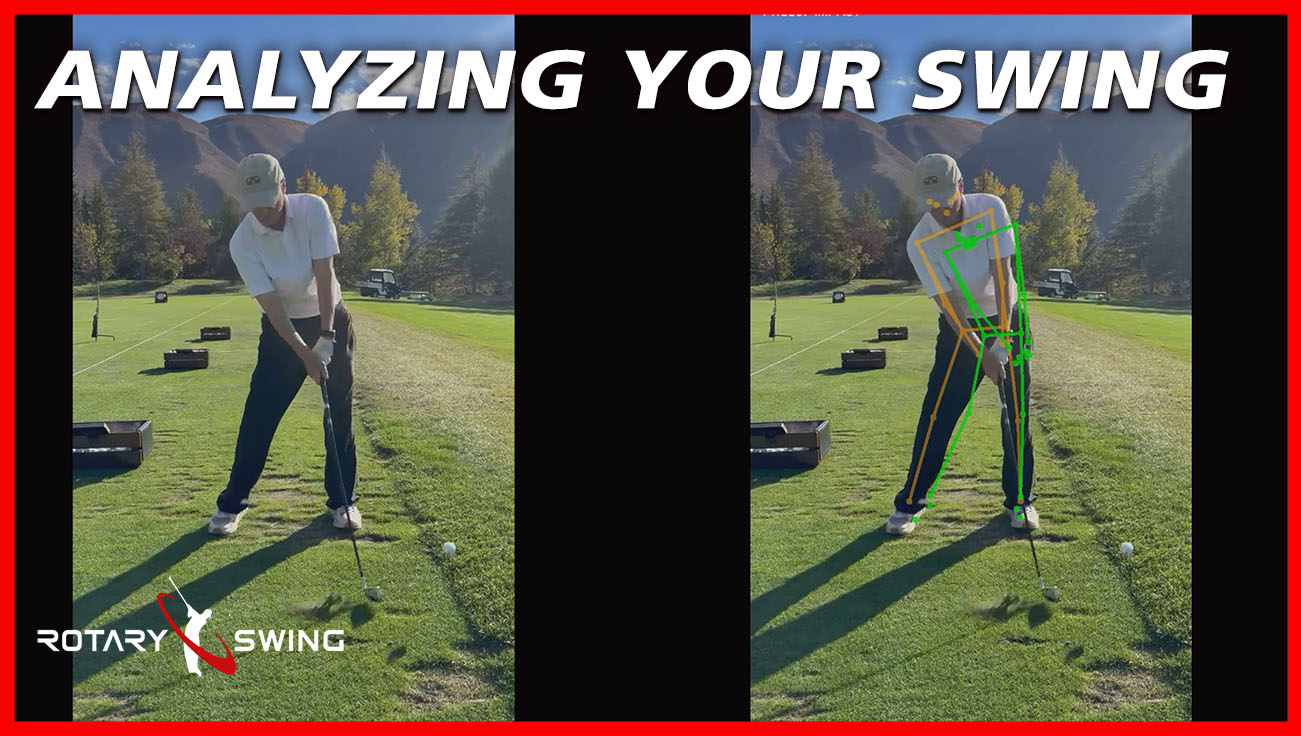
Whether you're using a mirror, like I have here and here.
Whether you're using a camera, an iPad, an iPhone, an Android.
Whether you're using your wife or your brother.
You need somebody, You need Some awareness of what's going on and you can't fix anything unless you can see it.
You have to have some feedback because at the end of the day feel in a real or two different things.
So during this process and during the boot camp and after you leave the boot camp, always make sure That you're getting some type of feedback.
Because that's going to be the only way to really make a significant change.
And then when you do get good doing something, you get good at doing phase one, you get good at doing phase two or certain positions.
Do it over and over again.
You have to make golf boring, and the more boring that you make it, the more fun it's gonna be.
Because it's gonna be easy, it's gonna be repeatable, you're gonna know what you're gonna get, I've always told players, you know, play good golf is to play boring golf.
Whether you're hitting, you know, a perfectly straight ball every single time, or let's say you hit a 15-yard draw, but you hit a 15-yard draw every single shot, you're going to know how to play that, and you're going to know how to go out there and score and have fun.
That's what we want to do here.
We want to build some consistency.
We want to build some speed into it, and we want to go have more fun.
So I'm going to go over a little bit of setup.
I'm not going to get into too much details.
We'll set up just some of the basics.
And then we're going to kind of start a little bit with phase two and work our way back to phase one.
Video is blurry.
I just saw something pop up.
Anthony, we all good?
So with the setup, there's a couple different parameters.
And if you have your PDF, you can follow along with me.
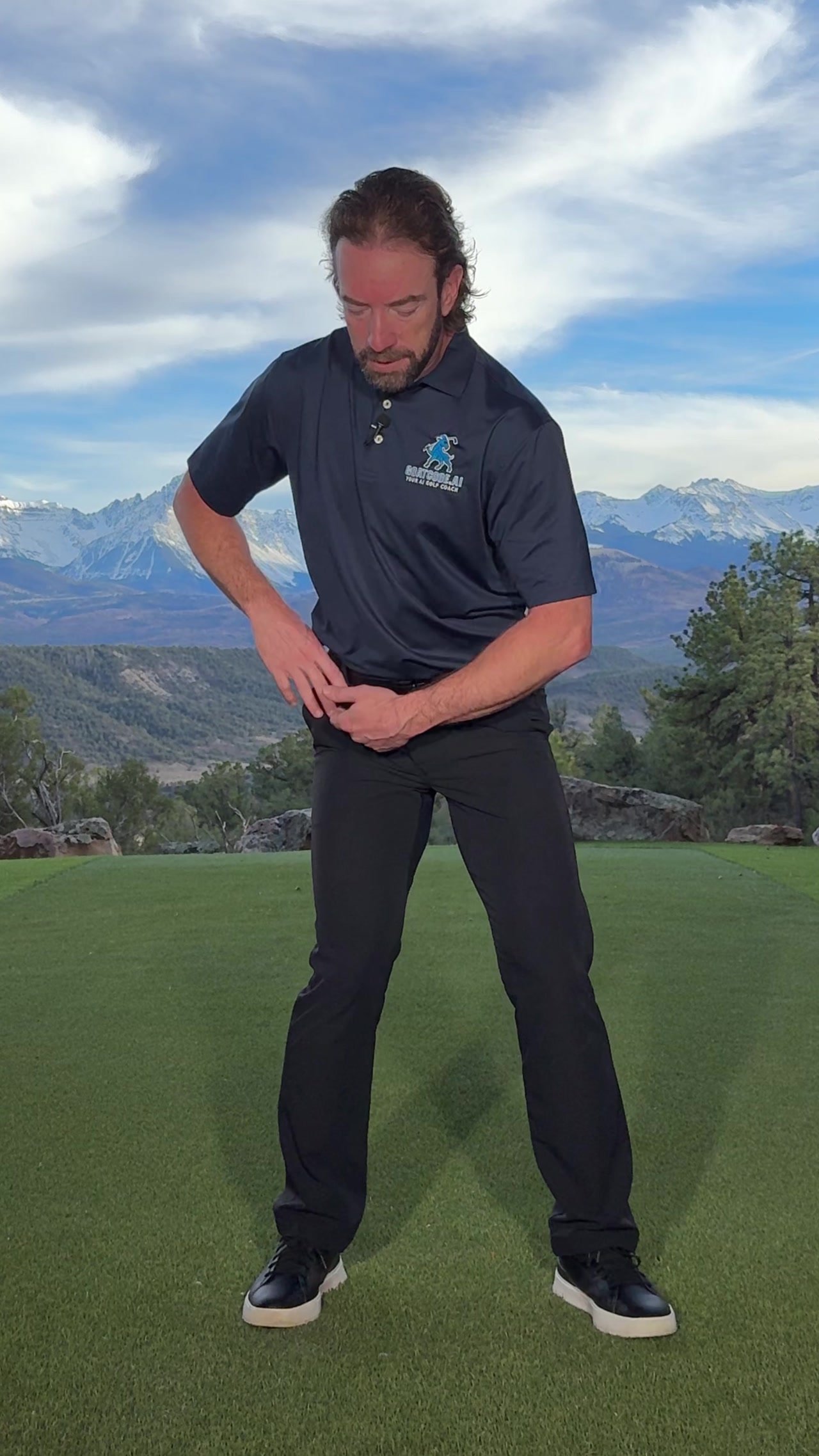
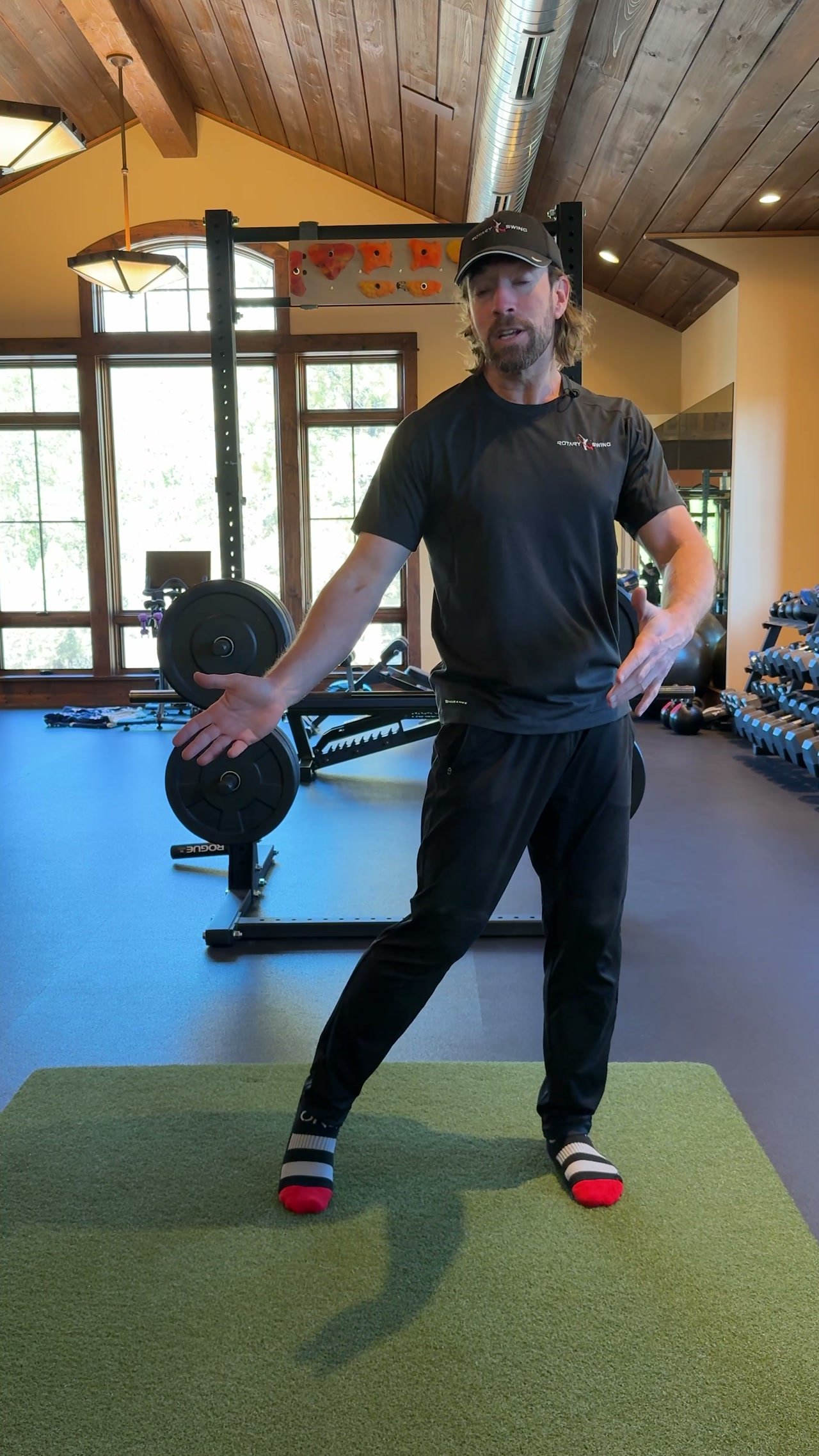
The very first kind of requirement we need to make sure of is that we have proper stance, width, and what we're looking for is two inches outside of neutral.
Okay, and what do I mean by neutral?
Well, neutral?
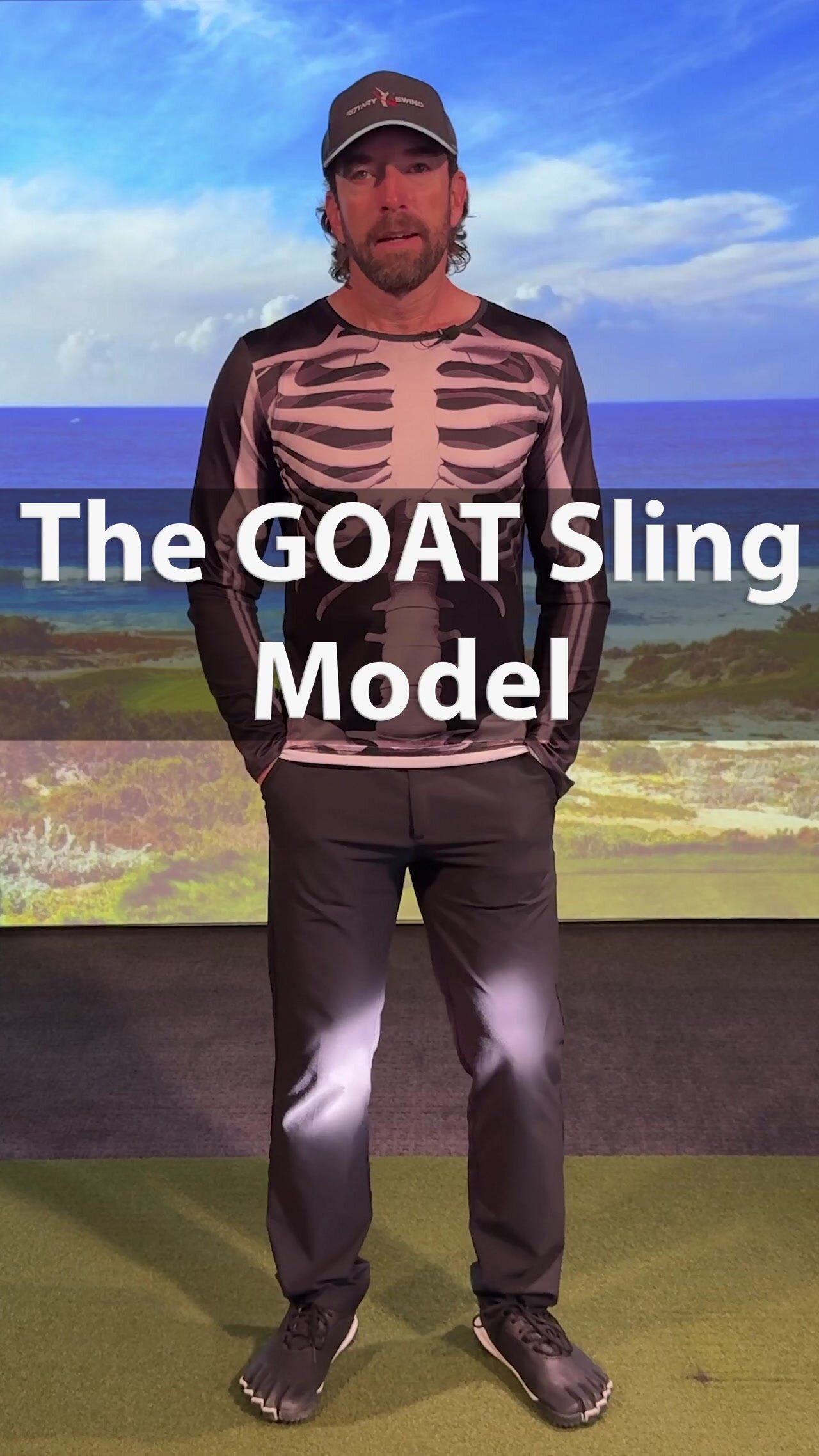
Joint alignment is just if I pulled all the skin off me, all the muscles off me, down to my bare bones.
And it would be where my body would be perfectly balanced or perfectly in alignment.
Okay, we could look at this from a face-on perspective, down the line perspective, But it's where your body is neutrally based and safe.
And so for me and for you at home, neutral joint alignment would be if I drew a line from the center of my ankle joint through the center of my knee, the center of my hip socket.
This is going to be where I'm perfectly balanced.
Okay.
We want two inches outside of that with both legs.
Okay.
Now you can get.
Really technical with this.
You can take two fingers.
You can find your hip bone right here.
And the inside finger is probably going to be right about where your hip socket is.
And that's going to be where you want to be two inches outside of.
You can do that on both sides.
Or the cheat sheet, so to speak, would be if you have pants with belt loops.
Most pants with belt loops are right around your hip sockets.
Right around your hip sockets.
So if you were to drop a club down from that belt loop, you can see for me, it's kind of a straight line from my ankle to my knee to my hip.
And I just want to be two inches outside of that.
And I want to do that with both feet.
And this is going to be where I'm in enough width to be able to shift my weight without my head going all over the place.
But also be dynamic, to have some freedom, to have some movement.
If I get too narrow, I can't maintain balance.
If I get too wide, I can't shift weight.
I can, but if I did, I would lose all my other parameters.
So we want to make sure that our stance width is about two inches outside of neutral.
The next thing that we're going to need is axis tilt.
Once you get the stance set up, Axis tilt is just leaning your spine away from the target.
And this lean of spine away from the target allows us to rotate in the backswing because it helps open up our facet joints to facilitate proper rotation.
It also will aid a little bit in making sure we get a little bit of weight into the trail side.
It also allows the trail hand to get on the club properly.
And to have proper axis tilt, all you need to do is just take a club right down your sternum right here, right down your spine.
Put one hand on your belt.
One hand on your chest and just bump your hip just slightly towards the target until that club hits you on the inside of the lead knee or alignment rod.
All right, that's all we need.
We don't need anything crazy, just a little bit of axis tilt.
Okay, but I can tell you, and Anthony can tell you, we see that messed up very often.
And it can be an absolute swing killer.
If you do too much axis tilt, it'll kill the swing, but if you do too little axis tilt, it's kind of game over.
People don't rotate, people don't shift weight.
And usually when you give them that little bit of tidbit of information and they make that change, all of a sudden they're like, well, things feel a little bit more fluid and it feels a little bit more natural.
And that's because the trail hand's lower on the club.
So when you're setting up like this with your trail hand on the club and you're very vertical like this, It doesn't make it natural to rotate.
It makes it more natural to push your arms, to swing with your arms.
So when you start to add that, it starts to feel more or easier to have rotation.
So if we have our stance width and we have our axis tilt, we need to make sure that when we hinge forward, we hinge forward from our hips so that we can have nice flat posture.
What I typically see when people hinge forward or try to get into posture, they just bend at the thoracic like this.
And then they add some knee bend.
And now what happens is the posture gets rounded and now they can't rotate very efficiently.
So all you're wanting to do right here is that when you set up, posture nice and flat.
If you need any aid, put one hand on your head and one hand at the base of your spine.
Just drop your butt back, keeping the club against your spine.
at the bottom with the lumbar and at the top with the head.
And let all your weight kind of fall back towards your heels.
And then soften your knees, keeping that same flat posture and having the proper balance.
You don't want the weight too far towards the heels.
You don't want the weight too far towards the toes.
You kind of want it centered over the ankle joint.
And I get this question a lot.
Well, what is centered over the ankle joint?
What position is that?
Well, When you hinge forward properly from the hips and let all your weight fall back and then soften your knees to get in that kind of true balance position, you should be able to draw a line from your ankle joint through the back of your knee to your hip socket.
And this will kind of let you know that you're in the right balanced position.
If I'm back towards my heels like this, if I had the club here, I don't want to fall over.
you can see that this line would be kind of going through the front of my knees.
If I had too much knee bend and I'm way out here on the balls of my feet, I'd have too big a spacing between my ankle joint and the back of my knees.
And this is very important.
And my compadre, our partner in crime, talked about this in one of the videos he did recently, where one of the biggest faults we see is that players set up with their weight too far towards the heels.
In the previous decade, it was all towards the balls of the feet.
Now it's all towards the heels.
But when you set up too far towards the heels, think about it this way.
If all my weight is towards my heels, what's the only direction I can move?
The only direction I can move is forward.
I can't go back of back.
So you need to be in a position so when you're moving throughout the swing, you can move your pressure, you can move your weight.
from front to back, move it where it needs to be.
If you're already too far back, the only direction you can go is forward.
So a lot of players struggle with losing the tush line or early extension, and they don't realize a lot of it just starts with setup.
So some basic setup parameters.
We're two inches outside of neutral.
We have a little bit of axis tilt.
We should still be 50-50 weight balance.
You shouldn't be setting up with so much tilt that you're.
Presetting 75.
On this side, this is like a counterbalance.
A little bit of tilt this way, a little bit of tilt away from the target.
I'm bumping my hip towards the target, which is creating my tilt.
I'm not just leaning my spine because then I would be losing my straight spine.
Okay, I'm bumping the hips slightly towards the target.
Inside the lead knee.
50 50.
With weight, I've got my stance, I'm hinged forward into position, my weight balance, my posture flat.
Now I'm ready to go.
Okay.
And that's kind of the main things that you have to make sure of when you're set up is just to make sure that those kind of big parameters are there.
We're not going to really talk about grip or anything like that because, you know, I don't want to get too crazy and I know we want to get to work and work on some things.
But typically with the grip, you're going to have players that are going to miss a little bit on the weaker side or miss a little bit on the stronger side.
But unless they're on this end of the spectrum, a little bit here and there, it's not going to make that much of a difference.
Stronger grip players are going to tend to have a little bit more face rotation, a little bit more lag.
Weaker grip players are going to tend to be able to flight the ball better, and they're going to tend to be able to kind of hold the face a little bit more, kind of changing their shot shape.
But unless your grip is really egregious, I really wouldn't worry about it too much.
And that's why we'll just kind of leave that.
All right.
So now, we understand where we need to set up.
We understand that at any point in time, we're doing drills.
And what we're going to start with right now, we need feedback.
We need something to tell us whether we're doing it right, whether it's the mirror, the camera, a friend, a wife.
I would say your dog, but.
My dog just says, give me a treat.
He'd be like, yeah, you're doing great.
So what I want to do is I kind of want to work backwards.
We're going to kind of jump to phase two and then work back to phase one.
Okay, so you're going to see the PDF and the pamphlet.
It starts with phase one and then goes to phase two.
So right now what we're doing is we're jumping to day two, which I'm not sure what page that is.
But that's we're jumping to where I'm sitting there, doing what I like to call the mini dead drill.
And this is where I want you to start.
And until you can do this, body only, body and arm only.
Don't worry about the golf club.
Okay, the golf club is only going to kind of get in the way in this beginning piece.
So the first thing is, we're going to get our setup, we're going to make sure that our stance to it's outside of neutral 50 50 axis.
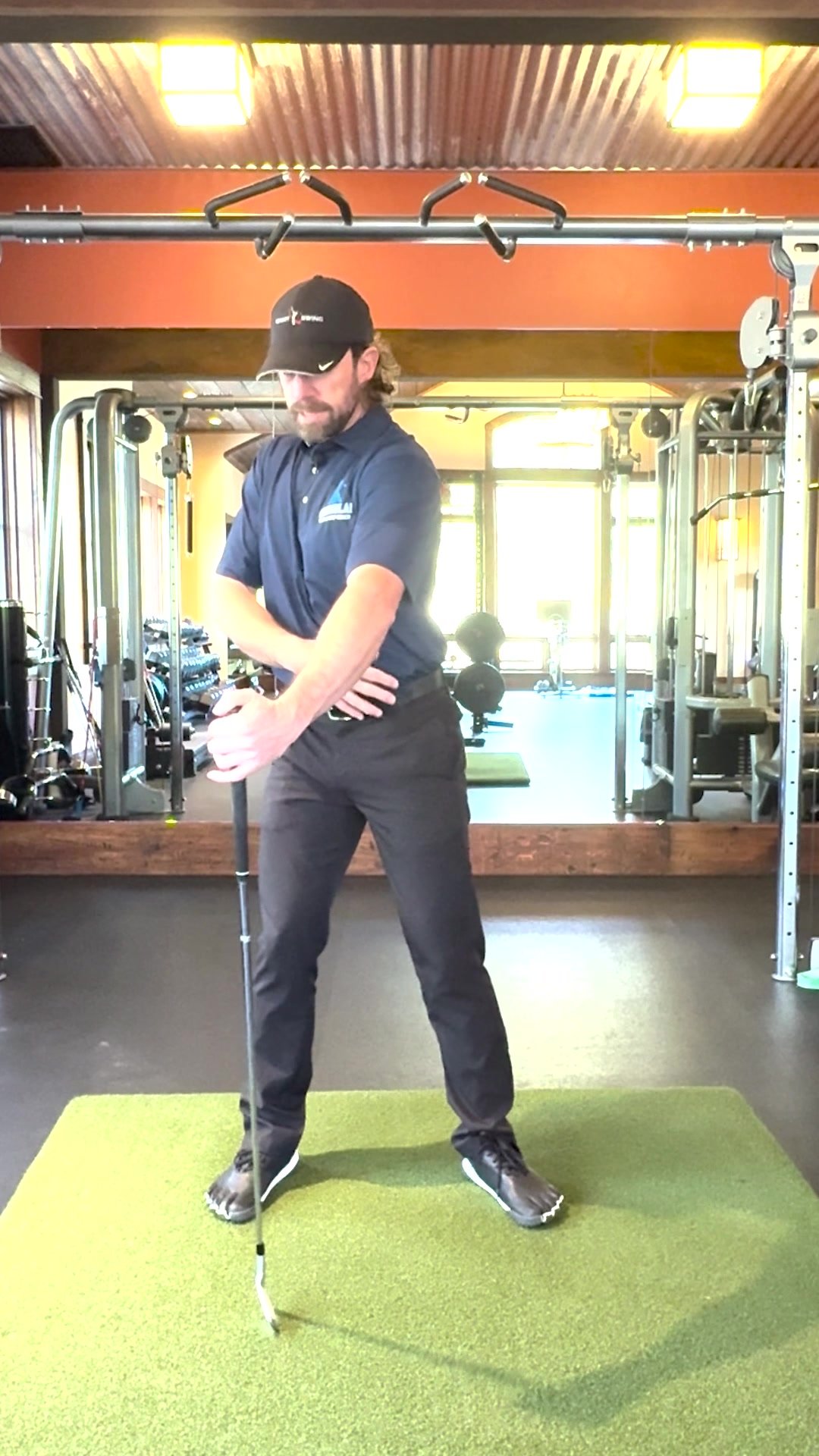
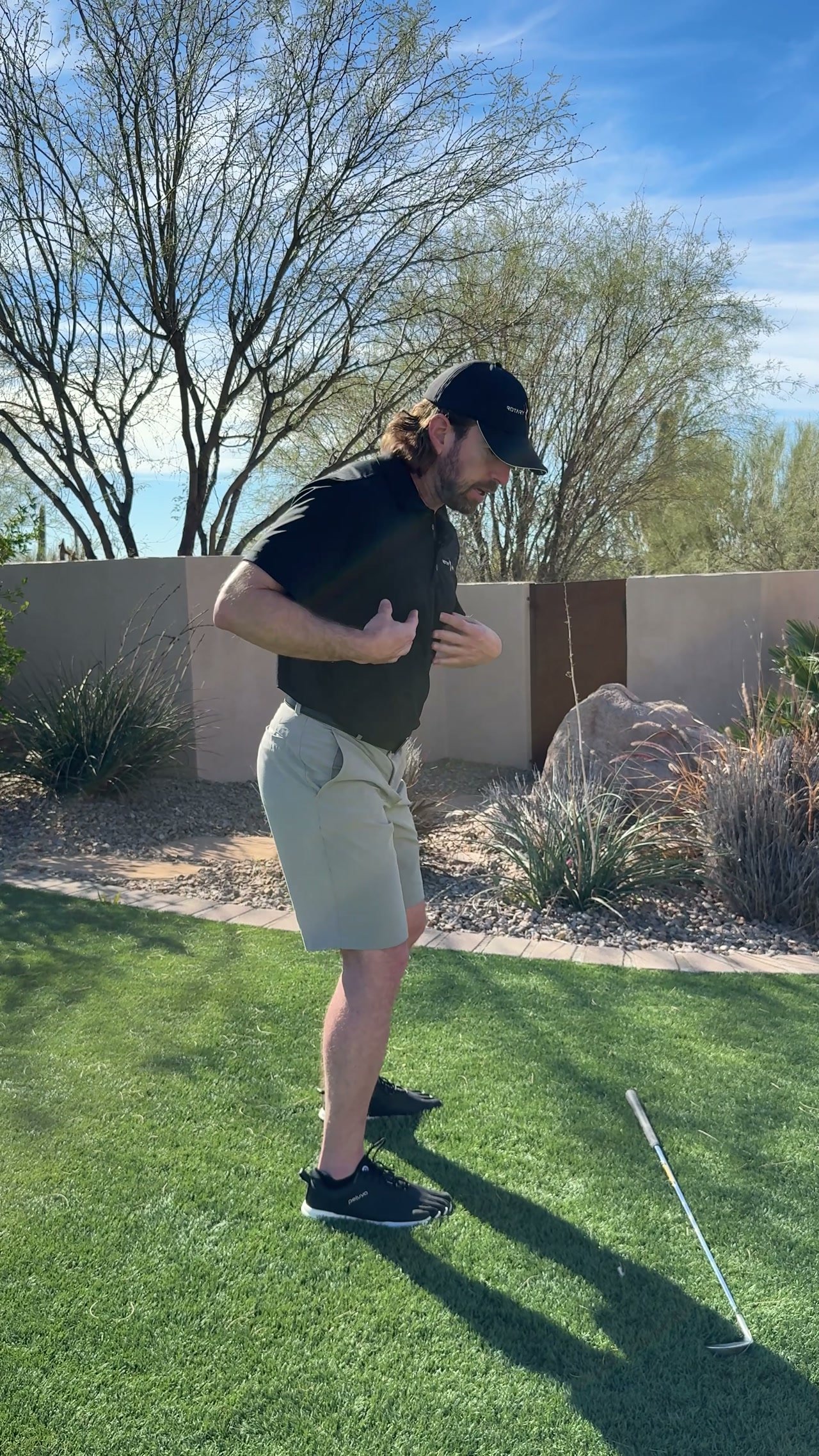
Tilt hands across the chest Now, what I want you to do from here is I want you to push your trail foot into the ground to shift a little bit of weight.
Now, notice I'm moving a tiny bit, but I'm going from 50-50 to about 70-80% right here into my trail leg.
And I really didn't have to do that much to do that.
I want you to push your trail foot into the ground, get about 70-80% of your weight into the trail leg.
I want you to rotate your shoulders 45 degrees.
Okay?
So the first move is going to be push the trail foot into the ground, pull the trail shoulder behind you to 45 degrees.
Once we're in this position, the first move down, which is going to be with all the clubs in the back, is going to be weight shift.
And so now from this position, I don't want you to use your shoulders.
I don't want you to use anything else.
I want you to plant the weight back into your lead foot.
Okay?
I want you to get 80% into this lead foot.
So we're going trail foot, trail shoulder.
So we have our weight, our rotation, lead foot with our weight.
And once we get to this position, we're going to post.
And all posting is, is it going to be straightening of the lead leg, allowing the lead hip to rotate behind us.
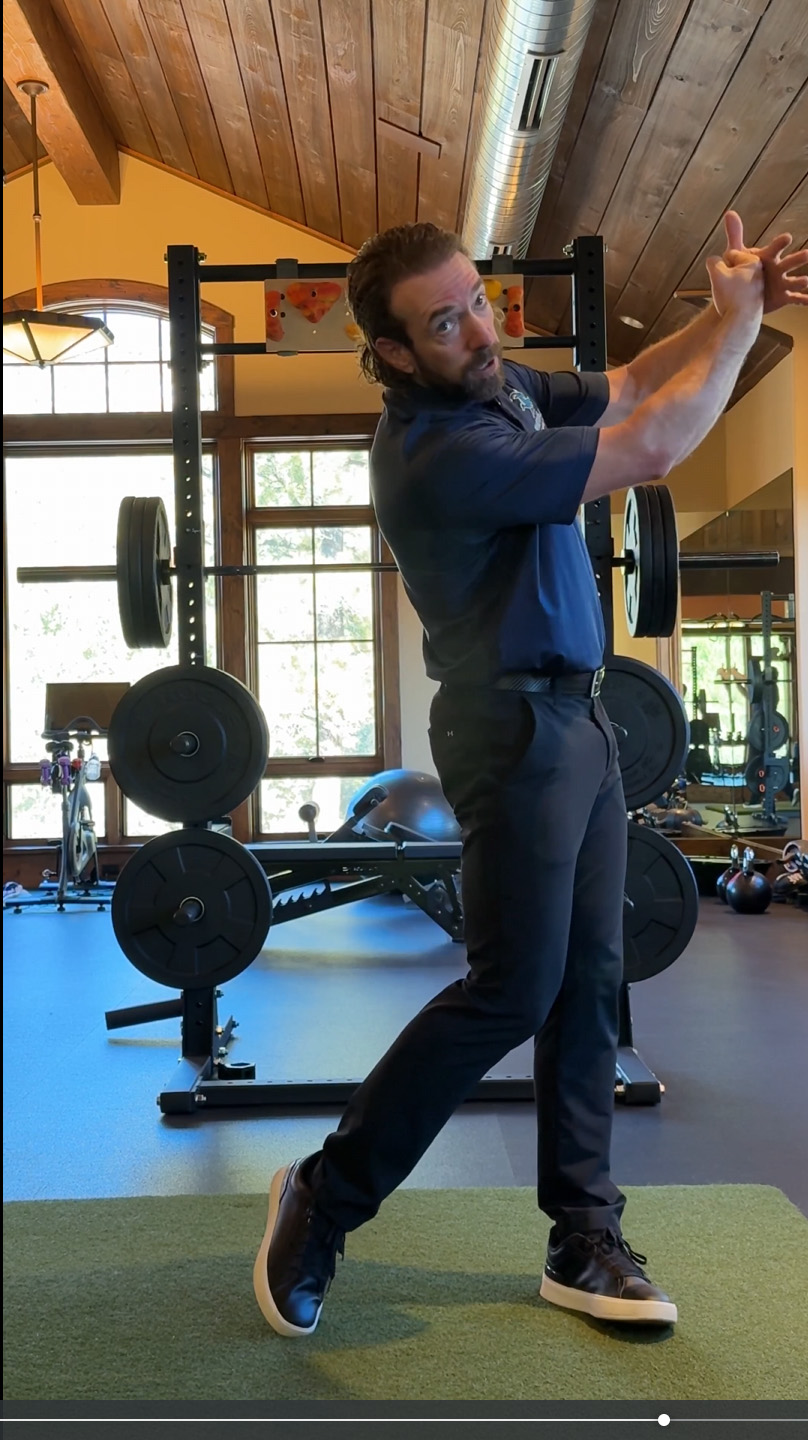
And you might not be able to tell on camera, but from this position, my belt buckle's pointed about 45 degrees in front of me out ahead of the golf ball.
and my shoulders are square.
This is kind of the first move that you need to master.
You need to master being able to shift rotate, shift post.
And when you get to this position, I want you to stop.
I want you to check.
I want you to kind of look down.
Look at the golf swing the way that I do.
I kind of look at it from the ground up, the inside out and from the ground up.
And if you look at this position, You'll see that my trail foot is slightly rolled onto the instep, but my heel isn't lifted.
Nothing's crazy going on.
Just slightly rolled onto the instep.
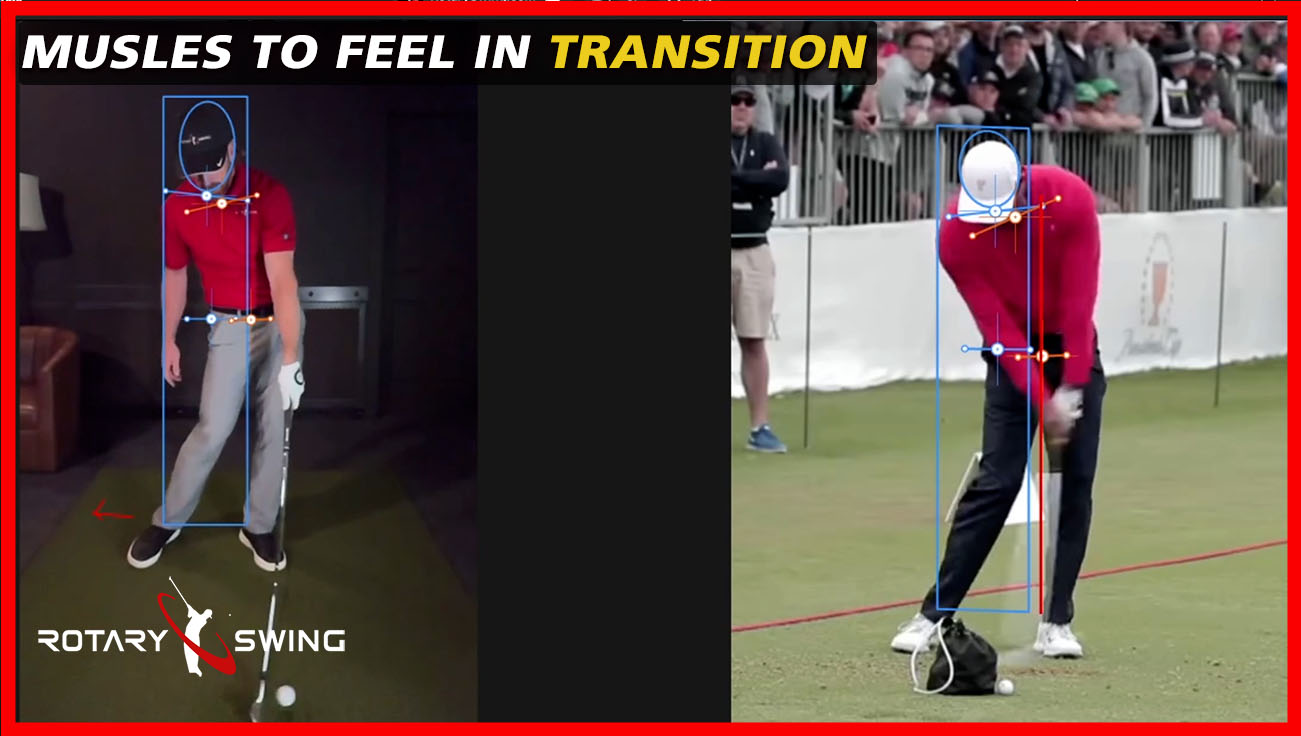
You'll see that my hips are open 35, 45 degrees, and my lead leg is straight.
You'll see that my chest is square and that my shoulder, my hip, and my ankle are all in alignment.
If I were to draw a straight line between my shoulder, hip, knee, and ankle, it'd all be in a straight line.
And for right now, My head is down.
These checkpoints, other than what's going on with your arm, are the first checkpoints of the phase one drill.
We need to master these first.
You need to start to feel what it's like to move your body before you worry about the arm, before you worry about the club.
Because the body is the engine of the swing, this might feel very small and mundane, But this is really the kickstart to make the change in your swing.
Most players overwork the arms in the swing.
They have too much arm swing, too little body.
And what I'm trying to do is I'm trying to change your mind.
I'm trying to change how everything processes up there to say, no, the priority is how I'm moving my body so I don't have to do so much with my arms.
And I can kind of simplify this.
I can kind of make my machine.
run more efficiently.
So the first goal is we're going to get set up here, and we're going to work through those positions, and I want you to try to do it in one fluid motion.
Trail foot, trail shoulder, lead foot, post.
Try to get this all in one motion.
Trail foot, trail shoulder, lead foot, post.
Okay?
All this is is just a miniature golf swing.
I'll do it from down the line as well.
It's all we're doing.
We're just repping the feel of what it's like.
To make a miniature golf swing, this is just a half swing trail, foot trail, shoulder, lead, foot post.
And when you get to those positions, I know I'm kind of running through them, but when you get to those positions, check your checkpoints.
Every time you finish a move, anytime you finish a swing or anything, stop, Look at it.
See what's going on.
I get a lot of information from somebody's finish.
I get a lot of feedback from that.
I get a lot of information from somebody stopping in their release point.
I get a lot of information from somebody stopping at impact.
When you're doing this, I want you to work through this and stop and check.
See if your heel's up this way.
Make sure you see your.
Lead butt cheek working back that you can see both right here.
Make sure that your chest is square, that your head is down.
Okay, and try to build just a little bit of pace into it, you don't want to stay too static and too slow with this.
Once you start to get the feel of this as you're checking yourself and just build a little bit of pace into it.
Nothing crazy, just a little bit of pace, Just to help kind of make things a little bit more rhythmical, build a little bit of fluidity into it.
It also helps kind of spark the learning a little bit.
We're going trail foot, trail shoulder, lead foot, post.
Start to get the feel for the body.
After you do your body reps and it's feeling good and it's looking good on camera in a mirror, I want you to start to add the arm to the equation.
And I want you to add your lead arm only.
Your trail arm, you can put it in your pocket.
You can put it behind your back.
You can cut it off.
I've told students that they probably should think about that.
Got a hacksaw in my garage.
Makes golf very simple once you get that trail arm out of it in some situations.
But for right now, just kind of tuck it away to the side.
And I want you to start in the same setup position.
I want you to stick your arm out in front of you.
Kind of shaking hands like this, you can do it.
In your grip position, or you can do it shaking hands like this, either, one's fine.
I do it like this just because it allows me to kind of see how my wrist angles are working and how the rotation's working.
Yes, Mike, with the weight, it'll vary a little bit and I'll answer a lot of questions at the end.
But 70 to 80 percent is going to happen here in the trail side.
Now you may see other players get to like 68 percent, you know, pressure, they may get 75.
But for right now, I want you getting the weight moving because the vast majority of people don't move enough.
Okay, and so that's that's going to kind of be the window that we're looking for.
Even in this small move, you got to remember, We're building up to a fuller swing, but right now, that's kind of where we want it to be for this drill.
So I want you to stick the arm and hand in front of you.
And when you do this, don't hold it out here like this, okay?
Let it kind of hang from the shoulder socket right here, almost to where you'd be holding the golf club, okay?
So we're going to take this setup, get in our position.
Now, when you get the arm out in front of you like this, All I want you to do, and all I kind of want you to think about, is the same thing that you just did with your body positions.
And let your arm react to how you're moving.
Okay, so we're going to take our setup right here and we're going to go trail foot, trail shoulder to take away length.
All right, and you can see it my position right here.
My glove logo or watch would be kind of facing the camera.
I've still got 45 degrees of shoulder rotation right here.
So I feel that my weight and my pressure's over here on my right side, on my trail side, my trail shoulder's back.
I'm letting the movements of the weight and the rotation bring my arm back.
I haven't swung my arm.
I'm just letting my weight and rotation bring my arm to this position.
This is already training you how to make a perfect takeaway, okay?
Because you're not doing this with your arm.
You're training how to move your body to move your arm and hand.
So let's work to this position right here.
And we're going to do the same thing as coming down, but this time we're going to stop at impact with our arm and hand.
So I want you to shift the weight back to the lead side.
Don't use the shoulders.
And I want you to post.
And when you post, I want you to stop at impact right here.
The same thing that we just did with the body.
But when you get here, I want your arm and hand to be in front of your lead thigh with the logo of your glove.
Or watch facing the proverbial target.
And I want this wrist flat.
And if you're a cupper at home or a scooper at home, I want you to practice.
Feeling a little bit of bow, okay, which would be allowing this wrist joint to kind of bow out like this.
Okay, if you're a big time cupper and, you know, struggle with those fields, so we're going to take our setup trail, foot, trail, shoulder, lead, foot, post, stop.
Check your positions.
Okay.
Take our setup.
Check our positions.
Make sure that you don't lose the sense of moving your body to move your arm and hand, because that's what typically happens next.
When we add the club is that the body stuff kind of goes out the window.
As you're stacking these components, Always make sure that everything's being driven from this inside stuff.
Hinge forward, get into position, arm and hand in front.
Trail arm out of the equation.
Trail foot, trail shoulder to this kind of shaking hands position.
You can see with me, you can see the rotary logo still on my chest.
Kind of shaking hands with proverbial fake person right here.
I've got my weight over here.
My shoulders are rotated.
Now I'm going to shift my weight back.
And when I shift my weight back, I'm going to let my arm react.
I'm just going to let my arm work down due to the weight shift.
I'm not going to get overly aggressive and try to leave it up or push it down.
I'm just going to let it react.
Now I'm going to post into impact.
And I'm going to go through my same checkpoints.
My trail foot, my lead leg.
How's my arm and hand?
Is it facing the target?
My left butt cheek, my head down?
Until I can make that a little bit fluidly.
Until I can make it with a little bit of rhythm.
Until I don't have to really think about it a whole bunch.
I can just move through these positions by feeling my weight, my rotation, my weight, and my post work through these spots.
Okay?
And as you do more reps, you'll be able to build more speed into it.
But what you should notice, if you've gone through the pamphlet or you've watched the videos, At this point in time, we're at a phase one, okay?
At this point in time, we're at a phase one.
So what I want you to do, if you're doing this along with me, I want you to grab a golf club.
And I want you to do the same thing, lead arm only, okay?
And when you set up lead arm only with the axis tilt, all the same fun stuff.
Keep that trail arm out of the way right here.
I want you to shift and rotate to the takeaway.
Shaking hands position.
Don't think too much about the golf club or anything.
Remember, you move you.
You let the arm and club react to your weight and your rotation.
Club will naturally start to set a little bit.
You'll feel a little bit of the weight.
And work to the takeaway position.
Now I want you to shift your weight back.
I want you to post and stop at impact, okay?
And when you stop at this impact position, I want you to walk through your same checkpoints.
How's your trail foot?
How's your stackedness?
How's your straight left leg or lead leg?
How's your glove logo?
Where's your watch going?
Is it facing out towards the camera?
Is it facing behind you?
Is it bowed?
Is it cup?
It needs to be at least flat or slightly bowed.
How's the chest?
Is the chest square?
Is the head down?
Is the club face square?
Notice I didn't first say is the club face square and then work my way back into here.
I asked about all these things and then asked if the club face was square.
And the reason why is it's very easy to kind of manipulate club face.
Okay.
I don't have to move any of this stuff to make my club face do a whole lot.
Okay.
I don't have to do that.
So I want you to kind of think about these things and kind of being last, especially because when we start to add release to this thing, it's not going to really be up to you a whole lot.
Let's see.
All right.
And remember, class, I'll answer.
I'll stay until everybody's answered.
Anthony, I know, will take care of some of those.
But I'll stay until all questions are answered.
Don't worry.
So when we get here and we get to this position, remember that was kind of the last thing that I looked at.
Okay.
This thing is just, it's moving because of what I'm doing here.
Okay.
So I want you to be able to work from here to here and stop and be able to check your checkpoints.
Shift your weight, shift post and stop.
Okay.
Once you can do that, and I'll do a couple from down the line.
Here, all I'm thinking about is a little weight, a little rotation of the shaking hands position.
Club toe up.
Don't want it facing the ground.
Don't want it wide open.
Toe up.
It could be a little toe down depending on the strength of your grip.
Load rotate.
Now we're just going to shift and post and hold that impact position.
Okay?
And once you can do this, looking at a camera, looking in the mirror that we can, you can hit all those positions and you're really not having to think because you're doing a lot of your reps, excuse because you're doing a lot of those reps.
Then what we're going to do is we're going to add the trail hand in the mix and then I want you to practice.
Okay.
I want you to go practice.
I want you to start to hit some shots with that impact position.
So the next step would be, can you do the same thing with the trail hand on the club?
So as you set up and you get your trail hand on the club, you work through the same positions.
Little weight and some rotation.
Nothing changes.
Trail arm stays straight.
I'm not going to worry about perfecting the takeaway right now, but if you're solely just focusing on your weight and rotation, and you're allowing the club to move with that, and you're not adding any unnecessary motion, You're going to be pretty darn close to a perfect takeaway from here.
We're going to shift, then we're going to post into impact, and that's why you'll hear us a lot.
Say.
Push that lead foot into the ground to get that hip, to work back behind you, to straighten that leg.
That's all I mean by post here.
Then I want you to stop at this impact position and go through your checkpoints.
And once you can do it with all of these parameters, trail foot, trail shoulder, lead foot, lead hip.
Then I want you to start to try it with a golf ball and I want you to start to hit some shots.
And sorry, I've got some lung issues, so I'm trying to make sure I don't break out into a coughing fit.
I want you to try to hit some shots, okay?
I want you to start to test yourself.
Some rotary students and some players in general wait a little bit too long to kind of start testing, which is part of the reason that we have this C4.
I want you to start kind of testing it a little bit early.
Once you can kind of get the semblance of what you're doing, go get a golf ball.
If you don't have a golf ball, use a potato.
If you don't have potato, try to find a foam ball like I have right here.
I got these off Amazon for like 10 bucks or something.
I got them a long, long time ago.
Then we're going to set up for the golf ball.
And what I want you to do is not worry about the golf ball at first.
Okay.
I want you to get in front of the golf ball.
And I want you to have your same mantra of what you're feeling.
Some players may need to feel like they're rotating a little bit more.
Some players need to feel the weight.
But the main thing at the end of the day is feel how you're moving your body to move your arms, to move the hands, to move the club.
And all we're going to do is have a little weight in rotation, a little weight in post, and stop.
Okay?
Stop right here.
Now, at first.
Don't worry about the golf ball.
Stop.
Go through your checkpoints.
Make sure, just because you added the golf ball into the mix, that you can still hit all the checkpoints.
Still have the flat lead wrist, the open hips, the foot, all the checkpoints.
Make sure you have those parameters first, okay?
There's no point in worrying about it.
If you look at it and your ball flight and your golf ball is perfect, but your mechanics are off because it's very easy to manipulate golf ball flight.
It's very easy to manipulate shots.
Okay.
But are you doing it the right way?
Okay.
So check this part first because you may only hit two out of 10.
Well.
Ball, flight wise, but at first it's like, but my movements weren't bad, they just they're uncomfortable.
Me, I'm a little bit tighter than I need to be, that's okay.
But once you check it on camera and the movements start to get pretty good.
And you're going trail foot and you can stop and check.
Yes, my shoulders are a little bit open right here, but I have my trail hand on the club and I can't perfectly stop it here.
But they would have been square at impact.
Okay, you can see my trail foot's behaved, my head's down, my chest is good, my hips are good.
All right, I'll do one from this view, so you take the setup, get in proper posture.
No lordosis.
I saw a little bit of that sneaking in.
All we're going to do is we're going to take the same thing.
Don't worry so much about the takeaway.
The takeaway is really egregious.
We may need to visit it, or you may need to check it out.
As long as you're not going like this, rolling it way inside right now, or your club's facing the ground like this, it just needs to be a little bit within the margin of error, which is going to be kind of toe up, a little bit toe down, and just still out in front of you.
This one is the bad one.
Just general reason for takeaway.
But if you're moving and you're kind of going about it the same way, takeaway is going to probably be pretty good right now.
So I'm going to take the setup.
I want you to think the same thing.
Put a weight rotation, shift post, and stop.
Notice how even inside right here, me hitting this ball, where's my head right now?
It's still down.
Okay.
But I'm going to go through my checkpoints.
I'm starting to learn how to move.
this club with my body and hit a golf ball.
All right?
It's of the utmost importance that all your awareness of how to move this golf club isn't coming from your hands.
Now, the problem is, is your hands give you a whole lot of feedback.
And I can promise you, like.
When anything's going wrong, I mean, you're going to trust your hands more because that's the thing holding the golf club.
I'm going to finagle this thing around.
But overall, for your stock proper fundamentally sound swing, we've got to make sure that the hands, okay, aren't having to manipulate and do too much.
Okay.
So we take our same setup, we go through the same positions, we're just going to have a little wait and rotation, a little shift and post.
Now notice I'm not moving overly fast or anything like that, because your first parameters and your first checkpoints with this is going to be to only hit kind of 10, 15 yard shots.
And in those 10, 15 yard shots, they only need to be at about a one or two yard.
margin for error window.
Okay.
You're not moving that fast yet.
You're not moving that far.
Shouldn't be that forgiving or we shouldn't be that forgiving on our grades with this.
And a 10, 15 yard shot, you should be able to hit in between a one or two yard radius at least 80% of the time.
So if you're doing 10 reps, eight out of 10 of those should be able to be within one or two yards.
Now, if you watched the new introductory videos of me going through phase one at the end of last summer, you can see even for me, I had to go back through and do the same thing.
But that margin of error, all right, is going to start to really tighten things up for you.
If you can get the little things right, then as we get bigger and bigger and bigger, We don't have to kind of go back and fix some of these things because you've already kind of taken care of it.
And this is a really good pace and good length to really kind of master these things.
This is a good pace, a good length, a good type of shot selection to start being aware of your weight, okay?
Now I know, and it may already be in the chat, that some players.
We'll do exactly what I'm doing right here and they'll say, Craig, well, I'm hitting the ball a mile, all right.
Well, number one, you're swinging too hard, number two.
In phase one, you can preset the weight a little bit on the lead side, okay, and not have this little weight transfer back.
Because in phase one, the point of emphasis is on impact.
So you really don't, we really don't require in phase one to have any weight transfer.
And if right now you've gone through this little mini dead drill with me, that weight shift is going to start to create a little bit of momentum.
Okay.
So you're either A swinging a little bit hard or B, you're just using a lot of that momentum and it's generating some more speed.
So if you're looking at all your checkpoints and you can't figure out what's going on, it's like, I'm sitting here doing everything Craig said.
And I don't feel like I'm swinging fast and I'm hitting all my checkpoints, but the ball is jumping out a little bit.
It's probably just because you added weight shift to it, and we really don't require that in phase one.
I like to do it still personally, because it just helps me kind of still feel the same rhythm and rhyme that I need to feel in my own golf swing.
But sometimes it's just because you've added that weight shift and also the ball is jumping out, even though you're hitting all the same correct positions.
So the first part of your homework is going to be to master what I just went through right there.
Okay.
Now I know a lot of these players in bootcamp have already been through this, so they probably already have phase one down.
Okay.
But if you don't have down what I just went through, being able to move your body, do that, do it with the club and being able to hit it within that radius and hit your percentages, you need to do that first.
And you need to do that until You can.
Then you can go into this next move that I'm going to add.
But I know a lot of players kind of already, they know this impact.
The next evolutionary phase to this drill and to take this drill to phase two.
Because what's really the only difference in phase one and phase two?
You're working on an impact feel and gaining some awareness and some consistency.
And now we're going to increase the consistency and increase a little bit of the shot size and shape.
We're going to start to kind of master this.
As we worked from here to here, The only difference between this and a half golf swing is allowing the club to release, that's it.
It's literally the only thing that we kind of deleted in this.
Okay, because a lot of people don't have a proper feel for impact and they don't know how to, you know, flight it low or really have control of their lead wrist.
Okay, so we want you to have the feel of what it's like at impact.
To hit that small, little compressed shot before you start kind of giving up a little bit of control.
Because that's all that you're doing when you're adding the release.
You're giving up a little bit of control to gain control.
Because as everyone knows at home, the definition of release is to what?
It's to let it go.
And that's what we're doing right here, is we're going to start to allow the club to release.
Now, the beautiful news, at the end of the day, you are not required to square up this club face.
You are not required to make the club release.
It's where Isaac Newton is.
It's the physics.
It's the way that the club's designed.
The way that the heel-toe balances, it's designed to rotate.
That's why if I hold it right here and I let it go, what does the club do?
It literally falls this way.
That's because the club is swung on an incline plane, and this toe is designed to rotate around the heel.
It's not designed to stay perfectly square and perfectly square.
Or it'd be kind of like some of your putters at home.
It'd be perfectly face balanced.
If I were to balance it right here, this club face would stay facing the sky.
But it doesn't.
It's designed to rotate.
And when you start allowing the club to rotate, not only does consistency go up, because you're letting the club do what it wants to do, okay?
You're not impeding.
It's natural design.
But what you're also doing is you're also adding a lot more speed.
In a properly released club, the toe rotates around the heel about 10 to 12 miles an hour faster.
The center of the face rotates about six to eight miles an hour faster.
So as we've always said in clinics and with students, if you want six to eight miles per hour of speed for free, literally just start letting the club rotate.
That's not a hook.
It's not an over -manipulation.
It's just a release.
You're allowing this club to do what it wants to okay?
So my ideal scenario, if you're able to get to phase one and get to these positions and you can get that, start back with a little bit of an advanced version of your dead drill that you did.
Taking your setup right here.
Lead arm only.
Let's get this trail hand back out of the equation.
And all I want you to do is do the exact same thing you did in your phase one, except let the club rotate.
And all it's going to do is look like this.
Weight, rotation, shift post, let the club release.
And when you get here, I want you to stop and go through your same checkpoints with your body.
None of this should have changed.
The only thing that's changed is you've started to allow.
This club to release independently of your body.
Okay.
So the two additional points of emphasis, it's going to be the position you're in right here with the club.
Is the club toe up or slightly toe down?
And what is your wrist doing?
Is your wrist flat?
Could be slightly cut.
But is it facing behind you, not facing the sky?
If I do this from an up-the-line perspective, you'll see.
The club face is toe up or slightly toe down, wrist flat, glove logo facing behind me.
It's not this.
That's what the vast majority of players do.
They hold on to this face, thinking it's giving them more control.
But let's think about this.
If I were standing right here, and I'm going to hold this club face square, and I try to do this with a little bit of pace, how consistent do you think this face at the ball is going to be with its squareness?
How consistent do you think that's going to be?
How consistent do you think I can be going like this?
Or do you think I could be a little bit more consistent?
giving in a little bit to the golf gods and letting this rotate back and through.
Do you think that this point, that moment in time at the bottom, that squareness or the squaring up at that time is going to be a more consistent rate of rotation, but a more consistent clubface angle?
What's it going to be?
Letting physics square this up for me is going to be much more consistent.
Okay?
So all I want you to do is I want you.
To go back, take your trail arm out of the equation, go through the same thing.
Trail foot, trail shoulder, shift post, let it release.
And go through all the same checkpoints other than now checking your release.
Okay?
That's the only thing that's changed.
Your mantra, your method of how you got here hasn't changed.
You're still thinking the exact same things.
The only thing you're literally let happen.
is the club rotate through.
That's it.
It's literally the only thing you're letting happen.
Once you can do that, get your trail hand on the club.
Then I want you to do the same thing to the takeaway position.
Shift, post, let the club release.
You don't need to add anything with the trail hand right now.
The trail hand at this point is just a little bit along for the ride.
I want you to really have.
the awareness and feel of what the lead arm and hand's doing, okay?
The trail hand's just a little quiet during this phase because we're not really concerned with power, all right?
So once you can do that with the left arm only or lead arm only, add your trail hand, and it's the same thing.
I'm going to kind of watch the camera on this one.
We're going to shift, rotate, shift, post, and let the club release, okay?
Once you can do that, In your practice swings once, you can do that in front of the mirror and on the camera, correctly working your way from the ground up.
Then start to add back the golf ball and what you should immediately notice When you add back the golf ball.
Working through this, what you should immediately notice is there's more speed.
You didn't necessarily pick up speed, But now the ball is going further.
But you didn't really do anything different.
You shouldn't have.
You should be still thinking the same thing with the weight and the rotation, how you're moving your body, letting the club react.
But you'll notice all of a sudden you have a little bit more jump and distance.
And the reason you have this jump and distance is because you're allowing the club to release.
You're allowing it to rotate over.
So you're getting a lot more free speed at this stage.
And just like you did in your phase one, I want you to do the same thing with this.
I want you to work through it, getting to this position.
Shift post, letting it release.
Get the positions down first with the golf ball.
Okay?
Get the positions down first.
And then start kind of watching what the golf ball's doing.
But as you can hear, like with my shots in here, I didn't really pick up the pace any.
But my ball's jumping off the face a little bit more.
There's some more speed in there because I'm allowing these things to happen.
Okay?
All you've done is go from phase one and add a release, which is technically not really adding anything.
You're just allowing for it to happen.
The release is very passive.
You're allowing for the club to rotate over.
Okay?
Now, when you look at phase one and you look at phase two, there's a lot of different variables that can happen with your ball flight.
And I have most of them on the PDF.
The types of strikes that you might have.
But as you're working through this, typically what you're going to see.
If you're hitting the shot fat and you can't fix it or you can't figure it out, it's typically going to be because you didn't shift your weight and or clear your hip.
Okay, check the body position first.
The secondary thing would be the trail hand did too much work for you.
So if you're going through this and you're looking at all these things, and that happens, that's probably going to be the number one and two culprit.
If you start hitting it thin and you can't figure it out, or you start hitting it right, it's probably because you're overly working your shoulders, and the overworking of the shoulders is delaying the rotation of the face.
And it's taking your fulcrum position, which will be your lead shoulder, out of the shot.
So if you work down here and you rip your shoulders through versus maintaining the chest square at impact or maintaining the chest square, letting the club release, what you're going to probably see is a lot of thin and a lot of toe strikes shooting off this way because it's delaying the face rotation.
If you notice a lot of cupping in your lead wrist, you're hitting everything overly high because these shots should be relatively low to mid trajectory, erring on the lower side.
then more than likely you're just taking over with your trail hand too much, Which is adding a lot of cupping to the lead wrist, because that's going to literally be.
The only reason that the lead wrist would need to cup is that the trail hand is overtaking.
If you're struggling with heel shots, the heel shot is going to usually be adding too much push from your trail side.
Because as you start to come down, because these are very small shots, as you start to come down, you start driving too much.
With your trail foot or trail hip towards the golf ball, and that creates a little bit of early extension.
Okay, so you can see that.
My heel would come up off the ground early, my hip would start to come in and that would start to push this club too far in down.
Okay, that's going to typically be, in both versions, the usual suspects.
And when you get to your phase two, what you're looking for is you want to be able to hit 40 to 50 yards.
Then a four or five yard margin of error I may have given you a little bit wider, I don't think I did, I may have.
Yeah, I did.
Gave you five yards, 40 to 50 yards, five yard margin of error, left to right.
Because you should still have a good feel for the impact position.
But now all you've done is you've allowed for some rotation.
So the dispersion really shouldn't change that much.
Okay, shouldn't really change that much.
Only thing it should have done is add a little bit of speed.
But you're also going to start to gain consistency.
Because you're going to start to allow the club to square itself.
Which that's what it needs to do at the end of the day.
You don't need to be the driver of this car, so to speak.
You need to allow Newton to kind of take the wheel in this one.
Because he's going to get this squaring of the face right way more often than we're going to be able to.
He's going to be able to kind of correct this and have this rate of rotation and have this squaring up point at the right time.
Work out much more in our favor, okay?
So we have our rep tracker in the PDF for phase one and phase two or day one and day five.
You need to start where you need to start.
And what I mean is if you're new to Rotary or this is, you know, your first bootcamp or you're just now starting out in C4, then start with the very first thing that I talked about with phase one and the impact.
Don't jump ahead just yet.
All right.
Do a couple days of that.
Do that on Wednesday and Thursday and try to get that down.
But since you kind of have me now, after Wednesday and Thursday, try to jump to phase two, adding a little bit of release and see what you can do in between now and then.
Because by the time we get to Saturday, even though you may not be ready for that in your real swing, if you have any thoughts or questions or something, I want you to be able to come back at me and be like, all right, Craig, well, I attempted it.
And this is what happened, or this is what broke down.
How do I fix this?
That way, when boot camp is over with, you can go back and be like, Okay, you know, I.
I did all the phases and I did the drills and I understand what's going on.
But I need to go back to phase one, or I need to go back to phase two.
Because I just don't quite have the handle on it yet, because I can't hit my percentage of shots, or I look in the camera mirror and I can't quite get everything that way.
You can go back, but you already kind of have the questions answered.
But you know the destination, you know the journey, you know the cities you're stopping at along the way, okay, and I know that this today's format is very condensed and there's a lot going on in today's.
So it may feel a little bit rushed to get there, but I think if you can keep the focus on this body and the arm.
The club is just the tool, right?
This is just the hammer.
And not many people think about the hammer.
They think about what they're doing and they think about the target.
They think about what they're hitting.
They think about the nail.
They don't really think about this.
Just allowing this club to kind of move with how you're moving.
But I do want you to test it just a little bit.
I'm not trying to rush anybody.
But while you have me and while you have this camp, test it out a little bit.
And then you can kind of go back and put in your reps, maxing out at the percentage that you have.
Okay, a lot of this will make a lot more sense, more and more that we go through this.
But also I want to kind of pick things up, especially for players that kind of already can do the phase ones, or kind of already understand the impact.
So, like, I can do that, but I struggle as I as I get further along.
So that's why this is going to kind of be a little bit of an accelerator program.
Okay, so, with that said questions, you can fire away and I'll be happy to answer everything and thank you for giving me a chance.
You.
The replays will be up by the morning.
Um, For some of you that know me, if it looked like I was a little bit off my game or anything, I can't believe I'm even standing right now.
So hopefully you learned something, you understand what's going on.
This is just day one.
I know it's a lot of information right now, but we're going to get this together, all right?
Anthony and I are going to bust our humps to make sure that everybody in this class knows exactly what they need to do.
And don't stay in the dark.
You've got the community.
You've got swing reviews.
You've got live lessons, which I should have a link for a discounted live lesson with me, and it's not on the page.
I do not know why, but I will make sure it's in the next game.
You can take a live lesson with Anthony.
You can take an in-person lesson.
There's all sorts of ways to get help, okay?
Don't stay stuck.
Don't be frustrated.
Let us know.
Let us help.
The video form.
Okay, you're not alone in this journey.
we are here to help you.
Okay, so, with that said, I'm going to take Q A if you have to leave.
Thank you for stopping by and giving me an opportunity today.
I will see you bright and early on Saturday at 10 a.
m eastern time okay but if you have questions which i'm sure you do no problem i'm going to stay until everybody's happy All right.
Okay.
Let's see.
Thank you, Robert.
All right.
I'm going to start with Leon.
And then anybody else that's asked a question above that, it's hard for me to scroll back.
Leon, confirming that this is day one of four.
Yes, this is day one and day five.
Okay.
So I've combined day one and day five, okay?
We worked from day five back into day one and then back into day five, okay?
But that's because this is gonna be an accelerator program adding driver.
And I've got a lot to cover, especially if I'm doing a whole session on driver, all right?
It will balance back out after today and you will understand.
Guy, can you show me shoulder and waist position at impact?
Certainly.
So from face on, shoulder and waist position, if I'm reading that correctly, when you get to impact, what we're looking for right here, okay, trail foot is going to be slightly rolled on the instep, hips 35 to 45 degrees open, should be stacked, ankle, knee, and hip, and shoulder, lead wrist facing out ahead, shoulders should be square, head should be down.
Just to show you, I'm not cheating to get to that position.
Same thing.
Should see both butt cheeks, my trail foot.
My chest shoulder is square.
My head is down.
Logo is facing the target, so to speak.
For me, the mirror.
Hopefully that helps.
If you need a little bit more, let me know.
Let's see.
Dermot, going back to the initial drill, you are balanced at address.
Can you go over the first move, what we're doing with the trail leg or foot?
Into the first drill.
As in with the body, with the body, the first thing you're doing is you're just pushing your trail foot into the ground.
So if you're right-handed, all you're doing is you're just starting to push your right foot into the ground, okay?
You should be pretty balanced, and you're going to start moving towards your heel, not the back of your heel, but you're going to start moving towards the back of your foot, pushing.
Your trail heel into the ground to start to put some pressure on it, to start to move a little bit of weight.
Thank you Steven.
I appreciate it Fred.
many thanks.
many thanks, Anthony.
Um, Bernie wanted to see a demonstration of the release versus a flip?
All right, that's a really good question, so release versus a flip.
So if I'm setting up right here, I load and rotate to this position.
I'm going to do a release first, and I'll show you the flip, a release.
What's going to happen is my lead, arm and hand and all this fun stuff is going to work to impact flat the boat.
And you're going to see this kind of pendulum effect.
Okay, you see this kind of pendulum effect right here.
My radius hasn't changed a whole bunch.
So release.
Is that all this maintaining with the club rotating over?
Now watch the difference.
I'm going to move this into a flip.
Now what happened right here?
A flip is going to be a manual rotation of the face.
And one of the most common things that you're going to see is the fact that all of a sudden, what do I not have?
that I just had a second ago.
I don't have any width.
A flip is typically gonna be you manually stop everything, like literally stop, like you hit a proverbial wall and you take your hands and you make that club rotate over, okay?
So a flip is a manual rotation of the face.
Now there's some pros, that's why they call it a pro flip, that walk the fine edge between a release and a flip, okay?
Because if you don't release it, it's kind of pointless.
You got to release the club.
So a flip is a manual speeding up of the face with your hands.
This is a manual takeover of the club face.
On this one, I'm letting the club release whenever it wants.
And you'll see that I still maintain a little bit of my extension on the way through.
I'm not manually making it happen.
Excuse me.
Anthony, you got Mike.
We'd be providing more information to help from opening up your shoulders.
Yes.
That will be, a lot of this will get back in alignment starting Saturday.
Because starting Saturday, we're basically going by the book until we get to driver.
And I'll talk about shoulders because when we start adding a little more pace to this, that's the one, it's not the first.
Well, it's usually the first, if not the first thing that usually goes is shoulders, all right, that people start messing up when they add speed.
So we'll talk a lot about the shoulders on Saturday.
But technically thinking about this, when you make this little takeaway right here, your legs will bring everything back to the ball for you.
I've never had to tell anybody in my entire career teaching with an iron to use their shoulders in the downswing.
But we'll talk about that when we add speed.
Joel, is most of the weight in the trail foot towards the outside of the heel?
When?
Is most of the weight in the trail foot towards the outside of the heel?
If you're thinking axiom-wise and you're moving in the counterclockwise nature, you will start a little bit exaggerated when you do that, okay?
But it's going to be very buttoned up at the end.
So as I move towards here, it's going to be a little bit towards there.
Just a little bit.
But it shouldn't be so much that either your foot's picking up or you can't maintain stability.
Brad, that helps a lot.
Cupping is that I struggle with.
So Brad, if you struggle with cupping.
Two things I want you to think about, all right?
Number one, the number one reason people usually cup is because they push with their trail hand.
You literally have no choice to cup your lead if your trail hand overworks, all right?
I can't keep that from happening.
But then also going back to Bernie with the flip, if you're getting into this position and you're speeding up your trail hand so much to make this rotation of the face happen, what did it do to my wrist?
It's going to be really hard.
To flip the club with a flat lead wrist, you can, but it's really tough.
Same thing Joel.
It's going to be moving towards the heel, and yes, it can.
It can air a little bit, a little bit more on the outside, especially if you're doing axiom.
But it.
The reason that I, I kind of shy away from saying is because when people, when I mention things about the golf swing, everybody kind of hears it a little differently.
So if I say, hey, you can move to the outside of your trail heel, then I'm going to have players that are going to be like this because this is what they think the outside of their trail heel is.
That's an extreme case.
But yes, it moves a little that way.
John, what happens when your trailing leg is bent too much at impact?
Very good question.
Three things that happen.
Well, there's a lot of things.
I'm going to give you my three highlights.
When the trail leg, or you said trail or lead, what happens when your trailing leg is bent too much at impact?
Okay.
So the trailing leg, when it's bent too much at impact, all right, needs to be a little bit bent.
But if I'm going from here and it's bent too much at impact, what's one thing I probably didn't do?
Look at my lead leg.
I probably didn't post with my lead leg, okay?
So if I'm not posting with my lead leg, I'm probably still in a squatted position, which when this is too bent, what's typically going to be happening with my weight?
My weight's going to typically be more towards the balls of my feet.
And when my weight's more towards the balls of my feet, not only am I not balanced, But I'm also putting my weight balance into my knee joints instead of putting it back here in my lead hip socket.
So as you start to come down, if you notice that your trail leg is diving in and bending a lot, more than likely, you're not posting up correctly.
You're pushing too much with your trail foot and trail hip, which is moving your weight too far forward.
Okay.
And probably causing a little bit of early extension.
It's not everybody, but probably causing a little bit of early extension.
Excuse me.
Let's see.
Thank you, Mitchell.
I appreciate it.
Pat, you're welcome.
Joel got to run.
Thank you so much, Craig.
Thank you, Joel.
Appreciate it.
Now, remember, you're going to have these replays.
So if anybody asks any question after that, you can pick it up at this spot and see what I yelled at people about.
I know I'm not yelling at you, but I do yell at most of my students.
Sometimes they need it.
So no other questions.
Nothing so far?
There's a lot in a little amount of time.
Okay, we got one.
Jim, all right.
I have a tendency to be late on my weight transfer from trail side to lead side.
What is a good cue?
To start the weight transfer timing to the front side.
What is a good cue to start?
I mean, there's.
I'd kind of change that up a little bit.
Because there are some things with sequencing and timing in this morning.
If you struggle from going from this leg to this leg, get that down pat first.
Even if you're moving a little bit too much.
It's going to always be easier for me to button you up versus get you to move.
Okay, I?
It's kind of like it was some players all right, that, let's say, they way overly use their hips.
Okay, now if I tell some player, Okay, let's turn it off five degrees, what are the odds that they're going to be able to consistently turn it off five degrees?
Not very good, but if I say, okay, let's absolutely kill them.
And then we'll gradually add them back in.
That's going to be a lot easier.
So if you struggle with this weight, why don't you just pick up your feet at first?
Just to make sure that as you move here and you plant your right foot, you can feel your left foot kind of pick up a little bit.
And I'm going to start to plant my left foot into the ground and let my right foot pick up.
Get a feeling for this first.
Just kind of pick up the feet.
And what you'll notice is you'll start to feel how as you start to get weight, Into this side, you naturally you'll start to naturally develop the rhythm to start to push the other foot in the ground.
So we'll deal with that a lot more the more wet we go.
But what I would do is I would pick up the feet a little bit.
I left the feet kind of lift up and down.
Uh, James, keep on playing in the backswing, what about keeping on playing in the backswing?
Expand Ryan, how do I make the transfer from trail to lead?
Same thing I just told Jim, all right?
And we will do much more on that in the next session because right now we're just moving this little bit of weight, just getting this little bit of feel.
You can just pick up the feet a little bit to get this feel, but just feel it a little bit in the feet, okay?
Go to the weight shift sweep drill on the website.
Let's see.
James, keep them playing.
How to keep on playing in the backswing?
In this drill, because I don't want to go full swing yet.
I want to stay on task.
In this, keeping it on playing, we're just trying to be within a margin of error.
An easy thing to do for this little drill.
is just as simple as taking an alignment rod right here and stepping on it like this, kind of letting it go through your ankle joints.
And just make sure that when you're making this backswing, you don't let the club go this way.
You don't let it roll inside.
Now, if you can't stop that, we have drills on the site with how to fix takeaway and all that.
We'll talk about perfecting takeaway.
But for what we're doing right now, the main thing is, is just that it's staying somewhere in front of you.
All right.
Right now, it doesn't have to be perfect.
But what I would do is just stand on a stick like this.
And if you're struggling with it, don't let the club get behind the stick for right now.
That'll make sure that you stay on enough playing.
Full backswing-wise, we'll work on that later.
But I need players to stay focused on what they're doing with their body movements, impact, and release.
Because you start thinking backswing stuff.
By the time you finish thinking your backswing stuff, you've already hit the golf ball.
Because the golf swing happens too fast.
And plane's a little bit more of a byproduct if you're moving everything else.
Mike, how do you stop from swaying your head when shifting to the trail side?
Swaying your head from shifting to the trail side?
Well, it's a pretty loaded question.
Okay.
It's a pretty loaded question because should the head stay perfectly still?
If I'm shifting weight into this side, my head might move just a little bit.
So if you see about a half inch, maybe an inch of motion right now, it's not the worst thing in the world.
It's not the worst thing in the world if you see just a little bit.
If you're seeing excessive, it's probably not due to the fact that you're overshifting.
It's probably due to the fact that you're pushing with your lead shoulder.
So what you're probably doing is instead Pushing your trail foot in the ground and pulling your trail shoulder behind your head.
You're probably pushing your trail foot in the ground and pushing your lead shoulder to this side, so you're probably pushing with that.
And what I would do is I'd find a mirror like this.
Okay, and go go.
Get like a piece of Blue Painter's tape and put it on the mirror right here.
And I'll kind of do it right here, just kind of put it on the mirror right here.
And then make your same body motions right here, where you don't let the head leave that.
But the the main culprit is typically going to be taking your lead shoulder and moving it this way, versus taking your trail shoulder and pulling it behind you.
It's not going to usually be because of that.
Typically, if the head's doing all that stuff, you're going to start to see like the hips are getting way out of bounds right here, James, yes, thanks.
No problem.
Did that answer your question, Mike, or you need a little bit more on that?
Excuse me.
I'm sorry.
Perfect.
All right.
Thanks.
Okay.
Any other questions?
I'll give you all one more minute.
As long as it pertains to anything today and back.
Nothing about future.
If you know, you can't know too much about your future.
And I would have started my journey back this week if I wasn't feeling so poorly.
Jim, thanks for having to see you Saturday.
Great start.
Thank you, Jim.
I appreciate it.
Mike, get some rest.
Well, I can't say will do because I can't promise that.
I'll get more than I've had.
Luckily, my father's a physician, so I'll make sure to get some stuff to get on the other side of things.
Thank you, Diane.
I appreciate it.
Good to see you.
Good to see you.
Does the shoulder have to darn.
Close to square impact.
Does the shoulder have to darn close to square impact?
Thank you, Badr.
I appreciate it.
How close to square?
Well, Guy, I mean, some of that's going to be relative, depending on which release you're using, which we're going to talk about in future camps.
But at this small.
And since we're making this very lead side biased, down in here, the shoulders should be square at impact.
I really don't want to see the chest and shoulders, you know, five degrees or 10 degrees open.
At this small emotion, I really would like to see the shoulders square.
Now, when you're looking at it, obviously, if we start talking gears and stuff, you're going to see a difference in chest, shoulders, all this stuff.
But it's a lot easier to picture your shoulders.
So if you're.
looking at this and your shoulders are square to your target line right here, you're going to be pretty good.
I just don't want to see this.
This is going to be where we get into trouble, okay?
Because if you don't leave those shoulders square, the club's going to have a hard time releasing correctly.
Does that help you out?
Perfect.
All right.
With that being said, Thank you all, everyone, for stopping by.
As soon as I get the replays downloaded, I will get them up to the site more than likely.
It will be bright and early first thing in the morning.
Good to see everyone.
I hope you all are having a wonderful beginning.
I don't know if it's spring yet, but beginning of spring so far.
And I will see you all bright and early Saturday.
And be ready A to work and B.
Bring your questions.
That's what I'm here for.
That's what Anthony's here for.
We are here to help and get all this stuff fixed so you start enjoying golf more.
No problem, Mark.
Thanks, James.
Y'all have a good evening, and I will see you Saturday.





Kevin
Craig (Certified RST Instructor)
Arthur
Craig (Certified RST Instructor)
Tara
Craig (Certified RST Instructor)
Bruce
Craig (Certified RST Instructor)