









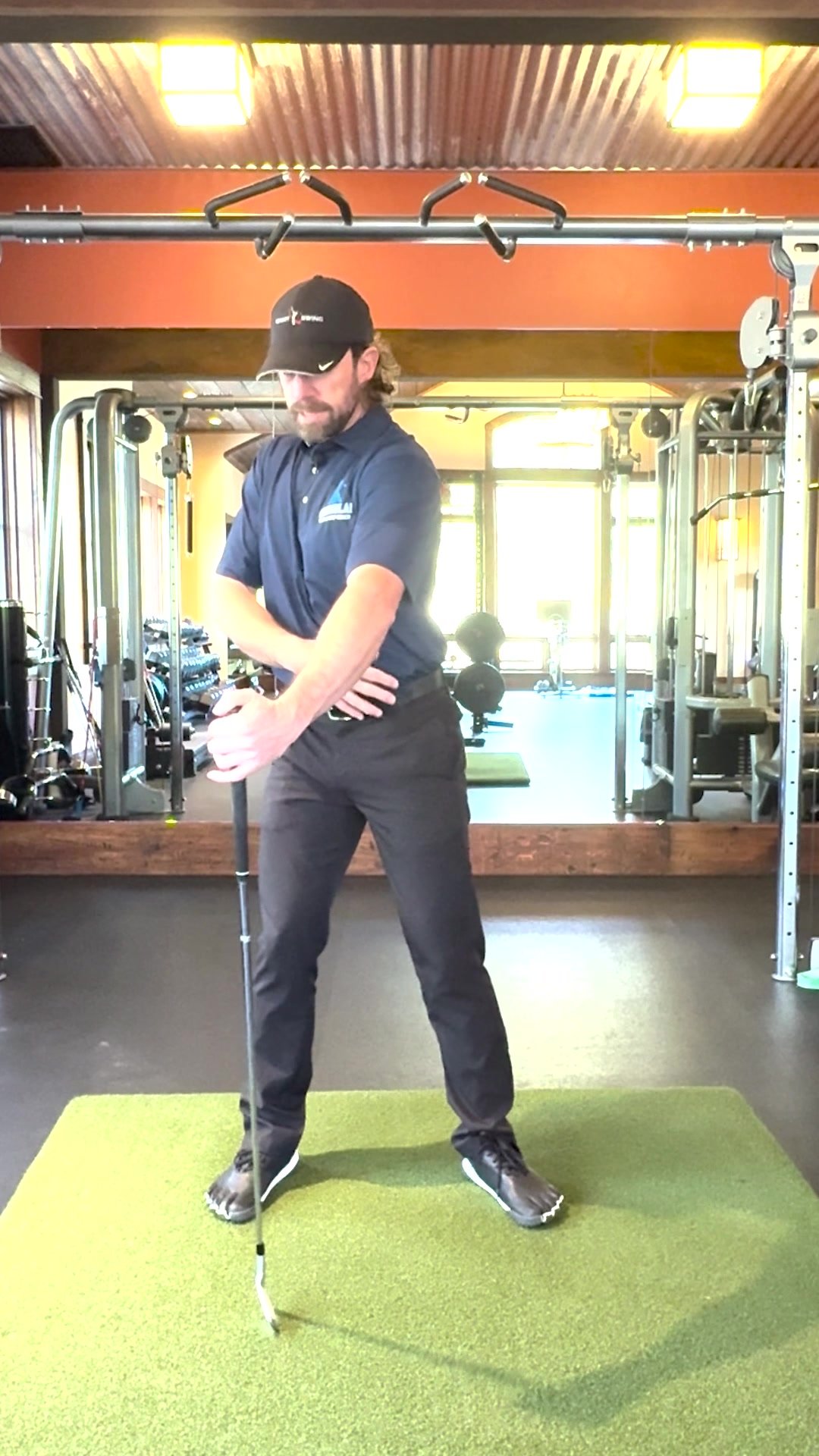
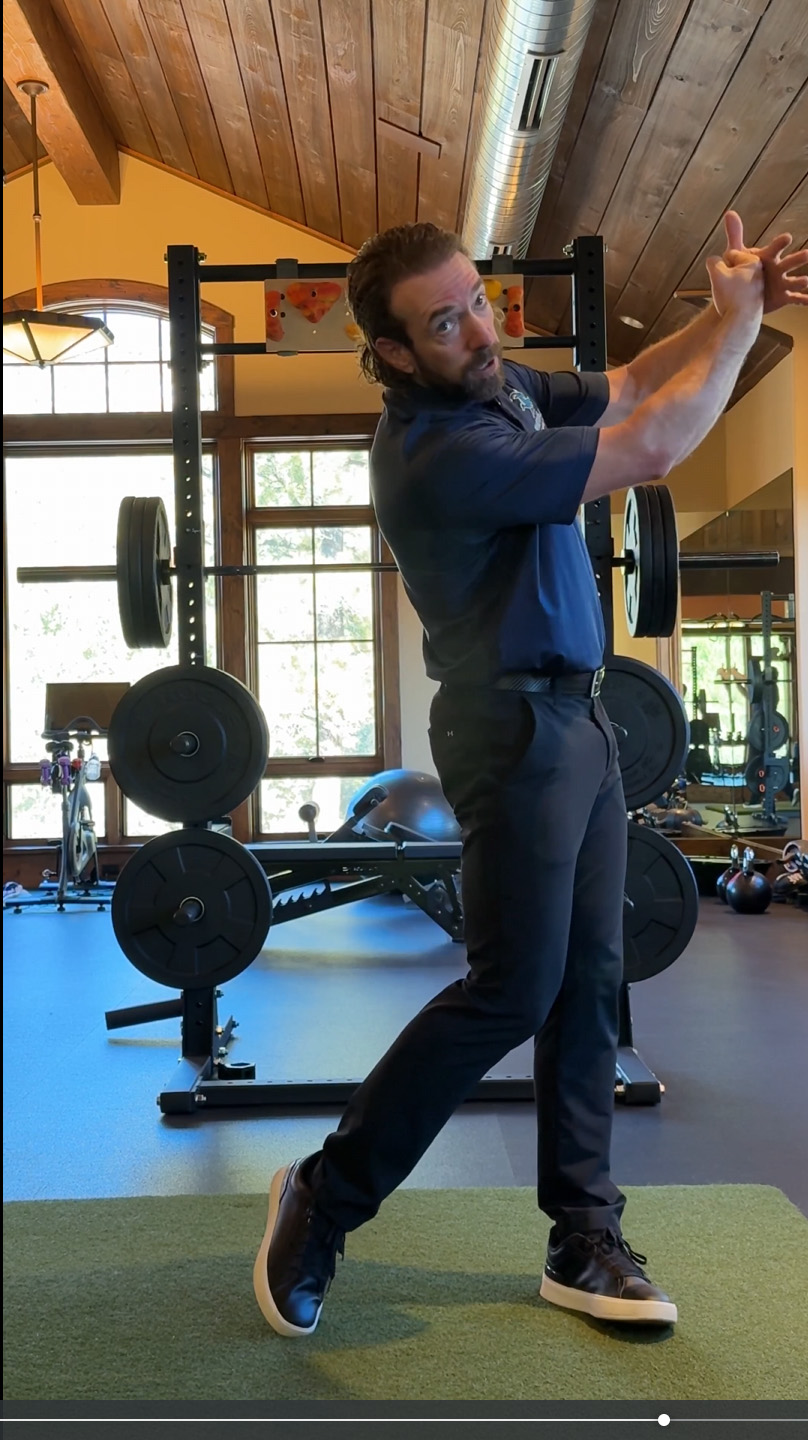
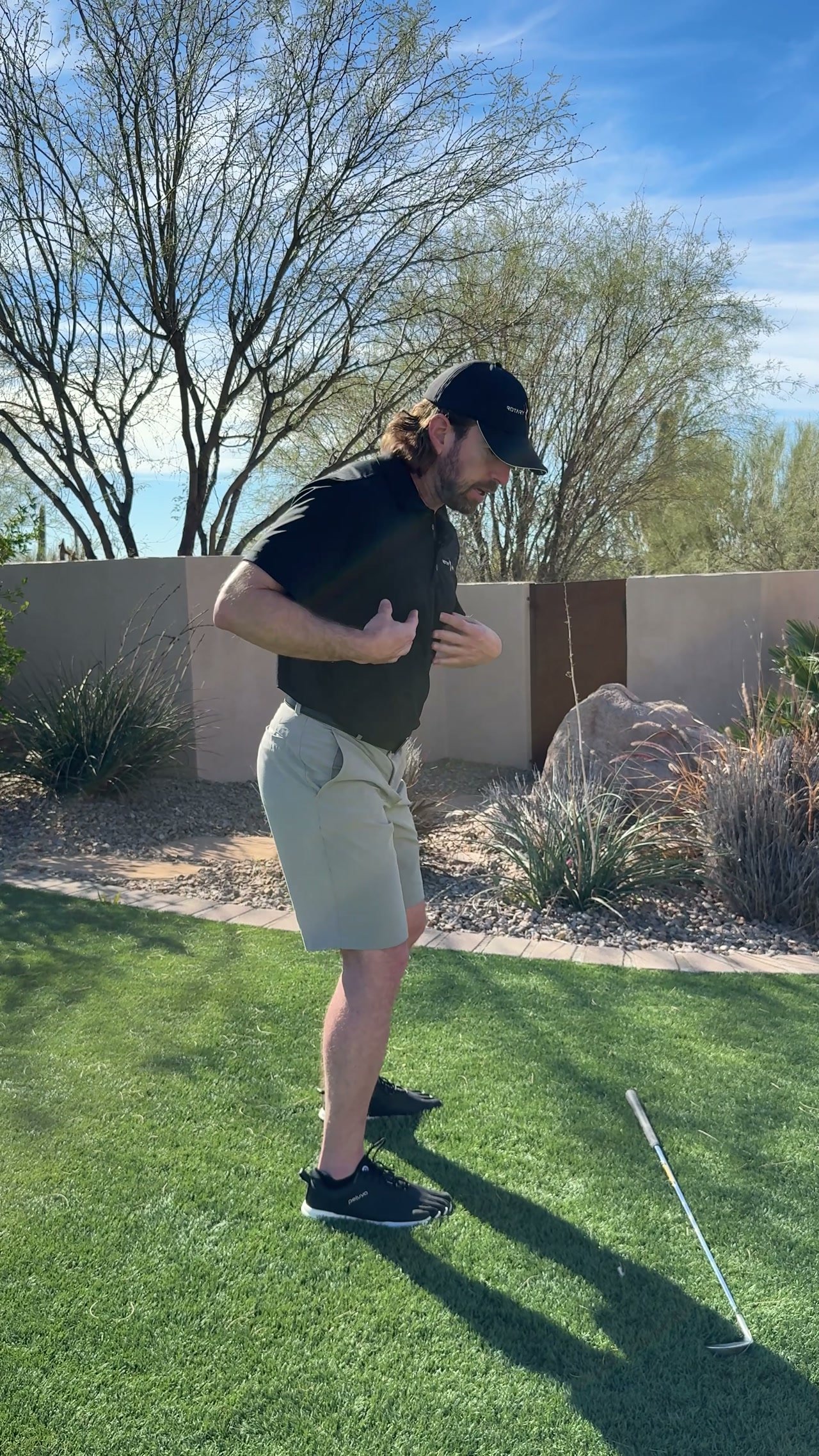









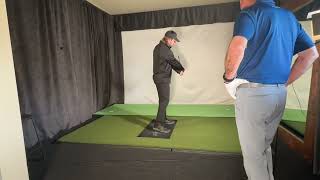
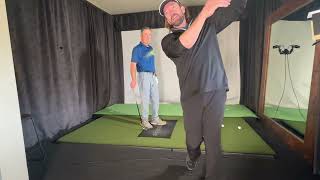






































































































































































The GOAT Code Speed Webinar - 100 mph in 30 minutes
Sorry, you need to be a member to access this video.
You Are Just Seconds Away - Become a member here!
Already a member? Log in now
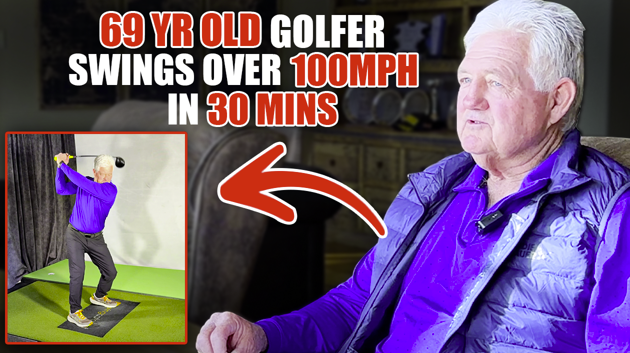
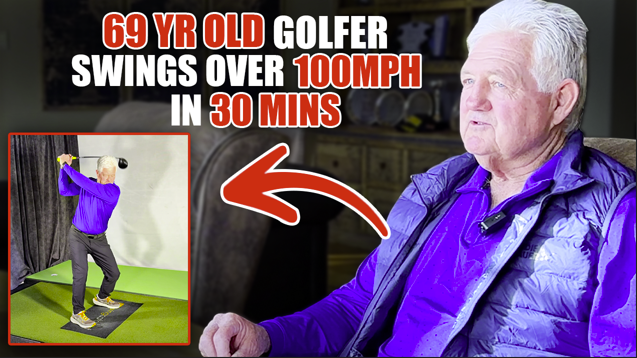
The GOAT Code Speed Webinar - 100 mph in 30 minutes LIVE Training - Learn The Exact Sequence I Used To Increase A 69 Yr Old's Swing Speed 15 mph In Just 30 minutes!!
Really start to let everybody get registered and signed in and stuff.
Uh, if you can hear me, okay, as you get signed in, just post something in the chat here.
Let me know.
You guys can hear me, fine.
Hey guys, can you hear me?
Sounds good, awesome, thank you, appreciate that.
I'm just getting ready, warming up a little bit here.
All right, I got a six iron here, guys, I want you to guess.
What do you think my club head speed is with this?
200.
All right.
What do you guess on the club head speed?
Yards.
All right.
Any other guesses?
95.
All right.
Now let's take a little gander here.
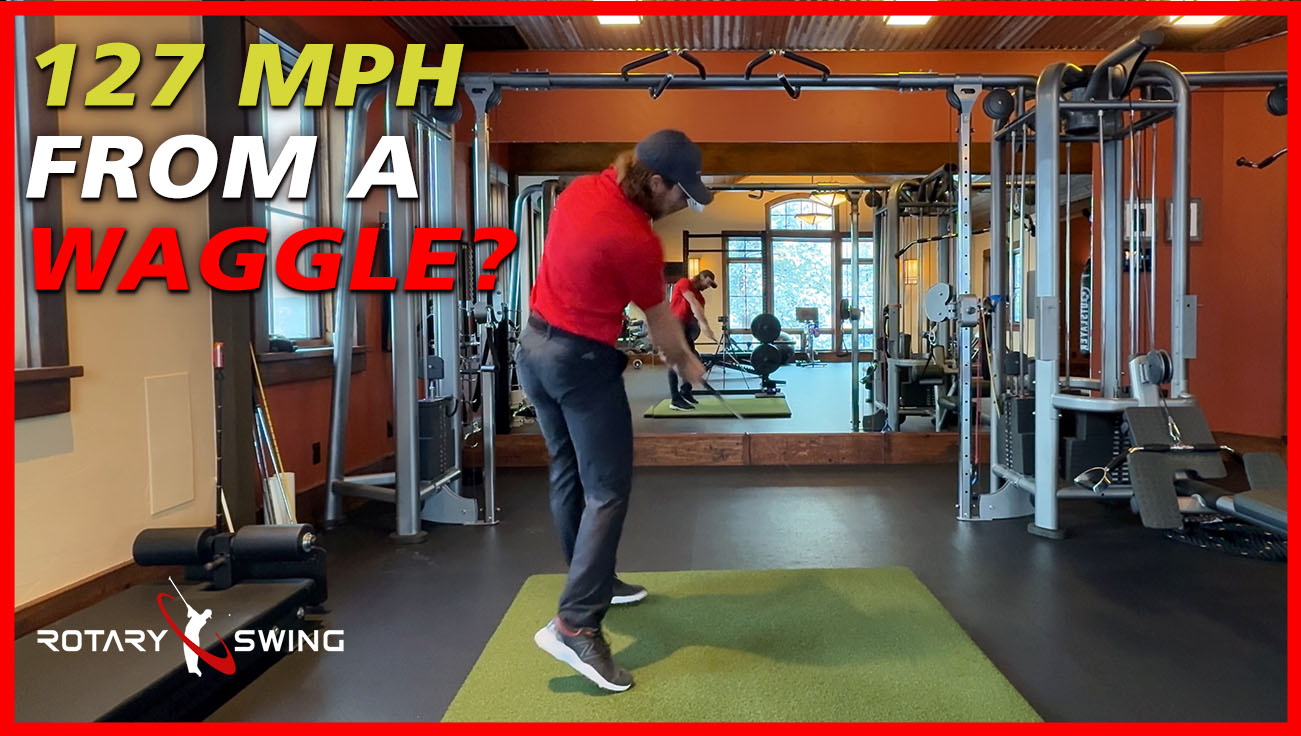
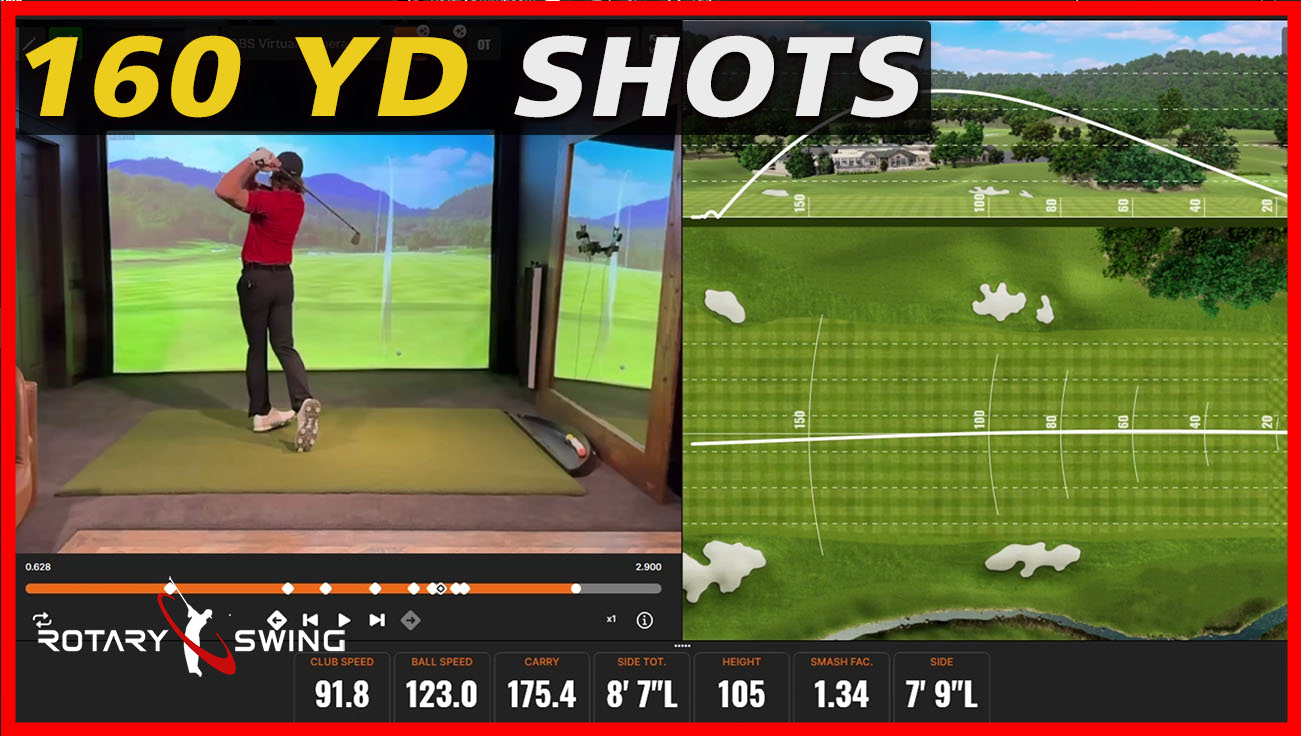
It is 108.
It is not that hard to swing fast.
That's what you're going to learn today.
It's much, much simpler than you think.
It's just understanding a couple things that we're going to talk about today that you're going to learn.
It's going to be very simple to pick up on.
One of the nine, getting faster.
Getting faster.
How many of you are stuck swinging less than 100 miles an hour with your driver right now out there?
Yeah, come on.
Stuck at 98.
All right, this is going to be fun for you guys.
I promise you, it's way simpler than you think.
Way simpler than you think.
I hit 109.
3 on that time.
Not bad.
I think I can bust into 110 here.
Still got a few more minutes.
I'm going to let everybody get signed in here.
Come on, it's got to be 110.
Boom, on the number.
So yeah, with a six iron, guys, you guys can swing way, way faster.
You're going to after tonight.
My goal is for everybody, everybody, to swing at least 105 miles an hour.
That's my goal, at least 105, that's my goal.
And everybody else is saying the audio is okay.
So maybe check audio settings on your end.
Just make sure your volume is all the way up.
Anybody else have any issues hearing me?
Okay, I appreciate that, guys.
Yes, it might just be an issue on his end.
We have four more minutes to let everybody sign in here.
I'm at altitude here, so that's obviously an altitude number.
It's normal six irons, maybe 205, 210.
242 yards.
Did I stretch?
No, I do not stretch.
That probably sounds crazy.
Uh, I don't, I'm not a big guy, big believer in static stretching and things like that.
I, uh, and I think the issue is on your end.
Everybody else is saying the audio is fine, so you might want to check the volume settings on your.
Uh, whatever you're you're tuning into us with.
But no, I don't stretch, um, whole controversial thing about all that stuff.
But I believe in doing ballistic movements.
So I try to move the way that I'm going to move in the golf swing, which to me is very explosive.
I appreciate that, David.
I'm definitely not trying very hard.
That's the goal.
Everything I do is about effortless power.
That's everything I'm trying to do.
And, yes, this will be recorded, so you guys will receive a link afterwards when this is done.
So, yeah, you'll be able to watch this playback.
But, yeah, I don't stretch.
I just kind of do ballistic movements.
I really just kind of swing.
Honestly, like, I'll start with the wedge, you know, my sandwich.
I'll hit a lot of, like little baby shots.
I do a lot of shots one-handed and just getting the feeling of supination and using the trails out of my body.
And then I'll kind of start hitting some full sandwiches and so on.
I've posted some of my warm-up stuff on, UH, on Instagram.
Three most important exercises.
I do have an exercise program that I'll talk about at the end of this webinar.
I want to get through the whole thing that I want to do first, and then I'm going to talk about if you guys are interested in how I work out.
I'm not a fitness expert by any stretch of the imagination.
I work out.
I kind of develop my own stuff based on what I feel I do in my swing, based on the go-code stuff.
I train in a very, very specific way.
kind of unconventional.
But yeah, I'll talk about that at the end.
One more minute and then we're going to get rocking and rolling here.
I'm going to go ahead and get started here.
Make sure everything's good to go.
Okay, so let me talk to you about what the gist of tonight is going to be about on this afternoon wherever you're at.
What I'm going to do is walk you through literally exactly what I did with Steve, the student you saw on this podcast this past week.
literally exactly everything I told him and did to take him from 85 miles an hour to 101 in 30 minutes, 32 minutes.
But I'm going to tell you the exact secret, everything that I did.
And then I'm actually going to give you some, a little bit more information, a little bit deeper dive into this.
That's going to help you take that from 101 to 110, because that is my goal with Steve.
So Steve's 69 years older.
He'll be 69 in two months.
Been playing golf for 30, 40 years.
He's never swung over 100 miles an hour in his life.
And I told him in 30 minutes I could get him over 100.
No problem.
And we did.
And so that 16 mile an hour gain is what I'm going to talk about first.
But I'm also going to explain some things that are more into how I'm going to take him that next level to get him over 110.
So and you'll be able to do it.
I have no doubt.
So what I'm going to do first, I'm going to show you his swings because this is important.
You must video your swing.
Please video your swing.
It is so it's the most important thing.
to video your swing and understand what you're looking at.
So what I'm going to do is show you Steve's first swing and show you what I saw so that when you look at your swing, you'll understand why I did the things that I did because so many of you guys are going to relate to Steve's swing.
You're going to look, you probably look exactly the same.
So let's dive in here.
Let me show you what he did here.
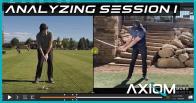
Okay, so this is Steve's very first swing that we did on video.
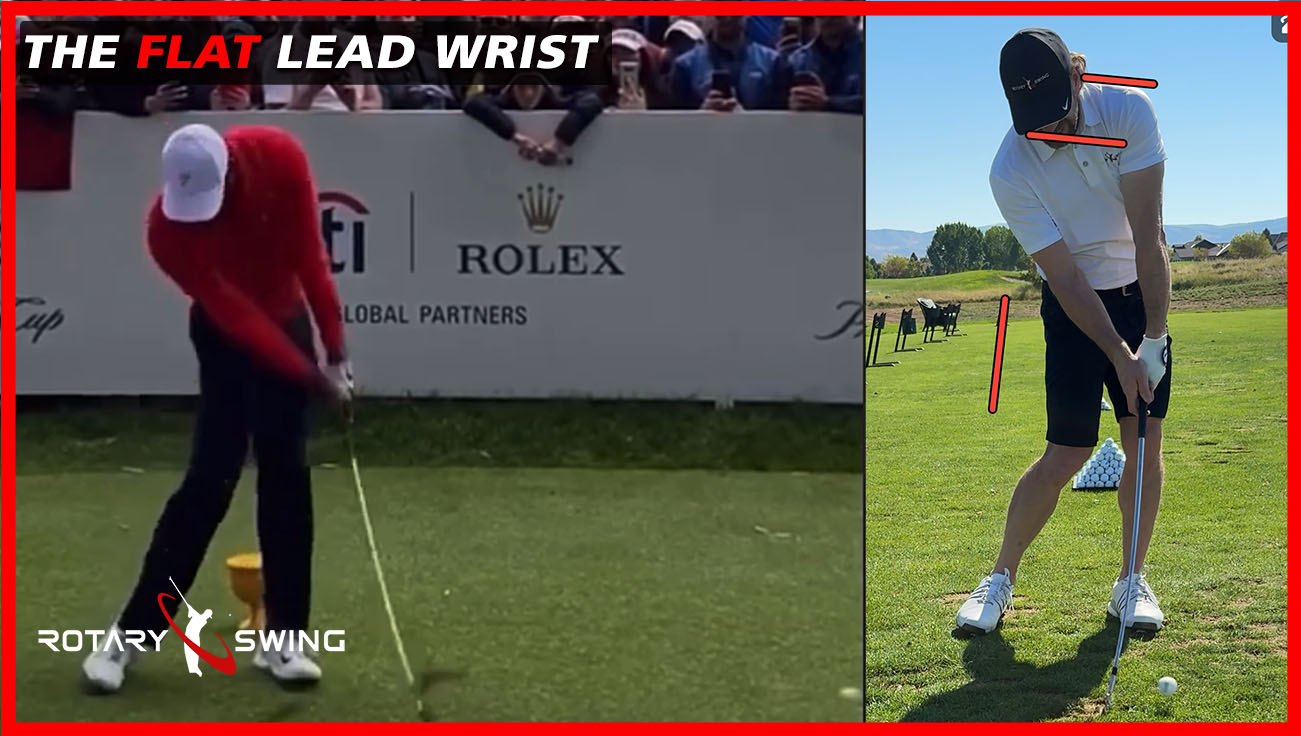
And obviously, you're going to see some setup issues here on the side on the right, you know, face on views.
A lot of golfers do this.
And I asked Steve, like, why do you set up so far, so tilted like this with your head so far back?
And he's like, well, I need to hit up on the ball.
And that's a common, obviously, for maximum distance, you do want to hit up on the ball.
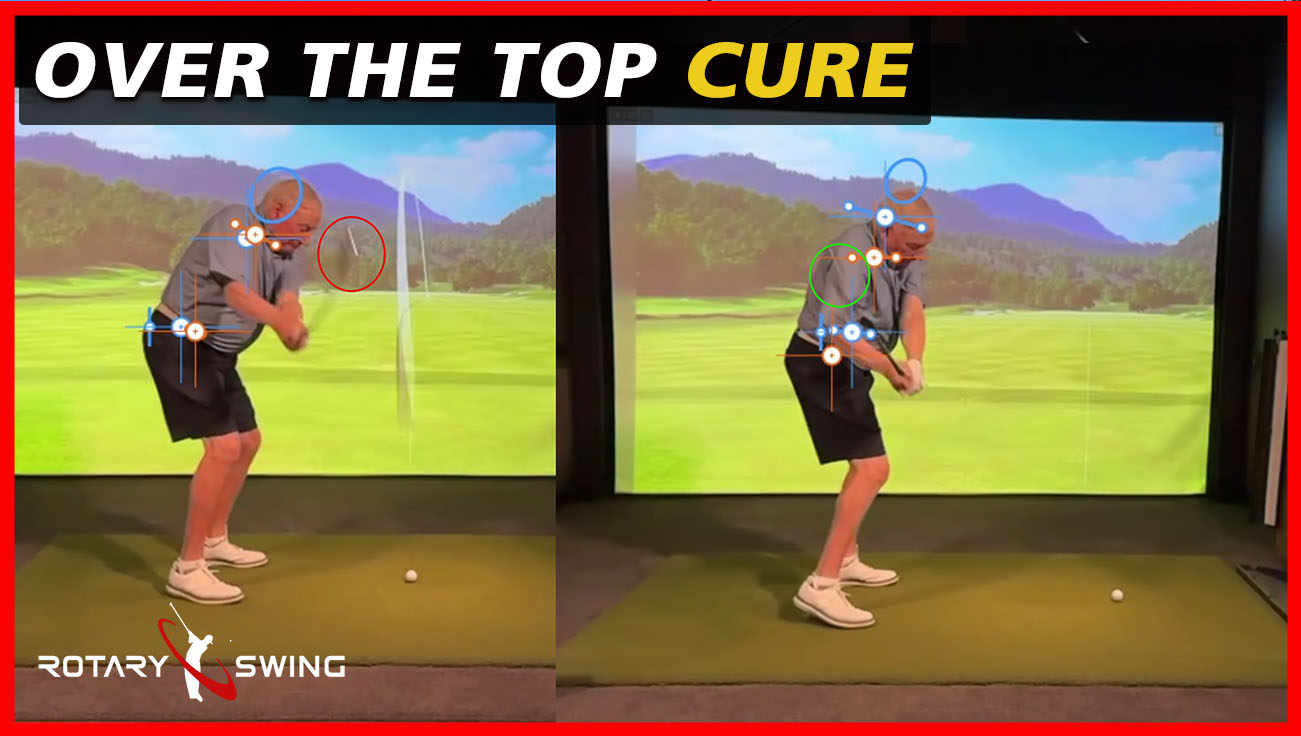
But if you get yourself set up in such a way that you're so far back, you're not going to be able to move correctly.
And in the second part of this video I'm going to talk about for this webinar, I'm going to talk about how I fix this.
To help him understand why you can't set up like this.
But what you're doing, notice first, is the dreaded flat shoulder turn.
So if we put a line on him here real quick, you're going to see that his shoulders are like, basically horizontal to the ground.
This is super, super flat.
And this is what happens to almost every golfer who doesn't have any speed because they don't understand how to move their body yet.
But I'm going to talk about that in part two.
The first part of what I want to talk about is just generating raw power.
So, but here you can see, he doesn't make much of a shoulder turn.
He's very, very flat and shoulders are almost parallel to the ground.
And you can see his left shoulder is really hiked up.
I'm kind of covering his mouth the most.
No, you can't see his right shoulder there.
And then as he starts down, it's all arms and hands and you can see him casting the club and that at impact, he looks like he did it set, right?
There's not that much difference.
between this setup position and his impact position.
You can't see his left butt cheek.
You can't see his left knee.
It's basically he's right back where he started.
And so what this shows is he doesn't know how to use the trail side of his body for speed and power.
And this is the first thing that we've got to do because we cannot look like this.
We've got to look like what we started doing afterwards as we started working on some drills.
You'll see that I start now noticing Watch his right leg.
You see the difference here.
Notice how much more his hips have turned here now.
You guys know that all tour pros, you see both butt cheeks at impact and.
And a lot of people think, Oh, I'm just not flexible enough because only the tour pros can do that.
Because they're genetic freaks.
It's all nonsense.
Here's a 69 year old man with both butt cheeks Of course doesn't have both hands on the club and so on, but we're gonna see how it all works together in a minute But this is the first thing I had to do to wake up his body, because if your body's not working at all, then you're going to have to swing all arms and all hands, and that's not going to work.
So just making sure everybody's good.
Okay, so what did I do first?
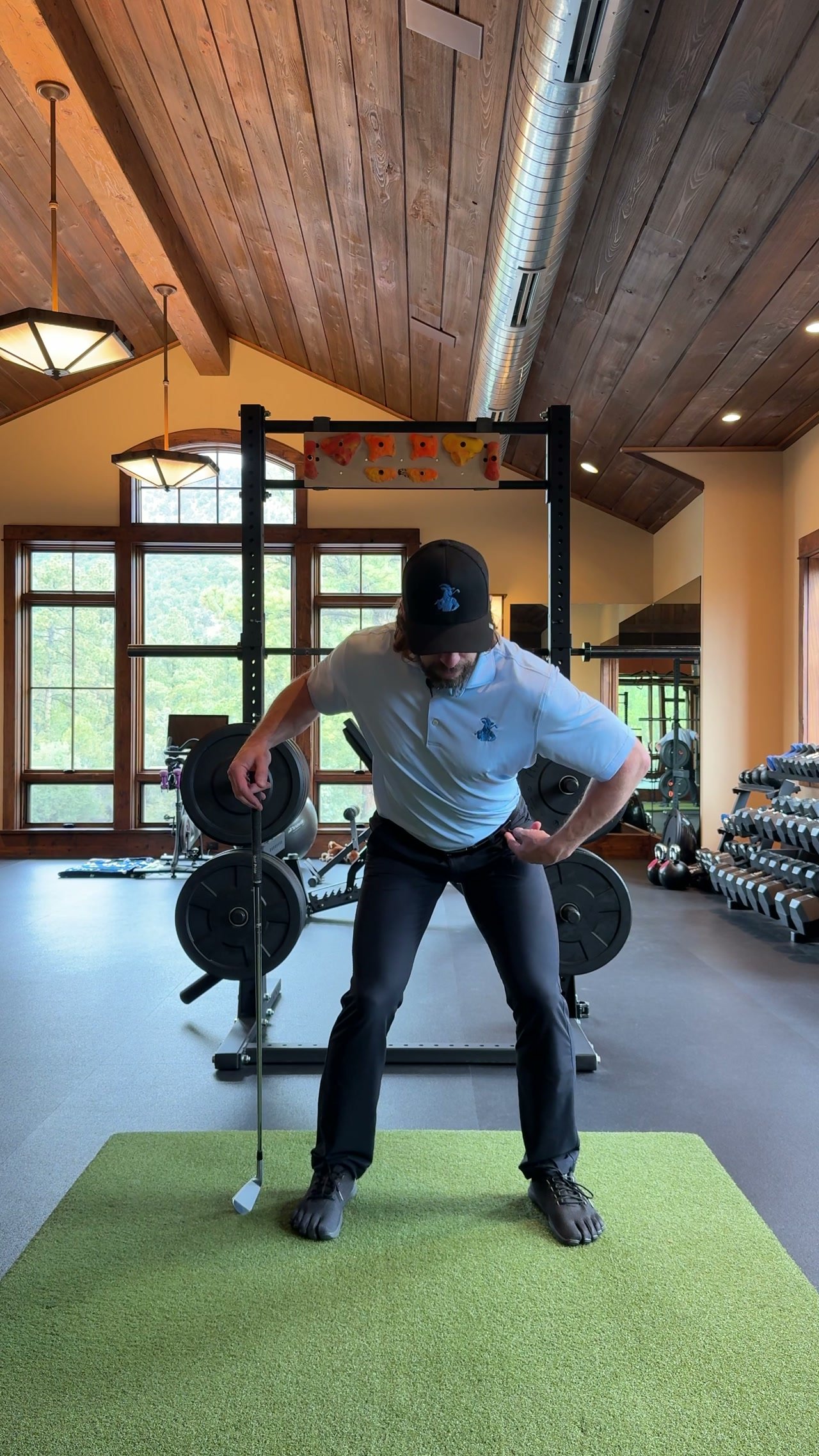
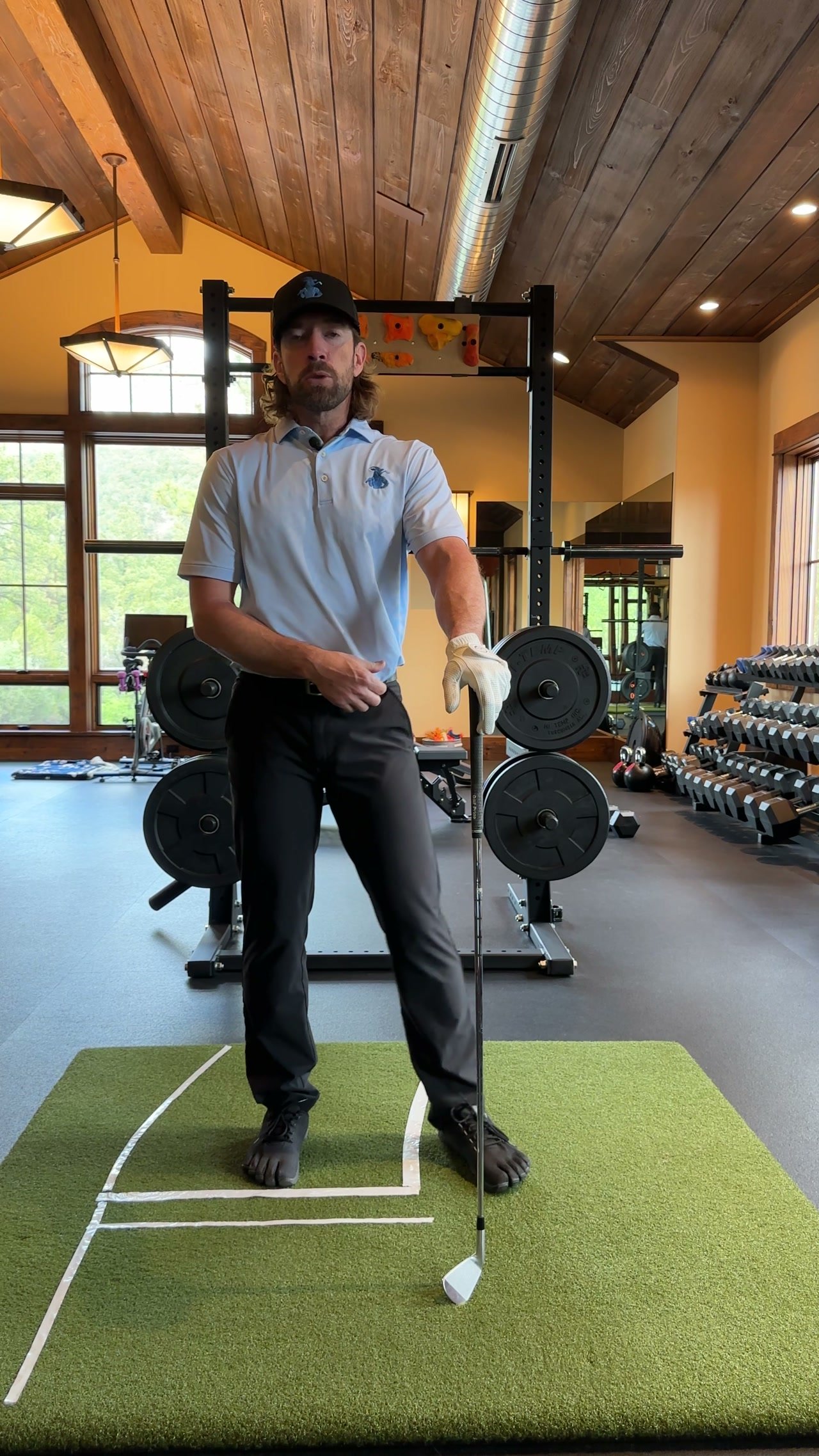
If you're in a place where you can stand up and do this with me, I would like for you to do that, because this was the most impactful thing for Steve.
When he first started trying to do this movement, I had to get him to mimic exactly what I was doing, exactly the way I was doing it and the timing and the speed of it.
Our brains have these things called mirror neurons, and what these are.
This is how we learn.
This is a really, uh, a really misunderstood or perhaps not even hardly even understood part of how we learn.
When you think about when you were an infant and you were learning how to walk, walking is a very complicated motion, As complicated as the golf swing in many ways, right?
You've got your arms swinging, your legs doing this, and the muscles have to fire on and off, on and off, on and off, super quickly, super rapidly.
And you have to coordinate all of this stuff, your entire body, your core, everything is working as you're walking.
But the way that you learn that is not the way that you learn the golf swing.
You know, you didn't read a book or watch a YouTube video and like, okay, I'm two years old, now I'm going to learn how to walk.
Maybe it'll be like that in the future, but right now we all learn by watching something.
And we have these brain cells literally called mirror neurons that allow us to watch somebody do something and be able to start to mimic it.
And it's where the old saying monkey see, monkey do comes from.
That is what I had to do with Steve because just explaining this to him, he couldn't get it.
But as soon as I started showing him how to do it and have him match me and coach him to do it.
Then he was able to start to understand what this really feels like and what the golf swing should really feel like with the trail side of his body.
So if you can, stand up and watch me.
And I want you to try and do this with me, because this is the first thing I did with Steve.
This is what's so important to understand, how to start to fire your body very quickly, and that's the big key.
It has to happen quickly.
A lot of times we think about the golf swing as being really powerful.
And I saw some of you saying that, oh, it doesn't look like you're trying.
It's because I'm sequenced well.
If you're sequenced well, you don't have to try to produce a lot of muscular power and effort.
Obviously, I'm not a big guy.
Speed comes from technique.
And the first thing you've got to do is understand that your body needs to move very quick.
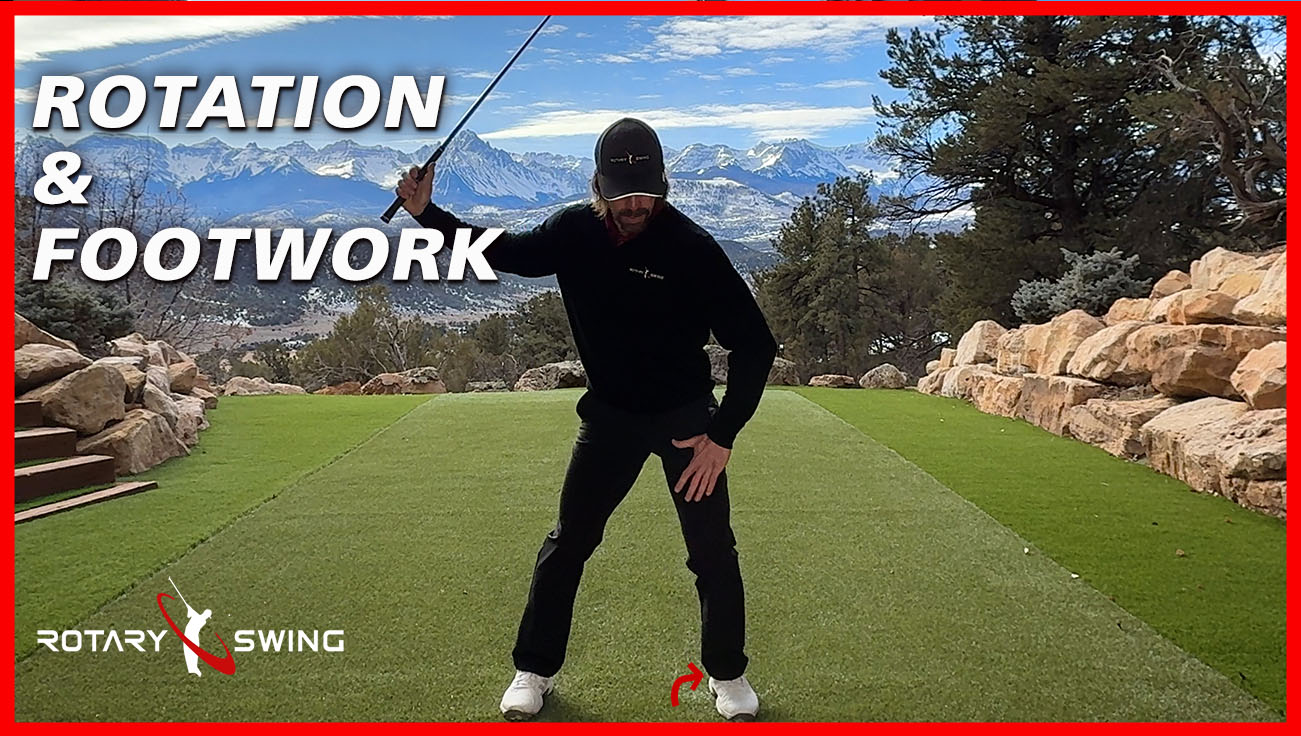
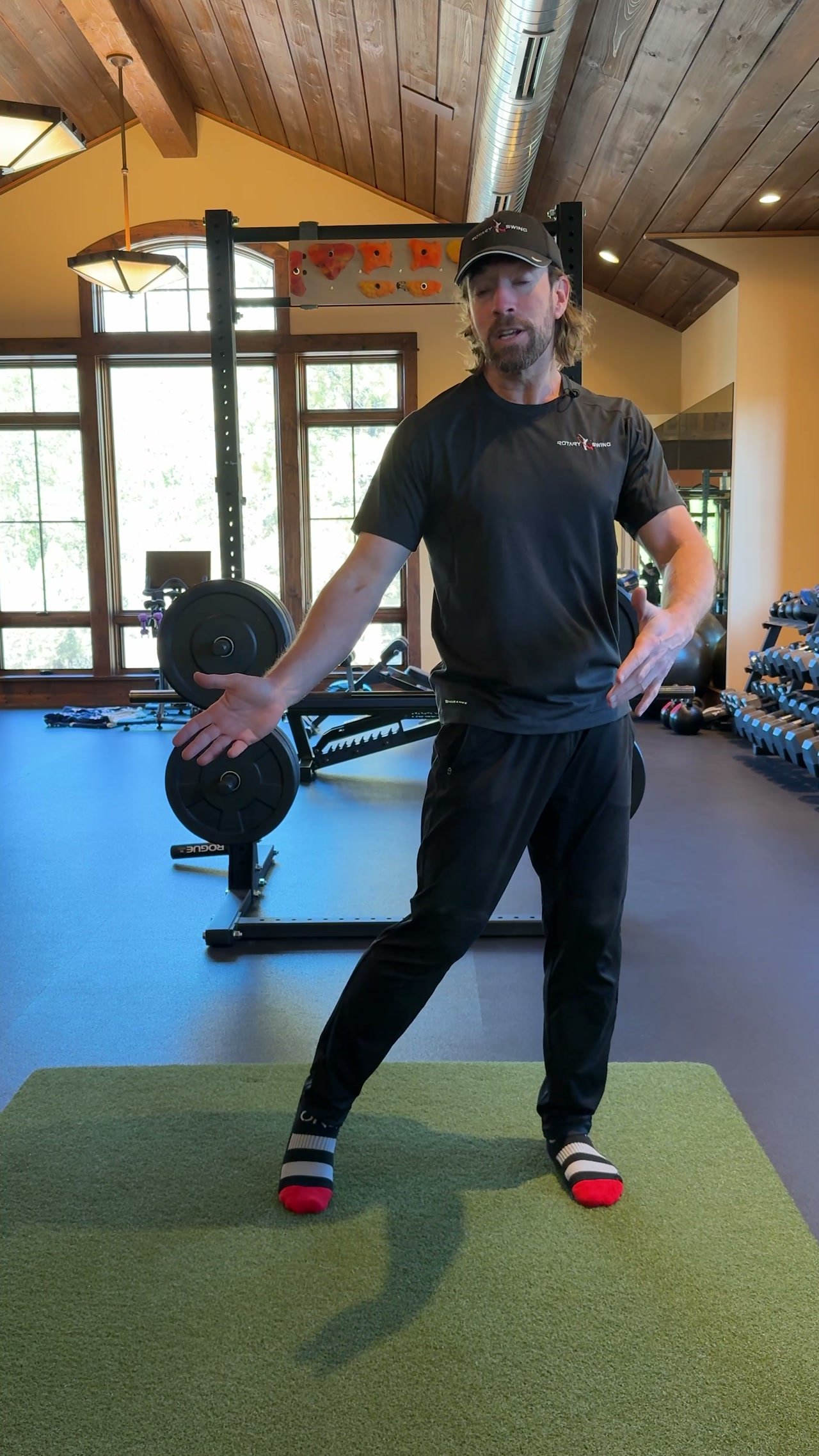
And so the first part of that is this trail leg.
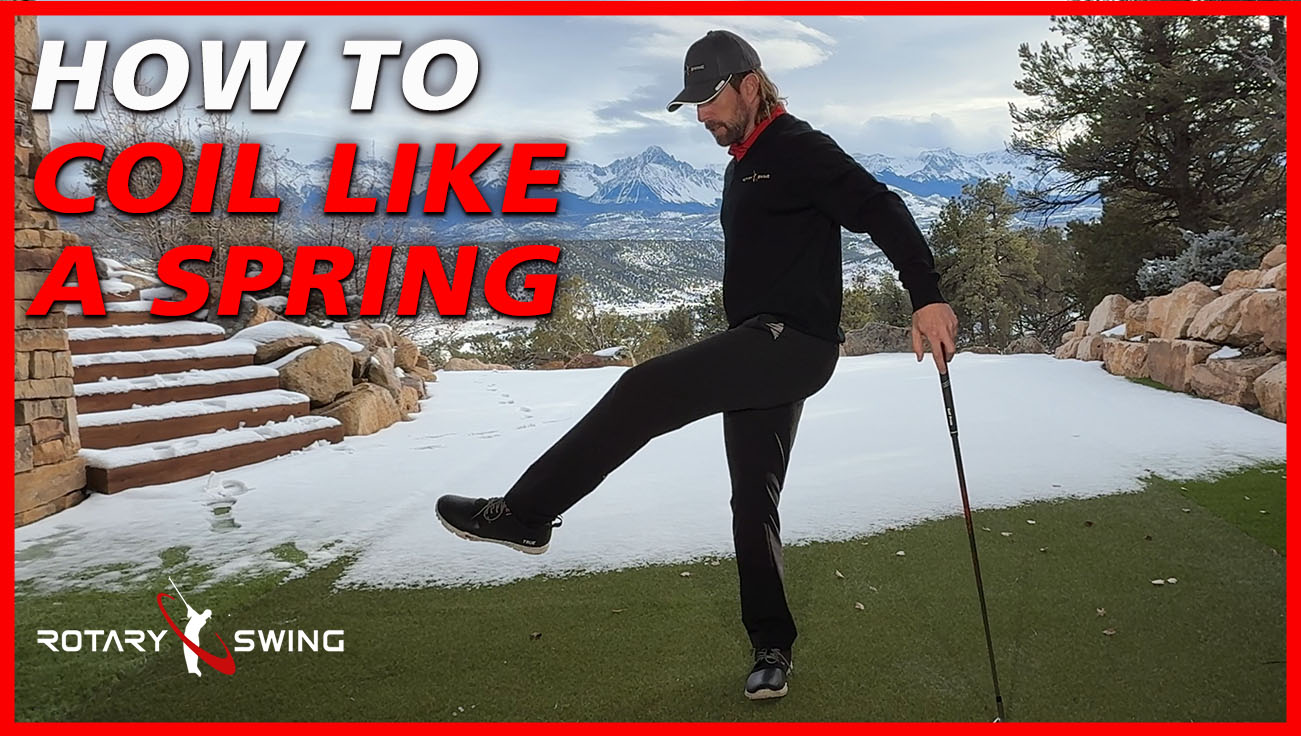
So what I'm going to do first, and this is exactly what I did with speed, is I said, OK, Steve, what I want you to do is take your right leg.
then do this.
I want you to take your right knee, come up onto your right or your trail big toe and snap it forward.
And so Steve started doing it like this, pushing hard off his leg, pushing up this way, trying to turn his hips.
I'm like, no, no, no, don't try to turn your hips.
I want you to just take your trail leg and snap it.
So I want you to try and mimic me doing it this fast.
I want you to go literally as quick as you can.
And for me, I use a lot of boxing, kickboxing kind of stuff, MMA techniques in my training.
And so I feel like this is how I'm gonna throw a kick or a knee into somebody really, really quick, or into a heavy back.
And so I actually practice that move of Being able to fire that really fast now, in the real swing.
It's not going to happen quite that fast because there's a lot of stuff going on.
But I'm going to show you the exact timing and sequence of it, and how you time this with your hands and your arms in a minute.
All I want to do right now is literally just start feeling like you're moving.
This is as fast as you possibly can.
And you actually, if you do this correctly, your core is going to have to tense up for a second.
You hold your breath for just a second and then breathe out.
So see if you can mirror what I'm doing as quickly as I'm doing.
I'll do it from both angles so you can see.
This motion is the primary initiator of the downswing in a trail side pattern.
You've heard this a million times, the swing starts from the ground up.
What does that mean?
This is what you're talking about.
What you're really trying to understand is this movement of coming up onto this big toe, driving this knee and hip forward as quickly as humanly possible.
If this doesn't get out of the way, you're going to have to swing all upper body and all arms.
Let me show you now what we're talking about.
of what the goat himself does in this same motion.
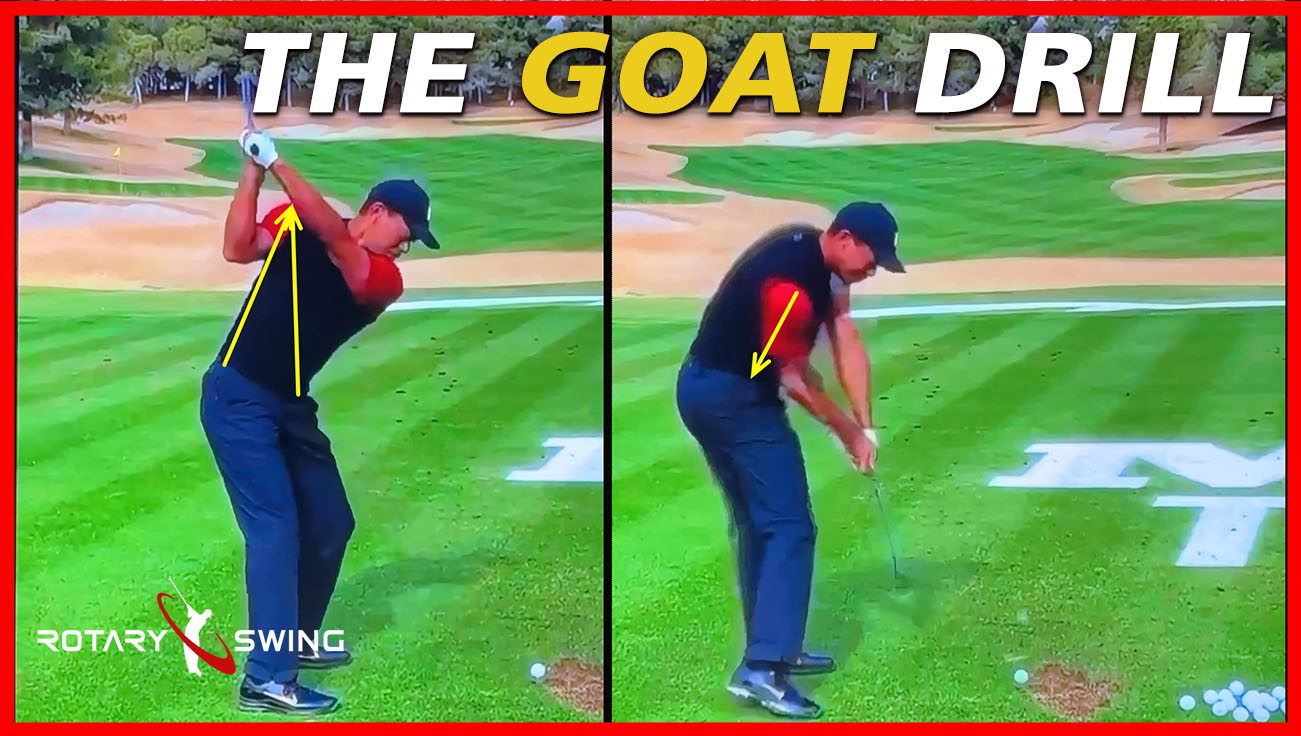
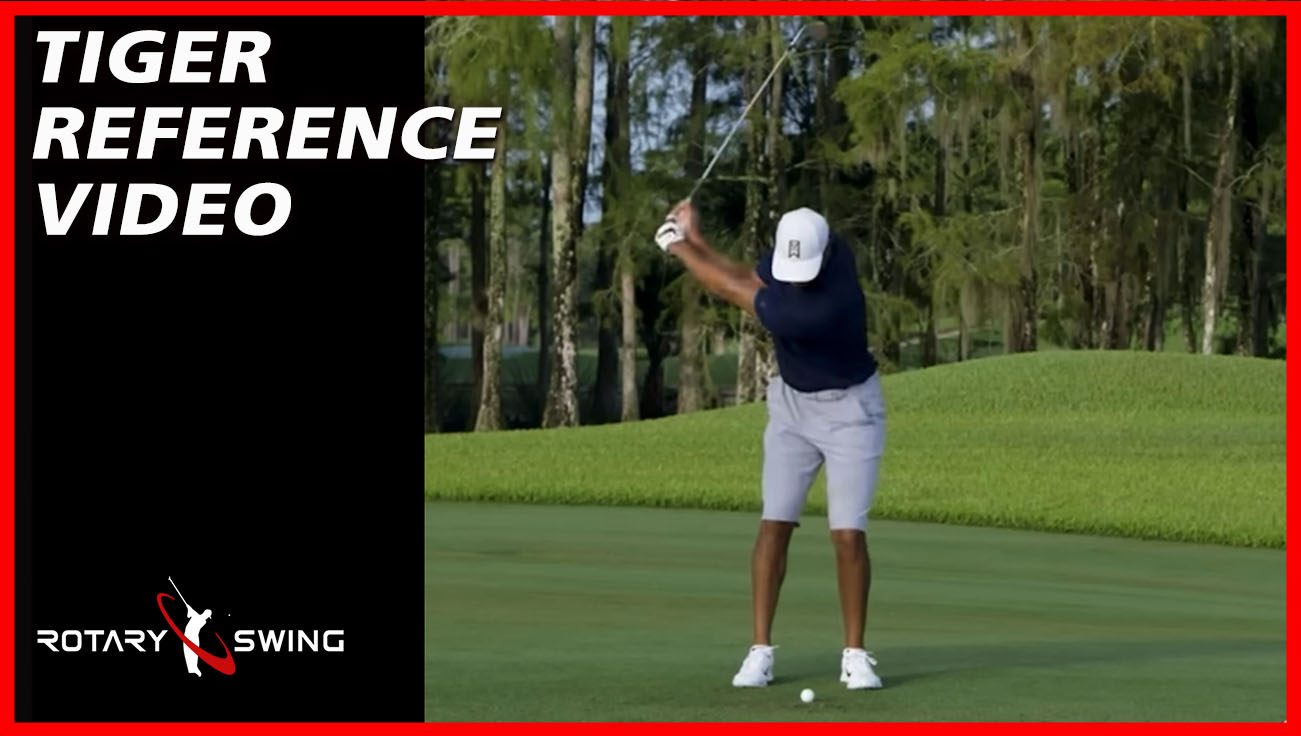
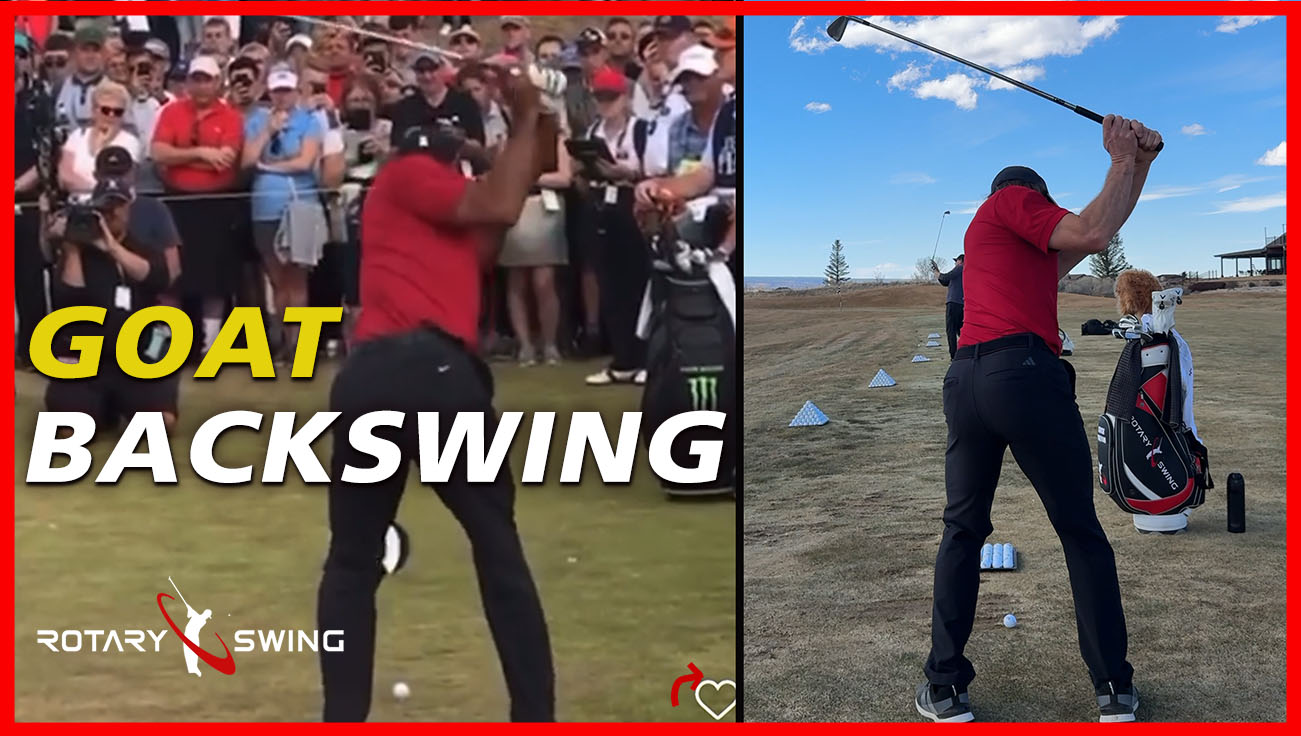
So I recently posted this clip on, I think on Instagram or social media or something, and this was a check swing of tigers, and it's perfect for helping you understand what's firing when in the downswing.
So watch his right knee.
I know he's wearing black pants, it's a little bit tricky, but I'll put a line right here on his right knee, on the back of his leg, so you kind of have.
A little trapping there, knowing where it is.
And now watch as he starts down.
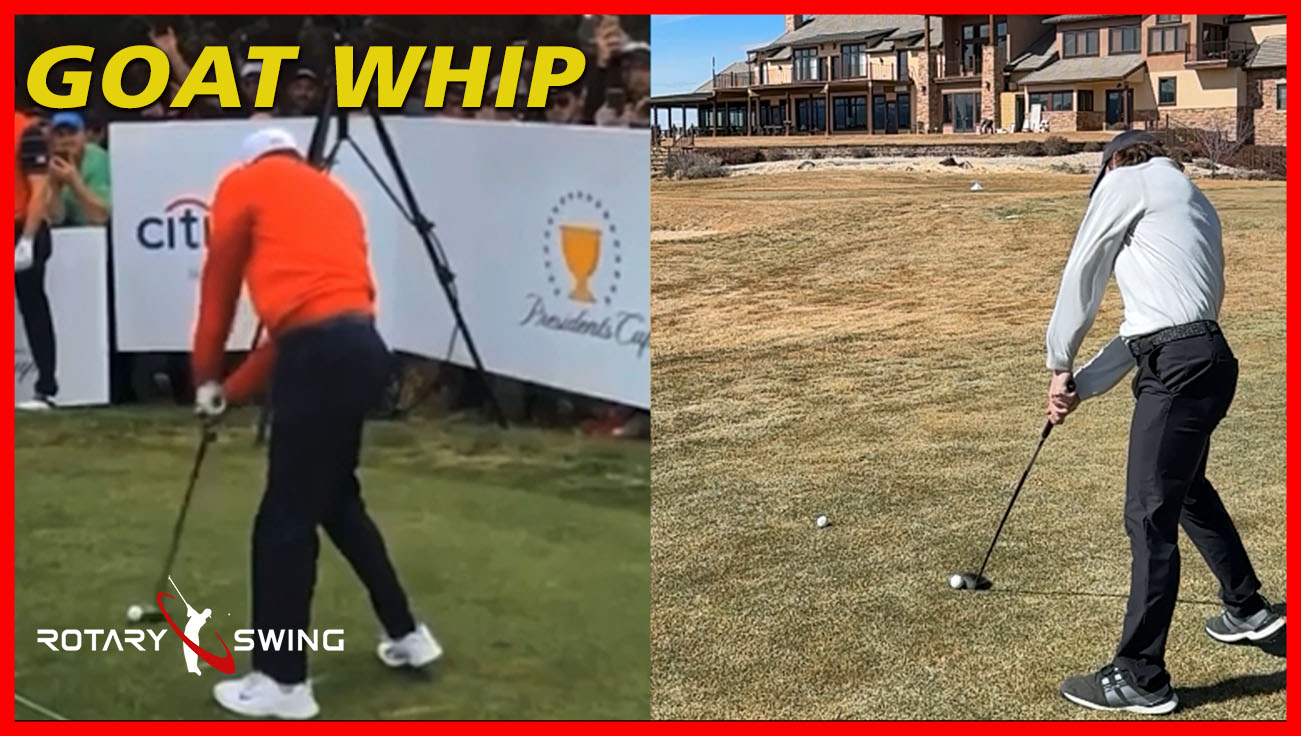
You see how much his right knee is firing?
But now compare that to how much the left knee is moving.
In relative terms, the left knee has barely moved, but the right knee has fired a ton.
And now also notice that his hands are still way up here.
I'm going to talk about how that happens in just a minute.
But notice by the time he checks his swing, his arms and hands were still fully cocked and loaded.
Look at that right arm.
Look at how much flexion he still got in there.
Full wrist set.
But that right knee was hammering.
And he's doing this extremely fast.
Now, you may be thinking to yourself, wait a second, Chuck.
There's just no way that I can move that fast.
And Steve thought the same thing.
And because he's not used to moving fast, he's used to moving kind of slow and heavy and moving his whole body around and then firing his arms.
Then your legs get really heavy.
He was shocked to see that he could still move this fast.
So I took him upstairs into the gym and just started working on some of these movements.
I started having him mirror me and doing some exercises to help him feel that same thing, even going up and down my stairs.
Instead of walking real slow, like I talked in the podcast and a lot of flexion and stuff.
You want to spring.
You want to bounce.
You want to keep these tendons stiff.
That's where you get a springiness to your body.
That's how you use the fascia to be able to snap this really quick.
Once you can snap this, then you're going to understand how to move your arms and how to supinate correctly.
This has to move.
If this doesn't move, everything else is being blocked because as you're driving this forward, what does that do to my arm?
It makes room for it.
Now, what happens if I look like Steve?
How do I get my arm back to the ball?
I've got to start shoving my upper body into it.
Understanding that as you're going back and driving forward and snapping this foot, this is what's going to give you the ability to be able to move your arms down into impact without you moving your arms.
Does that make sense?
You guys have any questions on that?
It's doing both.
It's moving forward and then moving toward the target.
Any other questions on this?
So this whole first initial move, just getting used to how to do this very quickly, is extremely important.
And that was the first thing that I did with Steve.
Now, the second thing, we didn't get into it very much because that's what I'm going to do with him at the next lesson.
Now, you don't think anything with the left hip right now.
Your left hip is going to push back.
A lot of times, again, there's kind of two conflicting ways of thinking about the golf swing.
And they both work, but they're just very different.
You've no doubt seen guys who get onto the left side really hard and then turn like this, right?
That is not a trail side pattern.
A trail side pattern is this.
You can imagine how much faster I can move by pivoting like this versus making a big shift, getting on my lead leg, and then turning the whole body.
So they're two very, very different ways of thinking about the club.
Are you twisting or driving in the area?
Okay, so I'll try to answer some of these questions.
But if you watch my leg, it's hard to do it kind of slow, to be honest.
I'll try to move in here closer.
But I'm coming up and forward.
Because what I'm really trying to do is take my hip and my knee and my leg and drive it forward so my arm has room to come down If I don't do that again, my hip's blocking everything and it's in the way.
So if you do.
This, it's bringing your arm down into the hitting area and bringing right into GDP.
So now let me talk about How this works with the arm.
And this is a little bit of a bonus stuff.
Because I didn't do this with Steve yet, I was just kind of letting him do what he did with his arms.
But as you start putting this together, all of a sudden the light bulb is going to go off in your head.
Because the golf swing in a trail side pattern.
It feels like you're doing everything to keep the club away from the ball.
In fact, you're deliberately moving it away from the ball to get it back to the ball.
That sounds really crazy.
Let me explain what I mean by that.
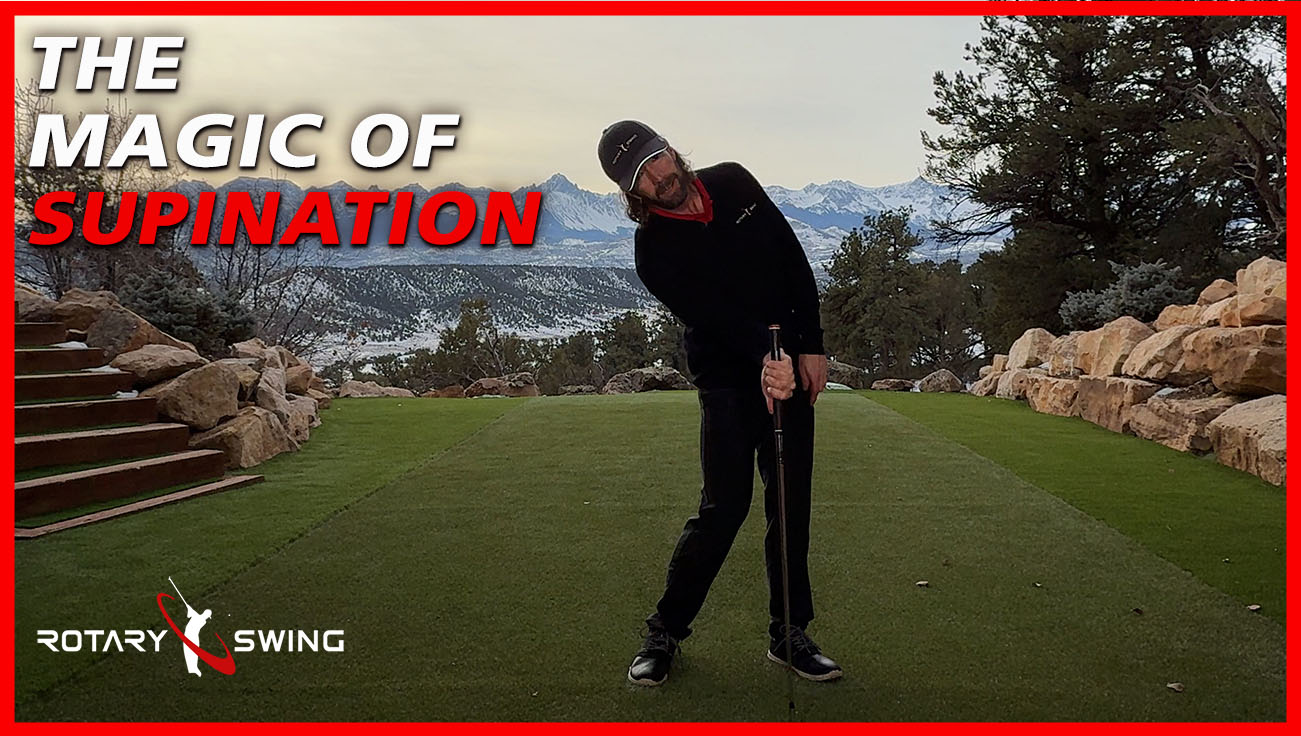
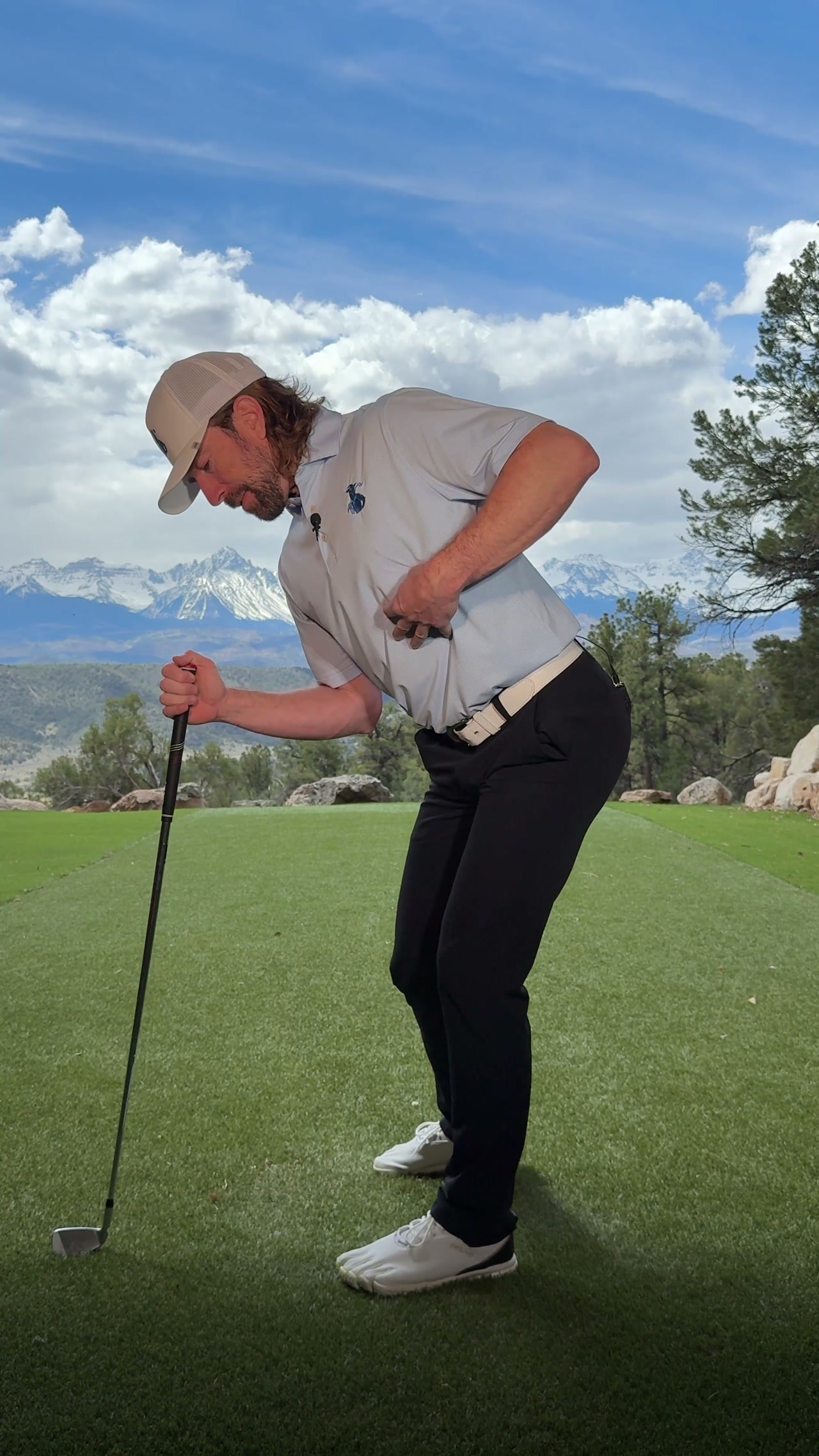
So as I'm holding this club up here, you know that I'm talking about supinating the wrist from the top.
That's how I start the downswing.
I take my right hand, my trail hand, and I start supinating this wrist.
Now by itself, this looks kind of weird.
It doesn't make any sense.
But what happens when I start to do this?
Do you see?
How?
The motion of my arm and club with my trail hip, do you see how they move together as one?
Now?
What is my arm doing at this point?
Nothing right.
Moving my hip, my core and my arm is staying close to my body.
As soon as I start extending my arm, I start pushing the club.
You can do that, but it's really inefficient.
You better have a lot of muscular force, a lot of effort to try and generate any speed like that.
But as soon as I start doing this, you see how the club falls.
My wrist supinates, but I'm not actively trying to just fling it as hard as I can from the top.
I've got to blend these two motions together.
You see how my trail knee and my hand's dropping the club.
Boom.
This is me holding it obviously at speed, I'm not holding it.
My wrists are starting to deviate and release and snap back out in front of me.
That's how I get speed, so I go to the top.
Do you see that?
I'm trying to not ever bring the club this way?
That's death.
As soon as you do that, you have no power.
But if I just supinate with this trail knee speed for days without any effort.
This is how I'm going to take Steve from where he is at 101 to 111.
or faster.
It takes no effort to do this.
I'm literally letting my wrist do this on my hip knee right side does this.
Does that make sense?
I know you guys have some questions on that, so I'll pause for just a minute.
No, the club's not open.
I've talked about this a million times.
Let me just show you that real quick.
So this is a common misconception people think supinating opens the cliff face.
It does not open the cliff face.
I'll show you that in just a moment, But I'll just show you real quick, with the goat himself doing this exact motion.
Now watch, I'll play it first and then I'll slow it down.
You see it now.
Let me slow it down.
What is Tiger doing with his right hand?
Supinating.
Look at that.
And that supination starts turning into deviation later.
Look at the angle on his right wrist and club shaft still a ton.
Boom.
Dead square clubface.
Supination does not open the clubface.
Any questions?
Let's see.
I just saw one here.
You push with your.
Foot in the ground to move the knee.
Yes, absolutely.
you should move the trail knee as fast as possible.
The lead knee is going to naturally get out of the way.
It's not like you would do this all right.
So as I start to do this, my lead leg snaps straight.
Because as this hip is going forward, this one's going back and we work together in that sense.
The Goat drill, you say the first move is to crunch the right shoulder down.
These are happening simultaneously.
So if I crunch my trail side, my hip moves faster.
These are all happening at the same time.
They're simultaneous.
The core is firing just like in the goat drill.
I'm going to talk about that in just a moment.
Do you think about moving the right knee?
I don't think about anything.
move, but I'm not a swing thoughts kind of guy, but I don't think swing thoughts are a good idea.
But you have to learn how to do this stuff correctly by going through the program, going through it step by step because you're not going to understand how to do this stuff.
I want to talk about this real quick because I haven't seen this happen.
I have these guys all the time now messaging me on Instagram saying, hey, I went ahead and started your program.
I skipped a phase four.
Don't ask me for help then.
You're not going to be able to do this.
I'd say 99% of people are not going to go from The parking lot's at 8500, that's the first one how to drive a car.
You have to learn, and can you maybe skip the putting stuff a little bit, but you're hurting yourself in that sense.
But the chipping and the pitching and the short wedge shots, they're teaching you how to control the club face with the trail side of your body.
So you must start with the beginning.
Otherwise, you're going to have a really hard time.
No, it does not put any stress on the back because your trail side is all moving together as one.
When you put stress on your back is when your upper body is moving independent of your lower body, or your lower body moving independent of your upper body.
I'm moving them all together as one and I'm just moving into side bend.
Side bend by itself is perfectly healthy.
If you're in side bend and then trying to twist your hips, that's no bueno.
I'm getting everything on the trail side of my body to hit hard.
as one piece.
There's no stress on your body.
I'm going to try to answer a few more questions.
Are you pulling your arms down?
Nope.
My arms are falling to start because all I want to do is start to let the supination start to happen.
And as soon as I rock my body forward, as my hip drives forward, to start to make room for my elbow, where does that clip actually want to go?
If you've got a club in your hand, you should feel the clubs naturally falling back behind you.
And that's what's going to make it snap back out in front of you.
So this movement should all coordinate its gears.
Nope, doesn't have to be all the way on your lead foot, you can, you don't have to.
I'm pushing off my right hip.
Can the upper body open when you do this move?
Nope, it stays shut.
House windows, Counter torque happen.
It's all the same thing.
So as I'm starting to drive this, once I'm done with my lateral move, the body moves into rotation.
And that's when you're going to start to feel counter torque.
But there's a lateral move first that gets you into side bin.
It starts to drop the shaft.
And then from there, I'm starting to rotate.
So if I was to exaggerate one here.
The more I get pressure on my lead foot, the more you're going to notice that counter torque.
So I'll do one here where I get more weight on my lead side and my foot will slide.
So there, as I get more pressure here, this foot gets lighter because my core is rotating that way to drive that pump base arm through, my foot slides out.
The more I stay back, the less that's going to happen because I'm just going to pivot on this trail foot.
Now, when do you want to do which?
The more control and the more flighted you want to bring the ball in, the lower, the more lateral movement I have, and the less torque I'm putting into it, the harder and higher I want to hit the ball.
The more I stay back on this trail foot, And pivot, and that helps me create more of a positive angle that's happening.
So that just changes from shot to shot, depending on how much suck, how much pressure I want to put on that side.
You should absolutely not lose the tush line by the end.
If you're losing the tush line, you're goat humping.
I'm not goat humping at all.
My hips staying in place as I go back, as I start to move forward, as I go down, my core control compressed compressing that moves my hips further back.
If you're losing the touch line, you're pushing forward instead of pivoting correctly.
I'm not consciously engaging like, I think you guys are searching for things that you shouldn't be searching for.
I see a lot of things like, what is your swing?
thought on this?
your trigger thought that?
or are you consciously thinking this?
You cannot?
There's no time to consciously think anything, period.
That's why it's so important to learn how to do these movements in a basis, right?
Like the exact same thing I'm doing a chipping stroke and a pitch shot and a little wedge shot and a full swing are exactly the same.
But me taking you from zero to a full swing is never going to work.
You really have got to slow down, take your time and get these little movements because this.
is so important.
This is that me moving that goat arm or the trail side of my body, holding that club face nice and square.
And you've got to do that step by step.
Yep, shoulders are square at impact.
I don't understand why I get this question a lot too.
People are saying, well, is it different with the driver?
Why would it be any different?
It's exactly the same with every single club in the bag always and forever and always will be.
Now you might stay back a little bit more to catch it on the upswing, but your mechanics are the same.
It's just whether or not I shift more laterally.
I shift a little bit more laterally on my driver than a lot of people because I want to hit down on it.
I'm not trying to stay back like this and hit the ball as high as I can, as far as I can.
I turn to hit the ball and play.
I have plenty of speed.
So what I'm always doing is I shift a little more laterally and hit down on about a degree or so.
And so I hit the ball pretty low with my driver.
But again, that's totally up to you.
You can do whichever you want.
How are you going to draw this one?
Release your hands.
The feeling in my feet.
The feeling in the feet is, all right, I'll put it simple for you.
Now we're talking about kind of abstract things.
I grew up in a pretty rough neighborhood.
I grew up in government housing.
So fighting for me after school was not like something that happened randomly.
I fought all the time.
And I had to because it was literally a fight or flight, you survive or you don't kind of thing.
I grew up in the ghetto.
So for me, we used to fight as kids all the time.
We used to train in our basements.
My first fist fight was in first grade.
So I had to learn how to fight really young.
And so one of the things that I had to do, because I was always a really small guy, I didn't have a lot of knockout power, so I had to find other ways to survive to get home from the school bus to my house.
Literally, it was like running the gauntlet every day, going through our ghetto neighborhood, our apartments and stuff to get home.
What my feet feel like is I'm taking somebody's head because I grew up as a wrestler, so I have a lot of, you know, I'm used to being tied up with somebody and holding onto their head and their neck, and I would grab their head, and I would move their head into my knee as fast as I could.
That's what my foot feels like.
I'm trying to move this.
as quickly as I can.
So as my foot is doing this, it's me moving my knee as fast as I can.
So it's impossible to think about.
This is happening so quick that you can't try to think through, okay, I need to move my knee forward.
Okay, now I'm on my right big toe.
Now I need to pivot.
It has to be a motion where you're literally trying to mirror what you see me doing as quickly as you can and you'll get the overall feel for it.
Let's see.
The flat shoulder plane I'm going to talk about in the second part of this, so I'll come back to that, Jim.
You do snap your wrists over.
But how long do you keep the club face square?
I keep the club face square as long as freaking possible.
But at speed, I don't have any control over that.
In my wedge swing, somebody noticed this the other day on my one-handed wedge swing, because I kind of do my follow-through when I'm hitting the one-handed wedge shot.
Is like this, I'm holding the club face square.
I'm never letting it release because I've only got one hand, I'm swinging slow and I can hold off the release.
As soon as I start adding speed, my wrists snap over.
I don't have any control of stopping that, but I'm trying to drive it forward.
Square as long as I can, but as soon as momentum takes over, there's no way to hold the square that long, Eric, I'm able to do it at 50% power.
I go to 100% drive with my right shoulder and pull it.
That's because you're just trying to muscle it.
You have to work on this technique.
Why isn't this hip spinning?
Hip spinning is when you go to the top and you, hip spinning is a common lead side problem thing.
It's not really a trail side problem unless you've got your arms really deep and you got really stuck.
But a hip spin comes from a lead side dominant player who's not really using their trail side or trail arm.
And so because of that, the arm is going to get stuck.
And if you spin your hips really fast, you're going to leave the club face wide open like this.
This is a completely different pattern, and you must drive with your hips.
The left leg braces to resist the trail side for sure.
Okay, so let's move forward.
Let me just recap here real quick, because this is what I want you to work on.
kind of help you understand where some of these questions are coming from.
You need to practice in slow motion.
You need to start with the wedge.
And you need to work on that.
If you can't do this, there's no way you're going to be able to do this at speed.
As soon as you have this wedge shot, you can start building it up.
You can see I'm still holding that club firm to hold the release off.
So my club face is square for about four feet.
Square back here all the way through.
It's teaching you this motion, and then as you start doing it with speed, it's all going to start to come together.
But you have to learn this technique, the supination, same thing, you know, as you're starting to come down this motion.
The club's falling this way to me, they're hand in hand.
This is like glove, hand in a glove, my club, supinating my wrist, supinating.
By holding this arm in and pivoting on this trail hip, the club is just going where it goes, And then it releases.
So when you put those two things together, you start to understand what a trail side pattern is.
Yes, you're throwing the club from the top.
I'll answer one more question here.
I'm throwing the club, but people don't really understand what that means.
I'm throwing the club with my fingers in my trail hand.
That's it.
Just like I would throw a ball.
So if I picked up this ball and I held it in my fingers, I would start throwing from back here, but it wouldn't release until out here.
With golf swing, I start throwing back here, but it doesn't fully release until down here.
If I didn't do anything, the club would get really narrow and I would be down cogging and then trying to get rid of a bunch of angles.
So if I go to the top, the way that I throw is I supinate.
If you throw like this, owner deviation.
Throw like this, pronation, you're done.
That's why I was saying it feels like you're trying to keep the club from ever getting back to the ball.
I'm supernated.
I'm moving the club head away from the ball right now.
This is my move to start down.
It's not this exaggerated, but this is the move.
Now when I combine that with my pivot, the club comes right back down to square.
It is very much similar to skipping a rock across the water.
All those things are very, very similar.
All right, so now let's go back to Steve's movement.
So again, we started with just his right leg.
I'm just going to recap this so you're going to see.
We move him into impact.
He looks just like he did at a dress, okay?
So you can see his right leg never fired.
The right side of his body, his right core.
Notice the spacing between his shoulder and his hip.
They should be half of that.
But because he didn't use his core at all, his right side didn't shrink down.
He didn't drive his hip forward, so there's no room for his right shoulder to shrink down.
So he just extended his right arm, and so as he gets down to the ball, he's expended all his energy.
He has nothing left to hit with.
other than trying to just scoop it as best he can with his hands.
So we started working on his right hip pivot.
I just had him do this drill.
You guys have seen this on the site with the name that Craig will remember.
Oh, I think it was coiling around the trail leg.
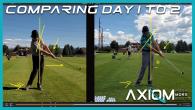
So we started to wake up his trail leg and you can see now he's not doing it perfect, but he's starting to wake up that trail side of his body and notice the speed that that right knee is firing with.
compared to where he was over here.
So now on the right, if you watch his face on view, you'll see his right knee on the far right side of the screen.
His right knee barely moves, right?
Look how quiet that right knee is through the whole swing.
Obviously it's not just the right knee, the entire right side of the body, but the right knee is an easy thing to measure and visualize.
Now focus on the second face on view, the second side from the left, and watch this right knee.
See how much more active.
Now again, not perfect, but look how open his hips are.
Now again, he's 69 years old and probably thought in his lifetime he would never see both butt cheeks at impact.
Now again, one arm swing, et cetera, et cetera, right?
But you've got to start to feel the movements with these basic drills.
So this is what I had him do.
Is I hadn't put the club on his shoulder, just like I do on the, uh, the coil around the trail leg video?
And that helps him start to feel supination.
Because if you don't move your arm at all, see how bent his right arm is still, you'll see that as his right arm is still bent.
Still bent, still bent.
He's got.
He's not running out of right arm, right?
And because he's moved his right hip forward so much.
His right elbow now has a chance to get in front of the ball, get closer in front of the ball, which now you can see again.
These are one-handed drills, so they're exaggerations, but this is how you have to learn.
You can see just how much angle he has in his right hand.
He's got a lot left to hit with.
He hasn't ran out of right arm yet and that is the key now again, he's doing all sorts of other stuff, but this is the first key to that.
So then what did we do?
So now?
Because he had a very flat shoulder turn, I had him start working on how to fix that.
So now when you look at him on the right, you do Where he was at the beginning.
Okay, so now let me move him through.
So now when you look at him at the top of his swing, what do you notice difference?
One, obviously, it's obvious that you can see his right shoulder over here.
And he's obviously made a much bigger turn.
His hips have also turned and they've moved in a very different way than how people think about moving their hips.
Here, his hips are turning kind of flat on the right, and he's just kind of swinging his arms back around his body.
So from there, he's done.
He's got to swing nothing to arms and shoulders down here.
Here at the top, he looks like a tour pro.
This is how you start to understand how to move correctly.
I'm going to show you how to do this and how this feels in just a moment.
But this is the visual.
You cannot be flat.
You've got to move into side bend and extension.
Now.
Let me explain what that is okay, so now?
So the first 10 minutes of the lesson, remember, we had 30 minutes, right?
the first 10 minutes of the lesson.
We're just getting his trail side to wake up.
You just start doing this, you put that club on your shoulder, like I showed in that drill which is on the website, and I just so you don't.
You start extending your trail arm.
You just start pivoting really quickly.
You're going to feel all this momentum of the club flinging off your shoulders.
Now you start to pivot down.
The club goes down.
So how do we get that to happen?
You do not really turn your shoulders in the golf swing.
They turn a little bit.
I don't really want you to think so much about turning because turning gets you doing this.
And that's what Steve looked like.
He pushed his lead arm across his shoulder.
His shoulders were really flat.
Moved your head off the ball.
And then you got to kind of heat everything back down.
That is when what happens.
When people think about turning their shoulders, you don't really turn, you tilt and move into extension while turning now versus turning.
I'm.
I'm starting to rotate and then my spine's going into side bend and then extension.
Now I've made a full shoulder turn, but I didn't turn my shoulders.
I'm not flexible to turn my shoulders that far without still being able to see the ball.
Understanding side bend and extension with rotation is how you start moving your body correctly.
These videos are on the site.
You understand that all the greats, they start to move.
They move laterally into this trail hip.
I'm going to talk about this in just a second.
As you start moving, loading into this trail hip, because remember, you've got to fire this thing really quick, so you load into it.
I'm starting to turn.
I'm starting to move into side bend.
And then I'm moving to extension.
And that's how you stay centered over the ball.
If you don't move your spine into extension and you stay in flexion, your head's going to be way over here.
And then you're going to have to heave your whole body into it.
So that was step two.
So after I got him waking up his body and starting to move really, really quick, getting that feeling, I took him upstairs into the gym.
And we started working on the Goat drill, exactly the way I laid it out on the site in the video, right?
Having having the cable with a little handle on it.
And that helps you feel because the weight pulls you back into extension.
Once you're in extension, you will lengthen this whole core of your body, lengthen this trail side of your body, and then it can move really quick.
So when you combine this with this, I'm exaggerating.
Feel how powerful it is.
So hop up if you can, if you've got space to do this and start moving rotation, side bend, extension.
Feel this length and feel this trail hip coil really loaded up.
And then at the same time as you're snapping, fire your core and get everything to move together as one.
Give that a shot and let's see if you've got any questions about how you feel.
Yeah, It's a bit like a clamshell feel, you're moving into extension and reflection.
Nope, the necktie drill still legit.
That is just this.
Now you can.
If you did it a lot, my necktie would be hanging out past my foot.
I do it properly, my necktie still hanging down the inside of my leg.
This is how you start feeling real power in your swing.
And that's when you guys are seeing me hit balls and go, it doesn't look like you're trying.
Because I'm loading everything properly.
I am loading this trail hip, which I'm going to talk about in just a second.
Come on, camera, focus.
Piece of junk.
There we go.
All right.
Okay, so in a trail side dominant pattern like Tiger Woods, you have to load the whole trail side of your body.
And that's your hip, your core, your arms and shoulders.
So now you can see as I load into this hip, and yes, this is the feeling.
I'm going to talk about this in just a second.
The feeling is not turning my hips because that's going to get my hips really flat or make me reverse pivot.
I'm trying to get this right hip out and up.
That probably looks really funky, but I'm going to show you why this happens the way this is in just a moment.
But the moment you feel this, you're going to feel like a monster in terms of how much power you can produce.
Yes, it should feel much stronger.
How do you keep from turning flat?
You go into extension and side bend.
If I go into side bend and extension and rotate, there's no way that I can turn it flat.
I can do this in any order I want, but side bend, extension, rotation.
My shoulders are steep.
Now my hips up.
My right hips above my left.
This is loaded and ready to fire.
The trail hip does not have to come off the ground.
This is just a drill to wake up your body.
As I showed you with Steve, he was really flat-footed, barely coming up off the ground.
I want this thing to start to fire, so when you're exaggerating this, I want you to get that thing up in the air as quick as you can, like you used to see Tiger back in the day when he used to hammer Now, let me show you what it feels like to load properly on this trail hip, because it's probably not what you think.
I'm going to play this video and I'm going to let you take a look at it.
Just watch Tiger do this move.
You're probably saying, what the hell is he doing, right?
I'm going to play it one more time.
Take a look.
Do you see it?
How many of you just had your eyes open right there?
You get it?
What is he doing?
Anybody have it figured out?
Are you guys up there tinkering with it?
What this hip movement is, again, the opposite of what most golfers do.
Most golfers do this.
Turn really flat with their hips, turn really flat with their shoulders, and then they're done.
But the trail hip, when you load it correctly, it goes like this, like Tiger was showing, this exaggeration.
It doesn't look like this because I'm turning.
So you can't see it from face on, but that's exactly what I just did to get here.
I'm doing this with this.
Oh, look, I look like a golfer.
But it does not feel like what it looks like.
And this is the difficulty with the swing, is when you're looking at.
how things happen.
If you don't look at them in 3D, it doesn't look right.
So if you just look at like a two -dimension view, it just looks like my hips tilted.
But what did I do to get that look where I'm in a proper position at the top?
And so I went like that.
Make sense?
There we go.
One guy got the light bulb moment.
You can't really push off your heel.
You got to push off the ball of the foot.
So your foot, this is a good point.
So somebody's asking, you know, when you start to do this movement, I can't do it off my heel.
I have to move forward.
My knee moves forward, and then it pivots this way.
So my knee goes forward, it's going this way.
And that's why Tiger's swing looks so different now, because he had his subtallic bone fuse.
And what that bone does is it keeps your leg from going side to side.
So this movement doesn't exist in Tiger's body anymore.
He can't do this.
his leg can't go like this and like this to keep the foot flat.
It's all moving as one piece.
So if he tried to do this anymore, the whole foot would come up and he would start to stand up and start to goat hump a little bit.
So that's why this foot looks very different now.
But we, if you don't have this limited mobility, your foot, your leg, I can keep my foot flat on the ground, but notice how much my shin bone, my knee can move side to side.
That's what Tiger lost in that fusion surgery.
That's why his swing looks so different.
Kind of, Jim.
It's, again, I covered this in the, Craig, again, you'll probably know the video, call it how the goats load up in the backswing, and I had Alton, Alton, I think is in here, 89-year-old golfer who was really bad staying in flexion, and we got him to move into extension, the side bend, get this hit back, and he started staying centered right over the ball.
So it's in that video, if you're not sure.
Exactly how to get that move?
I talk about it in depth.
And again, we did the Goat drill in the gym, so the Goat drill is really, really good.
Especially if you can get into a gym.
To feel that cable, because it will literally if you're trying to stay braced and resist that weight, it pulls you into extension because the cable is pulling you back this way.
And that's what opens up this whole fascial line in the body, the right side fascial line, the spiral fascial line.
You're loading up so much fashion that it just snaps down for you very, very quickly, so definitely take a look at that.
So any questions?
So we've covered the two main things.
Only one other thing I did with them.
To gain 15 miles an hour, we did the hip the trail side drive first, Waking up that leg, waking up his body, and then we got him staying centered.
Got this hip to do this funky thing.
It doesn't look like that.
We do it at pace.
And now he's loaded up.
So we only had one other thing to do.
So if you've got these two moves, you're 90% of the way there.
Please show that hip move again in the back.
It's literally like what Tiger was doing.
Again, he was doing it as an exaggeration, as a feel.
But it's this.
Just pop your hip out to the side.
Like you're making some weird goofy pose, right?
Just popping my hip out.
Come on, camera.
This, okay?
That's what I'm doing.
So I'm just popping my right hip out, straightening my leg.
I'll do it from this side.
So I'm just kind of moving my hip toward the camera, sticking my butt out.
Like all the girls on Instagram posting gym photos.
That's what I'm doing.
Just popping this hip out.
I do that when I'm turned.
It doesn't look like that.
But again, it's 3D.
So as I'm doing this, I'm just kind of getting into this hip, moving to extension and flexion, and then loading that and firing.
Nope, Henry, I said I was going to show you what I did.
These are the exact same thing, literally verbatim, exactly what I taught him.
All right, there's only one other thing that I did.
So by now, if you're doing this correctly, these simple moves, firing this hip, now loading up correctly and firing it all together, you should be able to swing over 100 miles an hour.
There's only one thing left, and that is what do the hands got to do?
The hands have got to move like this.
This is what I had Steve start doing.
I said, okay, Steve.
I want you to move your hand as fast as you can.
So Steve started doing this.
And it wasn't moving very fast.
I said, no, no, Steve.
I want you to move as fast as you can.
His wrist was still tight.
His hands were still tight.
So he was trying to force this wrist, trying to muscularly move it.
I said, no, no.
If you had paint on your fingers and you were trying to flick it off, how would you move it?
And so, again, this is where that monkey see, monkey do thing happens.
I'm going to move it very close to the camera.
So again, he was kind of trying to muscularly control and coordinate these moves to fire his wrist really fast.
And he couldn't move very fast.
Like that's as fast as you can kind of muscularly move it.
I said, how would you move it really, really fast?
Now you can't even see my hand.
Look how fast it's moving.
And my wrist is super soft.
You see that?
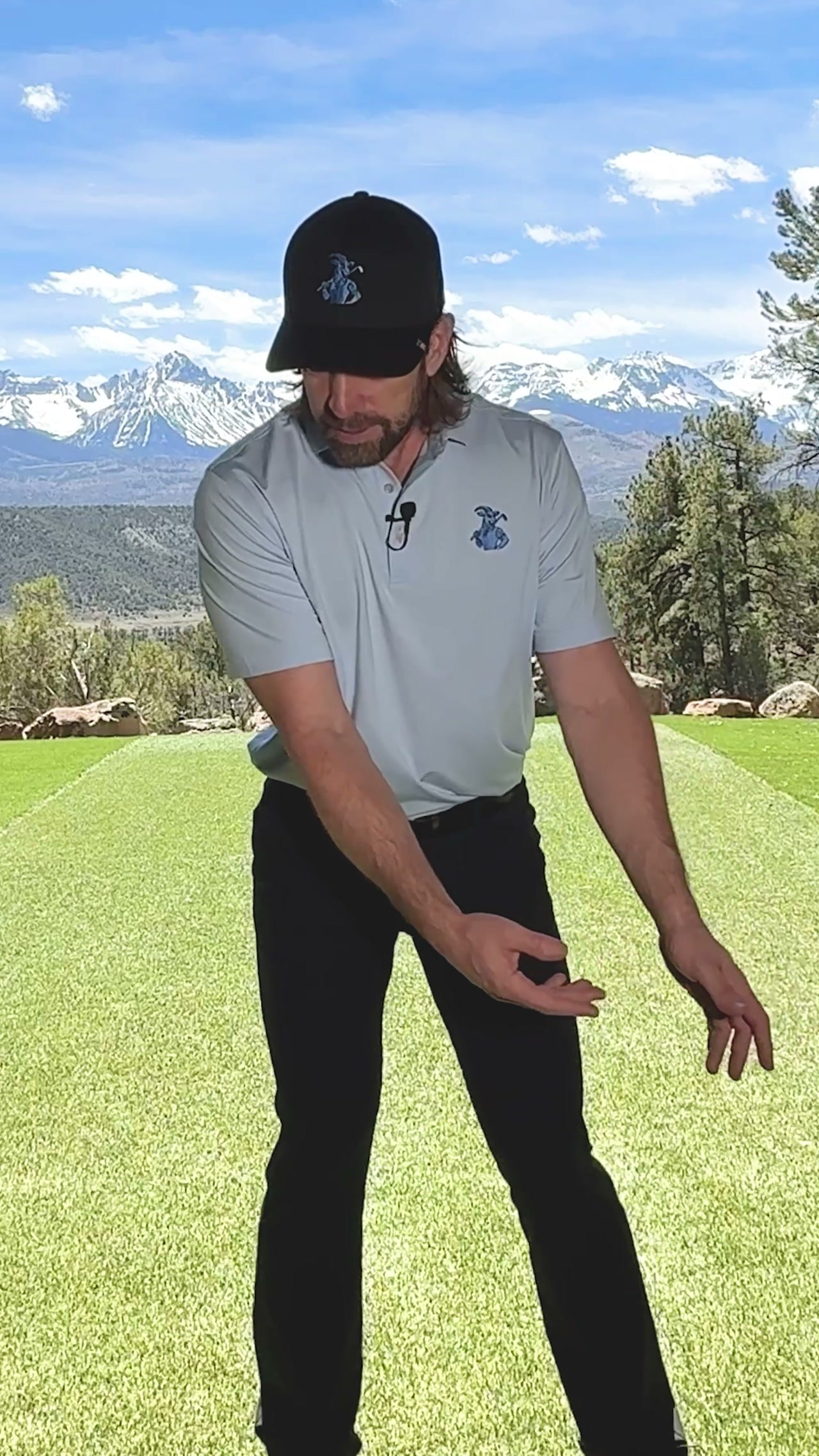
Now that is what the release feels like.
Not quite to that same loose degree, of course, just like this isn't happening quite that fast.
It's coordinated with supination and the whole core and everything firing together.
But as my hands come into impact, I want to let them snap.
And that is what that feels like.
So if you watch my hand, so here's the way I like to feel it.
Take your club and supinate it, hold it in your fingers, middle two fingers, your trawl hand, and then watch this.
Okay, watch again.
You see how fast my hand is snapping at the bottom?
You lose sight of it for a second.
You can see my fingers and then they disappear, right?
That is what the golf swing is.
If you can't let it snap like this and you're trying to muscularly force it, it'll never move as fast as relaxing that wrist and letting it fall.
And then I put both hands on the club and I do the same thing.
Watch how fast my wrist snaps.
I'm letting the club snap.
That is what my swing feels like at the bottom.
The faster I let that snap, the faster it releases.
So if I do it toward you, you'll see I go to the top, I'm going to do my hip kick, load up here, fire the trail side, snap the wrist.
My wrists are dead.
But you can see how much speed there is as I do this.
I'm not working hard because my wrists are doing that.
And that's why supination is so important.
And more importantly, perhaps, so natural.
This is how you would do anything.
If you were to throw a ball, throw it at that screen, or more importantly, throw it down here, would you go like this?
Only if you don't know how to pro.
There's no speed in pronation until the end.
So what I would do is I would take my hand, take it back kind of closed.
And then as I started down, my wrist would go this way.
And then as it would supinate, I'd let my wrist snap at the bottom.
And I wouldn't push it through.
How's that going to work?
There's no power in that.
I got to let that wrist snap.
And it has to go from supination.
to pronation as fast as possible.
The more speed you want, the more you go supination into pronation.
There's deviation there, of course, too.
I've talked about that on the site.
As you're supinating, what you're doing is loading the fascia.
If you do this to an exaggerated degree, you don't do it this much in the golf swing, but if you supinate it that much while you're driving through, you're going to feel all of these muscles and the fascia get tight.
Then they're going to want to release on the other side.
That's what it feels like.
So if I'm doing it up towards you, I'm this way, and then my hand snaps over from open to closed.
That is how you throw the club head at the ball.
As I'm going up here, I like to take it back a little bit shut because that keeps me from getting into supination too early, which loads things too soon, and then I start getting out of control.
But if I take it back kind of shut, like you see Tiger, Tiger takes club face back like this.
All right, he used to, when he was a painting, take it back like that.
And then he would hit the ball all over the place.
Get laid off.
You'd see this motion, Tiger would start working on the swing, his own trip.
Going back like this, that's keeping my hand on top.
And then as I go back, then it goes into supination.
And then, as it's loaded, tons of speed, no effort.
Does that make sense?
Yes, this is the conveyor belt feel, exactly.
Yep, very similar to fast pitch throw in softball, 100%.
Side arm to first base, absolutely.
I was a second baseman growing up, so I had a lot of quick throws to first base.
Did you see what my foot did?
Stood back, didn't it?
Counter torque.
The baseball swing, the baseball throw, the golf swing, softball, baseball hit, they all share very, very similar mechanics because our bodies only can kind of move in one way.
Yep, my wrists have to turn over.
There's no speed if I don't.
Now again, a lot of people get confused about this as to the timing of this.
My feeling is I'm doing this.
I'm trying to get my right hip open forward, because if it is, then my right elbow stays back, and that lets me hold the face square and be lofty.
I can't get this far, of course, in a real swing, but that's my feel, is I'm doing this.
In reality, I'm doing that, because I just can't hold off the release, nor do I want to.
But on the wedge shots, short shots, I do.
I hold that face very, very square, but as I'm doing this at speed, a simple way to think about this, the closer you are to the green, the less release you're going to have.
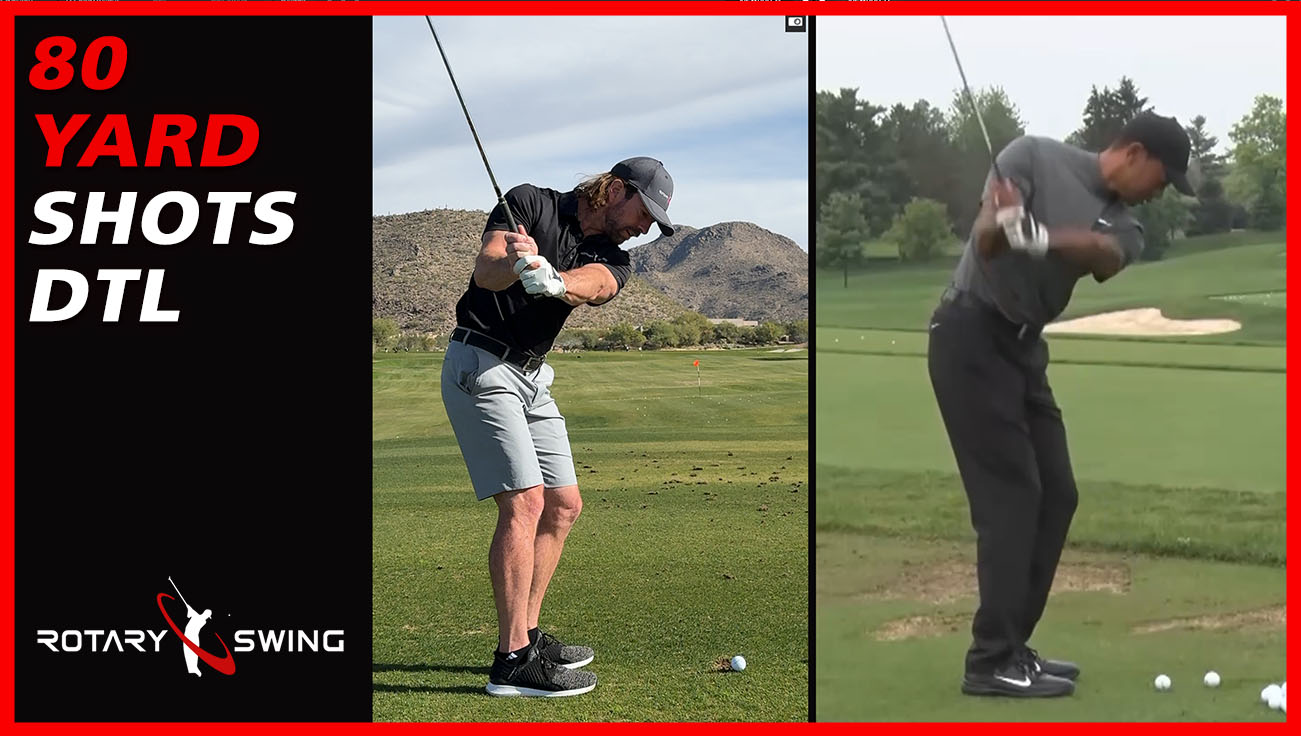
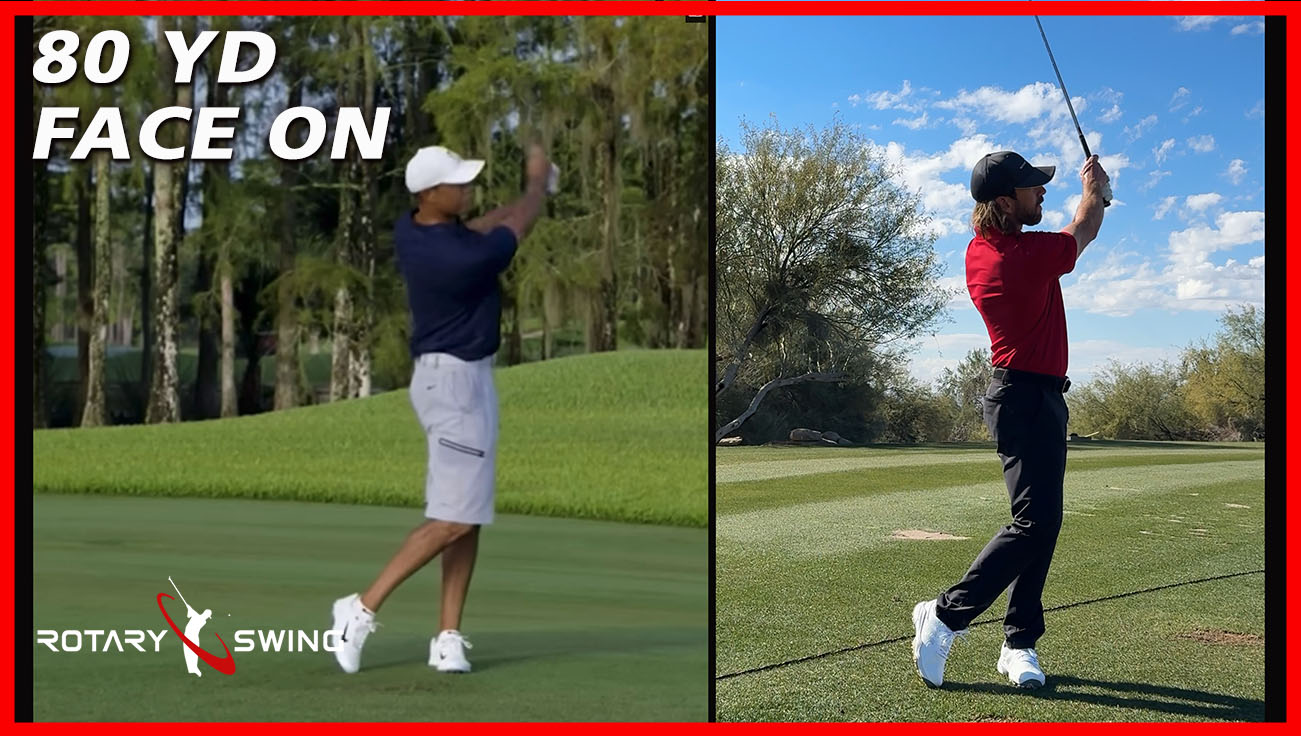
So like when I'm hitting like an 80-yard wedge shot, I'm holding that sucker off as long as I can because I don't need any power.
I'm hitting my sand wedge.
I don't need to release it.
I'm hitting a little bump 80-yard shot.
I'm holding that club face square.
As I start going from, I'm going to grab my sandy.
As I go from my little 80-yard shot to a 100-yard shot or 120-yard shot, My wrist has to start releasing more because I need that speed.
So as you get further from the green, you got to start giving up a little bit of control and replacing it with speed.
Your upper body tension If your body tension, if you're tight, there's, you're moving, you're moving either trying to muscle it or holding on with your arms too tight.
There's some serious mechanical thing going on.
So let me talk about two things here.
You guys are going to have a million questions.
I understand that and I want to help you as much as I can.
But at the same point, this is literally exactly what I taught Steve.
Nothing more.
So if you are following the program on the site, all of these things should fall into place.
If you've skipped ahead to phase four, then you're probably confused.
And I understand that because it's just like anything else in life.
You can't go to algebra if you can't do basic addition.
I had a guy today on the site complaining that.
He's not hitting the ball well, and he said, you know, I'm already up to doing this shot, that shot, whatever, and his grip was like this, and his setup was like this.
I'm like, well, what do you expect?
The fundamentals are there for a reason.
You have to go through them, and if you don't want to take the time to understand them, then do this, because this will save everybody a lot of time and frustration.
Join Craig's Unlimited Review Group.
Because he's going to offer you half off for the first month.
If you don't want to manage your swing, let him do it for you.
Because you must track all of these things that you're doing.
You must understand what you're doing, at least to some reasonable degree, to be confident to understand how to play good golf and understand what you're doing wrong.
Because it may be something, and most times it is something very, very simple that you're doing.
That you don't realize that you're doing, and it's wrecking, wrecking your entire swing.
So, like, somebody's saying, Well, you know, I built tents in my arms.
What could be 50, 000 different things?
It could be you set up wrong, it could be you set up like this, like Steve was.
it could be you turning really flat, lifting could be a million things.
It's creating all this tension in there.
So if you need help with your swing, take crack up on this offer and get half off for a first month of unlimited review.
So he will look at your swing every single day if you want to, and he will look at your video.
You just take a video on your phone, upload it to the site, he'll get it back to you with a review showing you exactly.
Step by step.
Watch this video.
Do this step, do this step, do this step.
So take advantage of that because he's offered half off for the first month.
Now.
Let me talk to you about the gym stuff, so the gym stuff that I do is very different than probably how most people conventionally work out.
Again, I'm not some fitness guru, my gym program is built around what I feel this swing needs in order for me to do it powerfully, safely, correctly, and engage the exact same muscles in the gym in the exact same way that I do on the golf course.
And so that's not a lot of bench press and things like that I bench, but that's not really what I'm trying to do.
So my program is built more around explosiveness because the golf swing is very, very, very fast.
And that's one of the things, again, I had to emphasize to Steve when we started with, How quick can you do that, like Bruce Lee, how you need to move.
And so if you're training to do really heavy squats, you're training your body to move something really heavy, really slow.
That's what you're telling your nervous system that you want to do.
The golf swing is moving something really light, really, really fast, so I train in the exact same way.
So when I do squats or things like that, I do them with relatively modest weight.
But I go up as fast as I can, I go down as fast as I can.
I don't just do squats, I do a lot of different exercises.
And so that is part of our RSA program.
If you're interested in that, then I'll put up a link here where you can join the RSA program.
What the RSA program does is it gives you not only access to these exercises that I do in the whole exercise program.
But it gives you two free swing reviews a month for the rest of your life, as long as you're a member of the site.
If you're a member, you will get a review every two weeks, forever, for free, included in your membership, as long as you're a member of the site.
And then you also get access to all of my workout programs where I'm talking about how to get these glutes to fire, all these different exercises that I get are kind of funky exercises that I do, but they're really goat code and golf specific.
I'm teaching your body how to move really, really fast.
So that's what the RSA program is really about.
It's an accelerator.
There's a lot of information in there.
But that is what I would recommend if you're interested in understanding how to work out and move really, really fast.
Because you need to train your body to move quick.
As you saw, this is really fast.
This is really fast.
This is really fast.
And that is really fast.
And that's the golf swing.
If you wanted to go in a nutshell, extension, side bend, rotation.
Hip kick, fire them all down, supinate the wrist, fling the club head.
That's it.
It's that simple.
When you do those things, you will have all the speed in the world.
That's where that speed comes from.
I'm throwing the club head, but throwing it correctly with my whole body, not just throwing it with my arms like Steve was to begin with.
I'm using everything.
I'm loading up this body to be able to throw as fast as I can.
When you do that, The throwing motion is the fastest motion the human body can make.
Do you guys know that?
The arm can go from external rotation to internal rotation at 9,000 RPM.
What am I doing in the golf swing?
Going from external to internal.
Most golfers push.
If you push the club into the ball, there's no power there.
You've got to muscle it as hard as you can.
I'm loading my fascia and slinging that puppy in there.
And that's why it doesn't look like I'm trying to swing very fast.
So what am I going to do to tell him to get to 110?
Great question.
So literally all I did with Steve was a trail side kick, take him in the gym, get the goat drill, and then start softening up his wrist.
That's all I told him.
So I told you guys a lot of stuff that I didn't tell him because, again, I had 30 minutes with him, and that was it.
So I had to kind of get down to the simplest things and make it really, really simple.
They weren't thinking about a bunch of stuff because obviously as you're thinking about things, you're always going to swing slow.
I don't care who you are.
So as he was thinking about things, I couldn't give him all of the stuff I gave you guys.
So you've gotten a lot more.
So some of the things that we covered today are going to be the things that I'm going to emphasize with him.
One, we didn't talk about throwing or supination at all.
That's why if you watch that podcast, I showed a clip where I said, oh, it looks like you're still trying to muscle because he was trying to go to the top and push his arms.
He's still moving his arms this way instead of this way.
Why?
Because this feels so good.
It feels so powerful to go to the top and do this.
It just doesn't work.
There's no power there.
I don't know if you guys follow baseball at all, but I'm not a baseball hitting coach by any stretch of the imagination.
I just more or less stayed at a Holiday Inn Express a couple of times.
So I have some understanding of how baseball swing works.
I played baseball growing up as a kid, but I didn't have proper hitting mechanics.
But there's two competing theories, and they're very similar to golf.
One theory says you push your arms and bat into the ball, and one theory says you stay back, step, and hit the supernate.
You can imagine which one I prefer.
Both of them work, just like in golf.
What I'm telling you to do is exactly what Tiger does.
Tiger's not the only golfer of all time.
Bobby Jones did a little bit different.
Hogan did a little bit different.
Nicholas did a little bit different.
Scottie Shepard does a little bit different.
There's lots and lots of different ways to hit the ball.
What I'm offering you is, in my opinion, The most efficient way to do it is I just do this with my hand and pivot my body and let my hand snap.
That's it.
That's what the difference is between what I teach and what everybody else teaches.
I'm not saying mine's the best way.
I'm just saying it's what Tiger does.
I'm saying it is, in my opinion, the most efficient way because I don't want to work for it.
I want speed and I want it effortless.
I don't want to work at going out there and trying to be really strong because I want to be able to swing.
As fast as I do now, for as long as I can, and by being very efficient and being very easy on my body and moving everything together.
This is another thing.
You guys know, I've got a lot of back issues, I've had a bad back since I was 19.
So for me, twisting my hips or pushing with my shoulders or firing my arm, it all puts too much torque on my spine.
But when I move all of this together as one thing, there's no stress on my spine.
I can do this all day long and doesn't hurt my body, so that's a huge emphasis on what I do is efficiency and safety.
All right, I'll open up to some questions here.
What else we got?
Yeah, there's no club face on the back.
Obviously, they're not exactly the same.
Thank you Jeff.
I hope this opens up everything to help you understand.
Really, this stuff is not that complicated.
My chest is open because I'm not hitting a golf ball on my left hand on the club.
So obviously they're not exactly the same.
If I'm doing a drill, I'm going to be way more open.
But once I put my left hand on the club, I can't be that open.
So yeah, they're going to look different.
Pressure remains on the trail foot.
It can.
It depends on how flighted you want to bring the ball down.
The lower you want to hit the ball, the more you move pressure to the lead side.
Tyler, yes.
In your brain, they all happen exactly the same time.
There's obviously a little microseconds of difference, but our brains can't really process that.
I think, Steve, to think of the left side reacting is a good way of thinking about it.
No matter how fast your back swing is, that's a good question.
I want to answer that one.
Yes, it does.
Yes and no, I should say.
So I can swing it back really slow and still get it fast.
That's not how I swing in real life.
I want to swing back as fast as I can.
Why?
Because as I do that, that loads the faster.
The fascia has to be loaded under tension very quickly, otherwise you cannot let it rebound for you.
So I try to take the club back relatively as fast as I can.
I'm not dawdling, let's just put it that way, let's see, let me scroll back up here.
When I drive my right knee, my left foot tends to relax once I push off my left foot.
Your left foot should push off, Walter.
Again, Everybody's going to think about and feel and internalize these things in slightly different ways, just based on what your movement patterns already are.
Like if you played baseball and I told you to step forward and snap, well, you would naturally push off this lead foot.
But if you don't have that kind of existing movement pattern in your brain, you may have to focus on pushing that left foot back.
You want maximum speed?
You start speeding that up.
So I move this really quick.
I move this really quick.
And then my hips pivot really quick.
So they work together.
So you can focus on the right.
You can focus on the left.
Whatever.
It depends on what you need to focus on.
But in general, the more you can do the trail side stuff, the easier it's going to be.
The drills pass the putter, chipping and pitching, they're all on the website in extreme detail.
So go and check out those.
Any extra drills to wake up the trail side?
This is all you need in my opinion.
I have not found that I need anything else than any of my students.
Rick, if you're concerned about hitting it fat, if you're hitting it fat, you're almost always firing your arms.
Let me talk about that real quick.
So this is another thing.
So a lot of times, like I play the ball pretty far up in my stance.
So just to give you guys a good reference point, this is my six iron.
I would play my 600 about here, which looks pretty crazy for a lot of people.
But I know that I'm going to drive hard and be able to get off and still be able to flight the ball really low.
So I go here, start supinate.
I got all the shaft in the world, right?
If you're used to hitting it fat and you're terrified of doing that, it's because you're extending your arm.
This arm does not ever try to extend.
And again, this is the two competing theories in baseball.
And in golf, we kind of have similar things.
Again, one baseball guy is telling you to push your arms at it.
You can do that.
It just takes a lot more muscular effort.
And in golf, I see guys on the website or on Instagram and stuff telling people, as you go to the top, start extending your right arm.
It's the same thing as pushing the bat in baseball.
If you start extending this trail arm, I would be worried about hitting it fat too.
I'm never trying to extend my trail arm back.
I'm trying to do the opposite.
I'm trying to hold this arm in close to my body.
as much as I can, then the only thing that can happen is my wrist is going to supinate.
Now as I start doing this down at the ball, my arm starts to extend.
If you're hitting it fat, it's because you are extending your arm instead of letting your arm be extended.
Bob, I don't have swing thoughts.
Have you had knee surgery?
I've had a lot of students who have had knee surgeries and not had any issues, so you just have to kind of play that one by ear.
But yeah, if you had it a year ago, you should be totally fine.
Let's see.
Yeah, Art, I talked about how that right hip works in there when you snap the lead leg right at the end.
That's a good question.
Ken, I'll talk about that.
So again, same thing as in any other hitting motion.
And I showed you in that motion of Tiger where he was doing the check swing.
So again, The reason Tiger can check and still have his hands way up here is because he's not doing anything with his arms.
If you start doing this with your arms, you're never going to stop your swing that late.
Tiger can do that easy because all he's doing is this, right?
You look like this and like that.
His left leg is still bent.
So if I do it from up here, as I start to tilt and go back, my lead leg is still bent.
It doesn't snap straight until the release.
Right at the end.
Is the timing of that so what you want to feel?
Wave, fire the trail side, and then as you snap the wrist, that's the same time that that lean leg is snapping straight.
Hey Thomas, you should get a replay to watch this as many times as you like.
Good John.
Yep, the hip extension definitely opens up the trail side.
Uh, yeah, basically, time to squish the butt drill more or less.
Your shoulders should not be flat.
So that's very, very similar to the axiom John.
Yes.
Getting the ball thin, you're flipping your wrists.
Hey Alton, how are you buddy?
How did forward chaplain come in?
I'll answer that one.
So forward chaplain is a result of supination.
If I supinate my wrist, if I just do this with my wrist and then it's obviously going to move into deviation.
So I'm just going to go to the top and I'm going to start to supinate.
So I'm taking the club back to the screen behind How would I not have shaft lean?
The only reason you're not going to have shaft lean is you start getting rid of If I just supinate, I have lagged for days, right?
You can see, again, these are little exaggerations, but as I do this, I keep moving my trail side forward.
I have all the shafts in the world.
So understanding that you must supinate if you want to maintain that angle.
You feel pressure in the ball of the foot or the heel.
In the backswing, it goes back into the heel.
It would cause a hook if you're flipping your hands.
A lot of shots are going left.
Try smothering it with your shoulders, pushing with your arms.
Yeah, Stephen, you can never replace in -person stuff.
It's just a shortcut, right?
And there's never, ever going to be a replacement for somebody being able to react immediately and saying, this is exactly what you're doing and phrasing it in the way that you need to hear it.
So yeah, we're doing the best we can with the online program.
And again, everything is in there.
If you really pay attention to it and you follow it and video your swing, you'll be able to do the same things, which we have tons of students that do.
But you're always having an in-person lesson speeds things up, of course.
What speed should you be practicing?
Uh, you know, that's a good question.
What speed should you be practicing at this phase?
Well, one.
I want you to get the feeling of moving as fast as you can.
But if you don't have kind of the foundation of setup and grip and how to back go in the backswing, all that stuff, moving fast is just going to make you have bigger mistakes, even faster.
So you really, again, you have to balance this stuff out.
You have to move correctly.
You have to be set up correctly.
You have to have a proper grip.
You can see that if I have a really bad grip, like I see all the time, and I get this much shaft lean, and my hands are really weak, well, that club face can be wide open.
So all of these fundamentals that are on the side, set up the grip, posture, take away, all that stuff is extremely important.
But if you have those, you should be able to swing very, very fast.
Yep, George, exactly.
I talked about contracting the bicep.
George, you will have a replay of this.
Now, you're not supinating it that much, Steve, so it's not going to be that narrow.
I was exaggerating that.
Once the inertia of the club starts taking over, it will start straightening your right arm for you.
Is there a right arm rotation in the back swing?
Yep.
Yep, supination lounge is shallow.
Let's see.
You're flipping your hands.
So if you're hitting it left, like you're smothering, You're either pushing and that's shutting the club face, and your path is coming left, or your trail hip is not coming forward like this because you're not using it.
And so you stay back and you flip your hands after to flip it.
So your hands are flipping over way, way too soon.
They really don't release until after the strike.
They're releasing into the ball.
Thank You Daryl appreciate that Okay, I'll talk about that real quick.
So, The simplest way to get the feel for the supination thing is to not super until you have to.
What I mean by that is.
This is one of the things that I loved about Tiger Swing that he switched in 2019 2018, we started working on his own.
He's like, let me just kind of put all this instruction nonsense out of my head and let me just do whatever I feel I want to do in my swing.
So I think in 2019, his swing was beautiful.
It was effortless.
It was powerful.
He obviously won the Masters.
He won the Zoso or whatever the hell it's called.
But his swing was just so damn simple.
And one of the things that he did that he got, you know, again, when he was with Haney, he really, Haney's a big swing playing guy.
And that.
manipulation of the face and rolling the face open is very difficult to time.
And Tiger really struggled with it.
I'm going to do a podcast in the desert next week, I think.
I'm going to, because I played at the gallery and that's where Tiger won the 2008 WGC match play championship against Accenture match play against J.
B.
Holmes.
And the first hole at this course, the fairway is insane.
I mean, it's got to be 50, 60 yards wide.
It's huge.
I don't think I've ever missed the fairway in all the time playing that.
Tiger on the first tee, hit this ball so far right, hit the cart path and went out of bounds in this guy's yard.
If you go on YouTube and you search for this, you can watch it.
But I'm going to like show you where the ball normally ends up and where he hit it.
And it's just for a player at Tiger's level, it's shocking that he could hit the ball that far offline.
It's really wild.
So literally it's 60, 70 yards.
right of where I would normally hit a tee shot there.
And so this is really tricky.
So how do you get out of this stuff with your hands?
Well, what Tiger switched to, the way that I describe it is how I would swing a tennis racket.
If I was going to hit a forehand, I wouldn't roll the racket open and then try and close it down.
And that's what Tiger was doing with Hank, was trying to get this perfect parallel swing plane idea, which in theory seems really cool.
In real life with the human body, not so cool.
So what Tiger does now is he takes the club back like this.
I'm exaggerating because this is only with my trail hand on.
If you watch Snappy Gilmore, so those of you guys on social media, Snappy Gilmore swings with only his right hand.
And he does the same thing.
He takes it back like this, and it's in complete pronation.
And then as he goes up at the top, then he starts the supination.
If you're doing this off the ball, it's really hard because you've already supinated as far as you can.
So I have altered my takeaway to feel like I'm taking the tennis racket back because I'm not going to open the face of the tennis racket.
I take it back like this, and then as I go back to the top, it starts to supinate, and then I come back down.
So that is a simple way to think about the takeaway.
It's just basically nothing happening with your hand.
You try to feel like that on the way back.
Let's see.
Speed is up with blocking a number of drives.
You probably grip is off or you're shoving your body through.
Again, these are things where if you're videoing your swing and you've been going through the program, I want to talk about that for a second because we're chasing rabbits down rabbit holes here.
If you go through the program, by the time you get to 80-yard shots, you should have complete control of the club face.
I mean literally complete control.
You should know exactly where the club face is going and exactly where your path is on every single shot.
So when you're asking me, well, I'm blocking it, it's because you didn't do that stuff.
Because there's no way that you'll get to that part of the program, going through the program the way that it is, and going through those checkout stages along the way, and still not know why you're missing shots.
What it means is you skipped everything and jumped to the end and just trying to get your cake before you ate your veggies.
And that's going to be impossible for everybody because you don't have the foundation.
to understand what's going on.
These fundamentals and doing them with the putter is so important because the putting stroke is a miniature driver.
It's a miniature driver swing, and the chip shot, and the pitch shot, and the wedge shot, and the pull swing.
They all work together.
So if you're confused as to what kind of ball flight you're with, I can almost guarantee that you haven't passed all of those steps.
Rope, hitter, cuff, tear, yep, for sure.
You don't have to have that much external location in there.
I don't think we have anybody in Las Vegas.
I'll try.
Let's see if I can do this.
I'll try with my hands.
Can you guys see that okay?
Let me look at the camera.
The most important thing.
Yeah, I'm using these grip master grips if you hear them being very sticky.
That's why they're amazing.
I get the club in my fingers, in my trail hand.
This is super important because I want the speed to come from my fingers and the whole.
Further I hold the club away from my wrist, The more leverage it gives on my wrist to snap it.
If you're holding a club like this, There's no speed there.
So I get the club deep into my fingers Left hand I don't really care where that is.
I just have a normal left hand grip my all my focus is on my right hand So I just really try to get it in there so that as I come into the ball, I feel this right hand swat with my fingers on my right hand.
You can putt left hand low, Rick.
You're going to miss some of the feel.
Is the pressure going to leave ball in the foot?
Yes, it does.
How long might it take for it to go from the phases from start to finish?
That totally depends on how much time you can practice.
I went through the exact same program, obviously, because I created it.
So I literally went through every single thing on there.
I did all the cutting drills.
I did all the chipping drills.
For me, it took me practicing every day.
I would say it probably took me two or three months.
to get through to the point where I had complete control of the club face up to my 80 yard shot.
And obviously as I was doing that, I started carrying into my full swing too.
So I was doing them simultaneously, but my emphasis was on all these short shots.
So everybody's going to be different.
You know, if you practice once a week and you don't do anything at home, which again, you can do all those cutting drills at home.
You can do chicken drills at home.
It might take you longer.
You might be better than me.
You might do it faster, but everybody's just going to be different on how that.
how long it takes you to get through that.
Okay, guys, a few more questions and then we'll get wrapped up here.
Thank you, Jason.
I appreciate that.
Oh, one other thing I want to tell you guys.
So I want to have a little contest.
I want to see who can pick up the most speed just from going through this webinar.
So tag me on social media.
Now I pretty much only hang out on Instagram personally, but my team monitors the Facebook stuff and then TikTok.
All you kooks that are on TikTok still and all of the other stuff.
And YouTube, I monitor a little bit.
But tag me on social media and show me who picked up the most speed.
Whoever picks up the most speed from this webinar, I'm going to give you guys a free lesson.
So tag me on social media.
Show me yours with a launch monitor.
We want real data.
And show me who picks up the most club head speed.
This will be super fun.
I want to see this.
Yeah, and just to be clear, there's a lot more stuff that I'm working on to help you understand how to do all these things at full speed.
But obviously, as I'm going through and developing the program, this stuff takes a lot of time and effort and research.
It didn't just make this stuff a lot of thin air.
It takes me a ton of works to do this.
So hopefully this starts to make sense and this ties a lot of pieces together for you guys.
You guys are welcome.
Thank you for attending.
I appreciate it.
Thank you, Bob.
Hopefully you guys learned a lot.
Thank you, Tom.
Thank you, Moan.
You guys are welcome.
Awesome.
Very, very cool.
I appreciate that.
Good words.
Thank you.
Thank you, Gary.
I appreciate that.
I appreciate it.
Thank you, guys.
I appreciate that.
Very kind.
It makes me feel very good.
Awesome.
You guys are welcome.
I really appreciate it.
One Moscow meal.
Oh, man.
I'm a cheap date.
That's probably all it takes.
What should the club path be?
That really depends.
You guys are very welcome.
Club path is a variable because it depends on what kind of ball flight you want.
My path is pretty square.
I hit down the ball relatively sharply with the driver.
Down the iron's about four degrees, so my path is a little bit in-to-out, but it's very, very minor, and it shifts a lot.
So I'm not a big launch monitor D-path, D -plane kind of guy, John.
So thank you, Richard.
I appreciate that.
Ronald, you'll be able to get a full replay of this.
And just to be clear, guys, you guys will get an email link.
As soon as we wrap up here, it'll render itself and then it'll email.
Hey, Mark, I don't teach at the gallery, I only teach at my studio back in Colorado.
Back some more up and down or around, and I don't even know my back swing is just whatever.
Trying to get the club loaded, I don't really think about that way.
That's again why you got to go through these short shots, because then it all makes sense.
What did Steve tell me at the end of his lesson?
I thought he was going to give me a kiss.
He gave me a big hug, but he was pretty damn happy.
He was pretty damn stoked.
He couldn't believe it, honestly.
It was super fun for me.
That's the rewarding stuff for That's the fun stuff for me is to just see somebody who thought they could never hit the ball 250 yards in the air and then all of a sudden be like, I'm a different golfer.
That's where the cool stuff is.
Again, if you're not sure what you're doing, if you're not sure if you got it right, Work with Craig because he will walk you through this stuff, and he's a thousand times more patient than any instructor you will ever work with in your life.
And he will make sure that you get this stuff right.
And all the little details that seem like they don't matter a lot, they matter a lot.
No, I don't teach on the road anymore.
I only teach at my studio in Colorado.
I'm too lazy to go out anymore.
I want you to come to me.
So yeah, I know if you want to work with me in person, you got to come here.
I'm located just outside of Telluride Ski Resort in Colorado.
Even the Amazon, holy cow.
That's wild.
All right, guys, I'm going to wrap up.
Thank you again so much for the kind words.
Again, work with Craig.
He is a saint, and he's been with me for over a decade, so he knows this stuff.
And again, you have to get all the little details right.
And that's what Craig is extremely detail oriented.
And so he will make sure you get to the promised land.
I won't let you move on and collect $2 until you're doing everything right.
So if you're not sure why you're hitting something weird, just get a quick review of it.
All right, guys, I'm going to go ahead and sign off.
I appreciate the time.
I hope you learned a lot.
Again, you'll get a replay link in just a bit.
And I will see you guys on the other side.




Steve
Craig (Certified RST Instructor)
GOATY
Steve
GOATY
Craig (Certified RST Instructor)
GOATY
charles
Craig (Certified RST Instructor)
Kirkland
Craig (Certified RST Instructor)
Everett
Craig (Certified RST Instructor)
Joel
Chuck
Joel
Lucas
Chuck
Paul (Vinni)
Chuck
Mark
Chuck
philip
Chuck
Joel
Chuck
Joel
Chuck
Chuck
Carver
Chuck
Scott
Chuck
Gregory
Chuck
Matt
Chuck
Paul
Chuck