



































































































Cure Reverse Pivot w/ the Necktie Drill
Sorry, you need to be a member to access this video. You Are Just Seconds Away!

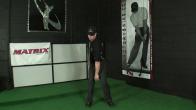
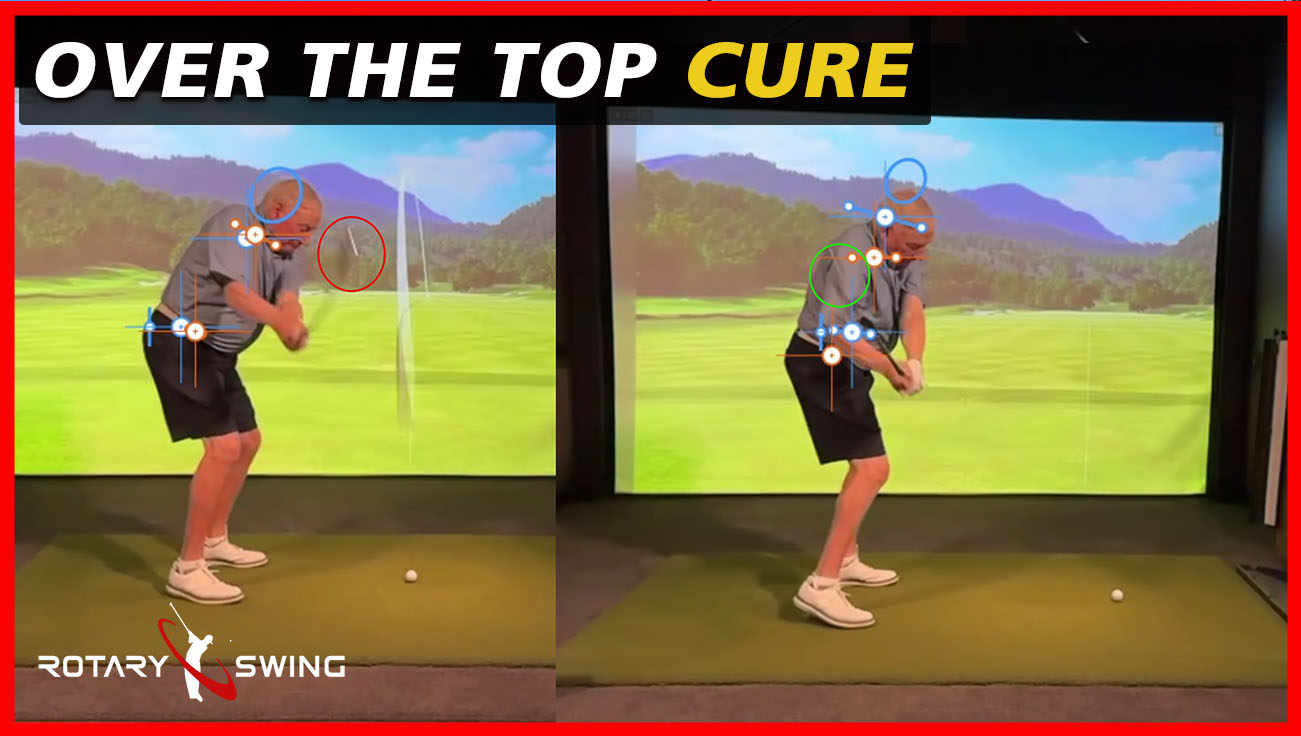
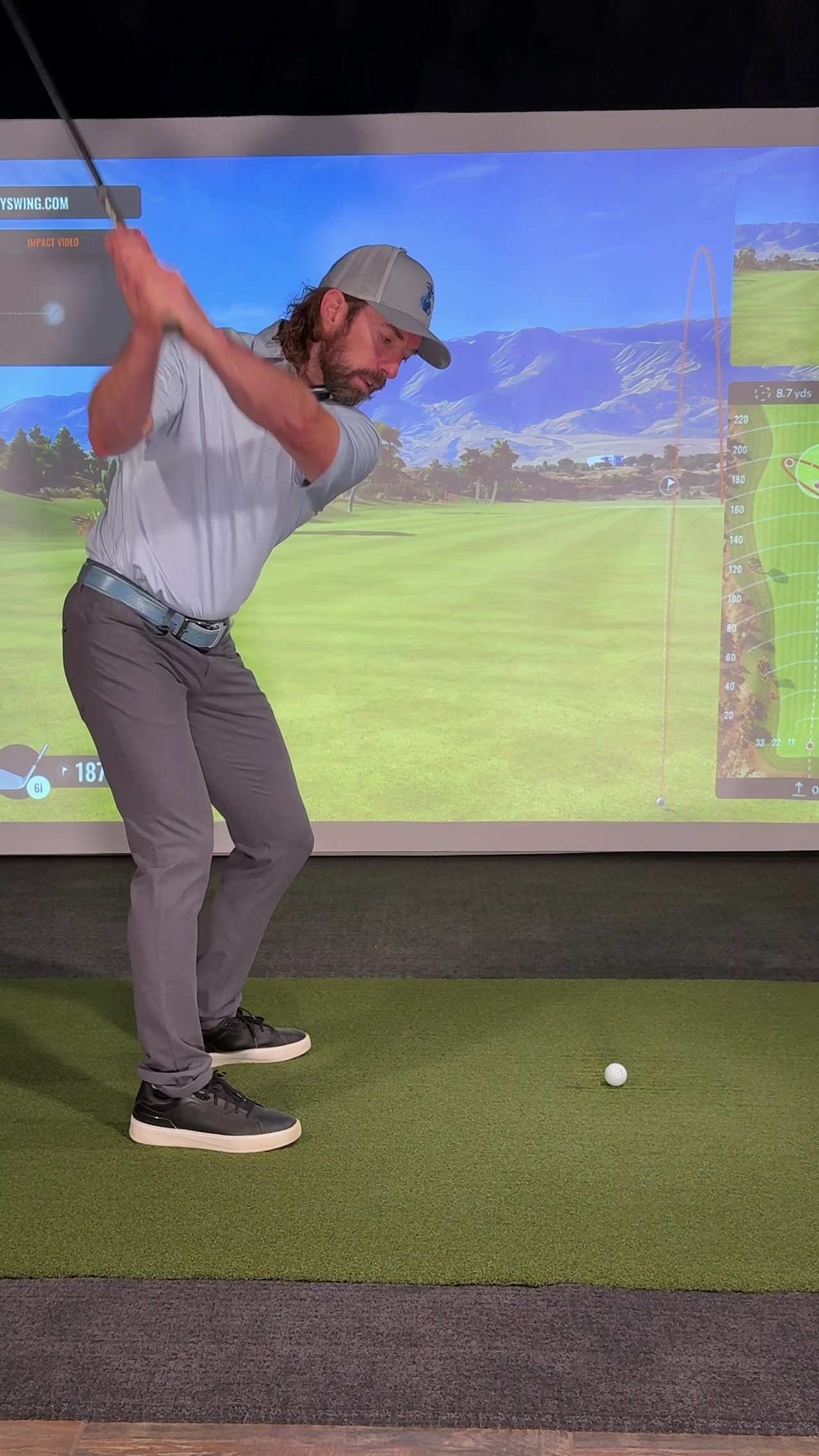
Axis tilt is a necessary fundamental of the golf swing that many golfers ignore or fail to understand the consequences of not having it, especially at the top of the backswing. This simple yet profoundly effective drill will show you exactly how to have the proper amount of tilt at the top.
- A necktie is a great training aid if you struggle with transition and bad position at the top
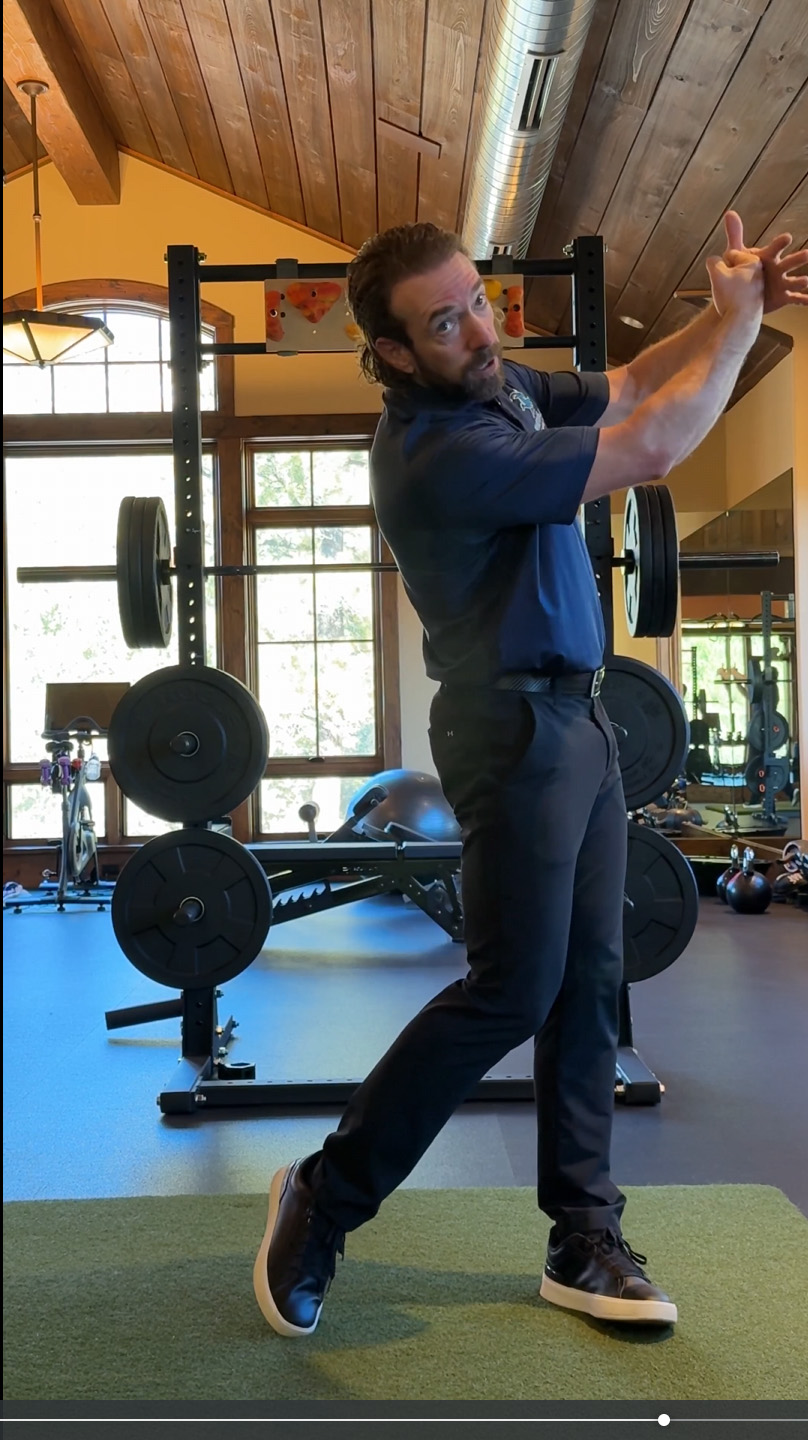
- Wear a necktie and go to the top of your swing
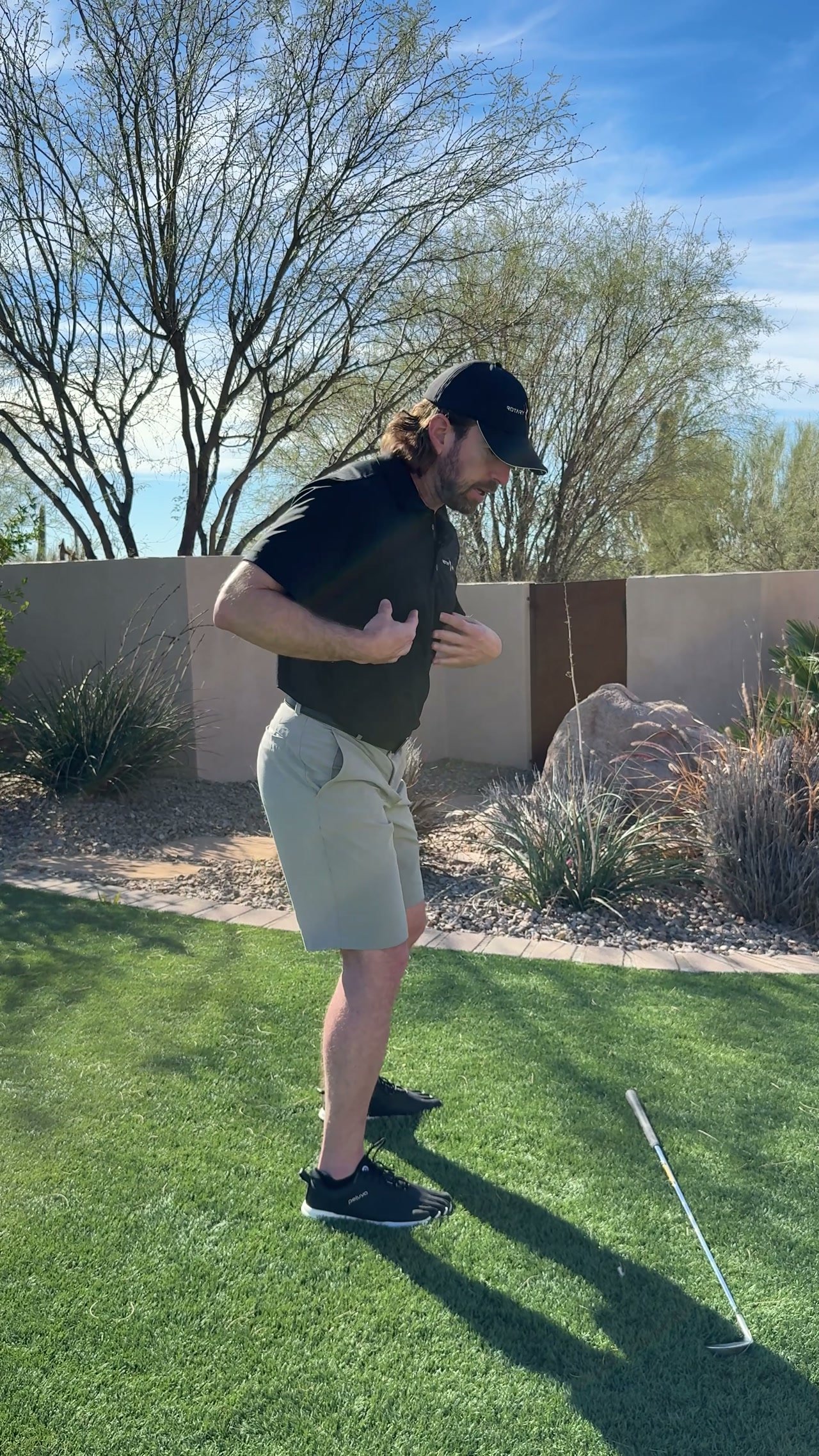
- If the tie drapes over your chest and belly, you are leaning toward the target - this is incorrect
- It should hang freely over the inside of your right knee
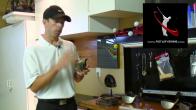
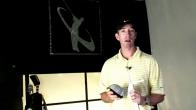
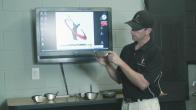
I've got some pretty non-standard rotary swing gear on here.
I don't usually wear a lot of neckties, but I know a lot of you do.
And it's a great, simple training aid to help you understand where you're struggling at with your swing, why you struggle with the transition, Why you're in bad positions at the top?
because this necktie can tell you a lot about the position that you're in at the top of your swing.
And with a simple little video camera filming you hitting some balls with the necktie on, you can get a really clear picture of what's going on.
So let me explain to you what you don't want to do in the golf swing.
What you don't want to do going back is A, get everything rotating together.
So when you lose the separation between the rotation of your shoulders, your upper torso, your ribcage, and your hips and they move back together, it's really hard to sequence a dynamic and powerful downswing, a transition where everything starts to move in the right sequence together.
The hips have got to move first.
So when this happens, when they get pulled back together, You get your muscles bound up and glued together, where everything wants to fire together, and then the shoulders fire, the arms fire, then everything's out of sequence and so it becomes, it takes a lot of effort to generate a lot of power because you're not moving in the right sequence.
So with a necktie on, We can rotate back and start checking our positions at the top to see whether or not we're in a good spot.
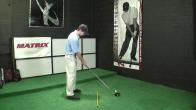
So very simple drill, put a necktie on, go to the top of your swing and see if that necktie hangs against your chest, hangs against your belly.
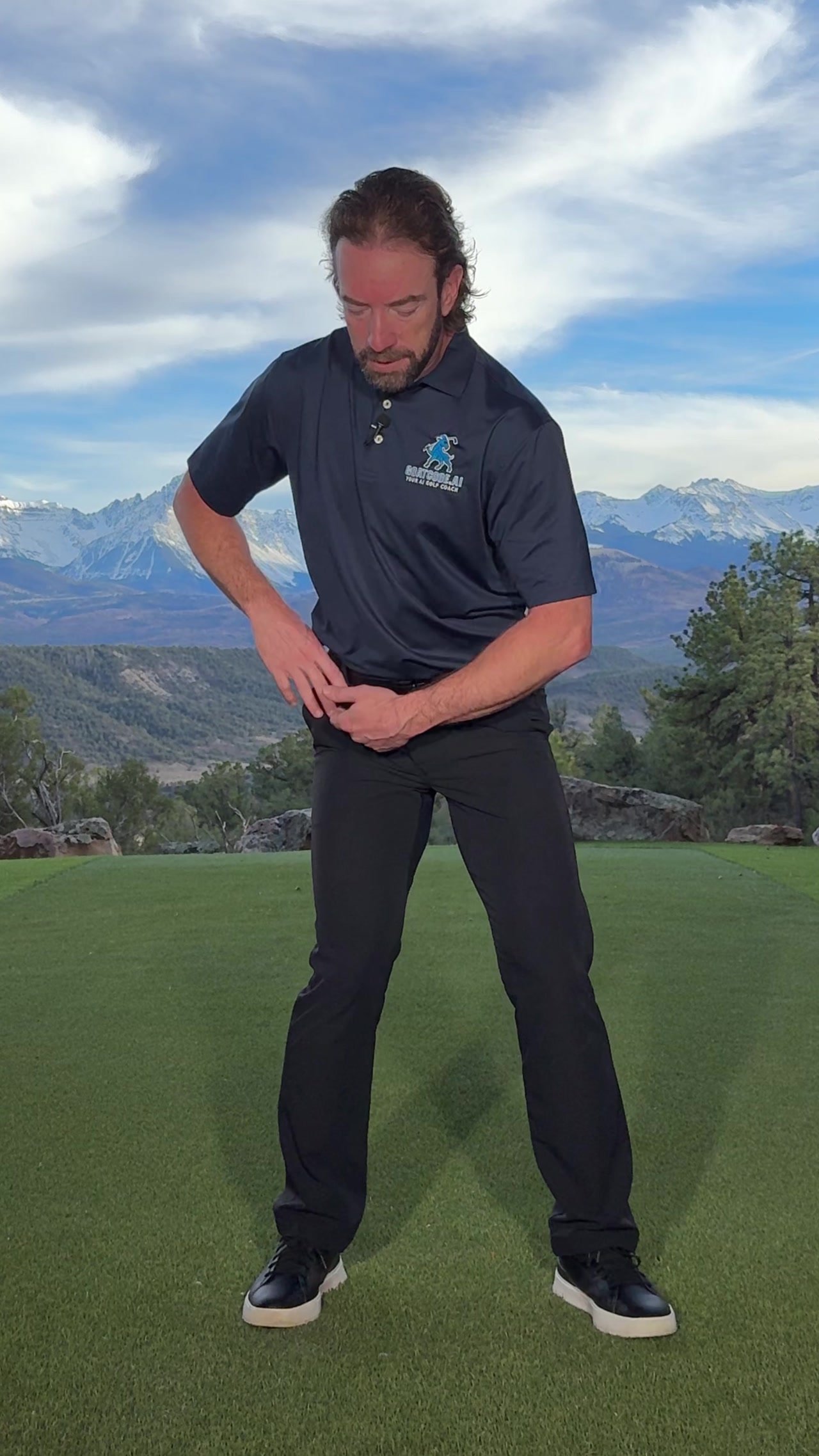
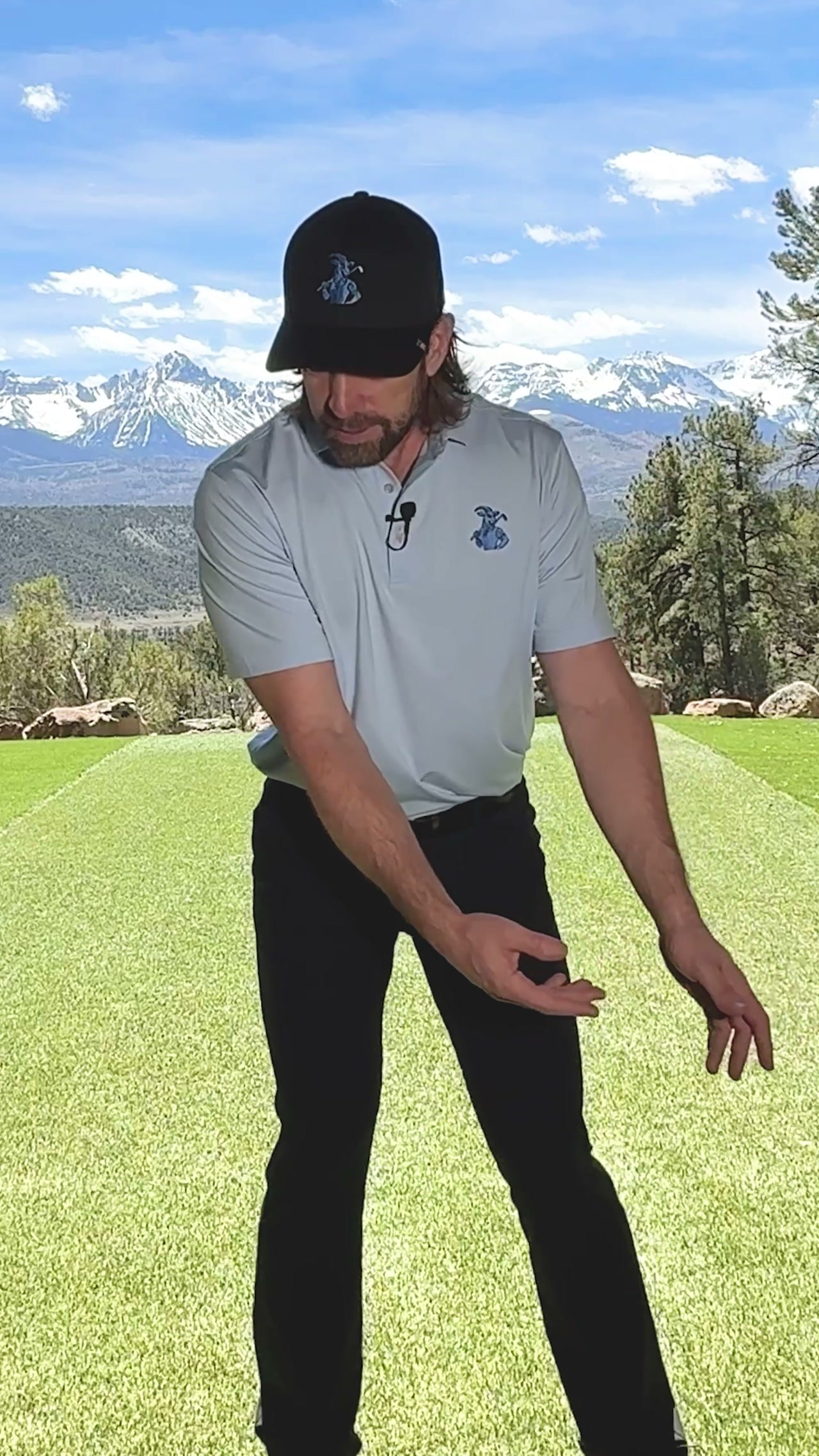
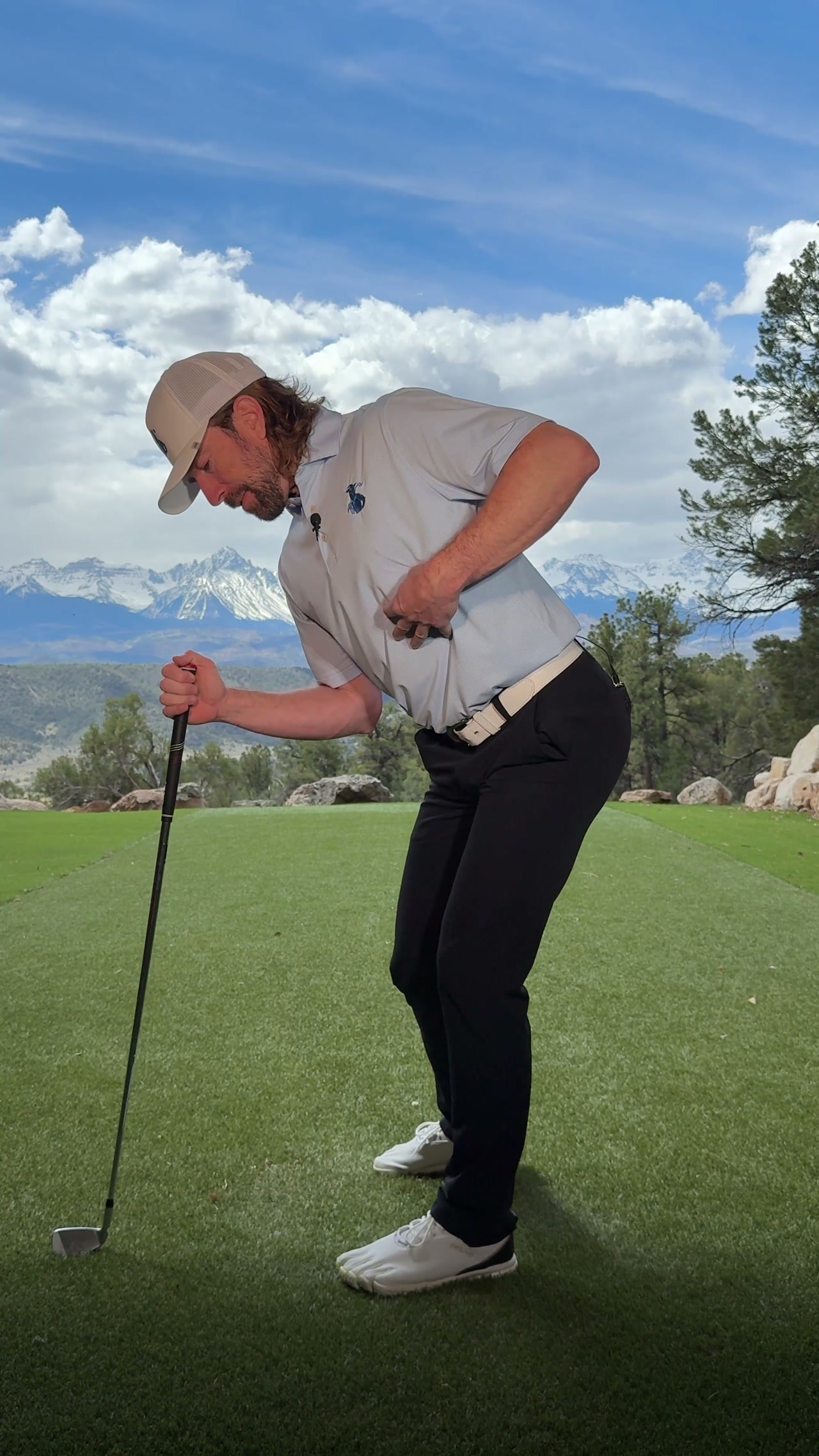
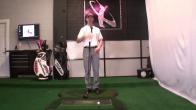
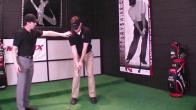
So you can see as I go back incorrectly, now my spine is leaning toward the target, my head's moved this way, I've let my hips and everything rotate a long ways because they've been pulled in with my body.
As I lean toward the target, that forces my pelvis this way.
So now I get, as my pelvis moves away from the target and my spine, upper part of my spine moves toward it, now this necktie is going to hang off my belly.
You can imagine that it's pretty difficult to get a dynamic transition from that position, it just doesn't work that way, it's not how your body's designed to move.
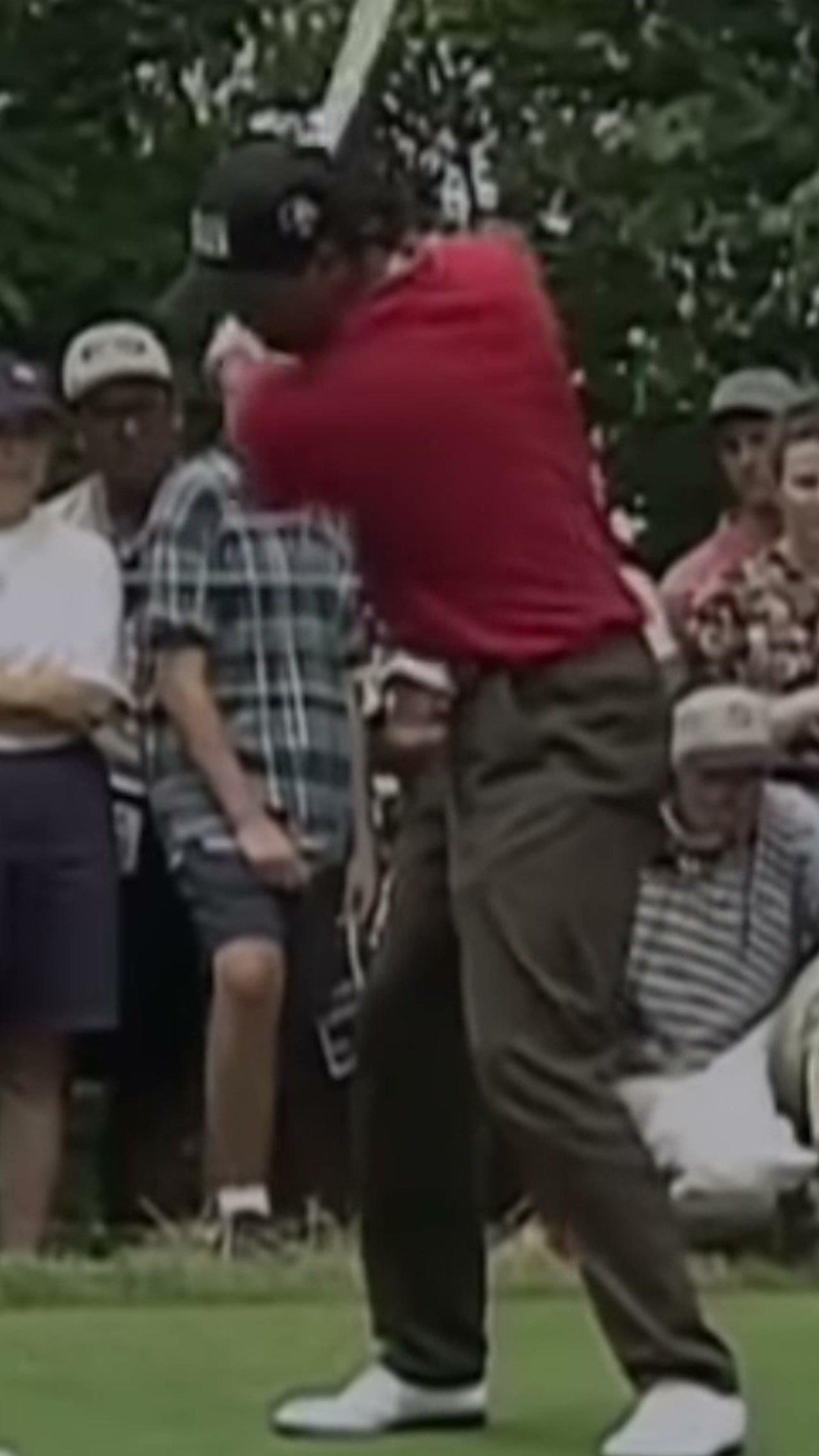
Imagine throwing a baseball as a pitcher and going like this at the top and then trying to throw, it doesn't make any sense.
If you were a pitcher throwing a ball, You would load back, and you wouldn't lean your upper part of your spine or your head toward the catcher, you would lean away from it.
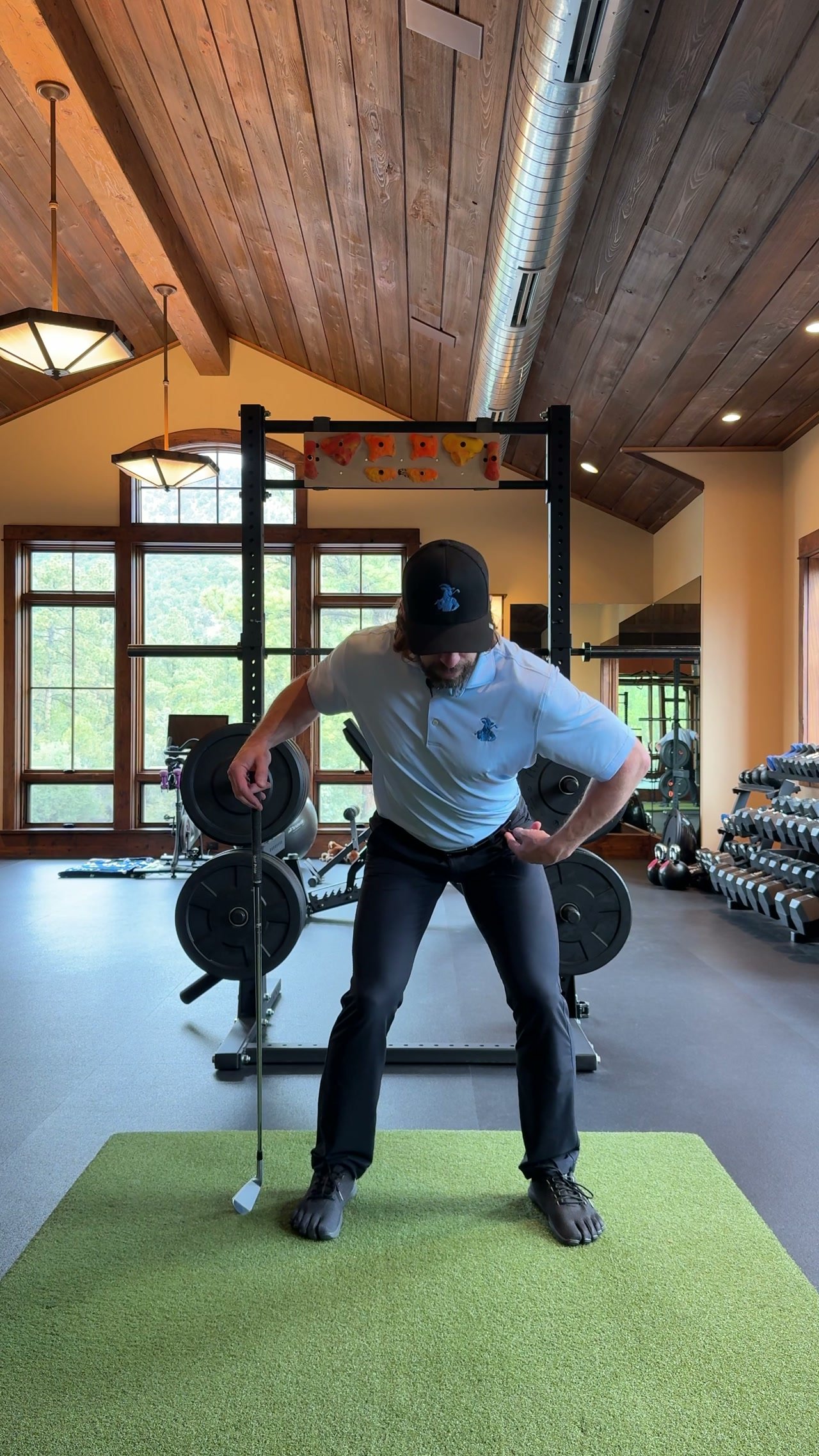
And now that you can see that necktie is free to move, see how it's freely swinging here.
Now as I step back, My spine is actually leaned away from the catcher and then I can sequence the downswing or the stride, just as I do in the golf swing.
There's a lot of similarities in terms of the sequencing.
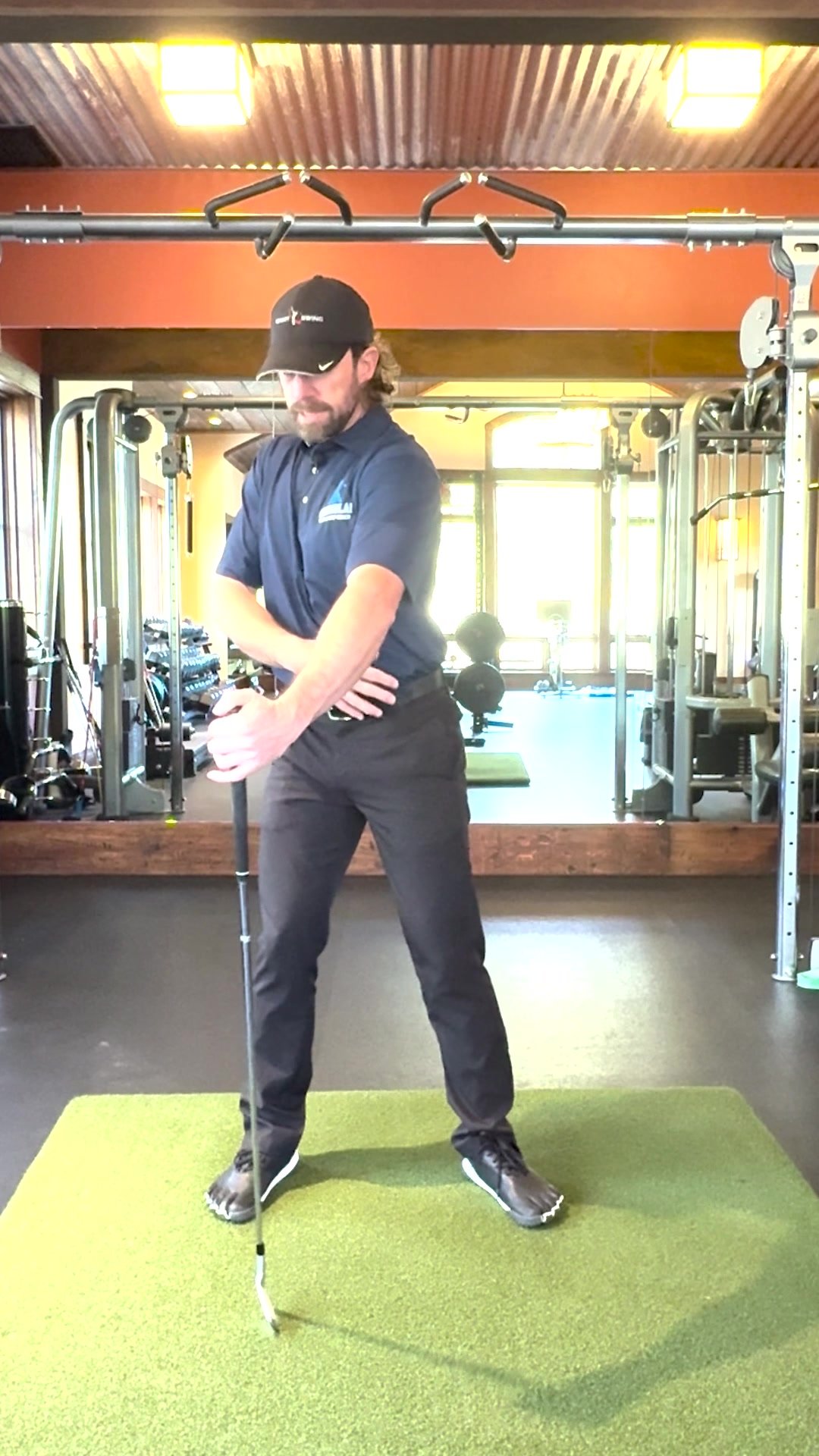
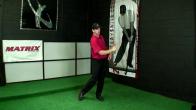
So, same thing when the golf swing, and now notice that just like a pitcher, that necktie is hanging freely off my chest.
When I go all the way to the top, I always tell people to imagine that they had a necktie hanging right over the inside of their right knee, and you can see it's kind of hanging straight down.
The opposite, this.
So now you can see when I do this, I stand up and lean my spine the other way, now it's draped across my belly.
And now watch my pelvis, they move together because they're attached.
So as my head moves this way, my pelvis is going to want to go that way.
And so you get into this awkward position, I see it all the time.
Golfers come to me complaining that they can't get the downswing right, they can't sequence the transition.
Well this is why.
When you're in this position, it's not a very athletic place to move from.
Versus here, being loaded up, and now you've got that support from the right glute as you load up correctly, instead of doing this, to sequence the downswing.
So that's why it's so important to be in a good position at the top, and that's why we work on the golf swing the way that we do.
Things have to be done in sequence.
So, if you're struggling with your golf swing at the transition, you're struggling with your position at the top, grab a video camera, throw a necktie on, And start making some practice swings and see if this is draped against your belly and your pelvis is moving out away from the target, or whether or not that necktie hangs straight down, and you'll start to be able to understand, you'll feel completely different.
You'll feel much more powerful when you're loaded up, with your spine leaning slightly away from the target, versus toward it, and you're just going to take strain off your back, your hip, and so on.
So, take a necktie, throw it on, make sure it's draped, it's hanging down away from you at the top, and see if it doesn't help you with your sequencing in the downswing.
I don't usually wear a lot of neckties, but I know a lot of you do.
And it's a great, simple training aid to help you understand where you're struggling at with your swing, why you struggle with the transition, Why you're in bad positions at the top?
because this necktie can tell you a lot about the position that you're in at the top of your swing.
And with a simple little video camera filming you hitting some balls with the necktie on, you can get a really clear picture of what's going on.
So let me explain to you what you don't want to do in the golf swing.
What you don't want to do going back is A, get everything rotating together.
So when you lose the separation between the rotation of your shoulders, your upper torso, your ribcage, and your hips and they move back together, it's really hard to sequence a dynamic and powerful downswing, a transition where everything starts to move in the right sequence together.
The hips have got to move first.
So when this happens, when they get pulled back together, You get your muscles bound up and glued together, where everything wants to fire together, and then the shoulders fire, the arms fire, then everything's out of sequence and so it becomes, it takes a lot of effort to generate a lot of power because you're not moving in the right sequence.
So with a necktie on, We can rotate back and start checking our positions at the top to see whether or not we're in a good spot.
So very simple drill, put a necktie on, go to the top of your swing and see if that necktie hangs against your chest, hangs against your belly.
So you can see as I go back incorrectly, now my spine is leaning toward the target, my head's moved this way, I've let my hips and everything rotate a long ways because they've been pulled in with my body.
As I lean toward the target, that forces my pelvis this way.
So now I get, as my pelvis moves away from the target and my spine, upper part of my spine moves toward it, now this necktie is going to hang off my belly.
You can imagine that it's pretty difficult to get a dynamic transition from that position, it just doesn't work that way, it's not how your body's designed to move.
Imagine throwing a baseball as a pitcher and going like this at the top and then trying to throw, it doesn't make any sense.
If you were a pitcher throwing a ball, You would load back, and you wouldn't lean your upper part of your spine or your head toward the catcher, you would lean away from it.
And now that you can see that necktie is free to move, see how it's freely swinging here.
Now as I step back, My spine is actually leaned away from the catcher and then I can sequence the downswing or the stride, just as I do in the golf swing.
There's a lot of similarities in terms of the sequencing.
So, same thing when the golf swing, and now notice that just like a pitcher, that necktie is hanging freely off my chest.
When I go all the way to the top, I always tell people to imagine that they had a necktie hanging right over the inside of their right knee, and you can see it's kind of hanging straight down.
The opposite, this.
So now you can see when I do this, I stand up and lean my spine the other way, now it's draped across my belly.
And now watch my pelvis, they move together because they're attached.
So as my head moves this way, my pelvis is going to want to go that way.
And so you get into this awkward position, I see it all the time.
Golfers come to me complaining that they can't get the downswing right, they can't sequence the transition.
Well this is why.
When you're in this position, it's not a very athletic place to move from.
Versus here, being loaded up, and now you've got that support from the right glute as you load up correctly, instead of doing this, to sequence the downswing.
So that's why it's so important to be in a good position at the top, and that's why we work on the golf swing the way that we do.
Things have to be done in sequence.
So, if you're struggling with your golf swing at the transition, you're struggling with your position at the top, grab a video camera, throw a necktie on, And start making some practice swings and see if this is draped against your belly and your pelvis is moving out away from the target, or whether or not that necktie hangs straight down, and you'll start to be able to understand, you'll feel completely different.
You'll feel much more powerful when you're loaded up, with your spine leaning slightly away from the target, versus toward it, and you're just going to take strain off your back, your hip, and so on.
So, take a necktie, throw it on, make sure it's draped, it's hanging down away from you at the top, and see if it doesn't help you with your sequencing in the downswing.
J'ai ici un équipement de balançoire rotative assez peu standard.
Je ne porte généralement pas beaucoup de cravates, mais je sais que beaucoup d'entre vous le font.
Et c'est une aide à l'entraînement formidable et simple pour vous aider à comprendre où vous avez des difficultés avec votre swing, pourquoi vous avez du mal avec la transition, pourquoi vous êtes dans de mauvaises positions au sommet ?
car cette cravate peut vous en dire beaucoup sur la position dans laquelle vous vous trouvez au sommet de votre swing.
Et avec une simple petite caméra vidéo vous filmant en train de frapper quelques balles avec la cravate, vous pouvez avoir une image très claire de ce qui se passe.
Alors laissez-moi vous expliquer ce que vous ne voulez pas faire dans le swing de golf.
Ce que vous ne voulez pas faire en revenant en arrière, c'est A, tout faire tourner ensemble.
Ainsi, lorsque vous perdez la séparation entre la rotation de vos épaules, du haut de votre torse, de votre cage thoracique et de vos hanches et qu'ils se rapprochent, il est vraiment difficile de séquencer un downswing dynamique et puissant, une transition où tout commence à bouger dans la bonne séquence ensemble.
Les hanches doivent d’abord bouger.
Donc, quand cela se produit, quand ils sont tirés ensemble, vos muscles se lient et se collent ensemble, là où tout veut tirer ensemble, puis les épaules tirent, les bras tirent, puis tout est hors séquence et cela devient, cela demande beaucoup d'efforts pour générer beaucoup de puissance parce que vous ne bougez pas dans la bonne séquence.
Ainsi, avec une cravate, nous pouvons revenir en arrière et commencer à vérifier nos positions au sommet pour voir si nous sommes ou non dans une bonne position.
Un exercice très simple : mettez une cravate, allez au sommet de votre swing et voyez si cette cravate pend contre votre poitrine, pend contre votre ventre.
Vous pouvez donc voir que lorsque je reviens en arrière de manière incorrecte, ma colonne vertébrale est maintenant penchée vers la cible, ma tête s'est déplacée de cette façon, j'ai laissé mes hanches et tout tourner sur une longue distance parce qu'ils ont été tirés avec mon corps.
Lorsque je me penche vers la cible, cela force mon bassin dans cette direction.
Alors maintenant, je comprends, alors que mon bassin s'éloigne de la cible et que ma colonne vertébrale, la partie supérieure de ma colonne vertébrale se déplace vers elle, maintenant cette cravate va pendre de mon ventre.
Vous pouvez imaginer qu'il est assez difficile d'obtenir une transition dynamique à partir de cette position, cela ne fonctionne tout simplement pas de cette façon, ce n'est pas ainsi que votre corps est conçu pour bouger.
Imaginez que vous lancez une balle de baseball en tant que lanceur et que vous faites comme ça en haut, puis que vous essayez de lancer, cela n'a aucun sens.
Si vous étiez un lanceur lançant une balle, vous vous pencheriez en arrière et vous ne pencheriez pas la partie supérieure de votre colonne vertébrale ou votre tête vers le receveur, vous vous pencheriez loin de lui.
Et maintenant que vous pouvez voir que la cravate est libre de bouger, voyez comment elle se balance librement ici.
Maintenant, lorsque je recule, ma colonne vertébrale est en fait penchée loin du receveur et je peux alors séquencer le downswing ou la foulée, comme je le fais dans le swing de golf.
Il y a beaucoup de similitudes en termes de séquençage.
Donc, même chose avec le swing de golf, et maintenant je remarque que, tout comme un lanceur, cette cravate pend librement sur ma poitrine.
Quand je vais tout en haut, je dis toujours aux gens d'imaginer qu'ils ont une cravate qui pend juste au-dessus de l'intérieur de leur genou droit, et vous pouvez voir qu'elle pend en quelque sorte tout droit vers le bas.
Le contraire, ceci.
Alors maintenant, vous pouvez voir que lorsque je fais cela, je me lève et je penche ma colonne vertébrale dans l'autre sens, maintenant elle est drapée sur mon ventre.
Et maintenant, regardez mon bassin, ils bougent ensemble parce qu'ils sont attachés.
Donc, lorsque ma tête bouge dans ce sens, mon bassin va vouloir aller dans ce sens.
Et donc vous vous retrouvez dans cette position inconfortable, je le vois tout le temps.
Les golfeurs viennent me voir en se plaignant de ne pas réussir à bien faire le downswing, de ne pas réussir à séquencer la transition.
Eh bien, voici pourquoi.
Lorsque vous êtes dans cette position, ce n'est pas un endroit très athlétique pour se déplacer.
Par rapport à ici, être chargé, et maintenant vous avez ce soutien du fessier droit pendant que vous chargez correctement, au lieu de faire cela, pour séquencer le downswing.
C'est pourquoi il est si important d'être dans une bonne position au sommet, et c'est pourquoi nous travaillons le swing de golf de la manière dont nous le faisons.
Les choses doivent être faites dans l’ordre.
Donc, si vous avez du mal avec votre swing de golf lors de la transition, si vous avez du mal avec votre position au sommet, prenez une caméra vidéo, mettez une cravate et commencez à faire quelques swings d'entraînement et voyez si cela drape contre votre ventre et si votre bassin s'éloigne de la cible, ou si cette cravate pend directement vers le bas, et vous commencerez à être capable de comprendre, vous vous sentirez complètement différent.
Vous vous sentirez beaucoup plus puissant lorsque vous serez chargé, avec votre colonne vertébrale légèrement inclinée vers la cible, plutôt que vers elle, et vous soulagerez simplement votre dos, votre hanche, etc.
Alors, prenez une cravate, enfilez-la, assurez-vous qu'elle est drapée, qu'elle pend loin de vous en haut, et voyez si cela ne vous aide pas dans votre séquençage pendant la descente.
Je ne porte généralement pas beaucoup de cravates, mais je sais que beaucoup d'entre vous le font.
Et c'est une aide à l'entraînement formidable et simple pour vous aider à comprendre où vous avez des difficultés avec votre swing, pourquoi vous avez du mal avec la transition, pourquoi vous êtes dans de mauvaises positions au sommet ?
car cette cravate peut vous en dire beaucoup sur la position dans laquelle vous vous trouvez au sommet de votre swing.
Et avec une simple petite caméra vidéo vous filmant en train de frapper quelques balles avec la cravate, vous pouvez avoir une image très claire de ce qui se passe.
Alors laissez-moi vous expliquer ce que vous ne voulez pas faire dans le swing de golf.
Ce que vous ne voulez pas faire en revenant en arrière, c'est A, tout faire tourner ensemble.
Ainsi, lorsque vous perdez la séparation entre la rotation de vos épaules, du haut de votre torse, de votre cage thoracique et de vos hanches et qu'ils se rapprochent, il est vraiment difficile de séquencer un downswing dynamique et puissant, une transition où tout commence à bouger dans la bonne séquence ensemble.
Les hanches doivent d’abord bouger.
Donc, quand cela se produit, quand ils sont tirés ensemble, vos muscles se lient et se collent ensemble, là où tout veut tirer ensemble, puis les épaules tirent, les bras tirent, puis tout est hors séquence et cela devient, cela demande beaucoup d'efforts pour générer beaucoup de puissance parce que vous ne bougez pas dans la bonne séquence.
Ainsi, avec une cravate, nous pouvons revenir en arrière et commencer à vérifier nos positions au sommet pour voir si nous sommes ou non dans une bonne position.
Un exercice très simple : mettez une cravate, allez au sommet de votre swing et voyez si cette cravate pend contre votre poitrine, pend contre votre ventre.
Vous pouvez donc voir que lorsque je reviens en arrière de manière incorrecte, ma colonne vertébrale est maintenant penchée vers la cible, ma tête s'est déplacée de cette façon, j'ai laissé mes hanches et tout tourner sur une longue distance parce qu'ils ont été tirés avec mon corps.
Lorsque je me penche vers la cible, cela force mon bassin dans cette direction.
Alors maintenant, je comprends, alors que mon bassin s'éloigne de la cible et que ma colonne vertébrale, la partie supérieure de ma colonne vertébrale se déplace vers elle, maintenant cette cravate va pendre de mon ventre.
Vous pouvez imaginer qu'il est assez difficile d'obtenir une transition dynamique à partir de cette position, cela ne fonctionne tout simplement pas de cette façon, ce n'est pas ainsi que votre corps est conçu pour bouger.
Imaginez que vous lancez une balle de baseball en tant que lanceur et que vous faites comme ça en haut, puis que vous essayez de lancer, cela n'a aucun sens.
Si vous étiez un lanceur lançant une balle, vous vous pencheriez en arrière et vous ne pencheriez pas la partie supérieure de votre colonne vertébrale ou votre tête vers le receveur, vous vous pencheriez loin de lui.
Et maintenant que vous pouvez voir que la cravate est libre de bouger, voyez comment elle se balance librement ici.
Maintenant, lorsque je recule, ma colonne vertébrale est en fait penchée loin du receveur et je peux alors séquencer le downswing ou la foulée, comme je le fais dans le swing de golf.
Il y a beaucoup de similitudes en termes de séquençage.
Donc, même chose avec le swing de golf, et maintenant je remarque que, tout comme un lanceur, cette cravate pend librement sur ma poitrine.
Quand je vais tout en haut, je dis toujours aux gens d'imaginer qu'ils ont une cravate qui pend juste au-dessus de l'intérieur de leur genou droit, et vous pouvez voir qu'elle pend en quelque sorte tout droit vers le bas.
Le contraire, ceci.
Alors maintenant, vous pouvez voir que lorsque je fais cela, je me lève et je penche ma colonne vertébrale dans l'autre sens, maintenant elle est drapée sur mon ventre.
Et maintenant, regardez mon bassin, ils bougent ensemble parce qu'ils sont attachés.
Donc, lorsque ma tête bouge dans ce sens, mon bassin va vouloir aller dans ce sens.
Et donc vous vous retrouvez dans cette position inconfortable, je le vois tout le temps.
Les golfeurs viennent me voir en se plaignant de ne pas réussir à bien faire le downswing, de ne pas réussir à séquencer la transition.
Eh bien, voici pourquoi.
Lorsque vous êtes dans cette position, ce n'est pas un endroit très athlétique pour se déplacer.
Par rapport à ici, être chargé, et maintenant vous avez ce soutien du fessier droit pendant que vous chargez correctement, au lieu de faire cela, pour séquencer le downswing.
C'est pourquoi il est si important d'être dans une bonne position au sommet, et c'est pourquoi nous travaillons le swing de golf de la manière dont nous le faisons.
Les choses doivent être faites dans l’ordre.
Donc, si vous avez du mal avec votre swing de golf lors de la transition, si vous avez du mal avec votre position au sommet, prenez une caméra vidéo, mettez une cravate et commencez à faire quelques swings d'entraînement et voyez si cela drape contre votre ventre et si votre bassin s'éloigne de la cible, ou si cette cravate pend directement vers le bas, et vous commencerez à être capable de comprendre, vous vous sentirez complètement différent.
Vous vous sentirez beaucoup plus puissant lorsque vous serez chargé, avec votre colonne vertébrale légèrement inclinée vers la cible, plutôt que vers elle, et vous soulagerez simplement votre dos, votre hanche, etc.
Alors, prenez une cravate, enfilez-la, assurez-vous qu'elle est drapée, qu'elle pend loin de vous en haut, et voyez si cela ne vous aide pas dans votre séquençage pendant la descente.
Tengo algunos engranajes giratorios bastante no estándar aquí.
Normalmente no uso muchas corbatas, pero sé que muchos de ustedes sí lo hacen.
Y es una gran y sencilla ayuda de entrenamiento para ayudarte a entender dónde tienes dificultades con tu swing, por qué tienes dificultades con la transición y por qué estás en malas posiciones en la parte superior.
porque esta corbata puede decirte mucho sobre la posición en la que te encuentras en la parte superior de tu swing.
Y con una simple y pequeña cámara de video que te filme mientras golpeas algunas pelotas con la corbata puesta, puedes obtener una imagen muy clara de lo que está sucediendo.
Entonces déjame explicarte lo que no debes hacer en el swing de golf.
Lo que no quieres hacer al volver atrás es A, conseguir que todo gire junto.
Entonces, cuando pierdes la separación entre la rotación de tus hombros, tu torso superior, tu caja torácica y tus caderas y vuelven a unirse, es realmente difícil secuenciar un downswing dinámico y poderoso, una transición donde todo comienza a moverse en la secuencia correcta en conjunto.
Las caderas tienen que moverse primero.
Entonces, cuando esto sucede, cuando se vuelven a juntar, los músculos se tensan y se pegan entre sí, donde todo quiere disparar al mismo tiempo, y luego los hombros disparan, los brazos disparan, entonces todo está fuera de secuencia y entonces se necesita mucho esfuerzo para generar mucha potencia porque no te estás moviendo en la secuencia correcta.
Entonces, con una corbata puesta, podemos girar hacia atrás y comenzar a verificar nuestras posiciones en la parte superior para ver si estamos o no en un buen lugar.
Un ejercicio muy simple: ponte una corbata, ve a la parte superior del swing y mira si esa corbata cuelga contra tu pecho, cuelga contra tu vientre.
Entonces puedes ver que mientras voy hacia atrás incorrectamente, ahora mi columna se inclina hacia el objetivo, mi cabeza se mueve en esta dirección, dejo que mis caderas y todo gire mucho porque han sido arrastradas con mi cuerpo.
Cuando me inclino hacia el objetivo, eso fuerza mi pelvis hacia este lado.
Entonces ahora, mientras mi pelvis se aleja del objetivo y mi columna, la parte superior de mi columna se mueve hacia él, ahora esta corbata va a colgar de mi vientre.
Puedes imaginar que es bastante difícil lograr una transición dinámica desde esa posición, simplemente no funciona de esa manera, no es como tu cuerpo está diseñado para moverse.
Imagínate lanzar una pelota de béisbol como lanzador y hacer esto en la parte superior y luego intentar lanzar, no tiene ningún sentido.
Si fueras un lanzador lanzando una pelota, cargarías hacia atrás y no inclinarías la parte superior de tu columna ni tu cabeza hacia el receptor, sino que te inclinarías en dirección opuesta a él.
Y ahora que puedes ver que la corbata se mueve libremente, observa cómo se balancea libremente aquí.
Ahora, cuando doy un paso atrás, mi columna se inclina en dirección contraria al receptor y entonces puedo secuenciar el downswing o la zancada, tal como lo hago en el swing de golf.
Hay muchas similitudes en términos de secuenciación.
Entonces, lo mismo ocurre cuando hago el swing de golf, y ahora note que, tal como un lanzador, esa corbata cuelga libremente de mi pecho.
Cuando llego a la cima, siempre le digo a la gente que se imagine que tiene una corbata colgando justo sobre el interior de su rodilla derecha, y puede ver que está colgando hacia abajo.
Lo contrario, esto.
Así que ahora puedes ver que cuando hago esto, me levanto e inclino mi columna hacia el otro lado, ahora queda sobre mi vientre.
Y ahora mira mi pelvis, se mueven juntas porque están unidas.
Entonces, cuando mi cabeza se mueve hacia este lado, mi pelvis querrá ir hacia ese lado.
Y entonces te metes en esta posición incómoda, lo veo todo el tiempo.
Los golfistas vienen a mí quejándose de que no pueden hacer bien el downswing y de que no pueden secuenciar la transición.
Bueno, esta es la razón.
Cuando estás en esta posición, no es un lugar muy atlético desde el cual moverse.
En comparación con aquí, al estar cargado, ahora tienes ese apoyo del glúteo derecho mientras cargas correctamente, en lugar de hacer esto, para secuenciar el downswing.
Por eso es tan importante estar en una buena posición en la cima, y es por eso que trabajamos el swing de golf de la forma en que lo hacemos.
Las cosas deben hacerse en secuencia.
Entonces, si estás teniendo dificultades con tu swing de golf en la transición, estás teniendo dificultades con tu posición en la parte superior, toma una cámara de video, ponte una corbata y comienza a hacer algunos swings de práctica y observa si esta está apoyada contra tu vientre y tu pelvis se está alejando del objetivo, o si esa corbata cuelga hacia abajo o no, y comenzarás a ser capaz de entender, te sentirás completamente diferente.
Te sentirás mucho más poderoso cuando estés cargado, con tu columna ligeramente inclinada lejos del objetivo, en lugar de hacia él, y solo vas a quitar tensión de tu espalda, tu cadera, etc.
Entonces, toma una corbata, póntela, asegúrate de que esté drapeada, colgando lejos de ti en la parte superior, y mira si eso te ayuda con tu secuencia en el downswing.
Normalmente no uso muchas corbatas, pero sé que muchos de ustedes sí lo hacen.
Y es una gran y sencilla ayuda de entrenamiento para ayudarte a entender dónde tienes dificultades con tu swing, por qué tienes dificultades con la transición y por qué estás en malas posiciones en la parte superior.
porque esta corbata puede decirte mucho sobre la posición en la que te encuentras en la parte superior de tu swing.
Y con una simple y pequeña cámara de video que te filme mientras golpeas algunas pelotas con la corbata puesta, puedes obtener una imagen muy clara de lo que está sucediendo.
Entonces déjame explicarte lo que no debes hacer en el swing de golf.
Lo que no quieres hacer al volver atrás es A, conseguir que todo gire junto.
Entonces, cuando pierdes la separación entre la rotación de tus hombros, tu torso superior, tu caja torácica y tus caderas y vuelven a unirse, es realmente difícil secuenciar un downswing dinámico y poderoso, una transición donde todo comienza a moverse en la secuencia correcta en conjunto.
Las caderas tienen que moverse primero.
Entonces, cuando esto sucede, cuando se vuelven a juntar, los músculos se tensan y se pegan entre sí, donde todo quiere disparar al mismo tiempo, y luego los hombros disparan, los brazos disparan, entonces todo está fuera de secuencia y entonces se necesita mucho esfuerzo para generar mucha potencia porque no te estás moviendo en la secuencia correcta.
Entonces, con una corbata puesta, podemos girar hacia atrás y comenzar a verificar nuestras posiciones en la parte superior para ver si estamos o no en un buen lugar.
Un ejercicio muy simple: ponte una corbata, ve a la parte superior del swing y mira si esa corbata cuelga contra tu pecho, cuelga contra tu vientre.
Entonces puedes ver que mientras voy hacia atrás incorrectamente, ahora mi columna se inclina hacia el objetivo, mi cabeza se mueve en esta dirección, dejo que mis caderas y todo gire mucho porque han sido arrastradas con mi cuerpo.
Cuando me inclino hacia el objetivo, eso fuerza mi pelvis hacia este lado.
Entonces ahora, mientras mi pelvis se aleja del objetivo y mi columna, la parte superior de mi columna se mueve hacia él, ahora esta corbata va a colgar de mi vientre.
Puedes imaginar que es bastante difícil lograr una transición dinámica desde esa posición, simplemente no funciona de esa manera, no es como tu cuerpo está diseñado para moverse.
Imagínate lanzar una pelota de béisbol como lanzador y hacer esto en la parte superior y luego intentar lanzar, no tiene ningún sentido.
Si fueras un lanzador lanzando una pelota, cargarías hacia atrás y no inclinarías la parte superior de tu columna ni tu cabeza hacia el receptor, sino que te inclinarías en dirección opuesta a él.
Y ahora que puedes ver que la corbata se mueve libremente, observa cómo se balancea libremente aquí.
Ahora, cuando doy un paso atrás, mi columna se inclina en dirección contraria al receptor y entonces puedo secuenciar el downswing o la zancada, tal como lo hago en el swing de golf.
Hay muchas similitudes en términos de secuenciación.
Entonces, lo mismo ocurre cuando hago el swing de golf, y ahora note que, tal como un lanzador, esa corbata cuelga libremente de mi pecho.
Cuando llego a la cima, siempre le digo a la gente que se imagine que tiene una corbata colgando justo sobre el interior de su rodilla derecha, y puede ver que está colgando hacia abajo.
Lo contrario, esto.
Así que ahora puedes ver que cuando hago esto, me levanto e inclino mi columna hacia el otro lado, ahora queda sobre mi vientre.
Y ahora mira mi pelvis, se mueven juntas porque están unidas.
Entonces, cuando mi cabeza se mueve hacia este lado, mi pelvis querrá ir hacia ese lado.
Y entonces te metes en esta posición incómoda, lo veo todo el tiempo.
Los golfistas vienen a mí quejándose de que no pueden hacer bien el downswing y de que no pueden secuenciar la transición.
Bueno, esta es la razón.
Cuando estás en esta posición, no es un lugar muy atlético desde el cual moverse.
En comparación con aquí, al estar cargado, ahora tienes ese apoyo del glúteo derecho mientras cargas correctamente, en lugar de hacer esto, para secuenciar el downswing.
Por eso es tan importante estar en una buena posición en la cima, y es por eso que trabajamos el swing de golf de la forma en que lo hacemos.
Las cosas deben hacerse en secuencia.
Entonces, si estás teniendo dificultades con tu swing de golf en la transición, estás teniendo dificultades con tu posición en la parte superior, toma una cámara de video, ponte una corbata y comienza a hacer algunos swings de práctica y observa si esta está apoyada contra tu vientre y tu pelvis se está alejando del objetivo, o si esa corbata cuelga hacia abajo o no, y comenzarás a ser capaz de entender, te sentirás completamente diferente.
Te sentirás mucho más poderoso cuando estés cargado, con tu columna ligeramente inclinada lejos del objetivo, en lugar de hacia él, y solo vas a quitar tensión de tu espalda, tu cadera, etc.
Entonces, toma una corbata, póntela, asegúrate de que esté drapeada, colgando lejos de ti en la parte superior, y mira si eso te ayuda con tu secuencia en el downswing.
Ich habe hier einige ziemlich ungewöhnliche Drehschwenkvorrichtungen.
Normalerweise trage ich nicht viele Krawatten, aber ich weiß, dass viele von Ihnen das tun.
Und es ist eine großartige, einfache Trainingshilfe, die Ihnen hilft zu verstehen, wo Sie mit Ihrem Schwung Schwierigkeiten haben, warum Sie mit dem Übergang zu kämpfen haben und warum Sie oben in einer schlechten Position sind.
denn diese Krawatte kann Ihnen viel über die Position verraten, in der Sie sich am höchsten Punkt Ihres Schwungs befinden.
Und mit einer einfachen kleinen Videokamera, die Sie beim Schlagen einiger Bälle mit der Krawatte filmt, können Sie sich ein wirklich klares Bild davon machen, was vor sich geht.
Lassen Sie mich Ihnen erklären, was Sie beim Golfschwung nicht tun sollten.
Was Sie auf keinen Fall tun sollten, ist A, alles gemeinsam rotieren zu lassen.
Wenn also die Trennung zwischen der Rotation Ihrer Schultern, Ihres Oberkörpers, Ihres Brustkorbs und Ihrer Hüften verloren geht und diese sich wieder gemeinsam bewegen, ist es wirklich schwierig, einen dynamischen und kraftvollen Abschwung hinzubekommen, einen Übergang, bei dem sich alles in der richtigen Reihenfolge zusammen zu bewegen beginnt.
Zuerst müssen die Hüften bewegt werden.
Wenn dies also geschieht und die Muskeln wieder zusammengezogen werden, verkrampfen und verkleben sie, sodass alles gleichzeitig arbeiten will. Dann arbeiten die Schultern und die Arme, und alles gerät aus der Reihe, und so ist es sehr anstrengend, viel Kraft aufzubringen, weil man sich nicht in der richtigen Reihenfolge bewegt.
Mit einer Krawatte um den Kopf können wir uns also zurückdrehen und unsere Positionen oben überprüfen, um zu sehen, ob wir an einem guten Platz sind oder nicht.
Eine ganz einfache Übung: Ziehen Sie eine Krawatte an, gehen Sie zum höchsten Punkt Ihres Schwungs und prüfen Sie, ob die Krawatte an Ihrer Brust oder Ihrem Bauch hängt.
Sie können also sehen, dass ich beim Zurückgehen falsch vorgehe. Jetzt neigt sich meine Wirbelsäule zum Ziel, mein Kopf ist in diese Richtung bewegt, ich habe meine Hüften und alles andere weit rotieren lassen, weil sie mit meinem Körper nach innen gezogen wurden.
Wenn ich mich zum Ziel neige, wird mein Becken in diese Richtung gezwungen.
Wenn sich nun mein Becken vom Ziel wegbewegt und meine Wirbelsäule, der obere Teil meiner Wirbelsäule, sich darauf zubewegt, hängt diese Krawatte von meinem Bauch herunter.
Sie können sich vorstellen, dass es ziemlich schwierig ist, aus dieser Position einen dynamischen Übergang zu erreichen. So funktioniert es einfach nicht, Ihr Körper ist nicht für solche Bewegungen ausgelegt.
Stellen Sie sich vor, Sie werfen als Pitcher einen Baseball, gehen so nach oben und versuchen dann zu werfen. Das ergibt keinen Sinn.
Wenn Sie ein Pitcher wären, der einen Ball wirft, würden Sie Ihren Schwerpunkt nach hinten verlagern und weder den oberen Teil Ihrer Wirbelsäule noch Ihren Kopf in Richtung des Catchers neigen, sondern von ihm weg.
Und jetzt, da Sie sehen, dass sich die Krawatte frei bewegen kann, sehen Sie, wie sie hier frei schwingt.
Wenn ich jetzt zurücktrete, ist meine Wirbelsäule tatsächlich vom Fänger weg geneigt und dann kann ich den Abschwung oder den Schritt genau so ausführen, wie ich es beim Golfschwung tue.
Hinsichtlich der Sequenzierung gibt es viele Ähnlichkeiten.
Das Gleiche gilt für den Golfschwung. Und jetzt fällt mir auf, dass die Krawatte wie bei einem Pitcher locker von meiner Brust hängt.
Wenn ich ganz nach oben gehe, sage ich den Leuten immer, sie sollen sich vorstellen, dass eine Krawatte direkt über der Innenseite ihres rechten Knies hängt, und sie können sehen, dass sie irgendwie gerade nach unten hängt.
Das Gegenteil ist der Fall.
Sie können jetzt sehen, dass ich dabei aufstehe und meine Wirbelsäule in die andere Richtung neige, sodass sie nun über meinen Bauch drapiert ist.
Und jetzt achten Sie auf mein Becken. Sie bewegen sich zusammen, weil sie miteinander verbunden sind.
Wenn sich mein Kopf also in diese Richtung bewegt, wird mein Becken in diese Richtung gehen wollen.
Und so geraten Sie in diese unangenehme Lage, das sehe ich ständig.
Golfer kommen zu mir und beschweren sich, dass ihnen der Abschwung nicht gelingt und sie den Übergang nicht richtig hinbekommen.
Nun, das ist der Grund.
Wenn Sie sich in dieser Position befinden, ist das keine sehr sportliche Position für Bewegungen.
Im Gegensatz dazu werden Sie hier belastet und haben jetzt die Unterstützung des rechten Gesäßmuskels, wenn Sie richtig belasten. Tun Sie stattdessen Folgendes, um den Abschwung zu sequenzieren.
Deshalb ist es so wichtig, an der Spitze eine gute Position einzunehmen, und deshalb arbeiten wir auf diese Weise am Golfschwung.
Die Dinge müssen der Reihe nach erledigt werden.
Wenn Sie also beim Übergang mit Ihrem Golfschwung zu kämpfen haben, mit Ihrer Position oben zu kämpfen haben, schnappen Sie sich eine Videokamera, ziehen Sie sich eine Krawatte an und beginnen Sie mit einigen Probeschwüngen. Achten Sie darauf, ob diese an Ihrem Bauch anliegt und Ihr Becken sich vom Ziel weg bewegt, oder ob die Krawatte gerade nach unten hängt. Dann werden Sie anfangen, es zu verstehen und sich völlig anders zu fühlen.
Sie werden sich viel stärker fühlen, wenn Sie belastet sind, Ihre Wirbelsäule leicht vom Ziel weg statt darauf zu geneigt ist und Sie Ihren Rücken, Ihre Hüfte usw. entlasten.
Nehmen Sie also eine Krawatte, ziehen Sie sie an, achten Sie darauf, dass sie gut sitzt und oben von Ihnen weg nach unten hängt, und prüfen Sie, ob sie Ihnen bei der Abfolge der Schläge im Abschwung hilft.
Normalerweise trage ich nicht viele Krawatten, aber ich weiß, dass viele von Ihnen das tun.
Und es ist eine großartige, einfache Trainingshilfe, die Ihnen hilft zu verstehen, wo Sie mit Ihrem Schwung Schwierigkeiten haben, warum Sie mit dem Übergang zu kämpfen haben und warum Sie oben in einer schlechten Position sind.
denn diese Krawatte kann Ihnen viel über die Position verraten, in der Sie sich am höchsten Punkt Ihres Schwungs befinden.
Und mit einer einfachen kleinen Videokamera, die Sie beim Schlagen einiger Bälle mit der Krawatte filmt, können Sie sich ein wirklich klares Bild davon machen, was vor sich geht.
Lassen Sie mich Ihnen erklären, was Sie beim Golfschwung nicht tun sollten.
Was Sie auf keinen Fall tun sollten, ist A, alles gemeinsam rotieren zu lassen.
Wenn also die Trennung zwischen der Rotation Ihrer Schultern, Ihres Oberkörpers, Ihres Brustkorbs und Ihrer Hüften verloren geht und diese sich wieder gemeinsam bewegen, ist es wirklich schwierig, einen dynamischen und kraftvollen Abschwung hinzubekommen, einen Übergang, bei dem sich alles in der richtigen Reihenfolge zusammen zu bewegen beginnt.
Zuerst müssen die Hüften bewegt werden.
Wenn dies also geschieht und die Muskeln wieder zusammengezogen werden, verkrampfen und verkleben sie, sodass alles gleichzeitig arbeiten will. Dann arbeiten die Schultern und die Arme, und alles gerät aus der Reihe, und so ist es sehr anstrengend, viel Kraft aufzubringen, weil man sich nicht in der richtigen Reihenfolge bewegt.
Mit einer Krawatte um den Kopf können wir uns also zurückdrehen und unsere Positionen oben überprüfen, um zu sehen, ob wir an einem guten Platz sind oder nicht.
Eine ganz einfache Übung: Ziehen Sie eine Krawatte an, gehen Sie zum höchsten Punkt Ihres Schwungs und prüfen Sie, ob die Krawatte an Ihrer Brust oder Ihrem Bauch hängt.
Sie können also sehen, dass ich beim Zurückgehen falsch vorgehe. Jetzt neigt sich meine Wirbelsäule zum Ziel, mein Kopf ist in diese Richtung bewegt, ich habe meine Hüften und alles andere weit rotieren lassen, weil sie mit meinem Körper nach innen gezogen wurden.
Wenn ich mich zum Ziel neige, wird mein Becken in diese Richtung gezwungen.
Wenn sich nun mein Becken vom Ziel wegbewegt und meine Wirbelsäule, der obere Teil meiner Wirbelsäule, sich darauf zubewegt, hängt diese Krawatte von meinem Bauch herunter.
Sie können sich vorstellen, dass es ziemlich schwierig ist, aus dieser Position einen dynamischen Übergang zu erreichen. So funktioniert es einfach nicht, Ihr Körper ist nicht für solche Bewegungen ausgelegt.
Stellen Sie sich vor, Sie werfen als Pitcher einen Baseball, gehen so nach oben und versuchen dann zu werfen. Das ergibt keinen Sinn.
Wenn Sie ein Pitcher wären, der einen Ball wirft, würden Sie Ihren Schwerpunkt nach hinten verlagern und weder den oberen Teil Ihrer Wirbelsäule noch Ihren Kopf in Richtung des Catchers neigen, sondern von ihm weg.
Und jetzt, da Sie sehen, dass sich die Krawatte frei bewegen kann, sehen Sie, wie sie hier frei schwingt.
Wenn ich jetzt zurücktrete, ist meine Wirbelsäule tatsächlich vom Fänger weg geneigt und dann kann ich den Abschwung oder den Schritt genau so ausführen, wie ich es beim Golfschwung tue.
Hinsichtlich der Sequenzierung gibt es viele Ähnlichkeiten.
Das Gleiche gilt für den Golfschwung. Und jetzt fällt mir auf, dass die Krawatte wie bei einem Pitcher locker von meiner Brust hängt.
Wenn ich ganz nach oben gehe, sage ich den Leuten immer, sie sollen sich vorstellen, dass eine Krawatte direkt über der Innenseite ihres rechten Knies hängt, und sie können sehen, dass sie irgendwie gerade nach unten hängt.
Das Gegenteil ist der Fall.
Sie können jetzt sehen, dass ich dabei aufstehe und meine Wirbelsäule in die andere Richtung neige, sodass sie nun über meinen Bauch drapiert ist.
Und jetzt achten Sie auf mein Becken. Sie bewegen sich zusammen, weil sie miteinander verbunden sind.
Wenn sich mein Kopf also in diese Richtung bewegt, wird mein Becken in diese Richtung gehen wollen.
Und so geraten Sie in diese unangenehme Lage, das sehe ich ständig.
Golfer kommen zu mir und beschweren sich, dass ihnen der Abschwung nicht gelingt und sie den Übergang nicht richtig hinbekommen.
Nun, das ist der Grund.
Wenn Sie sich in dieser Position befinden, ist das keine sehr sportliche Position für Bewegungen.
Im Gegensatz dazu werden Sie hier belastet und haben jetzt die Unterstützung des rechten Gesäßmuskels, wenn Sie richtig belasten. Tun Sie stattdessen Folgendes, um den Abschwung zu sequenzieren.
Deshalb ist es so wichtig, an der Spitze eine gute Position einzunehmen, und deshalb arbeiten wir auf diese Weise am Golfschwung.
Die Dinge müssen der Reihe nach erledigt werden.
Wenn Sie also beim Übergang mit Ihrem Golfschwung zu kämpfen haben, mit Ihrer Position oben zu kämpfen haben, schnappen Sie sich eine Videokamera, ziehen Sie sich eine Krawatte an und beginnen Sie mit einigen Probeschwüngen. Achten Sie darauf, ob diese an Ihrem Bauch anliegt und Ihr Becken sich vom Ziel weg bewegt, oder ob die Krawatte gerade nach unten hängt. Dann werden Sie anfangen, es zu verstehen und sich völlig anders zu fühlen.
Sie werden sich viel stärker fühlen, wenn Sie belastet sind, Ihre Wirbelsäule leicht vom Ziel weg statt darauf zu geneigt ist und Sie Ihren Rücken, Ihre Hüfte usw. entlasten.
Nehmen Sie also eine Krawatte, ziehen Sie sie an, achten Sie darauf, dass sie gut sitzt und oben von Ihnen weg nach unten hängt, und prüfen Sie, ob sie Ihnen bei der Abfolge der Schläge im Abschwung hilft.



Ross
Craig (Certified RST Instructor)
Ross
gwan
Craig (Certified RST Instructor)
Christopher
Craig (Certified RST Instructor)
Mike
Craig (Certified RST Instructor)
Anthony
Craig (Certified RST Instructor)
Alpha
Craig (Certified RST Instructor)
edward
Craig (Certified RST Instructor)
edward
Craig (Certified RST Instructor)
Ton
Craig (Certified RST Instructor)
Jay
Craig (Certified RST Instructor)
Martyn
Craig (Certified RST Instructor)
Martyn
Craig (Certified RST Instructor)
Martyn
Martyn
Craig (Certified RST Instructor)
Lee
Craig (Certified RST Instructor)
David
Craig (Certified RST Instructor)
Anthony
Craig (Certified RST Instructor)
chris
Chris (Certified RST Instructor)
James
Craig (Certified RST Instructor)
Jim
Craig (Certified RST Instructor)
Jonathan
Craig (Certified RST Instructor)
michael
Steven (Certified RST Instructor)
Anthony
Craig (Certified RST Instructor)
Anthony
Craig (Certified RST Instructor)
Jeff
Craig (Certified RST Instructor)
Jeff
Craig (Certified RST Instructor)
Jim
Craig (Certified RST Instructor)
Shaun
Craig (Certified RST Instructor)
Joseph
Craig (Certified RST Instructor)
Jason
Chris (Certified RST Instructor)
mike
Chris (Certified RST Instructor)
craig
Chris (Certified RST Instructor)