




















































































































































































































































































AXIOM BootCamp 4, Chris Tyler, Jan 2022, Session 1
Sorry, you need to be a RotarySwing Academy member to access this video.

Session 1 of 4
Hey everyone, you guys have no idea what just transpired here for the last 25 to 30 minutes.
I was absolutely crazy running around here in the studio trying to get internet connection to come back up.
So I'm happy to report that I am broadcasting in excellent quality at this point.
So it's nice to see you guys.
So you'll have to excuse me if I'm catching my breath here for the first few minutes.
As usual, if this is your first camp.
Or, if this is not your first camp, I'm going to allow people to come in and get settled into the room for the next three or four minutes.
So for those of you that are already joining us, you can post up in the chat who's here and where you're from?
So I'd like to say good evening to most of you, some of you on other parts of the world.
Good morning.
We have a action-packed night plan for you guys tonight.
Supercharged.
So I guess it's fitting for what I just went through.
So hopefully everybody can hear me.
okay, can everybody hear me?
all right, everybody doing all right, Tara, welcome.
Thank you very much for confirming.
Sean from Auckland.
Good morning.
I think it's good morning in your time right now, isn't it?
Absolutely.
Todd checking in.
Julia's checking in.
Great.
Welcome, everybody.
Hopefully everybody is having an awesome day so far.
I'm going to drink some water.
I'm going to calm back down.
My wife came in to the studio and put in a couple of.
plants for me to calm down with just because, again, it's been a little bit on the hectic side.
I see Gregory is joining us tonight.
Craig Morrow, Master Instructor Craig Morrow is in the chat tonight.
Welcome, Craig.
Hopefully you're doing well, buddy.
Hopefully you're feeling good.
So just a couple minutes and we're going to get started.
Nice response, Craig.
Michael checking in for Phoenix.
Welcome, welcome, welcome.
See some familiar faces that I've seen around the website for quite a while.
See some new faces as well.
So tonight is going to be pretty jam -packed.
So hopefully you guys got your focus juice out and you're ready to take in a lot of information.
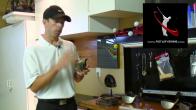
For those of you that don't know who I am, my name is Christopher Tyler.
I'm a master certified instructor here at rubberyswing.
com.
I've been teaching golf for 19, almost 20 years.
Been playing golf for 34 of my 39 years in existence, which is kind of weird to say.
And I gotta tell you myself.
Craig and Chuck have been busting our butts over these last probably 18 or so months writing this program.
And we have it.
What I would consider perfect.
And so I'm excited for those of you that are first timers to our boot camp, for you to be able to sit down and go through the information would be over the next two weeks because at the end of this two -week span.
If you follow the plan, you will be compressing the golf ball and hitting really good, tight golf shots.
But you'll also be able to start overcoming some of those really pesky faults.
Okay, and so the way this program is written was a lot of blood, sweat and tears.
Okay, there's a lot of experience with a lot of clinics, a lot of experience with, you know, the five-step program, a lot of experience with RSA, a lot of experience with the Dead Drill.
And what we've done is we've taken a combination of all of these things.
And we've really kind of whittled it down into this program of perfection, and it's awesome.
And so for those of you that are returning, you're probably going to hear some of the same information that you heard in last camp.
But you may hear some things that are different.
But for those of you that are our first timers here, We are going to be doing things a little bit different than what you might have heard around the website.
And I'm super, super, super excited to be able to bring this to you guys because we saw some really good stuff.
Last two camps, I like to be able to kind of report back on what we see from our students.
And we can tell because people are sending in swings for review.
And we saw some absolutely freaking rock star.
And I mean rock star movements.
I hope you guys are excited because tonight, Dickie, you can't see me.
so Dickie, if you cannot see me, please refresh the page.
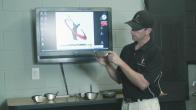
Because I am this screen right here, and then there's three screens over here are showing me exactly how I'm broadcasting to you guys at home.
And the reason why I have so much redundancy here is because this is my first big rodeo.
We've done this before, right?
So We've done a lot of beta testing.
We've done a lot of webinars with boot camp.
We've done some of the new RSA stuff.
We've also done three of these action boot camps.
So we've learned how to dot our I's and cross our T's to say the least.
So if for those of you that do run into some sort of bandwidth issue on your side, or maybe you're not able to see me, try refreshing the page.
If that doesn't work for you, then remember at the conclusion of tonight's presentation.
you're going to get a replay of everything I talked about.
It's going to go right to your inbox, and you'll be able to watch that in its entirety, no problem, for as long as you want.
Pretty exciting stuff, right?
Okay, so one more minute.
We'll let everybody come in and get settled down.
Hopefully, everybody is having an awesome start to the week so far.
So for those of you that got the PDF, The PDF is going to be up on this screen.
Everybody should have received this in their inbox.
If you did not, then hang out with us at the end.
We will get your name, and we will make sure that this is sent to you.
This is going to be your guide, and I know that you guys can't really see what's on my screen all that well, but this is just kind of a placeholder.
This is a way that I'm going to be kind of presenting the information that you guys sent.
So if you can see it, great.
If you can't, no big deal.
You have this available to you yourself, and you'll be able to follow along.
Okay?
So without further ado, let's get into the rules of engagement.
Now, as I said to you guys just a moment ago, if you follow this plan that we give you over the next two weeks, okay, if you follow this plan and you follow our rules of engagement, you will succeed.
If for some chance that you can't follow all of these rules of engagement, maybe.
Life comes at you a little bit faster.
You have other things going on.
We still have this stupid pandemic going on.
Maybe some of you get disrupted by that.
That's okay.
Okay?
We want you to work at the pace that you feel comfortable with.
We understand that there are going to be people that show up at the door with some big faults.
We understand that there are going to be some people that show up at the door with some good baseline movement that are going to really benefit from this stuff.
But I promise you, the way that we've written this program is we've taken it and we've toned it down at first.
And then built it back up.
And the reason for that is is because we learned very quickly.
Freedom, a little bit too much freedom, I should say.
You guys can create some big faults that are really tough to fix.
So we give you all of that big, big.
Early movement of axiom, where you had a lot of arm movement and we're sticking that up with lower body movement.
And quite honestly, we couldn't get in front of some of these faults.
And so what we've done is, and This is one of my favorite things about this program, and this is exactly the way that Chuck and I used to teach the clinics with one another, and this is how Craig used to teach the clinics as well before the program evolved into what it is now, is that we used to start out teaching just the release.
Why?
Well, because that's impact, right?
That's the hitting area.
That's the most important part of it also.
If you get this right, then it's much easier for you to be able to build some confidence into what you're doing.
None of you guys at home, and you can tell me otherwise.
none of you guys at home want to hit the golf ball for me.
And you guys can all sit there and tell me this.
No, I don't live under a rock, but you can tell me this if you want, that you understand that there's a process, right?
You've got to go down the ladder before you go back up.
Well, I'm going to say BS, because the way if you move your way through this program and you focus on it, the specific way.
That I'm going to outline it for you today and through Saturday into next Tuesday, and then the following Saturday when you graduate, you will be able to compress the golf ball.
Now, You're going to start out small, and you're going to have little benchmarks that you're going to be working your way through.
Some people are going to get to full swing territory.
Some people are going to be at half swings.
Some people are going to be at three-quarter swings.
I don't care.
As long as you get out there and you can press a golf ball, that's the feeling, right?
When you get out there and you hit those little shots that hiss, if they're going 80, 120, 160, 200 yards, it's all the same.
It feels the same, right?
It's that good, okay?
So rules of engagement.
You must, and I repeat must, using your camera.
Why?
Well, because you've got to know what you're doing, right?
So you have to know what you're doing.
You have to be able to back check the movements.
And I'm going to be outlining the three most important parts of your golf swing tonight and give you some very specific checkpoints.
And then what I'm going to be doing is I'm going to be taking the axiom movement and I'm going to be tying it all back together.
So that you guys leave here tonight.
And you start working through some very solid lower body movement from a backswing to transition to post-up.
And the reason why we're starting out with that tonight, and not the release, is because we want to give you ample amounts of time to be able to work on the hardest part of the ball swing.
If you get this stuff right, okay, then the whole ball swing becomes much more easy for us to manage.
I promise you.
Hands down.
Okay?
So you must use mirror.
If for any reason you're unsure about what you're doing, I can't put enough emphasis on this part.
And this is not a sales pitch by any means.
So please just put that out of your head.
If you're unsure of what you're doing, use the swing reviews.
Swing reviews are super easy on the website.
There's a tab on the website that says swing reviews.
Click on that.
You follow the prompts.
It's just like attaching email.
Okay, you can upload videos from your phone.
Super easy.
The reason why we have that in place is because we don't want you guys to suck at this game.
Myself and Craig sit here all day, every day, looking at your golf swings, pounding our head against the wall sometimes.
But at the end of it, we'd love to help you guys.
We're here to help you.
We have spots open in both of our limited swing review groups.
If you want a handheld experience in this process, then join an unlimited swing review group and let us help you because we are here in this process to make sure that you get success.
Don't feel like you're alone.
Now, some of you are going to feel like With the information that you get tonight, you're plenty fine to work on this stuff on your own.
Totally fine.
If you find that you have any questions, save those questions for us until the end.
If you find that you have questions throughout the next three or four days, save those until Saturday and then bring those with you to camp.
We'll sit here and answer questions with you guys all night long.
I have no problem doing that.
Okay?
So do not feel alone in this process.
In fact, If you guys want to start a little community group in our community forums and start talking back and forth to one another.
About some of the stuff that you might have heard here, or some of the stuff that you might like, and some stuff you might dislike, totally fine, we want you guys to communicate, it helps us.
Okay, now, ask questions during the live training, but I'm going to give you a little caveat to this one.
Okay, we have found myself, Craig and Chuck, We have found that, this little chat, and I can see the chat over here, can be very distracting to both myself and you guys at home.
So if you can do me a huge favor, okay, if you can hang on to your questions until I get through tonight's presentation, that would be super beneficial and super helpful because for those of you that don't know me at home, or for those of you that are just getting your firsthand experience of me, because I talk really fast, and I talk a lot.
If you miss something, I say, then you can go back and watch the recording.
But I can also start talking about things and kind of go up in these tangents.
That can kind of slow the program down.
And we're here to get you guys out of here in about an hour.
Okay, tonight, I'm going to tell you right now we're going to run maybe a little bit over because I got a lot of stuff to talk about.
Maybe we'll get done in an hour, but at that hour point.
Um, what we will do is we'll open up with some questions, stick around for a little bit and then we'll get you guys out of here.
So Important that you ask the questions, get those things answered before you get out of here.
Now, for those of you that have other engagements in your life and other things that you want to do and not have to sit here all night through Q&A, remember you can come back and watch the recording and you can see what you missed.
Totally fine.
In order to get the fastest results or get results, period, you must do the drills as we outline them.
I'm going to give you a certain number of reps that I would like you to complete tomorrow and the next day and the next day and the next day.
If you find that you don't have enough time to do those rest, totally fine.
We're going to just make sure that you understand that your progress might not get to the end result come next Saturday.
But if you take your time and you go through these things, go through them meticulously, and you practice the correct way, then there's no reason why you should get good results.
I know you guys are all like, just get out of interest, I get it.
Take notes.
We will give you plenty of space on this PDF to take notes, take notes.
I'm going to have you guys get up out of your chairs tonight anyways.
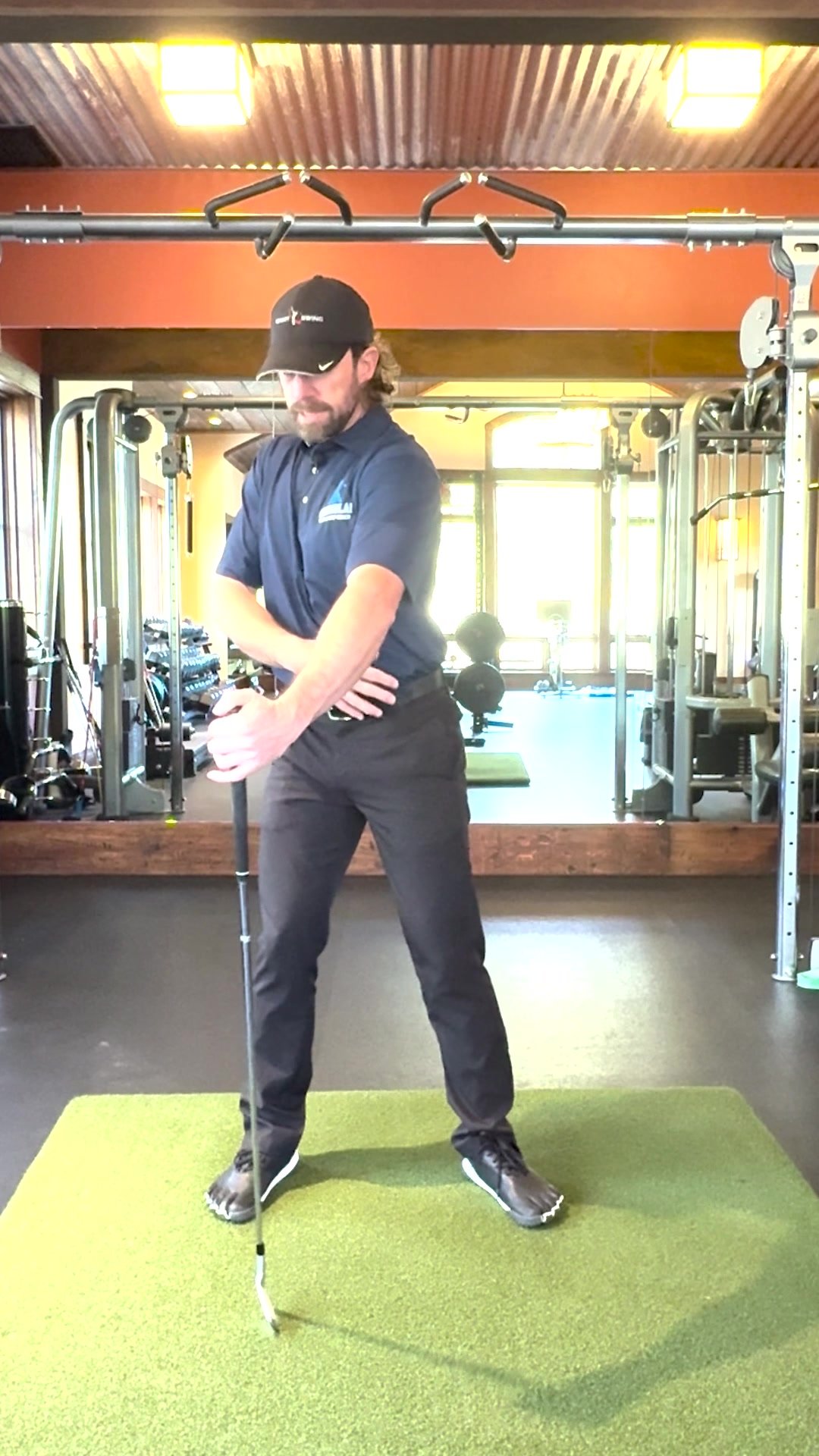
And I'm going to have you guys go through set up with me.
I'm going to have you guys go through loading, unloading and post up.
And then I'm going to tie it all together with a little secret move that we call the secret sauce.
I know that was really hokey.
I get it.
I make a lot of bad jokes too.
But you guys get used to track reps, so just track your reps, right?
So you do 80 reps or 90 reps, or 100 reps Right now, we want you to keep track of your rest.
Now, if one of you at home wants to be a little case study in this process, Or if you guys want to kind of go after this before and after thing that we like to do so much.
And get possibly a free month of unlimited swing regroups with myself or Trey, then by all means, we'll talk to you about that at the end of tonight's presentation.
So let's talk a little bit about what we are going to be doing tonight.
supercharged session where you're going to get a boat ton of information.
I mean, a boat ton, okay?
You're going to get so much information and it's going to be condensed down into an hour.
So please bear with me.
Again, you can always come back and rewatch.
So the objective tonight, and this is something that was asked to me in last camp.
And when this question was asked to me, it's changed the whole way that I go through this presentation.
It was.
What do you want us to be masters at come our next class?
Well, what I want you to remember is that tonight, when I give you this lower body movement, and then when we slow things way down and we start really working on the condensed release drills, you're still going to be working on your lower body movement into next week and through the end of next week.
Again, that's the reason why we started off with tonight's information the way that we did, because we know that this is an area that people struggle with the most.
You're going to be able to work on these things as two separate pieces come Saturday.
And then next Tuesday, you're going to be able to blend these things together.
So our objective tonight is to get you set up and to get you to impact in perfect body positions with perfect movement.
That's your objective, okay?
So the way that we're going to go through this is we're going to walk through setup first.
Now, for those of you that have been around the website for a while, or for those of you that are just kind of dipping your toes in the water now, you're probably going to hear some things a little bit differently.
Why?
Well, because I describe things differently than Chuck does.
Same thing with Craig.
Craig describes things differently than I do.
So you're going to hear some things different, but make no mistake about it.
We're all here to get you to the same goal.
So our RST fundamentals, our RST principles, we're never evading those.
Now, one of the good things that you're going to get here tonight is that I've spent a lot of time at my computer done just over 70,000 swing reviews on this website.
Okay, 70,000, that's a lot, right?
So there's different teaching techniques that I use or I've developed to be able to help what?
Well, to be able to help people at masses because we can describe something one way to you guys.
And if there's 100 people sitting in the room tonight, then 50 of you might get it and the other 50 of you might not get it.
So we have to be willing and able to be able to change the way that we deliver the information so that you guys get the most out of it.
Make sense, okay?
So with setup stuff, I'm not going to go through every single component of the setup.
Why?
Well, because that would take us a whole night.
There's a reason why this program went from dead drill that was at three weeks down to two weeks with axiom.
Because we found a better way to be able to get this information all tied together, and it's it's awesome, so setup is super important, I want you to get this right.
So for those of you at home that think that you already have a great setup, okay, just go through this process with me.
Just appease me because setup can cause thousands and thousands of problems if it's not done right.
Okay, it really can.
And I can get into all the biomechanics behind it.
I can talk to you about why too much knee flex is really bad on your knees and locks up your hips.
We can talk about that stuff.
But we're not going to do that tonight.
We're going to talk about how to get you into a good setup.
And then if you have questions on.
certain positions or certain things that you might be battling with, then we'll ask those at the end.
So first thing we're going to talk about is stance width.
Don't get locked up on stance width two inches outside of neutral joint alignment.
What is two inches outside of neutral joint alignment?
Well, if I'm standing here in front of you and you take all of the skin and fat off of me and I'm just standing here as a bag of bones, kind of where the center of the hip socket is here is right about two finger widths inside of the pointy pelvic bone in your body, or there's a belt loop right here.
If you were to drop a line straight down from that belt loop, and it went straight down through your knee and straight down through your ankle.
You can see that I'm standing in neutral joint line.
Okay, so pretty close together, my p.
All we're doing is stepping out two inches, just a little step on both sides, two inches.
Okay, don't overthink this.
Okay, don't find yourself dancing, just get yourself two inches outside of neutral and something that you guys carry in your golf bags.
Believe it or not, a sharpie, that cap, I measured it, it's two inches, So you can take a little sharp and calf foot on the ground, stand in neutral, and step up.
Piece of cake.
Okay?
Now, we're going to talk about axis tilt last because this is my least favorite topic on this website.
A lot of you are going to hear why in just a moment.
Posture.
So our posture, our job is to get ourselves over the golf ball.
Okay?
Now, there's many different ways to get ourselves over the golf ball.
But what we want to do is we want to keep our spine as close to being in neutral as we possibly can.
Now, I know a lot of you at home, especially for those of you that are doctors, we understand that the spine is not perfectly straight.
But what we want to do is we want to try to get ourselves over the ball without having a lot of roundness in our shoulders, a lot of slouching.
So a good way to get yourself over the golf ball is to feel like you're doing a hamstring stretch, okay?
So you're going to keep your legs locked out straight.
You're going to keep your chin up, okay?
And you're going to keep your shoulders back in a neutral.
You don't need to wrench your shoulders back where you're.
Uncomfortable?
Just keep your shoulders from rounding.
Okay, what we're going to do here is we're going to get ourselves over the golf ball.
We're going to go find the golf ball by keeping our chin up and we're going to hinge.
So we're going to Butt's going to go back, and our chest is going to go over the golf ball.
All right, so my big butt just went back this way.
My chest is over the ball now, you can see that my legs are still locked out straight, right?
All you need to do is just soften your knees.
okay, just soften your knees.
And now you're in a position where you're over the golf ball, right?
So you're going to hinge from your hips, feeling like you're doing a hamstring stretch until you can see the golf ball, okay?
And then you're just going to soften your knees.
That's it.
Piece of cake, right?
Now, when you soften your knees, you're going to feel your weight right underneath your ankle joints.
When you hinge, you're going to feel your weight go back to your heels, okay?
So your heels are going to get pretty heavy and your toes are going to get wet.
When you soften the knees, that moves the weight back underneath true balance.
Then, all you have to do at that point, Is just let your hands and arms hang down freely underneath your shoulders.
Now this number two up here.
Axis tilt, you've got to have it right.
axis tilt is just defined as the tilt or a spine.
Looking at me from a face-on perspective, you only need a small amount of axis tilt.
Now I want you to think about this objectively.
For a second, if your foot line, Your hip line and your shoulder line are all parallel.
And your right hand is on the club because it's lower.
Okay?
You're going to have natural axis tilt.
You don't need to add any.
Now, I know you've probably heard for years and years and years, Chris, Chuck always said hip bump axis tilt.
Okay?
So, yeah.
If you need a little bit of axis tilt because you are too upright with your spine, then the way that you're going to get axis tilt is you're going to follow this procedure.
Watch.
So we're going to keep our shoulders back in neutral, we're going to hinge from our hips, we're going to soften our knees.
And watch this little bump in my head towards the target, that's it, okay, use small now.
The reason why I'm putting so much emphasis on this axis tilt thing, folks, is because every single person, right will vouch, shows up at the door like this.
Because they get their access to that like this.
Now.
What's wrong with this?
What do you guys see?
I'll answer for you.
Weight distribution Your weight distribution is now you got your whole body leaning over on the right side.
You're in a position now when you start to shift and try to turn, it's almost impossible, right?
Stand like this is a very, very bad place for you to start your gossiping from.
You only need a small amount, so don't overcook it, right?
That's why Craig just said he's vouching we see it way too often.
So, for those of you that need a simple way to get yourself set up, watch.
Shoulders in neutral.
Stand vertically.
Hinge from your hips until you can see the ball.
Don't let your chin go down when you're trying to find it.
Just keep your chin up.
See the ball.
Soften the knees.
Let your arms hang freely.
If you need to, nudge the hip towards the target, and now that's your setup.
I want you to do that for the next three or four days.
Going through that exact procedure.
Why not?
It's a new year, right?
We've all got our New Year's resolutions set up.
Positions, I can tell you right now.
It can change swim plan, it can change your loading order.
It can make it almost impossible for you to load into your trailhead.
Think about that, so make your setup good.
I personally because I'm not playing a lot of golf these days, right?
So you know, I teach a lot, I work a lot, so I'm not out there playing golf as much as I'd like to.
So I have to remind myself to be in good posture.
Why?
Well, because sitting at a desk all day, right, you can start seeing there's some roundness from my thoracic spine up.
I kind of look like I get lazy.
So I have to do a lot of foam rolling.
I have to make sure that my shoulders aren't in that sort of slouchy, droopy position.
Makes it hard for you to turn.
So I'm going to walk you through it one more time.
Two inches outside of neutral joint.
Don't overthink it.
Get yourself a base that's stable.
Hinge from your hips.
So you can see the ball soften the knees, let your arms hang freely, a little bump in the hip towards the target.
You're good, peace kick, right?
All of that is up here on your notes and you can actually see the visuals of Chuck.
You'll see that he does show you that spine just inside the lead knee.
Do not over cook that.
I bet you a lot of money.
That there's somebody in this group that sends in a swing review over the next day or so that has too much access to it.
And you will get marked after me, Just like that.
Now, lower body checkpoints.
For those of you that have battled with lower body movements, maybe your hips coming forward, your hips spinning out, maybe your hips are getting pushed out past neutral, maybe you even have some soreness in your hips or your knees.
This is a very, very easy way for you to just kind of think about.
The loading process, the transitional phase and post -up.
And so we're going to, we're going to skip past axiom for now, we're going to tie it back together at the end of the session, you're going to see that.
I want you to actually start moving through these positions.
And I'm going to give you a kind of a super way to get into that really solid post-up position.
Which has been, like, crazy successful with just thinking about it, a very, very simple little way.
So what we're going to do is we're going to start out with back swing checkpoints, the back swing checkpoints.
I want you to think about it as a little pressure shift and big body turn, with the end goal of getting right around 90 of your weight underneath your.
I'm going to talk as a right-handed golfer.
Okay, you're going to get 90 of your weight underneath your right foot.
Sorry lefties.
I will sometimes say trail and lead side.
Um, I'll do a better job, I promise, so you're going to get about 90 of your weight underneath your trail foot.
Here.
Okay, that's the end.
With about 90 degrees of shoulder rotation.
Now.
Big thing I want you to remember is don't overthink, pressure shift.
If you were to take this belt loop on the right side of your pants, or the right side of my pants, and you were to think about this belt loop moving towards your right ankle, okay?
So think about that for a second.
My belt loop is going to move towards my right ankle.
What did my hips just do?
Well, you can see that they turned a little bit.
If you look at them from face on, what did they do?
Well, they're shifting a little bit.
The hips do two things they shift and they rotate.
don't just take the hips and start rotating them back and not shift.
That is a big no-no.
You've got to get a little bit of shift.
It's okay to move in the golf swing.
I'm not teaching you to sway, I'm teaching you to move a little bit, so you want to think about your pressure shift.
If you draw kind of a diagonal line from your belt, loop over towards your right ankle, you should feel about 70 of your weight in your right ankle.
Now, at this point, 70%.
So you go from 50-50 in a dress to about 70.
Piece of cake.
So I want you guys to stand up at home and do this.
Just a little tiny movement.
Don't be afraid.
And you're going to feel the pressure going back through the right heel, right ankle.
Now, I get myself in trouble with this because I do say right heel a lot.
I say right heel because people tend to stay too far forward on their foot.
I don't want you in the extreme heel where you're falling backwards.
Okay, within reason.
So right heel, right ankle.
You want to feel that pressure.
Now, how do we build that pressure up to 90%?
Well, we're going to turn our guts.
And how we're going to turn our guts is we're just going to take this right shoulder after we pressure shift, and we're going to pull it back behind our head.
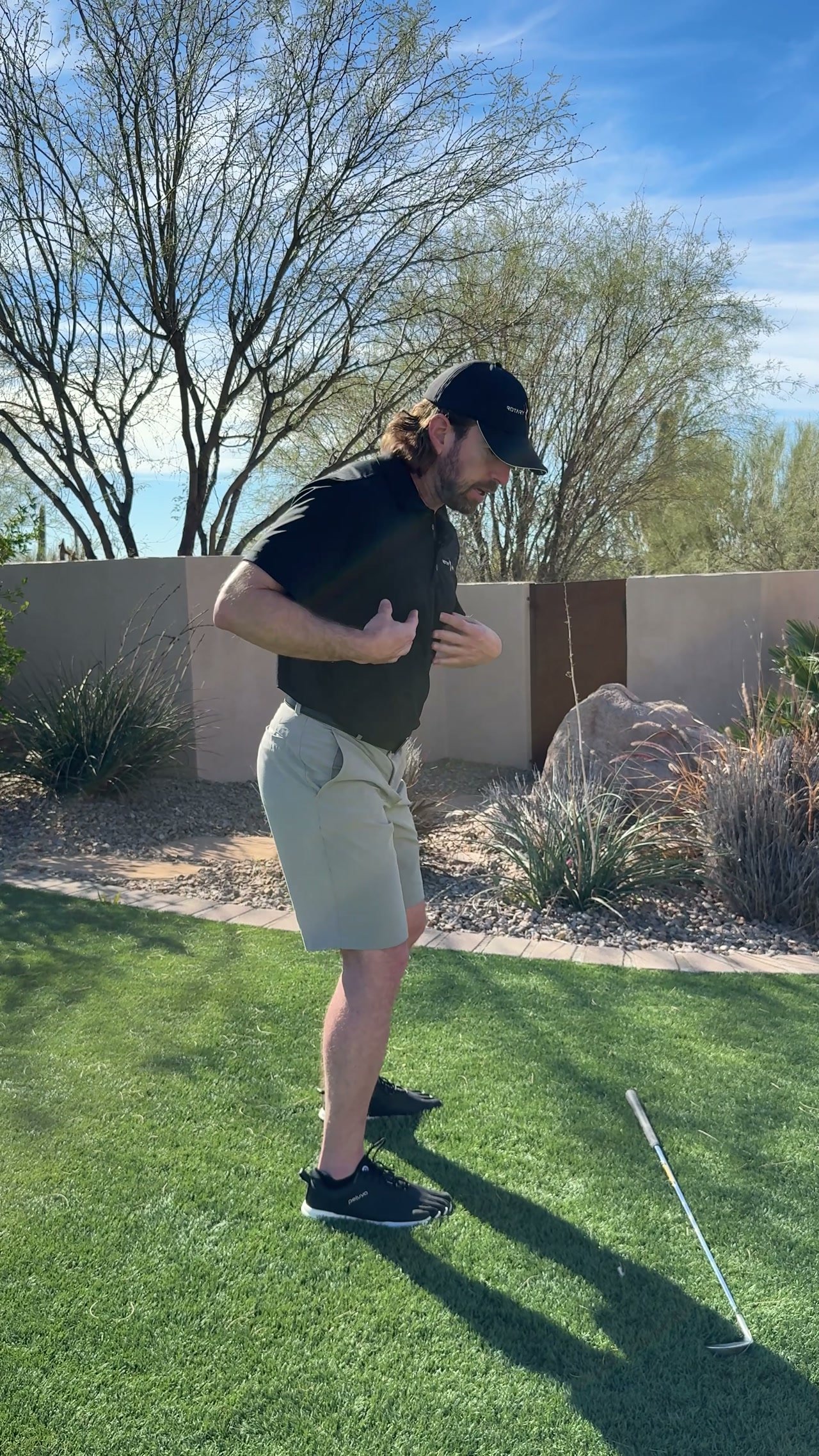
So if you take your arms and you cross them over your shoulders, you'll make a little pressure shift, and you're going to take that right shoulder and pull it back behind your head.
Pressure shift, turn.
Now you can see, A couple things are happening here.
I'm blending them together.
And what you're going to notice is is that my head did what well, watch very closely in relation to the TV back here behind me.
What did my head do?
It moved off the ball, that is fine, It's okay for your head to move a little bit, it's okay.
I know that a lot of you guys at home have been taught to stay in the barrel, stay really centered, right, really centered.
Please don't do that.
okay, please don't do that.
that's gonna hurt your back.
Anybody wants to argue with me on that?
Stick around, I'll argue with you.
Do not try to deadlock your head still.
Allow for a movement.
Inch to an inch and a half is totally fine, okay?
Now, what you want to look out for is vertical movement in either direction.
So you don't want to see your head moving up and you don't want to see your head moving down.
You want to see your head stay fairly level.
It should move about an inch to an inch and a half or so.
If you notice that your head moves down, then you're turning your shoulders too steeply, okay?
If you notice that your head is moving up off the ball, then chances are you are moving more from your lead side and you're pushing yourself off the golf ball.
So take that right shoulder and just pull it back behind your head as far as you possibly can.
If you keep your head from moving vertically and you allow it to move a little bit off the ball, and you're going to see it moves a little bit off of that little pressure shift, you're totally fine, okay?
It's fine.
Now, an end goal of that, like I said, is after you pressure shift and you turn, you want to feel about 90% of your weight underneath your right leg, and you want to feel that you've turned your body about 90 degrees.
Now, for those of you habitual offenders of having over-rotated hips, never creating enough separation between your hip line and shoulder length, simple little fix for that.
If you look at my trail leg at a dress, okay?
And you watch as I press your shift right.
And now look at my right shoulder going back behind my head.
Okay.
What do you guys notice about my right leg?
Well, you can see I've maintained some flex.
You're going to feel the medial side of your glutes start to contract.
Those are good muscles.
Okay.
Yeah, you can feel it all right.
If you keep your right leg as flexed or try to keep it as flexed as you have it addressed, it's going to be pretty restrictive.
It's okay if you lose a little bit of flex.
It's okay.
Okay.
We just don't want to see you like this.
If you look like this at the top of the swing, where you've got this big window between your knees, that's no es bueno, okay?
This is your hips over-rotating and becoming unstable.
Look at how much, if you watch me this move, look at how much my hips, my right hip, is up vertically behind me, okay?
That is a position that's going to hurt you, and it's not going to allow your spine to actually stop rotating, right?
When you free up your lower body like that, and you don't have any restriction, then your spine doesn't get any stopping point.
And your spine doesn't like two things.
It doesn't like sheer force and it doesn't like compression.
If you continue to rotate like that, you're going to hurt your back.
We're not here to have anybody's back.
Okay?
So, I want you to make sure your setup's good.
I want you to make sure your pressure shift is good.
I want you to make sure your body change is good.
Now, the reason why we're giving you this information and broken up pieces is because what I said to you guys at the beginning, giving you guys freedom of movement created a lot of really crazy shit.
Excuse my mouth, it did.
Sorry, I'll hit the swear jar for that one.
But it created a lot of faults.
We saw people not turning their body.
We saw people getting their hands and arms done.
So in order for us to be able to get in front of these faults, we want you to be able to do these really, really, what we consider important things.
We want you to do these as accurate as you possibly can.
So pressure shifting and loading into your trail side and making good body turn and trying to stabilize your hips, that's your goal.
Now we're going to talk about the hardest part of Bell Swing.
The transition.
This on a scale from one to ten, ten being hard, one being easy, this is like a 15 the transition.
Why?
Well, because a lot of things are happening here.
If you don't do this right, then this sort of negative trickle-down effect can start to happen in your golf swing.
And it's very difficult for this movement to happen.
Why?
Well, I'm going to answer it for you.
Because when I pick this golf club up, for me to move it around in space with my hands and my arms, I can do it pretty quickly, and I can make a lot of speed, right?
And I can shut my body down really fast.
If you keep your hands and your arms relaxed when we get to that point, and you focus on making this core movement happen, golf is a lot more manageable.
It's a lot more enjoyable.
The key points for transition, as outlined up here, I'm going to talk to you about them in the order that I want you to think about, is that we're going to get 90% of our weight from our right leg, and we're going to get to about 80% of our weight over to our left leg.
That's a lot of movement, right?
That's a lot of shift.
Now, in that process, the hips and knees are coming back to a square position, okay?
So they're going to be shifting, and they're going to be unwinding, but they're also going to be dropping down a little bit.
There's a little tiny sit, which is probably one of the most abused moves on the website.
People just try to make this really deep spot.
You don't need to make it a workout program.
A little tiny throw, okay?
But also, the upper body needs to follow along with it.
Remember what my upper body did going into the back squat.
What it did.
Well, it moved off the ball a little bit, right?
So we have to allow our upper body to move back in a position.
Now, I know a lot of you at home, when you do this movement with me tonight, are going to be like, he's teaching me to sway.
I'm not teaching you to sway.
I'm just teaching how to transfer your weight, just like any other hitting or throwing sport.
So the way that I want you to focus on things here is I want you to keep it simple.
All you're trying to do is get your hips and knees back to a square position.
You're trying to get 80% of your weight to your left leg, and you're trying to get your head back into its position where it was at address.
There's one little final piece here, and it's with the shoulders.
You want your shoulders to stay as closed as you possibly can, right?
So if you think about the equation here.
If I get myself turned on my right side, I've got 45 degrees of hip turn and 90 degrees of shoulder turn.
If I take my hips and shift them back to a square position and I'm trying my best to restrict my over half, how much shoulder rotation should I still have?
Well, 45 degrees, right?
So your right shoulder is going to be up, and your left shoulder is going to be down, your chest is going to be facing away from the golf ball.
That piece right there is probably the most overlooked piece.
Aside from head movement, We want your head to come back from position.
We want your upper body to stay wound.
If you allow your upper body to unwind too quickly, guess what's happening?
Your hands and arms are working out away from you.
You're losing lag.
You're changing the swing plane.
And you're going to be ultimately affecting everything that's going on down through the bottom of the swing arc.
And that's not fun to manage.
So the way the transition is going to work, I want you to think about sitting down onto your left side.
And I want your hips and knees to come back to a square position.
But I want you to allow your head.
to come back into its original spot or slightly in front.
So if you watch, I'm going to turn my body to my right side.
I'm going to sit down on my left side.
Now notice my head dropped down slightly, not a ton, and it actually went slightly in front of where it wasn't addressed.
Now you can see that I've got a lot of pressure on my left side.
If you look at my shoulders, my right shoulder's up, my left shoulder's down.
How did I get there?
Well, I want you to think about sitting down onto your left ankle about 90% of your weight and allowing your hips and knees to come back to the square position.
Let's look at that from down the line.
So I'm going to load my right side.
I'm going to sit down on my left.
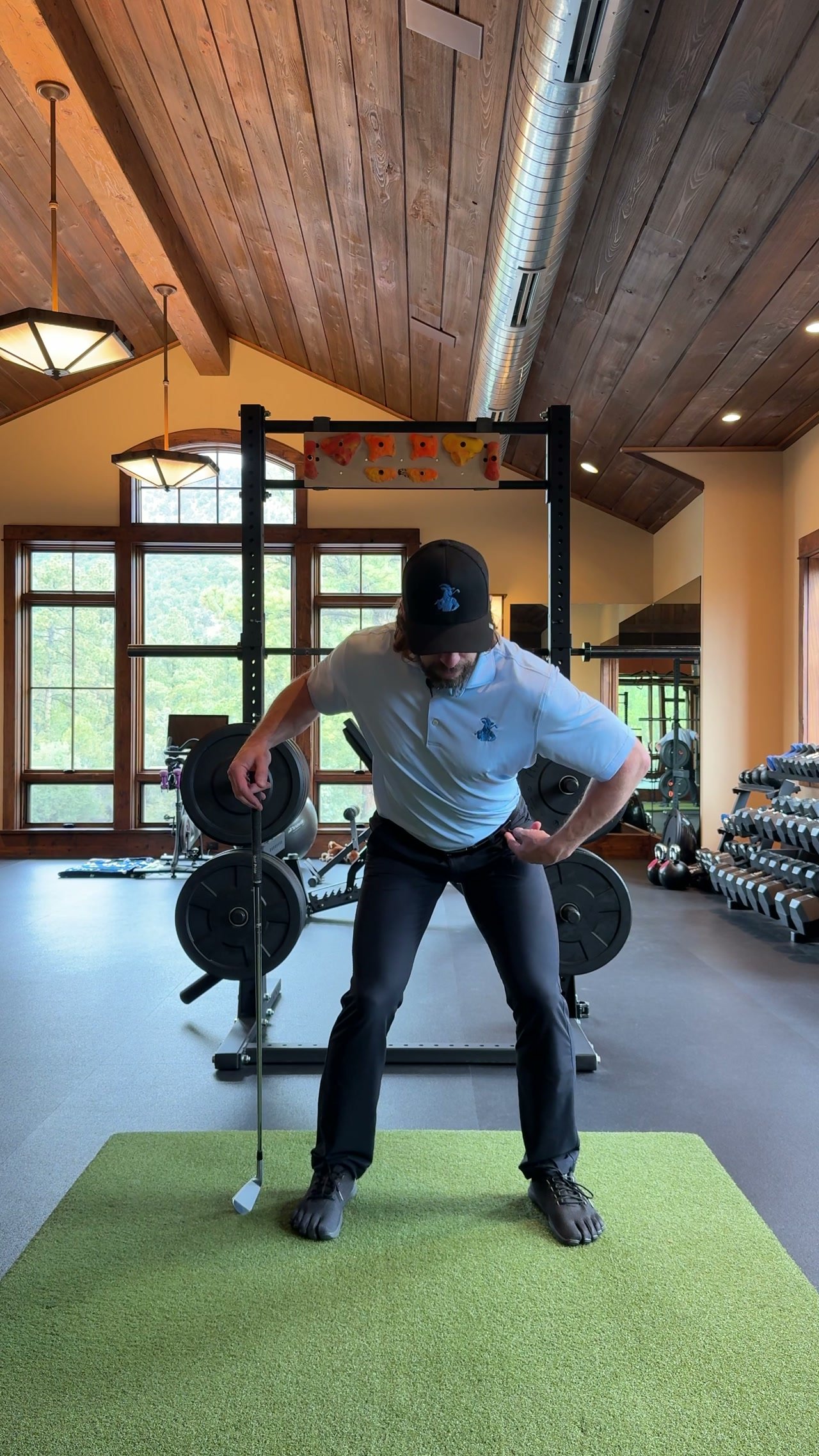
Now, I got a big rear end.
I ate a lot of food during COVID.
A lot, okay?
If you look at my butt, my butt goes back ever so slightly.
Think about your butt being kind of pushed up against the chair.
Butt goes back a little bit.
Don't let your butt go like this.
Don't get it tucked up underneath you.
That right there is one of the death moves.
So if you think about your little booty moving back just slightly.
If you look at your hips and knees, they come back to a square position.
You can see a little bit of my knee thigh here.
Totally fine.
You want to feel 80% of your weight underneath your left leg.
Why did Chris say 80%?
I've always been hearing 60 and 70% from Chuck or from Craig or whatever.
Get 80% of your weight over there.
Why?
You've got to transfer your weight.
Getting to this position right here and not getting that weight over there is leaving a ton of weight underneath your trail side.
What are you going to do with that weight?
Well, you're going to push up off of it.
When you start pushing up off of it, you create an early extension and everybody comes back to me and says, what?
I have an early extension.
Well, there's no crack, right?
So, 80%.
Squat to square.
Everybody's heard that video.
Wonderful video.
Allow yourself to sit down onto your left side.
Let's watch that again.
Allow yourself to move.
Come back into position.
Back to a square position.
Look at my shoulders.
Right shoulder up, left shoulder down.
In fact, I like to teach this by just saying, keep your lead shoulder down and your head moving back into position.
If you come back to the next stand on Saturday and you're moved a little bit too far, I'd rather have you err on getting too far over to that side.
Why?
Because it's much easier for us as golf instructors to tone that back just a little bit.
It's way harder for us to kind of chip away at this move.
How many of you look at your camera or look at your videos at home and you look like this?
Okay, this is an exaggerated.
How many of you look like that?
I guarantee it.
There's like 80% of you look like that.
Why?
Because you're afraid to move.
I get it.
It's all part of your vestibular process.
Part of your proprioception, our eyes.
One inch of movement feels like we're moving 35 inches.
It feels like we're moving all over the freaking place, right?
So allow yourself to move back into position.
So what I do to help this process out?
I don't have my mat out here is I put a ball on the ground and I will allow my left eye to focus on the back of the ball.
So I'm moving off the ball just a little bit and then I'm coming back into position, I'm trying to get my eye back slightly into the midsection of the ball.
Just a little pro tip there for you, okay?
You can try that out if you like.
Put a piece of tape on the ground.
Some of you at home like to use a mirror.
Okay, that's a good idea.
Put a piece of tape on the mirror and understand that your head is going to move off the ball a little bit.
Come back into position.
Remember, 80% of your weight now needs to be underneath your lead ankle.
Your hips and knees need to be back to square.
Your head needs to be back into position.
And your shoulders, your right shoulder needs to be up and your left shoulder needs to be down.
Piece of cake, right?
Now, let's talk about the final piece of the puzzle, and then I'm going to teach you guys how to move through this.
It's really, really cool.
For those of you that are sitting into this camp, because I did see some returning people, hopefully you guys will sit there in the chat at the end and talk about how cool this movement is, because we did see a lot of great success with it, okay?
Post-up.
Post-up, there's a really kind of fancy term for impact, right?
What is a post-up move?
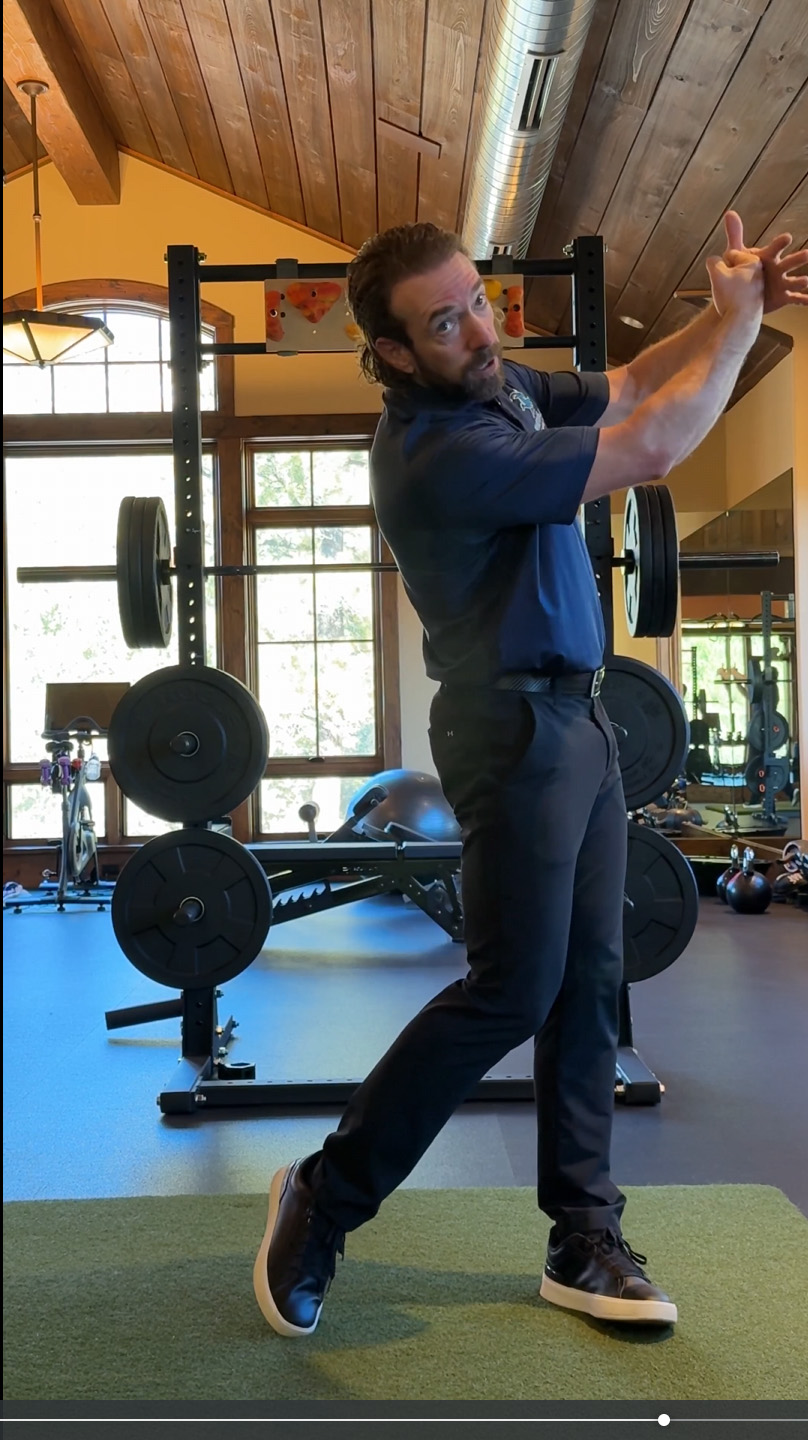
Well, the post-up is simply our left leg or our lead leg moving to a passively straight position and also rotating our hips open 45 degrees.
So 35 to 45 degrees open.
So that's what the post-up is.
Now, there's a lot of taboo around the post-up.
And there's a lot of mistakes that come out of this movement.
If you follow what I want you to do here and just keep things simple.
just by focusing on where your hips are trying to move to, then the post-run move becomes a piece of cake, okay?
Now, after you make your move and transition, so after you've completed the transition, what you're going to do here, okay, is you're going to focus on pushing your knee ankle into the ground, into the floor.
And if you have some awareness of your lead side obliques, you want to use your obliques to help move the left hip back up and away from where the golf ball is, moving in this direction.
Now, if you look at my lead leg, It's passively straight.
A lot of you at home are like, Chris, what in the hell does passively straight mean?
Let's talk about that for a second.
When I'm standing here having a conversation with you guys, I'm standing with passively straight legs.
I'm not locking my legs out straight.
Same thing with my arms.
I know that when we get to next Tuesday and we start putting the arms in the mix, it's going to be like, I've got to keep my left arm really straight.
Well, if you keep it passively straight, that's perfectly fine.
Same thing with your lead leg.
I don't want you snapping your leg back.
I just want you pushing into the floor and pulling this hip away from where the belt holds.
Now, here's where things can get really dicey, okay?
Is that post-up, for a lot of you, means that everything needs to move vertically.
okay?
If you watch here very closely from a downline perspective, okay, as I complete my transition, now watch my post-up.
Now, what did you notice about my head and my chest?
It didn't move vertically, right?
So watch again.
Okay, my head and chest stay down over the ball.
We all agree with that, right?
Do not allow your post-up to do this with your head and chest.
Why?
Well, because that, my friends, is going to lead to a lot of playing shift down through the bottom, and it's going to start getting your hands to become really active.
How many of you at home flip or scoop that?
How many of you?
How many of you have looked at your videos and seen?
This position right here, right?
I've got a lot of you.
Now, would you believe it if I told you that if you were moving up and out of posture, you're not going to be able to fix that?
You got to be able to stay in posture.
If you're moving vertically, the club is going to start doing all kinds of crazy things at the bottom.
So you have to remember, post-up means you're just getting your hips open to 45 degrees and your lead leg is going to be passively straight.
Now, there's a very safe anatomic position we'd like you to be in.
It's that neutral joint alignment position.
So if you watch after I complete transition, I'm not going to do it with all of this big body movement.
I'm just going to show you the lower half.
If you watch my lead hip here, as I'm moving it back and away, see how my hip continues to move laterally to neutral?
It also rotates open.
See it?
Now, I'm going to show you a simple way to get to that position so you understand exactly where post-up position or impact is.
From your static address position, Move your hip left, open your hips up, and keep your head and chest back.
That's what your impact position is going to feel like.
In fact, I would probably encourage a lot of you at home to try to put yourself into that position to know where you're going to be trying to go to, especially when we start putting this stuff all together.
So that's it.
That right there, those three key moves, is how I want you to practice tomorrow, the next day, and the next day.
But here's the kicker.
is that in golf, and this is the beauty of that scene.
I was a little skeptical about asking at first because I am, I'm not brainwashed.
I've just been around golf a long time.
I've studied every methodology that's out there, I promise you.
Even the guy that swings his stupid sword around and tells you that he's hitting Kentucky Fried chicken shells.
Okay, I've studied everything.
And so RST and the way it was written.
It was written by facts-based information.
It was written where it was black and white.
There's no gray area.
I grew up teaching the Jimmy Baller nine ball flight laws.
Think about that, right?
So that's where I remember my class A pro that I worked underneath when I was playing professionally.
And I needed a place to be able to teach at.
So I could, or I needed a place to go and hit balls at so I had to be a teacher there.
He made me watch the Jimmy Baller nine ball flight laws.
And then the next day on VHS tape, He put me in a golf garden and drove me around the golf course and he quizzed me on these things.
Now you fast forward many years down the road, where we have all of these fancy data tracking devices like Track Man and Flight Scope and GC Quad.
And we learned that Jimmy Baller's nine ball flight laws were a farce, right?
They blew them out of the water, they were absolutely.
I feel like I should go back in time and give everybody, hopefully nobody's in here.
I should.
I should give everybody a refund, right?
Why?
Because, again, I didn't know anybody.
And that, unfortunately, is why golf instruction sucks these days.
There's no formal training on anatomy and kinesiology.
There's no understanding of neuromuscular re-education.
Trust me, I went through PGA.
I went through PGM.
I dropped out at level two because I was like, I literally cannot take this information.
So I was like, I'm just not going to do that anymore.
And I actually went to PGA because they were giving our instructors MSR credits.
And I was out there trying to recruit, find other instructors to kind of pass our methodology along.
And they were giving MSR credits, and I said to them, I was like, your material is very dated.
Let me help you come back in and rewrite this stuff so that you're putting your instructors out there on the front line.
They're giving you information.
And so I go off on this little tangent because what we have now is just black and white stuff.
And so I was super skeptical on Axiom because it was movement.
I was like, man, I'm scared.
But I had to remember that that's what we're teaching, is we're teaching you movement.
We don't hit positions in the golf swing.
We move through positions in the golf swing.
So I saw people that were locked up without any, like they were just, you could see the smoke coming out of their ears.
Like they're very good players, but they were just locked up.
They were trying so hard to be so technically sound that they forgot that the golf swing is moving.
We don't want you to be locked up.
So it's time to start unlocking you right now.
Sorry, I'm not here to bash other methodology.
I'm really not.
Okay.
I'm here just because I like things.
just like Chuck likes them, and I assume just like Craig was.
I like things black and white.
I hate gray area, right?
I want to understand what, why, and how it works.
In fact, my two-year-old son, he has all these toys that I put batteries in all the time, and he's kind of like me.
You can see that he wants to pull everything apart, and then he's not very good about putting it back together, so he makes me do it, and chances are there's screws all over the place, but that's neither here nor there, right?
So.
How are we going to put those three movements together and feel like an athlete and feel like a golfer?
Well, I'm going to simplify this.
I'm going to give you two responsibilities.
Two.
Now, for some reason, the last camp got a little confused about this down and back movement that I'm about to talk about here in just a second.
I don't want you to get confused on it.
I just want you to think about this objectively because your job is to get your hips to that 45-degree open position.
and that lead leg passively straight.
But you're going to do that with a whole lot of help from your right side.
Now, for those of you that haven't really uncovered what the axiom movement is, the axiom movement is movement in one direction.
And I'm going to give you kind of a hybrid movement of it because I don't like having all of that excess movement.
So we're going to talk about pressure shifting, and then we're going to talk about moving off the merry-go-round, and we're going to couple it with the secret sauce.
If you are looking down at your foot, your right foot on the ground, and you think about 12 o'clock being up front and 6 o'clock being in the rear, all you're going to do is you're going to start moving the weight around the perimeter of your foot.
Now, don't powder puff this at home.
Allow your weight to move.
Now, if you look, and you can see that I'm making this pressure move around my foot, just like a fork, okay?
If you look at my knees and you look at my hips, I got a lot of movement here, right?
Don't sit at home and do this.
Okay.
You're just trying to move around.
Allow your body to move.
Unlock yourself.
Feel some freedom here.
Okay.
This right here is what we call your vortex generator.
That little circle that you're making in your foot is turning into a big circle with your body.
So what we're going to do is, is we're going to think about when our weight moves to six o'clock, that's the completion of our backswing.
We're going to start now working on the seven.
eight and nine o'clock movement as what?
Well, that's your transition.
And that is when you're going to start helping get things moving.
Okay.
Now the idea of getting off the merry-go-round.
So when you start going from six o'clock up through seven, eight, nine.
Okay.
So that's seven o 'clock, eight o'clock and nine o'clock is when your hips start doing what?
Well, you're going to start moving a lot more over to your lead side.
Right.
And getting off the merry-go-round is where everybody in rotary swing history has just been.
a little bit kind of dumbfounded by this, is that what we've been teaching is we want you to move your weight up onto your big toe.
Why?
Well, because everybody's afraid to move their hips.
Now, we have a video on the website.
It's probably my favorite video of all times.
If you haven't seen it, go watch it, okay?
It's called the roll of the right foot in the down swing, where you actually see us demonstrate the right foot rolling to the instep.
and we're keeping it down until our hands and arms get well up in front of our body.
You're going to see this movement.
This, again, is where you're going to be headed.
For now, it's okay for you, as you start working around the merry-go-round, go from 6 o'clock, and you're now going to be working to get off the merry-go-round, it's okay for you to get your big toe planted in the ground.
That's perfectly fine.
Don't be afraid to use it.
Why?
Well, I know that everybody's been taught.
for forever and a day that we should be pulled, pulled, pulled, right?
And then also things are happening pretty fast.
Let's think about a baseball pitcher for a second.
Would a baseball pitcher load its weight to his trail leg and then all of a sudden not do anything with it?
Heck no.
What are they going to do with that weight?
Well, they're going to push off of it, right?
Now, what does pushing do in the golf swing?
Well, pushing off of your trail leg can cause a lot of faults.
Think about this objective improvement, right?
So if I'm just standing there with my weight on my right foot.
and I start pushing in the direction of the target, what's that going to do to my posture?
Well, that's going to start moving me up and out of posture.
What's that going to do to my hips?
Well, it's going to move my hips past neutral.
It can also force my hips to spin out a little bit more.
Now, if I told you that I wanted you to push, but I wanted you to counterbalance it with some lead side activity here, would that get you into your post-up position?
I want you to ask yourself that question because I'm going to answer it for you in just a moment.
Yes, you can push because we want you to get things moving.
If you counterbalance it with a simple little thought of what your left butt or your lead butt is doing in your downswing, thinking about it moving down and back, and you're just moving from this right side to get off of your own, guess where you end up?
You end up in a post-up position.
Now, I just said to you a moment ago that you want to pull your left hip up and away, right?
Well, if you think about this, if my left butt is moving down and back, like I've got a chair back here, okay?
I'm thinking about down and back, but I'm continuing to move from my right side to help rotate my hips open.
Your hips will move up and away for you.
Wow.
Hopefully that didn't just blow your ass.
It runs out at home.
So all I have to do is think about my left butt.
moving down and back and I can push as hard as I want my right leg.
Yep.
I want you to try this out because I, I tested this with, I called it at first the Chrisium.
It was kind of funny.
I don't know if we talked like that one or Greg was trying to get royalties on this one as well.
Cause Greg was doing a little hybrid of this one.
All right.
So I tested this with a major league baseball player.
Okay.
Um, who is a fricking, he's an app, right?
So, and he's got a, Phenomenal golf swing like phenomenal.
But he had a lower body movement where his hips did this.
A little bit of transition, and then he really kind of got his hips opened up a lot down the bottom.
So his hips stayed forward.
So he forced him to get really rounded in his shoulders.
So it was harder for him to be able to transfer a lot of the energy from his trunk and his core.
So I tested it with him.
I said, Okay, the big thing that I need you to be able to do because you're an athlete is I need you to feel athletic.
And I said, Okay.
I want you to think about your lead butt moving down and back, and I want you to start working to push from that trail side as hard as you want.
Okay, get into that big tub, getting off that nerve and moving your left hip down and back.
And all of a sudden it worked.
And then I started testing with another one, another one, and I was like, Okay, now we're not letting people just get away with all this excess movement that's bringing their hips forward, and they're humping the goat and all this other bad stuff.
Okay, excuse my poor choice of words there.
So all I want you to think about is two things I want you to think about your knee butt going down and back, okay?
Just a small amount, a little small downward movement, right?
Down and back, okay?
So if you think about this left button going down and back from a loaded trail side, okay?
If you think about that going down and back as you're moving from this right side to this left, watch.
Watch my left button and my left head.
That's it, okay?
Down and back.
Look, I'm in that position.
Now, for those of you at home that want to stand up and do this with me.
Set up for me.
Get yourself into a setup position where you've got two inches outside of neutral.
You're over the golf ball.
You got your arms across your shoulders.
Okay, you got a little bit of axis tilt.
Rehearse this for me for a second.
Move your left hip to neutral and open your hips up.
Hold that static for a second.
Okay, hold it.
Then come back over to your right side.
So pressure shift right.
Okay, and now I want you to think about that left butt moving down and back and go from six o'clock.
up through seven, eight, nine, as aggressively as you want, okay?
So six o'clock up through seven, eight, nine, as aggressively as you want, thinking about your left butt continuing to move down and back.
Try it.
I promise you, you should be up out of your chairs right now going, holy smokes.
Now, how many of you at home have gone through your golf swing changes like this?
Okay, there's so many pressure shift, turn, squat to square, post up.
How many have you done that?
And how many of you have done extended periods of reps?
But how many of you, when you get out to the golf course, do this?
How many of you do that?
How come that stuff hasn't translated?
Because you didn't train it in movement.
That's the whole beauty of what I just gave you, is that Axiom now unlocked those movements and got you to move through the position of impact.
It got you to impact, and it did one thing that you didn't even really have to think about.
It taught you how to squat to square instantly without having to think about that.
If your left butt moves down and back and your right side helps you move through that position, okay, this position right here, okay, is where golf is made, right here.
Okay, yes, my right foot is a little bit off the floor, but watch.
Whoa, I'm going to drive through 789, okay.
Does that look all right?
Okay, this right here is where you play ball from.
I'm in posture, I'm stable.
Load right, down and back, boom.
Now, I don't want your shoulders to turn past go.
I want your shoulders to end up square at this point.
You're going to see a lot of people try to move through that position with your chest facing in this direction.
Do not move past a square position, okay?
This is your stopping point for your body.
What?
Because I want you guys to hit the golf ball with some gusto.
You turn through, you're going to hit it really short.
We'll talk about that on Saturday.
So how many of you at home are like, what the hell did Chris just say to me?
All I've got to do is move my left foot down and back.
Exactly.
Think about when you move that weight from 6 o'clock on your trail foot, and you're going through 7, 8, 9, so your weight should be moving off of this foot.
And you're going to 9 o 'clock.
And all I've got to do is take my left foot and move it down and back, down in the spot.
How many of you at home think you can do that for the next week to two weeks?
How many of you at home are a little bit skeptical?
Okay, try it.
Try it first.
If you find over the next couple days that you've tried it and you haven't really gotten success with it, send it in for review.
Let us look at it because, again, I sent this to you guys at the start of the session this time.
Some of you, or maybe 50%, I'm not going to give you percentages.
Some people may not resonate with.
If you need something different, remember, I'm here to get you the end goal.
What I would suggest that you do is start out at a static address position, go through that setup.
I'll walk you through it again.
Two inches outside of neutral okay, hinge from your hips, butt, back, chest over the golf ball, soften your knees a little bit of axis tilt.
We're going to load to our right side now.
What we're going to do is we're going to move through that position.
Seven, eight, nine, and we're going to think about our left butt moving down and back.
Now, go to the place where you're trying to go before you try to move to that position.
Put your hip over to neutral and open your hips up.
Head and chest stay back.
Put yourself here.
Hold that static.
Come back into the static address position.
Lower right.
And move back to that spot.
Down and back.
Push as hard as you want on the right side.
Piece of cake.
Right?
So your goal between now and next Tuesday is to get as many reps as you possibly can.
I like for at least 100 reps per practice session.
100 reps.
May seem like a piece of cake.
It can be a little bit of work.
Okay, 100 to 300 reps.
If you don't have time for your 100 or 300 reps, just do some right.
Just do set up, maybe work on loading your backswing up, or maybe do those in three pieces for the next day or two.
I want you to be able to show up next Tuesday, not this Saturday.
I want you to show up on Saturday with questions.
Or, you know, um, you know, continuing to work on things, but next Tuesday.
I want you to be pretty proficient in that movement now over the next day or two.
If you start real slow and you're kind of working on, you know, feeling the weight, move around your foot and then you're kind of all right.
I'm going to do some kind of broken up drills here, totally fine, everybody needs to practice a little bit different.
Your goal is to get yourself loaded up and get yourself to impact, right, just like I showed you, impact position that matters the most is right here.
Our hips open 45 degrees, I'm in posture, my shoulders are square.
You get to this spot, then all of the stuff that I'm doing on Saturday, this upcoming Saturday, is going to meld back together with that.
And that's when you're going to start hitting shots.
And some of you on Saturday are actually going to start hitting golf balls right away.
Think about that.
I'm already starting to hit golf balls?
Yep.
And you should be able to compress it.
It's not going to have a lot of big freedom to it.
But we're going to get you hitting the golf ball right away.
Why?
Well, because in order for this stuff to work, we've got to stop the.
whole notion that we shouldn't challenge our subconscious and that we're just going to build these great practice things.
You have to challenge yourself to put a ball there.
Why?
Because your brain, unfortunately, is what's working against us.
We have to challenge our subconscious.
We have to.
That's what I spend all day and every day doing is I can teach people movement pretty quickly.
But teaching you how to practice it and teaching you how to get his golf course is the hard part.
So I just gave you guys something that you could actually take to the golf course.
Pressure shift to six o 'clock.
Move through seven, eight, nine.
Get to that spot.
Have a ball, right?
It may not be perfect at first, but at least you have movement now that's going to allow yourself to kind of chill out your hands and your arms and now at least play some ball.
So 100 to 300 reps a day.
I would geek out all day long.
I was epileptic as a kid until I was like 12.
And so I'm fascinated by the brain.
And so I have really kind of dedicated my life, not just from the golf instruction standpoint, but I like to understand how to get people better at this stuff.
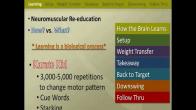
And that's what makes us dangerous here is that we actually talk about this part, because nerve muscular reeducation is something you don't hear anywhere else.
If you need a video to go watch about the processes of changing your brain, go watch the backwards brain bicycle.
It's seven minutes long.
It's on YouTube.
It's on a channel called Getting Smarter Every Day.
It's this high IQ engineer.
His name is Destin.
He has a bicycle built for him where the handlebars turn the exact opposite way.
Everybody automatically thinks about it.
How easy that would be, right?
Why you're just changing is the direction in which the handlebars turn.
But think about that for a moment.
Think about all of the moving parts that you learned how to synchronize as a kid to be able to keep that bike upright and keep it moving.
Think about it.
Then it becomes that age-old expression like riding a bike, right?
To rewire that one thing, that one movement, it took him quite a while.
You'll see it in the video.
And so you have to also remember that if you go through this process, and you continue to challenge yourself and you practice the correct way, which I'm going to be doing an RSA webinar on Saturday before our actual session number two, is I'm going to teach people how to practice.
I have to tell you, if you learn how to practice the correct way, then you get to the end results.
If you practice the wrong way and you just expect results because you're doing a lot of movement, then chances are you're going to end up at the next move game, right?
And I don't want to say I want to cut you guys free.
I want you guys to play some golf.
So, with that being said, thank you guys very much for bearing with me tonight.
I wish you guys could have seen the chaos that was ensuing around here when I was getting ready to come on tonight.
I was, like, sweating.
It was just a tough time.
So, I appreciate you guys sticking around for me or with me for tonight's session.
Remember, a couple things here.
You're going to get a recording of tonight's session.
Okay, so you can go back and watch it anytime.
Remember to use the freaking swing reviews.
Okay.
Please don't be afraid.
I'm not going to make fun of you.
I'm here to help you.
Okay.
Your success is what I want.
Okay.
I'm not just a talking bobblehead.
We're full of a bunch of hot air.
I want you to succeed because I don't know where it worked for me when I stopped playing golf professionally, but I love to watch you guys hit the golf ball really well.
I really do.
I love watching you guys hit and seeing you guys smile.
It's awesome.
Okay.
I see people are asking about the backwards brain muscle already.
Have fun with that video.
It's kind of fun.
Like I said, I can geek out on neuromuscular reeducation if you guys want to talk about it.
So with that being said, for those of you that are going to get out of here, have a great night.
Thank you very much for sitting with me in this supercharged session.
We will see you on Saturday at 12 o'clock Eastern Standard Time.
For those of you that have some questions, I'm going to stick around for a few minutes and answer some questions.
I will ask one really big favor.
Don't ask me questions about lag or driver.
Don't do that.
Keep the questions in relation to what we talked about here tonight.
I don't want to get a lot of stuff in people's brains that doesn't need to be there yet.
You're going to see that as we start adding more pieces in here that you can ask other questions that are permanent to lag.
I know that tonight's session is not the sexiest one, but remember, we're doing this for a reason.
This is what we've seen.
You get the setup done, you get to that impact position with some movement here.
Then what we're going to do moving forward is just add the hands and the arms of the club to it.
And that's when you start getting balls, all right.
So who's got questions?
Should you practice setup and the rest separately?
Sure, so setup can be.
You're going to get to a point and I will.
I will say this if you're diligent and you spend the next probably three to five days with making sure that your setup is perfect, going through that little step-by-step process before you do any reps on loading or movement, then you're going to find that that's going to become a piece of cake for you faster than anything else.
Why?
Well, because that's a static position.
Don't overlook it, though.
So if you want to just spend tonight or tomorrow just doing setup to make sure that's perfect, fine.
But there are going to be people that want to get reps into the movement.
I'm kind of.
I'm both ways in this.
I want you to move, right?
I want you to feel like you can move.
So I would rather have you get set up and some of the loading and transition and some of the post-up stuff in there.
I would like for you guys to challenge yourself to try to get that movement going in the next two days or so.
So at least you're trying to get yourself to move from six up through seven, eight, nine and getting into that post-up position.
Because if you're not doing it correctly, Then Saturday is going to be the day that I want to get that cleaned up with you so that you can spend those next two days and come back on Tuesday.
Because Tuesday is when I start taking the lower body movements and tying the release stuff together with it.
And we start working your way up through compression drills and making the swing longer.
So, again, this program is written very, very fast -paced for a reason, right?
Because we want you guys to get success and get started on this stuff.
Go out there and start playing golf with movement.
All right.
So.
How much weight should be on your left foot at post up?
So 80 to 90%.
So it's going to increase a little bit after transition.
So you're going to feel about 90% on that side.
Great question.
So Chris, that was it.
Actually made a lot of sense right away, but I messed up in my swing and lost the movements and agreed with the dead row.
I was coming out of posture at post up.
Sorry, I'm reading more of this.
It's moving with the left foot down the back.
Perfect.
I love that.
So it's a simpler way to think about it, right?
It's kind of a hybrid movement.
So beef stir fry.
I don't know what you're having, but that sounds good.
I made a really good French onion soup this time.
If anybody wants a good French onion soup recipe, I've got to tell you, I might be.
My mother-in-law told me I could sell it.
I was like, I'm not selling a soup.
Chris, show us the post-up from the front view again as well as from the lead side.
Okay, so post-up.
So I'm going to do it after transition.
So I'm going to low change my trail side.
Sorry, my stance was too wide.
You didn't see me catch myself.
Transition.
Now I want you to watch my post-up from my lead hip and my lead leg.
Okay, so you see how my lead hip is moving this way.
So it's moving back and away.
I'll show you from up the line.
I think this is a good view.
So transition, back it away.
So again, neutral joint alignment is gonna be drop that line straight down through the center of the ankle.
This is out past neutral, this is inside of neutral.
When you get inside of neutral, I should have probably mentioned this in the session tonight, you leave yourself really, really open to a whole lot more rotation of your hips.
Watch what that looks like.
So if I don't make it to neutral, okay, your lead leg's gonna look like this.
See how my weight kind of fell back on my trail foot here?
So you need to get to neutral.
Make sure you get to that spot.
So 90% of whatever you want.
Man, I got requests for the French -Chinese soup.
All right, I got you.
I got you.
So left butt down and back is prior to post-up.
So it's actually moving you through transition into post-up, believe it or not.
It's happened right away.
So as soon as you start moving from 6 o 'clock, if you just think about keeping that left butt moving down and back, It moves you to that spot.
So don't think about the timing of it.
Think about as soon as you start your down swim, left butt down and back and push from that right side.
That push movement is helping do a few things.
It's helping you rotate your hips and it's helping you shift your hips.
If you counterbalance it with a down and back movement, it does what?
It introduces squat in the middle of it and it moves you to post up as that hip's moving back.
Pretty crazy, right?
Greg, I know you love it.
Is there a checkpoint for axis tilt?
Yeah, there is.
Sorry, I'm going to just explain to you just because axis tilt is just people set up with too much, okay?
So if you look at my spine, so I'm standing there vertically, okay?
It's right down the center of my sternum.
Move your hip towards the target.
It's just inside your lead knee.
You don't have to have it all the way to your lead knee, okay?
It can be just a little tiny bit.
Again, if your right hand is lower on the club watch, okay, I'm obviously I'm ingrained because I've played golf for a while, so we walk in, my right hand comes on the club.
I have natural access without having to bump my head towards the target.
You probably already have some, I promise you, trust me on that one.
When I tell you that we see way too many people set up with way too much of it, access is super important.
Okay, it does put your right side in the passive position, It does allow you to rotate around your spine without working into reverse pivot.
And so it helps put the head behind the ball as well.
So it's a passive sort of right side movement.
So just don't overcook it.
So I've had the tendency to move past NJ, down and back movement may help fix that.
Other thoughts on how to prevent it.
So just make sure that if you focus on deep, deep, deep, like you in your case, you need to focus on the deepness out of depth of that left butt.
And that will keep you from getting slid out past neutral.
Okay, you have to remember if you're getting pushed out past neutral.
That's too much lateral movement, right?
What sort of movement did I introduce?
That's going to counterbalance that well back, right?
So when I practice my second posture with the club, how far should I be away from the ball?
Awesome session today.
So much today.
Well, thank you Jeremy.
how far away from the golf ball should you be?
Great question.
So, Set up.
So this is a nine iron.
So when you hinge from your knees, you need to get yourself over the ball and then your hands and arms need to hang freely from your shoulders.
You don't want your hands moved that way from your body.
You don't want to hold it.
A good checkpoint for you is you want the center of the elbow to be directly underneath the center of the shoulder.
Okay.
You can see that at home here.
I don't have my arms pushed that way.
Now, as we go through the bag, golf clubs are going to do what?
They're going to get a little bit longer.
Right?
So when my club gets a little bit longer, let's just say I have a free iron, what's my spine going to be doing?
Well, I'm going to hinge just a little bit less.
It's very, very minimal.
Remember, you want your hands and your arms to be hanging down from your shoulders.
You don't want them moved in any direction.
You want your shoulders neutral and your hands and arms hanging free.
Now, one big mistake that I see a lot of students make is that they try to pick your hands up at a dress.
Look at my hands.
And what that does is it soles the club perfectly flat on the ground.
But you would think, well, Chris, don't I want to have the club perfectly sold on the ground?
No, you don't.
In fact, you want the club up off the ground.
Why?
Well, because there's something that happens in your golf swing that you don't realize is happening.
It's called shaft troop.
The club shaft actually flexes in this direction.
It flexes like this on the way down.
It's called shaft troop.
It's how the center of gravity lies itself over the handle.
So that's why if you've heard us playing professionals talk about we have our loft and lies adjusted, that's what we're doing.
We can bend the club of the hosel either upright or flat, just depending on what our swing is like.
So always make sure that your hands and your arms are hanging there and the club is resting your hands.
Do not start with unwanted tension.
It's hard to get rid of.
Yes, the chin line.
So when your end of your right hand, this is another line that you can use, is the end of the right hand underneath my chin.
If you drop the line straight down, you'll notice that it goes right down on my right hand.
Okay.
Do you perform the complete move in the compression drill, or is it less rotation back and through?
Do you perform the complete move in the compression drill, or is it less?
So we're not doing anything as far as compression drill is concerned yet.
Tuesday, next Tuesday is when we're going to start that.
So I'm not sure.
I can answer that question.
I mean, I want you to make a good full body turn going back.
I want you to try to get that piece in there.
A lot of it, I want you to try to focus on your lower half and getting to that position.
Then try to get, you know, a good solid turn, then move into that position.
You can start kind of stacking those pieces together.
Remember, the end goal between now and next Tuesday is to be able to do this.
It's to be able to load and get to here, right?
Okay, now you have some specific checkpoints that you can help with your backswing, with squat to square.
how much weight you're going to have.
You understand that you can have this sort of approach where you put yourself in impact first and then kind of move your way into that position.
But you're going to find, and I'm just going to tell you right now, that most of you at home, doing things in three pieces, you're not going to have to spend as much time doing that other than just kind of focusing on your shoulder rotation, going back, your head movement in transition.
You're going to find that you want to get the movement going right away, right?
If you notice that, hey, I'm shifting like this when I'm driving off my right foot.
Then go back and do a bunch of transition drills where you allow your head to come back into position right and then start tying it back together with move right.
Think about how to, how you would want to practice these things to get to the end result.
Start small and then build on top of it.
And if you come back and you started real small and you weren't able to kind of progress your way through it.
Then just let me know, right?
We'll sit in the chat, we'll help you get through this.
So, all right.
I think I'm missing the move back to the left side in transition, 80%.
So, yeah, so that right side, when you're moving from 6 o'clock up through 7, 8, 9, okay, you can see that there's movement, right?
Look at my head and my chest.
Guess what it's doing?
It's coming back into position, right?
And it's going to stabilize as soon as my left head moves, starts moving down and back.
So, June, thank you very much for joining us.
Have a wonderful rest of your review.
We will see you on Saturday.
All right, so it looks like we are winding down.
You guys have been awesome.
Thank you guys for asking great questions.
Go to work.
Come back on Saturday with questions if you have some.
Don't feel stuck in this process.
Please send in reviews if you need it, okay?
If you want the hand-holding experience, join the Endless Review Group.
Those guys are the ones that get the priority reviews.
They get those back quickly.
If you find that you're just struggling, Please do not hesitate to ask questions.
Because it's very important to myself and to Craig and to Chuck that you guys walk out of here with an intellectual understanding of what you're doing, but you understand how you're going to get this stuff done.
Okay.
So you guys are awesome.
I hope you guys have a wonderful rest of your night.
Thank you.
We'll see you on Saturday.