




































































































































Webinar 5: The GOAT Hands Webinar
Sorry, you need to be a member to access this video.
You Are Just Seconds Away - Become a member here!
Already a member? Log in now
Try a free live lesson with GOATY
GOATY, my AI golf coach, watches your swing through your phone camera and coaches every rep. Free, about 20 minutes, no credit card.
The GOAT Hands Webinar
Hello, everyone.
Can you hear me okay?
Can you guys hear me?
My cold bed cover's falling off.
You guys hear me good?
Perfect.
All right.
How is everyone?
Thank you for sharing your Tuesday evening with me.
Everybody can hear me well?
Perfect.
All right.
Awesome.
All right, we're going to give just a few moments just to let everybody jump in the room and then we're going to get rocking and rolling here.
Everybody can hear me?
Perfect.
Perfect.
Cool.
Thank you so much.
All right.
We're talking about the hands.
Now, the hands are perhaps the most confusing part of the golf swing.
And what I'm aiming to do with this webinar and perhaps a series of webinars, depending on how far we get tonight with questions and everything.
is to simplify what the arms are really doing in this one what the hands are really doing in the swing the trick to all of this is understanding how everything is connected and all works together and what i see all the time in my urgs and swing reviews is a lot of the stuff i want to cover tonight because i see a lot of the same stuff over and over again and so what we're going to do tonight is make sure that you understand how to get from point a to point b how do you understand how to move your hands throughout the swing Now, the trick to this first starts off with the grip.
This is the most overlooked part and perhaps the most important part of the golf swing.
So I'm going to spend just a few moments going over the grip in detail because without a proper grip, you can't make a proper swing.
And I see this all the time with golfers with really weak grips or not knowing what it should feel like in your hands and your fingers and so on.
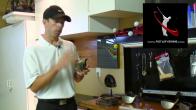
So I'm going to come up close to the camera here.
And I'm going to show you very much in detail some of the things I see all the time and how to fix them.
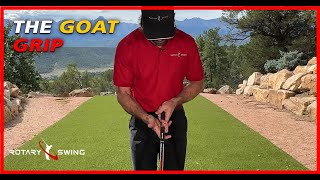
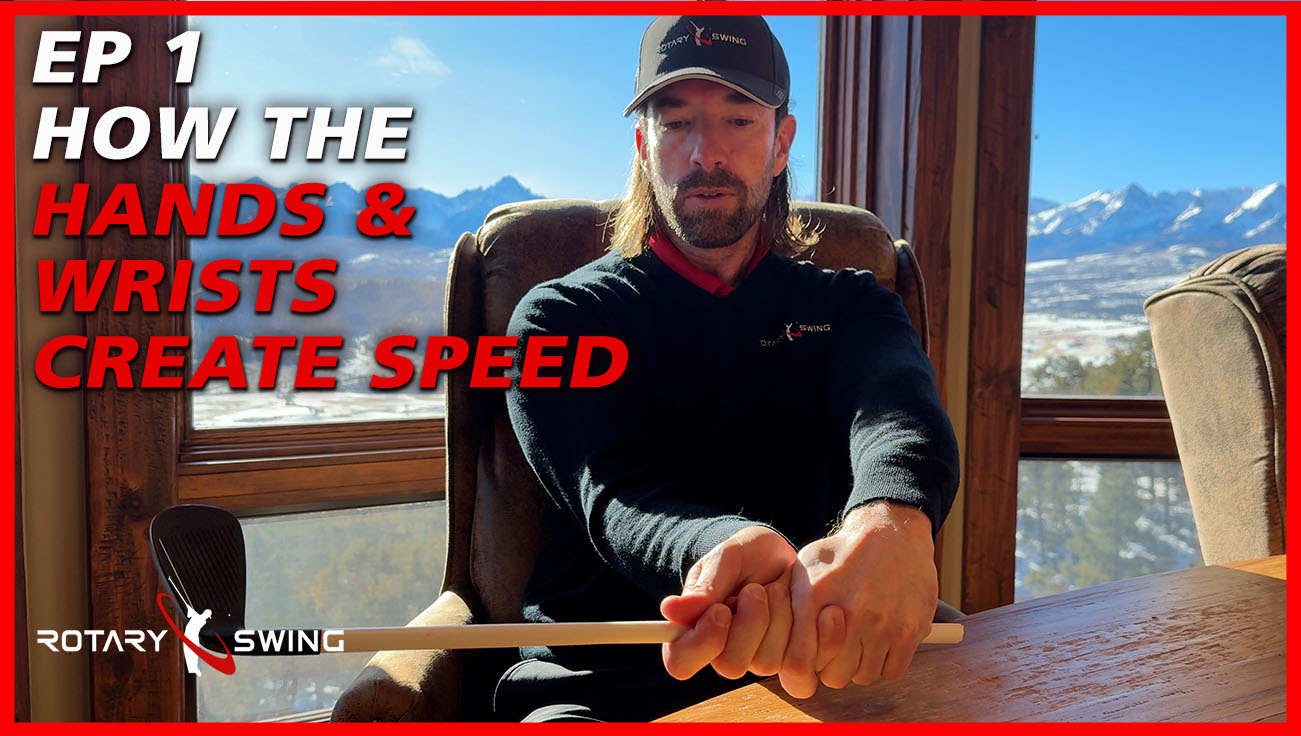
So the first thing we're going to start with is the left hand.
Now, this guy here has to work even in a trailside dominant swing.
Just because you're trailside dominant doesn't mean your left hand, your lead hand doesn't do anything.
Of course, they have to work together.
Everything has to work together.
So one of the keys that I see all the time is a very, very weak.
lead hand now you can play golf with a weak lead hand but we're going after the goats right we're really going after how tiger and jack and how these really really great players played and tiger especially has always had for the most part a relatively stronger grip now the reason this is important because one of the keys that we're going to get to tonight is we're going to try and get everybody to perfect this first part off the ball because it's if you start off with the takeaway wrong everything's going to go wrong.
And what you're going to find is that most golfers take the club inside their hands.
Now, just real quick on the screen there, how many of you have the club head go inside your hands?
Just real quick.
I bet out of the 200 people that are on live right now, I bet probably almost everyone, only for 30 years.
Yeah, exactly.
You do not.
There's a few people that don't.
But almost everybody struggles with the club going inside.
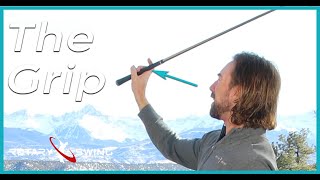
And the first key to getting this right is this lead hand being set up so that this little notch, I'm going to move my glove here.
You can kind of push down between these two little bone here and the ligament here.
There's a little soft spot right in here.
And this little soft spot needs to sit just to the side of center of the shaft.
If it sits way over here, what's going to tend to happen is this wrist is going to want to go into flexion, bow early.
And of course, that's going to send the club ripping inside.
What you're going to feel in just a moment when we start working on this takeaway is that you need to feel that this hand, the lead hand, can push down on the butt of the club just a little bit.
This is going to help the club go up and stay outside your hands, which we'll look at in a moment.
So once you've got kind of this basic feel of your lead hand and the old classic line between your thumb and forefingers going towards your trail ear, give or take a little bit, I want to see this logo.
This is really, really important.
You need to be able to see the logo of your glove.
Again, if you're doing like this, I see this all the time.
It's really hard to control the glove.
And my goal with the glove is that my hands do as little as humanly possible to square the face.
And so we've got to get this grip like this.
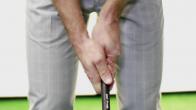
Now, once you're here, once you start to put your trail hand on, it's very important to get it in your fingers.
there's some internet footage of tiger and charlie his son charlie kind of gripping the club over and over again a couple times and they really kind of show how much both of them are really trying to get the club into their fingers and their trail hand and you'll see that a lot of times i see this stuff this is deck if you're gripping the club like this we cannot pass go cannot collect 200 you've got to get the club in your fingers so you can see my wrist is kind of arched back here And I'm really being able to get it deep into the cradle of my fingers and move a little bit closer here.
And then that's going to make this right finger, my index finger kind of have this old school crook in it.
You know, you've seen a lot of old school guys talk about this.
The more you get the club in your fingers, the more you're going to find that that finger wants to sit like that.
So now with my grip completed here, I shouldn't see a big gap between the top part of my thumb.
and my trail hand.
You see how you can't really see my pants very much behind it?
I see this stuff all the time.
This is impossible to play golf like this.
So understand that if you get the hands to work together correctly, everything else is so much easier.
So now you'll see that my fingers clubs deep in my fingers, which allows my palm, turn this way a little bit, to wrap over this thumb.
And now one of the keys is understanding What does this lead thumb do?
One of the things that Hogan talked about for years later after he wrote his book is that he felt that having a quote unquote long thumb versus a short thumb, this would be a short thumb.
This is a long thumb where it's kind of going down the shaft.
Helped stabilize the face for him and gave him some more control.
A long thumb, Tiger does the same thing.
And you'll see the reason I'm wearing this glove because it's very easy to see what my thumb sticking out.
So you can see I kind of got a little pig in the blanket.
My thumb.
him is is part of the pig and my right hand is the blanket and so as i close my grip you see that as my my thumb and forefinger of my right hand come together i cover up my thumb but my thumb is right there it's right toward the end and so i have a little bit of a long thumb and as you get to the top it's kind of easier to help control the face a little bit if you've got this long thumb versus short thumb now you can play both ways short and long but the goat tiger he has a little bit of a long thumb and that gives what's really cool about that longer thumb is it takes up all the space in your palm so now as i wrap my thumb my trail hand over that thumb is filling in all this gap in my palm here if you feel like your grip is really loose you probably are playing with a really short thumb and you've got your hand out of position but if you get this thumb going down the shaft and get that thumb that your trail hand wrapped over it now Like Hogan said, your hands should feel like they're welded together.
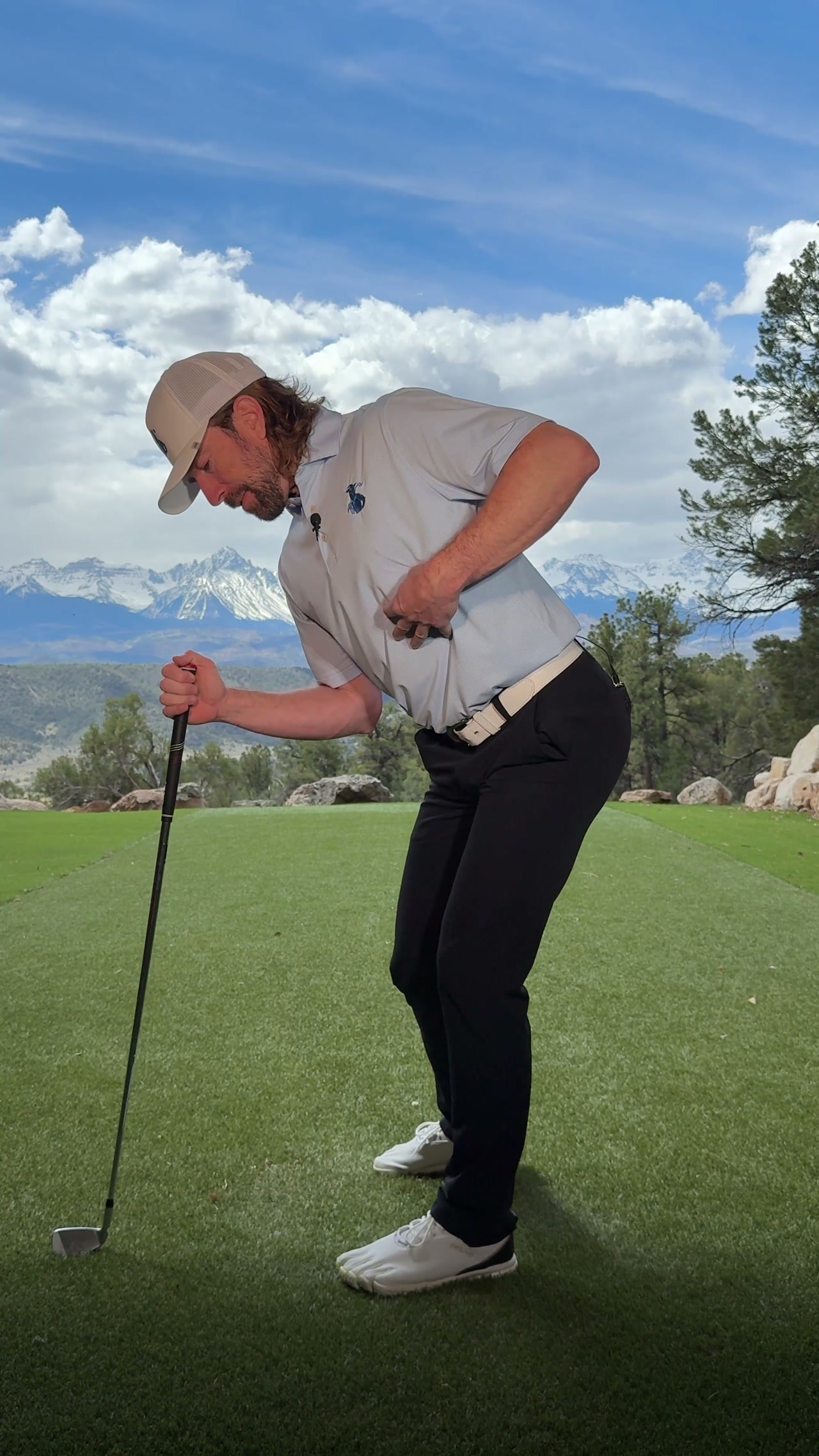
Now, the next most important part of this grip is that your hands should feel like this at setup.
I'm exaggerating this a little bit, but what do you see here?
What do you see in my hands?
Notice that my left hand is really cocked or an extension there, and my trail hand inflection or bowed a little bit.
This is what your hands should feel like.
Again, an exaggeration here, but this is what they should feel like at a dress.
Now, why should they feel like this at a dress?
Any ideas?
I'll give you a couple seconds to think up an answer here.
Your hands must feel like this because if they're set up like this and you get into impact, how are you going to square the face?
So if I'm like this and I get like this, my clubface is going to be square.
Let me show you.
So I'm going to have my grip all welded together.
I feel, again, I'm exaggerating this.
I feel like this.
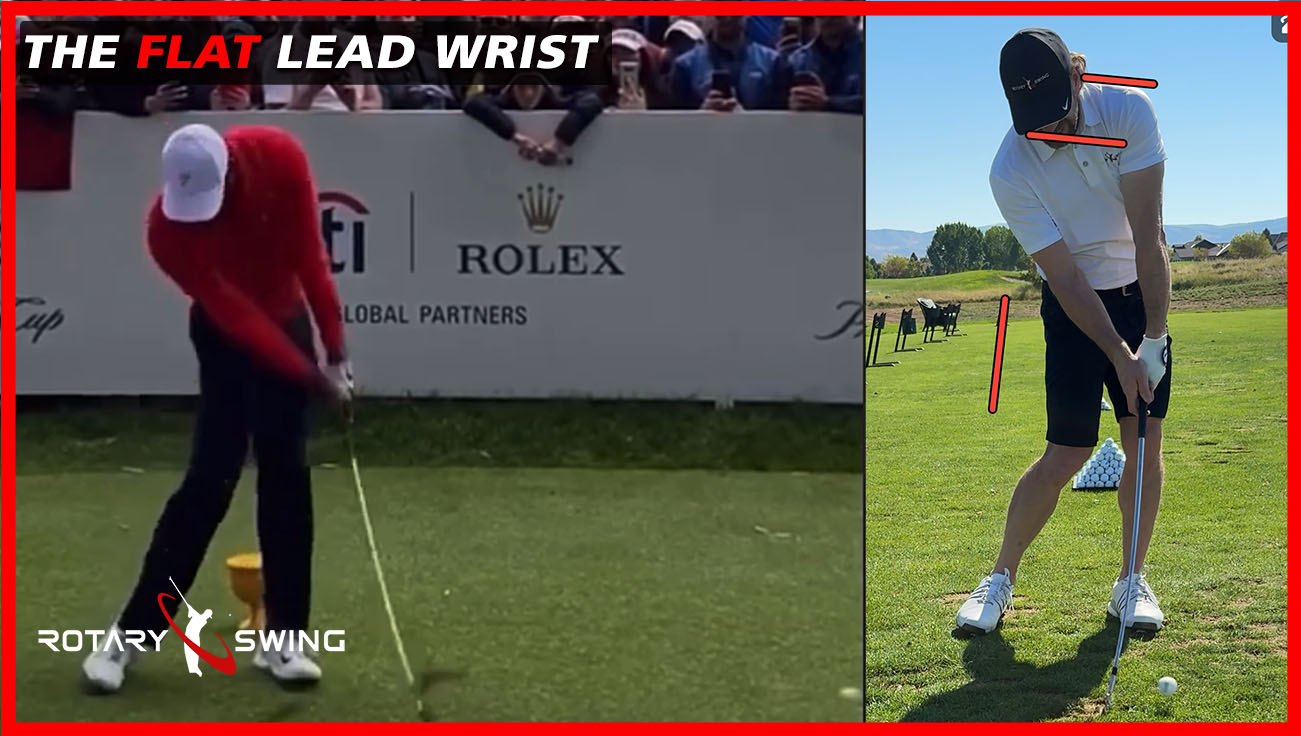
And then if I get into my impact position, my clubface is square.
So I've got it lifted off the ground.
You can see the clubface there.
But I could have my hands way out in front here and still have that clubface squared up.
But if I'm like this and I got this weird grip and I get my hands forward, well, now that clubface is wide open.
So you need to feel like this in order to be like this at impact.
So it's really important that you kind of start practicing feeling this slightly exaggerated motion.
Now, when I do it normal, it doesn't quite look that goofy, but you can still see I have a little bit of flexion in my trail hand and my lead wrist is a little bit of extension.
Again, that's going to help me at impact.
So if you can get just these simple little details right about the grip.
Your life will be so much easier.
But without this stuff, the next part that we're going to talk about is impossible.
My goal for tonight is to get everybody for the next few weeks to just perfecting this one key move of the swing.
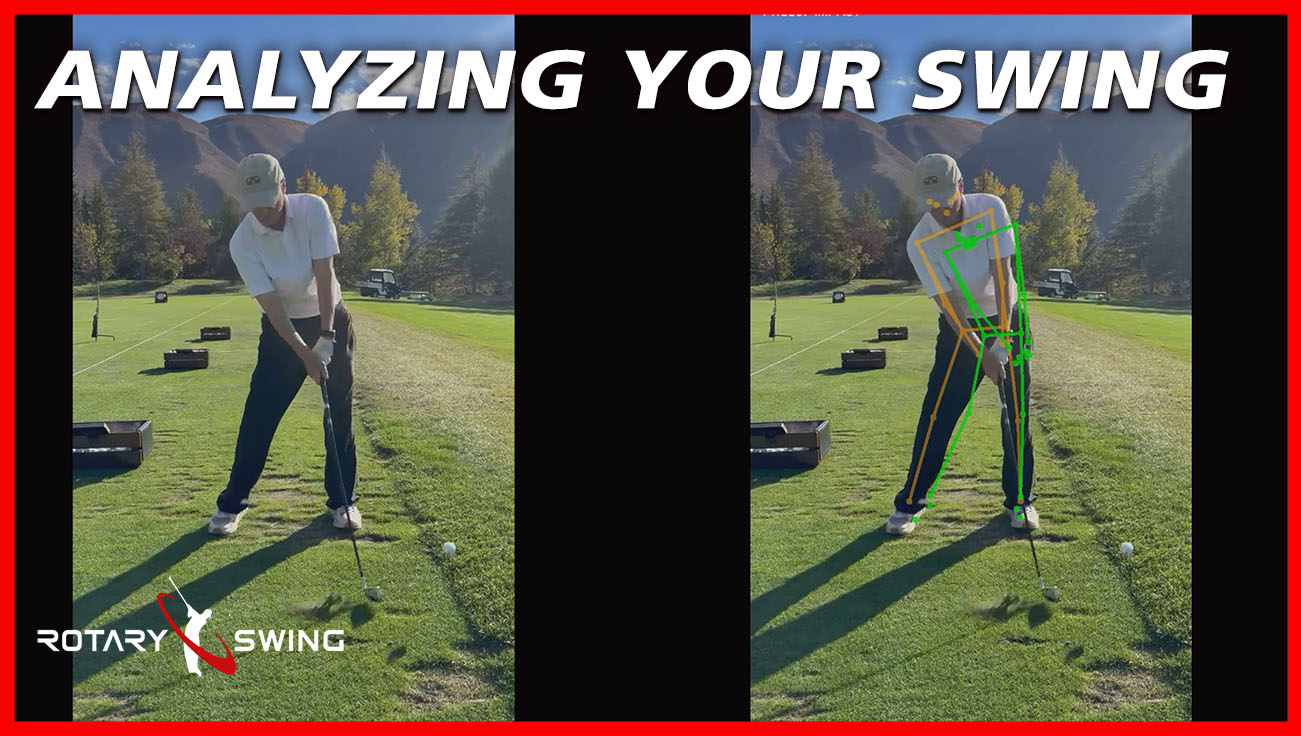
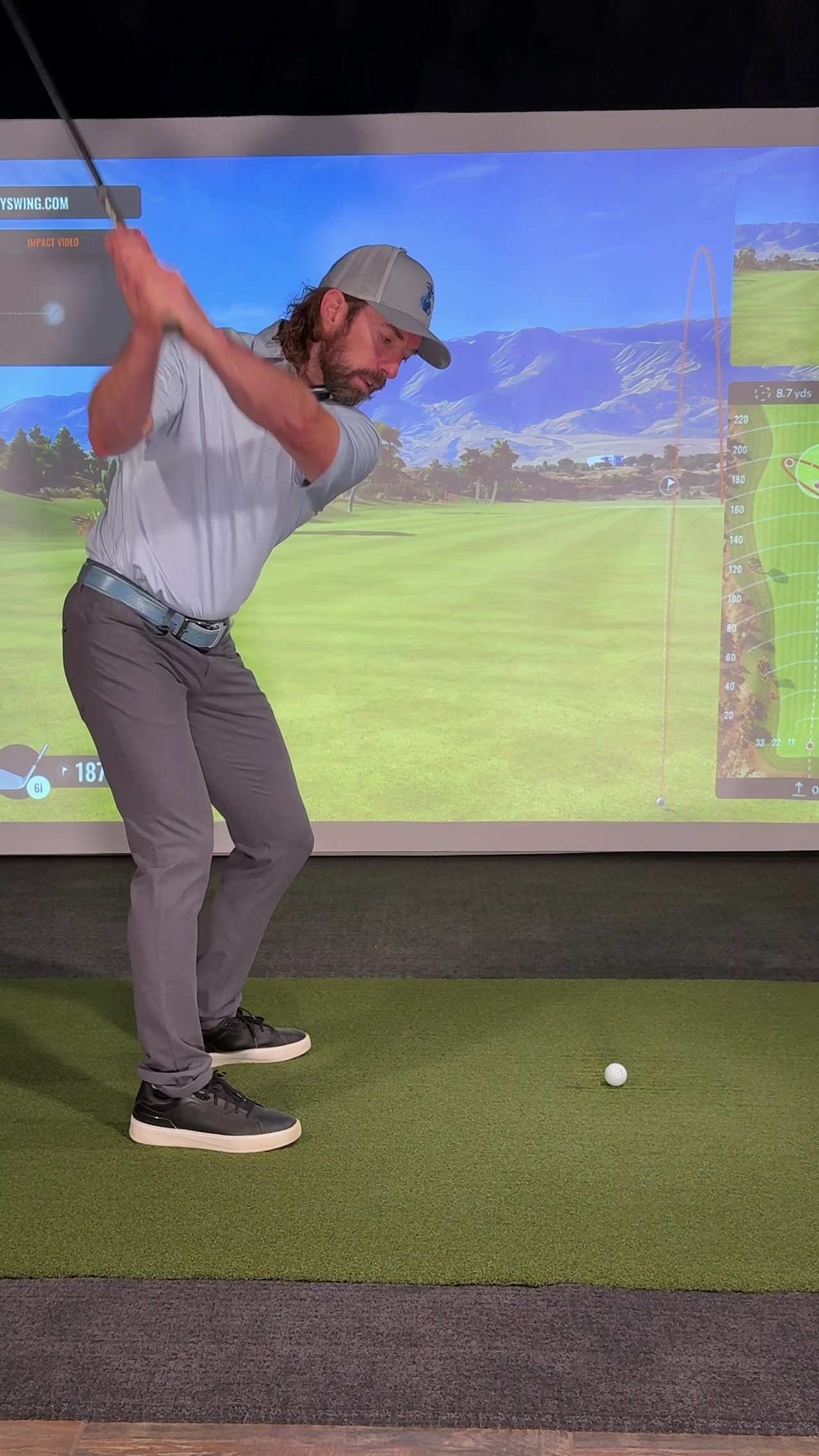
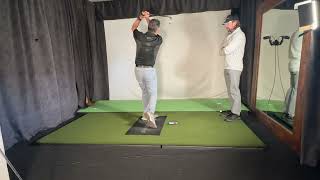
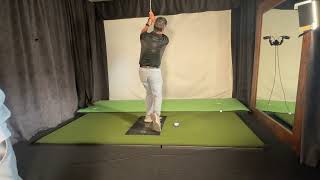
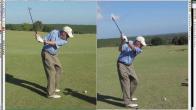
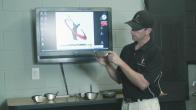
And I see I've got my swing up here on the screen here.
I was hitting balls just before we started.
What do you see in relationship to the club head and my hands here?
Now, I'll share my screen so it's a little bit easier to see this.
What do you see there?
Yep.
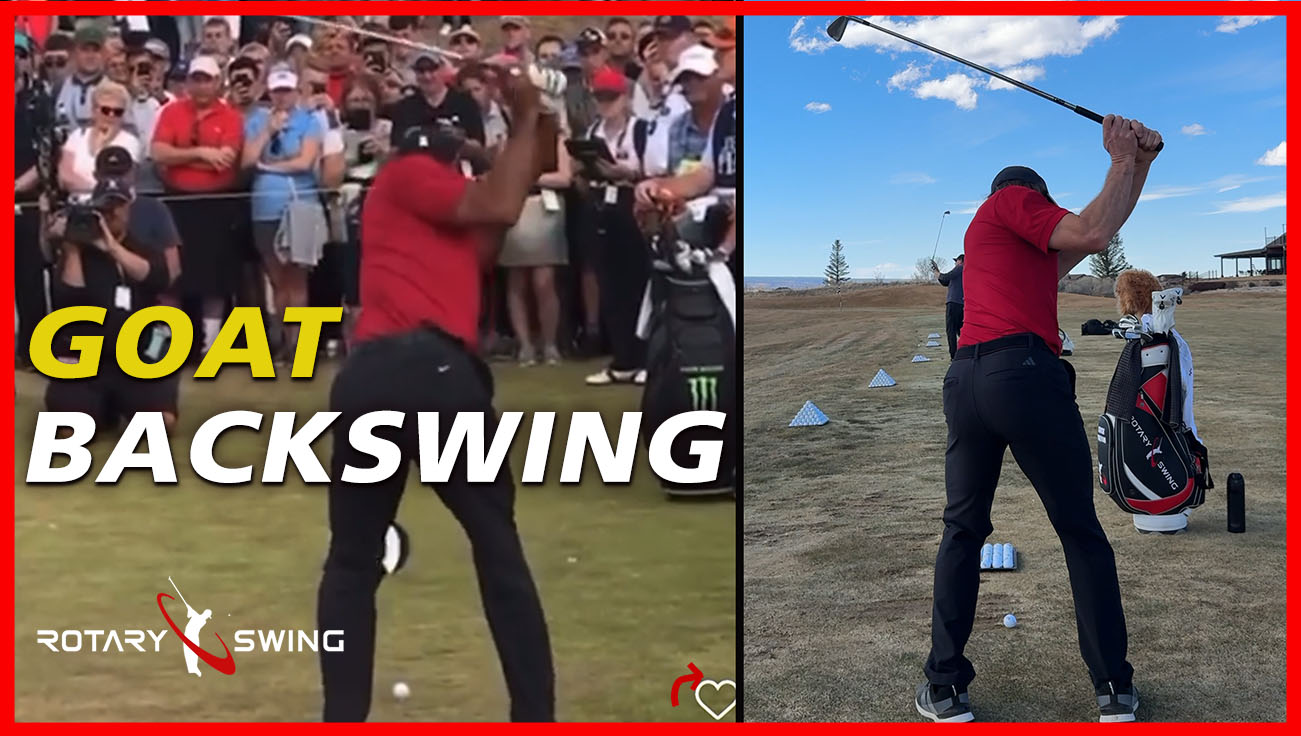
Clubhead's just a little bit outside of my hands, right?
This, if I had all my students doing this, my life would be so much easier.
Getting this motion down is perhaps the most important part of the swing because if this isn't right, then nothing else is going to work right at all.
It's basically impossible to get anything else to work correctly.
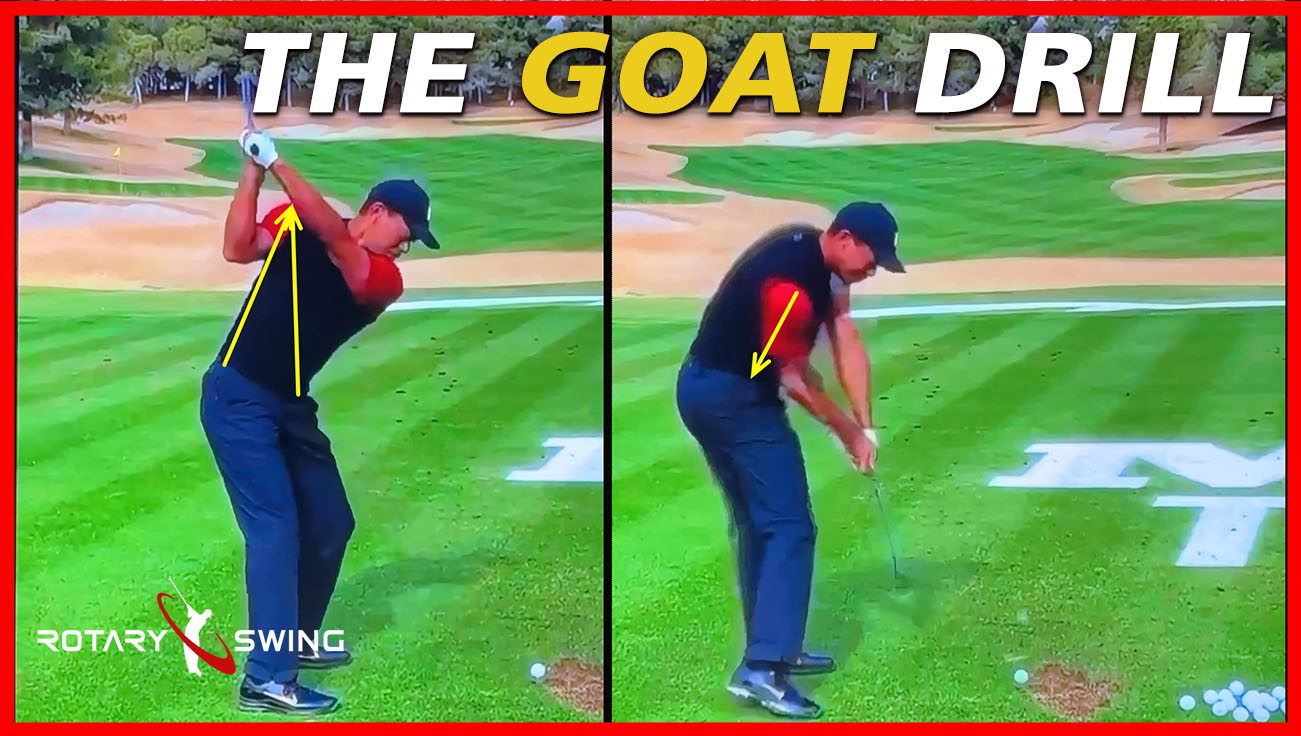
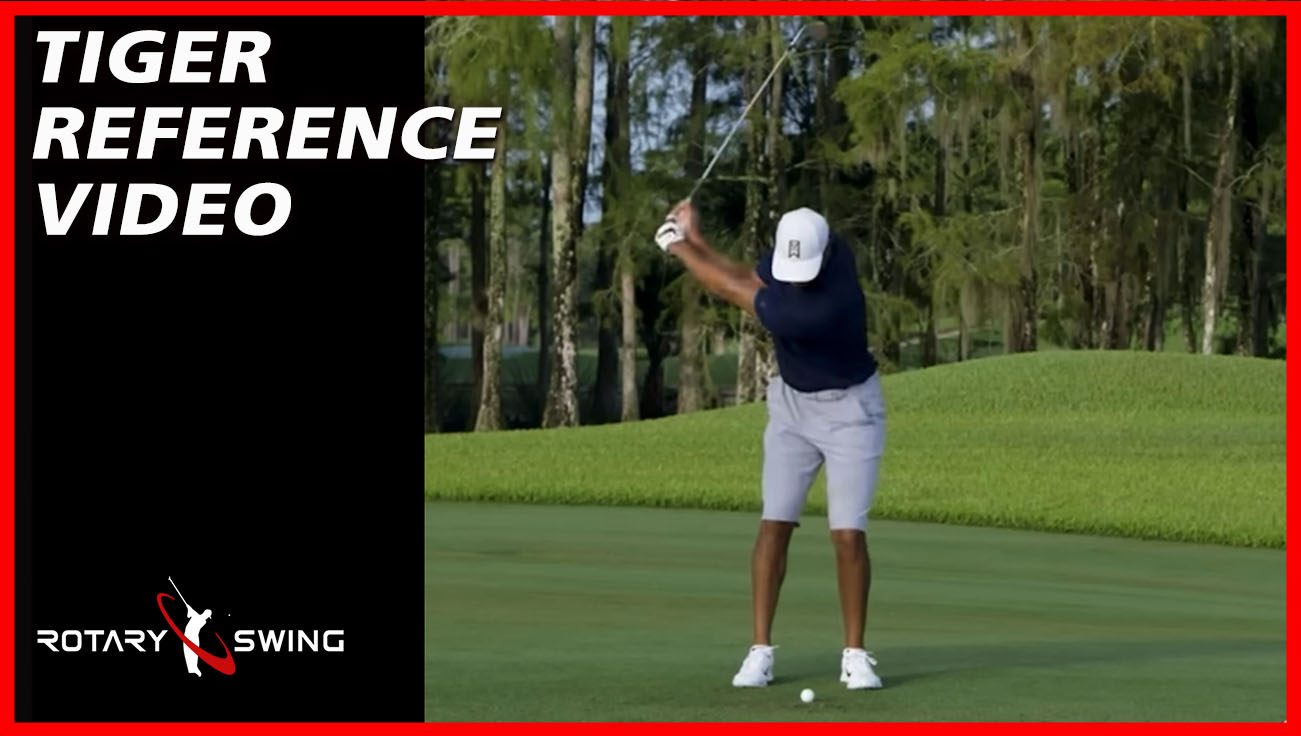
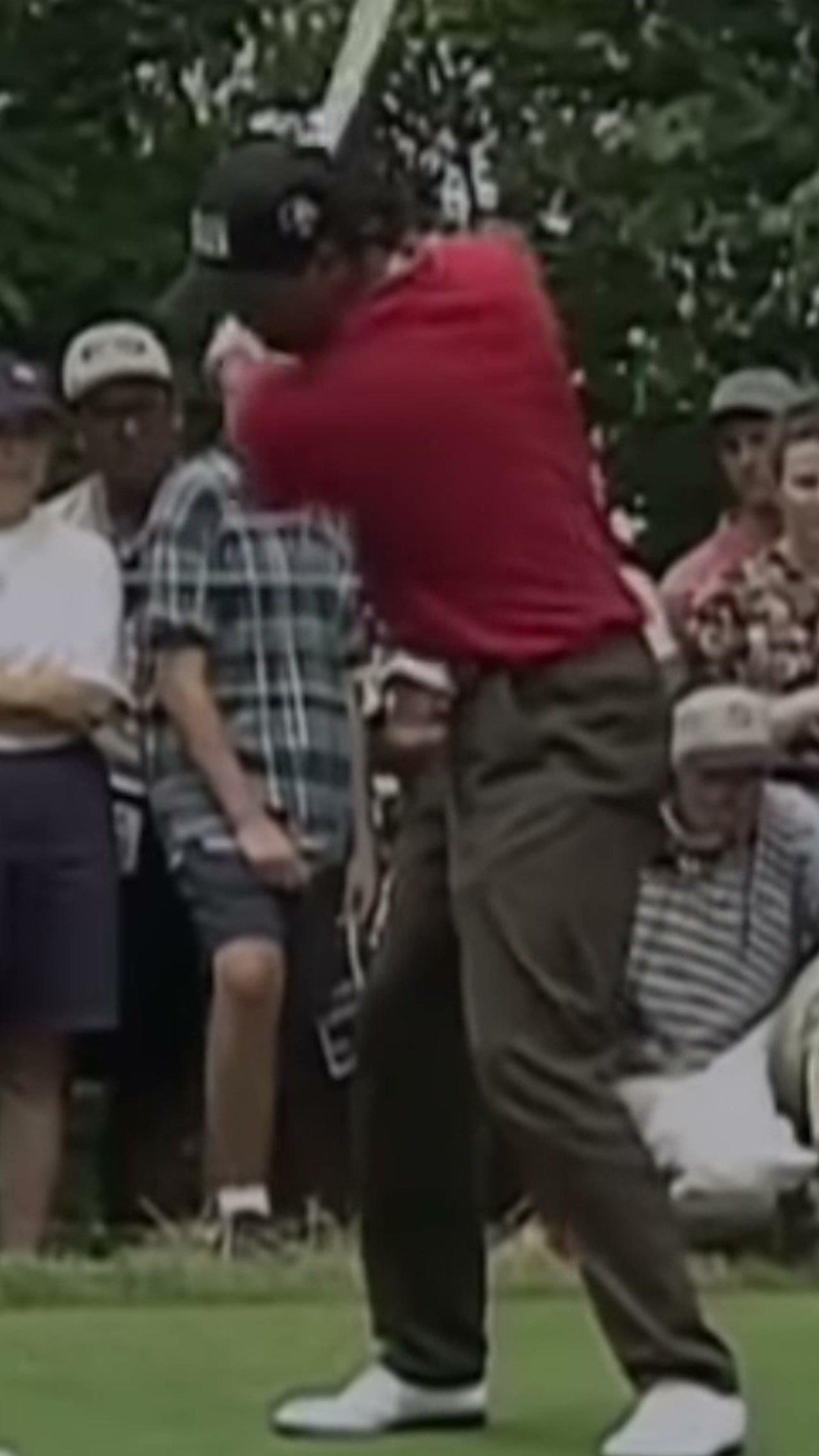
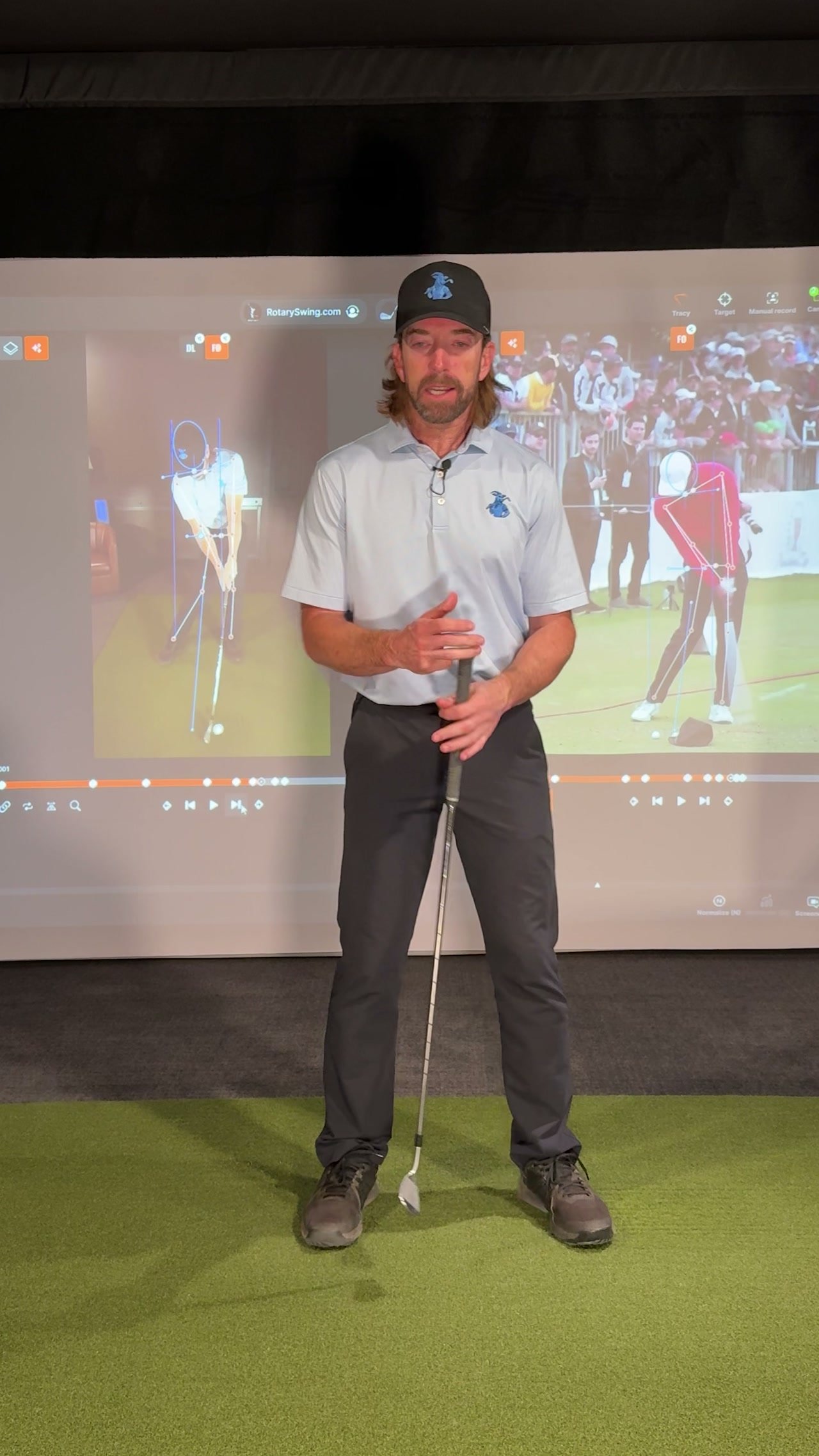
So now let's take a look at Tiger here will pull him up.
Can you see?
Can you see Tiger on the screen here?
Now, as he goes up, that club head never looks like it's ever going to go inside of his hands, right?
The motion, first of all, is set up by the grip.
But without this, nothing else is going to work correctly in the swing.
So now let's take a look at how do we get this motion as part of the overall swing.
And what are we really trying to do in the overall swing?
Our hands are going from this to this at impact.
Now they're going on quite a journey from here though, right?
That's a big change from here to here.
So what does it really need to feel like?
What are you really trying to do with your hands?
As I'm taking the club back, my hands, the club head's staying outside my hands here, obviously.
Now, most golfers can't do this no matter what they try.
And I've struggled with this for years myself.
It took me a long time to really understand how do I get this to feel natural?
Because anybody can kind of exaggerate taking the club way outside, but it doesn't feel right.
I'm sure many of you have struggled with that.
A lot of this starts with how your body's moving.
For golfers who take the club inside and the club goes around their body like this, whether it gets inside and shut or inside and open, it doesn't really matter.
They're all death moves.
But what really tends to happen is that most golfers move their body kind of like a door, like a door hinge.
They kind of move like this.
Everything's turning back and everything's turning together.
If you're doing that and if I just move myself like a door hinge.
There's so much momentum on my hands that it's almost impossible for me to not have that club head go inside.
So if I don't want to end up here and then having to come over the top or doing something else really crazy, how do I do this and make it feel natural?
I don't want my hands and arms to go whipped way inside.
What I have to do is understand that I'm trying to create torque.
My body needs to be twisting in order to create rotational power in the swing.
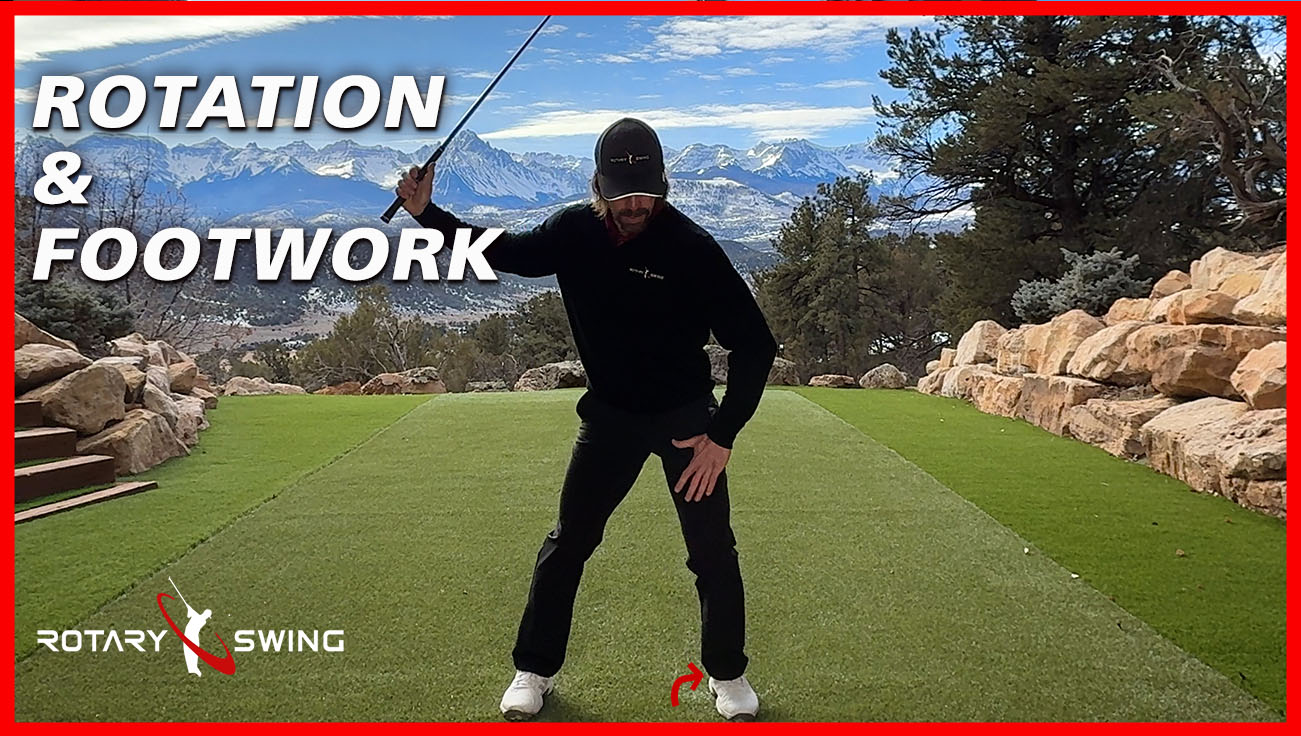
So if I'm turning this part of my body this way, what my feet need to be doing is actually the opposite direction.
Now, this is going to sound a little crazy at first, so you got to bear with me.
My feet in the backswing are going like this or creating torque this way while my upper body is going like this.
And in the downswing, it's the opposite.
Now my feet are creating resistance the other way while my core and everything is turning my shoulders back in the other direction.
that starts before that club even really starts to move.
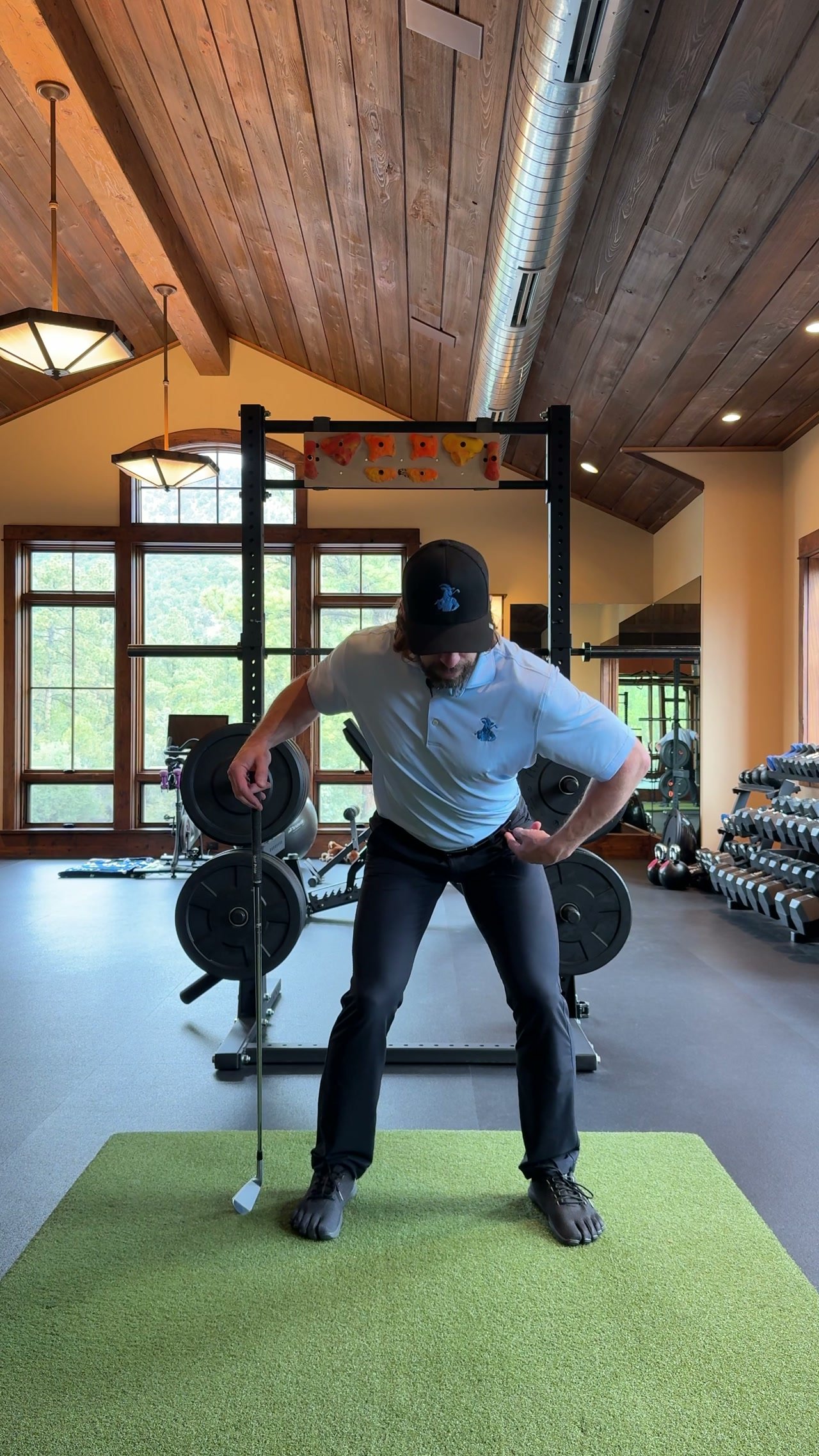
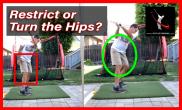
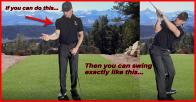
What I mean by that is one of the key moves, I'm going to exaggerate this so it's easy to see, that as you start this club back, you can't just start it with your arms and hands.
You start with your arms and hands, you're going way inside.
It's done.
And if you just try and turn your hips like a door hinge or your shoulders like a door hinge, that's going to give your arms the momentum they need to go inside.
But what I'm actually doing is going like this.
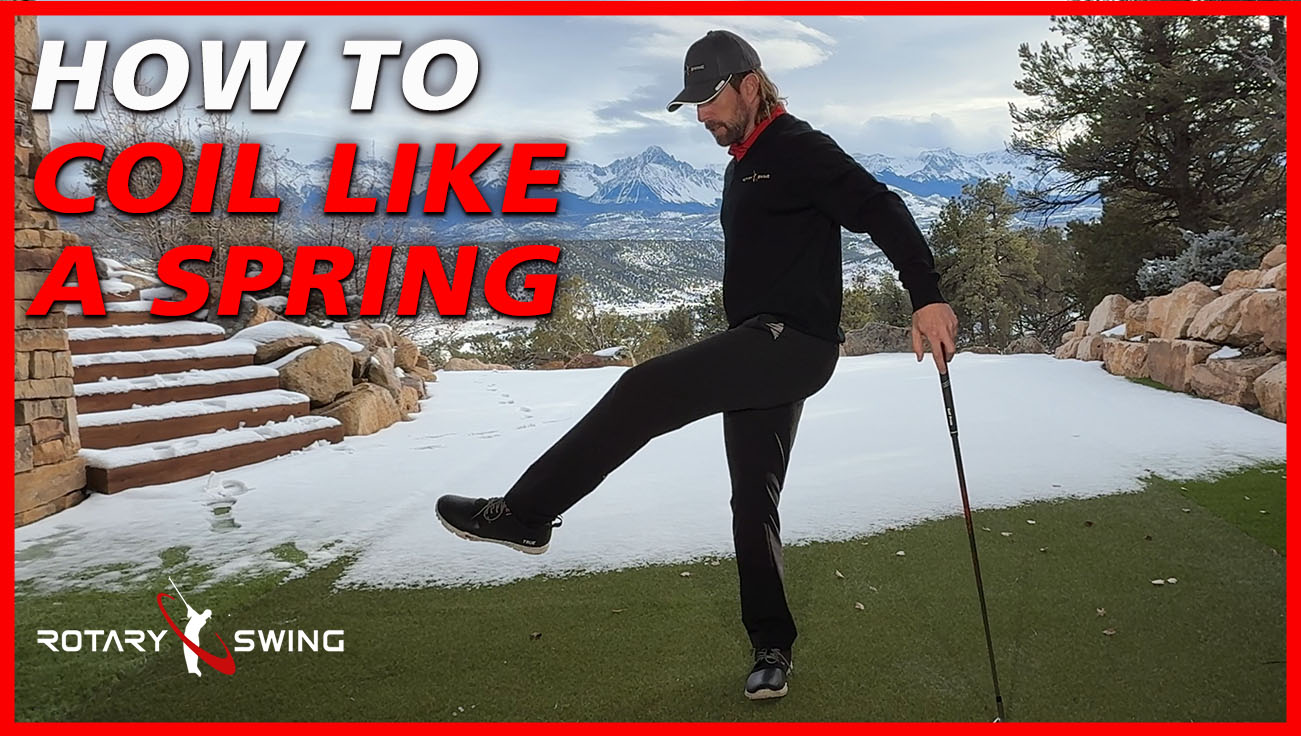
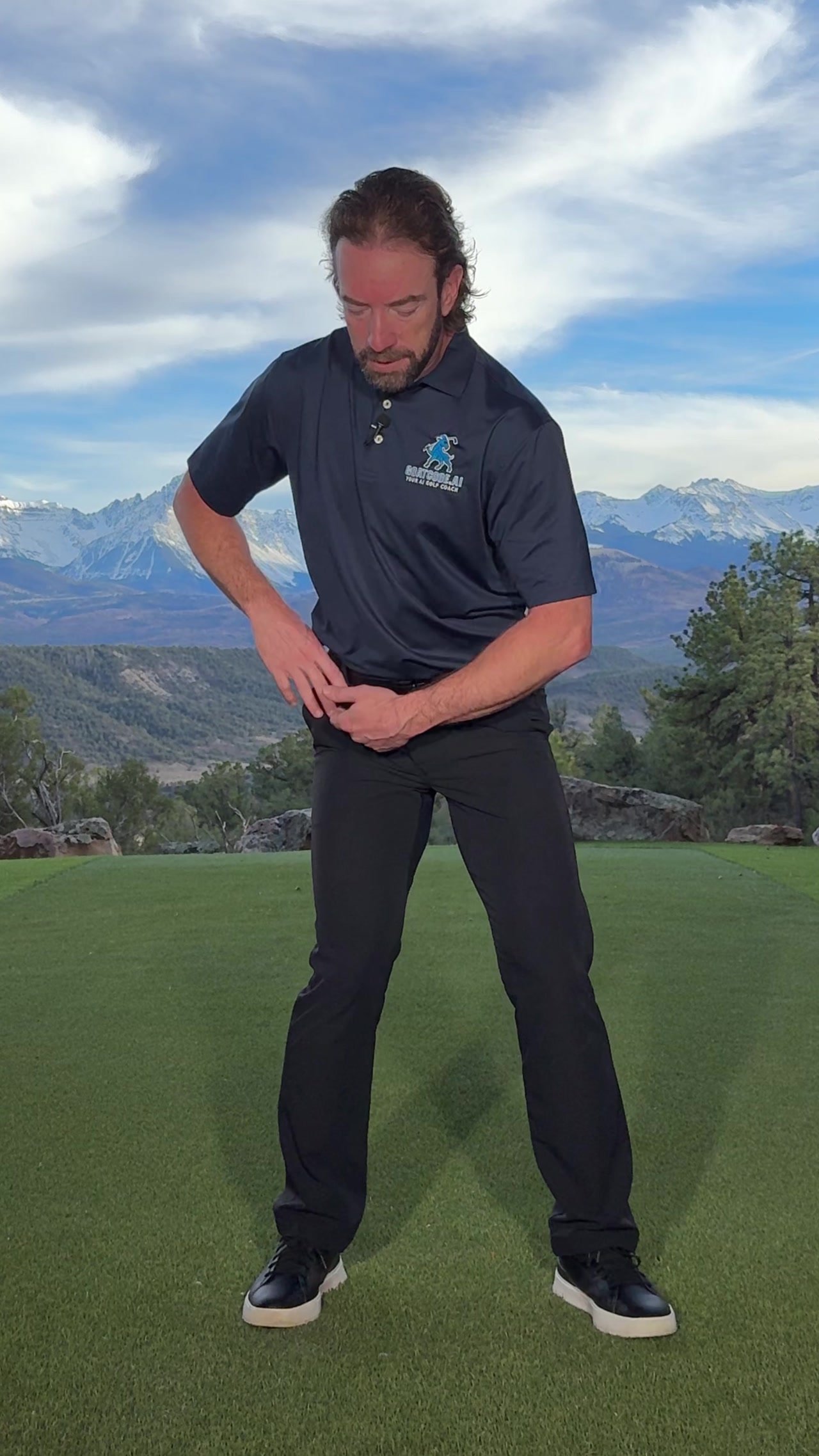
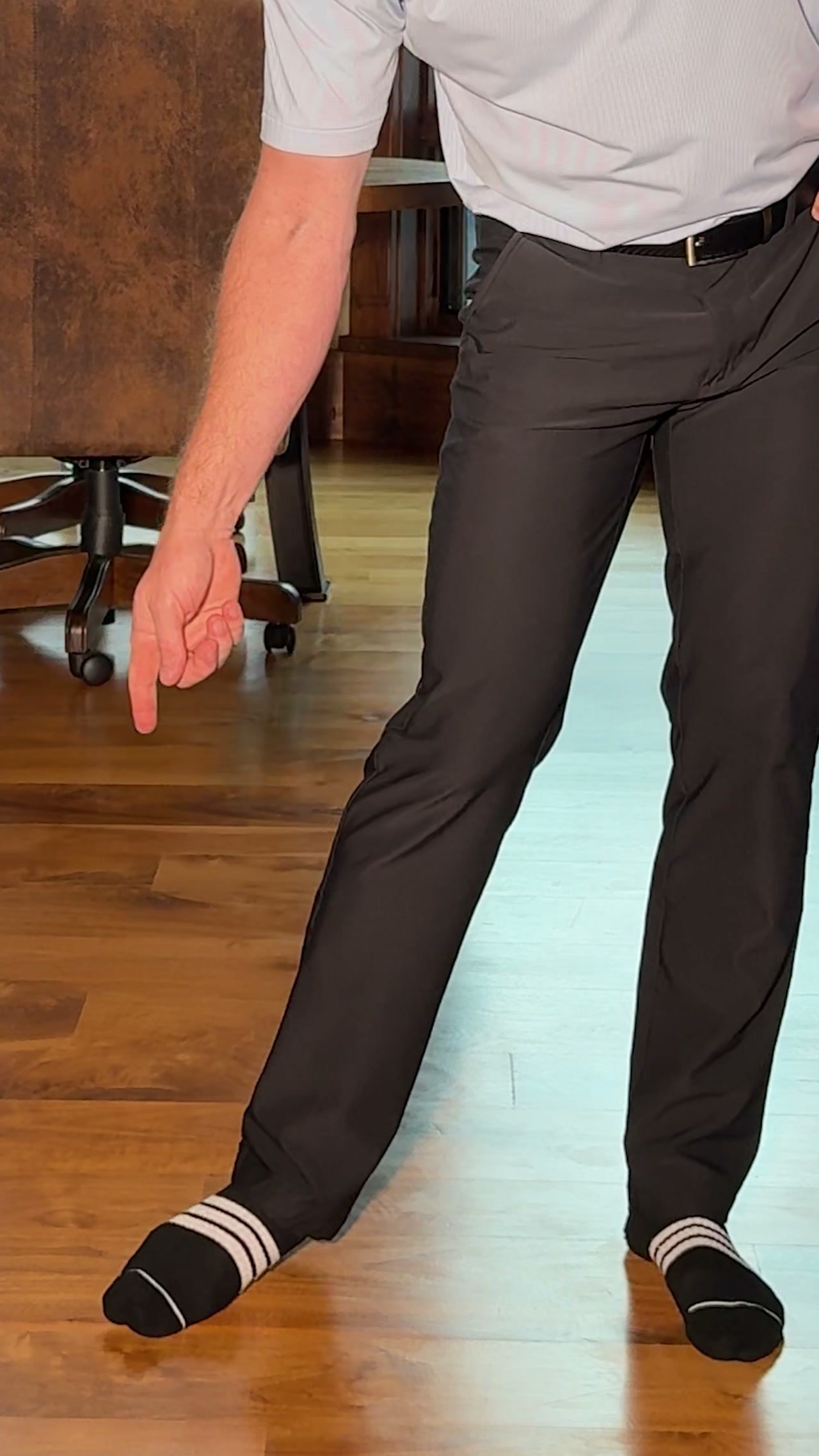
Now you'll see that my left hip is actually going back, my knees going forward.
And then as I start back, I kind of sit into it and then start to rotate.
What do you think that's going to do to my body as I start to move in this direction, which seems really strange at first.
Why would I turn this way to go this way?
Any ideas?
Tension.
Yep.
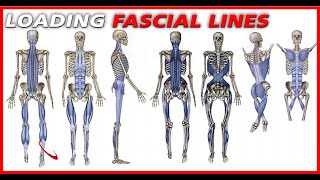
I need to stretch this fascia.
And it's not just one fascial line.
It's all connected everywhere from the top of your head to the bottom of your feet.
There's fascia throughout the entire body.
And if I start moving like this, I don't create any tension in this.
It's all kind of gone slack together, right?
But if I go this way first, and now, so if you're in front of a computer, you can stand up and do this.
Try and turn your hips this way first.
So if you're a right-handed golfer, you're going to actually turn your left hip back, almost like you're going into what you would be doing in your impact position.
And then as you do that, start rotating from your core the other way.
And you'll feel your feet kind of lock into the ground and provide resistance in the opposite direction.
If I do this.
You should feel really loaded up.
Give that a shot for a second.
Tell me what you feel if you do that.
What do you guys feel?
Can you get this movement in your head?
I know it seems really strange to feel like your feet are doing this and your upper body is doing this.
Like I can let it go.
Tight stomach.
Yep.
You should feel bound up.
Ground force, a lot of stretch in the tension in the backside, tight feet grip, wired.
The hips don't open as much as normal.
This is yes, right?
Because you're actually going the opposite way first.
Now, you may be thinking, oh, dude, there's no way that anybody does that.
That seems really crazy.
Well, let's take a look.
and see what we see.
So we'll use Tiger here as an example again.
Now with an iron, it's not going to be that substantial, but you're going to see as he starts back, watch his right knee.
And again, this is subtle, but you'll see his hip move back.
His right knee move forward.
So he's turning just a little bit in the opposite direction to get him started.
Now, when I would do it in my swing, I do it a little bit more exaggerated.
So it's a little bit easier to see.
So I'll show you in my swing so you can see something where it's a little bit more obvious.
So, watch my knees.
You're going to see me bent, kind of squat down into my right knee, right?
And what's really happening here, you can't see my lead hip, but my lead leg is actually straightening a little bit.
My hip's moving, my left hip's moving back, so you still can't see my left knee, and now it's starting to pop up.
So, what I've done is I've given myself a little bit of a head start with my hands to keep from ripping everything inside.
That allows me to keep the hands and club in line going straight down rather than trying to rip everything inside.
So now it's very easy for me to get my hands and everything up on plane.
But this first move, again, if you see, watch closely here, you can actually see my left pant leg start to show up behind my right knee as I start to bend it and my left leg starts to extend.
Now you can see a little bit of my left pant leg.
And now everything begins to rotate back.
And now what I've started to do is I'm creating a lot of tension in my body right away.
So right now I'm fully loaded up.
At this point, I'm getting really, my core is getting really loaded and ready to fire.
But I started this all at the beginning with my little trigger move.
So now let's talk about this a little bit more closely.
So this move.
Again, you can see it kind of exaggerated in mind.
I go like this.
This versus this, which is always going to rip the club inside, is getting me loaded.
Now I've immediately started loading up my glutes.
And more importantly, perhaps more importantly, if you start like this, you're going to stay centered.
If you don't have anything kind of this natural little trigger to kind of, again, I'm exaggerating this.
To get you kind of going, most people get kind of frozen over the ball and they just start everything all together at once.
And that's always going to move offside, off center, because you're pushing from this lead side because it's kind of the most powerful move you've got when you're kind of frozen static.
Whereas instead, I'm kind of loading my glutes right away and getting everything kind of starting ready to go like this.
And now it gives me some speed because once I've got this motion.
Now I can really move and stay really centered but create a lot of speed without worrying about the club going inside So my goal here is I go like this Now all I want to feel I've talked about in other videos is kind of the train tracks analogy, right?
So if I take a couple of alignment sticks here Throw them on the ground one for my hands one for the club head My feeling as I start back is that my club head, from my perspective, it's obviously going to go inside, but from my perspective, as I get my wrist to cock the club up a little bit, is that it looks like my club head is over that shaft from my perspective, and my hands are going over this shaft versus this.
Can you see the difference, how common and how easy it is to do this?
This motion, if I'm kind of creating a little counter rotation to get my feet kind of screwed into the ground the other way, now as I go back, it's very easy for me to keep that club head outside my hands.
Does it make sense?
Any questions on the takeaway stuff so far?
Thank you, David.
Hopefully this helps you.
Feet pressure.
Be more specific.
Any questions?
You guys got this figured out?
Why is it important to keep the club head outside the hands?
Okay, let's start there.
The club head going inside of your hands is first of all going to get the club off plane.
So now you've got to compensate to try and get the club back on plane.
There also changes the club face angle.
Whether you take it back really shut, it's impossible to keep it perfectly square the way you had it and moving correctly.
if you start taking this club way back inside so all i'm trying to do is make my life really easy i want to get here and have to do basically very little to square that club face back up so keeping the club that outside your hands is extremely important let me scroll back up here a little bit let's see so you're bending your right knee first and starting shoulders uh i don't I wouldn't describe it that way.
I'm not going to get too deep into this because I really want to focus on kind of the hand movement.
This is just to kind of get you understanding what's going on with your hands or the takeaway.
But yes, I am bending my knee, but it's not just bending my knee.
I'm actually twisting my hips, twisting my spine, stretching my core, everything to be able to then fire it.
I want to be able to move very quickly in the backswing.
And if I can move very quickly, I can load this fascia a lot more easily, a lot more efficiently.
So when I'm doing this, I'm actually doing this very quick and getting tight in my core.
So then as I go back, this is super, super stretched.
Whereas a lot of times I see golfers are really slack.
Their shoulders are drooped, their arms are soft, and then they're kind of swinging their arms like this.
And there's just no power that way.
I'm doing this and I feel right now my core is really engaged and I'm stretching against that resistance that I'm creating throughout my whole body.
So it's not just a knee thing.
It's my whole body loading up to get ready to fire.
Let's see.
Percentage of weight on each foot in the takeaway.
I've talked about this on the pressure plate video.
So I tell you to take a look at those.
I don't have to duplicate that stuff.
But you shift most of your weight over to the pressure over to the trail foot by the end of the takeaway.
about 80 and then it's done after that and shifting starting to recenter slowly after that do you feel the body rotate more in a sideways position not sure what that means i'm feeling pressure in the balls of my right foot i'm not sure why you're probably getting too far on the balls of your feet seems like you're opening your front hip first create torque yes that's exactly what i'm doing where's your weight just talked about that let's see where is the left on the wrong grip uh i'm not sure what that means just to the right of center for a right-handed golfer what is the club doing when making that subtle move to the left okay that's a good question so as i am kind of doing this to start and create some early resistance my hands are going to go forward not because i'm trying to push my hands forward i think that's where a lot of people will get really lost with the forward press This forward press is like a reaction.
It's not that I'm trying to like shove my hands forward.
It's going to get me being really armsy.
But if I'm set up correctly and I start to kind of go forward, my right knee is kind of going forward, kicking forward.
This one's going back.
Where's my hands going to go?
My hands are just getting moved there.
I'm not trying to move them, but that will create a little bit of a forward press.
How much do you actually move?
Before starting your first move, that's totally up to you.
You can watch the videos of the swing and it's just a subtle move.
It's just to create some tension, but there's not like a fixed amount.
Like I said, I do it more than Tiger, but you may do it less.
It doesn't really matter.
It's about how much power and torque you want to create.
I'm not going to talk about lead side stuff in this.
Season of gravity, when do you do the initial move?
Not sure what that means.
How does this work with create shoulder tilt?
We're going to talk about this a little bit more.
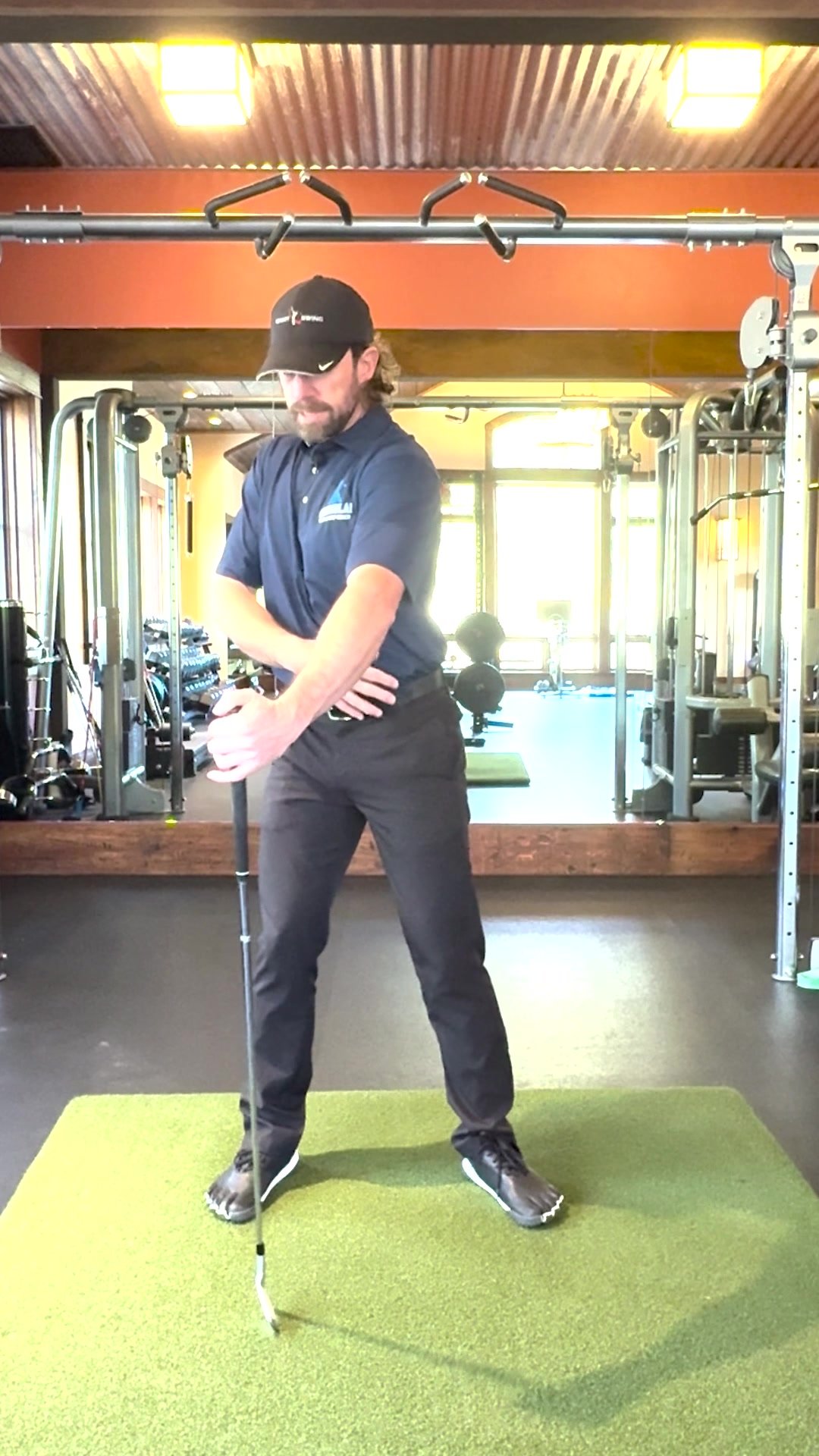
You can see in this image, obviously, that my shoulders are certainly not flat.
My shoulders are pretty steeply angled down toward the ground.
As I'm doing this, the only way you would turn flat is start to fling your arms around your body or just push with this lead side.
That'll make you turn really flat.
I'm actually going this way.
Let me talk about this a little bit more.
As I'm doing this move, this is creating space on the lead side of my body.
What I mean by that is a lot of times golfers, you set up a little bit more on the lead side and then they're kind of static with their body.
They don't do this little move to get their body kind of loaded.
And so they kind of just start turning and there's nowhere for them to go because my hip's in the way.
So I'm going to tend to turn really flat, lift up, et cetera.
But as I do this, as I drive, again, I'm a huge exaggeration here.
This hip's going back and then I'm loading into my trail side.
Look at the space that I've created here for my left shoulder, my lead shoulder to go down, right?
Rory does this move a lot in his swing.
So he has a really, really elevated lead shoulder and then he's got the stiff left arm and then he does the same move.
He goes back like this.
and he's really in this trail side, and then he gets the shoulders going back this way, down.
So as I go back, it's very easy for me to get my shoulders down because I'm creating that space by moving my hip back and out of the way.
So you shouldn't turn flat at all.
It should actually do the opposite.
You want to have the pressure on your feet going forward, which allows you to move your hips open a little bit to create that resistance.
Do you want to keep that feeling during the entire backswing?
To a degree, but I mean, it's too dynamic.
You can't just hold this one thing.
This is just kind of a piece of it as you're doing this.
So no, there's nothing holding in the swing.
Like I'm going in a very, very short period of time like this, back into my trail leg, recentering, pivoting.
posting up using my glutes.
It's not like you're just holding this one feeling.
It's much more dynamic than that.
Yeah, Kyle Berkshire does this.
Absolutely.
Anybody with power does this.
It's just, it's virtually impossible to generate power without doing this because you're not going to create a lot of resistance and load your core correctly.
i take a swing to the top slow i want to see the left hip well you can see my swing there i can show it we can share my screen again real quick and you'll see so my left hip here we'll put a Quick line here.
So you'll see as I go back, I start, you know, again, if you turn really aggressive with your shoulders and arms, you just kind of have an armsy swing, your hips will come away from this tush line.
I'm getting deeper into it.
And then I'm going to stay there into this downswing.
If you're just wanting to see from the back to the top, my left hip has got to come forward.
And it comes forward enough that you can actually see a gap between my legs.
Again, I really load up a lot because I like to hit the ball really hard.
You don't need to load up this aggressively.
This was a 175-yard eight iron, so this is hit pretty hard.
But the left hip is going to come forward as I start going back, as I start rotating.
But for a lot of golfers who are very, very armsy and using their body incorrectly to go back, what they'll see is that their left hip goes forward right away.
And this move, you can see my trail hip is also coming away from that line.
I'm moving back into it so that I'm really loaded back.
I'm back on my heel.
That gets my glute activated.
I can lift my foot up a little bit here.
And again, I'm just here for a split second.
Once I'm back here all the way, come up onto the ball of my foot, and that's what's going to get me going back really quickly.
But if you're used to doing this and going way inside, you'll find that your hips are always moving forward.
You really got to look at your swing on video and draw lines on it to see kind of what your hips are doing.
Yeah, Matthew Wolff does this just like to a massively extreme amount, but kind of does a little bit everything to the extreme.
How do you keep the full pressure?
I'm not sure what that means.
I get this question a lot.
I don't understand it, but I do get it a lot.
People asking, well.
what about the driver or the fairway woods or is it different with a wedge i only want one golf swing so i do the exact same thing for every single club in the bag so to me it doesn't make any sense to say okay with my irons i do this but with my drivers i do this and my fairway woods i do that it's always the same thing i only want one golf swing to maintain so it doesn't matter what it is there's only one thing that you want to try and maintain Let's see, I'm gonna take a couple more questions here and then we'll move forward.
Looks like you are shifting most of your weight to the lead side coming down.
Yeah, absolutely.
So as I'm going back, making room for my lead side to go into side bend, and as I keep moving back, I get re-centered.
My pressure is already on my lead side, but I'm still kind of at the top of my backswing.
So the movement would be kind of like here, there.
And again, big exaggeration.
I don't really move this much laterally in my backswing.
I'm just a little bit, but this move is what's getting me started.
Now I've shifted almost all my pressure by the end of my takeaway.
I'm pretty much shifted as much pressure as I'm going to have.
By the time I'm lead arm parallel, I'm starting, you know, I'm pretty much really done.
and then i'm starting to recenter and shift back over here so this move again it's a dynamic thing it's this this here so you can see i kick my knee forward left hip going back recenter again huge exaggerations to make it easy to see and then from here my left glute's going to fire and bring my bring everything back down into impact Where is the feeling in the hands during the takeaway?
All right.
So let's talk about this a little bit more.
I want to talk about the hands.
That's our main focus for tonight.
So feeling wise, as we're doing this again, you know, experiment with this move just to help you start to understand how to move and load correctly without ripping the club inside.
But what do we need to feel in our hands?
There's two things that I really focus on feeling when I'm taking the club back.
One.
Again, I have the club in my fingers.
So because the club's in my fingers of my trail hand, my dominant hand, what I don't wanna do is start picking the club up.
Because if I start doing that, I'm gonna fold this trail arm really early.
That's gonna make me really narrow.
I'm not gonna turn.
I'm not gonna have any power.
So again, we're doing this big move to start to build some power, right?
So I don't wanna do this and pick the club up right away.
This stuff is gonna be no bueno.
So what I wanna feel is that in my.
Middle two fingers of my trail hand and this little, you know, this trigger finger, my index finger.
I want to feel the club in there.
I also want to feel my thumb.
My trail thumb, my right hand thumb is pressing against the side of the shaft.
Now I see this stuff all the time and I don't know how you can play golf like this.
If your trail thumb is loose on the shaft, one, you better be really lead side dominant because your trail hand can't do anything.
But I actually want this thumb and forefinger to pinch together.
And you'll see the side of my thumb is pressing against the shaft.
Now, the reason this is important is that as I go to the top, I'm going to then push against the shaft with my thumb because that's going to help me start slinging the club head back into impact.
But another way to think about this, how would you throw a ball?
I'm almost certain that nobody would throw a ball.
without using their thumb or their index finger or they're trying i'm using these two fingers and throwing a ball and guess where my thumb would sit just like that the exact same way that i hold a golf club my fingers are super super important to me i need them i need them to play golf i need them to do all sorts of stuff you need them too so as i have my thumb my index finger my middle finger, all of this working together, this is giving me the sensitivity to know where this club head But I'm not trying to manhandle it just like I wouldn't be trying to manhandle that tennis ball.
I've got to have a feeling of throwing and creating a whipping motion, which is important to understand how you would throw this ball.
You wouldn't throw it with any power starting like this.
That's going to be a push.
What you would do is start like this.
Go back, and then as you're coming down, what would your wrist do?
Go back in the opposite direction.
Does this kind of look familiar?
This is how I would throw a ball.
This is how I would move my hand naturally.
This is how I would throw a club head.
If I have this feeling of this, I have the correct feeling of what my hand should do.
If I don't do this, and I don't know how to throw a ball, then all I'm going to do is hold the club in my palm and then push against the shaft and there's going to be no speed in that whatsoever.
So what I'm trying to feel here is my thumb, forefinger, two middle fingers are holding onto that club, but my lead hand is playing nicely with them.
And what I talked about earlier about getting this little soft spot in between this tendon and bone here to the side of the center shaft.
It allows me to push down on the shaft just slightly with this lead arm as this lead arm is staying extended.
That allows me to get the club head to work up naturally.
A lot of times I see golfers like this and then your hands can't do really anything but roll.
I need to be able to push down with my lead arm and hand and pull up with my trail hand fingers together without doing everything all crazy.
It's got to be subtle.
So as I'm doing this, My trail hand is, you know, I'm gripping it tight with my fingers, but not so tight that my wrists are rigid and my arms and shoulders are tight.
This feeling is like how I'd throw a ball.
My arm is not super, super rigid, but it's going to be tight when we talk about the golf club in just a moment.
But my hands, I need to feel, I got to have sensitivity in my fingers.
So as I'm doing this motion, what I'm feeling here.
Lead hand helping push down.
My pinky is involved there so that if I push down with the pad of my lead hand, my pinky needs to squeeze the club.
And then my trail hand fingers are helping pick the club up as I go back, going straight down those train tracks.
And as I do that all together with my body, the club is going straight up on plane.
I saw a bunch of questions here.
Let me see.
Somebody said, explain supination on the backswing and downswing.
The only point that you're really concerned with supination is in the downswing with your trail hand.
So again, if I take this ball analogy, I wouldn't just set this immediately and then try to throw.
I'd go back, it'd be dynamic.
And then as I was coming down, my hand would do this.
If I was throwing kind of a side hand or side arm throwing motion like we have.
throwing the golf club down at the ball.
As I go to the top of the swing, my thumb pushing against the shaft, my lead hand starting to bow, that's going to help square the face.
All of these things are happening together.
There.
So I'm pushing down with my right hand, my lead hand starting to go into flexion to start to bow and square the face.
Again, these are subtle moves.
I'm making them super obvious, so it's easy to see.
But as I go back, and do that.
What I'm feeling is this.
Now, it doesn't look like that, right?
It doesn't look like I'm just doing this with my hands, but that's exactly what it feels like as my body is working everything together.
But again, I'm not going to get my club head backwards like this.
I've talked about that in the magic of supination video.
I feel this, but what's really happening is this.
The club's coming back out on top of the plane, back out in front of me, because my lead wrist, as it's starting to move into flexion to bow the club face a little bit, and this wrist is supinating, that's what's bringing the club head back out on top of the plane.
But I want to talk about this a little bit more in context of the whole downswing, which I'll get to in just a moment, just to make sure there's no other questions there.
No, your grip pressure cannot remain constant.
It's impossible.
This is a common question, but your grip pressure changes a ton throughout the entire golf swing.
So at setup, it might be a six or a seven.
And as you start back, for most golfers, it tends to drop.
And then it peaks, like almost max grip pressure at the top during the transition because you're changing that direction of the club.
Then the grip pressure drops a lot again.
And then it peaks again, like right around in here at almost max grip pressure.
And then it relaxes again through there.
But you can't have a max, a constant grip pressure in the swing.
It doesn't work.
It is not how, it may feel like that.
You may think that is what's happening, but it is not definitely, definitely not what happens.
Can do a slow motion all the way to the top.
Sure.
So all I'm doing, again, I'll make this a little bit of an exaggeration.
So I'm going to kind of shift forward.
back here.
Now, again, this is kind of, when you're doing this stuff static, it doesn't really work because by the time I'm here, I would already be shifting back to the lead side, but I'll do it again kind of static so you can kind of get the idea.
One thing I want to talk about with your hands during this takeaway move is that your trail arm has got to be straight.
The one thing that I see most often, perhaps more often than any other fault, is this, where this right arm bends immediately off the ball.
I'd say 99 % of players tend to do this who are higher handicaps.
And tour players look like this.
Look at Rory, look at Tiger.
Their arms are straight.
They don't stay straight without tension.
You can't just have your arms like super relaxed and then think they're going to stay straight and keep your width during the backswing.
It's not going to happen.
You have to have some muscular engagement, some tension in your arm to hold that club straight.
So as I'm taking the club back, if I let this, if my right arm is really soft, it's really hard for me to not bend this arm and get the club going around and deep.
So what I'm trying to feel is that this trail arm is straight.
It's locked straight.
Now, I don't like locked is maybe.
it's going to be misinterpreted pretty easily.
What I'm trying to feel is that it's stiff enough to hold it straight, but not so stiff that it can't bend.
It's going to bend.
You're not going to go to the top of the swing like this.
It's never going to happen.
But what most golfers do, again, they're doing this way too early.
So if you feel like at setup, you straight, you engage this tricep muscle and hold this arm straight in that go position, the elbow pit out, as you go back, now it's very easy for me to keep the clubbed outside my hands.
However, any flexion in this right arm at all, trail arm, it's going to rip the club inside.
Left thumb sits to the side of the center of the shaft with your grip.
Scott, I just talked about if you're supinating, you're doing this way too much.
All of these moves are relatively subtle and they have to happen in conjunction with your body.
So a lot of times, like if people say, oh, I'm supinating, I'm dropping the clubway inside.
Well, first of all, it's not that big of a move and it's happening in conjunction with my whole body working everything back around.
So most of the time when I see people do this, they're just doing nothing but this and their body's not moving at all correctly.
And they're doing this way too much.
This is a, I've heard this in baseball.
I can't remember who it was, but there was a coach who teaches the same kind of motion in baseball.
And he said that, I can't remember, I think it might have been, I don't remember, some major league guy.
And the way that he thought about his thumb, how he pushed on the shaft, was he called it a thumb button.
In other words, think about if you had a button just to the side of your thumb here, right here, right?
It's not that you're trying to push against this thing as hard as you can.
It's a button.
You just tap it.
Just push it.
As I go to the top here and I just push that button, not trying to push it with all this might, just how hard I need to push a button.
that gets that club to shallow out start to supinate so that i can throw it with some speed there a lot of times again when people jump it underneath they're getting way too aggressive with that hand all right so let me move through this a little bit more to kind of get the big picture stuff and we can come back and do this in another webinar to get more in depth on things that you guys got questions about so if you do have questions first of all post them in the community we'll monitor them there and we'll start to understand what you guys need more information about.
So if you post them in there, we'll know what's going on.
But what I want to do is kind of get just like the overview tonight of like, what are the hands got to do?
So we've talked pretty much to the top of the backswing, right?
So we're loading up, keeping our hands outside or keeping the club outside our hands.
We know how to do that.
And then from here, we're starting a little bit of supination, a little bit of bowing of that left wrist, which is going to start to take your trail wrist and move it just slightly into extension because you're getting ready for the downswing and you want to be like this at impact, right?
If you start extending this trail hand as this one's moving into flexion, they're moving together, that's going to start to square the face and set me up so that as I come down at impact, I can have my trail hand still bent back to deloft and compress the ball coming down.
If I don't do that, then I'm going to tend to start to flip.
But the feeling of this is really what I want to get to because the important thing is how does all of this stuff work together?
If you just do the takeaway right, it's not necessarily going to get you to the promised land.
We've got to do all of these things together.
We need the correct overall feeling of how these hands release to generate speed.
So what I want you to feel or start to understand is where do we end up?
What's the finished product?
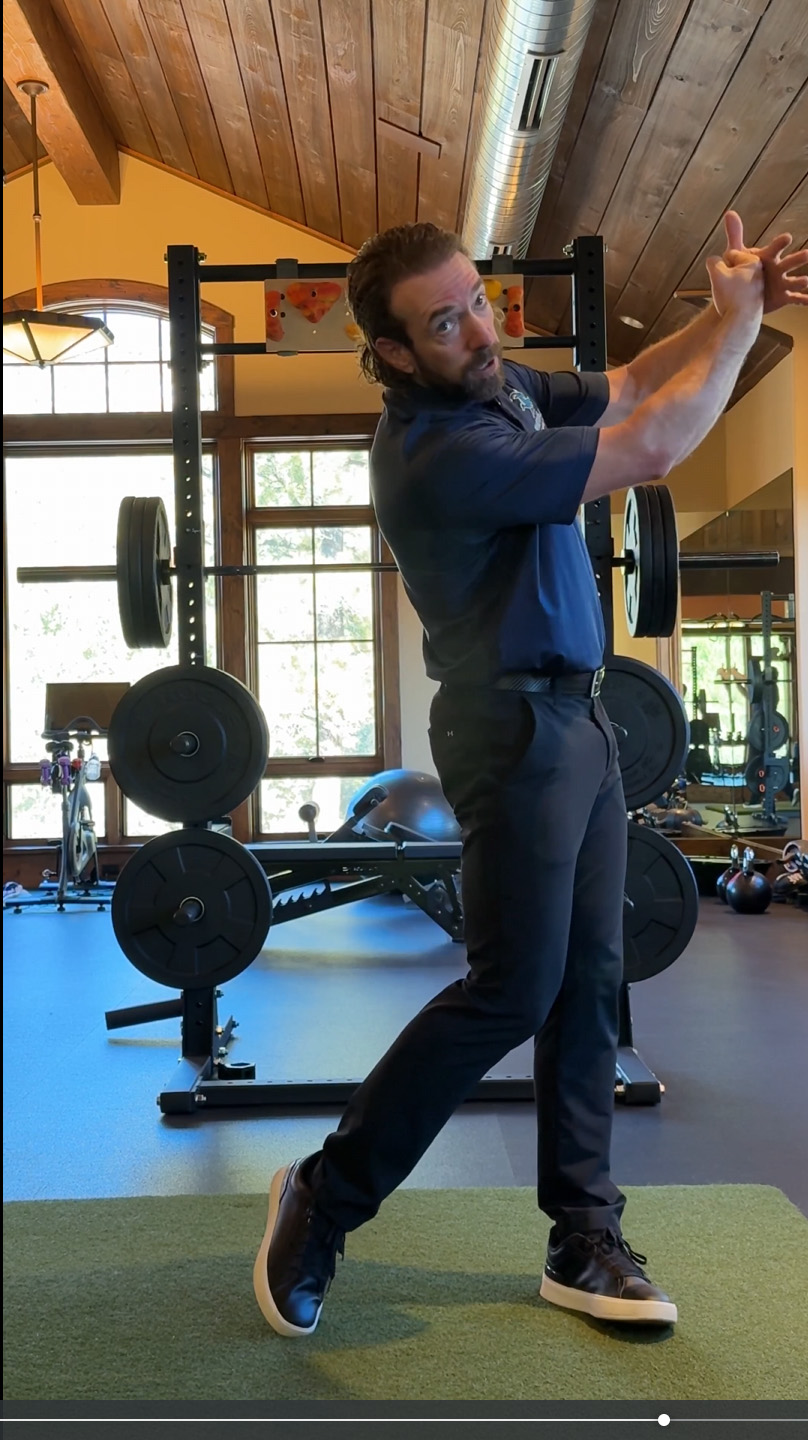
I want you to pay attention to my hands and the follow through here.
And I want you to see, I want you to focus on the left hand first, my lead hand.
Okay.
Now, what do you notice in my lead hand?
What do you see there?
Cupped.
Yep, exactly.
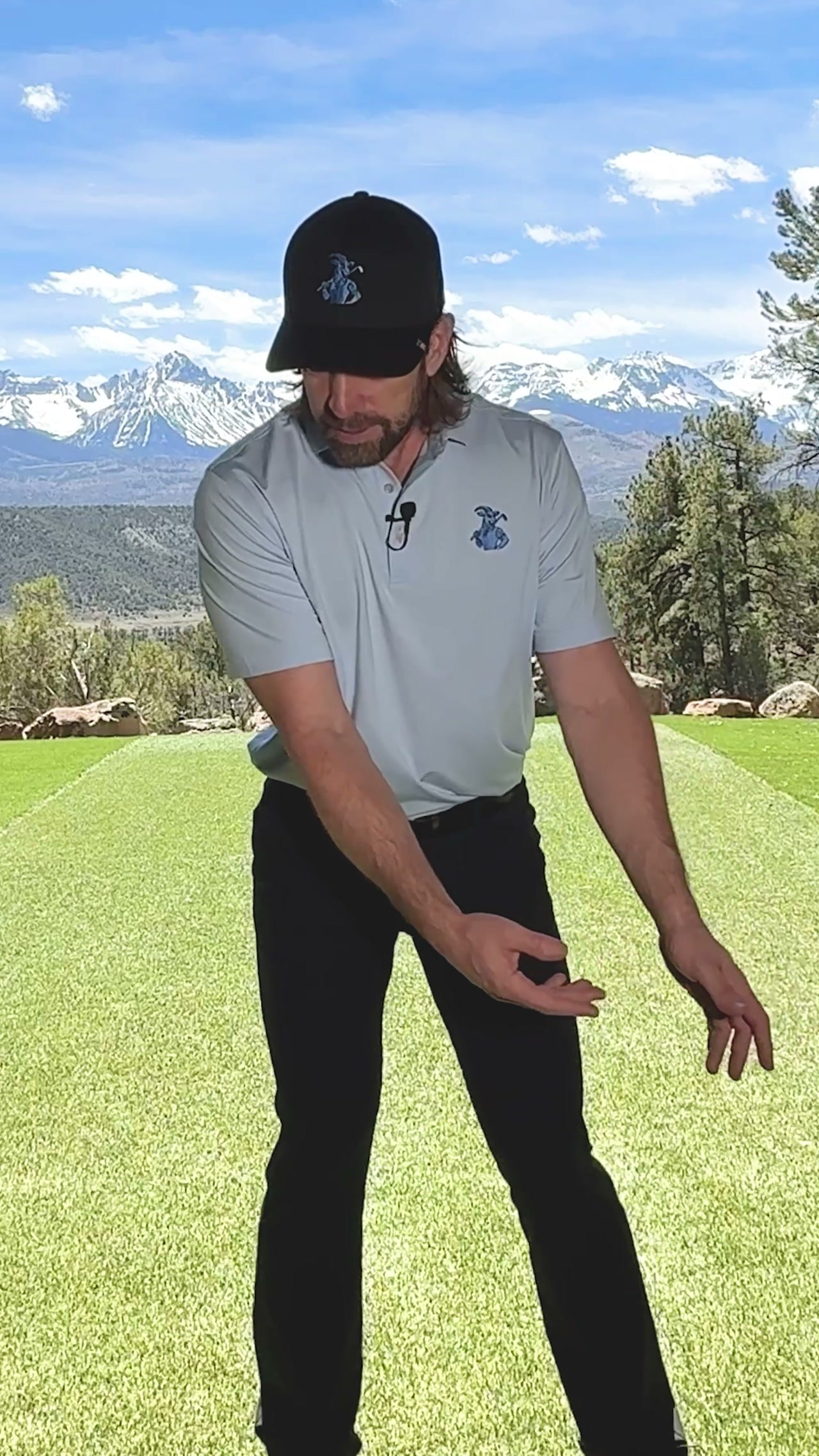
Your lead wrist has got to release through the swing like this.
A lot of times I see people who are trying to get a proper impact position, the bow in that wrist, and then they hold it like this, and they're staying in flexion somehow, and really fighting this off.
You want that club to release.
That's where the speed is.
So when you're in your follow-through position, This lead wrist needs to be fully released.
That's as cupped as I can get it.
And when you look at the club head, the club head is pointing down towards the ground.
It's also fully released.
It shouldn't look like this.
If it looks like this and I turn, you'll see that my wrist is bowed like this and the club face is shut.
I want that club to be able to take past my hand.
with a great deal of speed.
And this is again, why the club needs to be in the fingers as I'm coming through.
Again, note the toe of the club, it's fully released.
So I'm gonna go through this slow here.
Now, again, I won't be able to do it that much at speed.
It's gonna still be flat and releasing through, but the feeling is what you're after.
If you can get this feeling of your hands, again, being like this.
at setup, at impact, and then releasing through the follow-through, then you're starting to get the big picture of what your hands need to do.
They go here, here, here.
It's important that you get the feeling of that club fully releasing all the way through the shot.
And your trail hand, if you look at my trail hand now, it's kind of hard to see from that angle.
But my trail hand, if my lead wrist is cupped, My trail hand's gone into flexion just a little bit.
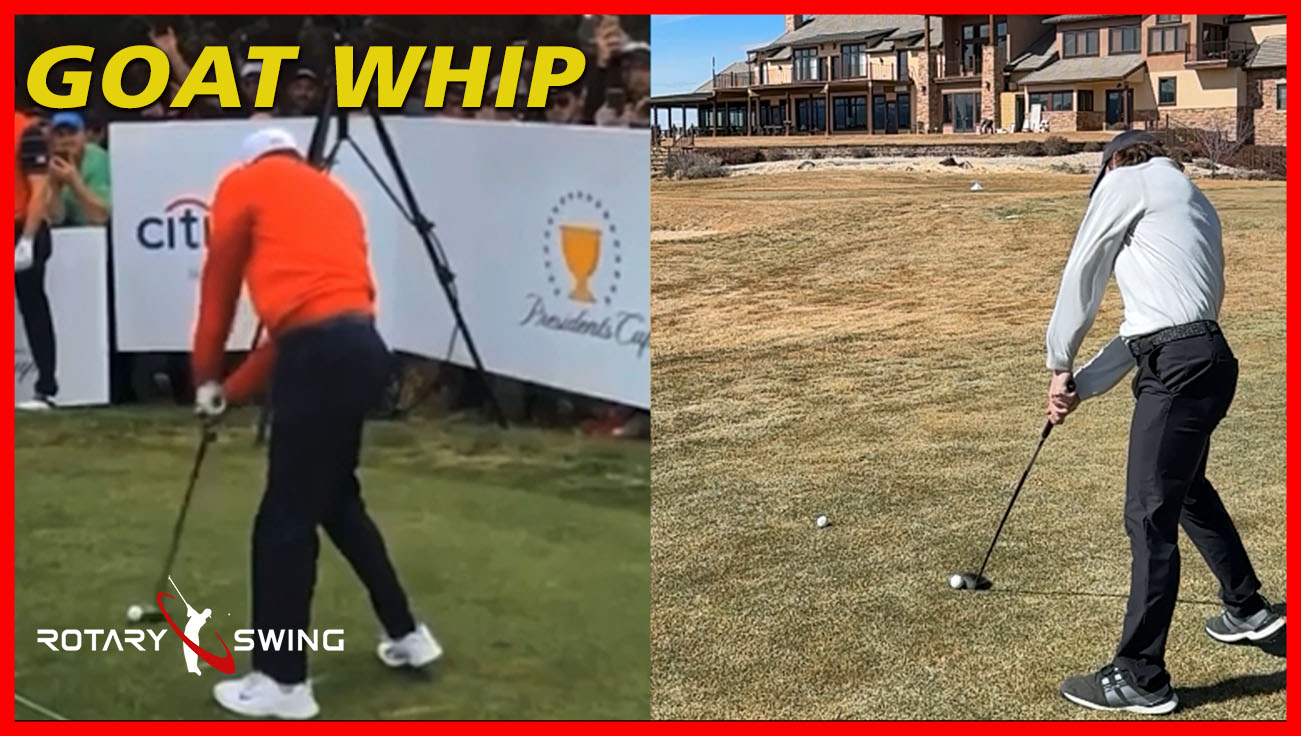
That motion is what's generating a lot of the speed.
So if you don't have this motion and you're kind of holding it off and have the club face where it's pointing back toward the camera, you need to get the feeling of letting that club release through until you get that toe kind of released and the club face pointing more down toward the ground.
Any questions on that?
Are you applying some pressure?
The lead hand on the downswing or is the movement only controlled by the trailing?
It's a good question.
There's all sorts of different ways that you can balance that out.
And everybody's going to be a little bit different.
Now, for me, I've got nerve damage in my left arm and my hand.
And so I have to feel a fair bit of tension in my left pinky because I have nerve damage there.
Again, it's really weak.
So I have to feel a lot more lead hand to help balance all of this stuff out.
My trail hand's really strong.
It's fine.
the truth of the matter is you're going to find golfers at all sorts of different variations between the two my goal is that both hands work together as one that's what i'm really trying to do now my trail hand is doing all of the steering of the club face if i want to shape a shot if i want to control it if i want to knock it down i do all of that stuff with my trail hand but on my quote unquote stock shot i want both hands to feel like they're released through together as one and my trail hands providing the speed my left hand can't really do a lot again it is releasing like this but that's not a really powerful motion you don't have a lot of muscle to help kind of snap that so you really just your body's kind of moving your lead arm for you and your trail hand is helping provide a lot of the thrust What's the best way to get the release to happen?
It all has to work together.
And this is something that you can't take the golf swing as like one thing.
You can't say, well, my arm has to do this or this or whatever.
It all has to work together.
You have all these different fascial slings in your body.
You've got anterior and posterior and spiral lines.
But the truth is your whole body is involved in the golf swing.
And really that's probably what makes it.
so complicated is that you can't just do one thing or the other it all has to work and that's why i started with helping you understand this little initial move off the ball to start getting your hips to work because most golfers that we see on a day-to-day basis in our swing reviews don't use their body really at all you know it's kind of more just arms and hands and and then of course it's just all a bunch of big bucket of compensations but In order to get the release to happen, your body has to work.
Everything has to work together.
You have to load everything and let it unload together.
And that's why it's so important to start with these little shots that we've talked about where we're just doing these little basic moves so that you can start getting a feeling for how your body is working together to help move that club rather than just trying to do one thing or the other.
Your whole body has to do it.
No, I would not.
Steve, would I say that throwing from the top would I feel like my arms are throwing straight down?
No, definitely not.
It's more of a.
I think one of the best ways of thinking about it is it's a bit like an underhand softball pitch.
That's more of the feeling.
It's not an overhand throw straight down.
Obviously, you can see just by mimicking that motion, that doesn't make any sense.
If I was throwing straight down, I'm just going to stick the club straight in the dirt.
By going underhand.
It forces my body to pivot and make room for this trail arm to be able to drive that club face down the target line like I've talked about in other videos of holding that thing square, at least on our short shots.
And then, of course, as we add speed, it starts to release.
But that is the feeling that I want.
I don't want to throw the club straight down.
I want to pivot and make my body move my arms for me so that they whip through.
Yes, the pitch shot starts the same, but it's just way more subtle.
All right, so a lot of these questions are things that are very specific to you.
So like somebody's saying, oh, how do I stop getting stuck?
How do I stop doing this?
You have to video your swing.
It's impossible to improve without it, quite frankly.
If you're not videoing your swing, Perhaps it's because you don't know what you're looking at and you don't understand how to fix it or how to change it.
If that's the case, work with one of our instructors.
Craig is in this webinar and he's offering a half off the first month of his unlimited review group.
If you're not sure about all these things, have somebody teach you how to look at your swing.
That's what Craig does.
He will review your swing for you.
If you don't want to learn how to do it, he'll just tell you what's going on and how to fix it.
But you really need to understand that you need to see what you're doing.
If you don't look at it and you're just relying solely on feel, you're going to spend the rest of your life completely befuddled and confused about the golf swing.
You must watch what you're doing.
You must see what you're doing.
That is the most important and fastest way to improve.
So if you've got all these questions about how to fix this thing or that thing, or why am I hitting shots like this and I'm hitting it off the toe, these are all specific things that I couldn't possibly answer here because you could be doing a million different things and none of it could be what I think you're actually doing.
The goal in the golf swing is to make it really freaking simple.
That's everything that we're trying to do.
And Craig is really great at making it really simple and keeping you focused on task and fixing the things that you need to fix because you really can't take the whole bottle of aspirin.
That's why my goal for you, and if you're going to work with Craig, what I'd like for you guys to do is just get this started right.
If we just get this right, even though your grip or your backswing, your downswing, you may not really know what to do from there, but I promise you.
If you don't get at least reasonably here, the rest of it doesn't matter because everything will be a box of compensations from there.
So you really have to understand how to get this thing started.
If you don't get this thing started correctly, everything's going to be just a big box of compensations.
Take away to the top of the backswing.
Sure.
So let me just, you can see the.
the swing that's up there i did right before this so from the takeaway so you can kind of imagine those parallel those train track lines if you watch my hands and my club head they're kind of going straight back and then from there the club head stays outside my hands goes right up through my forearm my shoulders are getting steep and that's it from there i'm all loaded up coiled up and ready to go but it all started right here.
If I don't get that right, I'm not going to have a chance to get anything else right.
Yeah, the visual eyes app that I've used on some of these videos is really helpful on your phone because you can do an overlay.
So I will always put my swing up there with a model swing of my own or tiger swing or whatever that is I'm working on.
and the visual eyes app that's a free app in the store is a great way to do that all right let me take a few more questions same plane with the driver every club is the same and obviously the plane the actual technical plane is a different but the movements are all exactly the same you're not trying to do something different with uh with the driver versus your wedge of course the the driver's wing plane is going to be much flatter but that's uh that's just going to be a byproduct of the shaft At what point would your hands look to you that they are inside the train track?
Ah, that's an interesting question.
So basically by the end of the takeaway, now at this point, everything's starting to go more up a little bit.
And so at that point, the thing is not so much what it's going to look like at that point, it's what it feels like.
So to me, what I'm trying to always feel is that my club head is always going straight back.
I like to look at my shadow a lot using lights above.
And when I look at if I have a light directly behind my head, my swing, my shadow is always a straight line.
So what I mean by that, when I'm looking at my shadow, when I see this, my club shaft is perfectly parallel to that.
At the top, it's perfectly parallel to that.
Halfway down.
it's perfectly parallel to that on the follow-through it's perfectly parallel on this side so i'm feeling like my club is always on those train tracks i don't feel like it ever leaves that thank you kevin i appreciate it can we have private virtual lessons with craig absolutely just so you guys know we've been doing zoom lessons for eons since we could do them so you can live Zoom lessons with myself, with Craig, with one of our instructors.
So those are like 30 minute sessions where if you just have like your camera, a webcam or whatever, you can do Zoom lessons like that.
We definitely do those.
How much hinge in the hands through the backswing to the top.
That's an interesting question.
That's something kind of feel what's going on in your swing.
The hinge, it depends on what hand you're talking about.
My goal is that at the top, I feel that this is fully set, but I can still hinge it more in the downswing, which I'm going to.
So I go from there kind of to there because that's helping keep the club head behind my hands and allowing me to drive it through.
So you're not going to be fully hinged at the top, but you're going to be kind of in the ballpark.
All right, guys.
Couple more questions.
Yes, the session will be available.
Once it finishes, we'll have it should have it uploaded on the site tomorrow.
But yes, it'll definitely be available on the website.
We covered a lot of ground and had a lot of questions.
And again, a lot of these questions are really specific to swing faults that you guys have.
So work with Craig or somebody, you know, work with an instructor who really knows what they're doing because you'll make your life so much easier than trying to just dig it out by feel.
Feel is not the way to go until you understand what the correct feel is.
And just your takeaway alone will probably not feel right to you at first.
It'll feel like you're completely off the mark.
But once you get just these basic things and you start getting the right shape of the swing, the right feel, the correct feels, you're going to be off to the races.
All right, guys.
Thank you so much.
I hope you learned something.
Craig's going to be doing one soon.
Thank you, guys.
I appreciate it.
You guys are very welcome.
I hope you have a great evening.
And I think Craig's doing one starting next week or the week after that.
But we'll see you guys here.
Thank you, guys.
I appreciate it.
Thank you for saying thank you.
Thank you for sharing.
Yeah, Craig's will be on Wednesdays.
I just did this one on Tuesday before we had a plan laid out for Craig's.
But yeah, going forward, they will all be on Wednesday evenings.
You guys are welcome.
Thank you so much for sharing your evening with me.
And I look forward to talking to you guys again soon.
All right, guys, take care.
Try a free live lesson with GOATY
GOATY, my AI golf coach, watches your swing through your phone camera and coaches every rep. Free, about 20 minutes, no credit card.




Kade
Kade
Kade
Craig (Certified RST Instructor)
Kade
Brent
Craig (Certified RST Instructor)
Steve
Craig (Certified RST Instructor)
William (Jeff)
Craig (Certified RST Instructor)
Zhengyang
Craig (Certified RST Instructor)
Zhengyang
Zhengyang
Craig (Certified RST Instructor)
Zhengyang
Craig (Certified RST Instructor)
Matt
Craig (Certified RST Instructor)
Matt
Craig (Certified RST Instructor)
Mark
Craig (Certified RST Instructor)
seth
Craig (Certified RST Instructor)
Mark
Craig (Certified RST Instructor)
Mark
Craig (Certified RST Instructor)
Steven J
Craig (Certified RST Instructor)
Asle
Craig (Certified RST Instructor)
Asle
Craig (Certified RST Instructor)