



































































































































































































Q-n-A Webinar 14: Dec 3
Sorry, you need to be a member to access this video.
You Are Just Seconds Away - Become a member here!
Already a member? Log in now


Try a free live lesson with GOATY
GOATY, my AI golf coach, watches your swing through your phone camera and coaches every rep. Free, about 20 minutes, no credit card.
Q-n-A with Craig Morrow, fourteenth webinar, December 3rd 2025
Hello, Mark.
Can you hear me?
Maybe.
Who knows?
Good evening, Scott.
All right, so the audio is good.
Loud enough.
Loud and clear.
Perfect.
All right.
Hey, Chris, Ken, Paul.
All right.
Well, welcome to another session.
of live webinar questions.
I will be the same humble golf host, RST instructor Craig Morrow here, guiding you through the questions submitted.
Hope everybody had a wonderful Thanksgiving.
And for anybody that did try to work on their golf swing and utilize Rotary in the meantime, our apologies as we were moving servers.
And I can tell you, It was not fun.
But everybody should be up and working again now.
Everything is in sync.
Everything is backed up.
And to my knowledge, there are no more issues.
If there are, let me know.
Let me try to help.
I think Chuck and co, we are all absolutely exhausted to get to this point.
So hopefully everybody's rocking and rolling.
Mark, what did I have for Thanksgiving dinner?
I just worked.
So my in-laws live in Myrtle Beach.
And so I left for Myrtle Beach on Wednesday morning.
And when I got to Myrtle, it was nuclear war for the site.
So I think I worked till like midnight that night.
And then the next morning, And my brother-in-law owns a few restaurants in Myrtle Beach.
And he owns a barbecue restaurant.
And so they catered.
So I just grabbed everything that was on that.
What about yourself?
And then I went back to work.
Hey, Tom, how we doing?
Standard dinner?
All right.
So did that.
Let's see.
What else?
What else is going on in my life?
Did that and then came back home on Saturday.
And then my in-laws came to stay with us for the last few days because my wife and I got them concert tickets at the Fox in Atlanta for Christmas.
And so they were coming to go see the concert that we bought for them.
All right, Vincent.
I've been taking lessons for several years now.
Go Coast.
Past few months working with Annie, I cannot seem to get into the Goat delivery position.
No matter what I work on, I don't know what to do anymore.
Uh, hadn't seen your swing, Vincent?
And I know Anthony is a fantastic instructor, so I'm sure he's giving you the tools to get there.
So I can't, really, I don't, I don't know what's going on.
I'd be happy to answer it.
More than likely.
All right.
And I haven't seen what you're doing.
So I can't really, I don't want to assume.
Wife told me never to assume.
But it starts with the engine first.
If you think of old rotary or dead drill or anything like that, if you don't know how to move this, don't be worried about this other stuff.
Because this other stuff is only going to keep doing what you don't want it to do until the engine is correct.
I'm sure Anthony's got you on the right track.
I'd be happy to take a look if you want me to.
But I mean, the first thing is, is really making sure what's going on in here.
And if this is working correctly, then we need to have a chitchat.
What's going on with your arms and hands?
What's going GDP, you know, the elusive GDP position.
I don't want to say it's hard to get into because it's not.
And I don't want to say it's easy to get into because it's not.
So I would imagine, check this first.
If you can look at your swing and say, all right, Craig, I've got my setup and I'm loading into my trail glue property.
My spine is good.
I'm shifting, posting.
All my body is looking great.
Then let's have a chitchat and let's talk about a little bit of the arms and hands.
But usually when I see people not getting into GDP, I see some sliding this way or some reverse pivoting or some late weight transfer or too much weight transfer.
So I'll be happy to help you out with it.
And I know Anthony's got you on a good track, but without me seeing, I can't really answer it.
But that's what I'd do first.
Just like I've told you all in this webinar and the same thing when I look at golf swings, I go down my checklist.
I start with the setup.
I look at the body.
I look at the arms and hands, and I do it from the feet up.
That's how I look at a golf swing.
That's how I diagnose it, and then I move from there.
Let's think about it this way.
If we look at somebody, and they're making their swing, and they're early extending.
It doesn't matter what I do with our arms and hands.
If I don't get rid of that early extension and they're going like this, I can't get them into GDP.
So it just depends on kind of how your swing looks.
Hanging in there, Paul.
Briar is a real trooper.
For anybody that doesn't know who Briar is, that's Chuck's dog.
A real trooper.
Been going through some treatments.
Had some.
health issues, and Breyer's been a real trooper about it.
Hey, Bill.
I know I'm going a little bit over right now, but I'm letting everybody kind of fill in.
I'm seeing the ticker.
I'll do this for about two more minutes, then we'll get started.
Tom, how do we incorporate your review into what we're doing from Goatee?
That's a great question.
I'll tackle that a little bit at the end because somebody did ask that in the webinar.
We're still finishing on the back end for when.
I do reviews that.
I can look at what you're doing with Godey and I can see what you're doing.
And we can use the notes from Godey and my notes, and we can work on the points together.
Everybody's excited and working on Godey and working on full swing.
And this is kind of a question that somebody's already asked that I'll talk about.
But if you're working on your full swing and you're working on Godey, you're not going to hurt.
whatever you're doing with me.
Say, Tom, for instance, if you're working on your 40-yard pitch shot or wedge shot right now, anything that you're doing, if you're working on the torque bridge drill or you're working on the punch drill or anything, you're not doing anything that's inhibiting our progress with what we need to do there, as long as you're not going out and just blasting 300 balls a day and being like, I got it.
Vincent, no problem.
We're all a team here.
Chuck, myself, Anthony, all of us.
We're all a team here.
Our whole goal is to have you enjoy life and golf.
I'll leave with this before I get to the questions unless there's anything else on there.
Tommy, how do I get access to Goaty?
Go to the menu tree, click Goaty.
Click the little hamburger menu tree, click Goaty after you log into your account.
Will there be instructions on how to use Goatee signed up?
Hey, Steven, it's all in Goatee, so once you log into Goatee, just go to New Lesson, and each page has a video on what to do, a tutorial on how to use it.
And if you have any questions, just come to the community.
I'd be happy to.
But with that being said, it's all a team effort here.
And people ask me all the time what I do for a living or what I think about the golf swing.
All these things.
Most of everybody in this room isn't doing golf for a living.
You're not banking on a paycheck for it.
Chuck or myself or somebody, you're not banking on a paycheck for it.
Your quality of score, like playing professional golf, tournament golf.
We're here to have you enjoy and have more fun with what you're doing.
Hit it further.
Enjoy it.
That's the whole point.
is to enjoy life and golf more.
When you struggle and do all that, just take it a little bit in stride.
There's a reason.
There's a small percentage of guys that do it for a living.
Cut yourself some slack.
Everybody thinks Chuck was born with this swing and I was born with my swing and Tiger was born with his swing.
Cut yourself some slack taking the stride.
It's easy, but it's not easy.
You're taking something that's so complex and taking our notes and dialing it down to something so simple that you're like, how come I can't get this just in my first try?
Well, because you've been doing it the other way for 20 years.
I've said this before and I'll say it again.
When we teach lead side dominant, if you've been writing your name like this with your right hand, Your entire life.
And I say, okay, well, give me your same signature with your left hand.
How do you think that's going to look?
And how long do you think that's going to take to kind of get it to look like a semblance of what your right hand looks like?
So cut yourself some slack.
People are way too hard on themselves when they're doing this golf swing.
Be your own best friend and don't beat yourself up.
And take the little wins.
If you go out and you're working on weight transfer.
And you, you don't hit it every single time, but you get 10 of them and you're like, Okay.
I looked on video and that was matching and it felt different and all that, but I didn't do it.
Every single strike, that's okay, it's okay.
We don't expect you to get it, but we're all a team here.
We want to get you over the finish line.
All right, so my ticker stopped.
So we will get going.
Still looking for sponsorship, if anybody knows anybody, PepsiCo.
I think it's PepsiCo.
Yeah, because being an Atlanta guy and not drinking a Coke product, I kind of get yelled at for that.
But look, even Culver's had this.
So Culver's, when they first moved to Georgia, was all Pepsi products.
Even they had to switch to Coke products because so many people in Georgia were complaining that it was Pepsi products.
And they're like, I don't want Diet Pepsi.
I want Diet Coke.
realizing that no matter what they do, it's not going to taste the same as a McDonald's Diet Coke.
All right.
You can see I'm losing my mind.
Q&A.
December.
First question.
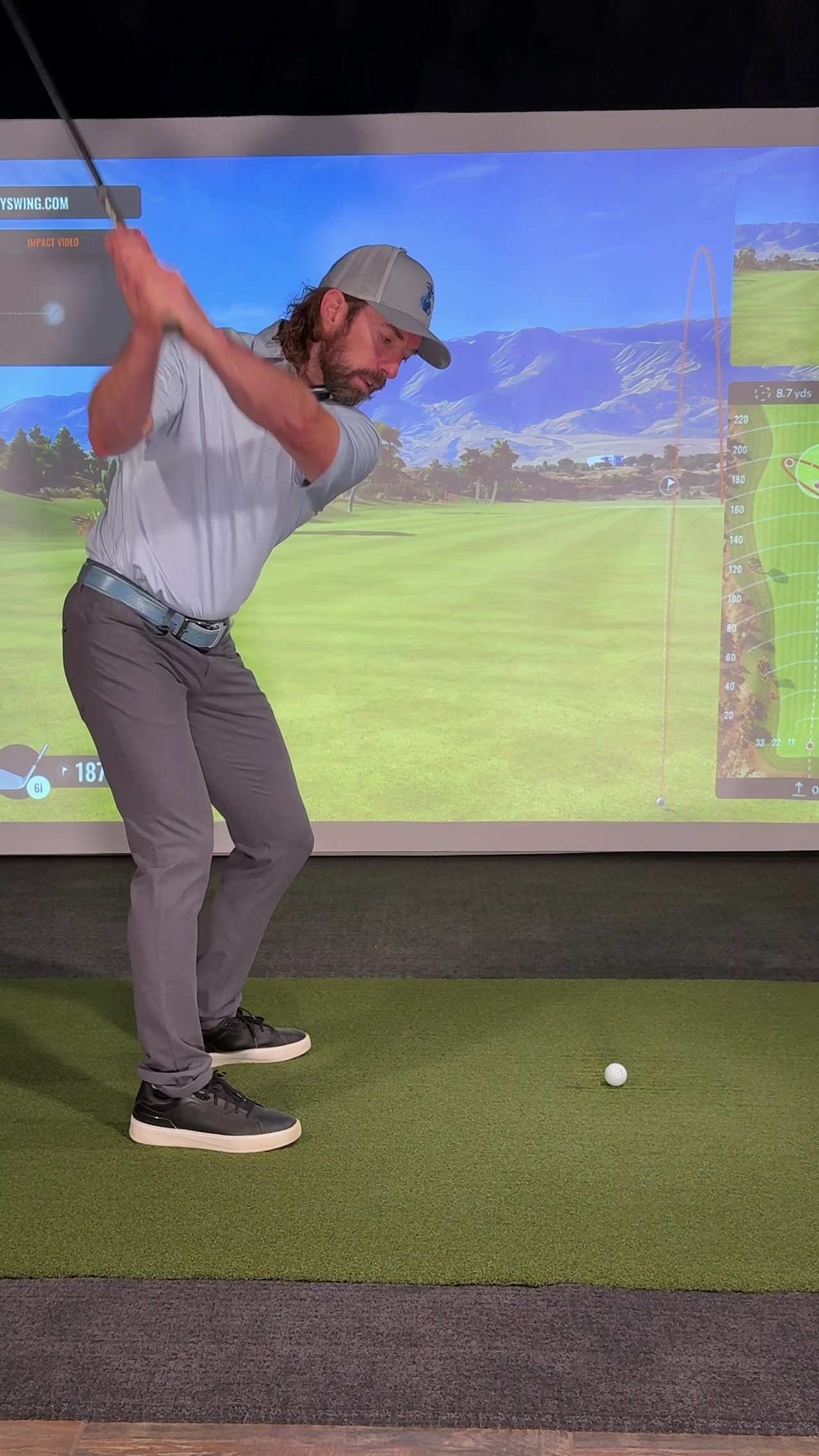
Should I feel like my lead hip moves back and my trail hip drives at the same time?
Or should the lead hip go first and then the trail hip drive?
It's a great question.
It's almost simultaneous, okay?
But you're going to feel the lead first because what happens in the backswing?
A lot of things happen in the backswing, but talking about the hips.
As we start to move into our backswing and we start to get loaded, what's really the kind of initiator coming down is that we start shifting our pressure.
Back to the lead side before we finish our backswing, and that's because we want to create a good stretch cycle.
But how you load your fascial lines is that you're going to start moving into this lead side as your arms and all the fun stuff for finishing the backswing.
So, even though it will almost feel like your lead hip is just leading so much, and then your trail hip.
Once you get to here.
They're both working, but I'm being careful with this feel I'm, you're going to feel your lead hip do a little bit more initially as your trail hip kind of speeds up this motion.
All right.
You got two sides to the golf swing.
You got two sides of your body.
All right.
Regardless of your trail side, lead side, it doesn't really matter.
Both sides have a role and both sides have a job.
So when you're loading, you're feeling your trail hip going this way, but then you're going to start to feel how your lead hip.
Starts to move pressure back into the lead side, and then you start driving your trail hip to kind of get everything working in sync.
But it happens so fast, this little bit right here that the lead hip goes just the tiniest bit first, and then you kind of feel your trail hip.
So that's why I say it's almost simultaneous, it's only this blink of an eye.
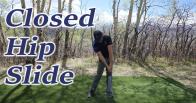
We talk about how there's almost like a little closed hip slide, that's what it, That's what it feels like.
And that's what it is.
Think about that.
As I'm getting here and I'm loading, I'm stretching, it's this like just little tiny window, this closed hip slide where you'll feel the lead hip and the pressure start to increase and get into the ground.
And then you're going to use that trail side to really drive and to pick it up.
And one thing that this has nothing to do with this question, but it just popped in my head as I was doing this.
One thing that I've seen a lot of, especially with the torque bridge drill.
Players are way overdoing their foot to the point that they're early extending and they're pushing towards the golf ball.
It's not just about taking the foot and then just lifting it off the ground as fast as you can.
If I just get here and I just lift it off the ground as fast as I can and start pushing this way, I'm going to create early extension.
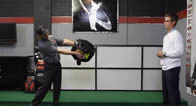
Remember, just like with this medicine ball, I know I'm getting off topic, but I figured this question will come at some point.
So the thing is just like with this medicine ball.
If I'm swinging this medicine ball back and forth and I move to here and I start to work down, it's my whole core.
It's this whole unit driving right here.
I'm not getting here and then just pushing with my foot because I've seen a lot of this from the torque bridge drill.
All right.
This whole unit is going.
You can see with my sternum.
In my hip tracer right here, if we have my little goatee view on it.
It's this whole unit, this whole core unit that's driving, it's not just push with the foot.
All right, I can sit here and do this all day long, like Elvis, I'm not moving anything.
You got to get these puppies engaged, it's this whole unit that's driving.
That's why this is really good at getting that feeling.
Or, um, the kettlebell.
But I actually think that the medicine ball for that particular issue, the two-handed medicine ball, gives you the better feel for that.
So, hopefully that answers said question.
Question for webinar.
All I know is it is common to be crunching in the downswing.
Yes.
I'm not sure what it is.
Crunching, all that is, is that it's taking, whether you're right or left -handed, it's taking your trail side, and as your trail side starts to stretch and open up in the backswing, And as you start to shift back, the crunching is taking this whole elongated stretch right here and firing it down.
So you can see how now I've kind of got this crunch looked right here.
And this is what brings me down into GDP and why I have the correct sideband and all that fun stuff right there.
But the crunching is this elongated and then snapping that back.
Because you can feel how powerful that motion is.
Just do what I'm doing right here.
Just really, if you exaggerate, just really stretch and then crunch.
And you can feel how fast and how tight and how your muscles want to fire and work.
That's what the crunching is.
It may have to do something with the right shoulder drop.
Yes.
Throw.
Yes.
Side bend.
Yes.
GDP.
Yes.
With the right elbow close into our side or something like that.
Can you clear this up?
What is crunching?
Well, that is crunching.
Should we have it in our downswing?
Absolutely.
Why and how?
Well, the why and how, why should we have crunching other than speed and supination and all this?
I could give a really loaded answer to this.
I can give you about 100 plus reasons why we need crunching, but I'm just going to give you one simple.
When I start to crunch, and go this way, what happens with my spine?
What happens with my spine when I crunch?
Or let me rephrase this.
What happens with my axis tilt?
Does my axis tilt increase or does it decrease?
Will my axis tilt increase?
Well, your spine is one of the easiest ways and easiest predictors of your swing plane.
If my spine and my axis tilt go the opposite of crunching.
As they get taller going this way, you will never shallow out the club.
You will never come down on a plane, ever.
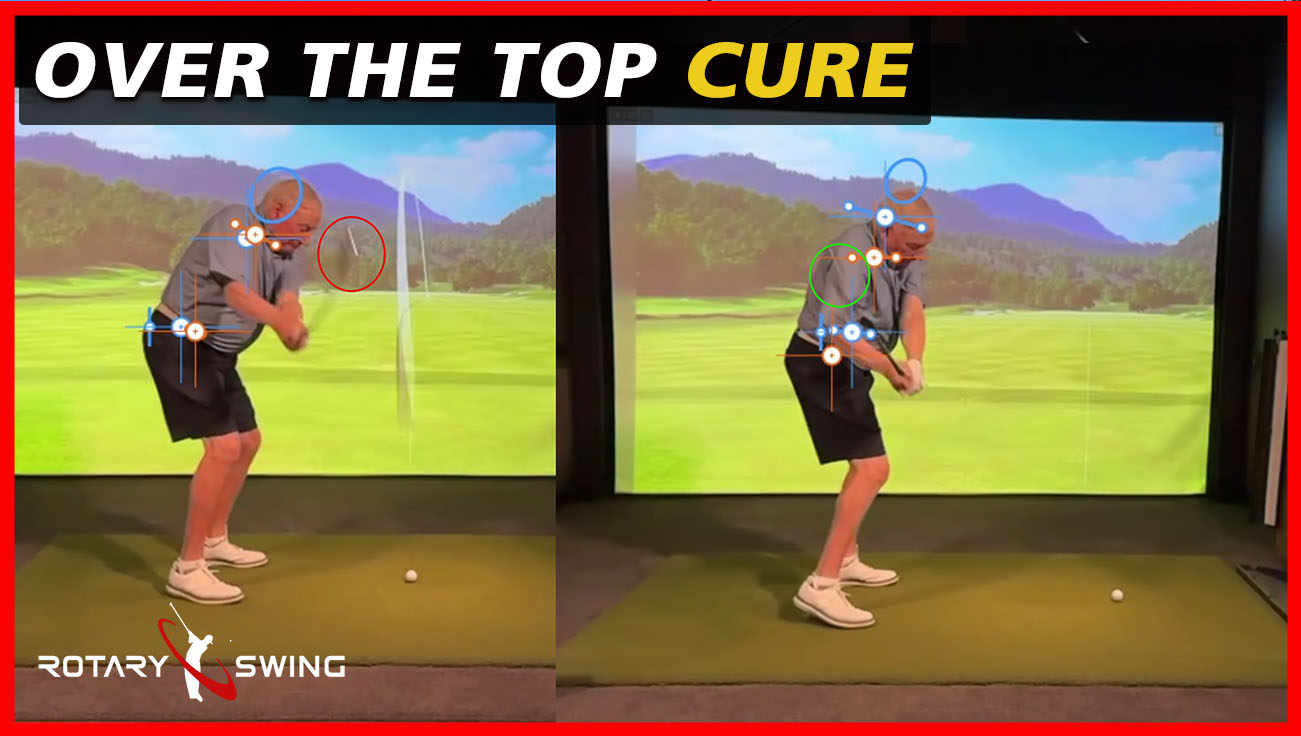
Look at every single over -the-topper.
If I'm crunching and I'm increasing secondary axis tilt without me moving my arm and hand in club, I just go to here and I just crunch.
If I don't do anything in the golf swing, and I'm not saying I want you to do it this way, but if I just crunch, where's my club?
Way too far inside.
I'm going to have to save this one.
But for most players, most players struggle with over the top.
Most players struggle with getting steep.
As you crunch and you move into side bend, this, I don't want to say ensures, but it pretty much ensures you can't come over the top if you do that correctly.
It's going to be really darn hard to go like this.
And this at the same time.
That doesn't really work that way.
Is crunching like doing a sit-up in any way form?
A little bit because it's this way and you're going forward at the same time.
But think about it more as the I'm a little teapot.
I mean, if I'm right here.
All right, and I go this way and now I pour my spout.
Well, as I pour my spout, where do my hips and my core go?
My core, I'm going this way.
I'm not just staying here like this.
And I think this is where a lot of people, look at where my head's going.
All right, I'm going to blow up my back.
Now I got problems.
As I start to crunch, my hips are clearing the way, which puts my spine in the correct position to keep me safe.
Because as I get into this position with rotation, it's just like basically a tennis shot right here.
I'm perfectly safe right here.
Now, if I didn't allow my hip to do that, that's going to hurt.
But it's all about not having to use your arms.
It's all about getting these fascial lines and this structure to stretch and fire.
I want to use these muscles, and I want this to go fast.
So the quickest way to do that is if I'm right here.
All right now, as I start to get back crunch, I can drive with my trail side right here to get into GDP.
So that crunching motion, just like when Chuck talks about that in the Uppercut video, that's the most powerful motion I can make.
I'm connected, I'm firing, gets my legs to work, It's just a very natural motion.
Um, so, I mean that that's what we gained, but the last question of that is, What do we gain by it?
You gain everything.
When you're controlling how, or basically, you know, if you understand how your spine works and you're controlling how your spine and legs work together, which is essentially what's happening when you're crunching, how they work in kind of, you know, unison with each other, it just makes everything.
Ridiculously simple.
Hi, Craig Howdy.
Watching the creating torque video, the trail foot moves back on the downswing to stop the hips from moving and allow the wrist to snap.
Correct.
So, and for anybody that doesn't know, creating torque video is just saying that.
As you start to come down, at some point in time, you've got to start slamming on the brakes.
You don't want to keep pushing through, you want to almost feel like your trail foot's going behind you, almost like you're bowling because you want the club to be able to snap.
And if you just continue to push, the club's not going to snap.
But how do pros manage to have their hips way open at impact if they do this, for example, Sheffield?
Well, there's a couple different answers to this.
First thing is because they get their hips open pretty darn quickly.
I mean, if you watch them, by the time they get to here, They're already cleared.
They're already done.
So at this point, this is where I've already cleared my hips.
So at this point, that's where this is sliding back to create whip.
But let me throw another monkey into this wrench.
I saw something pop up, so I want to make sure.
Let me throw another monkey into this wrench.
What are the three.
Movements in the downswing, we've got lateral motion, we've got rotational motion, and then we've got vertical motion.
Well, when you're applying counter torque, what part of that motion is really going on?
By the time I get to this position right here, I'm already done with my lateral and rotational motion.
Well, Craig, your hips are dead square right now.
How can you be done with rotation?
What do you mean you're done with rotation?
You've got to get the belt buckle facing the target at 45 degrees.
Remember, that's vertical motion.
That's not rotational motion.
Okay?
So my hip.
in getting the kind of two butt cheek look isn't because I'm trying to get here and have all this rotation this way.
That's why nobody gets their hips open.
And can't tell you how many times in an in-person lesson where somebody's trying as hard as they can to get their hips open.
And I'm like, all right, well, let's get our weight and get our rotation here and let's post up.
Well, now I've got both butt cheeks.
And you didn't try to rotate at all because it's a vertical motion.
It's the vertical motion of posting up and back that makes it appear like you're rotating like crazy.
But it's technically a vertical motion.
So that rotation that you're seeing is sometimes it's kind of a misnomer.
But with the counter torque right here, these players.
They're done with their golf swing by right here.
All right.
So you can see how I'm here.
I'm posted up.
I'm off my trail leg.
And now this is sliding through.
So hopefully I don't have seven years of bad luck, but let's find out.
So if I go from here and I start coming down and I counter torque, where are my hips right now?
All right.
I mean, I can't see my own butt, but I have both butt cheeks open and I'm doing extreme counter torquing right now.
But that's because as I'm going from here and working down, I'm using the counter torque to get this to snap.
But I've already gone through my progression of lateral rotational, I'm already done.
And now I'm trying to, I call it in my lessons, if anybody's ever taken a human lesson with me, I call it in my lessons dropping anchor.
Because that's almost what it kind of feels like.
All right, I want you to get up here and as you start to shift, you're getting.
Down to downswing right here.
As you start to get the, or trying to get the club to release, drop anchor.
Because that's what it kind of feels like, is that you're dropping anchor right here because you're trying to stabilize this from continuing to push to get the wrist to snap.
More often than not, amateurs are just behind professionals.
All right?
It's not that you're doing anything incorrectly.
We just get through our progressions faster.
All right.
By the time that you're thinking about getting your hips square, my hips are already open.
I'm already posted.
By the time that you're thinking about releasing the club, I'm already in my finish.
I forgot which student it was.
Okay.
I know which student it was, but we're talking about like tempos and ratios and all that in the golf swing.
And when he started measuring his tempo.
he realized, he's like, I don't swing hard enough compared to the pros.
In fact, he was two seconds off of the typical tour pro.
And that's what was, I mean, that's just what was killing his swing.
Once we got it sped up and all that, it made a world of difference.
But it's because he's sitting there thinking about getting through every single progression, and it's just taking too long to develop.
Versus I'm over here, I'm done.
Now this can snap on its own.
So long, short answer.
One, their hips are already open, and now they're dropping anchor to keep them from pushing through so that that club will snap.
The second thing is, remember, it's technically not rotation.
It's vertical motion.
You're already done with your lateral and rotational right there.
This is vertical motion.
So as I'm firing my glutes, squeezing the cheeks, and getting my inner thigh adductors, To squeeze right here, which is helping me create more that kind of dropping anchor right foot issue trail foot for lefties As I'm doing that this is vertical motion.
That's why Chuck said it's kind of like the the feeling of a pirouette You know if if I'm figure skating I'm like this But what I do, I start bringing things in to speed up.
Well, that's really what's going on right here is I'm bringing things in to speed this up, to get that club to snap.
But I don't want to keep pushing through.
But they're already there.
That's the best answer I can give you on that.
Okay.
Question quattro.
In the throwing of the frisbee analogy, Why do you show it with your left arm?
Right-handed person throw frisbee from right hand.
True.
I show it with left arm because I'm a lead side dominant golfer.
And the easiest way to kind of explain lead side dominance and pulling effects is to use that dominant arm.
Okay.
Maybe you're experimenting what a lead side dominant player does.
100%.
I'm not sure if frisbee throw is the best example after all, for lead side dominance or just overall.
My experience is that we don't actually need so much body activation.
It's mostly in the right wrist, even more than in golf.
Well, I got a couple arguments on that.
For a lead side dominant golfer, throwing a frisbee with the left hand is the easiest way to feel it because you can feel the pulling mechanisms.
Because what do you not want in a lead side dominant?
You don't want to be pushing a ton from your trail side.
Push will overtake the pull and defeat the whole purpose of a lead side dominant swing.
Now, if the frisbee analogy for right hand and a trail side throw, no, it's not the best analogy for that.
Skipping a stone, throwing a ball, much better.
This is the one thing I'm going to fight you on.
My experience is is that we don't actually need much body activation, it's mostly in the right wrist.
Okay, well, the problem is, everybody takes things different ways.
I might tell you, my grip pressure is a five, but to you, that's a Or you learned to throw a ball growing up?
And like, when I work with my German students, they never played baseball, they're like, what is what is this weird sport?
And so they never developed that same kinematic sequence that we did when we grew up playing baseball.
We grew up throwing rocks.
So I can sit here all day long and I can fire my right wrist all day long.
And you can hear there's a ton of speed in there.
I'm creating a ton of speed right here because leverage is an awesome power source.
Just ask Archimedes, right?
Leverage is an awesome power source.
But if I take my right wrist and now I stretch and use my muscles instead of just firing with my right wrist, and now I fire with my hips and my right wrist, there's more speed in that.
That's muscle activation.
That's me not just using one part.
I want to use every ounce of muscle I got.
It takes 32 pounds of muscle to create 100-mile-an-hour credit speed.
I want to use all the muscles I got if I'm trying to hit it as far as I want.
So for some players, absolutely.
I've got former major leaguers that I teach and players that have done other sports in life.
And if you tell them, you know, the throw the ball drill or the supination drill immediately, they're like, oh yeah, okay.
So I get here and they immediately start firing their body and snapping their wrists because they understand how to create power and use torque.
They did it at a high level.
But if somebody didn't develop that early on, I've given people the right arm drill before or supination drill before, but then they never, they didn't grow up like I did.
I played every sport.
And so they get their right hand and they go like this.
And they get up to this position.
They don't have any wrist.
And they're like, okay, fire your right hand and fire your right wrist.
They never developed the same thing.
So you need muscle activation.
And I'm trying to get, for me personally, I'm trying to get all my arms and hands out of the swing.
I want my arms and hands to just be directed by where my body's going and then right at the end just have some good snap.
I don't need to be trying to find all these positions doing with my arms and all that.
I'm moving me and then letting that snap.
So I understand your argument on that point, okay?
But that's not for everybody because you don't know what people have developed.
Because sometimes I will give them the exact same thing like, oh, it's the video that y'all always yell at me about and not squish the bug, the J release.
So I've seen people do J release and they start to get the feel of like, okay, I've got the feeling of the J.
But then they just go like this.
Yeah, I can hit a long way doing this.
I can actually play some great golf doing like that.
It's not the max of my capability.
I've got to combine.
I've got to get some of this muscle fiber to stretch and fire if I want the full Monty.
So I understand your argument.
To get a correct backswing slash downswing and release and stop using the arms and stop over the top.
That's a lot.
There's a lot going on.
Yeah.
What might be the most important things here?
Supination, getting to GDP.
Well, those are both tied together.
How to use the body for power and hands for speed.
Let's see how this is done again and again.
Can it be done in smaller steps to make it easier to learn that can be put together when we're ready for it?
Well, I'm actually going to take this question backwards.
Can it be done in smaller steps to make it easier to learn?
Absolutely.
You can break the swing up into many steps as possible.
If you want to break everything up into each little component where I'm right here, I've got weight, and now I start to get my turn.
Now as my core is going, I start to feel my scapula moves.
You can break it down as much as you want.
The problem is it's twofold.
One.
It's going to take you insanely long to build a golf swing.
Because that's just not how movement's done.
Second thing is right there, movement.
You need muscles to fire and react.
If you want something, if you want to pick up your pace and learning, you need muscles to fire and react and you need to be able to do it at pace.
Because if you sit there and you do it in just chunky, chunky, chunky, chunky.
It's going to take you forever.
Now, there's people in my unlimited group right now that are like, well, hey, Craig, you have me going all the way to here and then stopping at GDP and then releasing the club or going to the top and stopping and coming down.
Absolutely.
There's a time and place to kind of break things up.
But I don't have them break it up into 10 different pieces.
Because you've got to get the feel of the movement.
I'm trying to think of a good analogy for this.
Because I know there's a painter in our audience.
And I definitely don't want to use painting because I'll definitely say the wrong thing.
But let's just use painting.
Stephen, if I'm wrong, don't correct me.
Just think of the point of the analogy or metaphor.
So think about painting.
Like if you're sitting here.
You have to create the movement.
The brushstroke's a movement.
How are you going to ever cut in a line or draw a straight line if you're like, okay, one, two, three, four, five?
It's a movement.
I can make a straight line like this.
If I'm sitting there thinking about everything, things don't work correctly in sequence.
So to get a correct backswing, downswing, release, stop using the arm, stop over the top, there's a lot going on.
What are the most important things here?
SuperNation GDP.
I mean, that's going to be subjective.
It's going to be different for everybody, but this kind of goes back to what I was talking about earlier.
All right.
What's the most important thing first?
You got to get your setup.
If your grip's not correct, your setup's not correct.
What are you doing?
Literally, what are you doing?
I mean, that's the second thing is, is the body sequence.
Can I teach somebody the feel of supinating, deviating and rotating just like with J release and what all?
Absolutely.
I can.
Teach all that stuff.
But at some point in time, they're going to want to get their body involved and that's the thing that I see more often than not is that somebody will spend all this time correcting their arms.
And they'll negate everything that's going on here.
And they'll be like, Craig, look at this, just like the right wrist question.
I've got my takeaway right here, I've got shallow out, I've got this, I've got that, everything looks great.
And I'm like, okay, well, let's do it with a little pace.
And as soon as they add any miles per hour to it, what does their brain say?
Okay, well, this is creating some juice, but I got to put some body in it if I want to add a little bit more.
And as soon as they put their body into it, well, hip slide comes in.
Oh, early extension comes in.
All this stuff kind of breaks down.
I'm kind of a foundational type guy.
I get upset when builders.
And this is just a personal story of me.
I get upset when builders skip steps or say like, oh, well, that doesn't really matter.
I know that's on code, but that doesn't really matter.
Really?
Well, that's why I had a leak.
It's because somebody skipped a step.
So I'm a big foundational guy.
If I've got my setup, I've got my grip and my body is firing, my engine.
Notice how the first thing on goatee is your engine score, not your whip score.
If my engine is doing all this, well, taking care of these two little noodles, that's going to be a lot easier.
These are easy to train.
I can train these things all day long, but as soon as I start trying to move this big lug around and trying to add power, these things start flowing all over the place.
They start trying to figure it out, and they start timing things.
These are your safety valves.
They're trying to save you on these things.
All right, so what might be the most important things here?
Get your sequence correct with your body, learn how to use your legs, learn how to activate your core.
Why do you think, just like, even with chipping, we start here and we don't say hey?
Learn how to lag and release, say hey.
Learn how to feel your body.
First, learn how to move this, and then start blending it in As the body starts to get better, then start blending the arm and hand in.
I know that somebody's going to probably fight me.
I know that.
Believe me.
I get all this stuff on the back end.
That's for players that already understand these positions or feel these positions because of things they've done in the past.
So I would put the priority just like what Godey's doing right now.
Hey, more than likely.
I'd say 90% of y'all, probably your first suggestion was torque bridge drill saying, hey, you got to get better load.
You got to get better this.
Okay.
Get that first.
Then you go to the uppercut punch drill.
Let's start using that good lower half and let's combine it with this.
That's kind of how I would do it.
And that's where I'd kind of put the onus on it.
Next question.
Not using the arms for power.
We need mental discipline to make this happen.
Yeah.
It's so easy just to push with this arm or push with this shoulder.
You just have to realize at the end of the day, it's the slowest way to do it.
All right.
The slowest way is to push with all of this.
You can't make that club move faster than it's designed to move when swung correctly or using proper physics with it.
Are there methods to make this easier, more natural for us?
Good body mechanics, sequencing perhaps?
Yeah, I mean, obviously, proper sequencing and good body mechanics can do that.
But it's still, to me, the arms for power and the mental discipline of it.
More than likely, You're watching this webinar, or you're taking a swing review, or you're using Goaty, or you're a member of our site.
Because you want to be better.
Or you're frustrated, or you don't hit it far enough, or you don't hit it straight enough.
So what you're doing isn't working.
All right.
It's the reason I came to Rotary.
It's the reason I sought out Chuck in my professional career because what I was doing wasn't working.
Well, it was working, but not the word I needed.
To be so, when we say, hey, you're using your arms for power, take it hook, line and sinker, if you're using your arms for power.
That's kind of what probably got you here, and so we got to change that.
Now it's a lot easier.
And I'll say this, this is a so much easier question to answer in an in-person lesson.
And let me tell you what?
So I get somebody in an in-person lesson that's struggling with distance and they're swinging out of their shoes.
They're going as hard as they can.
And either I'll hit a golf ball and show them like, hey, how much effort did I use?
But then I'll start talking a little bit about release and I'll have them start to move.
And I'll have them, let's just say, do like a little nine to three.
And if I started to get their nine to three and I get them kind of making a decent takeaway and a decent shift.
I get them to start releasing the club for the first time, especially if I'm at the simulator or something, and they're like, oh, wow, I don't feel like I'm really doing the whole lot, and the ball's just jumping.
It's a lot easier to get that cell in, like, yeah, and look at how little you're using your arms.
Look at how little you're swinging right now until they go full swing.
Because what will happen is I get them here and they're not using their arms and they're getting good hips and they're getting good release.
Then all of a sudden they make a big old full swing and they hit it shorter than they did their nine to three.
They're like, I don't understand.
What happened?
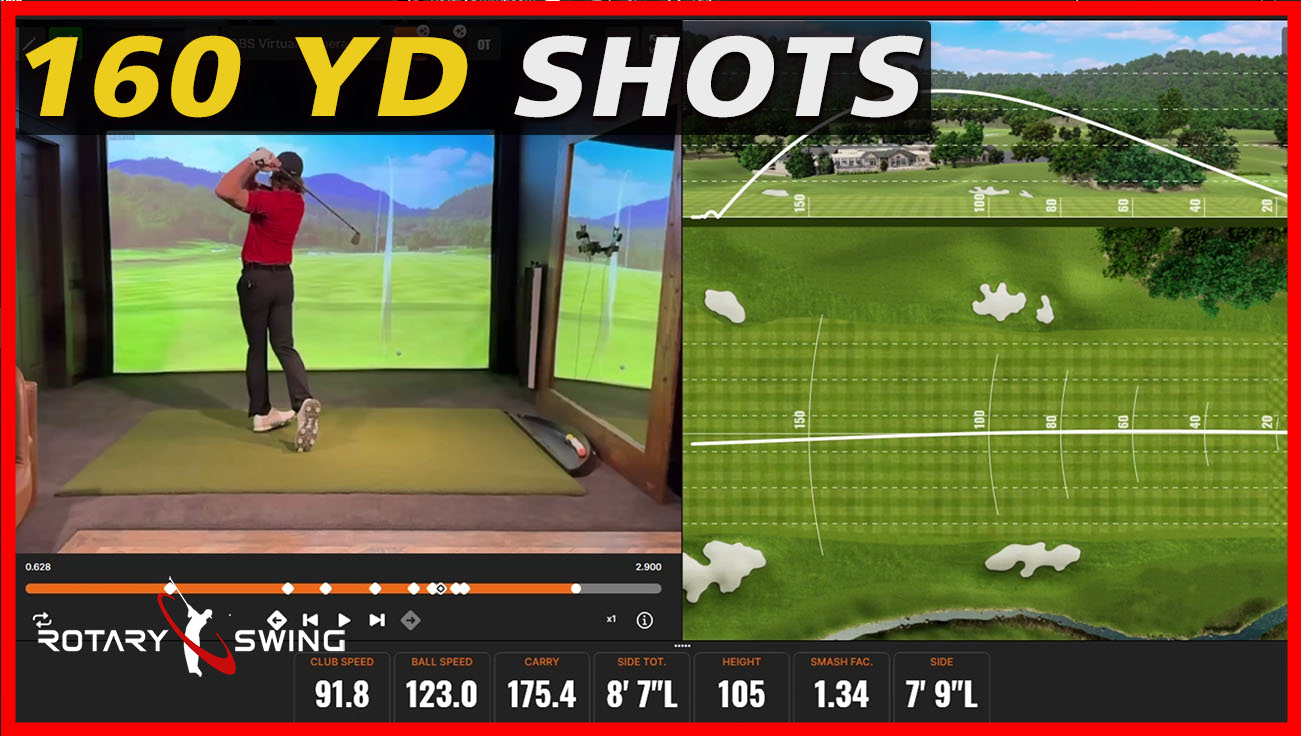
I was just hitting my nine to three 150 yards and now I just made a full swing and it's going 135.
It's exactly that problem right there.
It's because most players swing with their arms and hands.
And as soon as I let them, kind of go off into the wilderness and start making fuller swings before kind of developing the rest of this pattern, they go right back to firing their arms and hands and all of a sudden they lost all that free speed that they had.
So this still goes back to foundational things, which is set up, body sequencing.
It's really hard to get the arms out.
It just is.
I feel for you on this with the mental discipline on getting this push out because it just feels powerful.
The problem is anything that typically feels powerful in the golf swing just isn't.
If you feel, there's a difference in effort, but if you feel like you're having to make way too much effort and you're not getting out of it, you're probably just using your arms.
Just try it a different way.
You're giving us a shot.
Arms aren't the power.
Give in to us for a little bit on that.
It feels weird at first to do the torque bridge drill and to do all these sequencings and all that.
I promise you.
I promise you it works.
I'll make sure nothing popped up on that because I saw something.
Okay.
I'll get to your thing, William.
I can answer that one.
Craig, your next webinar.
Okay, so this goes back to the question earlier.
Would you give us your thoughts on Goaty and how we should best utilize the platform, or if at all, why wouldn't you utilize it?
That's my first question.
I'm always looking for something easier and better.
Anything that's going to help me.
Better my golf swing, better my life, anything that's going to make something quicker for me.
Hey, Google Maps says, if I make this left turn here, it's going to cut 12 minutes off my journey.
Let's do it.
So why would I not utilize it, even for me, even for Chuck?
If it's something that's going to give me feedback to get me doing something correctly on the sooner side, I'm gonna do it just me.
I don't have that much time in my life, so I I'm trying to.
I'm trying to cut little seconds and minutes every second I can get, every chance I get.
Does it make sense to use Goaty if we're working through progressions with you or another coach as an unlimited reviewer?
Sure.
No problem with that.
For my specific case, I'm rebuilding my swing.
So it seemed that I should stay solely with you, at least until I'm back working on my full swing, but I'd like to hear your thoughts.
Cost, I'm sure, is a factor for some of us.
Absolutely.
Cost is a factor in everything.
So if you can share your thoughts for those of us on a budget and for those that could only choose one or the other.
Okay.
I think it's time.
Time and place.
This probably isn't the best corporate answer.
It's corporate.
It's probably like, Craig, both.
All day, every day.
No substitution.
But I understand things cost money.
So this would be my thought on that.
It would be time and place.
Unlimited reviews take time.
They do.
All right.
You've got to have a place where you can swing and do things of that nature.
Goatee, you can do anytime, anywhere, especially like a little bit of the live training stuff.
You can do that anytime, anywhere.
Pull out your phone or iPad or whatever you use it on and start doing And get your feedback and start tackling However, there's a difference in a swing review and there's a difference in an in -person lesson.
There's a difference in Goatee and there's a difference in Craig.
Just like there's a difference in Goatee and there's a difference in Chuck.
Now, there may not be a difference in Chuck and Goatee one day.
They're slowly merging into one being.
But sometimes people need a little bit more explanation.
And Godey's going to tell you everything that you're doing wrong in your swing, essentially.
I mean, it's mapping out all these things.
But sometimes you need to talk it through.
And this is just, you know, this is my answer for time being, all right?
Because Godey's just going to continue to improve.
But sometimes you need to talk it over.
Sometimes you need somebody that has seen this a million times and you're like, Godey keeps telling me this is what I'm doing and I'm just not getting it.
Well, that's kind of where I come at.
All right.
Well, I've seen this a million times too.
And I understand why you're not getting it because this is going to kind of feel weird with the position I'm going to put you in, but this is going to be what does it for you.
So with cost being a factor and say, for instance, this student.
Do you continue to do unlimited reviews or do go to which one or the other, which is best?
I think it all depends on your circumstance.
One is your time and commitment.
If you don't have time to do a ton of swing reviews and all that, and you just have your little window, go to is probably going to be a better option because it's going to be harder for you to get to me.
But what I would say is if you're going through these kind of big, major changes, let me kind of get you going a little bit.
And once you kind of get the basis, think of like the overlay with Goatee.
If you're going all over the place like this with Goatee, all right, and it's sitting here, it's a great tool using that overlay to kind of see what you're doing.
Let me kind of tell you what you're doing.
Let's get the basic motion down and then kind of use Goatee a little bit to refine.
It's a tough call on which one's better and which one's worse.
And, you know, I'm.
Obviously, I'm always going to err on the side of me.
It's survival over here.
But I think it's always good kind of like going to your doctor.
Let me see what the doctor has to say.
Okay, now what's the course of treatment plan?
And that's the same thing that I'd tell you in a review.
If I looked at your golf swing and I'd say, hey, there's a guy in my unlimited review group right now that I literally told him.
I said, there's no need to rebuild your swing.
Your swing's fantastic.
You need a couple tweaks right here.
I don't want you to waste your time and money with me.
You don't need that.
But Goaty's actually going to be better for him because he just needs some very structured here, here, just some reps and kind of cleaning up a couple little things.
So that's a tough question.
I think, you know, as Goaty gets better, it's going to turn into more, you know, me and Chuck and Anthony.
But I think it all just depends on your time and commitment.
Swinger views as a commitment.
Goatee, it's kind of really on your own time whenever you can get to it.
But some people at the end of the day, they want to hear it from the horse's mouth.
That's a pretty loaded question.
I probably should have read this before that.
I saw the topic, but I didn't read the whole thing.
I think that.
And I think the beauty about all of it, try them both.
And this is what I mean.
If you're with me right now and you like what we're doing, let's finish our progressions and then go work with Goaty and see what Goaty's saying.
If you like working with Goaty and keep working with Goaty, or if you're currently working with Goaty and then you feel like you get stalled, come over to me.
That's why we don't have, we don't lock you into your contract like Verizon.
Drop out of that, use it, drop into me.
So that's a pretty loaded question, but for this particular student, you're rebuilding with me right now.
Let's finish the race.
Can't be that far off.
All right.
Next question.
Craig, I'm trying to reconcile two pieces of instruction about the trail leg.
In some goat videos, you talk about the trail glute going straight back.
and the trail leg straightening in the backswing, okay?
So the trail glute going straight back this direction, and the trail leg straightening.
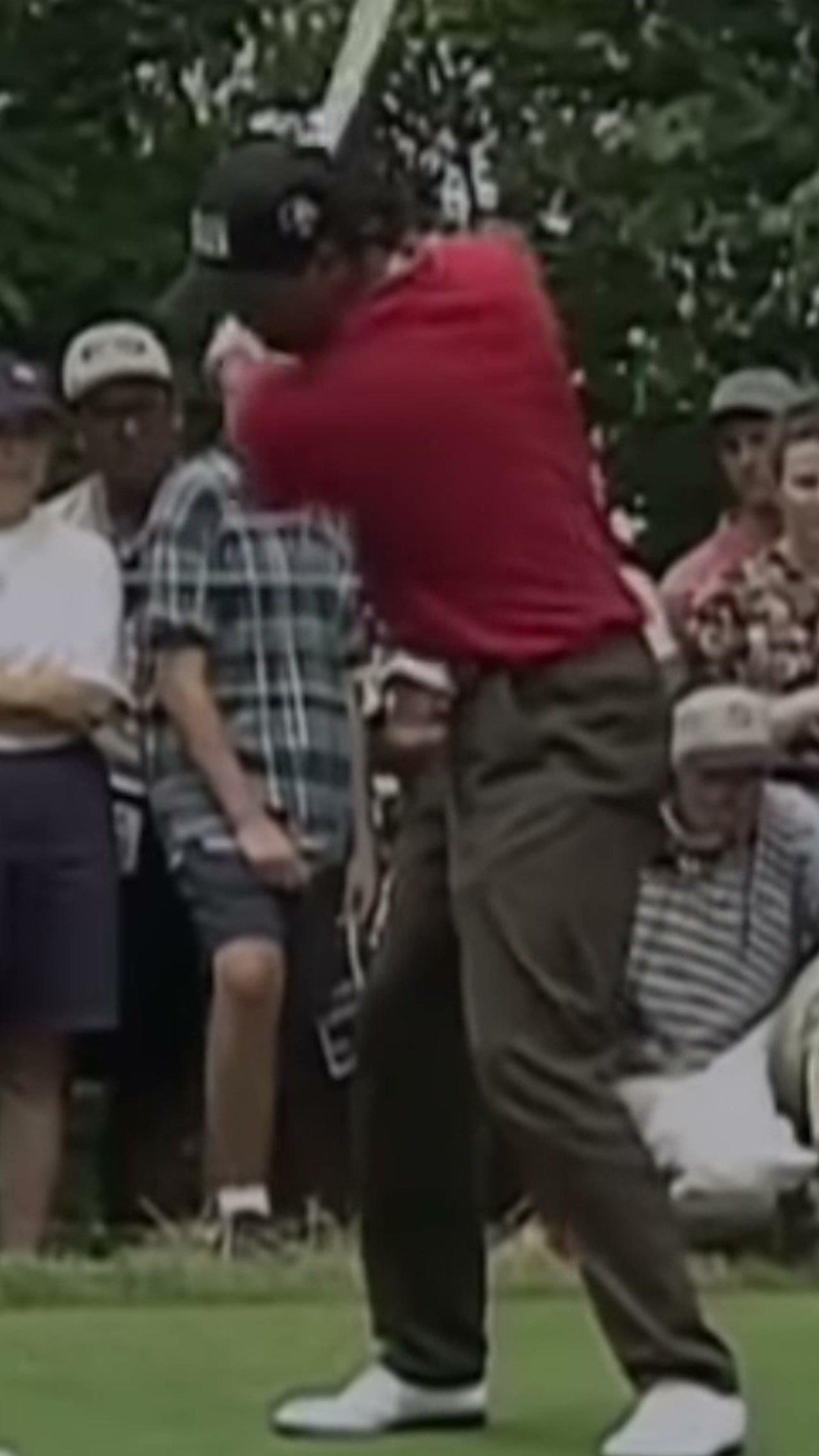
But in other models, Hogan's umbrella image and the 104-degree trail leg angle versus tiger, so go backswing, the trail leg stays angled in and doesn't go vertical.
It goes a little vertical.
Can you clarify what you mean?
By trail leg straightening, is it hip extension with the knee flex angled in, or should we be letting that leg get more vertical?
I want to make sure I'm copying the right feel on my swing.
Okay, so let me see if I can figure out exactly what, um, this person's looking for talking about.
So, Student Is saying, okay, what is trail leg straightening?
And or why do we need it?
Or do we need it?
That's kind of how I'm taking the long question.
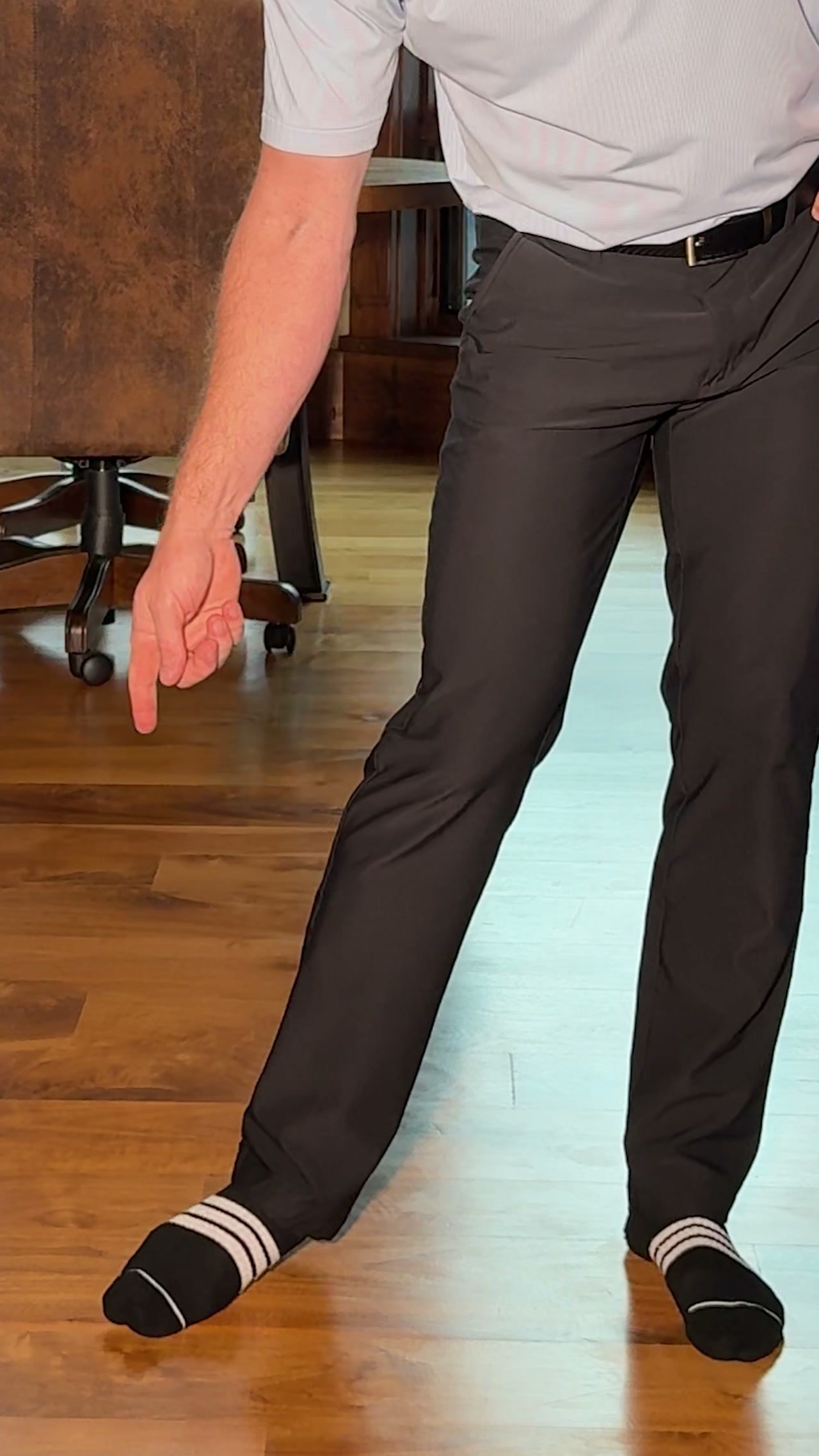
The trail leg in the backswing is allowed to straighten a little bit.
Is allowed to straighten.
And what we mean by straighten is it's inflection right now.
I'm wearing black.
It's inflection right now.
And it's straightening.
It is allowed to straighten.
Now, do we want it going dead straight?
No, not at all.
But the straightening or allowing it to straighten a little bit as you rotate is going to help you do what?
One, it's going to help you rotate.
If I kept my knee like this, it's about as far as I can move my hip.
But if I start to allow my trail leg to straighten a little bit, I've got a lot more motion right here.
I've got a lot more I can rotate.
The second thing is, goes into, well, let's take the torque bridge drill.
As my trail leg starts to straighten, my hips turn, all right?
And as it starts to straighten, what does my lead hip now want to start doing?
What did I talk about earlier about kind of starting the downswing before completing the backswing?
The straightening of the trail leg can aid in getting this piece and getting this pressure back to the lead side.
Okay, so a the trail leg.
allowing yourself to lose a little bit of flexion.
100.
Okay, do you want it locked out?
Dead straight?
Not at all.
104 degree angle.
I'm maintaining some flexion as I'm loading this glute, I'm maintaining on that angle, but as I'm doing that, my hips aren't rotating perfectly flat.
This hip's getting a little higher.
This hip's getting a little bit lower.
Chuck and Tiger both lose a little bit of flexion in their knee going in the back swing, okay?
So you still want to have that 104 degree, but it's okay to lose that because all that's going to do is raise this hip a little bit.
As that hip raises, it's going to aid in shifting back to this side and starting to post I've seen on both ends.
where players keep excessive flexion and they can't rotate.
And I've seen it on the other side where players lose all their flexion and this glute doesn't stay engaged.
So trail leg straightening, is it okay?
Yes, to a certain degree.
Trail leg straightening serve a purpose.
Absolutely.
It allows you to rotate more and it also aids in getting this lead hip starting to get the pressure back into this side correctly sooner.
versus waiting, waiting, waiting, waiting.
It helps out with the sequencing, okay?
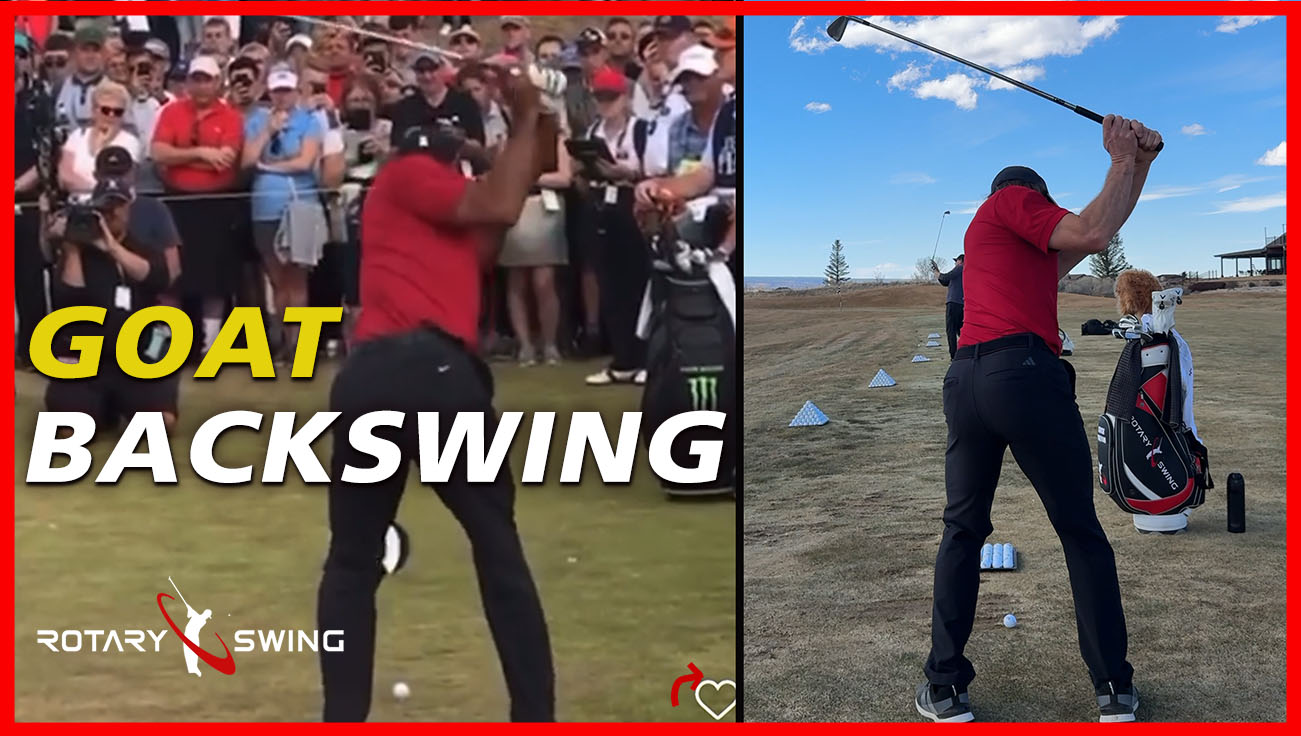
Does it match goat backswing in that 104 degree angle?
Yes, it does.
Chuck's doing the same thing in that video, all right?
It may not look like it, but Chuck's doing the same thing.
So trail leg straightening, okay, has a purpose.
And if you do struggle with rotating the backswing, or let's even take the torque bridge drill.
It's okay to allow that to straighten a little bit as you're getting into this side.
My knee's straightening a little bit right here.
It's only going to help me get to this position.
So it's okay.
I know it sounds faux pas because you may have seen like the laser beam knee drills in the past.
Probably a couple other videos that talked about it.
But in everybody's case, A little bit of straightening here, that's perfectly fine because there's way more good to allowing it to happen a little bit than never losing any flexion in the knee at all.
Like, if you just kept this anchored, nothing ever moved.
We don't want that.
That's not how things are performed.
You move.
You move in the swing.
And that little bit helps out the shift and the tilt in the pelvis in your sequencing.
All right.
Well, that's it on mine.
So as per usual, thank you everybody for stopping by.
I hope I helped you.
If you have questions for the next one, the reason I'm done right now, that was my last question.
Get those things in there.
Go to the community and give me some questions so I have something to talk about.
In the meantime, I'm going to go to the board right now.
I'm going to spend five or 10 minutes answering the things that popped up while I was up here.
If you have a question, I'll try to get to you.
So just put it up there.
I'll scroll back and I'll look through it.
But with that being said, I truly appreciate everybody for stopping by.
I hope I provided some clarity.
I hope I provided some good information and some new insights.
I hope that every time you leave this, it's not, ah, it's Craig again.
I hope that's a better way of thinking about something.
Or, hey, that might be the little bit of the light bulb moment I need.
So I hope that you got some good answers in here.
I hope a little bit better understanding.
I appreciate you for giving me your Wednesday evening, at least on the eastern side of the states.
And I'm going to go to the board right now and answer some questions.
And I hope everybody had a wonderful holiday in the states.
And have a good weekend.
So thank you again.
At least until we all know, at least until Goaty starts doing these webinars, just imagine at some point in time, there's going to be a giant cartoon character right here doing all these questions.
All right.
Let's see.
I think this is where I left off.
Tom, what's an Atlanta guy doing with a New England helmet on the shelf?
Yes, I know, Tom, and I get a whole lot of heck for that.
But that was one in the tournament in Baltimore in 2001 when they won their first one, signed by Brady.
This was a long, long time ago.
So that was the first one after the first Super Bowl win that he signed and did all that, and I won it in a tournament just outside of Baltimore.
So I figure.
It's a talking point.
It might be worth something someday.
I heard that Brady guy was a pretty decent football player.
That Mike should hang on to him.
Craig, if your engine and anchor are in the 70s but your whips are in your 40, how does one improve the hand angle at impact?
We got something coming out on that, Craig.
I don't want to get to these other questions, but Chuck's got another one that he's working on right now for players that are getting better with their engine.
I'm better with this to help.
Okay, my engine and my anchors are doing great, but my whip score is not increasing.
So just hang on.
I don't want to break anybody.
Chris, please show the strong right hand grip that Chuck talks about.
Sure.
Finally, a question I can answer.
I've got a really different sense of humor today with the amount of sleep that I've had.
So right hand grip.
Let me see if I can.
So the right hand grip, as you're taking your right hand, I'll scoot back just a little bit.
Right hand coming from underneath.
If you look at my hand right here, it's not like this.
I'm in this position right here, taking my middle finger, getting my knuckle at 11 o'clock right here, wrapping my fingers around.
I've got my V pointed right at my trail shoulder socket with my elbow pit pointed away.
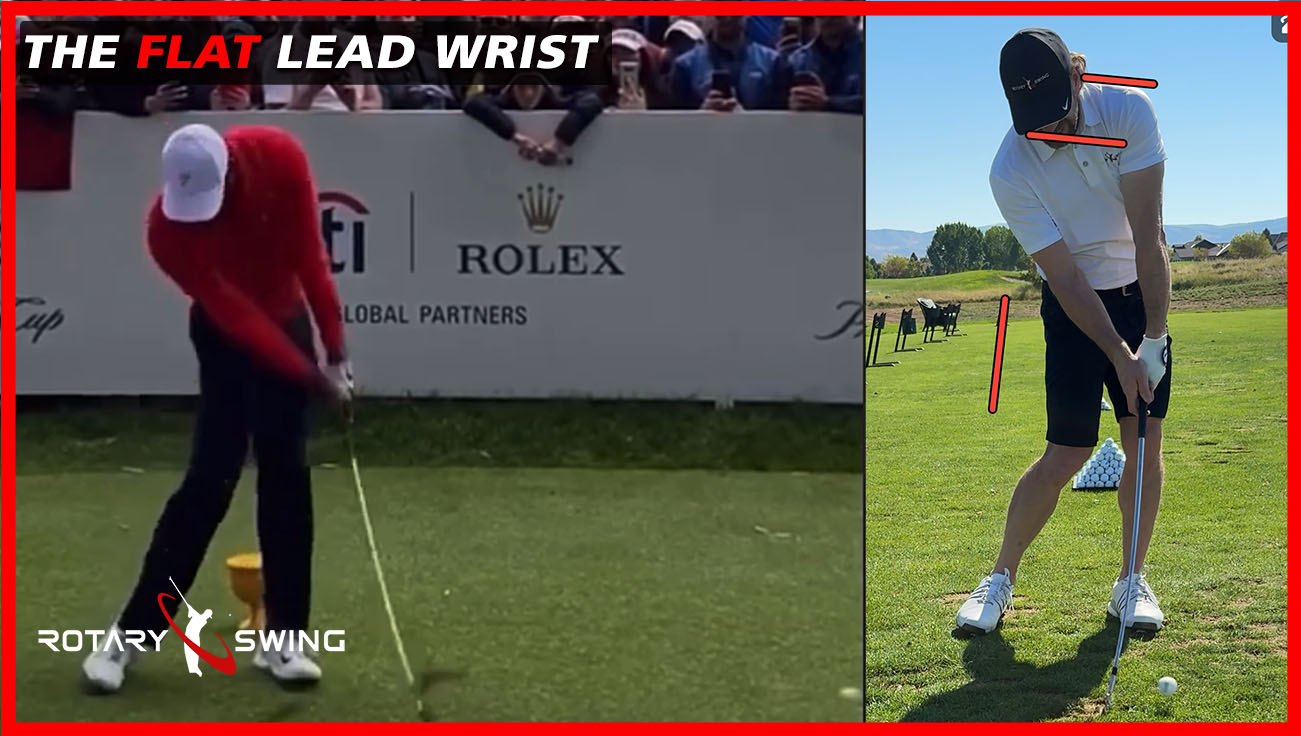
And when you get into this position, you're not going to have a whole bunch of extension in your wrist.
It should look relatively flat right here.
It may even look bowed to you when you look at it, okay, or in a lot of flexion.
In this point right here, this is what allows this whole connection between your core to here and here to the grip.
The biggest thing that I see on my end is that players get like this.
They are too weak.
Or players take this stronger grip, and when they take this stronger grip, This isn't, the knuckle isn't at 11 o 'clock, first knuckle in the middle finger right here.
They actually get too strong like this, and then they start rolling it this way, and they start flipping it that way.
Middle knuckle, 11 o'clock right here.
Get that trail hand on, get that V pointed up.
It's just as easy as I'm shaking my hand, turning it this way, knuckle, done, ready to swim.
Tom, any tips on how to control the speed of the body and club from driving the swing from the lower?
Any tips on how to control the speed of the body and club from driving the swing from the lower body up to the upper body?
Having trouble slowing it down to get a better feel what I'm doing.
Controlling the speed of the body and club from driving the swing from the lower body to the upper body.
You're going to have to explain that one a little bit to me, Tom.
I'm a little kerfuffle on that one.
Vincent.
So is the torque bridge uppercut punch drill to help with engine score?
Yeah, 100%.
Now, the uppercut punch will actually start to help you better with your whip score if you're doing it correctly, too.
But yes, the torque bridge is helping you with your engine and definitely helping you with your anchors if you're moving through those points correctly.
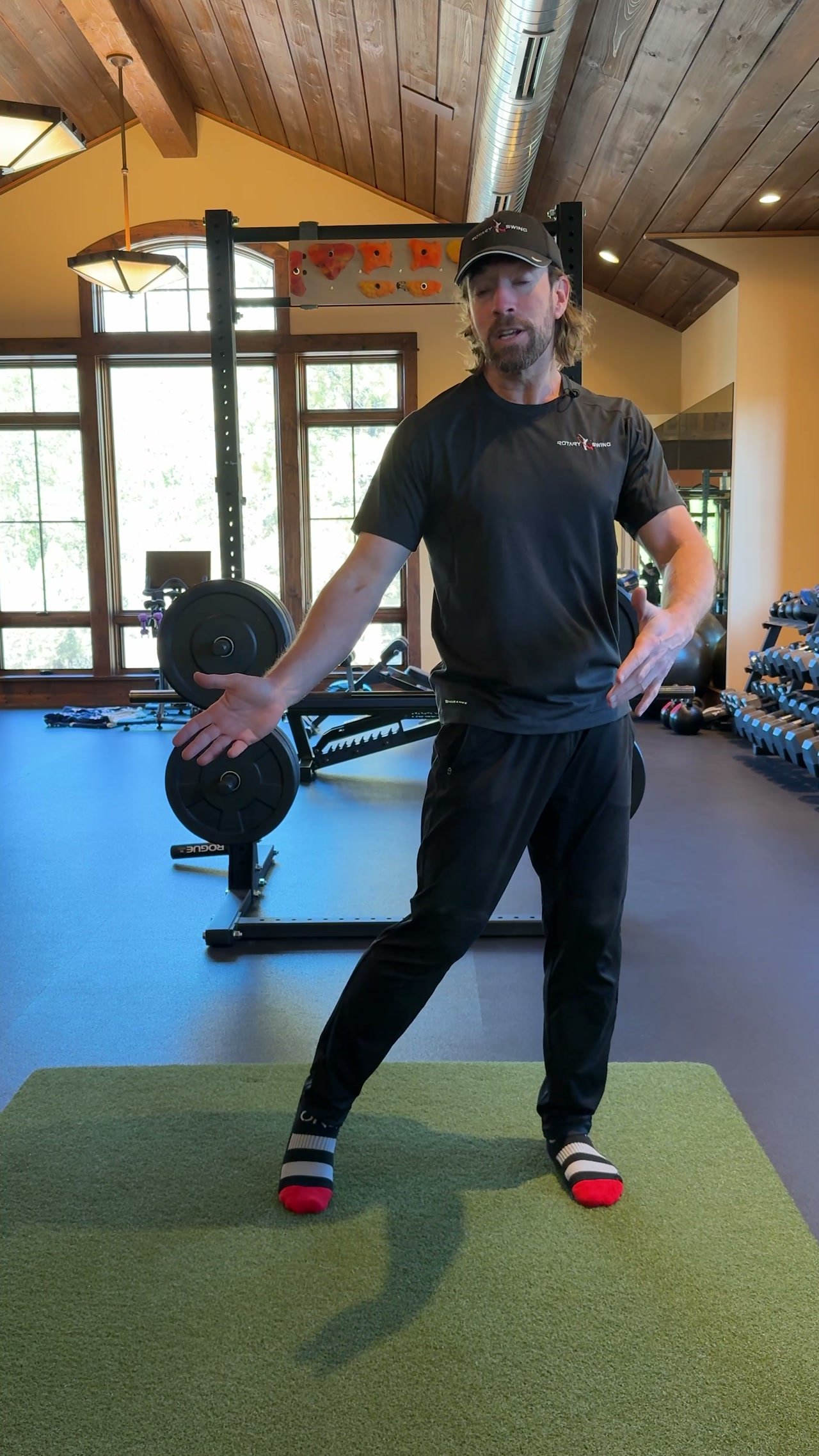
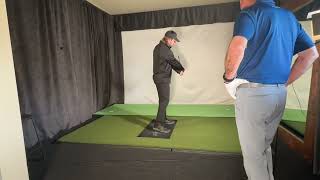
Now, William, the visuals would be way better clothing if you are wearing a lighter color to contrast the floor color.
Black clothing against black color is hard to see.
I know, William, and my apologies.
I did not think I would be back into this room today.
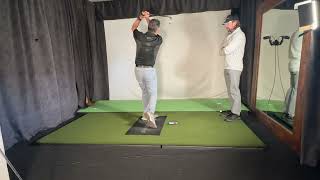
All right.
And so I already put this on for lessons this morning.
I did not think I'd be back in here.
I thought I'd be back in the one where I did the last webinar where everything's beige.
It's technically oatmeal.
And black on the oatmeal works great.
I completely understand your complaint here.
I got the lights as bright as I could, but I did not think I was going to be making it back in here today.
But this is so much better for me acoustics-wise and swinging because I can do all this.
So I apologize about that.
I know it's a little bit of a stickler with the lack of contrast.
Manny, I'm topping my seven wood.
Manny, where does typically the top come from?
Top comes from lack of weight transfer and too much secondary tilt.
So make sure that you get your weight back to the lead side and feel that your lead shoulder stays low.
It's going to be impossible to top it.
If I'm going into the ball like this, topping is typically hanging back too much secondary tilt, which goes into the crunching, which goes into the supination, which goes into the torque bridge drill, which goes into the uppercut punch drill.
When you start transferring back to the lead side, should have said this earlier, but Manny's question brought it up.
When you start transferring into the lead side, your head does not go this way.
This is not crunching.
All right.
I'm moving this direction.
So even though my spine and my secondary tilt is increasing, my head's not going further away from the target immediately in transition.
No problem, Annie.
Thank you.
Let's see.
Michael, how do you think we should use the live goatee swing analysis?
How do you think we should use Right now, we've got the sternum tracer on it right now to really help out with that engine score.
Remember, right now, we're still technically in beta right now.
Everything is going to get better.
Goatee is getting smarter every day, and we're going to have more drills, and we're going to have more live-action features of what you can drill and what Goatee can see you doing.
Nine out of ten times, people aren't getting the sternum drop, all right?
Even if you think you got it, you're not getting it.
So for right now, just getting the engine score going is that biggie.
Mitchell, you're welcome.
Paul, what is the secret to keeping your head from rising on the backswing?
What is the secret to keeping your head from rising on the backswing?
Not using your arms.
That sounds kind of silly.
But if I'm right here, over swinging my arms is why my head goes up.
So if I don't do anything with my arms and hands, and let's just take a torque break.
If I don't do anything with my arms and hands, and I'm loading into my glute, and all I'm focusing on is taking my sternum, taking my hip center right here, and I load into my glute, and I don't use my arms and hands, where does my head go?
My head goes down.
It actually lowers.
All right?
Even with my trail leg straightening, my head's still going down.
All right.
So the head lift is because you're doing, it's your arms doing this.
Get your arms out of the equation.
I guarantee if you didn't do anything with your arms right here, do it like this, your head would go down.
All right.
So the head lift is just arms.
Eric, many thanks.
Many thanks.
Steve.
Any chance Godey will be able to analyze swing with swing trainers in place of club and ball?
With it being winter, it would be ideal to swing indoors and get analysis.
Any chance Godey will be able to analyze swings with swing trainers in place of club and ball?
What do you mean with swing trainers?
Are you saying like a half club or something because you're indoors?
You can kind of swing anything.
It's going to mess up your score a little bit not using a 5-iron.
I mean, just find a space where you can do a 5-iron real fast.
Even if you've got to go in your garage and it's negative 4, take your 5-iron and then go inside and work on it.
Right now, that's a little bit tough.
Craig, this is very helpful.
Thank you, Tom.
Kevin, thank you, thank you.
Who's the best football team, an NFL or college?
Thanks, Craig.
Hope you get some time to enjoy the holidays.
That one didn't happen, so maybe I'll try this next holiday coming up.
Charles, thank you.
Aaron, can you show how to get the WIP score higher on Goatee?
Start releasing it correctly.
I mean, your WIP score, there's so many different factors that go into this.
We got one coming out on this, so I don't want to speak incorrectly.
But your whip score, As you're starting to get here and you're starting to post up and you're getting into extension right here and your hips are moving this way.
And getting this to snap, it's getting the snap without making the snap.
My apologies.
I kind of know what's going on in this video that Chuck's working on.
I just don't want.
I don't want to confuse people because I know how I would say it, and I know how Chuck's going to say it.
And Chuck always says things much more eloquently than I So you've got to start allowing it to release by getting your post up better right there, getting the extension better with your hip into position, and start letting it whip on its own.
It's not making this thing happen.
Chris, very helpful thing.
Thank you, Manny.
I have to weaken my grip from Chuck's recommended quite a bit to avoid a snap hook on my driver.
There's another way to adjust.
If you're having to change your grip to avoid a snap hook, there's an issue in the swing.
It's not the grip.
That's a band-aid fix.
Typically, the snap hook, starting left and going left for a right-handed player, is going to be as you're coming down, you are manually shutting down the club face and you're spinning your body at the same time.
All right.
So you're weakening your grip to keep that club from shutting.
But when you weaken your grip, you're slowing down your club head speed because the club can't snap as effectively because your grip isn't as strong, which doesn't allow you to get the proper leverage from your wrist.
It doesn't allow you to get the proper rotation from your wrist or pronation going on.
So this band-aid is what's hurting you.
So I would get a swinger view.
I would do something, get somebody to take a look at it because you're shooting yourself in the foot on distance.
To try to fix a problem that's creating other problems.
I would check your shoulders, and I would check the fact that you're not taking your right shoulder and right arm.
And prematurely making that club square.
Merry Christmas Craig and fellas.
Thank you Chris.
Appreciate that Paul.
Thank you Craig.
you always help me understand things better.
Awesome, I appreciate that.
Uh, Tommy, how much does go to cost members?
Is it one time or monthly, monthly?
I think it's 50 a month.
Don't quote me.
Because all of a sudden, I don't want to get a note in the customer service.
And I get yelled at by my wife because I gave you all a price.
And she's like, why did you give them that price?
That's not what it costs.
And I'm like, that's what I thought it was.
If you click Goatee, it'll tell you.
You'll get the price before you have to buy.
I think that's what it is.
Because it was $25 for Black Friday.
Steve, like with one club or half club.
Yeah, I'll talk to Chuck about that, Steve.
Because that actually is a really good question.
And see, this is how Goatee keeps getting better.
It's from all of y'all.
The more input y'all give us, like, hey, Craig, it'd be really great if Goatee could do like a half club.
Or it'd be really great if Goatee could do it in blinding sun.
But that'll be something I bring up to him.
That's a good one.
I know, Pat.
But come on.
The problem is, Kevin, you're putting me in a really tight spot.
Because if my neighbor hears me or something like that, I only have such a big arsenal here to defend myself.
So that's why I had to throw in maybe college.
Because college, I can get away with it.
College, I can just say, go Dawgs.
Steve, thank you very much for your time with all of this.
Truly appreciate it.
Well, thank you, Steve.
I appreciate that.
I'm glad that y'all are enjoying this.
I can tell you that co-behind-the-scenes right now, we are running on fumes.
There's no doubt about that.
Aaron25.
Okay.
See, that's what I said.
Don't quote me.
Hard to see impact point without a full.
Yeah, and that's the problem.
But there may be a way.
There may be a way because we've got so many points that we're looking at.
There may be a way to where you can still utilize Goatee with the half club for other portions of it.
But like I said, the more you tell us what you want and what you need and what you want to get out of it, then it's something that we can develop.
This has nothing to do with anything, but we're always on our Slack channel talking back and forth with what's going on.
And Chuck and I, one of the big arguments that, not arguments, but one of the discussions we were talking about was like with Apple.
And it's like, hopefully nobody here is best friends with Tim Cook, but he's ruined Apple.
I mean, Apple died with Steve Jobs because all the innovation died.
Hey, this has never been done before.
Let's figure out a way to do it.
So when you tell us things, that's how all of this came about.
It's like, hey, Craig, it'd kind of be cool if we could do it with this.
That's interesting.
Maybe there's a way to do it that way.
Or doing a different section where, hey, this isn't my full club, so maybe I can break this down where I can still get some work in.
So this is what sparks innovation is y'all telling us what you want and saying, hey, it can't be done.
All right.
Well, the one thing I always loved in my life, I'm going to prove you.
Be done.
I'm going to prove you wrong.
Can you show the grip from the golfer's perspective back?
That's going to be tough because I don't have an x-ray camera.
I'll check with member services.
Yeah, see?
I was close.
From the golfers.
I might be able to do this.
It's going to be a little tough.
I might be able to do this.
I just won't be able to see if I am doing it.
Give me two seconds.
From the golfer's perspective, can I get.
Give me two seconds.
Let me see if I can get this down enough.
Yeah, I don't think I can get it down enough.
I'm like, yeah, that, because that's about as low as I can get this camera right here.
So I mean, that's what mine looks like.
But you can't see anything from there.
That's kind of tough because that's I'm in a lot of cocking right now, a radial deviation right here, so I'll try to.
Yeah, sorry about that.
It's tough for me to get that view.
I can do it from here, where I'm getting my trail hand on right here, I'm nestling my lead right into that little cradle right there.
That's mine right there.
What I would say, just focus on getting 11 o'clock with the middle and your V's.
What do I mean by that?
We know about the middle finger.
Don't have your V's like this.
Don't have your V's like this.
You see how my V's are parallel with each other right here?
So I've got my trail hand V going straight up to my shoulder socket, and then my lead hand V is paralleling it.
If you get your V's correct in that middle finger right there, you're going to be relatively okay.
The only thing that you may screw up on is you may have it a little bit too much in the palm or anything like that.
But if you get into that position right there with your V's lining up right there, you're going to be in a pretty darn good spot.
And like I was saying earlier with the clothes, that wasn't carpet earlier.
This is.
The other one's oatmeal.
I forgot what this one was called.
Rainfall.
All right.
I can see that I'm losing people because my numbers are dwindling.
No problem, Andy.
I tried.
I just can't get that camera to bend down anymore.
Chuck has a good POV one.
Can't think of the name of the video right now, but he has one where he's kind of looking down on a GoPro.
No other questions?
Thank you, Paul.
Much appreciated.
I appreciate you.
Without you guys, what the hell else am I going to do?
I mean, I have to go get a real job.
I mean, that's.
Well, as Goaty keeps clawing at my job, I got to go get a real job.
Anybody hire him just in case?
Thank you, Andy.
I appreciate it.
All right.
No other questions?
You've got 15 seconds.
Tommy, no problem.
Bob, no problem.
Jack, great time.
Awesome.
Get questions into the community.
Keep Craig employed for at least one more month.
Put some stuff in there.
Wrist hinge in the backswing, lead or trail hand generated.
Wrist hinge in the backswing, lead or trail hand generated.
Neither.
Weight of club.
I'm not trying to make my wrist hinge.
I'm not trying to do anything.
As I start to make my backswing right here with my grip.
Lead hand.
Right here.
I start to support the weight of the club and as I start to work up towards the top, the weight of the club is setting my hands for me.
All right, I'm never trying, like, obviously in a pitch shot or a specialty shot, there's different parameters.
Okay, But I'm never trying to make my wrist hinge or do anything like that.
As I'm going from here, my wrists are very quiet.
I'm supporting the weight of the club as I'm rotating towards the top.
I let the weight of the club set it for me.
It feels like it's just kind of flipping a coin over your shoulder.
Or even like Jay Release, you're going here.
It just kind of has that little flipping it over your shoulder.
I'm not trying to make it happen.
But I can feel how the weight of the club.
Sets my wrist for me.
Way to the club.
I'm never really trying to do anything.
Steve.
Second Steve.
I'll answer and then I'm going to skedaddle.
I've got to eat.
I know it doesn't look like I need food on camera, but I do need food.
Is goatee geared solely to the trail side swing or just correct golf swing mechanics in general?
Great question.
Okay?
Golf swing mechanics in general.
Don't think about it as trail side.
Don't think about it as lead side.
Don't think about it as no side.
Think about it as these are the points that the greatest of all time hit.
These are the metrics of the best ball strikers and the best players of all time hit.
All right?
We can sit here and get in debate with somebody a little bit more in lead hand control or somebody a little bit more in trail hand control, and we can go over all these things.
Don't box yourself in, all right?
Trail side spurned all of this.
Now, I'd have to say is that most people feel it as a trail side dominant move as they're going through goatee and doing these things.
I perfectly understand that.
But at the end of the day, both sides are still doing something, all right?
So it's more of a amalgamation of everything into one.
So think about it.
It's just these are the mechanics.
If you hit these, golf's going to be pretty good.
Thank you, Steve.
Have a great weekend as well.
Brent, you're trying to sneak in there as I'm trying to maintain spine ankle and dropping from the top.
How do you stop fat?
All right, I'm going to finish with this Brent.
If you're hitting it fat as you're dropping from the top, why am I going to hit it fat?
All right, you're not.
You've got to let your body and your rotation keep driving your post to clear the space, then you can let this snap.
More than likely, as you're dropping down, you're not finishing your progression and you're firing your hands.
Instead of finish your progression, now my hands and arms and hands have all this space right here to swing.
Chuck and I don't really take divots at all.
Tiger didn't take divots.
But more than likely, if you're hitting it fat as you're dropping, you're probably way overdoing, getting heavy and moving too much mass.
And so you feel like you don't have time to get out of it.
So you start speeding up your hands to get the golf ball because your brain's like, hey, you got to speed up.
We're not going to have time to get this leg.
Get through your progression faster.
Then you can start releasing this.
You got to get to this position.
You're more than likely getting too much mass, too heavy.
It can't finish.
So you start firing in an attempt to get to the ball.
You hit it fat.
All right, ladies and gentlemen, thank you for stopping by.
I'm going to go get some food and probably do a couple of soybeans.
So thank you again.
I will see you in the trenches and in the next webinar.
Try a free live lesson with GOATY
GOATY, my AI golf coach, watches your swing through your phone camera and coaches every rep. Free, about 20 minutes, no credit card.



Marcel (Certified RST Instructor)
Craig (Certified RST Instructor)
Marcel (Certified RST Instructor)