












































































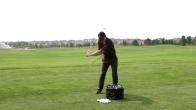













































































































































How to Whip the Club with GOATY
Sorry, you need to be a member to access this video.
You Are Just Seconds Away - Become a member here!
Already a member? Log in now

Try a free live lesson with GOATY
GOATY, my AI golf coach, watches your swing through your phone camera and coaches every rep. Free, about 20 minutes, no credit card.
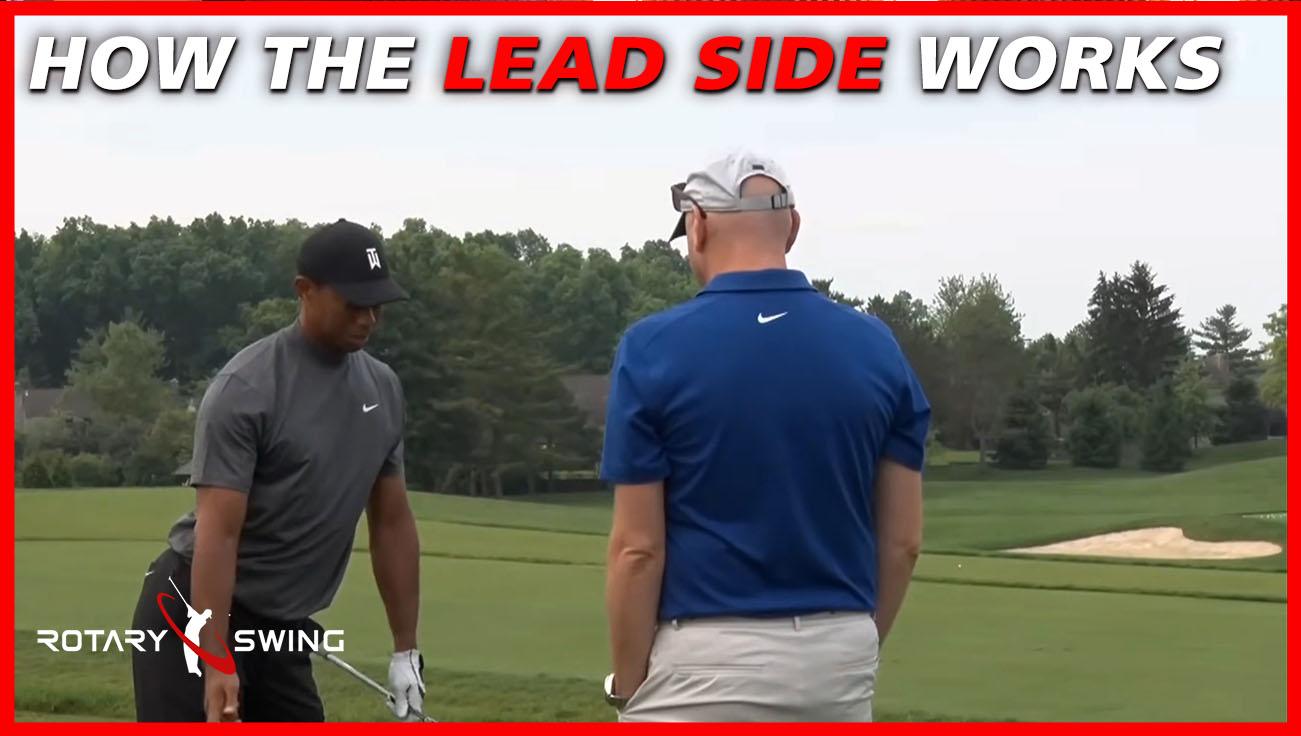
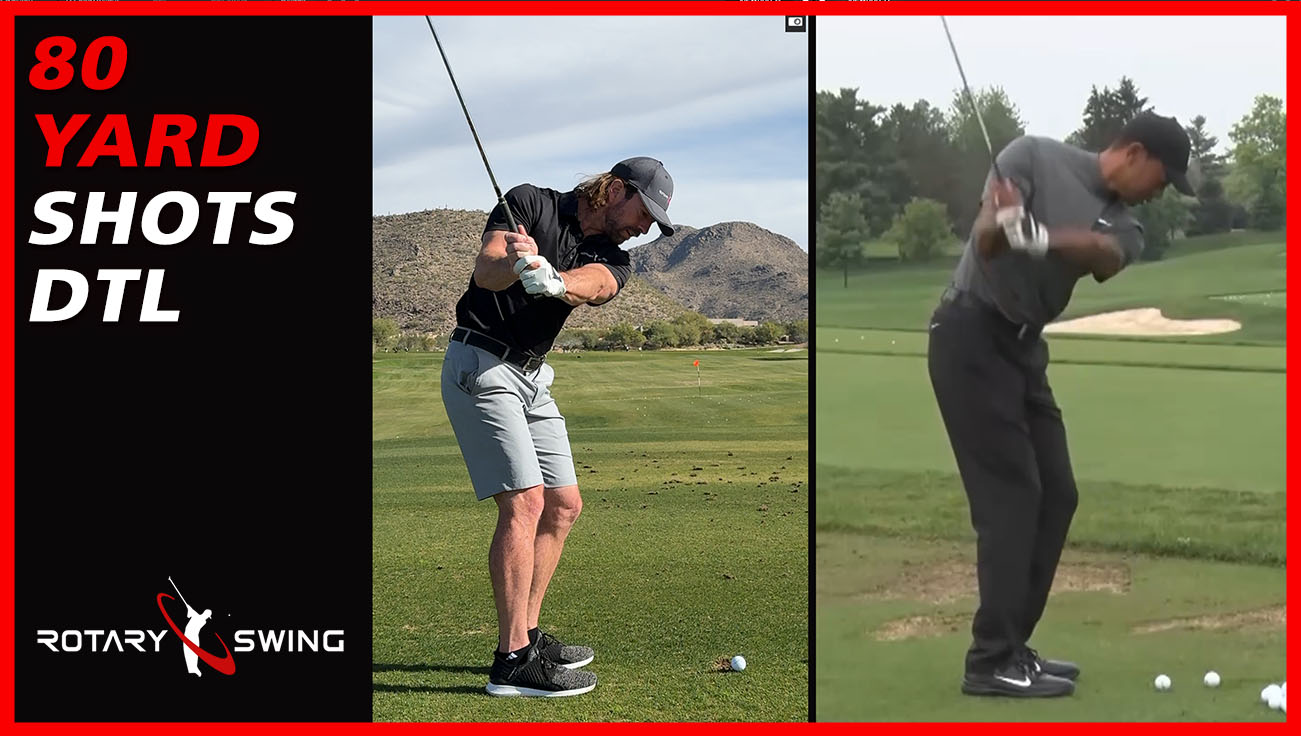
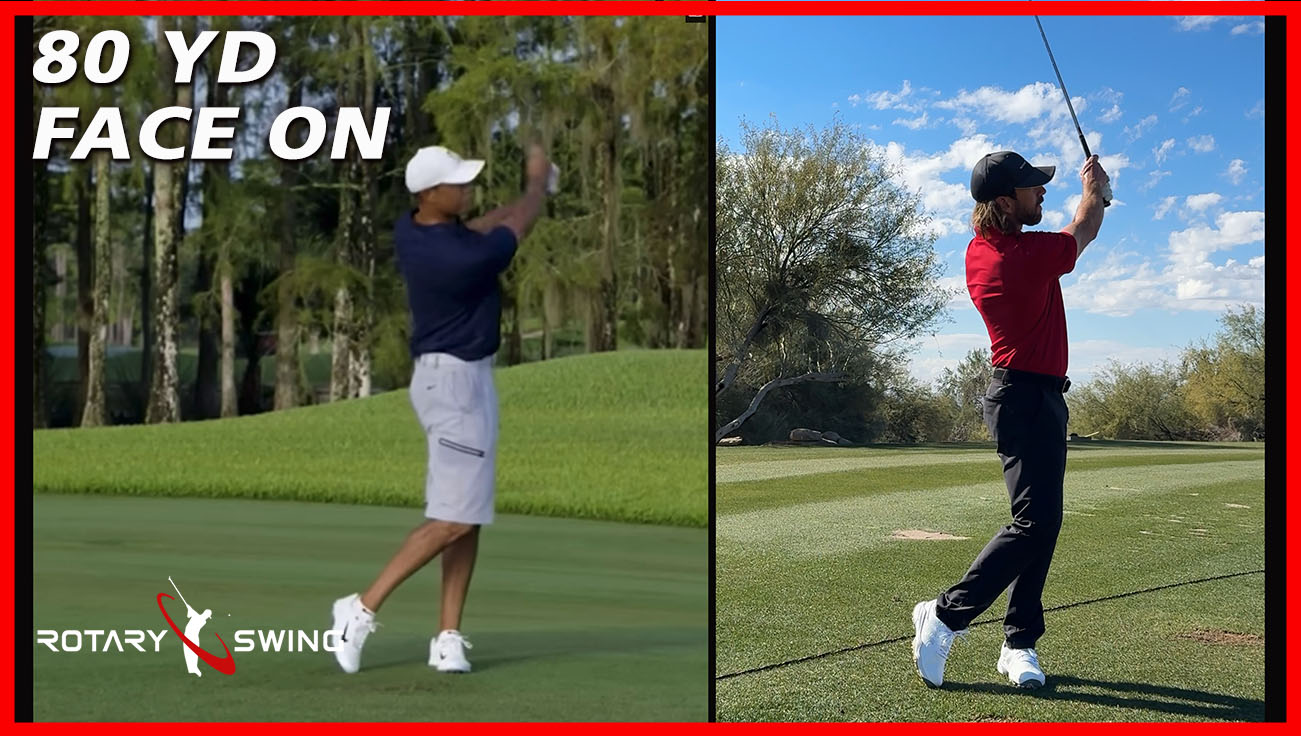
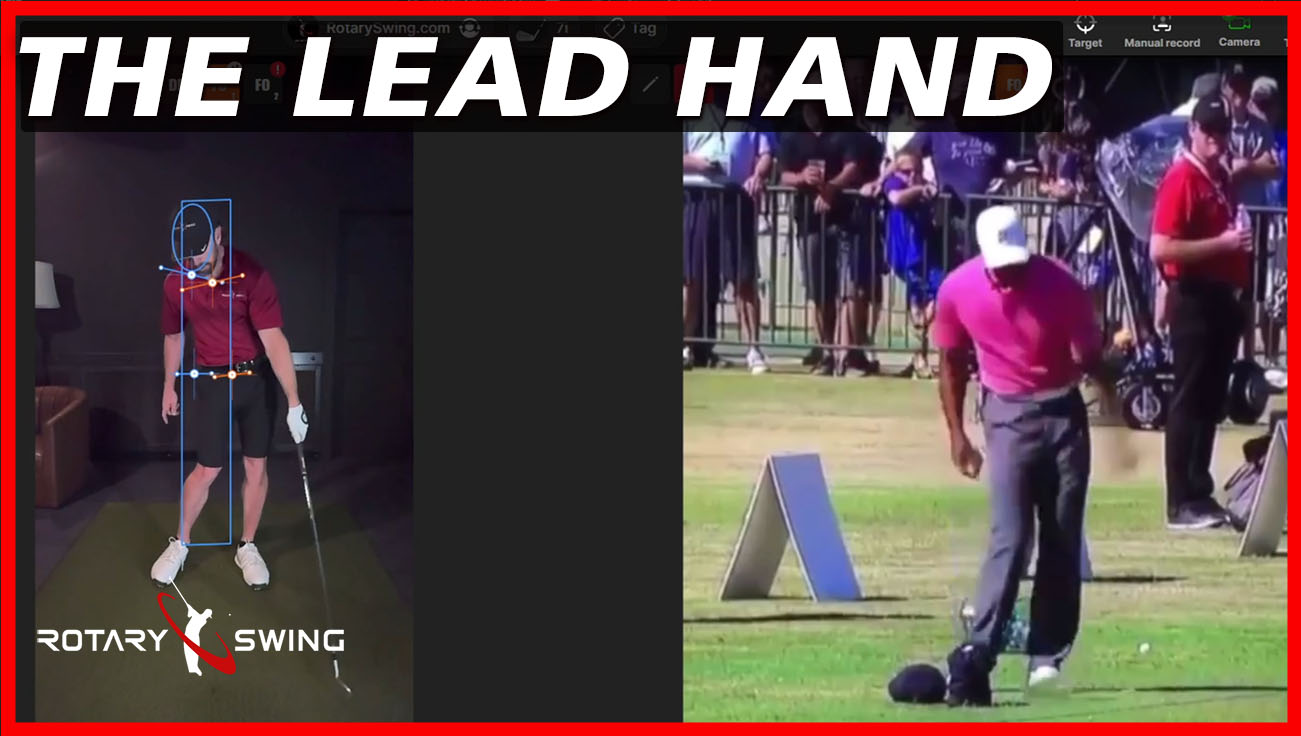
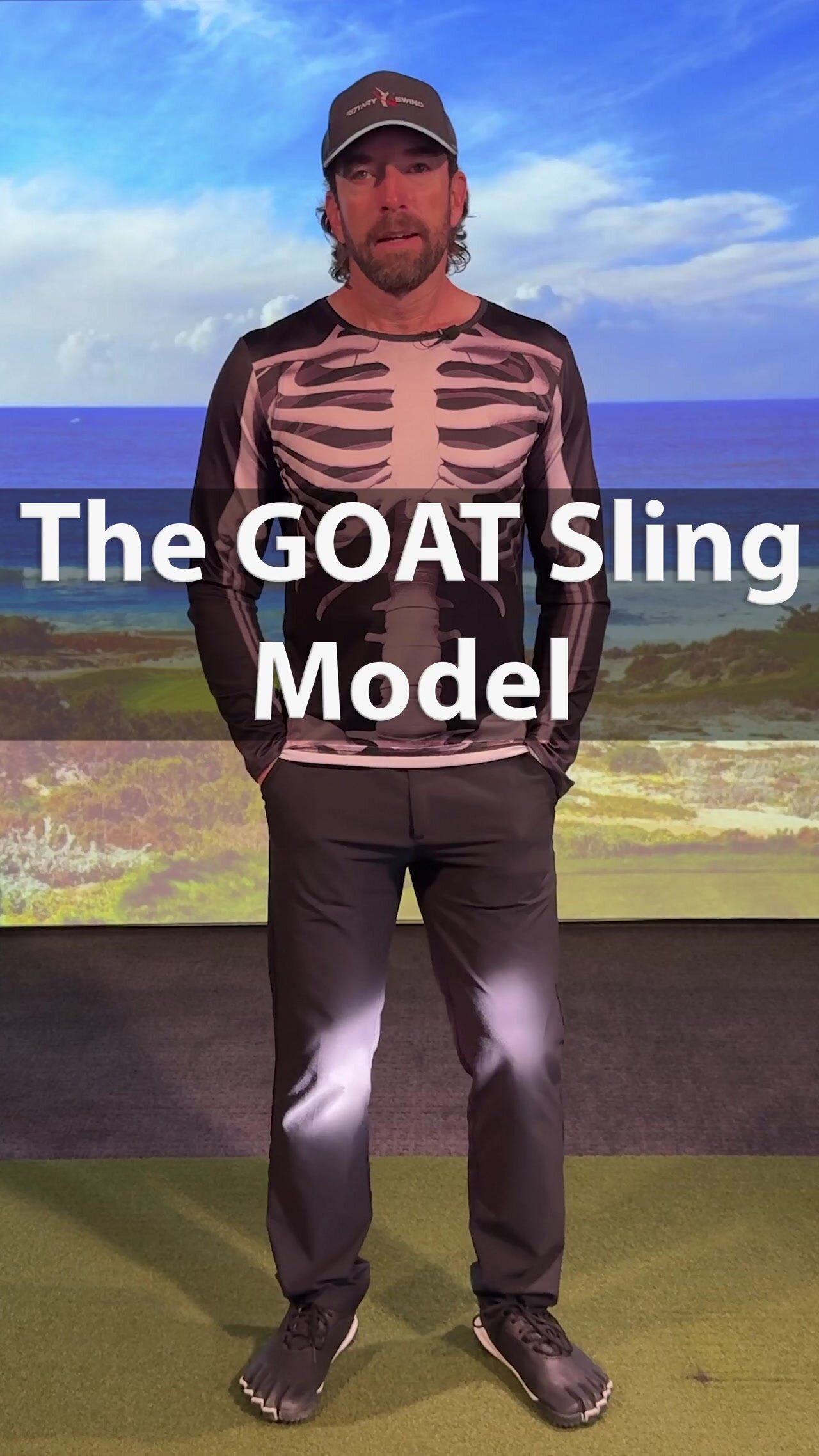
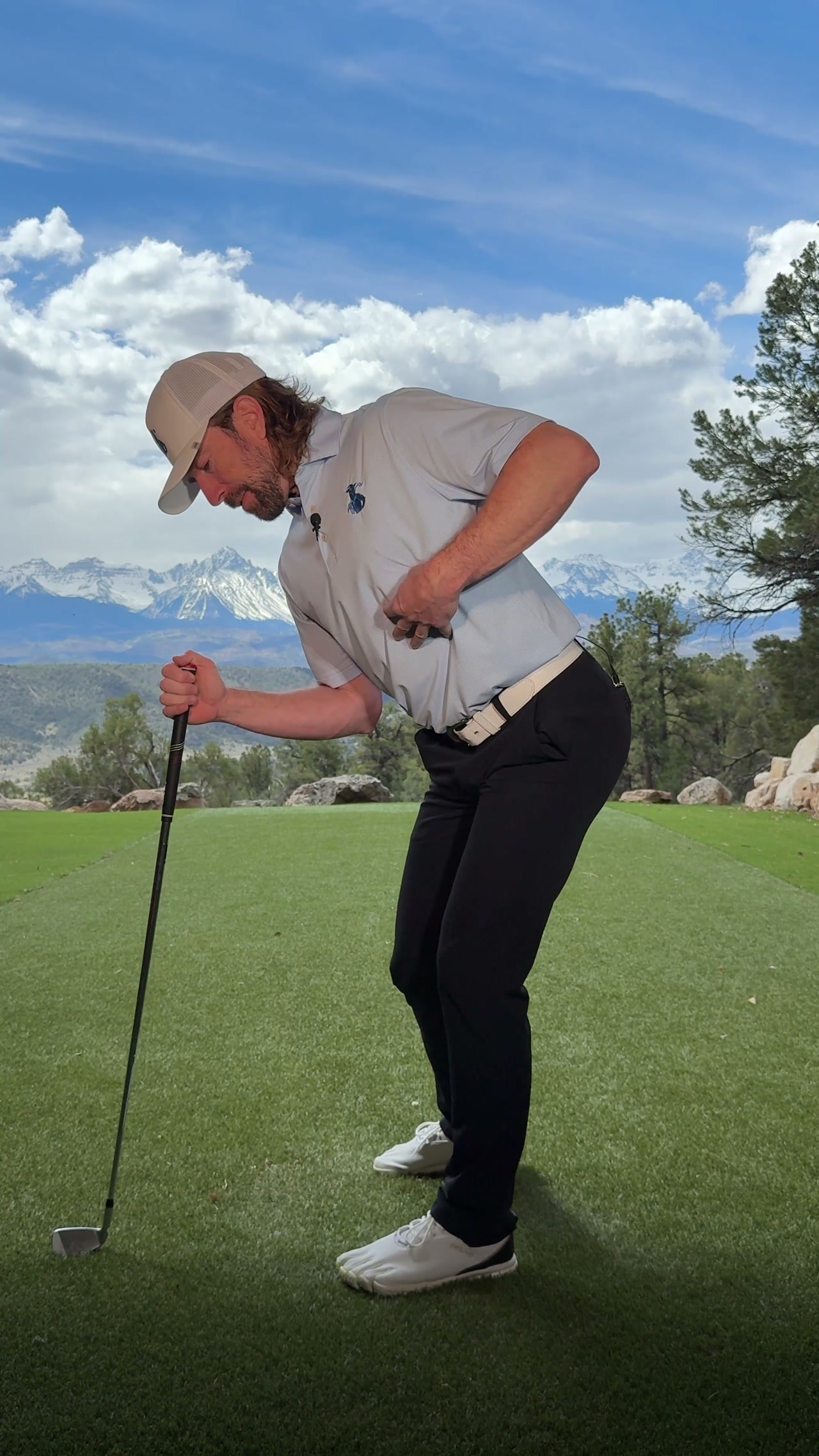
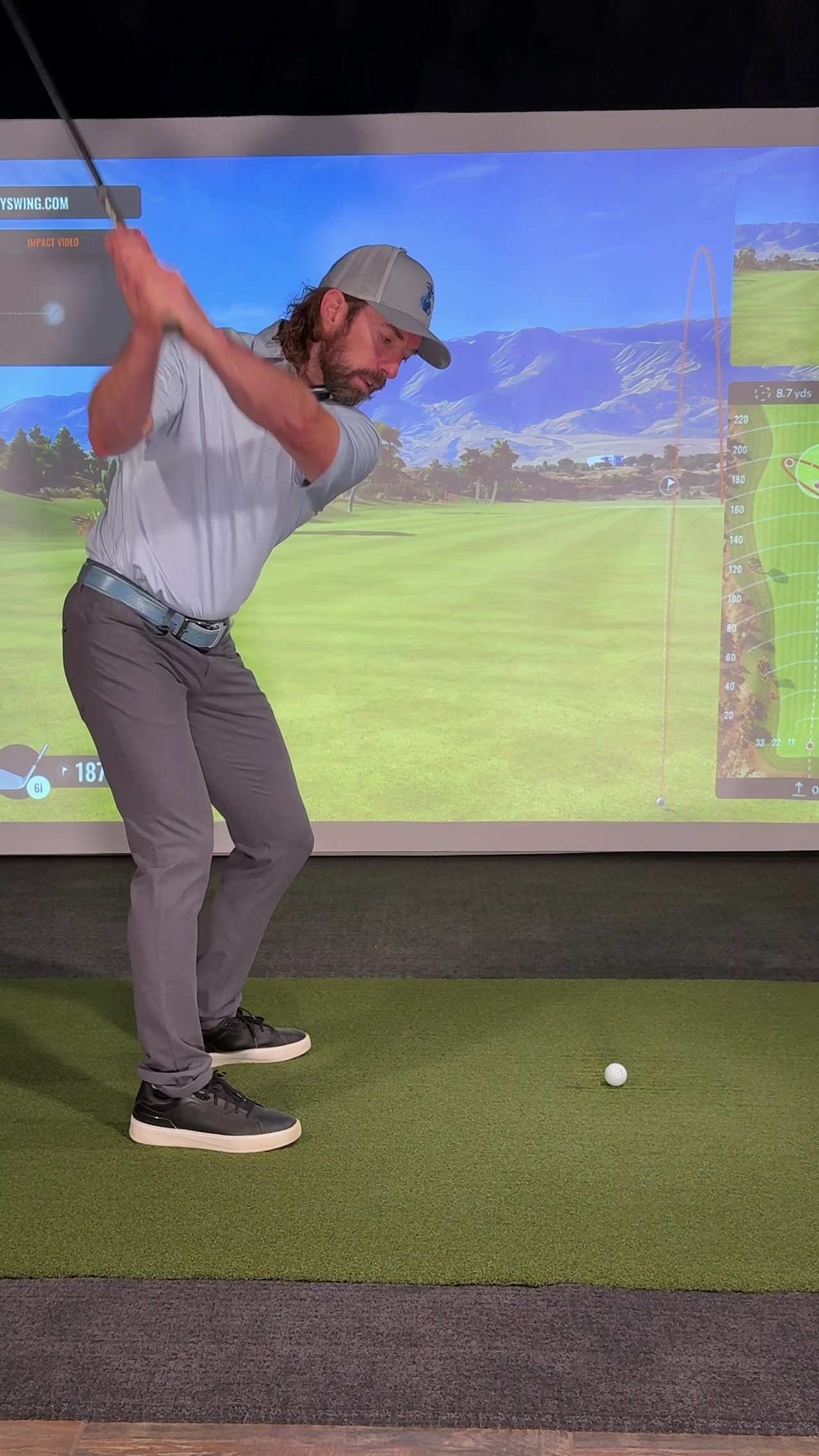
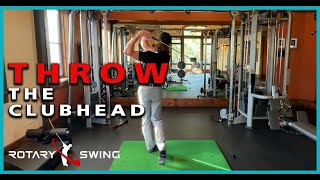
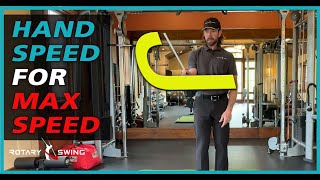
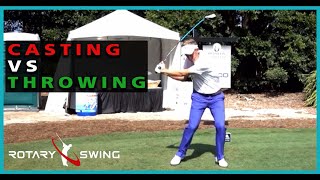
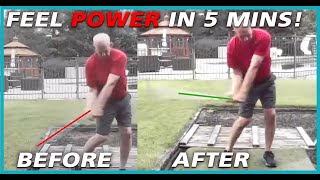
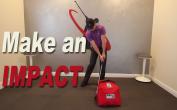
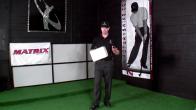
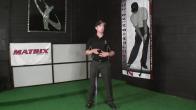
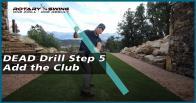
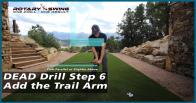
Most golfers never feel true clubhead whip because they drag the handle, push with the trail arm, or try to force speed with the body. In this video, I break down how elite players like Tiger create that effortless snap through impact — not by throwing the club from the top, but by setting up the release so the clubhead whips past the hands with almost no effort. The key is learning the release backwards: Feel the lead wrist supinate. Feel the butt of the club pivot. Stop dragging the handle forward. Let the club move out of the palm and into the fingers. Then learn how to stretch the lead side so the club can snap through naturally. This is the missing piece for golfers who struggle with handle drag, no release, weak speed, casting, or trying to muscle the club through impact. The GOATs don’t force the whip. They create the structure that makes the whip unavoidable. In this video, you’ll learn: Why handle drag kills clubhead speed How the lead wrist supinates through impact Why the butt of the club has to pivot instead of keep dragging forward How to feel the clubhead pass the hands Why the trail arm must stay passive How the lead side stretch creates a passive, powerful release How Tiger-like players create speed with less effort Try the drill slowly first. This is a feel-discovery drill, not a forced hand-roll. Once you feel the club snap, the release becomes far more effortless and controllable. Train with GOATY: Get GOATY
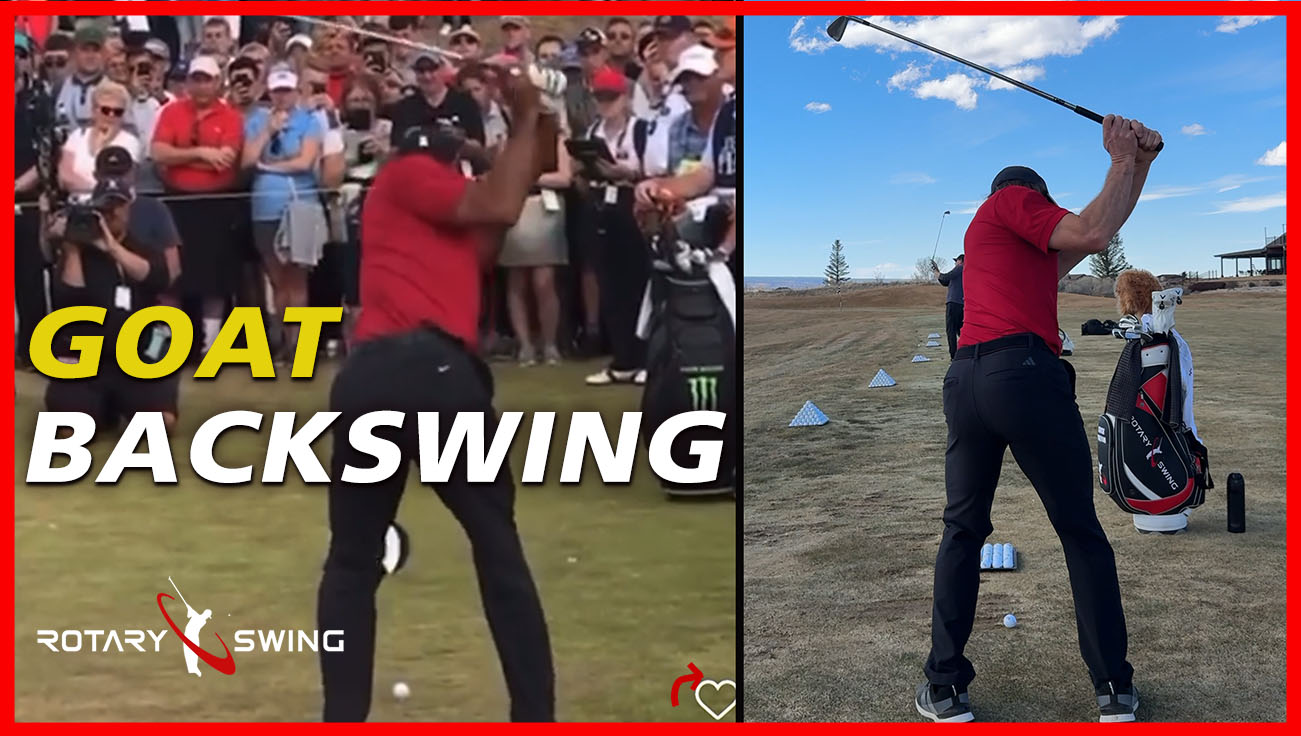
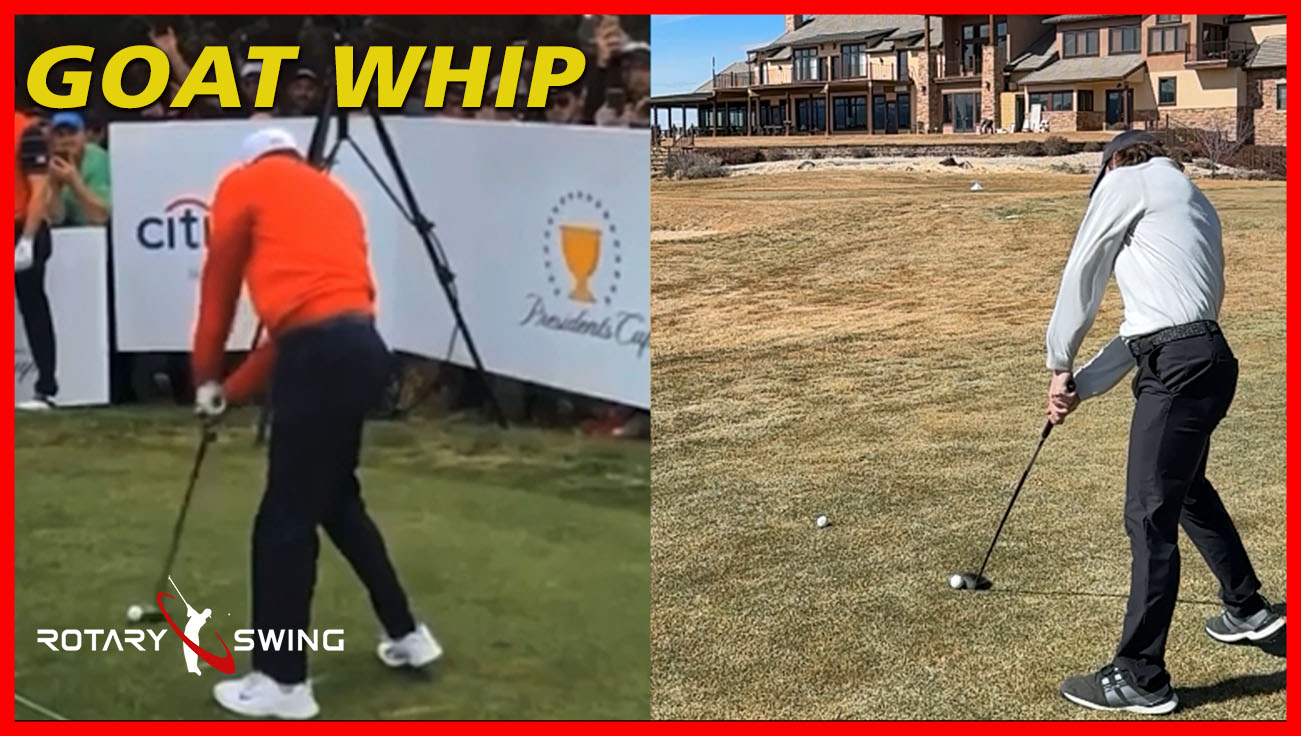
The Goats have all had one amazing trait and that is the ability to whip the club through the ball effortlessly.
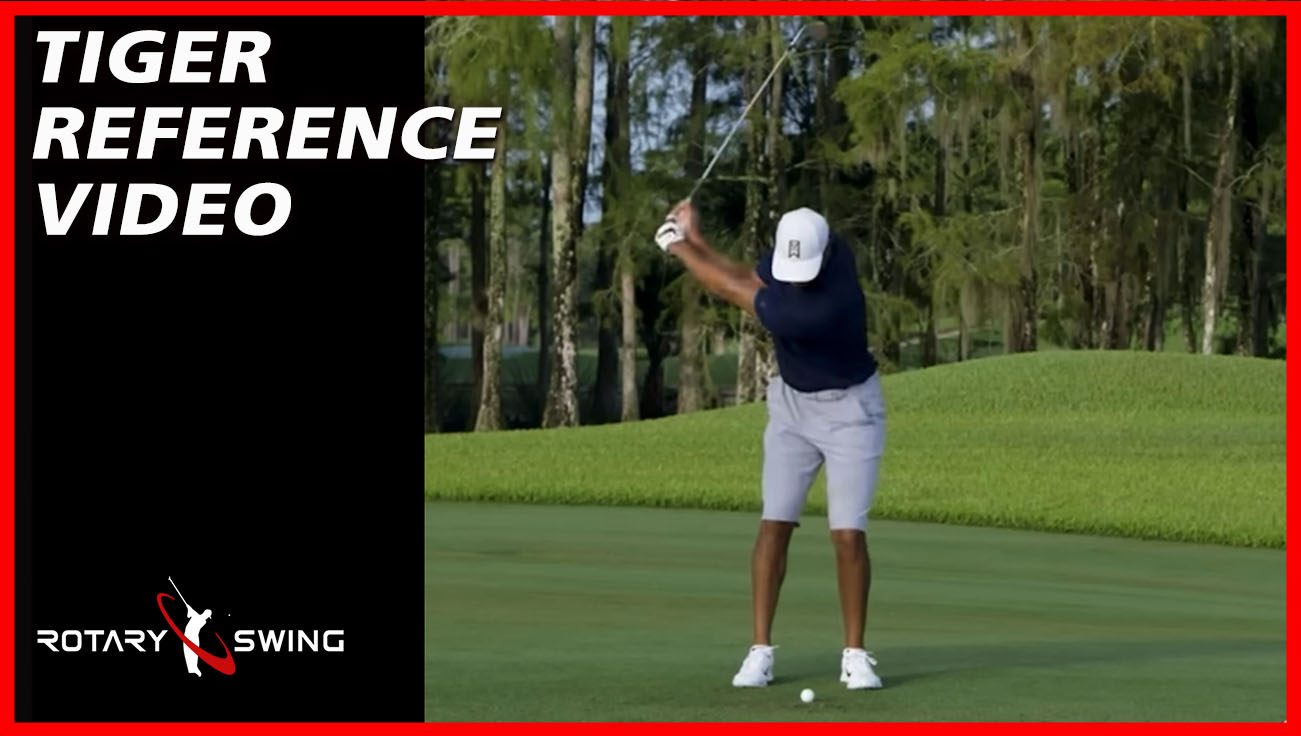
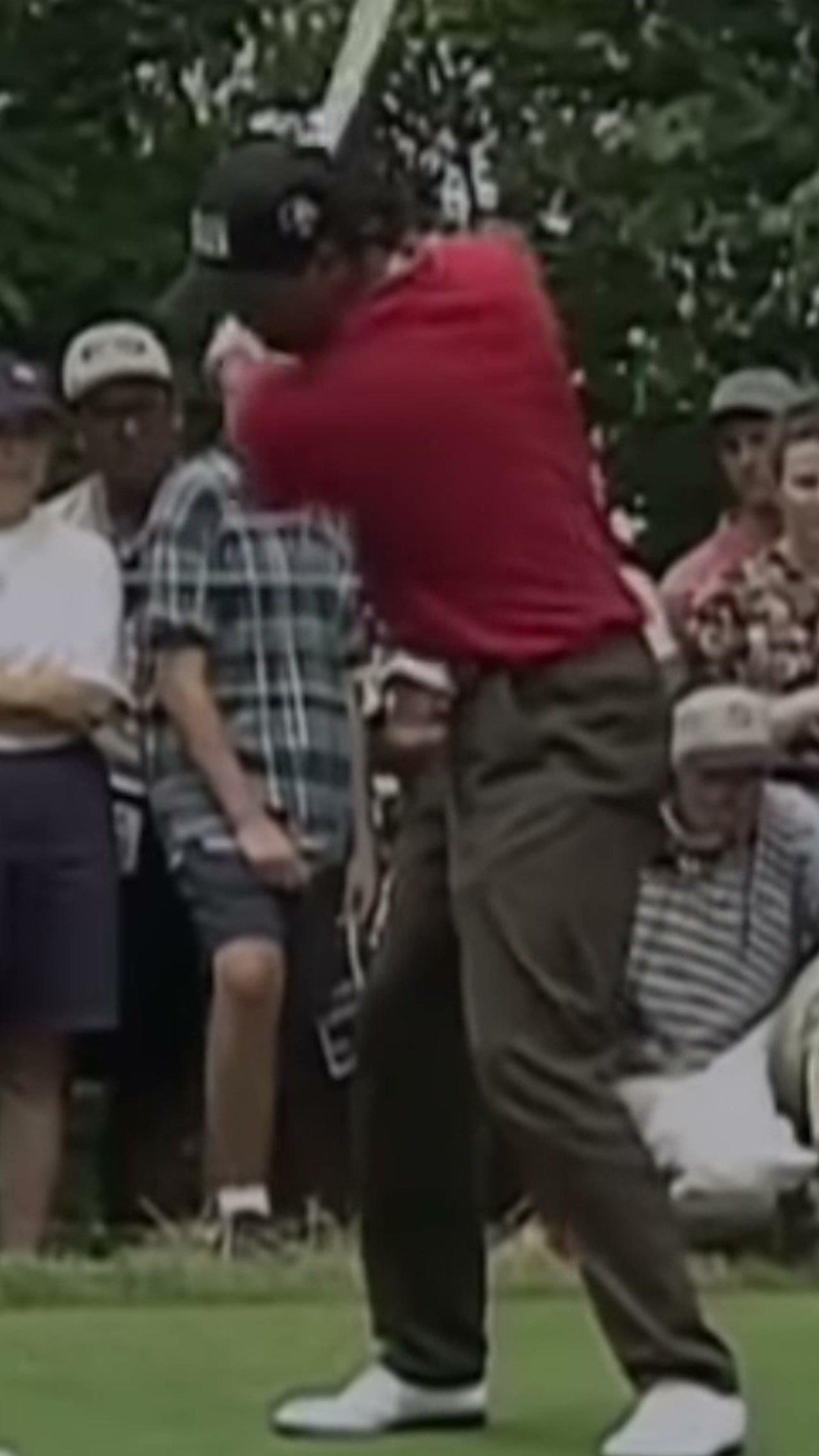
Listen to the way the club snaps through the ball a tiger and jack, two of the greatest ball strikers of all time, and yet they somehow made it look easy, effortless.
That whip is the key to unlocking golf and making it fun again.
And that's exactly what Goaty is teaching you, and that's exactly what I'm going to teach you.
In this video is how to release the club like the greatest of all time, so you can feel the effortless whip of the club.
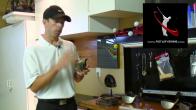
To begin to feel the whip, all I want you to start out with is a club, a golf glove, and a sharpie.
And all I want you to do at first is to draw two little faces on your golf glove.
So the first one you're gonna draw on the tab that you cinch your glove up with.
That's gonna be a sad face.
Then I want you to rotate your arm way over.
And then on the pad of your hand, I want you to draw a smiley face.
That's it.
If you can do those things, we're going to learn how to release the club like the goats.
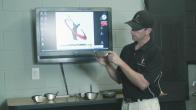
So I've got a little setup here for, I'm going to explain how all this works during this video, but first all I want you to feel is what the lead hand has to do in the swing.
Hogan talked about this a ton in his book about how he has to supinate.
That is the feeling that you have to learn, because the whole key to the swing in order to feel the whip.
And what Godey's looking for is how fast that club head is getting from this side of the ball to that side of the ball.
And how much your body is moving in that same time.
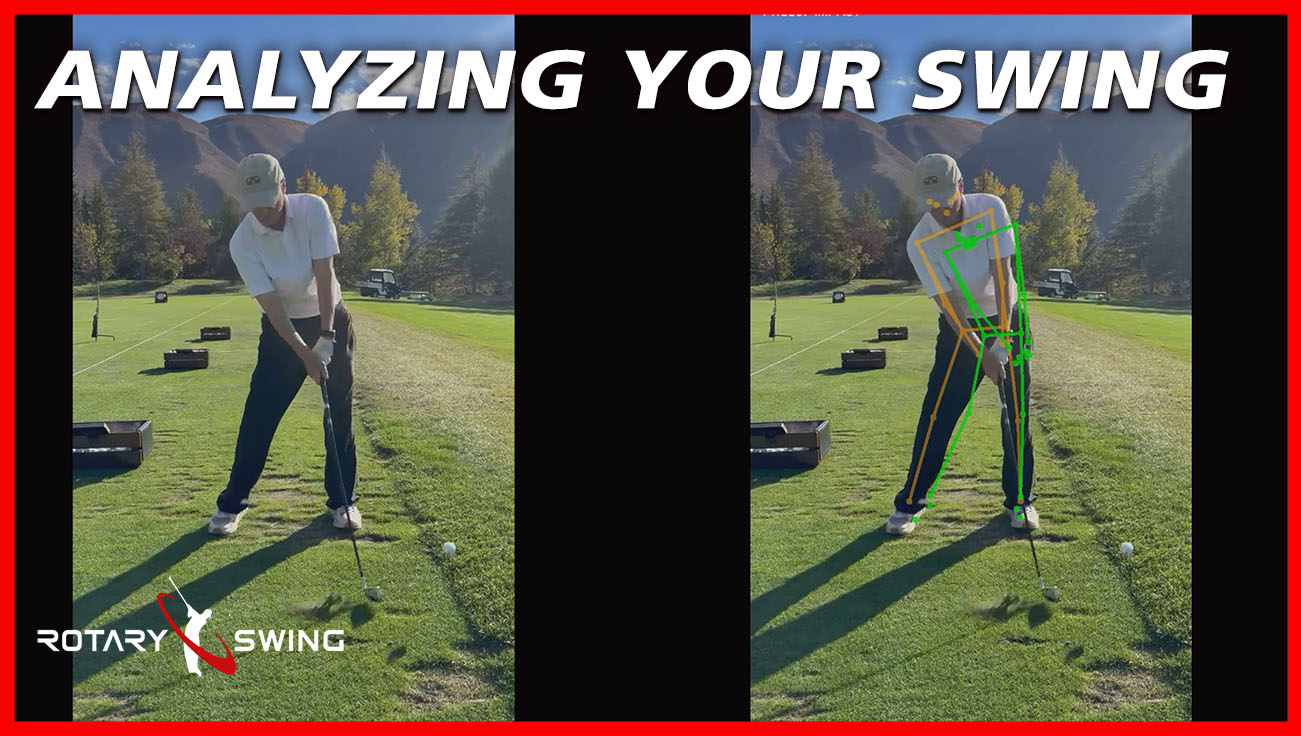
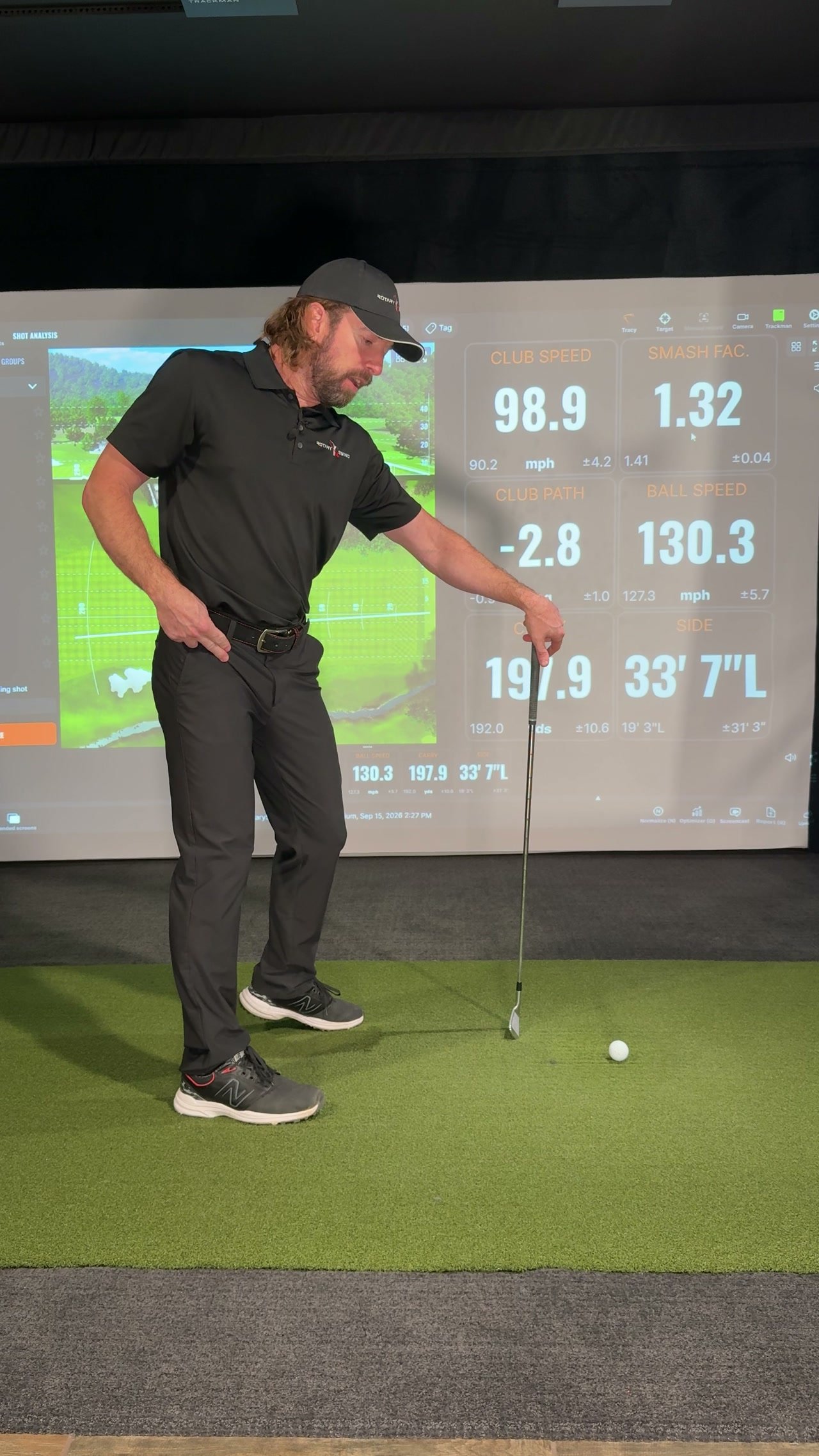
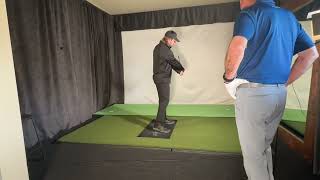
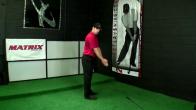
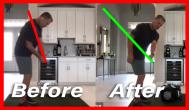
What most golfers do is they push the club through and so you can see my shadow, My whole body is kind of moving forward and you'll see the club and my body kind of all move together versus when I release it.
And I can see that smiley face looking back at me.
What's happening here is I'm trying to get the club head to pass my body, otherwise I have to go through with it.
And then you'll start to see that sad face.
Because this tends to lead to a flip where your lead hand or your trail hand is pushing this one over and breaking this red wrist down.
And if you see that sad face, it's no bueno.
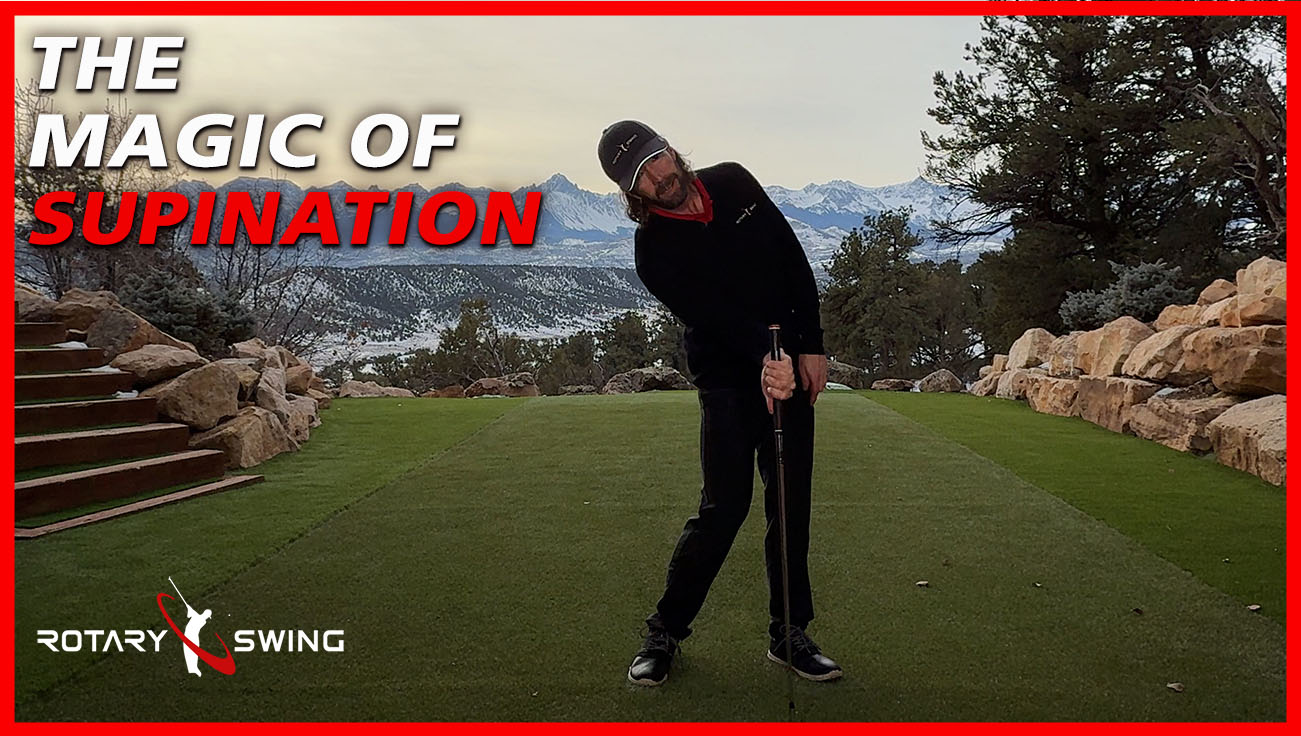
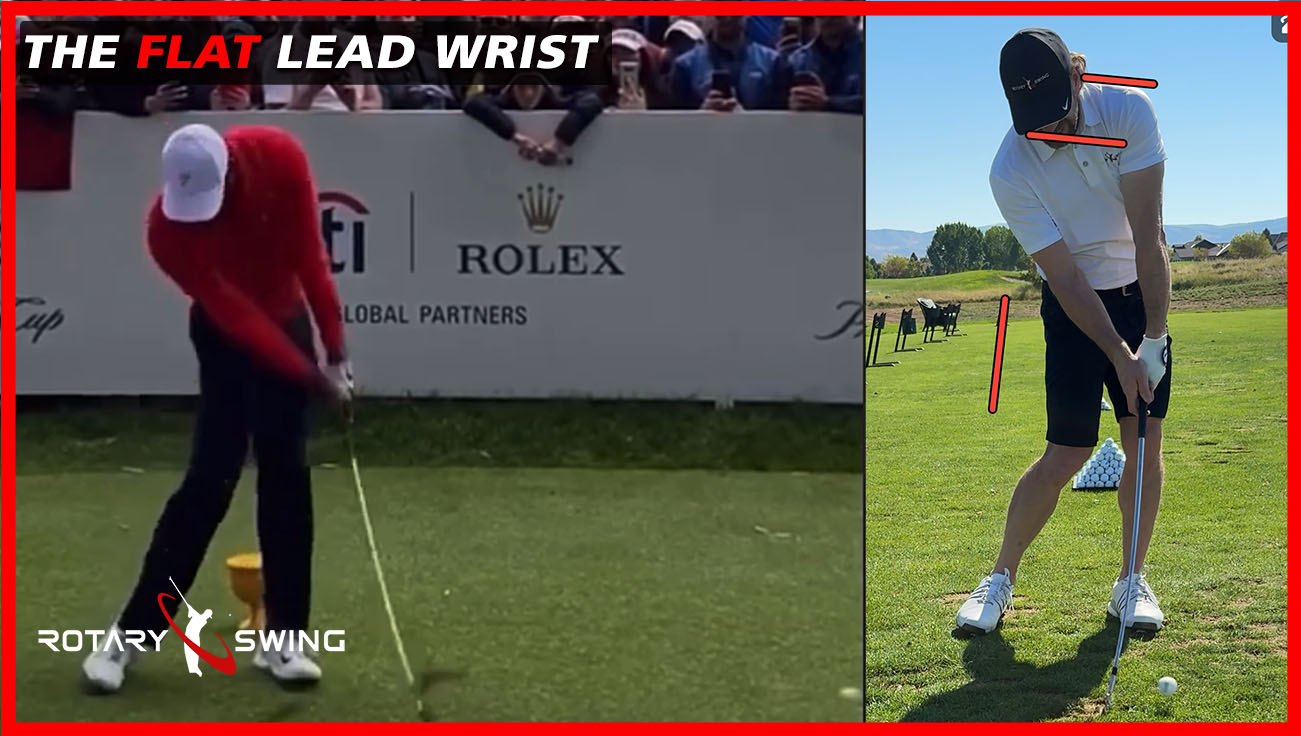
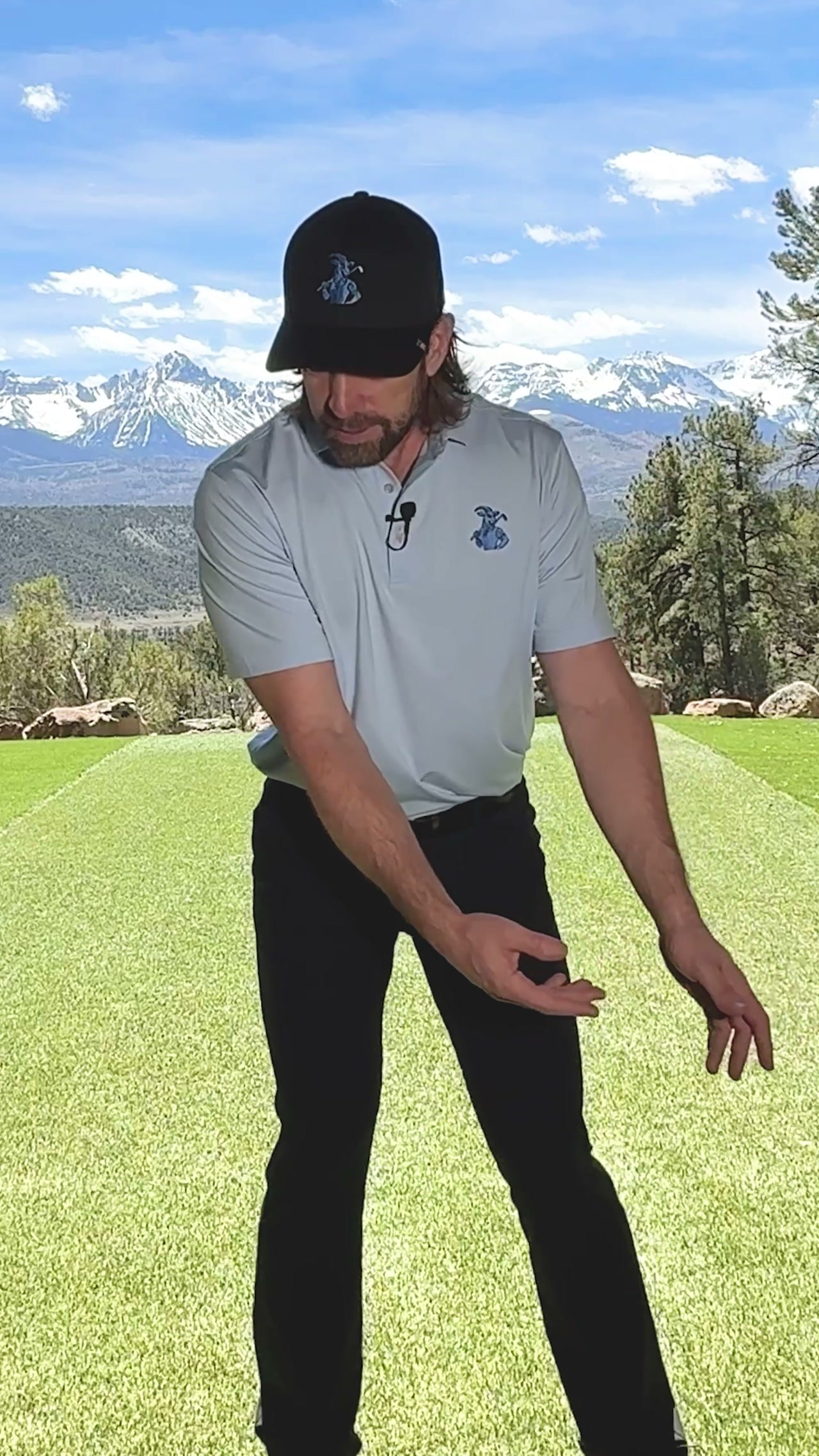
So what you're going to start feeling is that your lead hand starts supinating.
Supinating is just doing this external rotation.
And you want this to happen insanely fast throughout the swing.
So as you start practicing this feel, I want you to start feeling how if you snap it over like this, that your lead or your thumb starts to feel like it kind of gets snapped over and then kind of rebounds back.
The faster you do this and the more you keep that thumb relaxed, The more you're going to feel, that's what's happening now, what most golfers do in the swing is this, and so the lead hand.
Getting this to feel right.
At first is going to be a little bit handsy feeling to you.
Because you're probably used to flipping and you're not used to feeling the supination action, which is critical to whip the club.
So at first it's okay to feel a little bit handsy, then especially more so than what you're used to.
That's perfectly fine now.
What you're going to want to feel over time is that this becomes largely a passive snapping action.
Because you can't muscle this, it has to snap, your fascia has to be able to rebound.
That's why we're going to work through what these lines mean here in just a moment.
So that you keep the wrist loaded, the forearm loaded so that it can then snap so that you can see the smiley face.
So now with the club, what you're trying to do in the swing is basically.
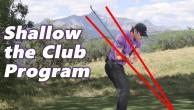
Feel that your hands are coming in to the ball from way back here, way back behind you, from the inside, at an angle toward the ball, so that you feel that the club is going to release.
Way out for a right-handed golfer, out to right or first base, if you use the old baseball analogies, it's not going to actually do that.
But that is what you must feel in order to feel this whip, because what's really happening in the whip is that.
Your hands are moving in close to the body, while the club head is moving out away.
And this creates this concept of concentric circles.
This is the path roughly, it's just a visualization for my hands and this is for the club head and they're going to roughly move together.
Now, what most golfers are going to do as I start to come down here is that their hands are going to start going way outside this first line.
And then the club is going to come like this.
That motion is you turning your body through the strike, Pushing with the trail side or pulling hard with your lead arm.
You can see that the club head and my hands are never anywhere near these two lines.
What I actually want to feel is that my hands feel they drop straight down during the swing, and this is again not you pulling them down, it's them falling.
That's what I want you to start to feel first, so that you can start to get your hands on this inside line.
So you almost feel like the butt of the club is gonna stab you.
The thigh or your hands are coming down to your pocket, the closer you get them to your body.
Versus being way out here, the more effortless speed you're going to have.
Because what's going to happen is the path and the track that your hands are working on is going to be much narrower and tighter.
And that's going to force the club to move much faster to catch up.
But if they're all way wide out here, my hands and club are going to move very slow together.
You want to feel that they come inside, they just fall straight down, so your lead arm kind of slides down your chest, the trail arm must retract.
It never goes out like this.
You're never pushing with your trail arm, never pushing with your trail shoulder.
The arm is just falling.
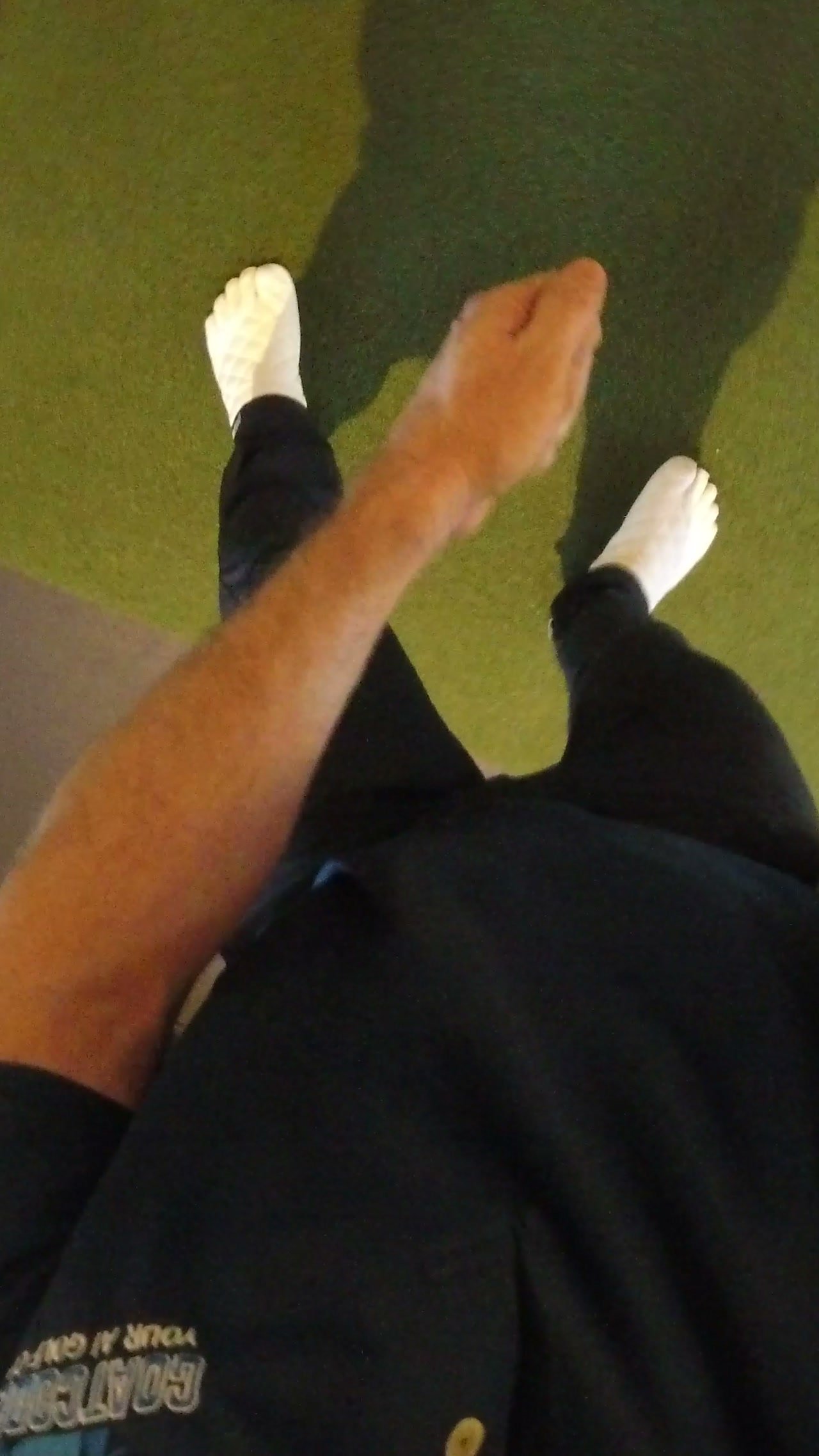
So if you look down at my shadow here, my arm just kind of does this.
It falls into my side.
And the faster it can fall, the faster everything can get on track.
And as my body rotates everything through, the more snap I'm going to have.
So as you're coming down, I want you to start practicing.
Feeling, seeing the smiley face as you come down, start feeling your hands coming into your body, almost like you're stabbing yourself in the thigh.
With your club feel, the club head, you can see from my perspective, that club head comes straight down, so I'll keep my head turned back.
Here.
My hands are on that line now, the club head's coming out to the second line.
They come together, there's impact, and as I release, they're not going like this.
That's again you trying to rotate through and that kills the snap.
What I'm doing is letting my wrist supinate and that makes the club feel like it's working more out this way.
But as I continue the supination, you'll see that the club head actually goes more.
What looks like straight line for just a moment and then releases down this way, so the feeling is this snapping releasing.
You're not actively trying to break your hands in terms of slowing them down, although they will slow down for sure.
You don't want to feel like your hands are driving through impact.
That's a very effort, full swing instead of an effortless swing.
What you want to feel is that there's no more acceleration happening to the hands.
Your arms and hands are literally just falling.
That's how you get them on this inside track instead of going out this way.
They're just falling down while my body is beginning to rotate and pull everything through.
And then my hands are going to decelerate because there's nothing left to continue accelerating them because my body's kind of ran out of range of motion here.
And so now the only thing that can happen is my wrist just guide that supination and let the wrist rotate.
This feeling at first, You're probably going to have to put a little bit of conscious muscular effort into it to feel your wrist rotate over until you can see that smiley face.
As you get comfortable with this, you're going to feel as we move later into this video that this motion is largely a passive motion.
You're not trying to muscle it through.
You're trying to get the feeling of your body stretching and whipping the club through while your wrist supinates.
So at first, be very mindful of what your trail hand is doing, it should be doing nothing during this drill.
You're just trying to get the feeling of the wrist doing this so you can see that smiley face.
That's all you need to feel.
And now once we have that, we can start to work on the next piece of it of getting the body to load correctly and release correctly.
Now, the first drill that I want to get you to feel is how the butt of the club works through the hands and what it should feel like.
So many golfers have seen Hogan talk about and other goats talk about bowing that lead wrist and suppening that wrist, but they try to muscle it.
And that's not what happens at all in the swing.
In fact, what you actually want is kind of the opposite.
You need that butt of the club to actually want to try and rip out of your hands, which I'm going to show you now.
And that is the feeling that you're looking for.
So what's actually happening in the swing is not me trying to muscle and hold the club tight and bow my wrist.
You'll feel that the club can't go very far, right?
I can't move very fast because my wrist is locked in here.
What I want is this.
So what I want you to start to feel is the club head taking over your hands and pulling your fingers away from your palm.
Now what's happening to the club?
You can feel that as you do this, it's accelerating past and you can see it on the video.
Now if I hold it tight, the same amount of effort, the club's not going very fast.
But here, as I let the butt of the club rip away so that the club head can accelerate and I can start to see that smiley face again, what I'm feeling here, you can see my wrist is bowed, ends naturally supinating, but the wrists or the fingers are being pulled away by the butt of the club.
That is the release.
You can see the club head is overtaking my hands and the trail hand is allowing this to happen or even helping it happen.
But what you want to feel at first is this motion of the butt of the club, trying to pull your fingers away.
Once you have this, you start to understand how the club snaps in the swings of the goats.
Now, of course, this is not something you're manually trying to do.
This is a drill at first to get you to feel.
The club head trying to overtake the hands without a flip, because we still need that club head to pass the hands as fast as possible.
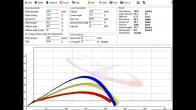
Or Goatee is going to keep showing that your your whip score is very, very low, the whip score is going to happen as your hands.
And everything begin to decelerate to allow the club to accelerate.
And the feeling of that is ripping the fingers away from the palm.
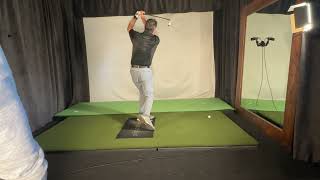
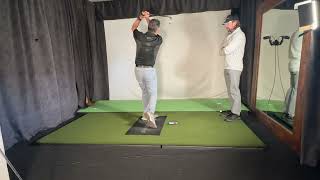
Now, let's move back to my little hitting station here, and I'm going to explain what these lines mean as we start working through this.
So as you are at the top of your swing trail, sides brace everything's getting ready to go back to the lead side.
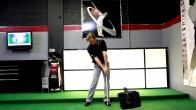
This is the most important thing and I want you to pay close attention to my shadow, I want you to practice with your shadow.
So I've got a light overhead above me here.
This should never happen, so as I've got these lines set up, don't worry about the angles and all of that stuff.
If you just put some lines on the ground and make arc slightly to the inside, that'll give you all the view that you need.
If you see your body going like this, this is all trail side push, pushing off the trail, hip pulling with the lead side too much.
All of that stuff is incorrect and gets the hands moving in a circle where the club's going to do this and your hands are going to flip.
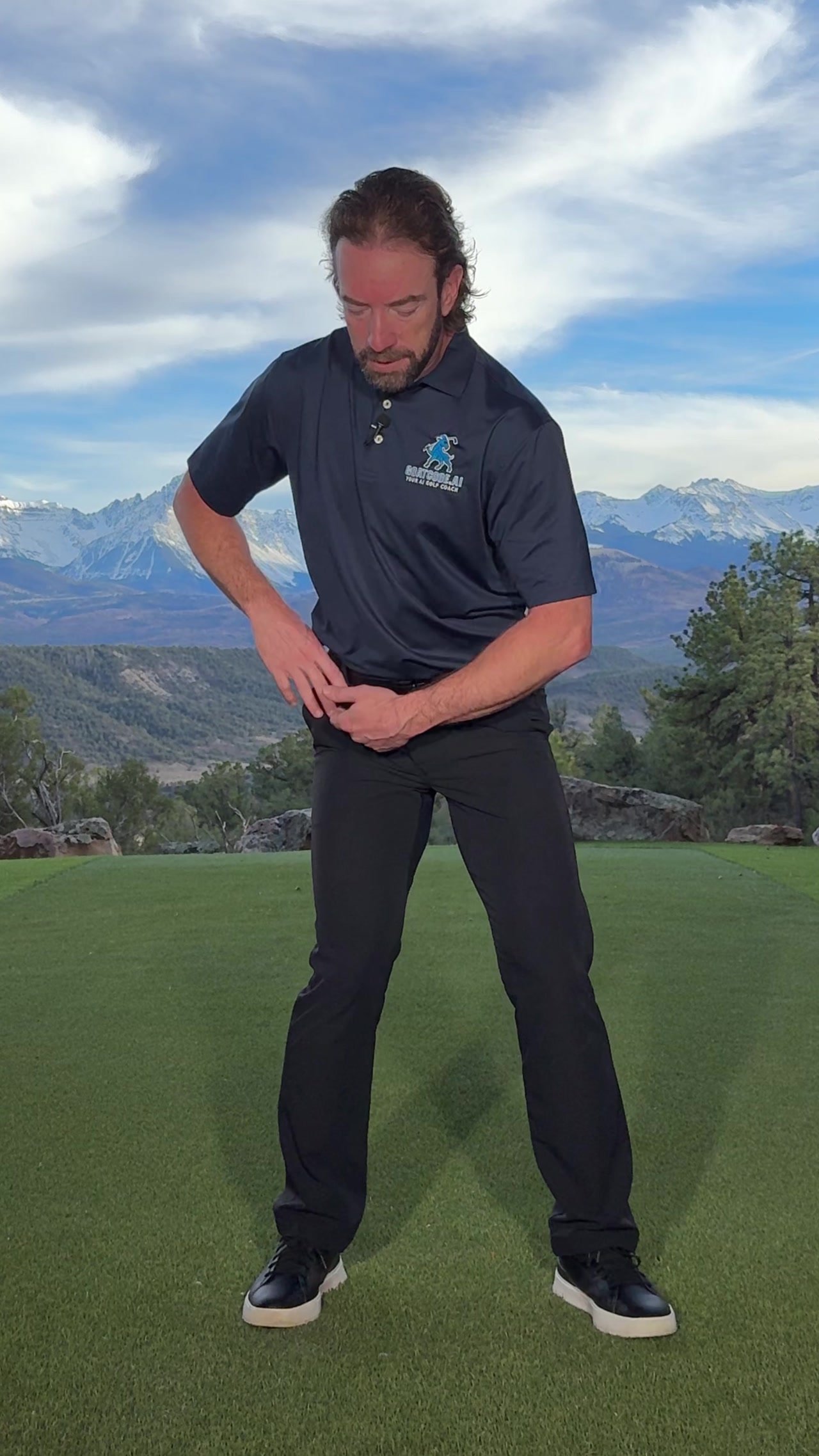
What I want you to feel from the top is just drop the hands and stab yourself in the thigh.
Now, you won't be able to do this at speed, of course, But this is the feeling is that you're starting to get the hands to drop vertically, straight down from the top of your swing.
Because the body's doing all of the work.
And as the body does that, that's what's going to get the club head to come out and start releasing.
And you'll feel now if we combine that with the little finger drill, where the fingers are being ripped away from my palm.
I start to feel the club ripping through.
Now, if you keep pulling the club through, you'll feel there's no speed in there whatsoever.
It's this, your hands are what create the bulk of the speed.
And so what I want you to get used to feeling is that your hands are falling down into your thigh.
Your body's staying closed for just a split moment longer than you're probably used to, if you're used to doing this and throwing the arms and club out over the top, stay closed just a little bit longer as you move laterally.
And that's what these two lines are here.
At address, the center of my pelvis and the center of my chest is going to be roughly on that line.
Maybe your center of your chest is just slightly behind it.
This is where the ball would be.
Now, as I go to the top of my swing and I start coming back to the lead side, Most, all elite players make a significant move, three or four inches back to the lead side.
And so now my pelvis, the center of my pelvis, has moved from here to here.
It's moved three or four inches forward and the center of my chest, it's going to move forward.
A little bit, too, depends on how you're measuring this, but the buttons on your shirt are going to still be pretty close to being on top of the ball.
You don't want to be hanging way back like this, you don't want to be way over here.
Because again, now you get the club going out to the hard, to the left.
The feeling of the release is that it's more from the inside and out to the right.
For a right -handed golfer, it'll actually go more straight down the line and naturally to the left.
You don't need to try and make it go left.
So now, as I'm here and I've shifted over now, I'm stacked over here.
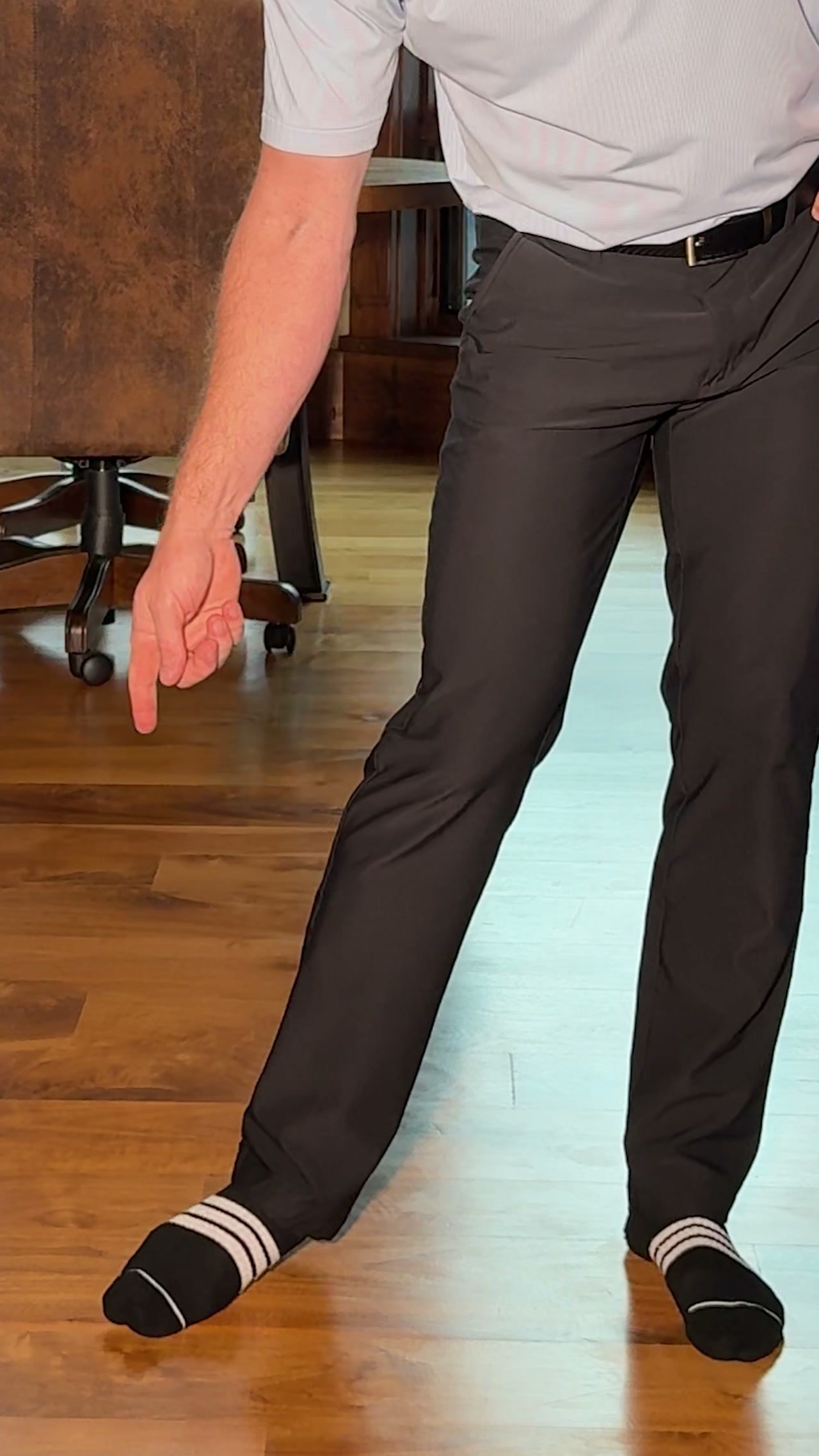
Pressure's on my right big toe, it's just there for balance.
More on the heel of my lead side, my lead foot.
And now, as doing this, I'm feeling once I've rotated my body as far as it's going to rotate, there's nothing left to keep accelerating the hands.
So what's going to happen that the club head is going to take over?
And this is again a largely passive feeling.
It's not you trying to muscle it, you'll feel there's no speed there.
I'm letting the club rip the butt of the club, rip my fingers away from my palm and release, that's the feeling.
So it's here.
The arms drop, pelvis shifts over three or four inches, upper body's coming with it.
It's going to start to angle back just a little bit.
This is where you get secondary tilt and then just start getting that smiley face to be visible.
You start having that and we start putting that together.
You can feel and hear how much whip there is there, and that's not body effort.
It's not me muscling, I'm doing this, letting my hand fall and snap.
Supinate release.
That's the motion.
Now.
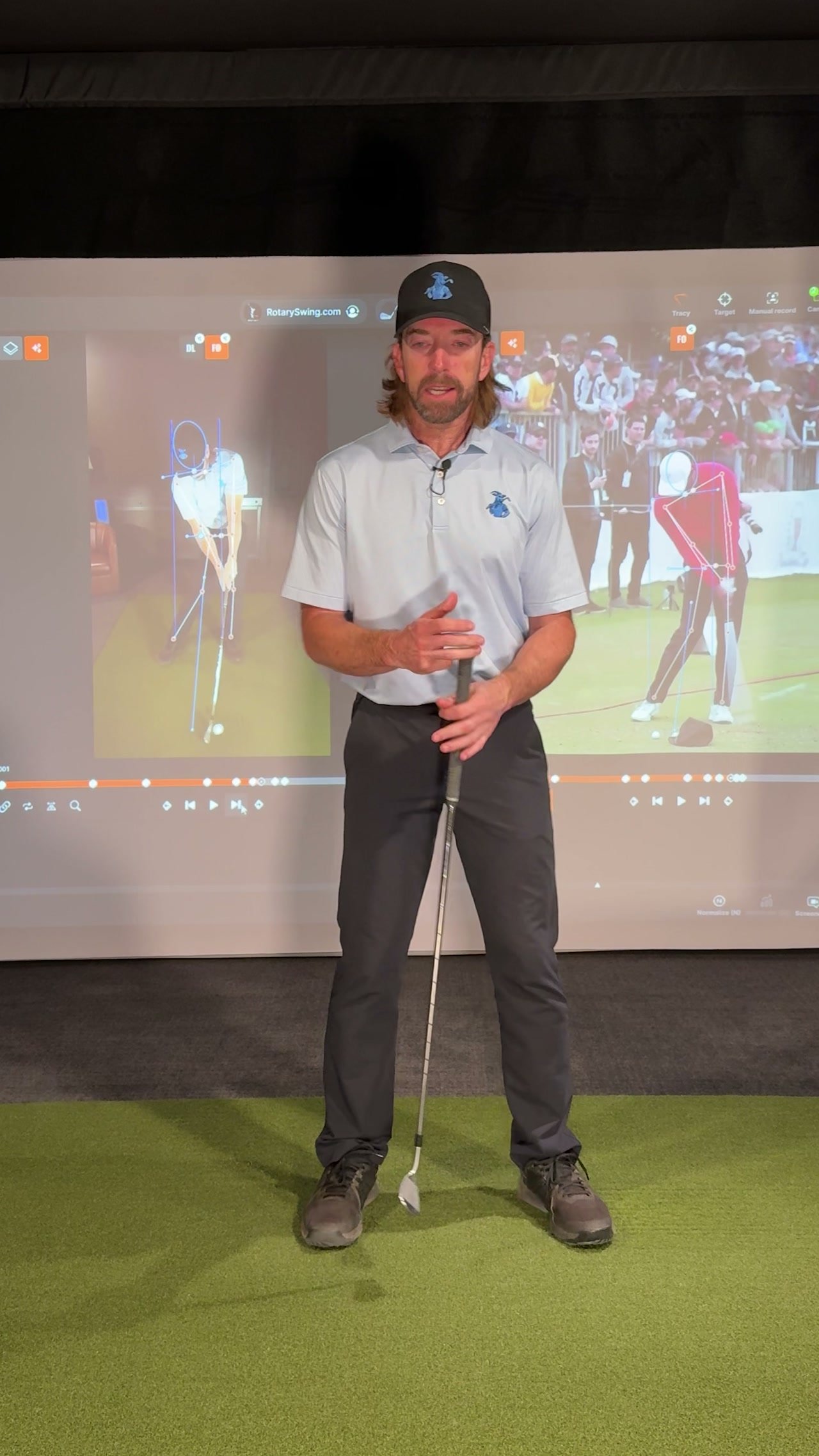
Let's look at how to put this all together now, as we start putting this all together, the key is loading properly and most golfers, as we've seen, we've got.
He's now studied hundreds of thousands of reps.
We've looked at tons and tons of data, over a billion, almost 2 billion data points now in the swing from all of our users.
And almost everybody picks the club up with their trail arm.
This is one of the first things that we see when we do live lessons with goatee is that the trail arm starts to lift the club.
As soon as you do this, you kill the stretch that makes the whip literally possible.
So the first thing you've got to feel is that what you're really trying to do is.
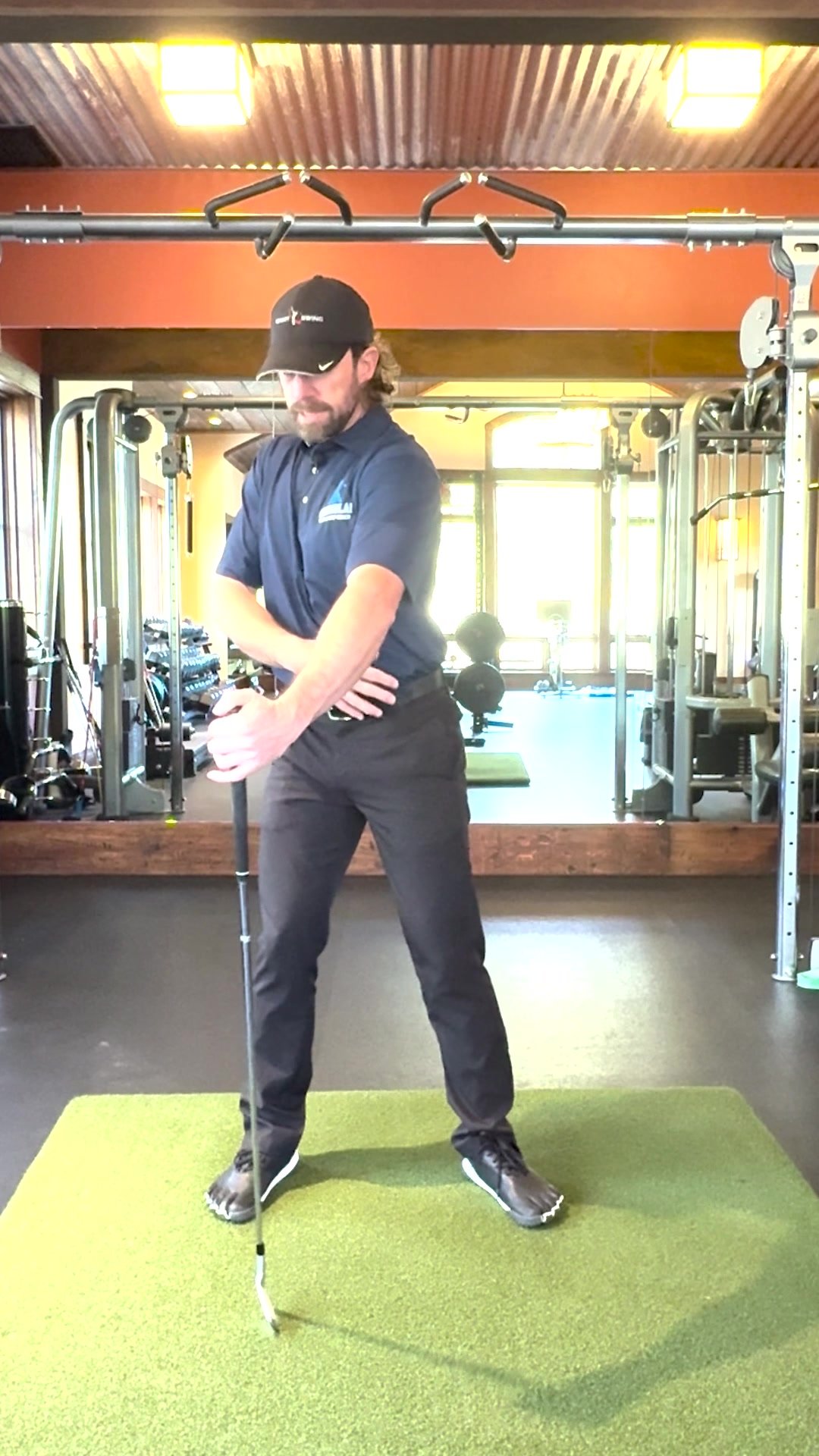
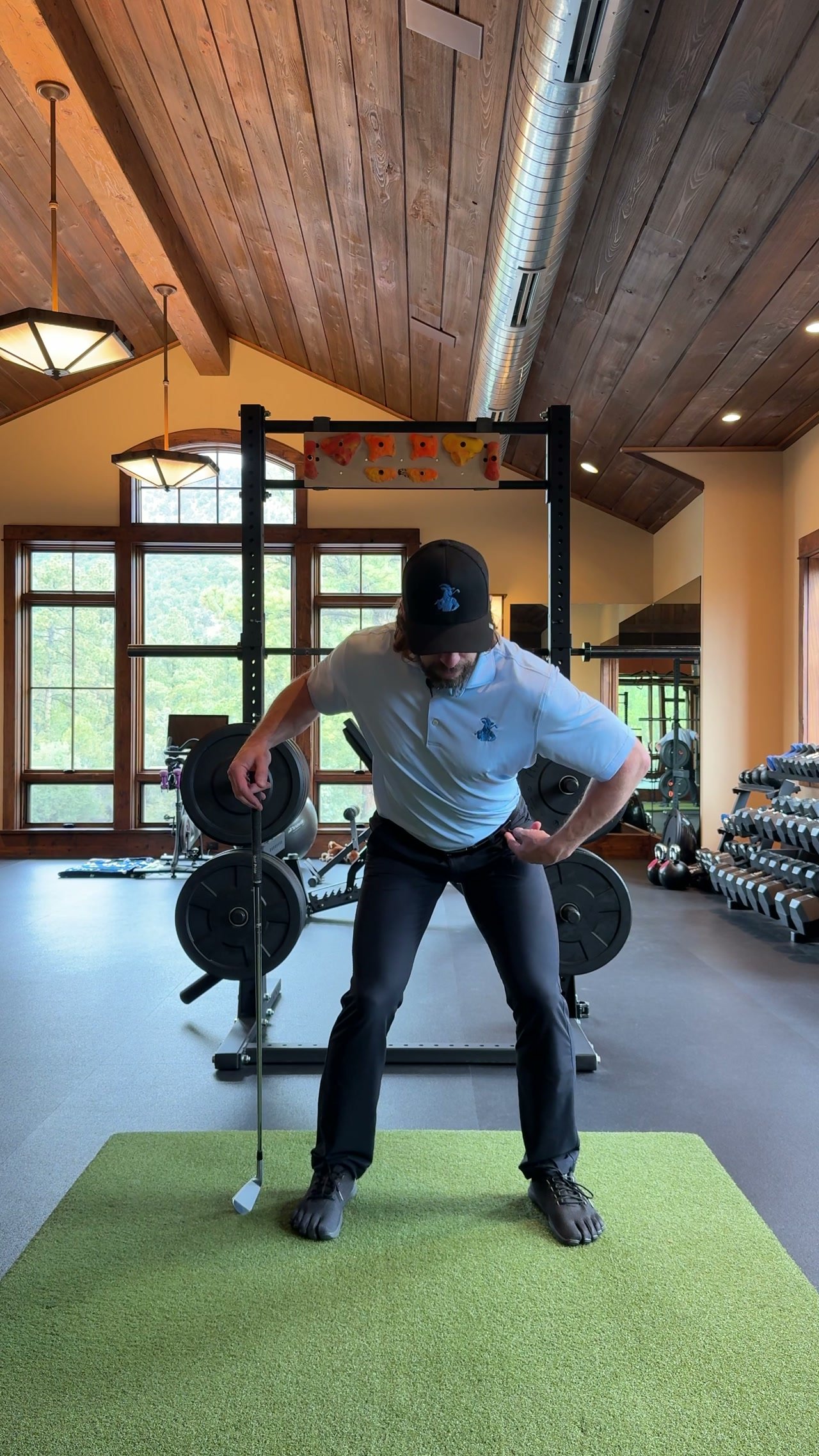
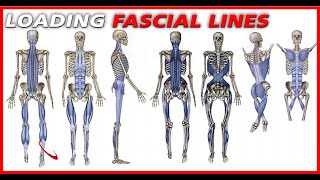
Take your lead shoulder and tuck it away from your trail hip and stretch that part of your body from behind as much as possible, within reason.
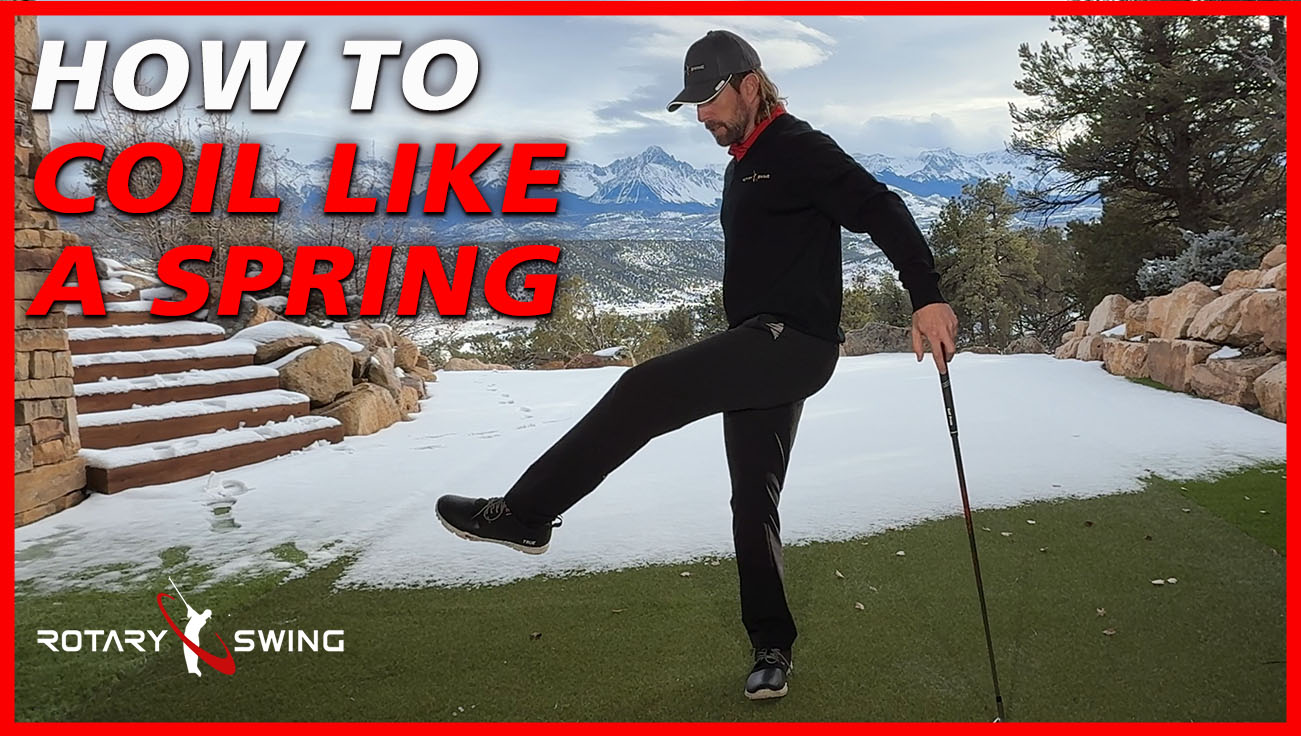
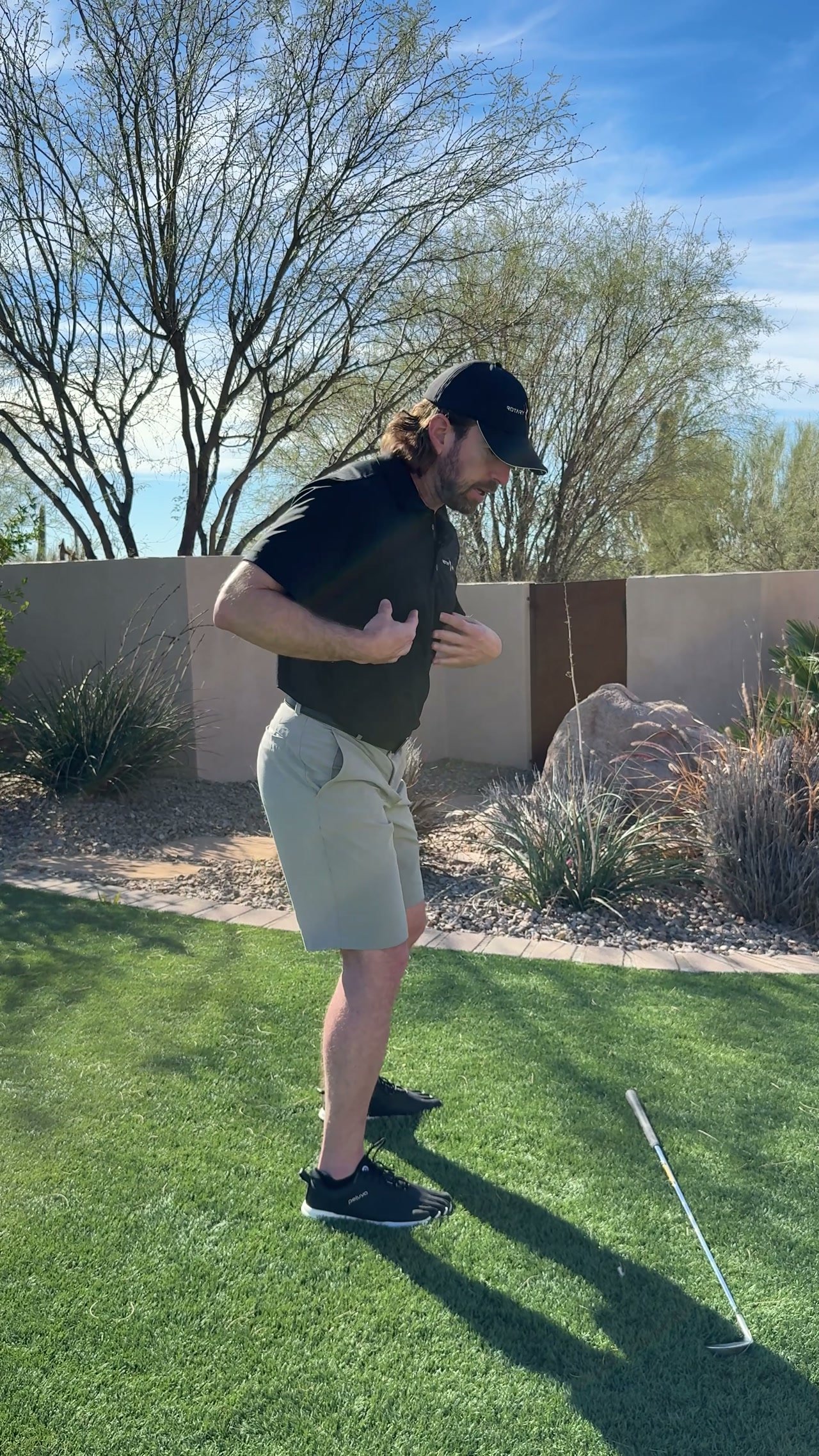
What I mean by that is if I take my lead shoulder and I just hold my right hip, my trail hip in place and I start pulling it away, I can feel a big coiling and stretch across my back into this trail hip.
My trail hip is bracing and this is moving down and across from the front perspective.
It's almost like I'm trying to put my lead shoulder into my trail hip pocket.
That's got me loaded and coiled.
That's the feel.
This is the opposite.
So take your lead shoulder and move it down and across like you're trying to put it into your trail hip pocket.
Keep this trail leg braced, hip braced.
Don't let it go like this.
You'll feel the stretch go away right away.
And that's the most important thing that Godey's really trying to teach you in the swing is that what you're trying to do in the backswing is stretch things, not try to get them ready to be able to contract.
That's not the feeling.
You're trying to stretch these muscles in this fascia so that it naturally wants to spring back for you.
And that's what gives you effortless power.
And when you don't do that and you don't load properly in the swing, you will start to muscle it with your trail side because your brain will sense, I don't have any power.
I got to start helping and start trying to do something with the trail side, whether it's pushing off this foot or your hip or your arm or your shoulder.
That's not what we want to do.
That's the opposite of what the goats did.
What the greatest ball strikers of all time all did was this lead shoulder went deep around across the trail hip got deep.
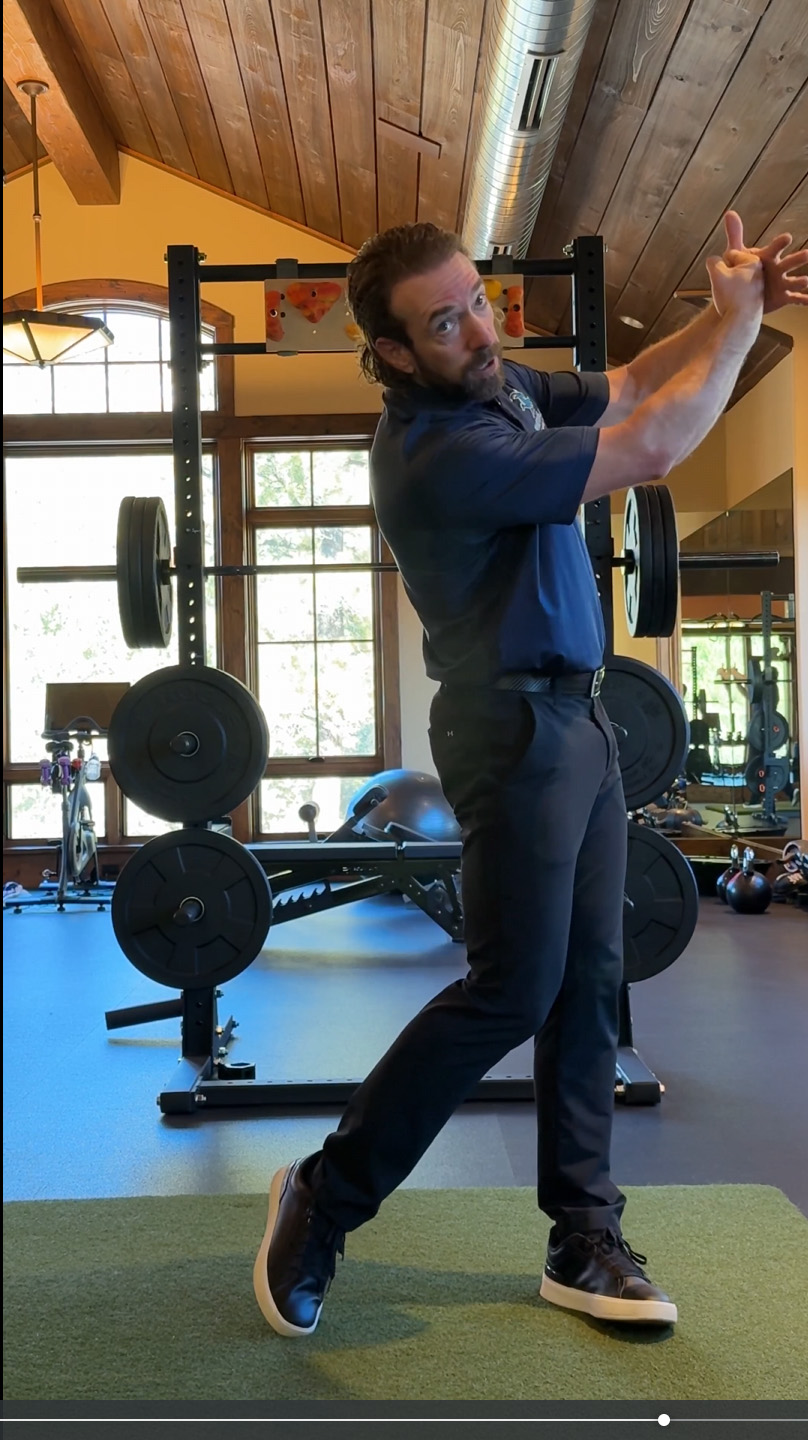
This got me loaded, and then as I'm starting to come back over, as that load is beginning to unload, I'm just letting that pull my body back around.
Look how open I am, but I didn't try and turn my hips.
What I did was load this up, stretch these fascial slings, and let that pull me back as everything moved forward, and that is what moves my hands down.
It's literally a passive thing.
The whole trick to the goats, and why I've been obsessed with the goat code for so long, is that they just did it effortlessly.
They didn't work hard in their swing.
They didn't muscle in their swing.
Hogan wasn't a big, strong dude.
He's not swinging like an aggressive gorilla like Bryson DeChambeau.
Tiger, all of the elites made it look easy and effortless.
And that's been my passion since I first picked up a club nearly 40 years ago.
So to get that feeling, what you're trying to feel is not swinging your arms or picking your arms up.
You're trying to keep this structural so that this stretches these slings, you feel this loaded, this trail side's braced.
And then, as everything starts to come back over now, you can see that your hands are just going to drop straight down from your.
From the down the line perspective, it's not this ever, it's this.
But the feeling is not rotating my body because that will, then I will unwind in the same way I will rotate and throw over the top.
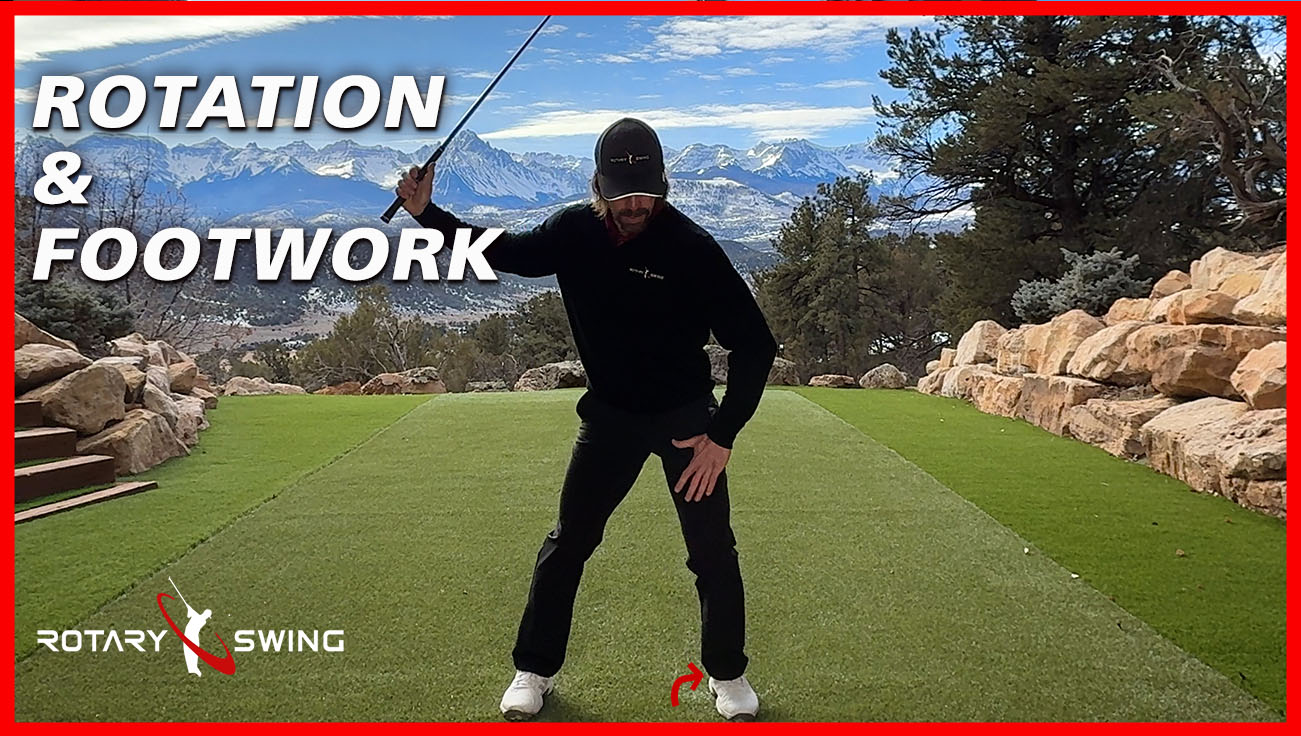
The feeling is more kind of a diagonal load, with a brace, trail hip, and that shoulder tucking around, this trail hip, going deep, keeping braced.
And now, as I start down, my hands aren't wanting to go this way.
Because I didn't rotate to then rotate on the way down.
I loaded by taking this shoulder around, and then as I come back, the feeling is really initially laterally, with my body.
I'm not doing this.
I don't want to turn early.
I want to wait just for a split second because that gets my arms down, my hands down.
This trail arm can then just do this.
From the top of your swing, your arm should never ever go this way.
It goes down and in.
And if you do a really good job, you'll feel your shoulder blade even retract a little because your arms are extra passive in that phase.
And that gets that trail shoulder and arm locked and loaded against the core, and that's what helps you be able to apply more force at the bottom.
But what you don't want is this.
It's load into it, stretch, let the hands drop, supinate, release, and that's it.
Anything else other than that is wrong.
It's just adding stuff that doesn't need to be there.
That's why the goats, when they describe their swings, the way they talk about their swings, tigers, so nonchalant.
Oh, I just feel my hand do this.
That's the whole golf swing for me.
Because in their minds, it is that simple.
All of us have made the swings way more complicated than they really are.
When you put this together and you understand the release, which is the whole point of the swing, this is the point, the payoff, right?
It really is that simple.
Load as you recenter, really actually moving way past center where you started, and the hands drop to drop onto these concentric circles.
And you start supinating that wrist, which really starts happening early.
You don't want to get down here, have the club way inside and then try to supinate.
It's actually starting to happen pretty early in the swing, in the downswing.
But this will all start to feel natural as you stop pushing the club through, pulling the club through, and you start letting the club fall in your body, pull it around so that your hands can just focus on doing this.
So when you want to whip the club, that's the feeling.
Stretch away from this lead hip, get into this trail hip, stretch and coil, get this shoulder away, get it wound up.
And then as that begins to unwind you, Your hands are just along for the ride and you're just going to focus on starting to feel this really relatively passive action of that hand snapping over, and this will feel truly effortless.
If you feel that you've got to do that on every swing, you're missing the whole point.
You're muscling the swing instead of letting the swing happen.
Load back.
Let that unload you.
Focus on getting your hands to release.
You don't want to feel your hands dragging through impact.
You want to feel them snapping through impact, and when you have that, your GOAT score will go way higher.
Try a free live lesson with GOATY
GOATY, my AI golf coach, watches your swing through your phone camera and coaches every rep. Free, about 20 minutes, no credit card.



Jason
Craig (Certified RST Instructor)
Chris
GOATY
Craig (Certified RST Instructor)
Chris
Craig (Certified RST Instructor)
Chris
Craig (Certified RST Instructor)
Chris
michael
GOATY
Laurence
Craig (Certified RST Instructor)
Steve
GOATY
Kade
GOATY
Kade
GOATY
Nikolai
GOATY
Nikolai
GOATY